RESEARCHING WORK,
   ORGANIZATION AND
PUBLICPRESENTATION ABOUT
 THE TOPIC “INFORMATION
        SOCIETY”
An information society is a society where the
creation, distribution, diffusion, use, integration
 and manipulation of information is a significant
    economic, political, and cultural activity.

 The aim of the information society is to gain
competitive advantage internationally, through
      using information technology (IT)

     The knowledge economy is its economic
counterpart, whereby wealth is created through
   the economic exploitation of understanding.
    People who have the means to partake or
participate in this form of society are sometimes
called digital citizens. This is one of many dozen
 labels that have been identified to suggest that
   humans are entering a new phase of society.
2. Expectations and realities of Information Technology. Applications of
 information technology in the scientific, technical and communications fields.


Applications of Information Technology
Every day, people use computers in new
ways. Computers and other electronic
devices are becoming increasingly
affordable. They continue to be more
powerful as information-processing tools as
well as easier to use. Humans are continually
becoming dependant on IT-enabled devices
for carrying out simple tasks like
remembering a phone number to complex
ones like flying a fighter plane.

Information Technology has applications in
almost all aspects of our life. Some of the
important ones are:                                    Science and Engineering
                                                       Bunisses and Commerce,
                                                        Education, Governance
                                                       Medicine, Entertainment
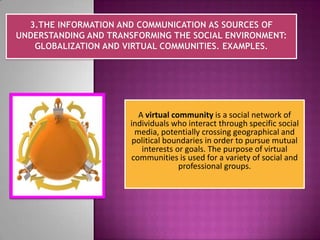
A virtual community is a social network of
individuals who interact through specific social
  media, potentially crossing geographical and
 political boundaries in order to pursue mutual
    interests or goals. The purpose of virtual
communities is used for a variety of social and
               professional groups.
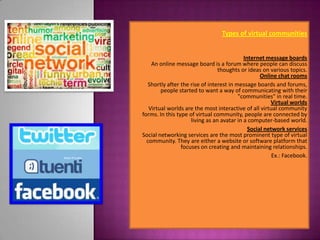
Types of virtual communities


                                            Internet message boards
    An online message board is a forum where people can discuss
                                 thoughts or ideas on various topics.
                                                   Online chat rooms
   Shortly after the rise of interest in message boards and forums,
        people started to want a way of communicating with their
                                          "communities" in real time.
                                                       Virtual worlds
   Virtual worlds are the most interactive of all virtual community
forms. In this type of virtual community, people are connected by
                     living as an avatar in a computer-based world.
                                              Social network services
Social networking services are the most prominent type of virtual
  community. They are either a website or software platform that
                 focuses on creating and maintaining relationships.
                                                        Ex.: Facebook.
                                                                     .
4.SOCIAL NETWORKING ON THE INTERNET.
EVOLUTION,FEATURES AND TOOLS AVAILABLE ON THE SOCIAL WEB,
                       TENDENCIES.
DEFINITI
                        ON
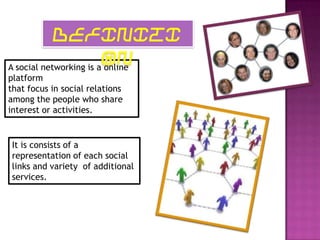
A social networking is a online
platform
that focus in social relations
among the people who share
interest or activities.


It is consists of a
representation of each social
links and variety of additional
services.
The most social network
  is e-mail and instant
       messaging
THE MAIN TYPES
The main types are the ones
  that are connected with
           friends
                                Facebook ,Twitter,
                              Google + are worldwide
                               and then for example
                                  Tuenti in Spain
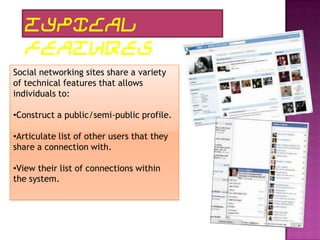
TYPICAL
   FEATURES
Social networking sites share a variety
of technical features that allows
individuals to:

•Construct a public/semi-public profile.

•Articulate list of other users that they
share a connection with.

•View their list of connections within
the system.
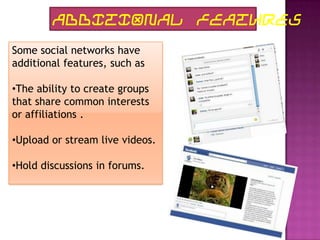
ADDITIONAL FEATURES
Some social networks have
additional features, such as

•The ability to create groups
that share common interests
or affiliations .

•Upload or stream live videos.

•Hold discussions in forums.
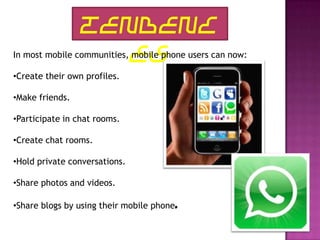
TENDENC
                   ES
In most mobile communities, mobile phone users can now:

•Create their own profiles.

•Make friends.

•Participate in chat rooms.

•Create chat rooms.

•Hold private conversations.

•Share photos and videos.

•Share blogs by using their mobile phone.
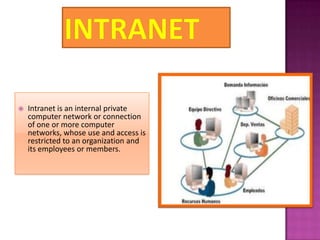
   Intranet is an internal private
    computer network or connection
    of one or more computer
    networks, whose use and access is
    restricted to an organization and
    its employees or members.
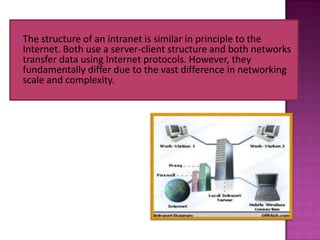
   The structure of an intranet is similar in principle to the
    Internet. Both use a server-client structure and both networks
    transfer data using Internet protocols. However, they
    fundamentally differ due to the vast difference in networking
    scale and complexity.
 An intranet is built in an
  organization, to enable
  resource sharing and
  provide a rapid
  communication channel
  that efficiently connects
  team members and peers.
  Corporate intranets have
  restricted access controlled
  by user ids and passwords,
  which are not accessible to
  anybody on the outside.
 The Internet, sometimes
 called simply "the Net," is a
 worldwide system of
 computer networks - a
 network of networks in
 which users at any one
 computer can, if they have
 permission, get information
 from any other computer
 (and sometimes talk directly
 to users at other
 computers).
 Internet is a global network which has information
 sharing on a global level as its goal. Internet is more
  open in the sense, that everything shared here, is
  accessible to every person connected to it, all over
                        the world.

INFORMATION SOCIETY

  • 1.
    RESEARCHING WORK, ORGANIZATION AND PUBLICPRESENTATION ABOUT THE TOPIC “INFORMATION SOCIETY”
  • 2.
    An information societyis a society where the creation, distribution, diffusion, use, integration and manipulation of information is a significant economic, political, and cultural activity. The aim of the information society is to gain competitive advantage internationally, through using information technology (IT) The knowledge economy is its economic counterpart, whereby wealth is created through the economic exploitation of understanding. People who have the means to partake or participate in this form of society are sometimes called digital citizens. This is one of many dozen labels that have been identified to suggest that humans are entering a new phase of society.
  • 3.
    2. Expectations andrealities of Information Technology. Applications of information technology in the scientific, technical and communications fields. Applications of Information Technology Every day, people use computers in new ways. Computers and other electronic devices are becoming increasingly affordable. They continue to be more powerful as information-processing tools as well as easier to use. Humans are continually becoming dependant on IT-enabled devices for carrying out simple tasks like remembering a phone number to complex ones like flying a fighter plane. Information Technology has applications in almost all aspects of our life. Some of the important ones are: Science and Engineering Bunisses and Commerce, Education, Governance Medicine, Entertainment
  • 4.
    A virtual communityis a social network of individuals who interact through specific social media, potentially crossing geographical and political boundaries in order to pursue mutual interests or goals. The purpose of virtual communities is used for a variety of social and professional groups.
  • 5.
    Types of virtualcommunities Internet message boards An online message board is a forum where people can discuss thoughts or ideas on various topics. Online chat rooms Shortly after the rise of interest in message boards and forums, people started to want a way of communicating with their "communities" in real time. Virtual worlds Virtual worlds are the most interactive of all virtual community forms. In this type of virtual community, people are connected by living as an avatar in a computer-based world. Social network services Social networking services are the most prominent type of virtual community. They are either a website or software platform that focuses on creating and maintaining relationships. Ex.: Facebook. .
  • 6.
    4.SOCIAL NETWORKING ONTHE INTERNET. EVOLUTION,FEATURES AND TOOLS AVAILABLE ON THE SOCIAL WEB, TENDENCIES.
  • 7.
    DEFINITI ON A social networking is a online platform that focus in social relations among the people who share interest or activities. It is consists of a representation of each social links and variety of additional services.
  • 8.
    The most socialnetwork is e-mail and instant messaging
  • 9.
    THE MAIN TYPES Themain types are the ones that are connected with friends Facebook ,Twitter, Google + are worldwide and then for example Tuenti in Spain
  • 10.
    TYPICAL FEATURES Social networking sites share a variety of technical features that allows individuals to: •Construct a public/semi-public profile. •Articulate list of other users that they share a connection with. •View their list of connections within the system.
  • 11.
    ADDITIONAL FEATURES Some socialnetworks have additional features, such as •The ability to create groups that share common interests or affiliations . •Upload or stream live videos. •Hold discussions in forums.
  • 12.
    TENDENC ES In most mobile communities, mobile phone users can now: •Create their own profiles. •Make friends. •Participate in chat rooms. •Create chat rooms. •Hold private conversations. •Share photos and videos. •Share blogs by using their mobile phone.
  • 14.
    Intranet is an internal private computer network or connection of one or more computer networks, whose use and access is restricted to an organization and its employees or members.
  • 15.
    The structure of an intranet is similar in principle to the Internet. Both use a server-client structure and both networks transfer data using Internet protocols. However, they fundamentally differ due to the vast difference in networking scale and complexity.
  • 16.
     An intranetis built in an organization, to enable resource sharing and provide a rapid communication channel that efficiently connects team members and peers. Corporate intranets have restricted access controlled by user ids and passwords, which are not accessible to anybody on the outside.
  • 17.
     The Internet,sometimes called simply "the Net," is a worldwide system of computer networks - a network of networks in which users at any one computer can, if they have permission, get information from any other computer (and sometimes talk directly to users at other computers).
  • 18.
     Internet isa global network which has information sharing on a global level as its goal. Internet is more open in the sense, that everything shared here, is accessible to every person connected to it, all over the world.