
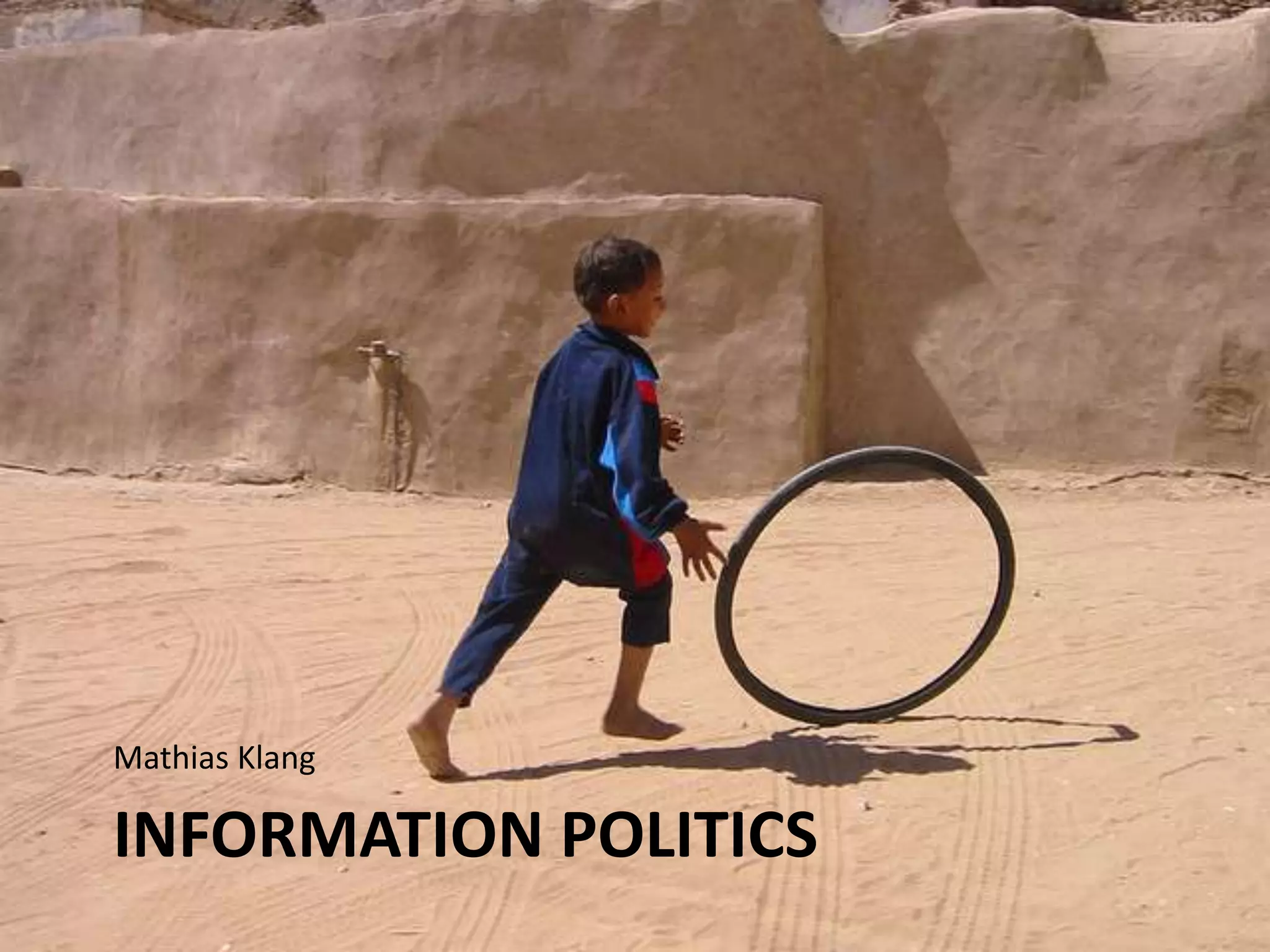


































Mathias KlangInformation Politics
What is information politics?
Is all control censorship?
So what is censorship?
All communication & media has been affectedinfo-control is ancient
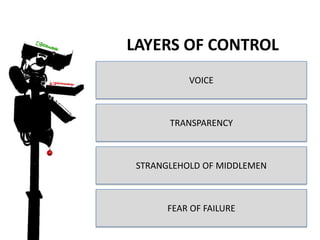
Layers of controlVOICETRANSPARENCYSTRANGLEHOLD OF MIDDLEMENFEAR OF FAILURE
Myth of rightsas linear progression
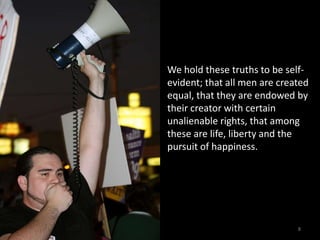
We hold these truths to be self-evident; that all men are created equal, that they are endowed by their creator with certain unalienable rights, that among these are life, liberty and the pursuit of happiness.8
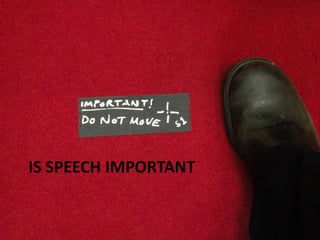
Is speech important
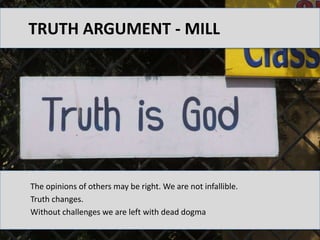
Truth argument - Mill The opinions of others may be right. We are not infallible.  Truth changes.  Without challenges we are left with dead dogma
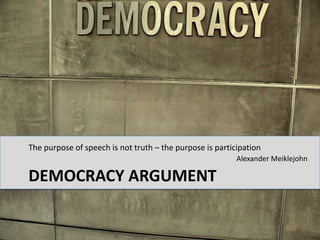
Alexander MeiklejohnDemocracy argumentThe purpose of speech is not truth – the purpose is participation
Tolerance argumentPaternalism is “natural” & expression includes non-speech actsJohn Bollinger “The Tolerant Society”
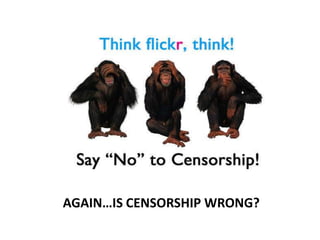
Again…Is censorship wrong?
The Wicked Bible (1631)
Anarchists CookbookNazi MemorabiliaSexual imagesCultural relativism
Daddy, what’s that man doing with the hamster
Language, culture & other tools of repression5 censors
Louis Sebastian Mercier “Tableau de Paris”Freedom of the press is only one form of freedom of expression. It is linked to a certain technology or technique and its importance diminishes with the development of other technologies which replace or complement the printing press.
George Orwell“Circus dogs jump when the trainer cracks his whip but the really well-trained dog is the one that turns his somersault when there is no whip.”Newspeak1st censor
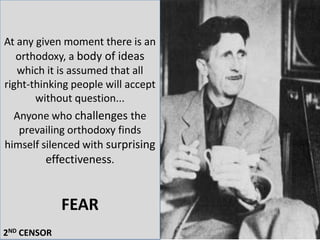
At any given moment there is an orthodoxy, a body of ideas which it is assumed that all right-thinking people will accept without question...Anyone who challenges the prevailing orthodoxy finds himself silenced with surprising effectiveness. fear2nd censor
Permission culture3rd censor
Control of channels of distribution4th censor
Law5th censor
So why do we need to look at information?
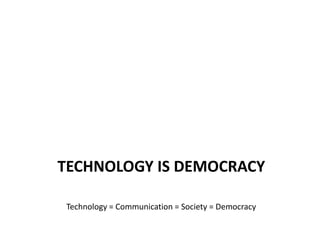
Technology = Communication = Society = DemocracyTechnology is Democracy
Technécontrols what & how	we 	interact	create	& think
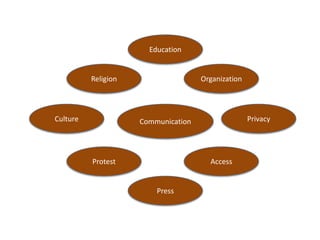
EducationOrganizationReligionCommunicationPrivacyCultureProtestAccessPress
No sidewalks online
Regulation of technology is the regulation of democracy
&
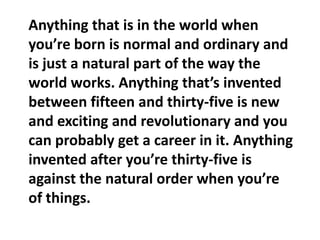
Anything that is in the world when you’re born is normal and ordinary and is just a natural part of the way the world works. Anything that’s invented between fifteen and thirty-five is new and exciting and revolutionary and you can probably get a career in it. Anything invented after you’re thirty-five is against the natural order when you’re of things.
?
Social acceptance of technology
De LegeferendaLagensom den börvara
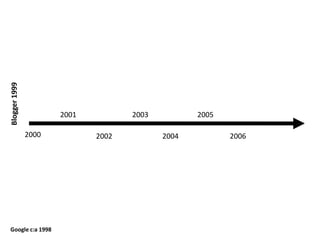
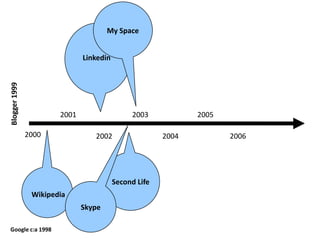
Blogger 19992001200320052000200220042006Google c:a 1998
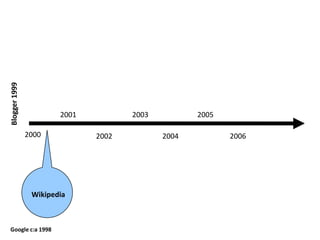
Blogger 19992001200320052000200220042006WikipediaGoogle c:a 1998
My SpaceLinkedinBlogger 19992001200320052000200220042006Second LifeSkypeWikipediaGoogle c:a 1998
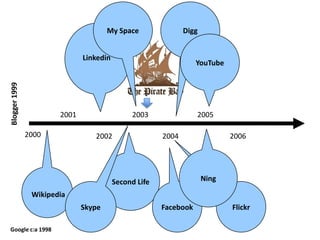
My SpaceDiggYouTubeLinkedinBlogger 19992001200320052000200220042006NingSecond LifeSkypeFacebookFlickrWikipediaGoogle c:a 1998
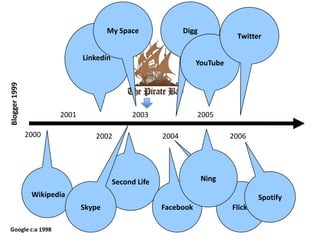
My SpaceDiggTwitterYouTubeLinkedinBlogger 19992001200320052000200220042006NingSecond LifeSpotifyFlickrSkypeFacebookWikipediaGoogle c:a 1998
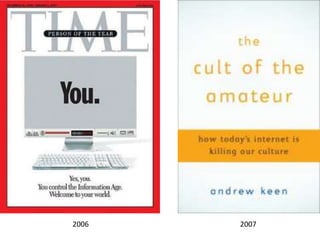
20062007
44
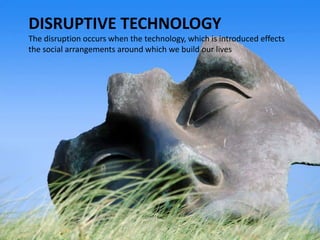
The disruption occurs when the technology, which is introduced effects the social arrangements around which we build our livesDISRUPTIVE TECHNOLOGY
IMPULSE: CONTROL
REGULATIONFrom Command and Control to Fuller & Lessig
The position of this work is that regulation is every force or external controls exerted upon those to be regulated.
“the enterprise of subjecting human conduct to the governance of rules”
Latour, B. (1992). “Where are the Missing Masses? Sociology of a Few Mundane Artefacts”Winner, L. (1985) “Do Artefacts have Politics?”
HCI people can think of this as the tyranny of affordance** I want to write an article with this title…
What’s wrong with Command and Control?It relies to heavily upon coercion and cooperation.
ONLINE OFFLINE“We are forming our own Social Contract. This governance will arise according to the conditions of our world, not yours. Our world is different.” (Barlow 1996)
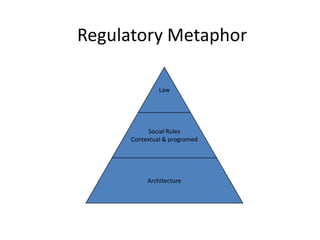
LawSocial RulesContextual & programedArchitectureRegulatory Metaphor
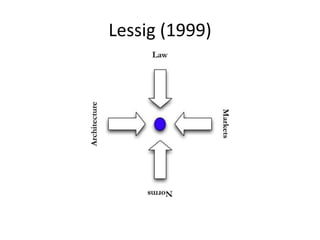
Lessig (1999)
BUT
Autonomy ruins everything
Enter the age of FREE
From orwell Huxley
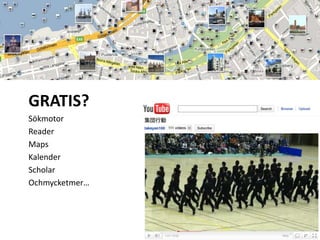
SökmotorReaderMapsKalenderScholarOchmycketmer…Gratis?
The Gmail service includes relevant advertising and related links based on the IP address, content of messages and other information related to your use of Gmail.We provide advertisers only aggregated non-personal information such as the number of times one of their ads was clicked. We do not sell, rent or otherwise share your personal information with any third parties except in the limited circumstances described in the Google Privacy Policy, such as when we believe we are required to do so by law.
Anything that is in the world when you’re born is normal and ordinary and is just a natural part of the way the world works. Anything that’s invented between when you’re fifteen and thirty-five is new and exciting and revolutionary and you can probably get a career in it. Anything invented after you’re thirty-five is against the natural order of things.
FacebookIf you are not a paying customer then you are the product
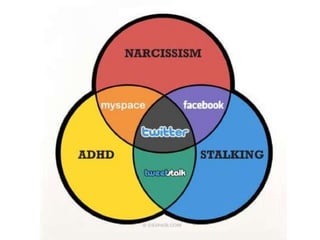
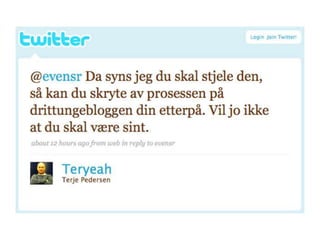
Twitter:tell It all
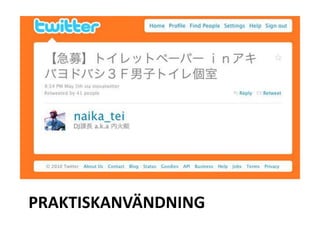
Praktiskanvändning
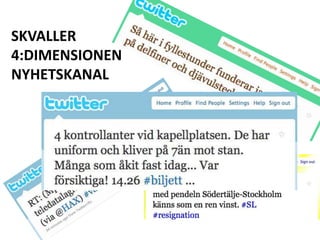
SKVALLER4:DIMENSIONENNYHETSKANAL
Danish Mother
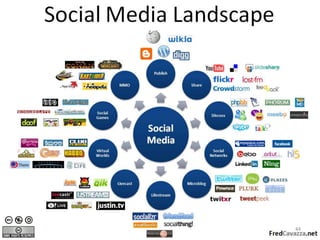
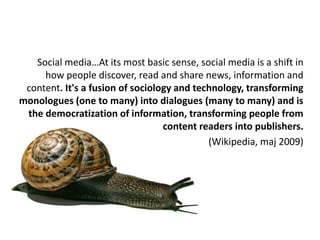
Social media…At its most basic sense, social media is a shift in how people discover, read and share news, information and content. It's a fusion of sociology and technology, transforming monologues (one to many) into dialogues (many to many) and is the democratization of information, transforming people from content readers into publishers.(Wikipedia, maj 2009)
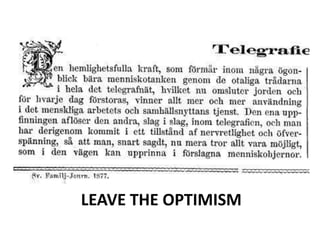
Leave the optimism
Google, a censor?
Movie: hitler parody
Privatizing CensorshipCensorshipNon-technical/self censorship“Public Pledge of Self-Regulation & Professional Ethics for China Internet Industry” Responsibility on the signatories:Inspect & monitor foreign & domestic sitesBlock harmful information
Thanks!
InformationAll images from/allabilderfrånwww.flickr.com (unless specifically stated), (omejannatanges)Image & licensing info in the notes section of slides/bild & licensinfofinnsianteckningsdelenförvarje slidePresentation licensed/Presentation licensierad under: Creative Commons BY-NC-SAThe presentation can be downloaded from/Presentationenkanladdasnerfrån: www.slideshare.net/klangMore information about me/förmer information ommig:  www.techrisk.se & www.digital-rights.net

Information politics

Editor's Notes

  • #2 Butterfly (Oases Egypt) from Ahron de Leeuw cc by
  • #3 can birds have a dog fight? by threecee cc by ncsa
  • #4 Brown Bagged Goof from privatenobby cc by ncsa
  • #5 communication age by Dom Dada cc by ncnd
  • #6 Eyes ! (Youth from Antikythera!) by agelakis cc by ncsa
  • #7 Merry Chistmas(you are being... from atomicjeep cc by
  • #8 Lake Baikal by f.stroganov cc by ncsa
  • #9 självständighetsförklaring (1776)Megaphone for Health Care Reform by cobalt123 cc by ncsa
  • #10 important! by estherase cc by ncsa
  • #11 truth is god by giobi cc by ncsa
  • #12 Democracy by _saturnine cc by ncsa
  • #13 1_365 from SMN cc by ncsa
  • #14 think monkeys (flickr) think by Arriving at the horizon cc by ncsa
  • #15 The Wicked Bible, sometimes called The Adulterous Bible or The Sinners' Bible, is a term referring to the Bible published in 1631 by Robert Barker and Martin Lucas, the royal printers in London, which was meant to be a reprint of the King James Bible. The name is derived from the compositors' mistake: in the Ten Commandments (Exodus  20:14) the word "not" in the sentence "Thou shalt not commit adultery" was omitted. This blunder was spread in a number of copies. About a year later, the publishers of the Wicked Bible were fined £300 and were deprived of their printer's license.[citation needed] The fact that this edition of the Bible contained such a flagrant mistake outraged Charles I of England and George Abbot, the Archbishop of Canterbury, who said then:I knew the tyme when great care was had about printing, the Bibles especially, good compositors and the best correctors were gotten being grave and learned men, the paper and the letter rare, and faire every way of the beste, but now the paper is nought, the composers boyes, and the correctors unlearned.[1]Wikipedia
  • #16 Four friends with their shadows - IMG_1807 BW ed + cr Four friends with their shadows - IMG_1807 BW ed + cr cc by ncsa
  • #17 Port-42 by Victor Bezrukov cc by ncnd
  • #18 Früg & Meight by Don Solo cc by ncsa
  • #20 7-CAPITAL SINS * GLUTTONY-ACOSTA * GULA * DETALLE by juanangeldibuja cc by ncsa
  • #21 Quote from early preface to George Orwell Animal FarmImage source unknown
  • #22 The Essence Of Communication by davidjwbailey cc by ncsa
  • #23 the same horizon by Norma Desmond cc by ncsa
  • #29 Protesters by mezzoblue (CC by-nc-nd)
  • #30 12-06 by Daniel*1977 cc by nc sa
  • #38 Theory of Relaxitivity from zetson cc by ncsa
  • #59 Google automatically scans e-mails to add context-sensitive advertisements to them. Privacy advocates raised concerns that the plan involved scanning their personal, assumed private, e-mails, and that this was a security problem. Allowing e-mail content to be read, even by a computer, raises the risk that the expectation of privacy in e-mail will be reduced. Furthermore, e-mail that non-subscribers choose to send to Gmail accounts is scanned by Gmail as well, even though those senders never agreed to Gmail's terms of service or privacy policy. Google can change its privacy policy unilaterally and Google is technically able to cross-reference cookies across its information-rich product line to make dossiers on individuals. However, most e-mail systems make use of server-side content scanning in order to check for spam.[41][42]Privacy advocates also regard the lack of disclosed data retention and correlation policies as problematic. Google has the ability to combine information contained in a person's e-mail messages with information from Internet searches. Google has not confirmed how long such information is kept or how it can be used. One of the concerns is that it could be of interest to law enforcement agencies. More than 30 privacy and civil liberties organizations have urged Google to suspend Gmail service until these issues are resolved.[43]Gmail's privacy policy contains the clause: "residual copies of deleted messages and accounts may take up to 60 days to be deleted from our active servers and may remain in our offline backup systems". Google points out that Gmail adheres to most industry-wide practices. Google has stated that they will "make reasonable efforts to remove deleted information from our systems as quickly as is practical."[44][45]Google defends its position by citing their use of email-scanning to the user's benefit. Google states that Gmail refrains from displaying ads next to potentially sensitive messages such as those that mention tragedy, catastrophe, or death.[4
  • #60 Consumer Watchdogs Flog Google's Privacy Policy (2008)http://techdailydose.nationaljournal.com/2008/06/consumer-watchdogs-flog-google.phpGoogle originally placed a cookie on each registered user's computer, which can be used to track that person's search history, and that cookie was not set to expire until 2038.[12] As of 2007, Google's cookie now expires in two years but renews itself when a Google service is used.[12] There is no evidence that Google turns over information to the FBI or the NSA, though some users remain anxious about the possibility.[12] In response, Google claims cookies are necessary to maintain user preferences between sessions and offer other search features. Other popular search engines, such as Yahoo! Search and Microsoft's Bing, use cookies with distant expiration dates as well.Privacy International has raised concerns regarding the dangers and privacy implications of having a centrally-located, widely popular data warehouse of millions of Internet users' searches, and how under controversial existing U.S. law, Google can be forced to hand over all such information to the U.S. government[13]. In early 2005, the United States Department of Justice filed a motion in federal court to force Google to comply with a subpoena for, "the text of each search string entered onto Google's search engine over a one-week period (absent any information identifying the person who entered such query)."[14] Google fought the subpoena, due to concerns about users' privacy.[15] In March 2006, the court ruled partially in Google's favor, recognizing the privacy implications of turning over search terms and refusing to grant access.[16]Steve Ballmer[17], Liz Figueroa[18], Mark Rasch[19], and the editors of Google Watch[20] believe the processing of email message content by Google's Gmail service goes beyond proper use. Google claims that mail sent to or from Gmail is never read by a human being beyond the account holder, and is only used to improve relevance of advertisements.[21] Whether Google is the only one doing this or simply the only one who publicly admits it is unknown, since the privacy policies of other popular email services, like Hotmail and Yahoo, allows for collection and utilizing of personal information for ads when using their services, but do not specify precisely what information and which services[22][23].Google's online map service, "Street View" has been accused of taking pictures and coming too close inside people's private homes and/or people who walk down the street not knowing they are being watched on Google's service.[24][25] Aaron and Christine Boring, a Pittsburgh couple, sued Google for "invasion of privacy". They claimed that Street View made a photo of their home available online, and it diminished the value of their house, which was purchased for its privacy.[26] They lost their case in a Pennsylvania court. "While it is easy to imagine that many whose property appears on Google's virtual maps resent the privacy implications, it is hard to believe that any – other than the most exquisitely sensitive – would suffer shame or humiliation," Judge Hay ruled.[27]In its 2007 Consultation Report, Privacy International ranked Google as "Hostile to Privacy", its lowest rating on their report, making Google the only company in the list to receive that ranking.[28][29]Carl Hewitt noted that intimate personal information is a "toxic asset" in Google datacenters because it will lead to government regulation "analogous to nuclear power plants," Consequently, he recommended that Google should perform semantic integration in clients' clouds so that client information in Google datacenters could be decrypted only by using a client's private key.[30][edit] European UnionEuropean Union (EU) data protection officials (the Article 29 working party who advise the EU on privacy policy) have written to Google asking the company to justify its policy of keeping information on individuals’ internet searches for up to two years. The letter questioned whether Google has “fulfilled all the necessary requirements” on the EU laws concerning data protection.[31] The probe by the EU into the data protection issue, As of 24 May 2007 (2007 -05-24)[update] is continuing. On 1 June Google agreed that its privacy policy is vague, and that they are constantly working at making it clearer to users.[32] The resulting modifications to its privacy policies have been met with praise[33].[edit] NorwayThe Data Inspectorate of Norway (Norway is not a member of the EU) has investigated Google (and others) and has stated that the 18- to 24-month period for retaining data proposed by Google was too long.[34]
  • #68 phre⋅nol⋅o⋅gy 6 by Gobble Monster cc by ncsa
  • #70 Singing in the Dark by {platinum} cc by ncsa
  • #71 When he found himself stuck in a public restroom stall (male toilets of Yodobashi Camera in Akihabara) without any toilet paper, Twitter user naika_tei did what any clever man would do: He posted a Twitter message pleading for help. It worked.It took 20 minutes from the time aika_tei first voiced his desperation, but someone apparently really brought him a roll of toilet paper. http://gizmodo.com/5535769/twitter-user-brings-toilet-paper-to-desperate-japanese-man
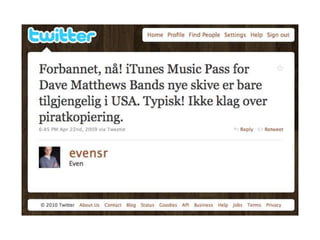
  • #76 "United Breaks Guitars" is a song by Canadian musician David Carroll and his band, Sons of Maxwell. It chronicles a real-life experience of how his guitar was broken during a trip on United Airlines in 2008, and the subsequent reaction from the airline. The song became an immediate YouTube and ITMS hit upon its release in July 2009.http://en.wikipedia.org/wiki/United_Breaks_Guitars
  • #78 helli.(sh).ell `๑´ by HadiFooladi cc by ncsa
  • #85 I just couldn’t live with myself... from Eric "Claptøn" Nelsøn cc by ncsa