Civil IndividualismA Modern Political Philosophy of Checks and Balances1/29/2010                               ©2009  Michael J. Thebado1
Civil Individualism: A DefinitionCivil Individualism is a political philosophy which holds first that sovereignty is rooted in each equal individual. Second, that, as individuals, we must collectively create institutionsin order to secure our freedoms, and to achieve other mutual benefits that we can not achieve alone. Lastly, that all of our institutions threaten to harm individuals, and mustbe governed by systems of checks & balances.1/29/2010                               ©2009  Michael J. Thebado2
Major Types of InstitutionsGovernmental: Federal, State, Municipal, Trans-National, Agencies, Political Parties.
Military: Army, Navy, Air Force, Marines, National Guards, Militias, Mercenaries.
Corporate: Corporations, Companies, LLC’s, Partnerships.
Religious: Churches, Denominations, Mosques, Temples, Cults.
Charitable: Charities, Foundations, Endowments, NGO’s
Educational: Colleges, Universities, Schools, Fraternities, Sororities, Institutes, Think Tanks.
Medical: Hospitals, Clinics, Professional Associations, Research Foundations.
Artistic: Museums, Orchestras, Troupes, Studios, Networks, Television & Radio Stations.
Athletic: Teams, Leagues, Associations, Committees, Boosters, Tournaments, Tours.
Legal: Courts, Law Firms, Professional Associations, Arbitration Societies.
Labor: Unions, Guilds, Trade Associations.
Other: Police & Fire Companies, Chambers of Commerce, Relief Organizations, Country Clubs, Organized Crime, Street Gangs.1/29/2010                               ©2009  Michael J. Thebado3
Core TenetsIndividuals are sovereign.Institutions exist to amplify individual efforts.Individuals are imperfect.Institutions magnify individual imperfections.Institutions have imperfections of their own.Institutional flaws harm individuals.We design and implement Checks & Balances to protect ourselves from institutional dangers.1/29/2010                               ©2009  Michael J. Thebado4
Sovereignty & Its ImplicationsIndividual sovereignty means that we are all implicitly free to do as we will, provided that we do not interfere with others’ sovereignty.Individual sovereignty also implies that all institutions are (or were originally) the voluntary creations of individual participantsAs the creation of individuals, all institutional authority is implicitly (or explicitly) derived from the consent of individual participants. 1/29/2010                               ©2009  Michael J. Thebado5
The Role of InstitutionsInstitutions exist solely as a means of coordinating and amplifying individual capabilities to achieve goals that are beyond the capacities of individuals on their own.
For example, governmental, military, and legal institutions allow us to band together to protect ourselves from each other.
Our institutions, no matter how long they have existed or how much they are respected, are simply our tools.1/29/2010                               ©2009  Michael J. Thebado6
Limits on InstitutionsWe have an absolute right to change/abolish specific institutions when, as our tools, they no longer meet our needs well.There is no moral justification for institutions pursuing goals of their own which are independent of their voluntary participants.We have an obligation to ensure that our institutions do not develop, pursue and/or expand their own agendas.1/29/2010                               ©2009  Michael J. Thebado7
Institutional SuccessesAt their best, our institutions harness and direct our energies to achieve truly inspiring goals – from the defeat of the Fascists in WWII, to the success of the Internet itself.
In their many successes, our institutions inspire pride in ourselves and our fellows, and reflect the best of our individual efforts.
Without our institutions, and their successes, our lives would be much poorer, and we ourselves, more isolated and vulnerable.1/29/2010                               ©2009  Michael J. Thebado8
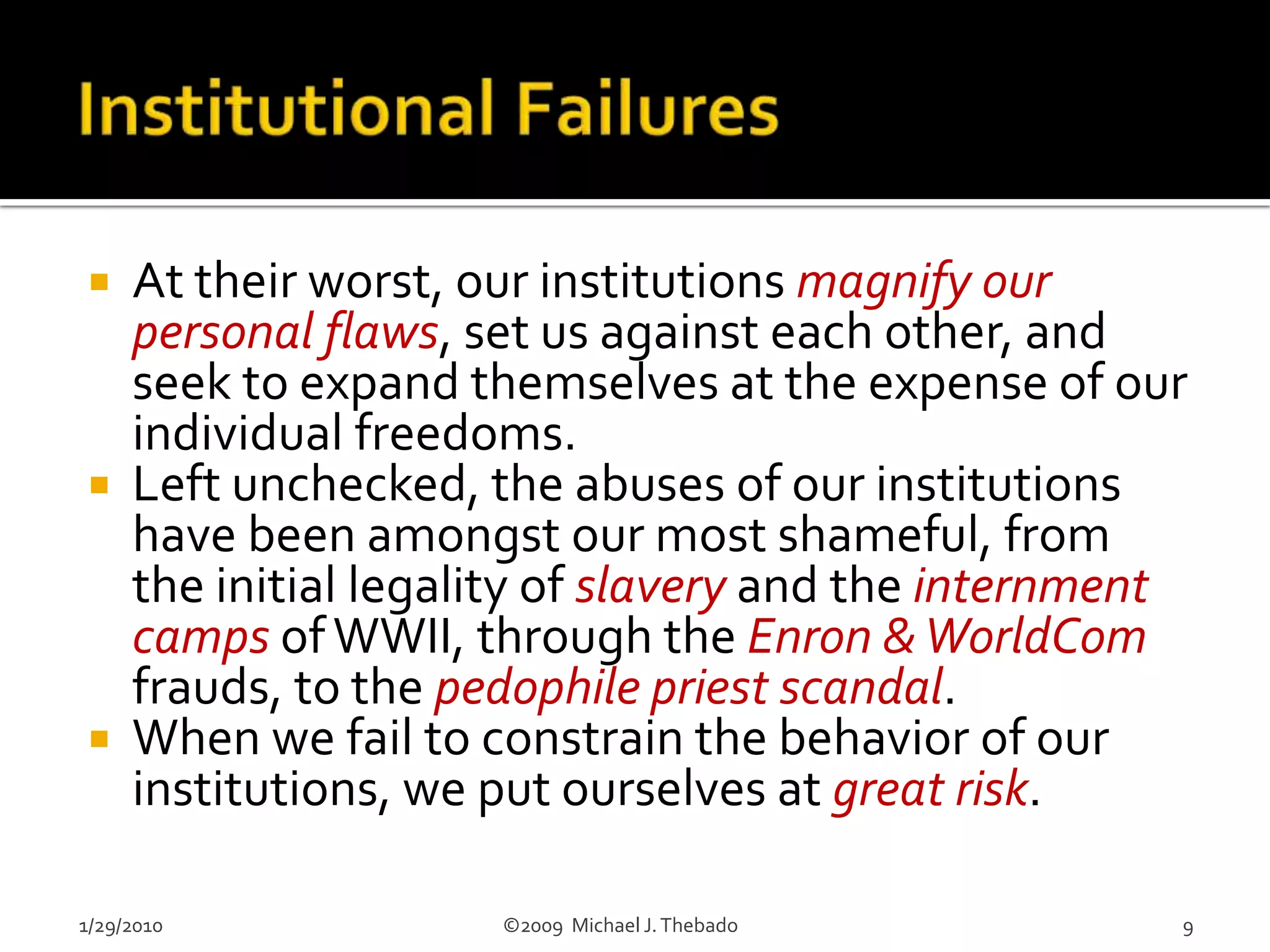
Institutional FailuresAt their worst, our institutions magnify our personal flaws, set us against each other, and seek to expand themselves at the expense of our individual freedoms.
Left unchecked, the abuses of our institutions have been amongst our most shameful, from the initial legality of slavery and the internment camps of WWII, through the Enron & WorldCom frauds, to the pedophile priest scandal.
When we fail to constrain the behavior of our institutions, we put ourselves at great risk.1/29/2010                               ©2009  Michael J. Thebado9
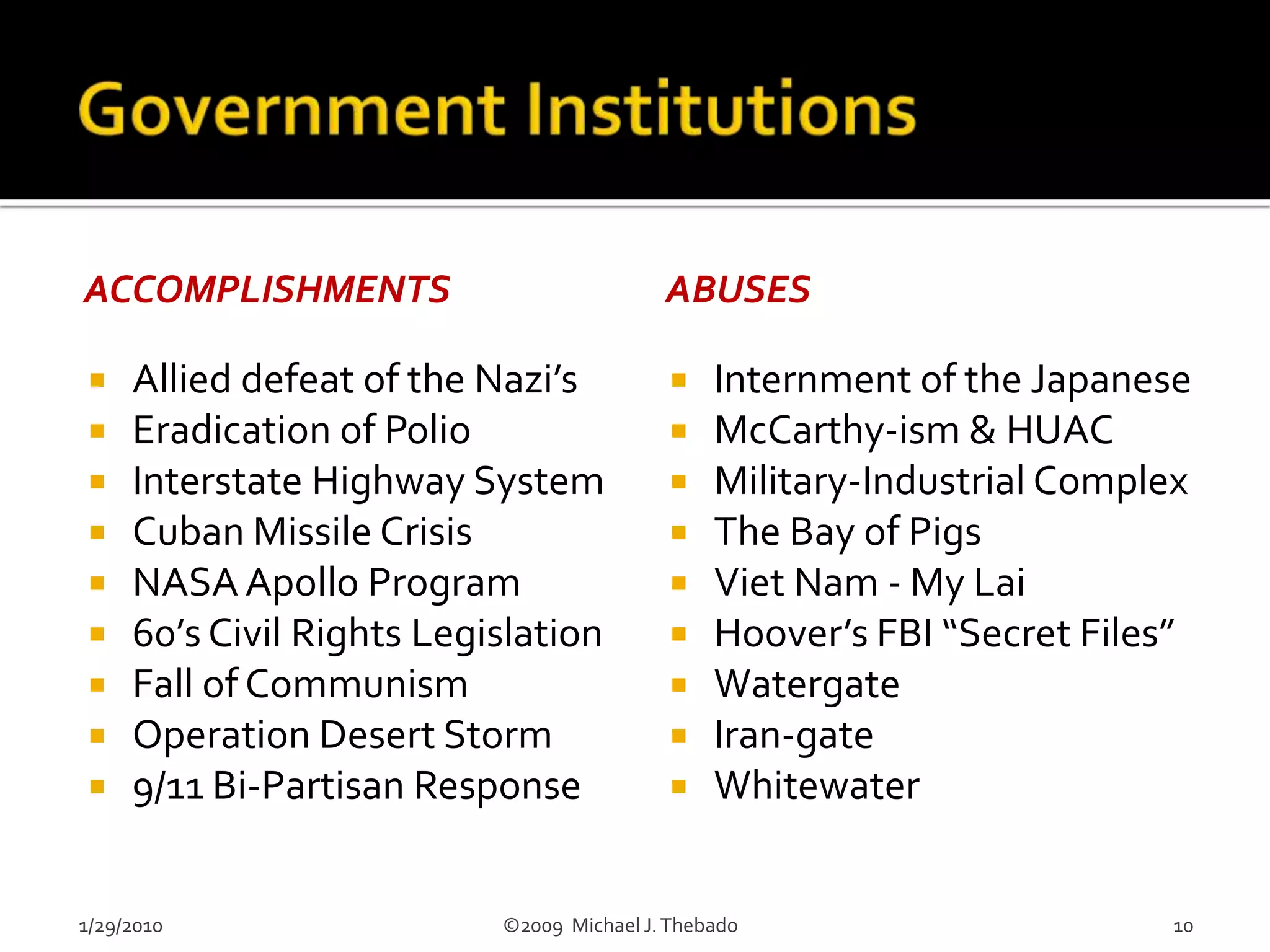
Government InstitutionsAccomplishments	AbusesAllied defeat of the Nazi’sEradication of PolioInterstate Highway SystemCuban Missile CrisisNASA Apollo Program60’s Civil Rights LegislationFall of CommunismOperation Desert Storm9/11 Bi-Partisan ResponseInternment of the JapaneseMcCarthy-ism & HUACMilitary-Industrial ComplexThe Bay of PigsViet Nam - My Lai Hoover’s FBI “Secret Files”WatergateIran-gateWhitewater1/29/2010                               ©2009  Michael J. Thebado10
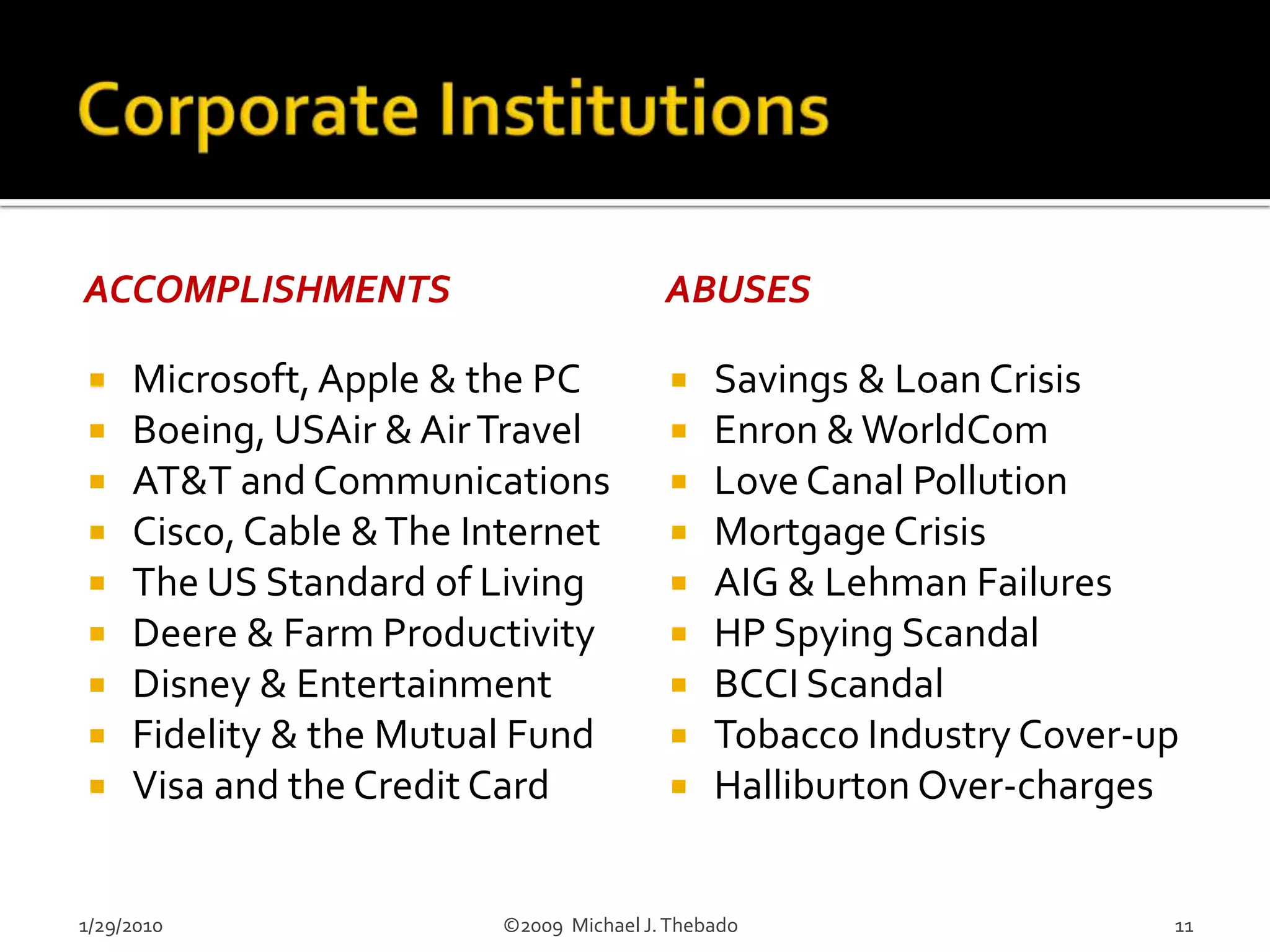
Corporate InstitutionsAccomplishments	AbusesMicrosoft, Apple & the PCBoeing, USAir & Air TravelAT&T and CommunicationsCisco, Cable & The InternetThe US Standard of LivingDeere & Farm ProductivityDisney & EntertainmentFidelity & the Mutual FundVisa and the Credit CardSavings & Loan CrisisEnron & WorldComLove Canal PollutionMortgage CrisisAIG & Lehman FailuresHP Spying ScandalBCCI ScandalTobacco Industry Cover-upHalliburton Over-charges1/29/2010                               ©2009  Michael J. Thebado11
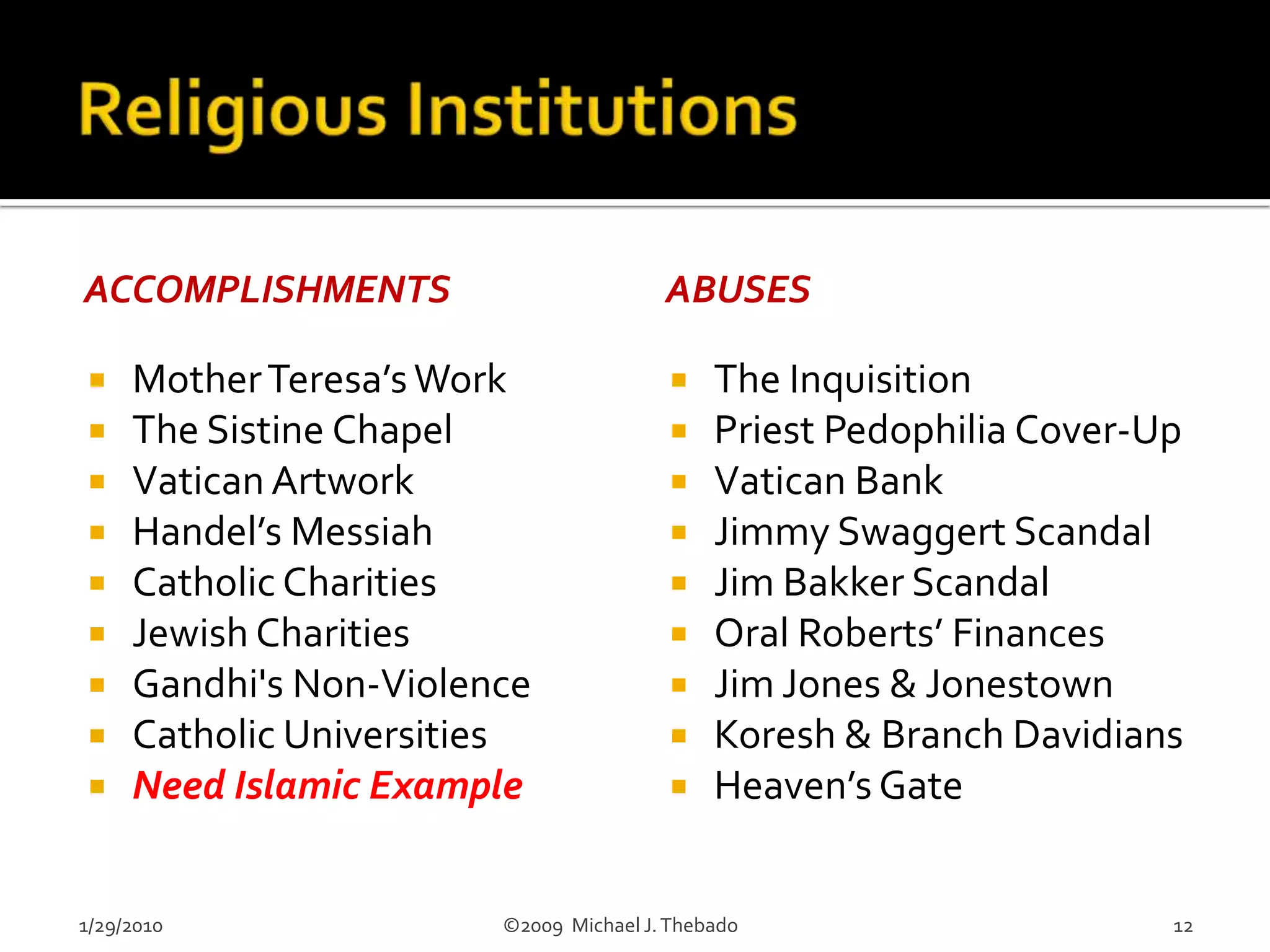
Religious InstitutionsAccomplishmentsAbusesMother Teresa’s WorkThe Sistine ChapelVatican ArtworkHandel’s MessiahCatholic CharitiesJewish CharitiesGandhi's Non-ViolenceCatholic UniversitiesNeed Islamic ExampleThe InquisitionPriest Pedophilia Cover-UpVatican BankJimmy Swaggert ScandalJim Bakker ScandalOral Roberts’ FinancesJim Jones & JonestownKoresh & Branch DavidiansHeaven’s Gate1/29/2010                               ©2009  Michael J. Thebado12
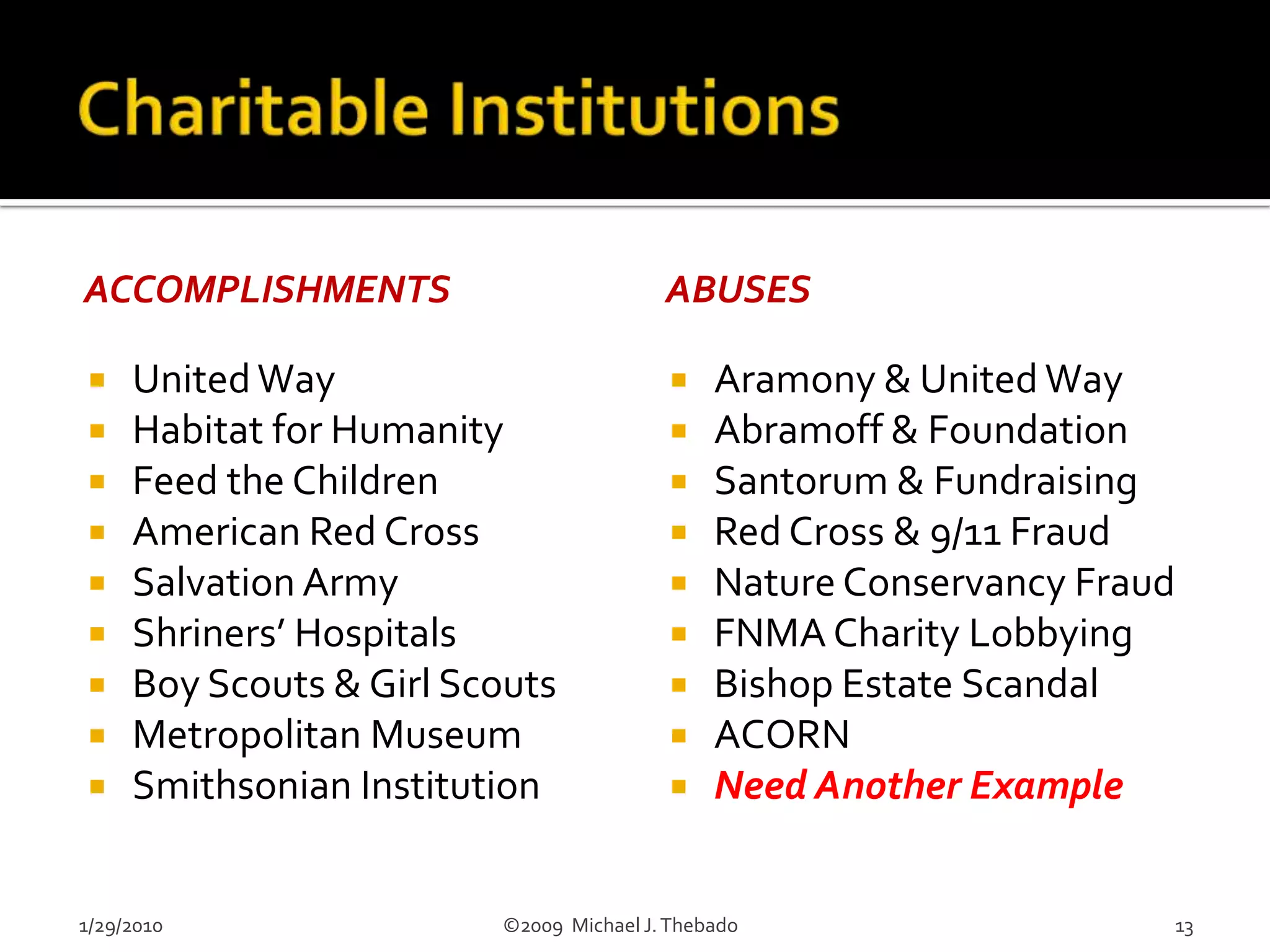
Charitable InstitutionsAccomplishments	AbusesUnited WayHabitat for HumanityFeed the ChildrenAmerican Red CrossSalvation ArmyShriners’ HospitalsBoy Scouts & Girl ScoutsMetropolitan Museum Smithsonian InstitutionAramony & United WayAbramoff & FoundationSantorum & FundraisingRed Cross & 9/11 FraudNature Conservancy FraudFNMA Charity LobbyingBishop Estate ScandalACORNNeed Another Example1/29/2010                               ©2009  Michael J. Thebado13
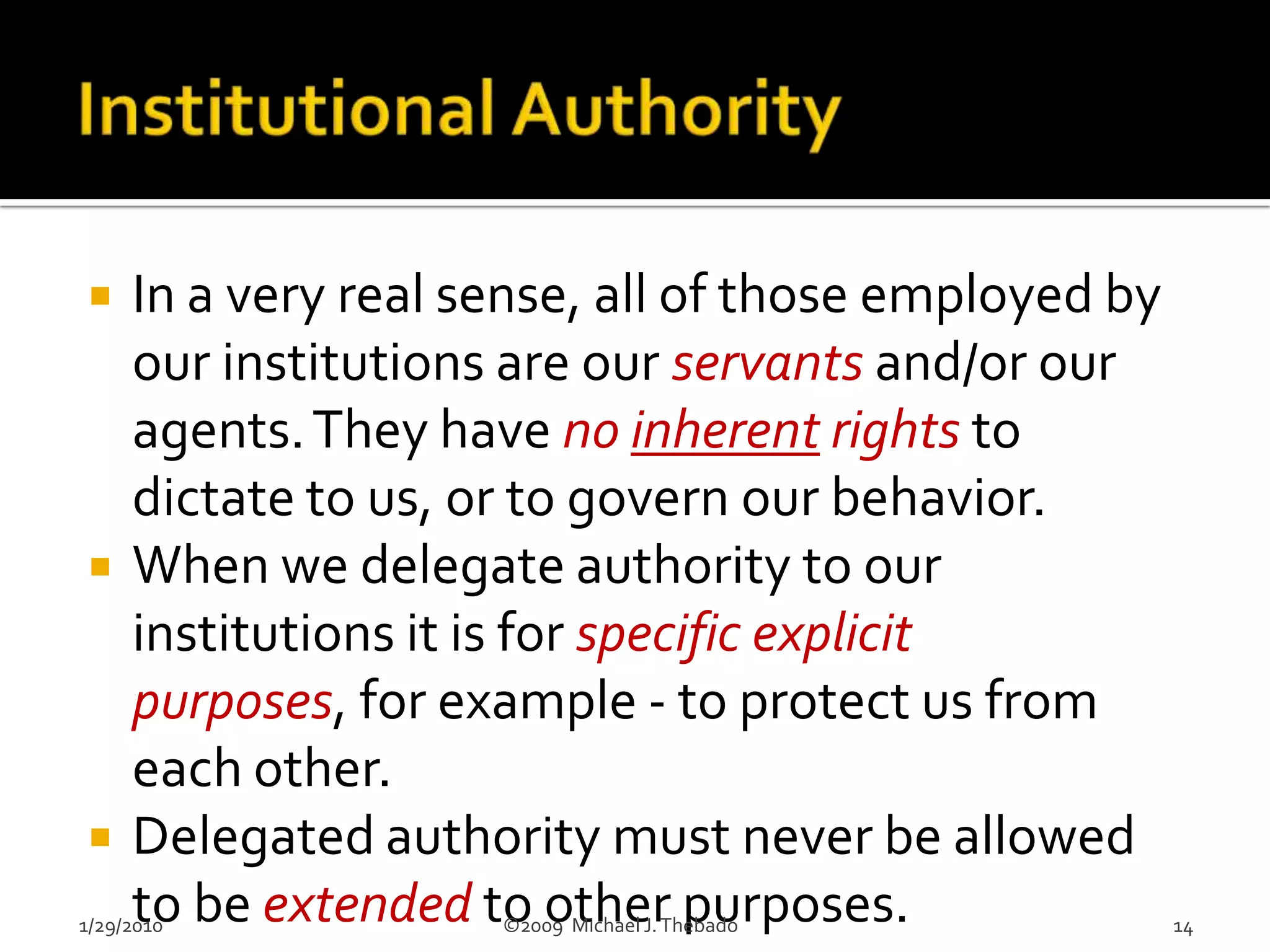
Institutional AuthorityIn a very real sense, all of those employed by our institutions are our servants and/or our agents. They have no inherent rights to dictate to us, or to govern our behavior.When we delegate authority to our institutions it is for specific explicit purposes, for example - to protect us from each other.Delegated authority must never be allowed to be extended to other purposes.1/29/2010                               ©2009  Michael J. Thebado14
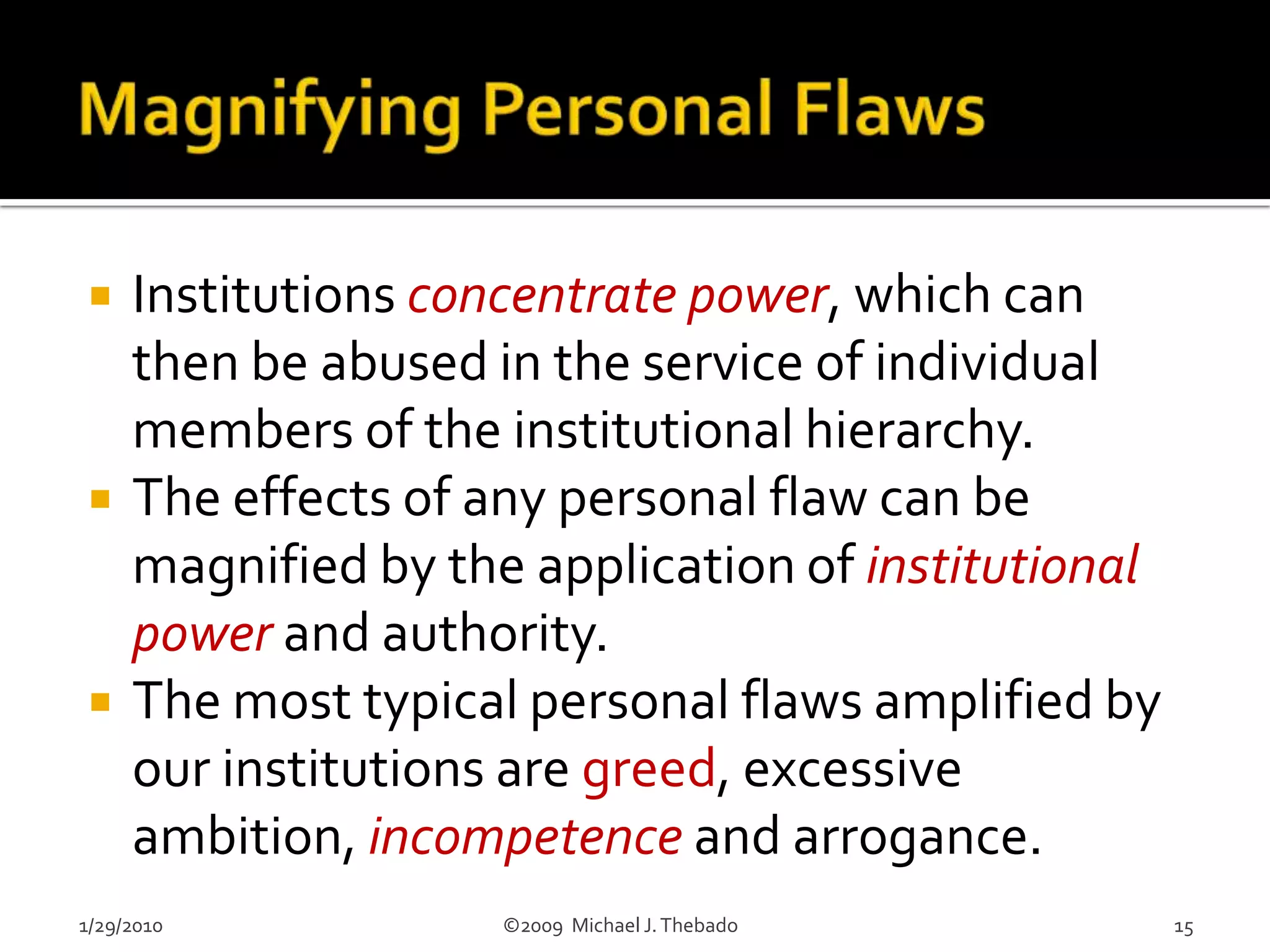
Magnifying Personal FlawsInstitutions concentrate power, which can then be abused in the service of individual members of the institutional hierarchy.The effects of any personal flaw can be magnified by the application of institutional power and authority.The most typical personal flaws amplified by our institutions are greed, excessive ambition, incompetence and arrogance.1/29/2010                               ©2009  Michael J. Thebado15
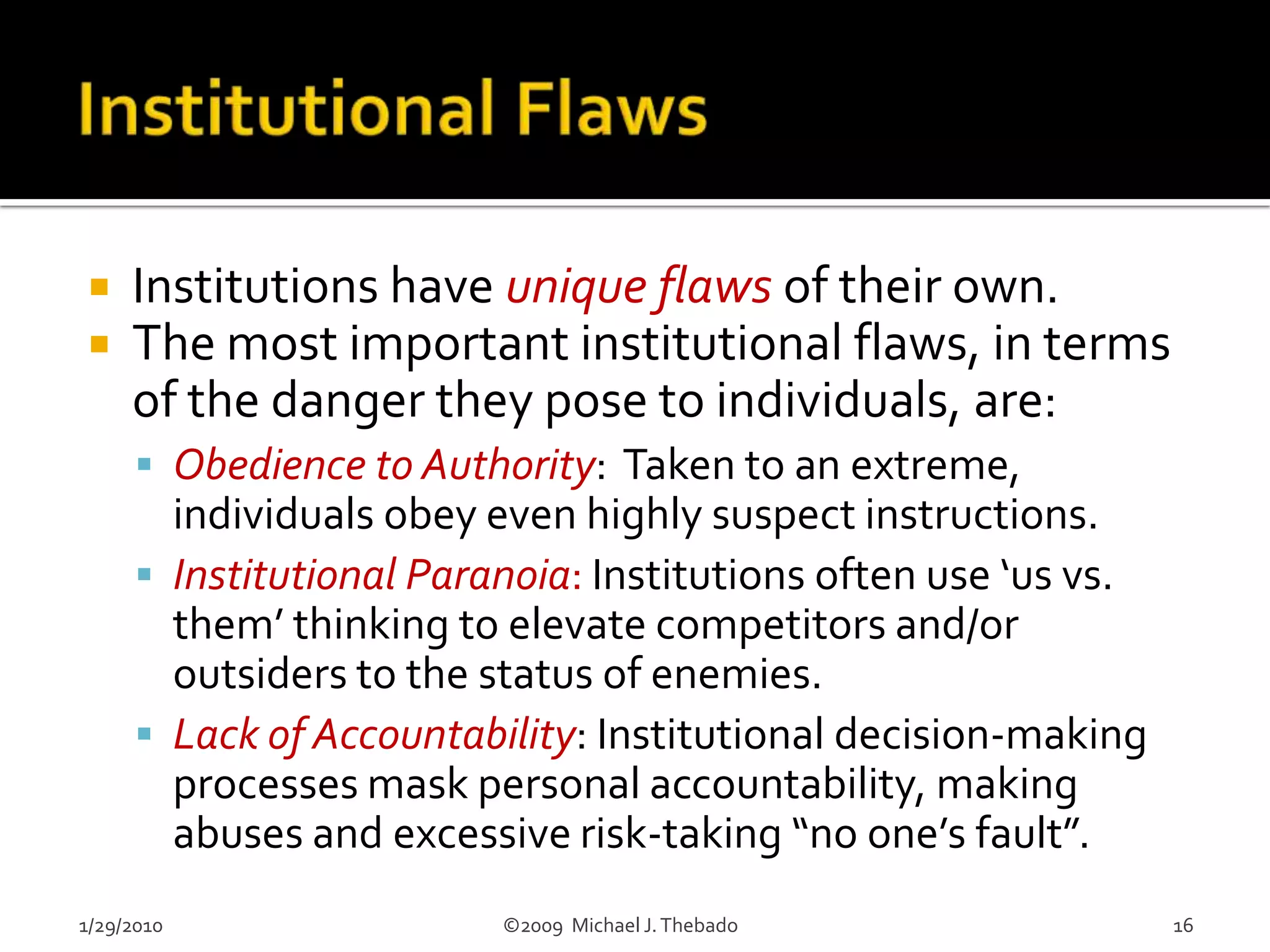
Institutional FlawsInstitutions have unique flaws of their own.
The most important institutional flaws, in terms of the danger they pose to individuals, are:
Obedience to Authority:  Taken to an extreme, individuals obey even highly suspect instructions.
Institutional Paranoia: Institutions often use ‘us vs. them’ thinking to elevate competitors and/or outsiders to the status of enemies.
Lack of Accountability: Institutional decision-making processes mask personal accountability, making abuses and excessive risk-taking “no one’s fault”.1/29/2010                               ©2009  Michael J. Thebado16
Obedience to AuthorityOriginally studied and articulated through the famous ‘Milgram experiments’ at Yale University in the 1960’s.Participants in institutional settings suppress their own judgment in favor of compliance with the instructions that they receive.Demonstration of how normal moral individuals can, at the behest of institutional authority, participate in great wrongdoing.1/29/2010                               ©2009  Michael J. Thebado17

Civil Individualism Overview Oct 2009

  • 1.
    Civil IndividualismA ModernPolitical Philosophy of Checks and Balances1/29/2010 ©2009 Michael J. Thebado1
  • 2.
    Civil Individualism: ADefinitionCivil Individualism is a political philosophy which holds first that sovereignty is rooted in each equal individual. Second, that, as individuals, we must collectively create institutionsin order to secure our freedoms, and to achieve other mutual benefits that we can not achieve alone. Lastly, that all of our institutions threaten to harm individuals, and mustbe governed by systems of checks & balances.1/29/2010 ©2009 Michael J. Thebado2
  • 3.
    Major Types ofInstitutionsGovernmental: Federal, State, Municipal, Trans-National, Agencies, Political Parties.
  • 4.
    Military: Army, Navy,Air Force, Marines, National Guards, Militias, Mercenaries.
  • 5.
  • 6.
    Religious: Churches, Denominations,Mosques, Temples, Cults.
  • 7.
  • 8.
    Educational: Colleges, Universities,Schools, Fraternities, Sororities, Institutes, Think Tanks.
  • 9.
    Medical: Hospitals, Clinics,Professional Associations, Research Foundations.
  • 10.
    Artistic: Museums, Orchestras,Troupes, Studios, Networks, Television & Radio Stations.
  • 11.
    Athletic: Teams, Leagues,Associations, Committees, Boosters, Tournaments, Tours.
  • 12.
    Legal: Courts, LawFirms, Professional Associations, Arbitration Societies.
  • 13.
    Labor: Unions, Guilds,Trade Associations.
  • 14.
    Other: Police &Fire Companies, Chambers of Commerce, Relief Organizations, Country Clubs, Organized Crime, Street Gangs.1/29/2010 ©2009 Michael J. Thebado3
  • 15.
    Core TenetsIndividuals aresovereign.Institutions exist to amplify individual efforts.Individuals are imperfect.Institutions magnify individual imperfections.Institutions have imperfections of their own.Institutional flaws harm individuals.We design and implement Checks & Balances to protect ourselves from institutional dangers.1/29/2010 ©2009 Michael J. Thebado4
  • 16.
    Sovereignty & ItsImplicationsIndividual sovereignty means that we are all implicitly free to do as we will, provided that we do not interfere with others’ sovereignty.Individual sovereignty also implies that all institutions are (or were originally) the voluntary creations of individual participantsAs the creation of individuals, all institutional authority is implicitly (or explicitly) derived from the consent of individual participants. 1/29/2010 ©2009 Michael J. Thebado5
  • 17.
    The Role ofInstitutionsInstitutions exist solely as a means of coordinating and amplifying individual capabilities to achieve goals that are beyond the capacities of individuals on their own.
  • 18.
    For example, governmental,military, and legal institutions allow us to band together to protect ourselves from each other.
  • 19.
    Our institutions, nomatter how long they have existed or how much they are respected, are simply our tools.1/29/2010 ©2009 Michael J. Thebado6
  • 20.
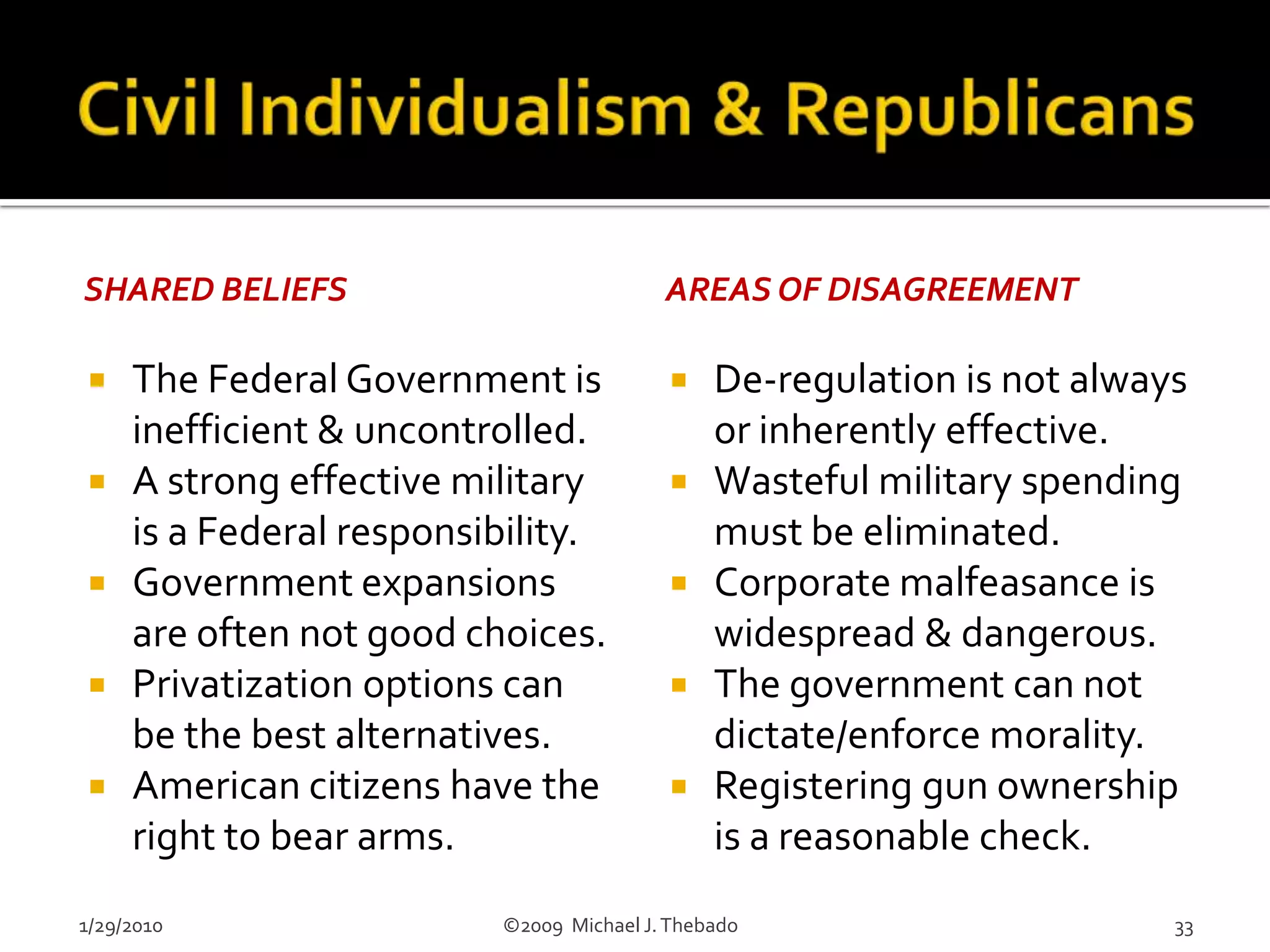
    Limits on InstitutionsWehave an absolute right to change/abolish specific institutions when, as our tools, they no longer meet our needs well.There is no moral justification for institutions pursuing goals of their own which are independent of their voluntary participants.We have an obligation to ensure that our institutions do not develop, pursue and/or expand their own agendas.1/29/2010 ©2009 Michael J. Thebado7
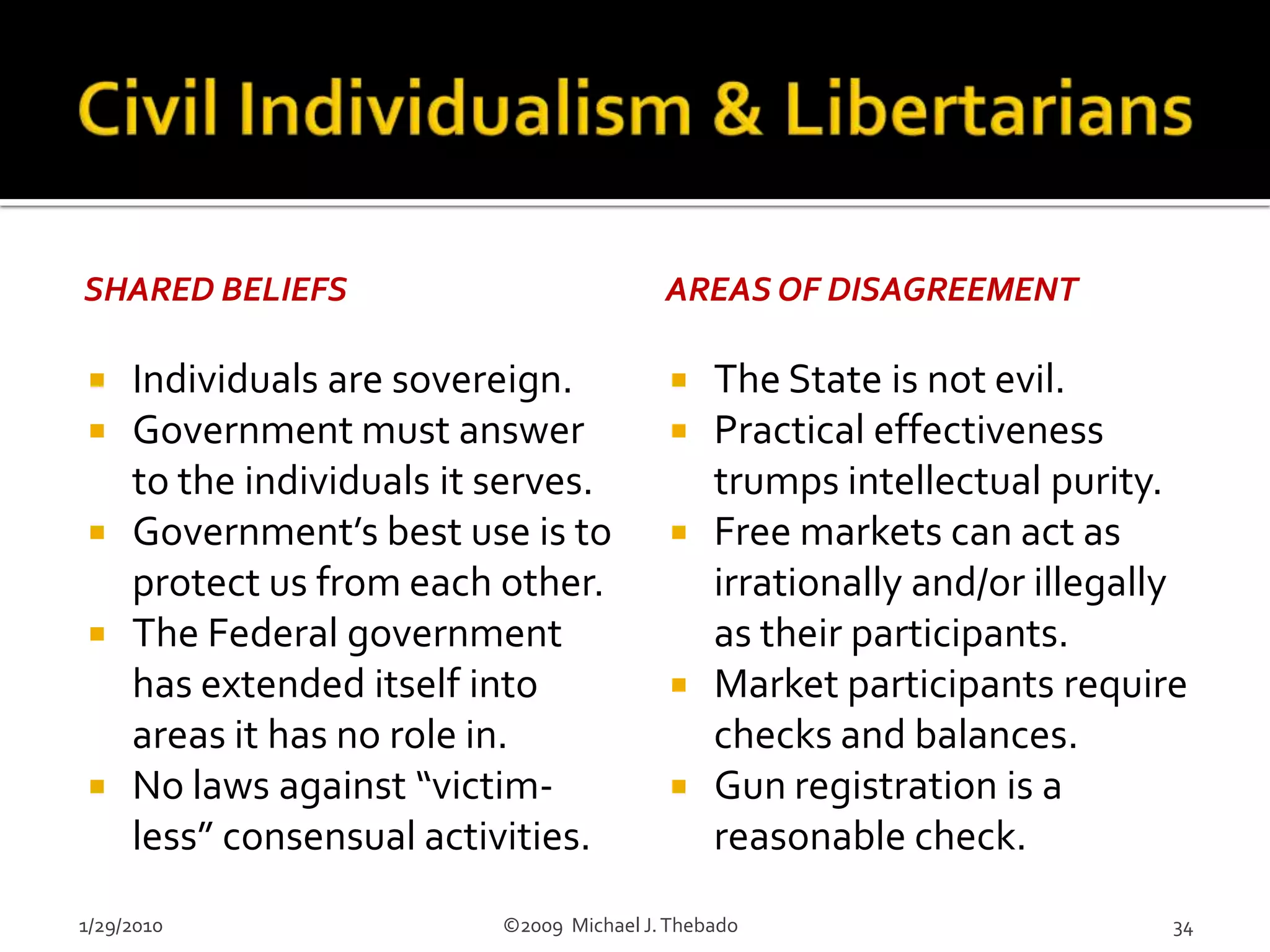
  • 21.
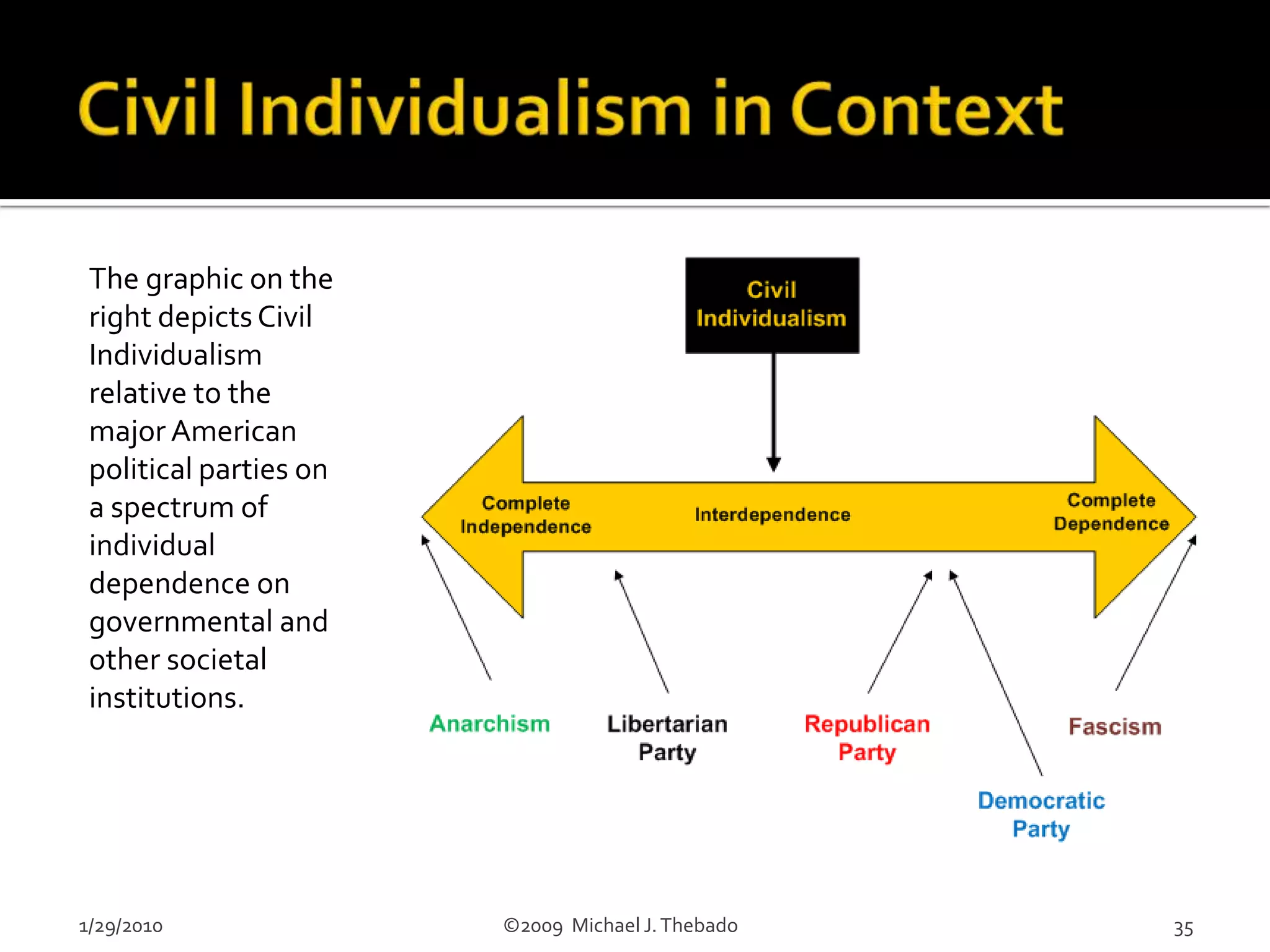
    Institutional SuccessesAt theirbest, our institutions harness and direct our energies to achieve truly inspiring goals – from the defeat of the Fascists in WWII, to the success of the Internet itself.
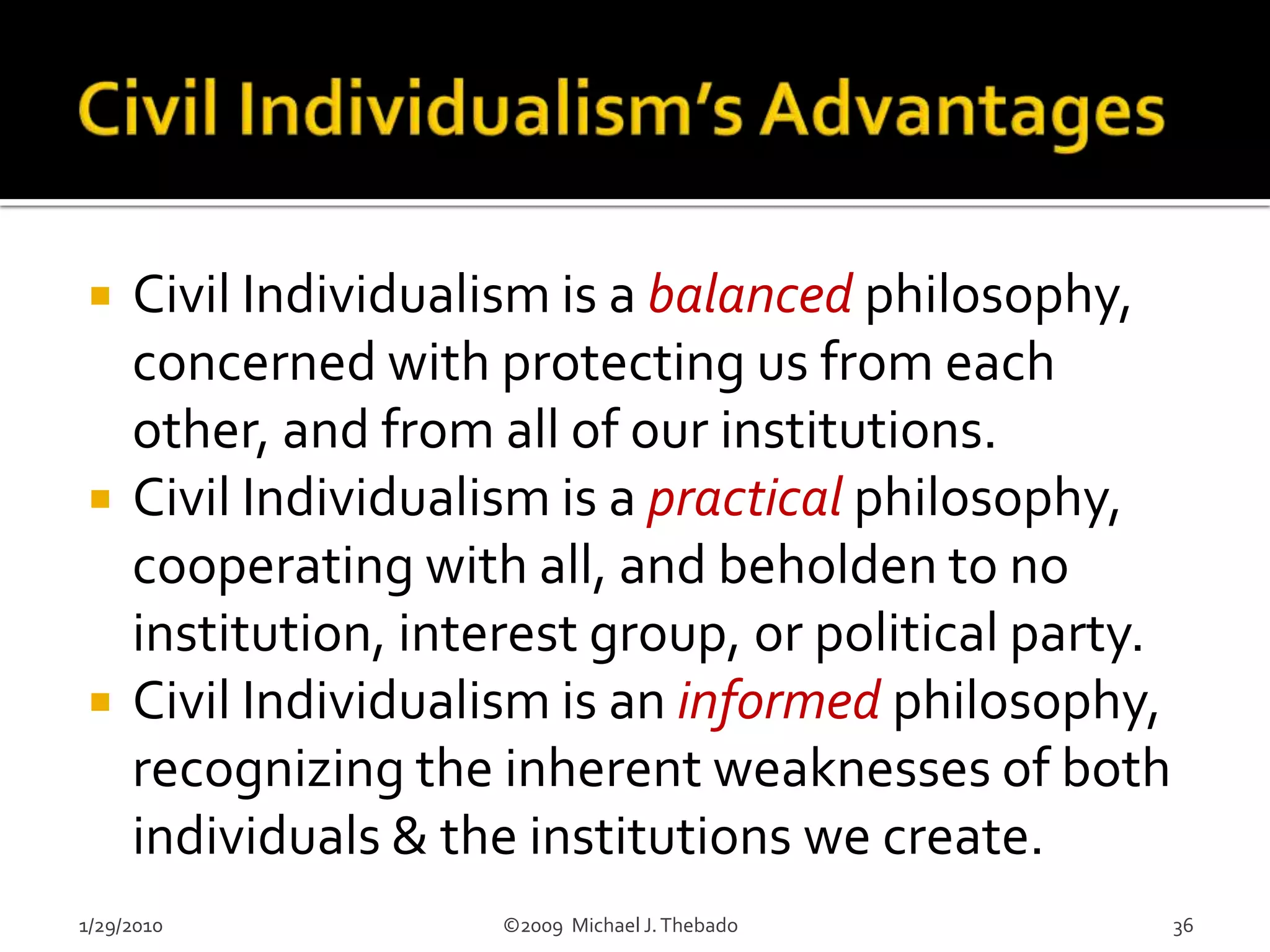
  • 22.
    In their manysuccesses, our institutions inspire pride in ourselves and our fellows, and reflect the best of our individual efforts.
  • 23.
    Without our institutions,and their successes, our lives would be much poorer, and we ourselves, more isolated and vulnerable.1/29/2010 ©2009 Michael J. Thebado8
  • 24.
    Institutional FailuresAt theirworst, our institutions magnify our personal flaws, set us against each other, and seek to expand themselves at the expense of our individual freedoms.
  • 25.
    Left unchecked, theabuses of our institutions have been amongst our most shameful, from the initial legality of slavery and the internment camps of WWII, through the Enron & WorldCom frauds, to the pedophile priest scandal.
  • 26.
    When we failto constrain the behavior of our institutions, we put ourselves at great risk.1/29/2010 ©2009 Michael J. Thebado9
  • 27.
    Government InstitutionsAccomplishments AbusesAllied defeatof the Nazi’sEradication of PolioInterstate Highway SystemCuban Missile CrisisNASA Apollo Program60’s Civil Rights LegislationFall of CommunismOperation Desert Storm9/11 Bi-Partisan ResponseInternment of the JapaneseMcCarthy-ism & HUACMilitary-Industrial ComplexThe Bay of PigsViet Nam - My Lai Hoover’s FBI “Secret Files”WatergateIran-gateWhitewater1/29/2010 ©2009 Michael J. Thebado10
  • 28.
    Corporate InstitutionsAccomplishments AbusesMicrosoft, Apple& the PCBoeing, USAir & Air TravelAT&T and CommunicationsCisco, Cable & The InternetThe US Standard of LivingDeere & Farm ProductivityDisney & EntertainmentFidelity & the Mutual FundVisa and the Credit CardSavings & Loan CrisisEnron & WorldComLove Canal PollutionMortgage CrisisAIG & Lehman FailuresHP Spying ScandalBCCI ScandalTobacco Industry Cover-upHalliburton Over-charges1/29/2010 ©2009 Michael J. Thebado11
  • 29.
    Religious InstitutionsAccomplishmentsAbusesMother Teresa’sWorkThe Sistine ChapelVatican ArtworkHandel’s MessiahCatholic CharitiesJewish CharitiesGandhi's Non-ViolenceCatholic UniversitiesNeed Islamic ExampleThe InquisitionPriest Pedophilia Cover-UpVatican BankJimmy Swaggert ScandalJim Bakker ScandalOral Roberts’ FinancesJim Jones & JonestownKoresh & Branch DavidiansHeaven’s Gate1/29/2010 ©2009 Michael J. Thebado12
  • 30.
    Charitable InstitutionsAccomplishments AbusesUnited WayHabitatfor HumanityFeed the ChildrenAmerican Red CrossSalvation ArmyShriners’ HospitalsBoy Scouts & Girl ScoutsMetropolitan Museum Smithsonian InstitutionAramony & United WayAbramoff & FoundationSantorum & FundraisingRed Cross & 9/11 FraudNature Conservancy FraudFNMA Charity LobbyingBishop Estate ScandalACORNNeed Another Example1/29/2010 ©2009 Michael J. Thebado13
  • 31.
    Institutional AuthorityIn avery real sense, all of those employed by our institutions are our servants and/or our agents. They have no inherent rights to dictate to us, or to govern our behavior.When we delegate authority to our institutions it is for specific explicit purposes, for example - to protect us from each other.Delegated authority must never be allowed to be extended to other purposes.1/29/2010 ©2009 Michael J. Thebado14
  • 32.
    Magnifying Personal FlawsInstitutionsconcentrate power, which can then be abused in the service of individual members of the institutional hierarchy.The effects of any personal flaw can be magnified by the application of institutional power and authority.The most typical personal flaws amplified by our institutions are greed, excessive ambition, incompetence and arrogance.1/29/2010 ©2009 Michael J. Thebado15
  • 33.
    Institutional FlawsInstitutions haveunique flaws of their own.
  • 34.
    The most importantinstitutional flaws, in terms of the danger they pose to individuals, are:
  • 35.
    Obedience to Authority: Taken to an extreme, individuals obey even highly suspect instructions.
  • 36.
    Institutional Paranoia: Institutionsoften use ‘us vs. them’ thinking to elevate competitors and/or outsiders to the status of enemies.
  • 37.
    Lack of Accountability:Institutional decision-making processes mask personal accountability, making abuses and excessive risk-taking “no one’s fault”.1/29/2010 ©2009 Michael J. Thebado16
  • 38.
    Obedience to AuthorityOriginallystudied and articulated through the famous ‘Milgram experiments’ at Yale University in the 1960’s.Participants in institutional settings suppress their own judgment in favor of compliance with the instructions that they receive.Demonstration of how normal moral individuals can, at the behest of institutional authority, participate in great wrongdoing.1/29/2010 ©2009 Michael J. Thebado17
  • 39.
    Institutional ParanoiaInstitutions compete.Competitionfosters “Us vs. Them” thinking.Excessive “Us vs. Them” thinking can lead to paranoia & the demonization of “enemies”.Examples:Liberal vs. Conservative hate-mongers.Religious wars.Corporate espionage.1/29/2010 ©2009 Michael J. Thebado18
  • 40.
    Lack of AccountabilityManyof our institutional endeavors involve dozens, if not hundreds, of people.When so many people are involved in a particular error or wrong-doing, it promotes the evasion of responsibility.For example:“I was only following orders” – Nazi defense“The auditors signed off on it” – Enron defense“I was following instructions” – auditors’ defense1/29/2010 ©2009 Michael J. Thebado19
  • 41.
    The Dangers ofGovernmentsAll of our institutions can both magnify our personal flaws, and add flaws of their own.Governmental institutions are particularly dangerous, for at least three reasons:Government institutions are often our largest.Government institutions are among our oldest.We delegate relatively more of our personal sovereignty to our governments, and some states claim sovereignty of their own right at gunpoint.1/29/2010 ©2009 Michael J. Thebado20
  • 42.
    The Dangers ofCorporationsNext to governments, corporate institutions are usually the next most influential in the lives of the majority of Americans.Corporations do not have quite the legal, size, or longevity advantages of governments. They do have their own:Corporations are usually relatively wealthy.Corporations usually have ready legal resources.Corporations influence governments greatly.1/29/2010 ©2009 Michael J. Thebado21
  • 43.
    The Limits ofPolitical DebateContemporary American political debate tends to focus on the problems of only the two main types of institutions, governmental & corporate.
  • 44.
    This “bi-polar” frameworkoften hinders us from identifying universal patterns & tends to restrict our solutions to only those 2 institutional types.
  • 45.
    American political dialoguehas become an often bitter struggle between the opposing political parties and their ideological deification and demonization of particular institutions.1/29/2010 ©2009 Michael J. Thebado22
  • 46.
    Political Parties &Their BiasesDemocrats generally argue that our problems stem from corporate and military institutions, but often ignore problems of governmental institutions.
  • 47.
    Republicans generally arguethat our problems stem from governmental institutions, but usually ignore problems caused by corporate institutions.
  • 48.
    Libertarians more consistentlyargue against governmental abuses, but remain relatively silent on the problems posed by corporate institutions and flawed free market mechanisms and beliefs.
  • 49.
    Independents frequently recognizethe problems of the major parties themselves, but often cannot effectively organize around a consistent platform.1/29/2010 ©2009 Michael J. Thebado23
  • 50.
    The Effects of“Tunnel Vision”The American political parties are usually right when the recognize the flaws of the institutions that they generally oppose, although they often exaggerate those flaws.
  • 51.
    The political partiesare nearly completely blind to the problems of the institutions that they draw their support from.
  • 52.
    The two majorparties argue that “their” institutions are the only (or the preferred) solutions to the problems posed by the institutions that they oppose.1/29/2010 ©2009 Michael J. Thebado24
  • 53.
    The Decline ofAmerican PoliticsOur political debates have become an institutional struggle for supremacy.Dialogue has been replaced by incendiary invective issued by ideological fanatics.Some of the public has enlisted in the “war”.The rest of the public has become either disaffected or fearful, or both.Bitterness and frustration are increasing.Our problems can seem too large to solve.1/29/2010 ©2009 Michael J. Thebado25
  • 54.
    Finding a WayOutOur problems do not stem from one type of institution, or another.Our solutions do not lie in preferring one type of institution over the others.Our solution starts with recognizing that all institutions are inherently flawed, and focusing instead on how to implement a more effective system of checks and balances to constrain their excesses and abuses.1/29/2010 ©2009 Michael J. Thebado26
  • 55.
    One Solution? CivilIndividualismCivil Individualism transcends party politics.
  • 56.
    Civil Individualism doesnot cater to any particular institution, or type of institution.
  • 57.
    Civil Individualism recognizesthe strengths & weaknesses of both individuals & institutions.
  • 58.
    Civil Individualism preservesmaximum individual freedom to use our strengths
  • 59.
    Civil Individualism allowsfor a minimum of consensual and consciously-created checks and balances needed to constrain our weaknesses.1/29/2010 ©2009 Michael J. Thebado27
  • 60.
    Focusing on Checks& BalancesAmerica’s Founding Fathers, and our Constitution, consciously embraced the concept of checks and balances to prevent governmental abuses.Civil Individualism seeks to extend the concept to all types of institutions.Civil Individualism also aims to formalize and expand the study and implementation of specific types of checks and balances.1/29/2010 ©2009 Michael J. Thebado28
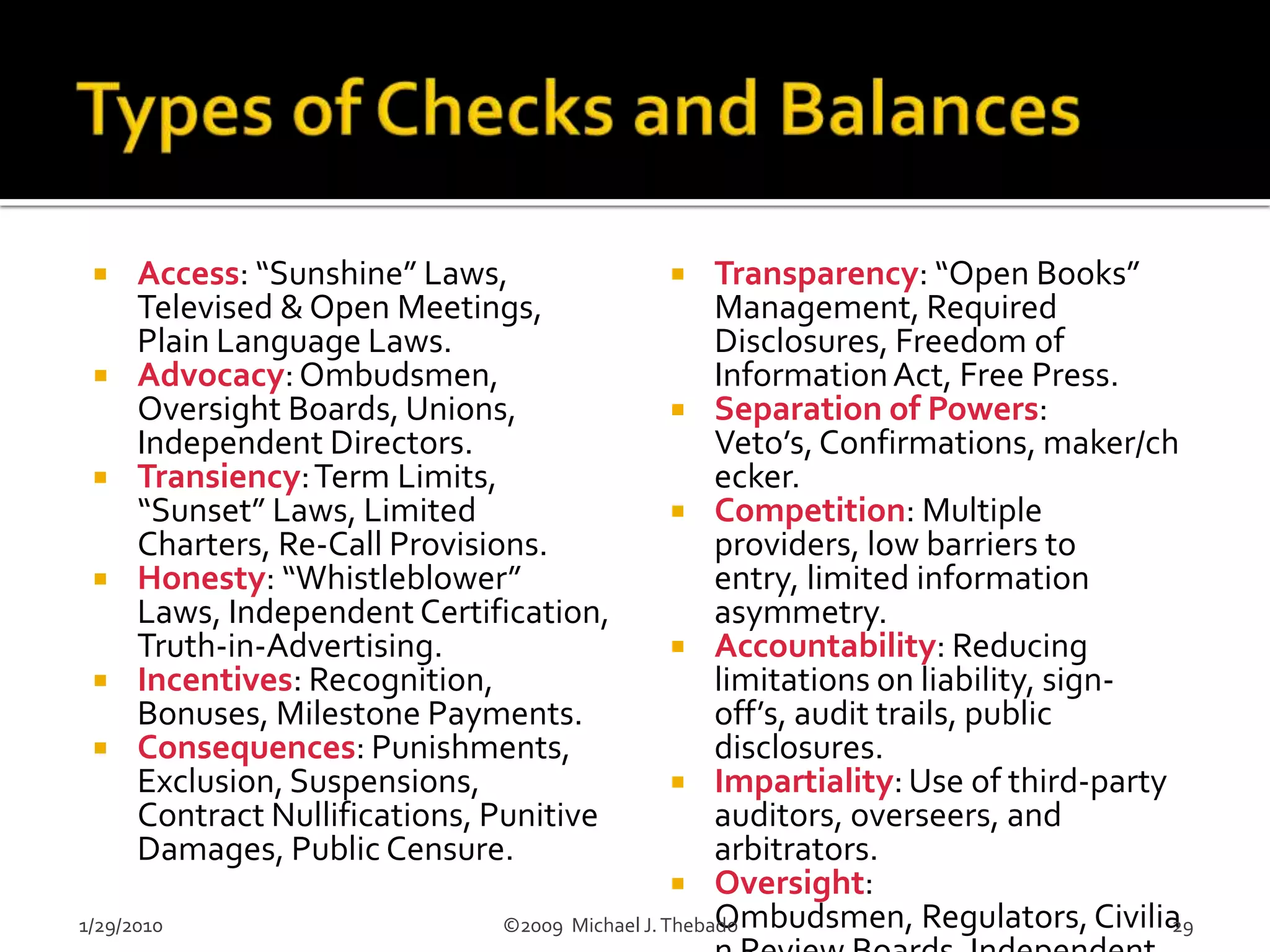
  • 61.
    Types of Checksand BalancesAccess: “Sunshine” Laws, Televised & Open Meetings, Plain Language Laws.
  • 62.
    Advocacy: Ombudsmen, OversightBoards, Unions, Independent Directors.
  • 63.
    Transiency: Term Limits,“Sunset” Laws, Limited Charters, Re-Call Provisions.
  • 64.
    Honesty: “Whistleblower” Laws,Independent Certification, Truth-in-Advertising.
  • 65.
  • 66.
    Consequences: Punishments, Exclusion,Suspensions, Contract Nullifications, Punitive Damages, Public Censure.
  • 67.
    Transparency: “Open Books”Management, Required Disclosures, Freedom of Information Act, Free Press.
  • 68.
    Separation of Powers:Veto’s, Confirmations, maker/checker.
  • 69.
    Competition: Multiple providers,low barriers to entry, limited information asymmetry.
  • 70.
    Accountability: Reducing limitationson liability, sign-off’s, audit trails, public disclosures.
  • 71.
    Impartiality: Use ofthird-party auditors, overseers, and arbitrators.
  • 72.
    Oversight: Ombudsmen, Regulators,Civilian Review Boards, Independent Directors1/29/2010 ©2009 Michael J. Thebado29
  • 73.
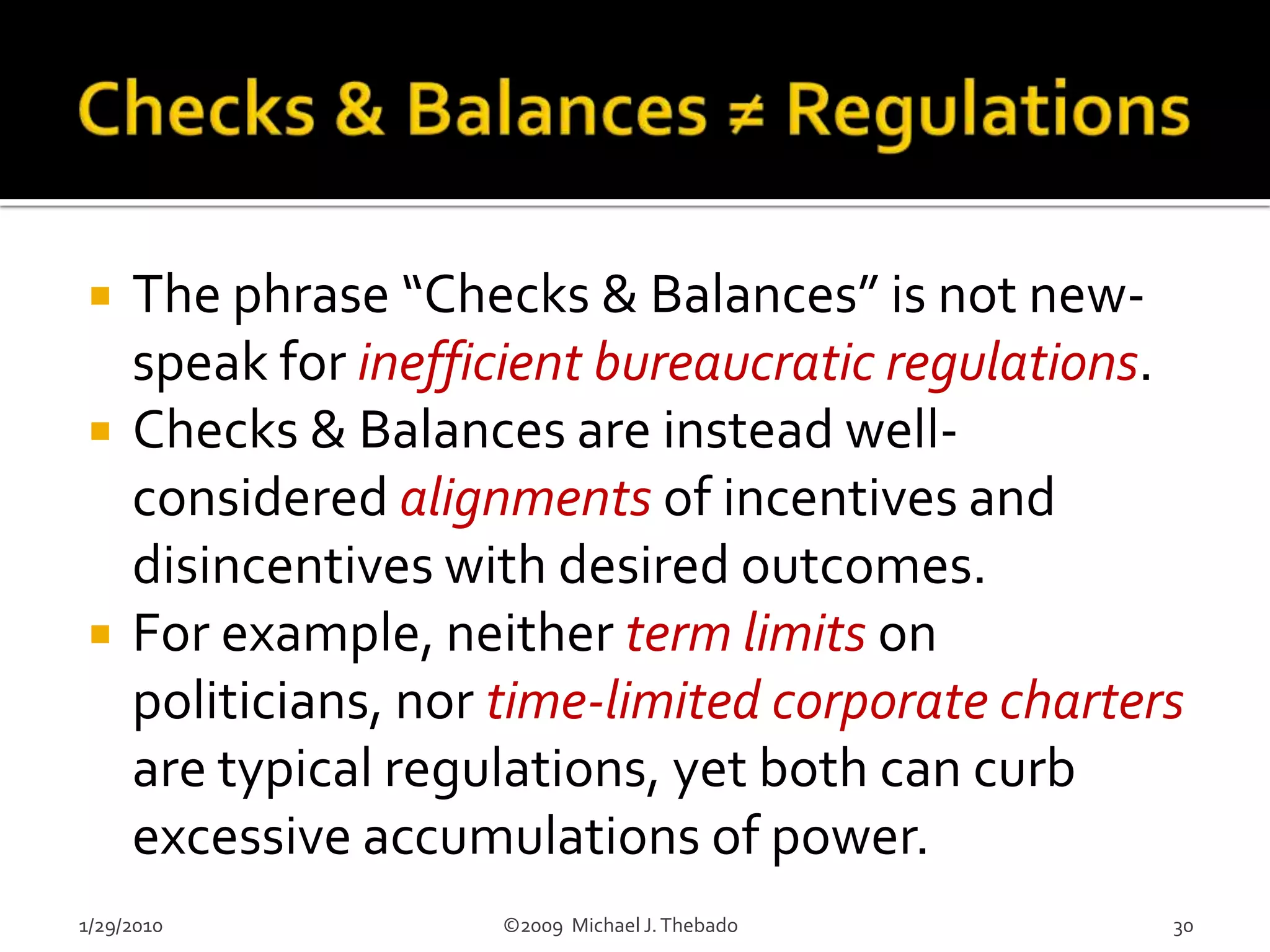
    Checks & Balances≠ RegulationsThe phrase “Checks & Balances” is not new-speak for inefficient bureaucratic regulations.Checks & Balances are instead well-considered alignments of incentives and disincentives with desired outcomes.For example, neither term limits on politicians, nor time-limited corporate charters are typical regulations, yet both can curb excessive accumulations of power.1/29/2010 ©2009 Michael J. Thebado30
  • 74.
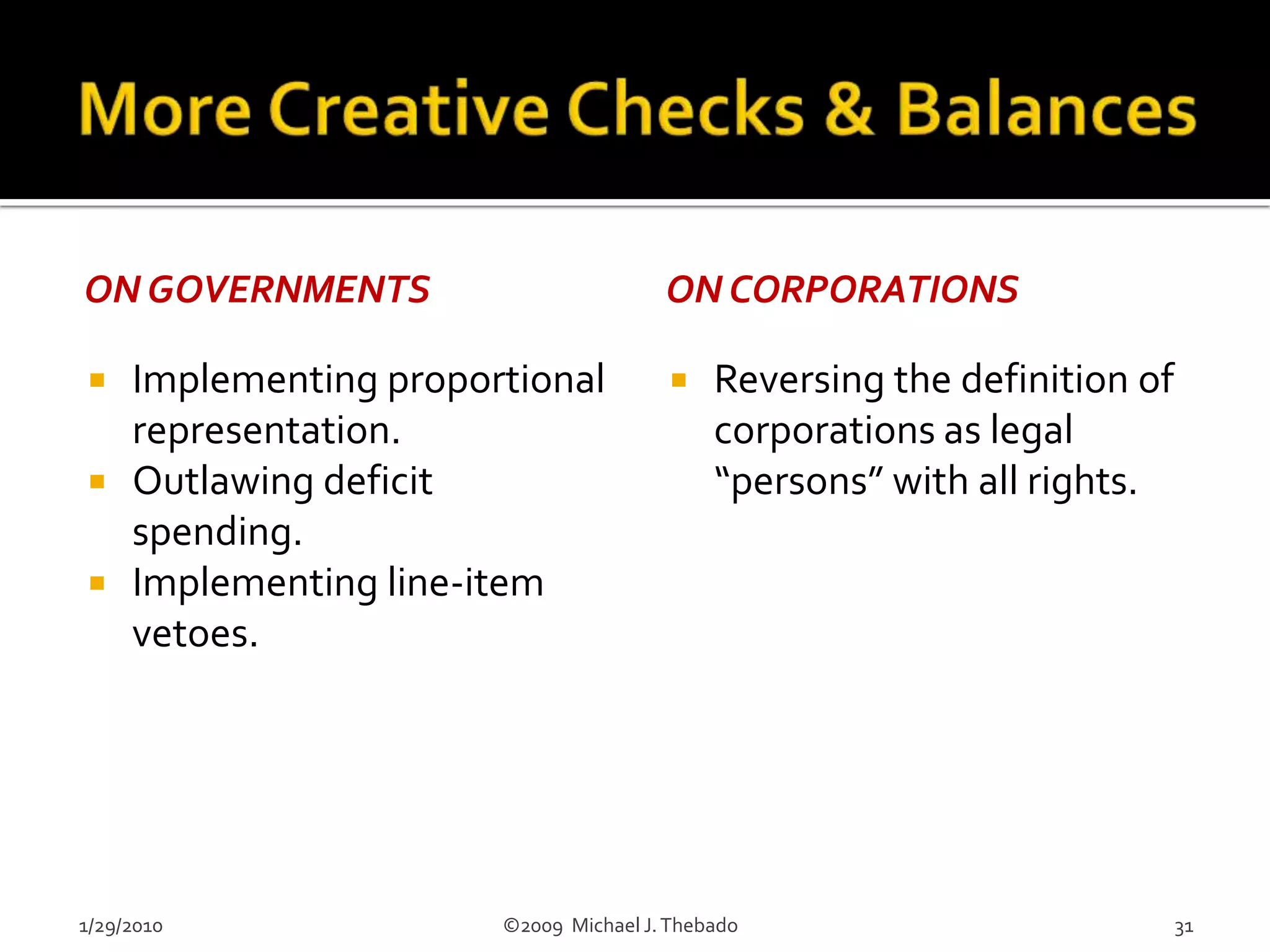
    More Creative Checks& BalancesOn GovernmentsOn CorporationsImplementing proportional representation.Outlawing deficit spending.Implementing line-item vetoes.Reversing the definition of corporations as legal “persons” with all rights.1/29/2010 ©2009 Michael J. Thebado31
  • 75.
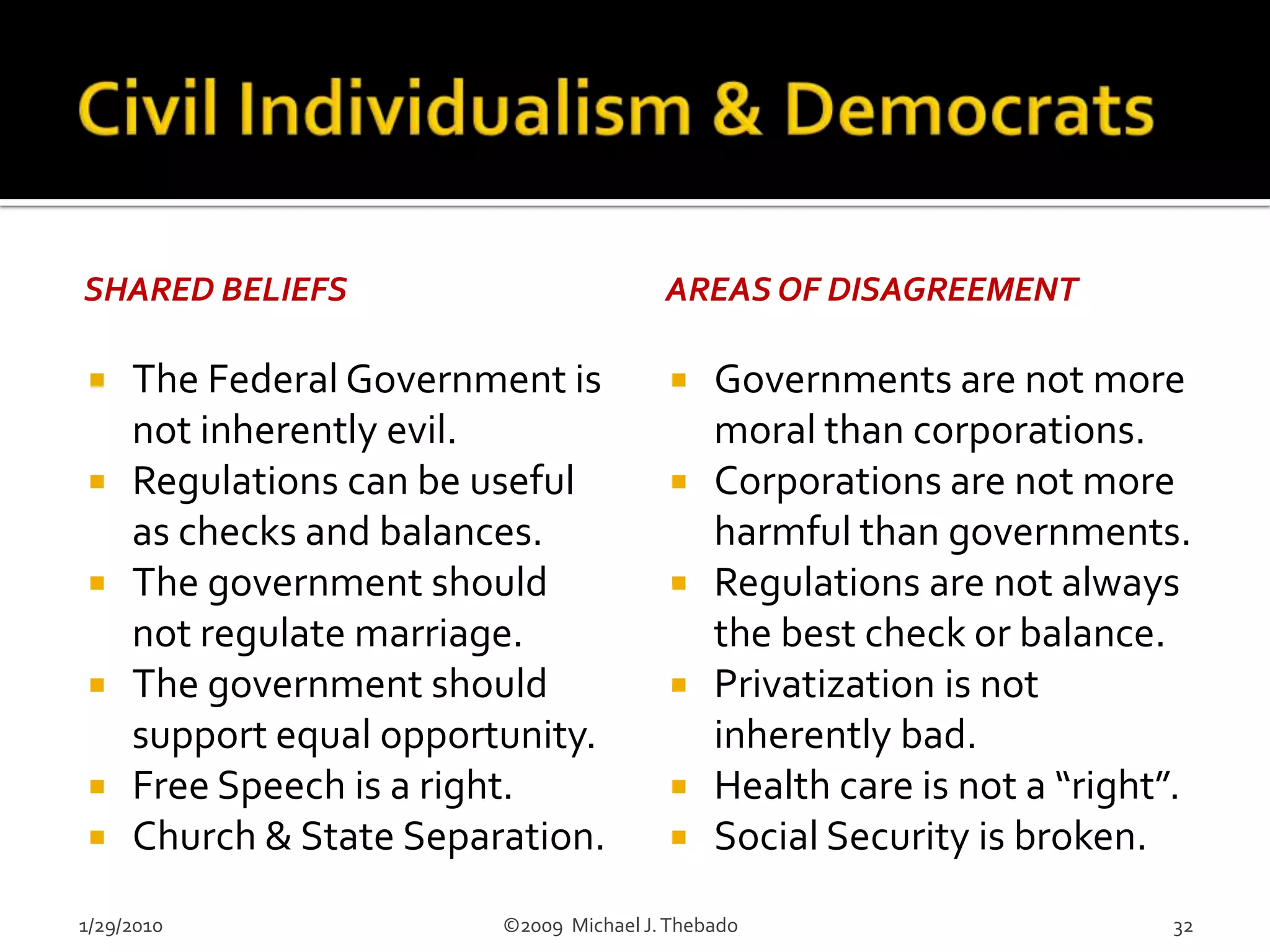
    Civil Individualism &DemocratsShared BeliefsAreas of disagreementThe Federal Government is not inherently evil.Regulations can be useful as checks and balances.The government should not regulate marriage.The government should support equal opportunity.Free Speech is a right.Church & State Separation.Governments are not more moral than corporations.Corporations are not more harmful than governments.Regulations are not always the best check or balance.Privatization is not inherently bad.Health care is not a “right”.Social Security is broken.1/29/2010 ©2009 Michael J. Thebado32
  • 76.
    Civil Individualism &RepublicansShared BeliefsAreas of disagreementThe Federal Government is inefficient & uncontrolled.A strong effective military is a Federal responsibility.Government expansions are often not good choices.Privatization options can be the best alternatives.American citizens have the right to bear arms.De-regulation is not always or inherently effective.Wasteful military spending must be eliminated.Corporate malfeasance is widespread & dangerous.The government can not dictate/enforce morality.Registering gun ownership is a reasonable check.1/29/2010 ©2009 Michael J. Thebado33
  • 77.
    Civil Individualism &LibertariansShared BeliefsAreas of disagreementIndividuals are sovereign.Government must answer to the individuals it serves.Government’s best use is to protect us from each other.The Federal government has extended itself into areas it has no role in.No laws against “victim-less” consensual activities.The State is not evil.Practical effectiveness trumps intellectual purity.Free markets can act as irrationally and/or illegally as their participants.Market participants require checks and balances.Gun registration is a reasonable check.1/29/2010 ©2009 Michael J. Thebado34
  • 78.
    Civil Individualism inContextThe graphic on the right depicts Civil Individualism relative to the major American political parties on a spectrum of individual dependence on governmental and other societal institutions.1/29/2010 ©2009 Michael J. Thebado35
  • 79.
    Civil Individualism’s AdvantagesCivilIndividualism is a balanced philosophy, concerned with protecting us from each other, and from all of our institutions.Civil Individualism is a practical philosophy, cooperating with all, and beholden to no institution, interest group, or political party.Civil Individualism is an informed philosophy, recognizing the inherent weaknesses of both individuals & the institutions we create.1/29/2010 ©2009 Michael J. Thebado36
  • 80.
    Implementing Civil IndividualismCIis a pragmatic philosophy, committed to improving things from where they are now.CI embraces an “overlay” implementation strategy, reforming wherever possible and replacing where reform would be ineffective.CI recognizes the need for gradual and incremental change, provided that it is also prioritized, constant and unremitting.1/29/2010 ©2009 Michael J. Thebado37
  • 81.
    Moving ForwardPhilosophies mustbecome either widely-embraced, or selectively implemented, to begin to become effectively influential.Civil Individualism currently seeks to enlist volunteer supporters to refine and spread an understanding of the philosophy.Our immediate near term goals are the formation of a 501(c)3 charitable foundation and the creation of an Internet presence.1/29/2010 ©2009 Michael J. Thebado38

Editor's Notes

  • #2 The purpose of this presentation is to introduce the concept of Civil Individualism (CI), and to outline (many of) its major tenets.We are seeking to engage concerned and politically-aware Americans of any political party affiliation (or none at all). We want to start a constructive dialogue about both the tenets of Civil Individualism themselves, and also about how we might best begin to implement (apply) the philosophy on a more widespread basis.The central arguments/points contained in this presentation will be amplified, re-organized, summarized, simplified and/or expanded as necessary to first spread an understanding of Civil Individualism as widely as possible, and then to begin to apply it, initially in the United States, and then more widely abroad.The concepts being presented will be re-packaged in whatever form(s) are best suited to their widespread communication, whether in book, pamphlet, blog, web-site, broadcast, video, podcast and/or e-book form.We refer to Civil Individualism as a “modern” philosophy primarily in the sense that it is a timely response to the shortcomings of our current philosophies, and the deterioration of political debate within the United States. The concepts themselves build on prior advances in political philosophy, primarily those of the American Founding Fathers and the advocates of the Libertarian schools of thought.
  • #3 Political philosophy is a branch of philosophy, which studies fundamental questions concerning the social or communal life of human beings. It inquires into a broad range of questions, such as the principles of justification of power and social governance, the grounds for the justification of certain forms of government, social obligations of constituting members of a society, and the origin, nature, and purpose of government. (New World Encyclopedia)“Sovereignty is the exclusive right to exercise supreme political (e.g. legislative, judicial, and/or executive) authority over a geographic region, group of people, or oneself." (from the Latin superanus, supremacy) In a demorcacy, sovereignty is considered to reside with the individual citizens. (WikiAnswers)Civil Individualism differs from other political philosophies in that it embraces an even-handed assessment of all institutional types, recognizing both their benefits and their threats to individuals. CI considers government institutions to be only one form of institution, although an obviously particularly important one.Civil individualism assumes both the existence and justification for all institutional types, and focuses instead on the conscious creation of effective controls over the potential abuses by all institutions.