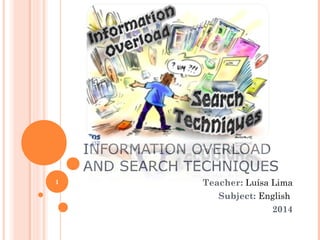
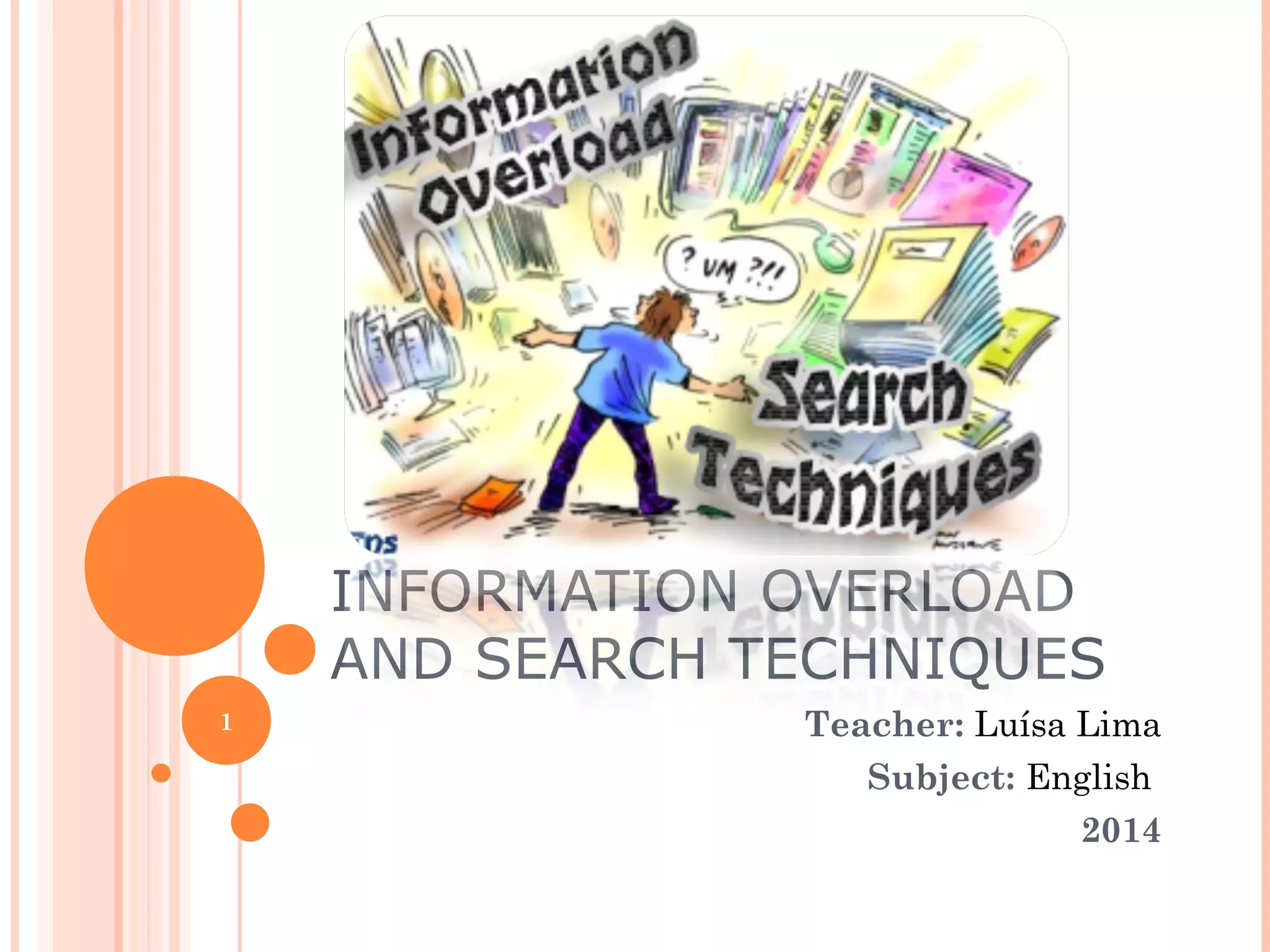

INFORMATION OVERLOAD
AND SEARCH TECHNIQUES
1

Teacher: Luísa Lima
Subject: English
2014
WHAT IS INFORMATION
OVERLOAD?
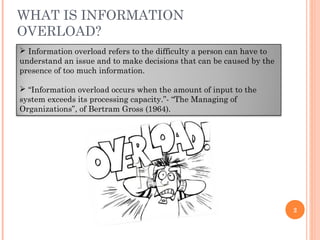
 Information overload refers to the difficulty a person can have to
understand an issue and to make decisions that can be caused by the
presence of too much information.
 “Information overload occurs when the amount of input to the
system exceeds its processing capacity.”- “The Managing of
Organizations”, of Bertram Gross (1964).

2
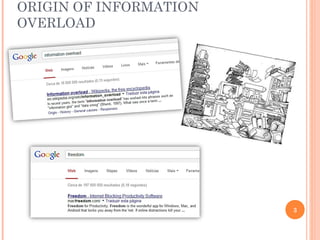
ORIGIN OF INFORMATION
OVERLOAD

3
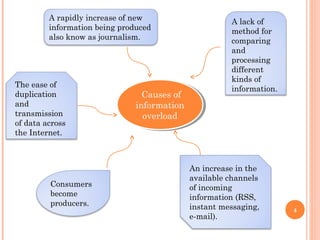
A rapidly increase of new
information being produced
also know as journalism.

The ease of
duplication
and
transmission
of data across
the Internet.

Consumers
become
producers.

Causes of
Causes of
information
information
overload
overload

A lack of
method for
comparing
and
processing
different
kinds of
information.

An increase in the
available channels
of incoming
information (RSS,
instant messaging,
e-mail).

4
IS INFORMATION OVERLOAD
KILLING YOUR PRODUCTIVITY?
* Linsday Broder published on FOXBusiness: “According to a
LexisNexis International Workplace Productivity Survey , “a majority of
workers in every market (62%, on average) admit that the quality of their
work suffers at times because they can’t sort through the information they
need fast enough.” ”
* She also say: “prioritize your information into three categories: must know,
should know and nice to know.”

5
6
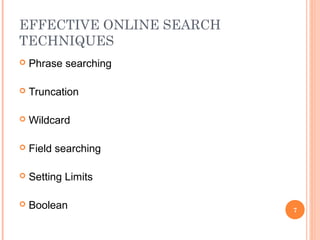
EFFECTIVE ONLINE SEARCH
TECHNIQUES


Phrase searching



Truncation



Wildcard



Field searching



Setting Limits



Boolean

7
SEARCH TECHNIQUES


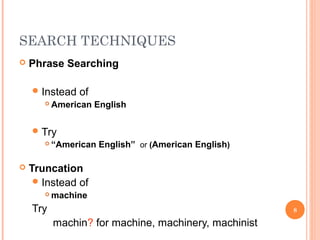
Phrase Searching
 Instead


of

American English

 Try




“American English” or (American English)

Truncation
 Instead of


machine

Try

8

machin? for machine, machinery, machinist
SEARCH TECHNIQUES
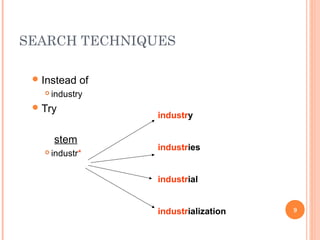
 Instead


of

industry

 Try

stem


industr*

industry
industries
industrial
industrialization

9
SEARCH TECHNIQUES
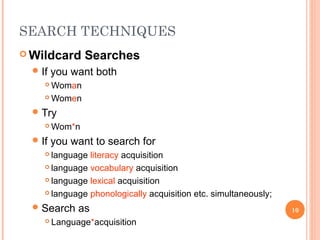
 Wildcard
 If

Searches

you want both

Woman
 Women


 Try


 If

Wom*n

you want to search for

language literacy acquisition
 language vocabulary acquisition
 language lexical acquisition
 language phonologically acquisition etc. simultaneously;


 Search


as

Language*acquisition

10
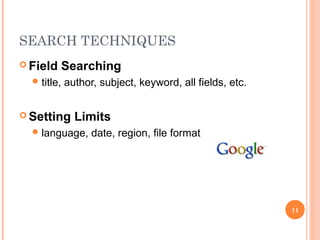
SEARCH TECHNIQUES
 Field
 title,

Searching
author, subject, keyword, all fields, etc.

 Setting

Limits

 language,

date, region, file format

11
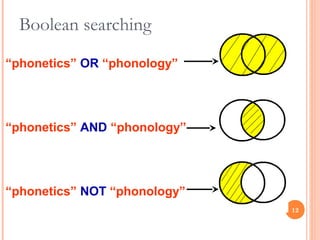
Boolean searching
“phonetics” OR “phonology”

“phonetics” AND “phonology”

“phonetics” NOT “phonology”
12
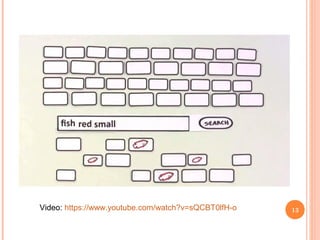
Video: https://www.youtube.com/watch?v=sQCBT0lfH-o

13
WEBGRAPHY

• http://en.wikipedia.org/wiki/Information_overload
•
http://www.foxbusiness.com/personal-finance/2013/09/25/is-information-overload-kil

•
http://truthpouredout.com/wp-content/uploads/2013/11/0511-1009-1319-0462_Black_
•
http://allantyoung.com/wp-content/uploads/2008/04/informationoverloadcartoon.jpg
• http://www.toonpool.com/user/250/files/spam_19825.jpg
• http://www.internetsegura.pt/files/thumb/103/300
• http://4.bp.blogspot.com/_jwn6NxywDU/TG3Ya_alpMI/AAAAAAAABag/MUgP5P9hZS4/s400/motores-debusca.jpg
• http://4.bp.blogspot.com/sFs0m_qF6q8/T89W20uvPlI/AAAAAAAAADA/HSy0srnd6Zg/s1600/MOTO
RES.gif
• http://rtiweb.net/images/solucoes/motores%20de%20busca.jpg
14
• http://www-beta.statcounter.com/images/screenshots/search-engines.png

Information overload and search techniques