Afghanistan Research and Evaluation Unit
Case Study Series
Afghanistan Research and Evaluation Unit
Women’s Economic Empowerment in
Afghanistan 2002-2012
Information Mapping
JULY 2013		
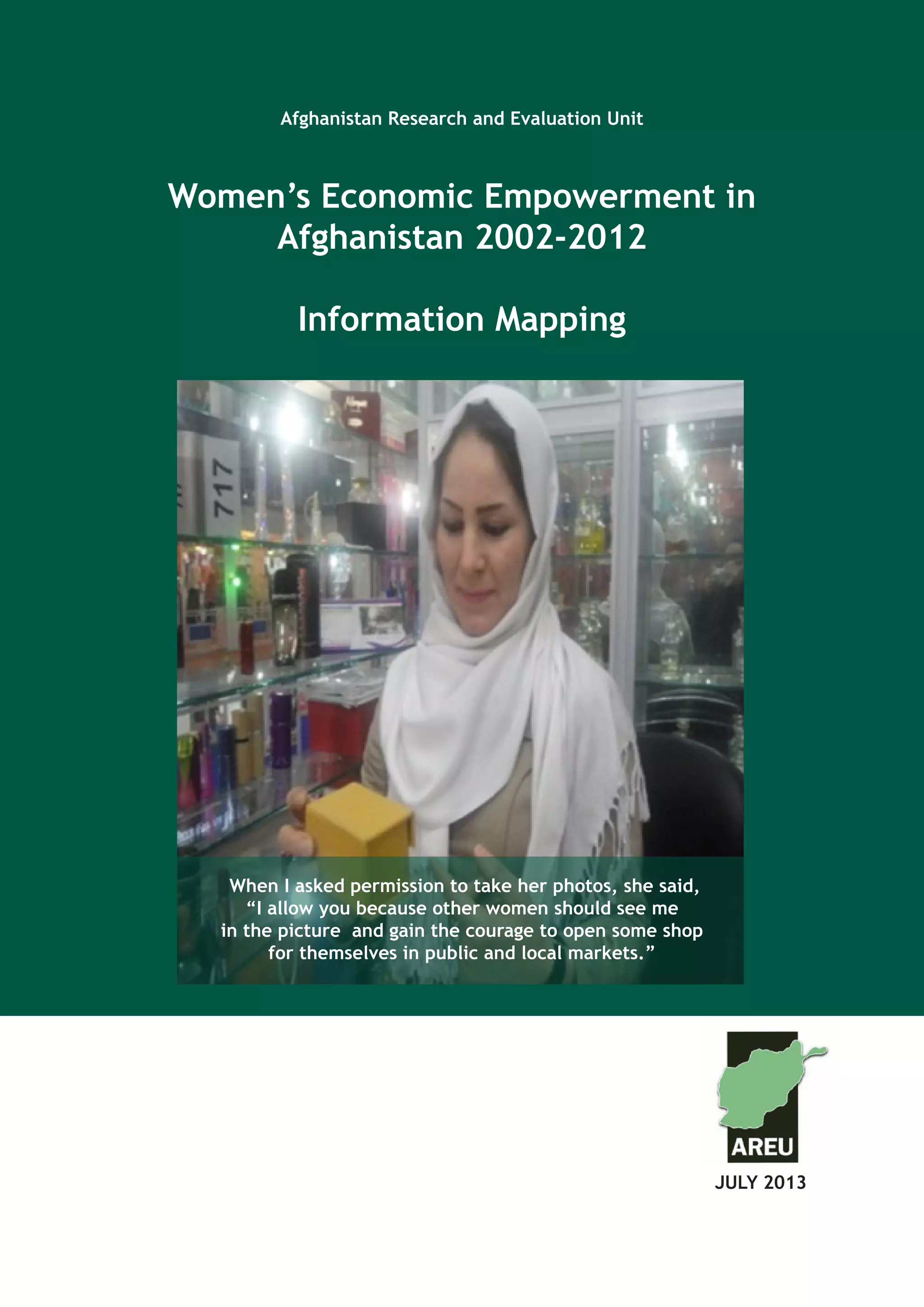
When I asked permission to take her photos, she said,
“I allow you because other women should see me
in the picture and gain the courage to open some shop
for themselves in public and local markets.”
July 2013
Women’s Economic Empowerment
in Afghanistan, 2002 - 2012
Information Mapping
Afghanistan Research and Evaluation Unit
Dr. Lena Ganesh
with
Massouda Kohistani
Rahim Azami
Dr. Rebecca L. Miller
This research was
funded by the UN
Women Afghanistan
Country Office
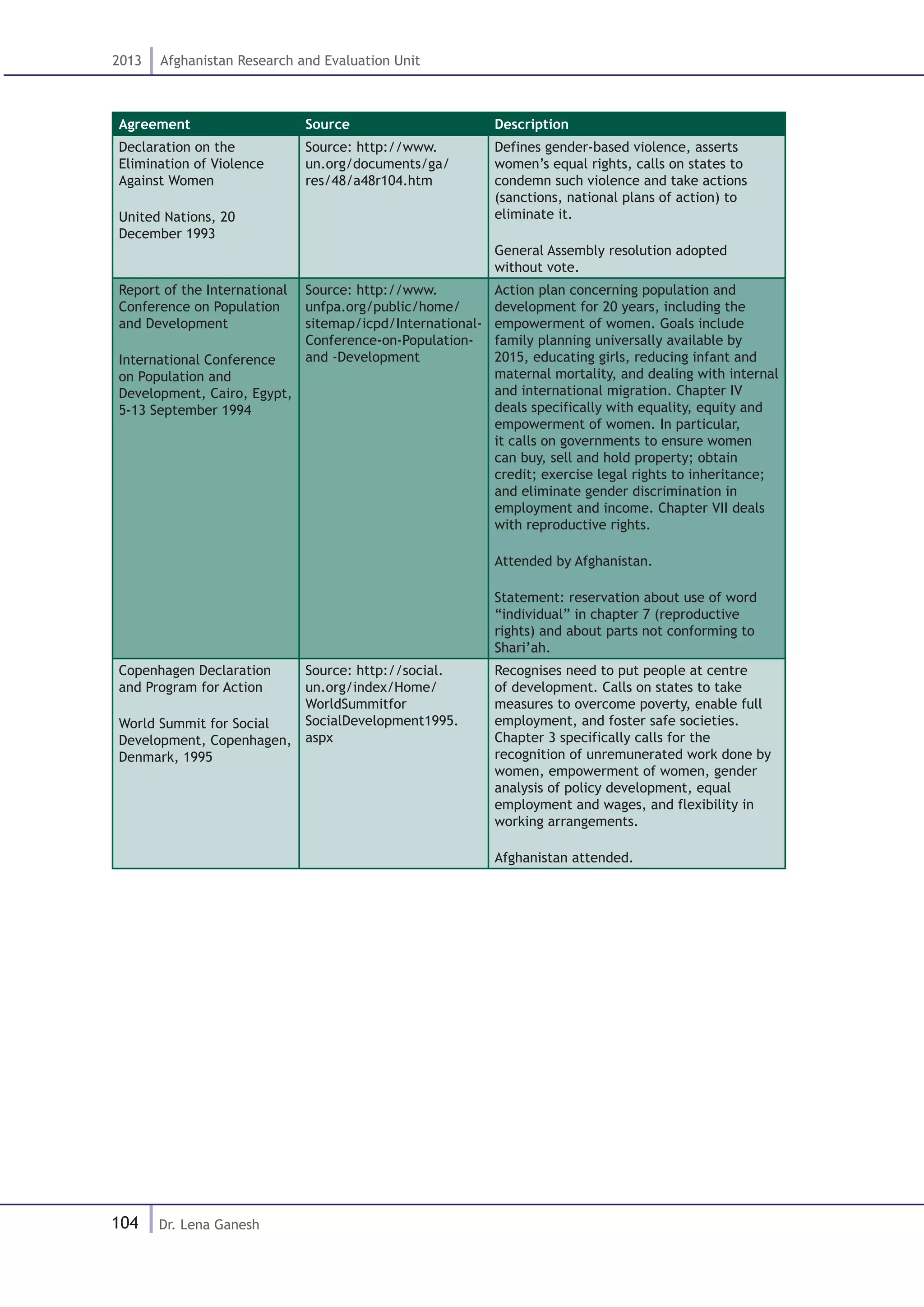
2013 Afghanistan Research and Evaluation Unit
Dr. Lena Ganesh
Editing: 			 Brandy Bauer
Design and layout: 		 Michael Monts
Cover Photograph: 		 Photo taken by Massouda Kohistani, Shahr-i-Naw, Kabul
AREU Publication Code: 	 1311
© 2013 Afghanistan Research and Evaluation Unit. The opinions expressed in this publication
are those of the author and do not necessarily reflect those of AREU. Some rights are reserved.
This publication may be reproduced, stored in a retrieval system or transmitted only for non-
commercial purposes and with written credit to AREU and the author. Where this publication is
reproduced, stored or transmitted electronically, a link to AREU’s website (www.areu.org.af)
should be provided. Any use of this publication falling outside of these permissions requires prior
written permission of the publisher, the Afghanistan Research and Evaluation Unit. Permission can
be sought by emailing areu@areu.org.af or by calling +93 (0) 799 608 548.
v
Afghanistan Research and Evaluation Unit 2013
Information Mapping Women’s Economic Empowerment in Afghanistan, 2002 - 2012
.... with the hope of a peaceful Afghanistan amid the problems that we have,
may there come a day in our life
that there should be an Afghanistan without violence,
without weapons, without cultivating poppy,
without crime and kidnappings, ...
we are in this hope so that merciful Allah do mercy on our people
so that the people themselves bring some changes
because I don’t think that an angel is coming to help us
or others will bring change to us and
it has been proved that no one can bring changes but we ourselves,
as there is a holy Ayah
which says that Allah will never bring changes to a nation until they don’t bring it themselves,
till we don’t try and start working ....
but unless we take courage in our hands and build this country
then no foreigner can ever bring changes.
And there is nothing else to say.
Representative, Ministry of Hajj and Religious Affairs,
Government of the Islamic Republic of Afghanistan, AREU interview, 31 December 2012
vi
2013 Afghanistan Research and Evaluation Unit
Dr. Lena Ganesh
About the Author
Dr Lena Ganesh is an anthropologist researching and working on gender, including gender
in areas of armed conflict. An architect with professional experience in the media, her
other areas of research experience and interest are violence against women, gendered
exclusion within traditional hierarchical social structures and the historical and extant
gendered uses of space.
About the Afghanistan Research and Evaluation Unit
The Afghanistan Research and Evaluation Unit (AREU) is an independent research
institute based in Kabul. AREU’s mission is to inform and influence policy and practice
through conducting high-quality, policy-relevant research and actively disseminating the
results, and to promote a culture of research and learning. To achieve its mission AREU
engages with policymakers, civil society, researchers and students to promote their use
of AREU’s research and its library, to strengthen their research capacity, and to create
opportunities for analysis, reflection and debate.
AREU was established in 2002 by the assistance community working in Afghanistan and
has a board of directors with representation from donors, the United Nations and other
multilateral agencies, and non-governmental organisations. AREU currently receives core
funds from the Embassy of Finland, the Swedish International Development Cooperation
Agency (SIDA), and the Swiss Agency for Development and Cooperation (SDC).
Specific projects in 2013 are currently being funded by the European Commission (EC), the
Swiss Agency for Development and Cooperation (SDC), the Overseas Development Institute
(ODI), the United Nations Development Programme (UNDP), the United Nations High
Commissioner for Refugees (UNHCR), the UN Women, as well as the Embassy of Finland.
AREU would like to extend special thanks to UN Women for making this publication
possible. In particular considerable gratitude is due to Dr Mamadou Bobo Diallo,
Economic Specialist, UN Women HQ New York and Mr. Asela Kalugampitiya, along with
Rim Aljabi and Hassan Fahimi of UN Women Afghanistan, for their inputs in reviewing
the paper. Finally, we would like to express our sincere appreciation to Anil Chandrika,
WESR Specialist at UN Women for his tireless efforts and dedication to this project.
vii
Afghanistan Research and Evaluation Unit 2013
Information Mapping Women’s Economic Empowerment in Afghanistan, 2002 - 2012
Preface
In the recent socio-economic culture of Afghanistan, as in most countries since the
Industrial Revolution’s introduction of the artificial division between production and
reproduction, women’s participation in the labour economy—whether reproductive or
productive—has been invisible and unaccounted for in much policy-making, planning and
budgeting. In parallel, socio-cultural practices specific to Afghanistan that have often
been an uncertain mix between the Shari’at code and those customary laws followed by
different ethnicities and tribes have adversely affected the living conditions of women
and girls. As a consequence too, women’s practical and strategic needs have not been
addressed by consecutive regimes, nor has the discourse of women’s human rights
percolated through much of the more recent rhetoric around “gender empowerment” to
materially and politically improve the lives of women and girls in Afghanistan.
This report looks at the current economic status of women in Afghanistan. It introduces
and contextualises the ways in which women’s economic activities have been addressed
and provides an assessment of the policies, laws and strategies drafted by the
Government of Afghanistan for enhancing women’s economic empowerment. It does
this through a listing and analysis of surveys, reports, projects and research undertaken
and implemented by the government, multilateral international agencies, national non-
governmental organisations and individual researchers on women’s economic activities.
This is juxtaposed with an assessment of the status of women’s human rights and the
ways in which women’s access to education, health, safety and public participation
have been enhanced in the past decade. As a parallel tool in understanding the whole, it
points to some strategies and methods that have been successful provincially, nationally
and internationally in mitigating some of the disempowerment that traditionally placed
power structures continue to effect.
The report concludes with recommendations evolving from the analysis and offers an
understanding of the ways in which policies and processes can often work in limited
and limiting ways in programming and implementation. While streamlining can offer
greater efficiency, there is a need for greater emphasis on effective and accountable
programming for longer-term strategies that could offer a more sustainable environment
for the economic empowerment of women in Afghanistan. This is all the more urgent
given the impending transition of security responsibilities and its associated legitimate
concerns on the bartering away of women’s recently (re)gained rights to placate
conservative factions in peace negotiations. The programming and utilisation of resources
could be better sensitised towards a cogent gender-oriented strategy that contributes
concretely to women’s equal participation in the development of Afghanistan, and
equally importantly, as equal citizens of the Islamic Republic of Afghanistan.
viii
2013 Afghanistan Research and Evaluation Unit
Dr. Lena Ganesh
Acknowledgements
This research is indebted to Massouda Kohistani, Rahim Azami and Roya Mahtabi, without
whose dedication and research skills, much orientation would have been lost. Their
tenacity in identifying appropriate individuals and representatives in organisations and
the government and their persistence in the often burdensome task of following up with
them contributed immensely to this report, as have their field notes, observation and
many other aspects of research. Thanks are also due to Mahdi Mosawi for his contributions
to the first phase of this project. The hard work put in by Ehsan Khamosh, Abdullah Azizi,
Hoshem Sidiqi, Homayun Rahimi and Ibrahim Amiri, in translating and transcribing the
interviews, remains invaluable.
Particular gratitude is owed to Dr Rebecca L. Miller for her patience in gathering
information and for her skills in data collation.
I would like to express my deep appreciation of my other colleagues in AREU, in
particular Nasrullah Baqaie, Ghulam Rasool, Ghulam Ali, Saidajan Sarwari, Parvez Azizi
and Atiqullah Shahnan for accommodating the team’s logistical needs and to Raqimajan
and Simagulljan for their many kindnesses. Dr Chona Echavez’s cheer and guidance
through this project has been invaluable.
Thanks are due to the many respondents who gave their time and proffered information.
Their opinions and views on women’s empowerment in Afghanistan form the bedrock of
this research. In particular, the female participants of the projects under study and the
men and women of their families and communities provided invaluable information on the
ways in which women and women’s economic empowerment are seen in society. In tandem,
I thank the representatives of those organisations which implemented these projects and
those in various departments of the government who made available data and shared
their opinions on the ways in which structural processes direct women’s empowerment.
Finally, I express my gratitude to the reviewers of this report who so kindly took the time
and trouble to offer comments and suggestions in order to improve its quality and clarity.
Any mistakes and misinterpretations remain my responsibility.
Lena Ganesh
July 2013
Kabul, Afghanistan
ix
Afghanistan Research and Evaluation Unit 2013
Information Mapping Women’s Economic Empowerment in Afghanistan, 2002 - 2012
Table of Contents
Preface ..................................................................................... vii
Acknowledgements ...................................................................... viii
Glossary......................................................................................xi
Acronyms ................................................................................. xiii
Executive Summary ........................................................................ 1
1. Introduction ............................................................................. 5
1.1 Objective ............................................................................ 8
1.2 Methodology......................................................................... 9
1.3 International agreements and resolutions..................................... 11
1.4 National policy environment: strategies and laws ........................... 14
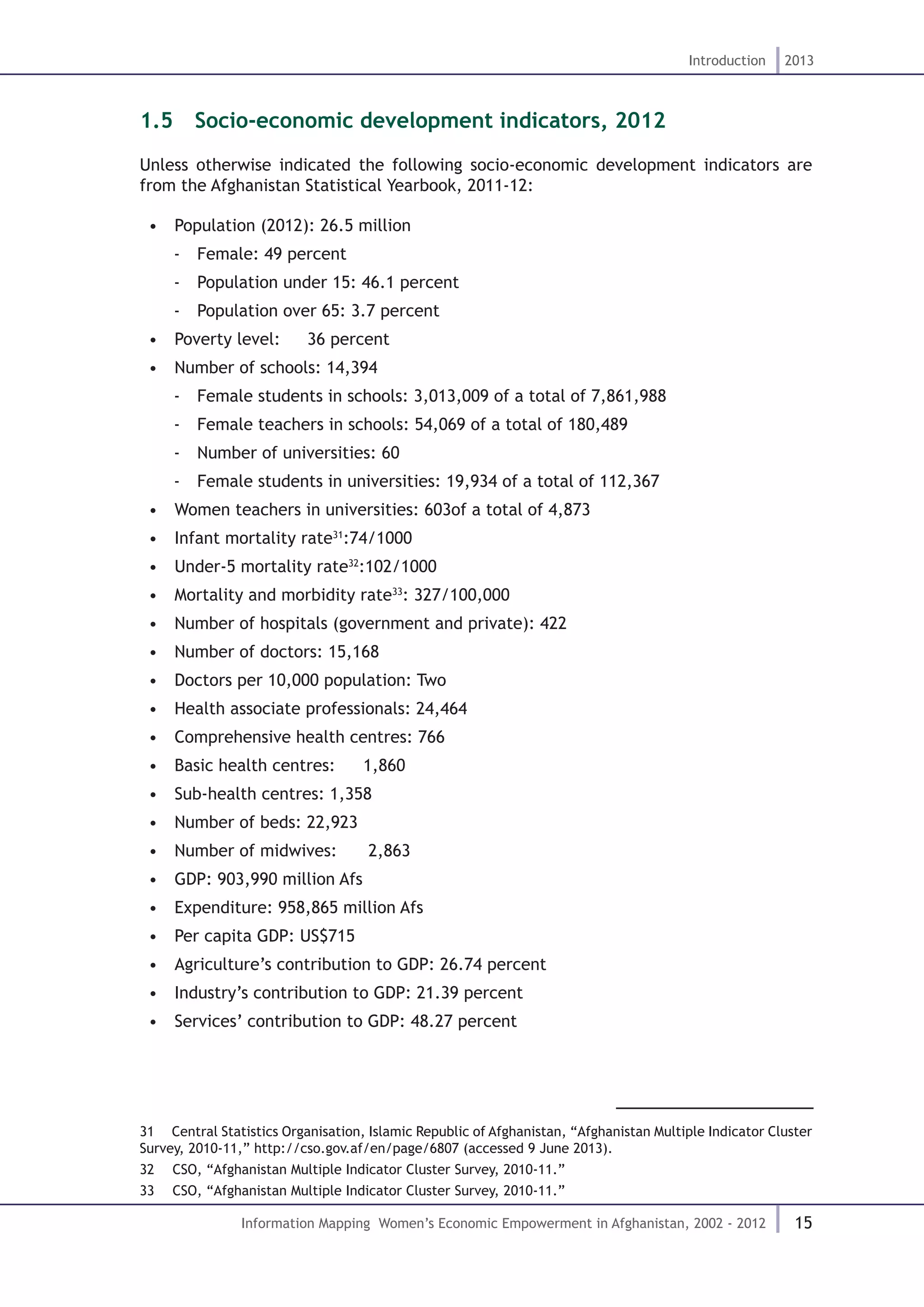
1.5 Socio-economic development indicators, 2012............................... 15
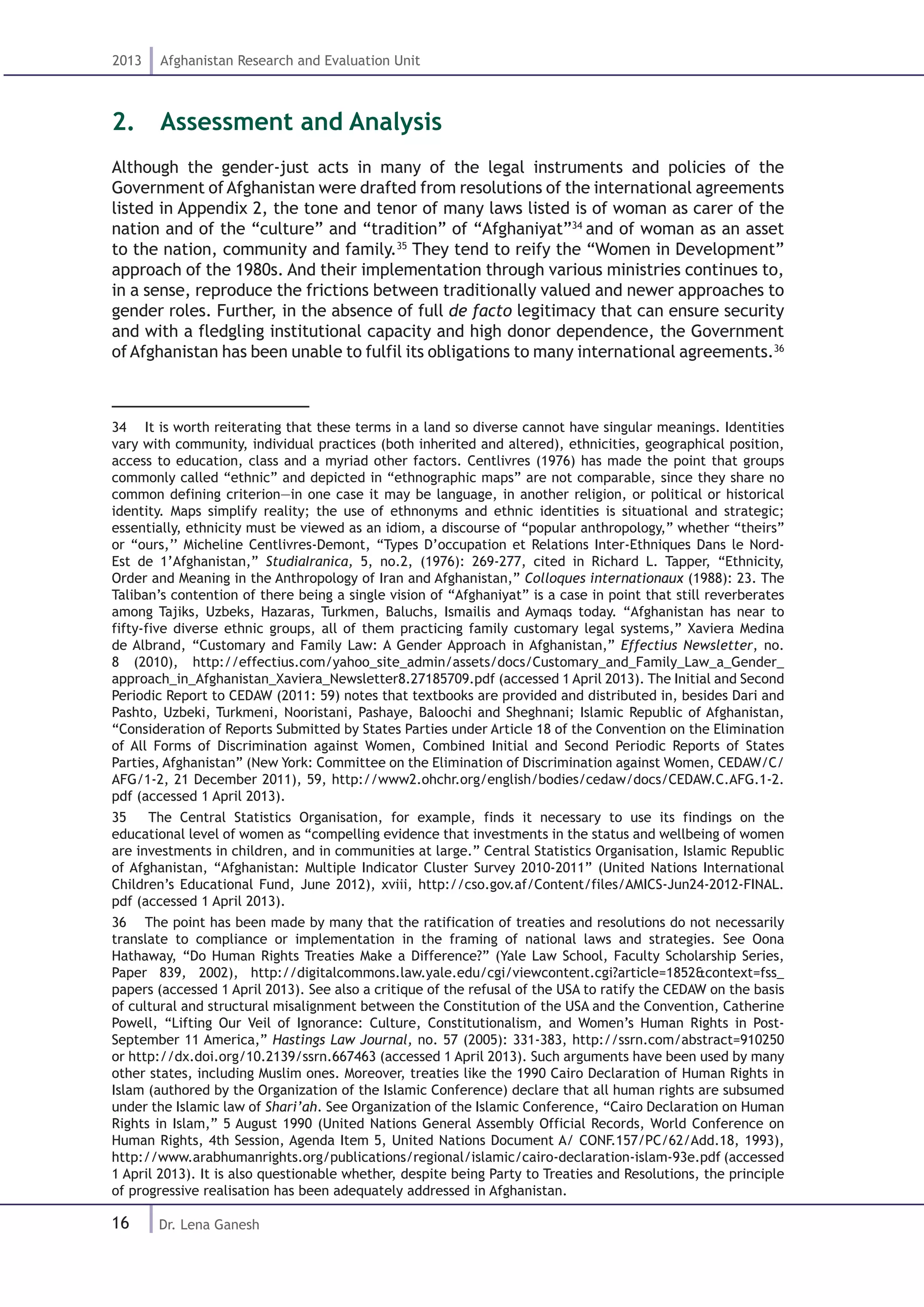
2. Assessment and Analysis.............................................................. 16
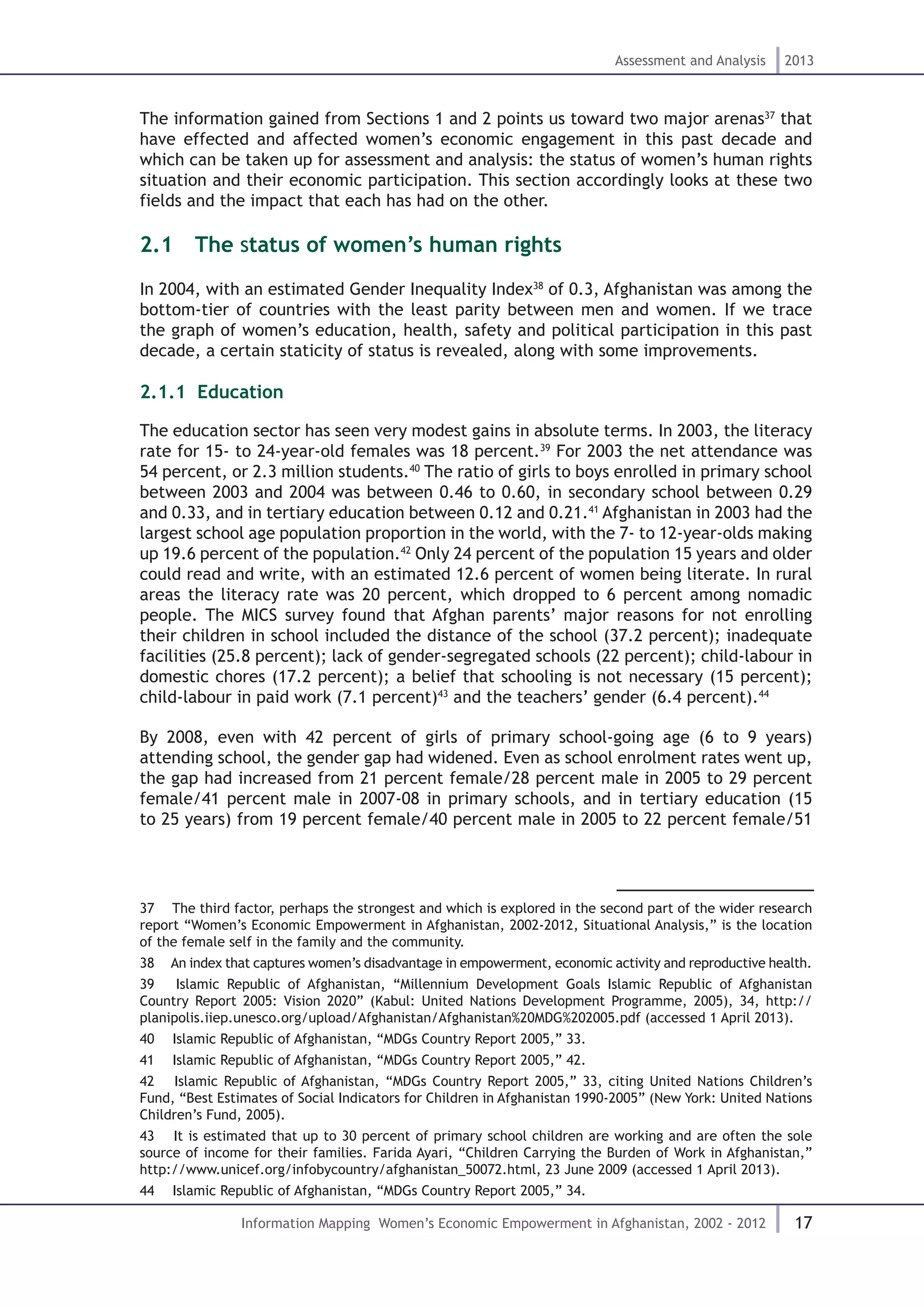
2.1 The status of women’s human rights........................................... 17
2.1.1 .Education ..................................................................... 17
2.1.2.Health.......................................................................... 20
2.1.3. Political and public participation ......................................... 24
2.1.4. Safety.......................................................................... 31
2.2 Women’s economic rights and empowerment ................................ 37
2.2.1 .Women’s labour participation .............................................. 39
2.2.2 .Sectors of women’s key participation, IGAs.............................. 41
2.2.3 .SMEs and women’s participation........................................... 49
2.2.4 .Networking across IGAs and SMEs .......................................... 56
2.3 Impacts of greater rights on economic opportunity .......................... 59
2.4 Summary.............................................................................. 76
3. Arenas for policy review ............................................................. 77
Appendices ................................................................................ 86
Bibliography ...............................................................................159
List of AREU Publications ...............................................................181
x
2013 Afghanistan Research and Evaluation Unit
Dr. Lena Ganesh
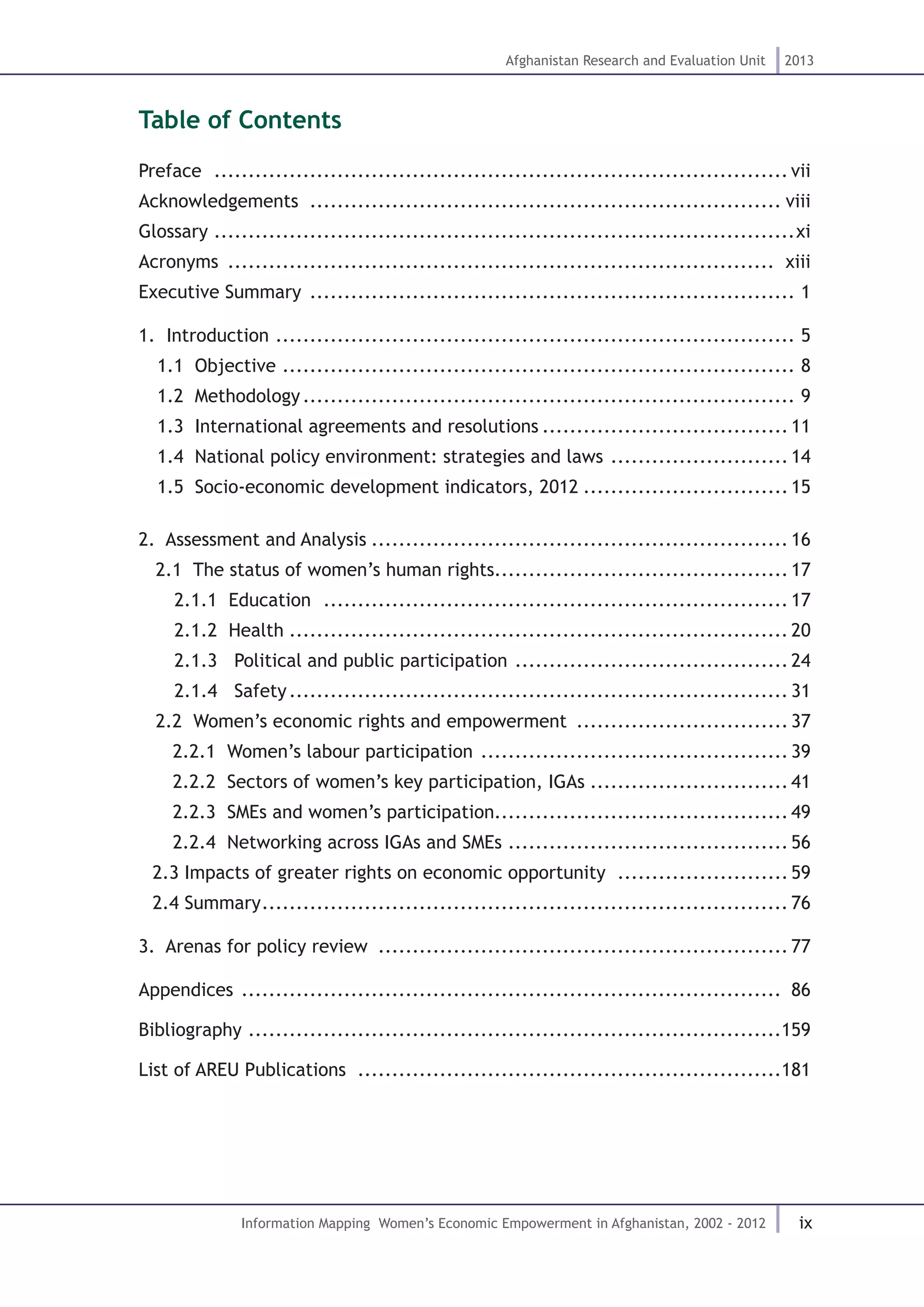
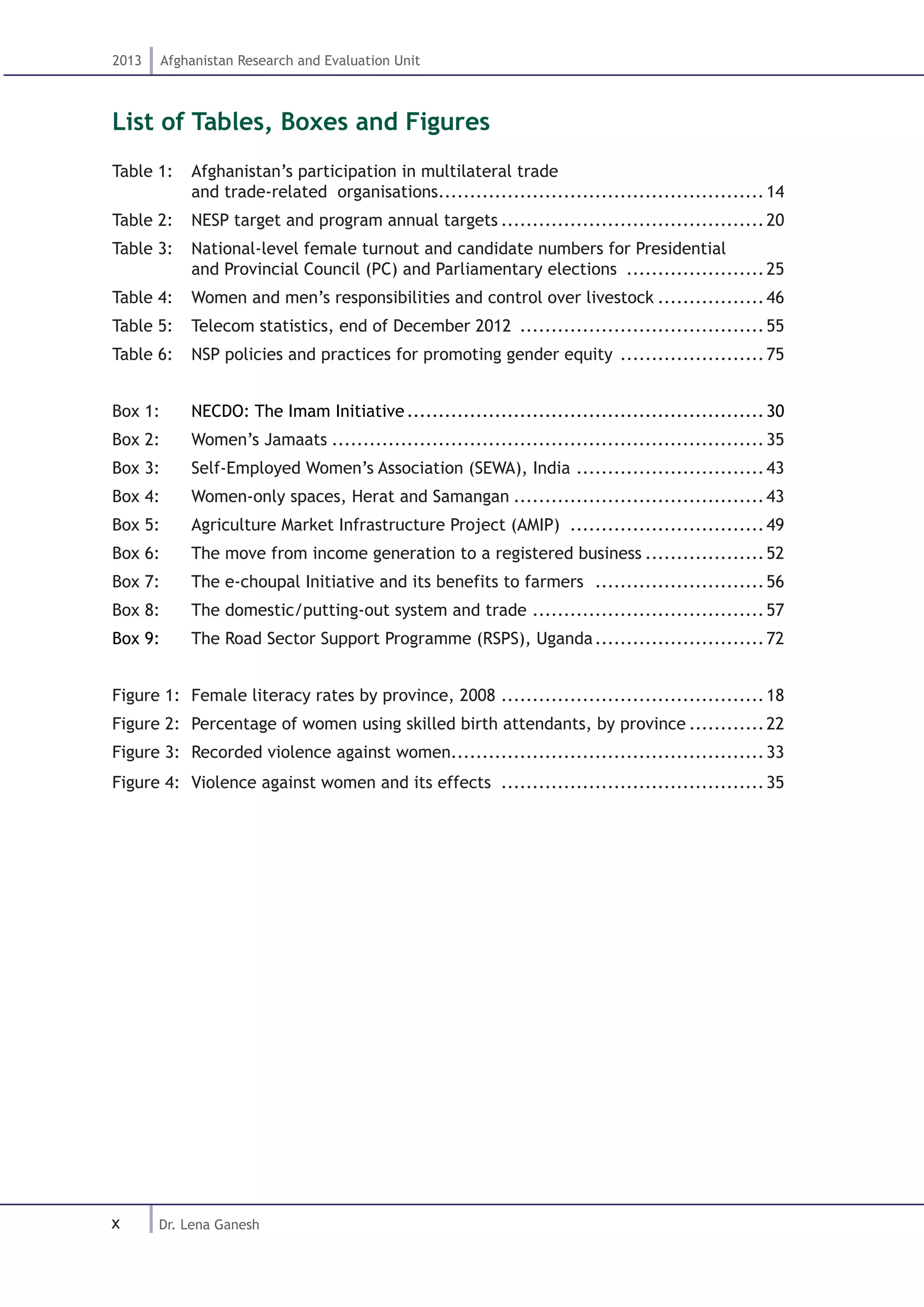
List of Tables, Boxes and Figures
Table 1: . Afghanistan’s participation in multilateral trade
and trade-related organisations.....................................................14
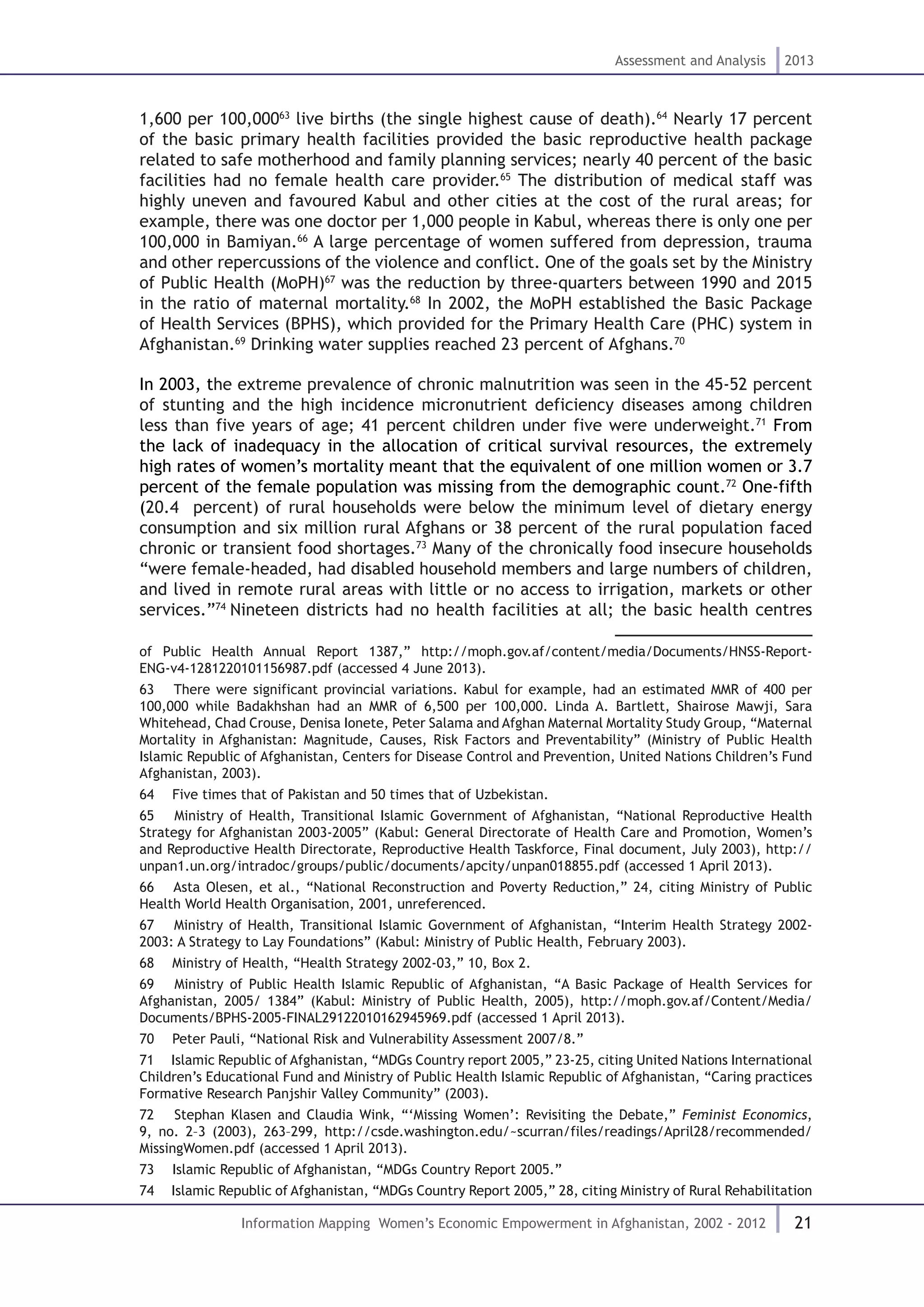
Table 2: . NESP target and program annual targets...........................................20
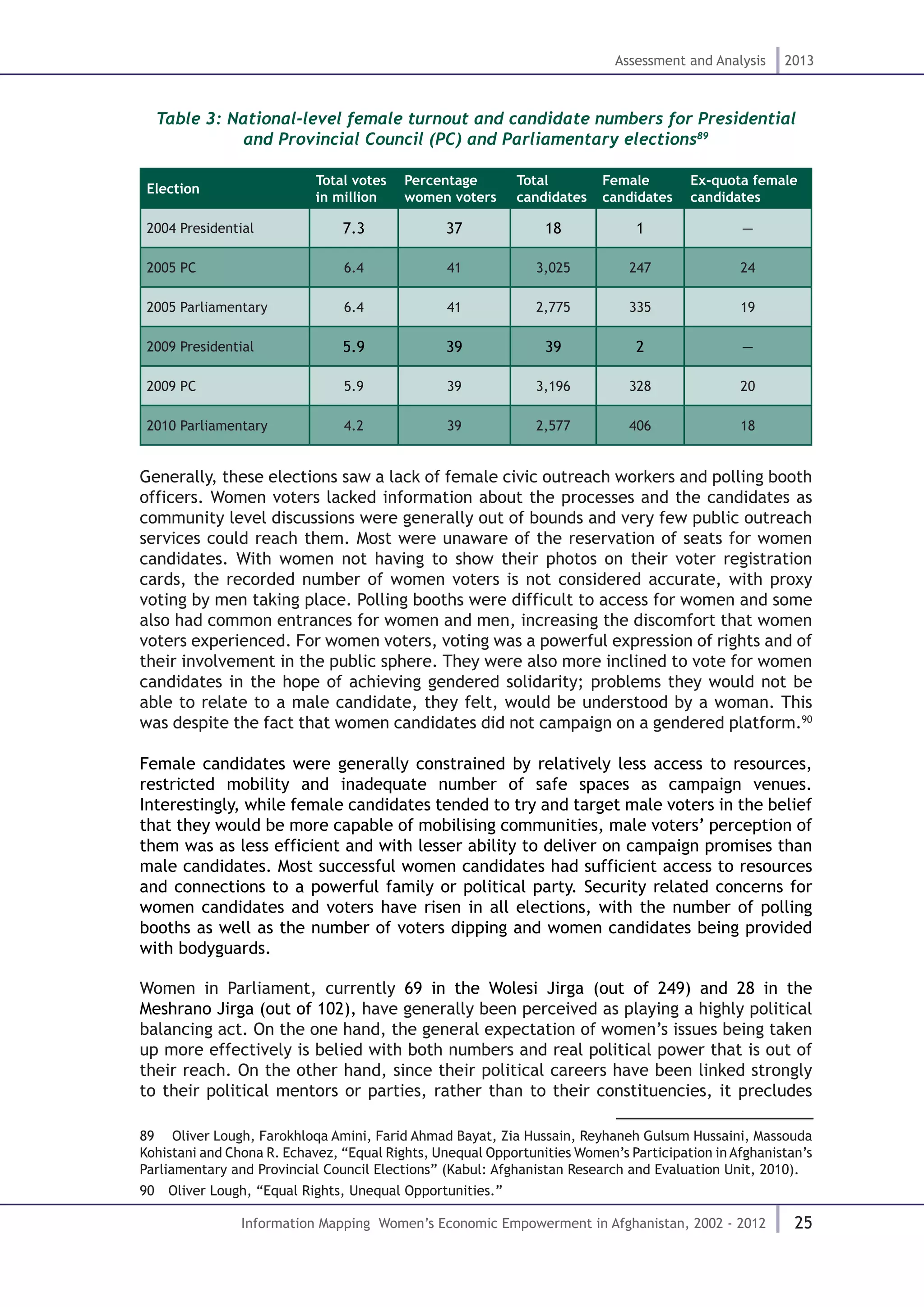
Table 3: . National-level female turnout and candidate numbers for Presidential
and Provincial Council (PC) and Parliamentary elections .......................25
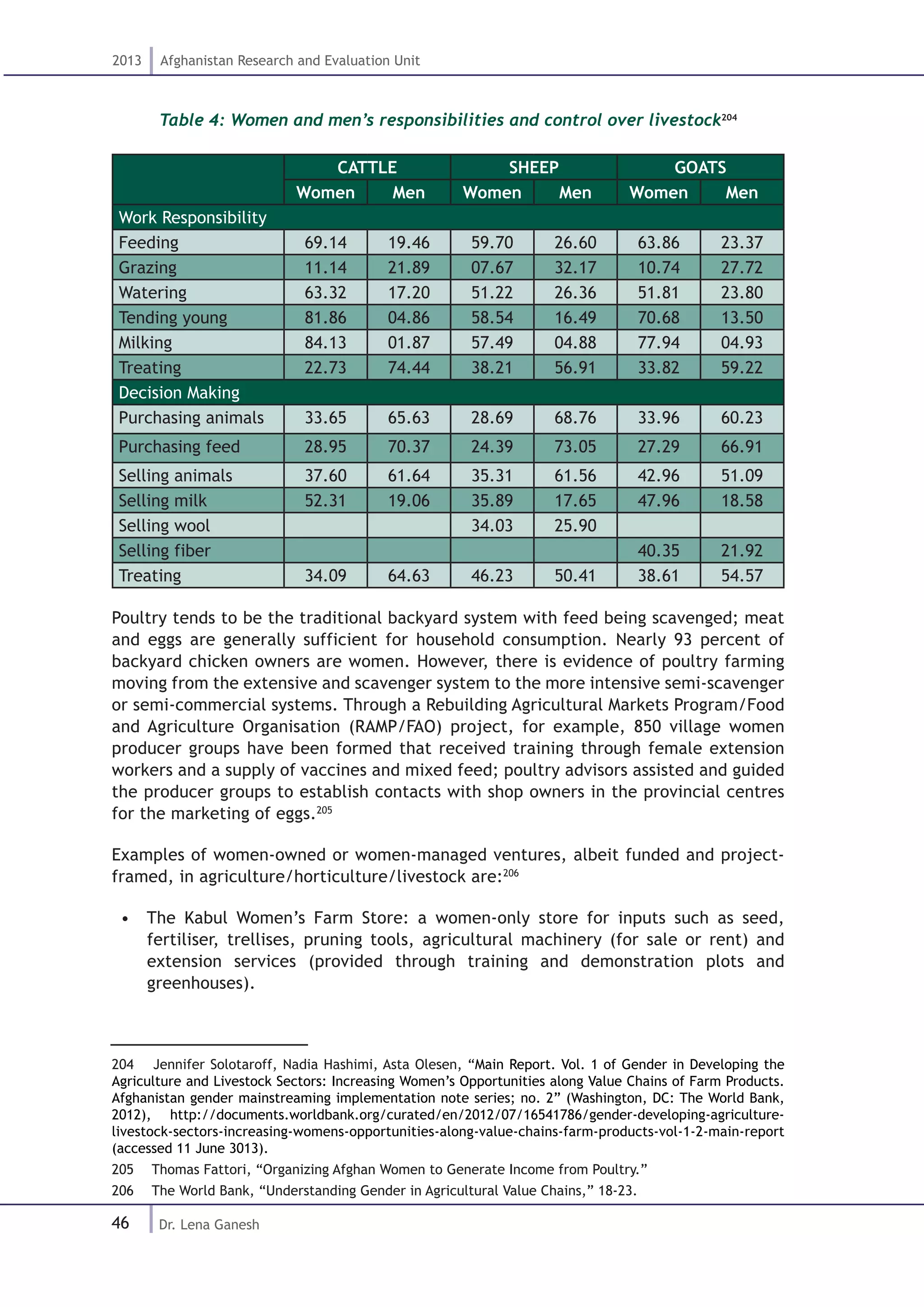
Table 4: . Women and men’s responsibilities and control over livestock..................46
Table 5: . Telecom statistics, end of December 2012 ........................................55
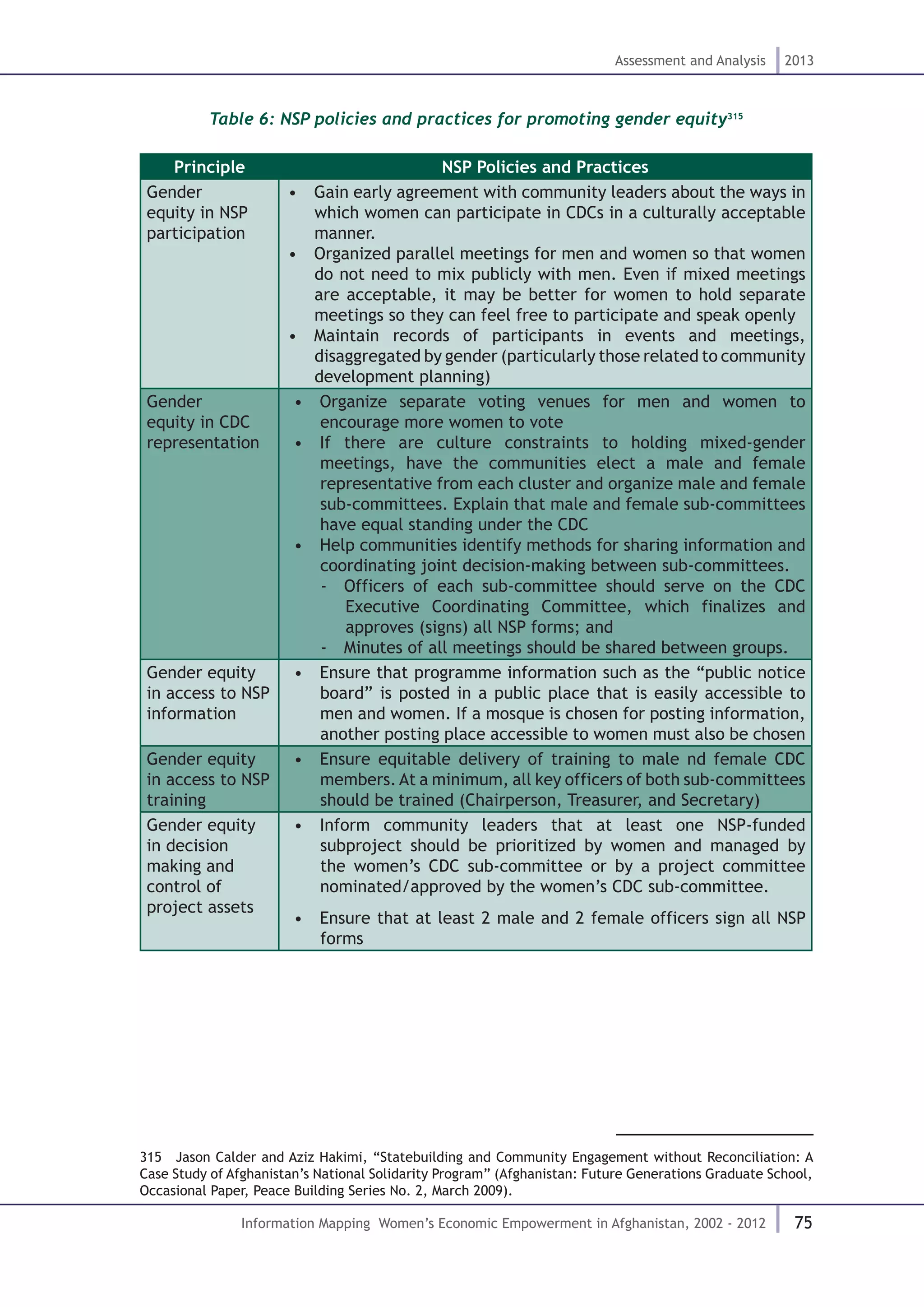
Table 6: . NSP policies and practices for promoting gender equity ........................75
Box 1: . NECDO: The Imam Initiative..........................................................30
Box 2: . Women’s Jamaats......................................................................35
Box 3: . Self-Employed Women’s Association (SEWA), India ...............................43
Box 4: . Women-only spaces, Herat and Samangan.........................................43
Box 5: . Agriculture Market Infrastructure Project (AMIP) ................................49
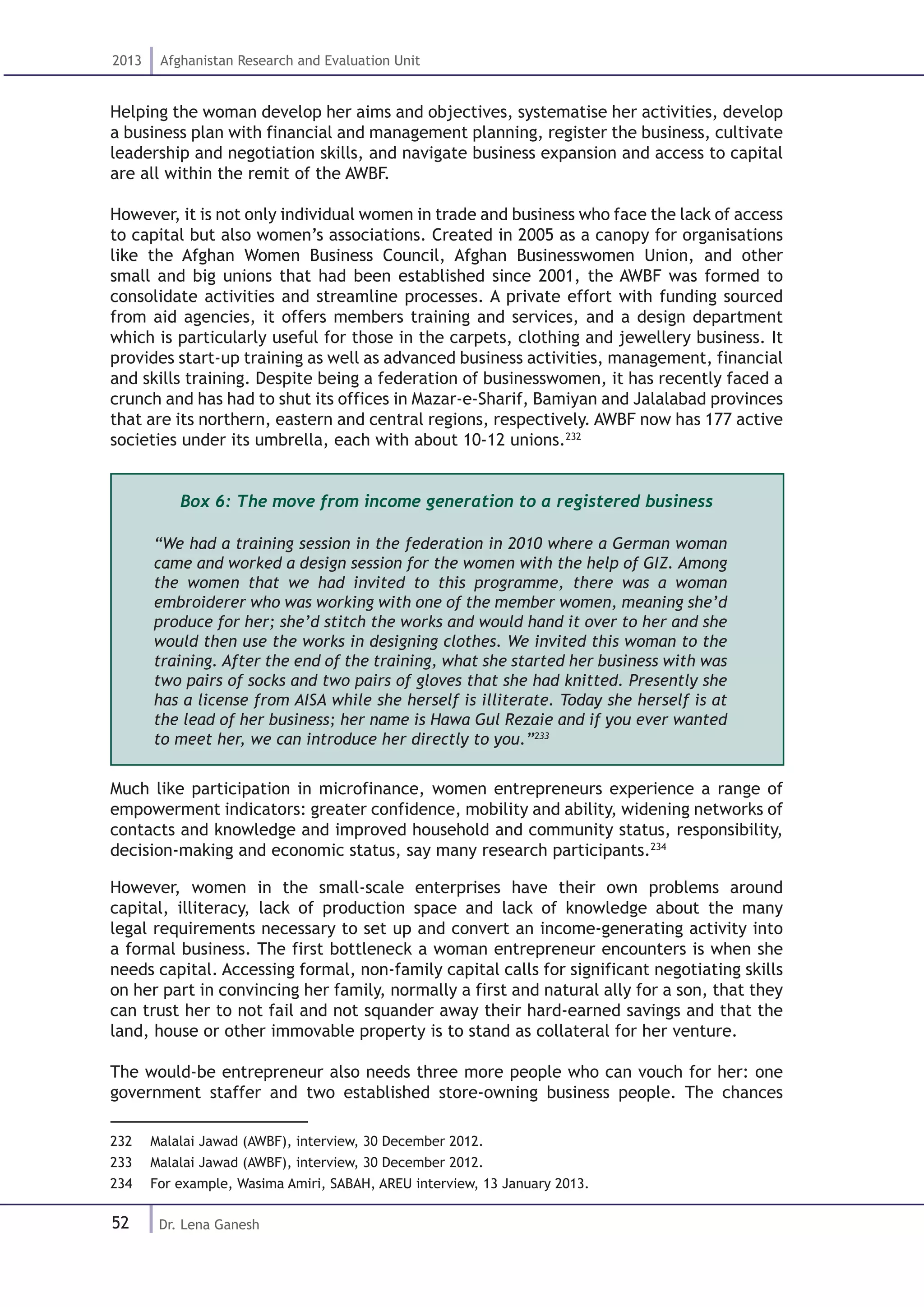
Box 6: . The move from income generation to a registered business....................52
Box 7: . The e-choupal Initiative and its benefits to farmers ............................56
Box 8: . The domestic/putting-out system and trade ......................................57
Box 9: . The Road Sector Support Programme (RSPS), Uganda............................72
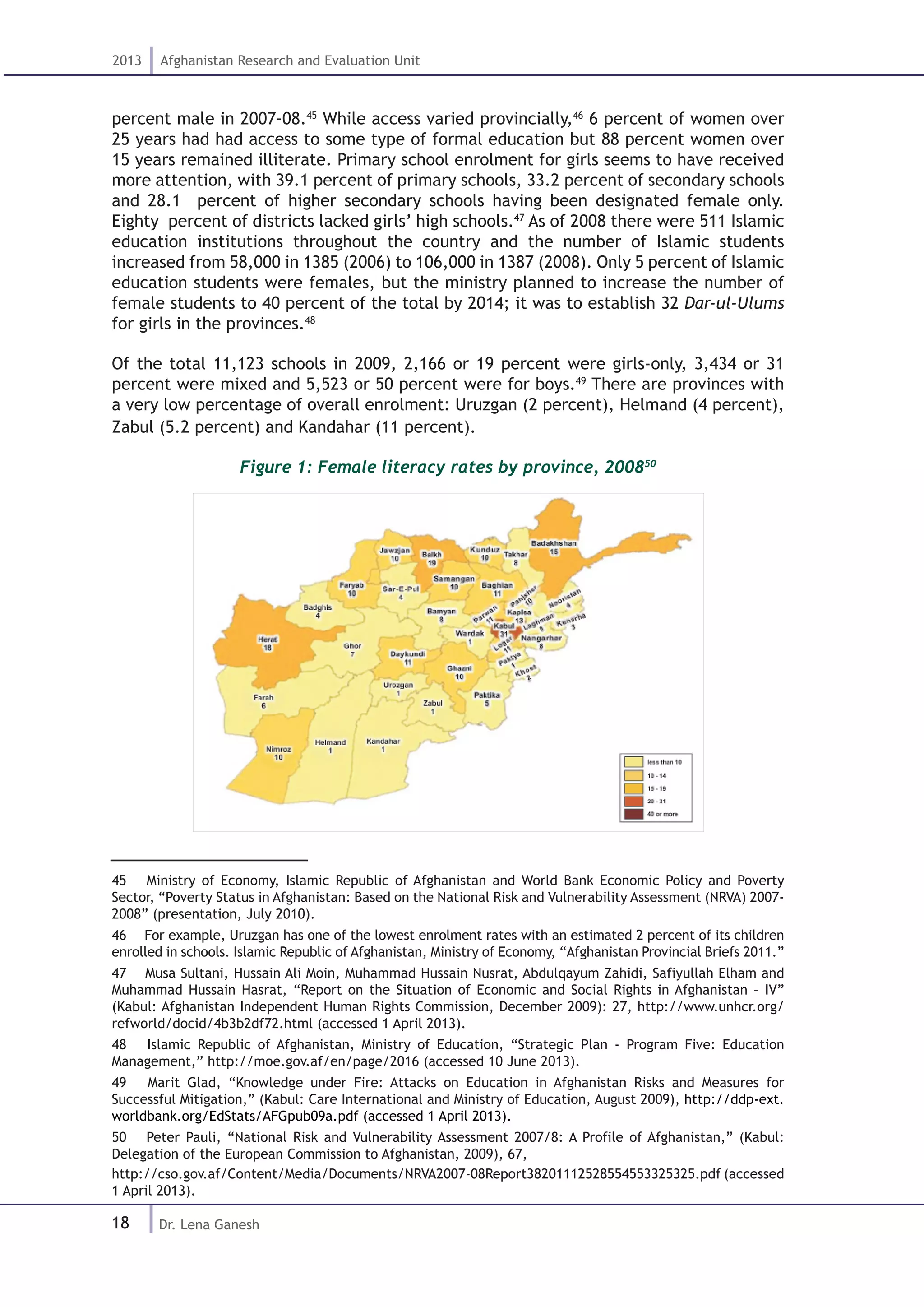
Figure 1: .Female literacy rates by province, 2008...........................................18
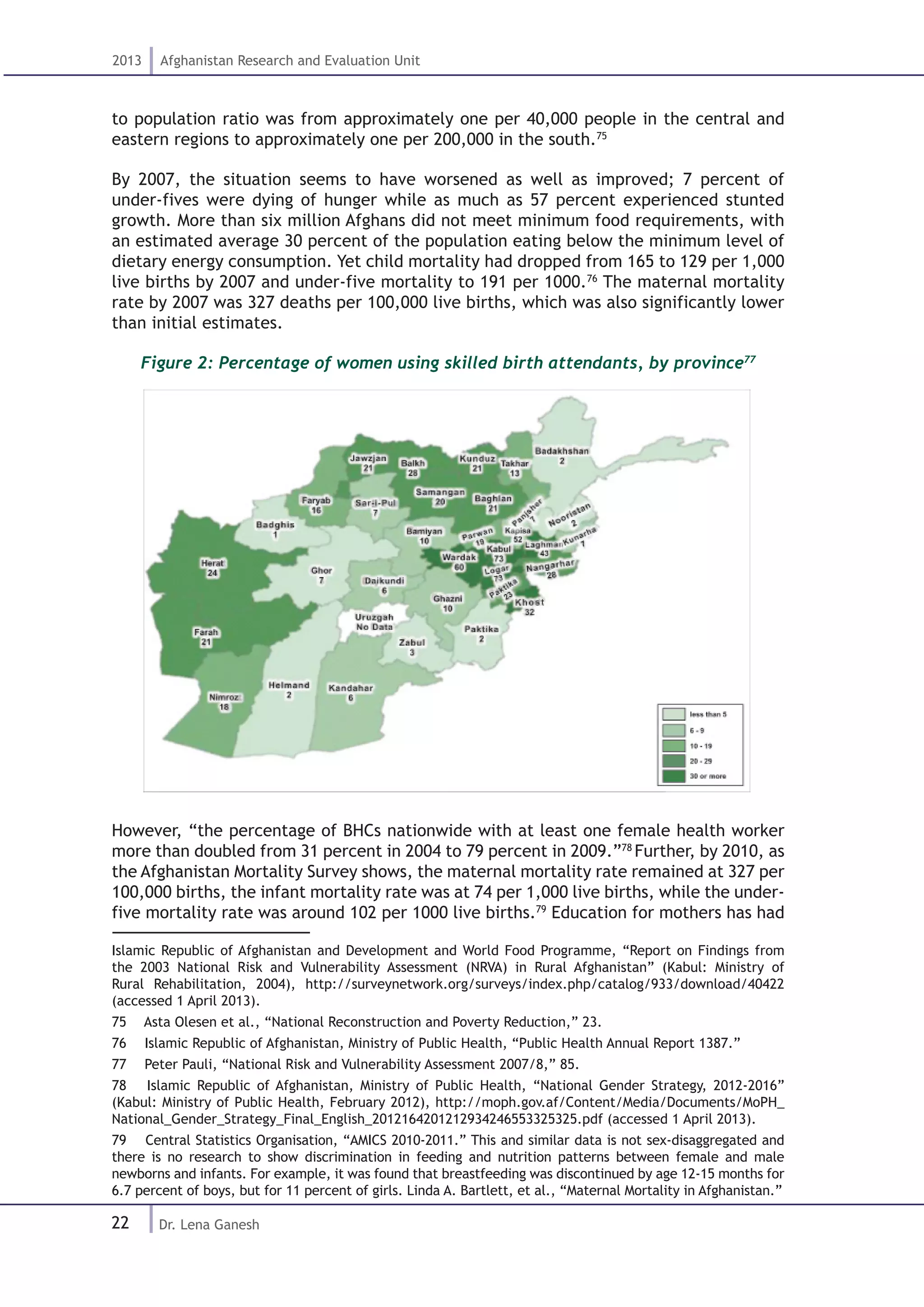
Figure 2: .Percentage of women using skilled birth attendants, by province.............22
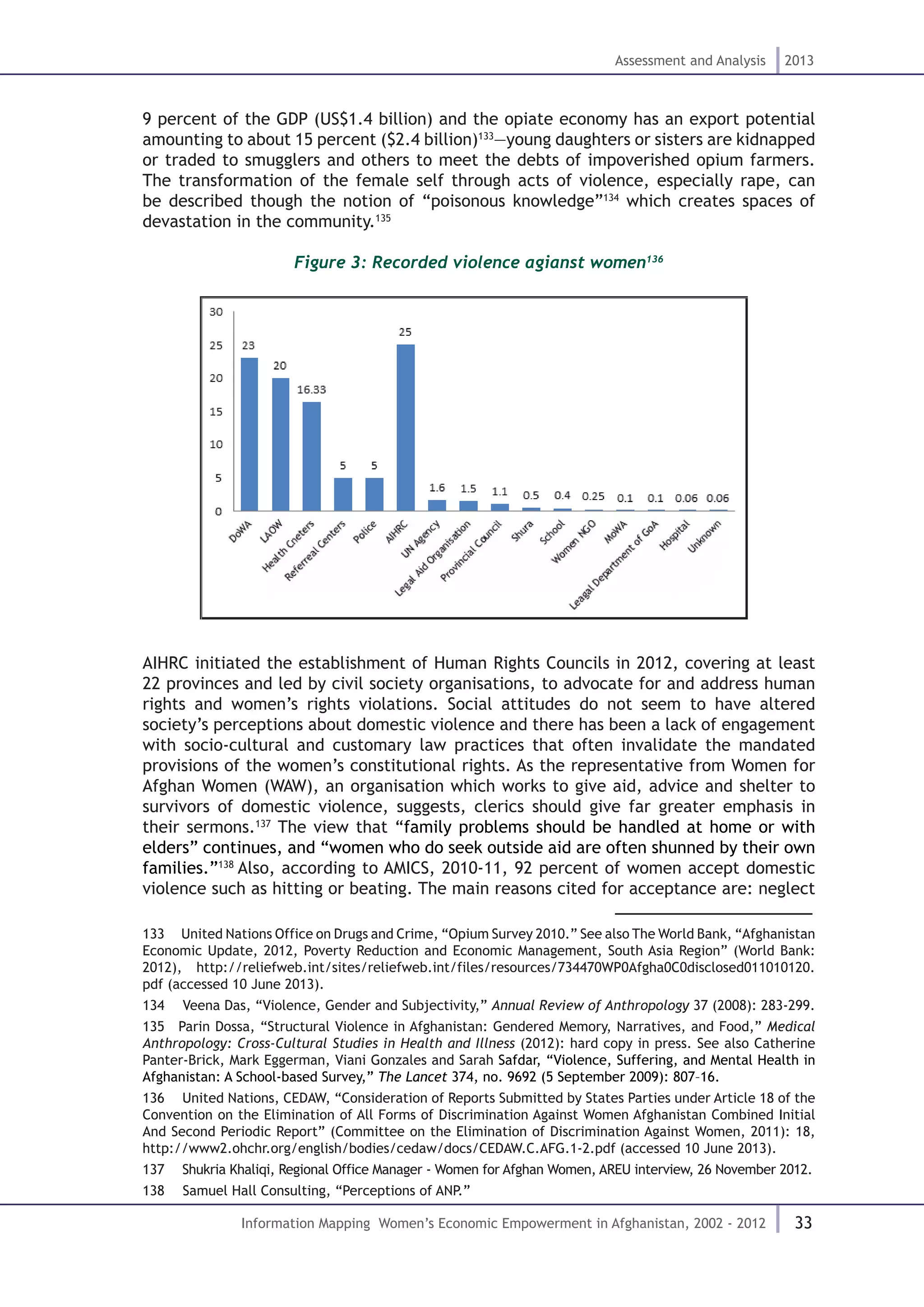
Figure 3: .Recorded violence against women..................................................33
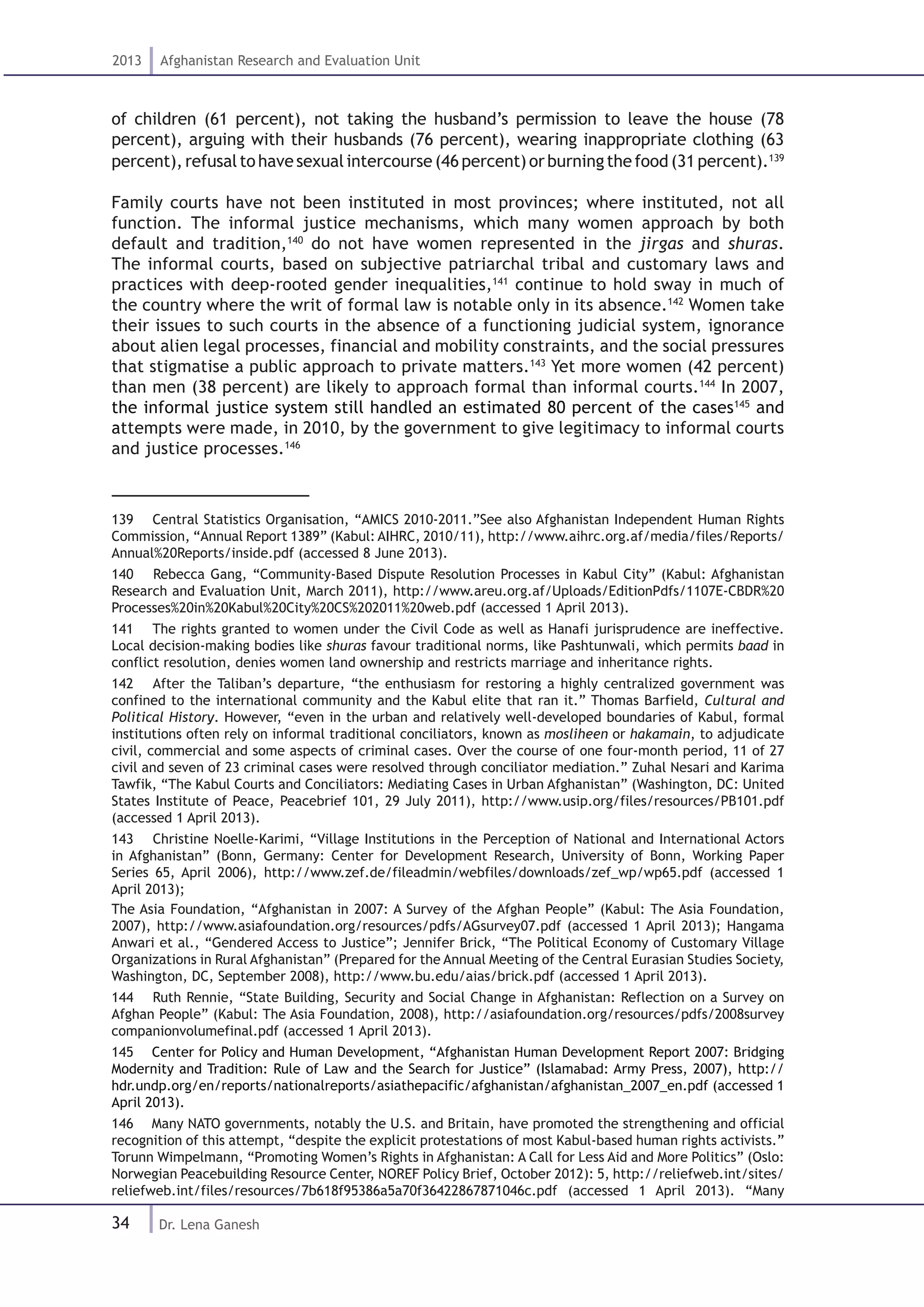
Figure 4: .Violence against women and its effects ...........................................35
xi
Afghanistan Research and Evaluation Unit 2013
Information Mapping Women’s Economic Empowerment in Afghanistan, 2002 - 2012
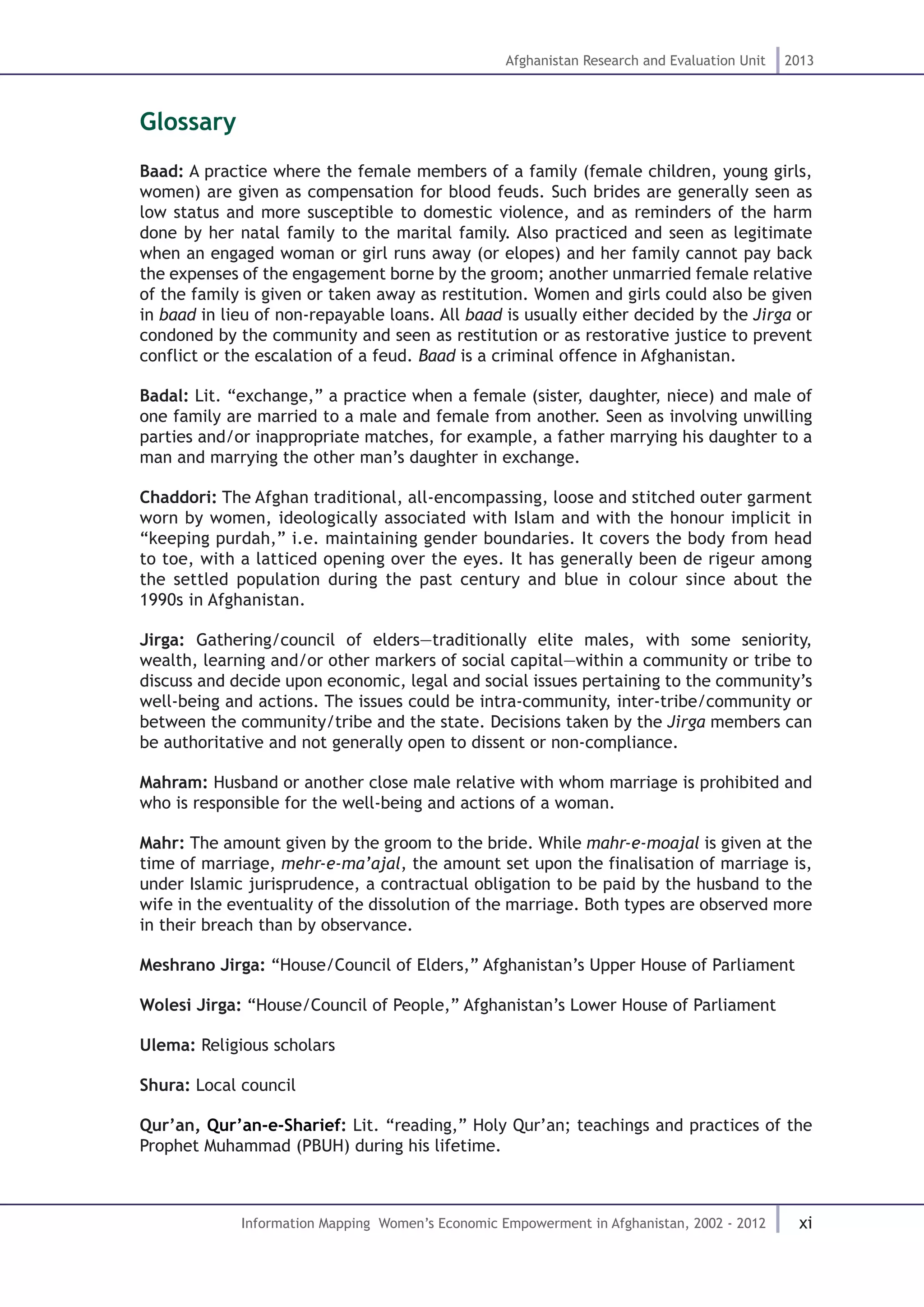
Glossary
Baad: A practice where the female members of a family (female children, young girls,
women) are given as compensation for blood feuds. Such brides are generally seen as
low status and more susceptible to domestic violence, and as reminders of the harm
done by her natal family to the marital family. Also practiced and seen as legitimate
when an engaged woman or girl runs away (or elopes) and her family cannot pay back
the expenses of the engagement borne by the groom; another unmarried female relative
of the family is given or taken away as restitution. Women and girls could also be given
in baad in lieu of non-repayable loans. All baad is usually either decided by the Jirga or
condoned by the community and seen as restitution or as restorative justice to prevent
conflict or the escalation of a feud. Baad is a criminal offence in Afghanistan.
Badal: Lit. “exchange,” a practice when a female (sister, daughter, niece) and male of
one family are married to a male and female from another. Seen as involving unwilling
parties and/or inappropriate matches, for example, a father marrying his daughter to a
man and marrying the other man’s daughter in exchange.
Chaddori: The Afghan traditional, all-encompassing, loose and stitched outer garment
worn by women, ideologically associated with Islam and with the honour implicit in
“keeping purdah,” i.e. maintaining gender boundaries. It covers the body from head
to toe, with a latticed opening over the eyes. It has generally been de rigeur among
the settled population during the past century and blue in colour since about the
1990s in Afghanistan.
Jirga: Gathering/council of elders—traditionally elite males, with some seniority,
wealth, learning and/or other markers of social capital—within a community or tribe to
discuss and decide upon economic, legal and social issues pertaining to the community’s
well-being and actions. The issues could be intra-community, inter-tribe/community or
between the community/tribe and the state. Decisions taken by the Jirga members can
be authoritative and not generally open to dissent or non-compliance.
Mahram: Husband or another close male relative with whom marriage is prohibited and
who is responsible for the well-being and actions of a woman.
Mahr: The amount given by the groom to the bride. While mahr-e-moajal is given at the
time of marriage, mehr-e-ma’ajal, the amount set upon the finalisation of marriage is,
under Islamic jurisprudence, a contractual obligation to be paid by the husband to the
wife in the eventuality of the dissolution of the marriage. Both types are observed more
in their breach than by observance.
Meshrano Jirga: “House/Council of Elders,” Afghanistan’s Upper House of Parliament
Wolesi Jirga: “House/Council of People,” Afghanistan’s Lower House of Parliament
Ulema: Religious scholars
Shura: Local council
Qur’an, Qur’an-e-Sharief: Lit. “reading,” Holy Qur’an; teachings and practices of the
Prophet Muhammad (PBUH) during his lifetime.
xii
2013 Afghanistan Research and Evaluation Unit
Dr. Lena Ganesh
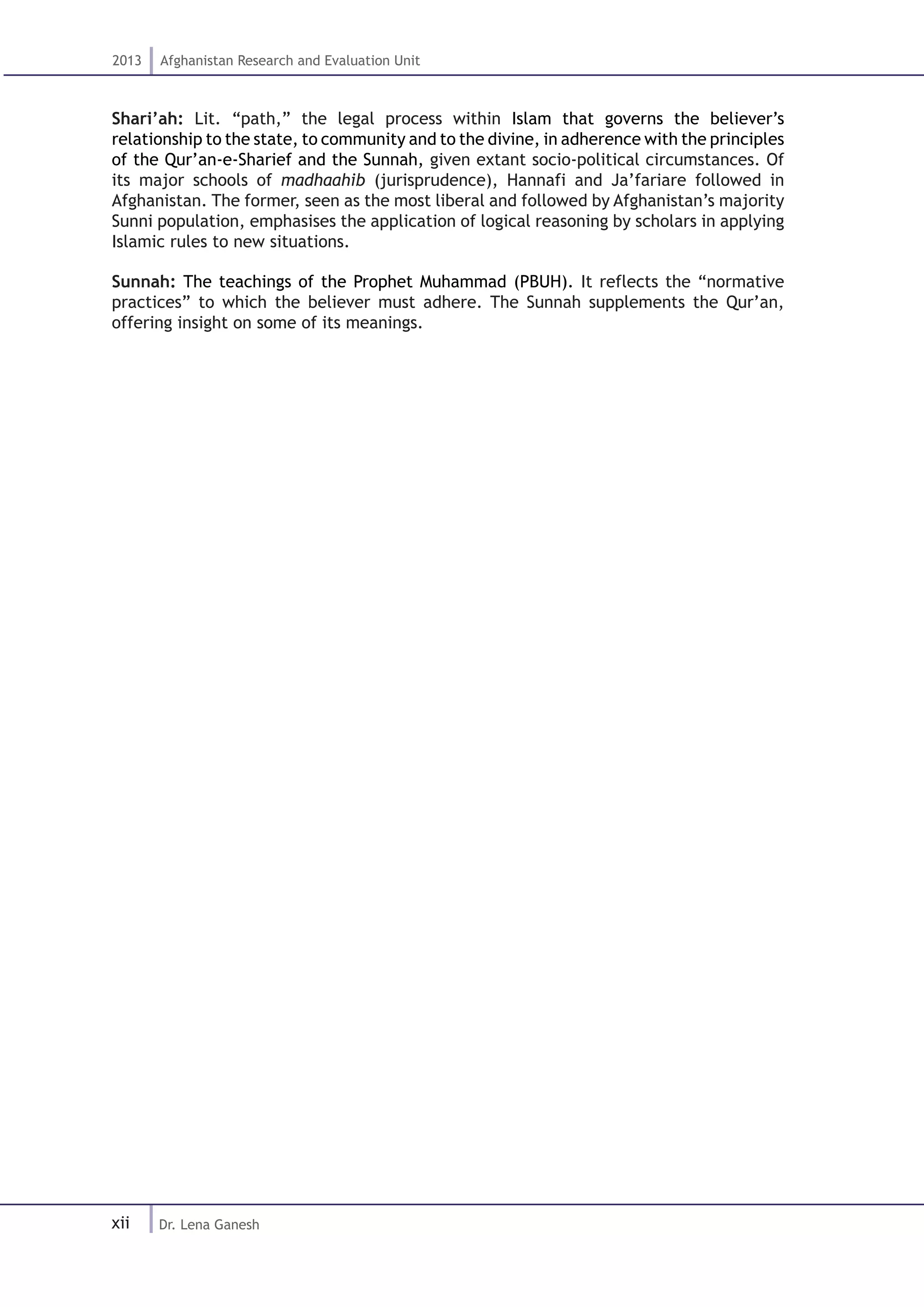
Shari’ah: Lit. “path,” the legal process within Islam that governs the believer’s
relationship to the state, to community and to the divine, in adherence with the principles
of the Qur’an-e-Sharief and the Sunnah, given extant socio-political circumstances. Of
its major schools of madhaahib (jurisprudence), Hannafi and Ja’fariare followed in
Afghanistan. The former, seen as the most liberal and followed by Afghanistan’s majority
Sunni population, emphasises the application of logical reasoning by scholars in applying
Islamic rules to new situations.
Sunnah: The teachings of the Prophet Muhammad (PBUH). It reflects the “normative
practices” to which the believer must adhere. The Sunnah supplements the Qur’an,
offering insight on some of its meanings.
xiii
Afghanistan Research and Evaluation Unit 2013
Information Mapping Women’s Economic Empowerment in Afghanistan, 2002 - 2012
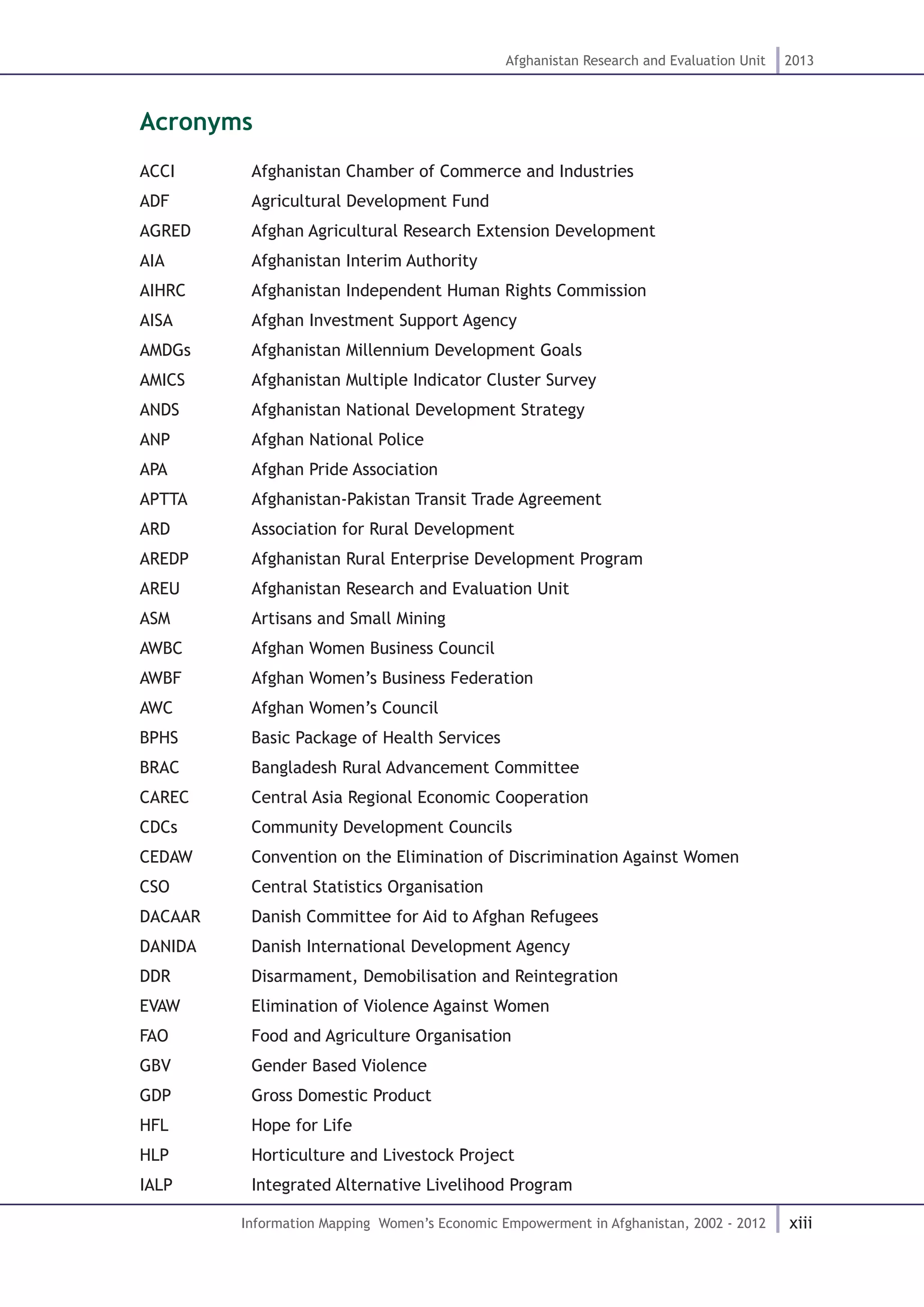
Acronyms
ACCI		 Afghanistan Chamber of Commerce and Industries
ADF		 Agricultural Development Fund
AGRED		 Afghan Agricultural Research Extension Development
AIA		 Afghanistan Interim Authority
AIHRC		 Afghanistan Independent Human Rights Commission
AISA		 Afghan Investment Support Agency
AMDGs		 Afghanistan Millennium Development Goals
AMICS		 Afghanistan Multiple Indicator Cluster Survey
ANDS		 Afghanistan National Development Strategy
ANP		 Afghan National Police
APA		 Afghan Pride Association
APTTA		 Afghanistan-Pakistan Transit Trade Agreement
ARD		 Association for Rural Development
AREDP		 Afghanistan Rural Enterprise Development Program
AREU		 Afghanistan Research and Evaluation Unit
ASM		 Artisans and Small Mining
AWBC		 Afghan Women Business Council
AWBF		 Afghan Women’s Business Federation
AWC		 Afghan Women’s Council
BPHS		 Basic Package of Health Services
BRAC		 Bangladesh Rural Advancement Committee		
CAREC		 Central Asia Regional Economic Cooperation
CDCs		 Community Development Councils
CEDAW		 Convention on the Elimination of Discrimination Against Women
CSO		 Central Statistics Organisation
DACAAR	 Danish Committee for Aid to Afghan Refugees
DANIDA	 Danish International Development Agency
DDR		 Disarmament, Demobilisation and Reintegration
EVAW		 Elimination of Violence Against Women
FAO		 Food and Agriculture Organisation
GBV		 Gender Based Violence
GDP		 Gross Domestic Product		
HFL		 Hope for Life
HLP		 Horticulture and Livestock Project
IALP		 Integrated Alternative Livelihood Program
xiv
2013 Afghanistan Research and Evaluation Unit
Dr. Lena Ganesh
I-ANDS		 Interim-Afghanistan National Development Strategy
IGAs		 Income Generating Activities
ILO		 International Labour Organisation
IMCs		 Inter-Ministerial Committees
LEVAW		 Law on Elimination of Violence Against Women
LOTFA		 Law and Order Trust Fund for Afghanistan
MAIL		 Ministry of Agriculture, Irrigation and Livestock
MCIT		 Ministry of Communication and Information Technology
MDGs		 Millennium Development Goals
MEDA		 Mennonite Economic Development Associates
MoEW		 Ministry of Energy and Water
MFIs		 Microfinance Institutions
MICS	 Multiple Indicator Cluster Survey 	
MISFA		 Microfinance Investment Support Facility for Afghanistan
MoCI		 Ministry of Commerce and Industries
MoEc		 Ministry of Economy
MoF		 Ministry of Finance
MoHRA		 Ministry of Hajj and Religious Affairs
MoIC		 Ministry of Information and Culture	
MoLSAMD	 Ministry of Labour, Social Affairs, Martyrs and Disabled
MoPH		 Ministry of Public Health
MoTCA		 Ministry of Transport and Civil Aviation
MoWA		 Ministry of Women’s Affairs
MRRD		 Ministry of Rural Rehabilitation and Development
NABDP		 National Area Based Development Program
NADF		 National Agricultural Development Framework
NAPWA		 National Action Plan for Women of Afghanistan
NATO		 North Atlantic Treaty Organisation		
NECDO		 Noor Educational and Capacity Development Organisation
NOREF		 NorskRessurssenter for Fredsbygging/Norwegian Peacebuilding 			
		Resource Centre
NPPs		 National Priority Programs
NRVA		 National Risk and Vulnerability Assessment
NSP		 National Solidarity Programme
OHCHR		 Office for the High Commissioner of Human Rights
PC		 Provincial Council
RAMP		 Rebuilding Agricultural Markets in Afghanistan Program
xv
Afghanistan Research and Evaluation Unit 2013
Information Mapping Women’s Economic Empowerment in Afghanistan, 2002 - 2012
RECCA V	 Fifth Regional Economic Cooperation Conference on Afghanistan
RMLSP		 Rural Microfinance and Livestock Support Program
SAARC		 South Asian Association for Regional Cooperation
SEWA		 Self-Employed Women’s Association
SME		 Small and Medium Enterprise
TAFA		 Trade and Accession Facilitation for Afghanistan
TALP		 Targeted Alternative Livelihood Program		
TVET		 Technical Vocational Education and Training		
UNDP		 United Nations Development Program
UNESCAP	 United Nations Economic and Social Commission for Asia 				
		 and the Pacific
UNHCR		 United Nations High Commissioner for Refugees
UNIFEM	 United Nations Development Fund for Women
USAID		 United States Agency for International Development
VAW		 Violence Against Women
WTO		 World Trade Organisation
xvi
2013 Afghanistan Research and Evaluation Unit
Dr. Lena Ganesh
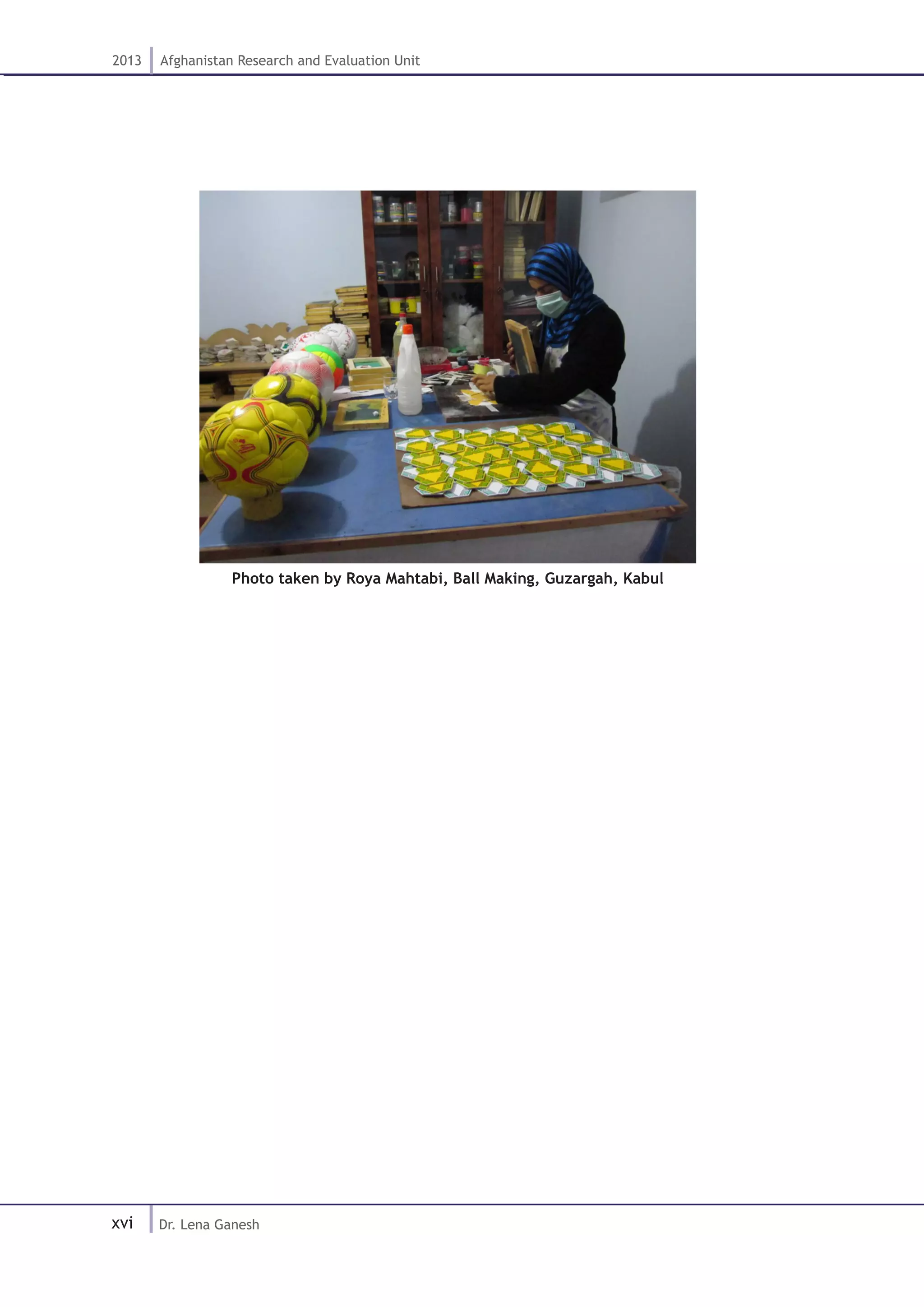
Photo taken by Roya Mahtabi, Ball Making, Guzargah, Kabul
1
Executive Summary 2013
Information Mapping Women’s Economic Empowerment in Afghanistan, 2002 - 2012
Executive Summary
The unequal position of women in Afghanistan has been particularly noted in recent
decades as well as researched in many contexts. While attention has been paid to
women’s human, social and political rights, women’s economic rights, a key human
right, has received much less attention. Yet there have been efforts, both scattered and
concerted, in many development strategies in the past decade to address this deficit.
Women’s economic participation is, in many aligned narratives, increasingly seen as an
integral part of both women’s rights and as a key factor contributing to inclusive growth
and development. Funded by UN Women as part of its broader strategy focused on
Women, Economic Security and Rights, this research aims to map efforts that have been
undertaken in Afghanistan for improving women’s economic status and rights since 2002
in order to inform policy for further development.
While the broader research is divided into two linked reports, this first report, “Women’s
Economic Empowerment in Afghanistan: Information Mapping, 2002-2012,”chiefly
presents information on developments and interventions around women’s economic
status in Afghanistan post-2001, including on international resolutions and governmental
strategies, legal amendments, procedures and mechanisms. Reviewing gendered
developmental and economic indicators, it maps the information of various resources
withinthegovernmentandinmultilateralandinstitutionalagenciesworkinginAfghanistan
around issues of women’s economic empowerment. It offers an assessment of the ways
in which women’s empowerment and economic engagement have been addressed, or
not, in this past decade. This report concludes by offering recommendations in the
arena of policy review which the state, as a key formulator of policies and strategies for
effective implementation, can consider.
The second report, “Women’s Economic Empowerment in Afghanistan, 2002-2012:
Situational Analysis,” contextualises the earlier report by focusing on the views of
women beneficiaries, and their communities, of the selected projects. An overview,
“Women’s Economic Empowerment in Afghanistan, 2002-2012: Information Mapping and
Situational Analysis,” consolidates the two reports and offers a summary of their findings
and recommendations. While each report can be read individually, a sequential reading
offers a clearer, contextualised understanding of women’s practical and strategic needs.
Three methods were used in obtaining information for the research presented in this
report: (i) a review of national and international perspectives and strategies since
2001, (ii) analyses of existing programme and project analyses and evaluations and
other documents from governmental, programming/donor agencies and implementing
organisations working directly on projects designed to enhance women’s participation in
economic activities, and (iii) semi-structured in-depth interviews with 25 representatives
of 12 ministries and government programmes, nine representatives of seven donor
agencies and embassies, and 25 representatives of 23 agencies and networks that
implement projects for women’s economic participation. Although there is a paucity
of gender disaggregated data in many sectors—especially on labour, employment
sectors, time-use, and similar—this research synthesises available information relevant
to women’s income-generating activities and identifies those aspects that need to be
considered for strengthening this much neglected but crucial area.
In addition to mapping women’s economic opportunities, the report offers information
on the ways in which gender and human rights have been addressed in the past decade.
This is primarily because of the tremendous gender-based violations and restrictions that
2
2013 Afghanistan Research and Evaluation Unit
Dr. Lena Ganesh
have been visited upon the general polity of Afghanistan in the extended period of conflict.
The contractions of space for Afghan women, especially in the field of education, health
and political participation, have had a direct result on the capacities of women to be
economically active. In providing information on gendered human rights, the report assesses
the improvements in women’s access to rights, which, within the context of the social and
cultural structures of Afghanistan, can direct their access to economic opportunities.
The analysis and recommendations are based upon the above in conjunction with
relevant data on strategy, policy programming and implementation. These measures are
short-term interventions and longer-term investments that require:
•  Specific strategies and action plans that have context-based gendered programming
with concrete output, outcome and impact indicators, gender-responsive budgeting,
and gender-sensitive and robust monitoring to bring them to fruition; and
•  Coordination between, especially, the sectors of education, health, justice, religious
affairs, labour and, of course, economy, agriculture, trade, industry and finance.
Research findings indicate that, although the achievements of the past decade are
many, they are relative to the cumulative deprivations faced during the preceding three
decades and are heavily constrained by extant severe poverty. Gender gaps are wide
across sectors and strategies in Afghanistan. At the governmental level, they are most
keenly seen in legal instruments and in the implementation and lack of extensive outreach
depth of ministerial policies and national strategies for gendered development. At the
level of policy, though, while many are well-positioned and cover much ground, some
lack context and gender sensitivity or focus on broad-based vision statements that offer
little material direction. On the ground, the effects of the gender gaps are sharpest
in: access to basic health services, particularly in reproductive health, mental health,
and in addressing gender-based violence; female absolute enrolment at primary school
levels and in retention at secondary and tertiary levels; women’s economic participation
in the public and private sectors and in the urban and non-urban economy; and women’s
political participation, especially at district and provincial levels and their absence in
most decision-making bodies. All of these have a cascading effect on women’s economic
well-being, particularly within the contexts of high levels of gender-based violence and
increasing insecurity.
Economically, the picture that emerges is that much of women’s work is being
unaccounted for, as women are mostly engaged in unpaid or low-paying labour in insecure
and vulnerable jobs in an informal, unregulated economy. Currently the micro-finance
investment sector is a significant, but quite restricted, channel of opportunity. However,
there is immense potential for new opportunities for women in the small and medium
enterprise industry, particularly in horticulture, aviculture and in agri-business. In all
these sectors, protection measures are required to nurture and sustain these sectors’
initial gestation and growth vis-à-vis their potential in engaging the maximum number
of women.
The Government of Afghanistan is bound by economic imperatives, its legal instruments
and agreements made with the international community to a) progressively realise its
citizens’ right to access to work, and b) create an enabling environment such that each
citizen—without discrimination by age, sex, disability, class, ethnicity, religion—has
equal opportunity to this human right. It has made it obligatory upon itself to remove all
impedimentstowomen’sequalaccesstothisrightandtothereforenotonlyprovide,monitor
and direct laws and strategies that specifically address women’s socio-culturally derived
3
Executive Summary 2013
Information Mapping Women’s Economic Empowerment in Afghanistan, 2002 - 2012
unequal access to developmental priorities, but to review the implementation of extant
laws and strategies that provide for women’s economic participation and empowerment.
Key challenges faced in implementing the economic rights of women provided in
resolutions, agreements, strategies and policies are inadequacies in: understanding the
rights of women, both Islamic and secular, and the concept of gender in policy-making and
implementation; technical expertise in programming, implementation, and monitoring;
and knowledge and/or understanding of national level policies among policy implementers.
Bringing changes in women’s access to economic opportunities will require strengthening
existing actions in many different activities in the coming decades. Under the prevailing
socio-cultural, legal and economic conditions in Afghanistan, but also keeping in mind
the planned and potential changes around 2014 as well as Afghanistan’s commitment to
its Millennium Development Goals, the research results show four chief areas of action
and intervention that could address women’s ongoing unequal access to economic
opportunities. These are, especially, in education, health, economic empowerment and
religious affairs. All four converge in the field of what could be termed “creating spaces
for women” by:
1.	 Strengthening the policy environment: At the central level of the government,
and for the Central Statistics Organisation (CSO), there has to be a revised
understanding of women’s contribution to the economy and the economic
development of Afghanistan. The specific implementation of the National
Action Plan for Women in Afghanistan (NAPWA) and the Afghanistan National
Development Strategy (ANDS) alone, in collaboration with line ministries, would
address many of the gaps that the country is facing today in human development,
poverty reduction and the greater involvement of women in economic activities.
2.	 Addressing human development gaps: It is crucial to address the gaps that girls
and women face in education and educational facilities, health care and provision,
and in access to safety, physical mobility and political participation. One route
to take is to provide facilities that are women oriented and gender segregated,
particularly since there is a significant gap in the retention of girls in secondary
level education. In the meantime, there is already enough encouragement for
women’s access to education—the quest for knowledge being a central pillar of
Islam—and to health services. The bottlenecks here are access to separate but
equal resources for women, particularly for girls and young women.
3.	 Focusing on deliverables: It is necessary to create a strong and active network of
and for women, across sectors, that operates at a pan-Afghanistan level in cities
and provincial headquarters to build a women-to-women service delivery model
(from producer to wholesalers, processors, exporters) and entrepreneurship
among women with a focus on the domestic market and export potential.
4.	 Engendering financial services: Access to credit and capital is essential to
widen and enhance women’s economic engagement, but women have extremely
limited access to substantial credit or capital; access to collateral remains a
bottleneck. They lack insurance and risk guarantee. In the current microfinance
climate, they also face high interest rates and small credits coupled with tight
repayment schedules. Simultaneously, the reach of the microfinance sector is
limited when compared to demand and is of a fairly standard nature which does
not always cater to the needs of women in the rural informal sector and in small-
scale trade.
4
2013 Afghanistan Research and Evaluation Unit
Dr. Lena Ganesh
Given the socio-cultural background of the region, as well as the gender dynamics
prevalent prior to 1973 and between 1973 and 2001, the situation at present has
relatively improved. However, there has to be both a better perception of how
various dimensions of exclusion interact with gender as well as the ability to
address existing socio-religious power structures that limit women’s participation
in economic activities. Equally, in order to create free, fair and favourable
opportunities for women’s equitable access to the monetised market, a “level
playing field” in the world economy is necessary. Much depends upon the nature
of the transition and the terms of agreement negotiated as well as the turn the
economy may take. Equally, the continued inflow of aid in the current quantum
from the international community is crucial in the coming years if women are to
have any leverage in building upon the initiatives of this past decade. Embedded
socio-cultural traditions cannot be countered in a decade and the economic
empowerment of women in terms of policy in Afghanistan is greatly complicated
by the interlinked absence or limited presence of human rights. While short-
term initiatives and medium-term investments by politicians, academics, civil
society activists, political parties, religious scholars, tribal elders, provincial
councils, members of commerce and trade, and other groups are critical to keep
the momentum going, longer term human and resource investment is vital for the
rejuvenation of society in a comprehensive manner.
5
Introduction 2013
Information Mapping Women’s Economic Empowerment in Afghanistan, 2002 - 2012
1.  Introduction
A key development in Afghanistan’s recent history has been its legal, political and
humanitarian engagement with the international community in the wake of the events
since 2001. In much of these publicised interactions on this topic, human rights compliance
and gender equality have played important roles both in national and international fora
and have been subjected to intense scrutiny. In most of these discourses in Afghanistan,
the language of the Universal Declaration of Human Rights (UDHR, 1948) and the
Convention on the Elimination of all forms of Discrimination Against Women (CEDAW,
1979), among others, has shaped the ways in which socio-political change has been
directed. Gendered economic engagement and empowerment, though, interfaced as
it is with poor infrastructural and developmental indices and predicated on the pre-
condition of security in Afghanistan, has perhaps received less attention.
While the value and nature of women’s work has changed in recent centuries, the
work itself has remained substantial. However, the advent of industrialisation and
the monetisation of work generally translated to a division between productive and
reproductive labour, in which the invisibility of women’s work has progressively meant a
great feminisation of poverty.1
In countries and regions subscribing to particularly strong
patriarchal structures, women’s labour remains unrecognised, unpaid and undervalued;
the ideal division of labour is still very much the man as breadwinner and the woman as
homemaker. The increasing interweaving and dependence of these societies’ economies
with the globalised economy has further meant that women’s entry into the labour
market ensures they do a triple shift.2
The division is particularly sharp in Afghanistan,
despite or due to the centrality of Islam, and has severe implications for women’s ability
to access a monetised labour market positioned in the public sphere.
Afghanistan, since 2004, formally subscribes to the free-market economy.3
Markets
are, however, dominated by those higher up in the national and global value chains
with access to capital and credit and who are able to effectively harness technology.
Afghanistan, with its largely informal and importing economy, liberal trade regime and
low tariffs, is not a key player and cannot compete in many sectors with neighbouring
countries whose raw materials and finished goods both dominate Afghan markets.
Meanwhile, the country’s many smaller players, chiefly in agriculture and handicrafts,
remain trapped in the subsistence-level informal economy. Women, typically, remain
in labour-intensive micro-level activities, at best supported by micro-level credit and
1  Poverty in Afghanistan is defined as the ability to access 2,100 calories and some basic non-
food needs, the monetary equivalent of which works out to about 47 Afghanis per person per day
or 708 Afs/USUS$14 per person per month, which 36 percent of the population is unable to access,
while 53 percent can just about access.“[O]ne small, negative shock has the potential to move
many individuals into poverty.” Central Statistics Organisation and World Bank, “Setting the Official
Poverty Line for Afghanistan,” 24, undated, http://siteresources.worldbank.org/AFGHANISTANEXTN/
Resources/305984-1326909014678/8376871-1334700522455/PovertyStatusMethodologyReport.pdf
(accessed 5 June 2013). See also Amelie Banzet, Marjan Kamal, Peggy Pascal, Johan Pasquet and François
Grunewald, “Research on Chronically Poor Women in Afghanistan: Final Report,” 18 (Japan International
Cooperation Agency and Deutsche Gesellschaft für Technische Zusammenarbeit, March 2008), http://www.
urd.org/IMG/pdf/CPW_report_hand-ove-_march2008.pdf (accessed 1 April 2013). A more recent multi
dimensional analysis of poverty in Afghanistan indicates a Multi dimensional Poverty Index (MPI) of 0.51 by
which estimate almost 84% of Afghan household are multi-dimensionally poor, Centre for Policy and Human
Development, “Afghanistan Human Development Report 2011 The Forgotten Front: Water Security and the
Crisis in Sanitation”, (Kabul: Kabul University, Centre for Policy and Human Development, 2011):36-38
2  Caring labour for the family, household work and income-generating work. See, for example, S.
Himmelweit, “Making Visible the Hidden Economy: The Case for Gender-Impact Analysis of Economic Policy,”
in Feminist Economists 8, no. 1 (2002): 49-70.
3  Article 10, Constitution of Afghanistan, 2004.
6
2013 Afghanistan Research and Evaluation Unit
Dr. Lena Ganesh
other forms of restricted access to productive resources, without access to savings and
remaining highly susceptible to risk. Further, the economic policies of the government
have not emphasised the sectors which are currently catered to by the majority of the
population4
and in which women play significant, albeit “invisible” roles.
Sources of economic growth in Afghanistan in the past decade have been services
(communication, transport, government services) and industry (dominated by
construction). From 2006 to 2011, revenue grew by 20 percent a year; in 2011 revenue
was 11 percent of gross domestic product (GDP), from 3 percent in 2002-03.5
The per
capita GDP has grown from US$426 in 2009 to $505 in 2010 to $629 in 2011;6
in 2012 the
per capita GDP was $725.7
Afghanistan’s growth is, in a best-case scenario, predicted at
7 percent for 2011-18; agriculture and resources are seen as the key drivers of growth,
with mining showing potential. Its governance and institutional structures are weak
and health, education and gender indicators are alarming. Security, in particular, is of
significant concern. Aid inflows in 2010-11 have equalled Afghanistan’s national GDP
but, with the bulk (88 percent) of this external aid having a local impact worth only
around 10-25 percent, its effect on the local economy is highly limited; the impact of
the foreseen decline in aid is expected to affect the development sector.8
Afghanistan’s population for 2012-13 has been estimated at 25.5 million, with nearly
12.5 million females and 13 million males.9
Within this, its non-working age population
was nearly 50 percent, with 11.5 million under the age of 15—the highest in the world—
and 0.75 million over 65 years;10
and making for an estimated dependency ratio of 96.
4  59.1 percent of the population is engaged in agriculture, 24.6 percent in services and 12.5 percent
in industry services. Ministry of Economy, Islamic Republic of Afghanistan, “Afghanistan Provincial Briefs
2011” (Kabul: 2011), http://moec.gov.af/Content/files/Last20updated%20english.pdf (accessed 1 April
2013). However, agriculture contributed to 26.74 percent of the GDP in 2012 while services and industry
contributed 48.27 percent and 21.39 percent respectively, Islamic Republic of Afghanistan, Central Statistics
Organisation (CSO), “Afghanistan Statistical Yearbook, 2011-12” (Kabul: 2012).
5  The World Bank, “Afghanistan in Transition: Looking Beyond 2014, Vol. 1: Overview” (Washington, DC:
The World Bank, May 2012).
6  Islamic Republic of Afghanistan, Central Statistics Organisation, “Statistical Indicators in the Country,”
http://cso.gov.af/Content/Media/Documents/StatisticalIndicatorsinthecountry3920128598270553325325.
pdf (accessed 5 June 2013).
7  CSO, “Statistical Yearbook, 2011-12.”
8  A mainstay of women’s rights, international aid programming in Afghanistan has supported the
development of policy instruments, pilot projects and programmes, technical assistance, and the generation
of greater awareness of the issue of women’s rights and gender. However, it has been bogged down in many
ways: lack of knowledge about, and resistance to, Afghan socio-cultural gender norms; coordination with
donor country objectives rather than with Afghan national priorities; value alignment with women’s rights
as seen in the Global North; ad hoc and short-term programming; lack of gender analysis in programming
and implementation; inadequate monitoring and evaluation; inability to reach the non-urban areas and
the consequent general restriction to urban elite women; limited overall outreach; focus on disbursements
and numbers rather than on impact and capacity. For example, of the US$10.4 billion pledged at the
2006 London Conference for Afghanistan National Development Strategy (ANDS) implementation, US$4.8
billion has been spent directly by donors and not aligned with ANDS sector priorities; Human Dimensions of
Poverty in Afghanistan (Office of the High Commissioner for Human Rights, 2010), 12, citing Donors Financial
Review (Ministry of Finance of Afghanistan, January 2009), 9. See also Matt Waldman, “Falling Short: Aid
effectiveness in Afghanistan” (Agency Coordinating Body for Afghan Relief, March 2008), 7; Naila Kabeer,
Ayesha Khan and Naysan Adlparvar, “Afghan Values or Women’s Rights? Gendered Narratives about Continuity
and Change in Urban Afghanistan” (Institute of Development Studies working paper 387, December 2011), 23.
9  Not including the 1.5 million nomad population, CSO, “Statistical Yearbook, 2011-12,” Settled Population
by Civil Division, http://cso.gov.af/Content/files/Settled%20Population%20by%20Civil%20Division.pdf
(accessed 7 June 2013).
10  The World Bank, “Labor participation rate, female (percent of female population ages, 15+),” http://
data.worldbank.org/indicator/SL.TLF.CACT.FE.ZS (accessed 5 June 2013).
7
Introduction 2013
Information Mapping Women’s Economic Empowerment in Afghanistan, 2002 - 2012
2007/2008 figures show women’s labour participation at 47 percent, with nearly 95 percent
of women in vulnerable employment and 78 percent in unpaid family work11
. With a 2.8
percent annual population growth, poverty levels are also expected to rise and inclusive
economic growth would accommodate all women into the active employment category.
As seen in this research, women are consistently contributing to Afghanistan’s productive
economy in what can be euphemistically called “back-end” labour but without which
labour the sectors would cease to function. The socio-cultural codes in Afghanistan
around honour and gender roles ensure that the end product of the joint labour of
women and men is converted by men in the monetised market in the public sphere in
which women have no direct access. Simultaneously, traditional codes often prevent
the social acknowledgement of women’s equal ability to earn an income, reiterate the
concept of man as breadwinner and woman as homemaker, and prevent the access
of women to both economic acknowledgement of their labour and to greater, formal
participation in economic activities. Some of the major constraints that women face
are lack of job opportunities and experience, lack of technical knowledge, low pay, low
educational attainment, and an unsupportive family environment.12
Even as women’s economic empowerment can be defined as “the ability of women to
bring about positive changes in their lives and societies as a result of their participation
in economic activities”13
, in the Afghan context, women’s economic empowerment
can best be additionally contextualised as i) the availability of economic opportunity
that monetises and/or makes visible their labour and ii) the allowance given by socio-
cultural norms and economic contexts to access the opportunities. Ideally, proposed
introductions in the former should address the latter as a result of more embedded
norms and values influencing the latter.
As examples from similarly placed countries like Indonesia show, even if formal
legal rights have little effect de facto—as in access to inheritance and land—female
empowerment can be enhanced disproportionately in households and communities
where women are seen to contribute economically. Globally, the high correlation
between practiced women’s rights and development points to a movement toward
increased formal property rights, decrease in fertility, increased focus on developmental
agendas, enhanced capacities of women within and over themselves, their families and
their communities and a reduction in the political gender gap.14
However, as seen from
11  Ministry of Economy and the World Bank “Poverty Status in Afghanistan: A Profile Based on the National
Risk Vulnerability Assessment (NRVA) 2007/8” (Ministry of Economy, 2010). However, as Gaye et al. (2010)
note: “Labor force participation, as traditionally measured, ignores the important contributions of women
in unpaid work and may perpetuate the undervaluing of these critical activities.’ Amie Gaye, Jeni Klugman,
Milorad Kovacevic, Sarah Twigg and Eduardo Zambrano, “Measuring key disparities in human development:
the Gender Inequality Index” (Human Development Research Paper, UNDP 2010/46): 14, http://paa2013.
princeton.edu/papers/130872 (accessed 5 June 2013). Further, the numbers of underemployed women are
not clear. However, an overall underemployment of 48.2 percent is indicated by NRVA 2007/8. Female
employment-to-population ratio in South Asia is highest in Afghanistan (NRVA 2007/8), pointing to the
exacerbated effects of extended conflict and its consequential destitution that act as a push factor in
women’s income generation.
12  Samuel Hall, “Economic Assessment and Labour Market Survey of Mazar-i Sharif, Pul-i Khumri, Kandahar
City and Kunduz City” (Kabul: Mercy Corps, 2011). These constraints are further examined in the forthcoming
“Economic Empowerment of Women in Afghanistan, 2002-2012: Situational Analysis,” as part of the wider
research for this project, accessible through the Afghanistan Research and Evaluation Unit website.
13  UN Women, “Guidance Note Women’s Economic Empowerment”, (New York, 2012), 1.
14  For example, Nistha Sinha, Dhushyanth Raju, and Andrew Robert Morrison, “Gender Equality, Poverty
8
2013 Afghanistan Research and Evaluation Unit
Dr. Lena Ganesh
the sections below, women’s economic empowerment has received varied attention in
the policy environment in Afghanistan and scattered emphasis in their translation into
practical measures.
Before looking at, and mapping, the access opportunities provided for women’s economic
participation in Afghanistan, it will be useful to look at the entry point of concerted
interventions which have set the tone and tenor of many of the developments that
address gender concerns in the country today.
The following sub-sections look at i) the objective of this study, ii) the methodology
used to chart the information-gathering process, iii) international conventions, treaties
and resolutions relevant to women’s economic participation, iv) national development
strategies that have been influential for women’s participation in the economy, and v)
the socio-economic and developmental status of women today. Section 2 is an assessment
and analysis of the steps taken in this past decade toward enhancing women’s human
rights and economic empowerment. Section 3, while looking at key components of
the country’s extant economic environment and the newer ways that women can be
positioned within this, concludes by offering policy and strategic approaches to address
the challenges that women face in accessing economic opportunities.
1.1  Objective
The primary objective of this research report is to identify, collate and assess information
on women’s economic empowerment in Afghanistan in the decade spanning 2002-2012.
As such it identifies the following and marks the provisions for women’s economic
empowerment:
•  Agreements and resolutions that were jointly drafted between the Afghanistan
authorities and representatives of the international community who were engaged
in the process of rehabilitation and rebuilding in Afghanistan;
•  International conventions to which Afghanistan is a state party;
•  Chief strategies and laws conceptualised by the Government of Afghanistan for the
socio-economic development of Afghanistan;
•  Key ministries and their strategies, programming policies and action plans; and
•  International and national agencies and institutions that work within the field
of women’s empowerment and women’s economic participation through project
planning, sponsorship or implementation.
and Economic Growth” (World Bank Policy Research Working Paper No. 4349, 1 September 2007), in analysing
the relationship between gender inequality and development. See also “World Development Report 2012
Gender Equality and Development” (Washington, DC: The World Bank, 2011); Keera Allendorf, “Do Women’s
Land Rights Promote Empowerment and Child Health in Nepal?” World Development, 35, no.11 (November
2007) 1975-1988, http://www.sciencedirect.com/science/article/pii/S0305750X07001416 (accessed 7 June
2013); Rose Kalima, “Where Women are Leaders” (London: Zed, 1992); Mukesh Eswaran, “The Empowerment
of Women, Fertility, and Child Mortality: Towards a Theoretical Analysis,” Journal of Population Economics,
15, no. 3 (2002): 433-454; Ester Boserup, Woman’s Role in Economic Development (London: Earthscan, 1970,
Reprinted 1997); Eastern Africa Sub-Regional Support Initiative for the Advancement of Women, “Women’s
Political Participation and Economic Empowerment in Post-Conflict Countries: Lessons from the Great Lakes
Region in Africa” (International Alert 2012), http://www.international-alert.org/sites/default/files/publica
tions/201209WomenEmpowermentEN_0.pdf (accessed 7 June 2013).
9
Introduction 2013
Information Mapping Women’s Economic Empowerment in Afghanistan, 2002 - 2012
It then assesses:
•  Human rights for women and the status and improvements in education, health,
political participation, and safety;
•  Economic rights for women, women’s labour participation and the key routes taken
in this past decade; and
•  The impact that improvements in women’s human rights have had on women’s
economic rights and vice-versa.
The recommendations for improving women’s access to human rights and economic
opportunities are based upon a consolidated analysis of all the above.
This document is not an in-depth or critical review of policy, policy-making and the
result of the distance between policy and practice on women’s economic empowerment
in Afghanistan. It offers a broad sweep of the status of women’s human rights and
economic engagement and summarises recommendations based upon literature review
and primary research. It can function as a resource for extensive and in-depth research
on the involvement of women in the unfolding economy of Afghanistan.
1.2  Methodology
Three methods were used in obtaining information for the research presented in this
report: i) reviews of existing programme and projects, including those of the government,
donor agencies and implementing organisations working directly on projects designed to
enhance women’s participation in economic activities, ii) primary research from semi-
structured in-depth interviews with 59 respondents (25 representatives of key ministries
and institutions, nine representatives of seven donor agencies and embassies, and 25
representatives of 23 agencies and networks that implement projects for women’s
economic participation), and iii) secondary evidence from documents, material and
information obtained from 11 ministries and donor agencies.
On the ground
The project began with a desk–based information mapping process involving the
collection, description and cataloguing of all policies, mechanisms, programmes and
other frameworks aimed at improving women’s economic life since 2002. This involved
the creation of an inventory of much qualitative and quantitative data and studies
currently available on: international treaties and agreements ratified by the Government
of Afghanisstan that are pertinent to the status of women, laws, policies and strategies
(Government of Afghanistan, para-government and the private sector), surveys and
reports (Government of Afghanistan, ministries, departments, international agencies,
international non-governmental organisations, Afghanistan-based non-governmental
organisations). In parallel, extensive reading of the gendered context of Afghanistan as
well as of the socio-political unravelling that took place in the last 30 years helped to
better understand the situation of women as it unfolded in the last decade.
The team was introduced to feminist qualitative research approaches and methodologies
and some capacity building—including on sensitive interviewing, informed consent and
social-sensitive indicators—to identify the challenges, opportunities and best practices.
Research respondents came from three categories: representatives of key ministries
and government programmes, representatives of donor agencies, and representatives
of agencies and networks that implement projects for women’s economic participation.
10
2013 Afghanistan Research and Evaluation Unit
Dr. Lena Ganesh
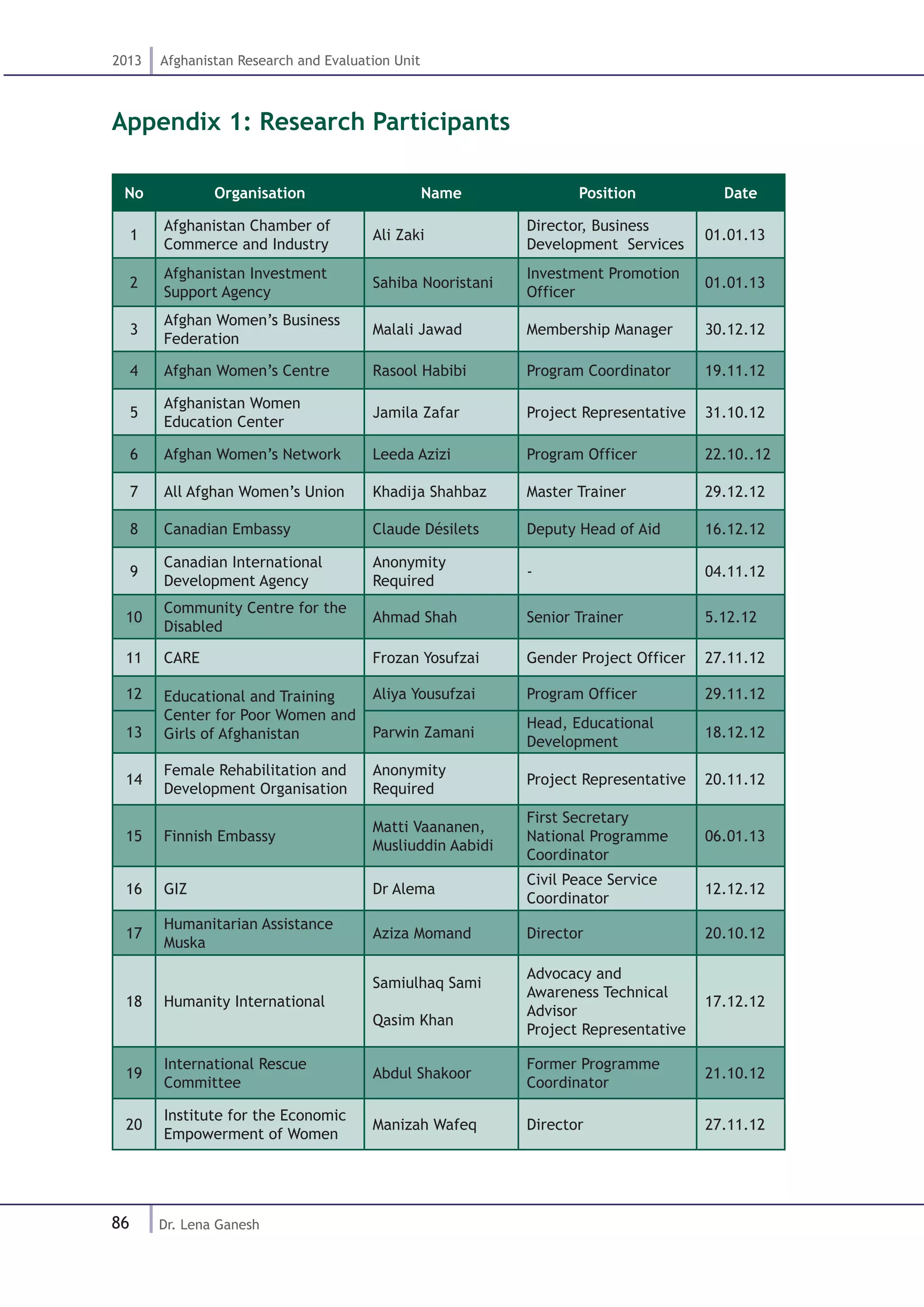
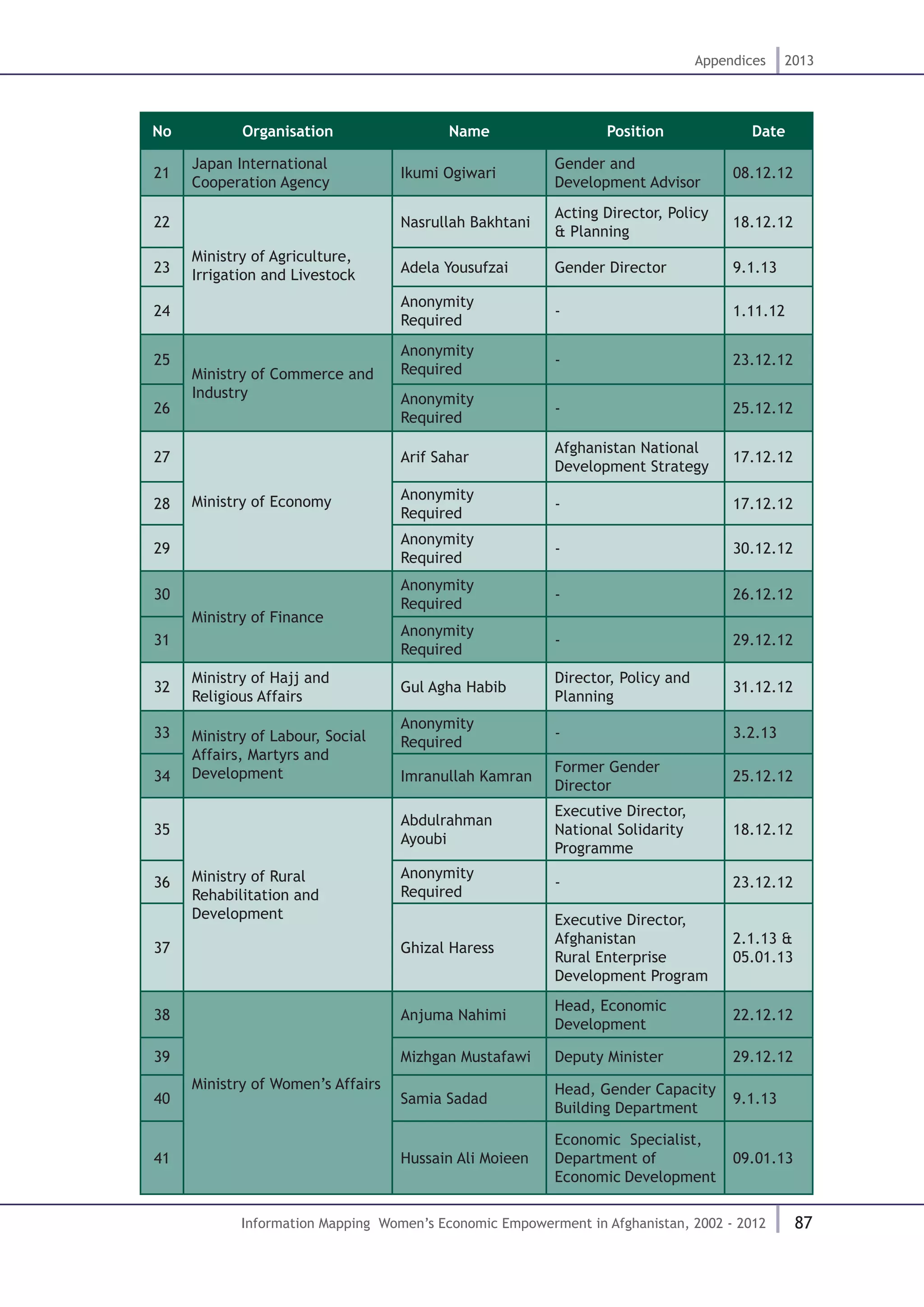
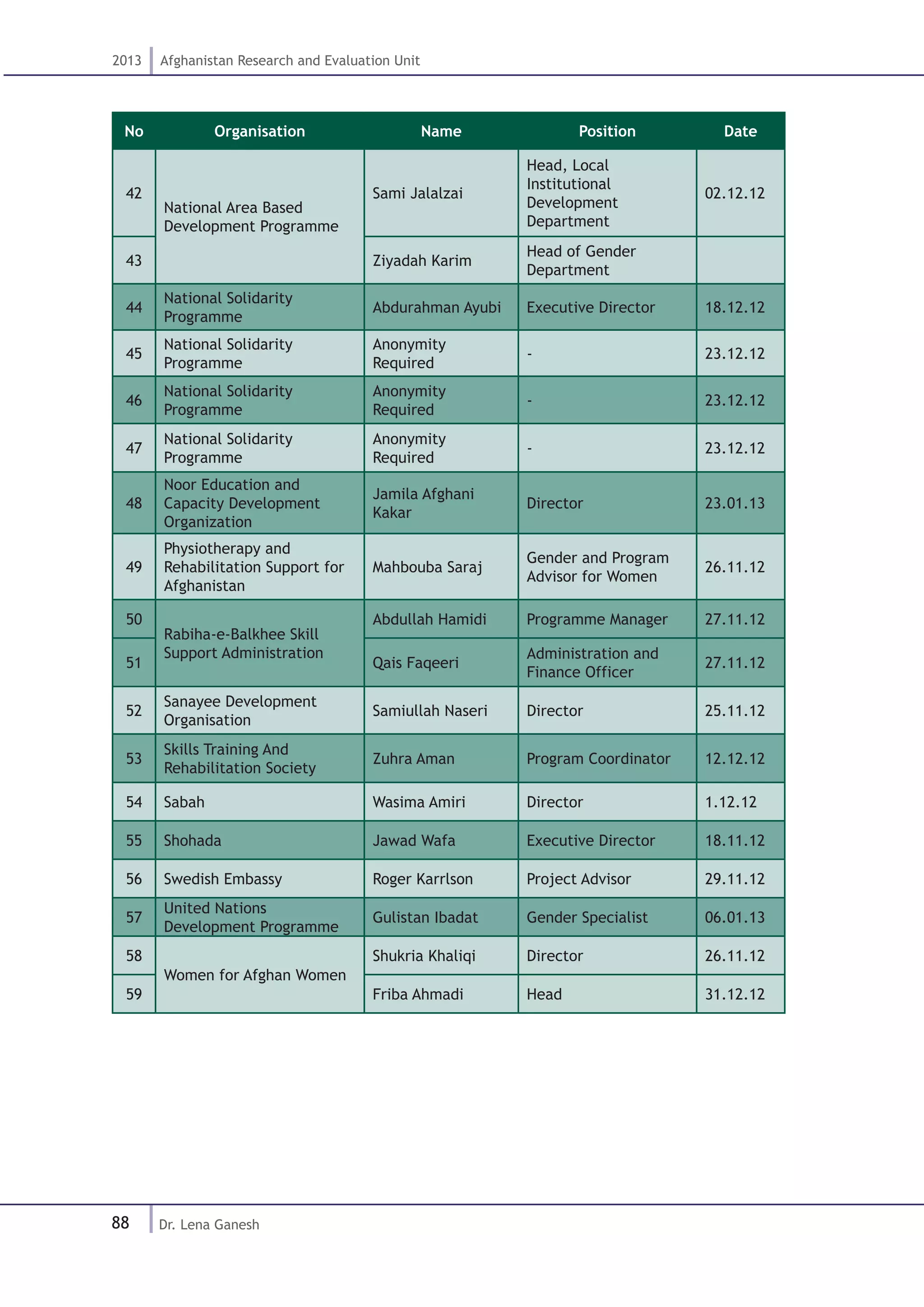
Appendix 1 provides the tabular information on the interviews conducted; topic guides
for semi-structured interviews were made specific to the three categories. The main
themes addressed across the topic guides were: i) approaches used by donors, government
programmers and implementing organisations to improve women’s economic situation
during the last decade, and ii) women’s ability to access the economic empowerment
initiatives and the sustainability of the initiatives. The variations in the topic guides
addressed: government policy planning, outreach and implementation; and the perceived
results of a woman’s access to economic power. A pilot was conducted in October 2012
and main fieldwork took place between November 2012 and March 2013.
The fieldwork was conducted by two Afghans, one female and one male. All interviews
except two were in Dari; one with a Ministry for Rural Rehabilitation and Development
(MRRD) representative was conducted in English by the non-Afghan member of the
team. All interviews were held in person except for two Skype interviews and two
telephonic interviews. Most interviews were conducted according to the gender of the
respondent/s and the interviewer. Most interviews were recorded (if the respondent
permitted) and translated by bilingual, non-professional Afghans. Team members
reviewed and revised the transcripts to ensure construct validity and better data
capture. Security considerations often overtook appointments and other forms of data-
gathering, requiring re-investments of time. Data analysis was done manually though
extensive coding and analysis.
The limitations of the report include:
•  the exclusion of development debates that could contribute to a better
understanding of women’s equitable access to and benefit from economic activities.
This is particularly important in view of the emphasis placed on private sector
development and the free-market economy in many governmental policies as well
as in donor-aid programming.
•  a focus on women’s human rights is necessary given that they are inextricably
intertwined with women’s access to economic opportunities. However, this limits
the space in this report for discussing more than a few key areas such as agriculture,
horticulture, livestock and small-scale trade. Women’s involvement in important
areas like opium-growing and rural handicraft and enterprise, or as informal vendors
or domestic workers, will need to be looked into in another, future study.
•  a lack of availability and poor quality of available data, particularly detailed micro-
level studies. Policy documents and programme reports are unclear on the causality
between inputs, outputs and outcomes.
•  some key ministry personnel were unavailable or busy. There has been confusion
about project monitoring and lack of knowledge of policy or strategy among
certain personnel within ministries. Information on the structure and functioning
of government ministries and departments are generally not available in the public
domain; official requests have not been met.
•  lack of focus on class and regional variations.
The following two sub-sections offer a look at international agreements and resolutions
that Afghanistan has entered into and the national policy environment of strategies
and laws.
11
Introduction 2013
Information Mapping Women’s Economic Empowerment in Afghanistan, 2002 - 2012
1.3  International agreements and resolutions
With the UN-convened Bonn Agreement of 200115
signalling a different phase in Afghan
history, Afghanistan has seen significant achievements for women’s rights in this past
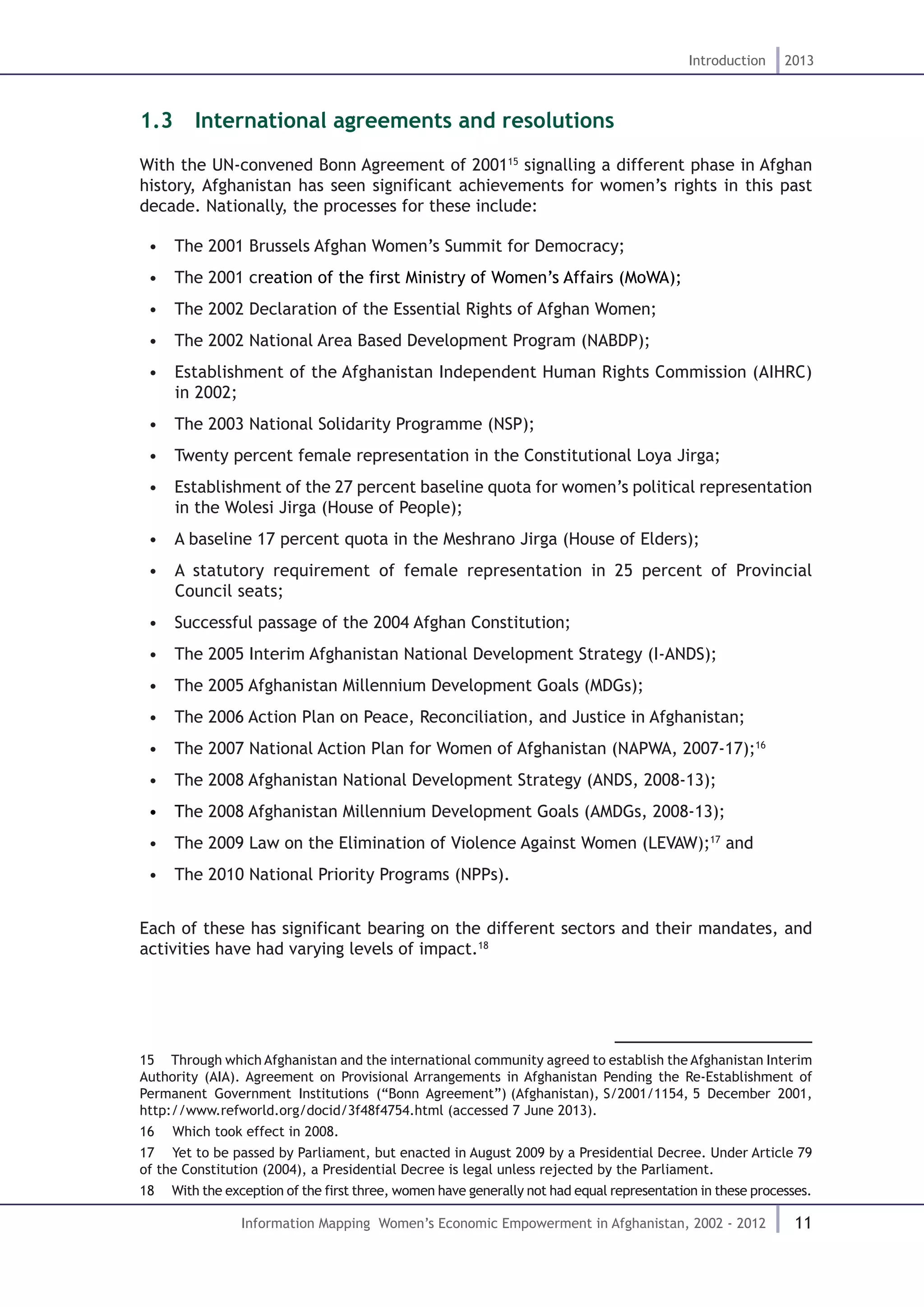
decade. Nationally, the processes for these include:
•  The 2001 Brussels Afghan Women’s Summit for Democracy;
•  The 2001 creation of the first Ministry of Women’s Affairs (MoWA);
•  The 2002 Declaration of the Essential Rights of Afghan Women;
•  The 2002 National Area Based Development Program (NABDP);
•  Establishment of the Afghanistan Independent Human Rights Commission (AIHRC)
in 2002;
•  The 2003 National Solidarity Programme (NSP);
•  Twenty percent female representation in the Constitutional Loya Jirga;
•  Establishment of the 27 percent baseline quota for women’s political representation
in the Wolesi Jirga (House of People);
•  A baseline 17 percent quota in the Meshrano Jirga (House of Elders);
•  A statutory requirement of female representation in 25 percent of Provincial
Council seats;
•  Successful passage of the 2004 Afghan Constitution;
•  The 2005 Interim Afghanistan National Development Strategy (I-ANDS);
•  The 2005 Afghanistan Millennium Development Goals (MDGs);
•  The 2006 Action Plan on Peace, Reconciliation, and Justice in Afghanistan;
•  The 2007 National Action Plan for Women of Afghanistan (NAPWA, 2007-17);16
•  The 2008 Afghanistan National Development Strategy (ANDS, 2008-13);
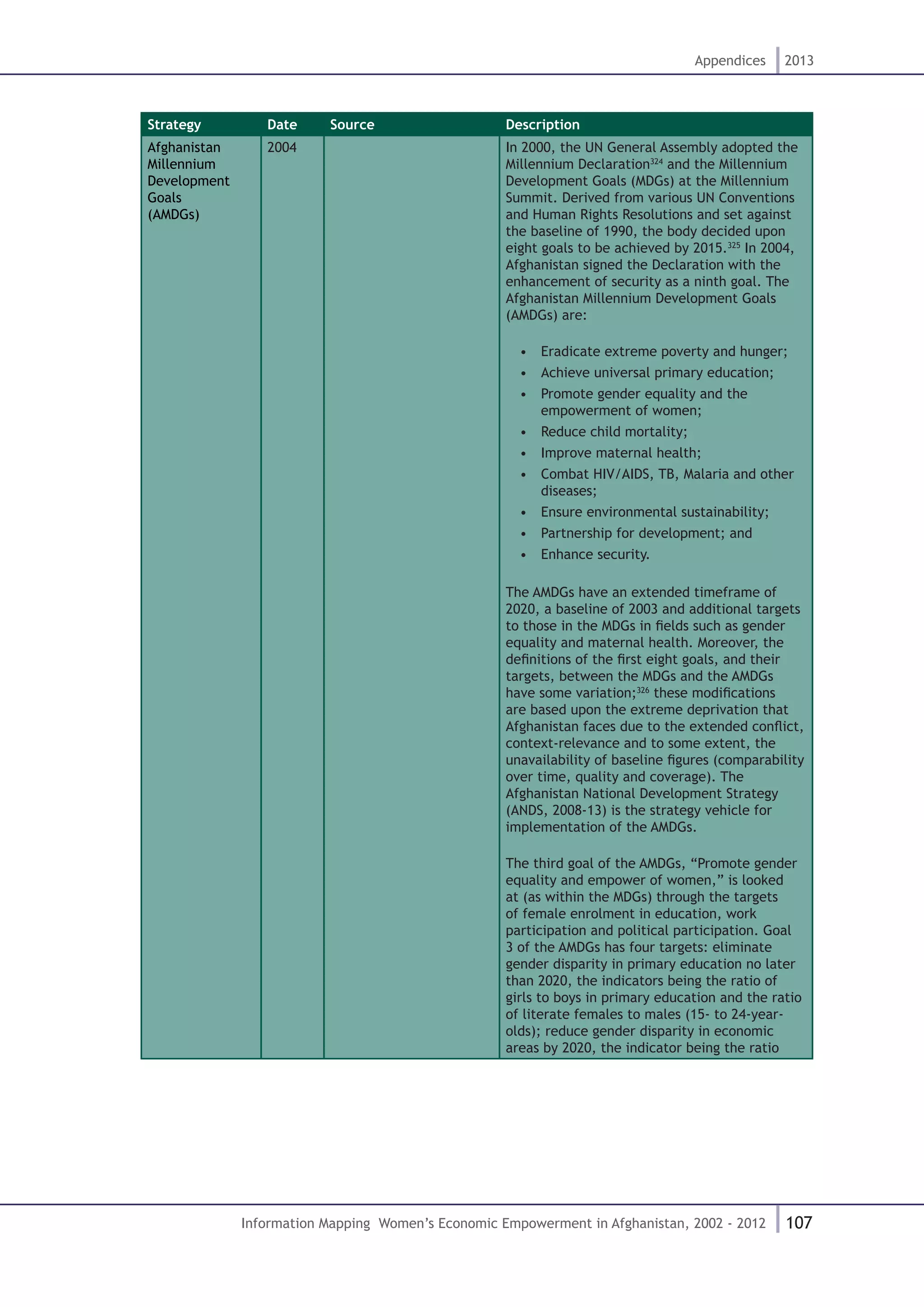
•  The 2008 Afghanistan Millennium Development Goals (AMDGs, 2008-13);
•  The 2009 Law on the Elimination of Violence Against Women (LEVAW);17
and
•  The 2010 National Priority Programs (NPPs).
Each of these has significant bearing on the different sectors and their mandates, and
activities have had varying levels of impact.18
15  Through which Afghanistan and the international community agreed to establish the Afghanistan Interim
Authority (AIA). Agreement on Provisional Arrangements in Afghanistan Pending the Re-Establishment of
Permanent Government Institutions (“Bonn Agreement”) (Afghanistan), S/2001/1154, 5 December 2001,
http://www.refworld.org/docid/3f48f4754.html (accessed 7 June 2013).
16  Which took effect in 2008.
17  Yet to be passed by Parliament, but enacted in August 2009 by a Presidential Decree. Under Article 79
of the Constitution (2004), a Presidential Decree is legal unless rejected by the Parliament.
18  With the exception of the first three, women have generally not had equal representation in these processes.
12
2013 Afghanistan Research and Evaluation Unit
Dr. Lena Ganesh
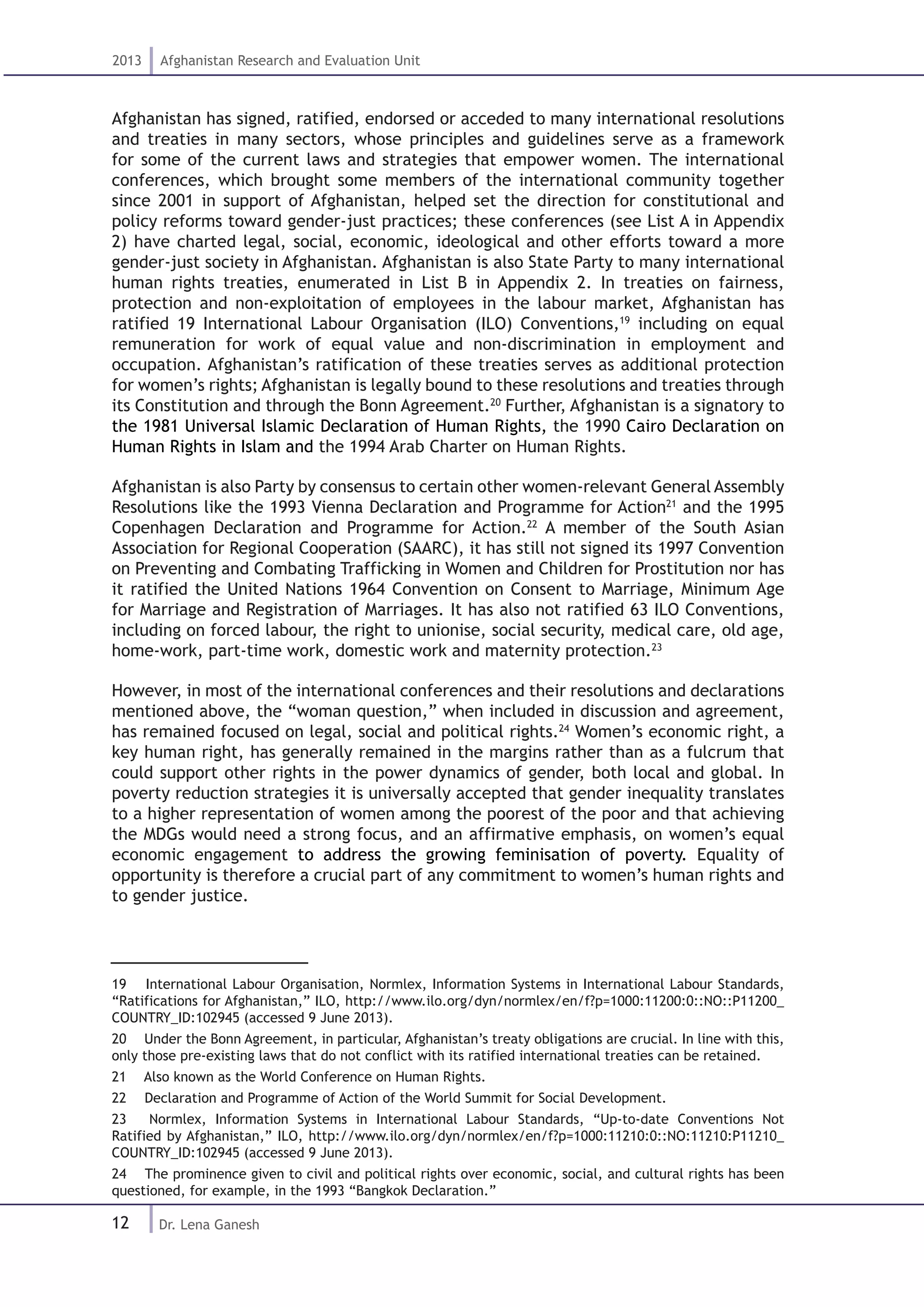
Afghanistan has signed, ratified, endorsed or acceded to many international resolutions
and treaties in many sectors, whose principles and guidelines serve as a framework
for some of the current laws and strategies that empower women. The international
conferences, which brought some members of the international community together
since 2001 in support of Afghanistan, helped set the direction for constitutional and
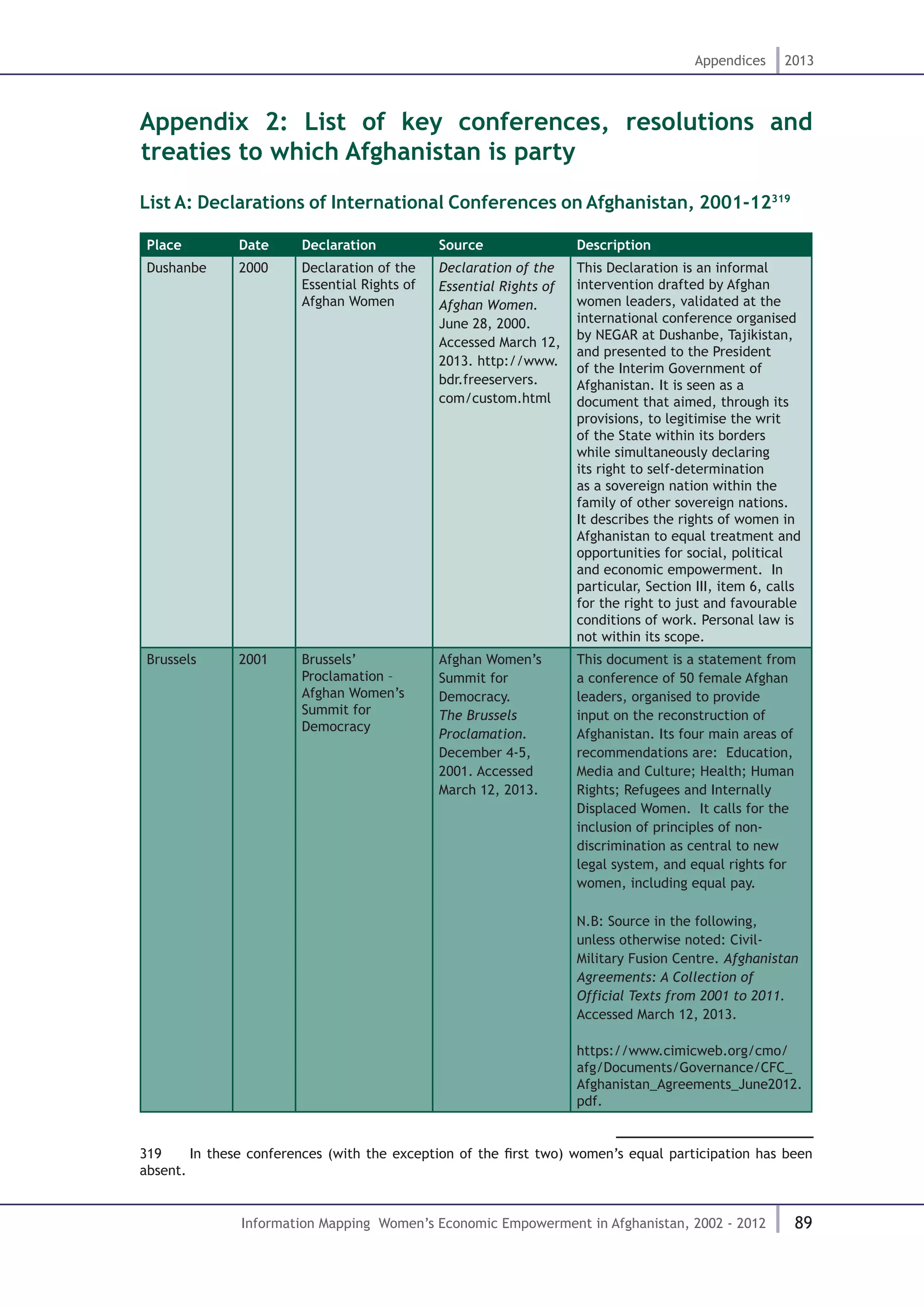
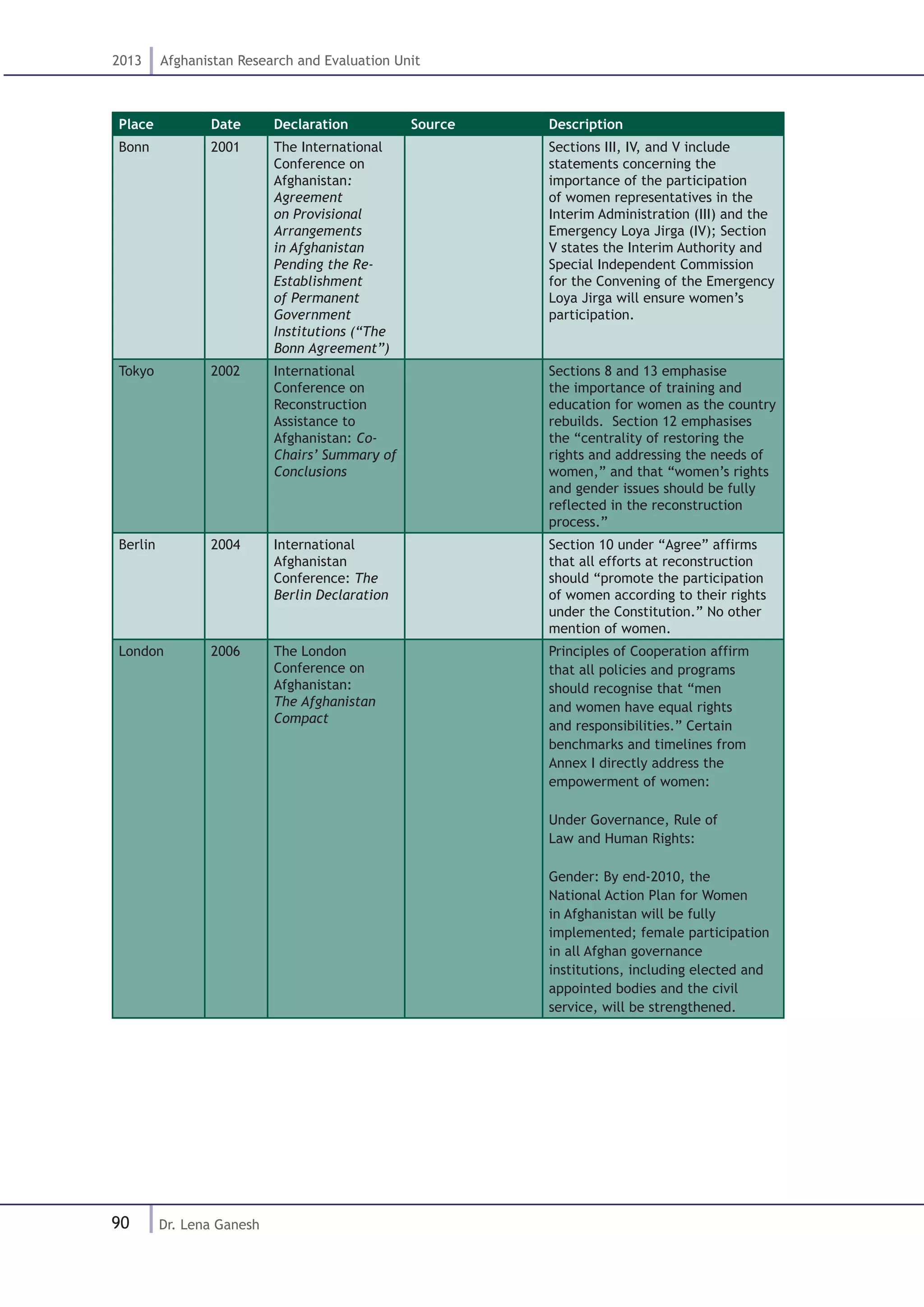
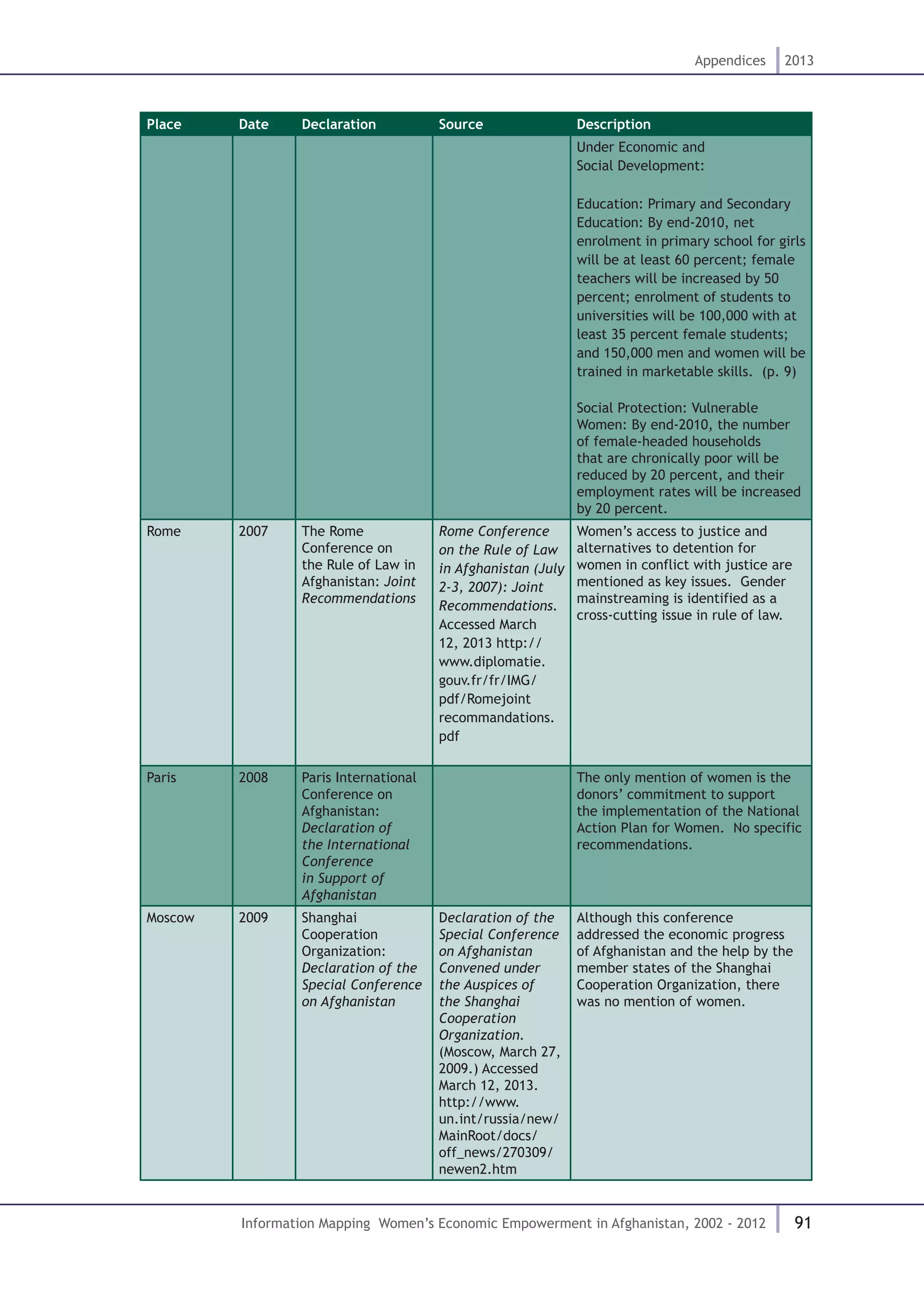
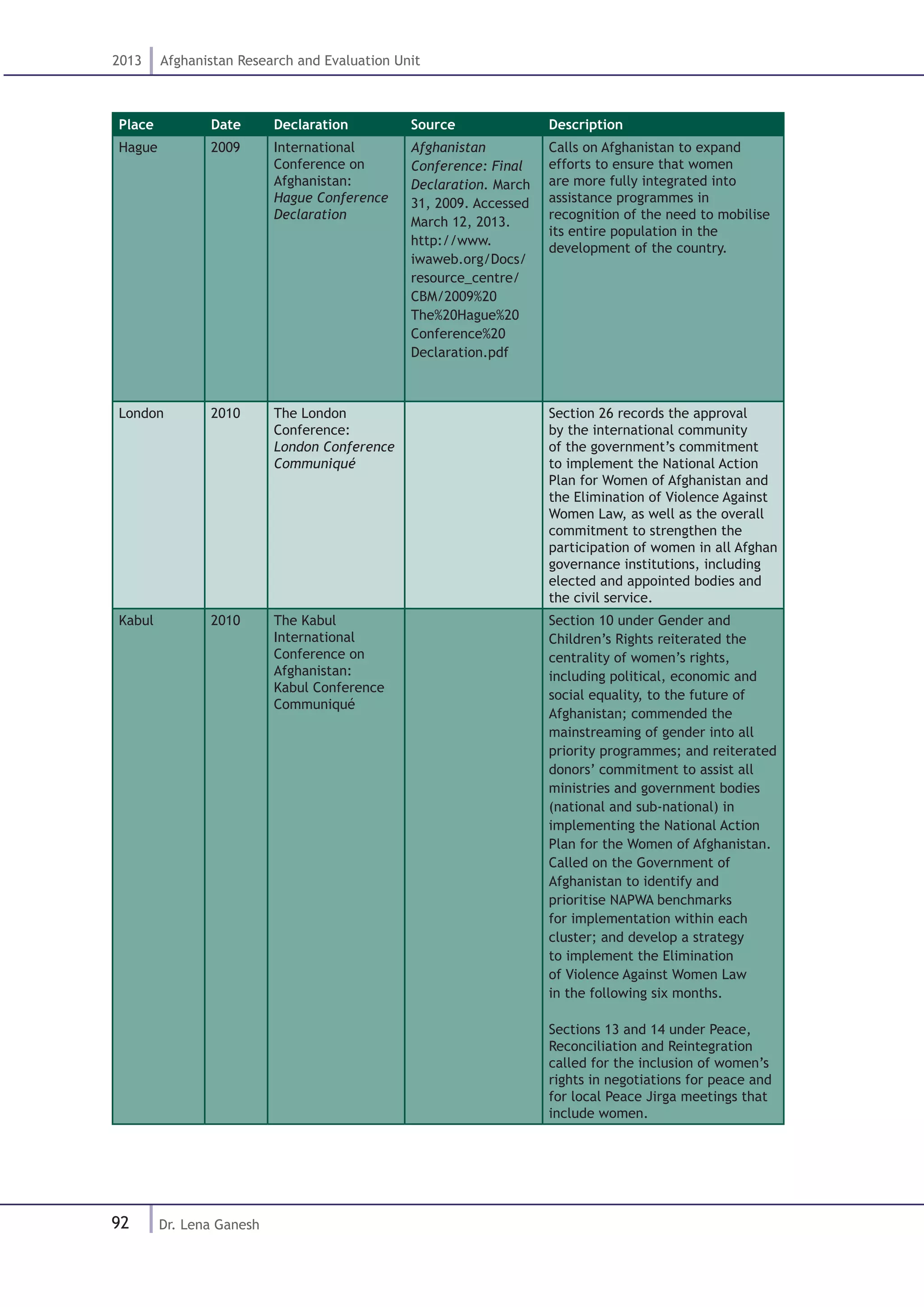
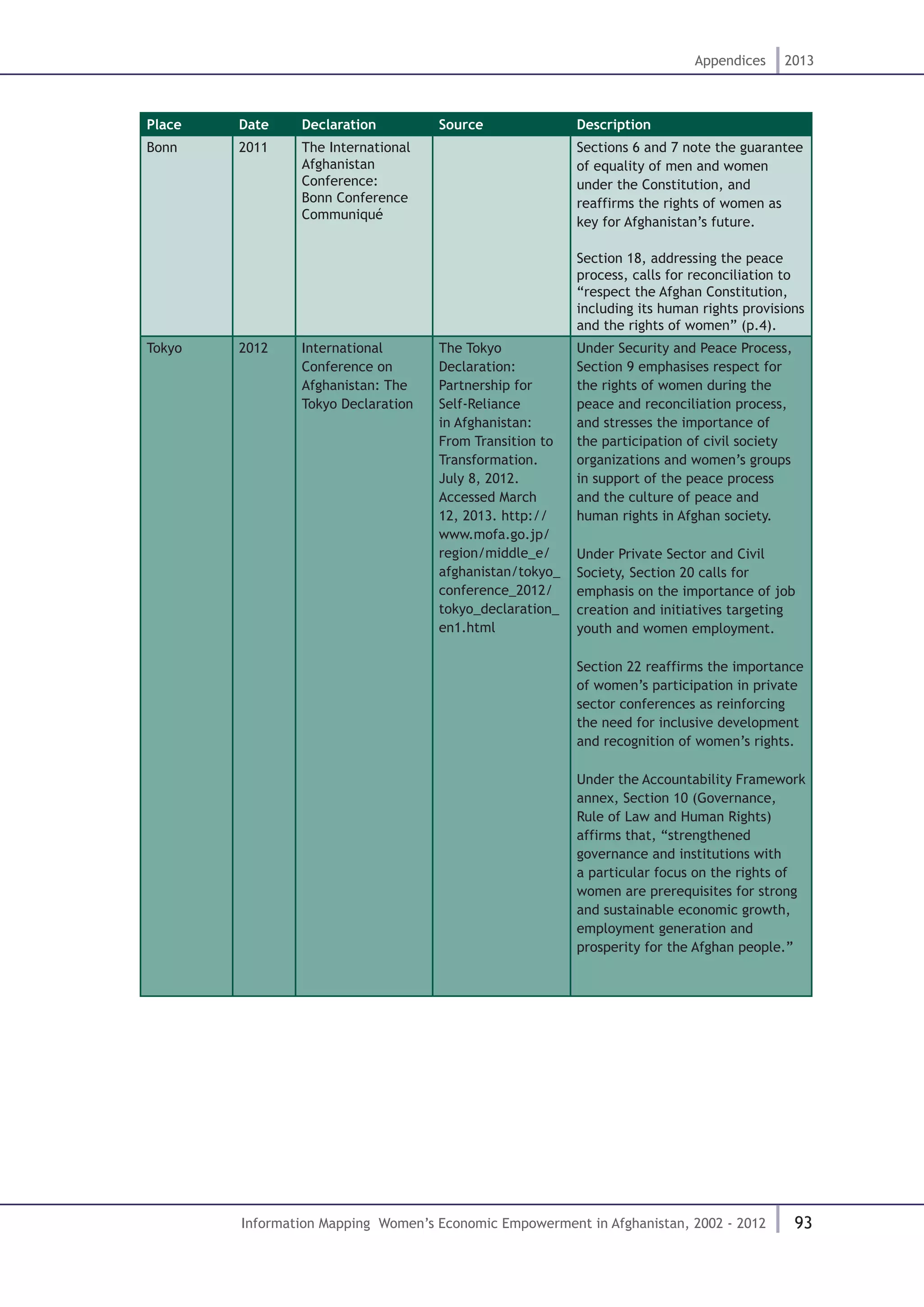
policy reforms toward gender-just practices; these conferences (see List A in Appendix
2) have charted legal, social, economic, ideological and other efforts toward a more
gender-just society in Afghanistan. Afghanistan is also State Party to many international
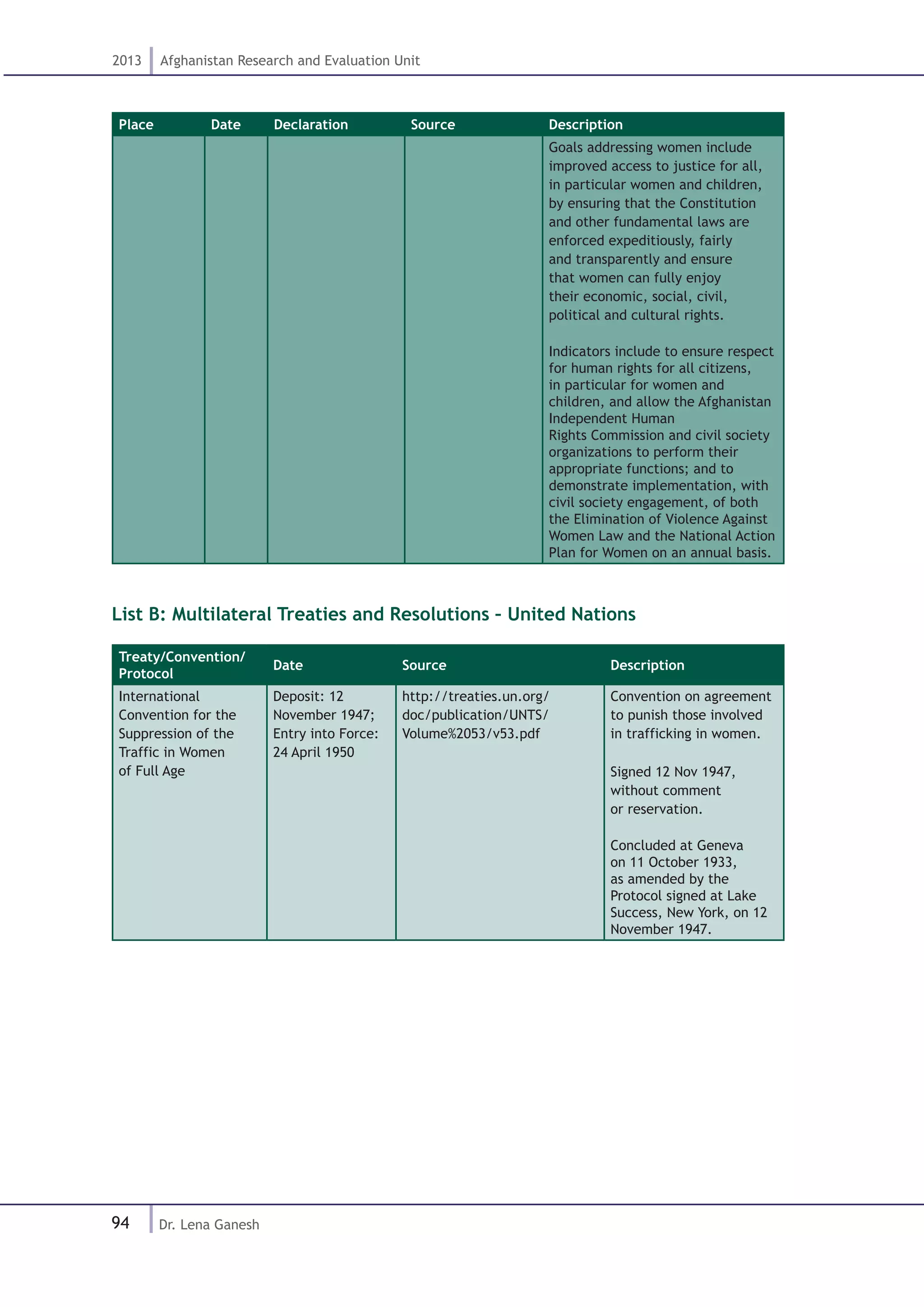
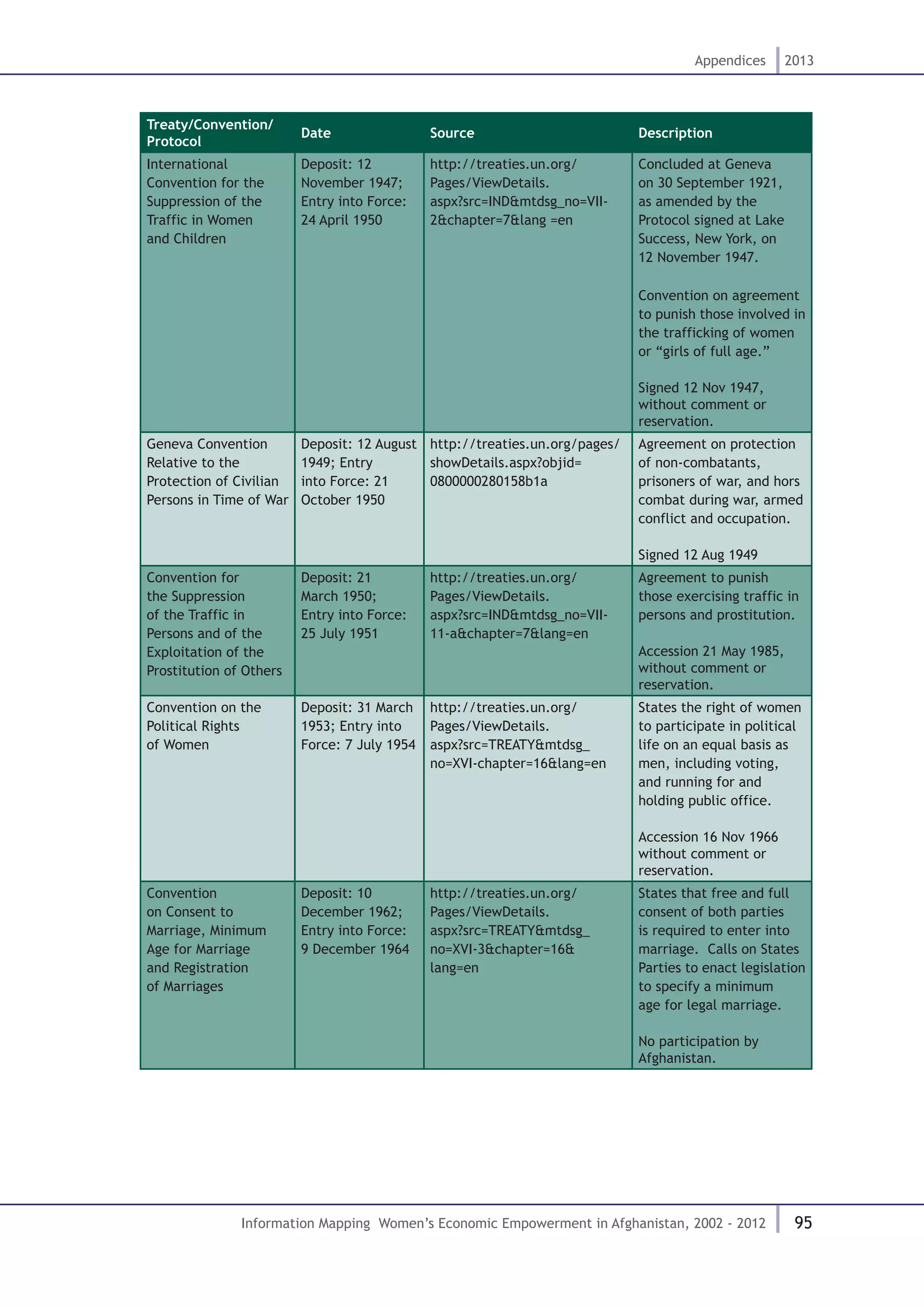
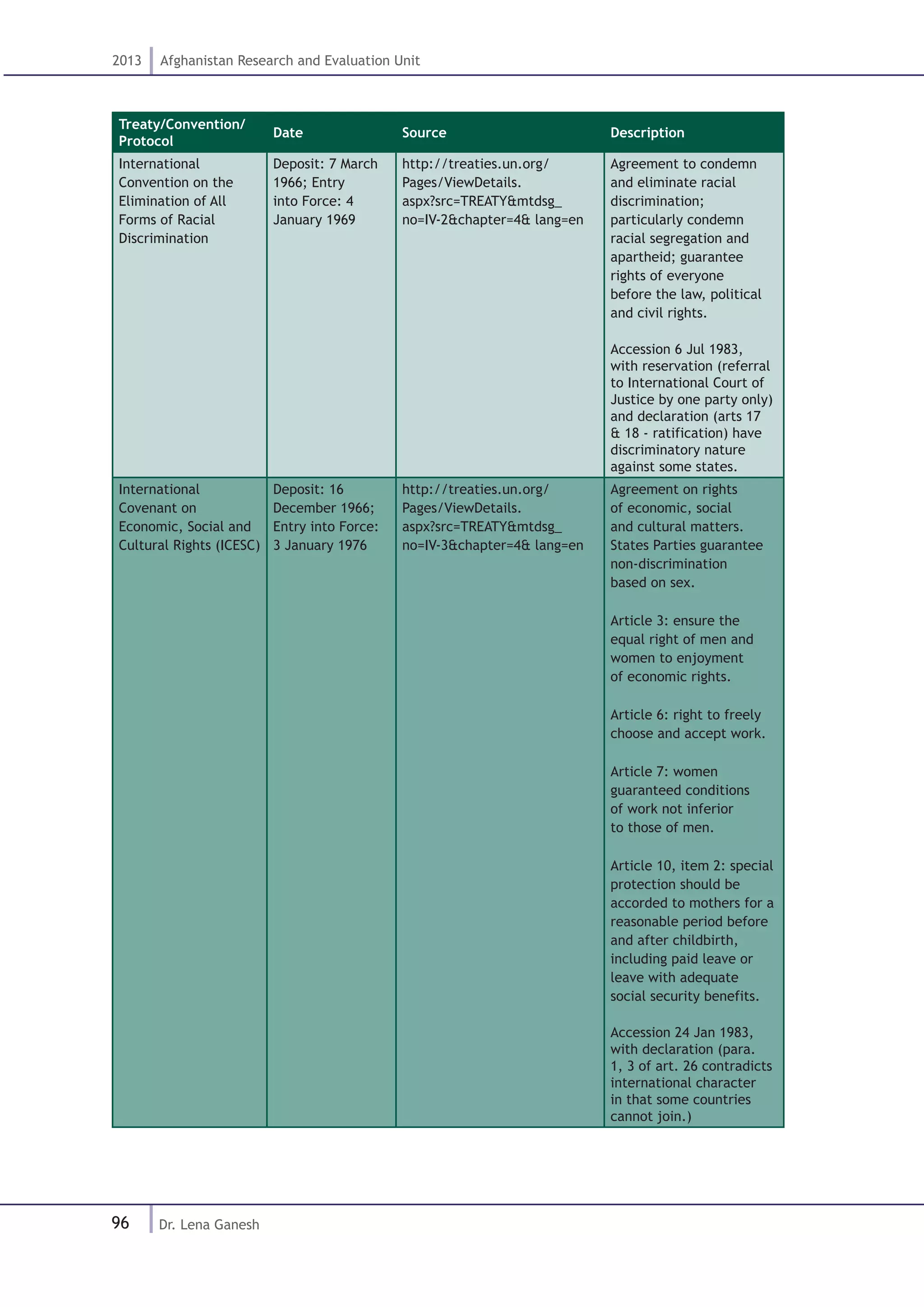
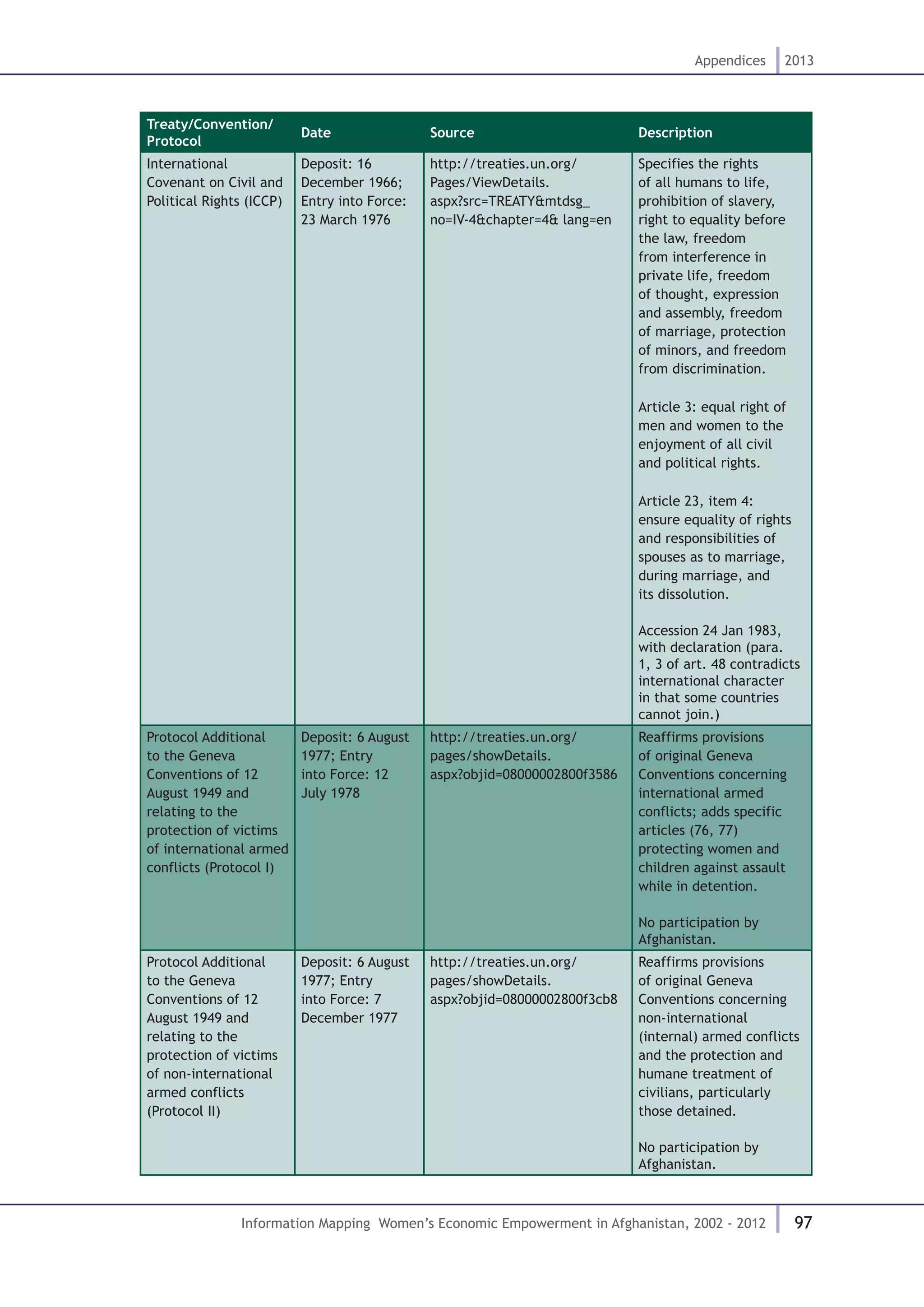
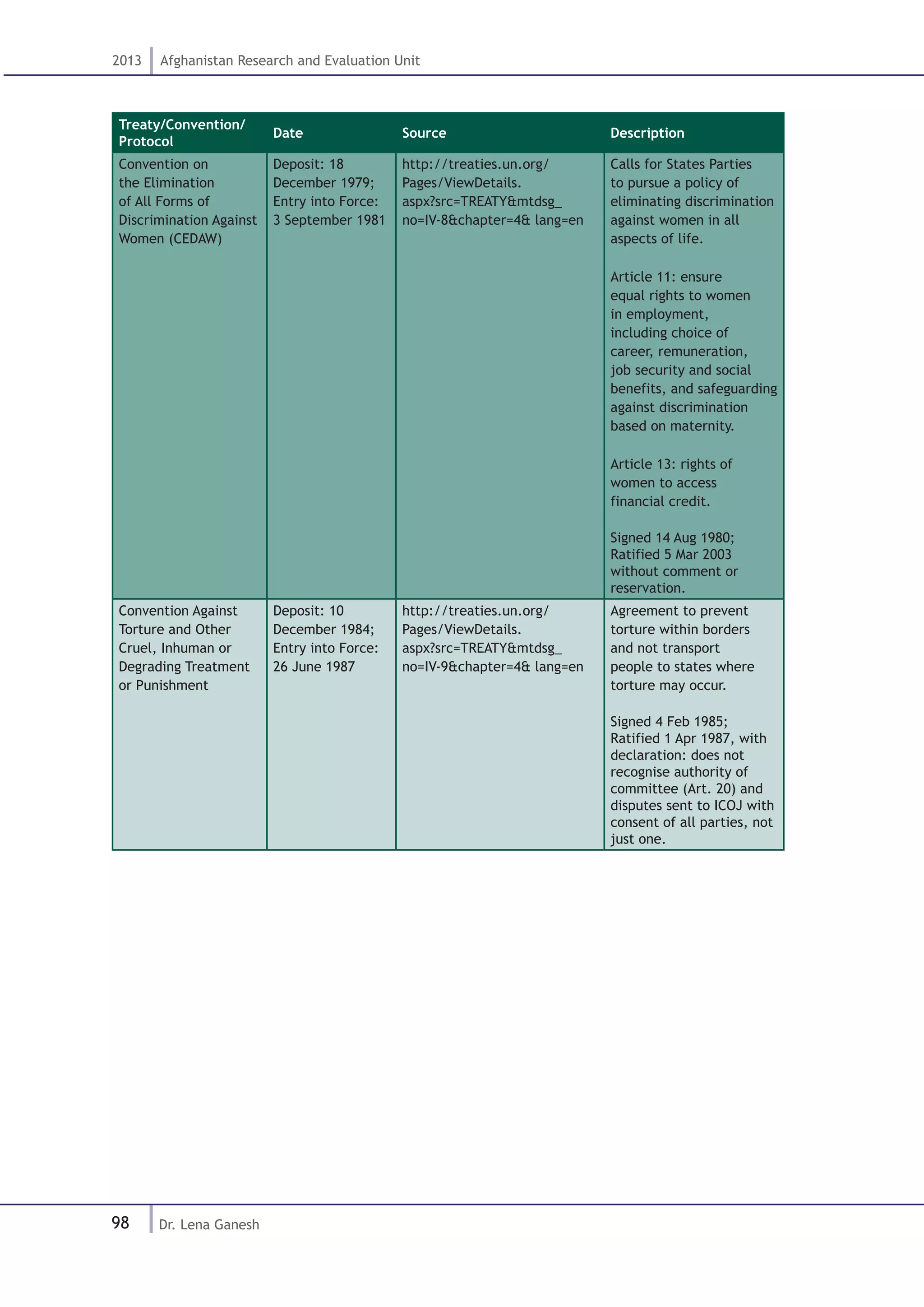
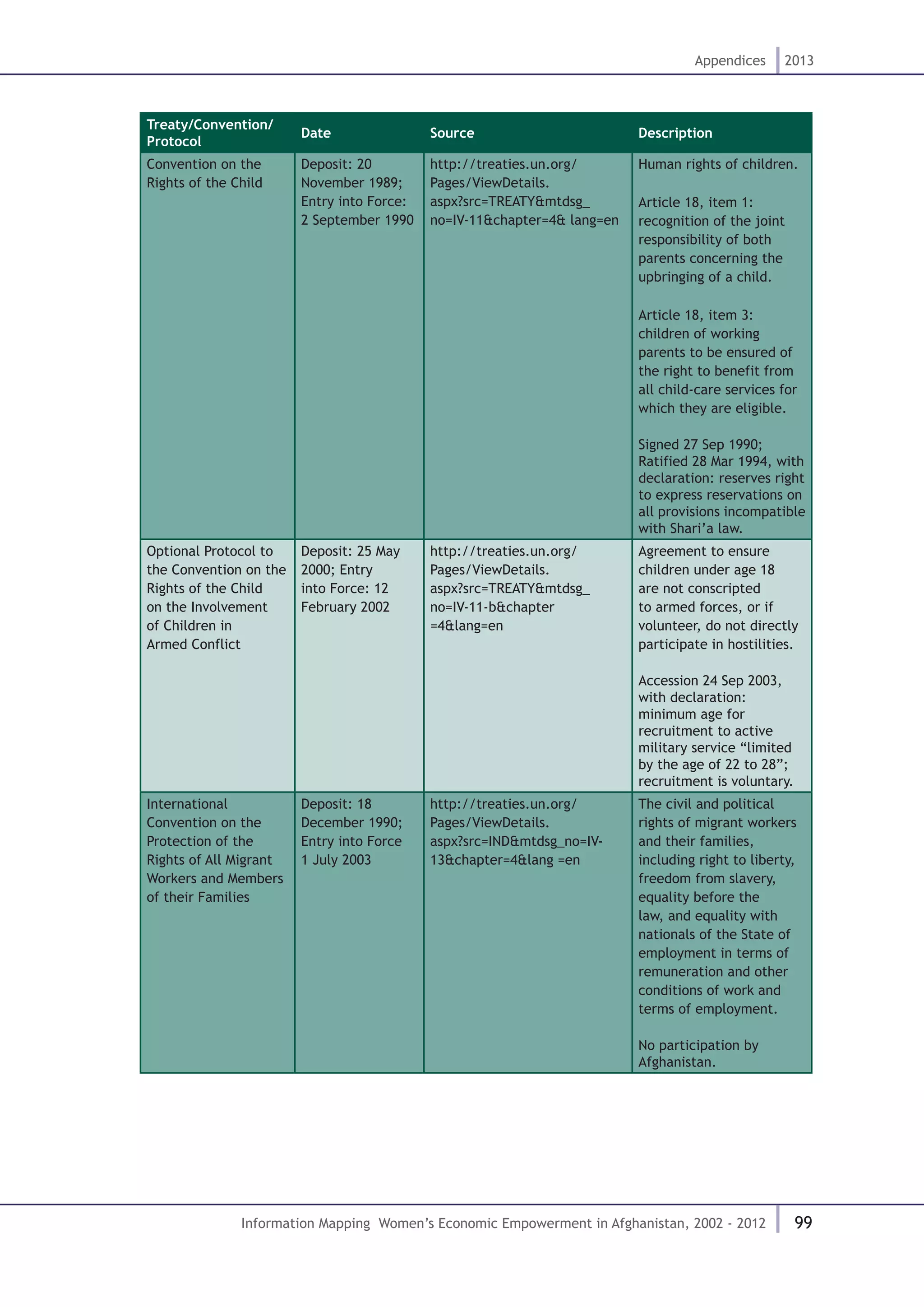
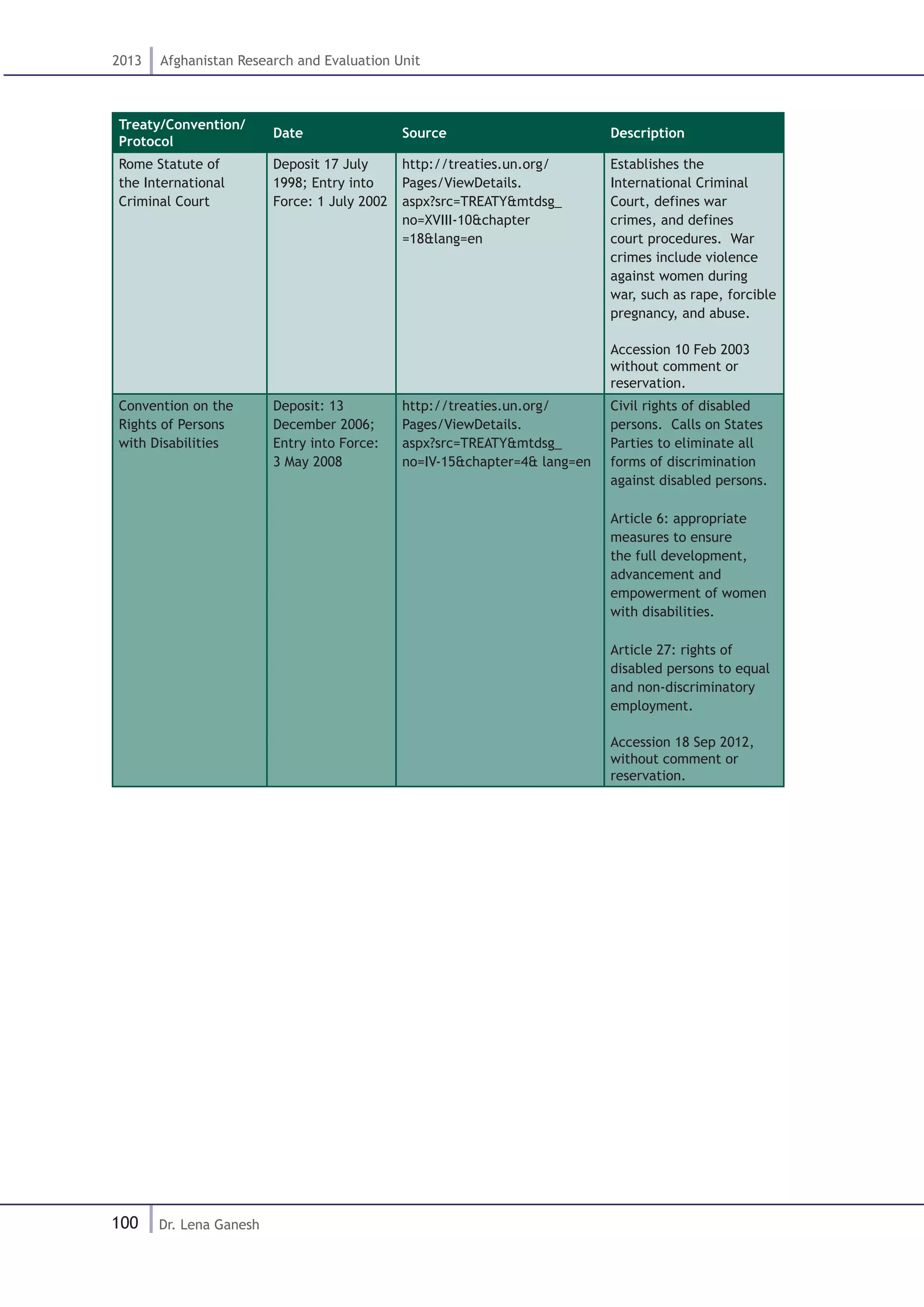
human rights treaties, enumerated in List B in Appendix 2. In treaties on fairness,
protection and non-exploitation of employees in the labour market, Afghanistan has
ratified 19 International Labour Organisation (ILO) Conventions,19
including on equal
remuneration for work of equal value and non-discrimination in employment and
occupation. Afghanistan’s ratification of these treaties serves as additional protection
for women’s rights; Afghanistan is legally bound to these resolutions and treaties through
its Constitution and through the Bonn Agreement.20
Further, Afghanistan is a signatory to
the 1981 Universal Islamic Declaration of Human Rights, the 1990 Cairo Declaration on
Human Rights in Islam and the 1994 Arab Charter on Human Rights.
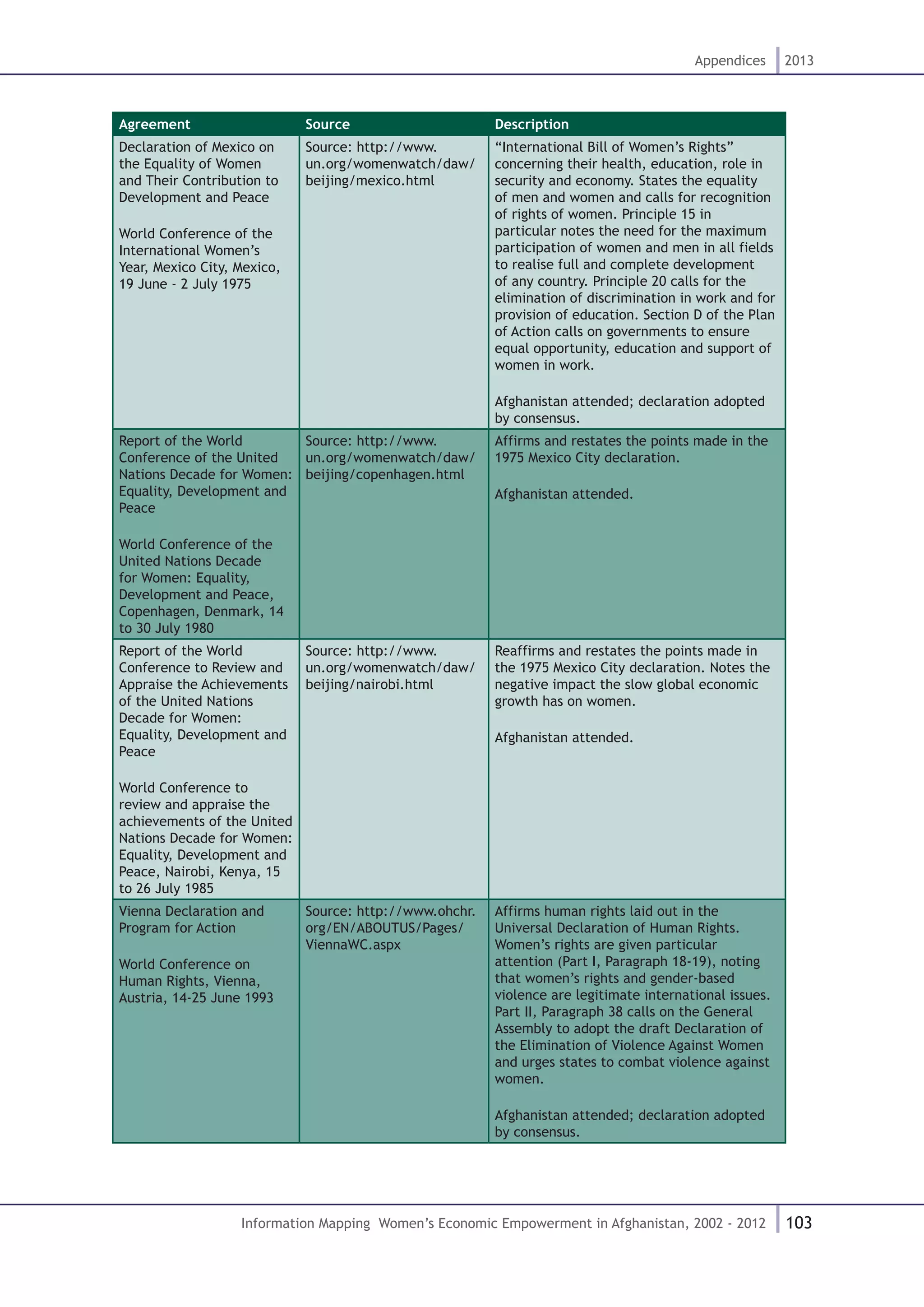
Afghanistan is also Party by consensus to certain other women-relevant General Assembly
Resolutions like the 1993 Vienna Declaration and Programme for Action21
and the 1995
Copenhagen Declaration and Programme for Action.22
A member of the South Asian
Association for Regional Cooperation (SAARC), it has still not signed its 1997 Convention
on Preventing and Combating Trafficking in Women and Children for Prostitution nor has
it ratified the United Nations 1964 Convention on Consent to Marriage, Minimum Age
for Marriage and Registration of Marriages. It has also not ratified 63 ILO Conventions,
including on forced labour, the right to unionise, social security, medical care, old age,
home-work, part-time work, domestic work and maternity protection.23
However, in most of the international conferences and their resolutions and declarations
mentioned above, the “woman question,” when included in discussion and agreement,
has remained focused on legal, social and political rights.24
Women’s economic right, a
key human right, has generally remained in the margins rather than as a fulcrum that
could support other rights in the power dynamics of gender, both local and global. In
poverty reduction strategies it is universally accepted that gender inequality translates
to a higher representation of women among the poorest of the poor and that achieving
the MDGs would need a strong focus, and an affirmative emphasis, on women’s equal
economic engagement to address the growing feminisation of poverty. Equality of
opportunity is therefore a crucial part of any commitment to women’s human rights and
to gender justice.
19  International Labour Organisation, Normlex, Information Systems in International Labour Standards,
“Ratifications for Afghanistan,” ILO, http://www.ilo.org/dyn/normlex/en/f?p=1000:11200:0::NO::P11200_
COUNTRY_ID:102945 (accessed 9 June 2013).
20  Under the Bonn Agreement, in particular, Afghanistan’s treaty obligations are crucial. In line with this,
only those pre-existing laws that do not conflict with its ratified international treaties can be retained.
21  Also known as the World Conference on Human Rights.
22  Declaration and Programme of Action of the World Summit for Social Development.
23  Normlex, Information Systems in International Labour Standards, “Up-to-date Conventions Not
Ratified by Afghanistan,” ILO, http://www.ilo.org/dyn/normlex/en/f?p=1000:11210:0::NO:11210:P11210_
COUNTRY_ID:102945 (accessed 9 June 2013).
24  The prominence given to civil and political rights over economic, social, and cultural rights has been
questioned, for example, in the 1993 “Bangkok Declaration.”
13
Introduction 2013
Information Mapping Women’s Economic Empowerment in Afghanistan, 2002 - 2012
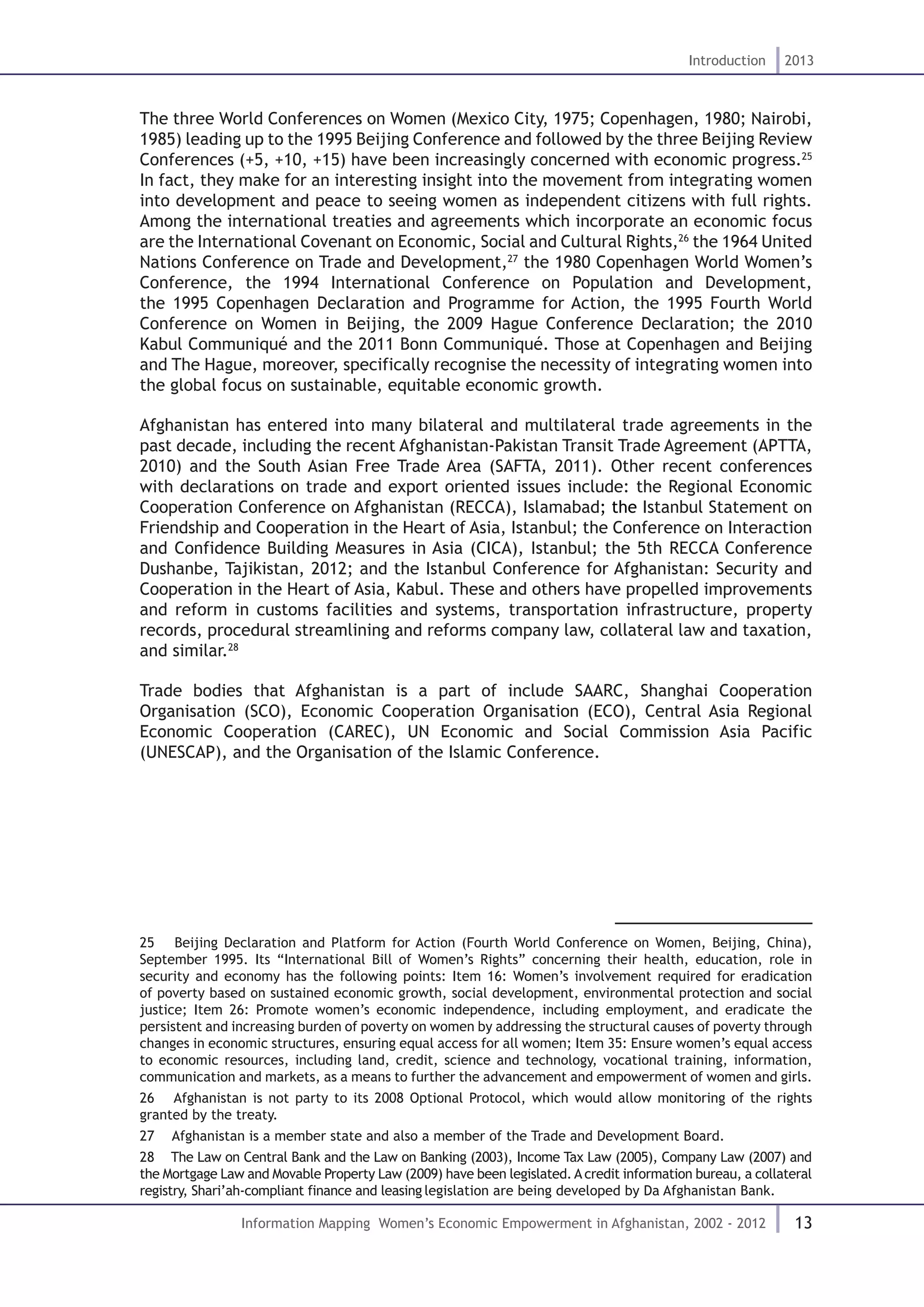
The three World Conferences on Women (Mexico City, 1975; Copenhagen, 1980; Nairobi,
1985) leading up to the 1995 Beijing Conference and followed by the three Beijing Review
Conferences (+5, +10, +15) have been increasingly concerned with economic progress.25
In fact, they make for an interesting insight into the movement from integrating women
into development and peace to seeing women as independent citizens with full rights.
Among the international treaties and agreements which incorporate an economic focus
are the International Covenant on Economic, Social and Cultural Rights,26
the 1964 United
Nations Conference on Trade and Development,27
the 1980 Copenhagen World Women’s
Conference, the 1994 International Conference on Population and Development,
the 1995 Copenhagen Declaration and Programme for Action, the 1995 Fourth World
Conference on Women in Beijing, the 2009 Hague Conference Declaration; the 2010
Kabul Communiqué and the 2011 Bonn Communiqué. Those at Copenhagen and Beijing
and The Hague, moreover, specifically recognise the necessity of integrating women into
the global focus on sustainable, equitable economic growth.
Afghanistan has entered into many bilateral and multilateral trade agreements in the
past decade, including the recent Afghanistan-Pakistan Transit Trade Agreement (APTTA,
2010) and the South Asian Free Trade Area (SAFTA, 2011). Other recent conferences
with declarations on trade and export oriented issues include: the Regional Economic
Cooperation Conference on Afghanistan (RECCA), Islamabad; the Istanbul Statement on
Friendship and Cooperation in the Heart of Asia, Istanbul; the Conference on Interaction
and Confidence Building Measures in Asia (CICA), Istanbul; the 5th RECCA Conference
Dushanbe, Tajikistan, 2012; and the Istanbul Conference for Afghanistan: Security and
Cooperation in the Heart of Asia, Kabul. These and others have propelled improvements
and reform in customs facilities and systems, transportation infrastructure, property
records, procedural streamlining and reforms company law, collateral law and taxation,
and similar.28
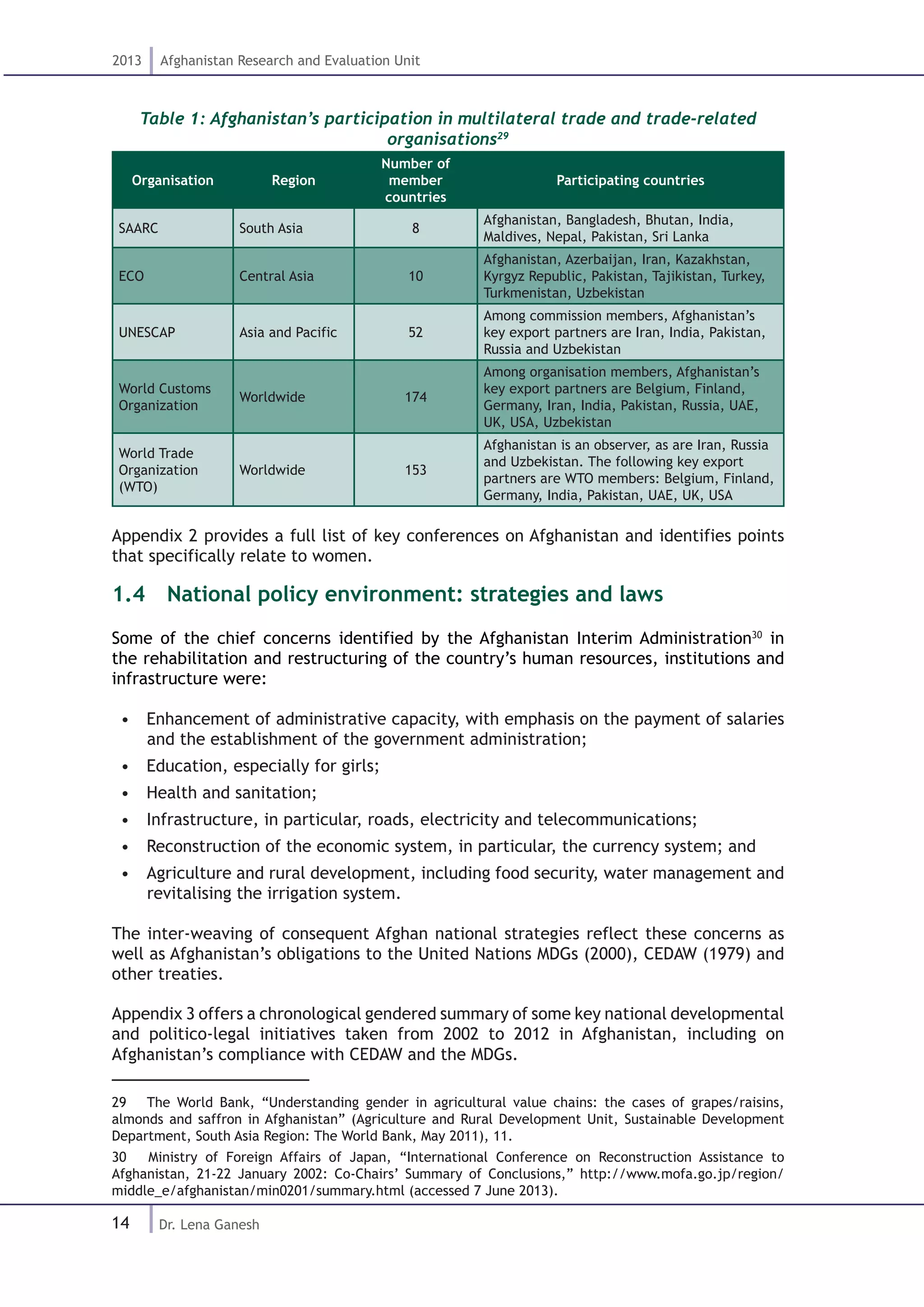
Trade bodies that Afghanistan is a part of include SAARC, Shanghai Cooperation
Organisation (SCO), Economic Cooperation Organisation (ECO), Central Asia Regional
Economic Cooperation (CAREC), UN Economic and Social Commission Asia Pacific
(UNESCAP), and the Organisation of the Islamic Conference.
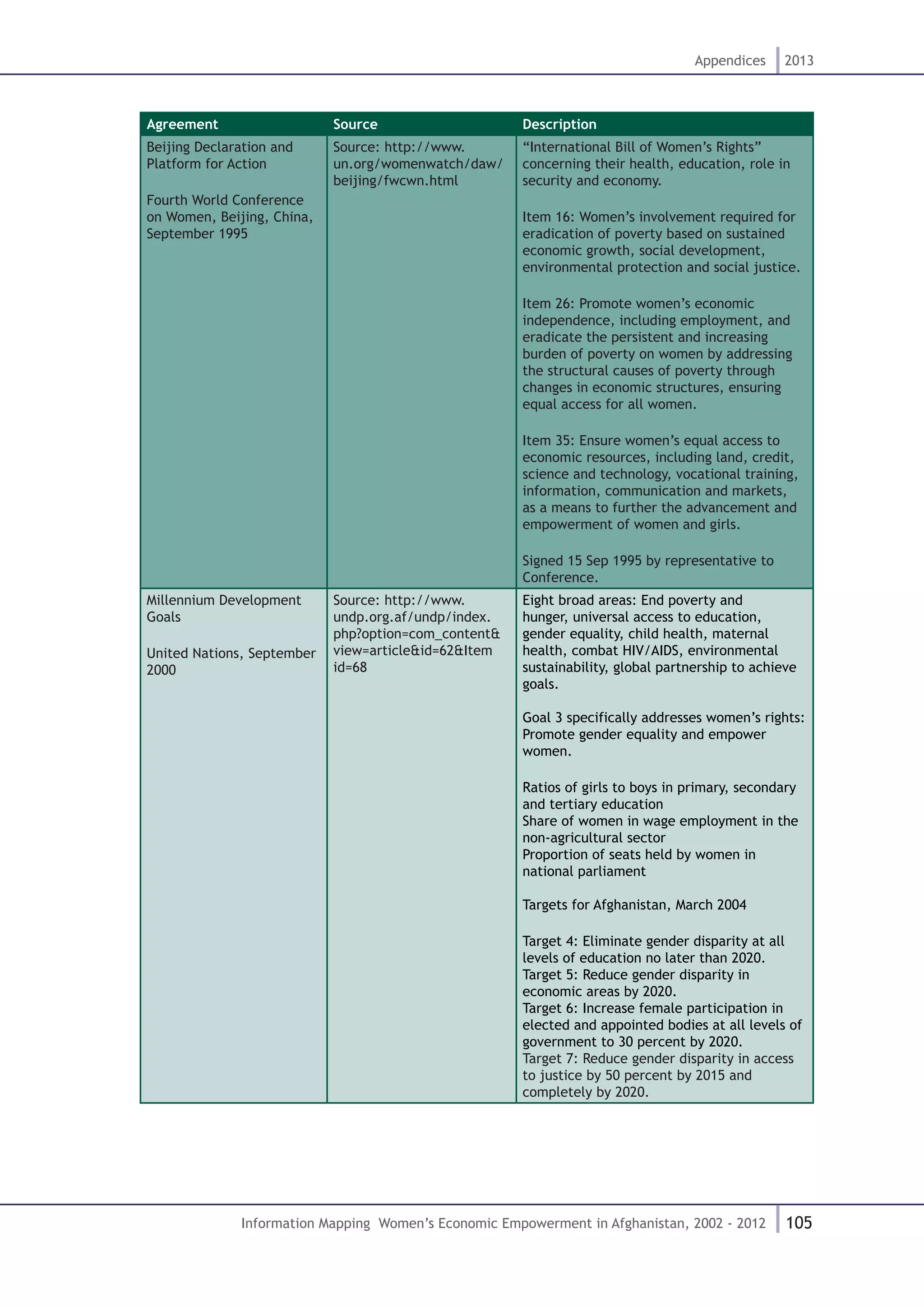
25  Beijing Declaration and Platform for Action (Fourth World Conference on Women, Beijing, China),
September 1995. Its “International Bill of Women’s Rights” concerning their health, education, role in
security and economy has the following points: Item 16: Women’s involvement required for eradication
of poverty based on sustained economic growth, social development, environmental protection and social
justice; Item 26: Promote women’s economic independence, including employment, and eradicate the
persistent and increasing burden of poverty on women by addressing the structural causes of poverty through
changes in economic structures, ensuring equal access for all women; Item 35: Ensure women’s equal access
to economic resources, including land, credit, science and technology, vocational training, information,
communication and markets, as a means to further the advancement and empowerment of women and girls.
26  Afghanistan is not party to its 2008 Optional Protocol, which would allow monitoring of the rights
granted by the treaty.
27  Afghanistan is a member state and also a member of the Trade and Development Board.
28  The Law on Central Bank and the Law on Banking (2003), Income Tax Law (2005), Company Law (2007) and
the Mortgage Law and Movable Property Law (2009) have been legislated. A credit information bureau, a collateral
registry, Shari’ah-compliant finance and leasing legislation are being developed by Da Afghanistan Bank.
14
2013 Afghanistan Research and Evaluation Unit
Dr. Lena Ganesh
Table 1: Afghanistan’s participation in multilateral trade and trade-related
organisations29
Organisation Region
Number of
member
countries
Participating countries
SAARC South Asia 8
Afghanistan, Bangladesh, Bhutan, India,
Maldives, Nepal, Pakistan, Sri Lanka
ECO Central Asia 10
Afghanistan, Azerbaijan, Iran, Kazakhstan,
Kyrgyz Republic, Pakistan, Tajikistan, Turkey,
Turkmenistan, Uzbekistan
UNESCAP Asia and Pacific 52
Among commission members, Afghanistan’s
key export partners are Iran, India, Pakistan,
Russia and Uzbekistan
World Customs
Organization
Worldwide 174
Among organisation members, Afghanistan’s
key export partners are Belgium, Finland,
Germany, Iran, India, Pakistan, Russia, UAE,
UK, USA, Uzbekistan
World Trade
Organization
(WTO)
Worldwide 153
Afghanistan is an observer, as are Iran, Russia
and Uzbekistan. The following key export
partners are WTO members: Belgium, Finland,
Germany, India, Pakistan, UAE, UK, USA
Appendix 2 provides a full list of key conferences on Afghanistan and identifies points
that specifically relate to women.
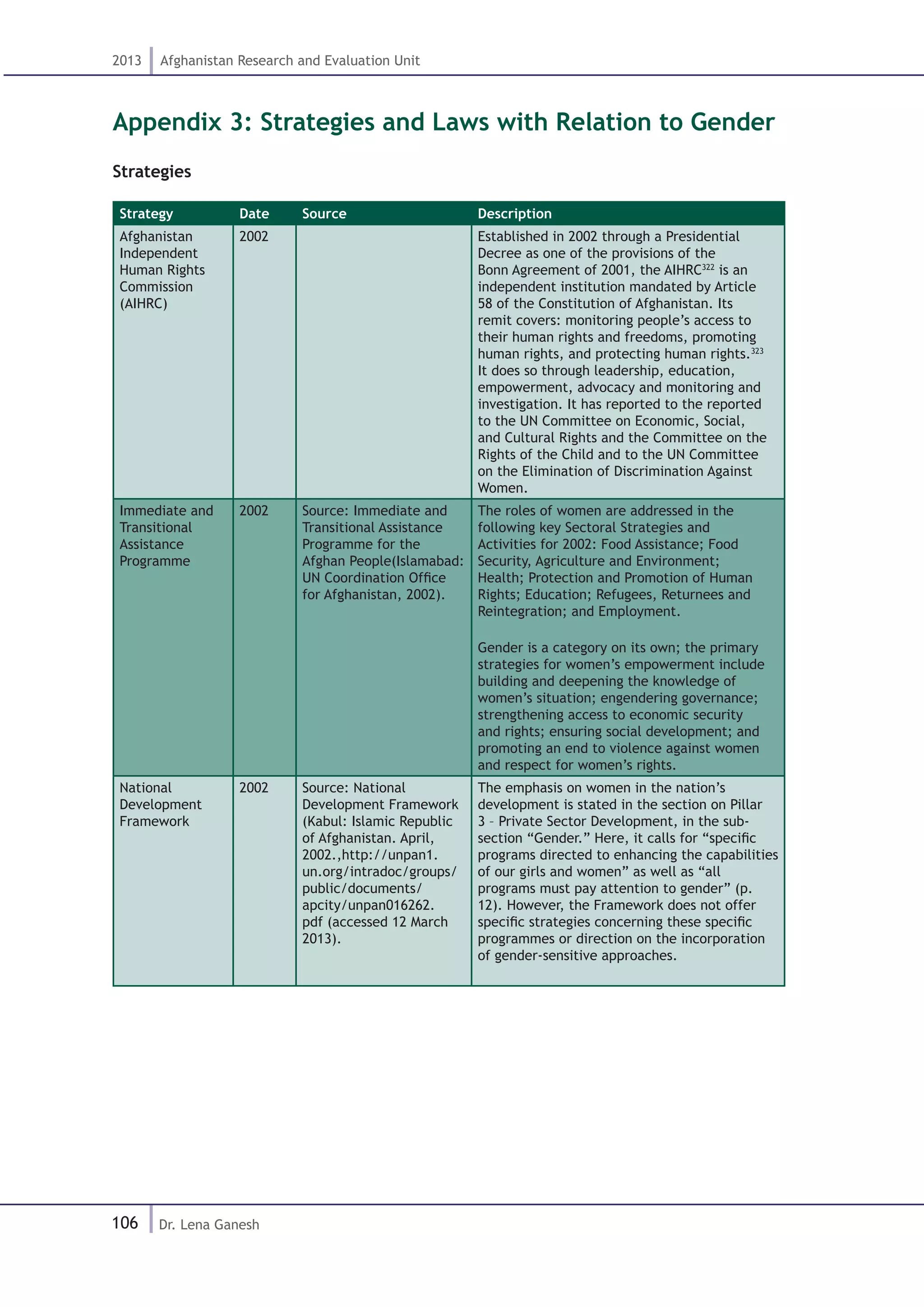
1.4  National policy environment: strategies and laws		
Some of the chief concerns identified by the Afghanistan Interim Administration30
in
the rehabilitation and restructuring of the country’s human resources, institutions and
infrastructure were:
•  Enhancement of administrative capacity, with emphasis on the payment of salaries
and the establishment of the government administration;
•  Education, especially for girls;
•  Health and sanitation;
•  Infrastructure, in particular, roads, electricity and telecommunications;
•  Reconstruction of the economic system, in particular, the currency system; and
•  Agriculture and rural development, including food security, water management and
revitalising the irrigation system.
The inter-weaving of consequent Afghan national strategies reflect these concerns as
well as Afghanistan’s obligations to the United Nations MDGs (2000), CEDAW (1979) and
other treaties.
Appendix 3 offers a chronological gendered summary of some key national developmental
and politico-legal initiatives taken from 2002 to 2012 in Afghanistan, including on
Afghanistan’s compliance with CEDAW and the MDGs.
29  The World Bank, “Understanding gender in agricultural value chains: the cases of grapes/raisins,
almonds and saffron in Afghanistan” (Agriculture and Rural Development Unit, Sustainable Development
Department, South Asia Region: The World Bank, May 2011), 11.
30  Ministry of Foreign Affairs of Japan, “International Conference on Reconstruction Assistance to
Afghanistan, 21-22 January 2002: Co-Chairs’ Summary of Conclusions,” http://www.mofa.go.jp/region/
middle_e/afghanistan/min0201/summary.html (accessed 7 June 2013).
15
Introduction 2013
Information Mapping Women’s Economic Empowerment in Afghanistan, 2002 - 2012
1.5  Socio-economic development indicators, 2012
Unless otherwise indicated the following socio-economic development indicators are
from the Afghanistan Statistical Yearbook, 2011-12:
•  Population (2012): 26.5 million	
-  Female: 49 percent
-  Population under 15: 46.1 percent
-  Population over 65: 3.7 percent
•  Poverty level:	 36 percent
•  Number of schools: 14,394
-  Female students in schools: 3,013,009 of a total of 7,861,988
-  Female teachers in schools: 54,069 of a total of 180,489
-  Number of universities: 60
-  Female students in universities: 19,934 of a total of 112,367
•  Women teachers in universities: 603of a total of 4,873
•  Infant mortality rate31
:74/1000
•  Under-5 mortality rate32
:102/1000
•  Mortality and morbidity rate33
: 327/100,000
•  Number of hospitals (government and private): 422
•  Number of doctors: 15,168
•  Doctors per 10,000 population: Two
•  Health associate professionals: 24,464
•  Comprehensive health centres: 766
•  Basic health centres:	 1,860
•  Sub-health centres: 1,358
•  Number of beds: 22,923
•  Number of midwives:	 2,863
•  GDP: 903,990 million Afs
•  Expenditure: 958,865 million Afs
•  Per capita GDP: US$715
•  Agriculture’s contribution to GDP: 26.74 percent
•  Industry’s contribution to GDP: 21.39 percent
•  Services’ contribution to GDP: 48.27 percent
 
31  Central Statistics Organisation, Islamic Republic of Afghanistan, “Afghanistan Multiple Indicator Cluster
Survey, 2010-11,” http://cso.gov.af/en/page/6807 (accessed 9 June 2013).
32  CSO, “Afghanistan Multiple Indicator Cluster Survey, 2010-11.”
33  CSO, “Afghanistan Multiple Indicator Cluster Survey, 2010-11.”
16
2013 Afghanistan Research and Evaluation Unit
Dr. Lena Ganesh
2.  Assessment and Analysis
Although the gender-just acts in many of the legal instruments and policies of the
Government of Afghanistan were drafted from resolutions of the international agreements
listed in Appendix 2, the tone and tenor of many laws listed is of woman as carer of the
nation and of the “culture” and “tradition” of “Afghaniyat”34
and of woman as an asset
to the nation, community and family.35
They tend to reify the “Women in Development”
approach of the 1980s. And their implementation through various ministries continues to,
in a sense, reproduce the frictions between traditionally valued and newer approaches to
gender roles. Further, in the absence of full de facto legitimacy that can ensure security
and with a fledgling institutional capacity and high donor dependence, the Government
of Afghanistan has been unable to fulfil its obligations to many international agreements.36
34  It is worth reiterating that these terms in a land so diverse cannot have singular meanings. Identities
vary with community, individual practices (both inherited and altered), ethnicities, geographical position,
access to education, class and a myriad other factors. Centlivres (1976) has made the point that groups
commonly called “ethnic” and depicted in “ethnographic maps” are not comparable, since they share no
common defining criterion—in one case it may be language, in another religion, or political or historical
identity. Maps simplify reality; the use of ethnonyms and ethnic identities is situational and strategic;
essentially, ethnicity must be viewed as an idiom, a discourse of “popular anthropology,” whether “theirs”
or “ours,’’ Micheline Centlivres-Demont, “Types D’occupation et Relations Inter-Ethniques Dans le Nord-
Est de 1’Afghanistan,” StudiaIranica, 5, no.2, (1976): 269-277, cited in Richard L. Tapper, “Ethnicity,
Order and Meaning in the Anthropology of Iran and Afghanistan,” Colloques internationaux (1988): 23. The
Taliban’s contention of there being a single vision of “Afghaniyat” is a case in point that still reverberates
among Tajiks, Uzbeks, Hazaras, Turkmen, Baluchs, Ismailis and Aymaqs today. “Afghanistan has near to
fifty-five diverse ethnic groups, all of them practicing family customary legal systems,” Xaviera Medina
de Albrand, “Customary and Family Law: A Gender Approach in Afghanistan,” Effectius Newsletter, no.
8 (2010), http://effectius.com/yahoo_site_admin/assets/docs/Customary_and_Family_Law_a_Gender_
approach_in_Afghanistan_Xaviera_Newsletter8.27185709.pdf (accessed 1 April 2013). The Initial and Second
Periodic Report to CEDAW (2011: 59) notes that textbooks are provided and distributed in, besides Dari and
Pashto, Uzbeki, Turkmeni, Nooristani, Pashaye, Baloochi and Sheghnani; Islamic Republic of Afghanistan,
“Consideration of Reports Submitted by States Parties under Article 18 of the Convention on the Elimination
of All Forms of Discrimination against Women, Combined Initial and Second Periodic Reports of States
Parties, Afghanistan” (New York: Committee on the Elimination of Discrimination against Women, CEDAW/C/
AFG/1-2, 21 December 2011), 59, http://www2.ohchr.org/english/bodies/cedaw/docs/CEDAW.C.AFG.1-2.
pdf (accessed 1 April 2013).
35  The Central Statistics Organisation, for example, finds it necessary to use its findings on the
educational level of women as “compelling evidence that investments in the status and wellbeing of women
are investments in children, and in communities at large.” Central Statistics Organisation, Islamic Republic
of Afghanistan, “Afghanistan: Multiple Indicator Cluster Survey 2010-2011” (United Nations International
Children’s Educational Fund, June 2012), xviii, http://cso.gov.af/Content/files/AMICS-Jun24-2012-FINAL.
pdf (accessed 1 April 2013).
36  The point has been made by many that the ratification of treaties and resolutions do not necessarily
translate to compliance or implementation in the framing of national laws and strategies. See Oona
Hathaway, “Do Human Rights Treaties Make a Difference?” (Yale Law School, Faculty Scholarship Series,
Paper 839, 2002), http://digitalcommons.law.yale.edu/cgi/viewcontent.cgi?article=1852&context=fss_
papers (accessed 1 April 2013). See also a critique of the refusal of the USA to ratify the CEDAW on the basis
of cultural and structural misalignment between the Constitution of the USA and the Convention, Catherine
Powell, “Lifting Our Veil of Ignorance: Culture, Constitutionalism, and Women’s Human Rights in Post-
September 11 America,” Hastings Law Journal, no. 57 (2005): 331-383, http://ssrn.com/abstract=910250
or http://dx.doi.org/10.2139/ssrn.667463 (accessed 1 April 2013). Such arguments have been used by many
other states, including Muslim ones. Moreover, treaties like the 1990 Cairo Declaration of Human Rights in
Islam (authored by the Organization of the Islamic Conference) declare that all human rights are subsumed
under the Islamic law of Shari’ah. See Organization of the Islamic Conference, “Cairo Declaration on Human
Rights in Islam,” 5 August 1990 (United Nations General Assembly Official Records, World Conference on
Human Rights, 4th Session, Agenda Item 5, United Nations Document A/ CONF.157/PC/62/Add.18, 1993),
http://www.arabhumanrights.org/publications/regional/islamic/cairo-declaration-islam-93e.pdf (accessed
1 April 2013). It is also questionable whether, despite being Party to Treaties and Resolutions, the principle
of progressive realisation has been adequately addressed in Afghanistan.
17
Assessment and Analysis 2013
Information Mapping Women’s Economic Empowerment in Afghanistan, 2002 - 2012
The information gained from Sections 1 and 2 points us toward two major arenas37
that
have effected and affected women’s economic engagement in this past decade and
which can be taken up for assessment and analysis: the status of women’s human rights
situation and their economic participation. This section accordingly looks at these two
fields and the impact that each has had on the other.
2.1  The status of women’s human rights
In 2004, with an estimated Gender Inequality Index38
of 0.3, Afghanistan was among the
bottom-tier of countries with the least parity between men and women. If we trace
the graph of women’s education, health, safety and political participation in this past
decade, a certain staticity of status is revealed, along with some improvements.
2.1.1 Education
The education sector has seen very modest gains in absolute terms. In 2003, the literacy
rate for 15- to 24-year-old females was 18 percent.39
For 2003 the net attendance was
54 percent, or 2.3 million students.40
The ratio of girls to boys enrolled in primary school
between 2003 and 2004 was between 0.46 to 0.60, in secondary school between 0.29
and 0.33, and in tertiary education between 0.12 and 0.21.41
Afghanistan in 2003 had the
largest school age population proportion in the world, with the 7- to 12-year-olds making
up 19.6 percent of the population.42
Only 24 percent of the population 15 years and older
could read and write, with an estimated 12.6 percent of women being literate. In rural
areas the literacy rate was 20 percent, which dropped to 6 percent among nomadic
people. The MICS survey found that Afghan parents’ major reasons for not enrolling
their children in school included the distance of the school (37.2 percent); inadequate
facilities (25.8 percent); lack of gender-segregated schools (22 percent); child-labour in
domestic chores (17.2 percent); a belief that schooling is not necessary (15 percent);
child-labour in paid work (7.1 percent)43
and the teachers’ gender (6.4 percent).44
By 2008, even with 42 percent of girls of primary school-going age (6 to 9 years)
attending school, the gender gap had widened. Even as school enrolment rates went up,
the gap had increased from 21 percent female/28 percent male in 2005 to 29 percent
female/41 percent male in 2007-08 in primary schools, and in tertiary education (15
to 25 years) from 19 percent female/40 percent male in 2005 to 22 percent female/51
37  The third factor, perhaps the strongest and which is explored in the second part of the wider research
report “Women’s Economic Empowerment in Afghanistan, 2002-2012, Situational Analysis,” is the location
of the female self in the family and the community.
38  An index that captures women’s disadvantage in empowerment, economic activity and reproductive health.
39  Islamic Republic of Afghanistan, “Millennium Development Goals Islamic Republic of Afghanistan
Country Report 2005: Vision 2020” (Kabul: United Nations Development Programme, 2005), 34, http://
planipolis.iiep.unesco.org/upload/Afghanistan/Afghanistan%20MDG%202005.pdf (accessed 1 April 2013).
40  Islamic Republic of Afghanistan, “MDGs Country Report 2005,” 33.
41  Islamic Republic of Afghanistan, “MDGs Country Report 2005,” 42.
42  Islamic Republic of Afghanistan, “MDGs Country Report 2005,” 33, citing United Nations Children’s
Fund, “Best Estimates of Social Indicators for Children in Afghanistan 1990-2005” (New York: United Nations
Children’s Fund, 2005).
43  It is estimated that up to 30 percent of primary school children are working and are often the sole
source of income for their families. Farida Ayari, “Children Carrying the Burden of Work in Afghanistan,”
http://www.unicef.org/infobycountry/afghanistan_50072.html, 23 June 2009 (accessed 1 April 2013).
44  Islamic Republic of Afghanistan, “MDGs Country Report 2005,” 34.
18
2013 Afghanistan Research and Evaluation Unit
Dr. Lena Ganesh
percent male in 2007-08.45
While access varied provincially,46
6 percent of women over
25 years had had access to some type of formal education but 88 percent women over
15 years remained illiterate. Primary school enrolment for girls seems to have received
more attention, with 39.1 percent of primary schools, 33.2 percent of secondary schools
and 28.1 percent of higher secondary schools having been designated female only.
Eighty percent of districts lacked girls’ high schools.47
As of 2008 there were 511 Islamic
education institutions throughout the country and the number of Islamic students
increased from 58,000 in 1385 (2006) to 106,000 in 1387 (2008). Only 5 percent of Islamic
education students were females, but the ministry planned to increase the number of
female students to 40 percent of the total by 2014; it was to establish 32 Dar-ul-Ulums
for girls in the provinces.48
Of the total 11,123 schools in 2009, 2,166 or 19 percent were girls-only, 3,434 or 31
percent were mixed and 5,523 or 50 percent were for boys.49
There are provinces with
a very low percentage of overall enrolment: Uruzgan (2 percent), Helmand (4 percent),
Zabul (5.2 percent) and Kandahar (11 percent).
Figure 1: Female literacy rates by province, 200850
45  Ministry of Economy, Islamic Republic of Afghanistan and World Bank Economic Policy and Poverty
Sector, “Poverty Status in Afghanistan: Based on the National Risk and Vulnerability Assessment (NRVA) 2007-
2008” (presentation, July 2010).
46  For example, Uruzgan has one of the lowest enrolment rates with an estimated 2 percent of its children
enrolled in schools. Islamic Republic of Afghanistan, Ministry of Economy, “Afghanistan Provincial Briefs 2011.”
47  Musa Sultani, Hussain Ali Moin, Muhammad Hussain Nusrat, Abdulqayum Zahidi, Safiyullah Elham and
Muhammad Hussain Hasrat, “Report on the Situation of Economic and Social Rights in Afghanistan – IV”
(Kabul: Afghanistan Independent Human Rights Commission, December 2009): 27, http://www.unhcr.org/
refworld/docid/4b3b2df72.html (accessed 1 April 2013).
48  Islamic Republic of Afghanistan, Ministry of Education, “Strategic Plan - Program Five: Education
Management,” http://moe.gov.af/en/page/2016 (accessed 10 June 2013).
49  Marit Glad, “Knowledge under Fire: Attacks on Education in Afghanistan Risks and Measures for
Successful Mitigation,” (Kabul: Care International and Ministry of Education, August 2009), http://ddp-ext.
worldbank.org/EdStats/AFGpub09a.pdf (accessed 1 April 2013).
50  Peter Pauli, “National Risk and Vulnerability Assessment 2007/8: A Profile of Afghanistan,” (Kabul:
Delegation of the European Commission to Afghanistan, 2009), 67,
http://cso.gov.af/Content/Media/Documents/NRVA2007-08Report38201112528554553325325.pdf (accessed
1 April 2013).
19
Assessment and Analysis 2013
Information Mapping Women’s Economic Empowerment in Afghanistan, 2002 - 2012
The AMICS (2010-11), with 81 percent of its respondent women aged between 18-49 and
living in rural Afghanistan, shows 82 percent had no formal education, while 8 percent had
primary level education only, and 11 percent had attained secondary level education or
higher. Chief constraints to female education remain financial inadequacy,51
remoteness of
schools, lack of separate facilities, and denial of consent by the family. However, insecurity
for girls’ education has become significant. The years 2007-08 saw 311 attacks on schools
with 84 deaths and 115 injuries to children, teachers and employees.52
As of June 2009,
695 schools across the country were closed, affecting over 340,000 students.53
An ongoing
feature has been warning letters sent to teachers and students to stay away from schools,
and improvised explosive devices and physical attacks on students and teachers.
2010 data reveals that women formed 30 percent of the 170,000 teachers, 38 percent of
students enrolled in Teacher Training Colleges, and 26 percent of graduates from Grade
1254
and 12,421 schools. Only 22.2 percent of women between the ages of 15-24 were
literate55
and women’s literacy rate in rural areas was more than three times lower than
urban areas.56
As of 2012, the percentage of female students enrolled in formal education—General
Education (Grades 1 to 12), Islamic Education (Grades 1 to 14), Teacher Training College
(Grades 10 to 14), Technical and Vocational Education and Training (TVET) (Grades 10 to
14), Community Based Education (CBE) (Grades 1 to 6) and Cross Border Education was
38.04. The percentage of male students is 61.96 and the total number of students was
8,328,350. Zabul had the least number of students enrolled with a total of 21,114. Overall,
38.58 percent of teachers were female and 5 percent were female in Islamic Education.57
The total number of schools (primary, middle, professional, night-time schools, teacher
training and religious) was 14,394, with a total 7,861,988 students, of which 3,013,009
were female. The total number of teachers was 180,489 of which 54,069 were women.
In higher education there were 60 government and private universities with 112,367
students, of which 19,934 were women. In these universities, the total number of
51  “...damaged schools are not rebuilt and are not safe. There are shortages of teachers, books, tables,
chairs, papers and pencils, let alone other equipments. The university courses close down because of lack
of teachers and equipments.” Mansoora, a teacher in Mazhar-e Sharif, said: “Universities do not have the
capacity to absorb the number of candidates and there are no teachers. The salaries of the existing teachers
are not paid for months.” Elaheh Rostami Povey, Afghan Women: Identity and Invasion (London: Zed Books,
2007), 307.
52  United Nations International Children’s Educational Fund, “Annual Report 2008” (New York: United
Nations Children’s Fund, June 2009), http://www.unicef.org/publications/files/UNICEF_Annual_
Report_2008_EN_072709.pdf (accessed 1 April 2013).
53  According to the Ministry of Economy security database, cited in Marit Glad, “Knowledge on Fire,” 38.
54  Ministry of Education Islamic Republic of Afghanistan, “Summary Report of Education Situation: Year
1388 (2009-2010)” (Kabul: Directorate of Educational Management Information System and Directorate
General of Planning and Evaluation, undated), http://moe.gov.af/Content/files/079_1388%20English%20
Report.pdf (accessed 1 April 2013).
55  Anuradha Rajivan, “Power, Voice and Rights: A Turning Point for Gender Equality in Asia and the
Pacific” (Colombo: United Nations Development Programme Regional Centre for Asia Pacific and Human
Development Report Unit, Asia-Pacific Human Development Report, February 2010), http://web.undp.org/
asia/pdf/APHumanDevelopmentReport2010.pdf (accessed 1 April 2013).
56  Central Statistics Organisation, “AMICS 2010-2011.”
57  Ministry of Education Islamic Republic of Afghanistan, “1390 (2011/2012) EMIS Statistical Analytical
Report” (Kabul: Directorate of Educational Management Information System and Directorate General of
Planning and Evaluation, 2012), http://moe.gov.af/Content/files/MoE_1390_Stat_Analysis_Final.pdf
(accessed 1 April 2013).
20
2013 Afghanistan Research and Evaluation Unit
Dr. Lena Ganesh
teachers was 4,873, of which 603 were women.58
In vocational training however, there
were very few women—3,245 out of 27,019 students. The highest enrolment in vocational
training for women was in management and accounting (around half), followed by food
and light industries, which includes computer literacy. However, there was some limited
enrolment of women in non-traditional occupations like auto mechanics (13), but very
few women were listed for training in agriculture and veterinary training (32).59
The
figure for women teachers at government teacher training institutes was low—just 282
out of 1,577; in many provinces their representation was nil. The number of female
students was 19,233 out of a total of 52,617.
Table 2: National Education Strategic Plan target and program annual targets60
Main indicators 2010 Achievements 2011 Achievements 2014 Targets
Number of students 7,101,461 8,008,676 9,938,727
Number of schools 12,421 13,562 16,150
Number of teachers 166,262 172,291 200,014
Number of school councils/ shuras 10,876 1,333 16,150
Overall, while enrolment in education for girls at the primary level has increased
considerably in this decade, it remains very low in absolute numbers as well as in the
female-to-male ratio. The Afghanistan Compact (2006) says, “By end-2010: in line with
Afghanistan’s MDGs, net enrolment in primary school for girls and boys will be at least
60 percent and 75 percent respectively; a new curriculum will be operational in all
secondary schools; female teachers will be increased by 50 percent.” The non-provision
of girls-only schools and early marriage has contributed to a high drop-out rate when
girls reach puberty and when purdah restrictions begin to be activated. If Afghanistan is
to meet the AMDGs’ aim for 100 percent literacy by 2020, there has to be a huge amount
of resources channelled into girls-only schools with all-female teachers and a greater
monitoring of child-marriage; community-based schools for girls and young women
also need to be expanded. Further, the significant disparities at the provincial level
need to be addressed. Much depends on the security situation and the abilities of the
government and the communities to counter reactionary forces. Equally importantly, the
curriculum has to address girls’ professional and economic capacities rather than, for
example, agriculture being taught to boys and home management to girls.61
In keeping
with women’s current and contributory roles in agriculture, for example, it is important
to provide knowledge and training within the gendered division of roles in rural work or
in trade, enterprise and other aspects of non-rural occupations.
2.1.2 Health
The graph of the health sector shows some relative improvement in certain areas for
this decade. In 2002, Afghanistan had an under-five mortality rate of 257 per 1,000
(varyingly, the second or the third highest in the world) and infant mortality rate of 165
per 1,000.62
The fertility rate was 6.9 and the estimated maternal mortality rate was
58  CSO, “Statistical Yearbook 2011-12,” Education, 54, http://cso.gov.af/Content/files/Education%20syb.
pdf (accessed 1 April 2013).
59  CSO, “Statistical Yearbook 2011-12,” 66.
60  Adapted from Islamic Republic of Afghanistan, Ministry of Education, “1390/2011 Annual Progress
Report” (General Planning and Evaluation Department EMIS Directorate, undated), 1.
61  Islamic Republic of Afghanistan, “Combined periodic reports to CEDAW,” 46.
62  Islamic Republic of Afghanistan, Ministry of Public Health, “Islamic Republic of Afghanistan Ministry
21
Assessment and Analysis 2013
Information Mapping Women’s Economic Empowerment in Afghanistan, 2002 - 2012
1,600 per 100,00063
live births (the single highest cause of death).64
Nearly 17 percent
of the basic primary health facilities provided the basic reproductive health package
related to safe motherhood and family planning services; nearly 40 percent of the basic
facilities had no female health care provider.65
The distribution of medical staff was
highly uneven and favoured Kabul and other cities at the cost of the rural areas; for
example, there was one doctor per 1,000 people in Kabul, whereas there is only one per
100,000 in Bamiyan.66
A large percentage of women suffered from depression, trauma
and other repercussions of the violence and conflict. One of the goals set by the Ministry
of Public Health (MoPH)67
was the reduction by three-quarters between 1990 and 2015
in the ratio of maternal mortality.68
In 2002, the MoPH established the Basic Package
of Health Services (BPHS), which provided for the Primary Health Care (PHC) system in
Afghanistan.69
Drinking water supplies reached 23 percent of Afghans.70
In 2003, the extreme prevalence of chronic malnutrition was seen in the 45-52 percent
of stunting and the high incidence micronutrient deficiency diseases among children
less than five years of age; 41 percent children under five were underweight.71
From
the lack of inadequacy in the allocation of critical survival resources, the extremely
high rates of women’s mortality meant that the equivalent of one million women or 3.7
percent of the female population was missing from the demographic count.72
One-fifth
(20.4 percent) of rural households were below the minimum level of dietary energy
consumption and six million rural Afghans or 38 percent of the rural population faced
chronic or transient food shortages.73
Many of the chronically food insecure households
“were female-headed, had disabled household members and large numbers of children,
and lived in remote rural areas with little or no access to irrigation, markets or other
services.”74
Nineteen districts had no health facilities at all; the basic health centres
of Public Health Annual Report 1387,” http://moph.gov.af/content/media/Documents/HNSS-Report-
ENG-v4-1281220101156987.pdf (accessed 4 June 2013).
63  There were significant provincial variations. Kabul for example, had an estimated MMR of 400 per
100,000 while Badakhshan had an MMR of 6,500 per 100,000. Linda A. Bartlett, Shairose Mawji, Sara
Whitehead, Chad Crouse, Denisa Ionete, Peter Salama and Afghan Maternal Mortality Study Group, “Maternal
Mortality in Afghanistan: Magnitude, Causes, Risk Factors and Preventability” (Ministry of Public Health
Islamic Republic of Afghanistan, Centers for Disease Control and Prevention, United Nations Children’s Fund
Afghanistan, 2003).
64  Five times that of Pakistan and 50 times that of Uzbekistan.
65  Ministry of Health, Transitional Islamic Government of Afghanistan, “National Reproductive Health
Strategy for Afghanistan 2003-2005” (Kabul: General Directorate of Health Care and Promotion, Women’s
and Reproductive Health Directorate, Reproductive Health Taskforce, Final document, July 2003), http://
unpan1.un.org/intradoc/groups/public/documents/apcity/unpan018855.pdf (accessed 1 April 2013).
66  Asta Olesen, et al., “National Reconstruction and Poverty Reduction,” 24, citing Ministry of Public
Health World Health Organisation, 2001, unreferenced.
67  Ministry of Health, Transitional Islamic Government of Afghanistan, “Interim Health Strategy 2002-
2003: A Strategy to Lay Foundations” (Kabul: Ministry of Public Health, February 2003).
68  Ministry of Health, “Health Strategy 2002-03,” 10, Box 2.
69  Ministry of Public Health Islamic Republic of Afghanistan, “A Basic Package of Health Services for
Afghanistan, 2005/ 1384” (Kabul: Ministry of Public Health, 2005), http://moph.gov.af/Content/Media/
Documents/BPHS-2005-FINAL29122010162945969.pdf (accessed 1 April 2013).
70  Peter Pauli, “National Risk and Vulnerability Assessment 2007/8.”
71  Islamic Republic of Afghanistan, “MDGs Country report 2005,” 23-25, citing United Nations International
Children’s Educational Fund and Ministry of Public Health Islamic Republic of Afghanistan, “Caring practices
Formative Research Panjshir Valley Community” (2003).
72  Stephan Klasen and Claudia Wink, “‘Missing Women’: Revisiting the Debate,” Feminist Economics,
9, no. 2–3 (2003), 263–299, http://csde.washington.edu/~scurran/files/readings/April28/recommended/
MissingWomen.pdf (accessed 1 April 2013).
73  Islamic Republic of Afghanistan, “MDGs Country Report 2005.”
74  Islamic Republic of Afghanistan, “MDGs Country Report 2005,” 28, citing Ministry of Rural Rehabilitation
22
2013 Afghanistan Research and Evaluation Unit
Dr. Lena Ganesh
to population ratio was from approximately one per 40,000 people in the central and
eastern regions to approximately one per 200,000 in the south.75
By 2007, the situation seems to have worsened as well as improved; 7 percent of
under-fives were dying of hunger while as much as 57 percent experienced stunted
growth. More than six million Afghans did not meet minimum food requirements, with
an estimated average 30 percent of the population eating below the minimum level of
dietary energy consumption. Yet child mortality had dropped from 165 to 129 per 1,000
live births by 2007 and under-five mortality to 191 per 1000.76
The maternal mortality
rate by 2007 was 327 deaths per 100,000 live births, which was also significantly lower
than initial estimates.
Figure 2: Percentage of women using skilled birth attendants, by province77
However, “the percentage of BHCs nationwide with at least one female health worker
more than doubled from 31 percent in 2004 to 79 percent in 2009.”78
Further, by 2010, as
the Afghanistan Mortality Survey shows, the maternal mortality rate remained at 327 per
100,000 births, the infant mortality rate was at 74 per 1,000 live births, while the under-
five mortality rate was around 102 per 1000 live births.79
Education for mothers has had
Islamic Republic of Afghanistan and Development and World Food Programme, “Report on Findings from
the 2003 National Risk and Vulnerability Assessment (NRVA) in Rural Afghanistan” (Kabul: Ministry of
Rural Rehabilitation, 2004), http://surveynetwork.org/surveys/index.php/catalog/933/download/40422
(accessed 1 April 2013).
75  Asta Olesen et al., “National Reconstruction and Poverty Reduction,” 23.
76  Islamic Republic of Afghanistan, Ministry of Public Health, “Public Health Annual Report 1387.”
77  Peter Pauli, “National Risk and Vulnerability Assessment 2007/8,” 85.
78  Islamic Republic of Afghanistan, Ministry of Public Health, “National Gender Strategy, 2012-2016”
(Kabul: Ministry of Public Health, February 2012), http://moph.gov.af/Content/Media/Documents/MoPH_
National_Gender_Strategy_Final_English_2012164201212934246553325325.pdf (accessed 1 April 2013).
79  Central Statistics Organisation, “AMICS 2010-2011.” This and similar data is not sex-disaggregated and
there is no research to show discrimination in feeding and nutrition patterns between female and male
newborns and infants. For example, it was found that breastfeeding was discontinued by age 12-15 months for
6.7 percent of boys, but for 11 percent of girls. Linda A. Bartlett, et al., “Maternal Mortality in Afghanistan.”
23
Assessment and Analysis 2013
Information Mapping Women’s Economic Empowerment in Afghanistan, 2002 - 2012
a significant link for both maternal and infant mortality; for mothers with no education
the infant mortality rate was 74 but for those with secondary education or higher it
drops to 55; mothers’ education also significantly influences children’s immunization
rates. However, inadequate access to nutrition due to high poverty translated to 31
percent of children under five being moderately to severely underweight, 55 percent
being moderately stunted and 18 percent being moderately or severely wasted.
In 2010, the fertility rate was 5.1. Fertility was seen to drop rapidly, from 5.3 children
among women with no education to 2.8 children among women with higher education.80
It was found that 14 percent of women aged 15-19 have begun childbearing with 2
percent having had a live birth before the age of 15. Nearly 25 percent of women aged
20-24 years had already had a live birth before reaching age 18. Importantly, 20 percent
among those with no education, 27 percent among women with primary education,
and 38 percent among women with secondary education or higher, used contraception.
Nearly 20 percent of women aged 15-19 years are currently married—15 percent of
women aged 15-49 years were married before the age of 15, while 46 percent were
married before the age of 18. About 7 percent of women aged 15-49 years were in a
polygamous marriage, with the incidence of polygamous marriage being almost twice as
high among women with no education (8 percent) than among the 4 percent of women
who have secondary education or higher. About 2 percent of women aged 15-19 years
are in a polygamous marriage, while it is 11 percent for women aged 40-49 years.81
Fifty-
seven percent of all marriages involve female children under the age of 16.82
Nearly 87 percent of the population is currently under the coverage of the BPHS, of
which 66 percent have access to health facilities within two hours’ walking distance and
57 percent within one hour walking distance.83
There are 280 public hospitals and 142
private hospitals in total for a population of 26.5 million.84
Health services in Afghanistan
are still highly limited and the medical profession has a specific shortage of female
doctors and nurses; supplies as well as obstetric care are inadequate and the health
centres are at not easily accessible for women without transportation or without a
mahram. The Asia Foundation Survey (2012) says “only 38 percent of the people agree
that their health conditions and access to medicine have improved. Forty-seven percent
of the people are still waiting for their health conditions and access to medicine to
improve. The change still has to come. Fourteen percent of the people are worried
because their health conditions have deteriorated as compared to the Taliban regime.”
Overall, the health sector has shown optimistic trends in the reduction of infant, child
and maternal mortality, and in increasing the range of basic health care facilities. In
child nutrition and stunting much more needs to be achieved; the AMDG target for the
80  Ministry of Public Health, Islamic Republic of Afghanistan and Central Statistics Organisation, Islamic
Republic of Afghanistan, “Afghanistan Mortality Survey 2010: Key Findings” (2010), 6-7, http://www.
measuredhs.com/pubs/pdf/SR186/SR186.pdf (accessed 1 April 2013).
81  Central Statistics Organisation, “AMICS 2010-2011.”
82  Afghanistan Independent Human Rights Commission, “Fifth Report Situation of Economic and Social
Rights in Afghanistan” (Kabul: Afghanistan Independent Human Rights Commission, December 2011), http://
www.aihrc.org.af/media/files/Reports/SECR/Report%20on%20ESCR_Final_English_12_2011.pdf (accessed 1
April 2013).
83  Ministry of Economy, Islamic Republic of Afghanistan, “ANDS Annual Progressive Report:
1389” (Kabul: Ministry of Economy, 2011), 4, http://moec.gov.af/Content/Media/Documents/
ANDSAnnualProgressiveReport1389_English1102011142610417553325325.pdf (accessed 1 April 2013).
84  Central Statistics Organisation, Islamic Republic of Afghanistan, “Afghanistan Statistical Yearbook
2011-12,” (Kabul: Central Statistics Organisation, Chapter 4: Health Development, 2012), 110, http://cso.
gov.af/Content/files/Health%20Development(1).pdf (accessed 1 April 2013).
24
2013 Afghanistan Research and Evaluation Unit
Dr. Lena Ganesh
prevalence of underweight children under five years of age by 2015 is 15 percent; the
MDG is 109 maternal deaths per 100,000 live births. The outreach depth of health care
and reproductive health services needs to be strengthened further and the fertility rate,
evolving from early marriage and child-bearing, needs to be lowered far more. The
disparities between urban and rural health care access are significant. Again, unless
women are catered to by women professionals, the provision of health care and the
corresponding health-seeking behaviour will remain highly unsatisfactory.
2.1.3 .Political and public participation
Access to the public sphere and equal participation in a nation’s political landscape
could be a litmus test for women’s empowerment. With the public-private divide in
Afghanistan being especially rigid and with a man and his family’s honour being associated
with women’s circumscription within the boundaries of the home/family/community,
women’s crossing the boundary and entering into the male territory of the public sphere
has strong implications for gender roles and gender dynamics.
As noted in Section 1.3, Afghan women have participated in a highly limited way in
the various international discussions that charted the route to the reconstruction of
their country. Apart from the Declaration of the Essential Rights of Women at Dushanbe,
2001,85
the Brussels Conference in 2001, and the Constitutional Loya Jirga 2003 (which
had 114 women out of 504 delegates), the participation of women in bodies deliberating
political change has been negligible or nil.86
At the 2010 London Conference87
and the
2011 Bonn Conference, in particular, the sidelining of women has been much remarked
upon; eventually the latter included only 11 women (22 percent) of 69 in the delegation
(but formed 50 percent of civil society delegation).88
At the crucial pre-conference talks
of all the international conferences, when agendas are decided and decisions taken,
there have been no women reported. The Chicago Conference 2012 was the first to
include women’s right to participate in conflict and post-conflict decision-making.
Intheelectionsin2004and2009(Presidential),2005(ProvincialCouncilandParliamentary)
and 2010 (Parliamentary), there was a substantial turnout of women voters, with about
10-20 percent of candidates being women.
85  That many of its demands, including the right to physical mobility for women, were ignored in
subsequent instruments like the Constitution 2004, is indicative of political processes endemic to Afghan
and other societies that tend to not give credence to women’s right to voice and visibility.
86  The gloss given in the report of the Government of Afghanistan to CEDAW (2011:32) says “[a]mong the
60 participants in Bonn Conference [2001], where a national government for Afghanistan was profound [sic],
6 were women. After the Bonn Conference, Afghan women have attended other conferences on Afghanistan
around the world, although the number of women has been lower than the number of men. This can be
mainly due to the fact that there are few women in the leadership level in the country.” Islamic Republic of
Afghanistan, “Combined Periodic Reports to CEDAW,” 32.
87  “[A]t the London Conference in early 2010, it was on no one’s agenda to speak about Afghan women,
and the Conference seemed scripted to gain the assent of the international community for allowing the
return of Taliban. Nonetheless, Afghan women activists succeeded in a strong media campaign that at
least resulted in the acknowledgement of women’s rights and respect for the Constitution of Afghanistan.
Also, it was the Afghan women who strongly raised their voices to affirm the importance of justice as
well as the strengthening of the formal justice systems in the country.” Orzala Ashraf Nemat, “Afghan
Women at the Crossroads: Agents of Peace — or Its Victims?” (Century Foundation Report, 2011), http://old.
tcf.org/publications/2011/3/afghan-women-at-the-crossroads-agents-of-peace2014or-its-victims/get_pdf
(accessed 1 April 2013).
88  Mayfair and Soho Group, “Afghanistan and Women’s Rights,” 28 November 2012, http://www2.amnesty.
org.uk/groups/mayfair-and-soho/afghanistan-women%E2%80%99s-rights (accessed 1 April 2013).
25
Assessment and Analysis 2013
Information Mapping Women’s Economic Empowerment in Afghanistan, 2002 - 2012
Table 3: National-level female turnout and candidate numbers for Presidential
and Provincial Council (PC) and Parliamentary elections89
Election
Total votes
in million
Percentage
women voters
Total
candidates
Female
candidates
Ex-quota female
candidates
2004 Presidential 7.3 37 18 1 —
2005 PC 6.4 41 3,025 247 24
2005 Parliamentary 6.4 41 2,775 335 19
2009 Presidential 5.9 39 39 2 —
2009 PC 5.9 39 3,196 328 20
2010 Parliamentary 4.2 39 2,577 406 18
Generally, these elections saw a lack of female civic outreach workers and polling booth
officers. Women voters lacked information about the processes and the candidates as
community level discussions were generally out of bounds and very few public outreach
services could reach them. Most were unaware of the reservation of seats for women
candidates. With women not having to show their photos on their voter registration
cards, the recorded number of women voters is not considered accurate, with proxy
voting by men taking place. Polling booths were difficult to access for women and some
also had common entrances for women and men, increasing the discomfort that women
voters experienced. For women voters, voting was a powerful expression of rights and of
their involvement in the public sphere. They were also more inclined to vote for women
candidates in the hope of achieving gendered solidarity; problems they would not be
able to relate to a male candidate, they felt, would be understood by a woman. This
was despite the fact that women candidates did not campaign on a gendered platform.90
Female candidates were generally constrained by relatively less access to resources,
restricted mobility and inadequate number of safe spaces as campaign venues.
Interestingly, while female candidates tended to try and target male voters in the belief
that they would be more capable of mobilising communities, male voters’ perception of
them was as less efficient and with lesser ability to deliver on campaign promises than
male candidates. Most successful women candidates had sufficient access to resources
and connections to a powerful family or political party. Security related concerns for
women candidates and voters have risen in all elections, with the number of polling
booths as well as the number of voters dipping and women candidates being provided
with bodyguards.
Women in Parliament, currently 69 in the Wolesi Jirga (out of 249) and 28 in the
Meshrano Jirga (out of 102), have generally been perceived as playing a highly political
balancing act. On the one hand, the general expectation of women’s issues being taken
up more effectively is belied with both numbers and real political power that is out of
their reach. On the other hand, since their political careers have been linked strongly
to their political mentors or parties, rather than to their constituencies, it precludes
89  Oliver Lough, Farokhloqa Amini, Farid Ahmad Bayat, Zia Hussain, Reyhaneh Gulsum Hussaini, Massouda
Kohistani and Chona R. Echavez, “Equal Rights, Unequal Opportunities Women’s Participation in Afghanistan’s
Parliamentary and Provincial Council Elections” (Kabul: Afghanistan Research and Evaluation Unit, 2010).
90  Oliver Lough, “Equal Rights, Unequal Opportunities.”
26
2013 Afghanistan Research and Evaluation Unit
Dr. Lena Ganesh
wielding power outside of party or mentor interest.91
However, the more outspoken
female members of Parliament face particular intimidation and verbal attacks from
the religious majority or conservative colleagues and indifference from other male
colleagues; they are also more susceptible to militant threats. Within the ministries,
female members of Parliament are seen as operating on a far from equal position vis-
à-vis male members and are often perceived as having little or no authority. There are
currently 12 women in the executive (three ministers: Women’s Affairs, Public Health
and Labour, Social Affairs, Martyrs and Disabled), one general director, one director of
independent commissions (the AIHRC), five deputy ministers, one governor (Bamiyan)
and one mayor (Nili, Daikundi); the Deputy Speaker is a woman. The AMDGs’ target is 30
percent representation of women in Parliament by 2020.
Two out of nine secretaries of the Independent Election Commission (IEC) are women
and two women are members of IEC’s leadership committee. Seven percent of all staff
in the IEC are women but, of these 255 total, only 15 are permanent.92
However, half
of its regional and district staff are women and there are equal numbers of female and
male public awareness campaigners in all districts of Afghanistan. Direct representation
of women has been nationally established in 20 percent of the communities through
shuras and in 36 percent through Community Development Councils (CDCs), compared
to 56 and 60 percent for male representation. Only 4 percent of CDC officials are
female.93
Although when compared to 2001 there is a higher presence of women in
many government ministries as well as in the civil service, the numbers of female civil
servants dropped from 31 percent in 2006 to 18.5 percent in 201094
. Notwithstanding the
government’s commitment to 25 percent representation of women in the civil service,
20 percent of all government employees are women95
.
As of 2010, women made up 0.5 percent of the police96
. There is a strong need for
women to be represented in the police force, especially at officer and lower levels, to
address violence against women, particularly domestic violence. Sixty-five percent of
those surveyed for a 2009 Police Perception Survey97
endorsed this view. Like in many
other countries, access to justice for women in Afghanistan is an uncertain mix between
social prejudice and institutional lack:
•  Women’s expectations of the police in terms of helping protect against gender-
based violence is low.
91  See also Anna Wordsworth, “A Matter of Interests: Gender and the Politics of Presence in Afghanistan’s
Wolesi Jirga” (Kabul: Afghanistan Research and Evaluation Unit, Issues Paper Series, June 2007), http://www.
areu.org.af/Uploads/EditionPdfs/711E-A%20Matter%20of%20Interests%20IP.pdf (accessed 1 April 2013).
92  Islamic Republic of Afghanistan, “Combined Periodic Reports to CEDAW,”47.
93  Arne Disch, Vegard Bye, Torun Reite, Elina Dale and Stephanie Crasto, “ARTF at a Cross-Roads: History
and the Future,” 13 (Oslo: Scanteam, September 2012), http://ausaid.gov.au/countries/southasia/
afghanistan/Documents/artf-cross-roads.pdf (accessed 1 April 2013).
94  United Nations Development Fund for Women Afghanistan, “Factsheet 2010” (February 2010), http://
www.unifem.org/afghanistan/media/pubs/factsheet/10/index.html (accessed 3 February 2013).
95  Islamic Republic of Afghanistan, Central Statistics Organisation, “Afghanistan Statistical Yearbook 2009-
10” (Kabul: Central Statistics Organisation, 2010), http://cso.gov.af/en/page/4723 (accessed 1 April 2013).
96  Islamic Republic of Afghanistan, “Combined Periodic Reports to CEDAW,”30-33, citing United Nations
Development Programme-Afghanistan, “Police Perception Survey, 2009: The Afghan Perspective” (2009),
http://www.undp.org.af/publications/KeyDocuments/PolicePerceptionSurvey09.pdf
(accessed 1 April 2013).
97  Samuel Hall Consulting, “Women’s Perceptions of the Afghan National Police” (Kabul: Heinrich Böll
Stiftung Afghanistan, 2011), http://www.af.boell.org/downloads/PPS_new.pdf (accessed 1 April 2013).
27
Assessment and Analysis 2013
Information Mapping Women’s Economic Empowerment in Afghanistan, 2002 - 2012
•  There is tremendous social prejudice
against women who seek outside help
rather than keep domestic violence
private.
•  The Family Response Units set up by
theMinistryofInteriorisnotperceived
as legitimate or professional within
the Police department.
•  Extreme corruption exists within the
force.
•  There is a lack of training and
resources, commitment to crime
prevention, community confidence
and support, and vulnerability to
interference by politicians or local
elites.98
For a highly sex-segregated environment,
thenumberofpolicewomenisverylow—in2010,therewere584womenatofficerandlower
levels across the police force.99
The Law and Order Trust Fund for Afghanistan (LOTFA),
begun in 2002 as a mechanism to help build the Afghan police force, began trainings for
womenofficersin2010.In2011theLOTFAclaimstohave1,200womenintheANP.100
Thereis
resistance to progressive policies within the ANP and Afghan Ministry of Interior.101
“Policewomen are often relegated to ‘women’s work’ such as fetching tea, working in the
kitchen and cleaning. While some women actually volunteer for such tasks, being forced
to do menial tasks is incredibly frustrating for those women with a genuine interest in
police work.”102
Women police officers also report experiencing harassment and sexual
abuse.103
Having 5,000 women in the Afghan Police Force by 2014 is a target for the
LOTFA. Of great concern is the arming and funding of ex-militia to establish the village-
based defence forces, the Afghan Local Police;104
such methods have been tried in many
post-conflict areas and are associated with great human rights violations, whether as
militia or as part of the legitimate government.
While great effort is required in the enforcement arm of the justice sector, its other
arm, the judiciary, is malnourished in its inclusion of women in both religious and secular
systems. An Afghan Women Judges’ Association (AWJA) was created in 2003. Yet in 2010,
of the 2,203 judges there were 48 female judges in penal courts and 60 female judges
98  Samuel Hall Consulting, “Perceptions of ANP.”
99  Islamic Republic of Afghanistan, “Combined Periodic Reports to CEDAW,” 32.
100  United Nations Development Programme Afghanistan, “Law and Order Trust Fund for Afghanistan
(LOTFA): 2002-2013” (UNDP Project Factsheet, 2011), http://www.undp.org.af/Projects/Report2011/lotfa/
Project-LOTFA-Apr2011.pdf (accessed 1 April 2013).
101  Samuel Hall Consulting, “Perceptions of ANP,” 1.
102  Samuel Hall Consulting, “Perceptions of ANP,” 21, citing Ray Nash and Robert Ward, “Afghan National
Police Family Response Units and Women’s Police Corps” (Kabul: US Embassy, Bureau of International
Narcotics and Law Enforcement, 2011).
103  Quil Lawrence, “For Afghan Policewomen, Sex Abuse is a Job Hazard” (NPR, 8 March 2012), http://www.
npr.org/2012/03/08/148041305/for-afghan-policewomen-sex-abuse-is-a-job-hazard (accessed 9 June 2013).
104  International Development Committee, “Afghanistan: Development Progress and Prospects after 2014:
Sixth Report of Session 2012–13” (London: House of Commons, Vol. 1, 2012), 21, http://www.publications.
parliament.uk/pa/cm201213/cmselect/cmintdev/403/403.pdf (accessed 1 April 2013).
“Women police receive little respect
both from civilians and within the force.
Policewomen in Kabul inform a limited
number of family members of their
profession and never wear their uniforms
to work out of fear for their own safety.
In fact, many women rarely wear their
uniforms at all. Some women are instructed
not to wear uniforms by their commanders,
perpetuating the perception that women
are not ‘real’ police. Others do not have
uniforms, feel uncomfortable in uniforms
tailored for men that are ill suited for a
female form, or just prefer not to wear
them...”
Samuel Hall Consulting,
“Women’s Perceptions of ANP.”
28
2013 Afghanistan Research and Evaluation Unit
Dr. Lena Ganesh
in the civil courts, totalling 118,105
i.e. about 5 percent; unsurprisingly, the Family and
Juvenile Courts are generally headed by women. Affirmative action to encourage the
appointment of women to the courts has not been taken.106
Only 6.4 percent (35) of
the 546 prosecutors and 6.1 percent (75) of the 1,241 lawyers are female. There are no
women in the nine-member Supreme Court Council. In 2012, the AWJA was re-launched
with 150 women judges.
The lack of representation of women in the executive, the judiciary and law enforcement
is a serious negative indicator of women’s political participation in Afghanistan. In
March 2012, the all-male Ulema Council, composed of 150 leading clerics, issued a
statement justifying certain types of domestic violence, calling for legal amendments
for sex-segregated occupational and health facilities, mandatory hijab and a mahram
to accompany women in public spaces. This was endorsed by the President at a press
conference.107
If these calls to a return to pre-2001 years are not challenged and
contained or are allowed to be taken forward even regionally,108
the repercussions will
have obvious impacts on all constitutional gains and on the painfully slow and marginal
attitudinal changes toward women’s equal rights.
Women’s public visibility has increased to a relatively far greater level in this past decade
and this has been much remarked upon in this research, with approval, apprehension
and hostility. While this is true for mostly urban areas, it is a cautious and tentative
move for women that has called for much alertness, will and extracted legitimacy. In
this past decade, women in some circumstances have utilised collective strength and
gendered solidarity to break this divide. For example, in 2005, Kabul saw hundreds of
widows protesting against the kidnapping of a female aid worker. In 2007 in Kandahar,
in a bid to stop warring parties, women came together at the Kherqa Sharif mosque
(mosques are normally barred to women), and offered peace prayers.109
That same year,
women in Kabul visited mosques to advocate against the use of religion as a justification
for suicide attacks. In 2008, women in Kandahar protested the kidnapping of a woman
aid worker. In 2008, blue scarves were worn by women across many provinces to signify
opposition to violence and war. In 2012, there were protests by women and men in Kabul
against the execution of a woman on charges of adultery by the Taliban in Qimchok,
Parwan Province.
Overall, however, boundaries remain for women’s entry to the public sphere. A 2012
survey found that “(80 percent) of women say women should be allowed to work outside
the home compared to just over half (55 percent) of men. Likewise, significantly more
urban respondents agree with the statement (81 percent) than do their rural counterparts
(61 percent); strongest among Hazaras (77 percent), followed by Uzbeks (73 percent)
and Tajiks (72 percent). The highest levels of support for women working outside the
home are reported in the northwest (80 percent), central/Kabul (75 percent), central/
Hazarajat (71 percent), northeast (65 percent), east (59 percent) and west (58 percent)
105  Islamic Republic of Afghanistan, “Combined Periodic Reports to CEDAW,” 38.
106  Hangama Anwari, Cheshmak Farhoumand-Sims and Krista Nerland, “Assessing Gendered Access to
Justice in Afghanistan,” 15 (The North South Institute, Environmental Scan, Access and Action Series,
December 2009), http://www.nsi-ins.ca/wp-content/uploads/2012/10/2009-Assessing-Gendered-Access-
to-Justice-in-Afghanistan.pdf (accessed 1 April 2013).
107  See, for example, Sari Kuovo, “A Slippery Slope.”
108  For example, Al Arabiya, “Raping women in Tahrir NOT ‘red line’: Egyptian preacher Abu
Islam,” 7 February 2013, http://english.alarabiya.net/articles/2013/02/07/264982.html?utm_
medium=referral&utm_source=pulsenews
109  Julie Billaud, “Visible Under the Veil: Dissimulation, Performance and Agency in an Islamic Public
Space,” Journal of International Women’s Studies, 11, no. 1 (2009): 120-135.
29
Assessment and Analysis 2013
Information Mapping Women’s Economic Empowerment in Afghanistan, 2002 - 2012
regions. Opposition is highest in the southwest (55 percent) but also significant in
the east (40 percent) and west (38 percent).”110
Overall, support for women being
allowed to work outside the home fell from 71 percent in 2006 to 62 percent in 2011.
The streets remain highly territorialised as male and women’s use of them, without
a mahram, subjects women to different forms of intimidation as well as verbal and
physical sexual harassment.111
The political and social participation of women remains a highly contested area, and
interviews with women’s groups in this research have brought about strong calls for
the use of the clergy in redressing this inadequacy. One respondent expressed it as “...
I have a request from the Hajj and Islamic Affairs Ministry that in the Friday’s prayers
they take at least four minutes of their time and talk about women rights in mosques,
takya khana ha...”112
As has been often expressed, there has to be a far stronger thrust
by the Ministry of Hajj and Religious Affairs (MoHRA) in rectifying the wrongs done to
women in Afghanistan both under customary law and due to socio-cultural traditions
which are mistakenly thought to have sanction under Islam. While the respondent
from MoHRA113
has reiterated many of the traditional sentiments and ideals of the
private sphere being a woman’s primary locus, he has also expressed a need to rectify
many practices, especially those on widows’ rights, mahr and inheritance. He is of
the opinion that the ministry can encourage the spread of “correct interpretation”
through the different jameh mosques and unjameh mosques, takaya, husainia and
khanaqahs114
through the country. The influence of imams in Afghanistan cannot be
overstated and it is incumbent on the government to be far more pro-active in using
Islam positively to bring about changes in women’s lives.
The United Nations Development Program (UNDP), since 2007, has trained about 5,000
mullahs in collaboration with MoHRA on how to bring improvements in women’s lives,
related to education, marriages, rights, and inheritance. The mullahs are responsible
for disseminating this information on women’s rights from an Islamic perspective in
different districts in four provinces; the MoHRA has compiled a book for jumma khutbas
(Friday sermons) on how to incorporate gender rights in a more Islamic way.115
110  Nancy Hopkins, Mohammad Osman Tariq, Fazel Rabi Haqbeen, Palwasha Lena Kakar, Abdul Ghafor
Asheq, Fazel Rabi Wardak and Habibullah Haidar, “Afghanistan in 2012: A Survey of the Afghan People”
(Kabul: The Asia Foundation, 2012), http://asiafoundation.org/resources/pdfs/Surveybook2012web1.pdf
(accessed 1 April 2013).
111  For example, Samuel Hall, “The Challenge of Becoming Invisible Understanding Women’s Security in
Kabul” (Kabul and Berlin: Heinrich Boll Stoftung,2012).
112  Khadija Sherbaz, All Afghan Women Union, AREU interview, 29 December 2012.
113  Gul Aqa Habib, Director of Planning and Policy, MoHRA, AREU interview, 31 December 2012.
114  Jama mosques are used for daily congregation, unjamaeh are used for special occasions like Eid,
takaya and husainia are shi’te mosques, and khanaqah are congregations in the presence of a living pir or
holy man.
115  Gulistan Ibadat, Gender Specialist - UNDP, AREU interview, 6 January 2013.
30
2013 Afghanistan Research and Evaluation Unit
Dr. Lena Ganesh
Box 1: NECDO: The Imam Initiative
The Noor Education and Capacity Development Organization (NECDO) is one of the private
efforts in the re-orientation of the clergy116
. Begun in 2002, NECDO has trained 900 mullahs
in four years. With the help of the American Society for Muslim Advancement117
and
women scholars from Canada, Libya and Egypt, NECDO researched and prepared material
on marriage, child marriage, right of social participation (including job opportunities
and political participation), right to education and rights to inheritance. They invited 20
imams identified by MoHRA and shared this material for review and comment. The imams’
main reservations hinged around honour and women’s social and political participation;
debates and discussions were particularly around the necessity of a mahram. In the six
review meetings that followed, a common understanding evolved, and “the ideas of those
imams were eventually changed and then they were mentally ready, then we asked them to
conduct the study material to the people in the mosques, they accepted.” In order to check
that the imams were indeed including women’s rights in the Khutba (discourse) before the
Friday prayers, NECDO engaged 25 youth from 16 provinces from the Kabul University Hostel,
trained them in monitoring and report writing, and had them attend the various prayers
incognito. The imams who didn’t follow the agreement were then informed and they too
began including women’s rights in the Jumma Khutba. NECDO was able to collect and review
reports from 20 mosques every week; they eventually designed a one-year programme.
NECDO implemented the same programme in Nangarhar, with a similar set of actors—the
imams identified by the Nangarhar Department of Hajj and Religious Affairs and students
from Nangarhar University—where they faced even more resistance and which involved far
more discussion and reasoned arguments. Eventually the Nangarhar imams were convinced,
so much so that their sons were also involved in the monitoring.
“Then we extended the programme for another year so we targeted ten mosques for
girls and those imams who helped us previously now were ready to help us with the
female part; they activated the women’s sections in the mosques and they talked
to the people of their areas and convinced them, and the daughter of the imam
became the female in charge of that section; gradually they created two partitions
for [usually older] women to attend mosques in Nangarhar.”
The youth too carried the messages to 16 provinces. NECDO has since held successful
workshops on child marriage (incorporated into the nikah[marriage] ceremonies that the
imams conducted), on the selling of wives along border regions, baad,118
badal, human rights
according to Islam, and similar. NECDO has an active network with 25 committees of imams
in 16 provinces called Karama, with 20 imams, about 150 young women and four legal aid
offices.
NECDO’s goal is the “implementation of the women’s rights according to Islam and the laws
of the Afghan Government and to the [international] conventions that the government has
agreed to.” Since women are unable to cross the threshold (chaukhat) of their homes, whose
watchmen (chaukidars) are men, NECDO teaches men about women’s rights in order to open
the doors for women.
116  Jamila Afghani Kakar, Director, Noor Education and Capacity Development Organization, AREU
interview, 23 January 2013. It has helped NECDO’s success with the Imam Initiative that Jamila has a
Master’s in Shari’ah Law, a Master’s in International Relations, advanced training in gender (including on
gender-responsive budgeting), and belongs to a family regarded highly among the religious community in
Kabul.
117  American Society for Muslim Advancement, “Mission,” http://www.asmasociety.org/about/index.
html (accessed 1 April 2013).
118  A practice where the female members of a family are given in marriage as compensation for crimes
committed by their male relatives against the men of another family, through decisions taken by the Jirga.
A criminal offence under Article 517 of the 1976 Afghan Penal Code (only applicable when a woman above 18
years or a widow is traded, punishable with up to two years in prison) and under the 2009 LEVAW (with up
to ten years imprisonment including for trading girls under 18 years of age). See also “Harmful Traditional
Practices and Implementation of the Law on Elimination of Violence against Women in Afghanistan” (Kabul:
United Nations Assistance Mission in Afghanistan and Office of the High Commission for Human Rights, 2010).
31
Assessment and Analysis 2013
Information Mapping Women’s Economic Empowerment in Afghanistan, 2002 - 2012
2.1.4. Safety
The poverty trap that women in Afghanistan are enmeshed within has been exacerbated
by what has been generally called a “post-conflict” situation but where the state’s
authority has been termed as “a useful fiction.”119
The situation in 2012-2013 in
Afghanistan cannot be termed post-conflict. Armed military offensives continue in
various parts of the country and there is a rise in the intensity of armed conflict between
the Afghan government/NATO-led troops and the different militia groups. In parallel,
armed violence is used by non-state actors (including insurgent groups, criminal cartels,
drug rings, warlords and local militias). Apart from many districts in Kabul Province,
conflict is not seen to have ceased nor the rule of the law to be effective in many of
the other 33 provinces of the country.120
As of December 2012 there were about 102,000
foreign troops stationed in Afghanistan and the size of Afghan Security Forces in October
2012 was around 337,000; the number of insurgent attacks in October 2012 alone was
around 2,250.121
Seventy-four individual NGOs were victimised in 164 incidents, including
25 abductions and 45 violent (IED, SAF) cases. A total of 2038 people died in 2012 in
conflict-related incidents.122
Armed opposition groups have been becoming nationalised
with operations now converging to counter the efforts of the government/NATO forces.123
Figures compiled by the rights group Afghanistan Rights Monitor indicate that over
10,000 Afghan civilians have lost their lives in armed hostilities since 2008. The number
of those maimed and wounded is unknown but estimated at over 20,000.124
The situation
continues through internal displacement, poor access to civic and human rights and by
the lack of employment, health, food and nutrition, justice and security, education and
public participation.
Subsequent to the state’s decreasing control over the armed militia since 2005-06,
gender-based violence and intimidation is seen to have increased in all provinces
since 2007. The killings of women in public life—in particular, the shootings of female
politicians, media-persons and other high profile women with impunity—has reiterated
the extreme risks that women face when they step out of the traditional gender roles.125
119  Noah Coburn, “Bazaar Politics: Power &Pottery in an Afghan Market Town” (Stanford, CA: Stanford
University Press, 2011).
120  United Nations Office on Drugs and Crime, “Afghanistan Opium Survey 2010” (December 2010),
http://www.unodc.org/documents/crop-monitoring/Afghanistan/Afghanistan_Opium_Survey_2010_web.
pdf (accessed 1 April 2013).
121  Ian S. Livingston and Michael O’Hanlon, “Afghanistan Index: Also Including Selected Data on Pakistan”
(Washington, DC: Brookings, 31 January 2013), http://www.brookings.edu/~/media/Programs/foreign%20
policy/afghanistan%20index/index20130131.pdf (accessed 1 April 2013). See also Andrew Beath, Fotini
Christia and Ruben Enikolopov, “Direct Democracy and Resource Allocation: Experimental Evidence from
Afghanistan” (Washington, DC: The World Bank, Policy Research Working Paper Series 6133, 2012), http://
www-wds.worldbank.org/servlet/WDSContentServer/WDSP/IB/2012/07/16/000158349_20120716094426/
Rendered/PDF/WPS6133.pdf (accessed 1 April 2013); Simon Chesterman, “An International Rule of Law?”
American Journal of Comparative Law 56, no. 2 (2008): 331-61, http://www.humansecuritygateway.com/
documents/NYU_aninternationalruleoflaw.pdf (accessed 1 April 2013); Thomas Barfield, Afghanistan: A
Cultural and Political History (Princeton: Princeton University Press, 2012).
122  Afghanistan NGO Safety Office, “Quarterly Data Report: Q. 4 2012” (2013), http://www.ngosafety.
org/store/files/ANSO%20Q4%202012.pdf (accessed 1 April 2013).
123  Afghanistan NGO Safety Office, “Quarterly Data Report,” 14.
124  Orzala Ashraf Nemat and Ajmal Samadi, “Forgotten Heroes: Afghan Women Leaders Killed in Impunity
Ignored in Justice,” 1 (Afghan Rights Monitor, 2012), http://reliefweb.int/sites/reliefweb.int/files/
resources/Forgotten%20Heroes%20Afghan%20Women%20Leaders%20Killed%20in%20Impunity%20Ignored%20
in%20Justice.pdf (accessed 1 April 2013).
125  Nadia Sediqqi, Acting Head, DoWA, Laghman Province, was shot dead on her way to work in December
2012. Her predecessor, Hanifa Safi, was killed in July 2012 by a car bomb that her family blamed on the
Taliban. A schoolgirl, Anisa, was shot dead in Kapisa Province in December 2012, allegedly for her volunteer
32
2013 Afghanistan Research and Evaluation Unit
Dr. Lena Ganesh
This increasing insecurity has also created greater difficulties for women-led businesses,
women entrepreneurs and income-generating or employed women; they face fear,
extortion, intimidation and gender-based violence and sexual harassment.126
The thin
legitimacy of the present government and the limited reach of the rule of law have meant
that the climate of violence and fear for women has not changed in the past decade.
Women and girls face severe and multiple forms of domestic violence on a regular basis127
which not only prevents their access to basic human rights but institutionalises and
perpetuates the cycle of violence in a conflict-ridden society. The AIHRC alone recorded
18,580 cases of violence against women from 2002-2012, which makes for about six
reported cases per day recorded by one institution;128
the AIHRC records about 25
percent of the total recorded cases of violence against women (see Figure 3 below). The
increasing incidence of self-immolation by young women as an extreme form of protest129
to violence against them is matched only by the pitifully low number of shelters. There
are 17 shelters across Afghanistan, which have housed a total annual average of 60
women from 2005-09; in 2010, the total number of women housed in shelters was 186.130
Equally significant is the high incidence of ongoing violations against women131
through
child labour, child prostitution, prostitution, harmful traditional practices such as
baad, badal, sexual violence, trafficking and human smuggling.132
In addition, with
the government’s efforts to eradicate poppy crops—opium production generates about
work on polio vaccinations, which the Taliban opposed. These are just three examples of publicly visible
killings that reached the wider public domain. Such killings have included women development activists,
doctors, journalists, provincial lawmakers, teachers and others. See for example, Orzala Ashraf Nemat et
al., “Forgotten Heroes.”
126  See also Saeed Parto,Anna Paterson andAsif Karimi, “Enabling or Disabling: The Operating Environment
for Small and Medium Enterprises in Rural Afghanistan” (Kabul: Afghanistan Research and Evaluation Unit,
Working Paper Series, September 2007), http://www.areu.org.af/Uploads/EditionPdfs/720E-Enabling%20
or%20Disabling-WP-web.pdf (accessed 1 April 2013).
127  Diya Nijhowne and Lauryn Oates, “Living with Violence: A National Report on Domestic Abuse in
Afghanistan” (Washington, DC: Global Rights, 2008), http://www.globalrights.org/site/DocServer/final_
DVR_JUNE_16.pdf (accessed 1 April 2013). United Nations Assistance Mission in Afghanistan and Office of
the United Nations High Commissioner for Human Rights, “Silence is Violence: End the Abuse of Women in
Afghanistan” (8 July 2009), http://www.ohchr.org/Documents/Press/VAW_Report_7July09.pdf (accessed 1
April 2013). See, for example, Elaheh Rostami Povey, “Afghan Women: Identity and Invasion.”
128  Afghanistan Independent Human Rights Commission, “Fifth Report Situation of Economic and Social
Rights in Afghanistan” (Kabul: AIHRC, Qaus 1390/November/December 2011), http://www.aihrc.org.af/
media/files/Reports/SECR/Report%20on%20ESCR_Final_English_12_2011.pdf (accessed 17 June 2013).
129  Anita Raj, Charlemagne Gomez, and Jay G. Silverman, “Driven to a Fiery Death - The Tragedy of Self-
Immolation in Afghanistan,” New England Journal of Medicine 358, no. 21 (22 May 2008): 2201-03, http://
www.nejm.org/doi/pdf/10.1056/NEJMp0801340 (accessed 1 April 2013).
130  Islamic Republic of Afghanistan, “Combined Periodic Reports to CEDAW,” 50-51.
131  United Nations Assistance Mission in Afghanistan, “Still a Long Way to Go: Implementation of the
Law on Elimination of Violence Against Women in Afghanistan” (Kabul: United Nations Assistance Mission in
Afghanistan, 2012), http://unama.unmissions.org/LinkClick.aspx?fileticket=Qy9mDiEa5Rw%3d&tabid=1225
4&language=en-US (accessed 1 April 2013).
132  Rachel Reid, “The ‘Ten-Dollar Talib’ and Women’s Rights: Afghan Women and the Risks of Reintegration
and Reconciliation” (New York: Human Rights Watch, July 2010), www.hrw.org/sites/default/files/reports/
afghanistan0710webwcover.pdf (accessed 1 April 2013); Ashley Jackson, “High Stakes: Girls’ Education
in Afghanistan” (Oxford: Oxfam GB, Joint NGO Briefing Paper, 24 February 2011), http://oxfamilibrary.
openrepository.com/oxfam/bitstream/10546/125287/1/bp-high-stakes-girls-education-afghanistan-
240211-en.pdf (accessed 1 April 2013); Diya Nijhowne et al. “Living with Violence”; Julie Lafreniere,
“Uncounted and Discounted: A Secondary Data Research Project on Violence Against Women in Afghanistan”
(Kabul: United Nations Development Fund for Women Afghanistan, May 2006); United Nations Development
Fund for Women Afghanistan, “Child and Forced Marriage: Conference Proceedings” (Kabul: United Nations
Development Fund for Women Afghanistan, March 2007).
33
Assessment and Analysis 2013
Information Mapping Women’s Economic Empowerment in Afghanistan, 2002 - 2012
9 percent of the GDP (US$1.4 billion) and the opiate economy has an export potential
amounting to about 15 percent ($2.4 billion)133
—young daughters or sisters are kidnapped
or traded to smugglers and others to meet the debts of impoverished opium farmers.
The transformation of the female self through acts of violence, especially rape, can
be described though the notion of “poisonous knowledge”134
which creates spaces of
devastation in the community.135
Figure 3: Recorded violence agianst women136
AIHRC initiated the establishment of Human Rights Councils in 2012, covering at least
22 provinces and led by civil society organisations, to advocate for and address human
rights and women’s rights violations. Social attitudes do not seem to have altered
society’s perceptions about domestic violence and there has been a lack of engagement
with socio-cultural and customary law practices that often invalidate the mandated
provisions of the women’s constitutional rights. As the representative from Women for
Afghan Women (WAW), an organisation which works to give aid, advice and shelter to
survivors of domestic violence, suggests, clerics should give far greater emphasis in
their sermons.137
The view that “family problems should be handled at home or with
elders” continues, and “women who do seek outside aid are often shunned by their own
families.”138
Also, according to AMICS, 2010-11, 92 percent of women accept domestic
violence such as hitting or beating. The main reasons cited for acceptance are: neglect
133  United Nations Office on Drugs and Crime, “Opium Survey 2010.” See also The World Bank, “Afghanistan
Economic Update, 2012, Poverty Reduction and Economic Management, South Asia Region” (World Bank:
2012), http://reliefweb.int/sites/reliefweb.int/files/resources/734470WP0Afgha0C0disclosed011010120.
pdf (accessed 10 June 2013).
134  Veena Das, “Violence, Gender and Subjectivity,” Annual Review of Anthropology 37 (2008): 283-299.
135  Parin Dossa, “Structural Violence in Afghanistan: Gendered Memory, Narratives, and Food,” Medical
Anthropology: Cross-Cultural Studies in Health and Illness (2012): hard copy in press. See also Catherine
Panter-Brick, Mark Eggerman, Viani Gonzales and Sarah Safdar, “Violence, Suffering, and Mental Health in
Afghanistan: A School-based Survey,” The Lancet 374, no. 9692 (5 September 2009): 807–16.
136  United Nations, CEDAW, “Consideration of Reports Submitted by States Parties under Article 18 of the
Convention on the Elimination of All Forms of Discrimination Against Women Afghanistan Combined Initial
And Second Periodic Report” (Committee on the Elimination of Discrimination Against Women, 2011): 18,
http://www2.ohchr.org/english/bodies/cedaw/docs/CEDAW.C.AFG.1-2.pdf (accessed 10 June 2013).
137  Shukria Khaliqi, Regional Office Manager - Women for Afghan Women, AREU interview, 26 November 2012.
138  Samuel Hall Consulting, “Perceptions of ANP.”
34
2013 Afghanistan Research and Evaluation Unit
Dr. Lena Ganesh
of children (61 percent), not taking the husband’s permission to leave the house (78
percent), arguing with their husbands (76 percent), wearing inappropriate clothing (63
percent),refusaltohavesexualintercourse(46percent)orburningthefood(31percent).139
Family courts have not been instituted in most provinces; where instituted, not all
function. The informal justice mechanisms, which many women approach by both
default and tradition,140
do not have women represented in the jirgas and shuras.
The informal courts, based on subjective patriarchal tribal and customary laws and
practices with deep-rooted gender inequalities,141
continue to hold sway in much of
the country where the writ of formal law is notable only in its absence.142
Women take
their issues to such courts in the absence of a functioning judicial system, ignorance
about alien legal processes, financial and mobility constraints, and the social pressures
that stigmatise a public approach to private matters.143
Yet more women (42 percent)
than men (38 percent) are likely to approach formal than informal courts.144
In 2007,
the informal justice system still handled an estimated 80 percent of the cases145
and
attempts were made, in 2010, by the government to give legitimacy to informal courts
and justice processes.146
139  Central Statistics Organisation, “AMICS 2010-2011.”See also Afghanistan Independent Human Rights
Commission, “Annual Report 1389” (Kabul: AIHRC, 2010/11), http://www.aihrc.org.af/media/files/Reports/
Annual%20Reports/inside.pdf (accessed 8 June 2013).
140  Rebecca Gang, “Community-Based Dispute Resolution Processes in Kabul City” (Kabul: Afghanistan
Research and Evaluation Unit, March 2011), http://www.areu.org.af/Uploads/EditionPdfs/1107E-CBDR%20
Processes%20in%20Kabul%20City%20CS%202011%20web.pdf (accessed 1 April 2013).
141  The rights granted to women under the Civil Code as well as Hanafi jurisprudence are ineffective.
Local decision-making bodies like shuras favour traditional norms, like Pashtunwali, which permits baad in
conflict resolution, denies women land ownership and restricts marriage and inheritance rights.
142  After the Taliban’s departure, “the enthusiasm for restoring a highly centralized government was
confined to the international community and the Kabul elite that ran it.” Thomas Barfield, Cultural and
Political History. However, “even in the urban and relatively well-developed boundaries of Kabul, formal
institutions often rely on informal traditional conciliators, known as mosliheen or hakamain, to adjudicate
civil, commercial and some aspects of criminal cases. Over the course of one four-month period, 11 of 27
civil and seven of 23 criminal cases were resolved through conciliator mediation.” Zuhal Nesari and Karima
Tawfik, “The Kabul Courts and Conciliators: Mediating Cases in Urban Afghanistan” (Washington, DC: United
States Institute of Peace, Peacebrief 101, 29 July 2011), http://www.usip.org/files/resources/PB101.pdf
(accessed 1 April 2013).
143  Christine Noelle-Karimi, “Village Institutions in the Perception of National and International Actors
in Afghanistan” (Bonn, Germany: Center for Development Research, University of Bonn, Working Paper
Series 65, April 2006), http://www.zef.de/fileadmin/webfiles/downloads/zef_wp/wp65.pdf (accessed 1
April 2013);
The Asia Foundation, “Afghanistan in 2007: A Survey of the Afghan People” (Kabul: The Asia Foundation,
2007), http://www.asiafoundation.org/resources/pdfs/AGsurvey07.pdf (accessed 1 April 2013); Hangama
Anwari et al., “Gendered Access to Justice”; Jennifer Brick, “The Political Economy of Customary Village
Organizations in Rural Afghanistan” (Prepared for the Annual Meeting of the Central Eurasian Studies Society,
Washington, DC, September 2008), http://www.bu.edu/aias/brick.pdf (accessed 1 April 2013).
144  Ruth Rennie, “State Building, Security and Social Change in Afghanistan: Reflection on a Survey on
Afghan People” (Kabul: The Asia Foundation, 2008), http://asiafoundation.org/resources/pdfs/2008survey
companionvolumefinal.pdf (accessed 1 April 2013).
145  Center for Policy and Human Development, “Afghanistan Human Development Report 2007: Bridging
Modernity and Tradition: Rule of Law and the Search for Justice” (Islamabad: Army Press, 2007), http://
hdr.undp.org/en/reports/nationalreports/asiathepacific/afghanistan/afghanistan_2007_en.pdf (accessed 1
April 2013).
146  Many NATO governments, notably the U.S. and Britain, have promoted the strengthening and official
recognition of this attempt, “despite the explicit protestations of most Kabul-based human rights activists.”
Torunn Wimpelmann, “Promoting Women’s Rights in Afghanistan: A Call for Less Aid and More Politics” (Oslo:
Norwegian Peacebuilding Resource Center, NOREF Policy Brief, October 2012): 5, http://reliefweb.int/sites/
reliefweb.int/files/resources/7b618f95386a5a70f36422867871046c.pdf (accessed 1 April 2013). “Many
35
Assessment and Analysis 2013
Information Mapping Women’s Economic Empowerment in Afghanistan, 2002 - 2012
Box 2: Women’s Jamaats
In Southern India, family disputes are settled by Jamaats—all male bodies which
apply the Shari’ah law to cases without allowing women to be present, even to
defend themselves. Recognising this fundamental inequity, a group of women in
2004 established a women’s Jamaat, which soon became a network of 12,000
members spread over 12 districts. Despite enormous resistance, they have been
able to settle more than 8,000 cases to date, ranging from divorce to wife beating
to brutal murders and more. The women’s Jamaat has acquired power through both
communal education and the leaders’ persistent, tenacious and compassionate
investigation of the crimes. Above all, the women’s Jamaat exists to hold their
male counterparts and local police to account, and to reform a profoundly corrupt
system which allows men to take refuge in the most extreme interpretation of the
Qur’an to justify violence toward women.147
 
Figure 4: Violence against women and its effects148
Lastly, the implementation of the UN Security Council Resolution 1325 (2000) on Women,
Peace and Security (UNSCR 1325) is severely lacking149
. There are nine female members
of the 70-member High Peace Council150
and 2 women in the Council’s 15-member
governing body assigned with carrying out peace negotiations with the Taliban and
other militia groups. There is no reliable information on the number of women in
the provincial peace councils; according to a member of a provincial council, there
criminal and civil cases are currently being settled through traditional dispute resolution mechanisms. Such
mechanisms are suffused with practices that severely violate Afghan law, women’s human rights, as well
as women’s rights under Sharia law. Thus, they cause serious setbacks for women’s rights in Afghanistan.
Further, traditional mechanisms often cross the line from mediation over to judgment and punishment,
which is illegal. Only the formal justice system of the government has the legal right to determine whether
a crime has been committed and to convict and mete out appropriate punishment in a proper court of
law.” Islamic Republic of Afghanistan, “National Action Plan for Women of Afghanistan” (Kabul, Ministry of
Women’s Affairs, 2008): 41.
147  Deepa Dhanraj, “Invoking Justice,” Film Segment: http://www.wmm.com/advscripts/wmmvideo.
aspx?pid=192 (Women Make Movies, 2012).
http://www.wunrn.com/news/2012/09_12/09_17/091712_india.htm (accessed 8 June 2013).
148  United Nations, CEDAW, “Consideration of Reports Submitted under CEDAW,” 18.
149  For example, Zarin Hamid, “UN SCR 1325: Implementation in Afghanistan” (Kabul: Afghan Women’s
Network, 2011), http://www.gnwp.org/wp-content/uploads/2010/02/Afghanistan_Report.pdf (accessed 14
June 2013).
150  Created as part of a Joint Secretariat to oversee the Afghanistan Peace and Reintegration Program
(APRP) after the Peace Jirga of 2010. In 2011, the APRP issued a Gender Policy, including the creation of a
Gender Oversight Committee, a Gender Unit in the Joint Secretariat and Provincial and District Level Gender
Steering Committees, Stefanie Nijssen, “The Peace Process & Afghanistan’s Women Part 2 of a 4 Part-Series on
Peace and Reintegration in Afghanistan”, (Kabul: Civil-Military Fusion Centre, 2012). https://www.cimicweb.
org/cmo/afg/Documents/Governance/Afghanistan_Women_Reconciliation.pdf (accessed 1 April 2013).
36
2013 Afghanistan Research and Evaluation Unit
Dr. Lena Ganesh
are about two-three female members out of approximately 25–30 members in each
council151
. Moreover, regarding the different regional talks held with neighbouring
countries negotiating with militia groups over the coming transition and deciding the
conditions for it152
, women members say they are either not invited or told about the
meetings; sometimes the meetings are held at night when women find it difficult to
attend153
. A National Action Plan on Afghanistan’s implementation of the UNSCR1325 is
yet to be formulated.
Of equally grave concern is the arming and funding of ex-militia to establish village-
based defence forces, the Afghan Local Police154
; such methods have been tried in many
post-conflict areas and are associated with ongoing human rights violations, whether as
militia or as part of the legitimate government155
. The National Reconciliation, General
Amnesty and Stability Law (2009) gives amnesty to all those currently in government for
conflict crimes, including for crimes against women and for sexual crimes156
. A national
strategy on justice and reconciliation, with a timeline on reconciliation points, their
ideation and internalisation, needs to be pursued. This is necessary for, on the one
hand, restitution and the healing of a society left exhausted from three decades of
brutal violence as well as, on the other hand, to sustain islah (peace efforts through
community-based reconciliation, arbitration) in the coming years157
.
In tandem, though, the passage of such laws as the Shi’a Personal Law (2009)158
and
the National Reconciliation, General Amnesty and National Stability Law (2009)159
are
151  Anonymity requested, Personal communication, at the Women, Peace and Security Forum, Kabul, 4-6
December, 2012.
152  The Afghan People’s Dialogue on Peace, a process that included 78 discussion groups across
Afghanistan in October 2011, recorded many Afghan men and women saying they were worried that women’s
rights would become a casualty of peace. The Dialogue report noted that many of the 1,500 participants
interviewed said that women’s rights to education, work and freedom of movement in public spaces should
not be compromised and that Taliban-era abuses against women should not be permitted to return; Stefanie
Nijssen, “The Peace Process and Afghanistan’s Women”, 5.
153  . Anonymity requested, Personal communication, at the Women, Peace and Security Forum, Kabul,
4-6 December, 2012.
154  International Development Committee, “Afghanistan: Development Progress and Prospects after 2014:
Sixth Report of Session 2012–13” (London: House of Commons, Vol 1, 2012), 21, http://www.publications.
parliament.uk/pa/cm201213/cmselect/cmintdev/403/403.pdf (accessed 1 April 2013).
155  “[I]n May 2012, in the NATO Summit, Afghan Women’s Network called for: “a more transparent vetting
process for the recruitment of Afghan Local Police and other security forces so that those guilty of previous
human rights violations do not automatically become part of the security forces, including a community-
based vetting process that allows women to report on the background of those being recruited”’, Pirjo
Jukarainen “Implementing the UN Security Council Resolution 1325 “Women, Peace and Security in
Afghanistan- Analysis of Finland’s Activities during the Period of the National 1325 Action Plan 2008–2011”,
((www.1325.fi : 1325 Network Finland, 2012):8. http://www.1325.fi/tiedostot/Jukarainen_Afghanistan_
report_final_2012.pdf (accessed 10 June 2013).
156  The Law, granting amnesty to perpetrators of gross gender base violence, threatens constitutional
rights, besides contravening the provisions of the Convention on Non-Applicability of Statutory Limitations
to War Crimes and Crimes Against Humanity 1968, which Afghanistan ratified in 1983.
157  See, for example, “Position Paper, Demands of Afghanistan Civil Society on the occasion of Tokyo
Conference on Afghanistan – 08 July 2012,” http://www.af.boell.org/web/Democratization-Demands_of_
Afghanistan_Civil_Society_on_the_occasion_of_Tokyo_Conference_374.html (accessed 10 June 2013), Emily
Winterbotham, “ Healing the Legacies of Conflict in Afghanistan Community Voices on Justice, Peace and
Reconciliation,” (Kabul: Afghanistan Research and Evaluation Unit, 2012).
158  See also Lauryn Oates, “A Closer Look: The Policy and Lawmaking Process Behind the Shiite Personal
Status Law,” (Kabul: Afghanistan Research and Evaluation Unit Issues Paper Series, September 2009): 28,
http://www.areu.org.af/Uploads/EditionPdfs/935E-%20A%20Closer%20Look%20-%20The%20Policy%20and%20
Law-making%20Process%20Behind%20the%20Shitte%20Personal%20Stauts%20Law.pdf(accessed 1 April 2013).
159  The law, granting amnesty to perpetrators of gross gender-based violence, threatens constitutional
rights, besides contravening the provisions of the Convention on Non-Applicability of Statutory Limitations
37
Assessment and Analysis 2013
Information Mapping Women’s Economic Empowerment in Afghanistan, 2002 - 2012
detrimental to women’s limited gains. And, in 2012, the President’s office endorsed a
National Ulema Council statement which declared that women are secondary to men,
that certain types of violence against women are allowed by Shari’ah,160
contrary to the
provisions and penalties for domestic violence offered in the EVAW.161
It also suggested
legal measures for sex-segregated occupational and health facilities and the need for a
woman to be accompanied by a mahram.
There are five issues of alarming concern for gendered rights: trafficking, the rights
of disabled women, the situation of women-headed households and chronically poor
women, the situation for displaced women returnees and child marriage. These cannot
be elaborated here due to lack of space.
2.2  Women’s economic rights and empowerment
The areas in which gender mainstreaming has received substantive focus in, for example,
education and health, have shown some progress, which, considering the nature of the
deprivations faced by women, is appropriate and urgently needed. However, the focus
also seems to have fit well with the traditional power structures in Afghanistan that
construct women as dependent.
The employment sector during this past decade has not received attention.162
There is
a lack of data on employment by age, sex, education level, labour force participation
and its sector-wise data, unemployment and underemployment rates by provinces
and sectors, wage levels, as well as neglect of much collaborative or centralised,
sector-based programming. The generation of jobs; the review of the labour, trade
and investment policies; investment in agriculture or small scale industry; or reviews
of the financial markets’ domestic and international linkages all have been highly
inadequate. Forty-eight percent of the people surveyed in the Asia Foundation (2012)
report on economic development in Afghanistan163
responded that their living standards
have remained the same, and 9 percent stated that they are worse off than they were
under the Taliban regime.
In particular, it must be noted that the economic empowerment of women has not
been reviewed as much164
in this past decade, as compared to the number of projects
undertaken and resources invested. Afghan women’s economic engagement has
generally been overlooked in favour of vocational training and micro-jobs like sewing or
learning to operate a computer, which have had no specific market outlets165
and which,
to War Crimes and Crimes Against Humanity 1968 which Afghanistan ratified in 1983.
160  Official declaration by the National Ulema Council of Afghanistan on 2 March 2012, and endorsed by
the President on 6 March. See Sari Kuovo, “A Slippery Slope: What Happened to Women’s Rights in March
2012?” (Kabul: Afghanistan Analysts Network, 2012).
161  In May, 2013, the EVAW law was debated without endorsement by the Parliament.
162  Islamic Republic of Afghanistan, Ministry of Economy, “ANDS Annual Progressive Report 1389” (General
Director of Policy, ANDS Monitoring and Evaluation, 2011): 3. “The labor market has not yet been developed;
statistics or labor market analyses are not available. This is due to accurate statistics not being collated and
observed by relevant ministries.” And, page 44: “The government has not yet developed its own set of economic
objectives based on our guiding principles, neither for the economy as a whole nor for individual sectors.”
163  Abdul Qayum Mohmand, “The Prospects for Economic Development in Afghanistan, Reflections on a
Survey of the Afghan People, Part 2 of 4, Occasional Paper, No. 14” (Asia Foundation, June 2012).
164  For example, of a total of US$5.4 billion expended on projects by the World Bank from 2002-12,
US$597.4 million were for projects related to women. See Appendix 4.
165  For example, Ministry of Economy, “ANDS Annual Progressive Report, 1389,” page 44 says: “In total
38
2013 Afghanistan Research and Evaluation Unit
Dr. Lena Ganesh
moreover, have provided extremely limited access to economic opportunities. Some
programmes have focused on urban economic renewal but have allowed a non-gender
specific programme focus. Further, in a country where 77 percent of the population is
engaged in agriculture-related activities and 55 percent solely in agriculture, neglecting
its economic potential is detrimental to the majority of Afghanistan’s population. A
USAID study166
states that “the greatest hope for bringing this underutilised part of the
economy [women] into the workforce may lie in the reinvigoration of the carpet industry
and agricultural processing.”
The government’s current emphasis on private-sector led growth is detrimental to
women. The Afghan Constitution advocates the free market with little or no state
intervention; economic development is within the remit of the private sector. The free-
market approach is neither pro-poor nor equitable especially when social protection
measures are not in place and poverty and near-poverty levels are so high. Vulnerable
groups like women who have the least access to education, training, work experience
or marketable skills and to mobility, capital, credit or business acumen will face an
uphill struggle in capturing and retaining footholds in the unfolding economy. Women are
further ring-fenced by their reproductive and caring roles in terms of time availability,
especially given the high reproductive rates and limited access to health and care
facilities. Other socio-cultural norms ensure that access to the public sphere of markets
is necessarily mediated by males.
Access, especially direct access, to economic betterment is thus blocked in many ways
for women in a cash economy whose locus is the market/public sphere; their entry
into it is all but “forbidden.” This is also to be seen in light of the constrained status of
Afghanistan’s middle-class. Women are not to be seen much, except to some minimal
extent in government institutions, or as managers, producers, regulators, traders,
teachers, voters, and similar occupations which make a market economy function. The
market economy also depends on a functioning system of laws, courts, schools, credit,
electricity, information, security, transportation, and similar sectors, all of which are
currently either absent or woefully inadequate in Afghanistan. In the current climate,
micro-enterprises, which are mostly male-dominated, and subsistence farming, in which
women participate but within adequate recognition and remuneration, thrive better.
YetAfghanistan’s need to generate employment is crucial, particularly given its estimated
2.8 percent annual population growth. This section will first look at the available data
on women’s labour force participation and the nature of women’s participation, and
then at the efforts taken in this decade to enhance women’s engagement in agriculture,
horticulture and livestock and trade.167
It will conclude by offering some suggestions
on women’s inclusion in sectors perceived to have economic potential in Afghanistan in
the future. In doing so, it is conscious of privileging a market-driven position over other
approaches, particularly those oriented toward more developmental or social protection
strategies. This is partially due to limitations of space and scope and partially in
response to the free-trade approach that pre-dominates Afghanistan’s existing economic
strategies. Yet a particular tilt in this section toward the small-farm gendered economy
may provide a counter-force that propels and develops a rights-based solidarity among
small-scale and individual women producers.
186,409 women have received literacy training, attended workshops, campaigns, technical and vocational
trainings in the capital and provinces.” There is no mention of the types of training or of their impact on
women’s income generation.
166  BoozAllen Hamilton, “Afghanistan’sAgenda forAction: Developing the Trade and Business Environment”
(USAID, Business Climate Legal and Institutional Reform (BizCLIR) Project, August, 2007): 8.
167  Lack of space prevents this report from looking into, for example, gender and opium economy, women’s
roles in food security and access to credit, nor does it look at gendered rural enterprise and handicraft.
39
Assessment and Analysis 2013
Information Mapping Women’s Economic Empowerment in Afghanistan, 2002 - 2012
The informal sector in Afghanistan and women’s empowerment
At the outset, it is useful to classify the informal sector in Afghanistan into two
segments, based on the type of activity, number of people involved in the activity and
the complexity of transactions. As such, each segment requires a different strategy
for harnessing the underlying potential into income-generating growth and economic
empowerment of women.
1.	 The smaller segment can be classified as Income-Generating Activities (IGAs).
In most developing countries, this is the predominant type of informal activity.
Examples of IGAs in Afghanistan would include seasonal trading of agricultural
produce, keeping domestic animals, and many traditional craft activities like
embroidery and carpet-weaving, especially in rural areas. Such activities are pre-
entrepreneurial, and of a subsistence nature, supplementing farming incomes.
They usually concern part-time, seasonal activities, based on traditional
technologies, local materials and local markets. This segment usually employs a
few family members, apprentices and a few permanent workers. The technology
is usually purely traditional. These activities are not usually scalable.
2.	 The second segment—small and medium enterprises (SMEs)—comprises businesses
that are bigger than IGAs. They could employ about 10 to 20 (sometimes 50)
people. They use non-traditional or “modern” technologies in at least some of
the productive aspects of the transformation process. Their products and services
range from simple to complex and similarly span a wide range of consumers.
The marketing pattern may be somewhat complex, reflecting innovation in raw
material procurement and in sale of products. SMEs are (on the margin of) formal:
they are usually registered with the local government and tend to pay some
taxes. Examples of small enterprises are: garment assembly, motorised transport,
building and construction and medium-scale industrial agro-processing. Many of
these businesses have strong potential for growth, and for the development of
organisational and managerial skills.
2.2.1. Women’s labour participation
In 2002, female employment was 17 percent of the total employment in the non-
agricultural sector.168
In the agricultural sector, a report on the NRVA 2003169
survey on
employment and rural wages by gender indicated a very low participation of women in
income-earning activities and reported that their income was about 40-50 percent of
that paid to men. While very few were engaged in planting, harvesting, and a marginal
number in irrigation or shepherding,170
more women were employed as domestics or
in self-employment through home-based handicraft-making, weaving, tailoring and
embroidery; wood-gathering and other natural resources were also used for income
generation. Fewer numbers of women were participating in the waged economy in
the southern (13.7 percent), central (33.8 percent) and eastern (39 percent) parts of
Afghanistan and more in the west-central (45 percent), southwestern (52.7 percent),
168  Islamic Republic of Afghanistan, “Afghanistan’s Millennium Development Goals, Report 2005 Vision
2020”, Kabul: United Nations Development Programme,”39, Table 6.2, http://unama.unmissions.org/
Portals/UNAMA/Documents/MDG-2005-vision2020.pdf (accessed 9 June 2013), citing United Nations
Conference on Trade and Development (2002).
169  Carried out in July-September 2003 by MRRD.
170  Hector Maletta, “Gender and Employment in Rural Afghanistan, 2003-5,” Journal of Asian and African
Studies (2003): 173-196.
40
2013 Afghanistan Research and Evaluation Unit
Dr. Lena Ganesh
western (79.9 percent), northeastern (80.9), and northern (90.25) parts171
. Those
working in embroidery and handicrafts were predominantly in the northeast and north
and belonged to the medium and better-off category of the sample population, while
the maximum number of women engaged in weaving was in the north, northeast and
west as also for domestic service and in gathering wood. About 44 percent) of women
had some control over the income they generated.
By 2007, Afghan women living in certain urban areas were able to set up their own
businesses or go back into teaching, health care jobs, etc. However, huge inequalities
in employment remained in rural areas, with women being restricted, to low-paid
employment. In the case of urban sector employments such as education, health care
and service industries, women continued to be in the minority. About three 8 percent
of women worked in the formal economy172
,44 percent were in the informal sector, 32
percent worked unpaid in income generation within the family and around 7 percent
of women were unemployed; around 48 percent were underemployed.173
On average,
the number of female full-time employees ranged from 3 percent in small firms (1-
19 employees) to 4.2 percent in medium-sized enterprises (20-99 employees) and 1.6
percent in firms with 100+ employees.174
Only 0.7 percent of firms surveyed had women
at manager level while 2.8 percent of firms had female partnership in ownership.
In 2008, women’s share in employment in the non-agricultural sector was 18.4 percent.175
In 2009, according to a survey of non-agricultural economic activity in Afghanistan,176
57
percent of workers engaged in the manufacturing sector were women as were 56 percent
in the education and 18 percent in the health and social work sectors. Women were
barely represented in trade and repair, construction (1 percent), accommodation and
food services (1 percent), electricity, gas and water (2 percent), mining and quarrying
(3 percent), information and communication (3 percent), real estate (3 percent),
and transport and storage (5 percent). Of these, the sectors which provide maximum
employment for workers (female or male) were education (average of 20.6 workers per
establishment), mining and quarrying, and construction (10.6 workers each, average).
Manufacturing accounted for an average of only 3.6 workers per establishment while
health and social work provided for an average of three workers per establishment;
however, manufacturing had only 1.3 paid employees, health and social work 1.7 and
education 18.2 average paid employees per establishment.177
Education and the health
171  Hector Maletta, “Women at Work: Gender, Wealth, Wages and Employment in Rural Afghanistan, 2002-
2003” (Buenos Aires: Instituto de Investigación en Ciencias Sociales, Universidad del Salvador, April 2004),
http://papers.ssrn.com/sol3/papers.cfm?abstract_id=575026, (accessed 9 June 2013).
172  A figure far lower than the eight percent shown in 1989 statistics as women engaged in the formal
sector; see Valentine Moghadam, “Patriarchy and the Politics of Gender in Modernising Societies: Iran,
Pakistan and Afghanistan”, International Sociology, 7, no. 1 (1992): 35-53. It is also lower than the 1981
statistics of eight percent; see Hanne Christensen, “The Reconstruction of Afghanistan: A Chance for Rural
Afghan Women” (Geneva: United Nations Research Institute for Social Development, 2000), 8.
173  Peter Pauli, “NRVA 2007/8.”
174  The World Bank and International Finance Corporation, “Enterprise Surveys –Afghanistan” (Washington,
DC: The International Bank for Reconstruction and Development/The World Bank, 2008): 14.
175  The World Bank, “Share of women employed in the non-agricultural sector (% of total non-agricultural
employment,” http://search.worldbank.org/quickview?name=Share+of+%3Cem%3Ewomen%3C%2Fem%3E
+employed+in+the+nonagricultural+sector+%28%25+of+total+nonagricultural+employment%29&id=SL.EMP.
INSV.FE.ZS&type=Indicators&cube_no=2&qterm=afghanistan+women+agriculture (accessed 10 June 2013).
176  Asian Development Bank and Central Statistics Organisation, “Afghanistan Integrated Business Enterprise
Survey Report 2009” (Kabul: Central Statistics Organisation, 2009), http://cso.gov.af/Content/Media/
Documents/AFG2009EnterpriseSurvey8Sept2010382011123844606553325325.pdf (accessed 10 June 2013).
177  Asian Development Bank and Central Statistics Organisation, “Afghanistan Integrated Business
Enterprise Survey Report 2009.”
41
Assessment and Analysis 2013
Information Mapping Women’s Economic Empowerment in Afghanistan, 2002 - 2012
and services sectors appear to have the greatest potential in terms of their capacity to
employ women since jobs in these sectors are usually aligned with traditional gender
roles although manufacturing too offered a high potential.
In 2011, the female labour force participation rate (15+) was 15.8 percent178
and the
female-to-male labour participation ratio was 0.196, similar to 1990 figures of 0.190
but higher that 2000 figures of 0.166.179
2.2.2. Sectors of women’s key labour participation in IGAs
Agriculture
Agriculture, including crops, livestock, forestry and fishery, has traditionally been the
mainstay of the Afghan economy. In recent decades income through opium generation
and export has increased dramatically. And 59.1 percent180
of the population is engaged
in agriculture, mostly working in low-productivity and subsistence-type production.181
Only 12 percent of land in Afghanistan is arable and only half of this currently under
cultivation; 46 percent is under permanent pasture182
and 37 percent of rural households
have less than 3 percent of the irrigated land.183
Since landholdings are small—less than
0.5 ha of irrigated land184
—households and families that own land can rarely depend on
it for their entire source of food or household income. Instead, they supplement their
income through handicrafts, trade, livestock, farm labour, services and employment,
both seasonal and part-time.185
The contribution of agriculture to the GDP has come
down from 31.11 percent in 2009-10 to an estimated 26.74 percent in 2011-12.186
Of the economically active female population of Afghanistan in 2010, 32.1 percent
were involved in agriculture.187
Typically, female farmers and small farmers are the
major contributors to Afghanistan’s agricultural economy, even with small landholdings.
178  The World Bank, “Labour Force, female (% of total labour force),” http://search.worldbank.org/qu
ickview?name=Labor+%3Cem%3Eforce%3C%2Fem%3E%2C+female+%28%25+of+total+labor+%3Cem%3Eforce%3
C%2Fem%3E%29&id=SL.TLF.TOTL.FE.ZS&type=Indicators&cube_no=2&qterm=afghanistan+women+labour+fo
rce+partcipation (accessed 10 June 2013).
179  United Nations Development Programme, “International Human Development Indicators,” http://
hdrstats.undp.org/en/indicators/48906.html (accessed 11 June 2013).
180  Islamic Republic of Afghanistan, Ministry of Economy, “Afghanistan Provincial Brief, 2011.”
181  International Labour Organisation, “Afghanistan: Time to Move to Sustainable Jobs Study on the State
of Employment in Afghanistan” (Kabul: International Labour Organisation, May, 2012): 27. http://reliefweb.
int/sites/reliefweb.int/files/resources/Full_Report_4066.pdf (accessed on 9 June 2013).
182  CSO, “Statistical Yearbook, 2011-12,” Agriculture and Development, 138, http://cso.gov.af/Content/
files/Agriculture%20Development.pdf (accessed 9 June 2013)
183  Ministry of Agriculture, Animal Husbandry and Food, Master Plan (Kabul: 2005), cited in Adam Pain
and Sayed Mohammad Shah, “Policy Making in Agriculture and Rural Development in Afghanistan” (Kabul:
Afghanistan Research and Evaluation Unit, 2009): 44.
184  Adam Pain and Sayed Mohammad Shah, “Policymaking in Agriculture and Rural Development,” 14,
citing Asian Development Bank, “Rebuilding Afghanistan’s Agriculture Sector” (Manila: Asian Development
Bank, 2003): 23.
185  International Labour Organisation, “The state of employment in Afghanistan,” 17.
186  CSO, “Statistical Yearbook 2011-12,” National Accounts Table 7.4, 133, http://cso.gov.af/Content/
files/National%20Accounts(3).pdf, (accessed on 10 June 2013).
187  Food and Agriculture Organisation, “The State of Food and Agriculture 2010-11, Women in Agriculture
Closing the gender gap for development” (Rome: Food and Agriculture Organisation of the United Nations,
2011): Table A4, http://www.fao.org/docrep/013/i2050e/i2050e.pdf (accessed 10 June 2013).
42
2013 Afghanistan Research and Evaluation Unit
Dr. Lena Ganesh
Equally, this sector has been a chief vehicle for women’s income generation activities
and for their contribution to the economy. Women form an integral part of the informal
economy and of the agricultural value chains; their involvement is equal to that of men
in all agricultural produce. The specific division of labour within this sector, however,
depends upon the region, communities and ethnicities of the women as well as their
age, class, the number and age of the other women in their household, and other related
factors. Women from the better-off farming families tend to do farm-related work that is
more within the household while women from sharecropping families tend to work with
men on the land, seasonally, and in certain activities. Unmarried and married women
rarely own land. Daughters, married or unmarried, may sometimes have access to land
use and to the produce of their labour but even if inherited they do not have the selling
or mortgaging rights. Widowed women may inherit land sometimes and lend it out for
sharecropping or work on it themselves.
Women’s involvement in agricultural activities as compared to men could be affected
by various factors: whether a woman belongs to a landed or landless household,
village-specific resource sharing arrangements, household composition, knowledge of
agricultural activities, marital status, wealth, tradition, location and size of villages,
and the nature of NGO projects working in a given village.188
Women’s farm-based
activities include pre- and post-harvest activities: removing stones from the soil,
seed-bed preparation, weeding, cleaning and preparing the seed, moving the wheat
for storage and separating the wheat from the husk in preparation for making flour,
preparing the meals for male household members, and in certain areas, working on
the land. Men’s agricultural activities such as land preparation, planting/sowing, and
fertiliser application are usually completed within a specific time frame, while women’s
agricultural activities such as weeding are recurrent, daily activities that last from the
time the seed is planted to harvest time.189
Although in many regions of Afghanistan
women’s work in farming activities is mentioned as some pre-harvesting and mostly post-
harvesting work, interviews with representatives of the Ministry of Agriculture, Irrigation
and Livestock (MAIL)190
show that women in Nuristan and Kunar provinces undertake the
ploughing of fields and a host of other activities normally associated exclusively with
men. Regional variations mean that women may not be allowed to plough or harvest the
fields in the south.
Women farmers, however, face both invisibility and poor access to agricultural resources;
poor recognition in formal methods of accounting and programming; lack of land
ownership; insecure tenure; insecure control over land and its produce; fewer working
animals needed in farming; lack of control over the livestock and over the income from
livestock (whether owned or managed); socio-cultural constraints for having direct
market access; lesser or no access to newer varieties of seeds, fertilisers, pest control
measures and mechanical tools; unequal access to year-round or full-time jobs; lack of
credit and collateral; acute disparity in daily wages; less education and less access to
aid and extension services. In sum, there is lack of gendered equity in availability and
accessibility to opportunities and women in agriculture and related activities generally
remain at the micro-scale of production.
188  Jo Grace, “Who Owns the Farm? Rural Women’s Access to Land and Livestock” (Kabul: Afghanistan
Research and Evaluation Unit, 2005): 16.
189  Thomas Fattori, “Organizing Afghan Women to Generate Income from Poultry,” Rebuilding Agricultural
Markets Program (RAMP) in Afghanistan (Washington, DC: Food and Agriculture Organisation and Chemonics
International, 2005), http://globalfoodchainpartnerships.org/cairo/papers/TomFattoriAfghanistan.pdf; see
also World Bank, “National Reconstruction and Poverty Reduction.”
190  Nasrullah Bakhtiani, Director, Monitoring and Evaluation Department - Ministry of Agriculture,
Irrigation and Livestock, AREU interview, 18 December 2012; Anonymity required, MAIL representative,
AREU interview, 1 January 2013.
43
Assessment and Analysis 2013
Information Mapping Women’s Economic Empowerment in Afghanistan, 2002 - 2012
Box 3: Self-Employed Women’s Association (SEWA), India
SEWA sources ways of circumventing traditional gendered barriers. For example,
prohibition of women’s ownership of land has long been one of the ideologies
sustained by a patriarchal system. “In the arid areas of Banaskantha [district],
attempting direct ownership of land would have led to a long struggle lasting at least
a decade. By organising themselves into Pani Panchayats (Water Councils) of SEWA,
now they own water, its source or its supply, which has in effect, in an arid land,
made the women joint owners of the land.”191
SEWA aims its organising capacities
at areas where it can make a difference, “recognising that since economic and
social structures are so inter-related, the solutions too have to be integrated…
where various inputs are needed not one after the other but simultaneously.”192
Only women can be full members of SEWA. For several reasons it was thought
necessary to have a separate organisation for women. Social customs and
impediments imposed by the family and the community have restricted women’s
development. Experience has shown that when men attended meetings, women
either became silent observers or left altogether. Such situations, though they may
not be created or desired by the male participants, were nonetheless common.
It is felt that unless women acquire the ability and confidence to participate
equally with men, the situation will not change. At an initial stage women should
be provided with the necessary assistance to learn new attributes and skills, and
to develop their self-confidence. When women are able and willing to face men
on an equal footing in all spheres of activity, female and male workers must come
together in the common struggle for social change.193
Box 4: Women-only spaces, Herat and Samangan
“Past practices in Afghanistan have demonstrated that, even in more conservative
areas — such as Helmand — where women’s mobility is highly restricted, landowners
and fellow villagers are receptive to creating walled-off areas in which women can
work. As a part of the perennial horticulture component of MAIL’s Horticulture and
Livestock Project, farmers are encouraged to forgo some production of staple crops and
instead create an orchard on part of their land, on which women can work exclusively.
In Herat and Samangan, women were trained to weave gabions, an activity they
undertook from within a compound. This was an initiative of women’s CDCs, but was
warmly received and accepted by male members of the villages. The women chosen to
work on the program were identified through a transparent process of wealth ranking
undertaken at the village level and overseen by the women’s CDCs.”194
191  Ela Bhatt, “Late Early Years - SEWA’s Perspectives on Early Year after Indian Independence,” Inaugural
Address, The Early Years after Indian Independence: Women’s Perspectives, August 9-11, 1997, Baroda,
Indian Association of Women’s Studies, Centre for Women’s Development Studies and Women’s Studies
Research Centre of M.S. University (Ahmedabad: SEWA Academy,1994): 4.
192  Reema Nanavaty, “Making The Poor Women Reach Markets: ‘SEWA’s Journey,’” Annual Meetings in
Prague, International Monetary Fund, The World Bank Group (Ahmedabad: SEWA, 2000): 10.
193  S. Selliah, The Self-Employed Women’s Association, Ahmedabad, India (Geneva: International Labour
Office, 1989), 14.
194  Asta Olesen, et al., “National Reconstruction and Poverty Reduction.”
44
2013 Afghanistan Research and Evaluation Unit
Dr. Lena Ganesh
Horticulture
Women’s major contributions in horticulture are in dried fruits (grapes, raisins, almonds,
saffron), medicinal plants, and spices and seeds. In 2011-12, dried fruits contributed 32
percent of Afghanistan’s exports, while medicinal plants contributed 18 percent.195
Of
the dried fruits, grapes and raisins form 48 percent of exports and almonds form 18
percent. Women are also involved in fruit and vegetable cultivation through post-harvest
crop processing activities such as cleaning and drying vegetables.196
Grapes are grown in
Nangarhar, Nimruz, Kandahar, Kabul, Parwan, Jawzjan and Herat provinces, saffron (a
recent crop in Afghanistan) in Herat, and almonds in Samangan, Balkh, Parwan, Kunduz
and Daikundi provinces.
Studies on women’s presence in the raisin, almond and saffron sub-sectors show that
women are heavily involved in the irrigation, weeding and harvesting of these three
crops.197
Women farmers with small land holdings are less able to access innovative
technology (dryers for saffron, shelling for almonds, trellising for grapes, etc.).
Moreover, extension training service beneficiaries are often identified on the basis of
land ownership which means women are excluded. Women’s socio-cultural access to
local produce markets is not addressed by transportation mechanism patterns.198
The
male networks of middlemen, village-level traders and input suppliers are generally out
of bounds for women.
However, there has been an increase in the grouping of horticulturalists into cooperatives
and producer groups and women producer groups are emerging. Among the saffron
growers, for example, Herat has two women producer associations who cultivate saffron.
In Pashtoon Zarghoon District the producer association (of 275 women) owns the land
while in Ghoryan District the association (480 women, including many widows), lease the
land.199
Since they have cooperative strength, they are better able to reach markets in
which there are also some women domestic retailers. These women domestic retailers
are in direct contact with both the domestic consumer and the international informal
exporter. However, women are not part of the input supplier side of saffron growing.
In the grapes/raisin and almond sectors, while women are mostly involved in the drying,
cleaning, sorting, grading/sorting, with some level of contribution in packaging, they
are not involved at all in the post-harvest processing, including in dealing with middle-
men, traders, wholesalers, retailers and exporters. Further, “[r]ural women perform
harvesting and post-harvest processing of raisins, almonds, and saffron as a part of
household chores; thus, their work goes unpaid. Women in urban or peri-urban areas
are paid 100-200 Afghanis per day, or 100 Afs per 50-kilogram processed, and are hired
195  CSO, “Statistical Yearbook, 2011-12,” External Trade, 224.
196  For example, Alice Kerr-Wilson and Adam Pain, “Three Villages in Alingar, Laghman: A Case Study of
Rural Livelihoods” (Kabul: Afghanistan Research and Evaluation Unit, 2003).
197  The World Bank, “Understanding Gender in Agricultural Value Chains”; Saeed Parto, Anastasiya
Hozyainova, Rozbih Mihran, Jos Winters, Nafasgul Karimi, Zarghona Saify and Joost Gorter, “Gender and the
Agricultural Innovation System in Rural Afghanistan: Barriers and Bridges” (Kabul: Afghanistan Public Policy
Research Organisation, 2011).
198  J. Howe, “Rural Access and Mobility in Afghanistan – A Gender-sensitive Analysis” (Washington, DC:
World Bank, March 2010); Ruxandra Boros, “Afghan Women Entrepreneurs: At the Crossroads Between
Globalization and Local Traditions,” International Journal of Business and Globalization, 2, no. 4 (2008): 373–
402; Julie Babinard, “World Bank Gender Transport Surveys An Overview” (Washington, DC: The International
Bank for Reconstruction and Development/The World Bank, 2011), http://siteresources.worldbank.org/
INTTRANSPORT/Resources/336291-1227561426235/5611053-1231943010251/TRN-43-GenderSurveys.pdf
(accessed 10 June 2013).
199  The World Bank, “Understanding Gender in Agricultural Value Chains,” 21.
45
Assessment and Analysis 2013
Information Mapping Women’s Economic Empowerment in Afghanistan, 2002 - 2012
by processors or wholesalers to clean, sort, grade and package raisins or almonds for
national, regional and international markets.”200
Moreover, there are few or no women
service providers in extension, credit, input supply, or marketing. Despite the key roles
women play in harvesting and post-harvest processing, there is little or no training on
quality control, including hygiene, sanitation, and higher-value varieties.
Unlike in agriculture, the key blockades to women small horticulturists or to women
producer associations moving up in the value chain seem to be on the input side, in
the spheres of post-harvest processing and marketing. The latter two are the key areas
where greater income can accrue and where the conversion of women’s labour to the
monetised market is effected, currently by male village level traders, sales agents,
retailers and wholesalers. This not only prevents the woman worker from realising the
full benefit of her labour but also prevents the direct interaction with key actors of the
value chain.
The main constraints of women in the horticulture sub-sector are: socio-cultural
barriers, access to land, capital and start-up funds, ineffective regulations, insufficient
government programmes to encourage women to engage in entrepreneurial activity, lack
of information on start-up funds, lack of product-specific financial services, segregation
in the lower ends of the value-chains, inadequate reach of financial services, inadequate
number of qualified women extension workers who are educated as well as mobile,
inadequate, economical transportation, lack of access to time and labour-saving
equipment and innovative technology.201
Livestock
An integral part of most farming systems in Afghanistan is the livestock sector. It functions
as a source of sustainable livelihoods, assets that can be accumulated, protection in times
of seasonal changes, insurance in times of disasters, social currency used in marriage
transactions (pie-wasi), and also for consumption.202
Women have traditionally been given
pie-wasi in Afghanistan and livestock animals and their produce are considered women’s
domain, especially those animals that they bring in pie-wasi from their natal homes.
An activity that is within the household compounds, except for nomadic communities,
women are responsible for all livestock-related activities from breeding, caring for
newborn and sick animals, collecting fodder and feeding, to milking and making dairy
produce such as krut (dried yoghurt balls), milk and butter. Many women also engage
in spinning wool and some women use sheep’s wool for filling cushions and pillows and
making namads (felted woollen rugs).203
Women’s greater responsibility for livestock does, to some extent, appear to translate
into more decision-making power, as women appear to be able to sell the animals’ produce
and sometimes make decisions over how to use the income generated. In parts of the
northeast, women even interact with veterinarians; yet veterinary training is generally
given to men in villages. However, in the move away from work responsibility to decision-
making about the livestock, as Table 4 shows, men are more likely to be responsible.
200  The World Bank, “Understanding Gender in Agricultural Value Chains,” viii.
201  The World Bank, “Understanding Gender in Agricultural Value Chains”; Parto, et al, “Gender and the
Agricultural Innovation System in Rural Afghanistan: Barriers and Bridges.”
202  Food and Agriculture Organisation, “Invisible Guardians, Women Manage Livestock Diversity” (Rome:
Food and Agriculture Organisation of the United Nations, 2012), http://www.fao.org/docrep/016/i3018e/
i3018e00.pdf (accessed 11 June 2013).
203  Jo Grace, “Who Owns the Farm?”; Thomas Fattori, “Organizing Afghan Women to Generate Income
from Poultry.”
46
2013 Afghanistan Research and Evaluation Unit
Dr. Lena Ganesh
Table 4: Women and men’s responsibilities and control over livestock204
CATTLE SHEEP GOATS
Women Men Women Men Women Men
Work Responsibility
Feeding 69.14 19.46 59.70 26.60 63.86 23.37
Grazing 11.14 21.89 07.67 32.17 10.74 27.72
Watering 63.32 17.20 51.22 26.36 51.81 23.80
Tending young 81.86 04.86 58.54 16.49 70.68 13.50
Milking 84.13 01.87 57.49 04.88 77.94 04.93
Treating 22.73 74.44 38.21 56.91 33.82 59.22
Decision Making
Purchasing animals 33.65 65.63 28.69 68.76 33.96 60.23
Purchasing feed 28.95 70.37 24.39 73.05 27.29 66.91
Selling animals 37.60 61.64 35.31 61.56 42.96 51.09
Selling milk 52.31 19.06 35.89 17.65 47.96 18.58
Selling wool 34.03 25.90
Selling fiber 40.35 21.92
Treating 34.09 64.63 46.23 50.41 38.61 54.57
Poultry tends to be the traditional backyard system with feed being scavenged; meat
and eggs are generally sufficient for household consumption. Nearly 93 percent of
backyard chicken owners are women. However, there is evidence of poultry farming
moving from the extensive and scavenger system to the more intensive semi-scavenger
or semi-commercial systems. Through a Rebuilding Agricultural Markets Program/Food
and Agriculture Organisation (RAMP/FAO) project, for example, 850 village women
producer groups have been formed that received training through female extension
workers and a supply of vaccines and mixed feed; poultry advisors assisted and guided
the producer groups to establish contacts with shop owners in the provincial centres
for the marketing of eggs.205
Examples of women-owned or women-managed ventures, albeit funded and project-
framed, in agriculture/horticulture/livestock are:206
•  The Kabul Women’s Farm Store: a women-only store for inputs such as seed,
fertiliser, trellises, pruning tools, agricultural machinery (for sale or rent) and
extension services (provided through training and demonstration plots and
greenhouses).
204  Jennifer Solotaroff, Nadia Hashimi, Asta Olesen, “Main Report. Vol. 1 of Gender in Developing the
Agriculture and Livestock Sectors: Increasing Women’s Opportunities along Value Chains of Farm Products.
Afghanistan gender mainstreaming implementation note series; no. 2” (Washington, DC: The World Bank,
2012), http://documents.worldbank.org/curated/en/2012/07/16541786/gender-developing-agriculture-
livestock-sectors-increasing-womens-opportunities-along-value-chains-farm-products-vol-1-2-main-report
(accessed 11 June 3013).
205  Thomas Fattori, “Organizing Afghan Women to Generate Income from Poultry.”
206  The World Bank, “Understanding Gender in Agricultural Value Chains,” 18-23.
47
Assessment and Analysis 2013
Information Mapping Women’s Economic Empowerment in Afghanistan, 2002 - 2012
•  Roots of Peace: facilitates horticultural extension services from 18 women extension
workers for women’s producer groups; they receive training and information on
improving post-harvest processing
•  In Kabul City, the Afghan Pride Association (APA) is a processing centre owned and
operated by women, with 200 members who work at the centre as processors or
supervisors. The APA cooperates with women’s associations such as the Afghanistan
Women Business Council (AWBC).
Some strategies and programmes that have incorporated female groups or women’s
cooperatives include:
•  Accelerating Sustainable Agriculture Project (ASAP).
•  The Facilitation of Sustainable Decent Work through Skills Development and Market-
Friendly Labor Regulations Program.
•  The National Rural Access Program (Agriculture and Rural Development [ARD]
Cluster) that links farmers and communities to the growing national road network
while providing nationwide labour-intensive road construction and maintenance.
The ARD Cluster Programs generate jobs by increasing productivity in rural areas,
helping the farm sector link agricultural and rural products to markets, and creating
opportunities in rural enterprise in both agricultural and non-agricultural value-
added activities.
•  Agriculture Research and Extension Development Program (AGRED).
•  Integrated Alternative Livelihood Program (IALP).
•  Horticulture and Livestock Programme (HLP).
•  Sustainable Agricultural Livelihoods (SAL).
•  Agriculture Market Infrastructure Project (AMIP), including the Livestock Support
Project and Horticulture Support Project.
Some of these projects also provide training through female extension workers, access to
innovative technologies and improved market support. The extent of focus on women’s
groups is unclear in many but some like the AMIP and HLP are more clear. Moreover,
in the overall principles driving these projects too, as Pain and Sayed (2009) note, of
policy-making in MAIL, “[t]here are critical conditions or assumptions that have to be
met if linkages between changes in agricultural productivity and effects on poverty can
be created. Many of the positive effects of agricultural growth depend on small farms
playing the major role in agricultural growth, and this cannot be guaranteed.”207
A more in-depth look at some of these projects is provided in Appendix 5.
Many of these initiatives depend upon projects initiated by donor/aid agencies and
the programming life of the aid itself. In such short-term projects, the tenuous links
between the donor/programmer and the implementing agency break almost as soon
as they are established.208
With no follow-up activities charted—which are essential
when gendered socio-economic development is aspired for in traditional contexts—the
energies generated by short-term projects generally evaporate all too soon. One- or
two-year projects do not encourage sustainable change in the power relationships that
sustain gender imbalances; such measures, as the Office of the High Commissioner for
207  Adam Pain and Sayed Mohammad Shah, “Policymaking in Agriculture and Rural Development,” 25.
208  As we also note in the second report of this research: “Economic Empowerment of Women in
Afghanistan, 2002-2012: Situational Analysis.”
48
2013 Afghanistan Research and Evaluation Unit
Dr. Lena Ganesh
Human Rights (2010) report based upon a 14-province survey209
points out, serve to
exacerbate a situation of dire poverty, especially when they do not take into account
localised contexts.210
In this and all efforts, it is incumbent upon the government to
develop long-term programmes that can build upon each short-term project in ways that
can have effect at pan-Afghanistan levels.
In this, government-owned and operated programmes are more sustainable and likely to
win people’s long-term involvement. For example, the government, through MAIL, has
created the Agricultural Development Fund (ADF), which provides agribusinesses in key
value chains with credit and loans for a range of agricultural activities. It operates through
farmers’ cooperatives and associations at farm, retail, and regional levels, away from
the formal banking system, by offering Shari’ah-compliant (Murabaha) finance products.
It also has a Shari’ah Advisory Board, which includes a representative of MoHRA.
Since the ADF is designed to lend to small commercial farmers with farm holdings
between one and 30 hectares it has faced the problems with women around lack of land
and collateral. Its pilot, Zahra, is underway for 135 female agribusiness entrepreneurs
already operating medium-scale enterprises, individually or in groups in annual and
perennial horticulture, livestock husbandry and agro-processing.211
It is unclear how ADF/
Zahra is circumventing the lack of land /collateral or whether women’s cooperatives and
famers are participatory. If successful, ADF/Zahra could be a good replicable model
for women to profit from a structured, government-owned and operated, financial
lending and services institution. Similarly, MAIL has recently completed a Women’s
Cooperative Necessity Measurement with UNDP, which assesses the needs of women in
the management of cooperatives.212
Another example is the Afghanistan Rural Enterprise
Development Program’s (AREDP) gabion-box making by women’s cooperatives in Balkh.
Earlier imported from Pakistan, the cooperatives’ product feeds directly into the
infrastructure construction initiated by other local government activities.213
Currently, the critical mass required for women in all sections of the value chains has
not been reached. As Parto et al (2011) say, the creation of women’s associations alone
cannot eliminate gender inequities. What is needed is a “[s]ystemic change in chain
governance [providing] continued support, nurturing and even protection of these
associations, regulatory reform, and (dis)incentives aimed at creating an enabling
environment conducive to the emergence of a level playing field for all actors in the
value chains, regardless of gender.”214
209  United Nations Office of the High Commissioner for Human Rights, “Human Rights Dimension of Poverty
in Afghanistan” (Kabul: UNOHCHR, 2010). In making a similar point while advocating for transformative
social protection to tackle social and economic sources of risk, Kantor and Pain also say that this approach
“clashes with the current political reality in Afghanistan, where pressure to show quick results trumps
interest in dealing with the structural causes of poverty,” Paula Kantor and Adam Pain, “Running Out of
Options, Tracing Rural Afghan Livelihoods” (Kabul: Afghanistan Research and Evaluation Unit, 2011): 7.
210  An example of participatory implementation could be DACAAR’s Women Resource Centres, which
included extensive consultations with village leaders, elders, religious leaders, district governors, provincial
leaders, district officers, and other NGOs in order to create acceptance for women’s participation in and
making use of the centres, Norwegian Agency for Development Corporation, “Gender Review Report Royal
Norwegian Embassy” (Oslo: Norad, 2011): 29.
211  USAID, “Agricultural Credit Enhancement (ACE) Program 2012 Annual Report” (Kabul: USAID, 2012),
http://www.acdivoca.org/site/Lookup/ACE-ANNUAL-REPORT-FY2012_web/$file/ACE-ANNUAL-REPORT-
FY2012_web.pdf (accessed 11 June 2013).
212  Qais Faqeeri, Administration and Finance Officer - Rabiha-e-Balkhee Skill Support Administration
(RASA), AREU interview, 27 November 2012.
213  Roger Karlsson, Development Advisor - Swedish Embassy, AREU interview, 29 November 2012.
214  Parto, et al, “Gender and the Agricultural Innovation System in Rural Afghanistan,”25.
49
Assessment and Analysis 2013
Information Mapping Women’s Economic Empowerment in Afghanistan, 2002 - 2012
Some countries and communities facing constraints similar to those of Afghanistan
have found innovative ways to create the organisational infrastructure to capitalise on
microcredit, and to successfully integrate with the mainstream economy. The “Puthu
Vaazhvu” (New Life) project in southern India is a World Bank-assisted programme to
empower women and provide sustainable livelihoods for poor and marginalised individuals
and households; it is generally seen as successful.215
Box 5: A model for scaling up IGAs in Afghanistan
The“PuthuVaazhvu”projectbeingimplementedbythegovernmentinthesouthernstate
of Tamil Nadu in India, with World Bank assistance, is a relevant model for Afghanistan,
for harnessing the IGAs of numerous small entrepreneurs (mainly women).216
Under
this project, which began in 2006, a group of about 10 village members doing similar
livelihood activities form a Common Livelihood Group (CLG). The CLGs are formed for
the purpose of getting common support services like procurement of raw materials and
marketing, to improve business activity, eliminate middlemen and increase profits.
The project extends financial assistance to the CLG, based on their business plan, for
the purchase of common assets and meeting other support requirements like technical
training, marketing and procurement expenses. By February 2013, 3,853 CLGs have
been created in the state, with a cumulative membership of 73,031 persons.
Most of the work is managed by the women themselves, women who, by their own
admission, had never stepped out of their homes on their own prior to the project.
Another interesting aspect of the project is the Community Professional Learning
Training Centres (CPLTCs) that are meant to facilitate community-to-community
learning. These centres provide a platform for community members to share their
learning and experience. The project provides initial seed money to set up CPLTCs. 
For example, under the “Puthu Vaazhvu” project, the federation of Agarbathi (incense
sticks) producers of Edayansathu village (Vellore district) was created by bringing
together 18 existing women’s self-help groups (SHGs), all engaged in the manufacture
of incense sticks. The purpose of the federation is to facilitate information-sharing
among its members, to eliminate middlemen in marketing, and to increase profits
for the SHGs to make them financially self-sufficient. The SHGs are now running
the business of manufacturing the incense sticks through the federation, which was
registered under the Societies Registration Act in October 2007. While the project
provides initial funding for setting up the institutional support for the federations, the
federations are expected to rapidly become financially independent.
2.2.3 SMEs and women’s participation
According to the Vision 2020, Afghanistan in 2005 was “putting in place the most liberal
trade and tariff regime in the region.”217
One of I-ANDS’ five-year strategic benchmarks is
gaining accession to the WTO by 2010; and Article 10 of the Constitution,218
the third pillar
of ANDS,219
and Goal 8 of the AMDGs220
all emphasise private-sector led development.
215  Charukesi Ramadurai, “Stitching Lingerie Improves Women’s Lives in South India,” New York Times, 21
May 2012, http://india.blogs.nytimes.com/2012/05/21/stitching-lingerie-improves-womens-lives-in-south-
india/?_r=0, (accessed on 11 June 2013).
216  See Government of Tamil Nadu, “Pudhu Vazuthu Project,” http://www.pudhuvaazhvu.org (accessed
on 9 June 2013).
217  Islamic Republic of Afghanistan, “Afghanistan’s Millennium Development Goals, Report 2005 Vision
2020” (Kabul: United Nations Development Programme, 2008): 10.
218  The State “...encourages and protects private capital investments and enterprises based on the
market economy and guarantees their protection...”
219  “...reduce poverty, ensure sustainable development through a private-sector-led market...”
220  “...develop an open, rule-based, predictable, non-discriminatory trading and financial system...”
50
2013 Afghanistan Research and Evaluation Unit
Dr. Lena Ganesh
Afghanistan’s WTO membership is probably due in 2013-14, and the Afghanistan
Investment Support Agency (AISA) argues that accession will grant the country: more
credibility, lowering of barriers to cheaper imports and commodities, wider regional and
global export markets, preferential status among WTO members, and greater foreign
direct investment.221
Besides wider benefits due to its land-locked and Least Developed
Country status (additional technical assistance, support for economic diversification,
developing skills and infrastructure through Aid for Trade222
), membership to the WTO
can potentially offer Afghanistan greater negotiation for cooperation with neighbouring
member countries for access to ports and the transport of exports overland. However, WTO
membership would also mean opening up Afghanistan’s fledgling industry and business
to international competition with economies far more structured and technologically
informed.223
With little by way of social protection, there is a greater feminisation of
poverty, with many small industries in agri-business, livestock, horticulture, and the rugs
and carpet industry becoming more susceptible to more exploitative terms in the face of
far greater competition than already exists.224
There are also the negative realities of the private sector within Afghanistan, informed
by oligarchic power structures, insufficient regulatory systems, poor infrastructure and
security that are unlikely to attract foreign direct investment, the potential pressure to
privatise essential services, and the inability of the government to maintain the policy
space it needs to achieve development priorities.225
This is to be seen with “the reality of
economic operations within Afghanistan, such as corruption, government policy positions,
and in some cases, smuggling.”226
Afghanistan should be able to include the vision and needs
of women in the sectors it chooses to emphasise, in the tariff rates negotiated in import
and export and in the expansion of export markets on sustainable and equitable terms.
221  Afghanistan Investment Support Agency, “Afghanistan’s Accession to the WTO,” http://www.aisa.org.
af/newsarchive/AfghanistanAccessionWTO.pdf (undated).
222  Organization for Economic Co-operation and Development/World Trade Organisation, “Aid for Trade
at a Glance 2013 Connecting to Value Chains,” (OECD/WTO, 2013), http://www.wto.org/english/res_e/
booksp_e/aid4trade13_intro_e.pdf; http://dx.doi.org/10.1787/aid_glance-2013-en (accessed 9 June 2013).
223  Exports in Afghanistan had declined from US$1.2 billion in 2003 and further to US$545 million in 2009
to US$403 million in 2010; Trade and Accession Facilitation for Afghanistan (TAFA), “Afghan Women Go to
(the global) Market: An Analysis of Women’s Participation in Trade and Business” (Kabul: USAID & Chemonics,
2011): 7. Afghanistan is ranked 183rd out of 183 economies in a 2011 survey on the national environment for
conducting and doing business.
224  The Skills Training and Rehabilitation Society (STARS), for example, trains and provides a market
for women in bag-making and carpentry. As its representatives pointed put, “[o]ne of the main problems
in Afghanistan is the open market system that we have currently. The open market system harms all the
businesses that we have. For example, the women that we have trained in bag-making, these bags each cost
150 Afghanis, [but] the bags that come from China each cost only 50 Afs, with very good design. In carpentry,
a very nice table costs 5,000 Afs but the ones that come from China cost only 3,000 or 1,500 Afs so people
prefer those, even if they fall apart after a few months...We want to make a better market system, and the
government should collaborate with us on this...” Zuhra Aman, General Manager - STARS, AREU interview,
13 December 2012.
225  See, for example TAFA, “Afghan Women Go to (The Global) Market”; Sarah Lister and Adam Pain,
“Trading in Power: The Politics of Free Markets in Afghanistan” (Kabul: Afghanistan Research and Evaluation
Unit, 2004); Oxfam International, “Getting the Fundamentals Right: The Early Stages of Afghanistan’s WTO
Accession Process” (Oxfam, 2007), http://www.oxfam.org/sites/www.oxfam.org/files/Getting%20the%20
fundamentals.pdf (accessed 11 June 2013).
226  TAFA, “Knowledge, Attitudes and Practices Survey of Afghanistan toward Trade” (Kabul:
USAID/Trade and Accession Facilitation for Afghanistan, 2010), http://www.theairconsulting.com/
uploads/1/1/3/4/11343833/afghantrade.pdf. The World Bank closed the Private Sector Development
Support Project in 2011 and suggested a public-private partnership instead; see World Bank, “Afghanistan -
Private Sector Development Support Project” (Washington, DC: The World Bank, 2012), http://documents.
worldbank.org/curated/en/2012/03/16254564/afghanistan-private-sector-development-support-project
(accessed 11 June 2013).
51
Assessment and Analysis 2013
Information Mapping Women’s Economic Empowerment in Afghanistan, 2002 - 2012
Afghan women in business and entrepreneurship are generally in the small or micro level
and need a lot of support, both nationally and internationally. The chief problem for
women entrepreneurs in Afghanistan are conservative attitudes which make it difficult
for a woman to function and take decisions independent of the husband or father; these
can have particular relevance for establishing and running a business or enterprise, if
the woman is consequently socially constructed as autonomous. Secondly, interaction
with men in bureaucracy and other fields that is necessary at all levels—essentially
participating in what is a male preserve—is not considered wajib in Afghan society.
However, economic necessity (also frequently seen as losing face, abaru, for the
husband) can also be re-positioned as part of the woman’s role in taking care of her
family, along with achievement and economic autonomy.227
Thirdly, an aligned problem
is the female mobility that women’s participation in trade and commerce entails. This
not only makes the woman a transgressor of severe spatial barriers but can also subject
her to attacks and physical insecurity that defies the rule of law. While men can hire
bodyguards against criminal acts, women’s bodyguards can rarely be from the non-
mahram circle, i.e. professional bodyguards are not generally an option for the woman
trader or entrepreneur.
From a subjective and practical perspective, and as research respondents in this study
also indicate, there are—besides the reasons indicated above—high levels of insecurity,
corruption, an inability to capitalise upon successes, and fault lines between women’s
productive and reproductive labour.228
According to TAFA,229
women “who want to enter
trade or maintain or expand their business are faced with a broad range of issues in
every aspect of their lives, in every institution they deal with, and at practically every
step of the way.” Other constraints for women in trade range from: lack of literacy and
numeracy, business and organisational management skills, capital and credit, market
and trade competitive knowledge, access to quality raw materials and technology,
lack of or inadequate production space, equipment/facilities, quality control and
packaging, market information, transportation, and inadequate reach within domestic
and international markets. Further, women “are not consulted nor represented in
dialogues on national trade policies and international trade consultations, therefore,
their particular needs and concerns are not surfaced, recognised and addressed.”230
The
Afghan Women’s Business Federation (AWBF) puts it as “they need someone to take their
hands and help them and raise them and strengthen them so that they can continue their
businesses in a better and more advanced way.”231
The change in women’s participation in trading and economic activities, according
to the AWBF, is that women who formerly traded individually have gradually started
forming groups. A woman has now “directly entered the society, and can ascertain her
presence in the family and in the society, and says that she herself is involved in the
economic activity, and this is my daily or monthly or annual income that [it] comes to the
house [household income] from her.” To help women develop their income generation
into a business, the AWBF helps in the step-by-step process of building this business.
227  Also seen in countries such as Turkey, Robert Hisrich and Sevgi Ozturk, “Women entrepreneurs in a
developing country,” The Journal of Management Development, 18, no. 2 (1999): 114-125, and Morocco,
Kenneth Gray and Jocelyn Finely-Hervey, “Women and Entrepreneurship in Morocco: Debunking Stereotypes
and Discerning Strategies,” International Entrepreneurship and Management Journal, 1 (2005): 203-217.
228  Malalai Jawad, Membership Manager - Afghan Women’s Business Federation (AWBF), AREU interview,
30 December 2012; Sahiba Nooristani, Investment Promotion Officer - AISA, AREU interview, 1 January 2013.
229  TAFA, “Afghan Women Go to (the Global) Market,” 3.
230  TAFA, “Knowledge, Attitudes and Practices Survey,” 19.
231  Malalai Jawad, Membership Manager -A WBF, AREU interview, 30 December 2012.
52
2013 Afghanistan Research and Evaluation Unit
Dr. Lena Ganesh
Helping the woman develop her aims and objectives, systematise her activities, develop
a business plan with financial and management planning, register the business, cultivate
leadership and negotiation skills, and navigate business expansion and access to capital
are all within the remit of the AWBF.
However, it is not only individual women in trade and business who face the lack of access
to capital but also women’s associations. Created in 2005 as a canopy for organisations
like the Afghan Women Business Council, Afghan Businesswomen Union, and other
small and big unions that had been established since 2001, the AWBF was formed to
consolidate activities and streamline processes. A private effort with funding sourced
from aid agencies, it offers members training and services, and a design department
which is particularly useful for those in the carpets, clothing and jewellery business. It
provides start-up training as well as advanced business activities, management, financial
and skills training. Despite being a federation of businesswomen, it has recently faced a
crunch and has had to shut its offices in Mazar-e-Sharif, Bamiyan and Jalalabad provinces
that are its northern, eastern and central regions, respectively. AWBF now has 177 active
societies under its umbrella, each with about 10-12 unions.232
Box 6: The move from income generation to a registered business
“We had a training session in the federation in 2010 where a German woman
came and worked a design session for the women with the help of GIZ. Among
the women that we had invited to this programme, there was a woman
embroiderer who was working with one of the member women, meaning she’d
produce for her; she’d stitch the works and would hand it over to her and she
would then use the works in designing clothes. We invited this woman to the
training. After the end of the training, what she started her business with was
two pairs of socks and two pairs of gloves that she had knitted. Presently she
has a license from AISA while she herself is illiterate. Today she herself is at
the lead of her business; her name is Hawa Gul Rezaie and if you ever wanted
to meet her, we can introduce her directly to you.”233
Much like participation in microfinance, women entrepreneurs experience a range of
empowerment indicators: greater confidence, mobility and ability, widening networks of
contacts and knowledge and improved household and community status, responsibility,
decision-making and economic status, say many research participants.234
However, women in the small-scale enterprises have their own problems around
capital, illiteracy, lack of production space and lack of knowledge about the many
legal requirements necessary to set up and convert an income-generating activity into
a formal business. The first bottleneck a woman entrepreneur encounters is when she
needs capital. Accessing formal, non-family capital calls for significant negotiating skills
on her part in convincing her family, normally a first and natural ally for a son, that they
can trust her to not fail and not squander away their hard-earned savings and that the
land, house or other immovable property is to stand as collateral for her venture.
The would-be entrepreneur also needs three more people who can vouch for her: one
government staffer and two established store-owning business people. The chances
232  Malalai Jawad (AWBF), interview, 30 December 2012.
233  Malalai Jawad (AWBF), interview, 30 December 2012.
234  For example, Wasima Amiri, SABAH, AREU interview, 13 January 2013.
53
Assessment and Analysis 2013
Information Mapping Women’s Economic Empowerment in Afghanistan, 2002 - 2012
being that most store-owning businesspersons are men, it means that the woman is
going through yet another round of battling against deeply held patriarchal beliefs,
which distrust a woman’s ability to do business, besides the store-owner’s reluctance
to stand guarantee for a third party. Later, despite becoming skilled, established and
successful businesswomen, many women continue to run their business on a municipal
license, do not approach the AISA for registration, and find the taxation forms of the
Ministry of Finance convoluted and cumbersome. Hiring a tax expert is an ill-affordable
option. The AWBF suggests tax-exemption or tax-break for three to five years for women
entrepreneurs in order to help them stabilise their income and their businesses, and
thereby stimulate a sustainable, successful business environment for women.
Production space for an enterprise is another problem. The Ministry of Commerce
and Industries (MoCI) has built industrial parks in Kabul (Bagramee), Balkh (Gorimar),
Kandahar (Shorandam), Nangarhar (Hisar-e-Shahi, incomplete235
), and Helmand (Bost,
an agri-business park), which are being transferred to AISA. There are far larger parks
in the pipeline around Kabul at Kamari, Sinjet Dara and Deh Sabz.236
MoCI is leading a
National Priority Program on Integrated Trade and SME Facility under the Private Sector
Development Cluster, which includes US$200 million for industrial parks development
across the country. These parks are to not only provide high-quality infrastructure and
reliable power supply, but provide loan facilities to own the ground and construct upon
it. Unless women are given at least 30 percent access to the space and facilities being
developed in these parks, and other trade-development projects, targets like those in
the ANDS for women’s economic empowerment are not likely to be met. That SMEs are
responsible for the creation of 70 percent of new jobs worldwide cannot be overlooked.237
The many limited time-frame ventures financed by international agencies and
implemented by local NGOs target start-up entrepreneurs or offer technical skills such as
tailoring, embroidery or jewellery making. Representatives from organisations/networks
working on women’s rights and economic empowerment point out that the donor-led
projects, besides using de-contextualised, non-participatory and opaque programming,
tended to focus on occupational training and neglect to provide support on the input side
or in marketing and sales of the finished product. As with IGAs in agriculture, agencies
working with women in SMEs and which fund short-term projects for women in small-
scale ventures tend to wind up a project after some training and capacity building.
As on research participant put it, “in which community can such initiatives empower
women economically? Once such a project is over the centre vanishes,” she said and
“the women don’t know where to go and what to do.” She suggested hybrid, public-
private partnerships which can offer women long-term occupational stability and income
generation. Further, all projects should build in equipment costs into each cycle which
can become the property of the project participants so that the skills acquired during
project participation can be continued.238
Those organisations and their donors that have
had their marketing plans in place have stronger capacity to continue their activities
imparting income-generating skills to women. For example, SABAH, which trains women
in jam and sauce making and in tailoring, is able to market the products through a tie-up
with SAARC, through both its donor (SEWA) and MoWA.
235  World Bank, “Afghanistan - Private Sector Development Support Project.” It also says: “An independent
authority for the development of industrial parks has not been created,” and “there is an overlap of
responsibilities between AISA-IPD and Ministry of Commerce and Industry,” v.
236  Government of the United States of America, Department of Commerce, “Invest in Afghanistan:
Opportunities in Logistics and Transportation,” http://www.trade.gov/static/afghanistan_logistics.pdf
(accessed 11 June 2013).
237  Islamic Republic of Afghanistan, Ministry of Economy, “Toward Self Reliance, Strategic Vision for the
Transformation Decade” (Tokyo Conference on Afghanistan, 8 July 2012): 13, citing ILO.
238  Dr Alema, Civil Peace Service Coordinator - GIZ/DED, AREU interview, 12 December 2012.
54
2013 Afghanistan Research and Evaluation Unit
Dr. Lena Ganesh
Overall, it is evident that without institutional and organisational capacity, projects in
small-scale enterprise for women, women’s associations or microcredit institutions have
limited potential to transform into actual capital/asset creation channels for women.
There is a dearth of business support organisations for women. In the absence of basic
numeracy, book-keeping and accounting skills, the ability to make a profit, understand a
business plan, comply with government rules, or obtain larger loans become pitfalls for
sustained income expansion. Women’s consequent dependence on men could translate
to losing control over their own finances. Thus, although the outlook for Afghanistan’s
SMEs appears bright,239
there is no particular substantive evidence of women specifically
benefiting from these initiatives. Further, for the SME segment to become a dynamic
source of employment creation, access to international markets through trade is
imperative; the low-income domestic market is not capable of absorbing the production
of SMEs on a scale that would be able to provide substantial employment generation. A
survey of international private sector companies working with women-owned businesses
would be useful.
Laws that need review or introduction are: Company Law and Corporate Governance,
Contract Law and Enforcement, Real Property Law, Secured Transactions Law, Bankruptcy,
Competition Law and Policy, International Trade Law240
; the incorporation of provisions
that enhance women’s participation in trade and entrepreneurship is necessary, especially
around fiscal and logistical measures. For example, earning women with husbands face
obstacles in registering movable and immovable assets in their names and are coerced
by social pressure and government procedure into registering sole or jointly acquired
assets in their husband’s name.241
Legal steps need to be taken to facilitate and improve
women’s access to and control over assets and investments, their ability to utilise their
income and credit, and provide safety nets against potential risks. Particular attention
needs to be paid to the needs of widows and female-headed households.
Information and communication technology
Information-sharing among individuals engaged in these IGAs becomes a challenge when
women are not allowed to travel to nearby households and villages. If Afghanistan’s
informal IGA and SME segments are to coordinate their activities and integrate with
domestic and international markets, access to easy communication is a key prerequisite.
Given Afghanistan’s difficult physical terrain, poor transport networks and cultural
factors that restrict women’s mobility, the ability to communicate is one of the strategic
options for overcoming geographical and time barriers. Many developing countries
in Asia, Africa and South America have taken advantage of mobile communications
technology to overcome physical, infrastructural and organisational hurdles to economic
and social progress. Afghanistan is also well-placed to employ this technology to achieve
its development needs.
According to Afghanistan’s Ministry of Communication and Information Technology
(MCIT), mobile telephone coverage reaches over 60 percent of the population; over 19.5
million are GSM subscribers while about 164,000 are CDMA subscribers in a country of
239  See, for instance, Jake Cusack and Eric Malmstorm, “Afghanistan’s Willing Entrepreneurs Supporting
Private-Sector Growth in the Afghan Economy” (Washington, DC: Center for a New American Security, 2010),
http://www.cnas.org/files/documents/publications/CNAS_Kauffman_Entrepreneurs_CusackMalmstrom.
pdf, (accessed on 11 June, 2013); Microfinance Investment Support Facility for Afghanistan (MISFA), “MISFA
Annual Report for the Year ended 2012,” http://www.misfa.org.af/site_files/13613501921.pdf (accessed 12
June 2013).
240  Booz Allen Hamilton, “Afghanistan’s Agenda for Action: Developing the Trade & Business Environment.”
241  Anonymity requested, National Solidarity Programme staff, AREU interview, 23 December 2012.
55
Assessment and Analysis 2013
Information Mapping Women’s Economic Empowerment in Afghanistan, 2002 - 2012
31.4 million. There are 4,760 active towers throughout the country spanning 85 percent
of the population. The ministry plans to expand its services in remote parts of the
country where the remaining 15 percent of the population will be covered with the
installation of 700 new towers.
Table 5: Telecom statistics, end of December 2012242
GSM subscribers 19,520,813
CDMA subscribers 164,443
Landlines 90,017
Penetration 72 percent
Investments in US$ 1,922.00
Telecom base stations 5,005
Population coverage >88 percent
The government is already using mobile technology for delivering a literacy programme to
its citizens. As noted in Section 2.1.1, Afghanistan’s literacy rate among women remains
at just 12.5 percent, compared to 39.3 percent for Afghan men. The mobile literacy
programme enables Afghan men and women deprived of a basic education to learn to read
and write by using a mobile phone. The programme is intended as a major step toward the
government’s target of achieving 48 percent literacy among those over 15 by 2015.243
Afghanistan’s communications infrastructure is good, and government plans for continued
investment in this sector are expected to improve it considerably. Roshan offers M-paisa244
,
and Etisalat has also launched an application for women users.245
Further, according to the
Declaration of RECCA V, 2012, Afghanistan’s fibre optic system is to be connected with
regional fibre optic systems. However, the potential for harnessing this technology for
increasing productive capacity still remains untapped.
Clearly, mobile phones along with access to the internet can be an important conduit for
coordinating business activities within and across women’s SMEs and groups involved in
IGAs. According to ANDS (2005), under Enabling Environment, MCIT is to have piloted home-
based ICT related work for women by the end of 2008; this falls under the categories
of Development/Gender Cross-Cutting Issues. Although the pilot’s implementation and
subsequent policy development is unclear, in May 2013, MoWA and MCIT have launched
mobile technology programmes “specifically designed for women, such as a distance-
learning literacy program, a family hotline facility, an SMS service for teachers and students
tofast-tracktheirprogressineducation,andmobilehealthapplicationsduringpregnancy.”246
242  Islamic Republic of Afghanistan, Ministry of Communication and Information Technology, “Telecom
Statistics, End of December, 2012,” http://atra.gov.af/en/page/telecom-statistics-end-of-december-2012
(accessed 14 June 2013).
243  The phone is called Ustad Mobile (Mobile Teacher) and provides national curriculum courses in both
national languages, Dari and Pashto, as well as mathematics. All the lessons are audio-video, with writing,
pronunciation and phrases installed in Ustad Mobile phones and they are distributed free to students.
244  Offering, among other services, person-to-person money transfer, disbursement and repayment of
microfinance loans, bill payments, disbursement and receipt of salaries; Roshan Telecom, http://www.
roshan.af/Roshan/M-Paisa.aspx (accessed 11 June 2013)
245 Etisalat’s intended programme will “provide a number of services for female users, enabling them to
capitalize on business and training opportunities. Additionally, the program includes special services such as
day care centers, pre-natal care centers, health services, vaccination and immunization programs, as well as
a hotline for women to address emergency situations.” USAID, “Mobile money services customised for women”
(Kabul: USAID, March 2012).
246  USAID, “Connecting to Opportunity: A Survey of Afghan Women’s Access to Mobile Technology” (Kabul:
USAID, 2013).
56
2013 Afghanistan Research and Evaluation Unit
Dr. Lena Ganesh
Box 7: The e-choupal initiative and its benefits to farmers
In India, e-choupal is an “internet kiosk, village gathering place and e-commerce
hub all rolled into one”247
and addresses the agricultural challenges of small land-
holdings, the hold of middlemen, and the weak infrastructure that rural India faces.
Under e-choupal, internet centres provides farmers with real-time information on
weather, produce and input prices, and on management and risk. It is a digital
revolution that allows farmers a range of available alternative output marketing
routes and transaction costs at the e-choupal centre and enhances the value chain
of the farm to factory process to the advantage of the farmer. Launched in June
2000, e-choupal reaches out to “over 4 million farmers growing a range of crops—
soybean, coffee, wheat, rice, pulses, shrimp-in over 40,000 villages through 6,500
kiosks across 10states.248
2.2.4. Networking across IGAs and SMEs
If women are not to remain relegated to subsistence-level or the lowest paying jobs,
strategically targeted, public-private community partnerships that address women’s
social exclusion and build their socio-economic capital should form a part of future
efforts to look at women’s economic engagement.
If we are to promote and integrate women’s livelihood groups, for example, one chain
model could be to have:
1.	 At the village level: Expansion of livelihood-based, village-level women’s
producer groups (that are being addressed to some extent by some aid projects).
These producer groups can be linked to the CDC women’s shuras, to the MRRD
women’s councils, to the MISFA micro-credit and savings groups and perhaps to
the women producers in NABDP’s DDAs and the women’s groups in the Targeted
Alternative Livelihood Programme (TALP) of the AREDP. As an entry point these
programmes provide a governance mechanism by ensuring transparency and
accountability in the selection and management of producer groups. Such women
producer groups can represented at the district level in a cooperative form for
each livelihood: fruit growers, carpet makers, dairy producers, poultry workers,
farm workers, saffron producers, weavers, raisin producers, almond producers,
embroiderers, tailors, patch-workers, vegetable growers, cotton gin-workers,
silk producers, honey-bee farmers, mud-brick producers, and similar.
2.	 At the district level could be the Women’s Community Centre, a women’s-only
cooperative one-stop centre for all issues connected with livelihood groups
specific to that district, and owned and run by the livelihood/cooperative groups
of that district. The centre can combine:
•  A cooperative store that houses input supplies, procurement and storage of
raw material, seeds, vaccines, veterinary medicines, fertilisers, etc. Credit/
smart cards could be offered by the store.
247  Mohanbir Sawhney, “Fields of Online Dreams” (ITC, The CIO Magazine, 2002), http://www.itcportal.
com/media-centre/press-reports-content.aspx?id=655&type=C&news=Fields-Online-Dream (accessed 11
June 2013).
248  Nelson Vinod Moses, “Why Does the World Need More Social Entrepreneurs?” Ashoka India, http://
india.ashoka.org/why-does-world-needs-more-social-intrapreneurs (accessed 11 June 2013).
57
Assessment and Analysis 2013
Information Mapping Women’s Economic Empowerment in Afghanistan, 2002 - 2012
•  A centre for training and extension services, with facilities for networking
with mobile services such as Roshan’s M-Paisa and with linkage to e-choupal
services.
•  An e-choupal kiosk centre.
•  Microfinance institution (MFI) points: loan, credit, savings and insurance
facilities.
•  SME points: training and access to capital and a link to a private sector
database, with tax training and help with tax forms; legal aid could also be
introduced.
•  A production area catering exclusively to women’s local livelihood sectors.
•  Equipment leasing facility.
•  Child-care.
•  Women-only transportation to and from villages.
•  Marketing services for the local produce to be linked to domestic markets
and to public-private partnerships for trade to international markets through
Regional Centres.
•  Collection of products from the village and transportation of goods to
Regional Centres.
•  Coordination between government agencies and women producer groups on
problems related to irrigation, disease, electricity, water, and similar.
Importantly, the Community Centres can help eliminate the middleman and enable a
putting–out system, as explained in Box 8.
Box 8: The domestic/putting-out system and trade
Ashraf Ghani, former Finance Minister of Afghanistan, has suggested that the
textile industry might benefit from a domestic system (also known as a putting-
out system)249
, an arrangement that was successfully used by the English and
American textile industry during the Industrial Revolution, and continues to exist
in many industries across the world even now. Under the domestic system, work
is contracted by a central agent to subcontractors who complete the work in off-
site facilities, either in their own homes or in workshops with apprentices and
craftsmen. This system was a successful model in western countries in pre-urban
times, when farming and household duties tied people to their homes, and poor
infrastructure made travelling to work very difficult. These conditions prevail in
current-day Afghanistan due to cultural norms that constrain mobility for women,
as well as poor infrastructure largely destroyed by years of conflict. Through this
system of subcontracting, the domestic manufacturing sector can be linked to
international markets, thus allowing economies of scale to be realised and enabling
a large proportion of the workforce to be absorbed, without disturbing the cultural
norms that govern Afghan society. The textile industry is not the only industry
that can benefit from this system. This type of system currently exists in China,
India and South America, and is not limited to the textile industry; it is ideally
suited for any cottage industry. In India, much of rural non-traditional activity such
as lace-making and beedi making works under the put-out system even now, and
predominantly employs women.250
Other products in Afghanistan that are suited
for this sub-contracting model are products like carpets, dried fruits, saffron, etc.
249  Ashraf Ghani, “Rebuilding Broken States” (TED, Oct 2012), http://blog.ted.com/2009/08/20/
rebuilding_brok/ (accessed 12 June 2013). Afghanistan manufactured and exported good quality raw
material and textiles in the 1960s and 1970s, including cotton and falalein.
250  Koteeswara Rao, Empowerment of Women in India (New Delhi: Discovery Publishing House, 2005).
58
2013 Afghanistan Research and Evaluation Unit
Dr. Lena Ganesh
3.	 Regional Centres: These will need to be based upon the types of produce specific
to a geographical region, since the administrative boundaries of the current 34
provinces do not necessarily run parallel to the soil and economic conditions
connected to differing ecosystems. The Regional Centres could be based upon,
for example, Dupree’s 11 divisions of Afghanistan251
as an alternative to current
administrative divisions of 34 provinces. These Regional Centres can link women’s
village and district-level produce and the national women’s organisations dealing
with international markets. Its services will cater to local production as well as
export of produce with:
•  AISA regional offices for women.
•  Offices of the livelihood-based regional groupings of women in SME and
business support.
•  Training and extension centres, including for women’s participation in
renewable energy sources.
•  Input Procurement Centres that offer and supply quality input at cost rates to
the District Women’s Community Centres.
•  Free trade zones for women in agriculture, livestock, handicrafts and other
products and businesses specific to the region.
•  MFI centres for women, with access to sector-specific and women-friendly
credit, training, research and survey centres that can monitor women’s MFI
access and use in the districts in its ambit.
•  SME centres for women, with access to sector-specific and women-friendly
loans and capital and credit with training, research and survey centres that
can monitor the women’s SME access and use in the districts in its ambit.
•  A public-private partnered industrial park for women-owned and operated
SMEs, with low tax rate for microenterprises, small business, and small local
agricultural producers.
•  Coordination of public-private partnerships for trade to international markets.
MAIL, MRRD and MoCI should develop and embed an all-female Gender Technical
Team (GTT) to coordinate with each Regional Centre to include specialists in
finance, gender, technical services, renewable energy, value-chain, customer
service, female ulema, marketing, procurement and IT.
4.	 At the national level, an umbrella Afghan women’s organisation is needed that:
•  Coordinates all issues concerning women’s livelihood options, income and
equal wages;
•  Coordinates women’s access to credit, capital and training needs;
•  Coordinates women’s access to power, especially through renewable
energy sources;
•  Surveys and monitors women’s access to the above across the Regional Centres;
•  Offers policy advice to the government and reviews all existing laws in tax and
labour practices from a gender perspective;
•  Reviews international agreements in tariff and trade negotiations to ensure
women’s benefits and interests are protected; and
•  As a representative organisation, has members from the Regional Centres,
with sector-wise cross-linkages. These members will have presence in
251  The Wakhan Corridor-Pamir Knot, Badakhshan, Central Mountains, Eastern Mountains, Northern
Mountains and Foothills, Southern Mountains and Foothills, Turkistan Plains, Herat-Farah Lowlands, Sistan
Basin-Hilmand Valley, Western Stony Desert, and Southwestern Sandy Desert.
59
Assessment and Analysis 2013
Information Mapping Women’s Economic Empowerment in Afghanistan, 2002 - 2012
national-level institutions like AISA and the Afghanistan Chamber of Commerce
and Industries (ACCI), contribute to ministerial briefings, participate in all
international regional trade bodies and in all international multi-regional
conferences on trade and export.
AISA, ACCI, MoCI should organise regular training sessions across the Regional Centres to
raise awareness among the private sector, to encourage the incorporation, and equitable
incorporation, of women workers into business and industry and to increase business
dealings between the private-sector and women’s cooperatives and producer groups.
Thus far we have looked at the national and international legal instruments, strategies
and programmes that have evolved in the last decade around some issues of women’s
human rights and labour participation. Entrenched traditions (especially given
Afghanistan’s history of decentralised legal systems) and a localised understanding
of the Shari’ah continue to make precarious women’s rights to life, property,
justice, human rights and economic participation that are otherwise theoretically
better guaranteed by Islam and protected by the “theocratic constitutionalism”252
that frames the laws of Afghanistan. Further, there has been a significant lack of support,
and resistance to, gender-responsive laws in the Parliament and in administrative circles.
In effect then, the relative egalitarian spirit of the Constitution and that of the Shari’ah
is substantially undermined.
Overall in the past decade, although there have been some changes, much more remains
to be done to create an environment where women can participate better in the economy
of Afghanistan. The chief casualties continue to be education, health, women’s presence
in the public sphere and women’s safety, four important indicators of women’s well-
being in any society that connect directly to the economic empowerment of women.
Although women have been granted some rights through laws, mechanisms that enforce
and implement their realisation is seen to be lacking. The informal participation of
women in Afghanistan’s economy needs to now be streamlined and coordinated to utilise
women’s full economic potential.
2.3  Impacts of greater rights on economic opportunity and vice
versa
There are no effective assessments of the performance and effect of strategies and
laws, and in their absence it is difficult to estimate the impacts of the improvements
of women’s human rights upon their economic advantages. There have been some
qualitative and quantitative studies based upon limited samples, which point to various
results. These also point to the possibility that, even with the sometimes dismal
situation, there have been positive changes toward women’s human rights as well as
toward women’s economic empowerment in this past decade. The efforts of some of the
strategies, programmes and projects are beginning to bear fruit, with urban Afghanistan
and select pockets of rural Afghanistan being the drivers of change. Spaces and cracks
are opening up that encourage women’s participation and economic engagement. The
following pages analyse the effectiveness of some of the strategies and initiatives of the
past decade.
252  Larry Backer, “Theocratic Constitutionalism: An Introduction to a New Global Legal Ordering,”
Indiana Journal of Global Legal Studies, 16, no. 1 (2009): 85-172. See also Faiz Ahmed, “Afghanistan’s
Reconstruction, Five Years Later: Narratives of Progress, Marginalized Realities, and the Politics of Law in a
Transitional Islamic Republic,” Gonzaga Journal of International Law, 10, no. 3 (2006-2007).
60
2013 Afghanistan Research and Evaluation Unit
Dr. Lena Ganesh
A look at some key instruments
Afghanistan Independent Human Rights Commission (AIHRC), 2002
The AIHRC has:
•  Conducted workshops for training and awareness-raising on human rights;
•  Used radio and print media to communicate information on human rights instruments;
•  Identified, recorded and addressed human rights violations across the country;
•  Recorded cases of violence against women and offered outreach, advocacy, legal
aid and other services to victim-survivors;
•  Conducted monitoring missions at prisons, detention centres, custody centres, and
juvenile rehabilitation centres, hospitals, orphanages, and shelters;
•  Monitored, documented and reported on six election processes;
•  Conducted a nation-wide consultation on war crimes, crimes against humanity,
and gross infringements on human rights during the three decades of war in
Afghanistan and, with these documentations, helped draft an Action Plan on Peace,
Reconciliation, and Justice in Afghanistan;
•  Created a Special Investigation Team to monitor the observance of international
humanitarian law during the ongoing armed conflict, document violations, and
publish reports on conflict-caused civilian casualties and violations of international
humanitarian law;
•  Conducted research and published human rights challenges and opportunities; and
•  Organised several international conferences on family law, child custody, women’s
self-immolation, preventive mechanisms of violence against women, protection of
victims of war crimes and protection of child rights.
The AIHRC’s reach and range are powerful, as are the effects of its activities. However,
as an independent commission, it lacks teeth in enforcing punitive action and its
effectiveness is limited to documentation, building awareness and lobbying. The AIHRC
has initiated the establishment of Human Rights Councils in 2012, covering at least 22
provinces and led by civil society organisations to advocate for and address human rights
and women’s rights violations. Although created through the Constitution, it needs far
more support from the Ministries of Justice, Women’s Affairs, Counter Narcotics and
other ministries and agencies. The need for women’s shelters and far better access
to justice is urgent. As an MRRD official put it,“[O]n the one hand we want women to
know their ‘rights,’ on the other any attempt to exercise those rights are met with more
resistance from the men...if a woman is in an already tight situation...a husband who
hits her sometimes may start assaulting her every other day...253
”
Micro Finance Institutions (MFIs)
MFI programmes, in general, have had limited effect in impacting gendered social change.
Some of the results from women’s participation in the MFI in Balkh show varying results
in: access and forms of utilisation, enhanced mobility, household social status, decision-
making power, economic status, independence and self-confidence, a sense of ownership
253  Ghizal Haress, Executive Director - AREDP, MRRD, AREU interview, 2 January 2013 and 5 January 2013.
61
Assessment and Analysis 2013
Information Mapping Women’s Economic Empowerment in Afghanistan, 2002 - 2012
over monies gained and an extended radius of interaction254
. However, a case study in
Parwan255
shows that the success of an MFI also depends upon women’s access to other
forms of income, whether land and access to water or the income of other members of
the household that contributes to the repayment of loans. A study in Kabul shows that
most loans to women had been used as capital for male members of the household, to
pay off earlier informal loans or for use in household and ceremonial expenses. Overall
though, community contexts and self-perceptions have a big role to play in women’s use
of micro-credit, as in other issues. However, individual family dynamics also direct the
participation and ways in which the loans are used. Greater observable social change is
brought about through MFI participation in households and communities where women’s
roles are already less circumscribed. Objections to sudh (illicit interest) also vary; in
some communities it is not seen as much of an issue. If the community and the family
values the woman’s contribution to its income-generating activities, an avenue opening
up to enhance it is looked at positively, including MFIs.
The belief around women’s very limited mobility and lesser participation in household
decision-making is also seen to be non-universal and subject to traditional community
norms. However, where the MFIs have specifically contributed is in creating a relatively
greater opportunity for gendered solidarity in the sense of facilitating a common cause
for progress. Women who are part of the MFI are seen to come together more in meetings
and gatherings, learn from each other and participate more in each other’s problems. The
move from on-account, piece-work to gaining wider marketing skills to widen product
reach had not been made. The overall monitoring from the MFI staff is lacking, in terms
of i) utilisation of the loan by the woman client, ii) women’s economic independence, and
iii) a structured programming that sees the potential link between access to loans and
gendered social impact. Despite newer regulations around the Identity Card and required
proof of women’s business activities, the MFI programmes are chiefly instrumental in
channelling money through the woman to improve household economic status. Lastly,
access to credit is significantly interwoven with local power and social structures and
also interacts with the informal credit system that has presence in Afghanistan.256
In agricultural areas, where MFIs have less reach, more clientele are men due to issues
over land and inheritance as collateral. However, in most processes of the sub-sectors,
women and men work at complementary activities, and sometimes side-by-side. There
are many sections in agri-business, for example, where negotiations could be considered
to offer attractive returns for the partial transfer of the land/equipment to a wife, in
lieu of, for example, zero tariff on export. Such, or other measures that can look into
alternative methods of securing security for women, will require discussions across line
ministries including the MoHRA.
Microfinance Investment Support Facility for Afghanistan (MISFA)
MISFA was established in 2003, funded via the World Bank’s Afghanistan Reconstruction
Trust Fund and overseen by MRRD. Funding micro-credit investment and activities and
promoting an inclusive finance development sector, it was positioned with a time frame
254  Chona Echavez and Sogol Zand, “The Impact of Microfinance Programmes on Women’s Lives: A Case
Study in Balkh Province” (Kabul: Afghanistan Research and Evaluation Unit, 2012).
255  Sogol Zand, “The Impact of Microfinance Programmes on Women’s Lives: A Case Study in Parwan”
(Kabul: Afghanistan Research and Evaluation Unit, 2010).
256  For example, Erna Andersen, Paula Kantor and Amanda Sim, “Microcredit, Informal Credit and Rural
Livelihoods: A Village Case Study in Bamyan Province” (Kabul: Afghanistan Research and Evaluation Unit, 2008).
62
2013 Afghanistan Research and Evaluation Unit
Dr. Lena Ganesh
of five years within which a sustainable commercial market was to have been established.
In 2006, the Ministry of Finance became its sole shareholder and by 2008, it had 428,929
clients and 373,080 active borrowers.
The strategic plan for MISFA “developed in early 2008, envisioned a potential market of
3.5 million borrowers, actual clients of 750,000 and a portfolio outstanding of US$220
million by December of 2010.”257
MISFA went through a difficult period from 2003 to
about 2009. Its problems included: fewer resources, multiple borrowing by clients, lax
credit discipline, and short-cuts at all levels from staff training to client training and due
diligence, which led to the exit of many MFIs since 2009-10. Apart from lack of national
capacity and a weak impact monitoring system, the chief problem seems to be that
micro-credit programmes, mainly as part of broader humanitarian and developmental
programs, have been bogged down by lack of proper credit and risk management
policies as well as by non-repayment of loans and inadequate organisational governance.
Additionally, not all MFI funds were being sourced or routed through MISFA.
In 2009, MISFA had a portfolio US$127 million held with 16 partner institutions (limited
liability companies) supporting the programme. By 2011, the sector had nine institutions
and $110 million, with 88 percent held by three institutions. As of January 2012, MISFA
is active in 95 districts, and 54.6 percent of its borrowers are women. It has outstanding
loans of $108 million and six partners. Of these, ASA (95.8 percent), Bangladesh Rural
Advancement Committee (BRAC, 83 percent) and Hope For Life (HFL, 53 percent) cater to
the maximum number of women. Totally, MISFA has 168,818 female clients and 115,182
female borrowers. Those working exclusively with women are: the Afghanistan Rural
Microcredit Programme (ARMP), BRAC, Micro Finance Agency for Development (MoFAD),
Parwaz and Women for Women (WFW).
The activities of MISFA and the micro-finance sector in general are still heavily skewed
toward the urban base, with 244,882 urban and 84,183 rural active clients and 146,051
urban and 49,315 rural active borrowers. Consequently, the amount of loans disbursed
is seven times greater in urban areas than in rural ones.258
There is also a huge gap
between demand and supply with an estimated 1.8 million needing credit services to
the tune of about $1.3 billion.259
Micro-credit is not tailored according to sub-sector; the
need for loans in the wheat crop may differ from those for livestock, while handicraft
and other small-scale businesses like retail may have different repayment schedules.
There is a lack of savings services and no insurance products.260
Further, the repayment
of loans starts almost immediately, making it a doubtful venture for poor women. A
copy of the National Identification Card is required. Since 2011, savings have been made
voluntary rather than compulsory.
Group lending with women’s self-help groups seems to have had the best results, with
the collective ensuring peer pressure in both repayment and in countering any religious
opposition. However, this model has not been taken to scale. Solidarity loans offer loans
with the group as collateral but the amounts loaned are low. Loans offering a higher
amount (agricultural, livestock, business) require borrowers to have assets. Seed Banks
257  Dale Lampe, “One Step Back from the Brink: Donors, Disbursement and Default” (Microbanking
Bulletin: 2011), http://www.themix.org/sites/default/files/MBB%20-%20one%20step%20back%20from%20
the%20brink_1.pdf (accessed 11 June 2013). According to Lampe, a more realistic estimate for borrowers
would have been US$1.5 million.
258  MISFA, www.misfa.org.af.
259  Maliha Hamid Hussein, “State of Microfinance in Afghanistan” (Kabul: Institute of Microfinance, 2009):
36, http://www.inm.org.bd/publication/state_of_micro/Afghanistan.pdf (accessed 11 June 2013).
260  Maliha Hamid Hussein, “State of Microfinance in Afghanistan,” 37.
63
Assessment and Analysis 2013
Information Mapping Women’s Economic Empowerment in Afghanistan, 2002 - 2012
have also been a successful route as they are Shari’ah-compliant but not enough
Seed Banks have been targeted. Parwaz, a micro-credit agency operating under
MISFA, “uses a cost-effective strategy to reach female clients by hiring part-time
community agents, known as promoters, who live in the community and have strong
client relations. They host weekly group meetings and ensure high repayment and
social networking. Each loan officer works with two community promoters and is able
to reach as many as 600 clients.261
”
Loans taken by women could actually be used by their husbands. If the purpose for which
the loan is used succeeds, women’s status may go up within the household, but if they
don’t then domestic violence could increase with alterations in household dynamics.
There is a far greater need for Shari’ah-compliant micro-credit. A MISFA gender impact
assessment study262
identifies the following as constraints to women accessing micro-
credit services: traditional and religious norms, increasing insecurity, low literacy, lack
of identity cards (tazkira); utilisation of loans by the male head of household; lack of
business development services; lack of female staff; high costs of hiring female staff.
MISFA has, between 2010 and 2012, opened regional offices in Mazhar, Nangarhar and
Herat in collaboration with MRRD and evolved strategic partnerships with the Afghanistan
Microfinance Association and the Afghanistan Institute of Banking and Finance. In
partnership with the International Fund for Agricultural Development (IFAD), MISFA is
implementing a component of the Rural Microfinance and Livestock Support Program
(RMLSP) called the Ultra-poor Programme being piloted in Bamiyan and targeting 400
families over 33 months. Importantly, it is introducing new Shari’ah-compliant services
(Murabaha) with a fatwa 263
obtained from Afghanistan’s Supreme Council of Islamic
Scholars, and, facilitating e-payment for one of its partners, Mutahid, through a tie-up
with Roshan telecommunication. It is also focusing on understanding context-specific
products and services, including the time taken to repay loans, while working on
strengthening its institutional capacity-building.264
Murabaha has higher administrative
costs, and FINCA, one of MISFA’s partners, had introduced and experimented with
Murabaha in 2009.
The Constitution of Afghanistan, 2004
If the Constitution is seen in conjunction with the Civil Law and the Labour Law, secular
subjects such as banking, administration, revenues, commerce, the political structure
and similar are more or less discrete from the Shari’ah, while personal and family
matters are regulated by it. Key contradictions are seen between Article 22 and Article
3, under which “[n]o law shall contravene the tenets and provisions of the holy religion
of Islam in Afghanistan.” However, there are two points to be made in this context.
Firstly, Article 130 says on “[...] If there is no provision in the Constitution or other laws
about a case, the courts shall, in pursuance of Hanafi jurisprudence, and, within the
limits set by this Constitution, rule in a way that attains justice in the best manner.”
Article 130 thus seems to suggest either that statutory law is placed above Islamic law
or that Islamic law when applicable in the absence of a suitable state law is to operate
within the parameters the latter has set.265
However, it is fairly clear that although
261  Maliha Hamid Hussein, “State of Microfinance in Afghanistan,” 15.
262  Afghan Management and Marketing Consultants, “Gender Mainstreaming in Afghanistan’s Microfinance
Sector: An Impact Assessment” (Kabul: MISFA, undated), www.ammc.com.af (accessed on 11 June 2013).
263  A legal pronouncement made by an Islamic scholar on matters involving the Sharī’ah.
264  MISFA, “MISFA Annual Report, 2012.”
265  Nadjma Yassari, ed. “The Sharī΄a in the Constitutions of Afghanistan, Iran and Egypt: Implications for
Private Law” (Tubingen, Germany: Mohr Siebeck, 2005).
64
2013 Afghanistan Research and Evaluation Unit
Dr. Lena Ganesh
Shari’ah is operable on the subsidiary principle by Article 130, it supersedes statutory
law by the repugnancy principle in Article 3. Secondly, the Constitution is clearer on
the scope of the Shari’ah for Shi’a Muslim women. By Article 131,266
for Shi’a Afghans
all personal matters are to be dealt with in the first instance under the Jafari Law
within the parameters of statutory law, and, also in non-personal matters, if there is no
provision in state law; Article 3 applies here too.
Further, Yassari and Mohammad267
point out that the stand of Article 22 on equality is
contrary to the existence of the Civil Code of 1977 as well as the weight given to customary
law (urf), especially quasi-legal codes like the Pashtunwali268
that are steeped in practices
like poar,269
baad and badal. Penalties like those of the hadd (hudood) law remain
incorporated into the Criminal Law and Criminal Procedure Code. The CEDAW Report270
says “[if] a Hudood crime271
is proved, the judge shall punish the offender based upon the
Shari’ah law.” There is thus uncertainty in both writ and interpretation, which is left to
the courts to decide upon, as legal tradition in Afghanistan continues to be characterised
by diversity in custom, ethnicity and region, Shari’ah and non-religious or secular law272
.
However, this also means that the authority for the final interpretation of the law
pertaining to any particular case rests with the extant Supreme Court. The Supreme
Court (Stera Mahkama/Tamyeez) should be “composed of judges of top legal, scholarly,
and personal credentials, trained in Islamic, civil, and constitutional law, including Shi’a
and women”273
; it is not. The oligarchic nature of the judicial elite is cause for alertness
in a situation when only 5 percent of judges are women.
In particular, the rights of women have been left unresolved between the Shari’ah,
customary law and statutory law, between constitutional “equality” and legal inequality.
266  Afghan Official Gazette No. 988/2009, dated 27 July 2009. This legal allowance for Shi’a personal
matters was a first in Afghan Constitutional history.
267  Nadjma Yassari and Mohammad Hamid Saboory, “Sharia and National Law in Afghanistan,” Jura Gentium
(undated), http://www.juragentium.org/topics/islam/en/yassari.htm (accessed on 12 February 2013).
268  Pashtunwali, through the legal process of jirga and community elites (marakchi), is a form of common
law governing codes of behaviour and personal law, including for inheritance, transactions, obligations
and property ownership, among the Sunni Pashtun quams/communities (see, for example, Thomas J.
Barfield, “On Local Justice and Culture in Post Taliban Afghanistan,” Connecticut Journal of International
Law, 17 (2002): 437-439; International Legal Foundation, “The Customary Laws of Afghanistan A Report
by the International Legal Foundation” (Kabul: International Legal Foundation, 2003); Palwasha Kakar,
“Tribal Law of Pashtunwali and Women’s Legislative Authority” (Harvard Law School Islamic Legal Studies
Program, unpublished research paper, 2003), http://www.law.harvard.edu/programs/ilsp/research/alhp.
php (accessed 11 June 2013). Generally oriented toward restorative justice and non-static, it has been and
remains highly influential in law and practices through Afghanistan through a variety of cultural, national
and institutional filters despite some contestation from other ethnicities and sects. Carter and Connor
call it “an inclusive code of conduct guiding all aspects of Pashtun behavior and often superceding [sic]
the dictates of both Islam and the central government.” Lynn Carter and Kerry Connor, “A Preliminary
Investigation of Contemporary Afghan Councils” (Peshawar, Pakistan: Agency Coordinating Body for Afghan
Relief (ACBAR), 1989): 7, http://repository.forcedmigration.org./?search=A+PRELIMINARY+INVESTIGATION+
OF+CONTEMPORARY+AFGHAN+COUNCILS&start=0&rows=10 (accessed 11 June 2013).
269  Haq-ul-abd, recognised in Article 1310 of the Civil Code, 1977.
270  Islamic Republic of Afghanistan, “Combined Periodic Reports to CEDAW,” 32.
271  Hudood crimes include: adultery, drinking alcohol, brigandage, theft and qazf (to wrongfully accuse a
chaste Muslim man or chaste Muslim woman of adultery or homosexuality).
272  Almost all Constitutions since 1923 have balanced between the Shari’ah and secular western codes;
influences have been from Egypt, Turkey and France.
273  Referring to Fazel Hadi Shinwari’s term as Chief Justice from 2001-06 and his conservative rulings on,
for example, female singers on television, or against a feminist in the Cabinet, which according to Barnett
Rubin, reflected his exclusive training in Islamic Law, Barnett R. Rubin, “Afghanistan’s Uncertain Transition
From Turmoil to Normalcy,” CSR NO. 12, (Council of Foreign Relations, 2006):25.
65
Assessment and Analysis 2013
Information Mapping Women’s Economic Empowerment in Afghanistan, 2002 - 2012
This is reflected on a routine basis in the nature and control of the primary courts
and the provincial courts in cases of, for example, runaway women and girls who are
charged with and convicted of adultery and imprisoned in prisons and juvenile homes.
The cleavage shows in inheritance, as another example, where the Shari’ah recognises
women’s rights to inheritance but customary law and culture do not.274
Further, financial
independence and inheritance for women are guaranteed in the Constitution, but not
women’s participation in the judicial system or their right to free movement, all key
elements of women’s rights. The former two have been debated within concepts of
Islam and gender in many discussions275
while the last is pertinent because of the specific
socio-cultural context of Afghanistan that is rigid in its treatment of public and private
spheres.276
While it could be argued that financial independence for women is already
granted in the Shari’ah as is inheritance277
, albeit unequally, the lack of mobility for
women significantly impedes access to education, health care, economic participation,
political participation and many other basic as well as secondary rights.
Articles 83 and 84, through affirmative action, provide for the realisation of the rights
of women mandated by Article 33, whereby all citizens have the right to suffrage as
well as the opportunity to serve as elected officials. Article 53 though, requires the
state to care for those without other recourse, such as the term “[adult] women without
a caretaker.” Even if it is interpreted as a specific provision “for the many women
who have lost breadwinning husbands, fathers, or brothers in the decades of conflict
that have consumed the country and who lack access to viable economic opportunities
due to discrimination or to Afghanistan’s dismal economic situation,278
” the use of the
word “caretaker” is analogous with, and reinforces, the infantilisation of women and
promotes the stereotypical images of men as guardians. The centrality provided to the
mahram needs to be reviewed in terms of civil and citizenship debates.
Considering the above, and since customary barriers restrict the economic activities of
women and prevent their legitimate access to inheritance, mehr, maintenance, work,
financial independence and ownership of property and assets, there is a need to review
family law in the Shari’ah and address and reconstruct customary law accordingly,
including on consent. This is also in line with Article 54 of the Constitution that says
“[...]The state shall adopt necessary measures to attain[...]the elimination of related
traditions contrary to the principles of the sacred religion of Islam.”
274  See Jo Grace, “Who Owns the Farm?” 19-23.
275  Miriam A. Nawabi, “Women’s Rights in the New Constitution of Afghanistan” (New York: Center on
International Cooperation, 2003): 9-11; Christie S. Warren, “Lifting the Veil: Women and Islamic Law,”
(William and Mary Law School Scholarship Repository, Faculty Publications, Paper 99, 2008), http://
scholarship.law.wm.edu/facpubs/99; Faiz Ahmed, “Shari’a, Custom, and Statutory Law: Comparing State
Approaches to Islamic Jurisprudence, Tribal Autonomy, and Legal Development in Afghanistan and Pakistan,”
Global Jurist Advances, Article 5, 7, no. 1 (2007): 1-54; Laura Belkner, “The Secular and Religious Legal
Framework of Afghanistan as Compared to Western Notions of Equal Protection and Human Rights Treaties:
Is Afghanistan’s Legal Code Facially Consistent with Sex Equality?” Cardozo Journal of International and
Comparative Law, 20 (2012): 501-36.
276  The 2001 Essential Declaration of the Rights of Afghan Women makes specific mention of this: “The
right to move about freely and independently.”
277  Afghan Civil Code sections 289-342 and 1993-2267; Rural Development Institute, “Women’s Inheritance
Rights to Land and Property in South Asia: A Study of Afghanistan, Bangladesh, India, Nepal, Pakistan, and Sri
Lanka” (World Justice Project, December 2009), http://www.landesa.org/wp-content/uploads/2011/01/
RDI_Report_WJF_Womens_Inheritance_Six_South_Asian_Countries_December_2009.pdf (accessed 12 June
2013). All previous Constitutions, except one, had retained both secular and Islamic-Hanafi laws which later
applied to all Muslim Afghans in personal matters.
278  Nusrat Choudhury, “Constrained Spaces for Islamic Feminism: Women’s Rights and the 2004 Constitution
of Afghanistan,” Yale Journal of Law and Feminism, 19 (2007):155-74.
66
2013 Afghanistan Research and Evaluation Unit
Dr. Lena Ganesh
The Afghanistan Millennium Development Goals, 2005
The 2008 Progress Report for the AMDGs shows that the first three targets set for Goal
3279
were estimated as difficult to meet by 2020. Data varied on all indicators for the
first three targets (education, economic participation and political participation)
between no change and a marginal improvement, while one target (ratio of girls to boys
in primary education) showed a drop of 0.01. The fourth target, i.e. women’s access
to justice, was in 2008 still seen as achievable since legislation to deal with women’s
rights in employment, family rights, property and inheritance and to a violence-free life
was being reviewed. The 2010 AMDGs Progress Report shows an improvement in three
indicators: ratio of girls to boys in primary education (up by 7 percent from 59 percent in
2008), that in secondary education (up by 3 percent from 42 percent in 2008) and ratio
of literate females to males, aged 15 to 24 years (up by 8 percent from 37 percent).
Other indicators including for employment and political participation show a decline
in the 2010 AMDGs Progress Report. It mentions that legislation for women’s access to
justice is still being reviewed;280
family rights, property and inheritance are specified in
the Shari’ah and fall under Personal Law. As of 2013, no specific legislation to protect
the rights of women in employment has been adopted, reviewed or amended.
On the whole, the progress is lagging far behind the project’s 2020 Goals. To reach parity
in education by 2020, for example, will require five girls to be enrolled at the primary stage
for every three boys, and three girls for every boy at the secondary stage.281
In female
work participation in government institutions, the figures show a dip from 30 percent in
2005 to less than 20 percent in 2010.282
Further, there seem to have been certain gaps
in data collection and availability, especially in those provinces which continue to be
conflict affected. Most importantly, to adequately enhance female labour participation
in Afghanistan, the crucial sectors to be monitored, analysed and strategized for are in
the two sectors of agricultural and non-agricultural informal economy. Although we get
a measure of the challenges faced in increasing the gender balance, strong programming
in these two sectors will require urgent implementation.
National Action Plan for Women of Afghanistan (NAPWA), 2008
Adopted by the Cabinet in May 2008 as a national-level coordination mechanism, NAPWA
in early 2011 showed a slow pace of progress, reflecting a wide gap between policy and
implementation. NAPWAwas identified for support under a National Priority Program (2011)
named Capacity Development for Implementation of the NAPWA. As the implementing
agency for NAPWA, MoWA’s performance has been questioned by many in the government as
well as in civil society and the international aid community; some within the ministries do
not see it as a credible or effective advocate for enhancing women’s status in Afghanistan.
The points made in various documents for the lack of NAPWA implementation are related to
the role and position of MoWA, the lack of implementation and accountability mechanisms
that provide for benchmarks, timeframes and enforceability within all ministries responsible
for gender mainstreaming and, to some extent, a lack of ownership of NAPWA within MoWA
and within the government as a whole.283
279  The third Goal of the AMDGs, “Promote gender equality and empower of women” is looked at (as within
the MDGs) through the targets of female enrolment in education, work participation and political participation.
280  The enactment of the EVAW Bill in 2009 is not mentioned in the report.
281  UNDP Afghanistan, “Promote Gender Equality and Empower Women,” http://www.undp.org.af/undp/
index.php?option=com_content&view=article&id=87&Itemid=68 (accessed 12 June 2013).
282  Afghanistan Independent Human Rights Commission, “Fifth Report Situation of Social and Economic
Rights in Afghanistan” (Kabul: AIHRC, 2011): 73; UNIFEM Factsheet 2010, http://www.unifem.org/
afghanistan/media/pubs/factsheet/10/index.html, 12.
283  Norad, “Gender Review Report,” 27; Anna Wordsworth, “A Matter of Interests.”
67
Assessment and Analysis 2013
Information Mapping Women’s Economic Empowerment in Afghanistan, 2002 - 2012
All ministerial representatives, bar two, spoke of MoWA as the ministry to deal with
NAPWA as “women’s issues,” thus sidelining the concept and meaning of gender
mainstreaming entirely as well as shrugging off their own responsibility. Ministries
and their representatives need training on the concepts of gender, equity and gender-
responsive budgeting; there are some disturbing perspectives like “women are not clever
because they have gynaecological problems, they give birth to children and other female
problems that they have, their minds are not in place.284
” There is also not enough
understanding across sectors of how gender is localised in Afghan contexts. Further,
in the absence of specific requirements on benchmarks and indicators as well as low
capacity on gender within ministries, substantial guidance and capacity is required to
fulfil NAPWA directions.
For example, there is evidence that gender mainstreaming has not been translated to
policy and/or action within many sectors. If gender is to be truly cross-cutting, it should,
logically, be addressed in every sector from infrastructure to health to agriculture to
education to economy to security, even if over time. The programmes in the sectors
like energy, water, mining, communications technology, and urban development do not
have strategies for women’s participation or inclusion nor do line ministries mainstream
gender across strategies. The benefits to women are assumed as indirect as part of the
benefits to the population at large. For example, under ANDS, the Ministry of Mines
and Petroleum is to provide gender mainstreaming in the policies of the mining sector.
The Mining Policy does not mention women except that it has consulted both men and
women in its displacement and resettlement meetings and that its Artisans and Small
Mining (ASM) sub-sector has conducted a “scoping analysis regarding empowerment of
women in the gemstone / jewellery trade,” and under the Worlds Bank’s Sustainable
Development of Natural Resources Project (SDNRP II, 2011) project, it lists training for
women in gemstone-based entrepreneurial activities285
as one of its expected outcomes.
However, the ministry’s ASM Policy286
makes no mention of women. Moreover, and
especially, the ministry does not seem to have addressed the gendered implications of
the various sub-sectors under mining—there is no information of baseline assessments,
social mapping, and gender-sensitive indicators or of employment for women.
Similarly, the Civilian Technical Assistance Programme (CTAP) of the Ministry of Finance
makes no mention of women or of gendered indicators. As another example, under
ANDS, the Ministry of Transport and Civil Aviation (MoTCA) is to implement the policy
on promoting equitable access to transportation by 2010 under the category of both
Development and Gender as a Cross-Cutting Issue. Its implementation has not been
effected.The MoPH has included Gender-Based Violence (GBV) into its Health Management
Information System (HMIS) but neither its Health and Nutrition Sector Strategy (2007-
2008) nor the National Rural Health Strategy (2006-2009) mention GBV. There will need
to be a systematic review of all policies and strategies of ministries to see if NAPWA and
ANDS are being implemented in letter and spirit.
Gender balance within ministries also has not been achieved. For example, MAIL has
about 350 women among a total of 9,000 staff.287
Many ministries have a gender unit but
284  Anonymity requested, representative - Ministry of Finance, AREU interview, 29 December 2012.
285  Islamic Republic of Afghanistan, Ministry of Mines and Petroleum, “FAQs and Briefing Notes on Mining
and Hydrocarbon Sector” (2011), http://mom.gov.af/en/page/6393 (accessed 11 June 2013).
286  Islamic Republic ofAfghanistan, Ministry of Mines, “Artisanal and Small Scale Mining Policy” (Directorate
of Policy, Hoot 1390 [2010/11]), http://mom.gov.af/Content/files/Policies/English/English_ASM_Policy.pdf
(accessed 11 June 2013).
287  Anonymity requested, representative- MAIL, AREU interview, 1 January 2013.
68
2013 Afghanistan Research and Evaluation Unit
Dr. Lena Ganesh
some have a gender officer; MoHRA only has a gender representative. Gender units
in all respondent ministries are discrete from the planning and policy-making units
of the ministries. Most gender unit staff are lower-ranking and do not contribute to
the policies, implementation and impact assessment of the ministerial projects and
programmes; the lead person is sometimes senior and therefore can participate. The
practical job remit of gender units seems to chiefly focus on the recruitment of women
into the ministries. Some gender units have conducted a few intra-ministry trainings.
In some ministries their job is seen as restricted to celebrating Mother’s Day and
International Women’s Day, when banners and posters are made and small ceremonies
are held within the Ministry for those staff who care to attend. Among those ministries
that have a gender policy, MRRD’s policy is relatively substantive. MRRD has a Gender
Directorate since 2011, and one of its more successful programmes, the AREDP, also
has a Gender Equality Strategy tailored to meet its programmatic needs within the
Gender Policy of MRRD. MRRD also has a women’s shura for its internal gender policy
and for the coordination of five Directorates, the Deputy Ministry of Finance and
Administration and the sub-Directorate of Gender.
MoWA, as in many other countries where women’s status is very low, ranks low in
the hierarchy of ministries. Yet, as the policy-maker for women’s issues and as the
implementing and monitoring agency of the NAPWA, it is the apex body in Afghanistan
to “do gender” for all its population. The lack of accountability within Ministries to
gender mainstreaming is related to the low position given to MoWA as an implementer.
MoWA is seen as unable to “advocate counterparts in other ministries more forcefully
or successfully.”288
It requires capacity, qualified staff as well as a proportionate budget
if it is to function as a ministry that is to implement gender mainstreaming as well as
guide policy on women for Afghanistan. Most importantly, though, it is seen to lack
authority.289
MoWA in Afghanistan is in a double bind: gender is to be mainstreamed
by all but the mainstreaming is to be implemented by a ministry that has inadequate
capacity, minimal budget290
and almost no socio-executive capital.
In the past ten years MoWA has had four ministers, all women. The first three, also
independent activists, were seen as outspoken by the conservative factions within
the male-majority Parliament. The current minister has been in her position for about
four years now and is seen to keep a lower profile. Some of the ministry’s recent
achievements include: the current review of the Family Law, a greater emphasis on
project cycle management, including budget and monitoring, establishing gender units
in ministries and significant dissemination of information on women’s rights. The MoWA
representative hopes for greater cooperation from all ministries in MoWA’s monitoring
of the NAPWA and for gender responsive budgeting to be undertaken by all ministries.291
288  Wikileaks, Reference ID 08KABUL3342, “Afghan Ministry of Women’s Affairs: Not Speaking Up for
Afghan Women,” http://wikileaks.org/cable/2008/12/08KABUL3342.html (accessed 1 June 2013)
289  For example, a representative of the Nangarhar DoWA says, “I have witnessed...men who are directors
in high government and other posts come to my office and say: ‘Find me a good, beautiful, fashionable girl
because I want to marry for the second time.’ I am forced to be tough with them and say I am here to work
for women’s rights not to pimp out women for lustful men. Then they say that a woman without help cannot
get anywhere and that if I want men to give me importance then I should do what they tell me.” Sippi
Azarbaijani-Moghaddam, “A Study of Gender Equity through National Solidarity Programme’s Community
Development Councils ‘If Anyone Listens I Have a Lot of Plans’” (Kabul: DACAAR, 2010): 50.
290  MOWA’s actual budget expenditure was just 0.14 percent of the national budget expenditures in 2010-
11, CSO, “Afghanistan Statistical Yearbook 2010-11.”
291  Mizhgan Mustafawi, Deputy Minister of Policy and Plan- MoWA, AREU interview, 8 January 2013.
69
Assessment and Analysis 2013
Information Mapping Women’s Economic Empowerment in Afghanistan, 2002 - 2012
The Ministry of Women’s Affairs Initiative to Support Policy and Advocacy (MISPA) was
launched in 2006 to strengthen capacity for MoWA and the 33 DoWAs.292
Following
Presidential Decree No. 45 (October 2012) a Sub-Directorate of Monitoring was
established in the Directorate of Planning and Policy of MoWA to assess and monitor the
implementation of NAPWA in each ministry. Commissions across provinces to address
violence against women have been established. A Women’s Policy Development Centre
(WPDC) and Provincial Women’s Development Council (PWDC) in the provinces has
been lately developed within MoWA which is also to look into, monitor and assess the
implementation of NAPWA across the ministries.
Afghanistan Investment Support Agency (AISA)
The AISA, established in 2003 as a “one-stop shop for investors,” is an Investment
Promotion Agency. It is responsible for the registration, licensing, advocacy and
promotion of investments in Afghanistan and has regional offices in Herat, Kandahar,
Mazar, Jalalabad, Khost, Kunduz and Helmand. Of its 14 senior management personnel,
one (Human Resources) is a woman; of a total 130 staff, 20 are women.293
AISA’s
investment promotion officer is a woman, as are its license manager and service sector
specialist in the research department. AISA also scouts for suitable partnerships and
alliances with businesses in other countries and matches them with appropriate firms
in Afghanistan dealing with similar raw or finished products that can be imported or
exported to mutual advantage. Conferences and exhibitions are arranged between
buyers and sellers; AISA also makes sure that all products exhibited as Afghan produce
meet quality standards and are genuinely and fully made in Afghanistan.
AISA’s female members are mostly in handicrafts, furniture, excavation, marble and
jewellery; their business investments are far less than those
made by the male members. Women invited to participate in
AISAexhibitions are at first uncertain and apprehensive about
their presence in this trade sphere, primarily, according to an
ASIA representative,294
due to a nervousness in dealing with
men and selling their products to them. But, she says, AISA
finds women eager to participate in their future exhibitions
and that second-time participants are able to improve on
the quality and range of their products. They also seem to
offer a certain amount of discreet encouragement to women members inasmuch as not
insisting on certain formalities to be fulfilled immediately. AISA does not have a policy of
gender nor any projects for specifically encouraging women entrepreneurs, although it
has arranged for a few women to visit other countries for training and has also organised
some trainings for women in Afghanistan. Corruption among government agencies and
high insecurity for women was noted as a chief impediment for entrepreneurship,
particularly for women. Although they are in close coordination with the MoCI, the
Chamber of Commerce (CoC), MoF, and MoFA, AISA does not actively coordinate with
MoWA and finds them rather unresponsive. AISA needs a focus on women’s economic
activities and the development of specific initiatives in order to enhance women’s
economic potential. AISA also lacks women’s presence at its senior management level.
292  The Asia Foundation, “Ministry of Women’s Affairs Initiative to Support Policy and Advocacy,” http://
asiafoundation.org/resources/pdfs/MISPA1AfghanistanFINAL.pdf (accessed 12 June 2013).
293  www.aisa.org.af (accessed 11 June 2013).
294  Sahiba Nooristani, Investment Promotion Officer- AISA, AREU interview, 1 January 2013.
The Afghan Investment
Support Agency (AISA):
“It’s great, it’s
Afghan made”
70
2013 Afghanistan Research and Evaluation Unit
Dr. Lena Ganesh
The Afghanistan Chamber of Commerce and Industries (ACCI)
The ACCI (“the voice of Afghanistan’s private sector”) was established in 2004. It is an
independent organisation that is serving the advocacy and business facilitation needs of
the private sector economy and represents its interests to the government. All 21 board
members are male; of its team of 12, one is a woman (human resources). More credits
and loans are available to men than women.295
It offers various services in industry and
export promotions, international affairs, legal services and arbitration, and business
development services.
TheAfghan Women Business Federation is a permanent member ofACCI; theAfghan Women
Development Foundation and the Kabul Women Union are also members. ACCI offers a 50
percent discount to women entrepreneurs or their associations for membership. With 22
representatives in the provinces, ACCI is also partner with international agencies such as
the International Chamber of Commerce, SAARC, Innovative Research Universities, ECO
and ILO and has contributed to ANDS (2005). There are a few ad hoc programmes such
as arranging for a few businesswomen to obtain capacity building in other countries or
arranging their participation in exhibitions in other countries. It does not have a policy
or strategy to address businesswomen’s inclusion in the commerce and industry sector.
It is in the process of drafting some women-specific proposals in business training and
skills development in the Business Development Services Plan it is developing, and which
it hopes to implement in all provinces. The ACCI representative296
suggested that women
need strengthening in their approach to business and in their business management
and financial skills. As a means to enable better participation of women in commerce
and industry, he felt that a lower tariff for women-owned and operated businesses,
especially in export, would help immensely.
Trade and Accession Facilities for Afghanistan (TAFA)
TAFA was started in December 2010 to implement reforms in five key sectors to improve
the regulatory climate for SMEs. The project aims “to generate economic growth, trade
and investment by improving conditions for international trade and transit, help the
Afghan Government and the private sector capitalise on regional and global trade linkages
and boost trade through assistance in trade policy liberalization, customs reform and
trade facilitation.
TAFA needs to focus on the establishment of government-certified quality control
measures in various sectors across the country. It has not mentioned any gender-sensitive
measures like women’s inclusion in the business communities being represented in
development of trade policies nor in its collection and analysis of gender-disaggregated
data, nor in women-specific knowledge dissemination around policies and opportunities.
Afghanistan National Development Strategy (ANDS), 2008
The NAPWA is the designated principal policy tool for gender mainstreaming in the ANDS.
In the section introducing gender as a cross-cutting theme, the ANDS repeats the three
objectives stated in the NAPWA. It does not offer specific guidance or further details on
women’s empowerment. Gender is a cross-cutting issue in ANDS, and three immediate
goals have been prioritised, namely: i) to attain the 13 gender-specific benchmarks
of the Afghanistan Compact/I-ANDS, including the five-year priorities of NAPWA; ii) to
295  Qurban Haqjo, Head, Afghanistan’s Chamber of Commerce; TAFA, “Knowledge, Attitudes and Practices
Survey,” unnumbered.
296  Ali Zaki, Director, Business Development Services- ACCI, AREU interview, 1 January 2013.
71
Assessment and Analysis 2013
Information Mapping Women’s Economic Empowerment in Afghanistan, 2002 - 2012
realise the gender commitments that are mainstreamed in each of the ANDS sectors; and
iii) to develop basic institutional capacities of ministries and government agencies on
gender mainstreaming.
Under ANDS297
“performance of sectors on gender are to be monitored by the Oversight
Committee and the JCMB. The gender indicators and statistical framework of MoWA will
be expanded to include indicators on the performance of government on the promotion
of women’s status. To facilitate coordination, 17 Inter-Ministerial Committees (IMCs)
will be established, each responsible for overseeing the implementation of an ANDS
sector strategy. The monitoring and evaluation system of every ministry will:
•  Include gender in the terms of reference of the monitoring and evaluation unit and
job description of its chiefs.
•  Provide training on gender sensitive monitoring and reporting.
•  Adopt gender sensitive indicators.
•  Collect and process sex disaggregated data.
•  Highlight gender achievements in ministry and sector reports.
•  Surveys that will set the baseline data for monitoring will be conducted. The
baseline statistics on women and men in Afghanistan will be updated annually and
disseminated to strategic users
•  A mid-term evaluation will be conducted in 1387 (2008) and another in 1390 (2011).
Insights from the evaluation will be used to inform future planning, including the
updating of the National Action Plan for the Women of Afghanistan.”
However, under ANDS Monitoring and Evaluation Indicators for Gender, only three items
are mentioned: ratios of girls to boys in primary, secondary and tertiary education, to be
collected annually by the Ministries of Education and Higher Education; ratio of literate
women to men aged 15-24 years to be collected every three years by the NRVA and CSO;
and share of women in wage employment in the non-agricultural sector to be collected
every three years by the NRVA and CSO.
Action points made for women’s empowerment articulated in the ANDS Appendix 1298
are
provided in summary table form in Appendix 7 of this report. As seen in Appendix 7, in
the ANDS (2008-13) Appendix 2, the Monitoring Matrix, there are very few indicators,
baselines and targets that refer to the implementation and thence monitoring of the
points of the Action Plan. Many issues apparently addressed in ANDS have become
marginalised or have disappeared entirely in the Monitoring Matrix. As can be seen,
specific targets are provided for only in Governance, Rule of Law and Human Rights,
Education and Social Protection. Moreover, some of the baselines and targets are unclear.
Likewise, the quantity and quality of “doing gender” dips drastically from the broad
flourishes of the main document itself. Importantly, ANDS also does not include efforts
to expand or improve upon subsistence-level farming.
If gender is to be truly “cross-cutting,” it should, logically, be addressed in every sector—
from infrastructure to health to agriculture to education to economy to security, even
if over time. While the path of least resistance has been used in many countries with
embedded patriarchal norms, one can debate the limited allocation of resources to
“women’s” sectors/activities inAfghanistan, and question the lack of widening the scope of
activities and sectors targeting women’s participation to include economic empowerment.
297  Afghanistan National Development Strategy, 151-2.
298  Islamic Republic of Afghanistan, “Afghanistan National Development Strategy, (2008-13),” Appendix
1, National Action Plan (2009-13): 192-245.
72
2013 Afghanistan Research and Evaluation Unit
Dr. Lena Ganesh
Box 9: The Road Sector Support Programme (RSPS), Uganda
RSPS is supported by DANIDA. The RSPS’s “principle of equality of opportunity to
both women and men resulted in the most visible and direct gender outcomes. There
was improvement of women’s access to employment in the roads sub-sector, both
as workers and contractors and in training opportunities in labour-based methods
of road works. By actively promoting labour-based methods, the program enhanced
women’s opportunities to benefit directly from road improvements through earning
cash income for payment of school fees for their children, accessing health facilities
and consumer goods, as well as investment in productive assets such as land.”299
The National Priority Programs (NPPs)
The 22 NPPs were presented at the Kabul Conference in 2010 to “bring order, effectiveness,
and assessment to Afghan strategies, aid management, and action to improve utilization
of resources and achieve medium to long-term sustainability.”300
They are grouped into
six clusters301
:
•  Security: Peace and Reintegration;
•  Human Resource Development: Skills Development and Labor, Education for All,
Higher Education, Women Affairs, Capacity Building for Health;
•  Infrastructure Development: National Regional Resource Corridor, Extractive
Industries, National Energy Program, Urban Development;
•  Private Sector Development: Trade Facilitation and SME, E-Afghanistan;
•  Agriculture and Rural Development: Water and Natural Resource Management,
Comprehensive Agriculture, Rural Access, Strengthening Local Institutions; and
•  Governance: Economic and Financial Reform, Transparency and Accountability,
Efficient and Effective Government, Local Governance, Justice for ALL, Human
Rights.
National Solidarity Programme (NSP), 2003
The NSPresults for women’s participation have been mixed.According to the government’s
report to CEDAW in 2011, about 30,000 rural women are members of CDCs through
the women’s shuras; the MRRD lists “more than 30,000 CDCs” as of August 2012. The
women’s shuras have provided women with a certain space and voice through which to
partially participate in the development of their communities. This is a marked step
forward for women’s access to the public and political spheres within their communities
since the isolation that many Afghan women face due to socio-cultural norms inhibits
or prohibits their meeting with non-family, sometimes even with those women who are
not immediate (matrimonial) kin, without the permission of the male head of their
households. Like the MFIs, the women’s shuras mandated by the NSP provide some
299  Nite Tanzarn, “Integrating Gender Into World Bank Financed Transport Programs Case Study Uganda”
(Washington, DC: The World Bank, Road Sector Programme Support (RSPS), 2003): 5, http://www4.worldbank.
org/afr/ssatp/Resources/HTML/Gender-RG/Source%20%20documents%5Ccase%20studies%5CICNET%20
Case%20Studies%20for%20WB/CSICN12%20Uganda%20Road%20Program.pdf (accessed 12 June 2013).
300  IslamicRepublic ofAfghanistan, Ministry ofFinance, “TheKabulProcess,”http://www.thekabulprocess.
gov.af/ (accessed 12 June 2013).
301  Islamic Republic of Afghanistan, Ministry of Finance, “National Priority Programs,” http://mof.gov.af/
en/page/3976 (accessed 12 June 2013).
73
Assessment and Analysis 2013
Information Mapping Women’s Economic Empowerment in Afghanistan, 2002 - 2012
legitimate community-acknowledged spaces for gendered solidarity.302
Women in the
CDCs have obtained some literacy and vocational skills as well as leadership training,
and some ability to engage in the wider public sphere.
However, even as women’s and men’s shuras meet jointly only occasionally, even among
their limited community radius, there has been limited enhanced visibility for women
since men’s shuras either do not listen to women’s voices or tend to speak for them.
“[T]he women’s shuras have to communicate their needs to the World Bank, UNDP
project staff and MRRD through the men’s shura, which no doubt provides the men with
considerable control over the priorities funded...None of the national or international
advisers working directly with the shuras and local authorities are women.”303
Facilitating
Partners too fail to give adequate importance to women’s roles and women’s projects
are often decided in male-dominated selection procedures.
The quality of participation in the NSP process has been “impacted by men in CDCs
blocking information, lack of structured, two-way communication between men and
women’s groups, men controlling project funds and largely ignoring any input which
women may want to make.” There is inadequacy of female staff among the NSP and
the Facilitating Partner staff304
and “resultant inattention to or neglect of women’s
concerns and inputs.”305
There is possibly significant variation evolving from different
socio-cultural traditions that may enable more effective participation by some women
in CDCs; in Daikundi, i.e., “men are more willing to accept women’s leadership because
there has been a longstanding tradition of it as a result of which a number of women feel
confident about the quality of their leadership.”306
Yet, as Azarbaijani-Moghaddam (2010) points out, “[d]iscussions with staff of NSP and FPs
[Facilitating Partners] often demonstrated a sense that rural communities had somehow
stopped in a time warp and that rural people remained conservative and unwilling to
change, especially when it comes to gender relations. Interview transcripts are peppered
with phrases such as ‘our culture does not allow this,’ ‘we cannot change our culture,’
‘uneducated people are backward,’ ‘our women are uneducated,’ ‘our people are not
ready,’ and so on. This may be true to a certain extent, but as an underlying assumption,
it affects the way staff approach programming with women in these areas and how they
evaluate their work. It also raises questions about staff perceptions of the nature of
development and whether they realise that it involves inevitable social change.”307
According to interviews in this research, the CDCs have not been effective in enhancing
women’s public participation. The MRRD lists 388 CDCs with only male shuras, none with
302  Chona Echavez, “Gender and Economic Choice: What’s Old and What’s New for Women in Afghanistan
Results from a Rapid Qualitative Assessment in Kabul and Parwan Provinces” (Kabul: Afghanistan Research
and Evaluation Unit, 2012); Sippi Azarbaijani-Moghaddam, “A Study of Gender Equity through National
Solidarity Programme’s Community Development Councils.”
303  Carrol Faubert, Mary Kaldor, Saeed Niazi and Rajeev Pillay, “Case Study Afghanistan Evaluation of
UNDP Assistance to Conflict affected countries” (New York: UNDP Evaluation Office, 2006): 27, http://web.
undp.org/evaluation/documents/thematic/conflict/Afghanistan.pdf (accessed 12 June 2013).
304  Sippi Azarbaijani-Moghaddam, “A Study of Gender Equity through National Solidarity Programme’s
Community Development Councils,” vii-ix.
305  Islamic Republic of Afghanistan, Ministry of Rural Rehabilitation and Development, “Villages Speak and
the Nation Listens, The Third National Consultation Conference of Afghanistan’s Community Development
Councils” (2011): 15, http://www.nspafghanistan.org/files/2010%20CDC%20-%20NCC%20III%20Report.pdf
(accessed 12 June 2013)
306  Sippi Azarbaijani-Moghaddam, “A Study of Gender Equity through National Solidarity Programme’s
Community Development Councils,” 33.
307  Sippi Azarbaijani-Moghaddam, “A Study of Gender Equity through National Solidarity Programme’s
Community Development Councils,” 47.
74
2013 Afghanistan Research and Evaluation Unit
Dr. Lena Ganesh
women’s shuras and 377 CDCs with mixed shuras308
; some of the CDCs with only male
shuras have women’s groups and some have advisory groups which also include women.
The number of women in the mixed shuras is on average eight, with an average shura of
30 persons. Mid-level officials at the NSP, who interact with the councils and have charge
of project implementation, say that “the real picture is that women do not have the
authority to make decisions through the NSP and CDC.” They candidly but anonymously
say that “all the projects that women have through NSP and CDC they were already
decided by men in their community...then women get that project and work with it...
If men do not agree with women regarding their decision in the community, women can
never take on a project.”309
Yet, the NSP’s mobilisation of the CDCs has had a positive
impact on women’s groups, in for example, Balkh, and their participation in an AREDP
programme of the MRRD.310
It also has been argued that the CDCs are not accountable to the communities themselves
but are “rentier” community organisations dependent on the NGO that funds the
project. Further, large cash infusions along with inadequate self-enforcing accountability
mechanisms within a CDC “may be sources of contention that generate, rather than
prevent, conflict.”311
Even if funding is sourced through NGOs as implementing agencies,
there has to be a system where the CDC’s and/or the responsible NGO is accountable to
the communities and to the district government officials.
Further, the NSP is seen to lack monitoring and assessment mechanisms for gender-
related targets. However, its reach has helped develop the banking system and generated
more demand for banking services312
and it is also generally seen as one of the successful
participatory projects of Afghanistan that has contributed much to local governance
and decision-making. Overall, the NSP has not conducted an impact assessment on the
nature of women’s involvement and the effects it may have had upon them. The NSP has
about 1,000 staff, of which 10-15 percent are women.313
Although the CDC by-law (2006)314
offers a legitimate operational framework, a
CDC remains a service provision limited to the MRRD and funded by its donor. As a
constitutionally based, democratically elected development body at the community
level, there should be a policy in the CDC funding mechanism in order to absorb it
within the government strategies beyond the current donor-dependent one funded
by multilateral and bilateral donors, with core support from the World Bank. The NSP
can also consider affirmative action of at least 30 percent projects to be decided and
executed by women’s shuras, helped initially in accounting and management by trained
female staff among facilitating partners.
308  Unpublished, Islamic Republic of Afghanistan, Ministry of Rural Rehabilitation and Development,
National Area Based Development Programme.
309  Anonymity requested, NSP monitoring officers- NSP, AREU interview, 23 December 2012.
310  Roger Karlsson, Development Advisor - Swedish Embassy, AREU interview, 29 November 2012.
311  Joanna Brick, “The Political Economy of Customary Village Organizations in Rural Afghanistan.”
312  Yama Torabi, “Assessing the NSP: The Role of Accountability in Reconstruction” (Afghanistan: Integrity
Watch, 2007): 13, http://www.iwaweb.org/reports/PDF/AfghanNSP.pdf (accessed 5 June 2013).
313  Abdul Rahman Ayubi, Executive Director, Operations - NSP, AREU interview, 18 December 2012.
314  Islamic Republic of Afghanistan, Ministry of Rehabilitation and Rural Development, National Solidarity
Programme, “NSP Definitions,” http://www.nspafghanistan.org/default.aspx?sel=15#CDCByLaws (accessed
16 June 2013).
75
Assessment and Analysis 2013
Information Mapping Women’s Economic Empowerment in Afghanistan, 2002 - 2012
Table 6: NSP policies and practices for promoting gender equity315
Principle NSP Policies and Practices
Gender
equity in NSP
participation
•  Gain early agreement with community leaders about the ways in
which women can participate in CDCs in a culturally acceptable
manner.
•  Organized parallel meetings for men and women so that women
do not need to mix publicly with men. Even if mixed meetings
are acceptable, it may be better for women to hold separate
meetings so they can feel free to participate and speak openly
•  Maintain records of participants in events and meetings,
disaggregated by gender (particularly those related to community
development planning)
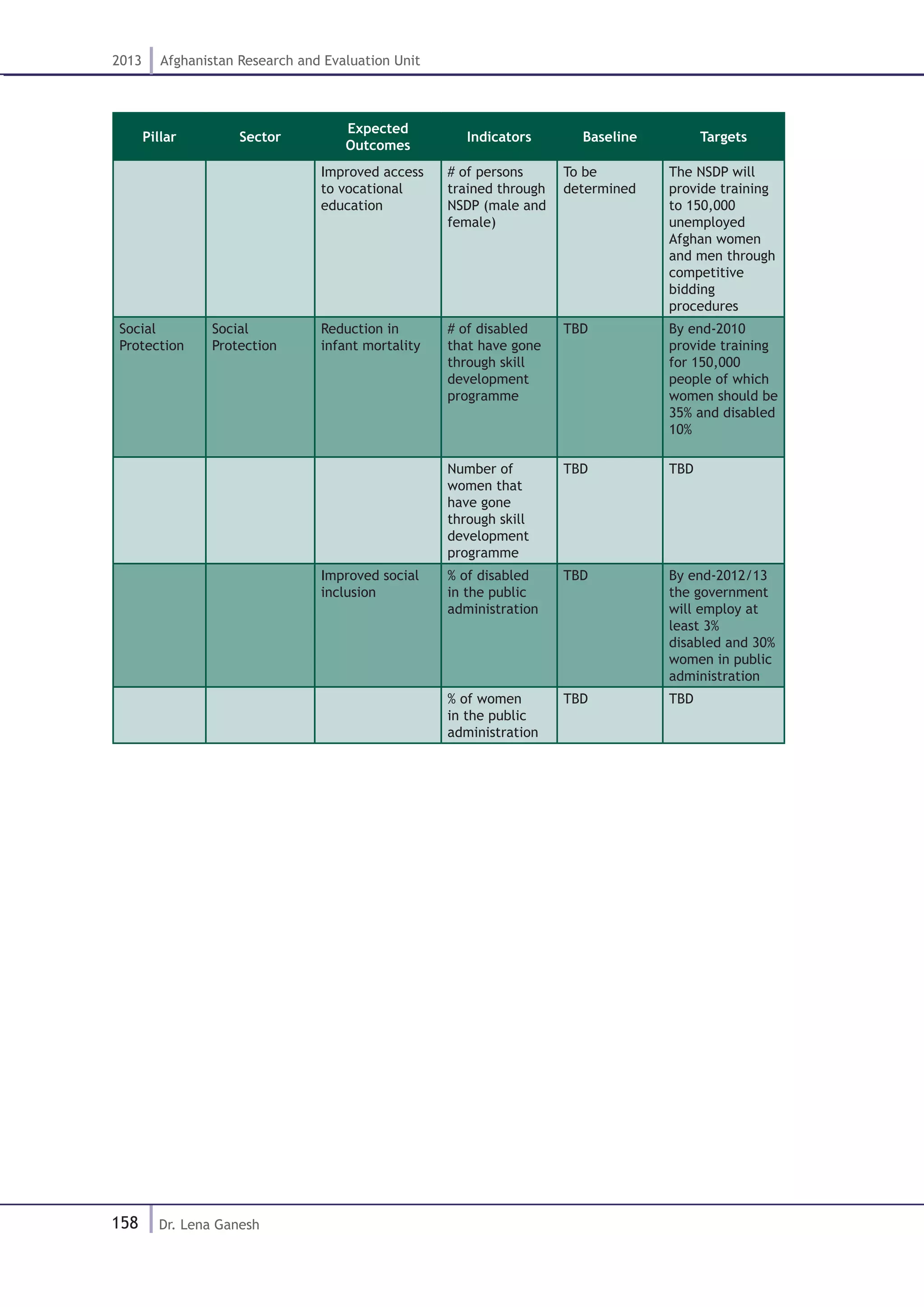
Gender
equity in CDC
representation
•  Organize separate voting venues for men and women to
encourage more women to vote
•  If there are culture constraints to holding mixed-gender
meetings, have the communities elect a male and female
representative from each cluster and organize male and female
sub-committees. Explain that male and female sub-committees
have equal standing under the CDC
•  Help communities identify methods for sharing information and
coordinating joint decision-making between sub-committees.
-  Officers of each sub-committee should serve on the CDC
Executive Coordinating Committee, which finalizes and
approves (signs) all NSP forms; and
-  Minutes of all meetings should be shared between groups.
Gender equity
in access to NSP
information
•  Ensure that programme information such as the “public notice
board” is posted in a public place that is easily accessible to
men and women. If a mosque is chosen for posting information,
another posting place accessible to women must also be chosen
Gender equity
in access to NSP
training
•  Ensure equitable delivery of training to male nd female CDC
members.At a minimum, all key officers of both sub-committees
should be trained (Chairperson, Treasurer, and Secretary)
Gender equity
in decision
making and
control of
project assets
•  Inform community leaders that at least one NSP-funded
subproject should be prioritized by women and managed by
the women’s CDC sub-committee or by a project committee
nominated/approved by the women’s CDC sub-committee.
•  Ensure that at least 2 male and 2 female officers sign all NSP
forms
315  Jason Calder and Aziz Hakimi, “Statebuilding and Community Engagement without Reconciliation: A
Case Study of Afghanistan’s National Solidarity Program” (Afghanistan: Future Generations Graduate School,
Occasional Paper, Peace Building Series No. 2, March 2009).
76
2013 Afghanistan Research and Evaluation Unit
Dr. Lena Ganesh
2.4  Summary
While there has been a limited impact of opportunities in education, health and political
participation for women it has been greatly tempered by lessening access to safety.
Compared to 2001, women’s access to education and health care has improved in
absolute numbers, but it is not proportionate to the population. In political participation
the numbers are there but the efficacy is highly limited. In safety, the situation for
women is deplorable. Access to economic opportunity is mediated by perceptions of
safety as well as by socio-developmental indicators and community contexts. As long
as women are offered enhanced economic engagement within the community context
of accepted gender roles, it may be accepted and used to greater effect. However, the
government has just begun to focus on women’s economic potential, and programmes
and strategies are underway to realise this potential. For these to be realised in full,
all ministries and their strategies, as well as international aid, have to be fully oriented
toward, especially, ANDS and to all principles of the NAPWA.
How “gender mainstreaming” is understood and if and whether it is put into action varies
within programmes and strategies and the mechanisms for this need strengthening.
Further, there is also a large gap between broadly stated principles in some policies
and the specifics that are then provided within the policies themselves. Coordination
and monitoring mechanisms need buttressing as do accountability mechanisms. MoWA
has recently formed a unit for monitoring and evaluation as an oversight body to ensure
the integration of gender-sensitive components in the design and implementation of
NAPWA and the indicators that have been developed jointly with the concerned women’s
networks and line ministries.
Women’s representation in labour is disorganised and piece-meal. There is very little
data or sector-wise analysis on women’s labour participation. Available data indicates
that there has been no surge in their economic participation yet. Their participation
remains at the lower end of value chains and lack of access to many resources prevents
an upgrade of their skills and income. Organised, informal income generation requires
processes and national-level strategies that can structure, streamline and harness
women’s potential, even if in a rather instrumentalist approach. This includes financial,
credit and trade related services for an extensive and deeper outreach tailored to suit
gender and sector needs so that women are incorporated into the promotion of value
chains in all products.
Collective processes at the local levels need to be linked with collective women-oriented
initiatives at the national and international levels; this link can be facilitated by a far
greater focus on women’s equitable access to resources. Women’s self-help groups and
women’s cooperatives can offer spaces to channel resources that individual women are
unable to access; localised groups help incorporate women’s familial and social roles
and help shape the contours of each woman’s economic mobility. Gendered collective
approaches, while raising income levels and reducing deprivation, address inadequacies
in capabilities and the paucity of opportunities that restricts individual ability. Human
capital (skills) and participatory community capital (community, kinship and social
networks) can be used to maximise women’s opportunities to exercise power and to
make choices, while lobbying collectively to implement changes in legislation and policy.
Such agency can help in the creation of subaltern counter-publics that target economic
self-sufficiency, integrated development and consciousness-raising.
77
Arenas for Policy Review 2013
Information Mapping Women’s Economic Empowerment in Afghanistan, 2002 - 2012
3.  Arenas for Policy Review
Afghanistan is facing the formidable task of rebuilding the country after the U.S. and
NATO forces leave in 2014. While an interim elected government has been in office
since 2001, peace and stability elude this war-ravaged country. The continuing battles
between insurgents and international forces have meant that the government is
extremely limited in its capacity to create jobs or offer public services. However, with
no formal safety nets, employment opportunities must increase rapidly, both to engage
greater numbers of the current working-age population, as well as to absorb the rapidly
growing population. The risks and consequences of a large number of unemployed youth
in fragile environments can be severe, as the experiences of the Middle East, Uganda
and Rwanda bear testimony to.
Restoring the physical, institutional, organisational and human infrastructure destroyed
during decades of conflict will require prudent yet assiduous employment of all domestic
resources available to the country, as well as access to foreign capital and markets. Women
have to participate equally in this nation-building effort; no country can achieve decent
living standards or economy when its female population lacks productive employment.
Women’s economic empowerment is therefore a prerequisite for Afghanistan’s growth
and prosperity. Yet, efforts to empower women cannot succeed unless men are equal
participants and beneficiaries in these efforts. Culturally, Afghanistan shares many
values with countries in South Asia, especially as they pertain to gender relations, the
family and the community. A focus on women’s income-generation activities in isolation,
without due consideration to the complex web of social and familial dynamics that are
deeply important for all involved, is likely to fail, and possibly worsen the outcomes for
women.316
Equally, economic empowerment often precedes social empowerment.
As noted earlier, the Government of Afghanistan is bound by economical imperatives,
legal instruments and agreements with the international community to:
•  Progressively realise its citizens’ right to access work, and
•  Create an enabling environment such that each citizen—without discrimination
by age, sex, disability, class, ethnicity or religion—has equal opportunity to this
human right.
It has made it obligatory upon itself to remove all impediments to women’s equal access
to this right and to therefore not only provide, monitor and direct laws and strategies
that specifically address women’s socio-culturally derived unequal access, but also
to review the implementation of extant laws and strategies that provide for women’s
economic participation and empowerment. The route chosen by the government and by
international agencies is “gender mainstreaming.”317
316  See also Melissa Kerr Chiovenda, “Afghan Women, Culture and Development” (AmericanAnthropological
Association, 2012), http://www.huffingtonpost.com/american-anthropological-association/afghan-
women_b_1409068.html (accessed 17 June 2013).
317  “…gender mainstreaming is a pox for women. The worst thing you can do for women is fold them into
the mandates of…[broader development programmes]. Once you’ve mainstreamed gender it’s everybody’s
business and nobody’s business. Everyone’s accountable and no one’s accountable. I don’t know who thought
up this gender mainstreaming guff, but I often wonder what their motives were…Gender mainstreaming
might work if we had what sports and financial enthusiasts call ‘a level playing field,’ that is to say, if there
were real equity and equality between women and men. Then gender mainstreaming becomes a way of
maintaining that equality. But when you start from such gross inequality, mainstreaming simply entrenches
the disparities.” S. Lewis, Race against Time: Searching for Hope in AIDS-Ravaged Africa (Melbourne: Text
Publishing, 2005), 125-6, cited in Martha Macintyre, “Modernity, Gender and Mining: Experiences from Papua
78
2013 Afghanistan Research and Evaluation Unit
Dr. Lena Ganesh
Given the socio-cultural background of the region, as well as the gender dynamics as
they played out politically prior to 1973 and between 1973 and 2001, there has to be
both a better perception of how various dimensions of exclusion interact with gender, as
well as the ability to address existing socio-religious power structures that limit women’s
participation in economic activities. Equally, in order to create free, fair and favourable
opportunities for women’s equitable access to the monetised market, a “level playing
field” in the world economy is necessary. Much depends upon the nature of the transition
and the terms of agreement negotiated as well as the turn the economy may take.
Equally, the continued inflow of international aid—in the current quantum—is crucial in
the coming decades, if women are to have any leverage in building upon the initiatives
of this past decade. Embedded socio-cultural traditions cannot be addressed in a single
decade; it takes decades to redress gross gendered imbalances.
The economic empowerment of women in terms of policy in Afghanistan is greatly
complicated by the interlinked absence or limited presence of human rights. While short-
term initiatives and medium-term investments by politicians, academics, civil society
activists, political parties, religious scholars, tribal elders, provincial councils, members
of commerce and trade and other groups are critical to keep the momentum going,
longer term human and resource investment is vital for the rejuvenation of society.
That said, and based on the insights gained from this mapping effort, the following
points, arranged in four broad categories, could be beneficial to enhance women’s
economic engagement. Gender is “mainstreamed” through all four categories through
the motif of “creating women-only spaces” as a crisp reminder of realities that have
been acknowledged all through the decade but not sufficiently acted upon.
The four categories are:
1.	 Strengthening the policy environment
2.	 Addressing human development gaps
3.	 Focusing on deliverables
4.	 Gendering the financial services
While many of these points have been made in other studies and reports, many are drawn
from the analysis in this study. However, recommendations have not been effectively
acted upon or acted upon at all.
1. Strengthening the policy environment
At the central level:
•  Legislative and administrative measures do not give legal backing to the Constitution
nor to Afghanistan’s ratification of international conventions. There is a need to
review all domestic and statutory laws as well as penal and civil codes based upon
international agreements, particularly CEDAW and its Optional Protocol, to ensure
that they reflect gender concerns and equity and human rights in all their provisions.
Afghanistan should ratify CEDAW’s Optional Protocol.  
New Guinea,” in Gendering the Field Towards Sustainable Livelihoods for Mining Communities, ed. Kuntala
Lahiri-Dutt, (ed.), 21-32 (Melbourne: ANU EPress, 2011),
http://epress.anu.edu.au/apps/bookworm/view/Gendering+the+Field%3A+Towards+Sustainable+Livelihoo
ds+for+Mining+Communities/5521/ch02.xhtml (accessed 9 June 2013).
79
Arenas for Policy Review 2013
Information Mapping Women’s Economic Empowerment in Afghanistan, 2002 - 2012
•  The review of the legislative framework and the judicial system will gain legitimacy
and efficacy only if it engages with the foundation of justice in Afghanistan, i.e.
Islamic law. A judicial debate, one that draws upon Islamic notions of equity
and social justice, is necessary to bring about changes which represent women’s
interests for a maximum impact on women. Tapping into compatibilities between
the Shari’ah and a legal code that recognises international human rights is not an
exercise unique to Afghanistan. It has gained acceptance, partly or in substantive
measure, in countries like Morocco, Malaysia and Egypt. However, the relevance of
the process to Afghanistan and Afghaniyat needs to be validated.
•  Along these lines too, the Family Law should be reviewed to ensure its compliance
with the Shari’ah, especially on issues of meras (inheritance) and mahr. Until such
time as women’s access to land and capital is not addressed, the government should
provide leased land to women’s producer groups and form women’s cooperatives.
The potential of such measures for women’s livelihood options as well as for the rural
economy has been addressed in Section 2.2. The Waqf Boards can also collaborate
in the leasing. In the longer run legislative measures need to be in place to enable
women to own, buy, sell and inherit land. Rather than zameen (land), zar (gold,
similar) and zan (woman, wife) belonging to a man, land being a woman’s heritage
should also be considered; zameen zar-e-zan ast.
•  Women’s representation in all consultative and decision-making fora regarding peace
and development in Afghanistan should be ensured at the minimum mandated level.
If the minimum mandated number of women is not present, the decisions of the
forum cannot be held legitimate for further discussion or progress.
•  Affirmative action for women’s employment of at least 30 percent in all government
institutions, at each grade, including in the judiciary and the executive, should
be ensured.
•  Labour laws, trade policies and private sector legislation (contracts, standards,
tariff and other similar instruments) should be in line with international standards
on labour rights, including Article 11 of CEDAW, should contribute to and be in line
with the Millennium Development Goals and the ANDS, and should ensure the social
protection of vulnerable livelihoods. In particular, government programmes and
donor agencies need to include the monitoring of minimum wages.
•  The intense vulnerabilities faced by chronically poor women, female-headed
households and disabled women need to be recognised.
•  A provision and a mechanism should be created within the Ministry of Justice that
ensures the implementation of all recommendations made by the AIHRC and by
the High Commission on Ending Violence Against Women. A national audit on the
implementation of the EVAW should be conducted annually and its results placed in
the public domain.
In the line ministries, a revised understanding of women’s contribution to the economy
and the economic development of Afghanistan is required. Although modifications are
needed, the specific implementation of NAPWA and ANDS alone would address many of
the gaps that the country is facing today in human development, poverty reduction and
the greater involvement of women in economic activities. This includes:
•  Ensuring gender justification of every project undertaken by any agency and by any
arm of the government, including in sectors considered non-traditional for women.
Although the Ministry of Finance is currently implementing this while reviewing
and before passing annual financial requests, the implementation of budgets for
activities targeting women is not currently ensured.
80
2013 Afghanistan Research and Evaluation Unit
Dr. Lena Ganesh
•  Mandate gender-responsive budgeting in every ministry and in all projects, gender
analyses and gender filters of proposed projects, embedded project mechanisms
like gender-disaggregated data and targets, gender impact analysis in every annual
report, and gender-auditing of each ministry’s activities. Achievements stated at
ministerial levels and in annual progress reports cannot be descriptive, but need
to reflect broader progress than the number of women given vocational training,
for example; reports need to provide credible, reliable information of impact, and
present a comparative analysis of monies spent.
•  Ensure a Gender Officer in the provincial departments of every ministry to help
monitor the implementation of all activities of the ministry.
•  Strengthen MoWA and DoWAs through increased budget, extensive capacity building
and executive powers to ensure accountability across all ministries.
•  Assess security policies and programmes, including the National Demobilization,
Disarmament and Reintegration (DDR) programme and the National Afghan Security
Policy (NASP), to ensure non-discrimination policies as well as to prevent attacks,
harassment and aggression toward women in the public sphere.
•  Afghan men working in projects for women could have a tendency to downplay both
their work and their role since such work can have low status for the men. This puts
at risk their commitment to empowering women. Orientation and training will help.
•  Establish a Labour Inspectorate; ensure minimum wage and equal wage for women.
•  Ensure that certification laboratories are set up and function for all sectors with
budgets, facilities, equipment and other infrastructure.
•  Give women-owned or managed cooperatives, businesses and companies a tax break
for the (graded) gestation period of the enterprise.
•  The MoCI, in coordination with line ministries, should look at participation in the
Enhanced Integration Framework of Least Developed Countries, and consider a
gendered Trade Integration Study.
•  The Ministry of Energy and Water (MoEW), in coordination with line ministries, should
focus far more on harnessing sources of renewable energy (wind, solar, biogas) and
induct women in the use and maintenance of energy equipment.
•  Women’s transportation needs should be specifically considered by the MoTCA
in coordination with line ministries that programme projects for women’s socio-
economic needs. While rural investments need a strong focus on connecting women
to health and education facilities, gender-sensitive policies and investments
in transport are necessary, including for women-only group travel; in parallel,
intermediary means of transport need be explored seriously.
Central Statistical Organisation (CSO)
•  Conduct a mixed-method, national, gender core-development indicators survey for
34 provinces with a sample size of at least 100,000 households. Comprehensively
analyse the gender dimension of, and compile data for women on: value chains in all
sectors, labour market participation and unemployment, industrial and occupational
distribution of workers, patterns of involvement in subsistence production,
unconventional definitions of work, women’s work in “non-traditional” sectors,
unpaid labour and its nature and extent, land ownership, water management,
domestic production and related tasks, time-use surveys, income-earning
opportunities, physical mobility, accessibility of services, the market viability of
goods made by women, women-managed and women-led patronage and support
81
Arenas for Policy Review 2013
Information Mapping Women’s Economic Empowerment in Afghanistan, 2002 - 2012
networks, disability, and similar in order to assess women’s productive work and
non-monetised contributions to the economy.
•  Also gather and analyse data on child marriage and child labour.
2.. Addressing human development gaps
It is crucial to address the gaps that girls and women face in education and educational
facilities and in health care and provision, and in access to safety, physical mobility
and political participation. One of the routes to take is to align with customary and
traditional norms and values.
•  Identify and create a network of respected female authority figures, preferably
with religious knowledge. Training senior women, especially wives of male religious
leaders, and younger women as female religious teachers (bibis) or as ulemas
will help to re-examine the ways in which Islamic rights for women within the
framework of Afghaniyat can be disseminated and how the “Canon” can be re-
visited. Home-based Qur’an schools will help establish such a network.
•  MoHRA should spear-head the development of initiatives to raise public awareness
on Islamic values and women’s rights.
In the meantime, there is already enough encouragement for women’s access to
education—the quest for knowledge being a central pillar of Islam—and health services.
The bottlenecks here are access to separate but equal resources for women, particularly
girls and young women. The possible ways out of the log-jam could be:
•  Providing equitable access to education for girls and women, including funding
and building more girls-only schools, especially at secondary and higher secondary
levels. Financial education in schools and other educational institutes is necessary
to develop financial acumen for both girls and boys, including on saving and
investment. The curriculum needs to be reviewed: for example, offering boys
training in agriculture-related programmes and home-management skills to girls
is detrimental to women’s economic knowledge and participation. Women’s rights
under the civil code and CEDAW as well as under Islamic jurisprudence should also
be incorporated in the curriculum.
•  Providing alternate formal education in Islamic jurisprudence to women at village
and district levels and incorporate Shari’ah-informed, women’s rights’ relevant
information in colleges and universities.
•  Training and recruiting women as sole teachers in numbers and with technical
expertise sufficient to meet the needs of girls-only schools.
•  Increasing health-seeking behaviour and equitable access to care by offering women-
only services within comprehensive health-care centres at the district level, by
providing women health workers at each community and basic health centre, and
mobile household health clinics at the village level in more remote areas.
•  Training and recruiting female doctors, nurses, midwives, surgeons, obstetricians
and paediatricians, and other technical staff in numbers and expertise sufficient to
meet the needs of women at district and provincial levels; all staff should also be
trained to look for signs of gender-based violence.
•  Providing a minimum of one shelter home and one legal aid centre for women in
each district.
82
2013 Afghanistan Research and Evaluation Unit
Dr. Lena Ganesh
•  Researching and addressing the key empowerment issue of women’s ability to access
physical public space, in terms of transportation, socio-cultural barriers, time and
sexual harassment.
•  Involving women from regional and other Muslim countries in all of the above activities.
3.. Focusing on deliverables
•  Create a strong and active network of and for women, across sectors, that
operates at a pan-Afghanistan level in cities and provincial headquarters to
build women-to-women service delivery models (from producer to wholesalers/
processors/ exporters) and entrepreneurship with a focus on the domestic
market and export potential.
•  Identify and group women into producer groups and associations based upon
livelihood and occupational categories. Clusters of women producers could be
formed so that women can work and learn in groups. Women’s CDCs, the women’s
savings groups of MRRD and other women’s shuras could be transformed into more
enterprise-focused entities.
•  Mobilising women based on their needs and opportunities through self-help groups,
associations, cooperatives and unions. The tendency among many families and
communities is to restrict women’s movement, not just outside their immediate
community groups but sometimes even with other women within their immediate
ethnic community or extended families. Women’s groups have a huge potential to
promote unity and solidarity to women.
•  Training and recruiting women field workers in sufficient numbers to provide a
comprehensive range of technical services and information from input to markets
for female farmers, producers, craftspeople and other sectors specific to a district
or region. The training of female extension workers (currently implemented in a
highly limited way) needs to be expanded to all districts and beyond horticulture to
include poultry, agriculture and animal husbandry.
•  Extension workers are needed in quality control, credit and trade/market linkages
to connect with women producer groups. Developing mobile agri-service centres at
district headquarters level could be highly beneficial.
•  The identified moderate barrier to women producers/association groups remains at
the level of contact and interaction with the next step of the market, i.e. village
traders/agents/farmers’ groups/associations. Identify and train women to fill these
gaps, especially at the community level.
•  Women input suppliers are needed for farm products in various sectors: women- only
stores should be developed at the district level, perhaps even mobile stores. They
should be identified, trained and incorporated into MAIL projects, such as HLP, the
Perennial Horticulture Development Project, the ASAP Ag-Depots, the Afghanistan
Farm Service Alliance, etc.
•  More women as basic veterinary workers are needed.
•  Access to markets: There is some acceptance of the strength-in-numbers approach,
and women travelling in groups may be an effective means of circumventing mobility
problems. Transportation has to be made accessible to women-only groups.
•  Develop women-owned and women-only processing centres.
•  MAIL and other ministries should develop a marketing strategy for each product
to access key regional and international markets. This could be developed in
83
Arenas for Policy Review 2013
Information Mapping Women’s Economic Empowerment in Afghanistan, 2002 - 2012
consultation with export support agencies, such as the Export Promotion Agency of
Afghanistan (EPAA), ACCI, and the private sector. A national consortium should be
developed, supported by a consortium of international investors.
•  MoCI should tie up with AISA, ACCI and TAFA to target women’s access to trade far
beyond the current limited number of women participating in trade exhibitions. A
“hub-regional” network of women’s organisations across Central Asia, the Middle
East and South Asia should be actively nurtured. This should also include direct
contact with women producer associations in the rural networks. Academia could
be consulted.
4. .Gendering financial services
Access to credit is essential to enhance women’s economic engagement, as women have
highly limited access to any kind of substantial credit or capital. They lack insurance and
risk guarantees. In the current microfinance climate, they also face high interest rates
and small amounts of credits coupled with tight repayment schedules. Simultaneously,
the reach of the MFI is limited when compared to demand, is of a fairly standard nature
and does always not take into account the contexts of women in the rural informal
sector and those engaged in small-scale trading.
MFIs and SME financing should:
•  Develop a diversified range of gender-sensitive financial products that can meet
rural-sector needs as well as trade and enterprise needs, in line with Islamic
modes of finance, and which will help the expansion of financial services to rural
communities through linkages with the commercial sector.
•  Promote micro-insurance and community rural insurance groups.
•  Be able to include credit to buy fodder, seeds, equipment (sale or lease) and all
input material.
•  Develop a flexible package for building women’s small and medium enterprises,
with longer grace and repayment periods.
•  Disseminate widely the Secured Transactions Law that allows abroad range of
movable assets to be used as security for availing business loans.
•  Reach those below the poverty line through appropriate incentives, a wider and
modified service portfolio, partnership support and risk mitigation measures.
•  Widen the reach of MISFA’s Murabaha-based microfinancing.
•  Make available loans and grants as start-up capital and/or seed money at the scale
that SMEs require. Social investment funds and joint equity funds could be facilitated
through international agencies. Loans should be gender, sector and context specific
and designed to allow for lower interest rates and longer repayment periods.
•  Assess approaches that use the individual, solidarity group and village-level banking
models to develop a better understanding of loan/credit use, and its impact on
women’s empowerment, social status, productivity and income.
Due to their relative wider outreach depth and their established principles of targeting
women, MFIs, with expanded training to staff and implementing agencies, have far
greater potential to create women’s spaces that encourage access to technical and
marketing networks and skills. This could be especially fruitful when combined with
the women’s CDCs of the NSP as well as the women’s councils and producer groups
84
2013 Afghanistan Research and Evaluation Unit
Dr. Lena Ganesh
identified by the MRRD. This could be further enhanced if the knowledge generated in
such combined knowledge hubs could be transferred periodically to the secondary level
girls’-only schools.
Also, at the international level:
•  Far greater emphasis has to be placed on women’s economic empowerment in
international conferences and resolutions. These should be accompanied by country
analysis, targets and indicators for increasing women’s livelihood opportunities.
•  Focus is necessary on the detrimental nature of the free-trade economy and its
contribution to the feminisation of poverty, especially in countries like Afghanistan.
In the light of the impending transition in 2014,318
expected lower aid and public spending
is anticipated to affect gendered aid programming. Tighter budgets could translate to
the greater expectation of value for money:
•  Every calf has four legs:There has been a significant lack of coordination among multi-
lateral and bilateral donors in Afghanistan, with agencies seeking to push individual
country agendas and ideologies onto policy-making within different ministries. The
buzkashi over the Afghan development calf has not given any focused, coordinated
or coherent output on gender and development and the ways in which it needs
to be systematically and holistically addressed in Afghanistan. Nor have potential
complementarities of agencies around gendered economic empowerment been
successfully addressed. In order to ensure information sharing on gender equality
and best practices in programming, a multi-donor analysis of “lessons learned,”
including an internal gender audit, will be timely before 2014 and before more
monies are channelled.
•  It is necessary to i) synergise all initiatives with Afghan-led initiatives and influence
policy in a unified manner, ii) increase the domestic economic impact of aid by
channelling all aid through the Afghan government budget, iii) increase domestic
contracting, and iv) continue to fund and support the formulation and, more
importantly, the effective implementation of policies that promote gendered
equality in Afghanistan.
•  Projects for women should be served by women facilitators on the ground and by
including women at senior and decision-making levels. If implementing agencies do
not yet have an adequate balance of women in staff and seniority, donors should
ask for it.
•  Ensure gender balance within donor and implementing organisations, especially at
the senior management level, including at embassies.
•  Ensure long-term consultants with an understanding ofAfghanistan and accountability
to programmes are developed, activated or executed. There needs to be a focus on
female economic development experts as lead agents.
•  The allocation of monies to women-specific projects should be at least 50 percent
of overall country strategy and contribution. They should have concrete outcomes.
Monitoring and evaluation should not only be conducted and placed in the public
domain for all monies allocated and disbursed and all projects contracted and
completed, but community monitoring through community representatives, with 50
percent women’s representation, should be taken on board before and during the
implementation of projects.
318  As of December, 2012, 11 of the 34 provinces are “fully transitioned,” i.e. have already undergone
the transition of security responsibility from the International Military Forces to the Afghanistan National
Security Forces.
85
Arenas for Policy Review 2013
Information Mapping Women’s Economic Empowerment in Afghanistan, 2002 - 2012
•  International agencies must take cognisance of dissent and dissenters within Islam.
Cultural relativism and cultural sensitivity must be tempered by taking intaccount
Muslim women’s organisations’ views on Islam and on Afghan women’s rights to
participate in the shaping of their culture and religion.
•  Networks of women’s human rights organisations across Central Asia and South
Asia as well as the Middle East should be actively considered. Active funding and
technical support for women activists in Afghanistan to link more regionally should
be looked at urgently.
86
2013 Afghanistan Research and Evaluation Unit
Dr. Lena Ganesh
Appendix 1: Research Participants
No Organisation Name Position Date
1
Afghanistan Chamber of
Commerce and Industry
Ali Zaki
Director, Business
Development  Services
01.01.13
2
Afghanistan Investment
Support Agency
Sahiba Nooristani
Investment Promotion
Officer
01.01.13
3
Afghan Women’s Business
Federation
Malali Jawad Membership Manager 30.12.12
4 Afghan Women’s Centre Rasool Habibi Program Coordinator 19.11.12
5
Afghanistan Women
Education Center
Jamila Zafar Project Representative 31.10.12
6 Afghan Women’s Network Leeda Azizi Program Officer 22.10..12
7 All Afghan Women’s Union Khadija Shahbaz Master Trainer 29.12.12
8 Canadian Embassy Claude Désilets Deputy Head of Aid 16.12.12
9
Canadian International
Development Agency
Anonymity
Required
- 04.11.12
10
Community Centre for the
Disabled
Ahmad Shah Senior Trainer 5.12.12
11 CARE Frozan Yosufzai Gender Project Officer 27.11.12
12 Educational and Training
Center for Poor Women and
Girls of Afghanistan
Aliya Yousufzai Program Officer 29.11.12
13 Parwin Zamani
Head, Educational
Development
18.12.12
14
Female Rehabilitation and
Development Organisation
Anonymity
Required
Project Representative 20.11.12
15 Finnish Embassy
Matti Vaananen,
Musliuddin Aabidi
First Secretary
National Programme
Coordinator
06.01.13
16 GIZ Dr Alema
Civil Peace Service
Coordinator
12.12.12
17
Humanitarian Assistance
Muska
Aziza Momand Director 20.10.12
18 Humanity International
Samiulhaq Sami
Qasim Khan
Advocacy and
Awareness Technical
Advisor
Project Representative
17.12.12
19
International Rescue
Committee
Abdul Shakoor
Former Programme
Coordinator
21.10.12
20
Institute for the Economic
Empowerment of Women
Manizah Wafeq Director 27.11.12
87
Appendices 2013
Information Mapping Women’s Economic Empowerment in Afghanistan, 2002 - 2012
No Organisation Name Position Date
21
Japan International
Cooperation Agency
Ikumi Ogiwari
Gender and
Development Advisor
08.12.12
22
Ministry of Agriculture,
Irrigation and Livestock
Nasrullah Bakhtani
Acting Director, Policy
& Planning
18.12.12
23 Adela Yousufzai Gender Director 9.1.13
24
Anonymity
Required
- 1.11.12
25
Ministry of Commerce and
Industry
Anonymity
Required
- 23.12.12
26
Anonymity
Required
- 25.12.12
27
Ministry of Economy
Arif Sahar
Afghanistan National
Development Strategy
17.12.12
28
Anonymity
Required
- 17.12.12
29
Anonymity
Required
- 30.12.12
30
Ministry of Finance
Anonymity
Required
- 26.12.12
31
Anonymity
Required
- 29.12.12
32
Ministry of Hajj and
Religious Affairs
Gul Agha Habib
Director, Policy and
Planning
31.12.12
33 Ministry of Labour, Social
Affairs, Martyrs and
Development
Anonymity
Required
- 3.2.13
34 Imranullah Kamran
Former Gender
Director
25.12.12
35
Ministry of Rural
Rehabilitation and
Development
Abdulrahman
Ayoubi
Executive Director,
National Solidarity
Programme
18.12.12
36
Anonymity
Required
- 23.12.12
37 Ghizal Haress
Executive Director,
Afghanistan
Rural Enterprise
Development Program
2.1.13 &
05.01.13
38
Ministry of Women’s Affairs
Anjuma Nahimi
Head, Economic
Development
22.12.12
39 Mizhgan Mustafawi Deputy Minister 29.12.12
40 Samia Sadad
Head, Gender Capacity
Building Department
9.1.13
41 Hussain Ali Moieen
Economic  Specialist,
Department of
Economic Development
09.01.13
88
2013 Afghanistan Research and Evaluation Unit
Dr. Lena Ganesh
No Organisation Name Position Date
42
National Area Based
Development Programme
Sami Jalalzai
Head, Local
Institutional
Development
Department
02.12.12
43 Ziyadah Karim
Head of Gender
Department
44
National Solidarity
Programme
Abdurahman Ayubi Executive Director 18.12.12
45
National Solidarity
Programme
Anonymity
Required
- 23.12.12
46
National Solidarity
Programme
Anonymity
Required
- 23.12.12
47
National Solidarity
Programme
Anonymity
Required
- 23.12.12
48
Noor Education and
Capacity Development
Organization
Jamila Afghani
Kakar
Director 23.01.13
49
Physiotherapy and
Rehabilitation Support for
Afghanistan
Mahbouba Saraj
Gender and Program
Advisor for Women
26.11.12
50
Rabiha-e-Balkhee Skill
Support Administration
Abdullah Hamidi Programme Manager 27.11.12
51 Qais Faqeeri
Administration and
Finance Officer
27.11.12
52
Sanayee Development
Organisation
Samiullah Naseri Director 25.11.12
53
Skills Training And
Rehabilitation Society	
Zuhra Aman Program Coordinator 12.12.12
54 Sabah Wasima Amiri Director 1.12.12
55 Shohada Jawad Wafa Executive Director 18.11.12
56 Swedish Embassy Roger Karrlson Project Advisor 29.11.12
57
United Nations
Development Programme
Gulistan Ibadat Gender Specialist 06.01.13
58
Women for Afghan Women
Shukria Khaliqi Director 26.11.12
59 Friba Ahmadi Head 31.12.12
89
Appendices 2013
Information Mapping Women’s Economic Empowerment in Afghanistan, 2002 - 2012
Appendix 2: List of key conferences, resolutions and
treaties to which Afghanistan is party
List A: Declarations of International Conferences on Afghanistan, 2001-12319
Place Date Declaration Source Description
Dushanbe 2000 Declaration of the
Essential Rights of
Afghan Women
Declaration of the
Essential Rights of
Afghan Women.
June 28, 2000.
Accessed March 12,
2013. http://www.
bdr.freeservers.
com/custom.html
This Declaration is an informal
intervention drafted by Afghan
women leaders, validated at the
international conference organised
by NEGAR at Dushanbe, Tajikistan,
and presented to the President
of the Interim Government of
Afghanistan. It is seen as a
document that aimed, through its
provisions, to legitimise the writ
of the State within its borders
while simultaneously declaring
its right to self-determination
as a sovereign nation within the
family of other sovereign nations.
It describes the rights of women in
Afghanistan to equal treatment and
opportunities for social, political
and economic empowerment. In
particular, Section III, item 6, calls
for the right to just and favourable
conditions of work. Personal law is
not within its scope.
Brussels 2001 Brussels’
Proclamation –
Afghan Women’s
Summit for
Democracy
Afghan Women’s
Summit for
Democracy.
The Brussels
Proclamation.
December 4-5,
2001. Accessed
March 12, 2013.
This document is a statement from
a conference of 50 female Afghan
leaders, organised to provide
input on the reconstruction of
Afghanistan. Its four main areas of
recommendations are: Education,
Media and Culture; Health; Human
Rights; Refugees and Internally
Displaced Women. It calls for the
inclusion of principles of non-
discrimination as central to new
legal system, and equal rights for
women, including equal pay.
N.B: Source in the following,
unless otherwise noted: Civil-
Military Fusion Centre. Afghanistan
Agreements: A Collection of
Official Texts from 2001 to 2011.
Accessed March 12, 2013.
https://www.cimicweb.org/cmo/
afg/Documents/Governance/CFC_
Afghanistan_Agreements_June2012.
pdf.
319   In these conferences (with the exception of the first two) women’s equal participation has been
absent.
90
2013 Afghanistan Research and Evaluation Unit
Dr. Lena Ganesh
Place Date Declaration Source Description
Bonn 2001 The International
Conference on
Afghanistan:
Agreement
on Provisional
Arrangements
in Afghanistan
Pending the Re-
Establishment
of Permanent
Government
Institutions (“The
Bonn Agreement”)
Sections III, IV, and V include
statements concerning the
importance of the participation
of women representatives in the
Interim Administration (III) and the
Emergency Loya Jirga (IV); Section
V states the Interim Authority and
Special Independent Commission
for the Convening of the Emergency
Loya Jirga will ensure women’s
participation.
Tokyo 2002 International
Conference on
Reconstruction
Assistance to
Afghanistan: Co-
Chairs’ Summary of
Conclusions
Sections 8 and 13 emphasise
the importance of training and
education for women as the country
rebuilds. Section 12 emphasises
the “centrality of restoring the
rights and addressing the needs of
women,” and that “women’s rights
and gender issues should be fully
reflected in the reconstruction
process.”
Berlin 2004 International
Afghanistan
Conference: The
Berlin Declaration
Section 10 under “Agree” affirms
that all efforts at reconstruction
should “promote the participation
of women according to their rights
under the Constitution.” No other
mention of women.
London 2006 The London
Conference on
Afghanistan:
The Afghanistan
Compact
Principles of Cooperation affirm
that all policies and programs
should recognise that “men
and women have equal rights
and responsibilities.” Certain
benchmarks and timelines from
Annex I directly address the
empowerment of women:
Under Governance, Rule of
Law and Human Rights:
Gender: By end-2010, the
National Action Plan for Women
in Afghanistan will be fully
implemented; female participation
in all Afghan governance
institutions, including elected and
appointed bodies and the civil
service, will be strengthened.
91
Appendices 2013
Information Mapping Women’s Economic Empowerment in Afghanistan, 2002 - 2012
Place Date Declaration Source Description
Under Economic and
Social Development:
Education: Primary and Secondary
Education: By end-2010, net
enrolment in primary school for girls
will be at least 60 percent; female
teachers will be increased by 50
percent; enrolment of students to
universities will be 100,000 with at
least 35 percent female students;
and 150,000 men and women will be
trained in marketable skills. (p. 9)
Social Protection: Vulnerable
Women: By end-2010, the number
of female-headed households
that are chronically poor will be
reduced by 20 percent, and their
employment rates will be increased
by 20 percent.
Rome 2007 The Rome
Conference on
the Rule of Law in
Afghanistan: Joint
Recommendations
Rome Conference
on the Rule of Law
in Afghanistan (July
2-3, 2007): Joint
Recommendations.
Accessed March
12, 2013 http://
www.diplomatie.
gouv.fr/fr/IMG/
pdf/Romejoint
recommandations.
pdf
Women’s access to justice and
alternatives to detention for
women in conflict with justice are
mentioned as key issues. Gender
mainstreaming is identified as a
cross-cutting issue in rule of law.
Paris 2008 Paris International
Conference on
Afghanistan:
Declaration of
the International
Conference
in Support of
Afghanistan
The only mention of women is the
donors’ commitment to support
the implementation of the National
Action Plan for Women. No specific
recommendations.
Moscow 2009 Shanghai
Cooperation
Organization:
Declaration of the
Special Conference
on Afghanistan
Declaration of the
Special Conference
on Afghanistan
Convened under
the Auspices of
the Shanghai
Cooperation
Organization.
(Moscow, March 27,
2009.) Accessed
March 12, 2013.
http://www.
un.int/russia/new/
MainRoot/docs/
off_news/270309/
newen2.htm
Although this conference
addressed the economic progress
of Afghanistan and the help by the
member states of the Shanghai
Cooperation Organization, there
was no mention of women.
92
2013 Afghanistan Research and Evaluation Unit
Dr. Lena Ganesh
Place Date Declaration Source Description
Hague 2009 International
Conference on
Afghanistan:
Hague Conference
Declaration
Afghanistan
Conference: Final
Declaration. March
31, 2009. Accessed
March 12, 2013.
http://www.
iwaweb.org/Docs/
resource_centre/
CBM/2009%20
The%20Hague%20
Conference%20
Declaration.pdf
Calls on Afghanistan to expand
efforts to ensure that women
are more fully integrated into
assistance programmes in
recognition of the need to mobilise
its entire population in the
development of the country.
London 2010 The London
Conference:
London Conference
Communiqué
Section 26 records the approval
by the international community
of the government’s commitment
to implement the National Action
Plan for Women of Afghanistan and
the Elimination of Violence Against
Women Law, as well as the overall
commitment to strengthen the
participation of women in all Afghan
governance institutions, including
elected and appointed bodies and
the civil service.
Kabul 2010 The Kabul
International
Conference on
Afghanistan:
Kabul Conference
Communiqué
Section 10 under Gender and
Children’s Rights reiterated the
centrality of women’s rights,
including political, economic and
social equality, to the future of
Afghanistan; commended the
mainstreaming of gender into all
priority programmes; and reiterated
donors’ commitment to assist all
ministries and government bodies
(national and sub-national) in
implementing the National Action
Plan for the Women of Afghanistan.
Called on the Government of
Afghanistan to identify and
prioritise NAPWA benchmarks
for implementation within each
cluster; and develop a strategy
to implement the Elimination
of Violence Against Women Law
in the following six months.
Sections 13 and 14 under Peace,
Reconciliation and Reintegration
called for the inclusion of women’s
rights in negotiations for peace and
for local Peace Jirga meetings that
include women.
93
Appendices 2013
Information Mapping Women’s Economic Empowerment in Afghanistan, 2002 - 2012
Place Date Declaration Source Description
Bonn 2011 The International
Afghanistan
Conference:
Bonn Conference
Communiqué
Sections 6 and 7 note the guarantee
of equality of men and women
under the Constitution, and
reaffirms the rights of women as
key for Afghanistan’s future.
Section 18, addressing the peace
process, calls for reconciliation to
“respect the Afghan Constitution,
including its human rights provisions
and the rights of women” (p.4).
Tokyo 2012 International
Conference on
Afghanistan: The
Tokyo Declaration
The Tokyo
Declaration:
Partnership for
Self-Reliance
in Afghanistan:
From Transition to
Transformation.
July 8, 2012.
Accessed March
12, 2013. http://
www.mofa.go.jp/
region/middle_e/
afghanistan/tokyo_
conference_2012/
tokyo_declaration_
en1.html
Under Security and Peace Process,
Section 9 emphasises respect for
the rights of women during the
peace and reconciliation process,
and stresses the importance of
the participation of civil society
organizations and women’s groups
in support of the peace process
and the culture of peace and
human rights in Afghan society.
Under Private Sector and Civil
Society, Section 20 calls for
emphasis on the importance of job
creation and initiatives targeting
youth and women employment.
Section 22 reaffirms the importance
of women’s participation in private
sector conferences as reinforcing
the need for inclusive development
and recognition of women’s rights.
Under the Accountability Framework
annex, Section 10 (Governance,
Rule of Law and Human Rights)
affirms that, “strengthened
governance and institutions with
a particular focus on the rights of
women are prerequisites for strong
and sustainable economic growth,
employment generation and
prosperity for the Afghan people.”
94
2013 Afghanistan Research and Evaluation Unit
Dr. Lena Ganesh
Place Date Declaration Source Description
Goals addressing women include
improved access to justice for all,
in particular women and children,
by ensuring that the Constitution
and other fundamental laws are
enforced expeditiously, fairly
and transparently and ensure
that women can fully enjoy
their economic, social, civil,
political and cultural rights.
Indicators include to ensure respect
for human rights for all citizens,
in particular for women and
children, and allow the Afghanistan
Independent Human
Rights Commission and civil society
organizations to perform their
appropriate functions; and to
demonstrate implementation, with
civil society engagement, of both
the Elimination of Violence Against
Women Law and the National Action
Plan for Women on an annual basis.
List B: Multilateral Treaties and Resolutions – United Nations
Treaty/Convention/
Protocol
Date Source Description
International
Convention for the
Suppression of the
Traffic in Women
of Full Age
Deposit: 12
November 1947;
Entry into Force:
24 April 1950
http://treaties.un.org/
doc/publication/UNTS/
Volume%2053/v53.pdf
Convention on agreement
to punish those involved
in trafficking in women.
Signed 12 Nov 1947,
without comment
or reservation.
Concluded at Geneva
on 11 October 1933,
as amended by the
Protocol signed at Lake
Success, New York, on 12
November 1947.
95
Appendices 2013
Information Mapping Women’s Economic Empowerment in Afghanistan, 2002 - 2012
Treaty/Convention/
Protocol
Date Source Description
International
Convention for the
Suppression of the
Traffic in Women
and Children
Deposit: 12
November 1947;
Entry into Force:
24 April 1950
http://treaties.un.org/
Pages/ViewDetails.
aspx?src=IND&mtdsg_no=VII-
2&chapter=7&lang =en
Concluded at Geneva
on 30 September 1921,
as amended by the
Protocol signed at Lake
Success, New York, on
12 November 1947.
Convention on agreement
to punish those involved in
the trafficking of women
or “girls of full age.”
Signed 12 Nov 1947,
without comment or
reservation.
Geneva Convention
Relative to the
Protection of Civilian
Persons in Time of War
Deposit: 12 August
1949; Entry
into Force: 21
October 1950
http://treaties.un.org/pages/
showDetails.aspx?objid=
0800000280158b1a
Agreement on protection
of non-combatants,
prisoners of war, and hors
combat during war, armed
conflict and occupation.
Signed 12 Aug 1949
Convention for
the Suppression
of the Traffic in
Persons and of the
Exploitation of the
Prostitution of Others
Deposit: 21
March 1950;
Entry into Force:
25 July 1951
http://treaties.un.org/
Pages/ViewDetails.
aspx?src=IND&mtdsg_no=VII-
11-a&chapter=7&lang=en
Agreement to punish
those exercising traffic in
persons and prostitution.
Accession 21 May 1985,
without comment or
reservation.
Convention on the
Political Rights
of Women
Deposit: 31 March
1953; Entry into
Force: 7 July 1954
http://treaties.un.org/
Pages/ViewDetails.
aspx?src=TREATY&mtdsg_
no=XVI-chapter=16&lang=en
States the right of women
to participate in political
life on an equal basis as
men, including voting,
and running for and
holding public office.
Accession 16 Nov 1966
without comment or
reservation.
Convention
on Consent to
Marriage, Minimum
Age for Marriage
and Registration
of Marriages
Deposit: 10
December 1962;
Entry into Force:
9 December 1964
http://treaties.un.org/
Pages/ViewDetails.
aspx?src=TREATY&mtdsg_
no=XVI-3&chapter=16&
lang=en
States that free and full
consent of both parties
is required to enter into
marriage. Calls on States
Parties to enact legislation
to specify a minimum
age for legal marriage.
No participation by
Afghanistan.
96
2013 Afghanistan Research and Evaluation Unit
Dr. Lena Ganesh
Treaty/Convention/
Protocol
Date Source Description
International
Convention on the
Elimination of All
Forms of Racial
Discrimination
Deposit: 7 March
1966; Entry
into Force: 4
January 1969
http://treaties.un.org/
Pages/ViewDetails.
aspx?src=TREATY&mtdsg_
no=IV-2&chapter=4& lang=en
Agreement to condemn
and eliminate racial
discrimination;
particularly condemn
racial segregation and
apartheid; guarantee
rights of everyone
before the law, political
and civil rights.
Accession 6 Jul 1983,
with reservation (referral
to International Court of
Justice by one party only)
and declaration (arts 17
& 18 - ratification) have
discriminatory nature
against some states.
International
Covenant on
Economic, Social and
Cultural Rights (ICESC)
Deposit: 16
December 1966;
Entry into Force:
3 January 1976
http://treaties.un.org/
Pages/ViewDetails.
aspx?src=TREATY&mtdsg_
no=IV-3&chapter=4& lang=en
Agreement on rights
of economic, social
and cultural matters.
States Parties guarantee
non-discrimination
based on sex.
Article 3: ensure the
equal right of men and
women to enjoyment
of economic rights.
Article 6: right to freely
choose and accept work.
Article 7: women
guaranteed conditions
of work not inferior
to those of men.
Article 10, item 2: special
protection should be
accorded to mothers for a
reasonable period before
and after childbirth,
including paid leave or
leave with adequate
social security benefits.
Accession 24 Jan 1983,
with declaration (para.
1, 3 of art. 26 contradicts
international character
in that some countries
cannot join.)
97
Appendices 2013
Information Mapping Women’s Economic Empowerment in Afghanistan, 2002 - 2012
Treaty/Convention/
Protocol
Date Source Description
International
Covenant on Civil and
Political Rights (ICCP)
Deposit: 16
December 1966;
Entry into Force:
23 March 1976
http://treaties.un.org/
Pages/ViewDetails.
aspx?src=TREATY&mtdsg_
no=IV-4&chapter=4& lang=en
Specifies the rights
of all humans to life,
prohibition of slavery,
right to equality before
the law, freedom
from interference in
private life, freedom
of thought, expression
and assembly, freedom
of marriage, protection
of minors, and freedom
from discrimination.
Article 3: equal right of
men and women to the
enjoyment of all civil
and political rights.
Article 23, item 4:
ensure equality of rights
and responsibilities of
spouses as to marriage,
during marriage, and
its dissolution.
Accession 24 Jan 1983,
with declaration (para.
1, 3 of art. 48 contradicts
international character
in that some countries
cannot join.)
Protocol Additional
to the Geneva
Conventions of 12
August 1949 and
relating to the
protection of victims
of international armed
conflicts (Protocol I)
Deposit: 6 August
1977; Entry
into Force: 12
July 1978
http://treaties.un.org/
pages/showDetails.
aspx?objid=08000002800f3586
Reaffirms provisions
of original Geneva
Conventions concerning
international armed
conflicts; adds specific
articles (76, 77)
protecting women and
children against assault
while in detention.
No participation by
Afghanistan.
Protocol Additional
to the Geneva
Conventions of 12
August 1949 and
relating to the
protection of victims
of non-international
armed conflicts
(Protocol II)
Deposit: 6 August
1977; Entry
into Force: 7
December 1977
http://treaties.un.org/
pages/showDetails.
aspx?objid=08000002800f3cb8
Reaffirms provisions
of original Geneva
Conventions concerning
non-international
(internal) armed conflicts
and the protection and
humane treatment of
civilians, particularly
those detained.
No participation by
Afghanistan.
98
2013 Afghanistan Research and Evaluation Unit
Dr. Lena Ganesh
Treaty/Convention/
Protocol
Date Source Description
Convention on
the Elimination
of All Forms of
Discrimination Against
Women (CEDAW)
Deposit: 18
December 1979;
Entry into Force:
3 September 1981
http://treaties.un.org/
Pages/ViewDetails.
aspx?src=TREATY&mtdsg_
no=IV-8&chapter=4& lang=en
Calls for States Parties
to pursue a policy of
eliminating discrimination
against women in all
aspects of life.
Article 11: ensure
equal rights to women
in employment,
including choice of
career, remuneration,
job security and social
benefits, and safeguarding
against discrimination
based on maternity.
Article 13: rights of
women to access
financial credit.
Signed 14 Aug 1980;
Ratified 5 Mar 2003
without comment or
reservation.
Convention Against
Torture and Other
Cruel, Inhuman or
Degrading Treatment
or Punishment
Deposit: 10
December 1984;
Entry into Force:
26 June 1987
http://treaties.un.org/
Pages/ViewDetails.
aspx?src=TREATY&mtdsg_
no=IV-9&chapter=4& lang=en
Agreement to prevent
torture within borders
and not transport
people to states where
torture may occur.
Signed 4 Feb 1985;
Ratified 1 Apr 1987, with
declaration: does not
recognise authority of
committee (Art. 20) and
disputes sent to ICOJ with
consent of all parties, not
just one.
99
Appendices 2013
Information Mapping Women’s Economic Empowerment in Afghanistan, 2002 - 2012
Treaty/Convention/
Protocol
Date Source Description
Convention on the
Rights of the Child
Deposit: 20
November 1989;
Entry into Force:
2 September 1990
http://treaties.un.org/
Pages/ViewDetails.
aspx?src=TREATY&mtdsg_
no=IV-11&chapter=4& lang=en
Human rights of children.
Article 18, item 1:
recognition of the joint
responsibility of both
parents concerning the
upbringing of a child.
Article 18, item 3:
children of working
parents to be ensured of
the right to benefit from
all child-care services for
which they are eligible.
Signed 27 Sep 1990;
Ratified 28 Mar 1994, with
declaration: reserves right
to express reservations on
all provisions incompatible
with Shari’a law.
Optional Protocol to
the Convention on the
Rights of the Child
on the Involvement
of Children in
Armed Conflict
Deposit: 25 May
2000; Entry
into Force: 12
February 2002
http://treaties.un.org/
Pages/ViewDetails.
aspx?src=TREATY&mtdsg_
no=IV-11-b&chapter
=4&lang=en
Agreement to ensure
children under age 18
are not conscripted
to armed forces, or if
volunteer, do not directly
participate in hostilities.
Accession 24 Sep 2003,
with declaration:
minimum age for
recruitment to active
military service “limited
by the age of 22 to 28”;
recruitment is voluntary.
International
Convention on the
Protection of the
Rights of All Migrant
Workers and Members
of their Families
Deposit: 18
December 1990;
Entry into Force
1 July 2003
http://treaties.un.org/
Pages/ViewDetails.
aspx?src=IND&mtdsg_no=IV-
13&chapter=4&lang =en
The civil and political
rights of migrant workers
and their families,
including right to liberty,
freedom from slavery,
equality before the
law, and equality with
nationals of the State of
employment in terms of
remuneration and other
conditions of work and
terms of employment.
No participation by
Afghanistan.
100
2013 Afghanistan Research and Evaluation Unit
Dr. Lena Ganesh
Treaty/Convention/
Protocol
Date Source Description
Rome Statute of
the International
Criminal Court
Deposit 17 July
1998; Entry into
Force: 1 July 2002
http://treaties.un.org/
Pages/ViewDetails.
aspx?src=TREATY&mtdsg_
no=XVIII-10&chapter
=18&lang=en
Establishes the
International Criminal
Court, defines war
crimes, and defines
court procedures. War
crimes include violence
against women during
war, such as rape, forcible
pregnancy, and abuse.
Accession 10 Feb 2003
without comment or
reservation.
Convention on the
Rights of Persons
with Disabilities
Deposit: 13
December 2006;
Entry into Force:
3 May 2008
http://treaties.un.org/
Pages/ViewDetails.
aspx?src=TREATY&mtdsg_
no=IV-15&chapter=4& lang=en
Civil rights of disabled
persons. Calls on States
Parties to eliminate all
forms of discrimination
against disabled persons.
Article 6: appropriate
measures to ensure
the full development,
advancement and
empowerment of women
with disabilities.
Article 27: rights of
disabled persons to equal
and non-discriminatory
employment.
Accession 18 Sep 2012,
without comment or
reservation.
101
Appendices 2013
Information Mapping Women’s Economic Empowerment in Afghanistan, 2002 - 2012
List C: United Nations Security Council Resolutions
Resolution Date Source Description
UNSCR 1325
“Women and
Peace and
Security”
31 October
2000
http://www.
un.org/events/
res_1325e.pdf.
Role of women in security, conflict and peace
building. Calls upon UN Member States to:
Ensure increased representation of women
at all decision-making levels concerning
conflict resolution and peace processes
Incorporate gender-sensitive training
guidelines and materials into training programs
for national military and civil police
Adopt gender perspective when negotiating
and implementing peace agreements
Respect rights and protection of women
and girls during armed conflict
Exclude sexual violence from amnesty provisions
UNSCR 1888
“Acts of Sexual
Violence
Against
Civilians
in Armed
Conflict”
19 June
2008
http://www.refworld.
org/docid/485bbca72.
html
Sexual violence against civilian women
during armed conflict. Calls upon Member
States and parties to armed conflict to:
Cease acts of sexual violence against
women and girl children
Take appropriate measures to protect
civilians from sexual violence
Exclude sexual violence from amnesty provisions
UNSCR 1889
“Women and
Peace and
Security”
30
September
2009
http://www.
refworld.org/
docid/4ac9aa152.html
Sexual violence against civilian women
during armed conflict. Calls upon Member
States and parties to armed conflict to:
Undertake legal and judicial reforms
to ensure access to justice
Investigate and bring to justice
alleged perpetrators
Increase access to health care, legal assistance
and psychosocial support for victims
Encourage leaders to play active role in
sensitising communities
102
2013 Afghanistan Research and Evaluation Unit
Dr. Lena Ganesh
Resolution Date Source Description
UNSCR 1325
“Women and
Peace and
Security”
5 October
2009
http://www.refworld.
org/docid/4acdd8512.
html
Sexual violence against civilian women
during armed conflict. Calls upon Member
States and parties to armed conflict to:
Further improve women’s participation
in all stages of peace processes
Ensure gender mainstreaming in all post-
conflict peace-building and recovery processes
Ensure women’s empowerment and
involvement are taken into account during
post-conflict recovery processes
Ensure equal access to education
Status: There is, currently, no National Action Plan in Afghanistan that addresses the above-mentioned
Security Council Resolutions. While the Elimination of Violence Against Women Law (2009) was brought
into effect through a Presidential decree, it has not been passed by Parliament. The National Consultative
Peace Jirga (June, 2010) had 21 percent women representatives with nine women (out of 70 seats) on High
Peace Council overseeing Afghanistan Peace and Reconciliation Program. The National Reconciliation,
General Amnesty and Stability Law (2009) gives amnesty to all currently in government for conflict crimes,
including for crimes against women and for sexual crimes
List D: International Non-Binding Agreements
Agreement Source Description
Universal Declaration of
Human Rights (United
Nations), 1948
Source: http://www.
un.org/en/documents/
udhr/index.shtml
“International Bill of Human Rights”
outlining rights of all humans, including
right to life, liberty and security of person;
education; participation in cultural
life; freedom from torture or inhumane
treatment; freedom of thought, conscience
and religion.
Voted in favour at UN General Assembly.
Proceedings of the United
Nations Conference on
Trade and Development
United Nations Conference
on Trade and Development,
Geneva, 23 March – 16 June
1964
Source: http://unctad.org/
en/pages/MeetingsArchive.
aspx?meetingid=22966
Establishes UNCTAD as principal organ of
UN dealing with economic and trade issues
of developing nations. No mention of
women’s roles or issues concerning economic
development.
Afghanistan attended; votes on multiple
items indicated within the proceedings.
103
Appendices 2013
Information Mapping Women’s Economic Empowerment in Afghanistan, 2002 - 2012
Agreement Source Description
Declaration of Mexico on
the Equality of Women
and Their Contribution to
Development and Peace
World Conference of the
International Women’s
Year, Mexico City, Mexico,
19 June - 2 July 1975
Source: http://www.
un.org/womenwatch/daw/
beijing/mexico.html
“International Bill of Women’s Rights”
concerning their health, education, role in
security and economy. States the equality
of men and women and calls for recognition
of rights of women. Principle 15 in
particular notes the need for the maximum
participation of women and men in all fields
to realise full and complete development
of any country. Principle 20 calls for the
elimination of discrimination in work and for
provision of education. Section D of the Plan
of Action calls on governments to ensure
equal opportunity, education and support of
women in work.
Afghanistan attended; declaration adopted
by consensus.
Report of the World
Conference of the United
Nations Decade for Women:
Equality, Development and
Peace
World Conference of the
United Nations Decade
for Women: Equality,
Development and Peace,
Copenhagen, Denmark, 14
to 30 July 1980
Source: http://www.
un.org/womenwatch/daw/
beijing/copenhagen.html
Affirms and restates the points made in the
1975 Mexico City declaration.
Afghanistan attended.
Report of the World
Conference to Review and
Appraise the Achievements
of the United Nations
Decade for Women:
Equality, Development and
Peace
World Conference to
review and appraise the
achievements of the United
Nations Decade for Women:
Equality, Development and
Peace, Nairobi, Kenya, 15
to 26 July 1985
Source: http://www.
un.org/womenwatch/daw/
beijing/nairobi.html
Reaffirms and restates the points made in
the 1975 Mexico City declaration. Notes the
negative impact the slow global economic
growth has on women.
Afghanistan attended.
Vienna Declaration and
Program for Action
World Conference on
Human Rights, Vienna,
Austria, 14-25 June 1993
Source: http://www.ohchr.
org/EN/ABOUTUS/Pages/
ViennaWC.aspx
Affirms human rights laid out in the
Universal Declaration of Human Rights.
Women’s rights are given particular
attention (Part I, Paragraph 18-19), noting
that women’s rights and gender-based
violence are legitimate international issues.
Part II, Paragraph 38 calls on the General
Assembly to adopt the draft Declaration of
the Elimination of Violence Against Women
and urges states to combat violence against
women.
Afghanistan attended; declaration adopted
by consensus.
104
2013 Afghanistan Research and Evaluation Unit
Dr. Lena Ganesh
Agreement Source Description
Declaration on the
Elimination of Violence
Against Women
United Nations, 20
December 1993
Source: http://www.
un.org/documents/ga/
res/48/a48r104.htm
Defines gender-based violence, asserts
women’s equal rights, calls on states to
condemn such violence and take actions
(sanctions, national plans of action) to
eliminate it.
General Assembly resolution adopted
without vote.
Report of the International
Conference on Population
and Development
International Conference
on Population and
Development, Cairo, Egypt,
5-13 September 1994
Source: http://www.
unfpa.org/public/home/
sitemap/icpd/International-
Conference-on-Population-
and -Development
Action plan concerning population and
development for 20 years, including the
empowerment of women. Goals include
family planning universally available by
2015, educating girls, reducing infant and
maternal mortality, and dealing with internal
and international migration. Chapter IV
deals specifically with equality, equity and
empowerment of women. In particular,
it calls on governments to ensure women
can buy, sell and hold property; obtain
credit; exercise legal rights to inheritance;
and eliminate gender discrimination in
employment and income. Chapter VII deals
with reproductive rights.
Attended by Afghanistan.
Statement: reservation about use of word
“individual” in chapter 7 (reproductive
rights) and about parts not conforming to
Shari’ah.
Copenhagen Declaration
and Program for Action
World Summit for Social
Development, Copenhagen,
Denmark, 1995
Source: http://social.
un.org/index/Home/
WorldSummitfor
SocialDevelopment1995.
aspx
Recognises need to put people at centre
of development. Calls on states to take
measures to overcome poverty, enable full
employment, and foster safe societies.
Chapter 3 specifically calls for the
recognition of unremunerated work done by
women, empowerment of women, gender
analysis of policy development, equal
employment and wages, and flexibility in
working arrangements.
Afghanistan attended.
105
Appendices 2013
Information Mapping Women’s Economic Empowerment in Afghanistan, 2002 - 2012
Agreement Source Description
Beijing Declaration and
Platform for Action
Fourth World Conference
on Women, Beijing, China,
September 1995
Source: http://www.
un.org/womenwatch/daw/
beijing/fwcwn.html
“International Bill of Women’s Rights”
concerning their health, education, role in
security and economy.
Item 16: Women’s involvement required for
eradication of poverty based on sustained
economic growth, social development,
environmental protection and social justice.
Item 26: Promote women’s economic
independence, including employment, and
eradicate the persistent and increasing
burden of poverty on women by addressing
the structural causes of poverty through
changes in economic structures, ensuring
equal access for all women.
Item 35: Ensure women’s equal access to
economic resources, including land, credit,
science and technology, vocational training,
information, communication and markets,
as a means to further the advancement and
empowerment of women and girls.
Signed 15 Sep 1995 by representative to
Conference.
Millennium Development
Goals
United Nations, September
2000
Source: http://www.
undp.org.af/undp/index.
php?option=com_content&
view=article&id=62&Item
id=68
Eight broad areas: End poverty and
hunger, universal access to education,
gender equality, child health, maternal
health, combat HIV/AIDS, environmental
sustainability, global partnership to achieve
goals.
Goal 3 specifically addresses women’s rights:
Promote gender equality and empower
women.
Ratios of girls to boys in primary, secondary
and tertiary education
Share of women in wage employment in the
non-agricultural sector
Proportion of seats held by women in
national parliament
Targets for Afghanistan, March 2004
Target 4: Eliminate gender disparity at all
levels of education no later than 2020.
Target 5: Reduce gender disparity in
economic areas by 2020.
Target 6: Increase female participation in
elected and appointed bodies at all levels of
government to 30 percent by 2020.
Target 7: Reduce gender disparity in access
to justice by 50 percent by 2015 and
completely by 2020.
106
2013 Afghanistan Research and Evaluation Unit
Dr. Lena Ganesh
Appendix 3: Strategies and Laws with Relation to Gender
Strategies
Strategy Date Source Description
Afghanistan
Independent
Human Rights
Commission
(AIHRC)
2002 Established in 2002 through a Presidential
Decree as one of the provisions of the
Bonn Agreement of 2001, the AIHRC322
is an
independent institution mandated by Article
58 of the Constitution of Afghanistan. Its
remit covers: monitoring people’s access to
their human rights and freedoms, promoting
human rights, and protecting human rights.323
It does so through leadership, education,
empowerment, advocacy and monitoring and
investigation. It has reported to the reported
to the UN Committee on Economic, Social,
and Cultural Rights and the Committee on the
Rights of the Child and to the UN Committee
on the Elimination of Discrimination Against
Women.
Immediate and
Transitional
Assistance
Programme
2002 Source: Immediate and
Transitional Assistance
Programme for the
Afghan People(Islamabad:
UN Coordination Office
for Afghanistan, 2002).
The roles of women are addressed in the
following key Sectoral Strategies and
Activities for 2002: Food Assistance; Food
Security, Agriculture and Environment;
Health; Protection and Promotion of Human
Rights; Education; Refugees, Returnees and
Reintegration; and Employment.
Gender is a category on its own; the primary
strategies for women’s empowerment include
building and deepening the knowledge of
women’s situation; engendering governance;
strengthening access to economic security
and rights; ensuring social development; and
promoting an end to violence against women
and respect for women’s rights.
National
Development
Framework
2002 Source: National
Development Framework
(Kabul: Islamic Republic
of Afghanistan. April,
2002.,http://unpan1.
un.org/intradoc/groups/
public/documents/
apcity/unpan016262.
pdf (accessed 12 March
2013).
The emphasis on women in the nation’s
development is stated in the section on Pillar
3 – Private Sector Development, in the sub-
section “Gender.” Here, it calls for “specific
programs directed to enhancing the capabilities
of our girls and women” as well as “all
programs must pay attention to gender” (p.
12). However, the Framework does not offer
specific strategies concerning these specific
programmes or direction on the incorporation
of gender-sensitive approaches.
107
Appendices 2013
Information Mapping Women’s Economic Empowerment in Afghanistan, 2002 - 2012
Strategy Date Source Description
Afghanistan
Millennium
Development
Goals
(AMDGs)
2004 In 2000, the UN General Assembly adopted the
Millennium Declaration324
and the Millennium
Development Goals (MDGs) at the Millennium
Summit. Derived from various UN Conventions
and Human Rights Resolutions and set against
the baseline of 1990, the body decided upon
eight goals to be achieved by 2015.325
In 2004,
Afghanistan signed the Declaration with the
enhancement of security as a ninth goal. The
Afghanistan Millennium Development Goals
(AMDGs) are:
•  Eradicate extreme poverty and hunger;
•  Achieve universal primary education;
•  Promote gender equality and the
empowerment of women;
•  Reduce child mortality;
•  Improve maternal health;
•  Combat HIV/AIDS, TB, Malaria and other
diseases;
•  Ensure environmental sustainability;
•  Partnership for development; and
•  Enhance security.
The AMDGs have an extended timeframe of
2020, a baseline of 2003 and additional targets
to those in the MDGs in fields such as gender
equality and maternal health. Moreover, the
definitions of the first eight goals, and their
targets, between the MDGs and the AMDGs
have some variation;326
these modifications
are based upon the extreme deprivation that
Afghanistan faces due to the extended conflict,
context-relevance and to some extent, the
unavailability of baseline figures (comparability
over time, quality and coverage). The
Afghanistan National Development Strategy
(ANDS, 2008-13) is the strategy vehicle for
implementation of the AMDGs.
The third goal of the AMDGs, “Promote gender
equality and empower of women,” is looked
at (as within the MDGs) through the targets
of female enrolment in education, work
participation and political participation. Goal
3 of the AMDGs has four targets: eliminate
gender disparity in primary education no later
than 2020, the indicators being the ratio of
girls to boys in primary education and the ratio
of literate females to males (15- to 24-year-
olds); reduce gender disparity in economic
areas by 2020, the indicator being the ratio
108
2013 Afghanistan Research and Evaluation Unit
Dr. Lena Ganesh
Strategy Date Source Description
In this third goal there are variations between
two targets of the AMDGs and MDGs. The
MDGs ask for women’s work participation to
be judged by the share of women in wage
employment in the non-agricultural sector,
while the AMDGs restrict it to women’s
employment in the government and in
governmental institutions.327
The baseline
data for AMDGs indicate that 29 percent of
central government employees and 17 percent
of provincial government employees are
women.328
Its target for 2020 is 1:1 indicating
a target of 50 percent female representation
at central and provincial levels of government.
The MDGs indicator for women’s political
participation is the (unspecified) proportion of
seats held by women in national parliament.
The AMDGs are clearer and widen the scope
by aiming for a 30 percent representation
in all levels of government. Further, in the
Afghan specific context where violence
against women is seen as endemic and where
women’s status is extremely low, this fourth
target is an additional target for Afghanistan.
The Vision 2020 also specifies that, as part of
Goal 3, indicators for all other AMDGs must
be disaggregated by sex so as to report key
dimensions of gender inequalities (AMDG,
2005: 35-40).Overall, given the enormity of the
challenge, the Vision 2020 could be called both
courageous and ambitious.
Constitution
of the Islamic
Republic of
Afghanistan
2004 Source: http://www.
embassyofafghanistan.
org/document/the-
constitution-of-the-
islamic-republic-of-
afghanistan
Articles Related to Women:
Article 7: The state shall observe the United
Nations Charter, inter-state agreements,
as well as international treaties to which
Afghanistan has joined, and the Universal
Declaration of Human Rights.
Article 22: Any kind of discrimination and
distinction between citizens of Afghanistan
shall be forbidden. The citizens of Afghanistan,
man and woman, have equal rights and duties
before the law.
Article 33: The citizens of Afghanistan shall
have the right to elect and be elected [...]
Article 43: Education is the right of all citizens
of Afghanistan, which shall be offered up to the
B.A. level in the state educational institutes
free of charge by the state [...]
Article 44: The state shall devise and
implement effective programs to create and
foster balanced education for women, improve
education for nomads as well as eliminate
illiteracy in the country.
109
Appendices 2013
Information Mapping Women’s Economic Empowerment in Afghanistan, 2002 - 2012
Strategy Date Source Description
Article 48: Work is the right of every
Afghan[...]Choice of occupation and craft shall
be free within the bounds of law.
Article 52: The state shall provide free
preventative health care and treatment of
diseases as well as medical facilities to all
citizens in accordance with the provisions of
the law [...]
Article 53: [...] The state shall guarantee the
rights of retirees, and shall render necessary
aid to the elderly, women without caretakers,
disabled and handicapped as well as poor
orphans, in accordance with provisions of the
law.
Article 54: Family is the fundamental pillar
of the society, and shall be protected by
the state. The state shall adopt necessary
measures to attain the physical and spiritual
health of the family, especially of the child and
mother, upbringing of children, as well as the
elimination of related traditions contrary to
the principles of the sacred religion of Islam
Article 58: To monitor respect for human rights
in Afghanistan as well as to foster and protect
it, the state shall establish the Independent
Human Rights Commission of Afghanistan. Every
individual shall complain to this Commission
about the violation of personal human rights
[...]
Article 83: Members of the House of People
shall be elected by the people through free,
general, secret, and direct balloting [...] The
elections law shall adopt measures to attain,
through the electorate system, general and
fair representation for all the people of the
country, and proportionate to the population
of every province, on average, at least two
females shall be the elected members of the
House of People from each province.
Article 84: Members of the House of Elders
shall be elected and appointed as follows: [...]
one-third of the members shall be appointed
by the President, for a 5-year term, from
among experts and experienced personalities,
including two members from among the
impaired and handicapped, as well as two from
nomads. The President shall appoint 50 percent
of these individuals from among women.
110
2013 Afghanistan Research and Evaluation Unit
Dr. Lena Ganesh
Strategy Date Source Description
Interim
Afghanistan
National
Development
Strategy
2005 Afghanistan National
Development Strategy:
An Interim Strategy for
Security, Governance,
Economic Growth and
Poverty Reduction.
Kabul: Government of
the Islamic Republic of
Afghanistan. No date.
http://reliefweb.
int/sites/reliefweb.
int/files/resources/
AFA4970B33A0505E49257
107000811C6-unama-
afg-30jan2.pdf Accessed
March 12, 2013.
The Interim Strategy for Afghanistan was
planned to lay out specific strategies
and deadlines for development priorities
throughout Afghanistan until a comprehensive
development strategy is written.Under
Governance, Rule of Law, and Human Rights
Priorities, it calls for the full implementation
of NAPWA and for strengthened female
participation in all governance institutions, as
well as separate prison facilities for women
by the end of 2010. Strategies include the
development of the National Action Plan for
Women; capacity-building of government
agencies for gender analysis; a national
advocacy campaign to broaden citizen support
of women’s rights; improved access to health
and education; promotion of economic
empowerment; targeted social protection for
especially vulnerable women; and improved
access to political participation.
While Pillar One, Security, does not mention
women, the following are the relevant points
for women under Pillars Two and Three:
Pillar Two: Governance
Sector Two: Governance, Rule of Law, and
Human Rights programs:
Program 3: Religious Affairs: 2. By 2010,
concrete measures will be put in place to
ensure that the status and participation of
women in Islamic activities increase, both
locally and internationally.
It has three pillars: Security, Governance, and
Economic and Social Development.
Program 5: Human Rights, Including Women’s
Rights Program: The Government will continue
to promote and protect women’s rights through
harmonising the women’s provisions in the
major policy frameworks of the country,
improving access to justice, and raising
awareness on issues such as child marriage,
domestic violence, and women’s employment
(pages 36-37).
111
Appendices 2013
Information Mapping Women’s Economic Empowerment in Afghanistan, 2002 - 2012
Strategy Date Source Description
Pillar Three: Economic and Social Development
programs:
Sector Six: Agriculture and Rural Development
Program 3: Community Development: Women
will have a share of grants and equity in village
decision-making processes.
Program 4: Rural Financial Services:
Women will have access to rural credit and
microfinance.
Sector Seven: Social Protection
Program 2: Support to Vulnerable Women:
Describes steps to reduce number of
chronically poor female-headed households
through their employment.
Afghanistan
National
Development
Strategy, 2008-
2013
2008 Source: Islamic
Republic of Afghanistan,
Afghanistan National
Development Strategy,
1387-1391 (2008-
2013): A Strategy for
Security, Governance,
Economic Growth and
Poverty Reduction,
http://www.undp.
org.af/publications/
KeyDocuments/ANDS_
Full_Eng.pdf (accessed 12
March 2013).
Building upon the I-ANDS, the Afghanistan
National Development Strategy (ANDS) sets
out development goals and strategies for the
2008-2013 period. It operates under three
Pillars: Security, Governance, Rule of Law;
Human Rights; and Economic and Social
Development. Seen as Afghanistan’s Poverty
Reduction Strategy Paper, it lays the foundation
for the achievement of Afghanistan’s
Millennium Development Goals, 2005, “Vision
2020.”Gender equality is recognised as a cross-
cutting issue across all sectors, and the goal
for gender equality is “an Afghanistan where
women and men enjoy security, equal rights
and equal opportunities in all spheres of life.”
Three of its immediate goals concern gender:
1) attain 13 gender-specific benchmarks of
Afghanistan Compact/I-ANDS and 5-year
priorities of NAPWA; 2) realise gender
commitments in ANDS sectors; and 3) develop
basic institutional capacities of government on
gender mainstreaming.
112
2013 Afghanistan Research and Evaluation Unit
Dr. Lena Ganesh
Strategy Date Source Description
The three main outcomes that this strategy
aims for are: 1) significant number of
government entities embracing and
implementing gender equity efforts, increased
expenditures on gender equity, and increased
number of ministries with functional gender
equity-promoting mechanisms and technically-
capable professionals; 2) measurable
improvements in women’s status, including
control over income, equal wages for equal
work, increasing leadership, greater economic
opportunities, access to and control over
productive assets and income, access to
gender-sensitive justice systems, and reduced
vulnerability to violence; and 3) greater
social acceptance of gender equity. Its
implementation framework objectives are:
capacities in government will be strengthened
at national and sub-national levels; NGOs
are encouraged to target women as project
participants and beneficiaries, and increase
their participation in management of NGOs; an
advocacy and public communication strategy
will be deployed across the nation; government
will establish mechanisms to facilitate,
monitor and coordinate activities; and baseline
statistics will be updated annually.
There is specific consideration of gender within
the following pillars and sectors:
•  Security Pillar: increase number of
qualified female staff; promote gender
mainstreaming and balance; increase
awareness of rights; increase women’s
decision-making role; ensure equal
employment opportunities within sector;
recognise equal rights in all policies and
programmes; set monitoring mechanisms;
reduce violence and harassment in
workplace.
•  Governance, Rule of Law and Human
Rights Pillar: full implementation of
NAPWA by end-2010; legislation on
affirmative action, reserving a specific
percent of seats for women in elected
district, municipal and village councils,
as well as civil service corps; education
reforms for women.
•  Social and Economic Development Pillar:
considers the following sectors:
•  Energy: improved local energy can
reduce traditional women’s household
burdens.
113
Appendices 2013
Information Mapping Women’s Economic Empowerment in Afghanistan, 2002 - 2012
Strategy Date Source Description
•  Transport: government transport
agencies will increase female
participation through additional
training and new opportunities.
•  Water Resource Management: access
to clean water will improve health.
•  Information and Communications
Technology: mobile and electronic
commerce will make it possible for
women to work at home and be
commercially viable without offending
cultural sensitivities.
•  Urban Development: women
will benefit from improved living
conditions; could enhance levels of
education; access to housing finance
and economic development initiatives.
•  Mining: “Women in Mining”
employment initiative.
•  Education: reduce barriers for women
both as students and teachers.
•  Culture, Media and Youth: issue
covered by all state media.
•  Agriculture and Rural Development:
gender mainstreaming and balanced
development; involvement in
community representation and
decision-making; income-producing
activities; skills development.
•  Health and Nutrition: female health
staff employed at every facility; raising
women’s decision-making role in
relation to health seeking practices.
•  Social Protection: introduce benefits
for chronically poor female-headed
households, victims of violence;
legislation to ensure women’s rights to
inherit; introduce free legal advice for
“at risk” women and improve women’s
access to justice.
•  Private sector: programmes to provide
greater access to training and credit
facilities, encourage women-owned
and operated businesses.
114
2013 Afghanistan Research and Evaluation Unit
Dr. Lena Ganesh
Strategy Date Source Description
Social Protection
Sector Strategy
2008 Source: Islamic Republic
of Afghanistan. Social
Protection Sector
Strategy, 1387-1391
(2007/08-2012/13),30
March 2008, http://
moec.gov.af/
Content/files/Social
percent20Protection
percent20Sector
percent20Strategy
percent20-
percent20English.pdf
(accessed 12 March
2013).
This strategy summarises the state of the
social protection sector as of 2008 and lays
out strategies for addressing changes in
the social support system, pension reform
and disaster readiness. Gender equality
is considered a cross-cutting issue; the
promotion of gender equality is viewed as an
important priority and the strategy calls for the
government to ensure women’s property rights,
especially inheritance. Its targets include the
government employing women as 20 percent
of its workforce by end of 2012; legislation
reinforcing women’s rights to inherit land and
assets by mid-2009; and special attention for
“women at risk,” including shelters, skills
development, employment in public work
schemes, microfinance options, legal advice,
and drug addiction rehabilitation.
National Action
Plan for the
Women of
Afghanistan:
2008-2018
2008 Source: Islamic Republic
of Afghanistan. National
Action Plan for the
Women of Afghanistan
(NAPWA), 2008-
2018,http://www.
unifem.org/afghanistan/
media/pubs/08/NAPWA_
EN.html?(accessed 12
March 2013).
The National Action Plan for the Women of
Afghanistan (NAPWA) was approved in 2008
as the main document for the Government of
Afghanistan to implement its commitments to
gender equality as outlined in the Afghanistan
Compact and the ANDS and to bring to fruition
the provisions for women’s rights that are
mandated in the Constitution and international
treaties. Its three main outcomes are stated
as: gender equality within government entities;
measurable improvements in women’s status;
and greater social acceptance of gender
equality. As a ten-year Action Plan, it focuses
on six sectors: security; legal protection
and human rights; leadership and political
participation; economy, work and poverty;
health; and education.
The economic empowerment of women is
placed under Pillar 3: Economic and Social
Development, Section 7: Economy, Work and
Policy to “create an enabling economic and
social environment that is conducive to the
full development and realization of women’s
economic potential.” Its objectives are:
•  Gender analysis of macroeconomic policies;
•  Adoption of affirmative action policies in
recruitment;
•  Allocation of trainings and business services
to bring gender parity;
•  Development of gender-sensitive socio-
economic surveys;
•  Development and strengthening of
institutional mechanisms and reform of
policies, procedures, laws to create more
conducive environment; and
•  Incorporation of critical gender concerns
into all aspects of programs and activities
designed to increase access to employment.
115
Appendices 2013
Information Mapping Women’s Economic Empowerment in Afghanistan, 2002 - 2012
Strategy Date Source Description
It identifies the following issues and
constraints: limited access to education/
vocational training; high fertility and inability
to exercise reproductive rights; limited
access of women to work outside the house;
limited access to productive assets; wage
discrimination; limited participation of women
in governance; and weak position in the
informal economy.
It outlines the following as its policies and
strategies:
•  Access to education, vocational training and
employment;
•  Legal protection;
•  Promoting recognition of women as
economic agents;
•  Development and adoption of a population
policy;
•  Promoting women’s leadership in the
economic sector; and
•  Development and adoption of policies to
address the needs of women working in the
informal economy.
The governmental vehicle for implementation
of NAPWA is the Ministry of Women’s Affairs,
which is to provide leadership, policy
advice and monitoring for all ministries; the
MoWA remit is also to establish provincial
representatives to the Department of Women’s
Affairs (DoWA) in each province as part of the
Provincial Development Plan.
National
Agricultural
Development
Framework
2009 Source: Islamic Republic
of Afghanistan. Ministry
of Agriculture, Irrigation
& Livestock. National
Agricultural Development
Framework (NADF),
http://mail.gov.
af/en/page/2233;
Economic regeneration
program: http://
mail.gov.af/Content/
Media/Documents/
meDocumentfinal2
The Framework outlines a strategy for the
development of the agricultural sector;
programmes include natural resource
management, agriculture production and
productivity, and economic regeneration. In
the agriculture production and productivity
programme, attention specifically for women
includes backyard poultry and gardening,
requiring the training of female extension
agents. Kuchi women will have specially
targeted training programmes in agriculture
and vocational education. In the economic
regeneration programme, women’s producer
groups and self-help groups are identified as
an important part of the production chain.
Gender is considered a cross-cutting issue
and the ministry will be guided by its gender
mainstreaming policy to address the integration
and mainstreaming of women in aspects of
agricultural production.
116
2013 Afghanistan Research and Evaluation Unit
Dr. Lena Ganesh
Strategy Date Source Description
Education
Interim Plan
2011 Source: Islamic Republic
of Afghanistan, Ministry
of Education, Education
Interim Plan 2011-13,
January 2011, http://
planipolis.iiep.unesco.
org/upload/Afghanistan/
Afghanistan_NEIP.pdf
(accessed 12 March
2013).
The Plan notes the strong correlation between
lack of female teachers and low girls’ school
attendance, especially in the provinces. To
encourage female teachers, an incentive
of US$60/month is paid for the two-year
training programme in 18 provinces. States
that female education needs to be carefully
designed and executed through community-
negotiated programmes to ensure its success
in insecure provinces. Section 6 addresses
gender, noting obstacles to education and
that lack of education restricts women’s
participation in the economy. Targets for the
Ministry of Education by end of 2014 in this
area include: provide and enforce universal
access to education; increase the number
of female teachers by 50 percent; increase
female enrolment by 60 percent; facilities
for girls’ education in 75 percent of schools;
improve female literacy from 15 percent in
1389 to 43 percent in 1393. The ministry plans
to mainstream gender equality in all its work.
Gender Policy
for Afghanistan
Peace and
Reintegration
Program
2011 Source: Joint Secretariat,
APRP. Gender Policy for
Afghanistan Peace and
Reintegration Program
(APRP). September
2011, https://www.
cimicweb.org/cmo/afg/
Documents/Reports/
APRP percent20Gender
percent20Policy
percent202011.pdf
(accessed 12 March
2013).
The policy recognises the critical need
for women to participate in peace and
reintegration, and the impact war has
had on women. Gaps that hinder women’s
participation include limited understanding
of the process, lack of capacity building at
sub-national level, absence of gender analysis
of post-conflict reconstruction, and lack of
gender mainstreaming. It calls for increased
recruitment of women in the security sector,
consultations with women for reintegration
programmes, eliminating gender-based
violence, increasing information networking,
and developing a gender-sensitive early
warning system. It proposes a Gender Oversight
Committee for the High Peace Council, Gender
Unit in the Joint Secretariat, and provincial
and district level Gender Steering Committees.
Ministry of
Public Health –
National Gender
Strategy
2012 Source: Islamic Republic
of Afghanistan.
Ministry of Public Health,
Gender Department.
National Gender Strategy,
2012-2016,
http://moph.gov.
af/Content/Media/
Documents/
MoPH_National_Gender_
Strategy_Final_English_
20121642012129
34246553325325.pdf
(accessed 12 March
2013).
The goal of the strategy is to improve the
health and nutrition status of women and
men equally, as well as improve gender equity
in the health sector. Outlines four strategic
directions: incorporate a gender perspective
in all MoPH programs; advocate that all MoPH
policies and procedures are gender-sensitive;
work to ensure equal access to health care free
of discrimination and addressing gender-based
violence; and create and monitor gender-
sensitive indicators for all health programmes.
117
Appendices 2013
Information Mapping Women’s Economic Empowerment in Afghanistan, 2002 - 2012
Strategy Date Source Description
Government of
Afghanistan -
Towards Self-
Reliance
2012 Source: Islamic Republic
of Afghanistan.
Towards Self-Reliance:
Strategic Vision
for the Transformation
Decade,
8 July 2012, http://mof.
gov.af/Content/
Media/Documents/
Towards-Self-
Reliance-27-6-
20121672012102
82583553325325.pdf
(accessed 12 March
2013).
The strategic plan notes the importance of the
role and participation of women in economic
and social growth. Gender is considered a
cross-cutting issue, and is mainstreamed
throughout the National Priority Programs by
the gender mainstreaming task force of the
Human Resource Development Cluster, chaired
by MoWA and UN Women. Notes that MoWA is
charged with strengthening the capacity of line
ministries concerning gender affairs. Gender
oriented vocational training to help assimilate
women into the workforce is planned.
Laws
Note: Original language copies of all laws are available at the Ministry of Justice: http://
moj.gov.af/content/files/Pages/summary1.htm
Law Source Description
Commercial Law
(Commercial Code)
Usulnameh on the Commercial
Law of Afghanistan, published
1955/12/15 (1334/09/21)
Source: http://afghantranslation.
checchiconsulting.com/documents/
laws/Commercial_Code_1955_ET.pdf
It presents laws governing commercial
transactions and on the establishment
and dissolution of companies; description
of commercial documents, including
recording transactions; and governance of
commercial agreements.
Section 12: Small businessmen are
considered those whose commercial
activities are based on physical strength
or whose income is so little it barely
suffices for their living.
Section 13: Small businessmen are not
affected by bankruptcy regulations.
There is no specific mention of women
in this law from 1955, in terms either of
supporting their economic empowerment
or preventing it. Sections 12 and 13 are
interesting because women are likely to
fall into this category given that their
income barely suffices for their living,
in which case they are not affected by
bankruptcy regulations. However, it also
means that they will subsequently not be
protected by bankruptcy law.
118
2013 Afghanistan Research and Evaluation Unit
Dr. Lena Ganesh
Law Source Description
Education Act Official Gazette No. 113, published
1968/09/22 (1347/06/31 A.P.)
Declaring education to be a fundamental
right it provides for education to be
mandatory up to the secondary level
and free up to the college level. This
Act presents definitions of types of
educational facilities, official regulation
of education, and similar.
Article 4: Equal terms of education
are available for all regardless of
sex, racial consideration, religion or
economic status. Article 6: Education is
compulsory for all boys and girls between
the ages of 7 and 13.
Article 22: Girls and boys can study
together in elementary school.
Education is fundamental to economic
empowerment. The Education Act of
1968 only addresses women’s education
in terms of basic education for children,
compulsory until age 13. Of note too is
the statement that girls and boys can
study togetherin elementary school, a
statement that is not included in the
sections addressing secondary and higher
education, leading to the implication that
the genders are segregated.
Law on Marriage Official Gazette No. 190, published
1971/08/08 (1350/05/17 A.P.)
Source: http://afghantranslation.
checchiconsulting.com/documents/
laws/Law_of_Marriage_1971_ET.pdf
It prescribes laws for establishing the
marriage contract, the procedure for
registering the marriage with officials
and laws for divorce. A Shari’ah divorce
is the right of the husband, but he may
surrender the power of divorce to the
wife in a Shari’ah document or in the
marriage contract. No mention made
concerning the mahr in the section on
divorce.
Article 18: The mahr (marriage portion)
is the right of the bride and must be paid
to her. The mahr is to be defined in the
marriage contract. A woman’s economic
empowerment may come from the
investment of her mahr.
Penal Code Official Gazette No. 347, published
1976/10/06 (1355/07/15 A.P.)
Source: http://www.cicr.org/ihl-nat.
nsf/6fa4d35e5e3025394125673e0050
8143/845809a497304d8fc1257114003
3ac69/$FILE/
Penal percent20Code percent20-
percent20Afghanistan percent20-
percent20EN.pdf
It codifies laws on crime, defines criminal
acts and sets out punishments.
Article 359: If a person is ordered by the
court to pay for the livelihood of his wife,
but he refuses although able to do so, the
punishment is short imprisonment and/or
cash fine.
119
Appendices 2013
Information Mapping Women’s Economic Empowerment in Afghanistan, 2002 - 2012
Law Source Description
Section 2, Chapter 2 deals with abortion
done by someone other than the
pregnant woman, which is punishable
by long, medium or short imprisonment
depending on the method. Article 405
addresses abortion initiated by the
pregnant woman; her punishment is short
imprisonment or cash fine. Section 2,
Chapter 7 deals with kidnapping. Article
420 is kidnapping of a girl; punishment
is long imprisonment (no more than 10
years); Article 425 states taking a woman
older than 16 for the purpose of marriage
who wilfully complies is not an act of
kidnapping.
Section 2, Chapter 8 deals with
adultery, which is punishable by long
imprisonment.
Section 2, Chapter 22 deals with crimes
pertaining to trade, such as fraudulent
bankruptcy, falsification of commercial
transactions. The laws on crimes having
to do with trade do not mention women
specifically.
Civil Law (Civil Code) Official Gazette No. 353, published
1977/01/05 (1355/10/15 A.P.)
Source: http://afghantranslation.
checchiconsulting.com/documents/
laws/Civil_Code_1977_ET_
LargestFileSize_NEW_ET.pdf
Article 70: Marriage shall not be
considered adequate until the male
completes the age of 18 and the female
the age of 16.
Article 71(1): Where the girl does not
complete the age provided under Article
70 of this law, the marriage may be
concluded only through her father and
the competent court.
Article 71(2): The marriage of a minor girl
whose age is less than 15 shall never be
permissible.
Laws concerning marriage, including
the exchange of mahr for marriage
(Articles 98-114), and maintenance during
marriage (Articles 117-130); and divorce
(Articles 131-216), including alimony are
included in the Civil Law. A woman can
expect the husband to provide marriage-
portion (moveable or immoveable
property) and fulfilment of her basic
needs during marriage. In divorce,
she retains the mahr and any personal
property, but can instigate divorce
through returning the mahr.
120
2013 Afghanistan Research and Evaluation Unit
Dr. Lena Ganesh
Law Source Description
Article 86: Polygamy is permitted when
there is no fear of injustice between
wives, the husband can provide for all
wives, and when legally expedient (such
as if the first wife is childless or suffers
from illness).
Article 110: A woman can exercise any
ownership power over her mahr.
Article 118: Maintenance consists of food,
shelter, clothing and medical treatment
in proportion to financial power of
husband.
Article 156: Marriage can be dissolved
upon the return of the marriage-portion
by the wife.
Article 186: [...] In the event when there
are no relatives of the two sides, the
conciliators shall be appointed from those
who would have sufficient information
about the conducts of the couple and
would be able to resolve the differences
of the spouses.
Article 230: The court shall recommend
the assignment of conciliators in cases
where the court senses willingness on the
part of the parties for settlement.
Article 231: If the settlement takes effect
during the proceedings and the trial, the
settlement is recorded in the decision
and a judgment is issued allowing the
settlement and an end to the dispute
between the parties.
Article 249: The care period of a male
child shall be ended when he attains
the age of seven, and a care period of
a female child shall be ended when she
reaches the age of nine.
Article 289: Executors of testaments shall
be male.
Article 1208: Revocation of gifts between
spouses is not permissible, even after
separation.
121
Appendices 2013
Information Mapping Women’s Economic Empowerment in Afghanistan, 2002 - 2012
Law Source Description
Article 1310: Compromise is not allowed
in pertaining affairs of personal status
and public order. However, compromise
on the financial rights arising from
personal status or crimes, is permissible
Inheritance law – Articles 1993-2267:
Customary law is also recognised.
Inheritance is based on degree of
relation to the decedent. In general,
female descendants and relatives
receive half as much as males. The Civil
Code regulates personal life of women
through laws on marriage, divorce and
inheritance. The law on the marriage-
portion clearly states a woman’s ability
to use her marriage-portion as she sees
fit, without the need for permission
of her husband. The laws on contracts
and other commercial transactions do
not specifically mention women, again
suggesting women are not commonly
considered business people. Inheritance
affects a woman’s accrual of wealth.
Based on Islamic law, the Civil Code
is very specific about the degrees of
relation one has to the decedent and
therefore the proportion to be given
as mandatory inheritance. Women
receive half the amount men do, which
has an impact on a woman’s ability to
accrue wealth and subsequent economic
independence. Under the laws on
contracts, debts, partnerships, leases,
employment, mortgage there is no
specific mention of women.
According to the Civil Law, under some
circumstances the law allows a girl to
be married at the age of 15 with the
permission of her father or the competent
court.
Traffic Law Official Gazette No. 484, published
1981/06/21 (1360/03/31 A.P.)
Source: http://www.aisa.org.af/
laws/I.2(A) percent20 percent20-
percent20E percent20Economic
percent20Laws percent20in
percent20Force/484 percent20traffic
percent201360 percent20+
percent20regs.doc
Laws on vehicles and traffic. Regulation
of types of vehicles, power of traffic
police, punishments of violations. No
specific mention of women.
In a gender-segregated society such
as Afghanistan, a woman’s ability to
transport herself and goods may be
limited. The Traffic Law does not
specifically mention women as drivers nor
does it specify public transport modes for
women. It does not provide for women-
only buses, for example.
122
2013 Afghanistan Research and Evaluation Unit
Dr. Lena Ganesh
Law Source Description
Civil Procedure Law Official Gazette No. 722, published
1990/08/22 (1369/05/31 A.P.)
Source: http://afghantranslation.
checchiconsulting.com/documents/
laws/Civil_Procedure_Code_1990_
ET_ET.pdf
The Law sets forth procedures in civil
court cases.
A woman is entitled to maintenance and
support by her husband while they are
married, which is often the sole means
for her survival. If the husband abandons
her, she can sue for maintenance. The
Civil Procedure Law determines where
the case can be held, based on the
husband’s residency.
Income Tax Law Official Gazette No. 845 published
2005/03/20 (1383/12/30 A.P.)
Source: http://mof.gov.af/Content/
files/IncomeTaxLaw.pdf
It presents regulations concerning income
taxes.
Article 20: Non-deductible personal
expenses include wages paid to any
person for services rendered to the
taxpayer or his family.
For women, this might affect employment
as they are not able to deduct potential
childcare expenses, but given the
traditional role of female family members
as caregivers, this might be moot.
Juvenile Law Official Gazette No. 861, published
2005/09/11 (1384/06/20 A.P.)
Source: http://www.aisa.
org.af/laws/I.2(A) percent20
percent20- percent20E
percent20Economic percent20Laws
percent20in percent20Force/861
percent20CivilServiceLaw.pdf
Under Laws on the Civil Service,
Management of Civil Service, processes
for performance review and appeals,
regulation of Civil Service activities.
Article 27, Item 5: Provides for safety
from harassment and discrimination
based on sex, ethnicity, tribal affiliation,
religion, political affiliation, appearance,
and civil status.
The Civil Service Law regulates the work
of the employees of the government.
The guarantee against harassment and
discrimination based on sex sets forth the
protection of women in the government
workplace.
Civil Service Law Official Gazette No. 861, published
2005/09/11 (1384/06/20 A.P.)
Source: http://www.aisa.
org.af/laws/I.2(A) percent20
percent20- percent20E
percent20Economic percent20Laws
percent20in percent20Force/861
percent20CivilServiceLaw.pdf
Under Laws on the Civil Service,
Management of Civil Service, processes
for performance review and appeals,
regulation of Civil Service activities.
Article 27, Item 5: Provides for safety
from harassment and discrimination
based on sex, ethnicity, tribal affiliation,
religion, political affiliation, appearance,
and civil status.
The Civil Service Law regulates the work
of the employees of the government.
The guarantee against harassment and
discrimination based on sex sets forth the
protection of women in the government
workplace.
123
Appendices 2013
Information Mapping Women’s Economic Empowerment in Afghanistan, 2002 - 2012
Law Source Description
Law on Non-
Governmental
Organizations
Official Gazette No. 857, published
2005/07/06 (1384/04/15 A.P.)
Source: http://www.aisa.org.af/
laws/I.2(A) percent20 percent20-
percent20E percent20Economic
percent20Laws percent20in
percent20Force/857 percent20NGO.
doc
This Law regulates the establishment,
administration and dissolution of non-
governmental organisations. It articulates
unauthorised activities, including
participation in political activities and
campaigns, and fundraising for political
purposes. It lays out registration
processes with Ministry of Economy,
administration and dissolution processes.
Labour Law Official Gazette No. 914, published
2007/02/21 (1385/12/02 A.P.)
Source:http://www.ilo.
org/dyn/natlex/docs/
MONOGRAPH/78309/83636/
F774573068/AFG78309.pdf
The law governs work in the government,
independent commissions, national
and international NGOs, administrative
employees of elected organisations,
military, police and national security.
It guarantees freedom to work for all
people, without discrimination. Women
are guaranteed benefits while pregnant
and breast-feeding.
Article 9:Forbids discrimination
in recruitment, salary, benefits or
profession; benefits for pregnant and
post-partum women; freedom to choose a
profession
Article 31, Item 3: Work hours for
pregnant women are reduced to 35.
Article 54: Guarantees 90 days maternity
leave.
Article 120: Women and youth are not
permitted to engage in physically arduous
work.
Article 121: The management is not
authorised to assign women and youth on
night duties.
Article 122: Pregnant women and women
with children under 2 cannot be assigned
overtime.
Article 123: Wo men assigned to lighter
work while maintaining wages during
pregnancy.
Article 124: Nursing mothers given 30
minute break (included in work time)
every three hours to breastfeed.
Article 125: It is forbidden to refuse to
employ women or to reduce their wages
because of pregnancy or nursing (feeding)
their children.
124
2013 Afghanistan Research and Evaluation Unit
Dr. Lena Ganesh
Law Source Description
The Labour Law makes clear
specifications about the protections
guaranteed to women who are pregnant
or breast-feeding. The Labour Law was
revised in 2009, but the articles related
to women’s labour rights were not
amended to enhance women’s rights to
employment. Lack of disbarment implies
that women are equally entitled to
overtime and benefits.
National
Reconciliation,
General Amnesty,
and National
Stability Law
Official Gazette No. 965, published
2008/12/03 (1387/09/13 A.P.)
Source: http://dkiafghanistan.
um.dk/da/~/media/dkiafghanistan/
Documents/Other/National
percent20Reconciliation
percent20and percent20Amnesty
percent20Law.ashx
It calls on armed opposition groups to
join the reconciliation process; amnesty
if offered for political factions and hostile
parties involved in hostile actions prior
to Interim Administration. There is no
mention of women or of gender-based
violence.
Shi’ite Personal
Status Law
Official Gazette No. 988, published
2009/02/07 (1387/11/19 A.P.)
Source: http://afghantranslation.
checchiconsulting.com/documents/
laws/Shiite_personal_status_law_
English_translation_April_09.pdf
This law regulates the civil life of Shi’a
Muslims. It provides definition of person;
regulations on marriage, mahr, divorce,
inheritance, and family lineage.
Article 131: Item 2: The husband is not
entitled to ownership or use of the wife’s
mahr.
Article 133: Places a woman’s right to
work, education, access to health care
and other services under the authority/
permission of her husband. Item 2: If
the wife is employed at the time of
marriage and provisions are made in the
marriage contract, the husband cannot
oppose her employment unless it is
against the interest of the family. Item 5:
A wife is the owner of her own assets and
can possess them in any form without her
husband’s permission.
Article 177: A husband is obligated to
provide maintenance to his wife.
Article 180: Income derived from a
woman’s occupation is hers, unless she
pays some part of the home expenses
with the permission of her husband.
Inheritance regulations are complicated;
in general a woman is eligible to
inherit one-half of a male comparable
descendent.
Article 226: Regulates inheritance
rights between couples. A woman can
only inherit moveable property from a
deceased spouse while a man can inherit
both moveable and immoveable property.
125
Appendices 2013
Information Mapping Women’s Economic Empowerment in Afghanistan, 2002 - 2012
Law Source Description
The Shiite Personal Status Law is similar
to the Civil Law, but applicable only
to the Shi’a Muslim population. It has
an important effect on the economic
empowerment of Shi’a women, due to
the explicit statement of the husband
controlling a woman’s right to work,
education and access to health care. The
law does state that a husband cannot
oppose the employment of his wife if she
is already employed before marriage,
unless it is against the interests of the
family, which he implicitly determines.
However, if a woman works, then the
law clearly states that the earnings are
hers alone, unless her husband allows
her to contribute to the home expenses
(for which he alone is responsible). The
section covering inheritance in the Shiite
Personal Status Law is similar to the
Civil Law, with the same description of
rights to inheritance based on degree of
closeness to the deceased. In general,
as with the Civil Law, women under the
Shiite Personal Status Law are guaranteed
a portion of inheritance, but always at
most half of what a male relative would
receive. Also of note is that a woman
cannot inherit immoveable property
(land or buildings) from her spouse, thus
limiting her accrual of wealth. Article 94
raises the marriageable age for women
and men to 16 and 18 respectively while
the Shi’a rules allow for marriage from
the age of puberty (nine for girls and 15
for boy).
Law Eliminating
Violence against
Women (LEVAW)
Official Gazette No. 989, published
2009/08/01 (1388/05/10 A.P.)
Source: http://www.
saarcgenderinfobase.org/includes/
showFile.php?id=85
Prohibits some of the violence against
women and also specifies penalties.
Article 5: Identifies 23 violent acts,
including rape, compulsory prostitution,
burn, baad, dispossession from
inheritance, prohibiting a woman from
access to personal property, deterring
a woman from education and work, and
forced labour, beating, rape.
Article 30: Harassment/persecution of
a woman carries a penalty of no less
than three months imprisonment; if
harassment is based on abuse of power,
the penalty is no less than six months
imprisonment.
Article 33: Prevention from inheritance
carries a penalty of restoring the
inheritance and imprisonment of not
more than one month.
126
2013 Afghanistan Research and Evaluation Unit
Dr. Lena Ganesh
Law Source Description
Article 34: Refusing to pay the mahr
carries a penalty of restoring the mahr
and imprisonment of not more than one
month.
Article 35: Prevention of the acquisition
of property carries the penalty of the
property being restored to the woman
and the offender being sentenced to not
more than three months imprisonment.
Article 36: Prevention of the right to work
and education carries a penalty of not
more than six months imprisonment.
Article 37: Forcing a woman to work
carries the penalty of not more than six
months imprisonment.
The law formalises acts of violence
against women and the resulting
penalties provide women a means for
ensuring their right to certain freedoms,
including the freedom to work. The law
specifically addresses issues concerning
economic empowerment through the
articles concerning the refusal to pay
mahr, the prevention of acquisition of
property (including inheritance), and the
prevention of the right to work.
Regulation on
Personal Affairs of
Civil Servants
Official Gazette No. 992, published
2009/08/17 (1388/05/26 A.P.)
Source: Available by request
from the AREU Library, no English
translation available online
It regulates on the employment of civil
servants and provides the processes for
hiring, termination, promotion, capacity-
building, retirement. This law does not
include mention of protection against
harassment, unlike in the Civil Service
Law.
Public Health Law Official Gazette No. 1004, published
2009/12/12 (1388/09/21 A.P.)
Source: Available by request
from the AREU Library, no English
translation available online
This Law regulates on the free delivery
of health services for the public,
coordination between Ministry of Public
Health and other ministries and NGOs.
Article 5, point 10: Scientific principles
of sanitation supply programs in
reproductive health, child and maternal
care.
Article 23, point 1: Establish health
care centres, child support, mothers and
maternity wards; point 2: Examinations
of pregnant women, the healthy
development of the foetus, first aid
medical supplies; point 4: Family
guidance and taking other measures to
support the child and mother through the
officials of health institutions.
127
Appendices 2013
Information Mapping Women’s Economic Empowerment in Afghanistan, 2002 - 2012
Law Source Description
Women have special health and
reproductive needs. Making sure a woman
is healthy and is able to plan children
contributes to her ability to work.
Electoral Law Official Gazette No. 1012, published
2010/03/01 (1388/12/10 A.P.)
Source: http://afghan2010.com/
resource/afghanistan-electoral-law
This law lays out regulations concerning
elections of government officials at
national, provincial, district and village
levels. It defines the eligibility of
candidates, eligibility of voters, processes
and procedures for voting.
Article 4: Equal rights of both men and
women as entitled voters to vote.
Article 19: On average, out of total
number of seats in each province, at least
two female members shall be elected to
Wolesi Jirga.
Article 23: Allocation of seats in the
Wolesi Jirga for female candidates.
Orders Election Commission to develop
procedures and formulae to determine
the number of female candidates in
each province; if there are not enough
female candidates in a constituency, the
Commission is ordered to adopt measures
to prevent the allocated seats from
remaining empty.
Article 29: At least one quarter of seats
in Provincial Councils should be allocated
to females; if not enough female
candidates, Election Commission will
take measures to prevent the seats from
remaining vacant.
Article 32: If an elected candidate cannot
fulfil duty, the seat is awarded to next
highest candidate of the same gender, if
none, then seat goes to candidate with
highest votes
Women’s rights are best represented
by women; the requirement to have
women in decision-making positions can
address this. However, the requirement
for women representatives is only at the
national and provincial level, not at the
district or village level.
128
2013 Afghanistan Research and Evaluation Unit
Dr. Lena Ganesh
Law Source Description
Law on the Rights
and Benefits
of People with
Disabilities and
Martyrs’ Families
Official Gazette No. 1037, published
2010/09/06 (1389/06/15 A.P.)
Source: Available by request
from the AREU Library, no English
translation available online
This law establishes the rights and
benefits of disabled people, including
the right to work in any organisation,
the elimination of violence, provision
of financial support and community
awareness. Disabled women represent a
particularly vulnerable group in terms of
societal and economic rights. They are
doubly disabled, as women and as people
with disability, but there is no particular
mention of or provisions identified for
disabled women.
Appendix 4: Projects Undertaken by the World Bank in
Afghanistan Relating to Women
Project Title
Commitment
amount in US$
million
Status Approval Date
Adolescent Girls Initiative - Afghanistan 3.0 Active 22 Aug 2011
National Solidarity Programme III 40.0 Active 29 June 2010
Strengthening Health Activity for the Rural
Poor Project
49.0 Active 2 June 2010
AF Rural Enterprise Development Program 30.0 Active 9 March 2010
Afghanistan - Strengthening Health Activities
for the Rural Poor (SHARP)
30.0 Active 24 March 2009
Afghanistan - Second Education Quality
Improvement Program
30.0 Closed 31 Jan 2008
Expanding Microfinance Outreach and
Improving Sustainability
30.0 Closed 8 Jan 2008
Public Financial Management Reform Project 33.4 Closed 29 May 2007
Afghanistan: Emergency National Solidarity
Project II
120.0 Closed 7 Dec 2006
Emergency National Solidarity -
Supplemental
28.0 Closed 20 June 2005
Education Quality Improvement Program 35.0 Closed 29 July 2004
Afghanistan: Emergency National Solidarity
Project
95.0 Closed 23 Dec 2003
Health Sector Emergency Reconstruction and
Development Project
59.6 Closed 5 June 2003
Emergency Education Rehabilitation &
Development Project
15.0 Closed 6 June 2002
Source: Modified from World Bank, http://www.worldbank.org/projects/search?lang=en&searchTerm=&cou
ntryshortname_exact=Afghanistan
129
Appendices 2013
Information Mapping Women’s Economic Empowerment in Afghanistan, 2002 - 2012
Appendix 5: Examples of Agricultural Women’s Group
Projects
Agriculture Market Infrastructure Project (AMIP)320
“AMIP has two primary objectives:
i. Improve market support through the agricultural market.
ii. Provide consultancy to MAIL staff (Private Sector Unit, Horticulture Unit and
Farmer’s Cooperative Unit).
AMIP will operate in two sectors:
•	 For Livestock Support (LS) plan to establish five slaughterhouses (two in Kabul
and one each in Mazar, Heart, and Kunduz). They are also looking into building
a milk processing plant in Jalalabad.
•	 For Horticulture Support (HS) plan to establish 200 collection centres in seven
agricultural zones The collection centres will support farmers/producers in
collection as well as processing, packaging, and marketing (including cold
storage if needed).
•	 AMIP is looking into pistachios, almonds, apricots, and raisins. They will be
hiring consultants to do value chain analyses for these products and will have
the survey results available by November. The study will then be their guide
when they implement this HS. The collection centres will be owned by farmer
groups, associations, cooperatives, with priority given to women’s groups.
•	 Women’s associations will be trained to run the collection centres and learn
what to plant based on the market demand. The project will also assist in
providing market information through various media (flyers, brochures, radio,
and TV).
•	 AMIP plans to finish the value chain study in 2010 and establish the centres in
2011.
•	 The project will also support the dried fruit and nut sector by reequipping the
Dried Fruits and Nuts Directorate under the Ministry of Commerce. They will
provide laboratory equipment that is acceptable for WTO certification and will
also provide training to laboratory technicians. AMIP will be hiring a female
staff member with a background in agriculture and business economics. She will
be in charge of their gender mainstreaming component and will provide support
to women’s associations.
•	 The project will provide women’s groups with opportunities for trading and
marketing. The groups will also manage small infrastructure projects.”
Mennonite Economic Development Associates (MEDA)321
MEDA has worked with women producers to develop and own vegetable value
chains by forming women’s producer groups, providing extension services,
developing female sales agents in value addition and marketing, and linking women
with MFIs. “MEDA’s technical assistance includes social mobilization, extension
services, support for marketing and value-adding interventions, and linkages with
input suppliers and MFIs. In collaboration with Kabul University, community-based
facilitators identified by the Afghan Women’s Business Council form producer
320  The World Bank, “Understanding gender in agricultural value chains,” 125
321  The World Bank, “Understanding gender in agricultural value chains,” 27.
130
2013 Afghanistan Research and Evaluation Unit
Dr. Lena Ganesh
groups of 20–25 women each. The groups facilitate joint savings and credit in
addition to learning through the Farmer Field School approach. The group chooses
one or two entrepreneurial women, generally lead farmers, for additional training
in productive and commercial skills, including marketing, managing equipment or
infrastructure to add value to their products, or additional business activities (such
as operating greenhouses, underground storage facilities, or drying equipment; or
acting as sales agents for a number of women farmers). To set up the value-adding
infrastructure, MEDA has provided matching grants to a few entrepreneurial women.
“MEDA facilitates linkages with Women for Women, which provides individual and
group (four to five women) loans. Women who need credit for inputs form groups
within the association to take group loans.”
Horticulture and Livestock Project (HLP)322
“HLP helps producers adopt improved practices to increase horticultural and
livestock productivity and production. The Ministry of Agriculture, Irrigation, and
Livestock implements the project in 11 focus districts in 11 provinces in north
eastern and central Afghanistan. The project has mobilised 160 women’s and 225
men’s producer groups with a membership of approximately 4,000 women and
6,000 men respectively. Mobilization usually involves both females and males in the
same households to facilitate better extension knowledge at the household level.”
Each focus district targets male and female Farmer Producer Groups established by
the Farmer Organization Development (FOD) component of the HLP.
- 	 Female Farmer Producer Groups have been established following the creation
of Horticulture Interest Groups. The male participants introduced their female
family members, other relatives and friends to the Facilitating Partners for
creating female Farmer Producer Groups. This is a significant change as HLP
shifted its focus from individual farmers to households to reflect the reality of
farming activities in the households. These groups have been mainly selected out
of the Horticulture Interest Groups established by Facilitating Partners for the
horticultural activities.
- 	 Women Extensionists: They expect to have 100 from the current 25. More are to
be hired and trained. Training for women has been adjusted – they are provided
training on intercropping rather than pruning.
- 	There are 1,000 groups (60 percent male, 40 percent female) implementing
Farmer Field Schools. They are provided technical training as well business
services provision, inputs, and marketing linkages. Women’s groups are provided
training on orchard management and savings boxes. From the money they
collected from savings boxes, the women financed economic projects and
agricultural production. If they need more loans, they are linked to WOCCU,
Ariana Financial Services (Mercy Corps), and First Microfinance Bank (Aga Khan).
HLP’s implementing partners are:
i. Roots of Peace (provides technical support in livestock and horticulture via 150
Horticulture Extensionists, 25 of whom are women; they also have 11 Livestock
Extension Workers).
ii. FAO (poultry production).
iii. NGOs, including SDO, Global Partnership for Afghanistan, Agency for Technical
Cooperation and Development (ACTED), ZoA, Afghan Aid and Hand in Hand
(implement the social mobilization component). The project ends in 2011.
Financing is not accessible to almond growers since most micro loans are for one
year and monthly repayments are required. Almond production requires four to six
years before the first fruit is harvested and sold. AAIDO reports that farmers’ other
issue is that charging interest is not Islamic.
322  The World Bank, “Understanding gender in agricultural value chains,” 19, 125-6.
131
Appendices 2013
Information Mapping Women’s Economic Empowerment in Afghanistan, 2002 - 2012
Appendix 6: Government Ministries and Gender Units
Ministry Role Gender Department
Ministry of
Agriculture,
Irrigation and
Livestock
(MAIL)
Responsible for oversight,
administration, facilitation
and development of
agriculture, crop irrigation,
and livestock.
Gender Department: Established in 2011; reports
to DM Finance and Administration. Responsible for
capacity building of female MAIL staff nationwide.
The gender unit has prepared a gender policy
(“Women’s Economic Security and Rights”) and
uses it as a tool to raise gender awareness and
also encourage women’s economic empowerment
through training in English language, leadership
skills, computers and communications.
Ministry of
Commerce and
Industries (MoCI)
Responsible for oversight,
administration, facilitation
and development of
commerce, industries and
trade.
Gender Department: Established in 2007; falls
under Administration and Finance Deputy Ministry.
Purpose is to ensure equal opportunities for the
economic and social advancement of women within
MoCI and Afghan economy as a whole. Within
MoCI, responsible for reviewing current position
of women and identifying initiatives to improve
their status in the ministry. Within economy more
broadly, plays role in ensuring equal opportunities
for women in key sectors, and encouraging greater
female representation in business associations and
advocacy groups.
Ministry of
Economy
(MoEc).
Responsible for monitoring
and evaluation of the
implementation of the
ANDS; analysing data and
progress measured by
indicators provided by line
ministries and the Central
Statistics Organisation. Main
coordinating body for social
and economic policies.
Gender Department: Established in 2010; falls
under Administration and Finance Deputy Ministry.
Responsible for capacity building of MoEc staff,
such as conducting workshops on management,
NAPWA, ANDS and the Afghanistan labour code.
The directorate also provides English and computer
courses for MOEc employees for two years and from
these programmes 45 persons have graduated thus
far. Ninety-five percent of MoEc employees have
received gender awareness training. The Gender
Directorate also publishes a quarterly which covers
all gender related topics and is usually used for
awareness and informative purposes.
Ministry of
Education
(MOE)..
Responsible for development
and oversight of policies and
governance of education
outside of higher education
(i.e. public and private
elementary and secondary
schools, technical and
vocational education).
Gender Unit: Established in 2011, falls under
Administration and Finance. Activities are to build
capacity of MOE employees and conduct training
and workshops on gender and employment of
females in MOE and implementation of NAPWA in
MOE.
132
2013 Afghanistan Research and Evaluation Unit
Dr. Lena Ganesh
Ministry Role Gender Department
Ministry of Finance Responsible for management
and execution of the
budget, collection of taxes,
organisation and control
of public expenditure and
payments to the government,
including customs.
Gender Unit: Activities started in 2010. Limited
activity and capacity; has been able to conduct
only a number of trainings.
Ministry of Hajj
and Religious
Affairs
Responsible for oversight of
religious affairs.
Gender Unit: None exists. There is a Women’s
Representative.
Ministry of Higher
Education
Responsible for oversight,
administration and
development of institutions
of higher education
(universities and colleges).
Gender Unit: Established in 2008. Provides training
on gender-sensitive budgeting and NAPWA to
ministry staff.
Ministry of Interior
Affairs
Responsible for security
within the borders of
Afghanistan, including
oversight of the Afghan
National Police and anti-
corruption.
Gender Unit: Established in 2008.Works to
attract more women to police and civil service
departments. Women, Children and Human Rights
section has a gender unit hotline, recruitment
information for women, female policing activities,
information about Family Response Units, and
police programmes for women.
Ministry of Justice Central institution in
executive branch responsible
for upholding rule of law and
the government’s judicial
affairs.
Gender Unit: Established in 2011.
Ministry of
Labor, Social
Affairs, Martyred
and Disabled
(MoLSAMD)
Responsible for the
management and
organisation of the labour
law, labour conditions,
pension management,
support and advocacy for the
martyrs and disabled, and
also the only government
organisation that works for
the protection of children
and defending their rights.
Gender Unit: Established in 2008.Provides gender
training for all MoLSAMD staff.
Ministry of Public
Health
Responsible for the oversight
and administration of
programmes related to the
health and nutritional status
of Afghanistan.
Gender Unit: Established in 2006.
133
Appendices 2013
Information Mapping Women’s Economic Empowerment in Afghanistan, 2002 - 2012
Ministry Role Gender Department
Ministry of Rural
Rehabilitation and
Development
Responsible for development
and implementation of
programmes promoting
responsible social and
financial growth in rural
areas, primarily in the
non-farm sector of all 34
provinces.
Gender Unit: Established in 2011; gender policy
was made 4 October 2011 and is a compilation of
different gender related issues and definitions.
Since 2011, consultant reporting to minister
coordinates on implementation of gender policy
and NAPWA by providing proof-reading and advisory
options. A Women’s Council was established in
2011; quarterly publication raising awareness
on gender. Internal capacity building, internal
women’s issues trouble-shooting. CDC/DDA councils
monitoring is done by regular monthly reporting, as
well as scheduled visits. Reports are first submitted
to sub-offices and then onto the women’s councils.
Ministry of
Women’s Affairs
(MoWA)
Responsible for managing
the affairs of Afghan
women in the national and
international arenas. It
aims to create an enabling,
discrimination-free and
supportive environment for
women to promote, support
and provide direction,
build inter-ministerial
collaboration and develop
the capacity of government
agencies to ensure that
policy formulation, planning,
implementation, reporting
and monitoring equitably
respond to the differential
needs and situations of
women and men.
Gender Unit: Main goal is capacity-building of
women inside the ministry. There is a “Women
Consultation Board,” consisting of women active in
sectors like culture, law and social activities. The
board is responsible for:
•  Women’s economic empowerment, health,
social participation, legal advocacy and
cultural assistance;
•  Defining indicators for related sub-offices in
accordance to MoWA policies and strategies
for women;
•  Identifying potential obstacles in front of
developing effective policies for women;
•  Coordinating between MoWA and other related
organisations like civil society organisations;
and;
•  Introducing expert women for administrative
positions in the government.
134
2013 Afghanistan Research and Evaluation Unit
Dr. Lena Ganesh
Appendix 7: Agencies and Organisations with Programmes
and Projects Pertaining to Women’s Economic Development
and Rights
For contact information for organisations listed, please consult the AREU A to Z Guide
to Afghanistan Assistance.
Multilateral organisations
United Nations Assistance Mission in Afghanistan (UNAMA)
Province All 34
Sectors All
Gender Strategy Gender issues fall primarily under the human rights sector, as a priority area “vio-
lence against women.” The current mandate calls for the need to ensure women’s
participation in the peace process, their protection from violence, and faster imple-
mentation of NAPWA and EVAW.
Partners Relevant ministries, all bilateral donors, embassies, other UN agencies
Projects Projects carried out by other UN agencies
United Nations Development Program (UNDP)
Province All 34
Sectors Agriculture/Rural development, Economy, Education, Governance, Health, Human
Rights
Gender Straegy Gender is a cross-cutting issue
Partners Relevant ministries, bilateral donors, embassies, other UN agencies, local and inter-
national NGOs
Projects “Institutional Capacity Building for Gender Equality,” enhance MoWA, Provincial
Women’s Development Councils; “Gender Equality Program,” agricultural and busi-
ness trainings
United Nations Educational, Scientific and Cultural Organization (UNESCO)
Province All 34
Sectors Civil society, Education
Gender Strategy Gender is a cross-cutting issue
Partners MoEd, MoHE, MoIC, other relevant ministries, bilateral donors, embassies, other UN
agencies, local and international NGOs
Projects Literacy, technical and vocational training; Gender Studies Institute at Kabul Univer-
sity
United Nations Entity for the Equality of Women and Gender Empowerment (UN Women)
Province All 34
Sectors Agriculture/Rural development, Civil Society, Economy, Education, Governance, Hu-
man Rights
Gender Strategy Women are sole focus; see AF Strategy
Partners MoWA, MoFA, other relevant ministries, bilateral donors, embassies, other UN agen-
cies, local and international NGOs
Projects Implementation of EVAW; capacity development of CSOs in gender equality; legisla-
tive and governance reform
United Nations Food and Agriculture Organization (FAO)
Province All 34
Sectors Agriculture/Rural development, Economy, Governance
Partners MAIL, MoEW, MRRD, World Food Programme, UNDP, UNESCO, UNIFEM, WHO, European
Union
135
Appendices 2013
Information Mapping Women’s Economic Empowerment in Afghanistan, 2002 - 2012
Projects “Strengthening the Role of Women in Agriculture;” women targeted for agribusiness,
agriculture and veterinary training
United Nations High Commissioner on Refugees (UNHCR)
Province All 34
Sectors Agriculture/Rural development, Governance, Health, Human rights
Gender Strategy Gender is a cross-cutting issue
Partners MAIL, MoPH, MoRR, MoWA, UNAMA, UNDP, local and international NGOs
Projects Women returnees targeted for agriculture, vocational trainings
United Nations Industrial Development Organization (UNIDO)
Province All 34
Sectors Agriculture/Rural development, Economy, Governance
Partners MoCI, MAIL, MoLSAMD, relevant UN agencies
Projects Vocational, handicraft, business and entrepreneurship training for rural women
United Nations World Health Organization (WHO)
Province All 34
Sectors Agriculture/Rural development, Health, Human rights
Gender Strategy http://www.emro.who.int/afg/programmes/gender-health-development.html
Partners MoPH, MoWA, USAID, UN Population Fund, UN Women
Projects Gender mainstreaming in health training; gender integration in health care packages;
gender-based violence treatment protocols
International Labor Organization (ILO)
Sectors Agriculture/Rural development, Economy, Governance
Gender Strategy Gender is a cross-cutting issue addressed in country strategy
Partners MoLSAMD, relevant UN agencies
Projects Decent Work Country Program,” women’s economic empowerment is one component;
research reports on women in work
International Monetary Fund (IMF)
Sectors Sectors:Agriculture/Rural development, Economy, Governance, Microfinance
Gender Strategy Gender Strategy: Gender is a cross-cutting issue addressed in country strategy
Partners Partners:MoCI, MoEc, relevant UN agencies
Projects Projects: No specific projects listed
The World Bank
Province All 34
Sectors Agriculture/Rural development, Economy, Governance
Gender Strategy Gender is a cross-cutting issue
Projects “Adolescent Girls Initiative,” vocational and literacy training for young women; “Ru-
ral Enterprise Development Program,” women targeted for vocational, agriculture,
business training, microcredit
Bilateral donors and some embassies active in development
AusAID
Province All 34
Sectors Agriculture/Rural Development, Civil Society, Education, Governance, Health
Partners Embassy of Australia, Red Cross, WHO, CARE Int'l, Save the Children, AIHRC,WFP,
World Bank
Projects “Empowerment through Education” (girls' schools)
Embassy of Canada
136
2013 Afghanistan Research and Evaluation Unit
Dr. Lena Ganesh
Gender Strategy http://www.afghanistan.gc.ca/canada-afghanistan/news-nou-
velles/2012/2012_03_08.aspx?lang=eng&view=d
Partners CIDA, MoJ, MoI, MoPH, UNICEF
Projects Implementing EVAW Law; legal aid to women; literacy; girls' education
Canadian International Development Agency (CIDA)
Province Badakhshan, Baghlan, Bamiyan, Kabul, Kandahar, Nangarhar, Takhar
Sectors Civil Society, Education, Governance, Health, Human Rights
Gender Strategy http://www.acdi-cida.gc.ca/acdi-cida/acdi-cida.nsf/eng/EMA-218123616-NN9
Partners Embassy of Canada, UNICEF, WFP, MAIL, MoJ, CARE Int'l
Projects Girls' education; midwifery training; “Through the Garden Gate: Integrating Women
into Markets;” “Afghan Women's Community Support;” “Responsive Fund for the Ad-
vancement of Women;” “Women's Rights & Family Law Reform;” “Women as Decision
Makers”
Embassy of Denmark
Province Helmand
Sectors Agriculture/Rural Development, Civil Society, Economy, Education, Governance,
Health, Human Rights
Partners DANIDA, UNICEF, UNHCR
Danish International Development Agency (DANIDA)
Province All 34
Sectors Agriculture/Rural Development, Education, Governance
Partners Global Partnership of Education, UNDP, AIHRC, AWN, UN Women, CSHRN, MRRD,
MISFA, UNHCR, Norwegian Refugee Council
Projects Training defense lawyers; women’s shelters in rural areas
Embassy of Estonia
Province Helmand, Parwan
Sectors Agriculture/Rural Development, Education, Governance, Health, Human Rights
Partners Red Cross, UNHCR, UNFPA
Projects “Sound Central Festival: Women's Day;” “Support System for Women & Children;”
girls' school in Parwan
Embassy of Finland
Province All 34
Sectors Education, Governance, Health, Microfinance
Partners UNDP, Marie Stopes Int'l, AIHRC, MISFA
Projects Reproductive health information; training women journalists
Embassy of France
Province Kapisa
Sectors Agriculture/Rural Development, Civil Society, Economy, Governance, Human Rights
Partners Cooperation for Peace & Unity, Int'l Law Development Org, AFD
Agence Française de Développement (AFD)
Sectors Sectors:	
Agriculture/Rural Development, Health, Microfinance
Partners Partners:	
French government
Embassy of India
Sectors Agriculture/Rural Development, Education, Health
Partners MoEc, MEW, MRRD, MAIL
Projects Women's Vocational Training Ctr (Bagh-e Zanana, Kabul)
Italian Development Cooperation Office (IDCO)
137
Appendices 2013
Information Mapping Women’s Economic Empowerment in Afghanistan, 2002 - 2012
Province Badghis, Baghlan, Herat, Kabul
Sectors Agriculture/Rural Development, Education, Health, Microfinance
Partners MoWA, MoLSAMD, MAIL, MRRD, MoF, ActionAid, UNESCO, World Bank
Projects Capacity building in MOWA, Baghlan DOWA, HAWCA; vocational training, literacy;
microcredit loans
Embassy of Japan
Province Bamiyan
Sectors Agriculture/Rural Development, Education, Governance, Health
Partners MoEd, MRRD, UNESCO, UNDP, JICA
Japan International Cooperation Agency (JICA)
Province Balkh, Herat, Kabul, Kandahar, Nangarhar
Sectors Agriculture/Rural Development, Education, Health
Partners Aga Khan Foundation, Embassy of Japan
New Zealand Aid Programme
Province Bamiyan
Sectors Agriculture/Rural Development, Economy, Health
Partners AIHRC, Afghan National Police, Embassy of New Zealand
Projects Increase women's participation in policing
Embassy of Pakistan
Province Balkh, Kabul, Logar, Nangarhar, Wardak
Sectors Agriculture/Rural Development, Education, Health
Spanish Agency for International Development Cooperation (AECID)
Sectors Civil Society, Education, Health, Human Rights
Partners Embassy of Spain
Swedish International Development Cooperation Agency (SIDA)
Province Balkh, Jawjzan, Samangan, Sar-i-Pul
Sectors Agriculture/Rural Development, Civil Society, Education, Governance, Health, Human
Rights
Partners Embassy of Sweden, UNDP, UNIFEM, UNICEF, Swedish Committee for Afghanistan, Red
Cross, BRAC, Hand in Hand, Marie Stopes, Int'l, Islamic Relief
Projects Reproductive health
Embassy of the Czech Republic
Province Logar
Sectors Agriculture/Rural Development, Education, Health
Partners Czech Development Agency, MoD, MoCI
Projects Radio training for women
Embassy of the Federal Republic of Germany
Province Badakhshan, Badghis, Ghazni, Herat, Kabul, Kandahar, Kapisa, Khost,Kunduz, Logar,
Paktia, Parwan, Takhar, Wardak
Sectors Agriculture/Rural Development, Banking, Civil Society, Economy, Education, Gover-
nance, Health
Partners MoF, MoPH, MoEd, GIZ
Projects Girls' school in Kunduz; training traffic policewomen
Deutsche Gesellschaft fur Internationale Zusammenarbeit (GIZ)
Province Badakhshan, Baghlan, Balkh, Kunduz, Takhar
Sectors Civil Society, Education, Governance, Health
Gender Strategy :http://www.giz.de/Themen/en/dokumente/en-factsheet-gender-Afghanistan.pdf
Partners MoCI, MoWA, German Ministry for Economic Cooperation & Development, World Bank,
Government of the Netherlands
138
2013 Afghanistan Research and Evaluation Unit
Dr. Lena Ganesh
Projects “Gender Mainstreaming” (MoWA capacity building, gov't training, CSO training)
Norwegian Agency for Development Cooperation (NORAD)
Province Badakhshan, Day Kundi, Faryab, Ghazni
Sectors Agriculture/Rural Development, Education, Governance, Health, Human Rights
Partners MoEd, MoI, MRRD, Embassy of Norway, UN Women, UNHCR, Afghan Women's Network,
Aga Khan Foundation, Norwegian Afghanistan Committee, DACAAR, ACTED, Norwegian
Church Aid, Norwegian Refugee Council
Projects Evaluations on UNIFEM
Embassy of the Kingdom of the Netherlands
Province Uruzgan
Sectors Agriculture/Rural Development, Civil Society, Economy, Governance
Embassy of the People's Republic of China
Sectors Economy, Governance
Partners MoCI
Embassy of the Republic of Kazakhstan
Province Bamiyan, Kunduz, Samangan
Sectors Education, Health
Partners MoF
Korea International Cooperation Agency (KOICA)
Sectors Agriculture/Rural Development, Governance, Human Rights
Partners UNDP, Embassy of Republic of Korea
Projects Gender training for gov't officials, held in Korea: “Gender Equality Policy Develop-
ment,” “Gender Equality & Women's Leadership Development,” “Economic Empower-
ment of Rural Women” (1 AF attendee), “Gender Course for Afghan Officials”
Embassy of the Republic of Poland
Province Ghazni, Kabul
Sectors Afghan Civil Service Institute
Embassy of the United Kingdom
Province Helmand
Sectors Agriculture/Rural Development, Education, Governance, Health, Human Rights
Gender Strategy http://ukinafghanistan.fco.gov.uk/en/about-us/working-with-afghanistan/Human-
Rights-Afg/Women-Rights
Partners DFID, British Council, USAID, MoPH, MoEd, MoI
Department for International Development (DFID)
Province Helmand, Herat, Kabul
Sectors Agriculture/Rural Development, Civil Society, Economy, Education, Governance,
Health, Human Rights
Gender Strategy http://www.dfid.gov.uk/What-we-do/Key-Issues/Economic-growth-and-the-private-
sector/Women-and-business/
Partners MercyCorps, Zardozi, MRRD, MISFA, Embassy of the United Kingdom
Projects Vocational training (sewing), microfinance
Embassy of the United States of America
Province All 34
Sectors Agriculture/Rural Development, Civil Society, Education, Governance, Human Rights,
Microfinance
Gender Strategy http://photos.state.gov/libraries/afghanistan/46736/saeediax/GenderStrategyCon-
densed.pdf
Partners USAID, MoCI, MoWA, MRRD, MoPH, MoFA, World Bank, International Finance Corpora-
tion
139
Appendices 2013
Information Mapping Women’s Economic Empowerment in Afghanistan, 2002 - 2012
Projects Microfinance, vocational training, women's rights advocacy projects funded bythe
Ambassador's Small Grants
US Agency for International Development (USAID)
Province All 34
Sectors Agriculture/Rural Development, Civil Society, Commerce, Economy, Education, Gov-
ernance, Health, Human rights, Microfinance
Gender Strategy http://photos.state.gov/libraries/afghanistan/46736/saeediax/GenderStrategyCon-
densed.pdf
Partners Embassy of the US, MoWA, MoPH, MoCI, MoI, MoEd, MoEC, MoF, MISFA, Asia Fdn, CIPE,
Chemonix, DAI, AECOM
Projects Girls' schools; women's vocational and business training, literacy; gender mainstream-
ing in gov’t; grants for women to attend American University; microloans to rural
poor
European Union Delegation
Province All 34
Sectors Agriculture/Rural Development, Civil Society, Economy, Education, Governance,
Health, Human Rights
Gender Strategy Gender discussed in country strategy
Partners UNAMA, FAO, MoPH, MoLSAMD, MEW, MRRD, MAIL, MoI, MoJ, MoWA
Projects “Empowering Women in Rural Afghanistan” (women's resource centers), “Reinforcing
the Ability of Afghan Women to Improve Their Living Conditions,” “Providing Legal Aid
& Protection to Women”
Swiss Agency for Development and Cooperation (SDC)
Province Bamiyan, Samangan, Takhar
Sectors Agriculture/Rural Development, Economy, Education, Governance, Health, Human
Rights
Partners Helvetas, CSHRN, UNIFEM
Projects Vocational, handicrafts, literacy training
International non-governmental organisations
ACDI/VOCA
Province Balkh
Sectors Agriculture/Rural Development, Commerce, Economy, Microfinance
Gender Strategy http://www.acdivoca.org/site/ID/aboutus_genderequity
Partners MAIL, MRRD, MoCN, USAID
Projects Agriculture, vocational, handicrafts, literacy training through IDEA-NEW, microfi-
nance through ARIES program
ActionAid
Province All 34
Sectors Governance, Human Rights
Partners HAWCA
Afghanistan Libre
Gender Strategy Women are sole focus
Partners Smiling Children, Amitie Franco-Afghane, Groupe URD, Open Society Institute, CIDA,
BRAC
Projects High schools targeting girls, health centres and psychosocial support for women
Aga Khan Development Network
Province Badakhshan, Baghlan, Bamiyan, Kabul, Takhar
Sectors Agriculture/Rural Development, Civil Society, Economy, Education, Health, Microfi-
nance
140
2013 Afghanistan Research and Evaluation Unit
Dr. Lena Ganesh
Partners Asian Development Bank, EC, FAO, UNESCO, World Bank, UNODC, UNHCR
Projects Women's wing at FMIC Hospital; microfinance for women's projects; agriculture,
handicraft and entrepreneurship trainings; schools for girls
Agency for Technical Cooperation and Development (ACTED)
Province Faryab, Kabul	
Sectors Agriculture/Rural Development, Economy
Partners GIZ, EuropeAid, UNHCR, UNDP, USAID, World Bank, Norwegian Embassy, relevant
GIROA ministries
Projects Microfinance through OXUS program, Self Help Groups in Faryab province
Asian Development Bank
Province All 34
Sectors Banking, Economy, Microfinance
Gender Strategy Included in country strategy
Partners MAIL, MRRD, MoF, bilateral donor countries
Projects “Afghanistan Rural Business Support Project,” handicraft training to women in Bami-
yan Province
Bangladesh Rural Advancement Committee (BRAC)
Province All 34
Sectors Agriculture/Rural Development, Education, Health, Microfinance
Partners MoAg, MoEd, MoPH, MRRD, MISFA, Oxfam Novib, DFID, AusAID
Projects Microloans to poor women, training agricultural extension agents, schools for girls,
Adolescent Reading Centres
Canadian Women4Women in Afghanistan
Province Bamiyan, Kabul, Laghman, Panjshir, Parwan
Sectors Education, Human Rights
Partners ACKU, PARSA, Dupree Foundation, Afghan Women's Resource Center, CIDA
Projects Girls' schools, women's literacy classes, teacher training
CARE International
Province Baghlan, Balkh, Ghazni, Kabul, Paktia, Parwan, Wardak
Sectors Agriculture/Rural Development, Education, Health
Partners Australian government, USAID, UNDP, MRRD, MoEd, Int'l Rescue Committee, Catholic
Relief Services, Aga Khan Development
Projects “Kabul Widows' Humanitarian Assistance,” “Widows' Income through Livestock
Development,” “Poultry Development for Women,” “Vocational Training for Afghan
Women”
Catholic Agency for Overseas Development (CAFOD)
Province Bamiyan, Ghor, Herat
Sectors Agriculture/Rural Development, Education
Partners DFID, Catholic Relief Services
Projects Women's savings groups, women's rights education
Catholic Organization for Relief and Development Aid (CordAid)
Province Herat, Kabul, Nangarhar, Uruzgan
Sectors Health, Human Rights
Partners Afghan Women's Network, Afghan Health & Development Services
Projects “Investigation: Are Women Still Safe?” “Community Midwifery Education School”
Catholic Relief Services
Province Bamiyan, Herat, Kabul, Kandahar
Sectors Agriculture/Rural Development, Education
141
Appendices 2013
Information Mapping Women’s Economic Empowerment in Afghanistan, 2002 - 2012
Partners Welfare Development Organization for Afghanistan
Projects Rural self-help groups for women, rural schools for girls
Center for International Private Enterprise (CIPE)
Province Kabul
Sectors Commerce, Economy
Partners AICC, MoEc, MoCI
Projects Tashabos high school business course (for boys and girls)
Danish Committee for Aid to Afghan Refugees (DACAAR)
Province Badakhshan, Badghis, Balkh, Farah, Faryab, Ghazni, Herat, Kabul, Laghman, Nangar-
har, Parwan, Sar-i-Pul, Takhar
Sectors Agriculture/Rural Development, Civil Society, Economy, Education, Governance,
Health, Human Rights
Partners DANIDA
Projects Women's Resource Centres, small business training, literacy, vocational training
Equal Access
Sectors Agriculture/Rural Development, Civil Society, Education, Governance, Human Rights
Partners MAIL, MoWA, USAID, Embassy of the UK, AIHRC, OSI, US Dept of State
Projects Groups meet to listen to media, discuss women's rights and democracy; human rights
radio drama
Foundation for International Community Assistance (FINCA)
Province Balkh, Herat, Kabul, Kunduz, Laghman, Nangarhar, Parwan
Sectors Agriculture/Rural Development, Commerce, Economy, Microfinance
Projects Women's Murabaha Lending Groups
Future Generations
Province Nangarhar
Sectors Agriculture/Rural Development, Education, Governance
Partners MRRD, MoEd, USIP, USAID, JICA
Projects Literacy; midwifery, vocational training; Community Development Committees estab-
lished
German Development Cooperation with Afghanistan
Province All 34
Sectors Agriculture/Rural Development, Civil Society, Economy, Education, Governance,
Health, Human Rights, Microfinance
Partners GIZ, Friedrich Ebert Fdn, Heinrich Boll Fdn, Konrad Adenauer Fdn, MoI, MoWA, MoEd,
MRRD, MoLSAMD, MoPH
Projects Computer and English workshops; Women Training Center (Balkh)
HAGAR International
Sectors Human Rights
Partners UN Women, UNICEF, AusAID, US Dept of State
Projects Women's shelter in Kabul, partner with Starlight (Afghan company) to make solar
powered stoves
Hand In Hand
Province Balkh
Sectors Agriculture/Rural Development, Commerce, Economy
Partners MRRD, MAIL, Women for Women Int'l, AfghanAid, UNDP
Projects Women's self-help groups; agriculture, vocational and business training
Handicap International
Province Herat, Kabul, Kandahar
Sectors Education, Governance, Health, Human Rights
142
2013 Afghanistan Research and Evaluation Unit
Dr. Lena Ganesh
Partners MoPH, MoMDP
Projects Rehabilitation centre focus on women
Helvetas Swiss Intercooperation (Helvetas)
Province Bamiyan
Sectors Agriculture/Rural Development, Education
Gender Strategy https://assets.helvetas.ch/downloads/12_striving_for_equality_between_men_and_
women_red_final_engl_a3_landscape.pdf
Partners MoEd
Projects Training women teachers, literacy
International Assistance Mission
Province Badakhshan, Balkh, Faryab, Ghor, Herat, Kabul, Kandahar
Sectors Agriculture/Rural Development, Economy, Education, Health
Partners SIDA, NORAD, Rotary Int'l, Bureau for Reconstruction & Development, Embassy of
Finland, Islamic Relief
Projects Projects:	
Agriculture and vocational training, literacy in Community Development Projects;
Community Based Learning Groups; Business Development Services
International Relief and Development (IRD)
Province All 34
Sectors Agriculture/Rural Development, Civil Society, Governance
Partners MoEd, MoPW, MRRD, USAID,
Projects Vulnerable women targeted in “Afghanistan Civilian Assistance Program” for literacy
and vocational training
INTERSOS
Province Faryab, Ghor, Herat, Kabul
Sectors Agriculture/Rural Development, Economy, Health
Partners Embassy of Italy, Italian Development Cooperation, UNICEF, IOM
Projects Vocational training, support for Afghan Women Lawyers Foundation
Islamic Relief Worldwide
Province Balkh
Sectors Civil Society, Education
Projects “Home Based Education for Afghan Deprived Women,” literacy and health education
Jhpiego
Province All 34
Sectors Health
Partners MoPH, USAID, Save the Children
Projects Midwifery training; establishment of the Afghan Midwife Association
Johanniter International Assistance
Province Balkh
Sectors Health
Partners MoPH, BMZ
Projects Midwifery training
Marie Stopes International
Province All 34
Sectors Health, Human Rights
Partners MoPH, DFID, Government of Finland, SIDA
Projects Policy improvements for sexual and reproductive health rights, social marketing for
family planning
Medica Afghanistan - Women Support Organization
143
Appendices 2013
Information Mapping Women’s Economic Empowerment in Afghanistan, 2002 - 2012
Province Balkh, Herat, Kabul
Sectors Agriculture/Rural Development, Education, Health, Human RIGHTS
Gender Strategy Women are sole focus
Partners Medica Mondiale
Projects Training female medical and legal professionals; women's rights awareness
Mennonite Economic Development Associates (MEDA)
Province Agriculture/Rural Development, Economy, Microfinance
Sectors http://www.meda.org/resources/policies-logos-and-branding/204-meda-gender-
equality-policy
Gender Strategy MISFA, CIDA, USAID
Projects “Seeds of Hope: Integrating Women into Sustainable Horticulture Markets”
MercyCorps
Province Helmand, Kabul, Kandahar, Kunar, Kunduz, Nangarhar
Sectors Agriculture/Rural Development, Economy
Gender Strategy http://www.mercycorps.org/Sectors:/gender
Partners MAIL, DFID, USAID, EC
Projects Vocational and agricultural training targeted to women, literacy, English, computing
Mothers for Peace
Province Bamiyan, Kabul
Sectors Agriculture/Rural Development, Education, Health
Gender Strategy Women are sole focus
Partners Government of Belgium, Dutch Association of Women
Projects Handicrafts, vocational, literacy, midwifery training through Women's Centres
National Democratic Institute
Province Balkh, Herat, Kabul, Kandahar, Khost, Kunduz, Nangarhar
Sectors Civil Society, Governance
Gender Strategy http://www.ndi.org/afghanistan#women
Partners USAID, Embassy of Denmark, Embassy of Sweden
Projects Campaign schools, leadership training for women political candidates
Norwegian Afghanistan Committee (NAC)
Province Badakhshan, Ghazni, Kabul, Laghman
Sectors Agriculture/Rural Development, Education, Health
Partners MRRD, MoEd, Norwegian Ministry of Foreign Affairs
Projects Community Health Nursing Education School; vocational, business and formal educa-
tion
Norwegian Church Aid (NCA)
Province Bamiyan, Day Kundi, Faryab, Uruzgan
Sectors Agriculture/Rural Development, Economy, Health, Human Rights
Gender Strategy See country strategy: http://www.kirkensnodhjelp.no/Documents/Kirkens%20N%C3
%B8dhjelp/Geografiske %20filer/Asia/KN
Partners MRRD, UNDP, Skills Training & Rehabilitation Society, Ghazni Rural Support Program,
Coordination of Afghan Relief
Projects Vocational, agricultural and literacy training through self-help groups and women
shuras; community health worker training
Norwegian Refugee Council (NRC)
Province Balkh, Faryab, Herat, Kabul, Nangarhar
Sectors Agriculture/Rural Development, Health, Human Rights
Gender Strategy http://www.nrc.no/arch/_img/9261415.pdf
144
2013 Afghanistan Research and Evaluation Unit
Dr. Lena Ganesh
Partners DANIDA, DFID, EC, ECHO, NORAD, SIDA, SDC, Norwegian Ministry of Foreign Affairs
Projects Vocational, handicrafts, business training to returned refugee women
Operation Mercy
Province Kabul
Sectors Agriculture/Rural Development, Education, Health
Partners Embassy of the US, Embassy of Germany, Embassy of Sweden, Embassy of Japan,
Embassy of Australia, UNICEF
Projects Vocational, handicrafts, literacy training through self-help groups
Oxfam
Province Badakhshan, Balkh, Herat, Kabul
Sectors Agriculture/Rural Development, Civil Society, Economy, Education, Governance, Hu-
man Rights
Partners CPAU
Projects Strengthening women in CSOs
OXUS Afghanistan
Sectors Agriculture/Rural Development, Microfinance
Partners MISFA, ACTED
Relief International
Province Kunar, Nangarhar, Nimroz
Sectors Agriculture/Rural Development, Governance, Health
Partners MRRD, UNDP
Projects Cottage Industry Cooperatives in Community Development Councils
Solidarite Afghanistan Belgique (SAB)
Province Bamiyan, Kabul, Kapisa, Logar, Parwan, Wardak
Sectors Agriculture/Rural Development
Gender Strategy http://www.assosab.be/pages/Nos-principes.en.php
Partners MoEd, EU
Projects Vocational, literacy training
Swedish Committee for Afghanistan (SCA)
Province Badakhshan, Baghlan, Balkh, Bamiyan, Ghazni, Jawjzan, Kunar, Kunduz, Laghman,
Logar, Nangarhar, Nuristan, Paktia, Parwan, Samangan, Sar-i-Pul, Takhar, Wardak
Sectors Agriculture/Rural Development, Education, Health
Gender Strategy http://www.swedishcommittee.org/our-work/crosscutting-units
Partners MoWA, MoPH, MRRD, AWN, AIHRC, SIDA, World Bank, EC
Projects None specifically stated; implied handicrafts, agricultural, teacher, literacy trainings
The Asia Foundation
Province All 34
Sectors Agriculture/Rural Development, Civil Society, Education, Governance, Health, Human
Rights
Gender Strategy See country strategy: http://www.asiafoundation.org/publications/pdf/751
Partners MoWA, MRRD,AusAID, Embassy of UK, DFID, CIDA, EU, Gov't of Belgium, Embassy of
the Netherlands, Embassy of the US, USAID
Projects Women's discussion groups on social, political and civil society issues; capacity build-
ing for MoWA; scholarships to attend university; literacy, vocational training
United Methodist Committee on Relief (UMCOR)
Province Kabul
Sectors Agriculture/Rural Development
Partners US Department of State
145
Appendices 2013
Information Mapping Women’s Economic Empowerment in Afghanistan, 2002 - 2012
Projects Woman-headed refugees households targeted for livestock kits and training; female
health worker and midwifery training
Womankind Worldwide
Province Balkh, Kabul, Nangarhar
Sectors Agriculture/Rural Development, Human Rights
Gender Strategy Women are sole focus
Partners Afghan Women Resource Center, MoEd, Afghan Women's Network
Projects Leadership training, vocational education centre in Kabul, monitor implementation of
EVAW
Women for Women International
Province Kabul
Sectors Agriculture/Rural Development, Economy, Human Rights, Microfinance
Gender Strategy Women are sole focus
Partners Hand in Hand
Projects Leadership education; vocational, agricultural, handicrafts, entrepreneurship
training; microloans
Organisations and institutions working at ground level
AfghanAid	
Province Badakhshan, Ghor, Nuristan, Samangan	
Sectors Agriculture/Rural Development, Economy
Gender Strategy Focus on women in agriculture, women's economic empowerment
Partners European Commission
Projects Literacy, vocational skills, agricultural skills
Afghan Civil Society Forum Organization		
Province Balkh, Bamiyan, Ghor, Herat, Kabul,Kandahar, Kunduz, Nangarhar, Paktia, Parwan,
Samangan	
Sectors Civil Society, Education
Gender Strategy Women are a cross-cutting issue
Partners Counterpart Int’l; GIZ; Oxfam Novib; Interchurch Organization for Development
Cooperation; Finland; SDC; Asia Foundation
Projects “Women Political Participation, Transparency and Accountability,” “Women Empow-
erment through Advocacy,” “Civic Education for Homebound Women”
Afghan Friends Network			
Province Ghazni	
Sectors Civil Society, Education
Gender Strategy Focus on educating girls
Projects Scholarship program for girls to attend university, non-traditional literacy classes for
widows
Afghan Health and Development Services 	 	
Province Kabul, Kandahar, Uruzgan	
Sectors Health
Gender Strategy Women's health and training women in health services
Partners European Community, USAID, WHO, UNICEF, FAO, CIDA, Save the Children, AusAID,
ActionAid
Projects Kandahar Institute of Health Sciences programme in midwifery
Afghan Institute of Learning
Province Herat, Kabul	
Sectors Education, Health
146
2013 Afghanistan Research and Evaluation Unit
Dr. Lena Ganesh
Gender Strategy Women are sole focus
Partners Creating Hope Int’l
Projects Traditional birth attendant training, reproductive education; school teacher training;
women's learning centres for literacy and vocational training
Afghan Women Advocacy Coalition		
Province Badakhshan, Baghlan, Balkh, Farah, Faryab, Ghazni, Ghor, Helmand, Herat, Jawjzan,
Kabul, Kandahar, Khost, Nangarhar, Nimroz, Paktia, Parwan, Takhar
Sectors Civil Society, Education, Governance
Gender Strategy Women are sole focus; focus on networking women organisations
Projects Workshops on advocacy, media to AWAC members
Afghan Women Services and Education Organization (AWSE)	 	
Province Kabul	
Sectors Civil Society, Education
Gender Strategy Women are sole focus
Afghan Women's Educational Center (AWEC)		
Province Balkh, Faryab, Ghor, Herat, Kabul, Kapisa, Logar, Paktia, Panjshir, Parwan, Wardak
Sectors Civil Society, Education, Governance, Human Rights
Gender Strategy Women are sole focus
Partners Afghan Women's Network; Afghan Women Services and Education Organization; Ox-
fam, Inter Church Organization for Development Cooperation, DACAAR, World Bank,
CAFOD, Open Society, British Council
Projects Afghan Women Empowerment; Education; Promoting Democracy and Peace Building;
Women's Rights Protection and Promotion
Afghan Women’s Network (AWN)
Province All 34	
Sectors Civil Society, Governance, Human rights
Gender Strategy Women are sole focus
Afghan Women's Organization	 	
Province Kabul	
Sectors Civil Society
Gender Strategy Women are sole focus
Afghan Women’s Resource Centre (AWRC)		
Sectors Civil Society
Gender Strategy Women are sole focus
Afghanistan Development Association (ADA) 		
Province Balkh, Bamiyan, Faryab, Ghazni, Herat, Jawjzan, Kabul, Kandahar, Kunduz, Lagh-
man, Nangarhar, Paktika, Parwan, Samangan, Takhar, Uruzgan, Zabul
Gender Strategy http://www.ada.org.af/ADA/images/Website%20Data/ADA %20Policies/8. %20Gen-
der20&%20Sexual%20Harassment%20Policy
Partners Ministry of Education, Ministry of Rural Rehabilitation and Development, Ministry of
Counter Narcotics, MAIL, MoLSAMD, CARE, EC, NCA, Oxfam, Asia Foundation, World
Bank, USAID, British Council, FAO
Projects Literacy, vocational skills, girls' enrollment in school
Afghanistan Women Council (AWC)
Province Kabul	
Sectors Economy, Education, Health
Gender Strategy Women are sole focus
Partners CIDA, Global Fund for Women, Kabul Bank, Friedrich Ebert Stiftung, World Food
Program, BRAC, ICRC
Projects Schools, clinics, microfinance, handicrafts and vocational training
147
Appendices 2013
Information Mapping Women’s Economic Empowerment in Afghanistan, 2002 - 2012
Afghans4Tomorrow	
Province Ghazni, Kabul	
Sectors Agriculture/Rural Development, Education, Health
Gender Strategy http://www.afghans4tomorrow.org/default.asp?contentid=23&qlid=87
Partners MoF, MRRD, Afghans for Afghans, Rotary Club of Denver, Kabul University, University
of Colorado
Projects Schools for girls in Kabul, women's vocational training center in Ghazni
Assistance to Defend Women Rights Organization (ADWRO)		
Province Balkh	
Sectors Civil Society, Human Rights
Gender Strategy Women are sole focus
Partners Global Fund for Women, UN Women, Counterpart Int'l, US Embassy
Projects Advocacy for women's civil society orgs, training in organisational capacity building
Bakhtar Development Network	
Province Baghlan, Balkh, Day Kundi, Ghazni, Herat, Jawjzan	
Sectors Health
Gender Strategy http://www.bdnglobal.org/index.php/expertise/womenempowerment
Partners MoPH, ARD, USAID
Projects Training community female health workers, training midwives, advocacy and aware-
ness for female health services, gender surveys on women accessing basic health
care
Civil Society & Human Rights Network (CSHRN)		
Province Balkh, Herat, Kabul, Nangarhar	
Sectors Education, Human Rights
Partners Danish Institute for Human Rights, Society for Threatened Peoples, DANIDA, SDC,
Afghan Civil Society Forum, Afghan Women's
Projects Awareness-raising on domestic violence
Development and Ability Organization (DAO)	
Province Badakhshan, Balkh, Ghazni, Herat, Kabul, Kandahar, Kapisa, Kunar, Kunduz, Lagh-
man, Logar, Nangarhar, Parwan, Samangan, Takhar, Wardak
Sectors Economy, Education, Health, Human Rights
Gender Strategy http://www.daoafghanistan.org/women.htm
Partners UNDP, UNICEF, UNMACA, Norway, Canada, Abilis Foundation
Projects Advocacy, vocational training and capacity building for disabled women
Development & Humanitarian Services for Afghanistan (DHSA)		
Province All 34	
Sectors Education, Governance, Human rights
Partners EC, Asia Foundation, Open Society Institute, French Embassy, USAID, MoIC, Afghan
Centre for International Journalism
Projects Mursal Women's Magazine
Educational & Training Center for Poor Women & Girls of Afghanistan (ECW) 	
Province Badakhshan, Baghlan, Bamiyan, Day Kundi, Faryab, Jawjzan, Kabul, Kapisa, Kunar,
Kunduz, Laghman, Logar, Nangarhar, Panjshir, Parwan, Takhar	
Sectors Agriculture/Rural Developmet, Civil Society, Education, Governance, Human Rights
Partners MRRD, AWN, ANCB
Projects Civic education, vocational training, media, rights awareness, legal aid clinics
Ghazni Rural Support Program	
Province Baghlan, Day Kundi, Ghazni, Kabul, Kunduz	
Sectors Agriculture/Rural Development, Education, Health
148
2013 Afghanistan Research and Evaluation Unit
Dr. Lena Ganesh
Partners MAIL, MoEW, MoEd, MoEc, MoLSAMD, MoPH, MRRD, USAID, Norwegian Church Aid, Aga
Khan Development Network
Projects Small and medium enterprise development, vocational training, literacy
Global Partnership for Afghanistan 		
Province Balkh, Helmand, Kabul, Kandahar, Kapisa, Khost, Kunduz, Logar, Paktia, Paktika,
Panjshir, Parwan, Samangan, Wardak
Sectors Agriculture/Rural Development,, Education
Gender Strategy http://gpfa.org/programs/ruralafghanwomen/
Partners MRRD, World Bank, EC, USAID, GIZ
Projects “Women Working Together Initiative,” agriculture training, district women's associa-
tions
Humanitarian Assistance for the Women and Children of Afghanistan (HAWCA)	
Province Baghlan, Balkh, Farah, Kabul, Nangarhar, Nimroz, Nuristan, Samangan	
Sectors Civil Society, Education, Governance, Human Rights
Gender Strategy http://www.hawca.org/main/en/about-us-footermenu-55/18-strategies.html
Partners MoWA, Embassy of the US, Int'l Medical Corps, ICDO, UN Woman, Womankind World-
wide
Projects Literacy, microcredit, vocational training
International Foundation of Hope (IF Hope)		
Province Nangarhar	
Sectors Agriculture/Rural Development
Partners MAIL, MRRD, USAID
Projects Women shuras through Community Development Programs, tree nurseries for women
Legal and Cultural Services for Afghan Women and Children (LCSAWC)
Province Badakhshan, Balkh, Ghazni, Kabul, Logar	
Sectors Human Rights
Partners Oxfam, GIZ, Counterpart Int'l, UNIFEM
Projects Trainings on women's rights, capacity building for CSOs on family law
Morning Star Development		
Province Herat, Kabul, Nangarhar	
Sectors Agriculture/Rural Development,, Economy, Education, Health
Gender Strategy http://www.msdev.org/morningstar/morningstar.php?page=elevating_women
Partners MRRD, MoPH
Projects Vocational, agricultural, literacy, leadership training through Community Develop-
ment Centers
Noor Educational & Capacity Development Organization (NECDO) 	
Province Ghazni, Kabul, Nangarhar	
Sectors Civil Society, Education, Human Rights
Gender Strategy Women are sole focus
Partners MoWA, GIZ, USAID, Asia Foundation, Unifem
Projects Afghan Women Professional Education Institute, capacity building for women civil
society organisations
Organization for Research & Community Development (ORCD)	 	
Province Baghlan, Day Kundi, Kabul	
Sectors Agriculture/Rural Development, Civil Society, Education, Human Rights
Partners Aga Khan Foundation, EC, AHDS
Projects Literacy training, community-based self-help groups, research on women's economic
empowerment
Sanayee Development Organization (SDO)
149
Appendices 2013
Information Mapping Women’s Economic Empowerment in Afghanistan, 2002 - 2012
Province Badghis, Ghazni, Ghor, Herat, Kabul	
Sectors Agriculture/Rural Development, Civil Society, Economy, Education, Governance,
Health
Partners MAIL, MolSAMD, MoPH, MRRD, GIZ, Oxfam, World Bank, JICA, UNHCR, NCA
Projects Capacity development and income generation through community-based develop-
ment groups; vocational, agricultural, handicrafts, literacy, business trainings
Serve Afghanistan (SERVE)	
Province Jawjzan, Kabul, Kandahar, Laghman, Nangarhar, Parwan
Sectors Agriculture/Rural Development, Health
Partners MRRD, MoEd, MoPH, European Union, CBM
Projects Leadership, vocational, agriculture, literacy training; cow keeping programme
through Community Development Programs; self-help
Skills Training and Rehabilitation Society (STARS) 	 	
Province Balkh, Day Kundi, Ghor, Jawjzan, Kabul, Kapisa, Parwan, Sar-i-Pul	
Sectors Agriculture/Rural Development, Education, Health
Partners NCA, USAID, CARE Intl
Projects Animal husbandry, handicrafts, vocational, literacy, microbusiness, midwifery train-
ings
Welfare Association for the Development of Afghanistan (WADAN)	
Province All 34	
Sectors Agriculture/Rural Development, Civil Society, Governance, Human Rights
Gender Strategy Gender is cross-cutting issue; see country strategy: http://www.wadan.org/about.
asp
Partners DFID, USAID, CIDA, Embassy of Sweden, Embassy of Norway
Projects “Women's Rights Under Islam” awareness programme
Women Activities and Social Services Association		
Province Badghis, Herat	
Sectors Civil Society, Human Rights
Gender Strategy Women are sole focus
Partners MoWA, Christian Aid, ACBAR, Asian Development Bank, UNICEF
Projects Social and legal counseling centers, training and outreach programmes on women's
rights
Women and Children Legal Research Foundation (WCLRF)	
Province Kabul	
Sectors Human Rights
Gender Strategy Women are sole focus
Partners MoWA, UN Women, Open Society Afghanistan
Projects Conference on Women's Access to Economic Rights; research on women's rights in
social, political, economic spheres
Young Women for Change
Sectors Human Rights
Gender Strategy Women are sole focus
Partners Foundation for Afghanistan
Projects Advocacy and awareness-raising about violence against women
Zardozi		
Province Kabul	
Sectors Agriculture/Rural Development, Economy
Gender Strategy Women are sole focus
Projects Sells handicrafts made by women, business and production trainings
150
2013 Afghanistan Research and Evaluation Unit
Dr. Lena Ganesh
Appendix 8: Women and the ANDS
Action Points for women’s empowerment in ANDS
TBD: To be decided
Objective/
Expected
Outcome
Policy Actions /Activities Category Time Frame Responsible Agency
GOOD GOVERNANCE
Governance and human rights
Corruption
reduced
Mid-term plans formulated
and implemented
Development Jaddi 1387
(end-2008)
Inter-ministerial
consultative group
Improved
participation
of women in
governance
Implement National Action
Plan for Women
Institutional
Development
Jaddi 1389
(end-2010)
MoWA, all other
ministries &
agencies
Affirmative action available
to women
Legislation Jaddi 1389
(end-2010)
MoJ, Cabinet,
National Assembly,
Office of President
Piloting of a Regional
Leadership Institute for
Women in two areas,
institutional
Development/
Gender Cross-
Cutting Issues
Jaddi 1387
(end-2010)
IARCSC
Capacity building program
for women in government
at the level of National
Assembly, Provincial
Council and women laid
off by the PRR processes
capacity building for
ministries and LGUs on
gender sensitive budgeting
Development/
Gender Cross-
Cutting Issues
Jaddi 1389
(end-2010)
IARCSC
Establishment of Women’s
Councils at the district
level institutional
Development/
Gender Cross-
Cutting Issues
Jaddi 1389
(end-2010)
IDLG
Gender awareness raising
of senior officials of
government
Development/
Gender Cross-
Cutting Issues
Jaddi 1389
(end-2010)
IARCSC
Justice and the rule of law
Public can
rely on
effectively
organised and
professionally
staffed
justice
institutions
Survey, develop
and implement
recommendations to
improve existing career
development practices
in each institution with
particular attention to
complying with gender
benchmarks
Institution
Building
Year 3 on SC, MoJ, AGO,
MoWA, MoHE
151
Appendices 2013
Information Mapping Women’s Economic Empowerment in Afghanistan, 2002 - 2012
Objective/
Expected
Outcome
Policy Actions /Activities Category Time Frame Responsible Agency
ECONOMIC GOVERNANCE AND PRIVATE SECTOR DEVELOPMENT
Private sector development and trade
INFRASTRUCTURE :Energy
Economic
activity
increases in
response to
increased
human
capacity and
skill sets
and business
services
Conceptualisation of
private sector Employment
Strategy for Women that
will yield to pro-women
employment strategies in
the private sector
Other
Measures/
Gender Cross-
Cutting Issues
No time
mentioned
MoCI, MoWA
Energy sector
created
Gender mainstreaming in
the policies in the energy
sector
Development/
Gender Cross-
Cutting Issues
“Continue” MEW, MoWA
Increased
access to
rural energy
services
Special attention to gender
issues in providing energy
for rural areas
Development TBD MEW, MRRD,
MoWA
Transport
Lower road
user costs
Subsidy to private bus
operators to implement
the policy of promoting
equitable access to
transportation
Development/
Gender Cross-
Cutting Issues
End-2008 MoTCA
Urban Development
Strengthened
institutional
capacity to
plan and
manage urban
development
in a
systematic
and
transparent
manner
Comprehensive and
gender sensitive reform
of institutions, review
and update of relevant
legislations, policies and
administrative processes
Institution
Building/
Gender Cross-
Cutting Issues
End-2009 KM/IDLG/MUD,
MoWA
Establish uni-urban data
collection unit (encourage
disaggregated data
collection)
Institution
Building/
Gender Cross-
Cutting Issues
No time
mentioned
MoUD, IDLG, KM
Mines and Natural Resources
Strong
regulatory
framework in
place
Gender mainstreaming in
the policies in the mining
sector
Development/
Gender Cross-
Cutting Issues
2008-2013 MoM
152
2013 Afghanistan Research and Evaluation Unit
Dr. Lena Ganesh
Objective/
Expected
Outcome
Policy Actions /Activities Category Time Frame Responsible Agency
Water Resources
Improved
water sector
legal and
governance
structures and
institutions in
place
Gender discrepancies in
various laws systematically
uncovered
Legislation/
Gender Cross-
Cutting Issues
2008-2009 National Assembly,
MoUD,MoJ
ICT
Enabling
environment
Pilot home-based ICT
related work for women
Development/
Gender Cross-
Cutting Issues
End-2008 MoCIT
Health and Nutrition
Effective
reproductive
and child
health system
A special cell is created to
take care and promote all
gender issues especially
health of females and
mothers
Development/
Gender Cross-
Cutting Issues
Ongoing-
2013
MoPH
Education and Culture
Education
Improved
quality of
education
Strengthen institutional
and staff capacities in
curriculum development
with special focus on
gender, counter-narcotics,
environment and anti-
corruption
Institution
Building/
Gender Cross-
Cutting Issues
1387-1389 MoE
Increase the number
of female primary and
secondary teachers
including retraining all
female teachers who were
separated from service
during the PRR process and
re-employing them
Development/
Gender Cross-
Cutting Issues
1389 MoE, MoWA
Establish/strengthen
teacher training colleges in
all provinces
Development/
Gender Cross-
Cutting Issues
1386-1389 MoE, MoWA
Adopt an enabling
policy to implement the
Constitutional provision of
compulsory education up to
intermediate level
Legislation/
Gender Cross-
Cutting Issues
1387 MoE
Adopt a system to follow
up on female drop-outs
and provide incentives to
return them to school
Institution
Building /
Gender Cross-
Cutting Issues
1387-1389 MoE; MoWA
153
Appendices 2013
Information Mapping Women’s Economic Empowerment in Afghanistan, 2002 - 2012
Objective/
Expected
Outcome
Policy Actions /Activities Category Time Frame Responsible Agency
Literacy rate
increased
Implement parent-oriented
campaign to promote
support to girls’ enrolment
Development/
Gender Cross-
Cutting Issues
1386-89 MoE; MoWA
Conduct review class
for girls who graduate
from secondary schools
to prepare for college
entrance examinations
Development/
Gender Cross-
Cutting Issues
1386-89 MoE
Equal
opportunities
for all
Construct dormitories
and pro-women facilities,
especially in the secondary
level schools
Development/
Gender Cross-
Cutting Issues
1386-89 MoE
Disaggregate by sex all
human related statistics
Gender
Cross- Cutting
Issues/
Institution
Building
1386-89 MoE/MoL/NSDP/
NOC/MoWA
Improved
quality of
academic
teaching and
research
Policies that require new
university professors and
lecturers to be hired on the
basis of academic merit
and gender balance
Legislation 1386-1389 MoHE; MoWA
Adopt strategy to hire more
women professionals; re-
train female teachers who
were dismissed during the
PRR process and re-employ
them
Institution
Building/
Gender Cross-
Cutting Issues
1385-89 MoHE; MoWA
Improved
access
to higher
education
Strengthen security in the
campus
Institution
Building /
Gender Cross-
Cutting Issues
1386-89 MoHE
Conduct review class for
girls to prepare them
for college entrance
examinations
Institution
Building /
Gender Cross-
Cutting Issues
1386-89 MoHE
Disaggregate by sex all
human related statistics
Institution
Building /
Gender Cross-
Cutting Issues
1386- 89 MoHE
Improved
quality of
vocational
education
Target the most vulnerable
women and youth in the
selection of training and
provision of employment
opportunities
Institution
Building/
Gender Cross-
Cutting
1386-89 NSDP
Improved
sports
facilities
Adopt and implement a
strategy to realise the
benchmark of increasing
women’s access, leadership
and participation in sports
Institution
Building/
Gender Cross-
Cutting Issues
1386-89 MoE/NOC; MoWA
154
2013 Afghanistan Research and Evaluation Unit
Dr. Lena Ganesh
Objective/
Expected
Outcome
Policy Actions /Activities Category Time Frame Responsible Agency
Media and Culture
Free and
independent
media
Sensitising media about the
issues related to gender,
anti-corruption, counter-
narcotics, environment and
regional cooperation
Development/
Gender Cross-
Cutting Issues
2010 MoIC (Youth Affairs
Deputy Ministry)
Empowerment of youth
Promoting voluntary efforts
for peace and development
and establishing a youth
volunteer corps for
Afghanistan and also
in the fields of gender,
anticorruption, counter-
narcotics, environment and
regional cooperation
Development 2010 MoIC (Youth Affairs
Deputy Ministry)
Sensitising youth about the
issues related to gender,
anti-corruption, counter-
narcotics, environment and
regional cooperation
Development/
Gender Cross-
Cutting Issues
2010 MoIC (Youth Affairs
Deputy Ministry)
Agriculture and Rural Development
Increased
agriculture
production
and
productivity
Special focus on gender in
polices and plans and their
implementation
Legislation /
Policy/Plan/
Gender Cross-
Cutting Issues
1387-1391 MAIL, MRRD
Improved
local
governance
Sensitisation of
functionaries of local
governance on gender,
environmental, counter-
narcotics and anti-
corruption issues
Legislation /
Policy/Plan/
Gender Cross-
Cutting Issues
1387-1389 MRRD
Special focus to gender
issues in polices and plans
and their implementation
Legislation /
Policy/Plan/
Gender Cross-
Cutting Issues
1387-1388 MAIL, MRRD
Social Protection and Refugees
Social Protection
Poverty and
vulnerability
reduction
Develop the policy and
criteria for providing
comprehensive support to
female-headed, chronically
poor households with small
children
Other
Measures/
Gender Cross-
Cutting Issues
TBD MoLSAMD
Poverty and
vulnerability
reduction,
improved
employment
Vocational trainings for
widows, chronically poor
and disabled women
Other
Measures/
Gender Cross-
Cutting Issues
Ongoing MoWA, MoLSAMD
155
Appendices 2013
Information Mapping Women’s Economic Empowerment in Afghanistan, 2002 - 2012
Objective/
Expected
Outcome
Policy Actions /Activities Category Time Frame Responsible Agency
Capacity
building
Conduct the survey to
collect data about the
female headed chronically
poor households with small
children
Other
Measures/
Gender Cross-
Cutting Issues
By end-
2008
MoWA, MoLSAMD
Improved
social
inclusion
Women’s capacity building,
and establishment
of economic centres
for better economic
opportunities
Other
Measures/
Gender Cross-
Cutting Issues
TBD MoWA, MoLSAMD
Refugees and
Internally
Displaced
Persons
(IDPs) return
voluntarily
according
to agreed
principles and
procedures
Identify bottlenecks
(political, security,
economic, social and legal)
facing returnees (refugees
and IDPs) and promote
sustainable solutions for
them with special focus on
chronically poor women,
disabled and widows.
(dispute settlement
mechanisms land tenure,
pasture management,
rehabilitated livestock,
productive infrastructure,
vocational skills, shelters
and etc.
Legislation/
Gender Cross-
Cutting Issues
2008–2013 MoRR, MoFA
Government’s
capacity
to manage
and support
return and
reintegration
programmes
is
strengthened
Data collection, analysis
(disaggregated by gender)
and knowledge generation
Institution
Building/
Gender Cross-
Cutting Issues
2008-2010 MoRR
Data on Afghans in
neighbouring countries
(Iran and Pakistan) is
analysed and Afghanistan’s
absorption capacity is
assessed Analysis to be
gender- and children-
sensitive
Other
Measures/
Gender Cross-
Cutting Issues
2008-2009 MoRR, UNHCR
156
2013 Afghanistan Research and Evaluation Unit
Dr. Lena Ganesh
Specific points in the Monitoring Matrix for women’s empowerment in ANDS
(2008-13)
Pillar Sector
Expected
Outcomes
Indicators Baseline Targets
Governance,
Rule of Law
and Human
Rights
Governance Improved
participation of
women in
governance
Index on the
progress of
putting plans,
systems and
mechanisms
in place for
improved
participation of
women in
governance
Under
assessment
By Jaddi 1389
(end-2010)
In line with
Afghanistan’s
MDGs, female
participation
in all Afghan
governance
institutions,
including elected
and appointed
bodies and the
civil service, will
be strengthened
by providing a
specific percent
reservation
of seats by
enacting a law
of affirmative
action
Justice and
Rule of Law
Justice
institutions have
access to
infrastructure,
transportation,
equipment,
and supplies
adequate to
support
effective delivery
of justice
services
# of adequate
detention and
correction
facilities for
women
2 (Kabul,
Herat);
18 provinces
with no
facilities
TBD
Religious
Affairs
Religious service
delivery and
infrastructure
# of
congregational
facilities for
women
- -
Education Education and
Media, Culture
and Youth
Improved quality
of education
Index on the
process of
designing and
conducting
competency
test for
teachers,
including
principals
Started in
1387 (% TBD)
70% of teachers
pass competency
test (minimum of
40% women)
# of competent
teachers (male
and female)
54,093 male
(2002)
20,508 female
(2002) EMIS
At least 140,000
competent
teachers;
Increase female
teachers by 50%
# of competent
principals (male
and female)
Under
assessment
26,000 school
principals
157
Appendices 2013
Information Mapping Women’s Economic Empowerment in Afghanistan, 2002 - 2012
Pillar Sector
Expected
Outcomes
Indicators Baseline Targets
Literacy rates
improved
% of boys and
girls enrolled
35% and 35%
respectively
Enrolment rates
(boys 75%, girls
60%) (1389)
# of illiterates
in the country
(male and
female)
11.2 million
illiterate
(1386)
Separate
programme
for non-formal
education in
place
Ratio of boys
and girls
enrolled
70% boys
(2002)
30% girls
(2002)
50%each
Equal opportunity
for all
# of new school
buildings
constructed
with basic
amenities for
both male and
female
692 (1386) At least 90%of
schools and
buildings have
male and female
facilities by 1389
Index on the
progress of
providing equal
opportunity for
all for
education
Establishment
of (1,200 new
schools and
1,200 CBS)and
construction
of 692 new
schools,
recruitment
of 149,000
teachers
(40,000
female)
Established and
constructed
new schools,
recruitment of
teachers,
especially
female teachers
Improved quality
of academic
teaching and
research
# of faculty
members
appointed (male
and female)
To be
determined
3,000 new
faculty members
to be recruited
from the region
by 1389
# of students
enrolled in the
universities
(male and
female)
52,200
enrolled male
and female
(1386
100,000 students
enrolled in
universities by
1389
Improved
access to higher
education
# of new
dormitories
constructed for
males;
# of new
dormitories
constructed for
females
2 female
dormitories
constructed
Construction
of 24 new
dormitories (12
for women and
12 for men)
158
2013 Afghanistan Research and Evaluation Unit
Dr. Lena Ganesh
Pillar Sector
Expected
Outcomes
Indicators Baseline Targets
Improved access
to vocational
education
# of persons
trained through
NSDP (male and
female)
To be
determined
The NSDP will
provide training
to 150,000
unemployed
Afghan women
and men through
competitive
bidding
procedures
Social
Protection
Social
Protection
Reduction in
infant mortality
# of disabled
that have gone
through skill
development
programme
TBD By end-2010
provide training
for 150,000
people of which
women should be
35% and disabled
10%
Number of
women that
have gone
through skill
development
programme
TBD TBD
Improved social
inclusion
% of disabled
in the public
administration
TBD By end-2012/13
the government
will employ at
least 3%
disabled and 30%
women in public
administration
% of women
in the public
administration
TBD TBD
159
Bibliography 2013
Information Mapping Women’s Economic Empowerment in Afghanistan, 2002 - 2012
Bibliography
Afghan International Chamber of Commerce. “National Business Agenda.” Kabul:
AICC, 2006. http://www.cipe.org/sites/default/files/publication-docs/AfghanNBA.pdf
(accessed 20 September 2012).
Afghanistan Independent Human Rights Commission. “Annual Report 1389.” Kabul:
AIHRC, 2010/11. http://www.aihrc.org.af/media/files/Reports/Annual%20Reports/
inside.pdf (accessed 8 June 2013).
AfghanistanIndependentHumanRightsCommission.“FifthReportSituationofEconomicand
Social Rights in Afghanistan.” Kabul: Afghanistan Independent Human Rights Commission.
Qaus 1390/November/December 2011. http://www.aihrc.org.af/media/files/Reports/
SECR/Report%20on%20ESCR_Final_English_12_2011.pdf (accessed 17 June 2013).
Afghanistan Interim Authority. “Agreement on Provisional Arrangements in
Afghanistan Pending the Re-Establishment of Permanent Government Institutions.”
S/2001/1154, 5 December 2001. http://www.refworld.org/docid/3f48f4754.
html (accessed 7 June 2013).
Afghanistan Investment Support Agency. www.aisa.org.af (accessed 11 June 2013).
Afghan Management and Marketing Consultants. “Gender Mainstreaming in Afghanistan’s
Microfinance Sector:An ImpactAssessment.” Kabul: Microfinance Support forAfghanistan.
undated. www.ammc.com.af (accessed 11 June 2013).
Afghanistan NGO Safety Office. “Quarterly data report: Q. 4 2012.” 2013. http://www.
ngosafety.org/store/files/ANSO%20Q4%202012.pdf (accessed 1 April 2013).
American Society for Muslim Advancement. “Mission.” http://www.asmasociety.org/
about/index.html (accessed 1 April 2013).
Afghan Official Gazette No. 988/2009, dated 27 July 2009.
Ahmed, Faiz. “Shari’a, Custom, and Statutory Law: Comparing State Approaches to
Islamic Jurisprudence, Tribal Autonomy, and Legal Development in Afghanistan and
Pakistan.” Global Jurist Advances Article 5, 7 no. 1 (2007): 1-54.
Ahmed, Faiz. “Afghanistan’s Reconstruction, Five Years Later: Narratives of Progress,
Marginalized Realities, and the Politics of Law in a Transitional Islamic Republic.”
Gonzaga Journal of International Law 10, no.3 (2006-2007): 269-312.
Allendorf, Keera. “Do Women’s Land Rights Promote Empowerment and Child Health
in Nepal?” World Development 35, no.11 (November 2007):1975-1988. http://www.
sciencedirect.com/science/article/pii/S0305750X07001416 (accessed 7 June 2013),
Al Arabiya. “Raping women in Tahrir NOT ‘red line’: Egyptian preacher Abu Islam.”
Thursday, 07 February 2013. http://english.alarabiya.net/articles/2013/02/07/264982.
html?utm_medium=referral&utm_source=pulsenews (accessed 13 June 2013).
160
2013 Afghanistan Research and Evaluation Unit
Dr. Lena Ganesh
“ANSF, NATO and Gender Equality – Role of Afghan Women during Security Transition and
Beyond.” Presentation, Civil Society Consultations before the NATO Summit in Chicago.
6 May 2012.
Andersen, Erna, Paula Kantor and Amanda Sim. “Microcredit, Informal Credit and Rural
Livelihoods: A Village Case Study in Bamyan Province.” Kabul: Afghanistan Research and
Evaluation Unit, 2008.
Anwari, Hangama, Cheshmak Farhoumand-Sims and Krista Nerland. “Assessing
Gendered Access to Justice in Afghanistan.” The North South Institute, Environmental
Scan, Access and Action Series, December 2009. http://www.nsi-ins.ca/wp-content/
uploads/2012/10/2009-Assessing-Gendered-Access-to-Justice-in-Afghanistan.pdf
(accessed 1 April 2013).
Asian Development Bank. “Rebuilding Afghanistan’s Agriculture Sector.” Manila: Asian
Development Bank, 2003.
Ashrafi, Hedayatullah. “Gender Dimension of Agriculture and Rural Employment: Special
Focus on Afghan Rural Women’s Access to Agriculture and Rural Development Sector.
Paper presented at the FAO-IFAD-ILO Workshop on Gaps, Trends and Current Research
in Gender Dimensions of Agriculture and Rural Employment: Differentiated Pathways
out of Poverty (Rome, 31 March – 2 April 2009).” No publisher, undated. http://www.
fao-ilo.org/fileadmin/user_upload/fao_ilo/pdf/Papers/23_March/Ashrafi_-_final.pdf
(accessed 20 September 2012).
Asian Development Bank and Central Statistics Organisation. “Afghanistan Integrated
Business Enterprise Survey Report 2009.” Kabul: Central Statistics Organisation, 2009.
http://cso.gov.af/Content/Media/Documents/AFG2009EnterpriseSurvey8 Sept20103820
11123844606553325325.pdf (accessed 10 June 2013).
Ayari, Farida. “Children Carrying the Burden of Work inAfghanistan.” http://www.unicef.
org/infobycountry/afghanistan_50072.html, 23 June 2009 (accessed 1 April 2013).
Azarbaijani-Moghaddam, Sippi. “Dastarkhan Weaving in Tagab-I Keshem, Badakhshan.”
Kabul: Zardozi, 2006. http://www.afghanartisans.com/PDFs/dasterkhwan_keshem_
study.pdf (accessed 4 February 2013).
Azarbaijani-Moghaddam, Sippi. “A Study of Gender Equity through National Solidarity
Programme’s Community Development Councils ‘If Anyone Listens I Have a Lot of Plans’.”
Kabul: DACAAR, 2010.
Babinard, Julie. “World Bank GenderTransport SurveysAn Overview.” Washington, DC:The
International Bank for Reconstruction and Development / The World Bank, 2011. http://
siteresources.worldbank.org/INTTRANSPORT/Resources/336291-1227561426235/
5611053-1231943010251/TRN-43-GenderSurveys.pdf, (accessed, 10 June 2013).
Backer, Larry. “Theocratic Constitutionalism: An Introduction to a New Global Legal
Ordering.” Indiana Journal of Global Legal Studies 16, no. 1 (2009): 85-172.
Banzet, Amelie, Marjan Kamal, Peggy Pascal, Johan Pasquet and François Grunewald.
“Research on Chronically Poor Women in Afghanistan: Final Report.” Japan International
Cooperation Agency and Deutsche Gesellschaft für Technische Zusammenarbeit, March
2008. http://www.urd.org/IMG/pdf/CPW_report_hand-ove-_march2008.pdf (accessed
1 April 2013).
161
Bibliography 2013
Information Mapping Women’s Economic Empowerment in Afghanistan, 2002 - 2012
Barfield, Thomas, Afghanistan: A Cultural and Political History. Princeton: Princeton
University Press, 2012.
Barfield, Thomas. “On Local Justice and Culture in Post TalibanAfghanistan.” Connecticut
Journal of International Law 17 (2002): 437-439.
Barnett, R. Rubin, “Afghanistan’s Uncertain Transition From Turmoil to Normalcy.” CSR
NO. 12, Council of Foreign Relations, 2006.
Bartlett, Linda A., Shairose Mawji, Sara Whitehead, Chad Crouse, Denisa Ionete, Peter
Salama and Afghan Maternal Mortality Study Group. “Maternal Mortality in Afghanistan:
Magnitude, Causes, Risk Factors and Preventability.” Ministry of Public Health Islamic
Republic of Afghanistan, Center for Disease Control and Prevention, United Nations
International Children’s Education Fund Afghanistan, 2003.
Beath, Andrew, Fotini Christia and Ruben Enikolopov. “Direct democracy and resource
allocation: experimental evidence from Afghanistan.” Washington, DC: The World
Bank, Policy Research Working Paper Series 6133, 2012. http://www-wds.worldbank.
org/servlet/WDSContentServer/WDSP/IB/2012/07/16/000158349_20120716094426/
Rendered/PDF/WPS6133.pdf (accessed 1 April 2013).
Beath, Andrew, Fotini Christia and Ruben Enikolopov. “Empowering women: evidence
from a field experiment in Afghanistan.” Washington, DC: The World Bank, Policy
Research Working Paper Series 6269, 2012. http://www-wds.worldbank.org/servlet/
WDSContentServer/WDSP/IB/2012/11/19/000158349_20121119142938/Rendered/PDF/
wps6269.pdf (accessed 1 April 2013).
Belkner, Laura. “The Secular and Religious Legal Framework of Afghanistan as Compared
to Western Notions of Equal Protection and Human Rights Treaties: Is Afghanistan’s
Legal Code Facially Consistent with Sex Equality?” Cardozo Journal of International and
Comparative Law 20 (2012): 501-36.
Bernard, Cheryl, Seth G. Jones, Olga Oliker, Cathryn Quantic Thurston, Brooke K. Stearns,
Kristen Cordell. “Women and Nation-Building.” Santa Monica, CA: RAND Corporation,
2008. http://www.rand.org/content/dam/rand/pubs/monographs/2008/RAND_MG579.
pdf (accessed 15 January 2013).
Bhatt, Ela. “Late Early Years - SEWA’s Perspectives on Early Year after Indian
Independence.” Inaugural Address, The Early Years after Indian Independence: Women’s
Perspectives, August 9-11, 1997, Baroda, Indian Association of Women’s Studies, Centre
for Women’s Development Studies and Women’s Studies Research Centre of M.S.
University. Ahmedabad: SEWA Academy: 1994.
Billaud, Julie. “Visible Under the Veil: Dissimulation, Performance and Agency in an
Islamic Public Space.” Journal of International Women’s Studies 11, no. 1 (2009):
120-135.
Boserup, Ester. Woman’s Role in Economic Development. London: Earthscan, 1970,
Reprinted 1997.
Brick,Jennifer.“ThePoliticalEconomyofCustomaryVillageOrganizationsinRuralAfghanistan.”
Prepared for the Annual Meeting of the Central Eurasian Studies Society, Washington, DC,
September 2008. http://www.bu.edu/aias/brick.pdf (accessed 1 April 2013).
162
2013 Afghanistan Research and Evaluation Unit
Dr. Lena Ganesh
Boros, Ruxandra. “Afghan Women Entrepreneurs:At the Crossroads Between Globalization
and Local Traditions.” International Journal of Business and Globalization 2, no. 4 (2008):
373–402.http://www.ifc.org/ifcext/enviro.nsf/AttachmentsByTitle/art_GEMTools_
AfghanWomenCrossroads/$FILE/Afghan+Women+Entrepreneurs+At+the+Crossroads.pdf
(accessed 16 January 2013).
Calder, Jason and Aziz Hakimi. “Statebuilding and Community Engagement without
Reconciliation: A Case Study of Afghanistan’s National Solidarity Program.” Afghanistan:
Future Generations Graduate School, Occasional Paper, Peace Building Series No. 2,
March 2009.
Carter, Lynn and Kerry Connor. “A Preliminary Investigation of Contemporary Afghan
Councils.” Peshawar, Pakistan: Agency Coordinating Body for Afghan Relief, 1989. http://
repository.forcedmigration.org./?search=A+PRELIMINARY+INVESTIGATION+OF+CONTEMP
ORARY+AFGHAN+COUNCILS&start=0&rows=10 (accessed 11 June 2013).
Center for Policy and Human Development. “Afghanistan human development report
2007: Bridging modernity and tradition: Rule of law and the search for justice.” Islamabad:
Army Press, 2007. http://hdr.undp.org/en/reports/nationalreports/asiathepacific/
afghanistan/afghanistan_2007_en.pdf (accessed 1 April 2013).
Centlivres-Demont, Micheline. “Types d’occupation et relations inter-ethniques dans le
nord-est de 1’Afghanistan.” StudiaIranica 5, no.2 (1976): 269-277.
Central Statistics Organisation Islamic Republic of Afghanistan. “Afghanistan Statistical
Yearbook 2011-12. Health Development.” Kabul: Central Statistics Organisation, 2012.
http://cso.gov.af/Content/files/Health%20Development(1).pdf accessed 1 April 2013.
Chesterman, Simon. “An International Rule of Law?” American Journal of Comparative
Law 56, no. 2 (2008): 331-61. http://www.humansecuritygateway.com/documents/
NYU_aninternationalruleoflaw.pdf (accessed 1 April 2013).
Chiovenda, Melissa Kerr. “Afghan women, culture and development.” American
AnthropologicalAssociation,2012.http://www.huffingtonpost.com/american-
anthropological-association/afghan-women_b_1409068.html (accessed 17 June 2013).
Choudhury, Nusrat. “Constrained Spaces for Islamic Feminism: Women’s Rights and the
2004 Constitution of Afghanistan.” Yale Journal of Law and Feminism 19 (2007): 155-74.
Christensen, Hanne. “The reconstruction of Afghanistan a chance for rural Afghan
women.” Geneva: United Nations Research Institute for Social Development, 2000.
Coburn, Noah. Bazaar Politics: Power & Pottery in an Afghan Market Town. Stanford:
Stanford University Press, 2011.
Cusack, Jake and Eric Malmstorm. “Afghanistan’s Willing Entrepreneurs Supporting
Private-Sector Growth in the Afghan Economy.” Washington, DC: Centre for a New
American Security, 2010. http://www.cnas.org/files/documents/publications/CNAS_
Kauffman_Entrepreneurs_CusackMalmstrom.pdf (accessed 11 June 2013).
Danish Committee for Aid to Afghan Refugees. “Final Report: Supporting Female Saffron
Producers in Value Addition Activities in Herat Province, Volume 1: Final Report. World
Bank Report No. 69369 (3 volumes).” Washington, DC: The World Bank, 2010. http://
documents.worldbank.org/curated/en/2011/02/16332884/afghanistan-supporting-
163
Bibliography 2013
Information Mapping Women’s Economic Empowerment in Afghanistan, 2002 - 2012
female-saffron-producers-value-addition-activities-herat-province# (accessed 21
September 2012).
Danish Committee for Aid to Afghan Refugees. “Final Report: Supporting Female Saffron
Producers in Value Addition Activities in Herat Province, Volume 2: Annex B—Final Lessons
Learned World Bank Report No. 69369 (3 volumes).” Washington, DC: The World Bank,
2010.http://documents.worldbank.org/curated/en/2010/12/16333653/afghanistan-
supporting-female-saffron-producers-value-addition-activities-herat-province-vol-2-3-
annex-b-final-lessons-learned (accessed 21 September 2012).
Danish Committee for Aid to Afghan Refugees. “Final Report: Supporting Female Saffron
Producers in Value Addition Activities in Herat Province, Volume 3: Saffron Value Chain
Forum for Women. World Bank Report No. 69369 (3 volumes).” Washington, DC: The
World Bank, 2010. http://documents.worldbank.org/curated/en/2010/04/16333712/
afghanistan-supporting-female-saffron-producers-value-addition-activities-herat-
province-vol-3-3-saffron-value-chain-forum-women-herat (accessed 21 September 2012).
Das, Veena. “Violence, Gender and Subjectivity.” Annual Review of Anthropology 37
(2008): 283-299.
Dhanraj, Deepa. “Invoking Justice.” Film Segment. Women Make Movies, 2012. http://
www.wunrn.com/news/2012/09_12/09_17/091712_india.htm (accessed 8 June 2013).
Disch, Arne, Vegard Bye, Torun Reite, Elina Dale and Stephanie Crasto. “ARTF at a Cross-
Roads: History and the Future.” Oslo: Scanteam, September 2012. http://ausaid.gov.au/
countries/southasia/afghanistan/Documents/artf-cross-roads.pdf (accessed 1 April 2013).
Dossa, Parin. “Structural Violence in Afghanistan: Gendered Memory, Narratives, and
Food.” Medical Anthropology: Cross-Cultural Studies in Health and Illness (2012): hard
copy in press.
Eastern Africa Sub-Regional Support Initiative for the Advancement of Women.
“Women’s political participation and economic empowerment in post-conflict countries
Lessons from the Great Lakes region in Africa.” International Alert 2012. http://www.
international-alert.org/sites/default/files/publications/201209WomenEmpowerment
EN_0.pdf (accessed 7 June 2013).
Echavez, Chona. “Gender and Economic Choice: What’s Old and What’s New for Women in
Afghanistan Results from a Rapid Qualitative Assessment in Kabul and Parwan Provinces.”
Kabul: Afghanistan Research and Evaluation Unit, 2012.
Echavez, Chona and Sogol Zand. “The Impact of Microfinance Programmes on Women’s
Lives: A Case Study in Balkh Province.” Kabul: Afghanistan Research and Evaluation
Unit, 2012.
Eswaran, Mukesh. “The Empowerment of Women, Fertility, and Child Mortality: Toward
a Theoretical Analysis.” Journal of Population Economics 15, no. 3 (2002): 433-454.
Fattori, Thomas. “Organizing Afghan Women to Generate Income from Poultry, Rebuilding
AgriculturalMarketsProgram(RAMP)inAfghanistan.”Washington,DC:FoodandAgriculture
Organisation and Chemonics International, 2005. http://globalfoodchainpartnerships.
org/cairo/papers/TomFattoriAfghanistan.pdf (accessed 15 June 2013).
164
2013 Afghanistan Research and Evaluation Unit
Dr. Lena Ganesh
Faubert, Carrol, Mary Kaldor, Saeed Niazi and Rajeev Pillay. “Case Study Afghanistan
Evaluation of UNDP Assistance to Conflict affected countries.” New York: UNDP
Evaluation Office, 2006. http://web.undp.org/evaluation/documents/thematic/
conflict/Afghanistan.pdf. (accessed 12 June 2013).
Food and Agriculture Organisation. “Invisible Guardians, Women manage Livestock
Diversity.” Rome: Food and Agriculture Organisation of the United Nations, 2012), http://
www.fao.org/docrep/016/i3018e/i3018e00.pdf. (accessed 11 June 2013).
Food and Agriculture Organisation. “The State of Food and Agriculture 2010-11, Women
in Agriculture Closing the Gender Gap for Development.” Rome: Food and Agriculture
Organisation of the United Nations, 2011. http://www.fao.org/docrep/013/i2050e/
i2050e.pdf (accessed 10 June 2013).
Gang, Rebecca. “Community-Based Dispute Resolution Processes in Kabul City.” Kabul:
Afghanistan Research and Evaluation Unit, March 2011. http://www.areu.org.af/
Uploads/EditionPdfs/1107E-CBDR%20Processes%20in%20Kabul%20City%20CS%202011%20
web.pdf (accessed 1 April 2013).
Gilmour, Erica M. A “Woman’s Work: Exploring Gender Roles and Agriculture in Charikar,
Afghanistan.” Carleton University, Canada. Unpublished thesis. 2007.
Glad, Marit. “Knowledge on Fire: Attacks on Education in Afghanistan: Risks and Measures
for Successful Mitigation.” CARE International and Ministry of Education, September
2009. http://ddp-ext.worldbank.org/EdStats/AFGpub09a.pdf (accessed 1 April 2013).
Ghani, Ashraf. “Rebuilding Broken States.” TED, October 2012. http://blog.ted.
com/2009/08/20/rebuilding_brok/ (accessed 12 June 2013).
Government of Japan, Ministry of Foreign Affairs of Japan. “International Conference
on Reconstruction Assistance to Afghanistan, 21-22 January 2002: Co-Chairs’ Summary
of Conclusions.” http://www.mofa.go.jp/region/middle_e/afghanistan/min0201/
summary.html (accessed 7 June 2013).
Government of Tamil Nadu. “Pudhu Vazuthu Project.” http://www.pudhuvaazhvu.org
(accessed 9 June 2013).
Government of the United States of America, Department of Commerce. http://www.
trade.gov/static/afghanistan_logistics.pdf. (accessed 11 June 2013).
Grace, Jo. “Gender Roles in Agriculture: Case Studies of Five Villages in Northern
Afghanistan.” Kabul: Afghanistan Research and Evaluation Unit, 2004. http://www.
areu.org.af/EditionDetails.aspx?EditionId=22&ContentId=7&ParentId=7 (accessed 22
September 2012).
Grace, Jo. “Who owns the farm? Rural Women’s Access to Land and Livestock.” Kabul:
Afghanistan Research and Evaluation Unit, 2005.
Gray, Kenneth and Jocelyn Finely-Hervey. “Women and entrepreneurship in Morocco:
Debunking stereotypes and discerning strategies.” International Entrepreneurship and
Management Journal 1 (2005): 203-217.
165
Bibliography 2013
Information Mapping Women’s Economic Empowerment in Afghanistan, 2002 - 2012
Hamilton, Booz Allen. “Afghanistan’s Agenda for Action: Developing the Trade and
Business Environment.” USAID: Business Climate Legal and Institutional Reform (BizCLIR)
Project, August 2007.
Hill Rojas, Mary and Zulaikha Aziz. “Recommendations for Integrating Gender into the
Rebuilding Agricultural Markets in Afghanistan Program (RAMP).” Washington, DC: USAID,
2004. http://pdf.usaid.gov/pdf_docs/PNACY296.pdf (accessed 24 September 2012).
Himmelweit, S. “Making Visible the Hidden Economy: The Case for Gender-Impact
Analysis of Economic Policy.” Feminist Economists 8, no.1 (2002): 49-70.
Holmén, Magnus, Thaw Tar Min, and Emilia Saarelainen. “Female Entrepreneurship in
Afghanistan”. Journal of Developmental Entrepreneurship 16, no. 3 (2011): 307-331.
Hussein, Maliha Hamid. “State of Microfinance in Afghanistan.” Kabul: Institute of
Microfinance, 2009). http://www.inm.org.bd/publication/state_of_micro/Afghanistan.
pdf (accessed 11 June 2013).
Howe, J. “Rural Access and mobility in Afghanistan – A Gender-sensitive Analysis.”
Washington, DC: World Bank, March 2010.
Hathaway, Oona. “Do Human Rights Treaties Make a Difference?” Yale Law School,
Faculty Scholarship Series, Paper 839, 2002.http://digitalcommons.law.yale.edu/cgi/
viewcontent.cgi?article=1852&context=fss_papers (accessed 1 April 2013).
Hisrich, Robert and Sevgi Ozturk. “Women entrepreneurs in a developing country.” The
Journal of Management Development 18, no. 2 (1999): 114-125.
Hopkins, Nancy, Mohammad Osman Tariq, Fazel Rabi Haqbeen, Palwasha Lena Kakar,
Abdul Ghafor Asheq, Fazel Rabi Wardak and Habibullah Haidar. “Afghanistan in 2012: A
Survey of the Afghan People.” Kabul: The Asia Foundation, 2012. http://asiafoundation.
org/resources/pdfs/Surveybook2012web1.pdf (accessed 1 April 2013).
Icheku, Vincent. “Post-Taliban Measures to Eliminate Gender Discrimination in
Employment.” Equality, Diversity and Inclusion: An International Journal 30, no. 7
(2011): 563-571.
International Development Committee. “Afghanistan: Development Progress and
Prospects after 2014: Sixth Report of Session 2012–13 Vol 1.” London: House of
Commons, 2012. http://www.publications.parliament.uk/pa/cm201213/cmselect/
cmintdev/403/403.pdf (accessed 1 April 2013).
International Labour Organisation. “Afghanistan: Time to move to Sustainable Jobs Study
on the State of Employment in Afghanistan.” Kabul: International Labour Organisation,
May 2012. http://reliefweb.int/sites/reliefweb.int/files/resources/Full_Report_4066.
pdf (accessed 9 June 2013).
International Labour Organisation, Normlex, Information Systems in International
Labour Standards. “Ratifications for Afghanistan.” http://www.ilo.org/dyn/normlex/
en/f?p=1000:11200:0::NO::P11200_COUNTRY_ID:102945 (accessed 9 June 2013).
International Labour Organisation, Normlex, Information Sytems in International Labour
Standards. “Up-to-date Conventions Not Ratified by Afghanistan.” http://www.ilo.org/
166
2013 Afghanistan Research and Evaluation Unit
Dr. Lena Ganesh
dyn/normlex/en/f?p=1000:11210:0::NO:11210:P11210_COUNTRY_ID:102945 (accessed 9
June, 2013).
International Legal Foundation, “The Customary Laws of Afghanistan: A Report by the
International Legal Foundation.” Kabul: International Legal Foundation, 2003.
Islamic Republic of Afghanistan, “Afghanistan National Development Strategy, (2008-
13).” Appendix 1, National Action Plan (2009-13): 192-245.
Islamic Republic of Afghanistan. Central Statistics Organisation. “Afghanistan: Multiple
Indicator Cluster Survey 2010-2011.” United Nations Children’s Fund, June 2012. http://
cso.gov.af/Content/files/AMICS-Jun24-2012-FINAL.pdf (accessed 1 April 2013).
Islamic Republic of Afghanistan. Central Statistics Organisation. “Afghanistan Statistical
Yearbook 2009-10.” Kabul: Central Statistics Organisation, 2010.http://cso.gov.af/en/
page/4723 (accessed 1 April 2013).
Islamic Republic of Afghanistan, Central Statistics Organisation. “Afghanistan National
Statistics Plan.” Kabul: Central Statistics Organisation, 2010.
Islamic Republic of Afghanistan. Central Statistics Organisation. “Statistical Yearbook,
2011-12. Agriculture and Development”. Kabul: Central Statistics Organisation, 2012.
http://cso.gov.af/Content/files/Agriculture%20Development.pdf (accessed 9 June 2013).
Islamic Republic of Afghanistan. Central Statistics Organisation. “Afghanistan Statistical
Yearbook 2011-12. Education.” Kabul: Central Statistics Organisation, 2012. http://cso.
gov.af/Content/files/Education%20syb.pdf (accessed 1 April 2013).
Islamic Republic of Afghanistan. Central Statistics Organisation. “Statistical Yearbook
2011-12. National Accounts.” Kabul: Central Statistics Organisation, 2012. http://cso.
gov.af/Content/files/National%20Accounts(3).pdf (accessed on 10 June 2013).
Islamic Republic of Afghanistan. Central Statistics Organisation. “Statistical Yearbook,
2011-12. Settled Population by Civil Division.” http://cso.gov.af/Content/files/
Settled%20Population%20by%20Civil%20Division.pdf (accessed 7 June 2013).
Islamic Republic of Afghanistan. Central Statistics Organisation. “Statistical Indicators in
the Country.” http://cso.gov.af/Content/Media/Documents/StatisticalIndicatorsinthe
country3920128598270553325325.pdf (accessed 5 June 2013).
IslamicRepublicofAfghanistan.CentralStatisticsOrganisationandWorldBank.“Settingthe
OfficialPovertyLineforAfghanistan.”CSOandWorldBank,undated: http://siteresources.
worldbank.org/AFGHANISTANEXTN/Resources/305984-1326909014678/8376871-
1334700522455/PovertyStatusMethodologyReport.pdf (accessed 5 June 2013).
Islamic Republic of Afghanistan. “Consideration of Reports Submitted by States Parties
underArticle 18 of the Convention on the Elimination ofAll Forms of Discrimination against
Women, Combined Initial and Second Periodic Reports of States Parties, Afghanistan.”
New York: Committee on the Elimination of Discrimination against Women, CEDAW/C/
AFG/1-2, 21 December 2011. http://www2.ohchr.org/english/bodies/cedaw/docs/
CEDAW.C.AFG.1-2.pdf (accessed 1 April 2013).
Islamic Republic of Afghanistan. “Millennium Development Goals Islamic Republic of
Afghanistan Country Report 2005: Vision 2020.” Kabul: United Nations Development
167
Bibliography 2013
Information Mapping Women’s Economic Empowerment in Afghanistan, 2002 - 2012
Programme, 2005. http://planipolis.iiep.unesco.org/upload/Afghanistan/Afghanistan%
20MDG%202005.pdf (accessed 1 April 2013).
Islamic Republic of Afghanistan. “Millennium Development Goals: Vision 2020 – Annual
Progress Report 2008.” Kabul: United Nations Development Programme, 2008.
Islamic Republic of Afghanistan. Ministry of Communication and Information Technology.
“Telecom Statistics, End of December, 2012.” http://atra.gov.af/en/page/telecom-
statistics-end-of-december-2012 (accessed 14 June 2013).
Islamic Republic of Afghanistan Ministry of Economy and World Bank Economic Policy
and Poverty Sector. “Poverty Status in Afghanistan: Based on the National Risk and
Vulnerability Assessment (NRVA) 2007-2008.” Presentation, July 2010. http://cso.gov.
af/Content/Media/Documents/NRVA2007-08Report38201112528554553325325.pdf
(accessed 1 April 2013).
Islamic Republic of Afghanistan Ministry of Economy. “Afghanistan Provincial Briefs.”
Kabul: Ministry of Economy, 2011. http://moec.gov.af/Content/files/Last%20updated%20
english.pdf (accessed 1 April 2013).
Islamic Republic of Afghanistan. Ministry of Economy. “ANDS Annual Progressive
Report: 1389.” Kabul: Ministry of Economy, General Director of Policy, ANDS
Monitoring and Evaluation, 2011. http://moec.gov.af/Content/Media/Documents/
ANDSAnnualProgressiveReport1389_English1102011142610417553325325.pdf (accessed
1 April 2013).
Islamic Republic of Afghanistan. Ministry of Economy. “Towards Self Reliance, Strategic
Vision for the Transformation Decade.” Tokyo Conference on Afghanistan, 8 July 2012.
Islamic Republic of Afghanistan. Ministry of Education. “1390 (2011/2012) EMIS Statistical
Analytical Report.” Kabul: Directorate of Educational Management Information System
and Directorate General of Planning and Evaluation, 2012. http://moe.gov.af/Content/
files/MoE_1390_Stat_Analysis_Final.pdf (accessed 1 April 2013).
Islamic Republic of Afghanistan. Ministry of Education. “1390/2011 Annual Progress
Report.” General Planning and Evaluation Department EMIS Directorate, undated.
Islamic Republic of Afghanistan, Ministry of Education. “Strategic Plan - Program Five:
Education Management.” http://moe.gov.af/en/page/2016 (accessed 10 June 2013).
Islamic Republic of Afghanistan. Ministry of Education. “Summary Report of Education
Situation: Year 1388 (2009-2010).” Kabul: Directorate of Educational Management
Information System and Directorate General of Planning and Evaluation, undated. http://
moe.gov.af/Content/files/079_1388%20English%20Report.pdf (accessed 1 April 2013).
Islamic Republic of Afghanistan. Ministry of Finance. “The Kabul Process.” http://www.
thekabulprocess.gov.af/, (accessed 12 June 2013).
Islamic Republic of Afghanistan. Ministry of Finance. “National Priority Programs.”
http://mof.gov.af/en/page/3976 (accessed 12 June 2013).
Islamic Republic of Afghanistan. Ministry of Mines and Petroleum. “FAQs and Briefing
Notes on Mining and Hydrocarbon Sector.” 2011. http://mom.gov.af/en/page/6393
(accessed 11 June 2013).
168
2013 Afghanistan Research and Evaluation Unit
Dr. Lena Ganesh
Islamic Republic of Afghanistan. Ministry of Mines. “Artisanal and Small Scale Mining
Policy.” Directorate of Policy, Hoot 1390 [2010/11]. http://mom.gov.af/Content/files/
Policies/English/English_ASM_Policy.pdf (accessed 11 June 2013).
Islamic Republic of Afghanistan. Ministry of Public Health and Central Statistics
Organisation “Afghanistan Mortality Survey 2010: Key Findings.” Kabul: Afghan Public
Health Institute and Central Statistics Organisation, 2010. http://www.measuredhs.
com/pubs/pdf/SR186/SR186.pdf (accessed 1 April 2013).
Islamic Republic of Afghanistan. Ministry of Public Health. “A Basic Package of Health
Services for Afghanistan, 2005/ 1384.” Kabul: Ministry of Public Health, 2005. http://
moph.gov.af/Content/Media/Documents/BPHS-2005-FINAL29122010162945969.pdf
(accessed 1 April 2013).
Islamic Republic ofAfghanistan. Ministry of Public Health. “Islamic Republic ofAfghanistan
Ministry of Public Health Annual Report 1387.” http://moph.gov.af/content/media/
Documents/HNSS-Report-ENG-v4-1281220101156987.pdf (accessed 4 June 2013).
Islamic Republic of Afghanistan. Ministry of Public Health. “National Gender
Strategy, 2012-2016.” Kabul: Ministry of Public Health, February 2012. http://
moph.gov.af/Content/Media/Documents/MoPH_National_Gender_Strategy_Final_
English_2012164201212934246553325325.pdf (accessed 1 April 2013).
Islamic Republic of Afghanistan. Ministry of Rural Rehabilitation and Development and
World Food Programme. “Report on Findings from the 2003 National Risk and Vulnerability
Assessment (NRVA) in Rural Afghanistan.” Kabul: Ministry of Rural Rehabilitation, 2004.
http://surveynetwork.org/surveys/index.php/catalog/933/download/40422 (accessed
1 April 2013).
Islamic Republic of Afghanistan, Ministry of Rehabilitation and Rural Development,
National Solidarity Programme. “NSP Definitions.” http://www.nspafghanistan.org/
default.aspx?sel=15#CDCByLaws (accessed 16 June 2013).
Islamic Republic of Afghanistan, Ministry of Rural Rehabilitation and Development.
“Villages Speak and the Nation Listens, The Third National Consultation Conference of
Afghanistan’s Community Development Councils.” 2011. http://www.nspafghanistan.
org/files/2010%20CDC%20-%20NCC%20III%20Report.pdf (accessed 12 June 2013)
Islamic Republic of Afghanistan. “National Action Plan for Women of Afghanistan.” Kabul:
Ministry of Women’s Affairs, 2008.
Islamic Republic of Afghanistan. “National Report Submitted in Accordance with
paragraph 15 (A) of the Annex to Human Rights Council Resolution 5/1 *.” Universal
Periodic Review to the United Nations General Assembly, 24 February 2009. http://
lib.ohchr.org/HRBodies/UPR/Documents/Session5/AF/A_HRC_WG6_5_AFG_1_E.pdf
(accessed 1 April 2013).
Jackson, Ashley. “High Stakes: Girls’ Education in Afghanistan.” Oxford: Oxfam GB, Joint
NGO Briefing Paper, 24 February 2011. http://oxfamilibrary.openrepository.com/oxfam/
bitstream/10546/125287/1/bp-high-stakes-girls-education-afghanistan-240211-en.pdf
(accessed 1 April 2013).
169
Bibliography 2013
Information Mapping Women’s Economic Empowerment in Afghanistan, 2002 - 2012
Kabeer, Naila, Ayesha Khan and Naysan Adlparvar.“Afghan Values or Women’s Rights?
Gendered Narratives about Continuity and Change in Urban Afghanistan.” Institute of
Development Studies working paper 387, December 2011.
Kakar, Palwasha. “Tribal Law of Pashtunwali and Women’s Legislative Authority.” Harvard
Law School Islamic Legal Studies Program, unpublished research paper, 2003. http://
www.law.harvard.edu/programs/ilsp/research/alhp.php (accessed 11 June 2013).
Kalima, Rose. Where Women are Leaders. London: Zed, 1992.
Kantor, Paula and Adam Pain. “Running out of options, Tracing Rural Afghan Livelihoods.”
Kabul: Afghanistan Research and Evaluation Unit, 2011.
Kerr-Wilson, Alice and Adam Pain. “Three Villages in Alingar, Laghman: A Case Study of
Rural Livelihoods.” Kabul: Afghanistan Research and Evaluation Unit, 2003.
Klasen, Stephan and Claudia Wink. “Missing Women: Revisiting the Debate.” Feminist
Economics 9, no. 2–3 (2003): 263–299. http://csde.washington.edu/~scurran/files/
readings/April28/recommended/MissingWomen.pdf (accessed 1 April 2013).
Kuovo, Sari, “A Slippery Slope: What Happened to Women’s Rights in March 2012?” Kabul:
Afghanistan Analysts Network, 2012.
Lampe, Dale. “One Step Back from the Brink: Donors, Disbursement and Default.”
Microbanking Bulletin: 2011. http://www.themix.org/sites/default/files/MBB%20-%20
one%20step%20back%20from%20the%20brink_1.pdf (accessed 11 June 2013).
Lafreniere, Julie. “Uncounted and Discounted: A Secondary Data Research Project on
Violence against Women in Afghanistan.” Kabul: United Nations Development Fund for
Women Afghanistan, May 2006.
Law on the Structure, Duties, and Mandate of the Afghanistan Independent Human Rights
Commission. Kabul: Afghanistan Independent Human Rights Commission, Saur 22, 1384
/May 12, 2005.
Lawrence, Quil. “For Afghan Policewomen, Sex Abuse is a Job Hazard.” NPR, 8 March
2012, http://www.npr.org/2012/03/08/148041305/for-afghan-policewomen-sex-abuse-
is-a-job-hazard (accessed 14 June 2013).
Lewis, S. Race against Time: Searching for Hope in AIDS-Ravaged Africa. Melbourne: Text
Publishing, 2005.
Lister, Sarah and Adam Pain. “Trading in Power: The Politics of Free Markets in
Afghanistan.” Kabul: Afghanistan Research and Evaluation Unit, 2004.
Livingston, Ian S. and Michael O’Hanlon. “Afghanistan Index: Also including selected
data on Pakistan.” Washington, DC: Brookings, 31 January 2013. http://www.brookings.
edu/~/media/Programs/foreign%20policy/afghanistan%20index/index20130131.pdf
(accessed 1 April 2013).
Lough, Oliver, Farokhloqa Amini, Farid Ahmad Bayat, Zia Hussain, Reyhaneh Gulsum
Hussaini, Massouda Kohistani and Chona R. Echavez. “Equal Rights, Unequal Opportunities
Women’s Participation in Afghanistan’s Parliamentary and Provincial Council Elections.”
Kabul: Afghanistan Research and Evaluation Unit, 2010.
170
2013 Afghanistan Research and Evaluation Unit
Dr. Lena Ganesh
Lyby, Eric. “Microfinance and Gender Roles in Afghanistan: A Study Report. Report No.
38130.” Washington D.C.: The World Bank, 2006. http://documents.worldbank.org/
curated/en/2006/11/7248759/microfinance-gender-roles-afghanistan (accessed 21
September 2012).
Macintyre, Martha. “Modernity, Gender and Mining: Experiences from Papua New Guinea.”
In Gendering the Field Towards Sustainable Livelihoods for Mining Communities, edited
by Kuntala Lahiri-Dutt, 21-32. Melbourne: ANU EPress, 2011. http://epress.anu.edu.au/
apps/bookworm/view/Gendering+the+Field%3A+Towards+Sustainable+Livelihoods+for+
Mining+Communities/5521/ch02.xhtml (accessed 9 June 2013).
Malapit, Hazel Jean and Elena Bardasi. “Women’s Employment and Asset Ownership
in Afghanistan, 2007-2008. Paper presented at the 6th
IZA/World Bank Conference:
Employment and Development. December 16, 2010. World Bank.” http://www.iza.org/
conference_files/worldb2011/malapit_h6808.pdf (accessed 4 February 2013).
Maletta, Hector. “Gender and Employment in Rural Afghanistan, 2003-5.” Journal of
Asian and African Studies (2003): 173-196.
Maletta, Hector. “Women at Work: Gender, Wealth, Wages and Employment in Rural
Afghanistan, 2002-2003.” Buenos Aires: Instituto de Investigación en Ciencias Sociales,
Universidad del Salvador, April 2004. http://papers.ssrn.com/sol3/papers.cfm?abstract_
id=575026 (accessed 9 June 2013).
Mason, M. “Cultural Knowledge Report: Women’s Work: Afghan Male Perspectives on
the Value of Women’s Work.” Jalalabad: Human Terrain Team AF3, November 2009.
Unpublished document.
Morris, Janelle. “Unlocking Economic Potential: Fostering an Environment for Female
Entrepreneurs to Rebuild the Economy in Afghanistan.” Princeton: Faculty of the Near
Eastern Studies Department, Unpublished thesis 2011. http://www.princeton.edu/~gss/
undergraduate/Janelle_MorrisThesis.pdf (accessed 16 January 2013).
Mayfair and Soho Group. “Afghanistan and Women’s Rights.” http://www2.amnesty.org.
uk/groups/mayfair-and-soho/afghanistan-women%E2%80%99s-rights, 28 November 2012
(accessed 1 April 2013).
Medina de Albrand, Xaviera. “Customary and Family Law: a Gender approach in
Afghanistan.” Effectius Newsletter, no. 8 (2010):1-6. http://effectius.com/yahoo_site_
admin/assets/docs/Customary_and_Family_Law_a_Gender_approach_in_Afghanistan_
Xaviera_Newsletter8.27185709.pdf (accessed 1 April 2013).
Microfinance Investment Support Facility for Afghanistan (MISFA). “MISFA Annual Report
for the Year ended 2012.” http://www.misfa.org.af/site_files/13613501921.pdf
(accessed 12 June 2013).
Moghadam, Valentine. “Patriarchy and the Politics of Gender in Modernising Societies:
Iran, Pakistan and Afghanistan.” International Sociology 7, no. 1 (1992): 35-53.
Mohmand, Abdul Qayum. “The Prospects for economic development in Afghanistan,
Reflections on a Survey of the Afghan People, Part 2 of 4, Occasional Paper, No. 14.”
Kabul: Asia Foundation, June 2012.
171
Bibliography 2013
Information Mapping Women’s Economic Empowerment in Afghanistan, 2002 - 2012
Moses, Vinod Nelson. “Why does the world need more social entrepreneurs?” Ashoka
India,http://india.ashoka.org/why-does-world-needs-more-social-intrapreneurs
(accessed 11 June 2013).
Nanavaty, Reema. “Making the Poor Women reach Markets: ‘SEWA’s Journey” Annual
Meetings in Prague, International Monetary Fund, The World Bank Group.” Ahmedabad:
SEWA, 2000.
Nassery, Homira. “Gender Status Report: Rebuilding Agricultural Markets Program.”
Washington, DC: USAID 2005. http://pdf.usaid.gov/pdf_docs/PNADH140.pdf (accessed
24 September 2012).
Nash, Ray and Robert Ward. “Afghan National Police Family Response Units and
Women’s Police Corps.” Kabul: US Embassy, Bureau of International Narcotics and Law
Enforcement, 2011.
Nawabi, Miriam A. “Women’s Rights in the New Constitution of Afghanistan.” New York:
Center on International Cooperation, 2003.
Nemat, Orzala Ashraf and Ajmal Samadi. “Forgotten Heroes: Afghan Women Leaders
Killed in Impunity Ignored in Justice, 2012.” Kabul: Afghan Rights Monitor, 2012. http://
reliefweb.int/sites/reliefweb.int/files/resources/Forgotten%20Heroes%20Afghan%20
Women%20Leaders%20Killed%20in%20Impunity%20Ignored%20in%20Justice.pdf (accessed
1 April 2013).
Nemat, Orzala Ashraf. “Afghan Women at the Crossroads: Agents of Peace — or Its
Victims?” Century Foundation Report, 2011. http://old.tcf.org/publications/2011/3/
afghan-women-at-the-crossroads-agents-of-peace2014or-its-victims/get_pdf (accessed
1 April 2013).
Nesari, Zuhal and Karima Tawfik. “The Kabul Courts and Conciliators: Mediating Cases in
Urban Afghanistan.” Washington, DC: United States Institute of Peace, Peacebrief 101,
29 July 2011. http://www.usip.org/files/resources/PB101.pdf (accessed 1 April 2013).
Nijhowne, Diya and Lauryn Oates. “Living with Violence: A National Report on Domestic
Abuse in Afghanistan.” Washington, DC: Global Rights, 2008. http://www.globalrights.
org/site/DocServer/final_DVR_JUNE_16.pdf (accessed 1 April 2013).
Nijssen, Stefanie. “The Peace Process and Afghanistan’s Women: Part 2 of a 4 Part-
Series on Peace and Reintegration in Afghanistan.” Civil-Military Fusion Centre Thematic
Reports, Afghanistan in Transition, April 2012. https://www.cimicweb.org/cmo/afg/
Documents/Governance/Afghanistan_Women_Reconciliation.pdf (accessed 1 April 2013).
Noelle-Karimi, Christine. “Village Institutions in the Perception of National and
International Actors in Afghanistan.” Bonn, Germany: Center for Development Research,
University of Bonn, Working Paper Series 65, April 2006. http://www.zef.de/fileadmin/
webfiles/downloads/zef_wp/wp65.pdf (accessed 1 April 2013).
Nussbaum, Martha. Women and Human Development: The Capabilities Approach.
Cambridge and New York: Cambridge University Press, 2000.
NorwegianAgency for Development Corporation. “Gender Review Report Royal Norwegian
Embassy.” Oslo: Norad, 2011.
172
2013 Afghanistan Research and Evaluation Unit
Dr. Lena Ganesh
Oates, Lauryn. “A Closer Look: The Policy and Lawmaking Process Behind the Shiite
Personal Status Law.” Kabul: Afghanistan Research and Evaluation Unit, September
2009. http://www.areu.org.af/Uploads/EditionPdfs/935E-%20A%20Closer%20Look%20
-%20The%20Policy%20and%20Law-making%20Process%20Behind%20the%20Shitte%20
Personal%20Stauts%20Law.pdf (accessed 1 April 2013).
Olesen, Asta, Carol Le Duc, Lant Hayward Pritchett, Lana Moriarty, Maitreyi B. Das,
Sujata Pradhan and Ratna M. Sudarshan. “Afghanistan: National Reconstruction and
Poverty Reduction: the Role of Women in Afghanistan’s Future.” Washington, DC: World
Bank, March 2005. http://siteresources.worldbank.org/AFGHANISTANEXTN/Resources/
AfghanistanGenderReport.pdf (accessed 1 April 2013).
Organization for Economic Co-operation and Development/ World Trade Organisation.
“Aid for Trade at a Glance 2013 Connecting to Value Chains.” Geneva: OECD/WTO, 2013.
http://www.wto.org/english/res_e/booksp_e/aid4trade13_intro_e.pdf; http://dx.doi.
org/10.1787/aid_glance-2013-en (accessed 9 June 2013).
Organization of the Islamic Conference. “Cairo Declaration on Human Rights in Islam.”
5 August 1990. United Nations General Assembly Official Records, World Conference
on Human Rights, 4th Session, Agenda Item 5, United Nations Document A/ CONF.157/
PC/62/Add.18, 1993. http://www.arabhumanrights.org/publications/regional/islamic/
cairo-declaration-islam-93e.pdf (accessed 1 April 2013).
Oxfam International. “Getting the Fundamentals Right: The Early Stages of Afghanistan’s
WTO Accession Process.” Oxfam International, Oxfam Briefing Paper 92, 2007. http://
www.oxfam.org/sites/www.oxfam.org/files/Getting%20the%20fundamentals.pdf
(accessed 11 June 2013).
Pain, Adam and Sayed Mohammad Shah. “Policy Making in Agriculture and Rural
Development in Afghanistan.” Kabul: Afghanistan Research and Evaluation Unit, 2009.
Panter-Brick, Catherine, Mark Eggerman, Viani Gonzales and Sarah Safdar. “Violence,
Suffering, and Mental Health in Afghanistan: A School-based Survey.” The Lancet 374,
no.9692 (5 September 2009): 807–16.
Parto, Saeed, Anastasiya Hozyainova, Rozbih Mihran, Jos Winters, Nafasgul Karimi,
Zarghona Saify and Joost Gorter. “Gender and the Agricultural Innovation System in
Rural Afghanistan: Barriers and Bridges.” Kabul: Afghanistan Public Policy Research
Organisation, 2011.
Parto, Saeed, Anna Paterson and Asif Karimi. “Enabling or Disabling: The Operating
Environment for Small and Medium Enterprises in Rural Afghanistan.” Kabul: Afghanistan
Research and Evaluation Unit, Working Paper Series, September 2007.
Pascal, Peggy, Cecile Duchet and Jean-Christophe Duchier. “Final Report: Enhancing
Women’s Roles in the Household Economy: Lal District (Ghor Province).” Groupe U.R.D.
Available by request from AREU Library, undated.
Pauli, Peter. “National Risk and VulnerabilityAssessment 2007/8:AProfile ofAfghanistan.”
Kabul: Delegation of the European Commission to Afghanistan, 2009. http://cso.gov.
af/Content/1 Media/Documents/NRVA2007-08Report38201112528554553325325.pdf
(accessed 1 April 2013).
173
Afghanistan Research and Evaluation Unit 2013
Information Mapping Women’s Economic Empowerment in Afghanistan, 2002 - 2012
Povey, Elaheh Rostami. Afghan Women: Identity and Invasion. London: Zed Books, 2007.
Powell, Catherine. “Lifting Our Veil of Ignorance: Culture, Constitutionalism, and
Women’s Human Rights in Post-September 11 America.” Hastings Law Journal no 57
(2005): 331-383. http://ssrn.com/abstract=910250 or http://dx.doi.org/10.2139/
ssrn.667463 (accessed 1 April 2013).
Raj, Anita, Charlemagne Gomez and Jay G. Silverman. “Driven to a Fiery Death - The
Tragedy of Self-Immolation in Afghanistan.” New England Journal of Medicine 358, no.
21 (22 May 2008): 2201-03. http://www.nejm.org/doi/pdf/10.1056/NEJMp0801340
(accessed 1 April 2013).
Rajivan,Anuradha. “Power, Voice and Rights:ATurning Point for Gender Equality inAsia and
the Pacific.” Colombo: United Nations Development Programme Regional Centre for Asia
Pacific and Human Development Report Unit, Asia-Pacific Human Development Report,
February 2010. http://web.undp.org/asia/pdf/APHumanDevelopmentReport2010.pdf
(accessed 1 April 2013).
Ramadurai, Charukesi .“Stitching Lingerie Improves Women’s Lives in South India.”
New York Times, 21 May 2012, http://india.blogs.nytimes.com/2012/05/21/stitching-
lingerie-improves-womens-lives-in-south-india/?_r=0 (accessed 11 June 2013).
Rao, Koteeswara. Empowerment of Women in India. New Delhi: Discovery Publishing
House, 2005.
Reid, Rachel. “The ‘Ten-Dollar Talib’ and Women’s Rights: Afghan Women and the Risks of
Reintegration and Reconciliation.” New York: Human Rights Watch, July 2010. www.hrw.
org/sites/default/files/reports/afghanistan0710webwcover.pdf (accessed 1 April 2013).
Rennie, Ruth. “State Building, Security and Social Change in Afghanistan: Reflection on
a Survey on Afghan People.” Kabul: The Asia Foundation, 2008. http://asiafoundation.
org/resources/pdfs/2008surveycompanionvolumefinal.pdf (accessed 1 April 2013).
Rural Development Institute. “Women’s Inheritance Rights to Land and Property
in South Asia: A Study of Afghanistan, Bangladesh, India, Nepal, Pakistan, and Sri
Lanka.” World Justice Project, December 2009. http://www.landesa.org/wp-content/
uploads/2011/01/RDI_Report_WJF_Womens_Inheritance_Six_South_Asian_Countries_
December_2009.pdf (accessed on 12 June 2013).
Samuel Hall Consulting. “Economic Assessment and Labour Market Survey of Mazar-i
Sharif, Pul-i Khumri, Kandahar City and Kunduz City.” Kabul: Mercy Corps, 2011.
Samuel Hall Consulting. “The Challenge of Becoming Invisible Understanding Women’s
Security in Kabul.” Kabul and Berlin: Heinrich Boll Stoftung, 2012.
Samuel Hall Consulting. “Women’s Perceptions of the Afghan National Police.” Kabul:
Heinrich Böll Stiftung Afghanistan, 2011. http://www.af.boell.org/downloads/PPS_new.
pdf (accessed 1 April 2013).
Selliah, S. The Self-Employed Women’s Association, Ahmedabad, India. Geneva:
International Labour Office, 1989.
174
2013 Afghanistan Research and Evaluation Unit
Dr. Lena Ganesh
Sawhney, Mohanbir. “Fields of Online Dreams.” ITC, The CIO Magazine, 2002. http://www.
itcportal.com/media-centre/press-reports-content.aspx?id=655&type=C&news=Fields-
Online-Dream (accessed 11 June 2013).
Sinha, Nistha, Dhushyanth Raju, and Andrew Robert Morrison. “Gender Equality,
Poverty and Economic Growth.” World Bank Policy Research Working Paper No. 4349, 1
September 2007.
Solotaroff, Jennifer, Nadia Hashimi, Asta Olesen. “Main report. Vol. 1 of Gender in
Developing the Agriculture and Livestock Sectors: Increasing Women’s Opportunities
Along Value Chains of Farm Products.”Afghanistan gender mainstreaming implementation
note series; no. 2. Washington, DC: The World Bank, 2012. http://documents.worldbank.
org/curated/en/2012/07/16541786/gender-developing-agriculture-livestock-sectors-
increasing-womens-opportunities-along-value-chains-farm-products-vol-1-2-main-
report (accessed 11 June 3013).
Sultani, Musa, HussainAli Moin, Muhammad Hussain Nusrat,Abdulqayum Zahidi, Safiyullah
Elham and Muhammad Hussain Hasrat. “Report on the Situation of Economic and Social
Rights in Afghanistan – IV.” Kabul: Afghanistan Independent Human Rights Commission,
December 2009. http://www.unhcr.org/refworld/docid/4b3b2df72.html (accessed 1
April 2013).
Tanzarn, Nite. “Integrating Gender Into World Bank Financed Transport Programs Case
Study Uganda.” Washington, DC: The World Bank, Road Sector Programme Support, 2003.
http://www4.worldbank.org/afr/ssatp/Resources/HTML/Gender-RG/Source%20%20
documents%5Ccase%20studies%5CICNET%20Case%20Studies%20for%20WB/CSICN12%20
Uganda%20Road%20Program.pdf (accessed 12 June 2013).
Tapper, Richard L. “Ethnicity, order and meaning in the anthropology of Iran and
Afghanistan.” Colloques internationaux Le Fait Ethnique en Iran et en Afghanistan. Paris:
Editions du CNRS (1988): 21-34.
The Asia Foundation. “Afghanistan in 2007: A Survey of the Afghan People.” Kabul: The
Asia Foundation, 2007. http://www.asiafoundation.org/resources/pdfs/AGsurvey07.pdf
(accessed 1 April 2013).
The Asia Foundation. “Ministry of Women’s Affairs Initiative to Support Policy and
Advocacy.” http://asiafoundation.org/resources/pdfs/MISPA1AfghanistanFINAL.pdf
(accessed 12 June 2013).
Tibbo, M., M. Abdelai-Martini, B. Rischkowsky, A. Aw-Hassan, B. Tariq, P. Salehy, A. R.
Manan, M. A. Khan, and M. Z. Anwar. “Gender Sensitive Research Enhances Agricultural
Employment in Conservative Societies: The Case of Women Livelihoods and Dairy Goat
Programme in Afghanistan and Pakistan. Paper presented at the FAO-IFAD-ILO Workshop
on Gaps, Trends and Current Research in Gender Dimensions of Agriculture and Rural
Employment: Differentiated Pathways out of Poverty March 31 – April 2, 2009.” Rome:
no publisher, undated. http://www.fao-ilo.org/fileadmin/user_upload/fao_ilo/pdf/
Papers/24_March/Tibbo_et_al_-_Paper_final.pdf (accessed 20 September 2012).
Trade and Accession Facilitation for Afghanistan (TAFA). “Afghan Women go to (the
global) market: An Analysis of Women’s Participation in Trade and Business.” Kabul:
USAID & Chemonics, 2011.
175
Afghanistan Research and Evaluation Unit 2013
Information Mapping Women’s Economic Empowerment in Afghanistan, 2002 - 2012
TradeandAccessionFacilitationforAfghanistan(TAFA).“Knowledge,AttitudesandPractices
Survey of Afghanistan towards Trade.” Kabul: USAID/Trade and Accession Facilitation
for Afghanistan, 2010. http://www.theairconsulting.com/uploads/1/1/3/4/11343833/
afghantrade.pdf.
Transitional Islamic Government ofAfghanistan. Ministry of Health. “Interim Health Strategy
2002-2003: A Strategy to Lay Foundations.” Kabul: Ministry of Health, February 2003.
TransitionalIslamicGovernmentofAfghanistan.MinistryofHealth.“NationalReproductive
Health Strategy for Afghanistan 2003-2005.” Kabul: General Directorate of Health Care
and Promotion, Women’s and Reproductive Health Directorate, Reproductive Health
Taskforce, Final document, July 2003. http://unpan1.un.org/intradoc/groups/public/
documents/apcity/unpan018855.pdf (accessed 1 April 2013).
Torabi, Yama. “Assessing the NSP: The Role of Accountability in Reconstruction.”
Afghanistan: Integrity Watch, 2007. http://www.iwaweb.org/reports/PDF/AfghanNSP.
pdf (accessed 5 June 2013).
UNIFEM. “Trade and Gender in Afghanistan: Dangers and Opportunities. Draft for
Discussion.” Kabul: UNIFEM, 2006. http://www.unifem.org/afghanistan/docs/pubs/06/
gender_and_trade_06.pdf (accessed 4 February 2013).
United Nations. General Assembly. “United Nations Millennium Declaration.” General
Assembly, 18 September, 2000. http://www.un.org/millennium/declaration/ares552e.
pdf (accessed 9 June 2013)
United Nations Assistance Mission in Afghanistan. “Harmful Traditional Practices and
Implementation of the Law on Elimination of Violence against Women in Afghanistan.”
(Kabul: United NationsAssistance Mission inAfghanistan and Office of the High Commission
for Human Rights, 2010.
United Nations Assistance Mission in Afghanistan and Office of the United Nations High
Commissioner for Human Rights. “Silence is Violence: End the Abuse of Women in
Afghanistan.” Kabul: United Nations Assistance Mission in Afghanistan and Office of the
United Nations High Commissioner for Human Rights, 8 July 2009. http://www.ohchr.
org/Documents/Press/VAW_Report_7July09.pdf (accessed 1 April 2013).
United Nations Assistance Mission in Afghanistan. “Still a Long Way to Go: Implementation
of the Law on Elimination of Violence against Women in Afghanistan.” Kabul: United
Nations Assistance Mission in Afghanistan, 2012. http://unama.unmissions.org/LinkClick.
aspx?fileticket=Qy9mDiEa5Rw%3d&tabid=12254&language=en-US (accessed 1 April 2013).
United Nations International Children’s Educational Fund. “Annual Report 2008.” New
York: United Nations Children’s Fund, June 2009. http://www.unicef.org/publications/
files/UNICEF_Annual_Report_2008_EN_072709.pdf (accessed 1 April 2013).
United Nations International Children’s Educational Fund and Ministry of Public Health
Islamic Republic of Afghanistan, “Caring Practices Formative Research Panjshir Valley
Community.” New York: United Nations International Children’s Educational Fund, 2003.
United Nations International Children’s Educational Fund. “Best Estimates of Social
Indicators for Children in Afghanistan 1990-2005.” New York: United Nations International
Children’s Educational Fund, 2005.
176
2013 Afghanistan Research and Evaluation Unit
Dr. Lena Ganesh
United Nations Development Fund for Women Afghanistan. “Child and Forced Marriage:
Conference Proceedings.” Kabul: United Nations Development Fund for Women
Afghanistan, March 2007.
United Nations Development Fund for WomenAfghanistan. “Factsheet 2010.” Kabul: United
Nations Development Fund for Women Afghanistan, February 2010. http://www.unifem.
org/afghanistan/media/pubs/factsheet/10/index.html (accessed 3 February 2013).
United Nations Development Programme. “International Human Development Indicators.”
http://hdrstats.undp.org/en/indicators/48906.html (accessed 11 June 2013).
United Nations Development Programme. “Maternal Mortality Ratio (Deaths of Women
per 100,000 Live Births.” http://hdrstats.undp.org/en/indicators/89006.html (accessed
1 April 2013).
United Nations Development Programme Afghanistan. “Law and Order Trust Fund for
Afghanistan (LOTFA): 2002-2013.” UNDP Project Factsheet, 2011. http://www.undp.org.
af/Projects/Report2011/lotfa/Project-LOTFA-Apr2011.pdf (accessed 1 April 2013).
United Nations Development Programme Afghanistan. “Millennium Development Goals in
Afghanistan.” http://www.undp.org.af/undp/index.php?option=com_content&view=art
icle&id=62&Itemid=68 (accessed 9 June 2013).
United Nations Development Programme Afghanistan. “Police Perception Survey, 2009:
The Afghan Perspective.” Kabul: United Nations Development Programme Afghanistan,
2009. http://www.undp.org.af/publications/KeyDocuments/PolicePerceptionSurvey09.
pdf (accessed 1 April 2013).
United Nations Development Programme Afghanistan. “Promote Gender Equality and
Empower Women.” http://www.undp.org.af/undp/index.php?option=com_content&vie
w=article&id=87&Itemid=68 (accessed 12 June 2013).
United Nations Office on Drugs and Crime. “Afghanistan Opium Survey 2010.” Vienna:
United Nations Office on Drugs and Crime, December 2010. http://www.unodc.org/
documents/crop-monitoring/Afghanistan/Afghanistan_Opium_Survey_2010_web.pdf
(accessed 1 April 2013).
United Nations Office of the High Commissioner for Human Rights. “Human Dimensions
of Poverty in Afghanistan.” Kabul: Office of the High Commissioner for Human
Rights, 2010.
United States Agency for International Development. “Agricultural Credit Enhancement
(ACE) Program 2012 Annual Report.” Kabul: USAID, 2012. http://www.acdivoca.org/site/
Lookup/ACE-ANNUAL-REPORT-FY2012_web/$file/ACE-ANNUAL-REPORT-FY2012_web.pdf
(accessed 11 June 2013).
United States Agency for International Development. “Connecting to Opportunity: A
Survey of Afghan Women’s Access to Mobile Technology.” Kabul: USAID, 2013.
United States Agency for International Development. “Fact Sheet Trade and Accession
Facilities for Afghanistan.” Kabul: USAID, 2012. http://afghanistan.usaid.gov/
documents/document/Document/2757/TAFA_Fact_Sheet__Dec_2012__FINAL (accessed
12 June 2013).
177
Afghanistan Research and Evaluation Unit 2013
Information Mapping Women’s Economic Empowerment in Afghanistan, 2002 - 2012
United States Agency for International Development. “Mobile Monetary Services
customised for Women.” Kabul: USAID, 2012.
Waldman, Matt. “Falling Short: Aid Effectiveness in Afghanistan.” Kabul: Agency
Coordinating Body for Afghan Relief, March 2008.
Warren, Christie S. “Lifting the Veil: Women and Islamic Law.” William and Mary Law
School Scholarship Repository, Faculty Publications, Paper 99, 2008. http://scholarship.
law.wm.edu/facpubs/99.
Wikileaks, Reference ID 08KABUL3342. “Afghan Ministry of Women’s Affairs: Not
Speaking up for Afghan Women.” http://wikileaks.org/cable/2008/12/08KABUL3342.
html (accessed 1 June 2013).
Wilson, Kerry Jane, Barbara Everdene and Floortje Klijn. “The Markets for Afghan
Artisans Approach to Women’s Economic Empowerment.” Gender and Development 20,
1 (2012): 81-94.
Wimpelmann, Torunn. “Promoting Women’s Rights in Afghanistan: A Call for Less Aid
and More Politics.” Oslo: Norwegian Peacebuilding Resource Center, NOREF Policy Brief,
October 2012. http://reliefweb.int/sites/reliefweb.int/files/resources/7b618f95386a5
a70f36422867871046c.pdf (accessed 1 April 2013).
Wordsworth, Anna. “A Matter of Interests: Gender and the Politics of Presence in
Afghanistan’s Wolesi Jirga.” Kabul: Afghanistan Research and Evaluation Unit, Issues
Paper Series, June 2007. http://www.areu.org.af/Uploads/EditionPdfs/711E-A%20
Matter%20of%20Interests%20IP.pdf (accessed 1 April 2013).
World Bank. “Afghanistan Economic Update.” Kabul: Poverty Reduction and Economic
Management, South Asia Region, The World Bank, October 2012. http://reliefweb.
int/sites/reliefweb.int/files/resources/734470WP0Afgha0C0disclosed011010120.pdf
(accessed 1 April 2013).
World Bank. “Afghanistan in Transition: Looking Beyond 2014, Vol. 1: Overview.”
Washington, DC: The World Bank, 2012.
World Bank. “Afghanistan - Private Sector Development Support Project.”
Washington, DC: The World Bank, 2012. http://documents.worldbank.org/curated/
en/2012/03/16254564/afghanistan-private-sector-development-support-project,
(accessed 11 June 2013).	
World Bank. “Helping Microfinance Work Better for Women: In a Rapidly Expanding Finance
Sector, More Room for Women Afghanistan Gender Mainstreaming Implementation Note
Series, No. 3. Report No. 68365.” Washington, DC: The World Bank, undated. http://
documents.worldbank.org/curated/en/2012/01/16258111/helping-microfinance-work-
better-women-rapidly-expanding-microfinance-sector-more-room-women# (accessed
21 September 2012).
World Bank. “Labor Participation Rate, Female (% of Female Population Ages, 15+).”
http://data.worldbank.org/indicator/SL.TLF.CACT.FE.ZS (accessed 5 June 2013).
World Bank. “Labour Force, Female (% of Total Labour Force).” http://search.
worldbank.org/quickview?name=Labor+%3Cem%3Eforce%3C%2Fem%3E%2C+fema
178
2013 Afghanistan Research and Evaluation Unit
Dr. Lena Ganesh
le+%28%25+of+total+labor+%3Cem%3Eforce%3C%2Fem%3E%29&id=SL.TLF.TOTL.
FE.ZS&type=Indicators&cube_no=2&qterm=afghanistan+women+labour+force+partcip
ation (accessed 10 June 2013).
World Bank. “Share of Women Employed in the Non-Agricultural Sector (% of Total Non-
Agricultural Employment.” http://search.worldbank.org/quickview?name=Share+of+%
3Cem%3Ewomen%3C%2Fem%3E+employed+in+the+nonagricultural+sector+%28%25+of+
total+nonagricultural+employment%29&id=SL.EMP.INSV.FE.ZS&type=Indicators&cube_
no=2&qterm=afghanistan+women+agriculture (accessed 10 June 2013).
World Bank. “Technical and Vocational Education and Training (TVET): Increasing
Women’s Employment Opportunities through TVETAfghanistan Gender Mainstreaming
Implementation Note Series, No. 4. Report No. 68366.” Washington, DC: The World
Bank. undated. http://documents.worldbank.org/curated/en/2012/01/16259432/
increasing-womens-employment-opportunities-through-tvet (accessed 21
September 2012).
World Bank. “Understanding Gender in Agricultural Value Chains: The Cases of
Grapes/Raisins, Almonds and Saffron in Afghanistan.” Kabul: Agriculture And Rural
Development Unit, Sustainable Development Department, South Asia Region, The
World Bank, May 2011.http://siteresources.worldbank.org/AFGHANISTANEXTN/
Resources/305984-1326909014678/AFGenderValueChain.pdf (accessed 11 June 2013).
World Bank, “World Development Report 2012 Gender Equality and Development.”
Washington, DC: The World Bank, 2011.
World Bank and International Finance Corporation. “Enterprise Surveys –Afghanistan.”
Washington, DC: The International Bank for Reconstruction and Development/The
World Bank, 2008.
Wright, Rebecca. “Afghan Female Home-based Workers: Isolated and Undervalued.”
Kabul: Human Rights Research and Advocacy Consortium, 2010. http://afghanadvocacy.
org.af/englishweb/Research_Reports/Afghanistan%20Female%20Home-Based%20
Worker%20Complete%20English%20Report.pdf (accessed 4 February 2013).
Yassari, Nadjma. Ed. The Sharī΄a in the Constitutions of Afghanistan, Iran and Egypt:
Implications for Private Law. Tubingen, Germany: Mohr Siebeck, 2005.
Yassari, Nadjma and Mohammad Hamid Saboory. “Sharia and National Law in
Afghanistan.” Jura Gentium (undated) http://www.juragentium.org/topics/islam/en/
yassari.htm, (accessed on 12 February 2013).
Zand, Sogol. “The Impact of Microfinance Programmes on Women’s Lives: A Case Study
in Kabul Province.” July 2011. Kabul: Afghanistan Research and Evaluation Unit, 2011.
http://www.areu.org.af/EditionDetails.aspx?EditionId=556&ContentId=7&ParentId=7
(accessed 22 September 2012).
Zand, Sogol. “The Impact of Microfinance Programmes on Women’s Lives: A Case Study
in Parwan.” Kabul: Afghanistan Research and Evaluation Unit, 2010.
179
Afghanistan Research and Evaluation Unit 2013
Information Mapping Women’s Economic Empowerment in Afghanistan, 2002 - 2012
Zardozi. “Market Survey of the Embroidered Garment & Handicraft Subsector in Rural &
Urban Afghanistan. Final report submitted to Oxfam Novib October 15, 2007.” http://
www.afghanartisans.com/PDFs/embroidery_report.pdf (accessed 4 February 2013).
Zardozi. “Value Chain Assessment Report: Women’s Handicrafts in Eastern Afghanistan.
January 2008.” http://www.afghanartisans.com/PDFs/east_afghan_report.pdf
(accessed 4 February 2013).
Zarin, Hamid. “UN SCR 1325: Implementation in Afghanistan.” Kabul: Afghan Women’s
Network, 2011. http://www.gnwp.org/wp-content/uploads/2010/02/Afghanistan_
Report.pdf (accessed 14 June 2013).
180
2013 Afghanistan Research and Evaluation Unit
Dr. Lena Ganesh
Request for Feedback
AREU is very interested to hear from its research users. Whether you are a regular
reader of our publications, have attended an AREU lecture or workshop, use the library,
or have only just become familiar with the organisation, your opinions and feedback
are valuable. They can help us deliver on our mandate as best we can by informing our
approach to research and the way we communicate results.
The easiest way to provide feedback is to email areu@areu.org.af. Alternatively, you
can call +93 (0)799 608 548. You are free to tell us what you like, but some potentially
useful information is:
•  How you engage with AREU (i.e., through publications, meetings, etc.)
•  What you use AREU research for
•  How you receive AREU publications
•  Whether you use hard or soft copy versions
•  How publications could better present information to you
•  Your thoughts on our research processes or results
•  Suggested areas of research
•  Your favourite AREU publications or events
•  What you believe we could do better
•  Your field of interest, employment or study, as well as location
The Afghanistan Research and Evaluation Unit (AREU) is an independent research institute based in Kabul. AREU’s
mission is to inform and influence policy and practice through conducting high-quality, policy-relevant research
and actively disseminating the results, and to promote a culture of research and learning. To achieve its mission
AREU engages with policymakers, civil society, researchers and students to promote their use of AREU’s research
and its library, to strengthen their research capacity, and to create opportunities for analysis, reflection and debate.
All AREU publications are available for download at www.areu.org.af and many in hardcopy from the AREU office:
Hs. 144, 3rd street on the left from Charahi Haji Yacoub toward Charahi Shaheed first block on the right
Shahr-i-Naw, Kabul, Afghanistan
phone: +93 (0)799 608 548 website: www.areu.org.af email: publications@areu.org.af
Recent Publications from AREU
All publications are available for download at www.areu.org.af, and many in hardcopy
for free from the AREU office in Kabul.
May 2013	 A Little Bit Poppy-free and a Little Bit Eradicated: Opium poppy cultivation in 		
		 Balkh and Badakhshan Provinces in 2011-2012, by Paul Fishstein
Mar 2013	 “Good” water governance models in Afghanistan: Gaps and Opportunities, 		
		by Vincent Thomas
Feb 2013	 Land, State, and the People in Afghanistan: 2002 – 2012, by Liz Alden Wily
Jan 2013 	 All Bets are Off! European Commission David Mansfield Prospects for (B)			
		 reaching Agreements and Drug Control in Helmand and Nangarhar in the 		
		 run up to Transition, by David Mansfield
Jan 2013 	 The 2013 A to Z Guide to Afghanistan Assistance, by AREU Available in hard 		
		 copy from the AREU office in Kabul.
Dec 2012 	 The Resilient Oligopoly: A Political-Economy of Northern Afghanistan, 2001 		
		 and Onwards, by Antonio Giustozzi
Oct 2012	 Land Governance at the Crossroads: A Review of Afghanistan’s Proposed New 		
		 Land Management Law, by Liz Alden Wily#
*
July 2012	 Fixing Afghanistan’s Electoral System: Arguments and Options for Reform, by 		
		 Andrew Reynolds and John Carey#
*
June 2012	 The Impact of Microfinance Programmes on Women’s Lives: A Case Study in 		
		 Balkh Province, by Chona R. Echavez, with Sogol Zand and Jennefer Lyn L. 		
		Bagaporo#
*
June 2012	 Mind the Gap? Local Practices and Institutional Reforms for Water Allocation 		
		 in Afghanistan’s Panj-Amu River Basin, by Vincent Thomas, with Wamiqullah 		
		 Mumtaz and Mujib Ahmad Azizi
May 2012	 The 2012 A to Z Guide to Afghanistan Assistance, by AREU#
*
Apr 2012	 Does Women’s Participation in the National Solidarity Programme Make a 		
		 Difference in their Lives? A Case Study in Kabul Province, by Chona R. Echavez
Mar 2012	 Gender and Economic Choice: What’s Old and What’s New for Women in 		
		 Afghanistan? by Chona R. Echavez
#
Indicates that the publication or a summary is or will be available in Dari and/or Pashto.
All AREU publications can be downloaded from our
website (www.areu.org.af). Many are also available
for free in hardcopy from the AREU office in Kabul:
This publication can be downloaded
fromUNWomen’sAfghanistanCountry
Office webpage (http://asiapacific.
unwomen.org/ countries/Afghanistan)Afghanistan Research and Evaluation Unit
Hs.144, 3rd street on the left from Charahi
Haji Yacoub toward Charahi Shaheed
First block on the right Shahr-i-Naw,
Kabul, Afghanistan
Phone: +93 (0)799 608 548
Email: areu@areu.org.af
Website: www.areu.org.af
Tel: (+93) (0) 752 14 11 78
Email: info.afghanistan@unwomen.org

Information mapping copy

  • 1.
    Afghanistan Research andEvaluation Unit Case Study Series Afghanistan Research and Evaluation Unit Women’s Economic Empowerment in Afghanistan 2002-2012 Information Mapping JULY 2013 When I asked permission to take her photos, she said, “I allow you because other women should see me in the picture and gain the courage to open some shop for themselves in public and local markets.”
  • 2.
    July 2013 Women’s EconomicEmpowerment in Afghanistan, 2002 - 2012 Information Mapping Afghanistan Research and Evaluation Unit Dr. Lena Ganesh with Massouda Kohistani Rahim Azami Dr. Rebecca L. Miller This research was funded by the UN Women Afghanistan Country Office
  • 3.
    2013 Afghanistan Researchand Evaluation Unit Dr. Lena Ganesh Editing: Brandy Bauer Design and layout: Michael Monts Cover Photograph: Photo taken by Massouda Kohistani, Shahr-i-Naw, Kabul AREU Publication Code: 1311 © 2013 Afghanistan Research and Evaluation Unit. The opinions expressed in this publication are those of the author and do not necessarily reflect those of AREU. Some rights are reserved. This publication may be reproduced, stored in a retrieval system or transmitted only for non- commercial purposes and with written credit to AREU and the author. Where this publication is reproduced, stored or transmitted electronically, a link to AREU’s website (www.areu.org.af) should be provided. Any use of this publication falling outside of these permissions requires prior written permission of the publisher, the Afghanistan Research and Evaluation Unit. Permission can be sought by emailing areu@areu.org.af or by calling +93 (0) 799 608 548.
  • 4.
    v Afghanistan Research andEvaluation Unit 2013 Information Mapping Women’s Economic Empowerment in Afghanistan, 2002 - 2012 .... with the hope of a peaceful Afghanistan amid the problems that we have, may there come a day in our life that there should be an Afghanistan without violence, without weapons, without cultivating poppy, without crime and kidnappings, ... we are in this hope so that merciful Allah do mercy on our people so that the people themselves bring some changes because I don’t think that an angel is coming to help us or others will bring change to us and it has been proved that no one can bring changes but we ourselves, as there is a holy Ayah which says that Allah will never bring changes to a nation until they don’t bring it themselves, till we don’t try and start working .... but unless we take courage in our hands and build this country then no foreigner can ever bring changes. And there is nothing else to say. Representative, Ministry of Hajj and Religious Affairs, Government of the Islamic Republic of Afghanistan, AREU interview, 31 December 2012
  • 5.
    vi 2013 Afghanistan Researchand Evaluation Unit Dr. Lena Ganesh About the Author Dr Lena Ganesh is an anthropologist researching and working on gender, including gender in areas of armed conflict. An architect with professional experience in the media, her other areas of research experience and interest are violence against women, gendered exclusion within traditional hierarchical social structures and the historical and extant gendered uses of space. About the Afghanistan Research and Evaluation Unit The Afghanistan Research and Evaluation Unit (AREU) is an independent research institute based in Kabul. AREU’s mission is to inform and influence policy and practice through conducting high-quality, policy-relevant research and actively disseminating the results, and to promote a culture of research and learning. To achieve its mission AREU engages with policymakers, civil society, researchers and students to promote their use of AREU’s research and its library, to strengthen their research capacity, and to create opportunities for analysis, reflection and debate. AREU was established in 2002 by the assistance community working in Afghanistan and has a board of directors with representation from donors, the United Nations and other multilateral agencies, and non-governmental organisations. AREU currently receives core funds from the Embassy of Finland, the Swedish International Development Cooperation Agency (SIDA), and the Swiss Agency for Development and Cooperation (SDC). Specific projects in 2013 are currently being funded by the European Commission (EC), the Swiss Agency for Development and Cooperation (SDC), the Overseas Development Institute (ODI), the United Nations Development Programme (UNDP), the United Nations High Commissioner for Refugees (UNHCR), the UN Women, as well as the Embassy of Finland. AREU would like to extend special thanks to UN Women for making this publication possible. In particular considerable gratitude is due to Dr Mamadou Bobo Diallo, Economic Specialist, UN Women HQ New York and Mr. Asela Kalugampitiya, along with Rim Aljabi and Hassan Fahimi of UN Women Afghanistan, for their inputs in reviewing the paper. Finally, we would like to express our sincere appreciation to Anil Chandrika, WESR Specialist at UN Women for his tireless efforts and dedication to this project.
  • 6.
    vii Afghanistan Research andEvaluation Unit 2013 Information Mapping Women’s Economic Empowerment in Afghanistan, 2002 - 2012 Preface In the recent socio-economic culture of Afghanistan, as in most countries since the Industrial Revolution’s introduction of the artificial division between production and reproduction, women’s participation in the labour economy—whether reproductive or productive—has been invisible and unaccounted for in much policy-making, planning and budgeting. In parallel, socio-cultural practices specific to Afghanistan that have often been an uncertain mix between the Shari’at code and those customary laws followed by different ethnicities and tribes have adversely affected the living conditions of women and girls. As a consequence too, women’s practical and strategic needs have not been addressed by consecutive regimes, nor has the discourse of women’s human rights percolated through much of the more recent rhetoric around “gender empowerment” to materially and politically improve the lives of women and girls in Afghanistan. This report looks at the current economic status of women in Afghanistan. It introduces and contextualises the ways in which women’s economic activities have been addressed and provides an assessment of the policies, laws and strategies drafted by the Government of Afghanistan for enhancing women’s economic empowerment. It does this through a listing and analysis of surveys, reports, projects and research undertaken and implemented by the government, multilateral international agencies, national non- governmental organisations and individual researchers on women’s economic activities. This is juxtaposed with an assessment of the status of women’s human rights and the ways in which women’s access to education, health, safety and public participation have been enhanced in the past decade. As a parallel tool in understanding the whole, it points to some strategies and methods that have been successful provincially, nationally and internationally in mitigating some of the disempowerment that traditionally placed power structures continue to effect. The report concludes with recommendations evolving from the analysis and offers an understanding of the ways in which policies and processes can often work in limited and limiting ways in programming and implementation. While streamlining can offer greater efficiency, there is a need for greater emphasis on effective and accountable programming for longer-term strategies that could offer a more sustainable environment for the economic empowerment of women in Afghanistan. This is all the more urgent given the impending transition of security responsibilities and its associated legitimate concerns on the bartering away of women’s recently (re)gained rights to placate conservative factions in peace negotiations. The programming and utilisation of resources could be better sensitised towards a cogent gender-oriented strategy that contributes concretely to women’s equal participation in the development of Afghanistan, and equally importantly, as equal citizens of the Islamic Republic of Afghanistan.
  • 7.
    viii 2013 Afghanistan Researchand Evaluation Unit Dr. Lena Ganesh Acknowledgements This research is indebted to Massouda Kohistani, Rahim Azami and Roya Mahtabi, without whose dedication and research skills, much orientation would have been lost. Their tenacity in identifying appropriate individuals and representatives in organisations and the government and their persistence in the often burdensome task of following up with them contributed immensely to this report, as have their field notes, observation and many other aspects of research. Thanks are also due to Mahdi Mosawi for his contributions to the first phase of this project. The hard work put in by Ehsan Khamosh, Abdullah Azizi, Hoshem Sidiqi, Homayun Rahimi and Ibrahim Amiri, in translating and transcribing the interviews, remains invaluable. Particular gratitude is owed to Dr Rebecca L. Miller for her patience in gathering information and for her skills in data collation. I would like to express my deep appreciation of my other colleagues in AREU, in particular Nasrullah Baqaie, Ghulam Rasool, Ghulam Ali, Saidajan Sarwari, Parvez Azizi and Atiqullah Shahnan for accommodating the team’s logistical needs and to Raqimajan and Simagulljan for their many kindnesses. Dr Chona Echavez’s cheer and guidance through this project has been invaluable. Thanks are due to the many respondents who gave their time and proffered information. Their opinions and views on women’s empowerment in Afghanistan form the bedrock of this research. In particular, the female participants of the projects under study and the men and women of their families and communities provided invaluable information on the ways in which women and women’s economic empowerment are seen in society. In tandem, I thank the representatives of those organisations which implemented these projects and those in various departments of the government who made available data and shared their opinions on the ways in which structural processes direct women’s empowerment. Finally, I express my gratitude to the reviewers of this report who so kindly took the time and trouble to offer comments and suggestions in order to improve its quality and clarity. Any mistakes and misinterpretations remain my responsibility. Lena Ganesh July 2013 Kabul, Afghanistan
  • 8.
    ix Afghanistan Research andEvaluation Unit 2013 Information Mapping Women’s Economic Empowerment in Afghanistan, 2002 - 2012 Table of Contents Preface ..................................................................................... vii Acknowledgements ...................................................................... viii Glossary......................................................................................xi Acronyms ................................................................................. xiii Executive Summary ........................................................................ 1 1. Introduction ............................................................................. 5 1.1 Objective ............................................................................ 8 1.2 Methodology......................................................................... 9 1.3 International agreements and resolutions..................................... 11 1.4 National policy environment: strategies and laws ........................... 14 1.5 Socio-economic development indicators, 2012............................... 15 2. Assessment and Analysis.............................................................. 16 2.1 The status of women’s human rights........................................... 17 2.1.1 .Education ..................................................................... 17 2.1.2.Health.......................................................................... 20 2.1.3. Political and public participation ......................................... 24 2.1.4. Safety.......................................................................... 31 2.2 Women’s economic rights and empowerment ................................ 37 2.2.1 .Women’s labour participation .............................................. 39 2.2.2 .Sectors of women’s key participation, IGAs.............................. 41 2.2.3 .SMEs and women’s participation........................................... 49 2.2.4 .Networking across IGAs and SMEs .......................................... 56 2.3 Impacts of greater rights on economic opportunity .......................... 59 2.4 Summary.............................................................................. 76 3. Arenas for policy review ............................................................. 77 Appendices ................................................................................ 86 Bibliography ...............................................................................159 List of AREU Publications ...............................................................181
  • 9.
    x 2013 Afghanistan Researchand Evaluation Unit Dr. Lena Ganesh List of Tables, Boxes and Figures Table 1: . Afghanistan’s participation in multilateral trade and trade-related organisations.....................................................14 Table 2: . NESP target and program annual targets...........................................20 Table 3: . National-level female turnout and candidate numbers for Presidential and Provincial Council (PC) and Parliamentary elections .......................25 Table 4: . Women and men’s responsibilities and control over livestock..................46 Table 5: . Telecom statistics, end of December 2012 ........................................55 Table 6: . NSP policies and practices for promoting gender equity ........................75 Box 1: . NECDO: The Imam Initiative..........................................................30 Box 2: . Women’s Jamaats......................................................................35 Box 3: . Self-Employed Women’s Association (SEWA), India ...............................43 Box 4: . Women-only spaces, Herat and Samangan.........................................43 Box 5: . Agriculture Market Infrastructure Project (AMIP) ................................49 Box 6: . The move from income generation to a registered business....................52 Box 7: . The e-choupal Initiative and its benefits to farmers ............................56 Box 8: . The domestic/putting-out system and trade ......................................57 Box 9: . The Road Sector Support Programme (RSPS), Uganda............................72 Figure 1: .Female literacy rates by province, 2008...........................................18 Figure 2: .Percentage of women using skilled birth attendants, by province.............22 Figure 3: .Recorded violence against women..................................................33 Figure 4: .Violence against women and its effects ...........................................35
  • 10.
    xi Afghanistan Research andEvaluation Unit 2013 Information Mapping Women’s Economic Empowerment in Afghanistan, 2002 - 2012 Glossary Baad: A practice where the female members of a family (female children, young girls, women) are given as compensation for blood feuds. Such brides are generally seen as low status and more susceptible to domestic violence, and as reminders of the harm done by her natal family to the marital family. Also practiced and seen as legitimate when an engaged woman or girl runs away (or elopes) and her family cannot pay back the expenses of the engagement borne by the groom; another unmarried female relative of the family is given or taken away as restitution. Women and girls could also be given in baad in lieu of non-repayable loans. All baad is usually either decided by the Jirga or condoned by the community and seen as restitution or as restorative justice to prevent conflict or the escalation of a feud. Baad is a criminal offence in Afghanistan. Badal: Lit. “exchange,” a practice when a female (sister, daughter, niece) and male of one family are married to a male and female from another. Seen as involving unwilling parties and/or inappropriate matches, for example, a father marrying his daughter to a man and marrying the other man’s daughter in exchange. Chaddori: The Afghan traditional, all-encompassing, loose and stitched outer garment worn by women, ideologically associated with Islam and with the honour implicit in “keeping purdah,” i.e. maintaining gender boundaries. It covers the body from head to toe, with a latticed opening over the eyes. It has generally been de rigeur among the settled population during the past century and blue in colour since about the 1990s in Afghanistan. Jirga: Gathering/council of elders—traditionally elite males, with some seniority, wealth, learning and/or other markers of social capital—within a community or tribe to discuss and decide upon economic, legal and social issues pertaining to the community’s well-being and actions. The issues could be intra-community, inter-tribe/community or between the community/tribe and the state. Decisions taken by the Jirga members can be authoritative and not generally open to dissent or non-compliance. Mahram: Husband or another close male relative with whom marriage is prohibited and who is responsible for the well-being and actions of a woman. Mahr: The amount given by the groom to the bride. While mahr-e-moajal is given at the time of marriage, mehr-e-ma’ajal, the amount set upon the finalisation of marriage is, under Islamic jurisprudence, a contractual obligation to be paid by the husband to the wife in the eventuality of the dissolution of the marriage. Both types are observed more in their breach than by observance. Meshrano Jirga: “House/Council of Elders,” Afghanistan’s Upper House of Parliament Wolesi Jirga: “House/Council of People,” Afghanistan’s Lower House of Parliament Ulema: Religious scholars Shura: Local council Qur’an, Qur’an-e-Sharief: Lit. “reading,” Holy Qur’an; teachings and practices of the Prophet Muhammad (PBUH) during his lifetime.
  • 11.
    xii 2013 Afghanistan Researchand Evaluation Unit Dr. Lena Ganesh Shari’ah: Lit. “path,” the legal process within Islam that governs the believer’s relationship to the state, to community and to the divine, in adherence with the principles of the Qur’an-e-Sharief and the Sunnah, given extant socio-political circumstances. Of its major schools of madhaahib (jurisprudence), Hannafi and Ja’fariare followed in Afghanistan. The former, seen as the most liberal and followed by Afghanistan’s majority Sunni population, emphasises the application of logical reasoning by scholars in applying Islamic rules to new situations. Sunnah: The teachings of the Prophet Muhammad (PBUH). It reflects the “normative practices” to which the believer must adhere. The Sunnah supplements the Qur’an, offering insight on some of its meanings.
  • 12.
    xiii Afghanistan Research andEvaluation Unit 2013 Information Mapping Women’s Economic Empowerment in Afghanistan, 2002 - 2012 Acronyms ACCI Afghanistan Chamber of Commerce and Industries ADF Agricultural Development Fund AGRED Afghan Agricultural Research Extension Development AIA Afghanistan Interim Authority AIHRC Afghanistan Independent Human Rights Commission AISA Afghan Investment Support Agency AMDGs Afghanistan Millennium Development Goals AMICS Afghanistan Multiple Indicator Cluster Survey ANDS Afghanistan National Development Strategy ANP Afghan National Police APA Afghan Pride Association APTTA Afghanistan-Pakistan Transit Trade Agreement ARD Association for Rural Development AREDP Afghanistan Rural Enterprise Development Program AREU Afghanistan Research and Evaluation Unit ASM Artisans and Small Mining AWBC Afghan Women Business Council AWBF Afghan Women’s Business Federation AWC Afghan Women’s Council BPHS Basic Package of Health Services BRAC Bangladesh Rural Advancement Committee CAREC Central Asia Regional Economic Cooperation CDCs Community Development Councils CEDAW Convention on the Elimination of Discrimination Against Women CSO Central Statistics Organisation DACAAR Danish Committee for Aid to Afghan Refugees DANIDA Danish International Development Agency DDR Disarmament, Demobilisation and Reintegration EVAW Elimination of Violence Against Women FAO Food and Agriculture Organisation GBV Gender Based Violence GDP Gross Domestic Product HFL Hope for Life HLP Horticulture and Livestock Project IALP Integrated Alternative Livelihood Program
  • 13.
    xiv 2013 Afghanistan Researchand Evaluation Unit Dr. Lena Ganesh I-ANDS Interim-Afghanistan National Development Strategy IGAs Income Generating Activities ILO International Labour Organisation IMCs Inter-Ministerial Committees LEVAW Law on Elimination of Violence Against Women LOTFA Law and Order Trust Fund for Afghanistan MAIL Ministry of Agriculture, Irrigation and Livestock MCIT Ministry of Communication and Information Technology MDGs Millennium Development Goals MEDA Mennonite Economic Development Associates MoEW Ministry of Energy and Water MFIs Microfinance Institutions MICS Multiple Indicator Cluster Survey MISFA Microfinance Investment Support Facility for Afghanistan MoCI Ministry of Commerce and Industries MoEc Ministry of Economy MoF Ministry of Finance MoHRA Ministry of Hajj and Religious Affairs MoIC Ministry of Information and Culture MoLSAMD Ministry of Labour, Social Affairs, Martyrs and Disabled MoPH Ministry of Public Health MoTCA Ministry of Transport and Civil Aviation MoWA Ministry of Women’s Affairs MRRD Ministry of Rural Rehabilitation and Development NABDP National Area Based Development Program NADF National Agricultural Development Framework NAPWA National Action Plan for Women of Afghanistan NATO North Atlantic Treaty Organisation NECDO Noor Educational and Capacity Development Organisation NOREF NorskRessurssenter for Fredsbygging/Norwegian Peacebuilding Resource Centre NPPs National Priority Programs NRVA National Risk and Vulnerability Assessment NSP National Solidarity Programme OHCHR Office for the High Commissioner of Human Rights PC Provincial Council RAMP Rebuilding Agricultural Markets in Afghanistan Program
  • 14.
    xv Afghanistan Research andEvaluation Unit 2013 Information Mapping Women’s Economic Empowerment in Afghanistan, 2002 - 2012 RECCA V Fifth Regional Economic Cooperation Conference on Afghanistan RMLSP Rural Microfinance and Livestock Support Program SAARC South Asian Association for Regional Cooperation SEWA Self-Employed Women’s Association SME Small and Medium Enterprise TAFA Trade and Accession Facilitation for Afghanistan TALP Targeted Alternative Livelihood Program TVET Technical Vocational Education and Training UNDP United Nations Development Program UNESCAP United Nations Economic and Social Commission for Asia and the Pacific UNHCR United Nations High Commissioner for Refugees UNIFEM United Nations Development Fund for Women USAID United States Agency for International Development VAW Violence Against Women WTO World Trade Organisation
  • 15.
    xvi 2013 Afghanistan Researchand Evaluation Unit Dr. Lena Ganesh Photo taken by Roya Mahtabi, Ball Making, Guzargah, Kabul
  • 16.
    1 Executive Summary 2013 InformationMapping Women’s Economic Empowerment in Afghanistan, 2002 - 2012 Executive Summary The unequal position of women in Afghanistan has been particularly noted in recent decades as well as researched in many contexts. While attention has been paid to women’s human, social and political rights, women’s economic rights, a key human right, has received much less attention. Yet there have been efforts, both scattered and concerted, in many development strategies in the past decade to address this deficit. Women’s economic participation is, in many aligned narratives, increasingly seen as an integral part of both women’s rights and as a key factor contributing to inclusive growth and development. Funded by UN Women as part of its broader strategy focused on Women, Economic Security and Rights, this research aims to map efforts that have been undertaken in Afghanistan for improving women’s economic status and rights since 2002 in order to inform policy for further development. While the broader research is divided into two linked reports, this first report, “Women’s Economic Empowerment in Afghanistan: Information Mapping, 2002-2012,”chiefly presents information on developments and interventions around women’s economic status in Afghanistan post-2001, including on international resolutions and governmental strategies, legal amendments, procedures and mechanisms. Reviewing gendered developmental and economic indicators, it maps the information of various resources withinthegovernmentandinmultilateralandinstitutionalagenciesworkinginAfghanistan around issues of women’s economic empowerment. It offers an assessment of the ways in which women’s empowerment and economic engagement have been addressed, or not, in this past decade. This report concludes by offering recommendations in the arena of policy review which the state, as a key formulator of policies and strategies for effective implementation, can consider. The second report, “Women’s Economic Empowerment in Afghanistan, 2002-2012: Situational Analysis,” contextualises the earlier report by focusing on the views of women beneficiaries, and their communities, of the selected projects. An overview, “Women’s Economic Empowerment in Afghanistan, 2002-2012: Information Mapping and Situational Analysis,” consolidates the two reports and offers a summary of their findings and recommendations. While each report can be read individually, a sequential reading offers a clearer, contextualised understanding of women’s practical and strategic needs. Three methods were used in obtaining information for the research presented in this report: (i) a review of national and international perspectives and strategies since 2001, (ii) analyses of existing programme and project analyses and evaluations and other documents from governmental, programming/donor agencies and implementing organisations working directly on projects designed to enhance women’s participation in economic activities, and (iii) semi-structured in-depth interviews with 25 representatives of 12 ministries and government programmes, nine representatives of seven donor agencies and embassies, and 25 representatives of 23 agencies and networks that implement projects for women’s economic participation. Although there is a paucity of gender disaggregated data in many sectors—especially on labour, employment sectors, time-use, and similar—this research synthesises available information relevant to women’s income-generating activities and identifies those aspects that need to be considered for strengthening this much neglected but crucial area. In addition to mapping women’s economic opportunities, the report offers information on the ways in which gender and human rights have been addressed in the past decade. This is primarily because of the tremendous gender-based violations and restrictions that
  • 17.
    2 2013 Afghanistan Researchand Evaluation Unit Dr. Lena Ganesh have been visited upon the general polity of Afghanistan in the extended period of conflict. The contractions of space for Afghan women, especially in the field of education, health and political participation, have had a direct result on the capacities of women to be economically active. In providing information on gendered human rights, the report assesses the improvements in women’s access to rights, which, within the context of the social and cultural structures of Afghanistan, can direct their access to economic opportunities. The analysis and recommendations are based upon the above in conjunction with relevant data on strategy, policy programming and implementation. These measures are short-term interventions and longer-term investments that require: •  Specific strategies and action plans that have context-based gendered programming with concrete output, outcome and impact indicators, gender-responsive budgeting, and gender-sensitive and robust monitoring to bring them to fruition; and •  Coordination between, especially, the sectors of education, health, justice, religious affairs, labour and, of course, economy, agriculture, trade, industry and finance. Research findings indicate that, although the achievements of the past decade are many, they are relative to the cumulative deprivations faced during the preceding three decades and are heavily constrained by extant severe poverty. Gender gaps are wide across sectors and strategies in Afghanistan. At the governmental level, they are most keenly seen in legal instruments and in the implementation and lack of extensive outreach depth of ministerial policies and national strategies for gendered development. At the level of policy, though, while many are well-positioned and cover much ground, some lack context and gender sensitivity or focus on broad-based vision statements that offer little material direction. On the ground, the effects of the gender gaps are sharpest in: access to basic health services, particularly in reproductive health, mental health, and in addressing gender-based violence; female absolute enrolment at primary school levels and in retention at secondary and tertiary levels; women’s economic participation in the public and private sectors and in the urban and non-urban economy; and women’s political participation, especially at district and provincial levels and their absence in most decision-making bodies. All of these have a cascading effect on women’s economic well-being, particularly within the contexts of high levels of gender-based violence and increasing insecurity. Economically, the picture that emerges is that much of women’s work is being unaccounted for, as women are mostly engaged in unpaid or low-paying labour in insecure and vulnerable jobs in an informal, unregulated economy. Currently the micro-finance investment sector is a significant, but quite restricted, channel of opportunity. However, there is immense potential for new opportunities for women in the small and medium enterprise industry, particularly in horticulture, aviculture and in agri-business. In all these sectors, protection measures are required to nurture and sustain these sectors’ initial gestation and growth vis-à-vis their potential in engaging the maximum number of women. The Government of Afghanistan is bound by economic imperatives, its legal instruments and agreements made with the international community to a) progressively realise its citizens’ right to access to work, and b) create an enabling environment such that each citizen—without discrimination by age, sex, disability, class, ethnicity, religion—has equal opportunity to this human right. It has made it obligatory upon itself to remove all impedimentstowomen’sequalaccesstothisrightandtothereforenotonlyprovide,monitor and direct laws and strategies that specifically address women’s socio-culturally derived
  • 18.
    3 Executive Summary 2013 InformationMapping Women’s Economic Empowerment in Afghanistan, 2002 - 2012 unequal access to developmental priorities, but to review the implementation of extant laws and strategies that provide for women’s economic participation and empowerment. Key challenges faced in implementing the economic rights of women provided in resolutions, agreements, strategies and policies are inadequacies in: understanding the rights of women, both Islamic and secular, and the concept of gender in policy-making and implementation; technical expertise in programming, implementation, and monitoring; and knowledge and/or understanding of national level policies among policy implementers. Bringing changes in women’s access to economic opportunities will require strengthening existing actions in many different activities in the coming decades. Under the prevailing socio-cultural, legal and economic conditions in Afghanistan, but also keeping in mind the planned and potential changes around 2014 as well as Afghanistan’s commitment to its Millennium Development Goals, the research results show four chief areas of action and intervention that could address women’s ongoing unequal access to economic opportunities. These are, especially, in education, health, economic empowerment and religious affairs. All four converge in the field of what could be termed “creating spaces for women” by: 1. Strengthening the policy environment: At the central level of the government, and for the Central Statistics Organisation (CSO), there has to be a revised understanding of women’s contribution to the economy and the economic development of Afghanistan. The specific implementation of the National Action Plan for Women in Afghanistan (NAPWA) and the Afghanistan National Development Strategy (ANDS) alone, in collaboration with line ministries, would address many of the gaps that the country is facing today in human development, poverty reduction and the greater involvement of women in economic activities. 2. Addressing human development gaps: It is crucial to address the gaps that girls and women face in education and educational facilities, health care and provision, and in access to safety, physical mobility and political participation. One route to take is to provide facilities that are women oriented and gender segregated, particularly since there is a significant gap in the retention of girls in secondary level education. In the meantime, there is already enough encouragement for women’s access to education—the quest for knowledge being a central pillar of Islam—and to health services. The bottlenecks here are access to separate but equal resources for women, particularly for girls and young women. 3. Focusing on deliverables: It is necessary to create a strong and active network of and for women, across sectors, that operates at a pan-Afghanistan level in cities and provincial headquarters to build a women-to-women service delivery model (from producer to wholesalers, processors, exporters) and entrepreneurship among women with a focus on the domestic market and export potential. 4. Engendering financial services: Access to credit and capital is essential to widen and enhance women’s economic engagement, but women have extremely limited access to substantial credit or capital; access to collateral remains a bottleneck. They lack insurance and risk guarantee. In the current microfinance climate, they also face high interest rates and small credits coupled with tight repayment schedules. Simultaneously, the reach of the microfinance sector is limited when compared to demand and is of a fairly standard nature which does not always cater to the needs of women in the rural informal sector and in small- scale trade.
  • 19.
    4 2013 Afghanistan Researchand Evaluation Unit Dr. Lena Ganesh Given the socio-cultural background of the region, as well as the gender dynamics prevalent prior to 1973 and between 1973 and 2001, the situation at present has relatively improved. However, there has to be both a better perception of how various dimensions of exclusion interact with gender as well as the ability to address existing socio-religious power structures that limit women’s participation in economic activities. Equally, in order to create free, fair and favourable opportunities for women’s equitable access to the monetised market, a “level playing field” in the world economy is necessary. Much depends upon the nature of the transition and the terms of agreement negotiated as well as the turn the economy may take. Equally, the continued inflow of aid in the current quantum from the international community is crucial in the coming years if women are to have any leverage in building upon the initiatives of this past decade. Embedded socio-cultural traditions cannot be countered in a decade and the economic empowerment of women in terms of policy in Afghanistan is greatly complicated by the interlinked absence or limited presence of human rights. While short- term initiatives and medium-term investments by politicians, academics, civil society activists, political parties, religious scholars, tribal elders, provincial councils, members of commerce and trade, and other groups are critical to keep the momentum going, longer term human and resource investment is vital for the rejuvenation of society in a comprehensive manner.
  • 20.
    5 Introduction 2013 Information MappingWomen’s Economic Empowerment in Afghanistan, 2002 - 2012 1.  Introduction A key development in Afghanistan’s recent history has been its legal, political and humanitarian engagement with the international community in the wake of the events since 2001. In much of these publicised interactions on this topic, human rights compliance and gender equality have played important roles both in national and international fora and have been subjected to intense scrutiny. In most of these discourses in Afghanistan, the language of the Universal Declaration of Human Rights (UDHR, 1948) and the Convention on the Elimination of all forms of Discrimination Against Women (CEDAW, 1979), among others, has shaped the ways in which socio-political change has been directed. Gendered economic engagement and empowerment, though, interfaced as it is with poor infrastructural and developmental indices and predicated on the pre- condition of security in Afghanistan, has perhaps received less attention. While the value and nature of women’s work has changed in recent centuries, the work itself has remained substantial. However, the advent of industrialisation and the monetisation of work generally translated to a division between productive and reproductive labour, in which the invisibility of women’s work has progressively meant a great feminisation of poverty.1 In countries and regions subscribing to particularly strong patriarchal structures, women’s labour remains unrecognised, unpaid and undervalued; the ideal division of labour is still very much the man as breadwinner and the woman as homemaker. The increasing interweaving and dependence of these societies’ economies with the globalised economy has further meant that women’s entry into the labour market ensures they do a triple shift.2 The division is particularly sharp in Afghanistan, despite or due to the centrality of Islam, and has severe implications for women’s ability to access a monetised labour market positioned in the public sphere. Afghanistan, since 2004, formally subscribes to the free-market economy.3 Markets are, however, dominated by those higher up in the national and global value chains with access to capital and credit and who are able to effectively harness technology. Afghanistan, with its largely informal and importing economy, liberal trade regime and low tariffs, is not a key player and cannot compete in many sectors with neighbouring countries whose raw materials and finished goods both dominate Afghan markets. Meanwhile, the country’s many smaller players, chiefly in agriculture and handicrafts, remain trapped in the subsistence-level informal economy. Women, typically, remain in labour-intensive micro-level activities, at best supported by micro-level credit and 1  Poverty in Afghanistan is defined as the ability to access 2,100 calories and some basic non- food needs, the monetary equivalent of which works out to about 47 Afghanis per person per day or 708 Afs/USUS$14 per person per month, which 36 percent of the population is unable to access, while 53 percent can just about access.“[O]ne small, negative shock has the potential to move many individuals into poverty.” Central Statistics Organisation and World Bank, “Setting the Official Poverty Line for Afghanistan,” 24, undated, http://siteresources.worldbank.org/AFGHANISTANEXTN/ Resources/305984-1326909014678/8376871-1334700522455/PovertyStatusMethodologyReport.pdf (accessed 5 June 2013). See also Amelie Banzet, Marjan Kamal, Peggy Pascal, Johan Pasquet and François Grunewald, “Research on Chronically Poor Women in Afghanistan: Final Report,” 18 (Japan International Cooperation Agency and Deutsche Gesellschaft für Technische Zusammenarbeit, March 2008), http://www. urd.org/IMG/pdf/CPW_report_hand-ove-_march2008.pdf (accessed 1 April 2013). A more recent multi dimensional analysis of poverty in Afghanistan indicates a Multi dimensional Poverty Index (MPI) of 0.51 by which estimate almost 84% of Afghan household are multi-dimensionally poor, Centre for Policy and Human Development, “Afghanistan Human Development Report 2011 The Forgotten Front: Water Security and the Crisis in Sanitation”, (Kabul: Kabul University, Centre for Policy and Human Development, 2011):36-38 2  Caring labour for the family, household work and income-generating work. See, for example, S. Himmelweit, “Making Visible the Hidden Economy: The Case for Gender-Impact Analysis of Economic Policy,” in Feminist Economists 8, no. 1 (2002): 49-70. 3  Article 10, Constitution of Afghanistan, 2004.
  • 21.
    6 2013 Afghanistan Researchand Evaluation Unit Dr. Lena Ganesh other forms of restricted access to productive resources, without access to savings and remaining highly susceptible to risk. Further, the economic policies of the government have not emphasised the sectors which are currently catered to by the majority of the population4 and in which women play significant, albeit “invisible” roles. Sources of economic growth in Afghanistan in the past decade have been services (communication, transport, government services) and industry (dominated by construction). From 2006 to 2011, revenue grew by 20 percent a year; in 2011 revenue was 11 percent of gross domestic product (GDP), from 3 percent in 2002-03.5 The per capita GDP has grown from US$426 in 2009 to $505 in 2010 to $629 in 2011;6 in 2012 the per capita GDP was $725.7 Afghanistan’s growth is, in a best-case scenario, predicted at 7 percent for 2011-18; agriculture and resources are seen as the key drivers of growth, with mining showing potential. Its governance and institutional structures are weak and health, education and gender indicators are alarming. Security, in particular, is of significant concern. Aid inflows in 2010-11 have equalled Afghanistan’s national GDP but, with the bulk (88 percent) of this external aid having a local impact worth only around 10-25 percent, its effect on the local economy is highly limited; the impact of the foreseen decline in aid is expected to affect the development sector.8 Afghanistan’s population for 2012-13 has been estimated at 25.5 million, with nearly 12.5 million females and 13 million males.9 Within this, its non-working age population was nearly 50 percent, with 11.5 million under the age of 15—the highest in the world— and 0.75 million over 65 years;10 and making for an estimated dependency ratio of 96. 4  59.1 percent of the population is engaged in agriculture, 24.6 percent in services and 12.5 percent in industry services. Ministry of Economy, Islamic Republic of Afghanistan, “Afghanistan Provincial Briefs 2011” (Kabul: 2011), http://moec.gov.af/Content/files/Last20updated%20english.pdf (accessed 1 April 2013). However, agriculture contributed to 26.74 percent of the GDP in 2012 while services and industry contributed 48.27 percent and 21.39 percent respectively, Islamic Republic of Afghanistan, Central Statistics Organisation (CSO), “Afghanistan Statistical Yearbook, 2011-12” (Kabul: 2012). 5  The World Bank, “Afghanistan in Transition: Looking Beyond 2014, Vol. 1: Overview” (Washington, DC: The World Bank, May 2012). 6  Islamic Republic of Afghanistan, Central Statistics Organisation, “Statistical Indicators in the Country,” http://cso.gov.af/Content/Media/Documents/StatisticalIndicatorsinthecountry3920128598270553325325. pdf (accessed 5 June 2013). 7  CSO, “Statistical Yearbook, 2011-12.” 8  A mainstay of women’s rights, international aid programming in Afghanistan has supported the development of policy instruments, pilot projects and programmes, technical assistance, and the generation of greater awareness of the issue of women’s rights and gender. However, it has been bogged down in many ways: lack of knowledge about, and resistance to, Afghan socio-cultural gender norms; coordination with donor country objectives rather than with Afghan national priorities; value alignment with women’s rights as seen in the Global North; ad hoc and short-term programming; lack of gender analysis in programming and implementation; inadequate monitoring and evaluation; inability to reach the non-urban areas and the consequent general restriction to urban elite women; limited overall outreach; focus on disbursements and numbers rather than on impact and capacity. For example, of the US$10.4 billion pledged at the 2006 London Conference for Afghanistan National Development Strategy (ANDS) implementation, US$4.8 billion has been spent directly by donors and not aligned with ANDS sector priorities; Human Dimensions of Poverty in Afghanistan (Office of the High Commissioner for Human Rights, 2010), 12, citing Donors Financial Review (Ministry of Finance of Afghanistan, January 2009), 9. See also Matt Waldman, “Falling Short: Aid effectiveness in Afghanistan” (Agency Coordinating Body for Afghan Relief, March 2008), 7; Naila Kabeer, Ayesha Khan and Naysan Adlparvar, “Afghan Values or Women’s Rights? Gendered Narratives about Continuity and Change in Urban Afghanistan” (Institute of Development Studies working paper 387, December 2011), 23. 9  Not including the 1.5 million nomad population, CSO, “Statistical Yearbook, 2011-12,” Settled Population by Civil Division, http://cso.gov.af/Content/files/Settled%20Population%20by%20Civil%20Division.pdf (accessed 7 June 2013). 10  The World Bank, “Labor participation rate, female (percent of female population ages, 15+),” http:// data.worldbank.org/indicator/SL.TLF.CACT.FE.ZS (accessed 5 June 2013).
  • 22.
    7 Introduction 2013 Information MappingWomen’s Economic Empowerment in Afghanistan, 2002 - 2012 2007/2008 figures show women’s labour participation at 47 percent, with nearly 95 percent of women in vulnerable employment and 78 percent in unpaid family work11 . With a 2.8 percent annual population growth, poverty levels are also expected to rise and inclusive economic growth would accommodate all women into the active employment category. As seen in this research, women are consistently contributing to Afghanistan’s productive economy in what can be euphemistically called “back-end” labour but without which labour the sectors would cease to function. The socio-cultural codes in Afghanistan around honour and gender roles ensure that the end product of the joint labour of women and men is converted by men in the monetised market in the public sphere in which women have no direct access. Simultaneously, traditional codes often prevent the social acknowledgement of women’s equal ability to earn an income, reiterate the concept of man as breadwinner and woman as homemaker, and prevent the access of women to both economic acknowledgement of their labour and to greater, formal participation in economic activities. Some of the major constraints that women face are lack of job opportunities and experience, lack of technical knowledge, low pay, low educational attainment, and an unsupportive family environment.12 Even as women’s economic empowerment can be defined as “the ability of women to bring about positive changes in their lives and societies as a result of their participation in economic activities”13 , in the Afghan context, women’s economic empowerment can best be additionally contextualised as i) the availability of economic opportunity that monetises and/or makes visible their labour and ii) the allowance given by socio- cultural norms and economic contexts to access the opportunities. Ideally, proposed introductions in the former should address the latter as a result of more embedded norms and values influencing the latter. As examples from similarly placed countries like Indonesia show, even if formal legal rights have little effect de facto—as in access to inheritance and land—female empowerment can be enhanced disproportionately in households and communities where women are seen to contribute economically. Globally, the high correlation between practiced women’s rights and development points to a movement toward increased formal property rights, decrease in fertility, increased focus on developmental agendas, enhanced capacities of women within and over themselves, their families and their communities and a reduction in the political gender gap.14 However, as seen from 11  Ministry of Economy and the World Bank “Poverty Status in Afghanistan: A Profile Based on the National Risk Vulnerability Assessment (NRVA) 2007/8” (Ministry of Economy, 2010). However, as Gaye et al. (2010) note: “Labor force participation, as traditionally measured, ignores the important contributions of women in unpaid work and may perpetuate the undervaluing of these critical activities.’ Amie Gaye, Jeni Klugman, Milorad Kovacevic, Sarah Twigg and Eduardo Zambrano, “Measuring key disparities in human development: the Gender Inequality Index” (Human Development Research Paper, UNDP 2010/46): 14, http://paa2013. princeton.edu/papers/130872 (accessed 5 June 2013). Further, the numbers of underemployed women are not clear. However, an overall underemployment of 48.2 percent is indicated by NRVA 2007/8. Female employment-to-population ratio in South Asia is highest in Afghanistan (NRVA 2007/8), pointing to the exacerbated effects of extended conflict and its consequential destitution that act as a push factor in women’s income generation. 12  Samuel Hall, “Economic Assessment and Labour Market Survey of Mazar-i Sharif, Pul-i Khumri, Kandahar City and Kunduz City” (Kabul: Mercy Corps, 2011). These constraints are further examined in the forthcoming “Economic Empowerment of Women in Afghanistan, 2002-2012: Situational Analysis,” as part of the wider research for this project, accessible through the Afghanistan Research and Evaluation Unit website. 13  UN Women, “Guidance Note Women’s Economic Empowerment”, (New York, 2012), 1. 14  For example, Nistha Sinha, Dhushyanth Raju, and Andrew Robert Morrison, “Gender Equality, Poverty
  • 23.
    8 2013 Afghanistan Researchand Evaluation Unit Dr. Lena Ganesh the sections below, women’s economic empowerment has received varied attention in the policy environment in Afghanistan and scattered emphasis in their translation into practical measures. Before looking at, and mapping, the access opportunities provided for women’s economic participation in Afghanistan, it will be useful to look at the entry point of concerted interventions which have set the tone and tenor of many of the developments that address gender concerns in the country today. The following sub-sections look at i) the objective of this study, ii) the methodology used to chart the information-gathering process, iii) international conventions, treaties and resolutions relevant to women’s economic participation, iv) national development strategies that have been influential for women’s participation in the economy, and v) the socio-economic and developmental status of women today. Section 2 is an assessment and analysis of the steps taken in this past decade toward enhancing women’s human rights and economic empowerment. Section 3, while looking at key components of the country’s extant economic environment and the newer ways that women can be positioned within this, concludes by offering policy and strategic approaches to address the challenges that women face in accessing economic opportunities. 1.1  Objective The primary objective of this research report is to identify, collate and assess information on women’s economic empowerment in Afghanistan in the decade spanning 2002-2012. As such it identifies the following and marks the provisions for women’s economic empowerment: •  Agreements and resolutions that were jointly drafted between the Afghanistan authorities and representatives of the international community who were engaged in the process of rehabilitation and rebuilding in Afghanistan; •  International conventions to which Afghanistan is a state party; •  Chief strategies and laws conceptualised by the Government of Afghanistan for the socio-economic development of Afghanistan; •  Key ministries and their strategies, programming policies and action plans; and •  International and national agencies and institutions that work within the field of women’s empowerment and women’s economic participation through project planning, sponsorship or implementation. and Economic Growth” (World Bank Policy Research Working Paper No. 4349, 1 September 2007), in analysing the relationship between gender inequality and development. See also “World Development Report 2012 Gender Equality and Development” (Washington, DC: The World Bank, 2011); Keera Allendorf, “Do Women’s Land Rights Promote Empowerment and Child Health in Nepal?” World Development, 35, no.11 (November 2007) 1975-1988, http://www.sciencedirect.com/science/article/pii/S0305750X07001416 (accessed 7 June 2013); Rose Kalima, “Where Women are Leaders” (London: Zed, 1992); Mukesh Eswaran, “The Empowerment of Women, Fertility, and Child Mortality: Towards a Theoretical Analysis,” Journal of Population Economics, 15, no. 3 (2002): 433-454; Ester Boserup, Woman’s Role in Economic Development (London: Earthscan, 1970, Reprinted 1997); Eastern Africa Sub-Regional Support Initiative for the Advancement of Women, “Women’s Political Participation and Economic Empowerment in Post-Conflict Countries: Lessons from the Great Lakes Region in Africa” (International Alert 2012), http://www.international-alert.org/sites/default/files/publica tions/201209WomenEmpowermentEN_0.pdf (accessed 7 June 2013).
  • 24.
    9 Introduction 2013 Information MappingWomen’s Economic Empowerment in Afghanistan, 2002 - 2012 It then assesses: •  Human rights for women and the status and improvements in education, health, political participation, and safety; •  Economic rights for women, women’s labour participation and the key routes taken in this past decade; and •  The impact that improvements in women’s human rights have had on women’s economic rights and vice-versa. The recommendations for improving women’s access to human rights and economic opportunities are based upon a consolidated analysis of all the above. This document is not an in-depth or critical review of policy, policy-making and the result of the distance between policy and practice on women’s economic empowerment in Afghanistan. It offers a broad sweep of the status of women’s human rights and economic engagement and summarises recommendations based upon literature review and primary research. It can function as a resource for extensive and in-depth research on the involvement of women in the unfolding economy of Afghanistan. 1.2  Methodology Three methods were used in obtaining information for the research presented in this report: i) reviews of existing programme and projects, including those of the government, donor agencies and implementing organisations working directly on projects designed to enhance women’s participation in economic activities, ii) primary research from semi- structured in-depth interviews with 59 respondents (25 representatives of key ministries and institutions, nine representatives of seven donor agencies and embassies, and 25 representatives of 23 agencies and networks that implement projects for women’s economic participation), and iii) secondary evidence from documents, material and information obtained from 11 ministries and donor agencies. On the ground The project began with a desk–based information mapping process involving the collection, description and cataloguing of all policies, mechanisms, programmes and other frameworks aimed at improving women’s economic life since 2002. This involved the creation of an inventory of much qualitative and quantitative data and studies currently available on: international treaties and agreements ratified by the Government of Afghanisstan that are pertinent to the status of women, laws, policies and strategies (Government of Afghanistan, para-government and the private sector), surveys and reports (Government of Afghanistan, ministries, departments, international agencies, international non-governmental organisations, Afghanistan-based non-governmental organisations). In parallel, extensive reading of the gendered context of Afghanistan as well as of the socio-political unravelling that took place in the last 30 years helped to better understand the situation of women as it unfolded in the last decade. The team was introduced to feminist qualitative research approaches and methodologies and some capacity building—including on sensitive interviewing, informed consent and social-sensitive indicators—to identify the challenges, opportunities and best practices. Research respondents came from three categories: representatives of key ministries and government programmes, representatives of donor agencies, and representatives of agencies and networks that implement projects for women’s economic participation.
  • 25.
    10 2013 Afghanistan Researchand Evaluation Unit Dr. Lena Ganesh Appendix 1 provides the tabular information on the interviews conducted; topic guides for semi-structured interviews were made specific to the three categories. The main themes addressed across the topic guides were: i) approaches used by donors, government programmers and implementing organisations to improve women’s economic situation during the last decade, and ii) women’s ability to access the economic empowerment initiatives and the sustainability of the initiatives. The variations in the topic guides addressed: government policy planning, outreach and implementation; and the perceived results of a woman’s access to economic power. A pilot was conducted in October 2012 and main fieldwork took place between November 2012 and March 2013. The fieldwork was conducted by two Afghans, one female and one male. All interviews except two were in Dari; one with a Ministry for Rural Rehabilitation and Development (MRRD) representative was conducted in English by the non-Afghan member of the team. All interviews were held in person except for two Skype interviews and two telephonic interviews. Most interviews were conducted according to the gender of the respondent/s and the interviewer. Most interviews were recorded (if the respondent permitted) and translated by bilingual, non-professional Afghans. Team members reviewed and revised the transcripts to ensure construct validity and better data capture. Security considerations often overtook appointments and other forms of data- gathering, requiring re-investments of time. Data analysis was done manually though extensive coding and analysis. The limitations of the report include: •  the exclusion of development debates that could contribute to a better understanding of women’s equitable access to and benefit from economic activities. This is particularly important in view of the emphasis placed on private sector development and the free-market economy in many governmental policies as well as in donor-aid programming. •  a focus on women’s human rights is necessary given that they are inextricably intertwined with women’s access to economic opportunities. However, this limits the space in this report for discussing more than a few key areas such as agriculture, horticulture, livestock and small-scale trade. Women’s involvement in important areas like opium-growing and rural handicraft and enterprise, or as informal vendors or domestic workers, will need to be looked into in another, future study. •  a lack of availability and poor quality of available data, particularly detailed micro- level studies. Policy documents and programme reports are unclear on the causality between inputs, outputs and outcomes. •  some key ministry personnel were unavailable or busy. There has been confusion about project monitoring and lack of knowledge of policy or strategy among certain personnel within ministries. Information on the structure and functioning of government ministries and departments are generally not available in the public domain; official requests have not been met. •  lack of focus on class and regional variations. The following two sub-sections offer a look at international agreements and resolutions that Afghanistan has entered into and the national policy environment of strategies and laws.
  • 26.
    11 Introduction 2013 Information MappingWomen’s Economic Empowerment in Afghanistan, 2002 - 2012 1.3  International agreements and resolutions With the UN-convened Bonn Agreement of 200115 signalling a different phase in Afghan history, Afghanistan has seen significant achievements for women’s rights in this past decade. Nationally, the processes for these include: •  The 2001 Brussels Afghan Women’s Summit for Democracy; •  The 2001 creation of the first Ministry of Women’s Affairs (MoWA); •  The 2002 Declaration of the Essential Rights of Afghan Women; •  The 2002 National Area Based Development Program (NABDP); •  Establishment of the Afghanistan Independent Human Rights Commission (AIHRC) in 2002; •  The 2003 National Solidarity Programme (NSP); •  Twenty percent female representation in the Constitutional Loya Jirga; •  Establishment of the 27 percent baseline quota for women’s political representation in the Wolesi Jirga (House of People); •  A baseline 17 percent quota in the Meshrano Jirga (House of Elders); •  A statutory requirement of female representation in 25 percent of Provincial Council seats; •  Successful passage of the 2004 Afghan Constitution; •  The 2005 Interim Afghanistan National Development Strategy (I-ANDS); •  The 2005 Afghanistan Millennium Development Goals (MDGs); •  The 2006 Action Plan on Peace, Reconciliation, and Justice in Afghanistan; •  The 2007 National Action Plan for Women of Afghanistan (NAPWA, 2007-17);16 •  The 2008 Afghanistan National Development Strategy (ANDS, 2008-13); •  The 2008 Afghanistan Millennium Development Goals (AMDGs, 2008-13); •  The 2009 Law on the Elimination of Violence Against Women (LEVAW);17 and •  The 2010 National Priority Programs (NPPs). Each of these has significant bearing on the different sectors and their mandates, and activities have had varying levels of impact.18 15  Through which Afghanistan and the international community agreed to establish the Afghanistan Interim Authority (AIA). Agreement on Provisional Arrangements in Afghanistan Pending the Re-Establishment of Permanent Government Institutions (“Bonn Agreement”) (Afghanistan), S/2001/1154, 5 December 2001, http://www.refworld.org/docid/3f48f4754.html (accessed 7 June 2013). 16  Which took effect in 2008. 17  Yet to be passed by Parliament, but enacted in August 2009 by a Presidential Decree. Under Article 79 of the Constitution (2004), a Presidential Decree is legal unless rejected by the Parliament. 18  With the exception of the first three, women have generally not had equal representation in these processes.
  • 27.
    12 2013 Afghanistan Researchand Evaluation Unit Dr. Lena Ganesh Afghanistan has signed, ratified, endorsed or acceded to many international resolutions and treaties in many sectors, whose principles and guidelines serve as a framework for some of the current laws and strategies that empower women. The international conferences, which brought some members of the international community together since 2001 in support of Afghanistan, helped set the direction for constitutional and policy reforms toward gender-just practices; these conferences (see List A in Appendix 2) have charted legal, social, economic, ideological and other efforts toward a more gender-just society in Afghanistan. Afghanistan is also State Party to many international human rights treaties, enumerated in List B in Appendix 2. In treaties on fairness, protection and non-exploitation of employees in the labour market, Afghanistan has ratified 19 International Labour Organisation (ILO) Conventions,19 including on equal remuneration for work of equal value and non-discrimination in employment and occupation. Afghanistan’s ratification of these treaties serves as additional protection for women’s rights; Afghanistan is legally bound to these resolutions and treaties through its Constitution and through the Bonn Agreement.20 Further, Afghanistan is a signatory to the 1981 Universal Islamic Declaration of Human Rights, the 1990 Cairo Declaration on Human Rights in Islam and the 1994 Arab Charter on Human Rights. Afghanistan is also Party by consensus to certain other women-relevant General Assembly Resolutions like the 1993 Vienna Declaration and Programme for Action21 and the 1995 Copenhagen Declaration and Programme for Action.22 A member of the South Asian Association for Regional Cooperation (SAARC), it has still not signed its 1997 Convention on Preventing and Combating Trafficking in Women and Children for Prostitution nor has it ratified the United Nations 1964 Convention on Consent to Marriage, Minimum Age for Marriage and Registration of Marriages. It has also not ratified 63 ILO Conventions, including on forced labour, the right to unionise, social security, medical care, old age, home-work, part-time work, domestic work and maternity protection.23 However, in most of the international conferences and their resolutions and declarations mentioned above, the “woman question,” when included in discussion and agreement, has remained focused on legal, social and political rights.24 Women’s economic right, a key human right, has generally remained in the margins rather than as a fulcrum that could support other rights in the power dynamics of gender, both local and global. In poverty reduction strategies it is universally accepted that gender inequality translates to a higher representation of women among the poorest of the poor and that achieving the MDGs would need a strong focus, and an affirmative emphasis, on women’s equal economic engagement to address the growing feminisation of poverty. Equality of opportunity is therefore a crucial part of any commitment to women’s human rights and to gender justice. 19  International Labour Organisation, Normlex, Information Systems in International Labour Standards, “Ratifications for Afghanistan,” ILO, http://www.ilo.org/dyn/normlex/en/f?p=1000:11200:0::NO::P11200_ COUNTRY_ID:102945 (accessed 9 June 2013). 20  Under the Bonn Agreement, in particular, Afghanistan’s treaty obligations are crucial. In line with this, only those pre-existing laws that do not conflict with its ratified international treaties can be retained. 21  Also known as the World Conference on Human Rights. 22  Declaration and Programme of Action of the World Summit for Social Development. 23  Normlex, Information Systems in International Labour Standards, “Up-to-date Conventions Not Ratified by Afghanistan,” ILO, http://www.ilo.org/dyn/normlex/en/f?p=1000:11210:0::NO:11210:P11210_ COUNTRY_ID:102945 (accessed 9 June 2013). 24  The prominence given to civil and political rights over economic, social, and cultural rights has been questioned, for example, in the 1993 “Bangkok Declaration.”
  • 28.
    13 Introduction 2013 Information MappingWomen’s Economic Empowerment in Afghanistan, 2002 - 2012 The three World Conferences on Women (Mexico City, 1975; Copenhagen, 1980; Nairobi, 1985) leading up to the 1995 Beijing Conference and followed by the three Beijing Review Conferences (+5, +10, +15) have been increasingly concerned with economic progress.25 In fact, they make for an interesting insight into the movement from integrating women into development and peace to seeing women as independent citizens with full rights. Among the international treaties and agreements which incorporate an economic focus are the International Covenant on Economic, Social and Cultural Rights,26 the 1964 United Nations Conference on Trade and Development,27 the 1980 Copenhagen World Women’s Conference, the 1994 International Conference on Population and Development, the 1995 Copenhagen Declaration and Programme for Action, the 1995 Fourth World Conference on Women in Beijing, the 2009 Hague Conference Declaration; the 2010 Kabul Communiqué and the 2011 Bonn Communiqué. Those at Copenhagen and Beijing and The Hague, moreover, specifically recognise the necessity of integrating women into the global focus on sustainable, equitable economic growth. Afghanistan has entered into many bilateral and multilateral trade agreements in the past decade, including the recent Afghanistan-Pakistan Transit Trade Agreement (APTTA, 2010) and the South Asian Free Trade Area (SAFTA, 2011). Other recent conferences with declarations on trade and export oriented issues include: the Regional Economic Cooperation Conference on Afghanistan (RECCA), Islamabad; the Istanbul Statement on Friendship and Cooperation in the Heart of Asia, Istanbul; the Conference on Interaction and Confidence Building Measures in Asia (CICA), Istanbul; the 5th RECCA Conference Dushanbe, Tajikistan, 2012; and the Istanbul Conference for Afghanistan: Security and Cooperation in the Heart of Asia, Kabul. These and others have propelled improvements and reform in customs facilities and systems, transportation infrastructure, property records, procedural streamlining and reforms company law, collateral law and taxation, and similar.28 Trade bodies that Afghanistan is a part of include SAARC, Shanghai Cooperation Organisation (SCO), Economic Cooperation Organisation (ECO), Central Asia Regional Economic Cooperation (CAREC), UN Economic and Social Commission Asia Pacific (UNESCAP), and the Organisation of the Islamic Conference. 25  Beijing Declaration and Platform for Action (Fourth World Conference on Women, Beijing, China), September 1995. Its “International Bill of Women’s Rights” concerning their health, education, role in security and economy has the following points: Item 16: Women’s involvement required for eradication of poverty based on sustained economic growth, social development, environmental protection and social justice; Item 26: Promote women’s economic independence, including employment, and eradicate the persistent and increasing burden of poverty on women by addressing the structural causes of poverty through changes in economic structures, ensuring equal access for all women; Item 35: Ensure women’s equal access to economic resources, including land, credit, science and technology, vocational training, information, communication and markets, as a means to further the advancement and empowerment of women and girls. 26  Afghanistan is not party to its 2008 Optional Protocol, which would allow monitoring of the rights granted by the treaty. 27  Afghanistan is a member state and also a member of the Trade and Development Board. 28  The Law on Central Bank and the Law on Banking (2003), Income Tax Law (2005), Company Law (2007) and the Mortgage Law and Movable Property Law (2009) have been legislated. A credit information bureau, a collateral registry, Shari’ah-compliant finance and leasing legislation are being developed by Da Afghanistan Bank.
  • 29.
    14 2013 Afghanistan Researchand Evaluation Unit Dr. Lena Ganesh Table 1: Afghanistan’s participation in multilateral trade and trade-related organisations29 Organisation Region Number of member countries Participating countries SAARC South Asia 8 Afghanistan, Bangladesh, Bhutan, India, Maldives, Nepal, Pakistan, Sri Lanka ECO Central Asia 10 Afghanistan, Azerbaijan, Iran, Kazakhstan, Kyrgyz Republic, Pakistan, Tajikistan, Turkey, Turkmenistan, Uzbekistan UNESCAP Asia and Pacific 52 Among commission members, Afghanistan’s key export partners are Iran, India, Pakistan, Russia and Uzbekistan World Customs Organization Worldwide 174 Among organisation members, Afghanistan’s key export partners are Belgium, Finland, Germany, Iran, India, Pakistan, Russia, UAE, UK, USA, Uzbekistan World Trade Organization (WTO) Worldwide 153 Afghanistan is an observer, as are Iran, Russia and Uzbekistan. The following key export partners are WTO members: Belgium, Finland, Germany, India, Pakistan, UAE, UK, USA Appendix 2 provides a full list of key conferences on Afghanistan and identifies points that specifically relate to women. 1.4  National policy environment: strategies and laws Some of the chief concerns identified by the Afghanistan Interim Administration30 in the rehabilitation and restructuring of the country’s human resources, institutions and infrastructure were: •  Enhancement of administrative capacity, with emphasis on the payment of salaries and the establishment of the government administration; •  Education, especially for girls; •  Health and sanitation; •  Infrastructure, in particular, roads, electricity and telecommunications; •  Reconstruction of the economic system, in particular, the currency system; and •  Agriculture and rural development, including food security, water management and revitalising the irrigation system. The inter-weaving of consequent Afghan national strategies reflect these concerns as well as Afghanistan’s obligations to the United Nations MDGs (2000), CEDAW (1979) and other treaties. Appendix 3 offers a chronological gendered summary of some key national developmental and politico-legal initiatives taken from 2002 to 2012 in Afghanistan, including on Afghanistan’s compliance with CEDAW and the MDGs. 29  The World Bank, “Understanding gender in agricultural value chains: the cases of grapes/raisins, almonds and saffron in Afghanistan” (Agriculture and Rural Development Unit, Sustainable Development Department, South Asia Region: The World Bank, May 2011), 11. 30  Ministry of Foreign Affairs of Japan, “International Conference on Reconstruction Assistance to Afghanistan, 21-22 January 2002: Co-Chairs’ Summary of Conclusions,” http://www.mofa.go.jp/region/ middle_e/afghanistan/min0201/summary.html (accessed 7 June 2013).
  • 30.
    15 Introduction 2013 Information MappingWomen’s Economic Empowerment in Afghanistan, 2002 - 2012 1.5  Socio-economic development indicators, 2012 Unless otherwise indicated the following socio-economic development indicators are from the Afghanistan Statistical Yearbook, 2011-12: •  Population (2012): 26.5 million -  Female: 49 percent -  Population under 15: 46.1 percent -  Population over 65: 3.7 percent •  Poverty level: 36 percent •  Number of schools: 14,394 -  Female students in schools: 3,013,009 of a total of 7,861,988 -  Female teachers in schools: 54,069 of a total of 180,489 -  Number of universities: 60 -  Female students in universities: 19,934 of a total of 112,367 •  Women teachers in universities: 603of a total of 4,873 •  Infant mortality rate31 :74/1000 •  Under-5 mortality rate32 :102/1000 •  Mortality and morbidity rate33 : 327/100,000 •  Number of hospitals (government and private): 422 •  Number of doctors: 15,168 •  Doctors per 10,000 population: Two •  Health associate professionals: 24,464 •  Comprehensive health centres: 766 •  Basic health centres: 1,860 •  Sub-health centres: 1,358 •  Number of beds: 22,923 •  Number of midwives: 2,863 •  GDP: 903,990 million Afs •  Expenditure: 958,865 million Afs •  Per capita GDP: US$715 •  Agriculture’s contribution to GDP: 26.74 percent •  Industry’s contribution to GDP: 21.39 percent •  Services’ contribution to GDP: 48.27 percent   31  Central Statistics Organisation, Islamic Republic of Afghanistan, “Afghanistan Multiple Indicator Cluster Survey, 2010-11,” http://cso.gov.af/en/page/6807 (accessed 9 June 2013). 32  CSO, “Afghanistan Multiple Indicator Cluster Survey, 2010-11.” 33  CSO, “Afghanistan Multiple Indicator Cluster Survey, 2010-11.”
  • 31.
    16 2013 Afghanistan Researchand Evaluation Unit Dr. Lena Ganesh 2.  Assessment and Analysis Although the gender-just acts in many of the legal instruments and policies of the Government of Afghanistan were drafted from resolutions of the international agreements listed in Appendix 2, the tone and tenor of many laws listed is of woman as carer of the nation and of the “culture” and “tradition” of “Afghaniyat”34 and of woman as an asset to the nation, community and family.35 They tend to reify the “Women in Development” approach of the 1980s. And their implementation through various ministries continues to, in a sense, reproduce the frictions between traditionally valued and newer approaches to gender roles. Further, in the absence of full de facto legitimacy that can ensure security and with a fledgling institutional capacity and high donor dependence, the Government of Afghanistan has been unable to fulfil its obligations to many international agreements.36 34  It is worth reiterating that these terms in a land so diverse cannot have singular meanings. Identities vary with community, individual practices (both inherited and altered), ethnicities, geographical position, access to education, class and a myriad other factors. Centlivres (1976) has made the point that groups commonly called “ethnic” and depicted in “ethnographic maps” are not comparable, since they share no common defining criterion—in one case it may be language, in another religion, or political or historical identity. Maps simplify reality; the use of ethnonyms and ethnic identities is situational and strategic; essentially, ethnicity must be viewed as an idiom, a discourse of “popular anthropology,” whether “theirs” or “ours,’’ Micheline Centlivres-Demont, “Types D’occupation et Relations Inter-Ethniques Dans le Nord- Est de 1’Afghanistan,” StudiaIranica, 5, no.2, (1976): 269-277, cited in Richard L. Tapper, “Ethnicity, Order and Meaning in the Anthropology of Iran and Afghanistan,” Colloques internationaux (1988): 23. The Taliban’s contention of there being a single vision of “Afghaniyat” is a case in point that still reverberates among Tajiks, Uzbeks, Hazaras, Turkmen, Baluchs, Ismailis and Aymaqs today. “Afghanistan has near to fifty-five diverse ethnic groups, all of them practicing family customary legal systems,” Xaviera Medina de Albrand, “Customary and Family Law: A Gender Approach in Afghanistan,” Effectius Newsletter, no. 8 (2010), http://effectius.com/yahoo_site_admin/assets/docs/Customary_and_Family_Law_a_Gender_ approach_in_Afghanistan_Xaviera_Newsletter8.27185709.pdf (accessed 1 April 2013). The Initial and Second Periodic Report to CEDAW (2011: 59) notes that textbooks are provided and distributed in, besides Dari and Pashto, Uzbeki, Turkmeni, Nooristani, Pashaye, Baloochi and Sheghnani; Islamic Republic of Afghanistan, “Consideration of Reports Submitted by States Parties under Article 18 of the Convention on the Elimination of All Forms of Discrimination against Women, Combined Initial and Second Periodic Reports of States Parties, Afghanistan” (New York: Committee on the Elimination of Discrimination against Women, CEDAW/C/ AFG/1-2, 21 December 2011), 59, http://www2.ohchr.org/english/bodies/cedaw/docs/CEDAW.C.AFG.1-2. pdf (accessed 1 April 2013). 35  The Central Statistics Organisation, for example, finds it necessary to use its findings on the educational level of women as “compelling evidence that investments in the status and wellbeing of women are investments in children, and in communities at large.” Central Statistics Organisation, Islamic Republic of Afghanistan, “Afghanistan: Multiple Indicator Cluster Survey 2010-2011” (United Nations International Children’s Educational Fund, June 2012), xviii, http://cso.gov.af/Content/files/AMICS-Jun24-2012-FINAL. pdf (accessed 1 April 2013). 36  The point has been made by many that the ratification of treaties and resolutions do not necessarily translate to compliance or implementation in the framing of national laws and strategies. See Oona Hathaway, “Do Human Rights Treaties Make a Difference?” (Yale Law School, Faculty Scholarship Series, Paper 839, 2002), http://digitalcommons.law.yale.edu/cgi/viewcontent.cgi?article=1852&context=fss_ papers (accessed 1 April 2013). See also a critique of the refusal of the USA to ratify the CEDAW on the basis of cultural and structural misalignment between the Constitution of the USA and the Convention, Catherine Powell, “Lifting Our Veil of Ignorance: Culture, Constitutionalism, and Women’s Human Rights in Post- September 11 America,” Hastings Law Journal, no. 57 (2005): 331-383, http://ssrn.com/abstract=910250 or http://dx.doi.org/10.2139/ssrn.667463 (accessed 1 April 2013). Such arguments have been used by many other states, including Muslim ones. Moreover, treaties like the 1990 Cairo Declaration of Human Rights in Islam (authored by the Organization of the Islamic Conference) declare that all human rights are subsumed under the Islamic law of Shari’ah. See Organization of the Islamic Conference, “Cairo Declaration on Human Rights in Islam,” 5 August 1990 (United Nations General Assembly Official Records, World Conference on Human Rights, 4th Session, Agenda Item 5, United Nations Document A/ CONF.157/PC/62/Add.18, 1993), http://www.arabhumanrights.org/publications/regional/islamic/cairo-declaration-islam-93e.pdf (accessed 1 April 2013). It is also questionable whether, despite being Party to Treaties and Resolutions, the principle of progressive realisation has been adequately addressed in Afghanistan.
  • 32.
    17 Assessment and Analysis2013 Information Mapping Women’s Economic Empowerment in Afghanistan, 2002 - 2012 The information gained from Sections 1 and 2 points us toward two major arenas37 that have effected and affected women’s economic engagement in this past decade and which can be taken up for assessment and analysis: the status of women’s human rights situation and their economic participation. This section accordingly looks at these two fields and the impact that each has had on the other. 2.1  The status of women’s human rights In 2004, with an estimated Gender Inequality Index38 of 0.3, Afghanistan was among the bottom-tier of countries with the least parity between men and women. If we trace the graph of women’s education, health, safety and political participation in this past decade, a certain staticity of status is revealed, along with some improvements. 2.1.1 Education The education sector has seen very modest gains in absolute terms. In 2003, the literacy rate for 15- to 24-year-old females was 18 percent.39 For 2003 the net attendance was 54 percent, or 2.3 million students.40 The ratio of girls to boys enrolled in primary school between 2003 and 2004 was between 0.46 to 0.60, in secondary school between 0.29 and 0.33, and in tertiary education between 0.12 and 0.21.41 Afghanistan in 2003 had the largest school age population proportion in the world, with the 7- to 12-year-olds making up 19.6 percent of the population.42 Only 24 percent of the population 15 years and older could read and write, with an estimated 12.6 percent of women being literate. In rural areas the literacy rate was 20 percent, which dropped to 6 percent among nomadic people. The MICS survey found that Afghan parents’ major reasons for not enrolling their children in school included the distance of the school (37.2 percent); inadequate facilities (25.8 percent); lack of gender-segregated schools (22 percent); child-labour in domestic chores (17.2 percent); a belief that schooling is not necessary (15 percent); child-labour in paid work (7.1 percent)43 and the teachers’ gender (6.4 percent).44 By 2008, even with 42 percent of girls of primary school-going age (6 to 9 years) attending school, the gender gap had widened. Even as school enrolment rates went up, the gap had increased from 21 percent female/28 percent male in 2005 to 29 percent female/41 percent male in 2007-08 in primary schools, and in tertiary education (15 to 25 years) from 19 percent female/40 percent male in 2005 to 22 percent female/51 37  The third factor, perhaps the strongest and which is explored in the second part of the wider research report “Women’s Economic Empowerment in Afghanistan, 2002-2012, Situational Analysis,” is the location of the female self in the family and the community. 38  An index that captures women’s disadvantage in empowerment, economic activity and reproductive health. 39  Islamic Republic of Afghanistan, “Millennium Development Goals Islamic Republic of Afghanistan Country Report 2005: Vision 2020” (Kabul: United Nations Development Programme, 2005), 34, http:// planipolis.iiep.unesco.org/upload/Afghanistan/Afghanistan%20MDG%202005.pdf (accessed 1 April 2013). 40  Islamic Republic of Afghanistan, “MDGs Country Report 2005,” 33. 41  Islamic Republic of Afghanistan, “MDGs Country Report 2005,” 42. 42  Islamic Republic of Afghanistan, “MDGs Country Report 2005,” 33, citing United Nations Children’s Fund, “Best Estimates of Social Indicators for Children in Afghanistan 1990-2005” (New York: United Nations Children’s Fund, 2005). 43  It is estimated that up to 30 percent of primary school children are working and are often the sole source of income for their families. Farida Ayari, “Children Carrying the Burden of Work in Afghanistan,” http://www.unicef.org/infobycountry/afghanistan_50072.html, 23 June 2009 (accessed 1 April 2013). 44  Islamic Republic of Afghanistan, “MDGs Country Report 2005,” 34.
  • 33.
    18 2013 Afghanistan Researchand Evaluation Unit Dr. Lena Ganesh percent male in 2007-08.45 While access varied provincially,46 6 percent of women over 25 years had had access to some type of formal education but 88 percent women over 15 years remained illiterate. Primary school enrolment for girls seems to have received more attention, with 39.1 percent of primary schools, 33.2 percent of secondary schools and 28.1 percent of higher secondary schools having been designated female only. Eighty percent of districts lacked girls’ high schools.47 As of 2008 there were 511 Islamic education institutions throughout the country and the number of Islamic students increased from 58,000 in 1385 (2006) to 106,000 in 1387 (2008). Only 5 percent of Islamic education students were females, but the ministry planned to increase the number of female students to 40 percent of the total by 2014; it was to establish 32 Dar-ul-Ulums for girls in the provinces.48 Of the total 11,123 schools in 2009, 2,166 or 19 percent were girls-only, 3,434 or 31 percent were mixed and 5,523 or 50 percent were for boys.49 There are provinces with a very low percentage of overall enrolment: Uruzgan (2 percent), Helmand (4 percent), Zabul (5.2 percent) and Kandahar (11 percent). Figure 1: Female literacy rates by province, 200850 45  Ministry of Economy, Islamic Republic of Afghanistan and World Bank Economic Policy and Poverty Sector, “Poverty Status in Afghanistan: Based on the National Risk and Vulnerability Assessment (NRVA) 2007- 2008” (presentation, July 2010). 46  For example, Uruzgan has one of the lowest enrolment rates with an estimated 2 percent of its children enrolled in schools. Islamic Republic of Afghanistan, Ministry of Economy, “Afghanistan Provincial Briefs 2011.” 47  Musa Sultani, Hussain Ali Moin, Muhammad Hussain Nusrat, Abdulqayum Zahidi, Safiyullah Elham and Muhammad Hussain Hasrat, “Report on the Situation of Economic and Social Rights in Afghanistan – IV” (Kabul: Afghanistan Independent Human Rights Commission, December 2009): 27, http://www.unhcr.org/ refworld/docid/4b3b2df72.html (accessed 1 April 2013). 48  Islamic Republic of Afghanistan, Ministry of Education, “Strategic Plan - Program Five: Education Management,” http://moe.gov.af/en/page/2016 (accessed 10 June 2013). 49  Marit Glad, “Knowledge under Fire: Attacks on Education in Afghanistan Risks and Measures for Successful Mitigation,” (Kabul: Care International and Ministry of Education, August 2009), http://ddp-ext. worldbank.org/EdStats/AFGpub09a.pdf (accessed 1 April 2013). 50  Peter Pauli, “National Risk and Vulnerability Assessment 2007/8: A Profile of Afghanistan,” (Kabul: Delegation of the European Commission to Afghanistan, 2009), 67, http://cso.gov.af/Content/Media/Documents/NRVA2007-08Report38201112528554553325325.pdf (accessed 1 April 2013).
  • 34.
    19 Assessment and Analysis2013 Information Mapping Women’s Economic Empowerment in Afghanistan, 2002 - 2012 The AMICS (2010-11), with 81 percent of its respondent women aged between 18-49 and living in rural Afghanistan, shows 82 percent had no formal education, while 8 percent had primary level education only, and 11 percent had attained secondary level education or higher. Chief constraints to female education remain financial inadequacy,51 remoteness of schools, lack of separate facilities, and denial of consent by the family. However, insecurity for girls’ education has become significant. The years 2007-08 saw 311 attacks on schools with 84 deaths and 115 injuries to children, teachers and employees.52 As of June 2009, 695 schools across the country were closed, affecting over 340,000 students.53 An ongoing feature has been warning letters sent to teachers and students to stay away from schools, and improvised explosive devices and physical attacks on students and teachers. 2010 data reveals that women formed 30 percent of the 170,000 teachers, 38 percent of students enrolled in Teacher Training Colleges, and 26 percent of graduates from Grade 1254 and 12,421 schools. Only 22.2 percent of women between the ages of 15-24 were literate55 and women’s literacy rate in rural areas was more than three times lower than urban areas.56 As of 2012, the percentage of female students enrolled in formal education—General Education (Grades 1 to 12), Islamic Education (Grades 1 to 14), Teacher Training College (Grades 10 to 14), Technical and Vocational Education and Training (TVET) (Grades 10 to 14), Community Based Education (CBE) (Grades 1 to 6) and Cross Border Education was 38.04. The percentage of male students is 61.96 and the total number of students was 8,328,350. Zabul had the least number of students enrolled with a total of 21,114. Overall, 38.58 percent of teachers were female and 5 percent were female in Islamic Education.57 The total number of schools (primary, middle, professional, night-time schools, teacher training and religious) was 14,394, with a total 7,861,988 students, of which 3,013,009 were female. The total number of teachers was 180,489 of which 54,069 were women. In higher education there were 60 government and private universities with 112,367 students, of which 19,934 were women. In these universities, the total number of 51  “...damaged schools are not rebuilt and are not safe. There are shortages of teachers, books, tables, chairs, papers and pencils, let alone other equipments. The university courses close down because of lack of teachers and equipments.” Mansoora, a teacher in Mazhar-e Sharif, said: “Universities do not have the capacity to absorb the number of candidates and there are no teachers. The salaries of the existing teachers are not paid for months.” Elaheh Rostami Povey, Afghan Women: Identity and Invasion (London: Zed Books, 2007), 307. 52  United Nations International Children’s Educational Fund, “Annual Report 2008” (New York: United Nations Children’s Fund, June 2009), http://www.unicef.org/publications/files/UNICEF_Annual_ Report_2008_EN_072709.pdf (accessed 1 April 2013). 53  According to the Ministry of Economy security database, cited in Marit Glad, “Knowledge on Fire,” 38. 54  Ministry of Education Islamic Republic of Afghanistan, “Summary Report of Education Situation: Year 1388 (2009-2010)” (Kabul: Directorate of Educational Management Information System and Directorate General of Planning and Evaluation, undated), http://moe.gov.af/Content/files/079_1388%20English%20 Report.pdf (accessed 1 April 2013). 55  Anuradha Rajivan, “Power, Voice and Rights: A Turning Point for Gender Equality in Asia and the Pacific” (Colombo: United Nations Development Programme Regional Centre for Asia Pacific and Human Development Report Unit, Asia-Pacific Human Development Report, February 2010), http://web.undp.org/ asia/pdf/APHumanDevelopmentReport2010.pdf (accessed 1 April 2013). 56  Central Statistics Organisation, “AMICS 2010-2011.” 57  Ministry of Education Islamic Republic of Afghanistan, “1390 (2011/2012) EMIS Statistical Analytical Report” (Kabul: Directorate of Educational Management Information System and Directorate General of Planning and Evaluation, 2012), http://moe.gov.af/Content/files/MoE_1390_Stat_Analysis_Final.pdf (accessed 1 April 2013).
  • 35.
    20 2013 Afghanistan Researchand Evaluation Unit Dr. Lena Ganesh teachers was 4,873, of which 603 were women.58 In vocational training however, there were very few women—3,245 out of 27,019 students. The highest enrolment in vocational training for women was in management and accounting (around half), followed by food and light industries, which includes computer literacy. However, there was some limited enrolment of women in non-traditional occupations like auto mechanics (13), but very few women were listed for training in agriculture and veterinary training (32).59 The figure for women teachers at government teacher training institutes was low—just 282 out of 1,577; in many provinces their representation was nil. The number of female students was 19,233 out of a total of 52,617. Table 2: National Education Strategic Plan target and program annual targets60 Main indicators 2010 Achievements 2011 Achievements 2014 Targets Number of students 7,101,461 8,008,676 9,938,727 Number of schools 12,421 13,562 16,150 Number of teachers 166,262 172,291 200,014 Number of school councils/ shuras 10,876 1,333 16,150 Overall, while enrolment in education for girls at the primary level has increased considerably in this decade, it remains very low in absolute numbers as well as in the female-to-male ratio. The Afghanistan Compact (2006) says, “By end-2010: in line with Afghanistan’s MDGs, net enrolment in primary school for girls and boys will be at least 60 percent and 75 percent respectively; a new curriculum will be operational in all secondary schools; female teachers will be increased by 50 percent.” The non-provision of girls-only schools and early marriage has contributed to a high drop-out rate when girls reach puberty and when purdah restrictions begin to be activated. If Afghanistan is to meet the AMDGs’ aim for 100 percent literacy by 2020, there has to be a huge amount of resources channelled into girls-only schools with all-female teachers and a greater monitoring of child-marriage; community-based schools for girls and young women also need to be expanded. Further, the significant disparities at the provincial level need to be addressed. Much depends on the security situation and the abilities of the government and the communities to counter reactionary forces. Equally importantly, the curriculum has to address girls’ professional and economic capacities rather than, for example, agriculture being taught to boys and home management to girls.61 In keeping with women’s current and contributory roles in agriculture, for example, it is important to provide knowledge and training within the gendered division of roles in rural work or in trade, enterprise and other aspects of non-rural occupations. 2.1.2 Health The graph of the health sector shows some relative improvement in certain areas for this decade. In 2002, Afghanistan had an under-five mortality rate of 257 per 1,000 (varyingly, the second or the third highest in the world) and infant mortality rate of 165 per 1,000.62 The fertility rate was 6.9 and the estimated maternal mortality rate was 58  CSO, “Statistical Yearbook 2011-12,” Education, 54, http://cso.gov.af/Content/files/Education%20syb. pdf (accessed 1 April 2013). 59  CSO, “Statistical Yearbook 2011-12,” 66. 60  Adapted from Islamic Republic of Afghanistan, Ministry of Education, “1390/2011 Annual Progress Report” (General Planning and Evaluation Department EMIS Directorate, undated), 1. 61  Islamic Republic of Afghanistan, “Combined periodic reports to CEDAW,” 46. 62  Islamic Republic of Afghanistan, Ministry of Public Health, “Islamic Republic of Afghanistan Ministry
  • 36.
    21 Assessment and Analysis2013 Information Mapping Women’s Economic Empowerment in Afghanistan, 2002 - 2012 1,600 per 100,00063 live births (the single highest cause of death).64 Nearly 17 percent of the basic primary health facilities provided the basic reproductive health package related to safe motherhood and family planning services; nearly 40 percent of the basic facilities had no female health care provider.65 The distribution of medical staff was highly uneven and favoured Kabul and other cities at the cost of the rural areas; for example, there was one doctor per 1,000 people in Kabul, whereas there is only one per 100,000 in Bamiyan.66 A large percentage of women suffered from depression, trauma and other repercussions of the violence and conflict. One of the goals set by the Ministry of Public Health (MoPH)67 was the reduction by three-quarters between 1990 and 2015 in the ratio of maternal mortality.68 In 2002, the MoPH established the Basic Package of Health Services (BPHS), which provided for the Primary Health Care (PHC) system in Afghanistan.69 Drinking water supplies reached 23 percent of Afghans.70 In 2003, the extreme prevalence of chronic malnutrition was seen in the 45-52 percent of stunting and the high incidence micronutrient deficiency diseases among children less than five years of age; 41 percent children under five were underweight.71 From the lack of inadequacy in the allocation of critical survival resources, the extremely high rates of women’s mortality meant that the equivalent of one million women or 3.7 percent of the female population was missing from the demographic count.72 One-fifth (20.4 percent) of rural households were below the minimum level of dietary energy consumption and six million rural Afghans or 38 percent of the rural population faced chronic or transient food shortages.73 Many of the chronically food insecure households “were female-headed, had disabled household members and large numbers of children, and lived in remote rural areas with little or no access to irrigation, markets or other services.”74 Nineteen districts had no health facilities at all; the basic health centres of Public Health Annual Report 1387,” http://moph.gov.af/content/media/Documents/HNSS-Report- ENG-v4-1281220101156987.pdf (accessed 4 June 2013). 63  There were significant provincial variations. Kabul for example, had an estimated MMR of 400 per 100,000 while Badakhshan had an MMR of 6,500 per 100,000. Linda A. Bartlett, Shairose Mawji, Sara Whitehead, Chad Crouse, Denisa Ionete, Peter Salama and Afghan Maternal Mortality Study Group, “Maternal Mortality in Afghanistan: Magnitude, Causes, Risk Factors and Preventability” (Ministry of Public Health Islamic Republic of Afghanistan, Centers for Disease Control and Prevention, United Nations Children’s Fund Afghanistan, 2003). 64  Five times that of Pakistan and 50 times that of Uzbekistan. 65  Ministry of Health, Transitional Islamic Government of Afghanistan, “National Reproductive Health Strategy for Afghanistan 2003-2005” (Kabul: General Directorate of Health Care and Promotion, Women’s and Reproductive Health Directorate, Reproductive Health Taskforce, Final document, July 2003), http:// unpan1.un.org/intradoc/groups/public/documents/apcity/unpan018855.pdf (accessed 1 April 2013). 66  Asta Olesen, et al., “National Reconstruction and Poverty Reduction,” 24, citing Ministry of Public Health World Health Organisation, 2001, unreferenced. 67  Ministry of Health, Transitional Islamic Government of Afghanistan, “Interim Health Strategy 2002- 2003: A Strategy to Lay Foundations” (Kabul: Ministry of Public Health, February 2003). 68  Ministry of Health, “Health Strategy 2002-03,” 10, Box 2. 69  Ministry of Public Health Islamic Republic of Afghanistan, “A Basic Package of Health Services for Afghanistan, 2005/ 1384” (Kabul: Ministry of Public Health, 2005), http://moph.gov.af/Content/Media/ Documents/BPHS-2005-FINAL29122010162945969.pdf (accessed 1 April 2013). 70  Peter Pauli, “National Risk and Vulnerability Assessment 2007/8.” 71  Islamic Republic of Afghanistan, “MDGs Country report 2005,” 23-25, citing United Nations International Children’s Educational Fund and Ministry of Public Health Islamic Republic of Afghanistan, “Caring practices Formative Research Panjshir Valley Community” (2003). 72  Stephan Klasen and Claudia Wink, “‘Missing Women’: Revisiting the Debate,” Feminist Economics, 9, no. 2–3 (2003), 263–299, http://csde.washington.edu/~scurran/files/readings/April28/recommended/ MissingWomen.pdf (accessed 1 April 2013). 73  Islamic Republic of Afghanistan, “MDGs Country Report 2005.” 74  Islamic Republic of Afghanistan, “MDGs Country Report 2005,” 28, citing Ministry of Rural Rehabilitation
  • 37.
    22 2013 Afghanistan Researchand Evaluation Unit Dr. Lena Ganesh to population ratio was from approximately one per 40,000 people in the central and eastern regions to approximately one per 200,000 in the south.75 By 2007, the situation seems to have worsened as well as improved; 7 percent of under-fives were dying of hunger while as much as 57 percent experienced stunted growth. More than six million Afghans did not meet minimum food requirements, with an estimated average 30 percent of the population eating below the minimum level of dietary energy consumption. Yet child mortality had dropped from 165 to 129 per 1,000 live births by 2007 and under-five mortality to 191 per 1000.76 The maternal mortality rate by 2007 was 327 deaths per 100,000 live births, which was also significantly lower than initial estimates. Figure 2: Percentage of women using skilled birth attendants, by province77 However, “the percentage of BHCs nationwide with at least one female health worker more than doubled from 31 percent in 2004 to 79 percent in 2009.”78 Further, by 2010, as the Afghanistan Mortality Survey shows, the maternal mortality rate remained at 327 per 100,000 births, the infant mortality rate was at 74 per 1,000 live births, while the under- five mortality rate was around 102 per 1000 live births.79 Education for mothers has had Islamic Republic of Afghanistan and Development and World Food Programme, “Report on Findings from the 2003 National Risk and Vulnerability Assessment (NRVA) in Rural Afghanistan” (Kabul: Ministry of Rural Rehabilitation, 2004), http://surveynetwork.org/surveys/index.php/catalog/933/download/40422 (accessed 1 April 2013). 75  Asta Olesen et al., “National Reconstruction and Poverty Reduction,” 23. 76  Islamic Republic of Afghanistan, Ministry of Public Health, “Public Health Annual Report 1387.” 77  Peter Pauli, “National Risk and Vulnerability Assessment 2007/8,” 85. 78  Islamic Republic of Afghanistan, Ministry of Public Health, “National Gender Strategy, 2012-2016” (Kabul: Ministry of Public Health, February 2012), http://moph.gov.af/Content/Media/Documents/MoPH_ National_Gender_Strategy_Final_English_2012164201212934246553325325.pdf (accessed 1 April 2013). 79  Central Statistics Organisation, “AMICS 2010-2011.” This and similar data is not sex-disaggregated and there is no research to show discrimination in feeding and nutrition patterns between female and male newborns and infants. For example, it was found that breastfeeding was discontinued by age 12-15 months for 6.7 percent of boys, but for 11 percent of girls. Linda A. Bartlett, et al., “Maternal Mortality in Afghanistan.”
  • 38.
    23 Assessment and Analysis2013 Information Mapping Women’s Economic Empowerment in Afghanistan, 2002 - 2012 a significant link for both maternal and infant mortality; for mothers with no education the infant mortality rate was 74 but for those with secondary education or higher it drops to 55; mothers’ education also significantly influences children’s immunization rates. However, inadequate access to nutrition due to high poverty translated to 31 percent of children under five being moderately to severely underweight, 55 percent being moderately stunted and 18 percent being moderately or severely wasted. In 2010, the fertility rate was 5.1. Fertility was seen to drop rapidly, from 5.3 children among women with no education to 2.8 children among women with higher education.80 It was found that 14 percent of women aged 15-19 have begun childbearing with 2 percent having had a live birth before the age of 15. Nearly 25 percent of women aged 20-24 years had already had a live birth before reaching age 18. Importantly, 20 percent among those with no education, 27 percent among women with primary education, and 38 percent among women with secondary education or higher, used contraception. Nearly 20 percent of women aged 15-19 years are currently married—15 percent of women aged 15-49 years were married before the age of 15, while 46 percent were married before the age of 18. About 7 percent of women aged 15-49 years were in a polygamous marriage, with the incidence of polygamous marriage being almost twice as high among women with no education (8 percent) than among the 4 percent of women who have secondary education or higher. About 2 percent of women aged 15-19 years are in a polygamous marriage, while it is 11 percent for women aged 40-49 years.81 Fifty- seven percent of all marriages involve female children under the age of 16.82 Nearly 87 percent of the population is currently under the coverage of the BPHS, of which 66 percent have access to health facilities within two hours’ walking distance and 57 percent within one hour walking distance.83 There are 280 public hospitals and 142 private hospitals in total for a population of 26.5 million.84 Health services in Afghanistan are still highly limited and the medical profession has a specific shortage of female doctors and nurses; supplies as well as obstetric care are inadequate and the health centres are at not easily accessible for women without transportation or without a mahram. The Asia Foundation Survey (2012) says “only 38 percent of the people agree that their health conditions and access to medicine have improved. Forty-seven percent of the people are still waiting for their health conditions and access to medicine to improve. The change still has to come. Fourteen percent of the people are worried because their health conditions have deteriorated as compared to the Taliban regime.” Overall, the health sector has shown optimistic trends in the reduction of infant, child and maternal mortality, and in increasing the range of basic health care facilities. In child nutrition and stunting much more needs to be achieved; the AMDG target for the 80  Ministry of Public Health, Islamic Republic of Afghanistan and Central Statistics Organisation, Islamic Republic of Afghanistan, “Afghanistan Mortality Survey 2010: Key Findings” (2010), 6-7, http://www. measuredhs.com/pubs/pdf/SR186/SR186.pdf (accessed 1 April 2013). 81  Central Statistics Organisation, “AMICS 2010-2011.” 82  Afghanistan Independent Human Rights Commission, “Fifth Report Situation of Economic and Social Rights in Afghanistan” (Kabul: Afghanistan Independent Human Rights Commission, December 2011), http:// www.aihrc.org.af/media/files/Reports/SECR/Report%20on%20ESCR_Final_English_12_2011.pdf (accessed 1 April 2013). 83  Ministry of Economy, Islamic Republic of Afghanistan, “ANDS Annual Progressive Report: 1389” (Kabul: Ministry of Economy, 2011), 4, http://moec.gov.af/Content/Media/Documents/ ANDSAnnualProgressiveReport1389_English1102011142610417553325325.pdf (accessed 1 April 2013). 84  Central Statistics Organisation, Islamic Republic of Afghanistan, “Afghanistan Statistical Yearbook 2011-12,” (Kabul: Central Statistics Organisation, Chapter 4: Health Development, 2012), 110, http://cso. gov.af/Content/files/Health%20Development(1).pdf (accessed 1 April 2013).
  • 39.
    24 2013 Afghanistan Researchand Evaluation Unit Dr. Lena Ganesh prevalence of underweight children under five years of age by 2015 is 15 percent; the MDG is 109 maternal deaths per 100,000 live births. The outreach depth of health care and reproductive health services needs to be strengthened further and the fertility rate, evolving from early marriage and child-bearing, needs to be lowered far more. The disparities between urban and rural health care access are significant. Again, unless women are catered to by women professionals, the provision of health care and the corresponding health-seeking behaviour will remain highly unsatisfactory. 2.1.3 .Political and public participation Access to the public sphere and equal participation in a nation’s political landscape could be a litmus test for women’s empowerment. With the public-private divide in Afghanistan being especially rigid and with a man and his family’s honour being associated with women’s circumscription within the boundaries of the home/family/community, women’s crossing the boundary and entering into the male territory of the public sphere has strong implications for gender roles and gender dynamics. As noted in Section 1.3, Afghan women have participated in a highly limited way in the various international discussions that charted the route to the reconstruction of their country. Apart from the Declaration of the Essential Rights of Women at Dushanbe, 2001,85 the Brussels Conference in 2001, and the Constitutional Loya Jirga 2003 (which had 114 women out of 504 delegates), the participation of women in bodies deliberating political change has been negligible or nil.86 At the 2010 London Conference87 and the 2011 Bonn Conference, in particular, the sidelining of women has been much remarked upon; eventually the latter included only 11 women (22 percent) of 69 in the delegation (but formed 50 percent of civil society delegation).88 At the crucial pre-conference talks of all the international conferences, when agendas are decided and decisions taken, there have been no women reported. The Chicago Conference 2012 was the first to include women’s right to participate in conflict and post-conflict decision-making. Intheelectionsin2004and2009(Presidential),2005(ProvincialCouncilandParliamentary) and 2010 (Parliamentary), there was a substantial turnout of women voters, with about 10-20 percent of candidates being women. 85  That many of its demands, including the right to physical mobility for women, were ignored in subsequent instruments like the Constitution 2004, is indicative of political processes endemic to Afghan and other societies that tend to not give credence to women’s right to voice and visibility. 86  The gloss given in the report of the Government of Afghanistan to CEDAW (2011:32) says “[a]mong the 60 participants in Bonn Conference [2001], where a national government for Afghanistan was profound [sic], 6 were women. After the Bonn Conference, Afghan women have attended other conferences on Afghanistan around the world, although the number of women has been lower than the number of men. This can be mainly due to the fact that there are few women in the leadership level in the country.” Islamic Republic of Afghanistan, “Combined Periodic Reports to CEDAW,” 32. 87  “[A]t the London Conference in early 2010, it was on no one’s agenda to speak about Afghan women, and the Conference seemed scripted to gain the assent of the international community for allowing the return of Taliban. Nonetheless, Afghan women activists succeeded in a strong media campaign that at least resulted in the acknowledgement of women’s rights and respect for the Constitution of Afghanistan. Also, it was the Afghan women who strongly raised their voices to affirm the importance of justice as well as the strengthening of the formal justice systems in the country.” Orzala Ashraf Nemat, “Afghan Women at the Crossroads: Agents of Peace — or Its Victims?” (Century Foundation Report, 2011), http://old. tcf.org/publications/2011/3/afghan-women-at-the-crossroads-agents-of-peace2014or-its-victims/get_pdf (accessed 1 April 2013). 88  Mayfair and Soho Group, “Afghanistan and Women’s Rights,” 28 November 2012, http://www2.amnesty. org.uk/groups/mayfair-and-soho/afghanistan-women%E2%80%99s-rights (accessed 1 April 2013).
  • 40.
    25 Assessment and Analysis2013 Information Mapping Women’s Economic Empowerment in Afghanistan, 2002 - 2012 Table 3: National-level female turnout and candidate numbers for Presidential and Provincial Council (PC) and Parliamentary elections89 Election Total votes in million Percentage women voters Total candidates Female candidates Ex-quota female candidates 2004 Presidential 7.3 37 18 1 — 2005 PC 6.4 41 3,025 247 24 2005 Parliamentary 6.4 41 2,775 335 19 2009 Presidential 5.9 39 39 2 — 2009 PC 5.9 39 3,196 328 20 2010 Parliamentary 4.2 39 2,577 406 18 Generally, these elections saw a lack of female civic outreach workers and polling booth officers. Women voters lacked information about the processes and the candidates as community level discussions were generally out of bounds and very few public outreach services could reach them. Most were unaware of the reservation of seats for women candidates. With women not having to show their photos on their voter registration cards, the recorded number of women voters is not considered accurate, with proxy voting by men taking place. Polling booths were difficult to access for women and some also had common entrances for women and men, increasing the discomfort that women voters experienced. For women voters, voting was a powerful expression of rights and of their involvement in the public sphere. They were also more inclined to vote for women candidates in the hope of achieving gendered solidarity; problems they would not be able to relate to a male candidate, they felt, would be understood by a woman. This was despite the fact that women candidates did not campaign on a gendered platform.90 Female candidates were generally constrained by relatively less access to resources, restricted mobility and inadequate number of safe spaces as campaign venues. Interestingly, while female candidates tended to try and target male voters in the belief that they would be more capable of mobilising communities, male voters’ perception of them was as less efficient and with lesser ability to deliver on campaign promises than male candidates. Most successful women candidates had sufficient access to resources and connections to a powerful family or political party. Security related concerns for women candidates and voters have risen in all elections, with the number of polling booths as well as the number of voters dipping and women candidates being provided with bodyguards. Women in Parliament, currently 69 in the Wolesi Jirga (out of 249) and 28 in the Meshrano Jirga (out of 102), have generally been perceived as playing a highly political balancing act. On the one hand, the general expectation of women’s issues being taken up more effectively is belied with both numbers and real political power that is out of their reach. On the other hand, since their political careers have been linked strongly to their political mentors or parties, rather than to their constituencies, it precludes 89  Oliver Lough, Farokhloqa Amini, Farid Ahmad Bayat, Zia Hussain, Reyhaneh Gulsum Hussaini, Massouda Kohistani and Chona R. Echavez, “Equal Rights, Unequal Opportunities Women’s Participation in Afghanistan’s Parliamentary and Provincial Council Elections” (Kabul: Afghanistan Research and Evaluation Unit, 2010). 90  Oliver Lough, “Equal Rights, Unequal Opportunities.”
  • 41.
    26 2013 Afghanistan Researchand Evaluation Unit Dr. Lena Ganesh wielding power outside of party or mentor interest.91 However, the more outspoken female members of Parliament face particular intimidation and verbal attacks from the religious majority or conservative colleagues and indifference from other male colleagues; they are also more susceptible to militant threats. Within the ministries, female members of Parliament are seen as operating on a far from equal position vis- à-vis male members and are often perceived as having little or no authority. There are currently 12 women in the executive (three ministers: Women’s Affairs, Public Health and Labour, Social Affairs, Martyrs and Disabled), one general director, one director of independent commissions (the AIHRC), five deputy ministers, one governor (Bamiyan) and one mayor (Nili, Daikundi); the Deputy Speaker is a woman. The AMDGs’ target is 30 percent representation of women in Parliament by 2020. Two out of nine secretaries of the Independent Election Commission (IEC) are women and two women are members of IEC’s leadership committee. Seven percent of all staff in the IEC are women but, of these 255 total, only 15 are permanent.92 However, half of its regional and district staff are women and there are equal numbers of female and male public awareness campaigners in all districts of Afghanistan. Direct representation of women has been nationally established in 20 percent of the communities through shuras and in 36 percent through Community Development Councils (CDCs), compared to 56 and 60 percent for male representation. Only 4 percent of CDC officials are female.93 Although when compared to 2001 there is a higher presence of women in many government ministries as well as in the civil service, the numbers of female civil servants dropped from 31 percent in 2006 to 18.5 percent in 201094 . Notwithstanding the government’s commitment to 25 percent representation of women in the civil service, 20 percent of all government employees are women95 . As of 2010, women made up 0.5 percent of the police96 . There is a strong need for women to be represented in the police force, especially at officer and lower levels, to address violence against women, particularly domestic violence. Sixty-five percent of those surveyed for a 2009 Police Perception Survey97 endorsed this view. Like in many other countries, access to justice for women in Afghanistan is an uncertain mix between social prejudice and institutional lack: •  Women’s expectations of the police in terms of helping protect against gender- based violence is low. 91  See also Anna Wordsworth, “A Matter of Interests: Gender and the Politics of Presence in Afghanistan’s Wolesi Jirga” (Kabul: Afghanistan Research and Evaluation Unit, Issues Paper Series, June 2007), http://www. areu.org.af/Uploads/EditionPdfs/711E-A%20Matter%20of%20Interests%20IP.pdf (accessed 1 April 2013). 92  Islamic Republic of Afghanistan, “Combined Periodic Reports to CEDAW,”47. 93  Arne Disch, Vegard Bye, Torun Reite, Elina Dale and Stephanie Crasto, “ARTF at a Cross-Roads: History and the Future,” 13 (Oslo: Scanteam, September 2012), http://ausaid.gov.au/countries/southasia/ afghanistan/Documents/artf-cross-roads.pdf (accessed 1 April 2013). 94  United Nations Development Fund for Women Afghanistan, “Factsheet 2010” (February 2010), http:// www.unifem.org/afghanistan/media/pubs/factsheet/10/index.html (accessed 3 February 2013). 95  Islamic Republic of Afghanistan, Central Statistics Organisation, “Afghanistan Statistical Yearbook 2009- 10” (Kabul: Central Statistics Organisation, 2010), http://cso.gov.af/en/page/4723 (accessed 1 April 2013). 96  Islamic Republic of Afghanistan, “Combined Periodic Reports to CEDAW,”30-33, citing United Nations Development Programme-Afghanistan, “Police Perception Survey, 2009: The Afghan Perspective” (2009), http://www.undp.org.af/publications/KeyDocuments/PolicePerceptionSurvey09.pdf (accessed 1 April 2013). 97  Samuel Hall Consulting, “Women’s Perceptions of the Afghan National Police” (Kabul: Heinrich Böll Stiftung Afghanistan, 2011), http://www.af.boell.org/downloads/PPS_new.pdf (accessed 1 April 2013).
  • 42.
    27 Assessment and Analysis2013 Information Mapping Women’s Economic Empowerment in Afghanistan, 2002 - 2012 •  There is tremendous social prejudice against women who seek outside help rather than keep domestic violence private. •  The Family Response Units set up by theMinistryofInteriorisnotperceived as legitimate or professional within the Police department. •  Extreme corruption exists within the force. •  There is a lack of training and resources, commitment to crime prevention, community confidence and support, and vulnerability to interference by politicians or local elites.98 For a highly sex-segregated environment, thenumberofpolicewomenisverylow—in2010,therewere584womenatofficerandlower levels across the police force.99 The Law and Order Trust Fund for Afghanistan (LOTFA), begun in 2002 as a mechanism to help build the Afghan police force, began trainings for womenofficersin2010.In2011theLOTFAclaimstohave1,200womenintheANP.100 Thereis resistance to progressive policies within the ANP and Afghan Ministry of Interior.101 “Policewomen are often relegated to ‘women’s work’ such as fetching tea, working in the kitchen and cleaning. While some women actually volunteer for such tasks, being forced to do menial tasks is incredibly frustrating for those women with a genuine interest in police work.”102 Women police officers also report experiencing harassment and sexual abuse.103 Having 5,000 women in the Afghan Police Force by 2014 is a target for the LOTFA. Of great concern is the arming and funding of ex-militia to establish the village- based defence forces, the Afghan Local Police;104 such methods have been tried in many post-conflict areas and are associated with great human rights violations, whether as militia or as part of the legitimate government. While great effort is required in the enforcement arm of the justice sector, its other arm, the judiciary, is malnourished in its inclusion of women in both religious and secular systems. An Afghan Women Judges’ Association (AWJA) was created in 2003. Yet in 2010, of the 2,203 judges there were 48 female judges in penal courts and 60 female judges 98  Samuel Hall Consulting, “Perceptions of ANP.” 99  Islamic Republic of Afghanistan, “Combined Periodic Reports to CEDAW,” 32. 100  United Nations Development Programme Afghanistan, “Law and Order Trust Fund for Afghanistan (LOTFA): 2002-2013” (UNDP Project Factsheet, 2011), http://www.undp.org.af/Projects/Report2011/lotfa/ Project-LOTFA-Apr2011.pdf (accessed 1 April 2013). 101  Samuel Hall Consulting, “Perceptions of ANP,” 1. 102  Samuel Hall Consulting, “Perceptions of ANP,” 21, citing Ray Nash and Robert Ward, “Afghan National Police Family Response Units and Women’s Police Corps” (Kabul: US Embassy, Bureau of International Narcotics and Law Enforcement, 2011). 103  Quil Lawrence, “For Afghan Policewomen, Sex Abuse is a Job Hazard” (NPR, 8 March 2012), http://www. npr.org/2012/03/08/148041305/for-afghan-policewomen-sex-abuse-is-a-job-hazard (accessed 9 June 2013). 104  International Development Committee, “Afghanistan: Development Progress and Prospects after 2014: Sixth Report of Session 2012–13” (London: House of Commons, Vol. 1, 2012), 21, http://www.publications. parliament.uk/pa/cm201213/cmselect/cmintdev/403/403.pdf (accessed 1 April 2013). “Women police receive little respect both from civilians and within the force. Policewomen in Kabul inform a limited number of family members of their profession and never wear their uniforms to work out of fear for their own safety. In fact, many women rarely wear their uniforms at all. Some women are instructed not to wear uniforms by their commanders, perpetuating the perception that women are not ‘real’ police. Others do not have uniforms, feel uncomfortable in uniforms tailored for men that are ill suited for a female form, or just prefer not to wear them...” Samuel Hall Consulting, “Women’s Perceptions of ANP.”
  • 43.
    28 2013 Afghanistan Researchand Evaluation Unit Dr. Lena Ganesh in the civil courts, totalling 118,105 i.e. about 5 percent; unsurprisingly, the Family and Juvenile Courts are generally headed by women. Affirmative action to encourage the appointment of women to the courts has not been taken.106 Only 6.4 percent (35) of the 546 prosecutors and 6.1 percent (75) of the 1,241 lawyers are female. There are no women in the nine-member Supreme Court Council. In 2012, the AWJA was re-launched with 150 women judges. The lack of representation of women in the executive, the judiciary and law enforcement is a serious negative indicator of women’s political participation in Afghanistan. In March 2012, the all-male Ulema Council, composed of 150 leading clerics, issued a statement justifying certain types of domestic violence, calling for legal amendments for sex-segregated occupational and health facilities, mandatory hijab and a mahram to accompany women in public spaces. This was endorsed by the President at a press conference.107 If these calls to a return to pre-2001 years are not challenged and contained or are allowed to be taken forward even regionally,108 the repercussions will have obvious impacts on all constitutional gains and on the painfully slow and marginal attitudinal changes toward women’s equal rights. Women’s public visibility has increased to a relatively far greater level in this past decade and this has been much remarked upon in this research, with approval, apprehension and hostility. While this is true for mostly urban areas, it is a cautious and tentative move for women that has called for much alertness, will and extracted legitimacy. In this past decade, women in some circumstances have utilised collective strength and gendered solidarity to break this divide. For example, in 2005, Kabul saw hundreds of widows protesting against the kidnapping of a female aid worker. In 2007 in Kandahar, in a bid to stop warring parties, women came together at the Kherqa Sharif mosque (mosques are normally barred to women), and offered peace prayers.109 That same year, women in Kabul visited mosques to advocate against the use of religion as a justification for suicide attacks. In 2008, women in Kandahar protested the kidnapping of a woman aid worker. In 2008, blue scarves were worn by women across many provinces to signify opposition to violence and war. In 2012, there were protests by women and men in Kabul against the execution of a woman on charges of adultery by the Taliban in Qimchok, Parwan Province. Overall, however, boundaries remain for women’s entry to the public sphere. A 2012 survey found that “(80 percent) of women say women should be allowed to work outside the home compared to just over half (55 percent) of men. Likewise, significantly more urban respondents agree with the statement (81 percent) than do their rural counterparts (61 percent); strongest among Hazaras (77 percent), followed by Uzbeks (73 percent) and Tajiks (72 percent). The highest levels of support for women working outside the home are reported in the northwest (80 percent), central/Kabul (75 percent), central/ Hazarajat (71 percent), northeast (65 percent), east (59 percent) and west (58 percent) 105  Islamic Republic of Afghanistan, “Combined Periodic Reports to CEDAW,” 38. 106  Hangama Anwari, Cheshmak Farhoumand-Sims and Krista Nerland, “Assessing Gendered Access to Justice in Afghanistan,” 15 (The North South Institute, Environmental Scan, Access and Action Series, December 2009), http://www.nsi-ins.ca/wp-content/uploads/2012/10/2009-Assessing-Gendered-Access- to-Justice-in-Afghanistan.pdf (accessed 1 April 2013). 107  See, for example, Sari Kuovo, “A Slippery Slope.” 108  For example, Al Arabiya, “Raping women in Tahrir NOT ‘red line’: Egyptian preacher Abu Islam,” 7 February 2013, http://english.alarabiya.net/articles/2013/02/07/264982.html?utm_ medium=referral&utm_source=pulsenews 109  Julie Billaud, “Visible Under the Veil: Dissimulation, Performance and Agency in an Islamic Public Space,” Journal of International Women’s Studies, 11, no. 1 (2009): 120-135.
  • 44.
    29 Assessment and Analysis2013 Information Mapping Women’s Economic Empowerment in Afghanistan, 2002 - 2012 regions. Opposition is highest in the southwest (55 percent) but also significant in the east (40 percent) and west (38 percent).”110 Overall, support for women being allowed to work outside the home fell from 71 percent in 2006 to 62 percent in 2011. The streets remain highly territorialised as male and women’s use of them, without a mahram, subjects women to different forms of intimidation as well as verbal and physical sexual harassment.111 The political and social participation of women remains a highly contested area, and interviews with women’s groups in this research have brought about strong calls for the use of the clergy in redressing this inadequacy. One respondent expressed it as “... I have a request from the Hajj and Islamic Affairs Ministry that in the Friday’s prayers they take at least four minutes of their time and talk about women rights in mosques, takya khana ha...”112 As has been often expressed, there has to be a far stronger thrust by the Ministry of Hajj and Religious Affairs (MoHRA) in rectifying the wrongs done to women in Afghanistan both under customary law and due to socio-cultural traditions which are mistakenly thought to have sanction under Islam. While the respondent from MoHRA113 has reiterated many of the traditional sentiments and ideals of the private sphere being a woman’s primary locus, he has also expressed a need to rectify many practices, especially those on widows’ rights, mahr and inheritance. He is of the opinion that the ministry can encourage the spread of “correct interpretation” through the different jameh mosques and unjameh mosques, takaya, husainia and khanaqahs114 through the country. The influence of imams in Afghanistan cannot be overstated and it is incumbent on the government to be far more pro-active in using Islam positively to bring about changes in women’s lives. The United Nations Development Program (UNDP), since 2007, has trained about 5,000 mullahs in collaboration with MoHRA on how to bring improvements in women’s lives, related to education, marriages, rights, and inheritance. The mullahs are responsible for disseminating this information on women’s rights from an Islamic perspective in different districts in four provinces; the MoHRA has compiled a book for jumma khutbas (Friday sermons) on how to incorporate gender rights in a more Islamic way.115 110  Nancy Hopkins, Mohammad Osman Tariq, Fazel Rabi Haqbeen, Palwasha Lena Kakar, Abdul Ghafor Asheq, Fazel Rabi Wardak and Habibullah Haidar, “Afghanistan in 2012: A Survey of the Afghan People” (Kabul: The Asia Foundation, 2012), http://asiafoundation.org/resources/pdfs/Surveybook2012web1.pdf (accessed 1 April 2013). 111  For example, Samuel Hall, “The Challenge of Becoming Invisible Understanding Women’s Security in Kabul” (Kabul and Berlin: Heinrich Boll Stoftung,2012). 112  Khadija Sherbaz, All Afghan Women Union, AREU interview, 29 December 2012. 113  Gul Aqa Habib, Director of Planning and Policy, MoHRA, AREU interview, 31 December 2012. 114  Jama mosques are used for daily congregation, unjamaeh are used for special occasions like Eid, takaya and husainia are shi’te mosques, and khanaqah are congregations in the presence of a living pir or holy man. 115  Gulistan Ibadat, Gender Specialist - UNDP, AREU interview, 6 January 2013.
  • 45.
    30 2013 Afghanistan Researchand Evaluation Unit Dr. Lena Ganesh Box 1: NECDO: The Imam Initiative The Noor Education and Capacity Development Organization (NECDO) is one of the private efforts in the re-orientation of the clergy116 . Begun in 2002, NECDO has trained 900 mullahs in four years. With the help of the American Society for Muslim Advancement117 and women scholars from Canada, Libya and Egypt, NECDO researched and prepared material on marriage, child marriage, right of social participation (including job opportunities and political participation), right to education and rights to inheritance. They invited 20 imams identified by MoHRA and shared this material for review and comment. The imams’ main reservations hinged around honour and women’s social and political participation; debates and discussions were particularly around the necessity of a mahram. In the six review meetings that followed, a common understanding evolved, and “the ideas of those imams were eventually changed and then they were mentally ready, then we asked them to conduct the study material to the people in the mosques, they accepted.” In order to check that the imams were indeed including women’s rights in the Khutba (discourse) before the Friday prayers, NECDO engaged 25 youth from 16 provinces from the Kabul University Hostel, trained them in monitoring and report writing, and had them attend the various prayers incognito. The imams who didn’t follow the agreement were then informed and they too began including women’s rights in the Jumma Khutba. NECDO was able to collect and review reports from 20 mosques every week; they eventually designed a one-year programme. NECDO implemented the same programme in Nangarhar, with a similar set of actors—the imams identified by the Nangarhar Department of Hajj and Religious Affairs and students from Nangarhar University—where they faced even more resistance and which involved far more discussion and reasoned arguments. Eventually the Nangarhar imams were convinced, so much so that their sons were also involved in the monitoring. “Then we extended the programme for another year so we targeted ten mosques for girls and those imams who helped us previously now were ready to help us with the female part; they activated the women’s sections in the mosques and they talked to the people of their areas and convinced them, and the daughter of the imam became the female in charge of that section; gradually they created two partitions for [usually older] women to attend mosques in Nangarhar.” The youth too carried the messages to 16 provinces. NECDO has since held successful workshops on child marriage (incorporated into the nikah[marriage] ceremonies that the imams conducted), on the selling of wives along border regions, baad,118 badal, human rights according to Islam, and similar. NECDO has an active network with 25 committees of imams in 16 provinces called Karama, with 20 imams, about 150 young women and four legal aid offices. NECDO’s goal is the “implementation of the women’s rights according to Islam and the laws of the Afghan Government and to the [international] conventions that the government has agreed to.” Since women are unable to cross the threshold (chaukhat) of their homes, whose watchmen (chaukidars) are men, NECDO teaches men about women’s rights in order to open the doors for women. 116  Jamila Afghani Kakar, Director, Noor Education and Capacity Development Organization, AREU interview, 23 January 2013. It has helped NECDO’s success with the Imam Initiative that Jamila has a Master’s in Shari’ah Law, a Master’s in International Relations, advanced training in gender (including on gender-responsive budgeting), and belongs to a family regarded highly among the religious community in Kabul. 117  American Society for Muslim Advancement, “Mission,” http://www.asmasociety.org/about/index. html (accessed 1 April 2013). 118  A practice where the female members of a family are given in marriage as compensation for crimes committed by their male relatives against the men of another family, through decisions taken by the Jirga. A criminal offence under Article 517 of the 1976 Afghan Penal Code (only applicable when a woman above 18 years or a widow is traded, punishable with up to two years in prison) and under the 2009 LEVAW (with up to ten years imprisonment including for trading girls under 18 years of age). See also “Harmful Traditional Practices and Implementation of the Law on Elimination of Violence against Women in Afghanistan” (Kabul: United Nations Assistance Mission in Afghanistan and Office of the High Commission for Human Rights, 2010).
  • 46.
    31 Assessment and Analysis2013 Information Mapping Women’s Economic Empowerment in Afghanistan, 2002 - 2012 2.1.4. Safety The poverty trap that women in Afghanistan are enmeshed within has been exacerbated by what has been generally called a “post-conflict” situation but where the state’s authority has been termed as “a useful fiction.”119 The situation in 2012-2013 in Afghanistan cannot be termed post-conflict. Armed military offensives continue in various parts of the country and there is a rise in the intensity of armed conflict between the Afghan government/NATO-led troops and the different militia groups. In parallel, armed violence is used by non-state actors (including insurgent groups, criminal cartels, drug rings, warlords and local militias). Apart from many districts in Kabul Province, conflict is not seen to have ceased nor the rule of the law to be effective in many of the other 33 provinces of the country.120 As of December 2012 there were about 102,000 foreign troops stationed in Afghanistan and the size of Afghan Security Forces in October 2012 was around 337,000; the number of insurgent attacks in October 2012 alone was around 2,250.121 Seventy-four individual NGOs were victimised in 164 incidents, including 25 abductions and 45 violent (IED, SAF) cases. A total of 2038 people died in 2012 in conflict-related incidents.122 Armed opposition groups have been becoming nationalised with operations now converging to counter the efforts of the government/NATO forces.123 Figures compiled by the rights group Afghanistan Rights Monitor indicate that over 10,000 Afghan civilians have lost their lives in armed hostilities since 2008. The number of those maimed and wounded is unknown but estimated at over 20,000.124 The situation continues through internal displacement, poor access to civic and human rights and by the lack of employment, health, food and nutrition, justice and security, education and public participation. Subsequent to the state’s decreasing control over the armed militia since 2005-06, gender-based violence and intimidation is seen to have increased in all provinces since 2007. The killings of women in public life—in particular, the shootings of female politicians, media-persons and other high profile women with impunity—has reiterated the extreme risks that women face when they step out of the traditional gender roles.125 119  Noah Coburn, “Bazaar Politics: Power &Pottery in an Afghan Market Town” (Stanford, CA: Stanford University Press, 2011). 120  United Nations Office on Drugs and Crime, “Afghanistan Opium Survey 2010” (December 2010), http://www.unodc.org/documents/crop-monitoring/Afghanistan/Afghanistan_Opium_Survey_2010_web. pdf (accessed 1 April 2013). 121  Ian S. Livingston and Michael O’Hanlon, “Afghanistan Index: Also Including Selected Data on Pakistan” (Washington, DC: Brookings, 31 January 2013), http://www.brookings.edu/~/media/Programs/foreign%20 policy/afghanistan%20index/index20130131.pdf (accessed 1 April 2013). See also Andrew Beath, Fotini Christia and Ruben Enikolopov, “Direct Democracy and Resource Allocation: Experimental Evidence from Afghanistan” (Washington, DC: The World Bank, Policy Research Working Paper Series 6133, 2012), http:// www-wds.worldbank.org/servlet/WDSContentServer/WDSP/IB/2012/07/16/000158349_20120716094426/ Rendered/PDF/WPS6133.pdf (accessed 1 April 2013); Simon Chesterman, “An International Rule of Law?” American Journal of Comparative Law 56, no. 2 (2008): 331-61, http://www.humansecuritygateway.com/ documents/NYU_aninternationalruleoflaw.pdf (accessed 1 April 2013); Thomas Barfield, Afghanistan: A Cultural and Political History (Princeton: Princeton University Press, 2012). 122  Afghanistan NGO Safety Office, “Quarterly Data Report: Q. 4 2012” (2013), http://www.ngosafety. org/store/files/ANSO%20Q4%202012.pdf (accessed 1 April 2013). 123  Afghanistan NGO Safety Office, “Quarterly Data Report,” 14. 124  Orzala Ashraf Nemat and Ajmal Samadi, “Forgotten Heroes: Afghan Women Leaders Killed in Impunity Ignored in Justice,” 1 (Afghan Rights Monitor, 2012), http://reliefweb.int/sites/reliefweb.int/files/ resources/Forgotten%20Heroes%20Afghan%20Women%20Leaders%20Killed%20in%20Impunity%20Ignored%20 in%20Justice.pdf (accessed 1 April 2013). 125  Nadia Sediqqi, Acting Head, DoWA, Laghman Province, was shot dead on her way to work in December 2012. Her predecessor, Hanifa Safi, was killed in July 2012 by a car bomb that her family blamed on the Taliban. A schoolgirl, Anisa, was shot dead in Kapisa Province in December 2012, allegedly for her volunteer
  • 47.
    32 2013 Afghanistan Researchand Evaluation Unit Dr. Lena Ganesh This increasing insecurity has also created greater difficulties for women-led businesses, women entrepreneurs and income-generating or employed women; they face fear, extortion, intimidation and gender-based violence and sexual harassment.126 The thin legitimacy of the present government and the limited reach of the rule of law have meant that the climate of violence and fear for women has not changed in the past decade. Women and girls face severe and multiple forms of domestic violence on a regular basis127 which not only prevents their access to basic human rights but institutionalises and perpetuates the cycle of violence in a conflict-ridden society. The AIHRC alone recorded 18,580 cases of violence against women from 2002-2012, which makes for about six reported cases per day recorded by one institution;128 the AIHRC records about 25 percent of the total recorded cases of violence against women (see Figure 3 below). The increasing incidence of self-immolation by young women as an extreme form of protest129 to violence against them is matched only by the pitifully low number of shelters. There are 17 shelters across Afghanistan, which have housed a total annual average of 60 women from 2005-09; in 2010, the total number of women housed in shelters was 186.130 Equally significant is the high incidence of ongoing violations against women131 through child labour, child prostitution, prostitution, harmful traditional practices such as baad, badal, sexual violence, trafficking and human smuggling.132 In addition, with the government’s efforts to eradicate poppy crops—opium production generates about work on polio vaccinations, which the Taliban opposed. These are just three examples of publicly visible killings that reached the wider public domain. Such killings have included women development activists, doctors, journalists, provincial lawmakers, teachers and others. See for example, Orzala Ashraf Nemat et al., “Forgotten Heroes.” 126  See also Saeed Parto,Anna Paterson andAsif Karimi, “Enabling or Disabling: The Operating Environment for Small and Medium Enterprises in Rural Afghanistan” (Kabul: Afghanistan Research and Evaluation Unit, Working Paper Series, September 2007), http://www.areu.org.af/Uploads/EditionPdfs/720E-Enabling%20 or%20Disabling-WP-web.pdf (accessed 1 April 2013). 127  Diya Nijhowne and Lauryn Oates, “Living with Violence: A National Report on Domestic Abuse in Afghanistan” (Washington, DC: Global Rights, 2008), http://www.globalrights.org/site/DocServer/final_ DVR_JUNE_16.pdf (accessed 1 April 2013). United Nations Assistance Mission in Afghanistan and Office of the United Nations High Commissioner for Human Rights, “Silence is Violence: End the Abuse of Women in Afghanistan” (8 July 2009), http://www.ohchr.org/Documents/Press/VAW_Report_7July09.pdf (accessed 1 April 2013). See, for example, Elaheh Rostami Povey, “Afghan Women: Identity and Invasion.” 128  Afghanistan Independent Human Rights Commission, “Fifth Report Situation of Economic and Social Rights in Afghanistan” (Kabul: AIHRC, Qaus 1390/November/December 2011), http://www.aihrc.org.af/ media/files/Reports/SECR/Report%20on%20ESCR_Final_English_12_2011.pdf (accessed 17 June 2013). 129  Anita Raj, Charlemagne Gomez, and Jay G. Silverman, “Driven to a Fiery Death - The Tragedy of Self- Immolation in Afghanistan,” New England Journal of Medicine 358, no. 21 (22 May 2008): 2201-03, http:// www.nejm.org/doi/pdf/10.1056/NEJMp0801340 (accessed 1 April 2013). 130  Islamic Republic of Afghanistan, “Combined Periodic Reports to CEDAW,” 50-51. 131  United Nations Assistance Mission in Afghanistan, “Still a Long Way to Go: Implementation of the Law on Elimination of Violence Against Women in Afghanistan” (Kabul: United Nations Assistance Mission in Afghanistan, 2012), http://unama.unmissions.org/LinkClick.aspx?fileticket=Qy9mDiEa5Rw%3d&tabid=1225 4&language=en-US (accessed 1 April 2013). 132  Rachel Reid, “The ‘Ten-Dollar Talib’ and Women’s Rights: Afghan Women and the Risks of Reintegration and Reconciliation” (New York: Human Rights Watch, July 2010), www.hrw.org/sites/default/files/reports/ afghanistan0710webwcover.pdf (accessed 1 April 2013); Ashley Jackson, “High Stakes: Girls’ Education in Afghanistan” (Oxford: Oxfam GB, Joint NGO Briefing Paper, 24 February 2011), http://oxfamilibrary. openrepository.com/oxfam/bitstream/10546/125287/1/bp-high-stakes-girls-education-afghanistan- 240211-en.pdf (accessed 1 April 2013); Diya Nijhowne et al. “Living with Violence”; Julie Lafreniere, “Uncounted and Discounted: A Secondary Data Research Project on Violence Against Women in Afghanistan” (Kabul: United Nations Development Fund for Women Afghanistan, May 2006); United Nations Development Fund for Women Afghanistan, “Child and Forced Marriage: Conference Proceedings” (Kabul: United Nations Development Fund for Women Afghanistan, March 2007).
  • 48.
    33 Assessment and Analysis2013 Information Mapping Women’s Economic Empowerment in Afghanistan, 2002 - 2012 9 percent of the GDP (US$1.4 billion) and the opiate economy has an export potential amounting to about 15 percent ($2.4 billion)133 —young daughters or sisters are kidnapped or traded to smugglers and others to meet the debts of impoverished opium farmers. The transformation of the female self through acts of violence, especially rape, can be described though the notion of “poisonous knowledge”134 which creates spaces of devastation in the community.135 Figure 3: Recorded violence agianst women136 AIHRC initiated the establishment of Human Rights Councils in 2012, covering at least 22 provinces and led by civil society organisations, to advocate for and address human rights and women’s rights violations. Social attitudes do not seem to have altered society’s perceptions about domestic violence and there has been a lack of engagement with socio-cultural and customary law practices that often invalidate the mandated provisions of the women’s constitutional rights. As the representative from Women for Afghan Women (WAW), an organisation which works to give aid, advice and shelter to survivors of domestic violence, suggests, clerics should give far greater emphasis in their sermons.137 The view that “family problems should be handled at home or with elders” continues, and “women who do seek outside aid are often shunned by their own families.”138 Also, according to AMICS, 2010-11, 92 percent of women accept domestic violence such as hitting or beating. The main reasons cited for acceptance are: neglect 133  United Nations Office on Drugs and Crime, “Opium Survey 2010.” See also The World Bank, “Afghanistan Economic Update, 2012, Poverty Reduction and Economic Management, South Asia Region” (World Bank: 2012), http://reliefweb.int/sites/reliefweb.int/files/resources/734470WP0Afgha0C0disclosed011010120. pdf (accessed 10 June 2013). 134  Veena Das, “Violence, Gender and Subjectivity,” Annual Review of Anthropology 37 (2008): 283-299. 135  Parin Dossa, “Structural Violence in Afghanistan: Gendered Memory, Narratives, and Food,” Medical Anthropology: Cross-Cultural Studies in Health and Illness (2012): hard copy in press. See also Catherine Panter-Brick, Mark Eggerman, Viani Gonzales and Sarah Safdar, “Violence, Suffering, and Mental Health in Afghanistan: A School-based Survey,” The Lancet 374, no. 9692 (5 September 2009): 807–16. 136  United Nations, CEDAW, “Consideration of Reports Submitted by States Parties under Article 18 of the Convention on the Elimination of All Forms of Discrimination Against Women Afghanistan Combined Initial And Second Periodic Report” (Committee on the Elimination of Discrimination Against Women, 2011): 18, http://www2.ohchr.org/english/bodies/cedaw/docs/CEDAW.C.AFG.1-2.pdf (accessed 10 June 2013). 137  Shukria Khaliqi, Regional Office Manager - Women for Afghan Women, AREU interview, 26 November 2012. 138  Samuel Hall Consulting, “Perceptions of ANP.”
  • 49.
    34 2013 Afghanistan Researchand Evaluation Unit Dr. Lena Ganesh of children (61 percent), not taking the husband’s permission to leave the house (78 percent), arguing with their husbands (76 percent), wearing inappropriate clothing (63 percent),refusaltohavesexualintercourse(46percent)orburningthefood(31percent).139 Family courts have not been instituted in most provinces; where instituted, not all function. The informal justice mechanisms, which many women approach by both default and tradition,140 do not have women represented in the jirgas and shuras. The informal courts, based on subjective patriarchal tribal and customary laws and practices with deep-rooted gender inequalities,141 continue to hold sway in much of the country where the writ of formal law is notable only in its absence.142 Women take their issues to such courts in the absence of a functioning judicial system, ignorance about alien legal processes, financial and mobility constraints, and the social pressures that stigmatise a public approach to private matters.143 Yet more women (42 percent) than men (38 percent) are likely to approach formal than informal courts.144 In 2007, the informal justice system still handled an estimated 80 percent of the cases145 and attempts were made, in 2010, by the government to give legitimacy to informal courts and justice processes.146 139  Central Statistics Organisation, “AMICS 2010-2011.”See also Afghanistan Independent Human Rights Commission, “Annual Report 1389” (Kabul: AIHRC, 2010/11), http://www.aihrc.org.af/media/files/Reports/ Annual%20Reports/inside.pdf (accessed 8 June 2013). 140  Rebecca Gang, “Community-Based Dispute Resolution Processes in Kabul City” (Kabul: Afghanistan Research and Evaluation Unit, March 2011), http://www.areu.org.af/Uploads/EditionPdfs/1107E-CBDR%20 Processes%20in%20Kabul%20City%20CS%202011%20web.pdf (accessed 1 April 2013). 141  The rights granted to women under the Civil Code as well as Hanafi jurisprudence are ineffective. Local decision-making bodies like shuras favour traditional norms, like Pashtunwali, which permits baad in conflict resolution, denies women land ownership and restricts marriage and inheritance rights. 142  After the Taliban’s departure, “the enthusiasm for restoring a highly centralized government was confined to the international community and the Kabul elite that ran it.” Thomas Barfield, Cultural and Political History. However, “even in the urban and relatively well-developed boundaries of Kabul, formal institutions often rely on informal traditional conciliators, known as mosliheen or hakamain, to adjudicate civil, commercial and some aspects of criminal cases. Over the course of one four-month period, 11 of 27 civil and seven of 23 criminal cases were resolved through conciliator mediation.” Zuhal Nesari and Karima Tawfik, “The Kabul Courts and Conciliators: Mediating Cases in Urban Afghanistan” (Washington, DC: United States Institute of Peace, Peacebrief 101, 29 July 2011), http://www.usip.org/files/resources/PB101.pdf (accessed 1 April 2013). 143  Christine Noelle-Karimi, “Village Institutions in the Perception of National and International Actors in Afghanistan” (Bonn, Germany: Center for Development Research, University of Bonn, Working Paper Series 65, April 2006), http://www.zef.de/fileadmin/webfiles/downloads/zef_wp/wp65.pdf (accessed 1 April 2013); The Asia Foundation, “Afghanistan in 2007: A Survey of the Afghan People” (Kabul: The Asia Foundation, 2007), http://www.asiafoundation.org/resources/pdfs/AGsurvey07.pdf (accessed 1 April 2013); Hangama Anwari et al., “Gendered Access to Justice”; Jennifer Brick, “The Political Economy of Customary Village Organizations in Rural Afghanistan” (Prepared for the Annual Meeting of the Central Eurasian Studies Society, Washington, DC, September 2008), http://www.bu.edu/aias/brick.pdf (accessed 1 April 2013). 144  Ruth Rennie, “State Building, Security and Social Change in Afghanistan: Reflection on a Survey on Afghan People” (Kabul: The Asia Foundation, 2008), http://asiafoundation.org/resources/pdfs/2008survey companionvolumefinal.pdf (accessed 1 April 2013). 145  Center for Policy and Human Development, “Afghanistan Human Development Report 2007: Bridging Modernity and Tradition: Rule of Law and the Search for Justice” (Islamabad: Army Press, 2007), http:// hdr.undp.org/en/reports/nationalreports/asiathepacific/afghanistan/afghanistan_2007_en.pdf (accessed 1 April 2013). 146  Many NATO governments, notably the U.S. and Britain, have promoted the strengthening and official recognition of this attempt, “despite the explicit protestations of most Kabul-based human rights activists.” Torunn Wimpelmann, “Promoting Women’s Rights in Afghanistan: A Call for Less Aid and More Politics” (Oslo: Norwegian Peacebuilding Resource Center, NOREF Policy Brief, October 2012): 5, http://reliefweb.int/sites/ reliefweb.int/files/resources/7b618f95386a5a70f36422867871046c.pdf (accessed 1 April 2013). “Many
  • 50.
    35 Assessment and Analysis2013 Information Mapping Women’s Economic Empowerment in Afghanistan, 2002 - 2012 Box 2: Women’s Jamaats In Southern India, family disputes are settled by Jamaats—all male bodies which apply the Shari’ah law to cases without allowing women to be present, even to defend themselves. Recognising this fundamental inequity, a group of women in 2004 established a women’s Jamaat, which soon became a network of 12,000 members spread over 12 districts. Despite enormous resistance, they have been able to settle more than 8,000 cases to date, ranging from divorce to wife beating to brutal murders and more. The women’s Jamaat has acquired power through both communal education and the leaders’ persistent, tenacious and compassionate investigation of the crimes. Above all, the women’s Jamaat exists to hold their male counterparts and local police to account, and to reform a profoundly corrupt system which allows men to take refuge in the most extreme interpretation of the Qur’an to justify violence toward women.147   Figure 4: Violence against women and its effects148 Lastly, the implementation of the UN Security Council Resolution 1325 (2000) on Women, Peace and Security (UNSCR 1325) is severely lacking149 . There are nine female members of the 70-member High Peace Council150 and 2 women in the Council’s 15-member governing body assigned with carrying out peace negotiations with the Taliban and other militia groups. There is no reliable information on the number of women in the provincial peace councils; according to a member of a provincial council, there criminal and civil cases are currently being settled through traditional dispute resolution mechanisms. Such mechanisms are suffused with practices that severely violate Afghan law, women’s human rights, as well as women’s rights under Sharia law. Thus, they cause serious setbacks for women’s rights in Afghanistan. Further, traditional mechanisms often cross the line from mediation over to judgment and punishment, which is illegal. Only the formal justice system of the government has the legal right to determine whether a crime has been committed and to convict and mete out appropriate punishment in a proper court of law.” Islamic Republic of Afghanistan, “National Action Plan for Women of Afghanistan” (Kabul, Ministry of Women’s Affairs, 2008): 41. 147  Deepa Dhanraj, “Invoking Justice,” Film Segment: http://www.wmm.com/advscripts/wmmvideo. aspx?pid=192 (Women Make Movies, 2012). http://www.wunrn.com/news/2012/09_12/09_17/091712_india.htm (accessed 8 June 2013). 148  United Nations, CEDAW, “Consideration of Reports Submitted under CEDAW,” 18. 149  For example, Zarin Hamid, “UN SCR 1325: Implementation in Afghanistan” (Kabul: Afghan Women’s Network, 2011), http://www.gnwp.org/wp-content/uploads/2010/02/Afghanistan_Report.pdf (accessed 14 June 2013). 150  Created as part of a Joint Secretariat to oversee the Afghanistan Peace and Reintegration Program (APRP) after the Peace Jirga of 2010. In 2011, the APRP issued a Gender Policy, including the creation of a Gender Oversight Committee, a Gender Unit in the Joint Secretariat and Provincial and District Level Gender Steering Committees, Stefanie Nijssen, “The Peace Process & Afghanistan’s Women Part 2 of a 4 Part-Series on Peace and Reintegration in Afghanistan”, (Kabul: Civil-Military Fusion Centre, 2012). https://www.cimicweb. org/cmo/afg/Documents/Governance/Afghanistan_Women_Reconciliation.pdf (accessed 1 April 2013).
  • 51.
    36 2013 Afghanistan Researchand Evaluation Unit Dr. Lena Ganesh are about two-three female members out of approximately 25–30 members in each council151 . Moreover, regarding the different regional talks held with neighbouring countries negotiating with militia groups over the coming transition and deciding the conditions for it152 , women members say they are either not invited or told about the meetings; sometimes the meetings are held at night when women find it difficult to attend153 . A National Action Plan on Afghanistan’s implementation of the UNSCR1325 is yet to be formulated. Of equally grave concern is the arming and funding of ex-militia to establish village- based defence forces, the Afghan Local Police154 ; such methods have been tried in many post-conflict areas and are associated with ongoing human rights violations, whether as militia or as part of the legitimate government155 . The National Reconciliation, General Amnesty and Stability Law (2009) gives amnesty to all those currently in government for conflict crimes, including for crimes against women and for sexual crimes156 . A national strategy on justice and reconciliation, with a timeline on reconciliation points, their ideation and internalisation, needs to be pursued. This is necessary for, on the one hand, restitution and the healing of a society left exhausted from three decades of brutal violence as well as, on the other hand, to sustain islah (peace efforts through community-based reconciliation, arbitration) in the coming years157 . In tandem, though, the passage of such laws as the Shi’a Personal Law (2009)158 and the National Reconciliation, General Amnesty and National Stability Law (2009)159 are 151  Anonymity requested, Personal communication, at the Women, Peace and Security Forum, Kabul, 4-6 December, 2012. 152  The Afghan People’s Dialogue on Peace, a process that included 78 discussion groups across Afghanistan in October 2011, recorded many Afghan men and women saying they were worried that women’s rights would become a casualty of peace. The Dialogue report noted that many of the 1,500 participants interviewed said that women’s rights to education, work and freedom of movement in public spaces should not be compromised and that Taliban-era abuses against women should not be permitted to return; Stefanie Nijssen, “The Peace Process and Afghanistan’s Women”, 5. 153  . Anonymity requested, Personal communication, at the Women, Peace and Security Forum, Kabul, 4-6 December, 2012. 154  International Development Committee, “Afghanistan: Development Progress and Prospects after 2014: Sixth Report of Session 2012–13” (London: House of Commons, Vol 1, 2012), 21, http://www.publications. parliament.uk/pa/cm201213/cmselect/cmintdev/403/403.pdf (accessed 1 April 2013). 155  “[I]n May 2012, in the NATO Summit, Afghan Women’s Network called for: “a more transparent vetting process for the recruitment of Afghan Local Police and other security forces so that those guilty of previous human rights violations do not automatically become part of the security forces, including a community- based vetting process that allows women to report on the background of those being recruited”’, Pirjo Jukarainen “Implementing the UN Security Council Resolution 1325 “Women, Peace and Security in Afghanistan- Analysis of Finland’s Activities during the Period of the National 1325 Action Plan 2008–2011”, ((www.1325.fi : 1325 Network Finland, 2012):8. http://www.1325.fi/tiedostot/Jukarainen_Afghanistan_ report_final_2012.pdf (accessed 10 June 2013). 156  The Law, granting amnesty to perpetrators of gross gender base violence, threatens constitutional rights, besides contravening the provisions of the Convention on Non-Applicability of Statutory Limitations to War Crimes and Crimes Against Humanity 1968, which Afghanistan ratified in 1983. 157  See, for example, “Position Paper, Demands of Afghanistan Civil Society on the occasion of Tokyo Conference on Afghanistan – 08 July 2012,” http://www.af.boell.org/web/Democratization-Demands_of_ Afghanistan_Civil_Society_on_the_occasion_of_Tokyo_Conference_374.html (accessed 10 June 2013), Emily Winterbotham, “ Healing the Legacies of Conflict in Afghanistan Community Voices on Justice, Peace and Reconciliation,” (Kabul: Afghanistan Research and Evaluation Unit, 2012). 158  See also Lauryn Oates, “A Closer Look: The Policy and Lawmaking Process Behind the Shiite Personal Status Law,” (Kabul: Afghanistan Research and Evaluation Unit Issues Paper Series, September 2009): 28, http://www.areu.org.af/Uploads/EditionPdfs/935E-%20A%20Closer%20Look%20-%20The%20Policy%20and%20 Law-making%20Process%20Behind%20the%20Shitte%20Personal%20Stauts%20Law.pdf(accessed 1 April 2013). 159  The law, granting amnesty to perpetrators of gross gender-based violence, threatens constitutional rights, besides contravening the provisions of the Convention on Non-Applicability of Statutory Limitations
  • 52.
    37 Assessment and Analysis2013 Information Mapping Women’s Economic Empowerment in Afghanistan, 2002 - 2012 detrimental to women’s limited gains. And, in 2012, the President’s office endorsed a National Ulema Council statement which declared that women are secondary to men, that certain types of violence against women are allowed by Shari’ah,160 contrary to the provisions and penalties for domestic violence offered in the EVAW.161 It also suggested legal measures for sex-segregated occupational and health facilities and the need for a woman to be accompanied by a mahram. There are five issues of alarming concern for gendered rights: trafficking, the rights of disabled women, the situation of women-headed households and chronically poor women, the situation for displaced women returnees and child marriage. These cannot be elaborated here due to lack of space. 2.2  Women’s economic rights and empowerment The areas in which gender mainstreaming has received substantive focus in, for example, education and health, have shown some progress, which, considering the nature of the deprivations faced by women, is appropriate and urgently needed. However, the focus also seems to have fit well with the traditional power structures in Afghanistan that construct women as dependent. The employment sector during this past decade has not received attention.162 There is a lack of data on employment by age, sex, education level, labour force participation and its sector-wise data, unemployment and underemployment rates by provinces and sectors, wage levels, as well as neglect of much collaborative or centralised, sector-based programming. The generation of jobs; the review of the labour, trade and investment policies; investment in agriculture or small scale industry; or reviews of the financial markets’ domestic and international linkages all have been highly inadequate. Forty-eight percent of the people surveyed in the Asia Foundation (2012) report on economic development in Afghanistan163 responded that their living standards have remained the same, and 9 percent stated that they are worse off than they were under the Taliban regime. In particular, it must be noted that the economic empowerment of women has not been reviewed as much164 in this past decade, as compared to the number of projects undertaken and resources invested. Afghan women’s economic engagement has generally been overlooked in favour of vocational training and micro-jobs like sewing or learning to operate a computer, which have had no specific market outlets165 and which, to War Crimes and Crimes Against Humanity 1968 which Afghanistan ratified in 1983. 160  Official declaration by the National Ulema Council of Afghanistan on 2 March 2012, and endorsed by the President on 6 March. See Sari Kuovo, “A Slippery Slope: What Happened to Women’s Rights in March 2012?” (Kabul: Afghanistan Analysts Network, 2012). 161  In May, 2013, the EVAW law was debated without endorsement by the Parliament. 162  Islamic Republic of Afghanistan, Ministry of Economy, “ANDS Annual Progressive Report 1389” (General Director of Policy, ANDS Monitoring and Evaluation, 2011): 3. “The labor market has not yet been developed; statistics or labor market analyses are not available. This is due to accurate statistics not being collated and observed by relevant ministries.” And, page 44: “The government has not yet developed its own set of economic objectives based on our guiding principles, neither for the economy as a whole nor for individual sectors.” 163  Abdul Qayum Mohmand, “The Prospects for Economic Development in Afghanistan, Reflections on a Survey of the Afghan People, Part 2 of 4, Occasional Paper, No. 14” (Asia Foundation, June 2012). 164  For example, of a total of US$5.4 billion expended on projects by the World Bank from 2002-12, US$597.4 million were for projects related to women. See Appendix 4. 165  For example, Ministry of Economy, “ANDS Annual Progressive Report, 1389,” page 44 says: “In total
  • 53.
    38 2013 Afghanistan Researchand Evaluation Unit Dr. Lena Ganesh moreover, have provided extremely limited access to economic opportunities. Some programmes have focused on urban economic renewal but have allowed a non-gender specific programme focus. Further, in a country where 77 percent of the population is engaged in agriculture-related activities and 55 percent solely in agriculture, neglecting its economic potential is detrimental to the majority of Afghanistan’s population. A USAID study166 states that “the greatest hope for bringing this underutilised part of the economy [women] into the workforce may lie in the reinvigoration of the carpet industry and agricultural processing.” The government’s current emphasis on private-sector led growth is detrimental to women. The Afghan Constitution advocates the free market with little or no state intervention; economic development is within the remit of the private sector. The free- market approach is neither pro-poor nor equitable especially when social protection measures are not in place and poverty and near-poverty levels are so high. Vulnerable groups like women who have the least access to education, training, work experience or marketable skills and to mobility, capital, credit or business acumen will face an uphill struggle in capturing and retaining footholds in the unfolding economy. Women are further ring-fenced by their reproductive and caring roles in terms of time availability, especially given the high reproductive rates and limited access to health and care facilities. Other socio-cultural norms ensure that access to the public sphere of markets is necessarily mediated by males. Access, especially direct access, to economic betterment is thus blocked in many ways for women in a cash economy whose locus is the market/public sphere; their entry into it is all but “forbidden.” This is also to be seen in light of the constrained status of Afghanistan’s middle-class. Women are not to be seen much, except to some minimal extent in government institutions, or as managers, producers, regulators, traders, teachers, voters, and similar occupations which make a market economy function. The market economy also depends on a functioning system of laws, courts, schools, credit, electricity, information, security, transportation, and similar sectors, all of which are currently either absent or woefully inadequate in Afghanistan. In the current climate, micro-enterprises, which are mostly male-dominated, and subsistence farming, in which women participate but within adequate recognition and remuneration, thrive better. YetAfghanistan’s need to generate employment is crucial, particularly given its estimated 2.8 percent annual population growth. This section will first look at the available data on women’s labour force participation and the nature of women’s participation, and then at the efforts taken in this decade to enhance women’s engagement in agriculture, horticulture and livestock and trade.167 It will conclude by offering some suggestions on women’s inclusion in sectors perceived to have economic potential in Afghanistan in the future. In doing so, it is conscious of privileging a market-driven position over other approaches, particularly those oriented toward more developmental or social protection strategies. This is partially due to limitations of space and scope and partially in response to the free-trade approach that pre-dominates Afghanistan’s existing economic strategies. Yet a particular tilt in this section toward the small-farm gendered economy may provide a counter-force that propels and develops a rights-based solidarity among small-scale and individual women producers. 186,409 women have received literacy training, attended workshops, campaigns, technical and vocational trainings in the capital and provinces.” There is no mention of the types of training or of their impact on women’s income generation. 166  BoozAllen Hamilton, “Afghanistan’sAgenda forAction: Developing the Trade and Business Environment” (USAID, Business Climate Legal and Institutional Reform (BizCLIR) Project, August, 2007): 8. 167  Lack of space prevents this report from looking into, for example, gender and opium economy, women’s roles in food security and access to credit, nor does it look at gendered rural enterprise and handicraft.
  • 54.
    39 Assessment and Analysis2013 Information Mapping Women’s Economic Empowerment in Afghanistan, 2002 - 2012 The informal sector in Afghanistan and women’s empowerment At the outset, it is useful to classify the informal sector in Afghanistan into two segments, based on the type of activity, number of people involved in the activity and the complexity of transactions. As such, each segment requires a different strategy for harnessing the underlying potential into income-generating growth and economic empowerment of women. 1. The smaller segment can be classified as Income-Generating Activities (IGAs). In most developing countries, this is the predominant type of informal activity. Examples of IGAs in Afghanistan would include seasonal trading of agricultural produce, keeping domestic animals, and many traditional craft activities like embroidery and carpet-weaving, especially in rural areas. Such activities are pre- entrepreneurial, and of a subsistence nature, supplementing farming incomes. They usually concern part-time, seasonal activities, based on traditional technologies, local materials and local markets. This segment usually employs a few family members, apprentices and a few permanent workers. The technology is usually purely traditional. These activities are not usually scalable. 2. The second segment—small and medium enterprises (SMEs)—comprises businesses that are bigger than IGAs. They could employ about 10 to 20 (sometimes 50) people. They use non-traditional or “modern” technologies in at least some of the productive aspects of the transformation process. Their products and services range from simple to complex and similarly span a wide range of consumers. The marketing pattern may be somewhat complex, reflecting innovation in raw material procurement and in sale of products. SMEs are (on the margin of) formal: they are usually registered with the local government and tend to pay some taxes. Examples of small enterprises are: garment assembly, motorised transport, building and construction and medium-scale industrial agro-processing. Many of these businesses have strong potential for growth, and for the development of organisational and managerial skills. 2.2.1. Women’s labour participation In 2002, female employment was 17 percent of the total employment in the non- agricultural sector.168 In the agricultural sector, a report on the NRVA 2003169 survey on employment and rural wages by gender indicated a very low participation of women in income-earning activities and reported that their income was about 40-50 percent of that paid to men. While very few were engaged in planting, harvesting, and a marginal number in irrigation or shepherding,170 more women were employed as domestics or in self-employment through home-based handicraft-making, weaving, tailoring and embroidery; wood-gathering and other natural resources were also used for income generation. Fewer numbers of women were participating in the waged economy in the southern (13.7 percent), central (33.8 percent) and eastern (39 percent) parts of Afghanistan and more in the west-central (45 percent), southwestern (52.7 percent), 168  Islamic Republic of Afghanistan, “Afghanistan’s Millennium Development Goals, Report 2005 Vision 2020”, Kabul: United Nations Development Programme,”39, Table 6.2, http://unama.unmissions.org/ Portals/UNAMA/Documents/MDG-2005-vision2020.pdf (accessed 9 June 2013), citing United Nations Conference on Trade and Development (2002). 169  Carried out in July-September 2003 by MRRD. 170  Hector Maletta, “Gender and Employment in Rural Afghanistan, 2003-5,” Journal of Asian and African Studies (2003): 173-196.
  • 55.
    40 2013 Afghanistan Researchand Evaluation Unit Dr. Lena Ganesh western (79.9 percent), northeastern (80.9), and northern (90.25) parts171 . Those working in embroidery and handicrafts were predominantly in the northeast and north and belonged to the medium and better-off category of the sample population, while the maximum number of women engaged in weaving was in the north, northeast and west as also for domestic service and in gathering wood. About 44 percent) of women had some control over the income they generated. By 2007, Afghan women living in certain urban areas were able to set up their own businesses or go back into teaching, health care jobs, etc. However, huge inequalities in employment remained in rural areas, with women being restricted, to low-paid employment. In the case of urban sector employments such as education, health care and service industries, women continued to be in the minority. About three 8 percent of women worked in the formal economy172 ,44 percent were in the informal sector, 32 percent worked unpaid in income generation within the family and around 7 percent of women were unemployed; around 48 percent were underemployed.173 On average, the number of female full-time employees ranged from 3 percent in small firms (1- 19 employees) to 4.2 percent in medium-sized enterprises (20-99 employees) and 1.6 percent in firms with 100+ employees.174 Only 0.7 percent of firms surveyed had women at manager level while 2.8 percent of firms had female partnership in ownership. In 2008, women’s share in employment in the non-agricultural sector was 18.4 percent.175 In 2009, according to a survey of non-agricultural economic activity in Afghanistan,176 57 percent of workers engaged in the manufacturing sector were women as were 56 percent in the education and 18 percent in the health and social work sectors. Women were barely represented in trade and repair, construction (1 percent), accommodation and food services (1 percent), electricity, gas and water (2 percent), mining and quarrying (3 percent), information and communication (3 percent), real estate (3 percent), and transport and storage (5 percent). Of these, the sectors which provide maximum employment for workers (female or male) were education (average of 20.6 workers per establishment), mining and quarrying, and construction (10.6 workers each, average). Manufacturing accounted for an average of only 3.6 workers per establishment while health and social work provided for an average of three workers per establishment; however, manufacturing had only 1.3 paid employees, health and social work 1.7 and education 18.2 average paid employees per establishment.177 Education and the health 171  Hector Maletta, “Women at Work: Gender, Wealth, Wages and Employment in Rural Afghanistan, 2002- 2003” (Buenos Aires: Instituto de Investigación en Ciencias Sociales, Universidad del Salvador, April 2004), http://papers.ssrn.com/sol3/papers.cfm?abstract_id=575026, (accessed 9 June 2013). 172  A figure far lower than the eight percent shown in 1989 statistics as women engaged in the formal sector; see Valentine Moghadam, “Patriarchy and the Politics of Gender in Modernising Societies: Iran, Pakistan and Afghanistan”, International Sociology, 7, no. 1 (1992): 35-53. It is also lower than the 1981 statistics of eight percent; see Hanne Christensen, “The Reconstruction of Afghanistan: A Chance for Rural Afghan Women” (Geneva: United Nations Research Institute for Social Development, 2000), 8. 173  Peter Pauli, “NRVA 2007/8.” 174  The World Bank and International Finance Corporation, “Enterprise Surveys –Afghanistan” (Washington, DC: The International Bank for Reconstruction and Development/The World Bank, 2008): 14. 175  The World Bank, “Share of women employed in the non-agricultural sector (% of total non-agricultural employment,” http://search.worldbank.org/quickview?name=Share+of+%3Cem%3Ewomen%3C%2Fem%3E +employed+in+the+nonagricultural+sector+%28%25+of+total+nonagricultural+employment%29&id=SL.EMP. INSV.FE.ZS&type=Indicators&cube_no=2&qterm=afghanistan+women+agriculture (accessed 10 June 2013). 176  Asian Development Bank and Central Statistics Organisation, “Afghanistan Integrated Business Enterprise Survey Report 2009” (Kabul: Central Statistics Organisation, 2009), http://cso.gov.af/Content/Media/ Documents/AFG2009EnterpriseSurvey8Sept2010382011123844606553325325.pdf (accessed 10 June 2013). 177  Asian Development Bank and Central Statistics Organisation, “Afghanistan Integrated Business Enterprise Survey Report 2009.”
  • 56.
    41 Assessment and Analysis2013 Information Mapping Women’s Economic Empowerment in Afghanistan, 2002 - 2012 and services sectors appear to have the greatest potential in terms of their capacity to employ women since jobs in these sectors are usually aligned with traditional gender roles although manufacturing too offered a high potential. In 2011, the female labour force participation rate (15+) was 15.8 percent178 and the female-to-male labour participation ratio was 0.196, similar to 1990 figures of 0.190 but higher that 2000 figures of 0.166.179 2.2.2. Sectors of women’s key labour participation in IGAs Agriculture Agriculture, including crops, livestock, forestry and fishery, has traditionally been the mainstay of the Afghan economy. In recent decades income through opium generation and export has increased dramatically. And 59.1 percent180 of the population is engaged in agriculture, mostly working in low-productivity and subsistence-type production.181 Only 12 percent of land in Afghanistan is arable and only half of this currently under cultivation; 46 percent is under permanent pasture182 and 37 percent of rural households have less than 3 percent of the irrigated land.183 Since landholdings are small—less than 0.5 ha of irrigated land184 —households and families that own land can rarely depend on it for their entire source of food or household income. Instead, they supplement their income through handicrafts, trade, livestock, farm labour, services and employment, both seasonal and part-time.185 The contribution of agriculture to the GDP has come down from 31.11 percent in 2009-10 to an estimated 26.74 percent in 2011-12.186 Of the economically active female population of Afghanistan in 2010, 32.1 percent were involved in agriculture.187 Typically, female farmers and small farmers are the major contributors to Afghanistan’s agricultural economy, even with small landholdings. 178  The World Bank, “Labour Force, female (% of total labour force),” http://search.worldbank.org/qu ickview?name=Labor+%3Cem%3Eforce%3C%2Fem%3E%2C+female+%28%25+of+total+labor+%3Cem%3Eforce%3 C%2Fem%3E%29&id=SL.TLF.TOTL.FE.ZS&type=Indicators&cube_no=2&qterm=afghanistan+women+labour+fo rce+partcipation (accessed 10 June 2013). 179  United Nations Development Programme, “International Human Development Indicators,” http:// hdrstats.undp.org/en/indicators/48906.html (accessed 11 June 2013). 180  Islamic Republic of Afghanistan, Ministry of Economy, “Afghanistan Provincial Brief, 2011.” 181  International Labour Organisation, “Afghanistan: Time to Move to Sustainable Jobs Study on the State of Employment in Afghanistan” (Kabul: International Labour Organisation, May, 2012): 27. http://reliefweb. int/sites/reliefweb.int/files/resources/Full_Report_4066.pdf (accessed on 9 June 2013). 182  CSO, “Statistical Yearbook, 2011-12,” Agriculture and Development, 138, http://cso.gov.af/Content/ files/Agriculture%20Development.pdf (accessed 9 June 2013) 183  Ministry of Agriculture, Animal Husbandry and Food, Master Plan (Kabul: 2005), cited in Adam Pain and Sayed Mohammad Shah, “Policy Making in Agriculture and Rural Development in Afghanistan” (Kabul: Afghanistan Research and Evaluation Unit, 2009): 44. 184  Adam Pain and Sayed Mohammad Shah, “Policymaking in Agriculture and Rural Development,” 14, citing Asian Development Bank, “Rebuilding Afghanistan’s Agriculture Sector” (Manila: Asian Development Bank, 2003): 23. 185  International Labour Organisation, “The state of employment in Afghanistan,” 17. 186  CSO, “Statistical Yearbook 2011-12,” National Accounts Table 7.4, 133, http://cso.gov.af/Content/ files/National%20Accounts(3).pdf, (accessed on 10 June 2013). 187  Food and Agriculture Organisation, “The State of Food and Agriculture 2010-11, Women in Agriculture Closing the gender gap for development” (Rome: Food and Agriculture Organisation of the United Nations, 2011): Table A4, http://www.fao.org/docrep/013/i2050e/i2050e.pdf (accessed 10 June 2013).
  • 57.
    42 2013 Afghanistan Researchand Evaluation Unit Dr. Lena Ganesh Equally, this sector has been a chief vehicle for women’s income generation activities and for their contribution to the economy. Women form an integral part of the informal economy and of the agricultural value chains; their involvement is equal to that of men in all agricultural produce. The specific division of labour within this sector, however, depends upon the region, communities and ethnicities of the women as well as their age, class, the number and age of the other women in their household, and other related factors. Women from the better-off farming families tend to do farm-related work that is more within the household while women from sharecropping families tend to work with men on the land, seasonally, and in certain activities. Unmarried and married women rarely own land. Daughters, married or unmarried, may sometimes have access to land use and to the produce of their labour but even if inherited they do not have the selling or mortgaging rights. Widowed women may inherit land sometimes and lend it out for sharecropping or work on it themselves. Women’s involvement in agricultural activities as compared to men could be affected by various factors: whether a woman belongs to a landed or landless household, village-specific resource sharing arrangements, household composition, knowledge of agricultural activities, marital status, wealth, tradition, location and size of villages, and the nature of NGO projects working in a given village.188 Women’s farm-based activities include pre- and post-harvest activities: removing stones from the soil, seed-bed preparation, weeding, cleaning and preparing the seed, moving the wheat for storage and separating the wheat from the husk in preparation for making flour, preparing the meals for male household members, and in certain areas, working on the land. Men’s agricultural activities such as land preparation, planting/sowing, and fertiliser application are usually completed within a specific time frame, while women’s agricultural activities such as weeding are recurrent, daily activities that last from the time the seed is planted to harvest time.189 Although in many regions of Afghanistan women’s work in farming activities is mentioned as some pre-harvesting and mostly post- harvesting work, interviews with representatives of the Ministry of Agriculture, Irrigation and Livestock (MAIL)190 show that women in Nuristan and Kunar provinces undertake the ploughing of fields and a host of other activities normally associated exclusively with men. Regional variations mean that women may not be allowed to plough or harvest the fields in the south. Women farmers, however, face both invisibility and poor access to agricultural resources; poor recognition in formal methods of accounting and programming; lack of land ownership; insecure tenure; insecure control over land and its produce; fewer working animals needed in farming; lack of control over the livestock and over the income from livestock (whether owned or managed); socio-cultural constraints for having direct market access; lesser or no access to newer varieties of seeds, fertilisers, pest control measures and mechanical tools; unequal access to year-round or full-time jobs; lack of credit and collateral; acute disparity in daily wages; less education and less access to aid and extension services. In sum, there is lack of gendered equity in availability and accessibility to opportunities and women in agriculture and related activities generally remain at the micro-scale of production. 188  Jo Grace, “Who Owns the Farm? Rural Women’s Access to Land and Livestock” (Kabul: Afghanistan Research and Evaluation Unit, 2005): 16. 189  Thomas Fattori, “Organizing Afghan Women to Generate Income from Poultry,” Rebuilding Agricultural Markets Program (RAMP) in Afghanistan (Washington, DC: Food and Agriculture Organisation and Chemonics International, 2005), http://globalfoodchainpartnerships.org/cairo/papers/TomFattoriAfghanistan.pdf; see also World Bank, “National Reconstruction and Poverty Reduction.” 190  Nasrullah Bakhtiani, Director, Monitoring and Evaluation Department - Ministry of Agriculture, Irrigation and Livestock, AREU interview, 18 December 2012; Anonymity required, MAIL representative, AREU interview, 1 January 2013.
  • 58.
    43 Assessment and Analysis2013 Information Mapping Women’s Economic Empowerment in Afghanistan, 2002 - 2012 Box 3: Self-Employed Women’s Association (SEWA), India SEWA sources ways of circumventing traditional gendered barriers. For example, prohibition of women’s ownership of land has long been one of the ideologies sustained by a patriarchal system. “In the arid areas of Banaskantha [district], attempting direct ownership of land would have led to a long struggle lasting at least a decade. By organising themselves into Pani Panchayats (Water Councils) of SEWA, now they own water, its source or its supply, which has in effect, in an arid land, made the women joint owners of the land.”191 SEWA aims its organising capacities at areas where it can make a difference, “recognising that since economic and social structures are so inter-related, the solutions too have to be integrated… where various inputs are needed not one after the other but simultaneously.”192 Only women can be full members of SEWA. For several reasons it was thought necessary to have a separate organisation for women. Social customs and impediments imposed by the family and the community have restricted women’s development. Experience has shown that when men attended meetings, women either became silent observers or left altogether. Such situations, though they may not be created or desired by the male participants, were nonetheless common. It is felt that unless women acquire the ability and confidence to participate equally with men, the situation will not change. At an initial stage women should be provided with the necessary assistance to learn new attributes and skills, and to develop their self-confidence. When women are able and willing to face men on an equal footing in all spheres of activity, female and male workers must come together in the common struggle for social change.193 Box 4: Women-only spaces, Herat and Samangan “Past practices in Afghanistan have demonstrated that, even in more conservative areas — such as Helmand — where women’s mobility is highly restricted, landowners and fellow villagers are receptive to creating walled-off areas in which women can work. As a part of the perennial horticulture component of MAIL’s Horticulture and Livestock Project, farmers are encouraged to forgo some production of staple crops and instead create an orchard on part of their land, on which women can work exclusively. In Herat and Samangan, women were trained to weave gabions, an activity they undertook from within a compound. This was an initiative of women’s CDCs, but was warmly received and accepted by male members of the villages. The women chosen to work on the program were identified through a transparent process of wealth ranking undertaken at the village level and overseen by the women’s CDCs.”194 191  Ela Bhatt, “Late Early Years - SEWA’s Perspectives on Early Year after Indian Independence,” Inaugural Address, The Early Years after Indian Independence: Women’s Perspectives, August 9-11, 1997, Baroda, Indian Association of Women’s Studies, Centre for Women’s Development Studies and Women’s Studies Research Centre of M.S. University (Ahmedabad: SEWA Academy,1994): 4. 192  Reema Nanavaty, “Making The Poor Women Reach Markets: ‘SEWA’s Journey,’” Annual Meetings in Prague, International Monetary Fund, The World Bank Group (Ahmedabad: SEWA, 2000): 10. 193  S. Selliah, The Self-Employed Women’s Association, Ahmedabad, India (Geneva: International Labour Office, 1989), 14. 194  Asta Olesen, et al., “National Reconstruction and Poverty Reduction.”
  • 59.
    44 2013 Afghanistan Researchand Evaluation Unit Dr. Lena Ganesh Horticulture Women’s major contributions in horticulture are in dried fruits (grapes, raisins, almonds, saffron), medicinal plants, and spices and seeds. In 2011-12, dried fruits contributed 32 percent of Afghanistan’s exports, while medicinal plants contributed 18 percent.195 Of the dried fruits, grapes and raisins form 48 percent of exports and almonds form 18 percent. Women are also involved in fruit and vegetable cultivation through post-harvest crop processing activities such as cleaning and drying vegetables.196 Grapes are grown in Nangarhar, Nimruz, Kandahar, Kabul, Parwan, Jawzjan and Herat provinces, saffron (a recent crop in Afghanistan) in Herat, and almonds in Samangan, Balkh, Parwan, Kunduz and Daikundi provinces. Studies on women’s presence in the raisin, almond and saffron sub-sectors show that women are heavily involved in the irrigation, weeding and harvesting of these three crops.197 Women farmers with small land holdings are less able to access innovative technology (dryers for saffron, shelling for almonds, trellising for grapes, etc.). Moreover, extension training service beneficiaries are often identified on the basis of land ownership which means women are excluded. Women’s socio-cultural access to local produce markets is not addressed by transportation mechanism patterns.198 The male networks of middlemen, village-level traders and input suppliers are generally out of bounds for women. However, there has been an increase in the grouping of horticulturalists into cooperatives and producer groups and women producer groups are emerging. Among the saffron growers, for example, Herat has two women producer associations who cultivate saffron. In Pashtoon Zarghoon District the producer association (of 275 women) owns the land while in Ghoryan District the association (480 women, including many widows), lease the land.199 Since they have cooperative strength, they are better able to reach markets in which there are also some women domestic retailers. These women domestic retailers are in direct contact with both the domestic consumer and the international informal exporter. However, women are not part of the input supplier side of saffron growing. In the grapes/raisin and almond sectors, while women are mostly involved in the drying, cleaning, sorting, grading/sorting, with some level of contribution in packaging, they are not involved at all in the post-harvest processing, including in dealing with middle- men, traders, wholesalers, retailers and exporters. Further, “[r]ural women perform harvesting and post-harvest processing of raisins, almonds, and saffron as a part of household chores; thus, their work goes unpaid. Women in urban or peri-urban areas are paid 100-200 Afghanis per day, or 100 Afs per 50-kilogram processed, and are hired 195  CSO, “Statistical Yearbook, 2011-12,” External Trade, 224. 196  For example, Alice Kerr-Wilson and Adam Pain, “Three Villages in Alingar, Laghman: A Case Study of Rural Livelihoods” (Kabul: Afghanistan Research and Evaluation Unit, 2003). 197  The World Bank, “Understanding Gender in Agricultural Value Chains”; Saeed Parto, Anastasiya Hozyainova, Rozbih Mihran, Jos Winters, Nafasgul Karimi, Zarghona Saify and Joost Gorter, “Gender and the Agricultural Innovation System in Rural Afghanistan: Barriers and Bridges” (Kabul: Afghanistan Public Policy Research Organisation, 2011). 198  J. Howe, “Rural Access and Mobility in Afghanistan – A Gender-sensitive Analysis” (Washington, DC: World Bank, March 2010); Ruxandra Boros, “Afghan Women Entrepreneurs: At the Crossroads Between Globalization and Local Traditions,” International Journal of Business and Globalization, 2, no. 4 (2008): 373– 402; Julie Babinard, “World Bank Gender Transport Surveys An Overview” (Washington, DC: The International Bank for Reconstruction and Development/The World Bank, 2011), http://siteresources.worldbank.org/ INTTRANSPORT/Resources/336291-1227561426235/5611053-1231943010251/TRN-43-GenderSurveys.pdf (accessed 10 June 2013). 199  The World Bank, “Understanding Gender in Agricultural Value Chains,” 21.
  • 60.
    45 Assessment and Analysis2013 Information Mapping Women’s Economic Empowerment in Afghanistan, 2002 - 2012 by processors or wholesalers to clean, sort, grade and package raisins or almonds for national, regional and international markets.”200 Moreover, there are few or no women service providers in extension, credit, input supply, or marketing. Despite the key roles women play in harvesting and post-harvest processing, there is little or no training on quality control, including hygiene, sanitation, and higher-value varieties. Unlike in agriculture, the key blockades to women small horticulturists or to women producer associations moving up in the value chain seem to be on the input side, in the spheres of post-harvest processing and marketing. The latter two are the key areas where greater income can accrue and where the conversion of women’s labour to the monetised market is effected, currently by male village level traders, sales agents, retailers and wholesalers. This not only prevents the woman worker from realising the full benefit of her labour but also prevents the direct interaction with key actors of the value chain. The main constraints of women in the horticulture sub-sector are: socio-cultural barriers, access to land, capital and start-up funds, ineffective regulations, insufficient government programmes to encourage women to engage in entrepreneurial activity, lack of information on start-up funds, lack of product-specific financial services, segregation in the lower ends of the value-chains, inadequate reach of financial services, inadequate number of qualified women extension workers who are educated as well as mobile, inadequate, economical transportation, lack of access to time and labour-saving equipment and innovative technology.201 Livestock An integral part of most farming systems in Afghanistan is the livestock sector. It functions as a source of sustainable livelihoods, assets that can be accumulated, protection in times of seasonal changes, insurance in times of disasters, social currency used in marriage transactions (pie-wasi), and also for consumption.202 Women have traditionally been given pie-wasi in Afghanistan and livestock animals and their produce are considered women’s domain, especially those animals that they bring in pie-wasi from their natal homes. An activity that is within the household compounds, except for nomadic communities, women are responsible for all livestock-related activities from breeding, caring for newborn and sick animals, collecting fodder and feeding, to milking and making dairy produce such as krut (dried yoghurt balls), milk and butter. Many women also engage in spinning wool and some women use sheep’s wool for filling cushions and pillows and making namads (felted woollen rugs).203 Women’s greater responsibility for livestock does, to some extent, appear to translate into more decision-making power, as women appear to be able to sell the animals’ produce and sometimes make decisions over how to use the income generated. In parts of the northeast, women even interact with veterinarians; yet veterinary training is generally given to men in villages. However, in the move away from work responsibility to decision- making about the livestock, as Table 4 shows, men are more likely to be responsible. 200  The World Bank, “Understanding Gender in Agricultural Value Chains,” viii. 201  The World Bank, “Understanding Gender in Agricultural Value Chains”; Parto, et al, “Gender and the Agricultural Innovation System in Rural Afghanistan: Barriers and Bridges.” 202  Food and Agriculture Organisation, “Invisible Guardians, Women Manage Livestock Diversity” (Rome: Food and Agriculture Organisation of the United Nations, 2012), http://www.fao.org/docrep/016/i3018e/ i3018e00.pdf (accessed 11 June 2013). 203  Jo Grace, “Who Owns the Farm?”; Thomas Fattori, “Organizing Afghan Women to Generate Income from Poultry.”
  • 61.
    46 2013 Afghanistan Researchand Evaluation Unit Dr. Lena Ganesh Table 4: Women and men’s responsibilities and control over livestock204 CATTLE SHEEP GOATS Women Men Women Men Women Men Work Responsibility Feeding 69.14 19.46 59.70 26.60 63.86 23.37 Grazing 11.14 21.89 07.67 32.17 10.74 27.72 Watering 63.32 17.20 51.22 26.36 51.81 23.80 Tending young 81.86 04.86 58.54 16.49 70.68 13.50 Milking 84.13 01.87 57.49 04.88 77.94 04.93 Treating 22.73 74.44 38.21 56.91 33.82 59.22 Decision Making Purchasing animals 33.65 65.63 28.69 68.76 33.96 60.23 Purchasing feed 28.95 70.37 24.39 73.05 27.29 66.91 Selling animals 37.60 61.64 35.31 61.56 42.96 51.09 Selling milk 52.31 19.06 35.89 17.65 47.96 18.58 Selling wool 34.03 25.90 Selling fiber 40.35 21.92 Treating 34.09 64.63 46.23 50.41 38.61 54.57 Poultry tends to be the traditional backyard system with feed being scavenged; meat and eggs are generally sufficient for household consumption. Nearly 93 percent of backyard chicken owners are women. However, there is evidence of poultry farming moving from the extensive and scavenger system to the more intensive semi-scavenger or semi-commercial systems. Through a Rebuilding Agricultural Markets Program/Food and Agriculture Organisation (RAMP/FAO) project, for example, 850 village women producer groups have been formed that received training through female extension workers and a supply of vaccines and mixed feed; poultry advisors assisted and guided the producer groups to establish contacts with shop owners in the provincial centres for the marketing of eggs.205 Examples of women-owned or women-managed ventures, albeit funded and project- framed, in agriculture/horticulture/livestock are:206 •  The Kabul Women’s Farm Store: a women-only store for inputs such as seed, fertiliser, trellises, pruning tools, agricultural machinery (for sale or rent) and extension services (provided through training and demonstration plots and greenhouses). 204  Jennifer Solotaroff, Nadia Hashimi, Asta Olesen, “Main Report. Vol. 1 of Gender in Developing the Agriculture and Livestock Sectors: Increasing Women’s Opportunities along Value Chains of Farm Products. Afghanistan gender mainstreaming implementation note series; no. 2” (Washington, DC: The World Bank, 2012), http://documents.worldbank.org/curated/en/2012/07/16541786/gender-developing-agriculture- livestock-sectors-increasing-womens-opportunities-along-value-chains-farm-products-vol-1-2-main-report (accessed 11 June 3013). 205  Thomas Fattori, “Organizing Afghan Women to Generate Income from Poultry.” 206  The World Bank, “Understanding Gender in Agricultural Value Chains,” 18-23.
  • 62.
    47 Assessment and Analysis2013 Information Mapping Women’s Economic Empowerment in Afghanistan, 2002 - 2012 •  Roots of Peace: facilitates horticultural extension services from 18 women extension workers for women’s producer groups; they receive training and information on improving post-harvest processing •  In Kabul City, the Afghan Pride Association (APA) is a processing centre owned and operated by women, with 200 members who work at the centre as processors or supervisors. The APA cooperates with women’s associations such as the Afghanistan Women Business Council (AWBC). Some strategies and programmes that have incorporated female groups or women’s cooperatives include: •  Accelerating Sustainable Agriculture Project (ASAP). •  The Facilitation of Sustainable Decent Work through Skills Development and Market- Friendly Labor Regulations Program. •  The National Rural Access Program (Agriculture and Rural Development [ARD] Cluster) that links farmers and communities to the growing national road network while providing nationwide labour-intensive road construction and maintenance. The ARD Cluster Programs generate jobs by increasing productivity in rural areas, helping the farm sector link agricultural and rural products to markets, and creating opportunities in rural enterprise in both agricultural and non-agricultural value- added activities. •  Agriculture Research and Extension Development Program (AGRED). •  Integrated Alternative Livelihood Program (IALP). •  Horticulture and Livestock Programme (HLP). •  Sustainable Agricultural Livelihoods (SAL). •  Agriculture Market Infrastructure Project (AMIP), including the Livestock Support Project and Horticulture Support Project. Some of these projects also provide training through female extension workers, access to innovative technologies and improved market support. The extent of focus on women’s groups is unclear in many but some like the AMIP and HLP are more clear. Moreover, in the overall principles driving these projects too, as Pain and Sayed (2009) note, of policy-making in MAIL, “[t]here are critical conditions or assumptions that have to be met if linkages between changes in agricultural productivity and effects on poverty can be created. Many of the positive effects of agricultural growth depend on small farms playing the major role in agricultural growth, and this cannot be guaranteed.”207 A more in-depth look at some of these projects is provided in Appendix 5. Many of these initiatives depend upon projects initiated by donor/aid agencies and the programming life of the aid itself. In such short-term projects, the tenuous links between the donor/programmer and the implementing agency break almost as soon as they are established.208 With no follow-up activities charted—which are essential when gendered socio-economic development is aspired for in traditional contexts—the energies generated by short-term projects generally evaporate all too soon. One- or two-year projects do not encourage sustainable change in the power relationships that sustain gender imbalances; such measures, as the Office of the High Commissioner for 207  Adam Pain and Sayed Mohammad Shah, “Policymaking in Agriculture and Rural Development,” 25. 208  As we also note in the second report of this research: “Economic Empowerment of Women in Afghanistan, 2002-2012: Situational Analysis.”
  • 63.
    48 2013 Afghanistan Researchand Evaluation Unit Dr. Lena Ganesh Human Rights (2010) report based upon a 14-province survey209 points out, serve to exacerbate a situation of dire poverty, especially when they do not take into account localised contexts.210 In this and all efforts, it is incumbent upon the government to develop long-term programmes that can build upon each short-term project in ways that can have effect at pan-Afghanistan levels. In this, government-owned and operated programmes are more sustainable and likely to win people’s long-term involvement. For example, the government, through MAIL, has created the Agricultural Development Fund (ADF), which provides agribusinesses in key value chains with credit and loans for a range of agricultural activities. It operates through farmers’ cooperatives and associations at farm, retail, and regional levels, away from the formal banking system, by offering Shari’ah-compliant (Murabaha) finance products. It also has a Shari’ah Advisory Board, which includes a representative of MoHRA. Since the ADF is designed to lend to small commercial farmers with farm holdings between one and 30 hectares it has faced the problems with women around lack of land and collateral. Its pilot, Zahra, is underway for 135 female agribusiness entrepreneurs already operating medium-scale enterprises, individually or in groups in annual and perennial horticulture, livestock husbandry and agro-processing.211 It is unclear how ADF/ Zahra is circumventing the lack of land /collateral or whether women’s cooperatives and famers are participatory. If successful, ADF/Zahra could be a good replicable model for women to profit from a structured, government-owned and operated, financial lending and services institution. Similarly, MAIL has recently completed a Women’s Cooperative Necessity Measurement with UNDP, which assesses the needs of women in the management of cooperatives.212 Another example is the Afghanistan Rural Enterprise Development Program’s (AREDP) gabion-box making by women’s cooperatives in Balkh. Earlier imported from Pakistan, the cooperatives’ product feeds directly into the infrastructure construction initiated by other local government activities.213 Currently, the critical mass required for women in all sections of the value chains has not been reached. As Parto et al (2011) say, the creation of women’s associations alone cannot eliminate gender inequities. What is needed is a “[s]ystemic change in chain governance [providing] continued support, nurturing and even protection of these associations, regulatory reform, and (dis)incentives aimed at creating an enabling environment conducive to the emergence of a level playing field for all actors in the value chains, regardless of gender.”214 209  United Nations Office of the High Commissioner for Human Rights, “Human Rights Dimension of Poverty in Afghanistan” (Kabul: UNOHCHR, 2010). In making a similar point while advocating for transformative social protection to tackle social and economic sources of risk, Kantor and Pain also say that this approach “clashes with the current political reality in Afghanistan, where pressure to show quick results trumps interest in dealing with the structural causes of poverty,” Paula Kantor and Adam Pain, “Running Out of Options, Tracing Rural Afghan Livelihoods” (Kabul: Afghanistan Research and Evaluation Unit, 2011): 7. 210  An example of participatory implementation could be DACAAR’s Women Resource Centres, which included extensive consultations with village leaders, elders, religious leaders, district governors, provincial leaders, district officers, and other NGOs in order to create acceptance for women’s participation in and making use of the centres, Norwegian Agency for Development Corporation, “Gender Review Report Royal Norwegian Embassy” (Oslo: Norad, 2011): 29. 211  USAID, “Agricultural Credit Enhancement (ACE) Program 2012 Annual Report” (Kabul: USAID, 2012), http://www.acdivoca.org/site/Lookup/ACE-ANNUAL-REPORT-FY2012_web/$file/ACE-ANNUAL-REPORT- FY2012_web.pdf (accessed 11 June 2013). 212  Qais Faqeeri, Administration and Finance Officer - Rabiha-e-Balkhee Skill Support Administration (RASA), AREU interview, 27 November 2012. 213  Roger Karlsson, Development Advisor - Swedish Embassy, AREU interview, 29 November 2012. 214  Parto, et al, “Gender and the Agricultural Innovation System in Rural Afghanistan,”25.
  • 64.
    49 Assessment and Analysis2013 Information Mapping Women’s Economic Empowerment in Afghanistan, 2002 - 2012 Some countries and communities facing constraints similar to those of Afghanistan have found innovative ways to create the organisational infrastructure to capitalise on microcredit, and to successfully integrate with the mainstream economy. The “Puthu Vaazhvu” (New Life) project in southern India is a World Bank-assisted programme to empower women and provide sustainable livelihoods for poor and marginalised individuals and households; it is generally seen as successful.215 Box 5: A model for scaling up IGAs in Afghanistan The“PuthuVaazhvu”projectbeingimplementedbythegovernmentinthesouthernstate of Tamil Nadu in India, with World Bank assistance, is a relevant model for Afghanistan, for harnessing the IGAs of numerous small entrepreneurs (mainly women).216 Under this project, which began in 2006, a group of about 10 village members doing similar livelihood activities form a Common Livelihood Group (CLG). The CLGs are formed for the purpose of getting common support services like procurement of raw materials and marketing, to improve business activity, eliminate middlemen and increase profits. The project extends financial assistance to the CLG, based on their business plan, for the purchase of common assets and meeting other support requirements like technical training, marketing and procurement expenses. By February 2013, 3,853 CLGs have been created in the state, with a cumulative membership of 73,031 persons. Most of the work is managed by the women themselves, women who, by their own admission, had never stepped out of their homes on their own prior to the project. Another interesting aspect of the project is the Community Professional Learning Training Centres (CPLTCs) that are meant to facilitate community-to-community learning. These centres provide a platform for community members to share their learning and experience. The project provides initial seed money to set up CPLTCs.  For example, under the “Puthu Vaazhvu” project, the federation of Agarbathi (incense sticks) producers of Edayansathu village (Vellore district) was created by bringing together 18 existing women’s self-help groups (SHGs), all engaged in the manufacture of incense sticks. The purpose of the federation is to facilitate information-sharing among its members, to eliminate middlemen in marketing, and to increase profits for the SHGs to make them financially self-sufficient. The SHGs are now running the business of manufacturing the incense sticks through the federation, which was registered under the Societies Registration Act in October 2007. While the project provides initial funding for setting up the institutional support for the federations, the federations are expected to rapidly become financially independent. 2.2.3 SMEs and women’s participation According to the Vision 2020, Afghanistan in 2005 was “putting in place the most liberal trade and tariff regime in the region.”217 One of I-ANDS’ five-year strategic benchmarks is gaining accession to the WTO by 2010; and Article 10 of the Constitution,218 the third pillar of ANDS,219 and Goal 8 of the AMDGs220 all emphasise private-sector led development. 215  Charukesi Ramadurai, “Stitching Lingerie Improves Women’s Lives in South India,” New York Times, 21 May 2012, http://india.blogs.nytimes.com/2012/05/21/stitching-lingerie-improves-womens-lives-in-south- india/?_r=0, (accessed on 11 June 2013). 216  See Government of Tamil Nadu, “Pudhu Vazuthu Project,” http://www.pudhuvaazhvu.org (accessed on 9 June 2013). 217  Islamic Republic of Afghanistan, “Afghanistan’s Millennium Development Goals, Report 2005 Vision 2020” (Kabul: United Nations Development Programme, 2008): 10. 218  The State “...encourages and protects private capital investments and enterprises based on the market economy and guarantees their protection...” 219  “...reduce poverty, ensure sustainable development through a private-sector-led market...” 220  “...develop an open, rule-based, predictable, non-discriminatory trading and financial system...”
  • 65.
    50 2013 Afghanistan Researchand Evaluation Unit Dr. Lena Ganesh Afghanistan’s WTO membership is probably due in 2013-14, and the Afghanistan Investment Support Agency (AISA) argues that accession will grant the country: more credibility, lowering of barriers to cheaper imports and commodities, wider regional and global export markets, preferential status among WTO members, and greater foreign direct investment.221 Besides wider benefits due to its land-locked and Least Developed Country status (additional technical assistance, support for economic diversification, developing skills and infrastructure through Aid for Trade222 ), membership to the WTO can potentially offer Afghanistan greater negotiation for cooperation with neighbouring member countries for access to ports and the transport of exports overland. However, WTO membership would also mean opening up Afghanistan’s fledgling industry and business to international competition with economies far more structured and technologically informed.223 With little by way of social protection, there is a greater feminisation of poverty, with many small industries in agri-business, livestock, horticulture, and the rugs and carpet industry becoming more susceptible to more exploitative terms in the face of far greater competition than already exists.224 There are also the negative realities of the private sector within Afghanistan, informed by oligarchic power structures, insufficient regulatory systems, poor infrastructure and security that are unlikely to attract foreign direct investment, the potential pressure to privatise essential services, and the inability of the government to maintain the policy space it needs to achieve development priorities.225 This is to be seen with “the reality of economic operations within Afghanistan, such as corruption, government policy positions, and in some cases, smuggling.”226 Afghanistan should be able to include the vision and needs of women in the sectors it chooses to emphasise, in the tariff rates negotiated in import and export and in the expansion of export markets on sustainable and equitable terms. 221  Afghanistan Investment Support Agency, “Afghanistan’s Accession to the WTO,” http://www.aisa.org. af/newsarchive/AfghanistanAccessionWTO.pdf (undated). 222  Organization for Economic Co-operation and Development/World Trade Organisation, “Aid for Trade at a Glance 2013 Connecting to Value Chains,” (OECD/WTO, 2013), http://www.wto.org/english/res_e/ booksp_e/aid4trade13_intro_e.pdf; http://dx.doi.org/10.1787/aid_glance-2013-en (accessed 9 June 2013). 223  Exports in Afghanistan had declined from US$1.2 billion in 2003 and further to US$545 million in 2009 to US$403 million in 2010; Trade and Accession Facilitation for Afghanistan (TAFA), “Afghan Women Go to (the global) Market: An Analysis of Women’s Participation in Trade and Business” (Kabul: USAID & Chemonics, 2011): 7. Afghanistan is ranked 183rd out of 183 economies in a 2011 survey on the national environment for conducting and doing business. 224  The Skills Training and Rehabilitation Society (STARS), for example, trains and provides a market for women in bag-making and carpentry. As its representatives pointed put, “[o]ne of the main problems in Afghanistan is the open market system that we have currently. The open market system harms all the businesses that we have. For example, the women that we have trained in bag-making, these bags each cost 150 Afghanis, [but] the bags that come from China each cost only 50 Afs, with very good design. In carpentry, a very nice table costs 5,000 Afs but the ones that come from China cost only 3,000 or 1,500 Afs so people prefer those, even if they fall apart after a few months...We want to make a better market system, and the government should collaborate with us on this...” Zuhra Aman, General Manager - STARS, AREU interview, 13 December 2012. 225  See, for example TAFA, “Afghan Women Go to (The Global) Market”; Sarah Lister and Adam Pain, “Trading in Power: The Politics of Free Markets in Afghanistan” (Kabul: Afghanistan Research and Evaluation Unit, 2004); Oxfam International, “Getting the Fundamentals Right: The Early Stages of Afghanistan’s WTO Accession Process” (Oxfam, 2007), http://www.oxfam.org/sites/www.oxfam.org/files/Getting%20the%20 fundamentals.pdf (accessed 11 June 2013). 226  TAFA, “Knowledge, Attitudes and Practices Survey of Afghanistan toward Trade” (Kabul: USAID/Trade and Accession Facilitation for Afghanistan, 2010), http://www.theairconsulting.com/ uploads/1/1/3/4/11343833/afghantrade.pdf. The World Bank closed the Private Sector Development Support Project in 2011 and suggested a public-private partnership instead; see World Bank, “Afghanistan - Private Sector Development Support Project” (Washington, DC: The World Bank, 2012), http://documents. worldbank.org/curated/en/2012/03/16254564/afghanistan-private-sector-development-support-project (accessed 11 June 2013).
  • 66.
    51 Assessment and Analysis2013 Information Mapping Women’s Economic Empowerment in Afghanistan, 2002 - 2012 Afghan women in business and entrepreneurship are generally in the small or micro level and need a lot of support, both nationally and internationally. The chief problem for women entrepreneurs in Afghanistan are conservative attitudes which make it difficult for a woman to function and take decisions independent of the husband or father; these can have particular relevance for establishing and running a business or enterprise, if the woman is consequently socially constructed as autonomous. Secondly, interaction with men in bureaucracy and other fields that is necessary at all levels—essentially participating in what is a male preserve—is not considered wajib in Afghan society. However, economic necessity (also frequently seen as losing face, abaru, for the husband) can also be re-positioned as part of the woman’s role in taking care of her family, along with achievement and economic autonomy.227 Thirdly, an aligned problem is the female mobility that women’s participation in trade and commerce entails. This not only makes the woman a transgressor of severe spatial barriers but can also subject her to attacks and physical insecurity that defies the rule of law. While men can hire bodyguards against criminal acts, women’s bodyguards can rarely be from the non- mahram circle, i.e. professional bodyguards are not generally an option for the woman trader or entrepreneur. From a subjective and practical perspective, and as research respondents in this study also indicate, there are—besides the reasons indicated above—high levels of insecurity, corruption, an inability to capitalise upon successes, and fault lines between women’s productive and reproductive labour.228 According to TAFA,229 women “who want to enter trade or maintain or expand their business are faced with a broad range of issues in every aspect of their lives, in every institution they deal with, and at practically every step of the way.” Other constraints for women in trade range from: lack of literacy and numeracy, business and organisational management skills, capital and credit, market and trade competitive knowledge, access to quality raw materials and technology, lack of or inadequate production space, equipment/facilities, quality control and packaging, market information, transportation, and inadequate reach within domestic and international markets. Further, women “are not consulted nor represented in dialogues on national trade policies and international trade consultations, therefore, their particular needs and concerns are not surfaced, recognised and addressed.”230 The Afghan Women’s Business Federation (AWBF) puts it as “they need someone to take their hands and help them and raise them and strengthen them so that they can continue their businesses in a better and more advanced way.”231 The change in women’s participation in trading and economic activities, according to the AWBF, is that women who formerly traded individually have gradually started forming groups. A woman has now “directly entered the society, and can ascertain her presence in the family and in the society, and says that she herself is involved in the economic activity, and this is my daily or monthly or annual income that [it] comes to the house [household income] from her.” To help women develop their income generation into a business, the AWBF helps in the step-by-step process of building this business. 227  Also seen in countries such as Turkey, Robert Hisrich and Sevgi Ozturk, “Women entrepreneurs in a developing country,” The Journal of Management Development, 18, no. 2 (1999): 114-125, and Morocco, Kenneth Gray and Jocelyn Finely-Hervey, “Women and Entrepreneurship in Morocco: Debunking Stereotypes and Discerning Strategies,” International Entrepreneurship and Management Journal, 1 (2005): 203-217. 228  Malalai Jawad, Membership Manager - Afghan Women’s Business Federation (AWBF), AREU interview, 30 December 2012; Sahiba Nooristani, Investment Promotion Officer - AISA, AREU interview, 1 January 2013. 229  TAFA, “Afghan Women Go to (the Global) Market,” 3. 230  TAFA, “Knowledge, Attitudes and Practices Survey,” 19. 231  Malalai Jawad, Membership Manager -A WBF, AREU interview, 30 December 2012.
  • 67.
    52 2013 Afghanistan Researchand Evaluation Unit Dr. Lena Ganesh Helping the woman develop her aims and objectives, systematise her activities, develop a business plan with financial and management planning, register the business, cultivate leadership and negotiation skills, and navigate business expansion and access to capital are all within the remit of the AWBF. However, it is not only individual women in trade and business who face the lack of access to capital but also women’s associations. Created in 2005 as a canopy for organisations like the Afghan Women Business Council, Afghan Businesswomen Union, and other small and big unions that had been established since 2001, the AWBF was formed to consolidate activities and streamline processes. A private effort with funding sourced from aid agencies, it offers members training and services, and a design department which is particularly useful for those in the carpets, clothing and jewellery business. It provides start-up training as well as advanced business activities, management, financial and skills training. Despite being a federation of businesswomen, it has recently faced a crunch and has had to shut its offices in Mazar-e-Sharif, Bamiyan and Jalalabad provinces that are its northern, eastern and central regions, respectively. AWBF now has 177 active societies under its umbrella, each with about 10-12 unions.232 Box 6: The move from income generation to a registered business “We had a training session in the federation in 2010 where a German woman came and worked a design session for the women with the help of GIZ. Among the women that we had invited to this programme, there was a woman embroiderer who was working with one of the member women, meaning she’d produce for her; she’d stitch the works and would hand it over to her and she would then use the works in designing clothes. We invited this woman to the training. After the end of the training, what she started her business with was two pairs of socks and two pairs of gloves that she had knitted. Presently she has a license from AISA while she herself is illiterate. Today she herself is at the lead of her business; her name is Hawa Gul Rezaie and if you ever wanted to meet her, we can introduce her directly to you.”233 Much like participation in microfinance, women entrepreneurs experience a range of empowerment indicators: greater confidence, mobility and ability, widening networks of contacts and knowledge and improved household and community status, responsibility, decision-making and economic status, say many research participants.234 However, women in the small-scale enterprises have their own problems around capital, illiteracy, lack of production space and lack of knowledge about the many legal requirements necessary to set up and convert an income-generating activity into a formal business. The first bottleneck a woman entrepreneur encounters is when she needs capital. Accessing formal, non-family capital calls for significant negotiating skills on her part in convincing her family, normally a first and natural ally for a son, that they can trust her to not fail and not squander away their hard-earned savings and that the land, house or other immovable property is to stand as collateral for her venture. The would-be entrepreneur also needs three more people who can vouch for her: one government staffer and two established store-owning business people. The chances 232  Malalai Jawad (AWBF), interview, 30 December 2012. 233  Malalai Jawad (AWBF), interview, 30 December 2012. 234  For example, Wasima Amiri, SABAH, AREU interview, 13 January 2013.
  • 68.
    53 Assessment and Analysis2013 Information Mapping Women’s Economic Empowerment in Afghanistan, 2002 - 2012 being that most store-owning businesspersons are men, it means that the woman is going through yet another round of battling against deeply held patriarchal beliefs, which distrust a woman’s ability to do business, besides the store-owner’s reluctance to stand guarantee for a third party. Later, despite becoming skilled, established and successful businesswomen, many women continue to run their business on a municipal license, do not approach the AISA for registration, and find the taxation forms of the Ministry of Finance convoluted and cumbersome. Hiring a tax expert is an ill-affordable option. The AWBF suggests tax-exemption or tax-break for three to five years for women entrepreneurs in order to help them stabilise their income and their businesses, and thereby stimulate a sustainable, successful business environment for women. Production space for an enterprise is another problem. The Ministry of Commerce and Industries (MoCI) has built industrial parks in Kabul (Bagramee), Balkh (Gorimar), Kandahar (Shorandam), Nangarhar (Hisar-e-Shahi, incomplete235 ), and Helmand (Bost, an agri-business park), which are being transferred to AISA. There are far larger parks in the pipeline around Kabul at Kamari, Sinjet Dara and Deh Sabz.236 MoCI is leading a National Priority Program on Integrated Trade and SME Facility under the Private Sector Development Cluster, which includes US$200 million for industrial parks development across the country. These parks are to not only provide high-quality infrastructure and reliable power supply, but provide loan facilities to own the ground and construct upon it. Unless women are given at least 30 percent access to the space and facilities being developed in these parks, and other trade-development projects, targets like those in the ANDS for women’s economic empowerment are not likely to be met. That SMEs are responsible for the creation of 70 percent of new jobs worldwide cannot be overlooked.237 The many limited time-frame ventures financed by international agencies and implemented by local NGOs target start-up entrepreneurs or offer technical skills such as tailoring, embroidery or jewellery making. Representatives from organisations/networks working on women’s rights and economic empowerment point out that the donor-led projects, besides using de-contextualised, non-participatory and opaque programming, tended to focus on occupational training and neglect to provide support on the input side or in marketing and sales of the finished product. As with IGAs in agriculture, agencies working with women in SMEs and which fund short-term projects for women in small- scale ventures tend to wind up a project after some training and capacity building. As on research participant put it, “in which community can such initiatives empower women economically? Once such a project is over the centre vanishes,” she said and “the women don’t know where to go and what to do.” She suggested hybrid, public- private partnerships which can offer women long-term occupational stability and income generation. Further, all projects should build in equipment costs into each cycle which can become the property of the project participants so that the skills acquired during project participation can be continued.238 Those organisations and their donors that have had their marketing plans in place have stronger capacity to continue their activities imparting income-generating skills to women. For example, SABAH, which trains women in jam and sauce making and in tailoring, is able to market the products through a tie-up with SAARC, through both its donor (SEWA) and MoWA. 235  World Bank, “Afghanistan - Private Sector Development Support Project.” It also says: “An independent authority for the development of industrial parks has not been created,” and “there is an overlap of responsibilities between AISA-IPD and Ministry of Commerce and Industry,” v. 236  Government of the United States of America, Department of Commerce, “Invest in Afghanistan: Opportunities in Logistics and Transportation,” http://www.trade.gov/static/afghanistan_logistics.pdf (accessed 11 June 2013). 237  Islamic Republic of Afghanistan, Ministry of Economy, “Toward Self Reliance, Strategic Vision for the Transformation Decade” (Tokyo Conference on Afghanistan, 8 July 2012): 13, citing ILO. 238  Dr Alema, Civil Peace Service Coordinator - GIZ/DED, AREU interview, 12 December 2012.
  • 69.
    54 2013 Afghanistan Researchand Evaluation Unit Dr. Lena Ganesh Overall, it is evident that without institutional and organisational capacity, projects in small-scale enterprise for women, women’s associations or microcredit institutions have limited potential to transform into actual capital/asset creation channels for women. There is a dearth of business support organisations for women. In the absence of basic numeracy, book-keeping and accounting skills, the ability to make a profit, understand a business plan, comply with government rules, or obtain larger loans become pitfalls for sustained income expansion. Women’s consequent dependence on men could translate to losing control over their own finances. Thus, although the outlook for Afghanistan’s SMEs appears bright,239 there is no particular substantive evidence of women specifically benefiting from these initiatives. Further, for the SME segment to become a dynamic source of employment creation, access to international markets through trade is imperative; the low-income domestic market is not capable of absorbing the production of SMEs on a scale that would be able to provide substantial employment generation. A survey of international private sector companies working with women-owned businesses would be useful. Laws that need review or introduction are: Company Law and Corporate Governance, Contract Law and Enforcement, Real Property Law, Secured Transactions Law, Bankruptcy, Competition Law and Policy, International Trade Law240 ; the incorporation of provisions that enhance women’s participation in trade and entrepreneurship is necessary, especially around fiscal and logistical measures. For example, earning women with husbands face obstacles in registering movable and immovable assets in their names and are coerced by social pressure and government procedure into registering sole or jointly acquired assets in their husband’s name.241 Legal steps need to be taken to facilitate and improve women’s access to and control over assets and investments, their ability to utilise their income and credit, and provide safety nets against potential risks. Particular attention needs to be paid to the needs of widows and female-headed households. Information and communication technology Information-sharing among individuals engaged in these IGAs becomes a challenge when women are not allowed to travel to nearby households and villages. If Afghanistan’s informal IGA and SME segments are to coordinate their activities and integrate with domestic and international markets, access to easy communication is a key prerequisite. Given Afghanistan’s difficult physical terrain, poor transport networks and cultural factors that restrict women’s mobility, the ability to communicate is one of the strategic options for overcoming geographical and time barriers. Many developing countries in Asia, Africa and South America have taken advantage of mobile communications technology to overcome physical, infrastructural and organisational hurdles to economic and social progress. Afghanistan is also well-placed to employ this technology to achieve its development needs. According to Afghanistan’s Ministry of Communication and Information Technology (MCIT), mobile telephone coverage reaches over 60 percent of the population; over 19.5 million are GSM subscribers while about 164,000 are CDMA subscribers in a country of 239  See, for instance, Jake Cusack and Eric Malmstorm, “Afghanistan’s Willing Entrepreneurs Supporting Private-Sector Growth in the Afghan Economy” (Washington, DC: Center for a New American Security, 2010), http://www.cnas.org/files/documents/publications/CNAS_Kauffman_Entrepreneurs_CusackMalmstrom. pdf, (accessed on 11 June, 2013); Microfinance Investment Support Facility for Afghanistan (MISFA), “MISFA Annual Report for the Year ended 2012,” http://www.misfa.org.af/site_files/13613501921.pdf (accessed 12 June 2013). 240  Booz Allen Hamilton, “Afghanistan’s Agenda for Action: Developing the Trade & Business Environment.” 241  Anonymity requested, National Solidarity Programme staff, AREU interview, 23 December 2012.
  • 70.
    55 Assessment and Analysis2013 Information Mapping Women’s Economic Empowerment in Afghanistan, 2002 - 2012 31.4 million. There are 4,760 active towers throughout the country spanning 85 percent of the population. The ministry plans to expand its services in remote parts of the country where the remaining 15 percent of the population will be covered with the installation of 700 new towers. Table 5: Telecom statistics, end of December 2012242 GSM subscribers 19,520,813 CDMA subscribers 164,443 Landlines 90,017 Penetration 72 percent Investments in US$ 1,922.00 Telecom base stations 5,005 Population coverage >88 percent The government is already using mobile technology for delivering a literacy programme to its citizens. As noted in Section 2.1.1, Afghanistan’s literacy rate among women remains at just 12.5 percent, compared to 39.3 percent for Afghan men. The mobile literacy programme enables Afghan men and women deprived of a basic education to learn to read and write by using a mobile phone. The programme is intended as a major step toward the government’s target of achieving 48 percent literacy among those over 15 by 2015.243 Afghanistan’s communications infrastructure is good, and government plans for continued investment in this sector are expected to improve it considerably. Roshan offers M-paisa244 , and Etisalat has also launched an application for women users.245 Further, according to the Declaration of RECCA V, 2012, Afghanistan’s fibre optic system is to be connected with regional fibre optic systems. However, the potential for harnessing this technology for increasing productive capacity still remains untapped. Clearly, mobile phones along with access to the internet can be an important conduit for coordinating business activities within and across women’s SMEs and groups involved in IGAs. According to ANDS (2005), under Enabling Environment, MCIT is to have piloted home- based ICT related work for women by the end of 2008; this falls under the categories of Development/Gender Cross-Cutting Issues. Although the pilot’s implementation and subsequent policy development is unclear, in May 2013, MoWA and MCIT have launched mobile technology programmes “specifically designed for women, such as a distance- learning literacy program, a family hotline facility, an SMS service for teachers and students tofast-tracktheirprogressineducation,andmobilehealthapplicationsduringpregnancy.”246 242  Islamic Republic of Afghanistan, Ministry of Communication and Information Technology, “Telecom Statistics, End of December, 2012,” http://atra.gov.af/en/page/telecom-statistics-end-of-december-2012 (accessed 14 June 2013). 243  The phone is called Ustad Mobile (Mobile Teacher) and provides national curriculum courses in both national languages, Dari and Pashto, as well as mathematics. All the lessons are audio-video, with writing, pronunciation and phrases installed in Ustad Mobile phones and they are distributed free to students. 244  Offering, among other services, person-to-person money transfer, disbursement and repayment of microfinance loans, bill payments, disbursement and receipt of salaries; Roshan Telecom, http://www. roshan.af/Roshan/M-Paisa.aspx (accessed 11 June 2013) 245 Etisalat’s intended programme will “provide a number of services for female users, enabling them to capitalize on business and training opportunities. Additionally, the program includes special services such as day care centers, pre-natal care centers, health services, vaccination and immunization programs, as well as a hotline for women to address emergency situations.” USAID, “Mobile money services customised for women” (Kabul: USAID, March 2012). 246  USAID, “Connecting to Opportunity: A Survey of Afghan Women’s Access to Mobile Technology” (Kabul: USAID, 2013).
  • 71.
    56 2013 Afghanistan Researchand Evaluation Unit Dr. Lena Ganesh Box 7: The e-choupal initiative and its benefits to farmers In India, e-choupal is an “internet kiosk, village gathering place and e-commerce hub all rolled into one”247 and addresses the agricultural challenges of small land- holdings, the hold of middlemen, and the weak infrastructure that rural India faces. Under e-choupal, internet centres provides farmers with real-time information on weather, produce and input prices, and on management and risk. It is a digital revolution that allows farmers a range of available alternative output marketing routes and transaction costs at the e-choupal centre and enhances the value chain of the farm to factory process to the advantage of the farmer. Launched in June 2000, e-choupal reaches out to “over 4 million farmers growing a range of crops— soybean, coffee, wheat, rice, pulses, shrimp-in over 40,000 villages through 6,500 kiosks across 10states.248 2.2.4. Networking across IGAs and SMEs If women are not to remain relegated to subsistence-level or the lowest paying jobs, strategically targeted, public-private community partnerships that address women’s social exclusion and build their socio-economic capital should form a part of future efforts to look at women’s economic engagement. If we are to promote and integrate women’s livelihood groups, for example, one chain model could be to have: 1. At the village level: Expansion of livelihood-based, village-level women’s producer groups (that are being addressed to some extent by some aid projects). These producer groups can be linked to the CDC women’s shuras, to the MRRD women’s councils, to the MISFA micro-credit and savings groups and perhaps to the women producers in NABDP’s DDAs and the women’s groups in the Targeted Alternative Livelihood Programme (TALP) of the AREDP. As an entry point these programmes provide a governance mechanism by ensuring transparency and accountability in the selection and management of producer groups. Such women producer groups can represented at the district level in a cooperative form for each livelihood: fruit growers, carpet makers, dairy producers, poultry workers, farm workers, saffron producers, weavers, raisin producers, almond producers, embroiderers, tailors, patch-workers, vegetable growers, cotton gin-workers, silk producers, honey-bee farmers, mud-brick producers, and similar. 2. At the district level could be the Women’s Community Centre, a women’s-only cooperative one-stop centre for all issues connected with livelihood groups specific to that district, and owned and run by the livelihood/cooperative groups of that district. The centre can combine: •  A cooperative store that houses input supplies, procurement and storage of raw material, seeds, vaccines, veterinary medicines, fertilisers, etc. Credit/ smart cards could be offered by the store. 247  Mohanbir Sawhney, “Fields of Online Dreams” (ITC, The CIO Magazine, 2002), http://www.itcportal. com/media-centre/press-reports-content.aspx?id=655&type=C&news=Fields-Online-Dream (accessed 11 June 2013). 248  Nelson Vinod Moses, “Why Does the World Need More Social Entrepreneurs?” Ashoka India, http:// india.ashoka.org/why-does-world-needs-more-social-intrapreneurs (accessed 11 June 2013).
  • 72.
    57 Assessment and Analysis2013 Information Mapping Women’s Economic Empowerment in Afghanistan, 2002 - 2012 •  A centre for training and extension services, with facilities for networking with mobile services such as Roshan’s M-Paisa and with linkage to e-choupal services. •  An e-choupal kiosk centre. •  Microfinance institution (MFI) points: loan, credit, savings and insurance facilities. •  SME points: training and access to capital and a link to a private sector database, with tax training and help with tax forms; legal aid could also be introduced. •  A production area catering exclusively to women’s local livelihood sectors. •  Equipment leasing facility. •  Child-care. •  Women-only transportation to and from villages. •  Marketing services for the local produce to be linked to domestic markets and to public-private partnerships for trade to international markets through Regional Centres. •  Collection of products from the village and transportation of goods to Regional Centres. •  Coordination between government agencies and women producer groups on problems related to irrigation, disease, electricity, water, and similar. Importantly, the Community Centres can help eliminate the middleman and enable a putting–out system, as explained in Box 8. Box 8: The domestic/putting-out system and trade Ashraf Ghani, former Finance Minister of Afghanistan, has suggested that the textile industry might benefit from a domestic system (also known as a putting- out system)249 , an arrangement that was successfully used by the English and American textile industry during the Industrial Revolution, and continues to exist in many industries across the world even now. Under the domestic system, work is contracted by a central agent to subcontractors who complete the work in off- site facilities, either in their own homes or in workshops with apprentices and craftsmen. This system was a successful model in western countries in pre-urban times, when farming and household duties tied people to their homes, and poor infrastructure made travelling to work very difficult. These conditions prevail in current-day Afghanistan due to cultural norms that constrain mobility for women, as well as poor infrastructure largely destroyed by years of conflict. Through this system of subcontracting, the domestic manufacturing sector can be linked to international markets, thus allowing economies of scale to be realised and enabling a large proportion of the workforce to be absorbed, without disturbing the cultural norms that govern Afghan society. The textile industry is not the only industry that can benefit from this system. This type of system currently exists in China, India and South America, and is not limited to the textile industry; it is ideally suited for any cottage industry. In India, much of rural non-traditional activity such as lace-making and beedi making works under the put-out system even now, and predominantly employs women.250 Other products in Afghanistan that are suited for this sub-contracting model are products like carpets, dried fruits, saffron, etc. 249  Ashraf Ghani, “Rebuilding Broken States” (TED, Oct 2012), http://blog.ted.com/2009/08/20/ rebuilding_brok/ (accessed 12 June 2013). Afghanistan manufactured and exported good quality raw material and textiles in the 1960s and 1970s, including cotton and falalein. 250  Koteeswara Rao, Empowerment of Women in India (New Delhi: Discovery Publishing House, 2005).
  • 73.
    58 2013 Afghanistan Researchand Evaluation Unit Dr. Lena Ganesh 3. Regional Centres: These will need to be based upon the types of produce specific to a geographical region, since the administrative boundaries of the current 34 provinces do not necessarily run parallel to the soil and economic conditions connected to differing ecosystems. The Regional Centres could be based upon, for example, Dupree’s 11 divisions of Afghanistan251 as an alternative to current administrative divisions of 34 provinces. These Regional Centres can link women’s village and district-level produce and the national women’s organisations dealing with international markets. Its services will cater to local production as well as export of produce with: •  AISA regional offices for women. •  Offices of the livelihood-based regional groupings of women in SME and business support. •  Training and extension centres, including for women’s participation in renewable energy sources. •  Input Procurement Centres that offer and supply quality input at cost rates to the District Women’s Community Centres. •  Free trade zones for women in agriculture, livestock, handicrafts and other products and businesses specific to the region. •  MFI centres for women, with access to sector-specific and women-friendly credit, training, research and survey centres that can monitor women’s MFI access and use in the districts in its ambit. •  SME centres for women, with access to sector-specific and women-friendly loans and capital and credit with training, research and survey centres that can monitor the women’s SME access and use in the districts in its ambit. •  A public-private partnered industrial park for women-owned and operated SMEs, with low tax rate for microenterprises, small business, and small local agricultural producers. •  Coordination of public-private partnerships for trade to international markets. MAIL, MRRD and MoCI should develop and embed an all-female Gender Technical Team (GTT) to coordinate with each Regional Centre to include specialists in finance, gender, technical services, renewable energy, value-chain, customer service, female ulema, marketing, procurement and IT. 4. At the national level, an umbrella Afghan women’s organisation is needed that: •  Coordinates all issues concerning women’s livelihood options, income and equal wages; •  Coordinates women’s access to credit, capital and training needs; •  Coordinates women’s access to power, especially through renewable energy sources; •  Surveys and monitors women’s access to the above across the Regional Centres; •  Offers policy advice to the government and reviews all existing laws in tax and labour practices from a gender perspective; •  Reviews international agreements in tariff and trade negotiations to ensure women’s benefits and interests are protected; and •  As a representative organisation, has members from the Regional Centres, with sector-wise cross-linkages. These members will have presence in 251  The Wakhan Corridor-Pamir Knot, Badakhshan, Central Mountains, Eastern Mountains, Northern Mountains and Foothills, Southern Mountains and Foothills, Turkistan Plains, Herat-Farah Lowlands, Sistan Basin-Hilmand Valley, Western Stony Desert, and Southwestern Sandy Desert.
  • 74.
    59 Assessment and Analysis2013 Information Mapping Women’s Economic Empowerment in Afghanistan, 2002 - 2012 national-level institutions like AISA and the Afghanistan Chamber of Commerce and Industries (ACCI), contribute to ministerial briefings, participate in all international regional trade bodies and in all international multi-regional conferences on trade and export. AISA, ACCI, MoCI should organise regular training sessions across the Regional Centres to raise awareness among the private sector, to encourage the incorporation, and equitable incorporation, of women workers into business and industry and to increase business dealings between the private-sector and women’s cooperatives and producer groups. Thus far we have looked at the national and international legal instruments, strategies and programmes that have evolved in the last decade around some issues of women’s human rights and labour participation. Entrenched traditions (especially given Afghanistan’s history of decentralised legal systems) and a localised understanding of the Shari’ah continue to make precarious women’s rights to life, property, justice, human rights and economic participation that are otherwise theoretically better guaranteed by Islam and protected by the “theocratic constitutionalism”252 that frames the laws of Afghanistan. Further, there has been a significant lack of support, and resistance to, gender-responsive laws in the Parliament and in administrative circles. In effect then, the relative egalitarian spirit of the Constitution and that of the Shari’ah is substantially undermined. Overall in the past decade, although there have been some changes, much more remains to be done to create an environment where women can participate better in the economy of Afghanistan. The chief casualties continue to be education, health, women’s presence in the public sphere and women’s safety, four important indicators of women’s well- being in any society that connect directly to the economic empowerment of women. Although women have been granted some rights through laws, mechanisms that enforce and implement their realisation is seen to be lacking. The informal participation of women in Afghanistan’s economy needs to now be streamlined and coordinated to utilise women’s full economic potential. 2.3  Impacts of greater rights on economic opportunity and vice versa There are no effective assessments of the performance and effect of strategies and laws, and in their absence it is difficult to estimate the impacts of the improvements of women’s human rights upon their economic advantages. There have been some qualitative and quantitative studies based upon limited samples, which point to various results. These also point to the possibility that, even with the sometimes dismal situation, there have been positive changes toward women’s human rights as well as toward women’s economic empowerment in this past decade. The efforts of some of the strategies, programmes and projects are beginning to bear fruit, with urban Afghanistan and select pockets of rural Afghanistan being the drivers of change. Spaces and cracks are opening up that encourage women’s participation and economic engagement. The following pages analyse the effectiveness of some of the strategies and initiatives of the past decade. 252  Larry Backer, “Theocratic Constitutionalism: An Introduction to a New Global Legal Ordering,” Indiana Journal of Global Legal Studies, 16, no. 1 (2009): 85-172. See also Faiz Ahmed, “Afghanistan’s Reconstruction, Five Years Later: Narratives of Progress, Marginalized Realities, and the Politics of Law in a Transitional Islamic Republic,” Gonzaga Journal of International Law, 10, no. 3 (2006-2007).
  • 75.
    60 2013 Afghanistan Researchand Evaluation Unit Dr. Lena Ganesh A look at some key instruments Afghanistan Independent Human Rights Commission (AIHRC), 2002 The AIHRC has: •  Conducted workshops for training and awareness-raising on human rights; •  Used radio and print media to communicate information on human rights instruments; •  Identified, recorded and addressed human rights violations across the country; •  Recorded cases of violence against women and offered outreach, advocacy, legal aid and other services to victim-survivors; •  Conducted monitoring missions at prisons, detention centres, custody centres, and juvenile rehabilitation centres, hospitals, orphanages, and shelters; •  Monitored, documented and reported on six election processes; •  Conducted a nation-wide consultation on war crimes, crimes against humanity, and gross infringements on human rights during the three decades of war in Afghanistan and, with these documentations, helped draft an Action Plan on Peace, Reconciliation, and Justice in Afghanistan; •  Created a Special Investigation Team to monitor the observance of international humanitarian law during the ongoing armed conflict, document violations, and publish reports on conflict-caused civilian casualties and violations of international humanitarian law; •  Conducted research and published human rights challenges and opportunities; and •  Organised several international conferences on family law, child custody, women’s self-immolation, preventive mechanisms of violence against women, protection of victims of war crimes and protection of child rights. The AIHRC’s reach and range are powerful, as are the effects of its activities. However, as an independent commission, it lacks teeth in enforcing punitive action and its effectiveness is limited to documentation, building awareness and lobbying. The AIHRC has initiated the establishment of Human Rights Councils in 2012, covering at least 22 provinces and led by civil society organisations to advocate for and address human rights and women’s rights violations. Although created through the Constitution, it needs far more support from the Ministries of Justice, Women’s Affairs, Counter Narcotics and other ministries and agencies. The need for women’s shelters and far better access to justice is urgent. As an MRRD official put it,“[O]n the one hand we want women to know their ‘rights,’ on the other any attempt to exercise those rights are met with more resistance from the men...if a woman is in an already tight situation...a husband who hits her sometimes may start assaulting her every other day...253 ” Micro Finance Institutions (MFIs) MFI programmes, in general, have had limited effect in impacting gendered social change. Some of the results from women’s participation in the MFI in Balkh show varying results in: access and forms of utilisation, enhanced mobility, household social status, decision- making power, economic status, independence and self-confidence, a sense of ownership 253  Ghizal Haress, Executive Director - AREDP, MRRD, AREU interview, 2 January 2013 and 5 January 2013.
  • 76.
    61 Assessment and Analysis2013 Information Mapping Women’s Economic Empowerment in Afghanistan, 2002 - 2012 over monies gained and an extended radius of interaction254 . However, a case study in Parwan255 shows that the success of an MFI also depends upon women’s access to other forms of income, whether land and access to water or the income of other members of the household that contributes to the repayment of loans. A study in Kabul shows that most loans to women had been used as capital for male members of the household, to pay off earlier informal loans or for use in household and ceremonial expenses. Overall though, community contexts and self-perceptions have a big role to play in women’s use of micro-credit, as in other issues. However, individual family dynamics also direct the participation and ways in which the loans are used. Greater observable social change is brought about through MFI participation in households and communities where women’s roles are already less circumscribed. Objections to sudh (illicit interest) also vary; in some communities it is not seen as much of an issue. If the community and the family values the woman’s contribution to its income-generating activities, an avenue opening up to enhance it is looked at positively, including MFIs. The belief around women’s very limited mobility and lesser participation in household decision-making is also seen to be non-universal and subject to traditional community norms. However, where the MFIs have specifically contributed is in creating a relatively greater opportunity for gendered solidarity in the sense of facilitating a common cause for progress. Women who are part of the MFI are seen to come together more in meetings and gatherings, learn from each other and participate more in each other’s problems. The move from on-account, piece-work to gaining wider marketing skills to widen product reach had not been made. The overall monitoring from the MFI staff is lacking, in terms of i) utilisation of the loan by the woman client, ii) women’s economic independence, and iii) a structured programming that sees the potential link between access to loans and gendered social impact. Despite newer regulations around the Identity Card and required proof of women’s business activities, the MFI programmes are chiefly instrumental in channelling money through the woman to improve household economic status. Lastly, access to credit is significantly interwoven with local power and social structures and also interacts with the informal credit system that has presence in Afghanistan.256 In agricultural areas, where MFIs have less reach, more clientele are men due to issues over land and inheritance as collateral. However, in most processes of the sub-sectors, women and men work at complementary activities, and sometimes side-by-side. There are many sections in agri-business, for example, where negotiations could be considered to offer attractive returns for the partial transfer of the land/equipment to a wife, in lieu of, for example, zero tariff on export. Such, or other measures that can look into alternative methods of securing security for women, will require discussions across line ministries including the MoHRA. Microfinance Investment Support Facility for Afghanistan (MISFA) MISFA was established in 2003, funded via the World Bank’s Afghanistan Reconstruction Trust Fund and overseen by MRRD. Funding micro-credit investment and activities and promoting an inclusive finance development sector, it was positioned with a time frame 254  Chona Echavez and Sogol Zand, “The Impact of Microfinance Programmes on Women’s Lives: A Case Study in Balkh Province” (Kabul: Afghanistan Research and Evaluation Unit, 2012). 255  Sogol Zand, “The Impact of Microfinance Programmes on Women’s Lives: A Case Study in Parwan” (Kabul: Afghanistan Research and Evaluation Unit, 2010). 256  For example, Erna Andersen, Paula Kantor and Amanda Sim, “Microcredit, Informal Credit and Rural Livelihoods: A Village Case Study in Bamyan Province” (Kabul: Afghanistan Research and Evaluation Unit, 2008).
  • 77.
    62 2013 Afghanistan Researchand Evaluation Unit Dr. Lena Ganesh of five years within which a sustainable commercial market was to have been established. In 2006, the Ministry of Finance became its sole shareholder and by 2008, it had 428,929 clients and 373,080 active borrowers. The strategic plan for MISFA “developed in early 2008, envisioned a potential market of 3.5 million borrowers, actual clients of 750,000 and a portfolio outstanding of US$220 million by December of 2010.”257 MISFA went through a difficult period from 2003 to about 2009. Its problems included: fewer resources, multiple borrowing by clients, lax credit discipline, and short-cuts at all levels from staff training to client training and due diligence, which led to the exit of many MFIs since 2009-10. Apart from lack of national capacity and a weak impact monitoring system, the chief problem seems to be that micro-credit programmes, mainly as part of broader humanitarian and developmental programs, have been bogged down by lack of proper credit and risk management policies as well as by non-repayment of loans and inadequate organisational governance. Additionally, not all MFI funds were being sourced or routed through MISFA. In 2009, MISFA had a portfolio US$127 million held with 16 partner institutions (limited liability companies) supporting the programme. By 2011, the sector had nine institutions and $110 million, with 88 percent held by three institutions. As of January 2012, MISFA is active in 95 districts, and 54.6 percent of its borrowers are women. It has outstanding loans of $108 million and six partners. Of these, ASA (95.8 percent), Bangladesh Rural Advancement Committee (BRAC, 83 percent) and Hope For Life (HFL, 53 percent) cater to the maximum number of women. Totally, MISFA has 168,818 female clients and 115,182 female borrowers. Those working exclusively with women are: the Afghanistan Rural Microcredit Programme (ARMP), BRAC, Micro Finance Agency for Development (MoFAD), Parwaz and Women for Women (WFW). The activities of MISFA and the micro-finance sector in general are still heavily skewed toward the urban base, with 244,882 urban and 84,183 rural active clients and 146,051 urban and 49,315 rural active borrowers. Consequently, the amount of loans disbursed is seven times greater in urban areas than in rural ones.258 There is also a huge gap between demand and supply with an estimated 1.8 million needing credit services to the tune of about $1.3 billion.259 Micro-credit is not tailored according to sub-sector; the need for loans in the wheat crop may differ from those for livestock, while handicraft and other small-scale businesses like retail may have different repayment schedules. There is a lack of savings services and no insurance products.260 Further, the repayment of loans starts almost immediately, making it a doubtful venture for poor women. A copy of the National Identification Card is required. Since 2011, savings have been made voluntary rather than compulsory. Group lending with women’s self-help groups seems to have had the best results, with the collective ensuring peer pressure in both repayment and in countering any religious opposition. However, this model has not been taken to scale. Solidarity loans offer loans with the group as collateral but the amounts loaned are low. Loans offering a higher amount (agricultural, livestock, business) require borrowers to have assets. Seed Banks 257  Dale Lampe, “One Step Back from the Brink: Donors, Disbursement and Default” (Microbanking Bulletin: 2011), http://www.themix.org/sites/default/files/MBB%20-%20one%20step%20back%20from%20 the%20brink_1.pdf (accessed 11 June 2013). According to Lampe, a more realistic estimate for borrowers would have been US$1.5 million. 258  MISFA, www.misfa.org.af. 259  Maliha Hamid Hussein, “State of Microfinance in Afghanistan” (Kabul: Institute of Microfinance, 2009): 36, http://www.inm.org.bd/publication/state_of_micro/Afghanistan.pdf (accessed 11 June 2013). 260  Maliha Hamid Hussein, “State of Microfinance in Afghanistan,” 37.
  • 78.
    63 Assessment and Analysis2013 Information Mapping Women’s Economic Empowerment in Afghanistan, 2002 - 2012 have also been a successful route as they are Shari’ah-compliant but not enough Seed Banks have been targeted. Parwaz, a micro-credit agency operating under MISFA, “uses a cost-effective strategy to reach female clients by hiring part-time community agents, known as promoters, who live in the community and have strong client relations. They host weekly group meetings and ensure high repayment and social networking. Each loan officer works with two community promoters and is able to reach as many as 600 clients.261 ” Loans taken by women could actually be used by their husbands. If the purpose for which the loan is used succeeds, women’s status may go up within the household, but if they don’t then domestic violence could increase with alterations in household dynamics. There is a far greater need for Shari’ah-compliant micro-credit. A MISFA gender impact assessment study262 identifies the following as constraints to women accessing micro- credit services: traditional and religious norms, increasing insecurity, low literacy, lack of identity cards (tazkira); utilisation of loans by the male head of household; lack of business development services; lack of female staff; high costs of hiring female staff. MISFA has, between 2010 and 2012, opened regional offices in Mazhar, Nangarhar and Herat in collaboration with MRRD and evolved strategic partnerships with the Afghanistan Microfinance Association and the Afghanistan Institute of Banking and Finance. In partnership with the International Fund for Agricultural Development (IFAD), MISFA is implementing a component of the Rural Microfinance and Livestock Support Program (RMLSP) called the Ultra-poor Programme being piloted in Bamiyan and targeting 400 families over 33 months. Importantly, it is introducing new Shari’ah-compliant services (Murabaha) with a fatwa 263 obtained from Afghanistan’s Supreme Council of Islamic Scholars, and, facilitating e-payment for one of its partners, Mutahid, through a tie-up with Roshan telecommunication. It is also focusing on understanding context-specific products and services, including the time taken to repay loans, while working on strengthening its institutional capacity-building.264 Murabaha has higher administrative costs, and FINCA, one of MISFA’s partners, had introduced and experimented with Murabaha in 2009. The Constitution of Afghanistan, 2004 If the Constitution is seen in conjunction with the Civil Law and the Labour Law, secular subjects such as banking, administration, revenues, commerce, the political structure and similar are more or less discrete from the Shari’ah, while personal and family matters are regulated by it. Key contradictions are seen between Article 22 and Article 3, under which “[n]o law shall contravene the tenets and provisions of the holy religion of Islam in Afghanistan.” However, there are two points to be made in this context. Firstly, Article 130 says on “[...] If there is no provision in the Constitution or other laws about a case, the courts shall, in pursuance of Hanafi jurisprudence, and, within the limits set by this Constitution, rule in a way that attains justice in the best manner.” Article 130 thus seems to suggest either that statutory law is placed above Islamic law or that Islamic law when applicable in the absence of a suitable state law is to operate within the parameters the latter has set.265 However, it is fairly clear that although 261  Maliha Hamid Hussein, “State of Microfinance in Afghanistan,” 15. 262  Afghan Management and Marketing Consultants, “Gender Mainstreaming in Afghanistan’s Microfinance Sector: An Impact Assessment” (Kabul: MISFA, undated), www.ammc.com.af (accessed on 11 June 2013). 263  A legal pronouncement made by an Islamic scholar on matters involving the Sharī’ah. 264  MISFA, “MISFA Annual Report, 2012.” 265  Nadjma Yassari, ed. “The Sharī΄a in the Constitutions of Afghanistan, Iran and Egypt: Implications for Private Law” (Tubingen, Germany: Mohr Siebeck, 2005).
  • 79.
    64 2013 Afghanistan Researchand Evaluation Unit Dr. Lena Ganesh Shari’ah is operable on the subsidiary principle by Article 130, it supersedes statutory law by the repugnancy principle in Article 3. Secondly, the Constitution is clearer on the scope of the Shari’ah for Shi’a Muslim women. By Article 131,266 for Shi’a Afghans all personal matters are to be dealt with in the first instance under the Jafari Law within the parameters of statutory law, and, also in non-personal matters, if there is no provision in state law; Article 3 applies here too. Further, Yassari and Mohammad267 point out that the stand of Article 22 on equality is contrary to the existence of the Civil Code of 1977 as well as the weight given to customary law (urf), especially quasi-legal codes like the Pashtunwali268 that are steeped in practices like poar,269 baad and badal. Penalties like those of the hadd (hudood) law remain incorporated into the Criminal Law and Criminal Procedure Code. The CEDAW Report270 says “[if] a Hudood crime271 is proved, the judge shall punish the offender based upon the Shari’ah law.” There is thus uncertainty in both writ and interpretation, which is left to the courts to decide upon, as legal tradition in Afghanistan continues to be characterised by diversity in custom, ethnicity and region, Shari’ah and non-religious or secular law272 . However, this also means that the authority for the final interpretation of the law pertaining to any particular case rests with the extant Supreme Court. The Supreme Court (Stera Mahkama/Tamyeez) should be “composed of judges of top legal, scholarly, and personal credentials, trained in Islamic, civil, and constitutional law, including Shi’a and women”273 ; it is not. The oligarchic nature of the judicial elite is cause for alertness in a situation when only 5 percent of judges are women. In particular, the rights of women have been left unresolved between the Shari’ah, customary law and statutory law, between constitutional “equality” and legal inequality. 266  Afghan Official Gazette No. 988/2009, dated 27 July 2009. This legal allowance for Shi’a personal matters was a first in Afghan Constitutional history. 267  Nadjma Yassari and Mohammad Hamid Saboory, “Sharia and National Law in Afghanistan,” Jura Gentium (undated), http://www.juragentium.org/topics/islam/en/yassari.htm (accessed on 12 February 2013). 268  Pashtunwali, through the legal process of jirga and community elites (marakchi), is a form of common law governing codes of behaviour and personal law, including for inheritance, transactions, obligations and property ownership, among the Sunni Pashtun quams/communities (see, for example, Thomas J. Barfield, “On Local Justice and Culture in Post Taliban Afghanistan,” Connecticut Journal of International Law, 17 (2002): 437-439; International Legal Foundation, “The Customary Laws of Afghanistan A Report by the International Legal Foundation” (Kabul: International Legal Foundation, 2003); Palwasha Kakar, “Tribal Law of Pashtunwali and Women’s Legislative Authority” (Harvard Law School Islamic Legal Studies Program, unpublished research paper, 2003), http://www.law.harvard.edu/programs/ilsp/research/alhp. php (accessed 11 June 2013). Generally oriented toward restorative justice and non-static, it has been and remains highly influential in law and practices through Afghanistan through a variety of cultural, national and institutional filters despite some contestation from other ethnicities and sects. Carter and Connor call it “an inclusive code of conduct guiding all aspects of Pashtun behavior and often superceding [sic] the dictates of both Islam and the central government.” Lynn Carter and Kerry Connor, “A Preliminary Investigation of Contemporary Afghan Councils” (Peshawar, Pakistan: Agency Coordinating Body for Afghan Relief (ACBAR), 1989): 7, http://repository.forcedmigration.org./?search=A+PRELIMINARY+INVESTIGATION+ OF+CONTEMPORARY+AFGHAN+COUNCILS&start=0&rows=10 (accessed 11 June 2013). 269  Haq-ul-abd, recognised in Article 1310 of the Civil Code, 1977. 270  Islamic Republic of Afghanistan, “Combined Periodic Reports to CEDAW,” 32. 271  Hudood crimes include: adultery, drinking alcohol, brigandage, theft and qazf (to wrongfully accuse a chaste Muslim man or chaste Muslim woman of adultery or homosexuality). 272  Almost all Constitutions since 1923 have balanced between the Shari’ah and secular western codes; influences have been from Egypt, Turkey and France. 273  Referring to Fazel Hadi Shinwari’s term as Chief Justice from 2001-06 and his conservative rulings on, for example, female singers on television, or against a feminist in the Cabinet, which according to Barnett Rubin, reflected his exclusive training in Islamic Law, Barnett R. Rubin, “Afghanistan’s Uncertain Transition From Turmoil to Normalcy,” CSR NO. 12, (Council of Foreign Relations, 2006):25.
  • 80.
    65 Assessment and Analysis2013 Information Mapping Women’s Economic Empowerment in Afghanistan, 2002 - 2012 This is reflected on a routine basis in the nature and control of the primary courts and the provincial courts in cases of, for example, runaway women and girls who are charged with and convicted of adultery and imprisoned in prisons and juvenile homes. The cleavage shows in inheritance, as another example, where the Shari’ah recognises women’s rights to inheritance but customary law and culture do not.274 Further, financial independence and inheritance for women are guaranteed in the Constitution, but not women’s participation in the judicial system or their right to free movement, all key elements of women’s rights. The former two have been debated within concepts of Islam and gender in many discussions275 while the last is pertinent because of the specific socio-cultural context of Afghanistan that is rigid in its treatment of public and private spheres.276 While it could be argued that financial independence for women is already granted in the Shari’ah as is inheritance277 , albeit unequally, the lack of mobility for women significantly impedes access to education, health care, economic participation, political participation and many other basic as well as secondary rights. Articles 83 and 84, through affirmative action, provide for the realisation of the rights of women mandated by Article 33, whereby all citizens have the right to suffrage as well as the opportunity to serve as elected officials. Article 53 though, requires the state to care for those without other recourse, such as the term “[adult] women without a caretaker.” Even if it is interpreted as a specific provision “for the many women who have lost breadwinning husbands, fathers, or brothers in the decades of conflict that have consumed the country and who lack access to viable economic opportunities due to discrimination or to Afghanistan’s dismal economic situation,278 ” the use of the word “caretaker” is analogous with, and reinforces, the infantilisation of women and promotes the stereotypical images of men as guardians. The centrality provided to the mahram needs to be reviewed in terms of civil and citizenship debates. Considering the above, and since customary barriers restrict the economic activities of women and prevent their legitimate access to inheritance, mehr, maintenance, work, financial independence and ownership of property and assets, there is a need to review family law in the Shari’ah and address and reconstruct customary law accordingly, including on consent. This is also in line with Article 54 of the Constitution that says “[...]The state shall adopt necessary measures to attain[...]the elimination of related traditions contrary to the principles of the sacred religion of Islam.” 274  See Jo Grace, “Who Owns the Farm?” 19-23. 275  Miriam A. Nawabi, “Women’s Rights in the New Constitution of Afghanistan” (New York: Center on International Cooperation, 2003): 9-11; Christie S. Warren, “Lifting the Veil: Women and Islamic Law,” (William and Mary Law School Scholarship Repository, Faculty Publications, Paper 99, 2008), http:// scholarship.law.wm.edu/facpubs/99; Faiz Ahmed, “Shari’a, Custom, and Statutory Law: Comparing State Approaches to Islamic Jurisprudence, Tribal Autonomy, and Legal Development in Afghanistan and Pakistan,” Global Jurist Advances, Article 5, 7, no. 1 (2007): 1-54; Laura Belkner, “The Secular and Religious Legal Framework of Afghanistan as Compared to Western Notions of Equal Protection and Human Rights Treaties: Is Afghanistan’s Legal Code Facially Consistent with Sex Equality?” Cardozo Journal of International and Comparative Law, 20 (2012): 501-36. 276  The 2001 Essential Declaration of the Rights of Afghan Women makes specific mention of this: “The right to move about freely and independently.” 277  Afghan Civil Code sections 289-342 and 1993-2267; Rural Development Institute, “Women’s Inheritance Rights to Land and Property in South Asia: A Study of Afghanistan, Bangladesh, India, Nepal, Pakistan, and Sri Lanka” (World Justice Project, December 2009), http://www.landesa.org/wp-content/uploads/2011/01/ RDI_Report_WJF_Womens_Inheritance_Six_South_Asian_Countries_December_2009.pdf (accessed 12 June 2013). All previous Constitutions, except one, had retained both secular and Islamic-Hanafi laws which later applied to all Muslim Afghans in personal matters. 278  Nusrat Choudhury, “Constrained Spaces for Islamic Feminism: Women’s Rights and the 2004 Constitution of Afghanistan,” Yale Journal of Law and Feminism, 19 (2007):155-74.
  • 81.
    66 2013 Afghanistan Researchand Evaluation Unit Dr. Lena Ganesh The Afghanistan Millennium Development Goals, 2005 The 2008 Progress Report for the AMDGs shows that the first three targets set for Goal 3279 were estimated as difficult to meet by 2020. Data varied on all indicators for the first three targets (education, economic participation and political participation) between no change and a marginal improvement, while one target (ratio of girls to boys in primary education) showed a drop of 0.01. The fourth target, i.e. women’s access to justice, was in 2008 still seen as achievable since legislation to deal with women’s rights in employment, family rights, property and inheritance and to a violence-free life was being reviewed. The 2010 AMDGs Progress Report shows an improvement in three indicators: ratio of girls to boys in primary education (up by 7 percent from 59 percent in 2008), that in secondary education (up by 3 percent from 42 percent in 2008) and ratio of literate females to males, aged 15 to 24 years (up by 8 percent from 37 percent). Other indicators including for employment and political participation show a decline in the 2010 AMDGs Progress Report. It mentions that legislation for women’s access to justice is still being reviewed;280 family rights, property and inheritance are specified in the Shari’ah and fall under Personal Law. As of 2013, no specific legislation to protect the rights of women in employment has been adopted, reviewed or amended. On the whole, the progress is lagging far behind the project’s 2020 Goals. To reach parity in education by 2020, for example, will require five girls to be enrolled at the primary stage for every three boys, and three girls for every boy at the secondary stage.281 In female work participation in government institutions, the figures show a dip from 30 percent in 2005 to less than 20 percent in 2010.282 Further, there seem to have been certain gaps in data collection and availability, especially in those provinces which continue to be conflict affected. Most importantly, to adequately enhance female labour participation in Afghanistan, the crucial sectors to be monitored, analysed and strategized for are in the two sectors of agricultural and non-agricultural informal economy. Although we get a measure of the challenges faced in increasing the gender balance, strong programming in these two sectors will require urgent implementation. National Action Plan for Women of Afghanistan (NAPWA), 2008 Adopted by the Cabinet in May 2008 as a national-level coordination mechanism, NAPWA in early 2011 showed a slow pace of progress, reflecting a wide gap between policy and implementation. NAPWAwas identified for support under a National Priority Program (2011) named Capacity Development for Implementation of the NAPWA. As the implementing agency for NAPWA, MoWA’s performance has been questioned by many in the government as well as in civil society and the international aid community; some within the ministries do not see it as a credible or effective advocate for enhancing women’s status in Afghanistan. The points made in various documents for the lack of NAPWA implementation are related to the role and position of MoWA, the lack of implementation and accountability mechanisms that provide for benchmarks, timeframes and enforceability within all ministries responsible for gender mainstreaming and, to some extent, a lack of ownership of NAPWA within MoWA and within the government as a whole.283 279  The third Goal of the AMDGs, “Promote gender equality and empower of women” is looked at (as within the MDGs) through the targets of female enrolment in education, work participation and political participation. 280  The enactment of the EVAW Bill in 2009 is not mentioned in the report. 281  UNDP Afghanistan, “Promote Gender Equality and Empower Women,” http://www.undp.org.af/undp/ index.php?option=com_content&view=article&id=87&Itemid=68 (accessed 12 June 2013). 282  Afghanistan Independent Human Rights Commission, “Fifth Report Situation of Social and Economic Rights in Afghanistan” (Kabul: AIHRC, 2011): 73; UNIFEM Factsheet 2010, http://www.unifem.org/ afghanistan/media/pubs/factsheet/10/index.html, 12. 283  Norad, “Gender Review Report,” 27; Anna Wordsworth, “A Matter of Interests.”
  • 82.
    67 Assessment and Analysis2013 Information Mapping Women’s Economic Empowerment in Afghanistan, 2002 - 2012 All ministerial representatives, bar two, spoke of MoWA as the ministry to deal with NAPWA as “women’s issues,” thus sidelining the concept and meaning of gender mainstreaming entirely as well as shrugging off their own responsibility. Ministries and their representatives need training on the concepts of gender, equity and gender- responsive budgeting; there are some disturbing perspectives like “women are not clever because they have gynaecological problems, they give birth to children and other female problems that they have, their minds are not in place.284 ” There is also not enough understanding across sectors of how gender is localised in Afghan contexts. Further, in the absence of specific requirements on benchmarks and indicators as well as low capacity on gender within ministries, substantial guidance and capacity is required to fulfil NAPWA directions. For example, there is evidence that gender mainstreaming has not been translated to policy and/or action within many sectors. If gender is to be truly cross-cutting, it should, logically, be addressed in every sector from infrastructure to health to agriculture to education to economy to security, even if over time. The programmes in the sectors like energy, water, mining, communications technology, and urban development do not have strategies for women’s participation or inclusion nor do line ministries mainstream gender across strategies. The benefits to women are assumed as indirect as part of the benefits to the population at large. For example, under ANDS, the Ministry of Mines and Petroleum is to provide gender mainstreaming in the policies of the mining sector. The Mining Policy does not mention women except that it has consulted both men and women in its displacement and resettlement meetings and that its Artisans and Small Mining (ASM) sub-sector has conducted a “scoping analysis regarding empowerment of women in the gemstone / jewellery trade,” and under the Worlds Bank’s Sustainable Development of Natural Resources Project (SDNRP II, 2011) project, it lists training for women in gemstone-based entrepreneurial activities285 as one of its expected outcomes. However, the ministry’s ASM Policy286 makes no mention of women. Moreover, and especially, the ministry does not seem to have addressed the gendered implications of the various sub-sectors under mining—there is no information of baseline assessments, social mapping, and gender-sensitive indicators or of employment for women. Similarly, the Civilian Technical Assistance Programme (CTAP) of the Ministry of Finance makes no mention of women or of gendered indicators. As another example, under ANDS, the Ministry of Transport and Civil Aviation (MoTCA) is to implement the policy on promoting equitable access to transportation by 2010 under the category of both Development and Gender as a Cross-Cutting Issue. Its implementation has not been effected.The MoPH has included Gender-Based Violence (GBV) into its Health Management Information System (HMIS) but neither its Health and Nutrition Sector Strategy (2007- 2008) nor the National Rural Health Strategy (2006-2009) mention GBV. There will need to be a systematic review of all policies and strategies of ministries to see if NAPWA and ANDS are being implemented in letter and spirit. Gender balance within ministries also has not been achieved. For example, MAIL has about 350 women among a total of 9,000 staff.287 Many ministries have a gender unit but 284  Anonymity requested, representative - Ministry of Finance, AREU interview, 29 December 2012. 285  Islamic Republic of Afghanistan, Ministry of Mines and Petroleum, “FAQs and Briefing Notes on Mining and Hydrocarbon Sector” (2011), http://mom.gov.af/en/page/6393 (accessed 11 June 2013). 286  Islamic Republic ofAfghanistan, Ministry of Mines, “Artisanal and Small Scale Mining Policy” (Directorate of Policy, Hoot 1390 [2010/11]), http://mom.gov.af/Content/files/Policies/English/English_ASM_Policy.pdf (accessed 11 June 2013). 287  Anonymity requested, representative- MAIL, AREU interview, 1 January 2013.
  • 83.
    68 2013 Afghanistan Researchand Evaluation Unit Dr. Lena Ganesh some have a gender officer; MoHRA only has a gender representative. Gender units in all respondent ministries are discrete from the planning and policy-making units of the ministries. Most gender unit staff are lower-ranking and do not contribute to the policies, implementation and impact assessment of the ministerial projects and programmes; the lead person is sometimes senior and therefore can participate. The practical job remit of gender units seems to chiefly focus on the recruitment of women into the ministries. Some gender units have conducted a few intra-ministry trainings. In some ministries their job is seen as restricted to celebrating Mother’s Day and International Women’s Day, when banners and posters are made and small ceremonies are held within the Ministry for those staff who care to attend. Among those ministries that have a gender policy, MRRD’s policy is relatively substantive. MRRD has a Gender Directorate since 2011, and one of its more successful programmes, the AREDP, also has a Gender Equality Strategy tailored to meet its programmatic needs within the Gender Policy of MRRD. MRRD also has a women’s shura for its internal gender policy and for the coordination of five Directorates, the Deputy Ministry of Finance and Administration and the sub-Directorate of Gender. MoWA, as in many other countries where women’s status is very low, ranks low in the hierarchy of ministries. Yet, as the policy-maker for women’s issues and as the implementing and monitoring agency of the NAPWA, it is the apex body in Afghanistan to “do gender” for all its population. The lack of accountability within Ministries to gender mainstreaming is related to the low position given to MoWA as an implementer. MoWA is seen as unable to “advocate counterparts in other ministries more forcefully or successfully.”288 It requires capacity, qualified staff as well as a proportionate budget if it is to function as a ministry that is to implement gender mainstreaming as well as guide policy on women for Afghanistan. Most importantly, though, it is seen to lack authority.289 MoWA in Afghanistan is in a double bind: gender is to be mainstreamed by all but the mainstreaming is to be implemented by a ministry that has inadequate capacity, minimal budget290 and almost no socio-executive capital. In the past ten years MoWA has had four ministers, all women. The first three, also independent activists, were seen as outspoken by the conservative factions within the male-majority Parliament. The current minister has been in her position for about four years now and is seen to keep a lower profile. Some of the ministry’s recent achievements include: the current review of the Family Law, a greater emphasis on project cycle management, including budget and monitoring, establishing gender units in ministries and significant dissemination of information on women’s rights. The MoWA representative hopes for greater cooperation from all ministries in MoWA’s monitoring of the NAPWA and for gender responsive budgeting to be undertaken by all ministries.291 288  Wikileaks, Reference ID 08KABUL3342, “Afghan Ministry of Women’s Affairs: Not Speaking Up for Afghan Women,” http://wikileaks.org/cable/2008/12/08KABUL3342.html (accessed 1 June 2013) 289  For example, a representative of the Nangarhar DoWA says, “I have witnessed...men who are directors in high government and other posts come to my office and say: ‘Find me a good, beautiful, fashionable girl because I want to marry for the second time.’ I am forced to be tough with them and say I am here to work for women’s rights not to pimp out women for lustful men. Then they say that a woman without help cannot get anywhere and that if I want men to give me importance then I should do what they tell me.” Sippi Azarbaijani-Moghaddam, “A Study of Gender Equity through National Solidarity Programme’s Community Development Councils ‘If Anyone Listens I Have a Lot of Plans’” (Kabul: DACAAR, 2010): 50. 290  MOWA’s actual budget expenditure was just 0.14 percent of the national budget expenditures in 2010- 11, CSO, “Afghanistan Statistical Yearbook 2010-11.” 291  Mizhgan Mustafawi, Deputy Minister of Policy and Plan- MoWA, AREU interview, 8 January 2013.
  • 84.
    69 Assessment and Analysis2013 Information Mapping Women’s Economic Empowerment in Afghanistan, 2002 - 2012 The Ministry of Women’s Affairs Initiative to Support Policy and Advocacy (MISPA) was launched in 2006 to strengthen capacity for MoWA and the 33 DoWAs.292 Following Presidential Decree No. 45 (October 2012) a Sub-Directorate of Monitoring was established in the Directorate of Planning and Policy of MoWA to assess and monitor the implementation of NAPWA in each ministry. Commissions across provinces to address violence against women have been established. A Women’s Policy Development Centre (WPDC) and Provincial Women’s Development Council (PWDC) in the provinces has been lately developed within MoWA which is also to look into, monitor and assess the implementation of NAPWA across the ministries. Afghanistan Investment Support Agency (AISA) The AISA, established in 2003 as a “one-stop shop for investors,” is an Investment Promotion Agency. It is responsible for the registration, licensing, advocacy and promotion of investments in Afghanistan and has regional offices in Herat, Kandahar, Mazar, Jalalabad, Khost, Kunduz and Helmand. Of its 14 senior management personnel, one (Human Resources) is a woman; of a total 130 staff, 20 are women.293 AISA’s investment promotion officer is a woman, as are its license manager and service sector specialist in the research department. AISA also scouts for suitable partnerships and alliances with businesses in other countries and matches them with appropriate firms in Afghanistan dealing with similar raw or finished products that can be imported or exported to mutual advantage. Conferences and exhibitions are arranged between buyers and sellers; AISA also makes sure that all products exhibited as Afghan produce meet quality standards and are genuinely and fully made in Afghanistan. AISA’s female members are mostly in handicrafts, furniture, excavation, marble and jewellery; their business investments are far less than those made by the male members. Women invited to participate in AISAexhibitions are at first uncertain and apprehensive about their presence in this trade sphere, primarily, according to an ASIA representative,294 due to a nervousness in dealing with men and selling their products to them. But, she says, AISA finds women eager to participate in their future exhibitions and that second-time participants are able to improve on the quality and range of their products. They also seem to offer a certain amount of discreet encouragement to women members inasmuch as not insisting on certain formalities to be fulfilled immediately. AISA does not have a policy of gender nor any projects for specifically encouraging women entrepreneurs, although it has arranged for a few women to visit other countries for training and has also organised some trainings for women in Afghanistan. Corruption among government agencies and high insecurity for women was noted as a chief impediment for entrepreneurship, particularly for women. Although they are in close coordination with the MoCI, the Chamber of Commerce (CoC), MoF, and MoFA, AISA does not actively coordinate with MoWA and finds them rather unresponsive. AISA needs a focus on women’s economic activities and the development of specific initiatives in order to enhance women’s economic potential. AISA also lacks women’s presence at its senior management level. 292  The Asia Foundation, “Ministry of Women’s Affairs Initiative to Support Policy and Advocacy,” http:// asiafoundation.org/resources/pdfs/MISPA1AfghanistanFINAL.pdf (accessed 12 June 2013). 293  www.aisa.org.af (accessed 11 June 2013). 294  Sahiba Nooristani, Investment Promotion Officer- AISA, AREU interview, 1 January 2013. The Afghan Investment Support Agency (AISA): “It’s great, it’s Afghan made”
  • 85.
    70 2013 Afghanistan Researchand Evaluation Unit Dr. Lena Ganesh The Afghanistan Chamber of Commerce and Industries (ACCI) The ACCI (“the voice of Afghanistan’s private sector”) was established in 2004. It is an independent organisation that is serving the advocacy and business facilitation needs of the private sector economy and represents its interests to the government. All 21 board members are male; of its team of 12, one is a woman (human resources). More credits and loans are available to men than women.295 It offers various services in industry and export promotions, international affairs, legal services and arbitration, and business development services. TheAfghan Women Business Federation is a permanent member ofACCI; theAfghan Women Development Foundation and the Kabul Women Union are also members. ACCI offers a 50 percent discount to women entrepreneurs or their associations for membership. With 22 representatives in the provinces, ACCI is also partner with international agencies such as the International Chamber of Commerce, SAARC, Innovative Research Universities, ECO and ILO and has contributed to ANDS (2005). There are a few ad hoc programmes such as arranging for a few businesswomen to obtain capacity building in other countries or arranging their participation in exhibitions in other countries. It does not have a policy or strategy to address businesswomen’s inclusion in the commerce and industry sector. It is in the process of drafting some women-specific proposals in business training and skills development in the Business Development Services Plan it is developing, and which it hopes to implement in all provinces. The ACCI representative296 suggested that women need strengthening in their approach to business and in their business management and financial skills. As a means to enable better participation of women in commerce and industry, he felt that a lower tariff for women-owned and operated businesses, especially in export, would help immensely. Trade and Accession Facilities for Afghanistan (TAFA) TAFA was started in December 2010 to implement reforms in five key sectors to improve the regulatory climate for SMEs. The project aims “to generate economic growth, trade and investment by improving conditions for international trade and transit, help the Afghan Government and the private sector capitalise on regional and global trade linkages and boost trade through assistance in trade policy liberalization, customs reform and trade facilitation. TAFA needs to focus on the establishment of government-certified quality control measures in various sectors across the country. It has not mentioned any gender-sensitive measures like women’s inclusion in the business communities being represented in development of trade policies nor in its collection and analysis of gender-disaggregated data, nor in women-specific knowledge dissemination around policies and opportunities. Afghanistan National Development Strategy (ANDS), 2008 The NAPWA is the designated principal policy tool for gender mainstreaming in the ANDS. In the section introducing gender as a cross-cutting theme, the ANDS repeats the three objectives stated in the NAPWA. It does not offer specific guidance or further details on women’s empowerment. Gender is a cross-cutting issue in ANDS, and three immediate goals have been prioritised, namely: i) to attain the 13 gender-specific benchmarks of the Afghanistan Compact/I-ANDS, including the five-year priorities of NAPWA; ii) to 295  Qurban Haqjo, Head, Afghanistan’s Chamber of Commerce; TAFA, “Knowledge, Attitudes and Practices Survey,” unnumbered. 296  Ali Zaki, Director, Business Development Services- ACCI, AREU interview, 1 January 2013.
  • 86.
    71 Assessment and Analysis2013 Information Mapping Women’s Economic Empowerment in Afghanistan, 2002 - 2012 realise the gender commitments that are mainstreamed in each of the ANDS sectors; and iii) to develop basic institutional capacities of ministries and government agencies on gender mainstreaming. Under ANDS297 “performance of sectors on gender are to be monitored by the Oversight Committee and the JCMB. The gender indicators and statistical framework of MoWA will be expanded to include indicators on the performance of government on the promotion of women’s status. To facilitate coordination, 17 Inter-Ministerial Committees (IMCs) will be established, each responsible for overseeing the implementation of an ANDS sector strategy. The monitoring and evaluation system of every ministry will: •  Include gender in the terms of reference of the monitoring and evaluation unit and job description of its chiefs. •  Provide training on gender sensitive monitoring and reporting. •  Adopt gender sensitive indicators. •  Collect and process sex disaggregated data. •  Highlight gender achievements in ministry and sector reports. •  Surveys that will set the baseline data for monitoring will be conducted. The baseline statistics on women and men in Afghanistan will be updated annually and disseminated to strategic users •  A mid-term evaluation will be conducted in 1387 (2008) and another in 1390 (2011). Insights from the evaluation will be used to inform future planning, including the updating of the National Action Plan for the Women of Afghanistan.” However, under ANDS Monitoring and Evaluation Indicators for Gender, only three items are mentioned: ratios of girls to boys in primary, secondary and tertiary education, to be collected annually by the Ministries of Education and Higher Education; ratio of literate women to men aged 15-24 years to be collected every three years by the NRVA and CSO; and share of women in wage employment in the non-agricultural sector to be collected every three years by the NRVA and CSO. Action points made for women’s empowerment articulated in the ANDS Appendix 1298 are provided in summary table form in Appendix 7 of this report. As seen in Appendix 7, in the ANDS (2008-13) Appendix 2, the Monitoring Matrix, there are very few indicators, baselines and targets that refer to the implementation and thence monitoring of the points of the Action Plan. Many issues apparently addressed in ANDS have become marginalised or have disappeared entirely in the Monitoring Matrix. As can be seen, specific targets are provided for only in Governance, Rule of Law and Human Rights, Education and Social Protection. Moreover, some of the baselines and targets are unclear. Likewise, the quantity and quality of “doing gender” dips drastically from the broad flourishes of the main document itself. Importantly, ANDS also does not include efforts to expand or improve upon subsistence-level farming. If gender is to be truly “cross-cutting,” it should, logically, be addressed in every sector— from infrastructure to health to agriculture to education to economy to security, even if over time. While the path of least resistance has been used in many countries with embedded patriarchal norms, one can debate the limited allocation of resources to “women’s” sectors/activities inAfghanistan, and question the lack of widening the scope of activities and sectors targeting women’s participation to include economic empowerment. 297  Afghanistan National Development Strategy, 151-2. 298  Islamic Republic of Afghanistan, “Afghanistan National Development Strategy, (2008-13),” Appendix 1, National Action Plan (2009-13): 192-245.
  • 87.
    72 2013 Afghanistan Researchand Evaluation Unit Dr. Lena Ganesh Box 9: The Road Sector Support Programme (RSPS), Uganda RSPS is supported by DANIDA. The RSPS’s “principle of equality of opportunity to both women and men resulted in the most visible and direct gender outcomes. There was improvement of women’s access to employment in the roads sub-sector, both as workers and contractors and in training opportunities in labour-based methods of road works. By actively promoting labour-based methods, the program enhanced women’s opportunities to benefit directly from road improvements through earning cash income for payment of school fees for their children, accessing health facilities and consumer goods, as well as investment in productive assets such as land.”299 The National Priority Programs (NPPs) The 22 NPPs were presented at the Kabul Conference in 2010 to “bring order, effectiveness, and assessment to Afghan strategies, aid management, and action to improve utilization of resources and achieve medium to long-term sustainability.”300 They are grouped into six clusters301 : •  Security: Peace and Reintegration; •  Human Resource Development: Skills Development and Labor, Education for All, Higher Education, Women Affairs, Capacity Building for Health; •  Infrastructure Development: National Regional Resource Corridor, Extractive Industries, National Energy Program, Urban Development; •  Private Sector Development: Trade Facilitation and SME, E-Afghanistan; •  Agriculture and Rural Development: Water and Natural Resource Management, Comprehensive Agriculture, Rural Access, Strengthening Local Institutions; and •  Governance: Economic and Financial Reform, Transparency and Accountability, Efficient and Effective Government, Local Governance, Justice for ALL, Human Rights. National Solidarity Programme (NSP), 2003 The NSPresults for women’s participation have been mixed.According to the government’s report to CEDAW in 2011, about 30,000 rural women are members of CDCs through the women’s shuras; the MRRD lists “more than 30,000 CDCs” as of August 2012. The women’s shuras have provided women with a certain space and voice through which to partially participate in the development of their communities. This is a marked step forward for women’s access to the public and political spheres within their communities since the isolation that many Afghan women face due to socio-cultural norms inhibits or prohibits their meeting with non-family, sometimes even with those women who are not immediate (matrimonial) kin, without the permission of the male head of their households. Like the MFIs, the women’s shuras mandated by the NSP provide some 299  Nite Tanzarn, “Integrating Gender Into World Bank Financed Transport Programs Case Study Uganda” (Washington, DC: The World Bank, Road Sector Programme Support (RSPS), 2003): 5, http://www4.worldbank. org/afr/ssatp/Resources/HTML/Gender-RG/Source%20%20documents%5Ccase%20studies%5CICNET%20 Case%20Studies%20for%20WB/CSICN12%20Uganda%20Road%20Program.pdf (accessed 12 June 2013). 300  IslamicRepublic ofAfghanistan, Ministry ofFinance, “TheKabulProcess,”http://www.thekabulprocess. gov.af/ (accessed 12 June 2013). 301  Islamic Republic of Afghanistan, Ministry of Finance, “National Priority Programs,” http://mof.gov.af/ en/page/3976 (accessed 12 June 2013).
  • 88.
    73 Assessment and Analysis2013 Information Mapping Women’s Economic Empowerment in Afghanistan, 2002 - 2012 legitimate community-acknowledged spaces for gendered solidarity.302 Women in the CDCs have obtained some literacy and vocational skills as well as leadership training, and some ability to engage in the wider public sphere. However, even as women’s and men’s shuras meet jointly only occasionally, even among their limited community radius, there has been limited enhanced visibility for women since men’s shuras either do not listen to women’s voices or tend to speak for them. “[T]he women’s shuras have to communicate their needs to the World Bank, UNDP project staff and MRRD through the men’s shura, which no doubt provides the men with considerable control over the priorities funded...None of the national or international advisers working directly with the shuras and local authorities are women.”303 Facilitating Partners too fail to give adequate importance to women’s roles and women’s projects are often decided in male-dominated selection procedures. The quality of participation in the NSP process has been “impacted by men in CDCs blocking information, lack of structured, two-way communication between men and women’s groups, men controlling project funds and largely ignoring any input which women may want to make.” There is inadequacy of female staff among the NSP and the Facilitating Partner staff304 and “resultant inattention to or neglect of women’s concerns and inputs.”305 There is possibly significant variation evolving from different socio-cultural traditions that may enable more effective participation by some women in CDCs; in Daikundi, i.e., “men are more willing to accept women’s leadership because there has been a longstanding tradition of it as a result of which a number of women feel confident about the quality of their leadership.”306 Yet, as Azarbaijani-Moghaddam (2010) points out, “[d]iscussions with staff of NSP and FPs [Facilitating Partners] often demonstrated a sense that rural communities had somehow stopped in a time warp and that rural people remained conservative and unwilling to change, especially when it comes to gender relations. Interview transcripts are peppered with phrases such as ‘our culture does not allow this,’ ‘we cannot change our culture,’ ‘uneducated people are backward,’ ‘our women are uneducated,’ ‘our people are not ready,’ and so on. This may be true to a certain extent, but as an underlying assumption, it affects the way staff approach programming with women in these areas and how they evaluate their work. It also raises questions about staff perceptions of the nature of development and whether they realise that it involves inevitable social change.”307 According to interviews in this research, the CDCs have not been effective in enhancing women’s public participation. The MRRD lists 388 CDCs with only male shuras, none with 302  Chona Echavez, “Gender and Economic Choice: What’s Old and What’s New for Women in Afghanistan Results from a Rapid Qualitative Assessment in Kabul and Parwan Provinces” (Kabul: Afghanistan Research and Evaluation Unit, 2012); Sippi Azarbaijani-Moghaddam, “A Study of Gender Equity through National Solidarity Programme’s Community Development Councils.” 303  Carrol Faubert, Mary Kaldor, Saeed Niazi and Rajeev Pillay, “Case Study Afghanistan Evaluation of UNDP Assistance to Conflict affected countries” (New York: UNDP Evaluation Office, 2006): 27, http://web. undp.org/evaluation/documents/thematic/conflict/Afghanistan.pdf (accessed 12 June 2013). 304  Sippi Azarbaijani-Moghaddam, “A Study of Gender Equity through National Solidarity Programme’s Community Development Councils,” vii-ix. 305  Islamic Republic of Afghanistan, Ministry of Rural Rehabilitation and Development, “Villages Speak and the Nation Listens, The Third National Consultation Conference of Afghanistan’s Community Development Councils” (2011): 15, http://www.nspafghanistan.org/files/2010%20CDC%20-%20NCC%20III%20Report.pdf (accessed 12 June 2013) 306  Sippi Azarbaijani-Moghaddam, “A Study of Gender Equity through National Solidarity Programme’s Community Development Councils,” 33. 307  Sippi Azarbaijani-Moghaddam, “A Study of Gender Equity through National Solidarity Programme’s Community Development Councils,” 47.
  • 89.
    74 2013 Afghanistan Researchand Evaluation Unit Dr. Lena Ganesh women’s shuras and 377 CDCs with mixed shuras308 ; some of the CDCs with only male shuras have women’s groups and some have advisory groups which also include women. The number of women in the mixed shuras is on average eight, with an average shura of 30 persons. Mid-level officials at the NSP, who interact with the councils and have charge of project implementation, say that “the real picture is that women do not have the authority to make decisions through the NSP and CDC.” They candidly but anonymously say that “all the projects that women have through NSP and CDC they were already decided by men in their community...then women get that project and work with it... If men do not agree with women regarding their decision in the community, women can never take on a project.”309 Yet, the NSP’s mobilisation of the CDCs has had a positive impact on women’s groups, in for example, Balkh, and their participation in an AREDP programme of the MRRD.310 It also has been argued that the CDCs are not accountable to the communities themselves but are “rentier” community organisations dependent on the NGO that funds the project. Further, large cash infusions along with inadequate self-enforcing accountability mechanisms within a CDC “may be sources of contention that generate, rather than prevent, conflict.”311 Even if funding is sourced through NGOs as implementing agencies, there has to be a system where the CDC’s and/or the responsible NGO is accountable to the communities and to the district government officials. Further, the NSP is seen to lack monitoring and assessment mechanisms for gender- related targets. However, its reach has helped develop the banking system and generated more demand for banking services312 and it is also generally seen as one of the successful participatory projects of Afghanistan that has contributed much to local governance and decision-making. Overall, the NSP has not conducted an impact assessment on the nature of women’s involvement and the effects it may have had upon them. The NSP has about 1,000 staff, of which 10-15 percent are women.313 Although the CDC by-law (2006)314 offers a legitimate operational framework, a CDC remains a service provision limited to the MRRD and funded by its donor. As a constitutionally based, democratically elected development body at the community level, there should be a policy in the CDC funding mechanism in order to absorb it within the government strategies beyond the current donor-dependent one funded by multilateral and bilateral donors, with core support from the World Bank. The NSP can also consider affirmative action of at least 30 percent projects to be decided and executed by women’s shuras, helped initially in accounting and management by trained female staff among facilitating partners. 308  Unpublished, Islamic Republic of Afghanistan, Ministry of Rural Rehabilitation and Development, National Area Based Development Programme. 309  Anonymity requested, NSP monitoring officers- NSP, AREU interview, 23 December 2012. 310  Roger Karlsson, Development Advisor - Swedish Embassy, AREU interview, 29 November 2012. 311  Joanna Brick, “The Political Economy of Customary Village Organizations in Rural Afghanistan.” 312  Yama Torabi, “Assessing the NSP: The Role of Accountability in Reconstruction” (Afghanistan: Integrity Watch, 2007): 13, http://www.iwaweb.org/reports/PDF/AfghanNSP.pdf (accessed 5 June 2013). 313  Abdul Rahman Ayubi, Executive Director, Operations - NSP, AREU interview, 18 December 2012. 314  Islamic Republic of Afghanistan, Ministry of Rehabilitation and Rural Development, National Solidarity Programme, “NSP Definitions,” http://www.nspafghanistan.org/default.aspx?sel=15#CDCByLaws (accessed 16 June 2013).
  • 90.
    75 Assessment and Analysis2013 Information Mapping Women’s Economic Empowerment in Afghanistan, 2002 - 2012 Table 6: NSP policies and practices for promoting gender equity315 Principle NSP Policies and Practices Gender equity in NSP participation •  Gain early agreement with community leaders about the ways in which women can participate in CDCs in a culturally acceptable manner. •  Organized parallel meetings for men and women so that women do not need to mix publicly with men. Even if mixed meetings are acceptable, it may be better for women to hold separate meetings so they can feel free to participate and speak openly •  Maintain records of participants in events and meetings, disaggregated by gender (particularly those related to community development planning) Gender equity in CDC representation •  Organize separate voting venues for men and women to encourage more women to vote •  If there are culture constraints to holding mixed-gender meetings, have the communities elect a male and female representative from each cluster and organize male and female sub-committees. Explain that male and female sub-committees have equal standing under the CDC •  Help communities identify methods for sharing information and coordinating joint decision-making between sub-committees. -  Officers of each sub-committee should serve on the CDC Executive Coordinating Committee, which finalizes and approves (signs) all NSP forms; and -  Minutes of all meetings should be shared between groups. Gender equity in access to NSP information •  Ensure that programme information such as the “public notice board” is posted in a public place that is easily accessible to men and women. If a mosque is chosen for posting information, another posting place accessible to women must also be chosen Gender equity in access to NSP training •  Ensure equitable delivery of training to male nd female CDC members.At a minimum, all key officers of both sub-committees should be trained (Chairperson, Treasurer, and Secretary) Gender equity in decision making and control of project assets •  Inform community leaders that at least one NSP-funded subproject should be prioritized by women and managed by the women’s CDC sub-committee or by a project committee nominated/approved by the women’s CDC sub-committee. •  Ensure that at least 2 male and 2 female officers sign all NSP forms 315  Jason Calder and Aziz Hakimi, “Statebuilding and Community Engagement without Reconciliation: A Case Study of Afghanistan’s National Solidarity Program” (Afghanistan: Future Generations Graduate School, Occasional Paper, Peace Building Series No. 2, March 2009).
  • 91.
    76 2013 Afghanistan Researchand Evaluation Unit Dr. Lena Ganesh 2.4  Summary While there has been a limited impact of opportunities in education, health and political participation for women it has been greatly tempered by lessening access to safety. Compared to 2001, women’s access to education and health care has improved in absolute numbers, but it is not proportionate to the population. In political participation the numbers are there but the efficacy is highly limited. In safety, the situation for women is deplorable. Access to economic opportunity is mediated by perceptions of safety as well as by socio-developmental indicators and community contexts. As long as women are offered enhanced economic engagement within the community context of accepted gender roles, it may be accepted and used to greater effect. However, the government has just begun to focus on women’s economic potential, and programmes and strategies are underway to realise this potential. For these to be realised in full, all ministries and their strategies, as well as international aid, have to be fully oriented toward, especially, ANDS and to all principles of the NAPWA. How “gender mainstreaming” is understood and if and whether it is put into action varies within programmes and strategies and the mechanisms for this need strengthening. Further, there is also a large gap between broadly stated principles in some policies and the specifics that are then provided within the policies themselves. Coordination and monitoring mechanisms need buttressing as do accountability mechanisms. MoWA has recently formed a unit for monitoring and evaluation as an oversight body to ensure the integration of gender-sensitive components in the design and implementation of NAPWA and the indicators that have been developed jointly with the concerned women’s networks and line ministries. Women’s representation in labour is disorganised and piece-meal. There is very little data or sector-wise analysis on women’s labour participation. Available data indicates that there has been no surge in their economic participation yet. Their participation remains at the lower end of value chains and lack of access to many resources prevents an upgrade of their skills and income. Organised, informal income generation requires processes and national-level strategies that can structure, streamline and harness women’s potential, even if in a rather instrumentalist approach. This includes financial, credit and trade related services for an extensive and deeper outreach tailored to suit gender and sector needs so that women are incorporated into the promotion of value chains in all products. Collective processes at the local levels need to be linked with collective women-oriented initiatives at the national and international levels; this link can be facilitated by a far greater focus on women’s equitable access to resources. Women’s self-help groups and women’s cooperatives can offer spaces to channel resources that individual women are unable to access; localised groups help incorporate women’s familial and social roles and help shape the contours of each woman’s economic mobility. Gendered collective approaches, while raising income levels and reducing deprivation, address inadequacies in capabilities and the paucity of opportunities that restricts individual ability. Human capital (skills) and participatory community capital (community, kinship and social networks) can be used to maximise women’s opportunities to exercise power and to make choices, while lobbying collectively to implement changes in legislation and policy. Such agency can help in the creation of subaltern counter-publics that target economic self-sufficiency, integrated development and consciousness-raising.
  • 92.
    77 Arenas for PolicyReview 2013 Information Mapping Women’s Economic Empowerment in Afghanistan, 2002 - 2012 3.  Arenas for Policy Review Afghanistan is facing the formidable task of rebuilding the country after the U.S. and NATO forces leave in 2014. While an interim elected government has been in office since 2001, peace and stability elude this war-ravaged country. The continuing battles between insurgents and international forces have meant that the government is extremely limited in its capacity to create jobs or offer public services. However, with no formal safety nets, employment opportunities must increase rapidly, both to engage greater numbers of the current working-age population, as well as to absorb the rapidly growing population. The risks and consequences of a large number of unemployed youth in fragile environments can be severe, as the experiences of the Middle East, Uganda and Rwanda bear testimony to. Restoring the physical, institutional, organisational and human infrastructure destroyed during decades of conflict will require prudent yet assiduous employment of all domestic resources available to the country, as well as access to foreign capital and markets. Women have to participate equally in this nation-building effort; no country can achieve decent living standards or economy when its female population lacks productive employment. Women’s economic empowerment is therefore a prerequisite for Afghanistan’s growth and prosperity. Yet, efforts to empower women cannot succeed unless men are equal participants and beneficiaries in these efforts. Culturally, Afghanistan shares many values with countries in South Asia, especially as they pertain to gender relations, the family and the community. A focus on women’s income-generation activities in isolation, without due consideration to the complex web of social and familial dynamics that are deeply important for all involved, is likely to fail, and possibly worsen the outcomes for women.316 Equally, economic empowerment often precedes social empowerment. As noted earlier, the Government of Afghanistan is bound by economical imperatives, legal instruments and agreements with the international community to: •  Progressively realise its citizens’ right to access work, and •  Create an enabling environment such that each citizen—without discrimination by age, sex, disability, class, ethnicity or religion—has equal opportunity to this human right. It has made it obligatory upon itself to remove all impediments to women’s equal access to this right and to therefore not only provide, monitor and direct laws and strategies that specifically address women’s socio-culturally derived unequal access, but also to review the implementation of extant laws and strategies that provide for women’s economic participation and empowerment. The route chosen by the government and by international agencies is “gender mainstreaming.”317 316  See also Melissa Kerr Chiovenda, “Afghan Women, Culture and Development” (AmericanAnthropological Association, 2012), http://www.huffingtonpost.com/american-anthropological-association/afghan- women_b_1409068.html (accessed 17 June 2013). 317  “…gender mainstreaming is a pox for women. The worst thing you can do for women is fold them into the mandates of…[broader development programmes]. Once you’ve mainstreamed gender it’s everybody’s business and nobody’s business. Everyone’s accountable and no one’s accountable. I don’t know who thought up this gender mainstreaming guff, but I often wonder what their motives were…Gender mainstreaming might work if we had what sports and financial enthusiasts call ‘a level playing field,’ that is to say, if there were real equity and equality between women and men. Then gender mainstreaming becomes a way of maintaining that equality. But when you start from such gross inequality, mainstreaming simply entrenches the disparities.” S. Lewis, Race against Time: Searching for Hope in AIDS-Ravaged Africa (Melbourne: Text Publishing, 2005), 125-6, cited in Martha Macintyre, “Modernity, Gender and Mining: Experiences from Papua
  • 93.
    78 2013 Afghanistan Researchand Evaluation Unit Dr. Lena Ganesh Given the socio-cultural background of the region, as well as the gender dynamics as they played out politically prior to 1973 and between 1973 and 2001, there has to be both a better perception of how various dimensions of exclusion interact with gender, as well as the ability to address existing socio-religious power structures that limit women’s participation in economic activities. Equally, in order to create free, fair and favourable opportunities for women’s equitable access to the monetised market, a “level playing field” in the world economy is necessary. Much depends upon the nature of the transition and the terms of agreement negotiated as well as the turn the economy may take. Equally, the continued inflow of international aid—in the current quantum—is crucial in the coming decades, if women are to have any leverage in building upon the initiatives of this past decade. Embedded socio-cultural traditions cannot be addressed in a single decade; it takes decades to redress gross gendered imbalances. The economic empowerment of women in terms of policy in Afghanistan is greatly complicated by the interlinked absence or limited presence of human rights. While short- term initiatives and medium-term investments by politicians, academics, civil society activists, political parties, religious scholars, tribal elders, provincial councils, members of commerce and trade and other groups are critical to keep the momentum going, longer term human and resource investment is vital for the rejuvenation of society. That said, and based on the insights gained from this mapping effort, the following points, arranged in four broad categories, could be beneficial to enhance women’s economic engagement. Gender is “mainstreamed” through all four categories through the motif of “creating women-only spaces” as a crisp reminder of realities that have been acknowledged all through the decade but not sufficiently acted upon. The four categories are: 1. Strengthening the policy environment 2. Addressing human development gaps 3. Focusing on deliverables 4. Gendering the financial services While many of these points have been made in other studies and reports, many are drawn from the analysis in this study. However, recommendations have not been effectively acted upon or acted upon at all. 1. Strengthening the policy environment At the central level: •  Legislative and administrative measures do not give legal backing to the Constitution nor to Afghanistan’s ratification of international conventions. There is a need to review all domestic and statutory laws as well as penal and civil codes based upon international agreements, particularly CEDAW and its Optional Protocol, to ensure that they reflect gender concerns and equity and human rights in all their provisions. Afghanistan should ratify CEDAW’s Optional Protocol.   New Guinea,” in Gendering the Field Towards Sustainable Livelihoods for Mining Communities, ed. Kuntala Lahiri-Dutt, (ed.), 21-32 (Melbourne: ANU EPress, 2011), http://epress.anu.edu.au/apps/bookworm/view/Gendering+the+Field%3A+Towards+Sustainable+Livelihoo ds+for+Mining+Communities/5521/ch02.xhtml (accessed 9 June 2013).
  • 94.
    79 Arenas for PolicyReview 2013 Information Mapping Women’s Economic Empowerment in Afghanistan, 2002 - 2012 •  The review of the legislative framework and the judicial system will gain legitimacy and efficacy only if it engages with the foundation of justice in Afghanistan, i.e. Islamic law. A judicial debate, one that draws upon Islamic notions of equity and social justice, is necessary to bring about changes which represent women’s interests for a maximum impact on women. Tapping into compatibilities between the Shari’ah and a legal code that recognises international human rights is not an exercise unique to Afghanistan. It has gained acceptance, partly or in substantive measure, in countries like Morocco, Malaysia and Egypt. However, the relevance of the process to Afghanistan and Afghaniyat needs to be validated. •  Along these lines too, the Family Law should be reviewed to ensure its compliance with the Shari’ah, especially on issues of meras (inheritance) and mahr. Until such time as women’s access to land and capital is not addressed, the government should provide leased land to women’s producer groups and form women’s cooperatives. The potential of such measures for women’s livelihood options as well as for the rural economy has been addressed in Section 2.2. The Waqf Boards can also collaborate in the leasing. In the longer run legislative measures need to be in place to enable women to own, buy, sell and inherit land. Rather than zameen (land), zar (gold, similar) and zan (woman, wife) belonging to a man, land being a woman’s heritage should also be considered; zameen zar-e-zan ast. •  Women’s representation in all consultative and decision-making fora regarding peace and development in Afghanistan should be ensured at the minimum mandated level. If the minimum mandated number of women is not present, the decisions of the forum cannot be held legitimate for further discussion or progress. •  Affirmative action for women’s employment of at least 30 percent in all government institutions, at each grade, including in the judiciary and the executive, should be ensured. •  Labour laws, trade policies and private sector legislation (contracts, standards, tariff and other similar instruments) should be in line with international standards on labour rights, including Article 11 of CEDAW, should contribute to and be in line with the Millennium Development Goals and the ANDS, and should ensure the social protection of vulnerable livelihoods. In particular, government programmes and donor agencies need to include the monitoring of minimum wages. •  The intense vulnerabilities faced by chronically poor women, female-headed households and disabled women need to be recognised. •  A provision and a mechanism should be created within the Ministry of Justice that ensures the implementation of all recommendations made by the AIHRC and by the High Commission on Ending Violence Against Women. A national audit on the implementation of the EVAW should be conducted annually and its results placed in the public domain. In the line ministries, a revised understanding of women’s contribution to the economy and the economic development of Afghanistan is required. Although modifications are needed, the specific implementation of NAPWA and ANDS alone would address many of the gaps that the country is facing today in human development, poverty reduction and the greater involvement of women in economic activities. This includes: •  Ensuring gender justification of every project undertaken by any agency and by any arm of the government, including in sectors considered non-traditional for women. Although the Ministry of Finance is currently implementing this while reviewing and before passing annual financial requests, the implementation of budgets for activities targeting women is not currently ensured.
  • 95.
    80 2013 Afghanistan Researchand Evaluation Unit Dr. Lena Ganesh •  Mandate gender-responsive budgeting in every ministry and in all projects, gender analyses and gender filters of proposed projects, embedded project mechanisms like gender-disaggregated data and targets, gender impact analysis in every annual report, and gender-auditing of each ministry’s activities. Achievements stated at ministerial levels and in annual progress reports cannot be descriptive, but need to reflect broader progress than the number of women given vocational training, for example; reports need to provide credible, reliable information of impact, and present a comparative analysis of monies spent. •  Ensure a Gender Officer in the provincial departments of every ministry to help monitor the implementation of all activities of the ministry. •  Strengthen MoWA and DoWAs through increased budget, extensive capacity building and executive powers to ensure accountability across all ministries. •  Assess security policies and programmes, including the National Demobilization, Disarmament and Reintegration (DDR) programme and the National Afghan Security Policy (NASP), to ensure non-discrimination policies as well as to prevent attacks, harassment and aggression toward women in the public sphere. •  Afghan men working in projects for women could have a tendency to downplay both their work and their role since such work can have low status for the men. This puts at risk their commitment to empowering women. Orientation and training will help. •  Establish a Labour Inspectorate; ensure minimum wage and equal wage for women. •  Ensure that certification laboratories are set up and function for all sectors with budgets, facilities, equipment and other infrastructure. •  Give women-owned or managed cooperatives, businesses and companies a tax break for the (graded) gestation period of the enterprise. •  The MoCI, in coordination with line ministries, should look at participation in the Enhanced Integration Framework of Least Developed Countries, and consider a gendered Trade Integration Study. •  The Ministry of Energy and Water (MoEW), in coordination with line ministries, should focus far more on harnessing sources of renewable energy (wind, solar, biogas) and induct women in the use and maintenance of energy equipment. •  Women’s transportation needs should be specifically considered by the MoTCA in coordination with line ministries that programme projects for women’s socio- economic needs. While rural investments need a strong focus on connecting women to health and education facilities, gender-sensitive policies and investments in transport are necessary, including for women-only group travel; in parallel, intermediary means of transport need be explored seriously. Central Statistical Organisation (CSO) •  Conduct a mixed-method, national, gender core-development indicators survey for 34 provinces with a sample size of at least 100,000 households. Comprehensively analyse the gender dimension of, and compile data for women on: value chains in all sectors, labour market participation and unemployment, industrial and occupational distribution of workers, patterns of involvement in subsistence production, unconventional definitions of work, women’s work in “non-traditional” sectors, unpaid labour and its nature and extent, land ownership, water management, domestic production and related tasks, time-use surveys, income-earning opportunities, physical mobility, accessibility of services, the market viability of goods made by women, women-managed and women-led patronage and support
  • 96.
    81 Arenas for PolicyReview 2013 Information Mapping Women’s Economic Empowerment in Afghanistan, 2002 - 2012 networks, disability, and similar in order to assess women’s productive work and non-monetised contributions to the economy. •  Also gather and analyse data on child marriage and child labour. 2.. Addressing human development gaps It is crucial to address the gaps that girls and women face in education and educational facilities and in health care and provision, and in access to safety, physical mobility and political participation. One of the routes to take is to align with customary and traditional norms and values. •  Identify and create a network of respected female authority figures, preferably with religious knowledge. Training senior women, especially wives of male religious leaders, and younger women as female religious teachers (bibis) or as ulemas will help to re-examine the ways in which Islamic rights for women within the framework of Afghaniyat can be disseminated and how the “Canon” can be re- visited. Home-based Qur’an schools will help establish such a network. •  MoHRA should spear-head the development of initiatives to raise public awareness on Islamic values and women’s rights. In the meantime, there is already enough encouragement for women’s access to education—the quest for knowledge being a central pillar of Islam—and health services. The bottlenecks here are access to separate but equal resources for women, particularly girls and young women. The possible ways out of the log-jam could be: •  Providing equitable access to education for girls and women, including funding and building more girls-only schools, especially at secondary and higher secondary levels. Financial education in schools and other educational institutes is necessary to develop financial acumen for both girls and boys, including on saving and investment. The curriculum needs to be reviewed: for example, offering boys training in agriculture-related programmes and home-management skills to girls is detrimental to women’s economic knowledge and participation. Women’s rights under the civil code and CEDAW as well as under Islamic jurisprudence should also be incorporated in the curriculum. •  Providing alternate formal education in Islamic jurisprudence to women at village and district levels and incorporate Shari’ah-informed, women’s rights’ relevant information in colleges and universities. •  Training and recruiting women as sole teachers in numbers and with technical expertise sufficient to meet the needs of girls-only schools. •  Increasing health-seeking behaviour and equitable access to care by offering women- only services within comprehensive health-care centres at the district level, by providing women health workers at each community and basic health centre, and mobile household health clinics at the village level in more remote areas. •  Training and recruiting female doctors, nurses, midwives, surgeons, obstetricians and paediatricians, and other technical staff in numbers and expertise sufficient to meet the needs of women at district and provincial levels; all staff should also be trained to look for signs of gender-based violence. •  Providing a minimum of one shelter home and one legal aid centre for women in each district.
  • 97.
    82 2013 Afghanistan Researchand Evaluation Unit Dr. Lena Ganesh •  Researching and addressing the key empowerment issue of women’s ability to access physical public space, in terms of transportation, socio-cultural barriers, time and sexual harassment. •  Involving women from regional and other Muslim countries in all of the above activities. 3.. Focusing on deliverables •  Create a strong and active network of and for women, across sectors, that operates at a pan-Afghanistan level in cities and provincial headquarters to build women-to-women service delivery models (from producer to wholesalers/ processors/ exporters) and entrepreneurship with a focus on the domestic market and export potential. •  Identify and group women into producer groups and associations based upon livelihood and occupational categories. Clusters of women producers could be formed so that women can work and learn in groups. Women’s CDCs, the women’s savings groups of MRRD and other women’s shuras could be transformed into more enterprise-focused entities. •  Mobilising women based on their needs and opportunities through self-help groups, associations, cooperatives and unions. The tendency among many families and communities is to restrict women’s movement, not just outside their immediate community groups but sometimes even with other women within their immediate ethnic community or extended families. Women’s groups have a huge potential to promote unity and solidarity to women. •  Training and recruiting women field workers in sufficient numbers to provide a comprehensive range of technical services and information from input to markets for female farmers, producers, craftspeople and other sectors specific to a district or region. The training of female extension workers (currently implemented in a highly limited way) needs to be expanded to all districts and beyond horticulture to include poultry, agriculture and animal husbandry. •  Extension workers are needed in quality control, credit and trade/market linkages to connect with women producer groups. Developing mobile agri-service centres at district headquarters level could be highly beneficial. •  The identified moderate barrier to women producers/association groups remains at the level of contact and interaction with the next step of the market, i.e. village traders/agents/farmers’ groups/associations. Identify and train women to fill these gaps, especially at the community level. •  Women input suppliers are needed for farm products in various sectors: women- only stores should be developed at the district level, perhaps even mobile stores. They should be identified, trained and incorporated into MAIL projects, such as HLP, the Perennial Horticulture Development Project, the ASAP Ag-Depots, the Afghanistan Farm Service Alliance, etc. •  More women as basic veterinary workers are needed. •  Access to markets: There is some acceptance of the strength-in-numbers approach, and women travelling in groups may be an effective means of circumventing mobility problems. Transportation has to be made accessible to women-only groups. •  Develop women-owned and women-only processing centres. •  MAIL and other ministries should develop a marketing strategy for each product to access key regional and international markets. This could be developed in
  • 98.
    83 Arenas for PolicyReview 2013 Information Mapping Women’s Economic Empowerment in Afghanistan, 2002 - 2012 consultation with export support agencies, such as the Export Promotion Agency of Afghanistan (EPAA), ACCI, and the private sector. A national consortium should be developed, supported by a consortium of international investors. •  MoCI should tie up with AISA, ACCI and TAFA to target women’s access to trade far beyond the current limited number of women participating in trade exhibitions. A “hub-regional” network of women’s organisations across Central Asia, the Middle East and South Asia should be actively nurtured. This should also include direct contact with women producer associations in the rural networks. Academia could be consulted. 4. .Gendering financial services Access to credit is essential to enhance women’s economic engagement, as women have highly limited access to any kind of substantial credit or capital. They lack insurance and risk guarantees. In the current microfinance climate, they also face high interest rates and small amounts of credits coupled with tight repayment schedules. Simultaneously, the reach of the MFI is limited when compared to demand, is of a fairly standard nature and does always not take into account the contexts of women in the rural informal sector and those engaged in small-scale trading. MFIs and SME financing should: •  Develop a diversified range of gender-sensitive financial products that can meet rural-sector needs as well as trade and enterprise needs, in line with Islamic modes of finance, and which will help the expansion of financial services to rural communities through linkages with the commercial sector. •  Promote micro-insurance and community rural insurance groups. •  Be able to include credit to buy fodder, seeds, equipment (sale or lease) and all input material. •  Develop a flexible package for building women’s small and medium enterprises, with longer grace and repayment periods. •  Disseminate widely the Secured Transactions Law that allows abroad range of movable assets to be used as security for availing business loans. •  Reach those below the poverty line through appropriate incentives, a wider and modified service portfolio, partnership support and risk mitigation measures. •  Widen the reach of MISFA’s Murabaha-based microfinancing. •  Make available loans and grants as start-up capital and/or seed money at the scale that SMEs require. Social investment funds and joint equity funds could be facilitated through international agencies. Loans should be gender, sector and context specific and designed to allow for lower interest rates and longer repayment periods. •  Assess approaches that use the individual, solidarity group and village-level banking models to develop a better understanding of loan/credit use, and its impact on women’s empowerment, social status, productivity and income. Due to their relative wider outreach depth and their established principles of targeting women, MFIs, with expanded training to staff and implementing agencies, have far greater potential to create women’s spaces that encourage access to technical and marketing networks and skills. This could be especially fruitful when combined with the women’s CDCs of the NSP as well as the women’s councils and producer groups
  • 99.
    84 2013 Afghanistan Researchand Evaluation Unit Dr. Lena Ganesh identified by the MRRD. This could be further enhanced if the knowledge generated in such combined knowledge hubs could be transferred periodically to the secondary level girls’-only schools. Also, at the international level: •  Far greater emphasis has to be placed on women’s economic empowerment in international conferences and resolutions. These should be accompanied by country analysis, targets and indicators for increasing women’s livelihood opportunities. •  Focus is necessary on the detrimental nature of the free-trade economy and its contribution to the feminisation of poverty, especially in countries like Afghanistan. In the light of the impending transition in 2014,318 expected lower aid and public spending is anticipated to affect gendered aid programming. Tighter budgets could translate to the greater expectation of value for money: •  Every calf has four legs:There has been a significant lack of coordination among multi- lateral and bilateral donors in Afghanistan, with agencies seeking to push individual country agendas and ideologies onto policy-making within different ministries. The buzkashi over the Afghan development calf has not given any focused, coordinated or coherent output on gender and development and the ways in which it needs to be systematically and holistically addressed in Afghanistan. Nor have potential complementarities of agencies around gendered economic empowerment been successfully addressed. In order to ensure information sharing on gender equality and best practices in programming, a multi-donor analysis of “lessons learned,” including an internal gender audit, will be timely before 2014 and before more monies are channelled. •  It is necessary to i) synergise all initiatives with Afghan-led initiatives and influence policy in a unified manner, ii) increase the domestic economic impact of aid by channelling all aid through the Afghan government budget, iii) increase domestic contracting, and iv) continue to fund and support the formulation and, more importantly, the effective implementation of policies that promote gendered equality in Afghanistan. •  Projects for women should be served by women facilitators on the ground and by including women at senior and decision-making levels. If implementing agencies do not yet have an adequate balance of women in staff and seniority, donors should ask for it. •  Ensure gender balance within donor and implementing organisations, especially at the senior management level, including at embassies. •  Ensure long-term consultants with an understanding ofAfghanistan and accountability to programmes are developed, activated or executed. There needs to be a focus on female economic development experts as lead agents. •  The allocation of monies to women-specific projects should be at least 50 percent of overall country strategy and contribution. They should have concrete outcomes. Monitoring and evaluation should not only be conducted and placed in the public domain for all monies allocated and disbursed and all projects contracted and completed, but community monitoring through community representatives, with 50 percent women’s representation, should be taken on board before and during the implementation of projects. 318  As of December, 2012, 11 of the 34 provinces are “fully transitioned,” i.e. have already undergone the transition of security responsibility from the International Military Forces to the Afghanistan National Security Forces.
  • 100.
    85 Arenas for PolicyReview 2013 Information Mapping Women’s Economic Empowerment in Afghanistan, 2002 - 2012 •  International agencies must take cognisance of dissent and dissenters within Islam. Cultural relativism and cultural sensitivity must be tempered by taking intaccount Muslim women’s organisations’ views on Islam and on Afghan women’s rights to participate in the shaping of their culture and religion. •  Networks of women’s human rights organisations across Central Asia and South Asia as well as the Middle East should be actively considered. Active funding and technical support for women activists in Afghanistan to link more regionally should be looked at urgently.
  • 101.
    86 2013 Afghanistan Researchand Evaluation Unit Dr. Lena Ganesh Appendix 1: Research Participants No Organisation Name Position Date 1 Afghanistan Chamber of Commerce and Industry Ali Zaki Director, Business Development  Services 01.01.13 2 Afghanistan Investment Support Agency Sahiba Nooristani Investment Promotion Officer 01.01.13 3 Afghan Women’s Business Federation Malali Jawad Membership Manager 30.12.12 4 Afghan Women’s Centre Rasool Habibi Program Coordinator 19.11.12 5 Afghanistan Women Education Center Jamila Zafar Project Representative 31.10.12 6 Afghan Women’s Network Leeda Azizi Program Officer 22.10..12 7 All Afghan Women’s Union Khadija Shahbaz Master Trainer 29.12.12 8 Canadian Embassy Claude Désilets Deputy Head of Aid 16.12.12 9 Canadian International Development Agency Anonymity Required - 04.11.12 10 Community Centre for the Disabled Ahmad Shah Senior Trainer 5.12.12 11 CARE Frozan Yosufzai Gender Project Officer 27.11.12 12 Educational and Training Center for Poor Women and Girls of Afghanistan Aliya Yousufzai Program Officer 29.11.12 13 Parwin Zamani Head, Educational Development 18.12.12 14 Female Rehabilitation and Development Organisation Anonymity Required Project Representative 20.11.12 15 Finnish Embassy Matti Vaananen, Musliuddin Aabidi First Secretary National Programme Coordinator 06.01.13 16 GIZ Dr Alema Civil Peace Service Coordinator 12.12.12 17 Humanitarian Assistance Muska Aziza Momand Director 20.10.12 18 Humanity International Samiulhaq Sami Qasim Khan Advocacy and Awareness Technical Advisor Project Representative 17.12.12 19 International Rescue Committee Abdul Shakoor Former Programme Coordinator 21.10.12 20 Institute for the Economic Empowerment of Women Manizah Wafeq Director 27.11.12
  • 102.
    87 Appendices 2013 Information MappingWomen’s Economic Empowerment in Afghanistan, 2002 - 2012 No Organisation Name Position Date 21 Japan International Cooperation Agency Ikumi Ogiwari Gender and Development Advisor 08.12.12 22 Ministry of Agriculture, Irrigation and Livestock Nasrullah Bakhtani Acting Director, Policy & Planning 18.12.12 23 Adela Yousufzai Gender Director 9.1.13 24 Anonymity Required - 1.11.12 25 Ministry of Commerce and Industry Anonymity Required - 23.12.12 26 Anonymity Required - 25.12.12 27 Ministry of Economy Arif Sahar Afghanistan National Development Strategy 17.12.12 28 Anonymity Required - 17.12.12 29 Anonymity Required - 30.12.12 30 Ministry of Finance Anonymity Required - 26.12.12 31 Anonymity Required - 29.12.12 32 Ministry of Hajj and Religious Affairs Gul Agha Habib Director, Policy and Planning 31.12.12 33 Ministry of Labour, Social Affairs, Martyrs and Development Anonymity Required - 3.2.13 34 Imranullah Kamran Former Gender Director 25.12.12 35 Ministry of Rural Rehabilitation and Development Abdulrahman Ayoubi Executive Director, National Solidarity Programme 18.12.12 36 Anonymity Required - 23.12.12 37 Ghizal Haress Executive Director, Afghanistan Rural Enterprise Development Program 2.1.13 & 05.01.13 38 Ministry of Women’s Affairs Anjuma Nahimi Head, Economic Development 22.12.12 39 Mizhgan Mustafawi Deputy Minister 29.12.12 40 Samia Sadad Head, Gender Capacity Building Department 9.1.13 41 Hussain Ali Moieen Economic  Specialist, Department of Economic Development 09.01.13
  • 103.
    88 2013 Afghanistan Researchand Evaluation Unit Dr. Lena Ganesh No Organisation Name Position Date 42 National Area Based Development Programme Sami Jalalzai Head, Local Institutional Development Department 02.12.12 43 Ziyadah Karim Head of Gender Department 44 National Solidarity Programme Abdurahman Ayubi Executive Director 18.12.12 45 National Solidarity Programme Anonymity Required - 23.12.12 46 National Solidarity Programme Anonymity Required - 23.12.12 47 National Solidarity Programme Anonymity Required - 23.12.12 48 Noor Education and Capacity Development Organization Jamila Afghani Kakar Director 23.01.13 49 Physiotherapy and Rehabilitation Support for Afghanistan Mahbouba Saraj Gender and Program Advisor for Women 26.11.12 50 Rabiha-e-Balkhee Skill Support Administration Abdullah Hamidi Programme Manager 27.11.12 51 Qais Faqeeri Administration and Finance Officer 27.11.12 52 Sanayee Development Organisation Samiullah Naseri Director 25.11.12 53 Skills Training And Rehabilitation Society Zuhra Aman Program Coordinator 12.12.12 54 Sabah Wasima Amiri Director 1.12.12 55 Shohada Jawad Wafa Executive Director 18.11.12 56 Swedish Embassy Roger Karrlson Project Advisor 29.11.12 57 United Nations Development Programme Gulistan Ibadat Gender Specialist 06.01.13 58 Women for Afghan Women Shukria Khaliqi Director 26.11.12 59 Friba Ahmadi Head 31.12.12
  • 104.
    89 Appendices 2013 Information MappingWomen’s Economic Empowerment in Afghanistan, 2002 - 2012 Appendix 2: List of key conferences, resolutions and treaties to which Afghanistan is party List A: Declarations of International Conferences on Afghanistan, 2001-12319 Place Date Declaration Source Description Dushanbe 2000 Declaration of the Essential Rights of Afghan Women Declaration of the Essential Rights of Afghan Women. June 28, 2000. Accessed March 12, 2013. http://www. bdr.freeservers. com/custom.html This Declaration is an informal intervention drafted by Afghan women leaders, validated at the international conference organised by NEGAR at Dushanbe, Tajikistan, and presented to the President of the Interim Government of Afghanistan. It is seen as a document that aimed, through its provisions, to legitimise the writ of the State within its borders while simultaneously declaring its right to self-determination as a sovereign nation within the family of other sovereign nations. It describes the rights of women in Afghanistan to equal treatment and opportunities for social, political and economic empowerment. In particular, Section III, item 6, calls for the right to just and favourable conditions of work. Personal law is not within its scope. Brussels 2001 Brussels’ Proclamation – Afghan Women’s Summit for Democracy Afghan Women’s Summit for Democracy. The Brussels Proclamation. December 4-5, 2001. Accessed March 12, 2013. This document is a statement from a conference of 50 female Afghan leaders, organised to provide input on the reconstruction of Afghanistan. Its four main areas of recommendations are: Education, Media and Culture; Health; Human Rights; Refugees and Internally Displaced Women. It calls for the inclusion of principles of non- discrimination as central to new legal system, and equal rights for women, including equal pay. N.B: Source in the following, unless otherwise noted: Civil- Military Fusion Centre. Afghanistan Agreements: A Collection of Official Texts from 2001 to 2011. Accessed March 12, 2013. https://www.cimicweb.org/cmo/ afg/Documents/Governance/CFC_ Afghanistan_Agreements_June2012. pdf. 319   In these conferences (with the exception of the first two) women’s equal participation has been absent.
  • 105.
    90 2013 Afghanistan Researchand Evaluation Unit Dr. Lena Ganesh Place Date Declaration Source Description Bonn 2001 The International Conference on Afghanistan: Agreement on Provisional Arrangements in Afghanistan Pending the Re- Establishment of Permanent Government Institutions (“The Bonn Agreement”) Sections III, IV, and V include statements concerning the importance of the participation of women representatives in the Interim Administration (III) and the Emergency Loya Jirga (IV); Section V states the Interim Authority and Special Independent Commission for the Convening of the Emergency Loya Jirga will ensure women’s participation. Tokyo 2002 International Conference on Reconstruction Assistance to Afghanistan: Co- Chairs’ Summary of Conclusions Sections 8 and 13 emphasise the importance of training and education for women as the country rebuilds. Section 12 emphasises the “centrality of restoring the rights and addressing the needs of women,” and that “women’s rights and gender issues should be fully reflected in the reconstruction process.” Berlin 2004 International Afghanistan Conference: The Berlin Declaration Section 10 under “Agree” affirms that all efforts at reconstruction should “promote the participation of women according to their rights under the Constitution.” No other mention of women. London 2006 The London Conference on Afghanistan: The Afghanistan Compact Principles of Cooperation affirm that all policies and programs should recognise that “men and women have equal rights and responsibilities.” Certain benchmarks and timelines from Annex I directly address the empowerment of women: Under Governance, Rule of Law and Human Rights: Gender: By end-2010, the National Action Plan for Women in Afghanistan will be fully implemented; female participation in all Afghan governance institutions, including elected and appointed bodies and the civil service, will be strengthened.
  • 106.
    91 Appendices 2013 Information MappingWomen’s Economic Empowerment in Afghanistan, 2002 - 2012 Place Date Declaration Source Description Under Economic and Social Development: Education: Primary and Secondary Education: By end-2010, net enrolment in primary school for girls will be at least 60 percent; female teachers will be increased by 50 percent; enrolment of students to universities will be 100,000 with at least 35 percent female students; and 150,000 men and women will be trained in marketable skills. (p. 9) Social Protection: Vulnerable Women: By end-2010, the number of female-headed households that are chronically poor will be reduced by 20 percent, and their employment rates will be increased by 20 percent. Rome 2007 The Rome Conference on the Rule of Law in Afghanistan: Joint Recommendations Rome Conference on the Rule of Law in Afghanistan (July 2-3, 2007): Joint Recommendations. Accessed March 12, 2013 http:// www.diplomatie. gouv.fr/fr/IMG/ pdf/Romejoint recommandations. pdf Women’s access to justice and alternatives to detention for women in conflict with justice are mentioned as key issues. Gender mainstreaming is identified as a cross-cutting issue in rule of law. Paris 2008 Paris International Conference on Afghanistan: Declaration of the International Conference in Support of Afghanistan The only mention of women is the donors’ commitment to support the implementation of the National Action Plan for Women. No specific recommendations. Moscow 2009 Shanghai Cooperation Organization: Declaration of the Special Conference on Afghanistan Declaration of the Special Conference on Afghanistan Convened under the Auspices of the Shanghai Cooperation Organization. (Moscow, March 27, 2009.) Accessed March 12, 2013. http://www. un.int/russia/new/ MainRoot/docs/ off_news/270309/ newen2.htm Although this conference addressed the economic progress of Afghanistan and the help by the member states of the Shanghai Cooperation Organization, there was no mention of women.
  • 107.
    92 2013 Afghanistan Researchand Evaluation Unit Dr. Lena Ganesh Place Date Declaration Source Description Hague 2009 International Conference on Afghanistan: Hague Conference Declaration Afghanistan Conference: Final Declaration. March 31, 2009. Accessed March 12, 2013. http://www. iwaweb.org/Docs/ resource_centre/ CBM/2009%20 The%20Hague%20 Conference%20 Declaration.pdf Calls on Afghanistan to expand efforts to ensure that women are more fully integrated into assistance programmes in recognition of the need to mobilise its entire population in the development of the country. London 2010 The London Conference: London Conference Communiqué Section 26 records the approval by the international community of the government’s commitment to implement the National Action Plan for Women of Afghanistan and the Elimination of Violence Against Women Law, as well as the overall commitment to strengthen the participation of women in all Afghan governance institutions, including elected and appointed bodies and the civil service. Kabul 2010 The Kabul International Conference on Afghanistan: Kabul Conference Communiqué Section 10 under Gender and Children’s Rights reiterated the centrality of women’s rights, including political, economic and social equality, to the future of Afghanistan; commended the mainstreaming of gender into all priority programmes; and reiterated donors’ commitment to assist all ministries and government bodies (national and sub-national) in implementing the National Action Plan for the Women of Afghanistan. Called on the Government of Afghanistan to identify and prioritise NAPWA benchmarks for implementation within each cluster; and develop a strategy to implement the Elimination of Violence Against Women Law in the following six months. Sections 13 and 14 under Peace, Reconciliation and Reintegration called for the inclusion of women’s rights in negotiations for peace and for local Peace Jirga meetings that include women.
  • 108.
    93 Appendices 2013 Information MappingWomen’s Economic Empowerment in Afghanistan, 2002 - 2012 Place Date Declaration Source Description Bonn 2011 The International Afghanistan Conference: Bonn Conference Communiqué Sections 6 and 7 note the guarantee of equality of men and women under the Constitution, and reaffirms the rights of women as key for Afghanistan’s future. Section 18, addressing the peace process, calls for reconciliation to “respect the Afghan Constitution, including its human rights provisions and the rights of women” (p.4). Tokyo 2012 International Conference on Afghanistan: The Tokyo Declaration The Tokyo Declaration: Partnership for Self-Reliance in Afghanistan: From Transition to Transformation. July 8, 2012. Accessed March 12, 2013. http:// www.mofa.go.jp/ region/middle_e/ afghanistan/tokyo_ conference_2012/ tokyo_declaration_ en1.html Under Security and Peace Process, Section 9 emphasises respect for the rights of women during the peace and reconciliation process, and stresses the importance of the participation of civil society organizations and women’s groups in support of the peace process and the culture of peace and human rights in Afghan society. Under Private Sector and Civil Society, Section 20 calls for emphasis on the importance of job creation and initiatives targeting youth and women employment. Section 22 reaffirms the importance of women’s participation in private sector conferences as reinforcing the need for inclusive development and recognition of women’s rights. Under the Accountability Framework annex, Section 10 (Governance, Rule of Law and Human Rights) affirms that, “strengthened governance and institutions with a particular focus on the rights of women are prerequisites for strong and sustainable economic growth, employment generation and prosperity for the Afghan people.”
  • 109.
    94 2013 Afghanistan Researchand Evaluation Unit Dr. Lena Ganesh Place Date Declaration Source Description Goals addressing women include improved access to justice for all, in particular women and children, by ensuring that the Constitution and other fundamental laws are enforced expeditiously, fairly and transparently and ensure that women can fully enjoy their economic, social, civil, political and cultural rights. Indicators include to ensure respect for human rights for all citizens, in particular for women and children, and allow the Afghanistan Independent Human Rights Commission and civil society organizations to perform their appropriate functions; and to demonstrate implementation, with civil society engagement, of both the Elimination of Violence Against Women Law and the National Action Plan for Women on an annual basis. List B: Multilateral Treaties and Resolutions – United Nations Treaty/Convention/ Protocol Date Source Description International Convention for the Suppression of the Traffic in Women of Full Age Deposit: 12 November 1947; Entry into Force: 24 April 1950 http://treaties.un.org/ doc/publication/UNTS/ Volume%2053/v53.pdf Convention on agreement to punish those involved in trafficking in women. Signed 12 Nov 1947, without comment or reservation. Concluded at Geneva on 11 October 1933, as amended by the Protocol signed at Lake Success, New York, on 12 November 1947.
  • 110.
    95 Appendices 2013 Information MappingWomen’s Economic Empowerment in Afghanistan, 2002 - 2012 Treaty/Convention/ Protocol Date Source Description International Convention for the Suppression of the Traffic in Women and Children Deposit: 12 November 1947; Entry into Force: 24 April 1950 http://treaties.un.org/ Pages/ViewDetails. aspx?src=IND&mtdsg_no=VII- 2&chapter=7&lang =en Concluded at Geneva on 30 September 1921, as amended by the Protocol signed at Lake Success, New York, on 12 November 1947. Convention on agreement to punish those involved in the trafficking of women or “girls of full age.” Signed 12 Nov 1947, without comment or reservation. Geneva Convention Relative to the Protection of Civilian Persons in Time of War Deposit: 12 August 1949; Entry into Force: 21 October 1950 http://treaties.un.org/pages/ showDetails.aspx?objid= 0800000280158b1a Agreement on protection of non-combatants, prisoners of war, and hors combat during war, armed conflict and occupation. Signed 12 Aug 1949 Convention for the Suppression of the Traffic in Persons and of the Exploitation of the Prostitution of Others Deposit: 21 March 1950; Entry into Force: 25 July 1951 http://treaties.un.org/ Pages/ViewDetails. aspx?src=IND&mtdsg_no=VII- 11-a&chapter=7&lang=en Agreement to punish those exercising traffic in persons and prostitution. Accession 21 May 1985, without comment or reservation. Convention on the Political Rights of Women Deposit: 31 March 1953; Entry into Force: 7 July 1954 http://treaties.un.org/ Pages/ViewDetails. aspx?src=TREATY&mtdsg_ no=XVI-chapter=16&lang=en States the right of women to participate in political life on an equal basis as men, including voting, and running for and holding public office. Accession 16 Nov 1966 without comment or reservation. Convention on Consent to Marriage, Minimum Age for Marriage and Registration of Marriages Deposit: 10 December 1962; Entry into Force: 9 December 1964 http://treaties.un.org/ Pages/ViewDetails. aspx?src=TREATY&mtdsg_ no=XVI-3&chapter=16& lang=en States that free and full consent of both parties is required to enter into marriage. Calls on States Parties to enact legislation to specify a minimum age for legal marriage. No participation by Afghanistan.
  • 111.
    96 2013 Afghanistan Researchand Evaluation Unit Dr. Lena Ganesh Treaty/Convention/ Protocol Date Source Description International Convention on the Elimination of All Forms of Racial Discrimination Deposit: 7 March 1966; Entry into Force: 4 January 1969 http://treaties.un.org/ Pages/ViewDetails. aspx?src=TREATY&mtdsg_ no=IV-2&chapter=4& lang=en Agreement to condemn and eliminate racial discrimination; particularly condemn racial segregation and apartheid; guarantee rights of everyone before the law, political and civil rights. Accession 6 Jul 1983, with reservation (referral to International Court of Justice by one party only) and declaration (arts 17 & 18 - ratification) have discriminatory nature against some states. International Covenant on Economic, Social and Cultural Rights (ICESC) Deposit: 16 December 1966; Entry into Force: 3 January 1976 http://treaties.un.org/ Pages/ViewDetails. aspx?src=TREATY&mtdsg_ no=IV-3&chapter=4& lang=en Agreement on rights of economic, social and cultural matters. States Parties guarantee non-discrimination based on sex. Article 3: ensure the equal right of men and women to enjoyment of economic rights. Article 6: right to freely choose and accept work. Article 7: women guaranteed conditions of work not inferior to those of men. Article 10, item 2: special protection should be accorded to mothers for a reasonable period before and after childbirth, including paid leave or leave with adequate social security benefits. Accession 24 Jan 1983, with declaration (para. 1, 3 of art. 26 contradicts international character in that some countries cannot join.)
  • 112.
    97 Appendices 2013 Information MappingWomen’s Economic Empowerment in Afghanistan, 2002 - 2012 Treaty/Convention/ Protocol Date Source Description International Covenant on Civil and Political Rights (ICCP) Deposit: 16 December 1966; Entry into Force: 23 March 1976 http://treaties.un.org/ Pages/ViewDetails. aspx?src=TREATY&mtdsg_ no=IV-4&chapter=4& lang=en Specifies the rights of all humans to life, prohibition of slavery, right to equality before the law, freedom from interference in private life, freedom of thought, expression and assembly, freedom of marriage, protection of minors, and freedom from discrimination. Article 3: equal right of men and women to the enjoyment of all civil and political rights. Article 23, item 4: ensure equality of rights and responsibilities of spouses as to marriage, during marriage, and its dissolution. Accession 24 Jan 1983, with declaration (para. 1, 3 of art. 48 contradicts international character in that some countries cannot join.) Protocol Additional to the Geneva Conventions of 12 August 1949 and relating to the protection of victims of international armed conflicts (Protocol I) Deposit: 6 August 1977; Entry into Force: 12 July 1978 http://treaties.un.org/ pages/showDetails. aspx?objid=08000002800f3586 Reaffirms provisions of original Geneva Conventions concerning international armed conflicts; adds specific articles (76, 77) protecting women and children against assault while in detention. No participation by Afghanistan. Protocol Additional to the Geneva Conventions of 12 August 1949 and relating to the protection of victims of non-international armed conflicts (Protocol II) Deposit: 6 August 1977; Entry into Force: 7 December 1977 http://treaties.un.org/ pages/showDetails. aspx?objid=08000002800f3cb8 Reaffirms provisions of original Geneva Conventions concerning non-international (internal) armed conflicts and the protection and humane treatment of civilians, particularly those detained. No participation by Afghanistan.
  • 113.
    98 2013 Afghanistan Researchand Evaluation Unit Dr. Lena Ganesh Treaty/Convention/ Protocol Date Source Description Convention on the Elimination of All Forms of Discrimination Against Women (CEDAW) Deposit: 18 December 1979; Entry into Force: 3 September 1981 http://treaties.un.org/ Pages/ViewDetails. aspx?src=TREATY&mtdsg_ no=IV-8&chapter=4& lang=en Calls for States Parties to pursue a policy of eliminating discrimination against women in all aspects of life. Article 11: ensure equal rights to women in employment, including choice of career, remuneration, job security and social benefits, and safeguarding against discrimination based on maternity. Article 13: rights of women to access financial credit. Signed 14 Aug 1980; Ratified 5 Mar 2003 without comment or reservation. Convention Against Torture and Other Cruel, Inhuman or Degrading Treatment or Punishment Deposit: 10 December 1984; Entry into Force: 26 June 1987 http://treaties.un.org/ Pages/ViewDetails. aspx?src=TREATY&mtdsg_ no=IV-9&chapter=4& lang=en Agreement to prevent torture within borders and not transport people to states where torture may occur. Signed 4 Feb 1985; Ratified 1 Apr 1987, with declaration: does not recognise authority of committee (Art. 20) and disputes sent to ICOJ with consent of all parties, not just one.
  • 114.
    99 Appendices 2013 Information MappingWomen’s Economic Empowerment in Afghanistan, 2002 - 2012 Treaty/Convention/ Protocol Date Source Description Convention on the Rights of the Child Deposit: 20 November 1989; Entry into Force: 2 September 1990 http://treaties.un.org/ Pages/ViewDetails. aspx?src=TREATY&mtdsg_ no=IV-11&chapter=4& lang=en Human rights of children. Article 18, item 1: recognition of the joint responsibility of both parents concerning the upbringing of a child. Article 18, item 3: children of working parents to be ensured of the right to benefit from all child-care services for which they are eligible. Signed 27 Sep 1990; Ratified 28 Mar 1994, with declaration: reserves right to express reservations on all provisions incompatible with Shari’a law. Optional Protocol to the Convention on the Rights of the Child on the Involvement of Children in Armed Conflict Deposit: 25 May 2000; Entry into Force: 12 February 2002 http://treaties.un.org/ Pages/ViewDetails. aspx?src=TREATY&mtdsg_ no=IV-11-b&chapter =4&lang=en Agreement to ensure children under age 18 are not conscripted to armed forces, or if volunteer, do not directly participate in hostilities. Accession 24 Sep 2003, with declaration: minimum age for recruitment to active military service “limited by the age of 22 to 28”; recruitment is voluntary. International Convention on the Protection of the Rights of All Migrant Workers and Members of their Families Deposit: 18 December 1990; Entry into Force 1 July 2003 http://treaties.un.org/ Pages/ViewDetails. aspx?src=IND&mtdsg_no=IV- 13&chapter=4&lang =en The civil and political rights of migrant workers and their families, including right to liberty, freedom from slavery, equality before the law, and equality with nationals of the State of employment in terms of remuneration and other conditions of work and terms of employment. No participation by Afghanistan.
  • 115.
    100 2013 Afghanistan Researchand Evaluation Unit Dr. Lena Ganesh Treaty/Convention/ Protocol Date Source Description Rome Statute of the International Criminal Court Deposit 17 July 1998; Entry into Force: 1 July 2002 http://treaties.un.org/ Pages/ViewDetails. aspx?src=TREATY&mtdsg_ no=XVIII-10&chapter =18&lang=en Establishes the International Criminal Court, defines war crimes, and defines court procedures. War crimes include violence against women during war, such as rape, forcible pregnancy, and abuse. Accession 10 Feb 2003 without comment or reservation. Convention on the Rights of Persons with Disabilities Deposit: 13 December 2006; Entry into Force: 3 May 2008 http://treaties.un.org/ Pages/ViewDetails. aspx?src=TREATY&mtdsg_ no=IV-15&chapter=4& lang=en Civil rights of disabled persons. Calls on States Parties to eliminate all forms of discrimination against disabled persons. Article 6: appropriate measures to ensure the full development, advancement and empowerment of women with disabilities. Article 27: rights of disabled persons to equal and non-discriminatory employment. Accession 18 Sep 2012, without comment or reservation.
  • 116.
    101 Appendices 2013 Information MappingWomen’s Economic Empowerment in Afghanistan, 2002 - 2012 List C: United Nations Security Council Resolutions Resolution Date Source Description UNSCR 1325 “Women and Peace and Security” 31 October 2000 http://www. un.org/events/ res_1325e.pdf. Role of women in security, conflict and peace building. Calls upon UN Member States to: Ensure increased representation of women at all decision-making levels concerning conflict resolution and peace processes Incorporate gender-sensitive training guidelines and materials into training programs for national military and civil police Adopt gender perspective when negotiating and implementing peace agreements Respect rights and protection of women and girls during armed conflict Exclude sexual violence from amnesty provisions UNSCR 1888 “Acts of Sexual Violence Against Civilians in Armed Conflict” 19 June 2008 http://www.refworld. org/docid/485bbca72. html Sexual violence against civilian women during armed conflict. Calls upon Member States and parties to armed conflict to: Cease acts of sexual violence against women and girl children Take appropriate measures to protect civilians from sexual violence Exclude sexual violence from amnesty provisions UNSCR 1889 “Women and Peace and Security” 30 September 2009 http://www. refworld.org/ docid/4ac9aa152.html Sexual violence against civilian women during armed conflict. Calls upon Member States and parties to armed conflict to: Undertake legal and judicial reforms to ensure access to justice Investigate and bring to justice alleged perpetrators Increase access to health care, legal assistance and psychosocial support for victims Encourage leaders to play active role in sensitising communities
  • 117.
    102 2013 Afghanistan Researchand Evaluation Unit Dr. Lena Ganesh Resolution Date Source Description UNSCR 1325 “Women and Peace and Security” 5 October 2009 http://www.refworld. org/docid/4acdd8512. html Sexual violence against civilian women during armed conflict. Calls upon Member States and parties to armed conflict to: Further improve women’s participation in all stages of peace processes Ensure gender mainstreaming in all post- conflict peace-building and recovery processes Ensure women’s empowerment and involvement are taken into account during post-conflict recovery processes Ensure equal access to education Status: There is, currently, no National Action Plan in Afghanistan that addresses the above-mentioned Security Council Resolutions. While the Elimination of Violence Against Women Law (2009) was brought into effect through a Presidential decree, it has not been passed by Parliament. The National Consultative Peace Jirga (June, 2010) had 21 percent women representatives with nine women (out of 70 seats) on High Peace Council overseeing Afghanistan Peace and Reconciliation Program. The National Reconciliation, General Amnesty and Stability Law (2009) gives amnesty to all currently in government for conflict crimes, including for crimes against women and for sexual crimes List D: International Non-Binding Agreements Agreement Source Description Universal Declaration of Human Rights (United Nations), 1948 Source: http://www. un.org/en/documents/ udhr/index.shtml “International Bill of Human Rights” outlining rights of all humans, including right to life, liberty and security of person; education; participation in cultural life; freedom from torture or inhumane treatment; freedom of thought, conscience and religion. Voted in favour at UN General Assembly. Proceedings of the United Nations Conference on Trade and Development United Nations Conference on Trade and Development, Geneva, 23 March – 16 June 1964 Source: http://unctad.org/ en/pages/MeetingsArchive. aspx?meetingid=22966 Establishes UNCTAD as principal organ of UN dealing with economic and trade issues of developing nations. No mention of women’s roles or issues concerning economic development. Afghanistan attended; votes on multiple items indicated within the proceedings.
  • 118.
    103 Appendices 2013 Information MappingWomen’s Economic Empowerment in Afghanistan, 2002 - 2012 Agreement Source Description Declaration of Mexico on the Equality of Women and Their Contribution to Development and Peace World Conference of the International Women’s Year, Mexico City, Mexico, 19 June - 2 July 1975 Source: http://www. un.org/womenwatch/daw/ beijing/mexico.html “International Bill of Women’s Rights” concerning their health, education, role in security and economy. States the equality of men and women and calls for recognition of rights of women. Principle 15 in particular notes the need for the maximum participation of women and men in all fields to realise full and complete development of any country. Principle 20 calls for the elimination of discrimination in work and for provision of education. Section D of the Plan of Action calls on governments to ensure equal opportunity, education and support of women in work. Afghanistan attended; declaration adopted by consensus. Report of the World Conference of the United Nations Decade for Women: Equality, Development and Peace World Conference of the United Nations Decade for Women: Equality, Development and Peace, Copenhagen, Denmark, 14 to 30 July 1980 Source: http://www. un.org/womenwatch/daw/ beijing/copenhagen.html Affirms and restates the points made in the 1975 Mexico City declaration. Afghanistan attended. Report of the World Conference to Review and Appraise the Achievements of the United Nations Decade for Women: Equality, Development and Peace World Conference to review and appraise the achievements of the United Nations Decade for Women: Equality, Development and Peace, Nairobi, Kenya, 15 to 26 July 1985 Source: http://www. un.org/womenwatch/daw/ beijing/nairobi.html Reaffirms and restates the points made in the 1975 Mexico City declaration. Notes the negative impact the slow global economic growth has on women. Afghanistan attended. Vienna Declaration and Program for Action World Conference on Human Rights, Vienna, Austria, 14-25 June 1993 Source: http://www.ohchr. org/EN/ABOUTUS/Pages/ ViennaWC.aspx Affirms human rights laid out in the Universal Declaration of Human Rights. Women’s rights are given particular attention (Part I, Paragraph 18-19), noting that women’s rights and gender-based violence are legitimate international issues. Part II, Paragraph 38 calls on the General Assembly to adopt the draft Declaration of the Elimination of Violence Against Women and urges states to combat violence against women. Afghanistan attended; declaration adopted by consensus.
  • 119.
    104 2013 Afghanistan Researchand Evaluation Unit Dr. Lena Ganesh Agreement Source Description Declaration on the Elimination of Violence Against Women United Nations, 20 December 1993 Source: http://www. un.org/documents/ga/ res/48/a48r104.htm Defines gender-based violence, asserts women’s equal rights, calls on states to condemn such violence and take actions (sanctions, national plans of action) to eliminate it. General Assembly resolution adopted without vote. Report of the International Conference on Population and Development International Conference on Population and Development, Cairo, Egypt, 5-13 September 1994 Source: http://www. unfpa.org/public/home/ sitemap/icpd/International- Conference-on-Population- and -Development Action plan concerning population and development for 20 years, including the empowerment of women. Goals include family planning universally available by 2015, educating girls, reducing infant and maternal mortality, and dealing with internal and international migration. Chapter IV deals specifically with equality, equity and empowerment of women. In particular, it calls on governments to ensure women can buy, sell and hold property; obtain credit; exercise legal rights to inheritance; and eliminate gender discrimination in employment and income. Chapter VII deals with reproductive rights. Attended by Afghanistan. Statement: reservation about use of word “individual” in chapter 7 (reproductive rights) and about parts not conforming to Shari’ah. Copenhagen Declaration and Program for Action World Summit for Social Development, Copenhagen, Denmark, 1995 Source: http://social. un.org/index/Home/ WorldSummitfor SocialDevelopment1995. aspx Recognises need to put people at centre of development. Calls on states to take measures to overcome poverty, enable full employment, and foster safe societies. Chapter 3 specifically calls for the recognition of unremunerated work done by women, empowerment of women, gender analysis of policy development, equal employment and wages, and flexibility in working arrangements. Afghanistan attended.
  • 120.
    105 Appendices 2013 Information MappingWomen’s Economic Empowerment in Afghanistan, 2002 - 2012 Agreement Source Description Beijing Declaration and Platform for Action Fourth World Conference on Women, Beijing, China, September 1995 Source: http://www. un.org/womenwatch/daw/ beijing/fwcwn.html “International Bill of Women’s Rights” concerning their health, education, role in security and economy. Item 16: Women’s involvement required for eradication of poverty based on sustained economic growth, social development, environmental protection and social justice. Item 26: Promote women’s economic independence, including employment, and eradicate the persistent and increasing burden of poverty on women by addressing the structural causes of poverty through changes in economic structures, ensuring equal access for all women. Item 35: Ensure women’s equal access to economic resources, including land, credit, science and technology, vocational training, information, communication and markets, as a means to further the advancement and empowerment of women and girls. Signed 15 Sep 1995 by representative to Conference. Millennium Development Goals United Nations, September 2000 Source: http://www. undp.org.af/undp/index. php?option=com_content& view=article&id=62&Item id=68 Eight broad areas: End poverty and hunger, universal access to education, gender equality, child health, maternal health, combat HIV/AIDS, environmental sustainability, global partnership to achieve goals. Goal 3 specifically addresses women’s rights: Promote gender equality and empower women. Ratios of girls to boys in primary, secondary and tertiary education Share of women in wage employment in the non-agricultural sector Proportion of seats held by women in national parliament Targets for Afghanistan, March 2004 Target 4: Eliminate gender disparity at all levels of education no later than 2020. Target 5: Reduce gender disparity in economic areas by 2020. Target 6: Increase female participation in elected and appointed bodies at all levels of government to 30 percent by 2020. Target 7: Reduce gender disparity in access to justice by 50 percent by 2015 and completely by 2020.
  • 121.
    106 2013 Afghanistan Researchand Evaluation Unit Dr. Lena Ganesh Appendix 3: Strategies and Laws with Relation to Gender Strategies Strategy Date Source Description Afghanistan Independent Human Rights Commission (AIHRC) 2002 Established in 2002 through a Presidential Decree as one of the provisions of the Bonn Agreement of 2001, the AIHRC322 is an independent institution mandated by Article 58 of the Constitution of Afghanistan. Its remit covers: monitoring people’s access to their human rights and freedoms, promoting human rights, and protecting human rights.323 It does so through leadership, education, empowerment, advocacy and monitoring and investigation. It has reported to the reported to the UN Committee on Economic, Social, and Cultural Rights and the Committee on the Rights of the Child and to the UN Committee on the Elimination of Discrimination Against Women. Immediate and Transitional Assistance Programme 2002 Source: Immediate and Transitional Assistance Programme for the Afghan People(Islamabad: UN Coordination Office for Afghanistan, 2002). The roles of women are addressed in the following key Sectoral Strategies and Activities for 2002: Food Assistance; Food Security, Agriculture and Environment; Health; Protection and Promotion of Human Rights; Education; Refugees, Returnees and Reintegration; and Employment. Gender is a category on its own; the primary strategies for women’s empowerment include building and deepening the knowledge of women’s situation; engendering governance; strengthening access to economic security and rights; ensuring social development; and promoting an end to violence against women and respect for women’s rights. National Development Framework 2002 Source: National Development Framework (Kabul: Islamic Republic of Afghanistan. April, 2002.,http://unpan1. un.org/intradoc/groups/ public/documents/ apcity/unpan016262. pdf (accessed 12 March 2013). The emphasis on women in the nation’s development is stated in the section on Pillar 3 – Private Sector Development, in the sub- section “Gender.” Here, it calls for “specific programs directed to enhancing the capabilities of our girls and women” as well as “all programs must pay attention to gender” (p. 12). However, the Framework does not offer specific strategies concerning these specific programmes or direction on the incorporation of gender-sensitive approaches.
  • 122.
    107 Appendices 2013 Information MappingWomen’s Economic Empowerment in Afghanistan, 2002 - 2012 Strategy Date Source Description Afghanistan Millennium Development Goals (AMDGs) 2004 In 2000, the UN General Assembly adopted the Millennium Declaration324 and the Millennium Development Goals (MDGs) at the Millennium Summit. Derived from various UN Conventions and Human Rights Resolutions and set against the baseline of 1990, the body decided upon eight goals to be achieved by 2015.325 In 2004, Afghanistan signed the Declaration with the enhancement of security as a ninth goal. The Afghanistan Millennium Development Goals (AMDGs) are: •  Eradicate extreme poverty and hunger; •  Achieve universal primary education; •  Promote gender equality and the empowerment of women; •  Reduce child mortality; •  Improve maternal health; •  Combat HIV/AIDS, TB, Malaria and other diseases; •  Ensure environmental sustainability; •  Partnership for development; and •  Enhance security. The AMDGs have an extended timeframe of 2020, a baseline of 2003 and additional targets to those in the MDGs in fields such as gender equality and maternal health. Moreover, the definitions of the first eight goals, and their targets, between the MDGs and the AMDGs have some variation;326 these modifications are based upon the extreme deprivation that Afghanistan faces due to the extended conflict, context-relevance and to some extent, the unavailability of baseline figures (comparability over time, quality and coverage). The Afghanistan National Development Strategy (ANDS, 2008-13) is the strategy vehicle for implementation of the AMDGs. The third goal of the AMDGs, “Promote gender equality and empower of women,” is looked at (as within the MDGs) through the targets of female enrolment in education, work participation and political participation. Goal 3 of the AMDGs has four targets: eliminate gender disparity in primary education no later than 2020, the indicators being the ratio of girls to boys in primary education and the ratio of literate females to males (15- to 24-year- olds); reduce gender disparity in economic areas by 2020, the indicator being the ratio
  • 123.
    108 2013 Afghanistan Researchand Evaluation Unit Dr. Lena Ganesh Strategy Date Source Description In this third goal there are variations between two targets of the AMDGs and MDGs. The MDGs ask for women’s work participation to be judged by the share of women in wage employment in the non-agricultural sector, while the AMDGs restrict it to women’s employment in the government and in governmental institutions.327 The baseline data for AMDGs indicate that 29 percent of central government employees and 17 percent of provincial government employees are women.328 Its target for 2020 is 1:1 indicating a target of 50 percent female representation at central and provincial levels of government. The MDGs indicator for women’s political participation is the (unspecified) proportion of seats held by women in national parliament. The AMDGs are clearer and widen the scope by aiming for a 30 percent representation in all levels of government. Further, in the Afghan specific context where violence against women is seen as endemic and where women’s status is extremely low, this fourth target is an additional target for Afghanistan. The Vision 2020 also specifies that, as part of Goal 3, indicators for all other AMDGs must be disaggregated by sex so as to report key dimensions of gender inequalities (AMDG, 2005: 35-40).Overall, given the enormity of the challenge, the Vision 2020 could be called both courageous and ambitious. Constitution of the Islamic Republic of Afghanistan 2004 Source: http://www. embassyofafghanistan. org/document/the- constitution-of-the- islamic-republic-of- afghanistan Articles Related to Women: Article 7: The state shall observe the United Nations Charter, inter-state agreements, as well as international treaties to which Afghanistan has joined, and the Universal Declaration of Human Rights. Article 22: Any kind of discrimination and distinction between citizens of Afghanistan shall be forbidden. The citizens of Afghanistan, man and woman, have equal rights and duties before the law. Article 33: The citizens of Afghanistan shall have the right to elect and be elected [...] Article 43: Education is the right of all citizens of Afghanistan, which shall be offered up to the B.A. level in the state educational institutes free of charge by the state [...] Article 44: The state shall devise and implement effective programs to create and foster balanced education for women, improve education for nomads as well as eliminate illiteracy in the country.
  • 124.
    109 Appendices 2013 Information MappingWomen’s Economic Empowerment in Afghanistan, 2002 - 2012 Strategy Date Source Description Article 48: Work is the right of every Afghan[...]Choice of occupation and craft shall be free within the bounds of law. Article 52: The state shall provide free preventative health care and treatment of diseases as well as medical facilities to all citizens in accordance with the provisions of the law [...] Article 53: [...] The state shall guarantee the rights of retirees, and shall render necessary aid to the elderly, women without caretakers, disabled and handicapped as well as poor orphans, in accordance with provisions of the law. Article 54: Family is the fundamental pillar of the society, and shall be protected by the state. The state shall adopt necessary measures to attain the physical and spiritual health of the family, especially of the child and mother, upbringing of children, as well as the elimination of related traditions contrary to the principles of the sacred religion of Islam Article 58: To monitor respect for human rights in Afghanistan as well as to foster and protect it, the state shall establish the Independent Human Rights Commission of Afghanistan. Every individual shall complain to this Commission about the violation of personal human rights [...] Article 83: Members of the House of People shall be elected by the people through free, general, secret, and direct balloting [...] The elections law shall adopt measures to attain, through the electorate system, general and fair representation for all the people of the country, and proportionate to the population of every province, on average, at least two females shall be the elected members of the House of People from each province. Article 84: Members of the House of Elders shall be elected and appointed as follows: [...] one-third of the members shall be appointed by the President, for a 5-year term, from among experts and experienced personalities, including two members from among the impaired and handicapped, as well as two from nomads. The President shall appoint 50 percent of these individuals from among women.
  • 125.
    110 2013 Afghanistan Researchand Evaluation Unit Dr. Lena Ganesh Strategy Date Source Description Interim Afghanistan National Development Strategy 2005 Afghanistan National Development Strategy: An Interim Strategy for Security, Governance, Economic Growth and Poverty Reduction. Kabul: Government of the Islamic Republic of Afghanistan. No date. http://reliefweb. int/sites/reliefweb. int/files/resources/ AFA4970B33A0505E49257 107000811C6-unama- afg-30jan2.pdf Accessed March 12, 2013. The Interim Strategy for Afghanistan was planned to lay out specific strategies and deadlines for development priorities throughout Afghanistan until a comprehensive development strategy is written.Under Governance, Rule of Law, and Human Rights Priorities, it calls for the full implementation of NAPWA and for strengthened female participation in all governance institutions, as well as separate prison facilities for women by the end of 2010. Strategies include the development of the National Action Plan for Women; capacity-building of government agencies for gender analysis; a national advocacy campaign to broaden citizen support of women’s rights; improved access to health and education; promotion of economic empowerment; targeted social protection for especially vulnerable women; and improved access to political participation. While Pillar One, Security, does not mention women, the following are the relevant points for women under Pillars Two and Three: Pillar Two: Governance Sector Two: Governance, Rule of Law, and Human Rights programs: Program 3: Religious Affairs: 2. By 2010, concrete measures will be put in place to ensure that the status and participation of women in Islamic activities increase, both locally and internationally. It has three pillars: Security, Governance, and Economic and Social Development. Program 5: Human Rights, Including Women’s Rights Program: The Government will continue to promote and protect women’s rights through harmonising the women’s provisions in the major policy frameworks of the country, improving access to justice, and raising awareness on issues such as child marriage, domestic violence, and women’s employment (pages 36-37).
  • 126.
    111 Appendices 2013 Information MappingWomen’s Economic Empowerment in Afghanistan, 2002 - 2012 Strategy Date Source Description Pillar Three: Economic and Social Development programs: Sector Six: Agriculture and Rural Development Program 3: Community Development: Women will have a share of grants and equity in village decision-making processes. Program 4: Rural Financial Services: Women will have access to rural credit and microfinance. Sector Seven: Social Protection Program 2: Support to Vulnerable Women: Describes steps to reduce number of chronically poor female-headed households through their employment. Afghanistan National Development Strategy, 2008- 2013 2008 Source: Islamic Republic of Afghanistan, Afghanistan National Development Strategy, 1387-1391 (2008- 2013): A Strategy for Security, Governance, Economic Growth and Poverty Reduction, http://www.undp. org.af/publications/ KeyDocuments/ANDS_ Full_Eng.pdf (accessed 12 March 2013). Building upon the I-ANDS, the Afghanistan National Development Strategy (ANDS) sets out development goals and strategies for the 2008-2013 period. It operates under three Pillars: Security, Governance, Rule of Law; Human Rights; and Economic and Social Development. Seen as Afghanistan’s Poverty Reduction Strategy Paper, it lays the foundation for the achievement of Afghanistan’s Millennium Development Goals, 2005, “Vision 2020.”Gender equality is recognised as a cross- cutting issue across all sectors, and the goal for gender equality is “an Afghanistan where women and men enjoy security, equal rights and equal opportunities in all spheres of life.” Three of its immediate goals concern gender: 1) attain 13 gender-specific benchmarks of Afghanistan Compact/I-ANDS and 5-year priorities of NAPWA; 2) realise gender commitments in ANDS sectors; and 3) develop basic institutional capacities of government on gender mainstreaming.
  • 127.
    112 2013 Afghanistan Researchand Evaluation Unit Dr. Lena Ganesh Strategy Date Source Description The three main outcomes that this strategy aims for are: 1) significant number of government entities embracing and implementing gender equity efforts, increased expenditures on gender equity, and increased number of ministries with functional gender equity-promoting mechanisms and technically- capable professionals; 2) measurable improvements in women’s status, including control over income, equal wages for equal work, increasing leadership, greater economic opportunities, access to and control over productive assets and income, access to gender-sensitive justice systems, and reduced vulnerability to violence; and 3) greater social acceptance of gender equity. Its implementation framework objectives are: capacities in government will be strengthened at national and sub-national levels; NGOs are encouraged to target women as project participants and beneficiaries, and increase their participation in management of NGOs; an advocacy and public communication strategy will be deployed across the nation; government will establish mechanisms to facilitate, monitor and coordinate activities; and baseline statistics will be updated annually. There is specific consideration of gender within the following pillars and sectors: •  Security Pillar: increase number of qualified female staff; promote gender mainstreaming and balance; increase awareness of rights; increase women’s decision-making role; ensure equal employment opportunities within sector; recognise equal rights in all policies and programmes; set monitoring mechanisms; reduce violence and harassment in workplace. •  Governance, Rule of Law and Human Rights Pillar: full implementation of NAPWA by end-2010; legislation on affirmative action, reserving a specific percent of seats for women in elected district, municipal and village councils, as well as civil service corps; education reforms for women. •  Social and Economic Development Pillar: considers the following sectors: •  Energy: improved local energy can reduce traditional women’s household burdens.
  • 128.
    113 Appendices 2013 Information MappingWomen’s Economic Empowerment in Afghanistan, 2002 - 2012 Strategy Date Source Description •  Transport: government transport agencies will increase female participation through additional training and new opportunities. •  Water Resource Management: access to clean water will improve health. •  Information and Communications Technology: mobile and electronic commerce will make it possible for women to work at home and be commercially viable without offending cultural sensitivities. •  Urban Development: women will benefit from improved living conditions; could enhance levels of education; access to housing finance and economic development initiatives. •  Mining: “Women in Mining” employment initiative. •  Education: reduce barriers for women both as students and teachers. •  Culture, Media and Youth: issue covered by all state media. •  Agriculture and Rural Development: gender mainstreaming and balanced development; involvement in community representation and decision-making; income-producing activities; skills development. •  Health and Nutrition: female health staff employed at every facility; raising women’s decision-making role in relation to health seeking practices. •  Social Protection: introduce benefits for chronically poor female-headed households, victims of violence; legislation to ensure women’s rights to inherit; introduce free legal advice for “at risk” women and improve women’s access to justice. •  Private sector: programmes to provide greater access to training and credit facilities, encourage women-owned and operated businesses.
  • 129.
    114 2013 Afghanistan Researchand Evaluation Unit Dr. Lena Ganesh Strategy Date Source Description Social Protection Sector Strategy 2008 Source: Islamic Republic of Afghanistan. Social Protection Sector Strategy, 1387-1391 (2007/08-2012/13),30 March 2008, http:// moec.gov.af/ Content/files/Social percent20Protection percent20Sector percent20Strategy percent20- percent20English.pdf (accessed 12 March 2013). This strategy summarises the state of the social protection sector as of 2008 and lays out strategies for addressing changes in the social support system, pension reform and disaster readiness. Gender equality is considered a cross-cutting issue; the promotion of gender equality is viewed as an important priority and the strategy calls for the government to ensure women’s property rights, especially inheritance. Its targets include the government employing women as 20 percent of its workforce by end of 2012; legislation reinforcing women’s rights to inherit land and assets by mid-2009; and special attention for “women at risk,” including shelters, skills development, employment in public work schemes, microfinance options, legal advice, and drug addiction rehabilitation. National Action Plan for the Women of Afghanistan: 2008-2018 2008 Source: Islamic Republic of Afghanistan. National Action Plan for the Women of Afghanistan (NAPWA), 2008- 2018,http://www. unifem.org/afghanistan/ media/pubs/08/NAPWA_ EN.html?(accessed 12 March 2013). The National Action Plan for the Women of Afghanistan (NAPWA) was approved in 2008 as the main document for the Government of Afghanistan to implement its commitments to gender equality as outlined in the Afghanistan Compact and the ANDS and to bring to fruition the provisions for women’s rights that are mandated in the Constitution and international treaties. Its three main outcomes are stated as: gender equality within government entities; measurable improvements in women’s status; and greater social acceptance of gender equality. As a ten-year Action Plan, it focuses on six sectors: security; legal protection and human rights; leadership and political participation; economy, work and poverty; health; and education. The economic empowerment of women is placed under Pillar 3: Economic and Social Development, Section 7: Economy, Work and Policy to “create an enabling economic and social environment that is conducive to the full development and realization of women’s economic potential.” Its objectives are: •  Gender analysis of macroeconomic policies; •  Adoption of affirmative action policies in recruitment; •  Allocation of trainings and business services to bring gender parity; •  Development of gender-sensitive socio- economic surveys; •  Development and strengthening of institutional mechanisms and reform of policies, procedures, laws to create more conducive environment; and •  Incorporation of critical gender concerns into all aspects of programs and activities designed to increase access to employment.
  • 130.
    115 Appendices 2013 Information MappingWomen’s Economic Empowerment in Afghanistan, 2002 - 2012 Strategy Date Source Description It identifies the following issues and constraints: limited access to education/ vocational training; high fertility and inability to exercise reproductive rights; limited access of women to work outside the house; limited access to productive assets; wage discrimination; limited participation of women in governance; and weak position in the informal economy. It outlines the following as its policies and strategies: •  Access to education, vocational training and employment; •  Legal protection; •  Promoting recognition of women as economic agents; •  Development and adoption of a population policy; •  Promoting women’s leadership in the economic sector; and •  Development and adoption of policies to address the needs of women working in the informal economy. The governmental vehicle for implementation of NAPWA is the Ministry of Women’s Affairs, which is to provide leadership, policy advice and monitoring for all ministries; the MoWA remit is also to establish provincial representatives to the Department of Women’s Affairs (DoWA) in each province as part of the Provincial Development Plan. National Agricultural Development Framework 2009 Source: Islamic Republic of Afghanistan. Ministry of Agriculture, Irrigation & Livestock. National Agricultural Development Framework (NADF), http://mail.gov. af/en/page/2233; Economic regeneration program: http:// mail.gov.af/Content/ Media/Documents/ meDocumentfinal2 The Framework outlines a strategy for the development of the agricultural sector; programmes include natural resource management, agriculture production and productivity, and economic regeneration. In the agriculture production and productivity programme, attention specifically for women includes backyard poultry and gardening, requiring the training of female extension agents. Kuchi women will have specially targeted training programmes in agriculture and vocational education. In the economic regeneration programme, women’s producer groups and self-help groups are identified as an important part of the production chain. Gender is considered a cross-cutting issue and the ministry will be guided by its gender mainstreaming policy to address the integration and mainstreaming of women in aspects of agricultural production.
  • 131.
    116 2013 Afghanistan Researchand Evaluation Unit Dr. Lena Ganesh Strategy Date Source Description Education Interim Plan 2011 Source: Islamic Republic of Afghanistan, Ministry of Education, Education Interim Plan 2011-13, January 2011, http:// planipolis.iiep.unesco. org/upload/Afghanistan/ Afghanistan_NEIP.pdf (accessed 12 March 2013). The Plan notes the strong correlation between lack of female teachers and low girls’ school attendance, especially in the provinces. To encourage female teachers, an incentive of US$60/month is paid for the two-year training programme in 18 provinces. States that female education needs to be carefully designed and executed through community- negotiated programmes to ensure its success in insecure provinces. Section 6 addresses gender, noting obstacles to education and that lack of education restricts women’s participation in the economy. Targets for the Ministry of Education by end of 2014 in this area include: provide and enforce universal access to education; increase the number of female teachers by 50 percent; increase female enrolment by 60 percent; facilities for girls’ education in 75 percent of schools; improve female literacy from 15 percent in 1389 to 43 percent in 1393. The ministry plans to mainstream gender equality in all its work. Gender Policy for Afghanistan Peace and Reintegration Program 2011 Source: Joint Secretariat, APRP. Gender Policy for Afghanistan Peace and Reintegration Program (APRP). September 2011, https://www. cimicweb.org/cmo/afg/ Documents/Reports/ APRP percent20Gender percent20Policy percent202011.pdf (accessed 12 March 2013). The policy recognises the critical need for women to participate in peace and reintegration, and the impact war has had on women. Gaps that hinder women’s participation include limited understanding of the process, lack of capacity building at sub-national level, absence of gender analysis of post-conflict reconstruction, and lack of gender mainstreaming. It calls for increased recruitment of women in the security sector, consultations with women for reintegration programmes, eliminating gender-based violence, increasing information networking, and developing a gender-sensitive early warning system. It proposes a Gender Oversight Committee for the High Peace Council, Gender Unit in the Joint Secretariat, and provincial and district level Gender Steering Committees. Ministry of Public Health – National Gender Strategy 2012 Source: Islamic Republic of Afghanistan. Ministry of Public Health, Gender Department. National Gender Strategy, 2012-2016, http://moph.gov. af/Content/Media/ Documents/ MoPH_National_Gender_ Strategy_Final_English_ 20121642012129 34246553325325.pdf (accessed 12 March 2013). The goal of the strategy is to improve the health and nutrition status of women and men equally, as well as improve gender equity in the health sector. Outlines four strategic directions: incorporate a gender perspective in all MoPH programs; advocate that all MoPH policies and procedures are gender-sensitive; work to ensure equal access to health care free of discrimination and addressing gender-based violence; and create and monitor gender- sensitive indicators for all health programmes.
  • 132.
    117 Appendices 2013 Information MappingWomen’s Economic Empowerment in Afghanistan, 2002 - 2012 Strategy Date Source Description Government of Afghanistan - Towards Self- Reliance 2012 Source: Islamic Republic of Afghanistan. Towards Self-Reliance: Strategic Vision for the Transformation Decade, 8 July 2012, http://mof. gov.af/Content/ Media/Documents/ Towards-Self- Reliance-27-6- 20121672012102 82583553325325.pdf (accessed 12 March 2013). The strategic plan notes the importance of the role and participation of women in economic and social growth. Gender is considered a cross-cutting issue, and is mainstreamed throughout the National Priority Programs by the gender mainstreaming task force of the Human Resource Development Cluster, chaired by MoWA and UN Women. Notes that MoWA is charged with strengthening the capacity of line ministries concerning gender affairs. Gender oriented vocational training to help assimilate women into the workforce is planned. Laws Note: Original language copies of all laws are available at the Ministry of Justice: http:// moj.gov.af/content/files/Pages/summary1.htm Law Source Description Commercial Law (Commercial Code) Usulnameh on the Commercial Law of Afghanistan, published 1955/12/15 (1334/09/21) Source: http://afghantranslation. checchiconsulting.com/documents/ laws/Commercial_Code_1955_ET.pdf It presents laws governing commercial transactions and on the establishment and dissolution of companies; description of commercial documents, including recording transactions; and governance of commercial agreements. Section 12: Small businessmen are considered those whose commercial activities are based on physical strength or whose income is so little it barely suffices for their living. Section 13: Small businessmen are not affected by bankruptcy regulations. There is no specific mention of women in this law from 1955, in terms either of supporting their economic empowerment or preventing it. Sections 12 and 13 are interesting because women are likely to fall into this category given that their income barely suffices for their living, in which case they are not affected by bankruptcy regulations. However, it also means that they will subsequently not be protected by bankruptcy law.
  • 133.
    118 2013 Afghanistan Researchand Evaluation Unit Dr. Lena Ganesh Law Source Description Education Act Official Gazette No. 113, published 1968/09/22 (1347/06/31 A.P.) Declaring education to be a fundamental right it provides for education to be mandatory up to the secondary level and free up to the college level. This Act presents definitions of types of educational facilities, official regulation of education, and similar. Article 4: Equal terms of education are available for all regardless of sex, racial consideration, religion or economic status. Article 6: Education is compulsory for all boys and girls between the ages of 7 and 13. Article 22: Girls and boys can study together in elementary school. Education is fundamental to economic empowerment. The Education Act of 1968 only addresses women’s education in terms of basic education for children, compulsory until age 13. Of note too is the statement that girls and boys can study togetherin elementary school, a statement that is not included in the sections addressing secondary and higher education, leading to the implication that the genders are segregated. Law on Marriage Official Gazette No. 190, published 1971/08/08 (1350/05/17 A.P.) Source: http://afghantranslation. checchiconsulting.com/documents/ laws/Law_of_Marriage_1971_ET.pdf It prescribes laws for establishing the marriage contract, the procedure for registering the marriage with officials and laws for divorce. A Shari’ah divorce is the right of the husband, but he may surrender the power of divorce to the wife in a Shari’ah document or in the marriage contract. No mention made concerning the mahr in the section on divorce. Article 18: The mahr (marriage portion) is the right of the bride and must be paid to her. The mahr is to be defined in the marriage contract. A woman’s economic empowerment may come from the investment of her mahr. Penal Code Official Gazette No. 347, published 1976/10/06 (1355/07/15 A.P.) Source: http://www.cicr.org/ihl-nat. nsf/6fa4d35e5e3025394125673e0050 8143/845809a497304d8fc1257114003 3ac69/$FILE/ Penal percent20Code percent20- percent20Afghanistan percent20- percent20EN.pdf It codifies laws on crime, defines criminal acts and sets out punishments. Article 359: If a person is ordered by the court to pay for the livelihood of his wife, but he refuses although able to do so, the punishment is short imprisonment and/or cash fine.
  • 134.
    119 Appendices 2013 Information MappingWomen’s Economic Empowerment in Afghanistan, 2002 - 2012 Law Source Description Section 2, Chapter 2 deals with abortion done by someone other than the pregnant woman, which is punishable by long, medium or short imprisonment depending on the method. Article 405 addresses abortion initiated by the pregnant woman; her punishment is short imprisonment or cash fine. Section 2, Chapter 7 deals with kidnapping. Article 420 is kidnapping of a girl; punishment is long imprisonment (no more than 10 years); Article 425 states taking a woman older than 16 for the purpose of marriage who wilfully complies is not an act of kidnapping. Section 2, Chapter 8 deals with adultery, which is punishable by long imprisonment. Section 2, Chapter 22 deals with crimes pertaining to trade, such as fraudulent bankruptcy, falsification of commercial transactions. The laws on crimes having to do with trade do not mention women specifically. Civil Law (Civil Code) Official Gazette No. 353, published 1977/01/05 (1355/10/15 A.P.) Source: http://afghantranslation. checchiconsulting.com/documents/ laws/Civil_Code_1977_ET_ LargestFileSize_NEW_ET.pdf Article 70: Marriage shall not be considered adequate until the male completes the age of 18 and the female the age of 16. Article 71(1): Where the girl does not complete the age provided under Article 70 of this law, the marriage may be concluded only through her father and the competent court. Article 71(2): The marriage of a minor girl whose age is less than 15 shall never be permissible. Laws concerning marriage, including the exchange of mahr for marriage (Articles 98-114), and maintenance during marriage (Articles 117-130); and divorce (Articles 131-216), including alimony are included in the Civil Law. A woman can expect the husband to provide marriage- portion (moveable or immoveable property) and fulfilment of her basic needs during marriage. In divorce, she retains the mahr and any personal property, but can instigate divorce through returning the mahr.
  • 135.
    120 2013 Afghanistan Researchand Evaluation Unit Dr. Lena Ganesh Law Source Description Article 86: Polygamy is permitted when there is no fear of injustice between wives, the husband can provide for all wives, and when legally expedient (such as if the first wife is childless or suffers from illness). Article 110: A woman can exercise any ownership power over her mahr. Article 118: Maintenance consists of food, shelter, clothing and medical treatment in proportion to financial power of husband. Article 156: Marriage can be dissolved upon the return of the marriage-portion by the wife. Article 186: [...] In the event when there are no relatives of the two sides, the conciliators shall be appointed from those who would have sufficient information about the conducts of the couple and would be able to resolve the differences of the spouses. Article 230: The court shall recommend the assignment of conciliators in cases where the court senses willingness on the part of the parties for settlement. Article 231: If the settlement takes effect during the proceedings and the trial, the settlement is recorded in the decision and a judgment is issued allowing the settlement and an end to the dispute between the parties. Article 249: The care period of a male child shall be ended when he attains the age of seven, and a care period of a female child shall be ended when she reaches the age of nine. Article 289: Executors of testaments shall be male. Article 1208: Revocation of gifts between spouses is not permissible, even after separation.
  • 136.
    121 Appendices 2013 Information MappingWomen’s Economic Empowerment in Afghanistan, 2002 - 2012 Law Source Description Article 1310: Compromise is not allowed in pertaining affairs of personal status and public order. However, compromise on the financial rights arising from personal status or crimes, is permissible Inheritance law – Articles 1993-2267: Customary law is also recognised. Inheritance is based on degree of relation to the decedent. In general, female descendants and relatives receive half as much as males. The Civil Code regulates personal life of women through laws on marriage, divorce and inheritance. The law on the marriage- portion clearly states a woman’s ability to use her marriage-portion as she sees fit, without the need for permission of her husband. The laws on contracts and other commercial transactions do not specifically mention women, again suggesting women are not commonly considered business people. Inheritance affects a woman’s accrual of wealth. Based on Islamic law, the Civil Code is very specific about the degrees of relation one has to the decedent and therefore the proportion to be given as mandatory inheritance. Women receive half the amount men do, which has an impact on a woman’s ability to accrue wealth and subsequent economic independence. Under the laws on contracts, debts, partnerships, leases, employment, mortgage there is no specific mention of women. According to the Civil Law, under some circumstances the law allows a girl to be married at the age of 15 with the permission of her father or the competent court. Traffic Law Official Gazette No. 484, published 1981/06/21 (1360/03/31 A.P.) Source: http://www.aisa.org.af/ laws/I.2(A) percent20 percent20- percent20E percent20Economic percent20Laws percent20in percent20Force/484 percent20traffic percent201360 percent20+ percent20regs.doc Laws on vehicles and traffic. Regulation of types of vehicles, power of traffic police, punishments of violations. No specific mention of women. In a gender-segregated society such as Afghanistan, a woman’s ability to transport herself and goods may be limited. The Traffic Law does not specifically mention women as drivers nor does it specify public transport modes for women. It does not provide for women- only buses, for example.
  • 137.
    122 2013 Afghanistan Researchand Evaluation Unit Dr. Lena Ganesh Law Source Description Civil Procedure Law Official Gazette No. 722, published 1990/08/22 (1369/05/31 A.P.) Source: http://afghantranslation. checchiconsulting.com/documents/ laws/Civil_Procedure_Code_1990_ ET_ET.pdf The Law sets forth procedures in civil court cases. A woman is entitled to maintenance and support by her husband while they are married, which is often the sole means for her survival. If the husband abandons her, she can sue for maintenance. The Civil Procedure Law determines where the case can be held, based on the husband’s residency. Income Tax Law Official Gazette No. 845 published 2005/03/20 (1383/12/30 A.P.) Source: http://mof.gov.af/Content/ files/IncomeTaxLaw.pdf It presents regulations concerning income taxes. Article 20: Non-deductible personal expenses include wages paid to any person for services rendered to the taxpayer or his family. For women, this might affect employment as they are not able to deduct potential childcare expenses, but given the traditional role of female family members as caregivers, this might be moot. Juvenile Law Official Gazette No. 861, published 2005/09/11 (1384/06/20 A.P.) Source: http://www.aisa. org.af/laws/I.2(A) percent20 percent20- percent20E percent20Economic percent20Laws percent20in percent20Force/861 percent20CivilServiceLaw.pdf Under Laws on the Civil Service, Management of Civil Service, processes for performance review and appeals, regulation of Civil Service activities. Article 27, Item 5: Provides for safety from harassment and discrimination based on sex, ethnicity, tribal affiliation, religion, political affiliation, appearance, and civil status. The Civil Service Law regulates the work of the employees of the government. The guarantee against harassment and discrimination based on sex sets forth the protection of women in the government workplace. Civil Service Law Official Gazette No. 861, published 2005/09/11 (1384/06/20 A.P.) Source: http://www.aisa. org.af/laws/I.2(A) percent20 percent20- percent20E percent20Economic percent20Laws percent20in percent20Force/861 percent20CivilServiceLaw.pdf Under Laws on the Civil Service, Management of Civil Service, processes for performance review and appeals, regulation of Civil Service activities. Article 27, Item 5: Provides for safety from harassment and discrimination based on sex, ethnicity, tribal affiliation, religion, political affiliation, appearance, and civil status. The Civil Service Law regulates the work of the employees of the government. The guarantee against harassment and discrimination based on sex sets forth the protection of women in the government workplace.
  • 138.
    123 Appendices 2013 Information MappingWomen’s Economic Empowerment in Afghanistan, 2002 - 2012 Law Source Description Law on Non- Governmental Organizations Official Gazette No. 857, published 2005/07/06 (1384/04/15 A.P.) Source: http://www.aisa.org.af/ laws/I.2(A) percent20 percent20- percent20E percent20Economic percent20Laws percent20in percent20Force/857 percent20NGO. doc This Law regulates the establishment, administration and dissolution of non- governmental organisations. It articulates unauthorised activities, including participation in political activities and campaigns, and fundraising for political purposes. It lays out registration processes with Ministry of Economy, administration and dissolution processes. Labour Law Official Gazette No. 914, published 2007/02/21 (1385/12/02 A.P.) Source:http://www.ilo. org/dyn/natlex/docs/ MONOGRAPH/78309/83636/ F774573068/AFG78309.pdf The law governs work in the government, independent commissions, national and international NGOs, administrative employees of elected organisations, military, police and national security. It guarantees freedom to work for all people, without discrimination. Women are guaranteed benefits while pregnant and breast-feeding. Article 9:Forbids discrimination in recruitment, salary, benefits or profession; benefits for pregnant and post-partum women; freedom to choose a profession Article 31, Item 3: Work hours for pregnant women are reduced to 35. Article 54: Guarantees 90 days maternity leave. Article 120: Women and youth are not permitted to engage in physically arduous work. Article 121: The management is not authorised to assign women and youth on night duties. Article 122: Pregnant women and women with children under 2 cannot be assigned overtime. Article 123: Wo men assigned to lighter work while maintaining wages during pregnancy. Article 124: Nursing mothers given 30 minute break (included in work time) every three hours to breastfeed. Article 125: It is forbidden to refuse to employ women or to reduce their wages because of pregnancy or nursing (feeding) their children.
  • 139.
    124 2013 Afghanistan Researchand Evaluation Unit Dr. Lena Ganesh Law Source Description The Labour Law makes clear specifications about the protections guaranteed to women who are pregnant or breast-feeding. The Labour Law was revised in 2009, but the articles related to women’s labour rights were not amended to enhance women’s rights to employment. Lack of disbarment implies that women are equally entitled to overtime and benefits. National Reconciliation, General Amnesty, and National Stability Law Official Gazette No. 965, published 2008/12/03 (1387/09/13 A.P.) Source: http://dkiafghanistan. um.dk/da/~/media/dkiafghanistan/ Documents/Other/National percent20Reconciliation percent20and percent20Amnesty percent20Law.ashx It calls on armed opposition groups to join the reconciliation process; amnesty if offered for political factions and hostile parties involved in hostile actions prior to Interim Administration. There is no mention of women or of gender-based violence. Shi’ite Personal Status Law Official Gazette No. 988, published 2009/02/07 (1387/11/19 A.P.) Source: http://afghantranslation. checchiconsulting.com/documents/ laws/Shiite_personal_status_law_ English_translation_April_09.pdf This law regulates the civil life of Shi’a Muslims. It provides definition of person; regulations on marriage, mahr, divorce, inheritance, and family lineage. Article 131: Item 2: The husband is not entitled to ownership or use of the wife’s mahr. Article 133: Places a woman’s right to work, education, access to health care and other services under the authority/ permission of her husband. Item 2: If the wife is employed at the time of marriage and provisions are made in the marriage contract, the husband cannot oppose her employment unless it is against the interest of the family. Item 5: A wife is the owner of her own assets and can possess them in any form without her husband’s permission. Article 177: A husband is obligated to provide maintenance to his wife. Article 180: Income derived from a woman’s occupation is hers, unless she pays some part of the home expenses with the permission of her husband. Inheritance regulations are complicated; in general a woman is eligible to inherit one-half of a male comparable descendent. Article 226: Regulates inheritance rights between couples. A woman can only inherit moveable property from a deceased spouse while a man can inherit both moveable and immoveable property.
  • 140.
    125 Appendices 2013 Information MappingWomen’s Economic Empowerment in Afghanistan, 2002 - 2012 Law Source Description The Shiite Personal Status Law is similar to the Civil Law, but applicable only to the Shi’a Muslim population. It has an important effect on the economic empowerment of Shi’a women, due to the explicit statement of the husband controlling a woman’s right to work, education and access to health care. The law does state that a husband cannot oppose the employment of his wife if she is already employed before marriage, unless it is against the interests of the family, which he implicitly determines. However, if a woman works, then the law clearly states that the earnings are hers alone, unless her husband allows her to contribute to the home expenses (for which he alone is responsible). The section covering inheritance in the Shiite Personal Status Law is similar to the Civil Law, with the same description of rights to inheritance based on degree of closeness to the deceased. In general, as with the Civil Law, women under the Shiite Personal Status Law are guaranteed a portion of inheritance, but always at most half of what a male relative would receive. Also of note is that a woman cannot inherit immoveable property (land or buildings) from her spouse, thus limiting her accrual of wealth. Article 94 raises the marriageable age for women and men to 16 and 18 respectively while the Shi’a rules allow for marriage from the age of puberty (nine for girls and 15 for boy). Law Eliminating Violence against Women (LEVAW) Official Gazette No. 989, published 2009/08/01 (1388/05/10 A.P.) Source: http://www. saarcgenderinfobase.org/includes/ showFile.php?id=85 Prohibits some of the violence against women and also specifies penalties. Article 5: Identifies 23 violent acts, including rape, compulsory prostitution, burn, baad, dispossession from inheritance, prohibiting a woman from access to personal property, deterring a woman from education and work, and forced labour, beating, rape. Article 30: Harassment/persecution of a woman carries a penalty of no less than three months imprisonment; if harassment is based on abuse of power, the penalty is no less than six months imprisonment. Article 33: Prevention from inheritance carries a penalty of restoring the inheritance and imprisonment of not more than one month.
  • 141.
    126 2013 Afghanistan Researchand Evaluation Unit Dr. Lena Ganesh Law Source Description Article 34: Refusing to pay the mahr carries a penalty of restoring the mahr and imprisonment of not more than one month. Article 35: Prevention of the acquisition of property carries the penalty of the property being restored to the woman and the offender being sentenced to not more than three months imprisonment. Article 36: Prevention of the right to work and education carries a penalty of not more than six months imprisonment. Article 37: Forcing a woman to work carries the penalty of not more than six months imprisonment. The law formalises acts of violence against women and the resulting penalties provide women a means for ensuring their right to certain freedoms, including the freedom to work. The law specifically addresses issues concerning economic empowerment through the articles concerning the refusal to pay mahr, the prevention of acquisition of property (including inheritance), and the prevention of the right to work. Regulation on Personal Affairs of Civil Servants Official Gazette No. 992, published 2009/08/17 (1388/05/26 A.P.) Source: Available by request from the AREU Library, no English translation available online It regulates on the employment of civil servants and provides the processes for hiring, termination, promotion, capacity- building, retirement. This law does not include mention of protection against harassment, unlike in the Civil Service Law. Public Health Law Official Gazette No. 1004, published 2009/12/12 (1388/09/21 A.P.) Source: Available by request from the AREU Library, no English translation available online This Law regulates on the free delivery of health services for the public, coordination between Ministry of Public Health and other ministries and NGOs. Article 5, point 10: Scientific principles of sanitation supply programs in reproductive health, child and maternal care. Article 23, point 1: Establish health care centres, child support, mothers and maternity wards; point 2: Examinations of pregnant women, the healthy development of the foetus, first aid medical supplies; point 4: Family guidance and taking other measures to support the child and mother through the officials of health institutions.
  • 142.
    127 Appendices 2013 Information MappingWomen’s Economic Empowerment in Afghanistan, 2002 - 2012 Law Source Description Women have special health and reproductive needs. Making sure a woman is healthy and is able to plan children contributes to her ability to work. Electoral Law Official Gazette No. 1012, published 2010/03/01 (1388/12/10 A.P.) Source: http://afghan2010.com/ resource/afghanistan-electoral-law This law lays out regulations concerning elections of government officials at national, provincial, district and village levels. It defines the eligibility of candidates, eligibility of voters, processes and procedures for voting. Article 4: Equal rights of both men and women as entitled voters to vote. Article 19: On average, out of total number of seats in each province, at least two female members shall be elected to Wolesi Jirga. Article 23: Allocation of seats in the Wolesi Jirga for female candidates. Orders Election Commission to develop procedures and formulae to determine the number of female candidates in each province; if there are not enough female candidates in a constituency, the Commission is ordered to adopt measures to prevent the allocated seats from remaining empty. Article 29: At least one quarter of seats in Provincial Councils should be allocated to females; if not enough female candidates, Election Commission will take measures to prevent the seats from remaining vacant. Article 32: If an elected candidate cannot fulfil duty, the seat is awarded to next highest candidate of the same gender, if none, then seat goes to candidate with highest votes Women’s rights are best represented by women; the requirement to have women in decision-making positions can address this. However, the requirement for women representatives is only at the national and provincial level, not at the district or village level.
  • 143.
    128 2013 Afghanistan Researchand Evaluation Unit Dr. Lena Ganesh Law Source Description Law on the Rights and Benefits of People with Disabilities and Martyrs’ Families Official Gazette No. 1037, published 2010/09/06 (1389/06/15 A.P.) Source: Available by request from the AREU Library, no English translation available online This law establishes the rights and benefits of disabled people, including the right to work in any organisation, the elimination of violence, provision of financial support and community awareness. Disabled women represent a particularly vulnerable group in terms of societal and economic rights. They are doubly disabled, as women and as people with disability, but there is no particular mention of or provisions identified for disabled women. Appendix 4: Projects Undertaken by the World Bank in Afghanistan Relating to Women Project Title Commitment amount in US$ million Status Approval Date Adolescent Girls Initiative - Afghanistan 3.0 Active 22 Aug 2011 National Solidarity Programme III 40.0 Active 29 June 2010 Strengthening Health Activity for the Rural Poor Project 49.0 Active 2 June 2010 AF Rural Enterprise Development Program 30.0 Active 9 March 2010 Afghanistan - Strengthening Health Activities for the Rural Poor (SHARP) 30.0 Active 24 March 2009 Afghanistan - Second Education Quality Improvement Program 30.0 Closed 31 Jan 2008 Expanding Microfinance Outreach and Improving Sustainability 30.0 Closed 8 Jan 2008 Public Financial Management Reform Project 33.4 Closed 29 May 2007 Afghanistan: Emergency National Solidarity Project II 120.0 Closed 7 Dec 2006 Emergency National Solidarity - Supplemental 28.0 Closed 20 June 2005 Education Quality Improvement Program 35.0 Closed 29 July 2004 Afghanistan: Emergency National Solidarity Project 95.0 Closed 23 Dec 2003 Health Sector Emergency Reconstruction and Development Project 59.6 Closed 5 June 2003 Emergency Education Rehabilitation & Development Project 15.0 Closed 6 June 2002 Source: Modified from World Bank, http://www.worldbank.org/projects/search?lang=en&searchTerm=&cou ntryshortname_exact=Afghanistan
  • 144.
    129 Appendices 2013 Information MappingWomen’s Economic Empowerment in Afghanistan, 2002 - 2012 Appendix 5: Examples of Agricultural Women’s Group Projects Agriculture Market Infrastructure Project (AMIP)320 “AMIP has two primary objectives: i. Improve market support through the agricultural market. ii. Provide consultancy to MAIL staff (Private Sector Unit, Horticulture Unit and Farmer’s Cooperative Unit). AMIP will operate in two sectors: • For Livestock Support (LS) plan to establish five slaughterhouses (two in Kabul and one each in Mazar, Heart, and Kunduz). They are also looking into building a milk processing plant in Jalalabad. • For Horticulture Support (HS) plan to establish 200 collection centres in seven agricultural zones The collection centres will support farmers/producers in collection as well as processing, packaging, and marketing (including cold storage if needed). • AMIP is looking into pistachios, almonds, apricots, and raisins. They will be hiring consultants to do value chain analyses for these products and will have the survey results available by November. The study will then be their guide when they implement this HS. The collection centres will be owned by farmer groups, associations, cooperatives, with priority given to women’s groups. • Women’s associations will be trained to run the collection centres and learn what to plant based on the market demand. The project will also assist in providing market information through various media (flyers, brochures, radio, and TV). • AMIP plans to finish the value chain study in 2010 and establish the centres in 2011. • The project will also support the dried fruit and nut sector by reequipping the Dried Fruits and Nuts Directorate under the Ministry of Commerce. They will provide laboratory equipment that is acceptable for WTO certification and will also provide training to laboratory technicians. AMIP will be hiring a female staff member with a background in agriculture and business economics. She will be in charge of their gender mainstreaming component and will provide support to women’s associations. • The project will provide women’s groups with opportunities for trading and marketing. The groups will also manage small infrastructure projects.” Mennonite Economic Development Associates (MEDA)321 MEDA has worked with women producers to develop and own vegetable value chains by forming women’s producer groups, providing extension services, developing female sales agents in value addition and marketing, and linking women with MFIs. “MEDA’s technical assistance includes social mobilization, extension services, support for marketing and value-adding interventions, and linkages with input suppliers and MFIs. In collaboration with Kabul University, community-based facilitators identified by the Afghan Women’s Business Council form producer 320  The World Bank, “Understanding gender in agricultural value chains,” 125 321  The World Bank, “Understanding gender in agricultural value chains,” 27.
  • 145.
    130 2013 Afghanistan Researchand Evaluation Unit Dr. Lena Ganesh groups of 20–25 women each. The groups facilitate joint savings and credit in addition to learning through the Farmer Field School approach. The group chooses one or two entrepreneurial women, generally lead farmers, for additional training in productive and commercial skills, including marketing, managing equipment or infrastructure to add value to their products, or additional business activities (such as operating greenhouses, underground storage facilities, or drying equipment; or acting as sales agents for a number of women farmers). To set up the value-adding infrastructure, MEDA has provided matching grants to a few entrepreneurial women. “MEDA facilitates linkages with Women for Women, which provides individual and group (four to five women) loans. Women who need credit for inputs form groups within the association to take group loans.” Horticulture and Livestock Project (HLP)322 “HLP helps producers adopt improved practices to increase horticultural and livestock productivity and production. The Ministry of Agriculture, Irrigation, and Livestock implements the project in 11 focus districts in 11 provinces in north eastern and central Afghanistan. The project has mobilised 160 women’s and 225 men’s producer groups with a membership of approximately 4,000 women and 6,000 men respectively. Mobilization usually involves both females and males in the same households to facilitate better extension knowledge at the household level.” Each focus district targets male and female Farmer Producer Groups established by the Farmer Organization Development (FOD) component of the HLP. - Female Farmer Producer Groups have been established following the creation of Horticulture Interest Groups. The male participants introduced their female family members, other relatives and friends to the Facilitating Partners for creating female Farmer Producer Groups. This is a significant change as HLP shifted its focus from individual farmers to households to reflect the reality of farming activities in the households. These groups have been mainly selected out of the Horticulture Interest Groups established by Facilitating Partners for the horticultural activities. - Women Extensionists: They expect to have 100 from the current 25. More are to be hired and trained. Training for women has been adjusted – they are provided training on intercropping rather than pruning. - There are 1,000 groups (60 percent male, 40 percent female) implementing Farmer Field Schools. They are provided technical training as well business services provision, inputs, and marketing linkages. Women’s groups are provided training on orchard management and savings boxes. From the money they collected from savings boxes, the women financed economic projects and agricultural production. If they need more loans, they are linked to WOCCU, Ariana Financial Services (Mercy Corps), and First Microfinance Bank (Aga Khan). HLP’s implementing partners are: i. Roots of Peace (provides technical support in livestock and horticulture via 150 Horticulture Extensionists, 25 of whom are women; they also have 11 Livestock Extension Workers). ii. FAO (poultry production). iii. NGOs, including SDO, Global Partnership for Afghanistan, Agency for Technical Cooperation and Development (ACTED), ZoA, Afghan Aid and Hand in Hand (implement the social mobilization component). The project ends in 2011. Financing is not accessible to almond growers since most micro loans are for one year and monthly repayments are required. Almond production requires four to six years before the first fruit is harvested and sold. AAIDO reports that farmers’ other issue is that charging interest is not Islamic. 322  The World Bank, “Understanding gender in agricultural value chains,” 19, 125-6.
  • 146.
    131 Appendices 2013 Information MappingWomen’s Economic Empowerment in Afghanistan, 2002 - 2012 Appendix 6: Government Ministries and Gender Units Ministry Role Gender Department Ministry of Agriculture, Irrigation and Livestock (MAIL) Responsible for oversight, administration, facilitation and development of agriculture, crop irrigation, and livestock. Gender Department: Established in 2011; reports to DM Finance and Administration. Responsible for capacity building of female MAIL staff nationwide. The gender unit has prepared a gender policy (“Women’s Economic Security and Rights”) and uses it as a tool to raise gender awareness and also encourage women’s economic empowerment through training in English language, leadership skills, computers and communications. Ministry of Commerce and Industries (MoCI) Responsible for oversight, administration, facilitation and development of commerce, industries and trade. Gender Department: Established in 2007; falls under Administration and Finance Deputy Ministry. Purpose is to ensure equal opportunities for the economic and social advancement of women within MoCI and Afghan economy as a whole. Within MoCI, responsible for reviewing current position of women and identifying initiatives to improve their status in the ministry. Within economy more broadly, plays role in ensuring equal opportunities for women in key sectors, and encouraging greater female representation in business associations and advocacy groups. Ministry of Economy (MoEc). Responsible for monitoring and evaluation of the implementation of the ANDS; analysing data and progress measured by indicators provided by line ministries and the Central Statistics Organisation. Main coordinating body for social and economic policies. Gender Department: Established in 2010; falls under Administration and Finance Deputy Ministry. Responsible for capacity building of MoEc staff, such as conducting workshops on management, NAPWA, ANDS and the Afghanistan labour code. The directorate also provides English and computer courses for MOEc employees for two years and from these programmes 45 persons have graduated thus far. Ninety-five percent of MoEc employees have received gender awareness training. The Gender Directorate also publishes a quarterly which covers all gender related topics and is usually used for awareness and informative purposes. Ministry of Education (MOE).. Responsible for development and oversight of policies and governance of education outside of higher education (i.e. public and private elementary and secondary schools, technical and vocational education). Gender Unit: Established in 2011, falls under Administration and Finance. Activities are to build capacity of MOE employees and conduct training and workshops on gender and employment of females in MOE and implementation of NAPWA in MOE.
  • 147.
    132 2013 Afghanistan Researchand Evaluation Unit Dr. Lena Ganesh Ministry Role Gender Department Ministry of Finance Responsible for management and execution of the budget, collection of taxes, organisation and control of public expenditure and payments to the government, including customs. Gender Unit: Activities started in 2010. Limited activity and capacity; has been able to conduct only a number of trainings. Ministry of Hajj and Religious Affairs Responsible for oversight of religious affairs. Gender Unit: None exists. There is a Women’s Representative. Ministry of Higher Education Responsible for oversight, administration and development of institutions of higher education (universities and colleges). Gender Unit: Established in 2008. Provides training on gender-sensitive budgeting and NAPWA to ministry staff. Ministry of Interior Affairs Responsible for security within the borders of Afghanistan, including oversight of the Afghan National Police and anti- corruption. Gender Unit: Established in 2008.Works to attract more women to police and civil service departments. Women, Children and Human Rights section has a gender unit hotline, recruitment information for women, female policing activities, information about Family Response Units, and police programmes for women. Ministry of Justice Central institution in executive branch responsible for upholding rule of law and the government’s judicial affairs. Gender Unit: Established in 2011. Ministry of Labor, Social Affairs, Martyred and Disabled (MoLSAMD) Responsible for the management and organisation of the labour law, labour conditions, pension management, support and advocacy for the martyrs and disabled, and also the only government organisation that works for the protection of children and defending their rights. Gender Unit: Established in 2008.Provides gender training for all MoLSAMD staff. Ministry of Public Health Responsible for the oversight and administration of programmes related to the health and nutritional status of Afghanistan. Gender Unit: Established in 2006.
  • 148.
    133 Appendices 2013 Information MappingWomen’s Economic Empowerment in Afghanistan, 2002 - 2012 Ministry Role Gender Department Ministry of Rural Rehabilitation and Development Responsible for development and implementation of programmes promoting responsible social and financial growth in rural areas, primarily in the non-farm sector of all 34 provinces. Gender Unit: Established in 2011; gender policy was made 4 October 2011 and is a compilation of different gender related issues and definitions. Since 2011, consultant reporting to minister coordinates on implementation of gender policy and NAPWA by providing proof-reading and advisory options. A Women’s Council was established in 2011; quarterly publication raising awareness on gender. Internal capacity building, internal women’s issues trouble-shooting. CDC/DDA councils monitoring is done by regular monthly reporting, as well as scheduled visits. Reports are first submitted to sub-offices and then onto the women’s councils. Ministry of Women’s Affairs (MoWA) Responsible for managing the affairs of Afghan women in the national and international arenas. It aims to create an enabling, discrimination-free and supportive environment for women to promote, support and provide direction, build inter-ministerial collaboration and develop the capacity of government agencies to ensure that policy formulation, planning, implementation, reporting and monitoring equitably respond to the differential needs and situations of women and men. Gender Unit: Main goal is capacity-building of women inside the ministry. There is a “Women Consultation Board,” consisting of women active in sectors like culture, law and social activities. The board is responsible for: •  Women’s economic empowerment, health, social participation, legal advocacy and cultural assistance; •  Defining indicators for related sub-offices in accordance to MoWA policies and strategies for women; •  Identifying potential obstacles in front of developing effective policies for women; •  Coordinating between MoWA and other related organisations like civil society organisations; and; •  Introducing expert women for administrative positions in the government.
  • 149.
    134 2013 Afghanistan Researchand Evaluation Unit Dr. Lena Ganesh Appendix 7: Agencies and Organisations with Programmes and Projects Pertaining to Women’s Economic Development and Rights For contact information for organisations listed, please consult the AREU A to Z Guide to Afghanistan Assistance. Multilateral organisations United Nations Assistance Mission in Afghanistan (UNAMA) Province All 34 Sectors All Gender Strategy Gender issues fall primarily under the human rights sector, as a priority area “vio- lence against women.” The current mandate calls for the need to ensure women’s participation in the peace process, their protection from violence, and faster imple- mentation of NAPWA and EVAW. Partners Relevant ministries, all bilateral donors, embassies, other UN agencies Projects Projects carried out by other UN agencies United Nations Development Program (UNDP) Province All 34 Sectors Agriculture/Rural development, Economy, Education, Governance, Health, Human Rights Gender Straegy Gender is a cross-cutting issue Partners Relevant ministries, bilateral donors, embassies, other UN agencies, local and inter- national NGOs Projects “Institutional Capacity Building for Gender Equality,” enhance MoWA, Provincial Women’s Development Councils; “Gender Equality Program,” agricultural and busi- ness trainings United Nations Educational, Scientific and Cultural Organization (UNESCO) Province All 34 Sectors Civil society, Education Gender Strategy Gender is a cross-cutting issue Partners MoEd, MoHE, MoIC, other relevant ministries, bilateral donors, embassies, other UN agencies, local and international NGOs Projects Literacy, technical and vocational training; Gender Studies Institute at Kabul Univer- sity United Nations Entity for the Equality of Women and Gender Empowerment (UN Women) Province All 34 Sectors Agriculture/Rural development, Civil Society, Economy, Education, Governance, Hu- man Rights Gender Strategy Women are sole focus; see AF Strategy Partners MoWA, MoFA, other relevant ministries, bilateral donors, embassies, other UN agen- cies, local and international NGOs Projects Implementation of EVAW; capacity development of CSOs in gender equality; legisla- tive and governance reform United Nations Food and Agriculture Organization (FAO) Province All 34 Sectors Agriculture/Rural development, Economy, Governance Partners MAIL, MoEW, MRRD, World Food Programme, UNDP, UNESCO, UNIFEM, WHO, European Union
  • 150.
    135 Appendices 2013 Information MappingWomen’s Economic Empowerment in Afghanistan, 2002 - 2012 Projects “Strengthening the Role of Women in Agriculture;” women targeted for agribusiness, agriculture and veterinary training United Nations High Commissioner on Refugees (UNHCR) Province All 34 Sectors Agriculture/Rural development, Governance, Health, Human rights Gender Strategy Gender is a cross-cutting issue Partners MAIL, MoPH, MoRR, MoWA, UNAMA, UNDP, local and international NGOs Projects Women returnees targeted for agriculture, vocational trainings United Nations Industrial Development Organization (UNIDO) Province All 34 Sectors Agriculture/Rural development, Economy, Governance Partners MoCI, MAIL, MoLSAMD, relevant UN agencies Projects Vocational, handicraft, business and entrepreneurship training for rural women United Nations World Health Organization (WHO) Province All 34 Sectors Agriculture/Rural development, Health, Human rights Gender Strategy http://www.emro.who.int/afg/programmes/gender-health-development.html Partners MoPH, MoWA, USAID, UN Population Fund, UN Women Projects Gender mainstreaming in health training; gender integration in health care packages; gender-based violence treatment protocols International Labor Organization (ILO) Sectors Agriculture/Rural development, Economy, Governance Gender Strategy Gender is a cross-cutting issue addressed in country strategy Partners MoLSAMD, relevant UN agencies Projects Decent Work Country Program,” women’s economic empowerment is one component; research reports on women in work International Monetary Fund (IMF) Sectors Sectors:Agriculture/Rural development, Economy, Governance, Microfinance Gender Strategy Gender Strategy: Gender is a cross-cutting issue addressed in country strategy Partners Partners:MoCI, MoEc, relevant UN agencies Projects Projects: No specific projects listed The World Bank Province All 34 Sectors Agriculture/Rural development, Economy, Governance Gender Strategy Gender is a cross-cutting issue Projects “Adolescent Girls Initiative,” vocational and literacy training for young women; “Ru- ral Enterprise Development Program,” women targeted for vocational, agriculture, business training, microcredit Bilateral donors and some embassies active in development AusAID Province All 34 Sectors Agriculture/Rural Development, Civil Society, Education, Governance, Health Partners Embassy of Australia, Red Cross, WHO, CARE Int'l, Save the Children, AIHRC,WFP, World Bank Projects “Empowerment through Education” (girls' schools) Embassy of Canada
  • 151.
    136 2013 Afghanistan Researchand Evaluation Unit Dr. Lena Ganesh Gender Strategy http://www.afghanistan.gc.ca/canada-afghanistan/news-nou- velles/2012/2012_03_08.aspx?lang=eng&view=d Partners CIDA, MoJ, MoI, MoPH, UNICEF Projects Implementing EVAW Law; legal aid to women; literacy; girls' education Canadian International Development Agency (CIDA) Province Badakhshan, Baghlan, Bamiyan, Kabul, Kandahar, Nangarhar, Takhar Sectors Civil Society, Education, Governance, Health, Human Rights Gender Strategy http://www.acdi-cida.gc.ca/acdi-cida/acdi-cida.nsf/eng/EMA-218123616-NN9 Partners Embassy of Canada, UNICEF, WFP, MAIL, MoJ, CARE Int'l Projects Girls' education; midwifery training; “Through the Garden Gate: Integrating Women into Markets;” “Afghan Women's Community Support;” “Responsive Fund for the Ad- vancement of Women;” “Women's Rights & Family Law Reform;” “Women as Decision Makers” Embassy of Denmark Province Helmand Sectors Agriculture/Rural Development, Civil Society, Economy, Education, Governance, Health, Human Rights Partners DANIDA, UNICEF, UNHCR Danish International Development Agency (DANIDA) Province All 34 Sectors Agriculture/Rural Development, Education, Governance Partners Global Partnership of Education, UNDP, AIHRC, AWN, UN Women, CSHRN, MRRD, MISFA, UNHCR, Norwegian Refugee Council Projects Training defense lawyers; women’s shelters in rural areas Embassy of Estonia Province Helmand, Parwan Sectors Agriculture/Rural Development, Education, Governance, Health, Human Rights Partners Red Cross, UNHCR, UNFPA Projects “Sound Central Festival: Women's Day;” “Support System for Women & Children;” girls' school in Parwan Embassy of Finland Province All 34 Sectors Education, Governance, Health, Microfinance Partners UNDP, Marie Stopes Int'l, AIHRC, MISFA Projects Reproductive health information; training women journalists Embassy of France Province Kapisa Sectors Agriculture/Rural Development, Civil Society, Economy, Governance, Human Rights Partners Cooperation for Peace & Unity, Int'l Law Development Org, AFD Agence Française de Développement (AFD) Sectors Sectors: Agriculture/Rural Development, Health, Microfinance Partners Partners: French government Embassy of India Sectors Agriculture/Rural Development, Education, Health Partners MoEc, MEW, MRRD, MAIL Projects Women's Vocational Training Ctr (Bagh-e Zanana, Kabul) Italian Development Cooperation Office (IDCO)
  • 152.
    137 Appendices 2013 Information MappingWomen’s Economic Empowerment in Afghanistan, 2002 - 2012 Province Badghis, Baghlan, Herat, Kabul Sectors Agriculture/Rural Development, Education, Health, Microfinance Partners MoWA, MoLSAMD, MAIL, MRRD, MoF, ActionAid, UNESCO, World Bank Projects Capacity building in MOWA, Baghlan DOWA, HAWCA; vocational training, literacy; microcredit loans Embassy of Japan Province Bamiyan Sectors Agriculture/Rural Development, Education, Governance, Health Partners MoEd, MRRD, UNESCO, UNDP, JICA Japan International Cooperation Agency (JICA) Province Balkh, Herat, Kabul, Kandahar, Nangarhar Sectors Agriculture/Rural Development, Education, Health Partners Aga Khan Foundation, Embassy of Japan New Zealand Aid Programme Province Bamiyan Sectors Agriculture/Rural Development, Economy, Health Partners AIHRC, Afghan National Police, Embassy of New Zealand Projects Increase women's participation in policing Embassy of Pakistan Province Balkh, Kabul, Logar, Nangarhar, Wardak Sectors Agriculture/Rural Development, Education, Health Spanish Agency for International Development Cooperation (AECID) Sectors Civil Society, Education, Health, Human Rights Partners Embassy of Spain Swedish International Development Cooperation Agency (SIDA) Province Balkh, Jawjzan, Samangan, Sar-i-Pul Sectors Agriculture/Rural Development, Civil Society, Education, Governance, Health, Human Rights Partners Embassy of Sweden, UNDP, UNIFEM, UNICEF, Swedish Committee for Afghanistan, Red Cross, BRAC, Hand in Hand, Marie Stopes, Int'l, Islamic Relief Projects Reproductive health Embassy of the Czech Republic Province Logar Sectors Agriculture/Rural Development, Education, Health Partners Czech Development Agency, MoD, MoCI Projects Radio training for women Embassy of the Federal Republic of Germany Province Badakhshan, Badghis, Ghazni, Herat, Kabul, Kandahar, Kapisa, Khost,Kunduz, Logar, Paktia, Parwan, Takhar, Wardak Sectors Agriculture/Rural Development, Banking, Civil Society, Economy, Education, Gover- nance, Health Partners MoF, MoPH, MoEd, GIZ Projects Girls' school in Kunduz; training traffic policewomen Deutsche Gesellschaft fur Internationale Zusammenarbeit (GIZ) Province Badakhshan, Baghlan, Balkh, Kunduz, Takhar Sectors Civil Society, Education, Governance, Health Gender Strategy :http://www.giz.de/Themen/en/dokumente/en-factsheet-gender-Afghanistan.pdf Partners MoCI, MoWA, German Ministry for Economic Cooperation & Development, World Bank, Government of the Netherlands
  • 153.
    138 2013 Afghanistan Researchand Evaluation Unit Dr. Lena Ganesh Projects “Gender Mainstreaming” (MoWA capacity building, gov't training, CSO training) Norwegian Agency for Development Cooperation (NORAD) Province Badakhshan, Day Kundi, Faryab, Ghazni Sectors Agriculture/Rural Development, Education, Governance, Health, Human Rights Partners MoEd, MoI, MRRD, Embassy of Norway, UN Women, UNHCR, Afghan Women's Network, Aga Khan Foundation, Norwegian Afghanistan Committee, DACAAR, ACTED, Norwegian Church Aid, Norwegian Refugee Council Projects Evaluations on UNIFEM Embassy of the Kingdom of the Netherlands Province Uruzgan Sectors Agriculture/Rural Development, Civil Society, Economy, Governance Embassy of the People's Republic of China Sectors Economy, Governance Partners MoCI Embassy of the Republic of Kazakhstan Province Bamiyan, Kunduz, Samangan Sectors Education, Health Partners MoF Korea International Cooperation Agency (KOICA) Sectors Agriculture/Rural Development, Governance, Human Rights Partners UNDP, Embassy of Republic of Korea Projects Gender training for gov't officials, held in Korea: “Gender Equality Policy Develop- ment,” “Gender Equality & Women's Leadership Development,” “Economic Empower- ment of Rural Women” (1 AF attendee), “Gender Course for Afghan Officials” Embassy of the Republic of Poland Province Ghazni, Kabul Sectors Afghan Civil Service Institute Embassy of the United Kingdom Province Helmand Sectors Agriculture/Rural Development, Education, Governance, Health, Human Rights Gender Strategy http://ukinafghanistan.fco.gov.uk/en/about-us/working-with-afghanistan/Human- Rights-Afg/Women-Rights Partners DFID, British Council, USAID, MoPH, MoEd, MoI Department for International Development (DFID) Province Helmand, Herat, Kabul Sectors Agriculture/Rural Development, Civil Society, Economy, Education, Governance, Health, Human Rights Gender Strategy http://www.dfid.gov.uk/What-we-do/Key-Issues/Economic-growth-and-the-private- sector/Women-and-business/ Partners MercyCorps, Zardozi, MRRD, MISFA, Embassy of the United Kingdom Projects Vocational training (sewing), microfinance Embassy of the United States of America Province All 34 Sectors Agriculture/Rural Development, Civil Society, Education, Governance, Human Rights, Microfinance Gender Strategy http://photos.state.gov/libraries/afghanistan/46736/saeediax/GenderStrategyCon- densed.pdf Partners USAID, MoCI, MoWA, MRRD, MoPH, MoFA, World Bank, International Finance Corpora- tion
  • 154.
    139 Appendices 2013 Information MappingWomen’s Economic Empowerment in Afghanistan, 2002 - 2012 Projects Microfinance, vocational training, women's rights advocacy projects funded bythe Ambassador's Small Grants US Agency for International Development (USAID) Province All 34 Sectors Agriculture/Rural Development, Civil Society, Commerce, Economy, Education, Gov- ernance, Health, Human rights, Microfinance Gender Strategy http://photos.state.gov/libraries/afghanistan/46736/saeediax/GenderStrategyCon- densed.pdf Partners Embassy of the US, MoWA, MoPH, MoCI, MoI, MoEd, MoEC, MoF, MISFA, Asia Fdn, CIPE, Chemonix, DAI, AECOM Projects Girls' schools; women's vocational and business training, literacy; gender mainstream- ing in gov’t; grants for women to attend American University; microloans to rural poor European Union Delegation Province All 34 Sectors Agriculture/Rural Development, Civil Society, Economy, Education, Governance, Health, Human Rights Gender Strategy Gender discussed in country strategy Partners UNAMA, FAO, MoPH, MoLSAMD, MEW, MRRD, MAIL, MoI, MoJ, MoWA Projects “Empowering Women in Rural Afghanistan” (women's resource centers), “Reinforcing the Ability of Afghan Women to Improve Their Living Conditions,” “Providing Legal Aid & Protection to Women” Swiss Agency for Development and Cooperation (SDC) Province Bamiyan, Samangan, Takhar Sectors Agriculture/Rural Development, Economy, Education, Governance, Health, Human Rights Partners Helvetas, CSHRN, UNIFEM Projects Vocational, handicrafts, literacy training International non-governmental organisations ACDI/VOCA Province Balkh Sectors Agriculture/Rural Development, Commerce, Economy, Microfinance Gender Strategy http://www.acdivoca.org/site/ID/aboutus_genderequity Partners MAIL, MRRD, MoCN, USAID Projects Agriculture, vocational, handicrafts, literacy training through IDEA-NEW, microfi- nance through ARIES program ActionAid Province All 34 Sectors Governance, Human Rights Partners HAWCA Afghanistan Libre Gender Strategy Women are sole focus Partners Smiling Children, Amitie Franco-Afghane, Groupe URD, Open Society Institute, CIDA, BRAC Projects High schools targeting girls, health centres and psychosocial support for women Aga Khan Development Network Province Badakhshan, Baghlan, Bamiyan, Kabul, Takhar Sectors Agriculture/Rural Development, Civil Society, Economy, Education, Health, Microfi- nance
  • 155.
    140 2013 Afghanistan Researchand Evaluation Unit Dr. Lena Ganesh Partners Asian Development Bank, EC, FAO, UNESCO, World Bank, UNODC, UNHCR Projects Women's wing at FMIC Hospital; microfinance for women's projects; agriculture, handicraft and entrepreneurship trainings; schools for girls Agency for Technical Cooperation and Development (ACTED) Province Faryab, Kabul Sectors Agriculture/Rural Development, Economy Partners GIZ, EuropeAid, UNHCR, UNDP, USAID, World Bank, Norwegian Embassy, relevant GIROA ministries Projects Microfinance through OXUS program, Self Help Groups in Faryab province Asian Development Bank Province All 34 Sectors Banking, Economy, Microfinance Gender Strategy Included in country strategy Partners MAIL, MRRD, MoF, bilateral donor countries Projects “Afghanistan Rural Business Support Project,” handicraft training to women in Bami- yan Province Bangladesh Rural Advancement Committee (BRAC) Province All 34 Sectors Agriculture/Rural Development, Education, Health, Microfinance Partners MoAg, MoEd, MoPH, MRRD, MISFA, Oxfam Novib, DFID, AusAID Projects Microloans to poor women, training agricultural extension agents, schools for girls, Adolescent Reading Centres Canadian Women4Women in Afghanistan Province Bamiyan, Kabul, Laghman, Panjshir, Parwan Sectors Education, Human Rights Partners ACKU, PARSA, Dupree Foundation, Afghan Women's Resource Center, CIDA Projects Girls' schools, women's literacy classes, teacher training CARE International Province Baghlan, Balkh, Ghazni, Kabul, Paktia, Parwan, Wardak Sectors Agriculture/Rural Development, Education, Health Partners Australian government, USAID, UNDP, MRRD, MoEd, Int'l Rescue Committee, Catholic Relief Services, Aga Khan Development Projects “Kabul Widows' Humanitarian Assistance,” “Widows' Income through Livestock Development,” “Poultry Development for Women,” “Vocational Training for Afghan Women” Catholic Agency for Overseas Development (CAFOD) Province Bamiyan, Ghor, Herat Sectors Agriculture/Rural Development, Education Partners DFID, Catholic Relief Services Projects Women's savings groups, women's rights education Catholic Organization for Relief and Development Aid (CordAid) Province Herat, Kabul, Nangarhar, Uruzgan Sectors Health, Human Rights Partners Afghan Women's Network, Afghan Health & Development Services Projects “Investigation: Are Women Still Safe?” “Community Midwifery Education School” Catholic Relief Services Province Bamiyan, Herat, Kabul, Kandahar Sectors Agriculture/Rural Development, Education
  • 156.
    141 Appendices 2013 Information MappingWomen’s Economic Empowerment in Afghanistan, 2002 - 2012 Partners Welfare Development Organization for Afghanistan Projects Rural self-help groups for women, rural schools for girls Center for International Private Enterprise (CIPE) Province Kabul Sectors Commerce, Economy Partners AICC, MoEc, MoCI Projects Tashabos high school business course (for boys and girls) Danish Committee for Aid to Afghan Refugees (DACAAR) Province Badakhshan, Badghis, Balkh, Farah, Faryab, Ghazni, Herat, Kabul, Laghman, Nangar- har, Parwan, Sar-i-Pul, Takhar Sectors Agriculture/Rural Development, Civil Society, Economy, Education, Governance, Health, Human Rights Partners DANIDA Projects Women's Resource Centres, small business training, literacy, vocational training Equal Access Sectors Agriculture/Rural Development, Civil Society, Education, Governance, Human Rights Partners MAIL, MoWA, USAID, Embassy of the UK, AIHRC, OSI, US Dept of State Projects Groups meet to listen to media, discuss women's rights and democracy; human rights radio drama Foundation for International Community Assistance (FINCA) Province Balkh, Herat, Kabul, Kunduz, Laghman, Nangarhar, Parwan Sectors Agriculture/Rural Development, Commerce, Economy, Microfinance Projects Women's Murabaha Lending Groups Future Generations Province Nangarhar Sectors Agriculture/Rural Development, Education, Governance Partners MRRD, MoEd, USIP, USAID, JICA Projects Literacy; midwifery, vocational training; Community Development Committees estab- lished German Development Cooperation with Afghanistan Province All 34 Sectors Agriculture/Rural Development, Civil Society, Economy, Education, Governance, Health, Human Rights, Microfinance Partners GIZ, Friedrich Ebert Fdn, Heinrich Boll Fdn, Konrad Adenauer Fdn, MoI, MoWA, MoEd, MRRD, MoLSAMD, MoPH Projects Computer and English workshops; Women Training Center (Balkh) HAGAR International Sectors Human Rights Partners UN Women, UNICEF, AusAID, US Dept of State Projects Women's shelter in Kabul, partner with Starlight (Afghan company) to make solar powered stoves Hand In Hand Province Balkh Sectors Agriculture/Rural Development, Commerce, Economy Partners MRRD, MAIL, Women for Women Int'l, AfghanAid, UNDP Projects Women's self-help groups; agriculture, vocational and business training Handicap International Province Herat, Kabul, Kandahar Sectors Education, Governance, Health, Human Rights
  • 157.
    142 2013 Afghanistan Researchand Evaluation Unit Dr. Lena Ganesh Partners MoPH, MoMDP Projects Rehabilitation centre focus on women Helvetas Swiss Intercooperation (Helvetas) Province Bamiyan Sectors Agriculture/Rural Development, Education Gender Strategy https://assets.helvetas.ch/downloads/12_striving_for_equality_between_men_and_ women_red_final_engl_a3_landscape.pdf Partners MoEd Projects Training women teachers, literacy International Assistance Mission Province Badakhshan, Balkh, Faryab, Ghor, Herat, Kabul, Kandahar Sectors Agriculture/Rural Development, Economy, Education, Health Partners SIDA, NORAD, Rotary Int'l, Bureau for Reconstruction & Development, Embassy of Finland, Islamic Relief Projects Projects: Agriculture and vocational training, literacy in Community Development Projects; Community Based Learning Groups; Business Development Services International Relief and Development (IRD) Province All 34 Sectors Agriculture/Rural Development, Civil Society, Governance Partners MoEd, MoPW, MRRD, USAID, Projects Vulnerable women targeted in “Afghanistan Civilian Assistance Program” for literacy and vocational training INTERSOS Province Faryab, Ghor, Herat, Kabul Sectors Agriculture/Rural Development, Economy, Health Partners Embassy of Italy, Italian Development Cooperation, UNICEF, IOM Projects Vocational training, support for Afghan Women Lawyers Foundation Islamic Relief Worldwide Province Balkh Sectors Civil Society, Education Projects “Home Based Education for Afghan Deprived Women,” literacy and health education Jhpiego Province All 34 Sectors Health Partners MoPH, USAID, Save the Children Projects Midwifery training; establishment of the Afghan Midwife Association Johanniter International Assistance Province Balkh Sectors Health Partners MoPH, BMZ Projects Midwifery training Marie Stopes International Province All 34 Sectors Health, Human Rights Partners MoPH, DFID, Government of Finland, SIDA Projects Policy improvements for sexual and reproductive health rights, social marketing for family planning Medica Afghanistan - Women Support Organization
  • 158.
    143 Appendices 2013 Information MappingWomen’s Economic Empowerment in Afghanistan, 2002 - 2012 Province Balkh, Herat, Kabul Sectors Agriculture/Rural Development, Education, Health, Human RIGHTS Gender Strategy Women are sole focus Partners Medica Mondiale Projects Training female medical and legal professionals; women's rights awareness Mennonite Economic Development Associates (MEDA) Province Agriculture/Rural Development, Economy, Microfinance Sectors http://www.meda.org/resources/policies-logos-and-branding/204-meda-gender- equality-policy Gender Strategy MISFA, CIDA, USAID Projects “Seeds of Hope: Integrating Women into Sustainable Horticulture Markets” MercyCorps Province Helmand, Kabul, Kandahar, Kunar, Kunduz, Nangarhar Sectors Agriculture/Rural Development, Economy Gender Strategy http://www.mercycorps.org/Sectors:/gender Partners MAIL, DFID, USAID, EC Projects Vocational and agricultural training targeted to women, literacy, English, computing Mothers for Peace Province Bamiyan, Kabul Sectors Agriculture/Rural Development, Education, Health Gender Strategy Women are sole focus Partners Government of Belgium, Dutch Association of Women Projects Handicrafts, vocational, literacy, midwifery training through Women's Centres National Democratic Institute Province Balkh, Herat, Kabul, Kandahar, Khost, Kunduz, Nangarhar Sectors Civil Society, Governance Gender Strategy http://www.ndi.org/afghanistan#women Partners USAID, Embassy of Denmark, Embassy of Sweden Projects Campaign schools, leadership training for women political candidates Norwegian Afghanistan Committee (NAC) Province Badakhshan, Ghazni, Kabul, Laghman Sectors Agriculture/Rural Development, Education, Health Partners MRRD, MoEd, Norwegian Ministry of Foreign Affairs Projects Community Health Nursing Education School; vocational, business and formal educa- tion Norwegian Church Aid (NCA) Province Bamiyan, Day Kundi, Faryab, Uruzgan Sectors Agriculture/Rural Development, Economy, Health, Human Rights Gender Strategy See country strategy: http://www.kirkensnodhjelp.no/Documents/Kirkens%20N%C3 %B8dhjelp/Geografiske %20filer/Asia/KN Partners MRRD, UNDP, Skills Training & Rehabilitation Society, Ghazni Rural Support Program, Coordination of Afghan Relief Projects Vocational, agricultural and literacy training through self-help groups and women shuras; community health worker training Norwegian Refugee Council (NRC) Province Balkh, Faryab, Herat, Kabul, Nangarhar Sectors Agriculture/Rural Development, Health, Human Rights Gender Strategy http://www.nrc.no/arch/_img/9261415.pdf
  • 159.
    144 2013 Afghanistan Researchand Evaluation Unit Dr. Lena Ganesh Partners DANIDA, DFID, EC, ECHO, NORAD, SIDA, SDC, Norwegian Ministry of Foreign Affairs Projects Vocational, handicrafts, business training to returned refugee women Operation Mercy Province Kabul Sectors Agriculture/Rural Development, Education, Health Partners Embassy of the US, Embassy of Germany, Embassy of Sweden, Embassy of Japan, Embassy of Australia, UNICEF Projects Vocational, handicrafts, literacy training through self-help groups Oxfam Province Badakhshan, Balkh, Herat, Kabul Sectors Agriculture/Rural Development, Civil Society, Economy, Education, Governance, Hu- man Rights Partners CPAU Projects Strengthening women in CSOs OXUS Afghanistan Sectors Agriculture/Rural Development, Microfinance Partners MISFA, ACTED Relief International Province Kunar, Nangarhar, Nimroz Sectors Agriculture/Rural Development, Governance, Health Partners MRRD, UNDP Projects Cottage Industry Cooperatives in Community Development Councils Solidarite Afghanistan Belgique (SAB) Province Bamiyan, Kabul, Kapisa, Logar, Parwan, Wardak Sectors Agriculture/Rural Development Gender Strategy http://www.assosab.be/pages/Nos-principes.en.php Partners MoEd, EU Projects Vocational, literacy training Swedish Committee for Afghanistan (SCA) Province Badakhshan, Baghlan, Balkh, Bamiyan, Ghazni, Jawjzan, Kunar, Kunduz, Laghman, Logar, Nangarhar, Nuristan, Paktia, Parwan, Samangan, Sar-i-Pul, Takhar, Wardak Sectors Agriculture/Rural Development, Education, Health Gender Strategy http://www.swedishcommittee.org/our-work/crosscutting-units Partners MoWA, MoPH, MRRD, AWN, AIHRC, SIDA, World Bank, EC Projects None specifically stated; implied handicrafts, agricultural, teacher, literacy trainings The Asia Foundation Province All 34 Sectors Agriculture/Rural Development, Civil Society, Education, Governance, Health, Human Rights Gender Strategy See country strategy: http://www.asiafoundation.org/publications/pdf/751 Partners MoWA, MRRD,AusAID, Embassy of UK, DFID, CIDA, EU, Gov't of Belgium, Embassy of the Netherlands, Embassy of the US, USAID Projects Women's discussion groups on social, political and civil society issues; capacity build- ing for MoWA; scholarships to attend university; literacy, vocational training United Methodist Committee on Relief (UMCOR) Province Kabul Sectors Agriculture/Rural Development Partners US Department of State
  • 160.
    145 Appendices 2013 Information MappingWomen’s Economic Empowerment in Afghanistan, 2002 - 2012 Projects Woman-headed refugees households targeted for livestock kits and training; female health worker and midwifery training Womankind Worldwide Province Balkh, Kabul, Nangarhar Sectors Agriculture/Rural Development, Human Rights Gender Strategy Women are sole focus Partners Afghan Women Resource Center, MoEd, Afghan Women's Network Projects Leadership training, vocational education centre in Kabul, monitor implementation of EVAW Women for Women International Province Kabul Sectors Agriculture/Rural Development, Economy, Human Rights, Microfinance Gender Strategy Women are sole focus Partners Hand in Hand Projects Leadership education; vocational, agricultural, handicrafts, entrepreneurship training; microloans Organisations and institutions working at ground level AfghanAid Province Badakhshan, Ghor, Nuristan, Samangan Sectors Agriculture/Rural Development, Economy Gender Strategy Focus on women in agriculture, women's economic empowerment Partners European Commission Projects Literacy, vocational skills, agricultural skills Afghan Civil Society Forum Organization Province Balkh, Bamiyan, Ghor, Herat, Kabul,Kandahar, Kunduz, Nangarhar, Paktia, Parwan, Samangan Sectors Civil Society, Education Gender Strategy Women are a cross-cutting issue Partners Counterpart Int’l; GIZ; Oxfam Novib; Interchurch Organization for Development Cooperation; Finland; SDC; Asia Foundation Projects “Women Political Participation, Transparency and Accountability,” “Women Empow- erment through Advocacy,” “Civic Education for Homebound Women” Afghan Friends Network Province Ghazni Sectors Civil Society, Education Gender Strategy Focus on educating girls Projects Scholarship program for girls to attend university, non-traditional literacy classes for widows Afghan Health and Development Services Province Kabul, Kandahar, Uruzgan Sectors Health Gender Strategy Women's health and training women in health services Partners European Community, USAID, WHO, UNICEF, FAO, CIDA, Save the Children, AusAID, ActionAid Projects Kandahar Institute of Health Sciences programme in midwifery Afghan Institute of Learning Province Herat, Kabul Sectors Education, Health
  • 161.
    146 2013 Afghanistan Researchand Evaluation Unit Dr. Lena Ganesh Gender Strategy Women are sole focus Partners Creating Hope Int’l Projects Traditional birth attendant training, reproductive education; school teacher training; women's learning centres for literacy and vocational training Afghan Women Advocacy Coalition Province Badakhshan, Baghlan, Balkh, Farah, Faryab, Ghazni, Ghor, Helmand, Herat, Jawjzan, Kabul, Kandahar, Khost, Nangarhar, Nimroz, Paktia, Parwan, Takhar Sectors Civil Society, Education, Governance Gender Strategy Women are sole focus; focus on networking women organisations Projects Workshops on advocacy, media to AWAC members Afghan Women Services and Education Organization (AWSE) Province Kabul Sectors Civil Society, Education Gender Strategy Women are sole focus Afghan Women's Educational Center (AWEC) Province Balkh, Faryab, Ghor, Herat, Kabul, Kapisa, Logar, Paktia, Panjshir, Parwan, Wardak Sectors Civil Society, Education, Governance, Human Rights Gender Strategy Women are sole focus Partners Afghan Women's Network; Afghan Women Services and Education Organization; Ox- fam, Inter Church Organization for Development Cooperation, DACAAR, World Bank, CAFOD, Open Society, British Council Projects Afghan Women Empowerment; Education; Promoting Democracy and Peace Building; Women's Rights Protection and Promotion Afghan Women’s Network (AWN) Province All 34 Sectors Civil Society, Governance, Human rights Gender Strategy Women are sole focus Afghan Women's Organization Province Kabul Sectors Civil Society Gender Strategy Women are sole focus Afghan Women’s Resource Centre (AWRC) Sectors Civil Society Gender Strategy Women are sole focus Afghanistan Development Association (ADA) Province Balkh, Bamiyan, Faryab, Ghazni, Herat, Jawjzan, Kabul, Kandahar, Kunduz, Lagh- man, Nangarhar, Paktika, Parwan, Samangan, Takhar, Uruzgan, Zabul Gender Strategy http://www.ada.org.af/ADA/images/Website%20Data/ADA %20Policies/8. %20Gen- der20&%20Sexual%20Harassment%20Policy Partners Ministry of Education, Ministry of Rural Rehabilitation and Development, Ministry of Counter Narcotics, MAIL, MoLSAMD, CARE, EC, NCA, Oxfam, Asia Foundation, World Bank, USAID, British Council, FAO Projects Literacy, vocational skills, girls' enrollment in school Afghanistan Women Council (AWC) Province Kabul Sectors Economy, Education, Health Gender Strategy Women are sole focus Partners CIDA, Global Fund for Women, Kabul Bank, Friedrich Ebert Stiftung, World Food Program, BRAC, ICRC Projects Schools, clinics, microfinance, handicrafts and vocational training
  • 162.
    147 Appendices 2013 Information MappingWomen’s Economic Empowerment in Afghanistan, 2002 - 2012 Afghans4Tomorrow Province Ghazni, Kabul Sectors Agriculture/Rural Development, Education, Health Gender Strategy http://www.afghans4tomorrow.org/default.asp?contentid=23&qlid=87 Partners MoF, MRRD, Afghans for Afghans, Rotary Club of Denver, Kabul University, University of Colorado Projects Schools for girls in Kabul, women's vocational training center in Ghazni Assistance to Defend Women Rights Organization (ADWRO) Province Balkh Sectors Civil Society, Human Rights Gender Strategy Women are sole focus Partners Global Fund for Women, UN Women, Counterpart Int'l, US Embassy Projects Advocacy for women's civil society orgs, training in organisational capacity building Bakhtar Development Network Province Baghlan, Balkh, Day Kundi, Ghazni, Herat, Jawjzan Sectors Health Gender Strategy http://www.bdnglobal.org/index.php/expertise/womenempowerment Partners MoPH, ARD, USAID Projects Training community female health workers, training midwives, advocacy and aware- ness for female health services, gender surveys on women accessing basic health care Civil Society & Human Rights Network (CSHRN) Province Balkh, Herat, Kabul, Nangarhar Sectors Education, Human Rights Partners Danish Institute for Human Rights, Society for Threatened Peoples, DANIDA, SDC, Afghan Civil Society Forum, Afghan Women's Projects Awareness-raising on domestic violence Development and Ability Organization (DAO) Province Badakhshan, Balkh, Ghazni, Herat, Kabul, Kandahar, Kapisa, Kunar, Kunduz, Lagh- man, Logar, Nangarhar, Parwan, Samangan, Takhar, Wardak Sectors Economy, Education, Health, Human Rights Gender Strategy http://www.daoafghanistan.org/women.htm Partners UNDP, UNICEF, UNMACA, Norway, Canada, Abilis Foundation Projects Advocacy, vocational training and capacity building for disabled women Development & Humanitarian Services for Afghanistan (DHSA) Province All 34 Sectors Education, Governance, Human rights Partners EC, Asia Foundation, Open Society Institute, French Embassy, USAID, MoIC, Afghan Centre for International Journalism Projects Mursal Women's Magazine Educational & Training Center for Poor Women & Girls of Afghanistan (ECW) Province Badakhshan, Baghlan, Bamiyan, Day Kundi, Faryab, Jawjzan, Kabul, Kapisa, Kunar, Kunduz, Laghman, Logar, Nangarhar, Panjshir, Parwan, Takhar Sectors Agriculture/Rural Developmet, Civil Society, Education, Governance, Human Rights Partners MRRD, AWN, ANCB Projects Civic education, vocational training, media, rights awareness, legal aid clinics Ghazni Rural Support Program Province Baghlan, Day Kundi, Ghazni, Kabul, Kunduz Sectors Agriculture/Rural Development, Education, Health
  • 163.
    148 2013 Afghanistan Researchand Evaluation Unit Dr. Lena Ganesh Partners MAIL, MoEW, MoEd, MoEc, MoLSAMD, MoPH, MRRD, USAID, Norwegian Church Aid, Aga Khan Development Network Projects Small and medium enterprise development, vocational training, literacy Global Partnership for Afghanistan Province Balkh, Helmand, Kabul, Kandahar, Kapisa, Khost, Kunduz, Logar, Paktia, Paktika, Panjshir, Parwan, Samangan, Wardak Sectors Agriculture/Rural Development,, Education Gender Strategy http://gpfa.org/programs/ruralafghanwomen/ Partners MRRD, World Bank, EC, USAID, GIZ Projects “Women Working Together Initiative,” agriculture training, district women's associa- tions Humanitarian Assistance for the Women and Children of Afghanistan (HAWCA) Province Baghlan, Balkh, Farah, Kabul, Nangarhar, Nimroz, Nuristan, Samangan Sectors Civil Society, Education, Governance, Human Rights Gender Strategy http://www.hawca.org/main/en/about-us-footermenu-55/18-strategies.html Partners MoWA, Embassy of the US, Int'l Medical Corps, ICDO, UN Woman, Womankind World- wide Projects Literacy, microcredit, vocational training International Foundation of Hope (IF Hope) Province Nangarhar Sectors Agriculture/Rural Development Partners MAIL, MRRD, USAID Projects Women shuras through Community Development Programs, tree nurseries for women Legal and Cultural Services for Afghan Women and Children (LCSAWC) Province Badakhshan, Balkh, Ghazni, Kabul, Logar Sectors Human Rights Partners Oxfam, GIZ, Counterpart Int'l, UNIFEM Projects Trainings on women's rights, capacity building for CSOs on family law Morning Star Development Province Herat, Kabul, Nangarhar Sectors Agriculture/Rural Development,, Economy, Education, Health Gender Strategy http://www.msdev.org/morningstar/morningstar.php?page=elevating_women Partners MRRD, MoPH Projects Vocational, agricultural, literacy, leadership training through Community Develop- ment Centers Noor Educational & Capacity Development Organization (NECDO) Province Ghazni, Kabul, Nangarhar Sectors Civil Society, Education, Human Rights Gender Strategy Women are sole focus Partners MoWA, GIZ, USAID, Asia Foundation, Unifem Projects Afghan Women Professional Education Institute, capacity building for women civil society organisations Organization for Research & Community Development (ORCD) Province Baghlan, Day Kundi, Kabul Sectors Agriculture/Rural Development, Civil Society, Education, Human Rights Partners Aga Khan Foundation, EC, AHDS Projects Literacy training, community-based self-help groups, research on women's economic empowerment Sanayee Development Organization (SDO)
  • 164.
    149 Appendices 2013 Information MappingWomen’s Economic Empowerment in Afghanistan, 2002 - 2012 Province Badghis, Ghazni, Ghor, Herat, Kabul Sectors Agriculture/Rural Development, Civil Society, Economy, Education, Governance, Health Partners MAIL, MolSAMD, MoPH, MRRD, GIZ, Oxfam, World Bank, JICA, UNHCR, NCA Projects Capacity development and income generation through community-based develop- ment groups; vocational, agricultural, handicrafts, literacy, business trainings Serve Afghanistan (SERVE) Province Jawjzan, Kabul, Kandahar, Laghman, Nangarhar, Parwan Sectors Agriculture/Rural Development, Health Partners MRRD, MoEd, MoPH, European Union, CBM Projects Leadership, vocational, agriculture, literacy training; cow keeping programme through Community Development Programs; self-help Skills Training and Rehabilitation Society (STARS) Province Balkh, Day Kundi, Ghor, Jawjzan, Kabul, Kapisa, Parwan, Sar-i-Pul Sectors Agriculture/Rural Development, Education, Health Partners NCA, USAID, CARE Intl Projects Animal husbandry, handicrafts, vocational, literacy, microbusiness, midwifery train- ings Welfare Association for the Development of Afghanistan (WADAN) Province All 34 Sectors Agriculture/Rural Development, Civil Society, Governance, Human Rights Gender Strategy Gender is cross-cutting issue; see country strategy: http://www.wadan.org/about. asp Partners DFID, USAID, CIDA, Embassy of Sweden, Embassy of Norway Projects “Women's Rights Under Islam” awareness programme Women Activities and Social Services Association Province Badghis, Herat Sectors Civil Society, Human Rights Gender Strategy Women are sole focus Partners MoWA, Christian Aid, ACBAR, Asian Development Bank, UNICEF Projects Social and legal counseling centers, training and outreach programmes on women's rights Women and Children Legal Research Foundation (WCLRF) Province Kabul Sectors Human Rights Gender Strategy Women are sole focus Partners MoWA, UN Women, Open Society Afghanistan Projects Conference on Women's Access to Economic Rights; research on women's rights in social, political, economic spheres Young Women for Change Sectors Human Rights Gender Strategy Women are sole focus Partners Foundation for Afghanistan Projects Advocacy and awareness-raising about violence against women Zardozi Province Kabul Sectors Agriculture/Rural Development, Economy Gender Strategy Women are sole focus Projects Sells handicrafts made by women, business and production trainings
  • 165.
    150 2013 Afghanistan Researchand Evaluation Unit Dr. Lena Ganesh Appendix 8: Women and the ANDS Action Points for women’s empowerment in ANDS TBD: To be decided Objective/ Expected Outcome Policy Actions /Activities Category Time Frame Responsible Agency GOOD GOVERNANCE Governance and human rights Corruption reduced Mid-term plans formulated and implemented Development Jaddi 1387 (end-2008) Inter-ministerial consultative group Improved participation of women in governance Implement National Action Plan for Women Institutional Development Jaddi 1389 (end-2010) MoWA, all other ministries & agencies Affirmative action available to women Legislation Jaddi 1389 (end-2010) MoJ, Cabinet, National Assembly, Office of President Piloting of a Regional Leadership Institute for Women in two areas, institutional Development/ Gender Cross- Cutting Issues Jaddi 1387 (end-2010) IARCSC Capacity building program for women in government at the level of National Assembly, Provincial Council and women laid off by the PRR processes capacity building for ministries and LGUs on gender sensitive budgeting Development/ Gender Cross- Cutting Issues Jaddi 1389 (end-2010) IARCSC Establishment of Women’s Councils at the district level institutional Development/ Gender Cross- Cutting Issues Jaddi 1389 (end-2010) IDLG Gender awareness raising of senior officials of government Development/ Gender Cross- Cutting Issues Jaddi 1389 (end-2010) IARCSC Justice and the rule of law Public can rely on effectively organised and professionally staffed justice institutions Survey, develop and implement recommendations to improve existing career development practices in each institution with particular attention to complying with gender benchmarks Institution Building Year 3 on SC, MoJ, AGO, MoWA, MoHE
  • 166.
    151 Appendices 2013 Information MappingWomen’s Economic Empowerment in Afghanistan, 2002 - 2012 Objective/ Expected Outcome Policy Actions /Activities Category Time Frame Responsible Agency ECONOMIC GOVERNANCE AND PRIVATE SECTOR DEVELOPMENT Private sector development and trade INFRASTRUCTURE :Energy Economic activity increases in response to increased human capacity and skill sets and business services Conceptualisation of private sector Employment Strategy for Women that will yield to pro-women employment strategies in the private sector Other Measures/ Gender Cross- Cutting Issues No time mentioned MoCI, MoWA Energy sector created Gender mainstreaming in the policies in the energy sector Development/ Gender Cross- Cutting Issues “Continue” MEW, MoWA Increased access to rural energy services Special attention to gender issues in providing energy for rural areas Development TBD MEW, MRRD, MoWA Transport Lower road user costs Subsidy to private bus operators to implement the policy of promoting equitable access to transportation Development/ Gender Cross- Cutting Issues End-2008 MoTCA Urban Development Strengthened institutional capacity to plan and manage urban development in a systematic and transparent manner Comprehensive and gender sensitive reform of institutions, review and update of relevant legislations, policies and administrative processes Institution Building/ Gender Cross- Cutting Issues End-2009 KM/IDLG/MUD, MoWA Establish uni-urban data collection unit (encourage disaggregated data collection) Institution Building/ Gender Cross- Cutting Issues No time mentioned MoUD, IDLG, KM Mines and Natural Resources Strong regulatory framework in place Gender mainstreaming in the policies in the mining sector Development/ Gender Cross- Cutting Issues 2008-2013 MoM
  • 167.
    152 2013 Afghanistan Researchand Evaluation Unit Dr. Lena Ganesh Objective/ Expected Outcome Policy Actions /Activities Category Time Frame Responsible Agency Water Resources Improved water sector legal and governance structures and institutions in place Gender discrepancies in various laws systematically uncovered Legislation/ Gender Cross- Cutting Issues 2008-2009 National Assembly, MoUD,MoJ ICT Enabling environment Pilot home-based ICT related work for women Development/ Gender Cross- Cutting Issues End-2008 MoCIT Health and Nutrition Effective reproductive and child health system A special cell is created to take care and promote all gender issues especially health of females and mothers Development/ Gender Cross- Cutting Issues Ongoing- 2013 MoPH Education and Culture Education Improved quality of education Strengthen institutional and staff capacities in curriculum development with special focus on gender, counter-narcotics, environment and anti- corruption Institution Building/ Gender Cross- Cutting Issues 1387-1389 MoE Increase the number of female primary and secondary teachers including retraining all female teachers who were separated from service during the PRR process and re-employing them Development/ Gender Cross- Cutting Issues 1389 MoE, MoWA Establish/strengthen teacher training colleges in all provinces Development/ Gender Cross- Cutting Issues 1386-1389 MoE, MoWA Adopt an enabling policy to implement the Constitutional provision of compulsory education up to intermediate level Legislation/ Gender Cross- Cutting Issues 1387 MoE Adopt a system to follow up on female drop-outs and provide incentives to return them to school Institution Building / Gender Cross- Cutting Issues 1387-1389 MoE; MoWA
  • 168.
    153 Appendices 2013 Information MappingWomen’s Economic Empowerment in Afghanistan, 2002 - 2012 Objective/ Expected Outcome Policy Actions /Activities Category Time Frame Responsible Agency Literacy rate increased Implement parent-oriented campaign to promote support to girls’ enrolment Development/ Gender Cross- Cutting Issues 1386-89 MoE; MoWA Conduct review class for girls who graduate from secondary schools to prepare for college entrance examinations Development/ Gender Cross- Cutting Issues 1386-89 MoE Equal opportunities for all Construct dormitories and pro-women facilities, especially in the secondary level schools Development/ Gender Cross- Cutting Issues 1386-89 MoE Disaggregate by sex all human related statistics Gender Cross- Cutting Issues/ Institution Building 1386-89 MoE/MoL/NSDP/ NOC/MoWA Improved quality of academic teaching and research Policies that require new university professors and lecturers to be hired on the basis of academic merit and gender balance Legislation 1386-1389 MoHE; MoWA Adopt strategy to hire more women professionals; re- train female teachers who were dismissed during the PRR process and re-employ them Institution Building/ Gender Cross- Cutting Issues 1385-89 MoHE; MoWA Improved access to higher education Strengthen security in the campus Institution Building / Gender Cross- Cutting Issues 1386-89 MoHE Conduct review class for girls to prepare them for college entrance examinations Institution Building / Gender Cross- Cutting Issues 1386-89 MoHE Disaggregate by sex all human related statistics Institution Building / Gender Cross- Cutting Issues 1386- 89 MoHE Improved quality of vocational education Target the most vulnerable women and youth in the selection of training and provision of employment opportunities Institution Building/ Gender Cross- Cutting 1386-89 NSDP Improved sports facilities Adopt and implement a strategy to realise the benchmark of increasing women’s access, leadership and participation in sports Institution Building/ Gender Cross- Cutting Issues 1386-89 MoE/NOC; MoWA
  • 169.
    154 2013 Afghanistan Researchand Evaluation Unit Dr. Lena Ganesh Objective/ Expected Outcome Policy Actions /Activities Category Time Frame Responsible Agency Media and Culture Free and independent media Sensitising media about the issues related to gender, anti-corruption, counter- narcotics, environment and regional cooperation Development/ Gender Cross- Cutting Issues 2010 MoIC (Youth Affairs Deputy Ministry) Empowerment of youth Promoting voluntary efforts for peace and development and establishing a youth volunteer corps for Afghanistan and also in the fields of gender, anticorruption, counter- narcotics, environment and regional cooperation Development 2010 MoIC (Youth Affairs Deputy Ministry) Sensitising youth about the issues related to gender, anti-corruption, counter- narcotics, environment and regional cooperation Development/ Gender Cross- Cutting Issues 2010 MoIC (Youth Affairs Deputy Ministry) Agriculture and Rural Development Increased agriculture production and productivity Special focus on gender in polices and plans and their implementation Legislation / Policy/Plan/ Gender Cross- Cutting Issues 1387-1391 MAIL, MRRD Improved local governance Sensitisation of functionaries of local governance on gender, environmental, counter- narcotics and anti- corruption issues Legislation / Policy/Plan/ Gender Cross- Cutting Issues 1387-1389 MRRD Special focus to gender issues in polices and plans and their implementation Legislation / Policy/Plan/ Gender Cross- Cutting Issues 1387-1388 MAIL, MRRD Social Protection and Refugees Social Protection Poverty and vulnerability reduction Develop the policy and criteria for providing comprehensive support to female-headed, chronically poor households with small children Other Measures/ Gender Cross- Cutting Issues TBD MoLSAMD Poverty and vulnerability reduction, improved employment Vocational trainings for widows, chronically poor and disabled women Other Measures/ Gender Cross- Cutting Issues Ongoing MoWA, MoLSAMD
  • 170.
    155 Appendices 2013 Information MappingWomen’s Economic Empowerment in Afghanistan, 2002 - 2012 Objective/ Expected Outcome Policy Actions /Activities Category Time Frame Responsible Agency Capacity building Conduct the survey to collect data about the female headed chronically poor households with small children Other Measures/ Gender Cross- Cutting Issues By end- 2008 MoWA, MoLSAMD Improved social inclusion Women’s capacity building, and establishment of economic centres for better economic opportunities Other Measures/ Gender Cross- Cutting Issues TBD MoWA, MoLSAMD Refugees and Internally Displaced Persons (IDPs) return voluntarily according to agreed principles and procedures Identify bottlenecks (political, security, economic, social and legal) facing returnees (refugees and IDPs) and promote sustainable solutions for them with special focus on chronically poor women, disabled and widows. (dispute settlement mechanisms land tenure, pasture management, rehabilitated livestock, productive infrastructure, vocational skills, shelters and etc. Legislation/ Gender Cross- Cutting Issues 2008–2013 MoRR, MoFA Government’s capacity to manage and support return and reintegration programmes is strengthened Data collection, analysis (disaggregated by gender) and knowledge generation Institution Building/ Gender Cross- Cutting Issues 2008-2010 MoRR Data on Afghans in neighbouring countries (Iran and Pakistan) is analysed and Afghanistan’s absorption capacity is assessed Analysis to be gender- and children- sensitive Other Measures/ Gender Cross- Cutting Issues 2008-2009 MoRR, UNHCR
  • 171.
    156 2013 Afghanistan Researchand Evaluation Unit Dr. Lena Ganesh Specific points in the Monitoring Matrix for women’s empowerment in ANDS (2008-13) Pillar Sector Expected Outcomes Indicators Baseline Targets Governance, Rule of Law and Human Rights Governance Improved participation of women in governance Index on the progress of putting plans, systems and mechanisms in place for improved participation of women in governance Under assessment By Jaddi 1389 (end-2010) In line with Afghanistan’s MDGs, female participation in all Afghan governance institutions, including elected and appointed bodies and the civil service, will be strengthened by providing a specific percent reservation of seats by enacting a law of affirmative action Justice and Rule of Law Justice institutions have access to infrastructure, transportation, equipment, and supplies adequate to support effective delivery of justice services # of adequate detention and correction facilities for women 2 (Kabul, Herat); 18 provinces with no facilities TBD Religious Affairs Religious service delivery and infrastructure # of congregational facilities for women - - Education Education and Media, Culture and Youth Improved quality of education Index on the process of designing and conducting competency test for teachers, including principals Started in 1387 (% TBD) 70% of teachers pass competency test (minimum of 40% women) # of competent teachers (male and female) 54,093 male (2002) 20,508 female (2002) EMIS At least 140,000 competent teachers; Increase female teachers by 50% # of competent principals (male and female) Under assessment 26,000 school principals
  • 172.
    157 Appendices 2013 Information MappingWomen’s Economic Empowerment in Afghanistan, 2002 - 2012 Pillar Sector Expected Outcomes Indicators Baseline Targets Literacy rates improved % of boys and girls enrolled 35% and 35% respectively Enrolment rates (boys 75%, girls 60%) (1389) # of illiterates in the country (male and female) 11.2 million illiterate (1386) Separate programme for non-formal education in place Ratio of boys and girls enrolled 70% boys (2002) 30% girls (2002) 50%each Equal opportunity for all # of new school buildings constructed with basic amenities for both male and female 692 (1386) At least 90%of schools and buildings have male and female facilities by 1389 Index on the progress of providing equal opportunity for all for education Establishment of (1,200 new schools and 1,200 CBS)and construction of 692 new schools, recruitment of 149,000 teachers (40,000 female) Established and constructed new schools, recruitment of teachers, especially female teachers Improved quality of academic teaching and research # of faculty members appointed (male and female) To be determined 3,000 new faculty members to be recruited from the region by 1389 # of students enrolled in the universities (male and female) 52,200 enrolled male and female (1386 100,000 students enrolled in universities by 1389 Improved access to higher education # of new dormitories constructed for males; # of new dormitories constructed for females 2 female dormitories constructed Construction of 24 new dormitories (12 for women and 12 for men)
  • 173.
    158 2013 Afghanistan Researchand Evaluation Unit Dr. Lena Ganesh Pillar Sector Expected Outcomes Indicators Baseline Targets Improved access to vocational education # of persons trained through NSDP (male and female) To be determined The NSDP will provide training to 150,000 unemployed Afghan women and men through competitive bidding procedures Social Protection Social Protection Reduction in infant mortality # of disabled that have gone through skill development programme TBD By end-2010 provide training for 150,000 people of which women should be 35% and disabled 10% Number of women that have gone through skill development programme TBD TBD Improved social inclusion % of disabled in the public administration TBD By end-2012/13 the government will employ at least 3% disabled and 30% women in public administration % of women in the public administration TBD TBD
  • 174.
    159 Bibliography 2013 Information MappingWomen’s Economic Empowerment in Afghanistan, 2002 - 2012 Bibliography Afghan International Chamber of Commerce. “National Business Agenda.” Kabul: AICC, 2006. http://www.cipe.org/sites/default/files/publication-docs/AfghanNBA.pdf (accessed 20 September 2012). Afghanistan Independent Human Rights Commission. “Annual Report 1389.” Kabul: AIHRC, 2010/11. http://www.aihrc.org.af/media/files/Reports/Annual%20Reports/ inside.pdf (accessed 8 June 2013). AfghanistanIndependentHumanRightsCommission.“FifthReportSituationofEconomicand Social Rights in Afghanistan.” Kabul: Afghanistan Independent Human Rights Commission. Qaus 1390/November/December 2011. http://www.aihrc.org.af/media/files/Reports/ SECR/Report%20on%20ESCR_Final_English_12_2011.pdf (accessed 17 June 2013). Afghanistan Interim Authority. “Agreement on Provisional Arrangements in Afghanistan Pending the Re-Establishment of Permanent Government Institutions.” S/2001/1154, 5 December 2001. http://www.refworld.org/docid/3f48f4754. html (accessed 7 June 2013). Afghanistan Investment Support Agency. www.aisa.org.af (accessed 11 June 2013). Afghan Management and Marketing Consultants. “Gender Mainstreaming in Afghanistan’s Microfinance Sector:An ImpactAssessment.” Kabul: Microfinance Support forAfghanistan. undated. www.ammc.com.af (accessed 11 June 2013). Afghanistan NGO Safety Office. “Quarterly data report: Q. 4 2012.” 2013. http://www. ngosafety.org/store/files/ANSO%20Q4%202012.pdf (accessed 1 April 2013). American Society for Muslim Advancement. “Mission.” http://www.asmasociety.org/ about/index.html (accessed 1 April 2013). Afghan Official Gazette No. 988/2009, dated 27 July 2009. Ahmed, Faiz. “Shari’a, Custom, and Statutory Law: Comparing State Approaches to Islamic Jurisprudence, Tribal Autonomy, and Legal Development in Afghanistan and Pakistan.” Global Jurist Advances Article 5, 7 no. 1 (2007): 1-54. Ahmed, Faiz. “Afghanistan’s Reconstruction, Five Years Later: Narratives of Progress, Marginalized Realities, and the Politics of Law in a Transitional Islamic Republic.” Gonzaga Journal of International Law 10, no.3 (2006-2007): 269-312. Allendorf, Keera. “Do Women’s Land Rights Promote Empowerment and Child Health in Nepal?” World Development 35, no.11 (November 2007):1975-1988. http://www. sciencedirect.com/science/article/pii/S0305750X07001416 (accessed 7 June 2013), Al Arabiya. “Raping women in Tahrir NOT ‘red line’: Egyptian preacher Abu Islam.” Thursday, 07 February 2013. http://english.alarabiya.net/articles/2013/02/07/264982. html?utm_medium=referral&utm_source=pulsenews (accessed 13 June 2013).
  • 175.
    160 2013 Afghanistan Researchand Evaluation Unit Dr. Lena Ganesh “ANSF, NATO and Gender Equality – Role of Afghan Women during Security Transition and Beyond.” Presentation, Civil Society Consultations before the NATO Summit in Chicago. 6 May 2012. Andersen, Erna, Paula Kantor and Amanda Sim. “Microcredit, Informal Credit and Rural Livelihoods: A Village Case Study in Bamyan Province.” Kabul: Afghanistan Research and Evaluation Unit, 2008. Anwari, Hangama, Cheshmak Farhoumand-Sims and Krista Nerland. “Assessing Gendered Access to Justice in Afghanistan.” The North South Institute, Environmental Scan, Access and Action Series, December 2009. http://www.nsi-ins.ca/wp-content/ uploads/2012/10/2009-Assessing-Gendered-Access-to-Justice-in-Afghanistan.pdf (accessed 1 April 2013). Asian Development Bank. “Rebuilding Afghanistan’s Agriculture Sector.” Manila: Asian Development Bank, 2003. Ashrafi, Hedayatullah. “Gender Dimension of Agriculture and Rural Employment: Special Focus on Afghan Rural Women’s Access to Agriculture and Rural Development Sector. Paper presented at the FAO-IFAD-ILO Workshop on Gaps, Trends and Current Research in Gender Dimensions of Agriculture and Rural Employment: Differentiated Pathways out of Poverty (Rome, 31 March – 2 April 2009).” No publisher, undated. http://www. fao-ilo.org/fileadmin/user_upload/fao_ilo/pdf/Papers/23_March/Ashrafi_-_final.pdf (accessed 20 September 2012). Asian Development Bank and Central Statistics Organisation. “Afghanistan Integrated Business Enterprise Survey Report 2009.” Kabul: Central Statistics Organisation, 2009. http://cso.gov.af/Content/Media/Documents/AFG2009EnterpriseSurvey8 Sept20103820 11123844606553325325.pdf (accessed 10 June 2013). Ayari, Farida. “Children Carrying the Burden of Work inAfghanistan.” http://www.unicef. org/infobycountry/afghanistan_50072.html, 23 June 2009 (accessed 1 April 2013). Azarbaijani-Moghaddam, Sippi. “Dastarkhan Weaving in Tagab-I Keshem, Badakhshan.” Kabul: Zardozi, 2006. http://www.afghanartisans.com/PDFs/dasterkhwan_keshem_ study.pdf (accessed 4 February 2013). Azarbaijani-Moghaddam, Sippi. “A Study of Gender Equity through National Solidarity Programme’s Community Development Councils ‘If Anyone Listens I Have a Lot of Plans’.” Kabul: DACAAR, 2010. Babinard, Julie. “World Bank GenderTransport SurveysAn Overview.” Washington, DC:The International Bank for Reconstruction and Development / The World Bank, 2011. http:// siteresources.worldbank.org/INTTRANSPORT/Resources/336291-1227561426235/ 5611053-1231943010251/TRN-43-GenderSurveys.pdf, (accessed, 10 June 2013). Backer, Larry. “Theocratic Constitutionalism: An Introduction to a New Global Legal Ordering.” Indiana Journal of Global Legal Studies 16, no. 1 (2009): 85-172. Banzet, Amelie, Marjan Kamal, Peggy Pascal, Johan Pasquet and François Grunewald. “Research on Chronically Poor Women in Afghanistan: Final Report.” Japan International Cooperation Agency and Deutsche Gesellschaft für Technische Zusammenarbeit, March 2008. http://www.urd.org/IMG/pdf/CPW_report_hand-ove-_march2008.pdf (accessed 1 April 2013).
  • 176.
    161 Bibliography 2013 Information MappingWomen’s Economic Empowerment in Afghanistan, 2002 - 2012 Barfield, Thomas, Afghanistan: A Cultural and Political History. Princeton: Princeton University Press, 2012. Barfield, Thomas. “On Local Justice and Culture in Post TalibanAfghanistan.” Connecticut Journal of International Law 17 (2002): 437-439. Barnett, R. Rubin, “Afghanistan’s Uncertain Transition From Turmoil to Normalcy.” CSR NO. 12, Council of Foreign Relations, 2006. Bartlett, Linda A., Shairose Mawji, Sara Whitehead, Chad Crouse, Denisa Ionete, Peter Salama and Afghan Maternal Mortality Study Group. “Maternal Mortality in Afghanistan: Magnitude, Causes, Risk Factors and Preventability.” Ministry of Public Health Islamic Republic of Afghanistan, Center for Disease Control and Prevention, United Nations International Children’s Education Fund Afghanistan, 2003. Beath, Andrew, Fotini Christia and Ruben Enikolopov. “Direct democracy and resource allocation: experimental evidence from Afghanistan.” Washington, DC: The World Bank, Policy Research Working Paper Series 6133, 2012. http://www-wds.worldbank. org/servlet/WDSContentServer/WDSP/IB/2012/07/16/000158349_20120716094426/ Rendered/PDF/WPS6133.pdf (accessed 1 April 2013). Beath, Andrew, Fotini Christia and Ruben Enikolopov. “Empowering women: evidence from a field experiment in Afghanistan.” Washington, DC: The World Bank, Policy Research Working Paper Series 6269, 2012. http://www-wds.worldbank.org/servlet/ WDSContentServer/WDSP/IB/2012/11/19/000158349_20121119142938/Rendered/PDF/ wps6269.pdf (accessed 1 April 2013). Belkner, Laura. “The Secular and Religious Legal Framework of Afghanistan as Compared to Western Notions of Equal Protection and Human Rights Treaties: Is Afghanistan’s Legal Code Facially Consistent with Sex Equality?” Cardozo Journal of International and Comparative Law 20 (2012): 501-36. Bernard, Cheryl, Seth G. Jones, Olga Oliker, Cathryn Quantic Thurston, Brooke K. Stearns, Kristen Cordell. “Women and Nation-Building.” Santa Monica, CA: RAND Corporation, 2008. http://www.rand.org/content/dam/rand/pubs/monographs/2008/RAND_MG579. pdf (accessed 15 January 2013). Bhatt, Ela. “Late Early Years - SEWA’s Perspectives on Early Year after Indian Independence.” Inaugural Address, The Early Years after Indian Independence: Women’s Perspectives, August 9-11, 1997, Baroda, Indian Association of Women’s Studies, Centre for Women’s Development Studies and Women’s Studies Research Centre of M.S. University. Ahmedabad: SEWA Academy: 1994. Billaud, Julie. “Visible Under the Veil: Dissimulation, Performance and Agency in an Islamic Public Space.” Journal of International Women’s Studies 11, no. 1 (2009): 120-135. Boserup, Ester. Woman’s Role in Economic Development. London: Earthscan, 1970, Reprinted 1997. Brick,Jennifer.“ThePoliticalEconomyofCustomaryVillageOrganizationsinRuralAfghanistan.” Prepared for the Annual Meeting of the Central Eurasian Studies Society, Washington, DC, September 2008. http://www.bu.edu/aias/brick.pdf (accessed 1 April 2013).
  • 177.
    162 2013 Afghanistan Researchand Evaluation Unit Dr. Lena Ganesh Boros, Ruxandra. “Afghan Women Entrepreneurs:At the Crossroads Between Globalization and Local Traditions.” International Journal of Business and Globalization 2, no. 4 (2008): 373–402.http://www.ifc.org/ifcext/enviro.nsf/AttachmentsByTitle/art_GEMTools_ AfghanWomenCrossroads/$FILE/Afghan+Women+Entrepreneurs+At+the+Crossroads.pdf (accessed 16 January 2013). Calder, Jason and Aziz Hakimi. “Statebuilding and Community Engagement without Reconciliation: A Case Study of Afghanistan’s National Solidarity Program.” Afghanistan: Future Generations Graduate School, Occasional Paper, Peace Building Series No. 2, March 2009. Carter, Lynn and Kerry Connor. “A Preliminary Investigation of Contemporary Afghan Councils.” Peshawar, Pakistan: Agency Coordinating Body for Afghan Relief, 1989. http:// repository.forcedmigration.org./?search=A+PRELIMINARY+INVESTIGATION+OF+CONTEMP ORARY+AFGHAN+COUNCILS&start=0&rows=10 (accessed 11 June 2013). Center for Policy and Human Development. “Afghanistan human development report 2007: Bridging modernity and tradition: Rule of law and the search for justice.” Islamabad: Army Press, 2007. http://hdr.undp.org/en/reports/nationalreports/asiathepacific/ afghanistan/afghanistan_2007_en.pdf (accessed 1 April 2013). Centlivres-Demont, Micheline. “Types d’occupation et relations inter-ethniques dans le nord-est de 1’Afghanistan.” StudiaIranica 5, no.2 (1976): 269-277. Central Statistics Organisation Islamic Republic of Afghanistan. “Afghanistan Statistical Yearbook 2011-12. Health Development.” Kabul: Central Statistics Organisation, 2012. http://cso.gov.af/Content/files/Health%20Development(1).pdf accessed 1 April 2013. Chesterman, Simon. “An International Rule of Law?” American Journal of Comparative Law 56, no. 2 (2008): 331-61. http://www.humansecuritygateway.com/documents/ NYU_aninternationalruleoflaw.pdf (accessed 1 April 2013). Chiovenda, Melissa Kerr. “Afghan women, culture and development.” American AnthropologicalAssociation,2012.http://www.huffingtonpost.com/american- anthropological-association/afghan-women_b_1409068.html (accessed 17 June 2013). Choudhury, Nusrat. “Constrained Spaces for Islamic Feminism: Women’s Rights and the 2004 Constitution of Afghanistan.” Yale Journal of Law and Feminism 19 (2007): 155-74. Christensen, Hanne. “The reconstruction of Afghanistan a chance for rural Afghan women.” Geneva: United Nations Research Institute for Social Development, 2000. Coburn, Noah. Bazaar Politics: Power & Pottery in an Afghan Market Town. Stanford: Stanford University Press, 2011. Cusack, Jake and Eric Malmstorm. “Afghanistan’s Willing Entrepreneurs Supporting Private-Sector Growth in the Afghan Economy.” Washington, DC: Centre for a New American Security, 2010. http://www.cnas.org/files/documents/publications/CNAS_ Kauffman_Entrepreneurs_CusackMalmstrom.pdf (accessed 11 June 2013). Danish Committee for Aid to Afghan Refugees. “Final Report: Supporting Female Saffron Producers in Value Addition Activities in Herat Province, Volume 1: Final Report. World Bank Report No. 69369 (3 volumes).” Washington, DC: The World Bank, 2010. http:// documents.worldbank.org/curated/en/2011/02/16332884/afghanistan-supporting-
  • 178.
    163 Bibliography 2013 Information MappingWomen’s Economic Empowerment in Afghanistan, 2002 - 2012 female-saffron-producers-value-addition-activities-herat-province# (accessed 21 September 2012). Danish Committee for Aid to Afghan Refugees. “Final Report: Supporting Female Saffron Producers in Value Addition Activities in Herat Province, Volume 2: Annex B—Final Lessons Learned World Bank Report No. 69369 (3 volumes).” Washington, DC: The World Bank, 2010.http://documents.worldbank.org/curated/en/2010/12/16333653/afghanistan- supporting-female-saffron-producers-value-addition-activities-herat-province-vol-2-3- annex-b-final-lessons-learned (accessed 21 September 2012). Danish Committee for Aid to Afghan Refugees. “Final Report: Supporting Female Saffron Producers in Value Addition Activities in Herat Province, Volume 3: Saffron Value Chain Forum for Women. World Bank Report No. 69369 (3 volumes).” Washington, DC: The World Bank, 2010. http://documents.worldbank.org/curated/en/2010/04/16333712/ afghanistan-supporting-female-saffron-producers-value-addition-activities-herat- province-vol-3-3-saffron-value-chain-forum-women-herat (accessed 21 September 2012). Das, Veena. “Violence, Gender and Subjectivity.” Annual Review of Anthropology 37 (2008): 283-299. Dhanraj, Deepa. “Invoking Justice.” Film Segment. Women Make Movies, 2012. http:// www.wunrn.com/news/2012/09_12/09_17/091712_india.htm (accessed 8 June 2013). Disch, Arne, Vegard Bye, Torun Reite, Elina Dale and Stephanie Crasto. “ARTF at a Cross- Roads: History and the Future.” Oslo: Scanteam, September 2012. http://ausaid.gov.au/ countries/southasia/afghanistan/Documents/artf-cross-roads.pdf (accessed 1 April 2013). Dossa, Parin. “Structural Violence in Afghanistan: Gendered Memory, Narratives, and Food.” Medical Anthropology: Cross-Cultural Studies in Health and Illness (2012): hard copy in press. Eastern Africa Sub-Regional Support Initiative for the Advancement of Women. “Women’s political participation and economic empowerment in post-conflict countries Lessons from the Great Lakes region in Africa.” International Alert 2012. http://www. international-alert.org/sites/default/files/publications/201209WomenEmpowerment EN_0.pdf (accessed 7 June 2013). Echavez, Chona. “Gender and Economic Choice: What’s Old and What’s New for Women in Afghanistan Results from a Rapid Qualitative Assessment in Kabul and Parwan Provinces.” Kabul: Afghanistan Research and Evaluation Unit, 2012. Echavez, Chona and Sogol Zand. “The Impact of Microfinance Programmes on Women’s Lives: A Case Study in Balkh Province.” Kabul: Afghanistan Research and Evaluation Unit, 2012. Eswaran, Mukesh. “The Empowerment of Women, Fertility, and Child Mortality: Toward a Theoretical Analysis.” Journal of Population Economics 15, no. 3 (2002): 433-454. Fattori, Thomas. “Organizing Afghan Women to Generate Income from Poultry, Rebuilding AgriculturalMarketsProgram(RAMP)inAfghanistan.”Washington,DC:FoodandAgriculture Organisation and Chemonics International, 2005. http://globalfoodchainpartnerships. org/cairo/papers/TomFattoriAfghanistan.pdf (accessed 15 June 2013).
  • 179.
    164 2013 Afghanistan Researchand Evaluation Unit Dr. Lena Ganesh Faubert, Carrol, Mary Kaldor, Saeed Niazi and Rajeev Pillay. “Case Study Afghanistan Evaluation of UNDP Assistance to Conflict affected countries.” New York: UNDP Evaluation Office, 2006. http://web.undp.org/evaluation/documents/thematic/ conflict/Afghanistan.pdf. (accessed 12 June 2013). Food and Agriculture Organisation. “Invisible Guardians, Women manage Livestock Diversity.” Rome: Food and Agriculture Organisation of the United Nations, 2012), http:// www.fao.org/docrep/016/i3018e/i3018e00.pdf. (accessed 11 June 2013). Food and Agriculture Organisation. “The State of Food and Agriculture 2010-11, Women in Agriculture Closing the Gender Gap for Development.” Rome: Food and Agriculture Organisation of the United Nations, 2011. http://www.fao.org/docrep/013/i2050e/ i2050e.pdf (accessed 10 June 2013). Gang, Rebecca. “Community-Based Dispute Resolution Processes in Kabul City.” Kabul: Afghanistan Research and Evaluation Unit, March 2011. http://www.areu.org.af/ Uploads/EditionPdfs/1107E-CBDR%20Processes%20in%20Kabul%20City%20CS%202011%20 web.pdf (accessed 1 April 2013). Gilmour, Erica M. A “Woman’s Work: Exploring Gender Roles and Agriculture in Charikar, Afghanistan.” Carleton University, Canada. Unpublished thesis. 2007. Glad, Marit. “Knowledge on Fire: Attacks on Education in Afghanistan: Risks and Measures for Successful Mitigation.” CARE International and Ministry of Education, September 2009. http://ddp-ext.worldbank.org/EdStats/AFGpub09a.pdf (accessed 1 April 2013). Ghani, Ashraf. “Rebuilding Broken States.” TED, October 2012. http://blog.ted. com/2009/08/20/rebuilding_brok/ (accessed 12 June 2013). Government of Japan, Ministry of Foreign Affairs of Japan. “International Conference on Reconstruction Assistance to Afghanistan, 21-22 January 2002: Co-Chairs’ Summary of Conclusions.” http://www.mofa.go.jp/region/middle_e/afghanistan/min0201/ summary.html (accessed 7 June 2013). Government of Tamil Nadu. “Pudhu Vazuthu Project.” http://www.pudhuvaazhvu.org (accessed 9 June 2013). Government of the United States of America, Department of Commerce. http://www. trade.gov/static/afghanistan_logistics.pdf. (accessed 11 June 2013). Grace, Jo. “Gender Roles in Agriculture: Case Studies of Five Villages in Northern Afghanistan.” Kabul: Afghanistan Research and Evaluation Unit, 2004. http://www. areu.org.af/EditionDetails.aspx?EditionId=22&ContentId=7&ParentId=7 (accessed 22 September 2012). Grace, Jo. “Who owns the farm? Rural Women’s Access to Land and Livestock.” Kabul: Afghanistan Research and Evaluation Unit, 2005. Gray, Kenneth and Jocelyn Finely-Hervey. “Women and entrepreneurship in Morocco: Debunking stereotypes and discerning strategies.” International Entrepreneurship and Management Journal 1 (2005): 203-217.
  • 180.
    165 Bibliography 2013 Information MappingWomen’s Economic Empowerment in Afghanistan, 2002 - 2012 Hamilton, Booz Allen. “Afghanistan’s Agenda for Action: Developing the Trade and Business Environment.” USAID: Business Climate Legal and Institutional Reform (BizCLIR) Project, August 2007. Hill Rojas, Mary and Zulaikha Aziz. “Recommendations for Integrating Gender into the Rebuilding Agricultural Markets in Afghanistan Program (RAMP).” Washington, DC: USAID, 2004. http://pdf.usaid.gov/pdf_docs/PNACY296.pdf (accessed 24 September 2012). Himmelweit, S. “Making Visible the Hidden Economy: The Case for Gender-Impact Analysis of Economic Policy.” Feminist Economists 8, no.1 (2002): 49-70. Holmén, Magnus, Thaw Tar Min, and Emilia Saarelainen. “Female Entrepreneurship in Afghanistan”. Journal of Developmental Entrepreneurship 16, no. 3 (2011): 307-331. Hussein, Maliha Hamid. “State of Microfinance in Afghanistan.” Kabul: Institute of Microfinance, 2009). http://www.inm.org.bd/publication/state_of_micro/Afghanistan. pdf (accessed 11 June 2013). Howe, J. “Rural Access and mobility in Afghanistan – A Gender-sensitive Analysis.” Washington, DC: World Bank, March 2010. Hathaway, Oona. “Do Human Rights Treaties Make a Difference?” Yale Law School, Faculty Scholarship Series, Paper 839, 2002.http://digitalcommons.law.yale.edu/cgi/ viewcontent.cgi?article=1852&context=fss_papers (accessed 1 April 2013). Hisrich, Robert and Sevgi Ozturk. “Women entrepreneurs in a developing country.” The Journal of Management Development 18, no. 2 (1999): 114-125. Hopkins, Nancy, Mohammad Osman Tariq, Fazel Rabi Haqbeen, Palwasha Lena Kakar, Abdul Ghafor Asheq, Fazel Rabi Wardak and Habibullah Haidar. “Afghanistan in 2012: A Survey of the Afghan People.” Kabul: The Asia Foundation, 2012. http://asiafoundation. org/resources/pdfs/Surveybook2012web1.pdf (accessed 1 April 2013). Icheku, Vincent. “Post-Taliban Measures to Eliminate Gender Discrimination in Employment.” Equality, Diversity and Inclusion: An International Journal 30, no. 7 (2011): 563-571. International Development Committee. “Afghanistan: Development Progress and Prospects after 2014: Sixth Report of Session 2012–13 Vol 1.” London: House of Commons, 2012. http://www.publications.parliament.uk/pa/cm201213/cmselect/ cmintdev/403/403.pdf (accessed 1 April 2013). International Labour Organisation. “Afghanistan: Time to move to Sustainable Jobs Study on the State of Employment in Afghanistan.” Kabul: International Labour Organisation, May 2012. http://reliefweb.int/sites/reliefweb.int/files/resources/Full_Report_4066. pdf (accessed 9 June 2013). International Labour Organisation, Normlex, Information Systems in International Labour Standards. “Ratifications for Afghanistan.” http://www.ilo.org/dyn/normlex/ en/f?p=1000:11200:0::NO::P11200_COUNTRY_ID:102945 (accessed 9 June 2013). International Labour Organisation, Normlex, Information Sytems in International Labour Standards. “Up-to-date Conventions Not Ratified by Afghanistan.” http://www.ilo.org/
  • 181.
    166 2013 Afghanistan Researchand Evaluation Unit Dr. Lena Ganesh dyn/normlex/en/f?p=1000:11210:0::NO:11210:P11210_COUNTRY_ID:102945 (accessed 9 June, 2013). International Legal Foundation, “The Customary Laws of Afghanistan: A Report by the International Legal Foundation.” Kabul: International Legal Foundation, 2003. Islamic Republic of Afghanistan, “Afghanistan National Development Strategy, (2008- 13).” Appendix 1, National Action Plan (2009-13): 192-245. Islamic Republic of Afghanistan. Central Statistics Organisation. “Afghanistan: Multiple Indicator Cluster Survey 2010-2011.” United Nations Children’s Fund, June 2012. http:// cso.gov.af/Content/files/AMICS-Jun24-2012-FINAL.pdf (accessed 1 April 2013). Islamic Republic of Afghanistan. Central Statistics Organisation. “Afghanistan Statistical Yearbook 2009-10.” Kabul: Central Statistics Organisation, 2010.http://cso.gov.af/en/ page/4723 (accessed 1 April 2013). Islamic Republic of Afghanistan, Central Statistics Organisation. “Afghanistan National Statistics Plan.” Kabul: Central Statistics Organisation, 2010. Islamic Republic of Afghanistan. Central Statistics Organisation. “Statistical Yearbook, 2011-12. Agriculture and Development”. Kabul: Central Statistics Organisation, 2012. http://cso.gov.af/Content/files/Agriculture%20Development.pdf (accessed 9 June 2013). Islamic Republic of Afghanistan. Central Statistics Organisation. “Afghanistan Statistical Yearbook 2011-12. Education.” Kabul: Central Statistics Organisation, 2012. http://cso. gov.af/Content/files/Education%20syb.pdf (accessed 1 April 2013). Islamic Republic of Afghanistan. Central Statistics Organisation. “Statistical Yearbook 2011-12. National Accounts.” Kabul: Central Statistics Organisation, 2012. http://cso. gov.af/Content/files/National%20Accounts(3).pdf (accessed on 10 June 2013). Islamic Republic of Afghanistan. Central Statistics Organisation. “Statistical Yearbook, 2011-12. Settled Population by Civil Division.” http://cso.gov.af/Content/files/ Settled%20Population%20by%20Civil%20Division.pdf (accessed 7 June 2013). Islamic Republic of Afghanistan. Central Statistics Organisation. “Statistical Indicators in the Country.” http://cso.gov.af/Content/Media/Documents/StatisticalIndicatorsinthe country3920128598270553325325.pdf (accessed 5 June 2013). IslamicRepublicofAfghanistan.CentralStatisticsOrganisationandWorldBank.“Settingthe OfficialPovertyLineforAfghanistan.”CSOandWorldBank,undated: http://siteresources. worldbank.org/AFGHANISTANEXTN/Resources/305984-1326909014678/8376871- 1334700522455/PovertyStatusMethodologyReport.pdf (accessed 5 June 2013). Islamic Republic of Afghanistan. “Consideration of Reports Submitted by States Parties underArticle 18 of the Convention on the Elimination ofAll Forms of Discrimination against Women, Combined Initial and Second Periodic Reports of States Parties, Afghanistan.” New York: Committee on the Elimination of Discrimination against Women, CEDAW/C/ AFG/1-2, 21 December 2011. http://www2.ohchr.org/english/bodies/cedaw/docs/ CEDAW.C.AFG.1-2.pdf (accessed 1 April 2013). Islamic Republic of Afghanistan. “Millennium Development Goals Islamic Republic of Afghanistan Country Report 2005: Vision 2020.” Kabul: United Nations Development
  • 182.
    167 Bibliography 2013 Information MappingWomen’s Economic Empowerment in Afghanistan, 2002 - 2012 Programme, 2005. http://planipolis.iiep.unesco.org/upload/Afghanistan/Afghanistan% 20MDG%202005.pdf (accessed 1 April 2013). Islamic Republic of Afghanistan. “Millennium Development Goals: Vision 2020 – Annual Progress Report 2008.” Kabul: United Nations Development Programme, 2008. Islamic Republic of Afghanistan. Ministry of Communication and Information Technology. “Telecom Statistics, End of December, 2012.” http://atra.gov.af/en/page/telecom- statistics-end-of-december-2012 (accessed 14 June 2013). Islamic Republic of Afghanistan Ministry of Economy and World Bank Economic Policy and Poverty Sector. “Poverty Status in Afghanistan: Based on the National Risk and Vulnerability Assessment (NRVA) 2007-2008.” Presentation, July 2010. http://cso.gov. af/Content/Media/Documents/NRVA2007-08Report38201112528554553325325.pdf (accessed 1 April 2013). Islamic Republic of Afghanistan Ministry of Economy. “Afghanistan Provincial Briefs.” Kabul: Ministry of Economy, 2011. http://moec.gov.af/Content/files/Last%20updated%20 english.pdf (accessed 1 April 2013). Islamic Republic of Afghanistan. Ministry of Economy. “ANDS Annual Progressive Report: 1389.” Kabul: Ministry of Economy, General Director of Policy, ANDS Monitoring and Evaluation, 2011. http://moec.gov.af/Content/Media/Documents/ ANDSAnnualProgressiveReport1389_English1102011142610417553325325.pdf (accessed 1 April 2013). Islamic Republic of Afghanistan. Ministry of Economy. “Towards Self Reliance, Strategic Vision for the Transformation Decade.” Tokyo Conference on Afghanistan, 8 July 2012. Islamic Republic of Afghanistan. Ministry of Education. “1390 (2011/2012) EMIS Statistical Analytical Report.” Kabul: Directorate of Educational Management Information System and Directorate General of Planning and Evaluation, 2012. http://moe.gov.af/Content/ files/MoE_1390_Stat_Analysis_Final.pdf (accessed 1 April 2013). Islamic Republic of Afghanistan. Ministry of Education. “1390/2011 Annual Progress Report.” General Planning and Evaluation Department EMIS Directorate, undated. Islamic Republic of Afghanistan, Ministry of Education. “Strategic Plan - Program Five: Education Management.” http://moe.gov.af/en/page/2016 (accessed 10 June 2013). Islamic Republic of Afghanistan. Ministry of Education. “Summary Report of Education Situation: Year 1388 (2009-2010).” Kabul: Directorate of Educational Management Information System and Directorate General of Planning and Evaluation, undated. http:// moe.gov.af/Content/files/079_1388%20English%20Report.pdf (accessed 1 April 2013). Islamic Republic of Afghanistan. Ministry of Finance. “The Kabul Process.” http://www. thekabulprocess.gov.af/, (accessed 12 June 2013). Islamic Republic of Afghanistan. Ministry of Finance. “National Priority Programs.” http://mof.gov.af/en/page/3976 (accessed 12 June 2013). Islamic Republic of Afghanistan. Ministry of Mines and Petroleum. “FAQs and Briefing Notes on Mining and Hydrocarbon Sector.” 2011. http://mom.gov.af/en/page/6393 (accessed 11 June 2013).
  • 183.
    168 2013 Afghanistan Researchand Evaluation Unit Dr. Lena Ganesh Islamic Republic of Afghanistan. Ministry of Mines. “Artisanal and Small Scale Mining Policy.” Directorate of Policy, Hoot 1390 [2010/11]. http://mom.gov.af/Content/files/ Policies/English/English_ASM_Policy.pdf (accessed 11 June 2013). Islamic Republic of Afghanistan. Ministry of Public Health and Central Statistics Organisation “Afghanistan Mortality Survey 2010: Key Findings.” Kabul: Afghan Public Health Institute and Central Statistics Organisation, 2010. http://www.measuredhs. com/pubs/pdf/SR186/SR186.pdf (accessed 1 April 2013). Islamic Republic of Afghanistan. Ministry of Public Health. “A Basic Package of Health Services for Afghanistan, 2005/ 1384.” Kabul: Ministry of Public Health, 2005. http:// moph.gov.af/Content/Media/Documents/BPHS-2005-FINAL29122010162945969.pdf (accessed 1 April 2013). Islamic Republic ofAfghanistan. Ministry of Public Health. “Islamic Republic ofAfghanistan Ministry of Public Health Annual Report 1387.” http://moph.gov.af/content/media/ Documents/HNSS-Report-ENG-v4-1281220101156987.pdf (accessed 4 June 2013). Islamic Republic of Afghanistan. Ministry of Public Health. “National Gender Strategy, 2012-2016.” Kabul: Ministry of Public Health, February 2012. http:// moph.gov.af/Content/Media/Documents/MoPH_National_Gender_Strategy_Final_ English_2012164201212934246553325325.pdf (accessed 1 April 2013). Islamic Republic of Afghanistan. Ministry of Rural Rehabilitation and Development and World Food Programme. “Report on Findings from the 2003 National Risk and Vulnerability Assessment (NRVA) in Rural Afghanistan.” Kabul: Ministry of Rural Rehabilitation, 2004. http://surveynetwork.org/surveys/index.php/catalog/933/download/40422 (accessed 1 April 2013). Islamic Republic of Afghanistan, Ministry of Rehabilitation and Rural Development, National Solidarity Programme. “NSP Definitions.” http://www.nspafghanistan.org/ default.aspx?sel=15#CDCByLaws (accessed 16 June 2013). Islamic Republic of Afghanistan, Ministry of Rural Rehabilitation and Development. “Villages Speak and the Nation Listens, The Third National Consultation Conference of Afghanistan’s Community Development Councils.” 2011. http://www.nspafghanistan. org/files/2010%20CDC%20-%20NCC%20III%20Report.pdf (accessed 12 June 2013) Islamic Republic of Afghanistan. “National Action Plan for Women of Afghanistan.” Kabul: Ministry of Women’s Affairs, 2008. Islamic Republic of Afghanistan. “National Report Submitted in Accordance with paragraph 15 (A) of the Annex to Human Rights Council Resolution 5/1 *.” Universal Periodic Review to the United Nations General Assembly, 24 February 2009. http:// lib.ohchr.org/HRBodies/UPR/Documents/Session5/AF/A_HRC_WG6_5_AFG_1_E.pdf (accessed 1 April 2013). Jackson, Ashley. “High Stakes: Girls’ Education in Afghanistan.” Oxford: Oxfam GB, Joint NGO Briefing Paper, 24 February 2011. http://oxfamilibrary.openrepository.com/oxfam/ bitstream/10546/125287/1/bp-high-stakes-girls-education-afghanistan-240211-en.pdf (accessed 1 April 2013).
  • 184.
    169 Bibliography 2013 Information MappingWomen’s Economic Empowerment in Afghanistan, 2002 - 2012 Kabeer, Naila, Ayesha Khan and Naysan Adlparvar.“Afghan Values or Women’s Rights? Gendered Narratives about Continuity and Change in Urban Afghanistan.” Institute of Development Studies working paper 387, December 2011. Kakar, Palwasha. “Tribal Law of Pashtunwali and Women’s Legislative Authority.” Harvard Law School Islamic Legal Studies Program, unpublished research paper, 2003. http:// www.law.harvard.edu/programs/ilsp/research/alhp.php (accessed 11 June 2013). Kalima, Rose. Where Women are Leaders. London: Zed, 1992. Kantor, Paula and Adam Pain. “Running out of options, Tracing Rural Afghan Livelihoods.” Kabul: Afghanistan Research and Evaluation Unit, 2011. Kerr-Wilson, Alice and Adam Pain. “Three Villages in Alingar, Laghman: A Case Study of Rural Livelihoods.” Kabul: Afghanistan Research and Evaluation Unit, 2003. Klasen, Stephan and Claudia Wink. “Missing Women: Revisiting the Debate.” Feminist Economics 9, no. 2–3 (2003): 263–299. http://csde.washington.edu/~scurran/files/ readings/April28/recommended/MissingWomen.pdf (accessed 1 April 2013). Kuovo, Sari, “A Slippery Slope: What Happened to Women’s Rights in March 2012?” Kabul: Afghanistan Analysts Network, 2012. Lampe, Dale. “One Step Back from the Brink: Donors, Disbursement and Default.” Microbanking Bulletin: 2011. http://www.themix.org/sites/default/files/MBB%20-%20 one%20step%20back%20from%20the%20brink_1.pdf (accessed 11 June 2013). Lafreniere, Julie. “Uncounted and Discounted: A Secondary Data Research Project on Violence against Women in Afghanistan.” Kabul: United Nations Development Fund for Women Afghanistan, May 2006. Law on the Structure, Duties, and Mandate of the Afghanistan Independent Human Rights Commission. Kabul: Afghanistan Independent Human Rights Commission, Saur 22, 1384 /May 12, 2005. Lawrence, Quil. “For Afghan Policewomen, Sex Abuse is a Job Hazard.” NPR, 8 March 2012, http://www.npr.org/2012/03/08/148041305/for-afghan-policewomen-sex-abuse- is-a-job-hazard (accessed 14 June 2013). Lewis, S. Race against Time: Searching for Hope in AIDS-Ravaged Africa. Melbourne: Text Publishing, 2005. Lister, Sarah and Adam Pain. “Trading in Power: The Politics of Free Markets in Afghanistan.” Kabul: Afghanistan Research and Evaluation Unit, 2004. Livingston, Ian S. and Michael O’Hanlon. “Afghanistan Index: Also including selected data on Pakistan.” Washington, DC: Brookings, 31 January 2013. http://www.brookings. edu/~/media/Programs/foreign%20policy/afghanistan%20index/index20130131.pdf (accessed 1 April 2013). Lough, Oliver, Farokhloqa Amini, Farid Ahmad Bayat, Zia Hussain, Reyhaneh Gulsum Hussaini, Massouda Kohistani and Chona R. Echavez. “Equal Rights, Unequal Opportunities Women’s Participation in Afghanistan’s Parliamentary and Provincial Council Elections.” Kabul: Afghanistan Research and Evaluation Unit, 2010.
  • 185.
    170 2013 Afghanistan Researchand Evaluation Unit Dr. Lena Ganesh Lyby, Eric. “Microfinance and Gender Roles in Afghanistan: A Study Report. Report No. 38130.” Washington D.C.: The World Bank, 2006. http://documents.worldbank.org/ curated/en/2006/11/7248759/microfinance-gender-roles-afghanistan (accessed 21 September 2012). Macintyre, Martha. “Modernity, Gender and Mining: Experiences from Papua New Guinea.” In Gendering the Field Towards Sustainable Livelihoods for Mining Communities, edited by Kuntala Lahiri-Dutt, 21-32. Melbourne: ANU EPress, 2011. http://epress.anu.edu.au/ apps/bookworm/view/Gendering+the+Field%3A+Towards+Sustainable+Livelihoods+for+ Mining+Communities/5521/ch02.xhtml (accessed 9 June 2013). Malapit, Hazel Jean and Elena Bardasi. “Women’s Employment and Asset Ownership in Afghanistan, 2007-2008. Paper presented at the 6th IZA/World Bank Conference: Employment and Development. December 16, 2010. World Bank.” http://www.iza.org/ conference_files/worldb2011/malapit_h6808.pdf (accessed 4 February 2013). Maletta, Hector. “Gender and Employment in Rural Afghanistan, 2003-5.” Journal of Asian and African Studies (2003): 173-196. Maletta, Hector. “Women at Work: Gender, Wealth, Wages and Employment in Rural Afghanistan, 2002-2003.” Buenos Aires: Instituto de Investigación en Ciencias Sociales, Universidad del Salvador, April 2004. http://papers.ssrn.com/sol3/papers.cfm?abstract_ id=575026 (accessed 9 June 2013). Mason, M. “Cultural Knowledge Report: Women’s Work: Afghan Male Perspectives on the Value of Women’s Work.” Jalalabad: Human Terrain Team AF3, November 2009. Unpublished document. Morris, Janelle. “Unlocking Economic Potential: Fostering an Environment for Female Entrepreneurs to Rebuild the Economy in Afghanistan.” Princeton: Faculty of the Near Eastern Studies Department, Unpublished thesis 2011. http://www.princeton.edu/~gss/ undergraduate/Janelle_MorrisThesis.pdf (accessed 16 January 2013). Mayfair and Soho Group. “Afghanistan and Women’s Rights.” http://www2.amnesty.org. uk/groups/mayfair-and-soho/afghanistan-women%E2%80%99s-rights, 28 November 2012 (accessed 1 April 2013). Medina de Albrand, Xaviera. “Customary and Family Law: a Gender approach in Afghanistan.” Effectius Newsletter, no. 8 (2010):1-6. http://effectius.com/yahoo_site_ admin/assets/docs/Customary_and_Family_Law_a_Gender_approach_in_Afghanistan_ Xaviera_Newsletter8.27185709.pdf (accessed 1 April 2013). Microfinance Investment Support Facility for Afghanistan (MISFA). “MISFA Annual Report for the Year ended 2012.” http://www.misfa.org.af/site_files/13613501921.pdf (accessed 12 June 2013). Moghadam, Valentine. “Patriarchy and the Politics of Gender in Modernising Societies: Iran, Pakistan and Afghanistan.” International Sociology 7, no. 1 (1992): 35-53. Mohmand, Abdul Qayum. “The Prospects for economic development in Afghanistan, Reflections on a Survey of the Afghan People, Part 2 of 4, Occasional Paper, No. 14.” Kabul: Asia Foundation, June 2012.
  • 186.
    171 Bibliography 2013 Information MappingWomen’s Economic Empowerment in Afghanistan, 2002 - 2012 Moses, Vinod Nelson. “Why does the world need more social entrepreneurs?” Ashoka India,http://india.ashoka.org/why-does-world-needs-more-social-intrapreneurs (accessed 11 June 2013). Nanavaty, Reema. “Making the Poor Women reach Markets: ‘SEWA’s Journey” Annual Meetings in Prague, International Monetary Fund, The World Bank Group.” Ahmedabad: SEWA, 2000. Nassery, Homira. “Gender Status Report: Rebuilding Agricultural Markets Program.” Washington, DC: USAID 2005. http://pdf.usaid.gov/pdf_docs/PNADH140.pdf (accessed 24 September 2012). Nash, Ray and Robert Ward. “Afghan National Police Family Response Units and Women’s Police Corps.” Kabul: US Embassy, Bureau of International Narcotics and Law Enforcement, 2011. Nawabi, Miriam A. “Women’s Rights in the New Constitution of Afghanistan.” New York: Center on International Cooperation, 2003. Nemat, Orzala Ashraf and Ajmal Samadi. “Forgotten Heroes: Afghan Women Leaders Killed in Impunity Ignored in Justice, 2012.” Kabul: Afghan Rights Monitor, 2012. http:// reliefweb.int/sites/reliefweb.int/files/resources/Forgotten%20Heroes%20Afghan%20 Women%20Leaders%20Killed%20in%20Impunity%20Ignored%20in%20Justice.pdf (accessed 1 April 2013). Nemat, Orzala Ashraf. “Afghan Women at the Crossroads: Agents of Peace — or Its Victims?” Century Foundation Report, 2011. http://old.tcf.org/publications/2011/3/ afghan-women-at-the-crossroads-agents-of-peace2014or-its-victims/get_pdf (accessed 1 April 2013). Nesari, Zuhal and Karima Tawfik. “The Kabul Courts and Conciliators: Mediating Cases in Urban Afghanistan.” Washington, DC: United States Institute of Peace, Peacebrief 101, 29 July 2011. http://www.usip.org/files/resources/PB101.pdf (accessed 1 April 2013). Nijhowne, Diya and Lauryn Oates. “Living with Violence: A National Report on Domestic Abuse in Afghanistan.” Washington, DC: Global Rights, 2008. http://www.globalrights. org/site/DocServer/final_DVR_JUNE_16.pdf (accessed 1 April 2013). Nijssen, Stefanie. “The Peace Process and Afghanistan’s Women: Part 2 of a 4 Part- Series on Peace and Reintegration in Afghanistan.” Civil-Military Fusion Centre Thematic Reports, Afghanistan in Transition, April 2012. https://www.cimicweb.org/cmo/afg/ Documents/Governance/Afghanistan_Women_Reconciliation.pdf (accessed 1 April 2013). Noelle-Karimi, Christine. “Village Institutions in the Perception of National and International Actors in Afghanistan.” Bonn, Germany: Center for Development Research, University of Bonn, Working Paper Series 65, April 2006. http://www.zef.de/fileadmin/ webfiles/downloads/zef_wp/wp65.pdf (accessed 1 April 2013). Nussbaum, Martha. Women and Human Development: The Capabilities Approach. Cambridge and New York: Cambridge University Press, 2000. NorwegianAgency for Development Corporation. “Gender Review Report Royal Norwegian Embassy.” Oslo: Norad, 2011.
  • 187.
    172 2013 Afghanistan Researchand Evaluation Unit Dr. Lena Ganesh Oates, Lauryn. “A Closer Look: The Policy and Lawmaking Process Behind the Shiite Personal Status Law.” Kabul: Afghanistan Research and Evaluation Unit, September 2009. http://www.areu.org.af/Uploads/EditionPdfs/935E-%20A%20Closer%20Look%20 -%20The%20Policy%20and%20Law-making%20Process%20Behind%20the%20Shitte%20 Personal%20Stauts%20Law.pdf (accessed 1 April 2013). Olesen, Asta, Carol Le Duc, Lant Hayward Pritchett, Lana Moriarty, Maitreyi B. Das, Sujata Pradhan and Ratna M. Sudarshan. “Afghanistan: National Reconstruction and Poverty Reduction: the Role of Women in Afghanistan’s Future.” Washington, DC: World Bank, March 2005. http://siteresources.worldbank.org/AFGHANISTANEXTN/Resources/ AfghanistanGenderReport.pdf (accessed 1 April 2013). Organization for Economic Co-operation and Development/ World Trade Organisation. “Aid for Trade at a Glance 2013 Connecting to Value Chains.” Geneva: OECD/WTO, 2013. http://www.wto.org/english/res_e/booksp_e/aid4trade13_intro_e.pdf; http://dx.doi. org/10.1787/aid_glance-2013-en (accessed 9 June 2013). Organization of the Islamic Conference. “Cairo Declaration on Human Rights in Islam.” 5 August 1990. United Nations General Assembly Official Records, World Conference on Human Rights, 4th Session, Agenda Item 5, United Nations Document A/ CONF.157/ PC/62/Add.18, 1993. http://www.arabhumanrights.org/publications/regional/islamic/ cairo-declaration-islam-93e.pdf (accessed 1 April 2013). Oxfam International. “Getting the Fundamentals Right: The Early Stages of Afghanistan’s WTO Accession Process.” Oxfam International, Oxfam Briefing Paper 92, 2007. http:// www.oxfam.org/sites/www.oxfam.org/files/Getting%20the%20fundamentals.pdf (accessed 11 June 2013). Pain, Adam and Sayed Mohammad Shah. “Policy Making in Agriculture and Rural Development in Afghanistan.” Kabul: Afghanistan Research and Evaluation Unit, 2009. Panter-Brick, Catherine, Mark Eggerman, Viani Gonzales and Sarah Safdar. “Violence, Suffering, and Mental Health in Afghanistan: A School-based Survey.” The Lancet 374, no.9692 (5 September 2009): 807–16. Parto, Saeed, Anastasiya Hozyainova, Rozbih Mihran, Jos Winters, Nafasgul Karimi, Zarghona Saify and Joost Gorter. “Gender and the Agricultural Innovation System in Rural Afghanistan: Barriers and Bridges.” Kabul: Afghanistan Public Policy Research Organisation, 2011. Parto, Saeed, Anna Paterson and Asif Karimi. “Enabling or Disabling: The Operating Environment for Small and Medium Enterprises in Rural Afghanistan.” Kabul: Afghanistan Research and Evaluation Unit, Working Paper Series, September 2007. Pascal, Peggy, Cecile Duchet and Jean-Christophe Duchier. “Final Report: Enhancing Women’s Roles in the Household Economy: Lal District (Ghor Province).” Groupe U.R.D. Available by request from AREU Library, undated. Pauli, Peter. “National Risk and VulnerabilityAssessment 2007/8:AProfile ofAfghanistan.” Kabul: Delegation of the European Commission to Afghanistan, 2009. http://cso.gov. af/Content/1 Media/Documents/NRVA2007-08Report38201112528554553325325.pdf (accessed 1 April 2013).
  • 188.
    173 Afghanistan Research andEvaluation Unit 2013 Information Mapping Women’s Economic Empowerment in Afghanistan, 2002 - 2012 Povey, Elaheh Rostami. Afghan Women: Identity and Invasion. London: Zed Books, 2007. Powell, Catherine. “Lifting Our Veil of Ignorance: Culture, Constitutionalism, and Women’s Human Rights in Post-September 11 America.” Hastings Law Journal no 57 (2005): 331-383. http://ssrn.com/abstract=910250 or http://dx.doi.org/10.2139/ ssrn.667463 (accessed 1 April 2013). Raj, Anita, Charlemagne Gomez and Jay G. Silverman. “Driven to a Fiery Death - The Tragedy of Self-Immolation in Afghanistan.” New England Journal of Medicine 358, no. 21 (22 May 2008): 2201-03. http://www.nejm.org/doi/pdf/10.1056/NEJMp0801340 (accessed 1 April 2013). Rajivan,Anuradha. “Power, Voice and Rights:ATurning Point for Gender Equality inAsia and the Pacific.” Colombo: United Nations Development Programme Regional Centre for Asia Pacific and Human Development Report Unit, Asia-Pacific Human Development Report, February 2010. http://web.undp.org/asia/pdf/APHumanDevelopmentReport2010.pdf (accessed 1 April 2013). Ramadurai, Charukesi .“Stitching Lingerie Improves Women’s Lives in South India.” New York Times, 21 May 2012, http://india.blogs.nytimes.com/2012/05/21/stitching- lingerie-improves-womens-lives-in-south-india/?_r=0 (accessed 11 June 2013). Rao, Koteeswara. Empowerment of Women in India. New Delhi: Discovery Publishing House, 2005. Reid, Rachel. “The ‘Ten-Dollar Talib’ and Women’s Rights: Afghan Women and the Risks of Reintegration and Reconciliation.” New York: Human Rights Watch, July 2010. www.hrw. org/sites/default/files/reports/afghanistan0710webwcover.pdf (accessed 1 April 2013). Rennie, Ruth. “State Building, Security and Social Change in Afghanistan: Reflection on a Survey on Afghan People.” Kabul: The Asia Foundation, 2008. http://asiafoundation. org/resources/pdfs/2008surveycompanionvolumefinal.pdf (accessed 1 April 2013). Rural Development Institute. “Women’s Inheritance Rights to Land and Property in South Asia: A Study of Afghanistan, Bangladesh, India, Nepal, Pakistan, and Sri Lanka.” World Justice Project, December 2009. http://www.landesa.org/wp-content/ uploads/2011/01/RDI_Report_WJF_Womens_Inheritance_Six_South_Asian_Countries_ December_2009.pdf (accessed on 12 June 2013). Samuel Hall Consulting. “Economic Assessment and Labour Market Survey of Mazar-i Sharif, Pul-i Khumri, Kandahar City and Kunduz City.” Kabul: Mercy Corps, 2011. Samuel Hall Consulting. “The Challenge of Becoming Invisible Understanding Women’s Security in Kabul.” Kabul and Berlin: Heinrich Boll Stoftung, 2012. Samuel Hall Consulting. “Women’s Perceptions of the Afghan National Police.” Kabul: Heinrich Böll Stiftung Afghanistan, 2011. http://www.af.boell.org/downloads/PPS_new. pdf (accessed 1 April 2013). Selliah, S. The Self-Employed Women’s Association, Ahmedabad, India. Geneva: International Labour Office, 1989.
  • 189.
    174 2013 Afghanistan Researchand Evaluation Unit Dr. Lena Ganesh Sawhney, Mohanbir. “Fields of Online Dreams.” ITC, The CIO Magazine, 2002. http://www. itcportal.com/media-centre/press-reports-content.aspx?id=655&type=C&news=Fields- Online-Dream (accessed 11 June 2013). Sinha, Nistha, Dhushyanth Raju, and Andrew Robert Morrison. “Gender Equality, Poverty and Economic Growth.” World Bank Policy Research Working Paper No. 4349, 1 September 2007. Solotaroff, Jennifer, Nadia Hashimi, Asta Olesen. “Main report. Vol. 1 of Gender in Developing the Agriculture and Livestock Sectors: Increasing Women’s Opportunities Along Value Chains of Farm Products.”Afghanistan gender mainstreaming implementation note series; no. 2. Washington, DC: The World Bank, 2012. http://documents.worldbank. org/curated/en/2012/07/16541786/gender-developing-agriculture-livestock-sectors- increasing-womens-opportunities-along-value-chains-farm-products-vol-1-2-main- report (accessed 11 June 3013). Sultani, Musa, HussainAli Moin, Muhammad Hussain Nusrat,Abdulqayum Zahidi, Safiyullah Elham and Muhammad Hussain Hasrat. “Report on the Situation of Economic and Social Rights in Afghanistan – IV.” Kabul: Afghanistan Independent Human Rights Commission, December 2009. http://www.unhcr.org/refworld/docid/4b3b2df72.html (accessed 1 April 2013). Tanzarn, Nite. “Integrating Gender Into World Bank Financed Transport Programs Case Study Uganda.” Washington, DC: The World Bank, Road Sector Programme Support, 2003. http://www4.worldbank.org/afr/ssatp/Resources/HTML/Gender-RG/Source%20%20 documents%5Ccase%20studies%5CICNET%20Case%20Studies%20for%20WB/CSICN12%20 Uganda%20Road%20Program.pdf (accessed 12 June 2013). Tapper, Richard L. “Ethnicity, order and meaning in the anthropology of Iran and Afghanistan.” Colloques internationaux Le Fait Ethnique en Iran et en Afghanistan. Paris: Editions du CNRS (1988): 21-34. The Asia Foundation. “Afghanistan in 2007: A Survey of the Afghan People.” Kabul: The Asia Foundation, 2007. http://www.asiafoundation.org/resources/pdfs/AGsurvey07.pdf (accessed 1 April 2013). The Asia Foundation. “Ministry of Women’s Affairs Initiative to Support Policy and Advocacy.” http://asiafoundation.org/resources/pdfs/MISPA1AfghanistanFINAL.pdf (accessed 12 June 2013). Tibbo, M., M. Abdelai-Martini, B. Rischkowsky, A. Aw-Hassan, B. Tariq, P. Salehy, A. R. Manan, M. A. Khan, and M. Z. Anwar. “Gender Sensitive Research Enhances Agricultural Employment in Conservative Societies: The Case of Women Livelihoods and Dairy Goat Programme in Afghanistan and Pakistan. Paper presented at the FAO-IFAD-ILO Workshop on Gaps, Trends and Current Research in Gender Dimensions of Agriculture and Rural Employment: Differentiated Pathways out of Poverty March 31 – April 2, 2009.” Rome: no publisher, undated. http://www.fao-ilo.org/fileadmin/user_upload/fao_ilo/pdf/ Papers/24_March/Tibbo_et_al_-_Paper_final.pdf (accessed 20 September 2012). Trade and Accession Facilitation for Afghanistan (TAFA). “Afghan Women go to (the global) market: An Analysis of Women’s Participation in Trade and Business.” Kabul: USAID & Chemonics, 2011.
  • 190.
    175 Afghanistan Research andEvaluation Unit 2013 Information Mapping Women’s Economic Empowerment in Afghanistan, 2002 - 2012 TradeandAccessionFacilitationforAfghanistan(TAFA).“Knowledge,AttitudesandPractices Survey of Afghanistan towards Trade.” Kabul: USAID/Trade and Accession Facilitation for Afghanistan, 2010. http://www.theairconsulting.com/uploads/1/1/3/4/11343833/ afghantrade.pdf. Transitional Islamic Government ofAfghanistan. Ministry of Health. “Interim Health Strategy 2002-2003: A Strategy to Lay Foundations.” Kabul: Ministry of Health, February 2003. TransitionalIslamicGovernmentofAfghanistan.MinistryofHealth.“NationalReproductive Health Strategy for Afghanistan 2003-2005.” Kabul: General Directorate of Health Care and Promotion, Women’s and Reproductive Health Directorate, Reproductive Health Taskforce, Final document, July 2003. http://unpan1.un.org/intradoc/groups/public/ documents/apcity/unpan018855.pdf (accessed 1 April 2013). Torabi, Yama. “Assessing the NSP: The Role of Accountability in Reconstruction.” Afghanistan: Integrity Watch, 2007. http://www.iwaweb.org/reports/PDF/AfghanNSP. pdf (accessed 5 June 2013). UNIFEM. “Trade and Gender in Afghanistan: Dangers and Opportunities. Draft for Discussion.” Kabul: UNIFEM, 2006. http://www.unifem.org/afghanistan/docs/pubs/06/ gender_and_trade_06.pdf (accessed 4 February 2013). United Nations. General Assembly. “United Nations Millennium Declaration.” General Assembly, 18 September, 2000. http://www.un.org/millennium/declaration/ares552e. pdf (accessed 9 June 2013) United Nations Assistance Mission in Afghanistan. “Harmful Traditional Practices and Implementation of the Law on Elimination of Violence against Women in Afghanistan.” (Kabul: United NationsAssistance Mission inAfghanistan and Office of the High Commission for Human Rights, 2010. United Nations Assistance Mission in Afghanistan and Office of the United Nations High Commissioner for Human Rights. “Silence is Violence: End the Abuse of Women in Afghanistan.” Kabul: United Nations Assistance Mission in Afghanistan and Office of the United Nations High Commissioner for Human Rights, 8 July 2009. http://www.ohchr. org/Documents/Press/VAW_Report_7July09.pdf (accessed 1 April 2013). United Nations Assistance Mission in Afghanistan. “Still a Long Way to Go: Implementation of the Law on Elimination of Violence against Women in Afghanistan.” Kabul: United Nations Assistance Mission in Afghanistan, 2012. http://unama.unmissions.org/LinkClick. aspx?fileticket=Qy9mDiEa5Rw%3d&tabid=12254&language=en-US (accessed 1 April 2013). United Nations International Children’s Educational Fund. “Annual Report 2008.” New York: United Nations Children’s Fund, June 2009. http://www.unicef.org/publications/ files/UNICEF_Annual_Report_2008_EN_072709.pdf (accessed 1 April 2013). United Nations International Children’s Educational Fund and Ministry of Public Health Islamic Republic of Afghanistan, “Caring Practices Formative Research Panjshir Valley Community.” New York: United Nations International Children’s Educational Fund, 2003. United Nations International Children’s Educational Fund. “Best Estimates of Social Indicators for Children in Afghanistan 1990-2005.” New York: United Nations International Children’s Educational Fund, 2005.
  • 191.
    176 2013 Afghanistan Researchand Evaluation Unit Dr. Lena Ganesh United Nations Development Fund for Women Afghanistan. “Child and Forced Marriage: Conference Proceedings.” Kabul: United Nations Development Fund for Women Afghanistan, March 2007. United Nations Development Fund for WomenAfghanistan. “Factsheet 2010.” Kabul: United Nations Development Fund for Women Afghanistan, February 2010. http://www.unifem. org/afghanistan/media/pubs/factsheet/10/index.html (accessed 3 February 2013). United Nations Development Programme. “International Human Development Indicators.” http://hdrstats.undp.org/en/indicators/48906.html (accessed 11 June 2013). United Nations Development Programme. “Maternal Mortality Ratio (Deaths of Women per 100,000 Live Births.” http://hdrstats.undp.org/en/indicators/89006.html (accessed 1 April 2013). United Nations Development Programme Afghanistan. “Law and Order Trust Fund for Afghanistan (LOTFA): 2002-2013.” UNDP Project Factsheet, 2011. http://www.undp.org. af/Projects/Report2011/lotfa/Project-LOTFA-Apr2011.pdf (accessed 1 April 2013). United Nations Development Programme Afghanistan. “Millennium Development Goals in Afghanistan.” http://www.undp.org.af/undp/index.php?option=com_content&view=art icle&id=62&Itemid=68 (accessed 9 June 2013). United Nations Development Programme Afghanistan. “Police Perception Survey, 2009: The Afghan Perspective.” Kabul: United Nations Development Programme Afghanistan, 2009. http://www.undp.org.af/publications/KeyDocuments/PolicePerceptionSurvey09. pdf (accessed 1 April 2013). United Nations Development Programme Afghanistan. “Promote Gender Equality and Empower Women.” http://www.undp.org.af/undp/index.php?option=com_content&vie w=article&id=87&Itemid=68 (accessed 12 June 2013). United Nations Office on Drugs and Crime. “Afghanistan Opium Survey 2010.” Vienna: United Nations Office on Drugs and Crime, December 2010. http://www.unodc.org/ documents/crop-monitoring/Afghanistan/Afghanistan_Opium_Survey_2010_web.pdf (accessed 1 April 2013). United Nations Office of the High Commissioner for Human Rights. “Human Dimensions of Poverty in Afghanistan.” Kabul: Office of the High Commissioner for Human Rights, 2010. United States Agency for International Development. “Agricultural Credit Enhancement (ACE) Program 2012 Annual Report.” Kabul: USAID, 2012. http://www.acdivoca.org/site/ Lookup/ACE-ANNUAL-REPORT-FY2012_web/$file/ACE-ANNUAL-REPORT-FY2012_web.pdf (accessed 11 June 2013). United States Agency for International Development. “Connecting to Opportunity: A Survey of Afghan Women’s Access to Mobile Technology.” Kabul: USAID, 2013. United States Agency for International Development. “Fact Sheet Trade and Accession Facilities for Afghanistan.” Kabul: USAID, 2012. http://afghanistan.usaid.gov/ documents/document/Document/2757/TAFA_Fact_Sheet__Dec_2012__FINAL (accessed 12 June 2013).
  • 192.
    177 Afghanistan Research andEvaluation Unit 2013 Information Mapping Women’s Economic Empowerment in Afghanistan, 2002 - 2012 United States Agency for International Development. “Mobile Monetary Services customised for Women.” Kabul: USAID, 2012. Waldman, Matt. “Falling Short: Aid Effectiveness in Afghanistan.” Kabul: Agency Coordinating Body for Afghan Relief, March 2008. Warren, Christie S. “Lifting the Veil: Women and Islamic Law.” William and Mary Law School Scholarship Repository, Faculty Publications, Paper 99, 2008. http://scholarship. law.wm.edu/facpubs/99. Wikileaks, Reference ID 08KABUL3342. “Afghan Ministry of Women’s Affairs: Not Speaking up for Afghan Women.” http://wikileaks.org/cable/2008/12/08KABUL3342. html (accessed 1 June 2013). Wilson, Kerry Jane, Barbara Everdene and Floortje Klijn. “The Markets for Afghan Artisans Approach to Women’s Economic Empowerment.” Gender and Development 20, 1 (2012): 81-94. Wimpelmann, Torunn. “Promoting Women’s Rights in Afghanistan: A Call for Less Aid and More Politics.” Oslo: Norwegian Peacebuilding Resource Center, NOREF Policy Brief, October 2012. http://reliefweb.int/sites/reliefweb.int/files/resources/7b618f95386a5 a70f36422867871046c.pdf (accessed 1 April 2013). Wordsworth, Anna. “A Matter of Interests: Gender and the Politics of Presence in Afghanistan’s Wolesi Jirga.” Kabul: Afghanistan Research and Evaluation Unit, Issues Paper Series, June 2007. http://www.areu.org.af/Uploads/EditionPdfs/711E-A%20 Matter%20of%20Interests%20IP.pdf (accessed 1 April 2013). World Bank. “Afghanistan Economic Update.” Kabul: Poverty Reduction and Economic Management, South Asia Region, The World Bank, October 2012. http://reliefweb. int/sites/reliefweb.int/files/resources/734470WP0Afgha0C0disclosed011010120.pdf (accessed 1 April 2013). World Bank. “Afghanistan in Transition: Looking Beyond 2014, Vol. 1: Overview.” Washington, DC: The World Bank, 2012. World Bank. “Afghanistan - Private Sector Development Support Project.” Washington, DC: The World Bank, 2012. http://documents.worldbank.org/curated/ en/2012/03/16254564/afghanistan-private-sector-development-support-project, (accessed 11 June 2013). World Bank. “Helping Microfinance Work Better for Women: In a Rapidly Expanding Finance Sector, More Room for Women Afghanistan Gender Mainstreaming Implementation Note Series, No. 3. Report No. 68365.” Washington, DC: The World Bank, undated. http:// documents.worldbank.org/curated/en/2012/01/16258111/helping-microfinance-work- better-women-rapidly-expanding-microfinance-sector-more-room-women# (accessed 21 September 2012). World Bank. “Labor Participation Rate, Female (% of Female Population Ages, 15+).” http://data.worldbank.org/indicator/SL.TLF.CACT.FE.ZS (accessed 5 June 2013). World Bank. “Labour Force, Female (% of Total Labour Force).” http://search. worldbank.org/quickview?name=Labor+%3Cem%3Eforce%3C%2Fem%3E%2C+fema
  • 193.
    178 2013 Afghanistan Researchand Evaluation Unit Dr. Lena Ganesh le+%28%25+of+total+labor+%3Cem%3Eforce%3C%2Fem%3E%29&id=SL.TLF.TOTL. FE.ZS&type=Indicators&cube_no=2&qterm=afghanistan+women+labour+force+partcip ation (accessed 10 June 2013). World Bank. “Share of Women Employed in the Non-Agricultural Sector (% of Total Non- Agricultural Employment.” http://search.worldbank.org/quickview?name=Share+of+% 3Cem%3Ewomen%3C%2Fem%3E+employed+in+the+nonagricultural+sector+%28%25+of+ total+nonagricultural+employment%29&id=SL.EMP.INSV.FE.ZS&type=Indicators&cube_ no=2&qterm=afghanistan+women+agriculture (accessed 10 June 2013). World Bank. “Technical and Vocational Education and Training (TVET): Increasing Women’s Employment Opportunities through TVETAfghanistan Gender Mainstreaming Implementation Note Series, No. 4. Report No. 68366.” Washington, DC: The World Bank. undated. http://documents.worldbank.org/curated/en/2012/01/16259432/ increasing-womens-employment-opportunities-through-tvet (accessed 21 September 2012). World Bank. “Understanding Gender in Agricultural Value Chains: The Cases of Grapes/Raisins, Almonds and Saffron in Afghanistan.” Kabul: Agriculture And Rural Development Unit, Sustainable Development Department, South Asia Region, The World Bank, May 2011.http://siteresources.worldbank.org/AFGHANISTANEXTN/ Resources/305984-1326909014678/AFGenderValueChain.pdf (accessed 11 June 2013). World Bank, “World Development Report 2012 Gender Equality and Development.” Washington, DC: The World Bank, 2011. World Bank and International Finance Corporation. “Enterprise Surveys –Afghanistan.” Washington, DC: The International Bank for Reconstruction and Development/The World Bank, 2008. Wright, Rebecca. “Afghan Female Home-based Workers: Isolated and Undervalued.” Kabul: Human Rights Research and Advocacy Consortium, 2010. http://afghanadvocacy. org.af/englishweb/Research_Reports/Afghanistan%20Female%20Home-Based%20 Worker%20Complete%20English%20Report.pdf (accessed 4 February 2013). Yassari, Nadjma. Ed. The Sharī΄a in the Constitutions of Afghanistan, Iran and Egypt: Implications for Private Law. Tubingen, Germany: Mohr Siebeck, 2005. Yassari, Nadjma and Mohammad Hamid Saboory. “Sharia and National Law in Afghanistan.” Jura Gentium (undated) http://www.juragentium.org/topics/islam/en/ yassari.htm, (accessed on 12 February 2013). Zand, Sogol. “The Impact of Microfinance Programmes on Women’s Lives: A Case Study in Kabul Province.” July 2011. Kabul: Afghanistan Research and Evaluation Unit, 2011. http://www.areu.org.af/EditionDetails.aspx?EditionId=556&ContentId=7&ParentId=7 (accessed 22 September 2012). Zand, Sogol. “The Impact of Microfinance Programmes on Women’s Lives: A Case Study in Parwan.” Kabul: Afghanistan Research and Evaluation Unit, 2010.
  • 194.
    179 Afghanistan Research andEvaluation Unit 2013 Information Mapping Women’s Economic Empowerment in Afghanistan, 2002 - 2012 Zardozi. “Market Survey of the Embroidered Garment & Handicraft Subsector in Rural & Urban Afghanistan. Final report submitted to Oxfam Novib October 15, 2007.” http:// www.afghanartisans.com/PDFs/embroidery_report.pdf (accessed 4 February 2013). Zardozi. “Value Chain Assessment Report: Women’s Handicrafts in Eastern Afghanistan. January 2008.” http://www.afghanartisans.com/PDFs/east_afghan_report.pdf (accessed 4 February 2013). Zarin, Hamid. “UN SCR 1325: Implementation in Afghanistan.” Kabul: Afghan Women’s Network, 2011. http://www.gnwp.org/wp-content/uploads/2010/02/Afghanistan_ Report.pdf (accessed 14 June 2013).
  • 195.
    180 2013 Afghanistan Researchand Evaluation Unit Dr. Lena Ganesh Request for Feedback AREU is very interested to hear from its research users. Whether you are a regular reader of our publications, have attended an AREU lecture or workshop, use the library, or have only just become familiar with the organisation, your opinions and feedback are valuable. They can help us deliver on our mandate as best we can by informing our approach to research and the way we communicate results. The easiest way to provide feedback is to email areu@areu.org.af. Alternatively, you can call +93 (0)799 608 548. You are free to tell us what you like, but some potentially useful information is: •  How you engage with AREU (i.e., through publications, meetings, etc.) •  What you use AREU research for •  How you receive AREU publications •  Whether you use hard or soft copy versions •  How publications could better present information to you •  Your thoughts on our research processes or results •  Suggested areas of research •  Your favourite AREU publications or events •  What you believe we could do better •  Your field of interest, employment or study, as well as location
  • 196.
    The Afghanistan Researchand Evaluation Unit (AREU) is an independent research institute based in Kabul. AREU’s mission is to inform and influence policy and practice through conducting high-quality, policy-relevant research and actively disseminating the results, and to promote a culture of research and learning. To achieve its mission AREU engages with policymakers, civil society, researchers and students to promote their use of AREU’s research and its library, to strengthen their research capacity, and to create opportunities for analysis, reflection and debate. All AREU publications are available for download at www.areu.org.af and many in hardcopy from the AREU office: Hs. 144, 3rd street on the left from Charahi Haji Yacoub toward Charahi Shaheed first block on the right Shahr-i-Naw, Kabul, Afghanistan phone: +93 (0)799 608 548 website: www.areu.org.af email: publications@areu.org.af Recent Publications from AREU All publications are available for download at www.areu.org.af, and many in hardcopy for free from the AREU office in Kabul. May 2013 A Little Bit Poppy-free and a Little Bit Eradicated: Opium poppy cultivation in Balkh and Badakhshan Provinces in 2011-2012, by Paul Fishstein Mar 2013 “Good” water governance models in Afghanistan: Gaps and Opportunities, by Vincent Thomas Feb 2013 Land, State, and the People in Afghanistan: 2002 – 2012, by Liz Alden Wily Jan 2013 All Bets are Off! European Commission David Mansfield Prospects for (B) reaching Agreements and Drug Control in Helmand and Nangarhar in the run up to Transition, by David Mansfield Jan 2013 The 2013 A to Z Guide to Afghanistan Assistance, by AREU Available in hard copy from the AREU office in Kabul. Dec 2012 The Resilient Oligopoly: A Political-Economy of Northern Afghanistan, 2001 and Onwards, by Antonio Giustozzi Oct 2012 Land Governance at the Crossroads: A Review of Afghanistan’s Proposed New Land Management Law, by Liz Alden Wily# * July 2012 Fixing Afghanistan’s Electoral System: Arguments and Options for Reform, by Andrew Reynolds and John Carey# * June 2012 The Impact of Microfinance Programmes on Women’s Lives: A Case Study in Balkh Province, by Chona R. Echavez, with Sogol Zand and Jennefer Lyn L. Bagaporo# * June 2012 Mind the Gap? Local Practices and Institutional Reforms for Water Allocation in Afghanistan’s Panj-Amu River Basin, by Vincent Thomas, with Wamiqullah Mumtaz and Mujib Ahmad Azizi May 2012 The 2012 A to Z Guide to Afghanistan Assistance, by AREU# * Apr 2012 Does Women’s Participation in the National Solidarity Programme Make a Difference in their Lives? A Case Study in Kabul Province, by Chona R. Echavez Mar 2012 Gender and Economic Choice: What’s Old and What’s New for Women in Afghanistan? by Chona R. Echavez # Indicates that the publication or a summary is or will be available in Dari and/or Pashto.
  • 197.
    All AREU publicationscan be downloaded from our website (www.areu.org.af). Many are also available for free in hardcopy from the AREU office in Kabul: This publication can be downloaded fromUNWomen’sAfghanistanCountry Office webpage (http://asiapacific. unwomen.org/ countries/Afghanistan)Afghanistan Research and Evaluation Unit Hs.144, 3rd street on the left from Charahi Haji Yacoub toward Charahi Shaheed First block on the right Shahr-i-Naw, Kabul, Afghanistan Phone: +93 (0)799 608 548 Email: areu@areu.org.af Website: www.areu.org.af Tel: (+93) (0) 752 14 11 78 Email: info.afghanistan@unwomen.org