Creative cities in
            Latvia


                   Alise Vitola, Mg.oec.
               Riga Technical University

                                LATVIA

Poznan, 2010
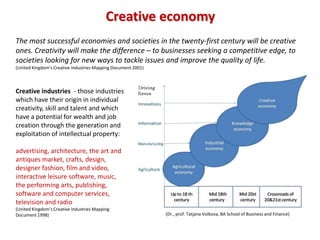
Creative economy
The most successful economies and societies in the twenty-first century will be creative
ones. Creativity will make the difference – to businesses seeking a competitive edge, to
societies looking for new ways to tackle issues and improve the quality of life.
(United Kingdom’s Creative Industries Mapping Document 2001)


Creative industries - those industries
which have their origin in individual
creativity, skill and talent and which
have a potential for wealth and job
creation through the generation and
exploitation of intellectual property:

advertising, architecture, the art and
antiques market, crafts, design,
designer fashion, film and video,
interactive leisure software, music,
the performing arts, publishing,
software and computer services,
television and radio
(United Kingdom’s Creative Industries Mapping
Document 1998)                                                 (Dr., prof. Tatjana Volkova, BA School of Business and Finance)
Creativity and economic growth
• Cultural and creative sector grows more rapidly than the general economy
    – In the years 1999-2003 sector’s growth was 12,3% higher than average growth
      in EU economy
    – in the years 2002-2004 employment in this sector grew by 1,85% whereas
      total employment in the EU decreased

• Culture and creativity contributes a lot to local development
    – the goods produced in these industries are closely related to local audience
      and culture and therefore can not be easily off-shored
    – culture and creativity helps to attract high qualified work force, investment
      and tourism thus boosting local economy
    – culture and creativity contributes to social and territorial integration

• R. Florida’s three T’s economic growth theory argues that the main driving
  forces for economic growth are technology, talent and tolerance
    – creative class and talent: people that are well educated and deal with creative
      or conceptual tasks in their professional life
The study
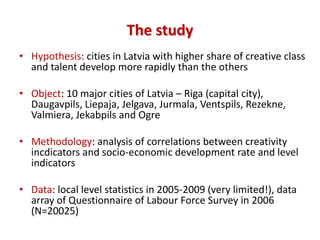
• Hypothesis: cities in Latvia with higher share of creative class
  and talent develop more rapidly than the others

• Object: 10 major cities of Latvia – Riga (capital city),
  Daugavpils, Liepaja, Jelgava, Jurmala, Ventspils, Rezekne,
  Valmiera, Jekabpils and Ogre

• Methodology: analysis of correlations between creativity
  incdicators and socio-economic development rate and level
  indicators

• Data: local level statistics in 2005-2009 (very limited!), data
  array of Questionnaire of Labour Force Survey in 2006
  (N=20025)
The indicators
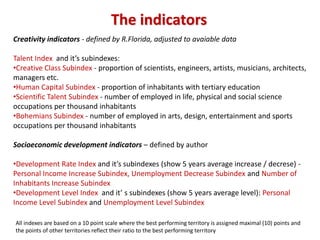
Creativity indicators - defined by R.Florida, adjusted to avaiable data

Talent Index and it’s subindexes:
•Creative Class Subindex - proportion of scientists, engineers, artists, musicians, architects,
managers etc.
•Human Capital Subindex - proportion of inhabitants with tertiary education
•Scientific Talent Subindex - number of employed in life, physical and social science
occupations per thousand inhabitants
•Bohemians Subindex - number of employed in arts, design, entertainment and sports
occupations per thousand inhabitants

Socioeconomic development indicators – defined by author

•Development Rate Index and it’s subindexes (show 5 years average increase / decrese) -
Personal Income Increase Subindex, Unemployment Decrease Subindex and Number of
Inhabitants Increase Subindex
•Development Level Index and it’ s subindexes (show 5 years average level): Personal
Income Level Subindex and Unemployment Level Subindex

All indexes are based on a 10 point scale where the best performing territory is assigned maximal (10) points and
the points of other territories reflect their ratio to the best performing territory
The results: socioeconomic development
12
         10 10         10                                  9.7                                              10                                                          10
10                                    9.1                                                                                                       9.3
                                                                                                                                                                                             8.7
                            8.1 7.8                                                                                                                               8.3
                                                     7.7                      7.7 7.8                                                                                                                                                          7.9
 8                                                                                            7.3     7.4                       7.4 7.1                     7.1                        7.1
                 6.8                                                                                                   6.5
                                                                       6.2                                                                                                                         5.9
                                                                                        5.4                                                                                                                                     5.7
 6                                                                                                                                                                                                              5.1 5.2
                                            4.7                  4.6                                                                                                                                     4.4
                                                                                                                                                                                                                                         4.0
 4                                                                                                               3.3                      3.3
                                                                                                                                                                                                                          2.6                              2.6

 2
                                                                                                                                                                             0.8
                                                                                                                                                                                                                                                     0.3
 0

          Jurmala            Ventspils                Jekabpils                Valmiera                 Jelgava                    Ogre*                    Daugavpils                       Riga                 Liepaja                    Rezekne
     Development Rate Index                   Personal Income Increase Subindex                                   Unemployment Decrease Subindex                                          Number of Inhabitants Increase Subindex

 Most rapid growing cities are Jurmala and Ventspils ..
12
         10 10 10
10                                                        9.3
                            8.9 8.9 8.9             8.8                      8.7 9.1 8.4            8.6 8.4 8.7              8.5 8.2 8.8
                                                                 8.3                                                                                              8.3
8                                                                                                                                                     6.9                          6.6 6.4 6.7                                         6.6
                                                                                                                                                                                                           6.1 5.9 6.3
                                                                                                                                                            5.5                                                                  5.7
6
                                                                                                                                                                                                                                             4.8

4

2

0

           Riga             Ventspils               Jurmala                  Valmiera                Ogre*                    Jelgava             Daugavpils                        Liepaja                Jekabpils              Rezekne
     Development Level Index                      Personal Income Level Subindex                             Unemployment Level Subindex

 .. the most developed cities in Latvia remain Riga, Ventspils and Jurmala
The results: creativity
12

     10 10 10         10         10         10
10                         9.2        9.4                9.4
                                                                                  8.6         8.6
                                                                                                                          8.2                                                                   8.3
                7.7                                                        7.7                                                                                                7.9
8                                                      7.3   7.3                                                                                        7.4
                                                                                                                                      7.0
                                                                         6.6                6.6                                             6.5                                   6.4
                                                                   6.2          5.9                  6               6.0                                      6.0
6                                                5.5                                                     5.4      5.4               5.4
                                                                                                                        5.0               4.9         5.1
                                                               4.8                                          4.7                                                       4.7   4.4               4.2   4.2
4                                                                                                                                                                                                         3.4
                                                                                      2.7
                                                                                                                                                                                    2.4
                                                                                                                                                1.9
2                                                                                                                             1.2                               1.3

                                                                                                                                                                                        0.0           0.0
0

        Ogre*                     Riga                   Jurmala          Daugavpils              Jelgava           Rezekne           Ventspils             Liepaja           Valmiera          Jekabpils
      Talent Index                    Creative Class Subindex                  Human Capital Subindex                Scientific Talent Subindex             Bohemians Subindex


•The most overall talented cities are Ogre, Riga and Jurmala
•The highest share of creative class is in Ogre (33,8%), Riga (33,3%), Jurmala (31,7%) and Jelgava (29,2%)
•The highest share of human capital is in Ogre (25,3%), Riga (23,8%), Jurmala (18,6%) and Valmiera
(16,2%)
•The highest share of scientific talent is in Riga (23,9 per th inhabitants), Daugavpils (20,6), Rezekne
(19,6) and Ogre (18,5)
•The highest share of bohemians is in Ogre (32,4 per th inhabitants), Jurmala (20,0) and Riga (17,9)

•With an exception of Daugavpils, most talented and creative cities in Latvia are located in the
economical centre of Latvia - Riga and it’s commuting area with radius of 50 km
The results: correlations
                                                     Develop-   Personal     Unemploy-      Number of      Develop-      Personal     Unem-
•Most talented cities do not        Creativity /
                                   development
                                                      ment
                                                       Rate
                                                                 Income
                                                                Increase
                                                                                ment
                                                                              Decrease
                                                                                            Inhabitants
                                                                                             Increase
                                                                                                            ment
                                                                                                            Level
                                                                                                                          Income
                                                                                                                           Level
                                                                                                                                     ployment
                                                                                                                                       Level
develop more rapidly than            measures         Index     Subindex      Subindex       Subindex       Index        Subindex    Subindex
                                   Talent Index         0,207        0,058        0,047          0,241       0,562*          0,464      0,575*
the others but →                  Creative Class
•Cities with higher the share        Subindex
                                  Human Capital
                                                       0,594*        0,329         0,131         0,609*     0,659**         0,543     0,677**

of creative class do have            Subindex           0,213       -0,094        -0,032          0,411     0,651**        0,596*      0,606*
                                 Scientific Talent
higher socioeconomic                 Subindex          -0,107        0,059         0,192         -0,399          0,344      0,272       0,365

development rate                    Bohemians
                                     Subindex           0,252       -0,006        -0,143          0,542          0,314      0,236       0,345
                                                           * with 0,10 significance; ** with 0,05 significance

•The number of inhabitants in cities with higher share of creative class grows more
rapidly or declines in a slower rate → creativity attracts residents!
•More talented cities, especially in terms of the share of creative class and human capital,
have higher overall development level and lover unemployment level

                                                                                            •Cities with higher
                                                                                            share of talent and
                                                                                            creative class have
                                                                                            higher income level
Thank you for your attention!


         vitola.alise@gmail.com

Creative Cities in Latvia (Poznan, 2010)

  • 1.
    Creative cities in Latvia Alise Vitola, Mg.oec. Riga Technical University LATVIA Poznan, 2010
  • 2.
    Creative economy The mostsuccessful economies and societies in the twenty-first century will be creative ones. Creativity will make the difference – to businesses seeking a competitive edge, to societies looking for new ways to tackle issues and improve the quality of life. (United Kingdom’s Creative Industries Mapping Document 2001) Creative industries - those industries which have their origin in individual creativity, skill and talent and which have a potential for wealth and job creation through the generation and exploitation of intellectual property: advertising, architecture, the art and antiques market, crafts, design, designer fashion, film and video, interactive leisure software, music, the performing arts, publishing, software and computer services, television and radio (United Kingdom’s Creative Industries Mapping Document 1998) (Dr., prof. Tatjana Volkova, BA School of Business and Finance)
  • 3.
    Creativity and economicgrowth • Cultural and creative sector grows more rapidly than the general economy – In the years 1999-2003 sector’s growth was 12,3% higher than average growth in EU economy – in the years 2002-2004 employment in this sector grew by 1,85% whereas total employment in the EU decreased • Culture and creativity contributes a lot to local development – the goods produced in these industries are closely related to local audience and culture and therefore can not be easily off-shored – culture and creativity helps to attract high qualified work force, investment and tourism thus boosting local economy – culture and creativity contributes to social and territorial integration • R. Florida’s three T’s economic growth theory argues that the main driving forces for economic growth are technology, talent and tolerance – creative class and talent: people that are well educated and deal with creative or conceptual tasks in their professional life
  • 4.
    The study • Hypothesis:cities in Latvia with higher share of creative class and talent develop more rapidly than the others • Object: 10 major cities of Latvia – Riga (capital city), Daugavpils, Liepaja, Jelgava, Jurmala, Ventspils, Rezekne, Valmiera, Jekabpils and Ogre • Methodology: analysis of correlations between creativity incdicators and socio-economic development rate and level indicators • Data: local level statistics in 2005-2009 (very limited!), data array of Questionnaire of Labour Force Survey in 2006 (N=20025)
  • 5.
    The indicators Creativity indicators- defined by R.Florida, adjusted to avaiable data Talent Index and it’s subindexes: •Creative Class Subindex - proportion of scientists, engineers, artists, musicians, architects, managers etc. •Human Capital Subindex - proportion of inhabitants with tertiary education •Scientific Talent Subindex - number of employed in life, physical and social science occupations per thousand inhabitants •Bohemians Subindex - number of employed in arts, design, entertainment and sports occupations per thousand inhabitants Socioeconomic development indicators – defined by author •Development Rate Index and it’s subindexes (show 5 years average increase / decrese) - Personal Income Increase Subindex, Unemployment Decrease Subindex and Number of Inhabitants Increase Subindex •Development Level Index and it’ s subindexes (show 5 years average level): Personal Income Level Subindex and Unemployment Level Subindex All indexes are based on a 10 point scale where the best performing territory is assigned maximal (10) points and the points of other territories reflect their ratio to the best performing territory
  • 6.
    The results: socioeconomicdevelopment 12 10 10 10 9.7 10 10 10 9.1 9.3 8.7 8.1 7.8 8.3 7.7 7.7 7.8 7.9 8 7.3 7.4 7.4 7.1 7.1 7.1 6.8 6.5 6.2 5.9 5.4 5.7 6 5.1 5.2 4.7 4.6 4.4 4.0 4 3.3 3.3 2.6 2.6 2 0.8 0.3 0 Jurmala Ventspils Jekabpils Valmiera Jelgava Ogre* Daugavpils Riga Liepaja Rezekne Development Rate Index Personal Income Increase Subindex Unemployment Decrease Subindex Number of Inhabitants Increase Subindex Most rapid growing cities are Jurmala and Ventspils .. 12 10 10 10 10 9.3 8.9 8.9 8.9 8.8 8.7 9.1 8.4 8.6 8.4 8.7 8.5 8.2 8.8 8.3 8.3 8 6.9 6.6 6.4 6.7 6.6 6.1 5.9 6.3 5.5 5.7 6 4.8 4 2 0 Riga Ventspils Jurmala Valmiera Ogre* Jelgava Daugavpils Liepaja Jekabpils Rezekne Development Level Index Personal Income Level Subindex Unemployment Level Subindex .. the most developed cities in Latvia remain Riga, Ventspils and Jurmala
  • 7.
    The results: creativity 12 10 10 10 10 10 10 10 9.2 9.4 9.4 8.6 8.6 8.2 8.3 7.7 7.7 7.9 8 7.3 7.3 7.4 7.0 6.6 6.6 6.5 6.4 6.2 5.9 6 6.0 6.0 6 5.5 5.4 5.4 5.4 5.0 4.9 5.1 4.8 4.7 4.7 4.4 4.2 4.2 4 3.4 2.7 2.4 1.9 2 1.2 1.3 0.0 0.0 0 Ogre* Riga Jurmala Daugavpils Jelgava Rezekne Ventspils Liepaja Valmiera Jekabpils Talent Index Creative Class Subindex Human Capital Subindex Scientific Talent Subindex Bohemians Subindex •The most overall talented cities are Ogre, Riga and Jurmala •The highest share of creative class is in Ogre (33,8%), Riga (33,3%), Jurmala (31,7%) and Jelgava (29,2%) •The highest share of human capital is in Ogre (25,3%), Riga (23,8%), Jurmala (18,6%) and Valmiera (16,2%) •The highest share of scientific talent is in Riga (23,9 per th inhabitants), Daugavpils (20,6), Rezekne (19,6) and Ogre (18,5) •The highest share of bohemians is in Ogre (32,4 per th inhabitants), Jurmala (20,0) and Riga (17,9) •With an exception of Daugavpils, most talented and creative cities in Latvia are located in the economical centre of Latvia - Riga and it’s commuting area with radius of 50 km
  • 8.
    The results: correlations Develop- Personal Unemploy- Number of Develop- Personal Unem- •Most talented cities do not Creativity / development ment Rate Income Increase ment Decrease Inhabitants Increase ment Level Income Level ployment Level develop more rapidly than measures Index Subindex Subindex Subindex Index Subindex Subindex Talent Index 0,207 0,058 0,047 0,241 0,562* 0,464 0,575* the others but → Creative Class •Cities with higher the share Subindex Human Capital 0,594* 0,329 0,131 0,609* 0,659** 0,543 0,677** of creative class do have Subindex 0,213 -0,094 -0,032 0,411 0,651** 0,596* 0,606* Scientific Talent higher socioeconomic Subindex -0,107 0,059 0,192 -0,399 0,344 0,272 0,365 development rate Bohemians Subindex 0,252 -0,006 -0,143 0,542 0,314 0,236 0,345 * with 0,10 significance; ** with 0,05 significance •The number of inhabitants in cities with higher share of creative class grows more rapidly or declines in a slower rate → creativity attracts residents! •More talented cities, especially in terms of the share of creative class and human capital, have higher overall development level and lover unemployment level •Cities with higher share of talent and creative class have higher income level
  • 9.
    Thank you foryour attention! vitola.alise@gmail.com

Editor's Notes

  • #3 The most successful economies and societies in the twenty-first century will be creative ones. Creativity will make the difference – to businesses seeking a competitive edge, to societies looking for new ways to tackle issues and improve the quality of life.” is written in the foreword of United Kingdom’s Creative Industries Mapping Document 2001. The first attempt to measure the economic contribution of creative industries was made with the Creative Industries Mapping Document that was published in the United Kingdom, year 1998. This document defined creative industries as “those industries which have their origin in individual creativity, skill and talent and which have a potential for wealth and job creation through the generation and exploitation of intellectual property” and stated that creative industries include advertising, architecture, the art and antiques market, crafts, design, designer fashion, film and video, interactive leisure software, music, the performing arts, publishing, software and computer services, television and radio. It was recognized that creative industries are closely related to tourism, hospitality, museums and galleries, heritage and sport.
  • #4 The first study on the economy of culture in Europe was initiated by the European Commission and published in 2006. The study showed that cultural and creative sector grows more rapidly than the general economy. In the years 1999-2003 sector’s growth was 12,3% higher than average growth in economy and in the years 2002-2004 employment in this sector grew by 1,85% whereas total employment in the EU decreased. Sector’s turnover was higher than in such industries as information and technology manufacturing or car manufacturing. In 2003 the sector contributed to 2,6% of EU GDP in 2003, more than the contribution of such industries as real estate, food, beverage and tobacco manufacturing, as well as textile industry and chemicals, rubber and plastic products industry. In addition the proportion of people with tertiary education employed in cultural and creative sectors is almost twice higher than in general economy (46,8% and 25,7%).Moreover, culture and creativity contributes a lot to local development because the goods produced in these industries are closely related to local audience and culture and therefore can not be easily off-shored. Furthermore, culture and creativity helps to attract high qualified work force, investment and tourism thus boosting local economy.Now when the importance of creative industries is acknowledged new theories of economic growth have emerged. Most widely known is the three T’s economic growth theory advanced in “The Rise of the Creative Class” by R. Florida where he argues that the main driving forces for economic growth are technology, talent and tolerance. Technology is the central element of this model that is accompanied by the quality of human capital and tolerance that helps to attract foreign talent and mobilize local ones. The local attractiveness and openness becomes a significant factor for economic development, because talented and creative people are highly mobile economic resources.
  • #5 The hypothesis of this article is that those cities in Latvia that have higher proportion of creative class and talent develop more rapidly. To verify this hypothesis, creative class and talent in 10 major cities of Latvia – Riga (capital city), Daugavpils, Liepaja, Jelgava, Jurmala, Ventspils, Rezekne, Valmiera, Jekabpils and Ogre - is analyzed by adjusting to available data Florida’s creativity and talent indicators.Data for the calculation of these indicators were taken from the data array of Questionnaire of Labour Force Survey that was carried out in the year 2006 as apart of research about occupational mobility of the labour force in Latvia.Furthermore creative potential of cities explored in context with the changes in such socio-economic development indicators as the amount of personal income tax per capita, unemployment level and the number of inhabitants in 2005-2009.
  • #6 Creativity performance indicators in this research include (1) Creative Class Subindex which is based on proportion of scientists, engineers, artists, musicians, architects, managers etc. as a percentage of working age (15-74) population, (2) Human Capital Subindex which is based on proportion of inhabitants with tertiary education as a percentage of working age (15-74) population, (3) Scientific Talent Subindex which is based on the number of employed in life, physical and social science occupations per thousand inhabitants in working age (15-74) and (4) Bohemians Subindex which is based on the number of employed in arts, design, entertainment and sports occupations per thousand inhabitants in working age (15-74). An aggregate Talent Index is calculated by using the four subindicators. Two aggregate indicators are designed for theanalysisofsocio-economicdevelopment. Development Rate Index consists of three subindexes that show the average increase in personal income tax per capita (Personal Income Increase Subindex), average decrease in unemployment level (Unemployment Decrease Subindex) and average increase number of inhabitants (Number of Inhabitants Increase Subindex). Whereas Development Level Index consists of two subindexes that show the average level of personal income tax per capita (Personal Income Level Subindex) and unemployment level (Unemployment Level Subindex).All before mentioned indexes are based on a 10 point scale where the best performing territory is assigned maximal (10) points and the points of other territories reflect their ratio to the best performing territory.
  • #7 The research shows that the most rapid growing cities were Jurmala (mostly due to the increase in personal income and number of inhabitants) and Ventspils (mostly due to decrease in unemployment and increase in personal income), whereas the most slowly growing cities were Rezekne (most of all due to high decrease in number of inhabitants and rapid increase in unemployment in the last two years) and Liepaja - also most of all due to rapid increase in unemployment.Still the most developed cities in Latvia remain Riga, Ventspils and Jurmala (mostly due to high level of personal income), whereas the least developed cities are Rezekne (due to the highest average unemployment level) and Jekabpils - due to both high unemployment and love income level.
  • #8 The most overall talented cities are Ogre (due to highest share of creative class, human capital and bohemians), Riga (due to highest share of scientific talent and also a very high share of creative class and human capital) and Jurmala (due to high share of bohemians, and also considerably large share of creative class and human capital).Cities with the highest share of creative class are Ogre (33,8%), Riga (33,3%), Jurmala (31,7%) and Jelgava (29,2%).Whereas the highest share of human capital (working age inhabitants with tertiary education) is Ogre (25,3%), Riga (23,8%), Jurmala (18,6%) and Valmiera (16,2%).The highest share of scientific talent (per thousand working age inhabitants) is in Riga (23,9), Daugavpils (20,6), Rezekne (19,6) and Ogre (18,5).And the highest share of bohemians (per thousand working age inhabitants) is in Ogre (32,4), Jurmala (20,0) and Riga (17,9). It should be noted that with an exception of Daugavpils, most talented and creative cities in Latvia are located in the economical centre of Latvia - Riga and it’s commuting area with radius of 50 km (see fig. 3).
  • #9 Correlation analysis shows that most talented cities do not develop more rapidly than the others. However cities with higher the share of creative class do have higher socioeconomic development rate. Moreover, the number of inhabitants in cities with higher share of creative class grows more rapidly or declines in a slower rate (only in Jurmala the number of inhabitants increased) thus confirming that creativity attracts residents. However analysis shows that more talented cities, especially in terms of the share of creative class and human capital, have higher overall development level and lover unemployment level.Correlation analysis also shows a significant correlation between the share of human capital and personal income level.The graphical reproduction of human capital, creative class and income level confirms that inhabitants in cities with higher share of talent and creative class have higher income level.