http://www.cit.ie
Industrial Physics B.Sc.
Joint degree CIT/UCC
Dr. Stephen Hegarty
1/12/16
Department of Physical Sciences
 Formed by union of previous departments of Chemistry and
Physics
 A research and teaching Department
 Strong ties with local employers, constant revision of courses to
maintain relevance
 Balanced between full-time students and part-time students who
work by day
2016-12-02 www.cit.ie 2
Research developments
 6 new lecturer hires in past 3 years from research
background
 Based in Tyndall National Institute and CREATE building,
Bishopstown campus
 Final year project students introduced to research
2016-12-02 3
Industrial Control Systems
2016-12-02 4
Instrument Engineering – CR360 (Level 8)
Applied Physics and Instrumentation – CR001 (Level 7)
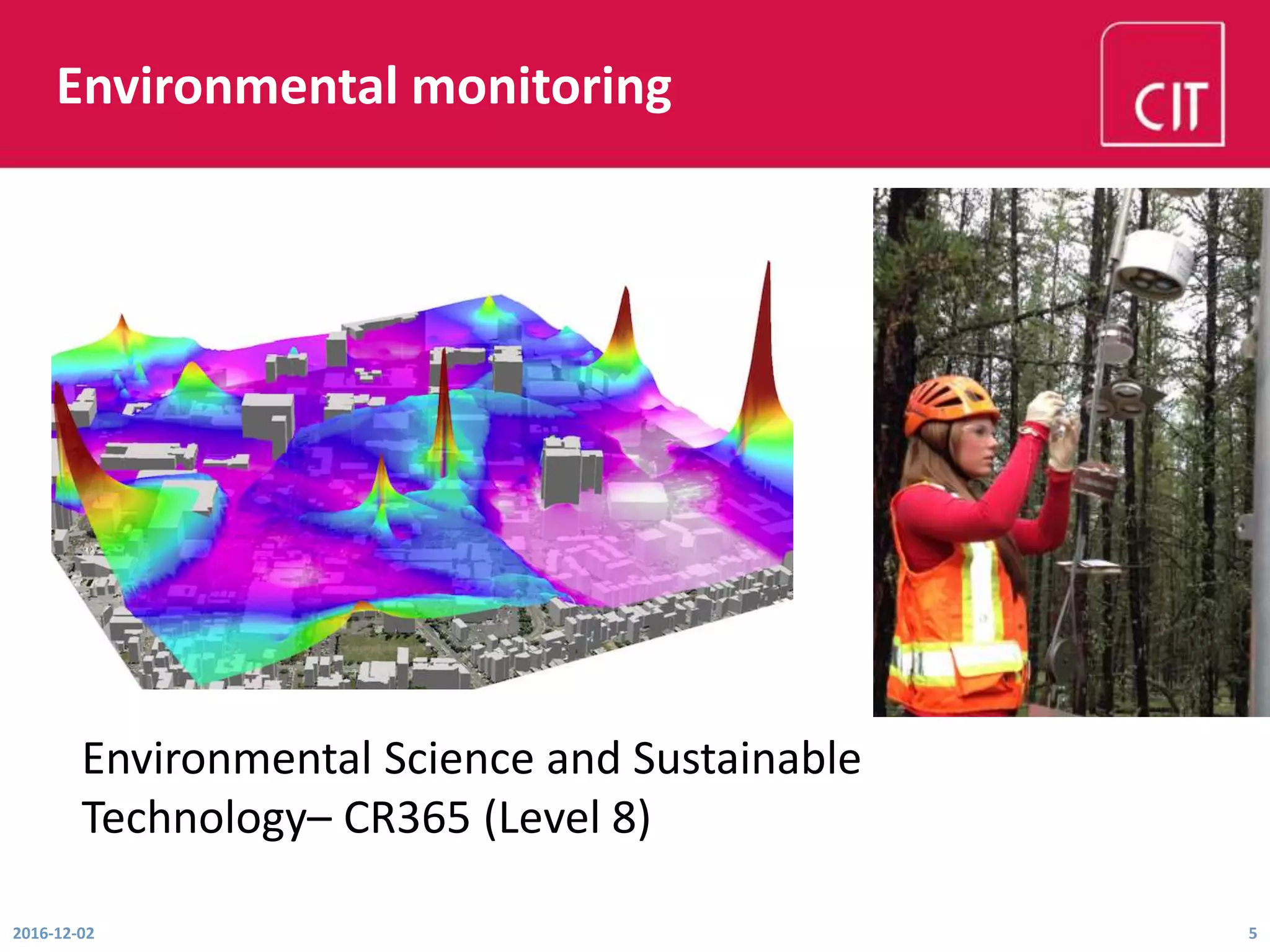
Environmental monitoring
2016-12-02 5
Environmental Science and Sustainable
Technology– CR365 (Level 8)
Destinations
2016-12-02 6
Instrument Engineering – CR360
Applied Physics and Instrumentation – CR001
Environmental Science and Sustainable Technology – CR365
Common Entry
2016-12-02 7
Industrial Physics CK409
 Joint degree CIT/UCC
 First intake September 2017
 Industrial physicists are problem solvers, devising and
employing novel and unconventional techniques as
needed.
- Biotech
- Pharma
- Medical devices
- Optical imaging
- Food and drink manufacturing
2016-12-02 8
Rationale
2016-12-02 9
UCC Physics graduates
• Analytically-oriented graduates
• Academia, IT, Financial services, Consultancy
BUT
• Often after postgraduate training
• Regional industry desires different skills for many roles
CIT Physics graduates
• Industry ready graduates
• Huge regional demand
BUT
• Employers desire more substantive background in
fundamental physics
• “Ceiling” for current graduates
Rationale
2016-12-02 10
UCC Physics graduates
• Analytically-oriented graduates
• Academia, IT, Financial services, Consultancy
BUT
• Often after postgraduate training
• Regional industry desires different skills for many roles
CIT Physics graduates
• Industry ready graduates
• Huge regional demand
BUT
• Employers desire more substantive background in
fundamental physics
• “Ceiling” for current graduates
BSc Industrial Physics
Structure
2016-12-02 11
 Synthesis of UCC and CIT programmes
 First two years predominantly in UCC:
 Deliver core physics modules
 Gain excellent background of fundamental physics and problem solving
skills
 Final two years predominantly in CIT:
 Deliver instrumentation, control and automation modules
 Work placement
 Industry readiness
 Quota of 20 students
Modules example (2nd year)
2016-12-02 12
Introduction to Quantum Physics (5 credits)
Electrostatics and Magnetostatics (5 credits)
Electromagnetism (5 credits)
Introduction to Thermodynamics and Statistical Physics (5 credits)
Introduction to Computational Physics (5 credits)
Experimental Physics I (5 credits)
Experimental Methods I (5 credits)
Engineering Mechanics with Transform Methods (5 credits)
Mathematics for Engineering (5 credits)
Introduction to Process Control (5 credits)
Water Quality Instrumentation (potable and waste water) (5 credits)
Industrial Automation and SCADA (5 credits)
Modules example (3rd year)
2016-12-02 13
Optics (5 credits)
Experimental Physics II (5 credits)
Experimental Methods II (5 credits)
Digital Systems and Interfacing (5 credits)
Industrial Communications and Networks (5 credits)
Process Control Systems (5 credits)
Introduction to Quality Systems (5 credits)
Programming for Measurement (5 credits)
Air Quality and Gas Analysis Instrumentation (5 credits)
Supervised work placement project (15 credits)
Timetabling
2016-12-02 14
Timetabling
2016-12-02 15
Placement
2016-12-02 16
15 credit work placement
Currently: Each year the Department of Physical Sciences
arranges 40 student placements:
This does not satisfy demand!
Has proven to be a major maturing phase for the students
Placement regularly leads to employment upon graduation
http://www.cit.ie
Dr. Stephen Hegarty
1/12/16
Thank you

Industrial Physics B.Sc. - New Joint Degree CIT/UCC

  • 1.
    http://www.cit.ie Industrial Physics B.Sc. Jointdegree CIT/UCC Dr. Stephen Hegarty 1/12/16
  • 2.
    Department of PhysicalSciences  Formed by union of previous departments of Chemistry and Physics  A research and teaching Department  Strong ties with local employers, constant revision of courses to maintain relevance  Balanced between full-time students and part-time students who work by day 2016-12-02 www.cit.ie 2
  • 3.
    Research developments  6new lecturer hires in past 3 years from research background  Based in Tyndall National Institute and CREATE building, Bishopstown campus  Final year project students introduced to research 2016-12-02 3
  • 4.
    Industrial Control Systems 2016-12-024 Instrument Engineering – CR360 (Level 8) Applied Physics and Instrumentation – CR001 (Level 7)
  • 5.
    Environmental monitoring 2016-12-02 5 EnvironmentalScience and Sustainable Technology– CR365 (Level 8)
  • 6.
    Destinations 2016-12-02 6 Instrument Engineering– CR360 Applied Physics and Instrumentation – CR001 Environmental Science and Sustainable Technology – CR365
  • 7.
  • 8.
    Industrial Physics CK409 Joint degree CIT/UCC  First intake September 2017  Industrial physicists are problem solvers, devising and employing novel and unconventional techniques as needed. - Biotech - Pharma - Medical devices - Optical imaging - Food and drink manufacturing 2016-12-02 8
  • 9.
    Rationale 2016-12-02 9 UCC Physicsgraduates • Analytically-oriented graduates • Academia, IT, Financial services, Consultancy BUT • Often after postgraduate training • Regional industry desires different skills for many roles CIT Physics graduates • Industry ready graduates • Huge regional demand BUT • Employers desire more substantive background in fundamental physics • “Ceiling” for current graduates
  • 10.
    Rationale 2016-12-02 10 UCC Physicsgraduates • Analytically-oriented graduates • Academia, IT, Financial services, Consultancy BUT • Often after postgraduate training • Regional industry desires different skills for many roles CIT Physics graduates • Industry ready graduates • Huge regional demand BUT • Employers desire more substantive background in fundamental physics • “Ceiling” for current graduates BSc Industrial Physics
  • 11.
    Structure 2016-12-02 11  Synthesisof UCC and CIT programmes  First two years predominantly in UCC:  Deliver core physics modules  Gain excellent background of fundamental physics and problem solving skills  Final two years predominantly in CIT:  Deliver instrumentation, control and automation modules  Work placement  Industry readiness  Quota of 20 students
  • 12.
    Modules example (2ndyear) 2016-12-02 12 Introduction to Quantum Physics (5 credits) Electrostatics and Magnetostatics (5 credits) Electromagnetism (5 credits) Introduction to Thermodynamics and Statistical Physics (5 credits) Introduction to Computational Physics (5 credits) Experimental Physics I (5 credits) Experimental Methods I (5 credits) Engineering Mechanics with Transform Methods (5 credits) Mathematics for Engineering (5 credits) Introduction to Process Control (5 credits) Water Quality Instrumentation (potable and waste water) (5 credits) Industrial Automation and SCADA (5 credits)
  • 13.
    Modules example (3rdyear) 2016-12-02 13 Optics (5 credits) Experimental Physics II (5 credits) Experimental Methods II (5 credits) Digital Systems and Interfacing (5 credits) Industrial Communications and Networks (5 credits) Process Control Systems (5 credits) Introduction to Quality Systems (5 credits) Programming for Measurement (5 credits) Air Quality and Gas Analysis Instrumentation (5 credits) Supervised work placement project (15 credits)
  • 14.
  • 15.
  • 16.
    Placement 2016-12-02 16 15 creditwork placement Currently: Each year the Department of Physical Sciences arranges 40 student placements: This does not satisfy demand! Has proven to be a major maturing phase for the students Placement regularly leads to employment upon graduation
  • 17.