Settlement Of Industrial
Disputes
According to the Industrial Dispute Act,1947 sec
(2(k)), Industrial disputes mean Any dispute or
difference between employers and employers, or
between employers and workmen, or between
workmen and workmen, which is connected with the
employment or non-employment or the terms of
employment or with the conditions of labour, of any
person.
INDUSTRIAL DISPUTE
 An Act to make provision for the investigation and
settlement of industrial disputes, and for certain
other purposes.
THE INDUSTRIAL DISPUTES ACT, 1947
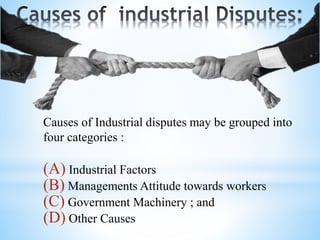
Causes of Industrial disputes may be grouped into
four categories :
(A) Industrial Factors
(B) Managements Attitude towards workers
(C) Government Machinery ; and
(D) Other Causes
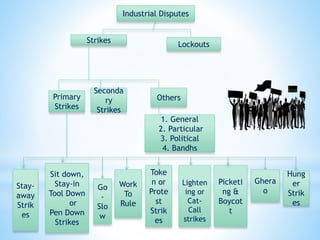
Strikes
Lockouts
Primary
Strikes
Seconda
ry
Strikes
Others
1. General
2. Particular
3. Political
4. Bandhs
Stay-
away
Strik
es
Sit down,
Stay-in
Tool Down
or
Pen Down
Strikes
Go
-
Slo
w
Work
To
Rule
Toke
n or
Prote
st
Strik
es
Industrial Disputes
Lighten
ing or
Cat-
Call
strikes
Picketi
ng &
Boycot
t
Ghera
o
Hung
er
Strik
es
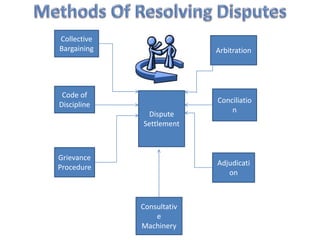
Collective
Bargaining
Code of
Discipline
Grievance
Procedure
Consultativ
e
Machinery
Arbitration
Conciliatio
n
Adjudicati
on
Dispute
Settlement
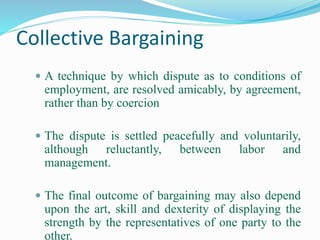
Collective Bargaining
 A technique by which dispute as to conditions of
employment, are resolved amicably, by agreement,
rather than by coercion
 The dispute is settled peacefully and voluntarily,
although reluctantly, between labor and
management.
 The final outcome of bargaining may also depend
upon the art, skill and dexterity of displaying the
strength by the representatives of one party to the
other.
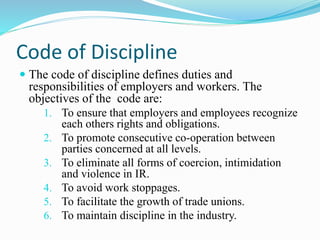
Code of Discipline
 The code of discipline defines duties and
responsibilities of employers and workers. The
objectives of the code are:
1. To ensure that employers and employees recognize
each others rights and obligations.
2. To promote consecutive co-operation between
parties concerned at all levels.
3. To eliminate all forms of coercion, intimidation
and violence in IR.
4. To avoid work stoppages.
5. To facilitate the growth of trade unions.
6. To maintain discipline in the industry.
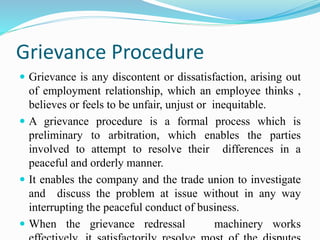
Grievance Procedure
 Grievance is any discontent or dissatisfaction, arising out
of employment relationship, which an employee thinks ,
believes or feels to be unfair, unjust or inequitable.
 A grievance procedure is a formal process which is
preliminary to arbitration, which enables the parties
involved to attempt to resolve their differences in a
peaceful and orderly manner.
 It enables the company and the trade union to investigate
and discuss the problem at issue without in any way
interrupting the peaceful conduct of business.
 When the grievance redressal machinery works
Arbitration
 Arbitration is a procedure in which a neutral third party
studies the bargaining situation, listens to both the parties,
gathers information and then makes recommendations that
are binding on both the parties.
 Arbitration is effective means of resolving disputes
because it is :
1. Established by the parties themselves and the
decision is acceptable to them.
2. Relatively expeditious when compared to courts and
tribunals.
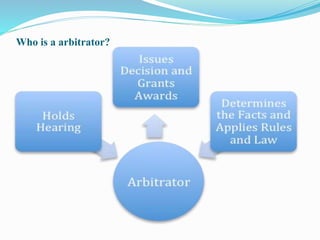
Who is a arbitrator?
Adjudication
 It is a process of dispute settlement wherein the government submit the case
to a competent authority and enforces its awards on the parties.
 The procedure of adjudication involves “ compulsory attendance of witness,
compulsory powers of investigation and compulsory enforcement of awards
with penalities for the breech of these awards.
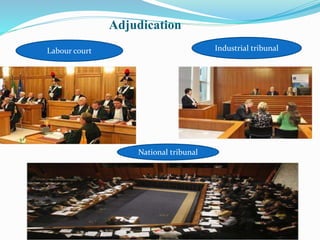
Adjudication
Labour court Industrial tribunal
National tribunal
Conciliation Conciliation is a process by which the
representatives of workers and employers are
brought together before a third party (tri-partile) with
a view to persuading them to arrive at an agreement
by mutual discussion between them. The third party
may be an individual or a group of people. The third
party may also be called as mediators.
 The ID Act, 1947and other state enactments
authorize the governments to appoint conciliators
charged with duty of mediating in and promoting the
settlement of industrial disputes.
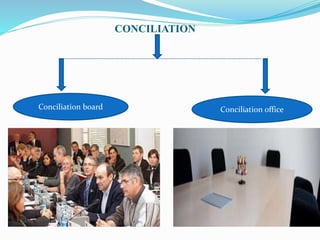
CONCILIATION
Conciliation board Conciliation office
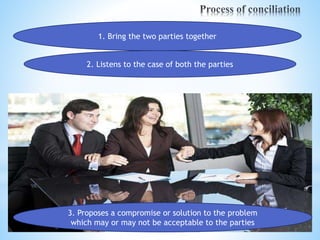
1. Bring the two parties together
2. Listens to the case of both the parties
3. Proposes a compromise or solution to the problem
which may or may not be acceptable to the parties
Thank You

SETTLEMENT OF INDUSTRIAL CONFLICTS

  • 1.
  • 2.
    According to theIndustrial Dispute Act,1947 sec (2(k)), Industrial disputes mean Any dispute or difference between employers and employers, or between employers and workmen, or between workmen and workmen, which is connected with the employment or non-employment or the terms of employment or with the conditions of labour, of any person. INDUSTRIAL DISPUTE
  • 3.
     An Actto make provision for the investigation and settlement of industrial disputes, and for certain other purposes. THE INDUSTRIAL DISPUTES ACT, 1947
  • 4.
    Causes of Industrialdisputes may be grouped into four categories : (A) Industrial Factors (B) Managements Attitude towards workers (C) Government Machinery ; and (D) Other Causes
  • 5.
    Strikes Lockouts Primary Strikes Seconda ry Strikes Others 1. General 2. Particular 3.Political 4. Bandhs Stay- away Strik es Sit down, Stay-in Tool Down or Pen Down Strikes Go - Slo w Work To Rule Toke n or Prote st Strik es Industrial Disputes Lighten ing or Cat- Call strikes Picketi ng & Boycot t Ghera o Hung er Strik es
  • 6.
  • 7.
    Collective Bargaining  Atechnique by which dispute as to conditions of employment, are resolved amicably, by agreement, rather than by coercion  The dispute is settled peacefully and voluntarily, although reluctantly, between labor and management.  The final outcome of bargaining may also depend upon the art, skill and dexterity of displaying the strength by the representatives of one party to the other.
  • 8.
    Code of Discipline The code of discipline defines duties and responsibilities of employers and workers. The objectives of the code are: 1. To ensure that employers and employees recognize each others rights and obligations. 2. To promote consecutive co-operation between parties concerned at all levels. 3. To eliminate all forms of coercion, intimidation and violence in IR. 4. To avoid work stoppages. 5. To facilitate the growth of trade unions. 6. To maintain discipline in the industry.
  • 9.
    Grievance Procedure  Grievanceis any discontent or dissatisfaction, arising out of employment relationship, which an employee thinks , believes or feels to be unfair, unjust or inequitable.  A grievance procedure is a formal process which is preliminary to arbitration, which enables the parties involved to attempt to resolve their differences in a peaceful and orderly manner.  It enables the company and the trade union to investigate and discuss the problem at issue without in any way interrupting the peaceful conduct of business.  When the grievance redressal machinery works
  • 10.
    Arbitration  Arbitration isa procedure in which a neutral third party studies the bargaining situation, listens to both the parties, gathers information and then makes recommendations that are binding on both the parties.  Arbitration is effective means of resolving disputes because it is : 1. Established by the parties themselves and the decision is acceptable to them. 2. Relatively expeditious when compared to courts and tribunals.
  • 11.
    Who is aarbitrator?
  • 12.
    Adjudication  It isa process of dispute settlement wherein the government submit the case to a competent authority and enforces its awards on the parties.  The procedure of adjudication involves “ compulsory attendance of witness, compulsory powers of investigation and compulsory enforcement of awards with penalities for the breech of these awards.
  • 13.
    Adjudication Labour court Industrialtribunal National tribunal
  • 14.
    Conciliation Conciliation isa process by which the representatives of workers and employers are brought together before a third party (tri-partile) with a view to persuading them to arrive at an agreement by mutual discussion between them. The third party may be an individual or a group of people. The third party may also be called as mediators.  The ID Act, 1947and other state enactments authorize the governments to appoint conciliators charged with duty of mediating in and promoting the settlement of industrial disputes.
  • 15.
  • 16.
    1. Bring thetwo parties together 2. Listens to the case of both the parties 3. Proposes a compromise or solution to the problem which may or may not be acceptable to the parties
  • 18.