Exploring Scientific
Thinking: The Roles of
Inductive and Deductive
Reasoning in
Methodology
R.SIVA PRASAD NAYAK
710721103006
In this presentation, we will explore
scientific thinking and the critical roles of
inductive and deductive reasoning.
Understanding these methodologies is
essential for effective research and
analysis, guiding scientists in forming
hypotheses and drawing conclusions.
What is Inductive
Reasoning?
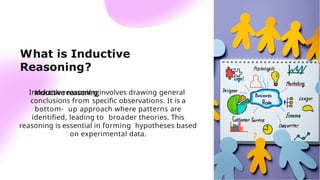
Inductive reasoning involves drawing general
conclusions from specific observations. It is a
bottom- up approach where patterns are
identified, leading to broader theories. This
reasoning is essential in forming hypotheses based
on experimental data.
For example,
let’s say you go to a cafe every day for a month, and every day, the same person
comes at exactly 11 am and orders a cappuccino. The specific observation is that
this person has come to the cafe at the same time and ordered the same thing
every day during the period observed. A general conclusion drawn from these
premises could be that this person always comes to the cafe at the same time and
orders the same thing.
While inductive reasoning can be useful, it’s prone to being flawed. That’s because
conclusions drawn using induction go beyond the information contained in the
premises. An inductive argument may be highly probable, but even if all the
observations are accurate, it can lead to incorrect conclusions.
What is Deductive
Reasoning?
Deductive reasoning is the process of drawing specific
conclusions from general principles or theories. It follows a
top-down approach, where premises lead to a logical
conclusion. This method is crucial for testing hypotheses in
scientific research.
For example:
Chickens are birds; all birds lay eggs; therefore, chickens lay eggs.
Another way to think of it: if something is true of a general class (birds), then it is true of the
members of the class (chickens).
Comparison of Reasoning Types
While inductive reasoning builds theories from
observations, deductive reasoning tests theories against
observations. Both methodologies complement each
other, enhancing the robustness of scientific inquiry and
ensuring balanced research outcomes.
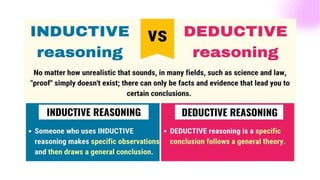
Inductive and deductive are commonly used in the context of logic, reasoning,
and science. Scientists use both inductive and deductive reasoning as part of the
scientific method.
The difference involves whether the reasoning moves from the general to the
specific or from the specific to the general.
Comparison of Reasoning Types
Applications in Research
Inductive and deductive reasoning are applied in various
scientific fields. Inductive reasoning helps in generating new
theories, while deductive reasoning is vital for validating
existing theories through experimentation and observation.
Conclusion
In conclusion, both inductive and deductive reasoning play vital roles in scientific
thinking. Understanding their differences and applications enhances our ability to
conduct thorough research and develop sound scientific theories.

Thanks

HUMAN VALUES AND ETHICS PPT.pphdhfhdhfhfjdhtx

  • 1.
    Exploring Scientific Thinking: TheRoles of Inductive and Deductive Reasoning in Methodology R.SIVA PRASAD NAYAK 710721103006
  • 2.
    In this presentation,we will explore scientific thinking and the critical roles of inductive and deductive reasoning. Understanding these methodologies is essential for effective research and analysis, guiding scientists in forming hypotheses and drawing conclusions.
  • 3.
    What is Inductive Reasoning? Inductivereasoning involves drawing general conclusions from specific observations. It is a bottom- up approach where patterns are identified, leading to broader theories. This reasoning is essential in forming hypotheses based on experimental data.
  • 4.
    For example, let’s sayyou go to a cafe every day for a month, and every day, the same person comes at exactly 11 am and orders a cappuccino. The specific observation is that this person has come to the cafe at the same time and ordered the same thing every day during the period observed. A general conclusion drawn from these premises could be that this person always comes to the cafe at the same time and orders the same thing. While inductive reasoning can be useful, it’s prone to being flawed. That’s because conclusions drawn using induction go beyond the information contained in the premises. An inductive argument may be highly probable, but even if all the observations are accurate, it can lead to incorrect conclusions.
  • 5.
    What is Deductive Reasoning? Deductivereasoning is the process of drawing specific conclusions from general principles or theories. It follows a top-down approach, where premises lead to a logical conclusion. This method is crucial for testing hypotheses in scientific research.
  • 6.
    For example: Chickens arebirds; all birds lay eggs; therefore, chickens lay eggs. Another way to think of it: if something is true of a general class (birds), then it is true of the members of the class (chickens).
  • 7.
    Comparison of ReasoningTypes While inductive reasoning builds theories from observations, deductive reasoning tests theories against observations. Both methodologies complement each other, enhancing the robustness of scientific inquiry and ensuring balanced research outcomes.
  • 8.
    Inductive and deductiveare commonly used in the context of logic, reasoning, and science. Scientists use both inductive and deductive reasoning as part of the scientific method. The difference involves whether the reasoning moves from the general to the specific or from the specific to the general. Comparison of Reasoning Types
  • 10.
    Applications in Research Inductiveand deductive reasoning are applied in various scientific fields. Inductive reasoning helps in generating new theories, while deductive reasoning is vital for validating existing theories through experimentation and observation.
  • 11.
    Conclusion In conclusion, bothinductive and deductive reasoning play vital roles in scientific thinking. Understanding their differences and applications enhances our ability to conduct thorough research and develop sound scientific theories.
  • 12.