1
TIME
MANAGEMENT
5/12/2017
2
 What is time ?
 Why time management?
 How to manage time
– Meetings
– Telephoning
– Priorotising etc
Content
5/12/2017
3
TIME, WHAT IS IT?
It is the passing of life
A resource common to all
It cannot be stored or saved.
It is MONEY
5/12/2017
4
TIME MANAGEMENT
Techniques designed to
enable one do more in less
time with better results.
5/12/2017
5
Why Time Management?
 For improved performance
 Improved productivity
 Goal achievement
 Effectiveness
 Efficiency
 Stress reduction.
5/12/2017
5/12/2017
6
FOUR AREAS OF TIME USE
1. BOSS IMPOSED TIME:
 Time consumed by Your boss e.g. Meetings,
assignments etc.
2. SYSTEM IMPOSED TIME
 Activities/requests from other managers,
supervisors, departments etc.
3. SUBORDINATE IMPOSED TIME:
 Difficulties encountered by subordinates on the
job.
 Associated with upward delegation
5/12/2017
7
4. DISCRETIONARY TIME
 Time devoted to planned assignments
 No demands on time by anyone
 Make effort to increase your discretionary time.
 Minimize time spent on other areas.
 Make effective use of the increased discretionary time.
DIFFICULTIES MAY BE DUE TO:
 Too much time in other areas at the expense of
discretionary time
 Discretionary time is adequate but not effectively utilized.
8
SOME COMMON TIME WASTERS/ROBBERS
 Procrastination
 Telephone interruptions
 Lack of priorities, objectives,
deadlines
 Drop-in visitors
 Poorly Managed Meetings
 Improper delegation
 Searching
5/12/2017
9
MANAGING YOUR TIME
 Plan your time by making a
“to do” list
 Establish priorities for the
various tasks and duties
 Prepare a time budget &
inventory
 Keep a daily time log.
5/12/2017
10
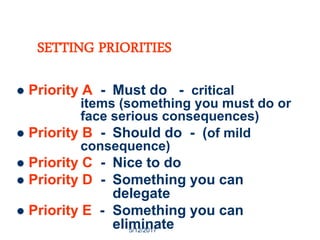
SETTING PRIORITIES
 Priority A - Must do - critical
items (something you must do or
face serious consequences)
 Priority B - Should do - (of mild
consequence)
 Priority C - Nice to do
 Priority D - Something you can
delegate
 Priority E - Something you can
eliminate
5/12/2017
11
SETTING PRIORITIES (CONT’D)
IMPORTANCE
Urgency
Low
High
Low High
Do not do it
Ask Someone
to do it
Do it later
Do it now and
do it yourself
5/12/2017
12
AUDIT YOUR DAY
 WHAT DID YOU DO EVERY
MINUTE?
 WAS THE TIME USED OR
WASTED?
 HOW WILL YOU DEAL WITH IT
THE NEXT DAY?
5/12/2017
13
CAUSES OF
PROCRASTINATION
Self-doubt
Search for perfection
Excessive socialising
Priority inverter.
5/12/2017
14
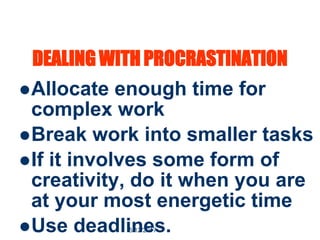
DEALING WITH PROCRASTINATION
Allocate enough time for
complex work
Break work into smaller tasks
If it involves some form of
creativity, do it when you are
at your most energetic time
Use deadlines.
5/12/2017
15
Meetings
Be consistent with the
purpose of the meeting
Start and end on time
Take minutes
Summarise activities and
review assignments.
5/12/2017
16
TELEPHONE
 Avoid a lot of personal calls
 Allocate time for making calls
 Plan what you are going to say
 Keep conversation short
 If possible, have someone screen
your calls
 Keep a directory of frequently
called numbers.
5/12/2017
17
DEALING WITH CLUTTERED DESK
 Handle each paper once
 Apply the “GUTS” technique
– Give it away
– Use it
– Throw it away
– Send it.
5/12/2017
18
SORT MAILS INTO:
A -Action folder - requires
immediate attention
I -Information
D -Deferred folders - spare
moments/ a break from
concentrating on more
substantial matters.
NB: A clear desk is the foundation for tomorrow’s work.
5/12/2017
19
CONTROLLING VISITORS
 Do not overdo the open door policy
 Set time limits for visits and stick to them
 Meet visitors outside your door
 Confer while standing
 Set the agenda early in the conversation
 If possible have someone screen your
visitors
 Use your office for business activities and
let others know this.
5/12/2017
20
Summary of 5S
Separate
items
Items
necessary
Items not
necessary
Items not used but must
keep
Items
sometimes used
Items
frequently used
Items of no value but
costly to dispose
Items of some
value
Items of no value & easily
disposable
STRATIFICATION
Store with identification
Place
farther away
Place near
point of use
Find cheapest
disposal
Sell to best buyer
Dispose of
immediately
REQUIRED ACTION
5/12/2017
21
ELIMINATING SEARCHING
 CLEAN UP
 TIDY UP
 PROVIDE HOMES
 PROVIDE LABLES
 PROVIDE
ENOUGH
 MONITOR
MOVEMENT
 KEEP RECORDS
 LEAVE
FORWARDING
ADDRESS
 EDUCATE ALL
5/12/2017
22
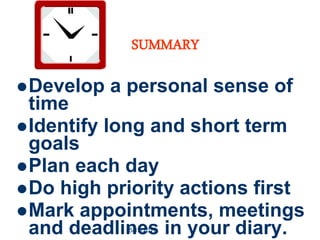
SUMMARY
Develop a personal sense of
time
Identify long and short term
goals
Plan each day
Do high priority actions first
Mark appointments, meetings
and deadlines in your diary.
5/12/2017
23
SUMMARY (Cont’d)
Make the best every time
Organise office work
Manage meetings
Delegate effectively
Manage your health.
5/12/2017
24
4Ds of time management
 Desire
– An intense, burning desire to
control your time to achieve
maximum effectiveness
 Decision
– Make a clear and firm decision that
you are going to practise good time
management till it becomes a habit.
5/12/2017
25
4Ds of time management (CONT’D)
Discipline
– Discipline yourself to make it a
lifelong practice
Determination
– Be willing to persist in the midst of
all the difficulties until you become
an effective time manager.
5/12/2017
5/12/2017
26
CRUCIAL ISSUE IN
LONG TERM TIME MANAGEMENT:
“WHAT WILL I LIKE TO BE
REMEMBERED FOR ”
5/12/2017
27
Anonymous Philosopher
YESTERDAY IS A CANCELLED CHEQUE
TOMORROW IS A PROMISORY NOTE
TODAY IS READY CASH !!!
USE IT !!!
DO IT NOW!!!!!!!!
5/12/2017
28
JOHN RUSKIN
DO IT NOW!
5/12/2017
29
THANK YOU
30
End of presentation on
TIME MANAGEMENT
5/12/2017

INDUCTION 2017 - TIME MANAGEMENT_0.pdf

  • 1.
  • 2.
    2  What istime ?  Why time management?  How to manage time – Meetings – Telephoning – Priorotising etc Content 5/12/2017
  • 3.
    3 TIME, WHAT ISIT? It is the passing of life A resource common to all It cannot be stored or saved. It is MONEY 5/12/2017
  • 4.
    4 TIME MANAGEMENT Techniques designedto enable one do more in less time with better results. 5/12/2017
  • 5.
    5 Why Time Management? For improved performance  Improved productivity  Goal achievement  Effectiveness  Efficiency  Stress reduction. 5/12/2017
  • 6.
    5/12/2017 6 FOUR AREAS OFTIME USE 1. BOSS IMPOSED TIME:  Time consumed by Your boss e.g. Meetings, assignments etc. 2. SYSTEM IMPOSED TIME  Activities/requests from other managers, supervisors, departments etc. 3. SUBORDINATE IMPOSED TIME:  Difficulties encountered by subordinates on the job.  Associated with upward delegation
  • 7.
    5/12/2017 7 4. DISCRETIONARY TIME Time devoted to planned assignments  No demands on time by anyone  Make effort to increase your discretionary time.  Minimize time spent on other areas.  Make effective use of the increased discretionary time. DIFFICULTIES MAY BE DUE TO:  Too much time in other areas at the expense of discretionary time  Discretionary time is adequate but not effectively utilized.
  • 8.
    8 SOME COMMON TIMEWASTERS/ROBBERS  Procrastination  Telephone interruptions  Lack of priorities, objectives, deadlines  Drop-in visitors  Poorly Managed Meetings  Improper delegation  Searching 5/12/2017
  • 9.
    9 MANAGING YOUR TIME Plan your time by making a “to do” list  Establish priorities for the various tasks and duties  Prepare a time budget & inventory  Keep a daily time log. 5/12/2017
  • 10.
    10 SETTING PRIORITIES  PriorityA - Must do - critical items (something you must do or face serious consequences)  Priority B - Should do - (of mild consequence)  Priority C - Nice to do  Priority D - Something you can delegate  Priority E - Something you can eliminate 5/12/2017
  • 11.
    11 SETTING PRIORITIES (CONT’D) IMPORTANCE Urgency Low High LowHigh Do not do it Ask Someone to do it Do it later Do it now and do it yourself 5/12/2017
  • 12.
    12 AUDIT YOUR DAY WHAT DID YOU DO EVERY MINUTE?  WAS THE TIME USED OR WASTED?  HOW WILL YOU DEAL WITH IT THE NEXT DAY? 5/12/2017
  • 13.
    13 CAUSES OF PROCRASTINATION Self-doubt Search forperfection Excessive socialising Priority inverter. 5/12/2017
  • 14.
    14 DEALING WITH PROCRASTINATION Allocateenough time for complex work Break work into smaller tasks If it involves some form of creativity, do it when you are at your most energetic time Use deadlines. 5/12/2017
  • 15.
    15 Meetings Be consistent withthe purpose of the meeting Start and end on time Take minutes Summarise activities and review assignments. 5/12/2017
  • 16.
    16 TELEPHONE  Avoid alot of personal calls  Allocate time for making calls  Plan what you are going to say  Keep conversation short  If possible, have someone screen your calls  Keep a directory of frequently called numbers. 5/12/2017
  • 17.
    17 DEALING WITH CLUTTEREDDESK  Handle each paper once  Apply the “GUTS” technique – Give it away – Use it – Throw it away – Send it. 5/12/2017
  • 18.
    18 SORT MAILS INTO: A-Action folder - requires immediate attention I -Information D -Deferred folders - spare moments/ a break from concentrating on more substantial matters. NB: A clear desk is the foundation for tomorrow’s work. 5/12/2017
  • 19.
    19 CONTROLLING VISITORS  Donot overdo the open door policy  Set time limits for visits and stick to them  Meet visitors outside your door  Confer while standing  Set the agenda early in the conversation  If possible have someone screen your visitors  Use your office for business activities and let others know this. 5/12/2017
  • 20.
    20 Summary of 5S Separate items Items necessary Itemsnot necessary Items not used but must keep Items sometimes used Items frequently used Items of no value but costly to dispose Items of some value Items of no value & easily disposable STRATIFICATION Store with identification Place farther away Place near point of use Find cheapest disposal Sell to best buyer Dispose of immediately REQUIRED ACTION 5/12/2017
  • 21.
    21 ELIMINATING SEARCHING  CLEANUP  TIDY UP  PROVIDE HOMES  PROVIDE LABLES  PROVIDE ENOUGH  MONITOR MOVEMENT  KEEP RECORDS  LEAVE FORWARDING ADDRESS  EDUCATE ALL 5/12/2017
  • 22.
    22 SUMMARY Develop a personalsense of time Identify long and short term goals Plan each day Do high priority actions first Mark appointments, meetings and deadlines in your diary. 5/12/2017
  • 23.
    23 SUMMARY (Cont’d) Make thebest every time Organise office work Manage meetings Delegate effectively Manage your health. 5/12/2017
  • 24.
    24 4Ds of timemanagement  Desire – An intense, burning desire to control your time to achieve maximum effectiveness  Decision – Make a clear and firm decision that you are going to practise good time management till it becomes a habit. 5/12/2017
  • 25.
    25 4Ds of timemanagement (CONT’D) Discipline – Discipline yourself to make it a lifelong practice Determination – Be willing to persist in the midst of all the difficulties until you become an effective time manager. 5/12/2017
  • 26.
    5/12/2017 26 CRUCIAL ISSUE IN LONGTERM TIME MANAGEMENT: “WHAT WILL I LIKE TO BE REMEMBERED FOR ”
  • 27.
    5/12/2017 27 Anonymous Philosopher YESTERDAY ISA CANCELLED CHEQUE TOMORROW IS A PROMISORY NOTE TODAY IS READY CASH !!! USE IT !!! DO IT NOW!!!!!!!!
  • 28.
  • 29.
  • 30.
    30 End of presentationon TIME MANAGEMENT 5/12/2017