THE STATE OF CYBERSECURITY IN INDONESIA
President of Indonesia, Joko “Jokowi” Widodo, said
recentlyinlateSeptember2016thatIndonesiahadseen
a drastic increase in cybercrime, with the number of
cases growing by 389 percents in 2014 to 2015. Jokowi
also informed that most of the cases occurred in the
e-commerce sector based and in 2013 Indonesia had
become the second largest target of cybercrimes
worldwide. The emergence of cybersecurity has become
a new challenge in terms of the readiness of Indonesian
governmentinstitutions.
According to the Global Cybersecurity Index (GCI) 2014
released by International Telecommunication Union
(ITU), Indonesia ranked number 5 in the cybersecurity
readiness among the Asia Pacic countries (or number
13 among 105 countries worldwide). Each country's
level of development analyzed
within 5 (ve) categories: Legal
Measures,TechnicalMeasures,
Organizational Measures,
Capacity Building and
Cooperation. The index aimed at capturing the
c y b e r s e c u r i t y r e a d i n e s s o f c o u n t r y
and not its detailed vulnerabilities. Based on the
Asia-Pacic Cybersecurity Dashboard 2015
releasedbyBusinessSoftwareAlliance(BSA),
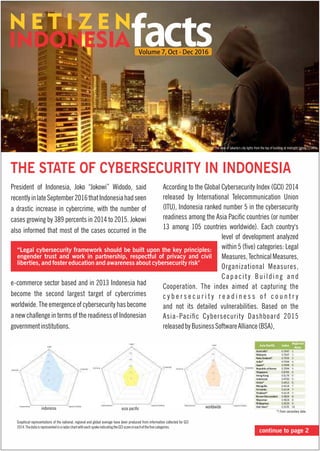
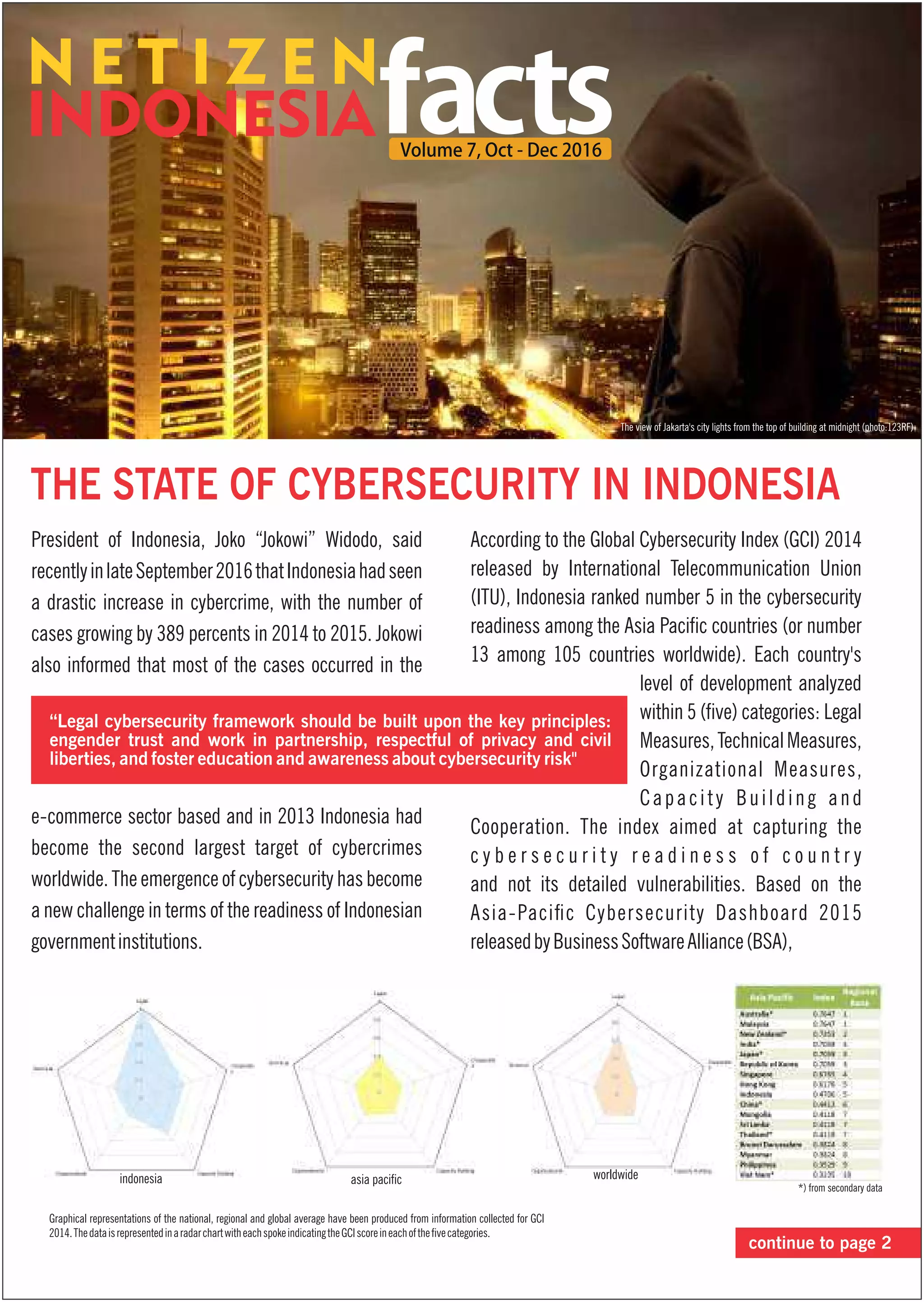
The view of Jakarta's city lights from the top of building at midnight (photo:123RF)
continue to page 2
indonesia worldwideasia pacic
Graphical representations of the national, regional and global average have been produced from information collected for GCI
2014.ThedataisrepresentedinaradarchartwitheachspokeindicatingtheGCIscoreineachofthevecategories.
*) from secondary data
THE THREE KEYS FOR DIGITAL STARTUP
Indonesia's national movement for 1.000 digital
startups(GerakanNasional1000StartupDigital)isstill
underway. It has started in three cities since late July
2016 and will move on to incubation stage
laterintheyear.
This movement put a very strong emphasis on using
digital technology for solving problems in Indonesia. All
the aspiring startup founders involved in this program
are encouraged to really understand the problem they
want to solve, and try to build a business that has a
positiveimpactforthesociety.
One of the stages for this movement is called the
Workshop, this is the immediate stage after the
inspirationphasecalledIgnition.IntheWorkshopstage,
aspiring founders are taught three key activities that
willhelptheirstartup.Thoseactivitiesare:
1. Design Thinking
Using sample of problems provided by
Lab Kinetic, the participants will identify
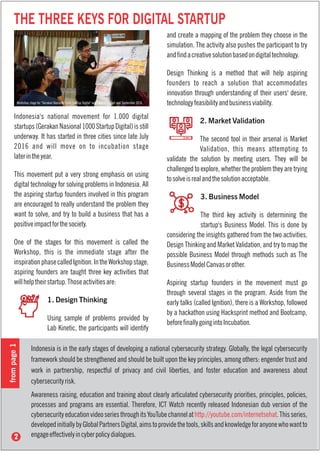
Workshop stage for "Gerakan Nasional 1000 Startup Digital" was held in August and September 2016.
and create a mapping of the problem they choose in the
simulation. The activity also pushes the participant to try
andndacreativesolutionbasedondigitaltechnology.
Design Thinking is a method that will help aspiring
founders to reach a solution that accommodates
innovation through understanding of their users' desire,
technologyfeasibilityandbusinessviability.
2. Market Validation
The second tool in their arsenal is Market
Validation, this means attempting to
validate the solution by meeting users. They will be
challenged to explore, whether the problem they are trying
tosolveisrealandthesolutionacceptable.
3. Business Model
The third key activity is determining the
startup's Business Model. This is done by
considering the insights gathered from the two activities,
Design Thinking and Market Validation, and try to map the
possible Business Model through methods such as The
BusinessModelCanvasorother.
Aspiring startup founders in the movement must go
through several stages in the program. Aside from the
early talks (called Ignition), there is a Workshop, followed
by a hackathon using Hacksprint method and Bootcamp,
beforenallygoingintoIncubation.
Indonesia is in the early stages of developing a national cybersecurity strategy. Globally, the legal cybersecurity
framework should be strengthened and should be built upon the key principles, among others: engender trust and
work in partnership, respectful of privacy and civil liberties, and foster education and awareness about
cybersecurityrisk.
Awareness raising, education and training about clearly articulated cybersecurity priorities, principles, policies,
processes and programs are essential. Therefore, ICT Watch recently released Indonesian dub version of the
cybersecurityeducationvideoseriesthroughitsYouTubechannelat .Thisseries,http://youtube.com/internetsehat
developedinitiallybyGlobalPartnersDigital,aimstoprovidethetools,skillsandknowledgeforanyonewhowantto
engageeffectivelyincyberpolicydialogues.
frompage1
SOCIAL MEDIA FOR RADICALISM IN INDONESIA
ONLINE ANONYMITY IS A MUST, BUT WHAT FOR?
If the online privacy violations are rising, Indonesian
netizens called for the availability of adequate
regulation as a priority that must be done. It is based
on the 50.7% of respondent's answers for the
Indonesian Netizen Perspective of Internet Privacy
surveyconductedinApril-May2016.Thesurveywas
delivered by the Faculty of Law - Padjadjaran
University and ICT Watch, and supported by
the Citizen Lab - University of Toronto.
Internet, especially social
media, raises challenges in
countering extremism efforts.
Nowadays, many radicals use
social media to disseminate
radicalism as well as
spreading their propaganda.
This issue was discussed
during the Jakarta World Forum
for Media Development, recently on September 2016.
The issue is also relevant with the ndings from
Indonesian Center for Deradicalization and Wisdom
(ICDW) that conducted interview in early 2015 to
s e v e r a l
I n d o n e s i a n
former radical
activists. As an
open platform,
social media is widely used by the propaganda
bureau of several radical organizations, rather than
by the recruitment bureau. To recruit young radicals,
private-communication channel is more preferable,
namely Telegram, Whatsapp and Facebook
ilustration / 123rf
Messenger. Of course, the recruitment process will
carry on once the target is considered began to be
affected by the propaganda. ICDW believes that in
response to these challenges, online censorship will
not stop the systematic work of radical, especially if
the actors not reported to the law enforcer or
authority. Committee to Protect Journalists (CPJ),
during the forum was also voicing similar concerns. A
signicant challenge in the counter-narrative efforts
is the belief that “extremist views are not allowed to
be expressed”, (then may leads to immediate and
careless censorship - Ed.). As quoted by The Jakarta
Post, CPJ argued that online censorship only pushed
radicals to private and encrypted chat-rooms, where
journalists and authorities will hard to notice what is
going on. A more sensible approach should focus not
on content (censorship), but on the (counter)
perception/narrativeofcontent.
Related to the “anonymity”, 71.9% of respondents
said it is a must to have as an integral part
of privacy protection. Uniquely, around 57.1%
believe that the online anonym users in Indonesia
exist because they simply want to avoid
or run from responsibility, not for protecting the truth
or the good cause. For more results of the survey,
pleaseaccesshttp://bit.ly/id-netprivacy.
Netizen Facts
published jointly by:
ICT Watch Indonesia and Lab Kinetic
Jl. Tebet Barat Dalam 6H No. 16A
Jakarta Selatan +6221-8292428
info@ictwatch.id www.ictwatch.id
a signicant challenge in the counter-narrative efforts is the
belief that “extremist views are not allowed to be expressed”,
(then may leads to immediate and careless censorship. - Ed.)
Indonesian tax authority is pursuing Google Asia Pacic over what ofcials
allege are unpaid taxes from advertising revenue which is estimated more
than $400 million in the year of 2015. The Authority concerns with the
discrepancies of tax being paid by Google Indonesia, a limited liability
company and already subject of Indonesian tax regulation, compared to
potential tax generated from the revenue of Google Asia Pacic from its
business in Indonesia. It is noted that Google Indonesia already paid taxes on
revenues booked through its local ofce in Indonesia which is lower than the
amount of business transaction derived from Google's operations in
Indonesia through its Asia-Pacic headquarters in Singapore.
(by:SindyNurFitri/MoFA/Indonesia)
InternationalTelecommunicationUnion(ITU)andAssociationofSouthEastAsianNations(ASEAN)organizedaworkshop
onChildOnlineProtection(COP)on13-14September2016inManila,Philippines.Theobjectivesoftheworkshopwereto
provide a platform for ASEAN Member States to share experiences, strengthen their knowledge and raise awareness on
Child Online Safety through a multi-stakeholders approach, involving governments, educators, ICT/telecoms regulators,
companies and civil society organization (CSO) dealing with children and youth. On this occasion, Indonesian Ministry of
Communications and Information Technology (MCIT) and ICT Watch Indonesia became one of the panelists, one of the
subjects presented was about the initiative of Indonesian COP Roadmap development. Presentation:
http://bit.ly/itucop-idmcit http://bit.ly/itucop-ictwatch(MCIT)and (ICTWatch).(by:RizkyAmeliah/MCIT/Indonesia)
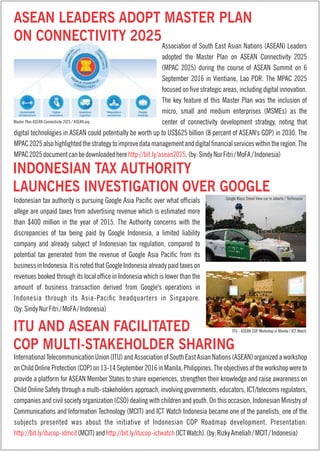
Association of South East Asian Nations (ASEAN) Leaders
adopted the Master Plan on ASEAN Connectivity 2025
(MPAC 2025) during the course of ASEAN Summit on 6
September 2016 in Vientiane, Lao PDR. The MPAC 2025
focused on ve strategic areas, including digital innovation.
The key feature of this Master Plan was the inclusion of
micro, small and medium enterprises (MSMEs) as the
center of connectivity development strategy, noting that
digital technologies in ASEAN could potentially be worth up to US$625 billion (8 percent of ASEAN's GDP) in 2030. The
MPAC2025alsohighlightedthestrategytoimprovedatamanagementanddigitalnancialserviceswithintheregion.The
MPAC2025documentcanbedownloadedhere .(by:SindyNurFitri/MoFA/Indonesia)http://bit.ly/asean2025
ASEAN LEADERS ADOPT MASTER PLAN
ON CONNECTIVITY 2025
INDONESIAN TAX AUTHORITY
LAUNCHES INVESTIGATION OVER GOOGLE
ITU AND ASEAN FACILITATED
COP MULTI-STAKEHOLDER SHARING
Master Plan ASEAN Connectivity 2025 / ASEAN.org
Google Maps Street View car in Jakarta / Techinasia
ITU - ASEAN COP Workshop in Manila / ICT Watch

Indonesia Netizen Facts (October - December 2016)

  • 1.
    THE STATE OFCYBERSECURITY IN INDONESIA President of Indonesia, Joko “Jokowi” Widodo, said recentlyinlateSeptember2016thatIndonesiahadseen a drastic increase in cybercrime, with the number of cases growing by 389 percents in 2014 to 2015. Jokowi also informed that most of the cases occurred in the e-commerce sector based and in 2013 Indonesia had become the second largest target of cybercrimes worldwide. The emergence of cybersecurity has become a new challenge in terms of the readiness of Indonesian governmentinstitutions. According to the Global Cybersecurity Index (GCI) 2014 released by International Telecommunication Union (ITU), Indonesia ranked number 5 in the cybersecurity readiness among the Asia Pacic countries (or number 13 among 105 countries worldwide). Each country's level of development analyzed within 5 (ve) categories: Legal Measures,TechnicalMeasures, Organizational Measures, Capacity Building and Cooperation. The index aimed at capturing the c y b e r s e c u r i t y r e a d i n e s s o f c o u n t r y and not its detailed vulnerabilities. Based on the Asia-Pacic Cybersecurity Dashboard 2015 releasedbyBusinessSoftwareAlliance(BSA), The view of Jakarta's city lights from the top of building at midnight (photo:123RF) continue to page 2 indonesia worldwideasia pacic Graphical representations of the national, regional and global average have been produced from information collected for GCI 2014.ThedataisrepresentedinaradarchartwitheachspokeindicatingtheGCIscoreineachofthevecategories. *) from secondary data
  • 2.
    THE THREE KEYSFOR DIGITAL STARTUP Indonesia's national movement for 1.000 digital startups(GerakanNasional1000StartupDigital)isstill underway. It has started in three cities since late July 2016 and will move on to incubation stage laterintheyear. This movement put a very strong emphasis on using digital technology for solving problems in Indonesia. All the aspiring startup founders involved in this program are encouraged to really understand the problem they want to solve, and try to build a business that has a positiveimpactforthesociety. One of the stages for this movement is called the Workshop, this is the immediate stage after the inspirationphasecalledIgnition.IntheWorkshopstage, aspiring founders are taught three key activities that willhelptheirstartup.Thoseactivitiesare: 1. Design Thinking Using sample of problems provided by Lab Kinetic, the participants will identify Workshop stage for "Gerakan Nasional 1000 Startup Digital" was held in August and September 2016. and create a mapping of the problem they choose in the simulation. The activity also pushes the participant to try andndacreativesolutionbasedondigitaltechnology. Design Thinking is a method that will help aspiring founders to reach a solution that accommodates innovation through understanding of their users' desire, technologyfeasibilityandbusinessviability. 2. Market Validation The second tool in their arsenal is Market Validation, this means attempting to validate the solution by meeting users. They will be challenged to explore, whether the problem they are trying tosolveisrealandthesolutionacceptable. 3. Business Model The third key activity is determining the startup's Business Model. This is done by considering the insights gathered from the two activities, Design Thinking and Market Validation, and try to map the possible Business Model through methods such as The BusinessModelCanvasorother. Aspiring startup founders in the movement must go through several stages in the program. Aside from the early talks (called Ignition), there is a Workshop, followed by a hackathon using Hacksprint method and Bootcamp, beforenallygoingintoIncubation. Indonesia is in the early stages of developing a national cybersecurity strategy. Globally, the legal cybersecurity framework should be strengthened and should be built upon the key principles, among others: engender trust and work in partnership, respectful of privacy and civil liberties, and foster education and awareness about cybersecurityrisk. Awareness raising, education and training about clearly articulated cybersecurity priorities, principles, policies, processes and programs are essential. Therefore, ICT Watch recently released Indonesian dub version of the cybersecurityeducationvideoseriesthroughitsYouTubechannelat .Thisseries,http://youtube.com/internetsehat developedinitiallybyGlobalPartnersDigital,aimstoprovidethetools,skillsandknowledgeforanyonewhowantto engageeffectivelyincyberpolicydialogues. frompage1
  • 3.
    SOCIAL MEDIA FORRADICALISM IN INDONESIA ONLINE ANONYMITY IS A MUST, BUT WHAT FOR? If the online privacy violations are rising, Indonesian netizens called for the availability of adequate regulation as a priority that must be done. It is based on the 50.7% of respondent's answers for the Indonesian Netizen Perspective of Internet Privacy surveyconductedinApril-May2016.Thesurveywas delivered by the Faculty of Law - Padjadjaran University and ICT Watch, and supported by the Citizen Lab - University of Toronto. Internet, especially social media, raises challenges in countering extremism efforts. Nowadays, many radicals use social media to disseminate radicalism as well as spreading their propaganda. This issue was discussed during the Jakarta World Forum for Media Development, recently on September 2016. The issue is also relevant with the ndings from Indonesian Center for Deradicalization and Wisdom (ICDW) that conducted interview in early 2015 to s e v e r a l I n d o n e s i a n former radical activists. As an open platform, social media is widely used by the propaganda bureau of several radical organizations, rather than by the recruitment bureau. To recruit young radicals, private-communication channel is more preferable, namely Telegram, Whatsapp and Facebook ilustration / 123rf Messenger. Of course, the recruitment process will carry on once the target is considered began to be affected by the propaganda. ICDW believes that in response to these challenges, online censorship will not stop the systematic work of radical, especially if the actors not reported to the law enforcer or authority. Committee to Protect Journalists (CPJ), during the forum was also voicing similar concerns. A signicant challenge in the counter-narrative efforts is the belief that “extremist views are not allowed to be expressed”, (then may leads to immediate and careless censorship - Ed.). As quoted by The Jakarta Post, CPJ argued that online censorship only pushed radicals to private and encrypted chat-rooms, where journalists and authorities will hard to notice what is going on. A more sensible approach should focus not on content (censorship), but on the (counter) perception/narrativeofcontent. Related to the “anonymity”, 71.9% of respondents said it is a must to have as an integral part of privacy protection. Uniquely, around 57.1% believe that the online anonym users in Indonesia exist because they simply want to avoid or run from responsibility, not for protecting the truth or the good cause. For more results of the survey, pleaseaccesshttp://bit.ly/id-netprivacy. Netizen Facts published jointly by: ICT Watch Indonesia and Lab Kinetic Jl. Tebet Barat Dalam 6H No. 16A Jakarta Selatan +6221-8292428 info@ictwatch.id www.ictwatch.id a signicant challenge in the counter-narrative efforts is the belief that “extremist views are not allowed to be expressed”, (then may leads to immediate and careless censorship. - Ed.)
  • 4.
    Indonesian tax authorityis pursuing Google Asia Pacic over what ofcials allege are unpaid taxes from advertising revenue which is estimated more than $400 million in the year of 2015. The Authority concerns with the discrepancies of tax being paid by Google Indonesia, a limited liability company and already subject of Indonesian tax regulation, compared to potential tax generated from the revenue of Google Asia Pacic from its business in Indonesia. It is noted that Google Indonesia already paid taxes on revenues booked through its local ofce in Indonesia which is lower than the amount of business transaction derived from Google's operations in Indonesia through its Asia-Pacic headquarters in Singapore. (by:SindyNurFitri/MoFA/Indonesia) InternationalTelecommunicationUnion(ITU)andAssociationofSouthEastAsianNations(ASEAN)organizedaworkshop onChildOnlineProtection(COP)on13-14September2016inManila,Philippines.Theobjectivesoftheworkshopwereto provide a platform for ASEAN Member States to share experiences, strengthen their knowledge and raise awareness on Child Online Safety through a multi-stakeholders approach, involving governments, educators, ICT/telecoms regulators, companies and civil society organization (CSO) dealing with children and youth. On this occasion, Indonesian Ministry of Communications and Information Technology (MCIT) and ICT Watch Indonesia became one of the panelists, one of the subjects presented was about the initiative of Indonesian COP Roadmap development. Presentation: http://bit.ly/itucop-idmcit http://bit.ly/itucop-ictwatch(MCIT)and (ICTWatch).(by:RizkyAmeliah/MCIT/Indonesia) Association of South East Asian Nations (ASEAN) Leaders adopted the Master Plan on ASEAN Connectivity 2025 (MPAC 2025) during the course of ASEAN Summit on 6 September 2016 in Vientiane, Lao PDR. The MPAC 2025 focused on ve strategic areas, including digital innovation. The key feature of this Master Plan was the inclusion of micro, small and medium enterprises (MSMEs) as the center of connectivity development strategy, noting that digital technologies in ASEAN could potentially be worth up to US$625 billion (8 percent of ASEAN's GDP) in 2030. The MPAC2025alsohighlightedthestrategytoimprovedatamanagementanddigitalnancialserviceswithintheregion.The MPAC2025documentcanbedownloadedhere .(by:SindyNurFitri/MoFA/Indonesia)http://bit.ly/asean2025 ASEAN LEADERS ADOPT MASTER PLAN ON CONNECTIVITY 2025 INDONESIAN TAX AUTHORITY LAUNCHES INVESTIGATION OVER GOOGLE ITU AND ASEAN FACILITATED COP MULTI-STAKEHOLDER SHARING Master Plan ASEAN Connectivity 2025 / ASEAN.org Google Maps Street View car in Jakarta / Techinasia ITU - ASEAN COP Workshop in Manila / ICT Watch