Foundations of Individual Behavior
Personality, Perception and Ability
Session 1
Nine Individual-level variables
1. Biographical Characteristics
2. Ability
3. Learning
4. Personality
5. Emotional Intelligence
6. Assertiveness
7. Perception
8. Values
9. Attitude
How these individual variables affect group performance and
satisfaction?
1
1. Biographical Characteristics & their
implications for Group Performance
I. Age: No affect on individual’s performance and hence
overall group performance
I. Gender: No significant differences in job productivity
between men and women
I. Tenure: Positive relationship between tenure and
member’s productivity and satisfaction.
2
2. Ability
⮚ An individual’s capacity to perform the various tasks in a
job.
⮚ Make an individual relatively superior or inferior to others in
performing certain tasks or activities.
⮚ Type of abilities:
– Intellectual Abilities
– Physical Abilities.
3
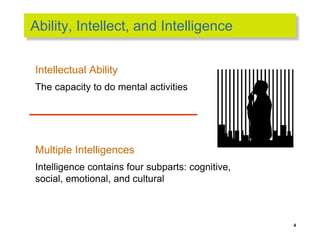
Ability, Intellect, and Intelligence
Intellectual Ability
The capacity to do mental activities
Multiple Intelligences
Intelligence contains four subparts: cognitive,
social, emotional, and cultural
4
• Number aptitude
• Verbal comprehension
• Perceptual speed
• Inductive reasoning
• Deductive reasoning
• Spatial visualization
• Memory
Dimensions of Intellectual Ability
5
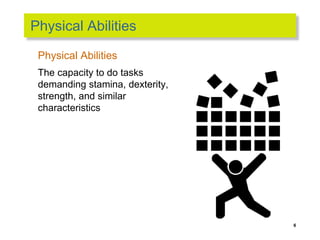
Physical Abilities
Physical Abilities
The capacity to do tasks
demanding stamina, dexterity,
strength, and similar
characteristics
6
Other Factors
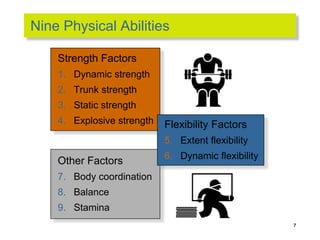
7. Body coordination
8. Balance
9. Stamina
Nine Physical Abilities
Strength Factors
1. Dynamic strength
2. Trunk strength
3. Static strength
4. Explosive strength Flexibility Factors
5. Extent flexibility
6. Dynamic flexibility
7
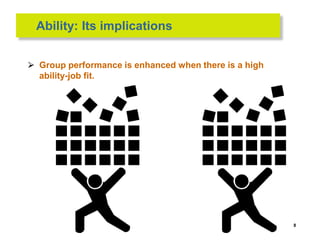
Ability: Its implications
⮚ Group performance is enhanced when there is a high
ability-job fit.
8
Personality
“The dynamic organization within the individual of
those psychophysical systems that determine his
unique adjustment to his environment” - Allport
The sum total of ways in which an individual reacts
and interacts with others.
9
Personality
●Personality factors
–Heredity
–Environment
–Situation
10
Personality Traits
– Enduring characteristics that describe an individual’s
behaviour
11
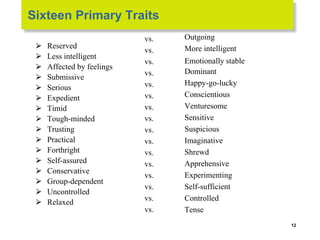
vs.
vs.
vs.
vs.
vs.
vs.
vs.
vs.
vs.
vs.
vs.
vs.
vs.
vs.
vs.
vs.
Outgoing
More intelligent
Emotionally stable
Dominant
Happy-go-lucky
Conscientious
Venturesome
Sensitive
Suspicious
Imaginative
Shrewd
Apprehensive
Experimenting
Self-sufficient
Controlled
Tense
Sixteen Primary Traits
⮚ Reserved
⮚ Less intelligent
⮚ Affected by feelings
⮚ Submissive
⮚ Serious
⮚ Expedient
⮚ Timid
⮚ Tough-minded
⮚ Trusting
⮚ Practical
⮚ Forthright
⮚ Self-assured
⮚ Conservative
⮚ Group-dependent
⮚ Uncontrolled
⮚ Relaxed
12
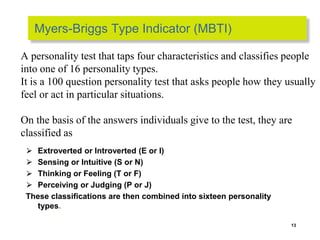
Myers-Briggs Type Indicator (MBTI)
⮚ Extroverted or Introverted (E or I)
⮚ Sensing or Intuitive (S or N)
⮚ Thinking or Feeling (T or F)
⮚ Perceiving or Judging (P or J)
These classifications are then combined into sixteen personality
types.
A personality test that taps four characteristics and classifies people
into one of 16 personality types.
It is a 100 question personality test that asks people how they usually
feel or act in particular situations.
On the basis of the answers individuals give to the test, they are
classified as
13
14
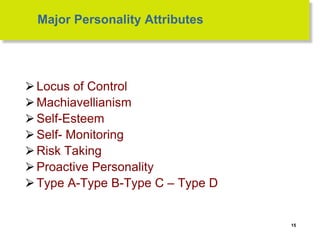
Major Personality Attributes
⮚Locus of Control
⮚Machiavellianism
⮚Self-Esteem
⮚Self- Monitoring
⮚Risk Taking
⮚Proactive Personality
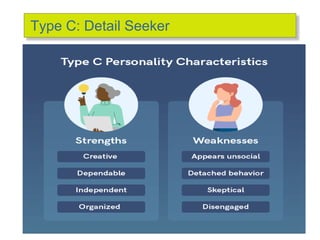
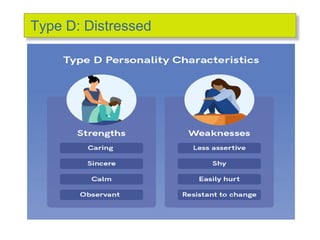
⮚Type A-Type B-Type C – Type D
15
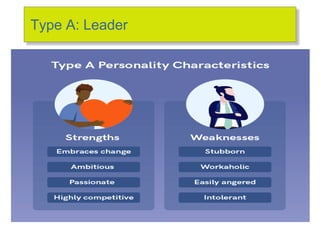
Type A: Leader
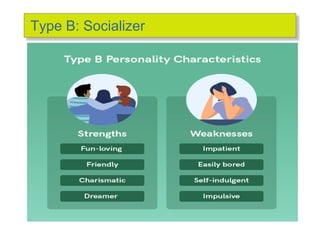
Type B: Socializer
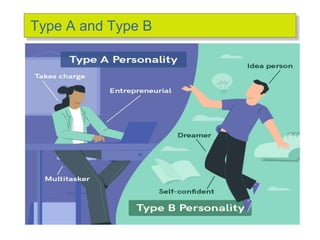
Type A and Type B
Type C: Detail Seeker
Type D: Distressed
What Is Perception?
⮚ A process by which individuals organize and interpret
their sensory impressions in order to give meaning to
their environment.
⮚ People’s behavior is based on their perception of
what reality is, not on reality itself.
⮚ The world as it is perceived is the world that is
behaviorally important.
6-21
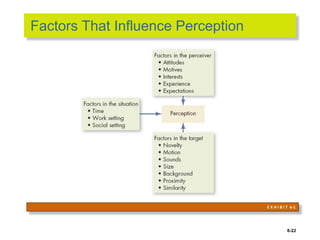
Factors That Influence Perception
6-22
E X H I B I T 6-1
Errors and Biases in Attributions
⮚ Fundamental Attribution Error
– The tendency to underestimate the influence of
external factors and overestimate the influence of
internal factors when making judgments about the
behavior of others
– We blame people first, not the situation
⮚ Self-Serving Bias
– The tendency for individuals to attribute their own
successes to internal factors while putting the blame
for failures on external factors
– It is “our” success but “their” failure
6-23
Frequently Used Shortcuts in Judging Others
⮚ Selective Perception
– People selectively interpret what
they see on the basis of their
interests, background,
experience, and attitudes
⮚ Halo Effect
– Drawing a general impression
about an individual on the basis of
a single characteristic
⮚ Contrast Effect
– Evaluation of a person’s
characteristics that are affected by
comparisons with other people
recently encountered who rank
higher or lower on the same
characteristics
6-24
Another Shortcut: Stereotyping
Judging someone on the basis of one’s perception of
the group to which that person belongs – a prevalent
and often useful, if not always accurate,
generalization
⮚Profiling
– A form of stereotyping in which members of a group
are singled out for intense scrutiny based on a single,
often racial, trait.
6-25
Perceptions and Individual Decision Making
⮚ Problem
– A perceived discrepancy between the
current state of affairs and a desired
state
⮚ Decisions
– Choices made from among alternatives
developed from data
⮚ Perception Linkage:
– All elements of problem identification
and the decision-making process are
influenced by perception.
• Problems must be recognized.
• Data must be selected and evaluated.
6-26

Individual chapter 1.pptx

  • 1.
    Foundations of IndividualBehavior Personality, Perception and Ability Session 1
  • 2.
    Nine Individual-level variables 1.Biographical Characteristics 2. Ability 3. Learning 4. Personality 5. Emotional Intelligence 6. Assertiveness 7. Perception 8. Values 9. Attitude How these individual variables affect group performance and satisfaction? 1
  • 3.
    1. Biographical Characteristics& their implications for Group Performance I. Age: No affect on individual’s performance and hence overall group performance I. Gender: No significant differences in job productivity between men and women I. Tenure: Positive relationship between tenure and member’s productivity and satisfaction. 2
  • 4.
    2. Ability ⮚ Anindividual’s capacity to perform the various tasks in a job. ⮚ Make an individual relatively superior or inferior to others in performing certain tasks or activities. ⮚ Type of abilities: – Intellectual Abilities – Physical Abilities. 3
  • 5.
    Ability, Intellect, andIntelligence Intellectual Ability The capacity to do mental activities Multiple Intelligences Intelligence contains four subparts: cognitive, social, emotional, and cultural 4
  • 6.
    • Number aptitude •Verbal comprehension • Perceptual speed • Inductive reasoning • Deductive reasoning • Spatial visualization • Memory Dimensions of Intellectual Ability 5
  • 7.
    Physical Abilities Physical Abilities Thecapacity to do tasks demanding stamina, dexterity, strength, and similar characteristics 6
  • 8.
    Other Factors 7. Bodycoordination 8. Balance 9. Stamina Nine Physical Abilities Strength Factors 1. Dynamic strength 2. Trunk strength 3. Static strength 4. Explosive strength Flexibility Factors 5. Extent flexibility 6. Dynamic flexibility 7
  • 9.
    Ability: Its implications ⮚Group performance is enhanced when there is a high ability-job fit. 8
  • 10.
    Personality “The dynamic organizationwithin the individual of those psychophysical systems that determine his unique adjustment to his environment” - Allport The sum total of ways in which an individual reacts and interacts with others. 9
  • 11.
  • 12.
    Personality Traits – Enduringcharacteristics that describe an individual’s behaviour 11
  • 13.
    vs. vs. vs. vs. vs. vs. vs. vs. vs. vs. vs. vs. vs. vs. vs. vs. Outgoing More intelligent Emotionally stable Dominant Happy-go-lucky Conscientious Venturesome Sensitive Suspicious Imaginative Shrewd Apprehensive Experimenting Self-sufficient Controlled Tense SixteenPrimary Traits ⮚ Reserved ⮚ Less intelligent ⮚ Affected by feelings ⮚ Submissive ⮚ Serious ⮚ Expedient ⮚ Timid ⮚ Tough-minded ⮚ Trusting ⮚ Practical ⮚ Forthright ⮚ Self-assured ⮚ Conservative ⮚ Group-dependent ⮚ Uncontrolled ⮚ Relaxed 12
  • 14.
    Myers-Briggs Type Indicator(MBTI) ⮚ Extroverted or Introverted (E or I) ⮚ Sensing or Intuitive (S or N) ⮚ Thinking or Feeling (T or F) ⮚ Perceiving or Judging (P or J) These classifications are then combined into sixteen personality types. A personality test that taps four characteristics and classifies people into one of 16 personality types. It is a 100 question personality test that asks people how they usually feel or act in particular situations. On the basis of the answers individuals give to the test, they are classified as 13
  • 15.
  • 16.
    Major Personality Attributes ⮚Locusof Control ⮚Machiavellianism ⮚Self-Esteem ⮚Self- Monitoring ⮚Risk Taking ⮚Proactive Personality ⮚Type A-Type B-Type C – Type D 15
  • 17.
  • 18.
  • 19.
    Type A andType B
  • 20.
  • 21.
  • 22.
    What Is Perception? ⮚A process by which individuals organize and interpret their sensory impressions in order to give meaning to their environment. ⮚ People’s behavior is based on their perception of what reality is, not on reality itself. ⮚ The world as it is perceived is the world that is behaviorally important. 6-21
  • 23.
    Factors That InfluencePerception 6-22 E X H I B I T 6-1
  • 24.
    Errors and Biasesin Attributions ⮚ Fundamental Attribution Error – The tendency to underestimate the influence of external factors and overestimate the influence of internal factors when making judgments about the behavior of others – We blame people first, not the situation ⮚ Self-Serving Bias – The tendency for individuals to attribute their own successes to internal factors while putting the blame for failures on external factors – It is “our” success but “their” failure 6-23
  • 25.
    Frequently Used Shortcutsin Judging Others ⮚ Selective Perception – People selectively interpret what they see on the basis of their interests, background, experience, and attitudes ⮚ Halo Effect – Drawing a general impression about an individual on the basis of a single characteristic ⮚ Contrast Effect – Evaluation of a person’s characteristics that are affected by comparisons with other people recently encountered who rank higher or lower on the same characteristics 6-24
  • 26.
    Another Shortcut: Stereotyping Judgingsomeone on the basis of one’s perception of the group to which that person belongs – a prevalent and often useful, if not always accurate, generalization ⮚Profiling – A form of stereotyping in which members of a group are singled out for intense scrutiny based on a single, often racial, trait. 6-25
  • 27.
    Perceptions and IndividualDecision Making ⮚ Problem – A perceived discrepancy between the current state of affairs and a desired state ⮚ Decisions – Choices made from among alternatives developed from data ⮚ Perception Linkage: – All elements of problem identification and the decision-making process are influenced by perception. • Problems must be recognized. • Data must be selected and evaluated. 6-26