MEETING THE INDIRECT COST
RECOVERY CHALLENGE
Collaborating, Innovating, Transforming:
2023 Economic Development Conference
for the EDA Denver Region
April 11, 2023
Presented by Bob Lloyd
THE TOPIC
OF
INDIRECT
COSTS
• Widely misunderstood by:
--- Some (or many) awarding agency
staff
--- Some (or many) recipient program
staff
--- Most of the media
--- Most elected officials
• The “folly” of comparing indirect cost
rates
2
RELATED
TERMINOLOGY
• Program costs vs. administrative
costs
• Facility and administrative (F&A)
costs
• Overhead
• “Back office” activities
• Rear echelon “troops”
3
THE REAL
THINGS
• Direct costs: Those that can
specifically identified with a
particular final cost objective (such
as a particular award, project,
service, or other activity of an
organization)
• Indirect costs: Those that have been
incurred for common or joint
objectives and cannot be readily
identified with a particular final cost
objective without effort
disproportionate to the benefit
received
• A term of “accounting convenience”
4
THE
TOOLS
• Indirect cost allocation plan: A
narrative and financial
document that identifies,
accumulates, and distributes
indirect costs to benefiting
organization units and activities
• Indirect cost rate: A device used
to determine what portion of an
organization’s indirect cost each
activity (such as individual
federal awards) should bear;
normally employed in lieu of
separately negotiating that
portion of indirect costs with
each awarding agency
5
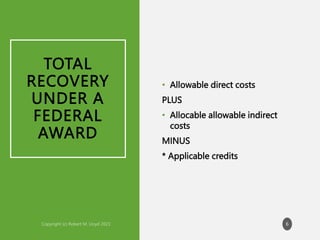
TOTAL
RECOVERY
UNDER A
FEDERAL
AWARD
• Allowable direct costs
PLUS
• Allocable allowable indirect
costs
MINUS
* Applicable credits
6
ALLOWABLE
COSTS
• Subpart E, 2 CFR 200
• Replaced separate
corresponding policies on the
subject affecting various
performers such as OMB
Circulars A-21, A-87, and A-122
• Key components
--- General tests of allowability
----- 2 CFR 200.402-6
--- “Selected” items of cost
----- 2 CFR 200.420-476
7
OMB’S
GRANT
REFORM
• Stated motivations
--- Policy consolidation
--- Regulatory relief
--- Burden reduction
--- Cost containment
• Original proposals re: indirect
costs
--- Election of “fixed” rates
--- Longer durations
• Recipient comments in response
8
REVISED
INDIRECT
COST
POLICIES
• Definitions ( 2 CFR 200-56-57, 2 CFR
200.68)
• General indirect (F&A) policies (2 CFR
200.409, 2 CFR 200.411-419)
--- The “general cost of government”
(2 CFR 200.444)
• Required or encouraged indirect cost
charging of certain costs (example:
proposal costs)
• Cognizant agency involvement in
innovative effort reporting and handling
of performance based awards
• “Performer specific” instructions (2 CFR
Appendices III-VII)
--- Governmental units (Appendices V-VII)
--- Nonprofit organizations (Appendix IV)
9
RESULTS
AND
REALITIES
• IDC instructions = “A Bridge Too
Far”
• Imperfections and gaps in new
policy statements
• Federal cognizance and staffing
issues
• Pass-through entity motivations
• “Be your own best friend”
10
INDIRECT COST
COGNIZANCE
• Cognizant = knowledgeable;
familiar
• Not to be confused with audit
cognizance
• Policy for organizations with direct
relationships with the federal
government
--- General rule: predominate source
of funds
--- Sustained period
--- Migration policy
--- Special rule for economic
development districts
• Policy for organizations with no
direct relationship with the federal
government
11
REVISED
INDIRECT
COST
POLICIES
• Required federal agency acceptance
of federally negotiated rates (2 CFR
200.414(c))
--- Limited exceptions
• Required pass-through entity
acceptance of federally approved
rates (2 CFR 200.332(a)(4))
--- No exceptions
• Pass-through entity negotiation (2
CFR 200.332(a)(4))
• Subrecipient election of the “de
minimis” indirect cost rate (10% of
MTDC) (2 CFR 200.414(f))
12
FEDERAL
INDIRECT
COST GUIDES
• “Cook book” approach
--- Department of Interior
--- Department of Labor
----- Indirect Cost Determination
Guide
--- Department of Health and
Human Services
----- Negotiation programs
13
PROCEDURES FOR
GOVERNMENTAL
UNITS
• Governmentwide central service
cost allocation plans (2 CFR 200,
Appendix V)
• Indirect cost rate proposal (2
CFR 200, Appendix VII)
• Submission policy
--- Entities receiving more that
$35 million
--- Entities receiving less than $35
million
14
WHO
PREPARES
• In-house capacity vs. outside
assistance
• Specific restriction affecting
public accounting firms that
perform the organization's
single audit (2 CFR 200.509)
--- Non-federal entity annual
indirect cost recovery > $1M
15
THE
INDIRECT
COST
RECOVERY
PROCESS
• Receipt of a federal award
• Organizational review
• Documenting cost policies
• Preparation of indirect cost
allocation plan
--- Descriptions of central services
and benefit to federal programs
• Preparation of indirect cost rate
proposal
--- Bases for distribution of costs
----- Federal suggestions
--- Exclusion of unallowables and
distorting factors
• Possible submission, negotiation,
and issuance of rate agreement
• Preparation of claims (financial
reports)
• Audit
16
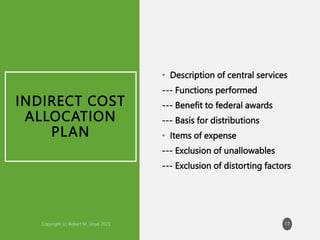
INDIRECT COST
ALLOCATION
PLAN
• Description of central services
--- Functions performed
--- Benefit to federal awards
--- Basis for distributions
• Items of expense
--- Exclusion of unallowables
--- Exclusion of distorting factors
17
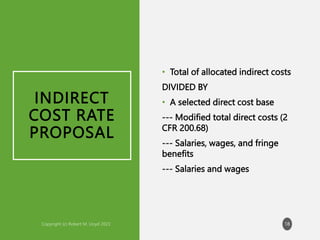
INDIRECT
COST RATE
PROPOSAL
• Total of allocated indirect costs
DIVIDED BY
• A selected direct cost base
--- Modified total direct costs (2
CFR 200.68)
--- Salaries, wages, and fringe
benefits
--- Salaries and wages
18
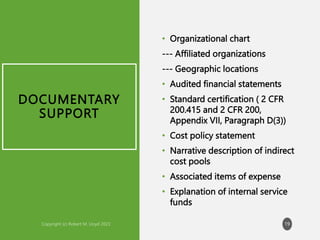
DOCUMENTARY
SUPPORT
• Organizational chart
--- Affiliated organizations
--- Geographic locations
• Audited financial statements
• Standard certification ( 2 CFR
200.415 and 2 CFR 200,
Appendix VII, Paragraph D(3))
• Cost policy statement
• Narrative description of indirect
cost pools
• Associated items of expense
• Explanation of internal service
funds
19
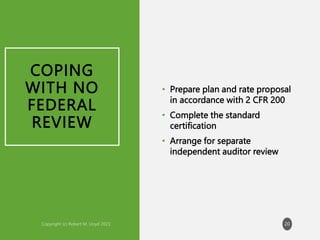
COPING
WITH NO
FEDERAL
REVIEW
• Prepare plan and rate proposal
in accordance with 2 CFR 200
• Complete the standard
certification
• Arrange for separate
independent auditor review
20
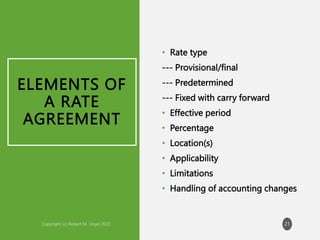
ELEMENTS OF
A RATE
AGREEMENT
• Rate type
--- Provisional/final
--- Predetermined
--- Fixed with carry forward
• Effective period
• Percentage
• Location(s)
• Applicability
• Limitations
• Handling of accounting changes
21
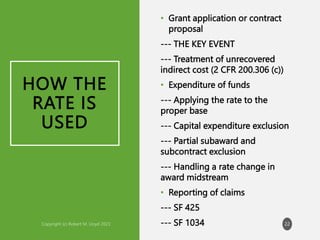
HOW THE
RATE IS
USED
• Grant application or contract
proposal
--- THE KEY EVENT
--- Treatment of unrecovered
indirect cost (2 CFR 200.306 (c))
• Expenditure of funds
--- Applying the rate to the
proper base
--- Capital expenditure exclusion
--- Partial subaward and
subcontract exclusion
--- Handling a rate change in
award midstream
• Reporting of claims
--- SF 425
--- SF 1034 22
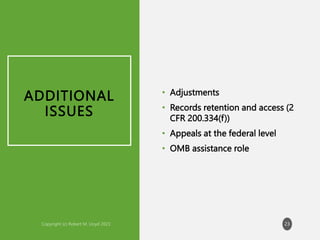
ADDITIONAL
ISSUES
• Adjustments
• Records retention and access (2
CFR 200.334(f))
• Appeals at the federal level
• OMB assistance role
23
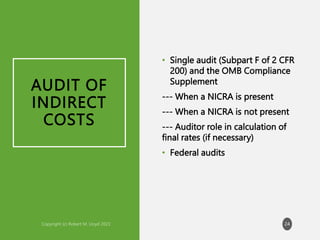
AUDIT OF
INDIRECT
COSTS
• Single audit (Subpart F of 2 CFR
200) and the OMB Compliance
Supplement
--- When a NICRA is present
--- When a NICRA is not present
--- Auditor role in calculation of
final rates (if necessary)
• Federal audits
24
GOING
FORWARD
• Build in-house knowledge of
the process
• Develop and maintain your
documentary tools
--- Clear cost policy statement
--- Current data and studies (e.g.,
space utilization)
--- Rationale for cost escalation
• Use the federal “lingo”
25
QUESTIONS
• Now
• Later
--- Bob Lloyd
(864) 235-8680
Consultlloyd@aol.com
26

INDIRECT COST RECOVERY

  • 1.
    MEETING THE INDIRECTCOST RECOVERY CHALLENGE Collaborating, Innovating, Transforming: 2023 Economic Development Conference for the EDA Denver Region April 11, 2023 Presented by Bob Lloyd
  • 2.
    THE TOPIC OF INDIRECT COSTS • Widelymisunderstood by: --- Some (or many) awarding agency staff --- Some (or many) recipient program staff --- Most of the media --- Most elected officials • The “folly” of comparing indirect cost rates 2
  • 3.
    RELATED TERMINOLOGY • Program costsvs. administrative costs • Facility and administrative (F&A) costs • Overhead • “Back office” activities • Rear echelon “troops” 3
  • 4.
    THE REAL THINGS • Directcosts: Those that can specifically identified with a particular final cost objective (such as a particular award, project, service, or other activity of an organization) • Indirect costs: Those that have been incurred for common or joint objectives and cannot be readily identified with a particular final cost objective without effort disproportionate to the benefit received • A term of “accounting convenience” 4
  • 5.
    THE TOOLS • Indirect costallocation plan: A narrative and financial document that identifies, accumulates, and distributes indirect costs to benefiting organization units and activities • Indirect cost rate: A device used to determine what portion of an organization’s indirect cost each activity (such as individual federal awards) should bear; normally employed in lieu of separately negotiating that portion of indirect costs with each awarding agency 5
  • 6.
    TOTAL RECOVERY UNDER A FEDERAL AWARD • Allowabledirect costs PLUS • Allocable allowable indirect costs MINUS * Applicable credits 6
  • 7.
    ALLOWABLE COSTS • Subpart E,2 CFR 200 • Replaced separate corresponding policies on the subject affecting various performers such as OMB Circulars A-21, A-87, and A-122 • Key components --- General tests of allowability ----- 2 CFR 200.402-6 --- “Selected” items of cost ----- 2 CFR 200.420-476 7
  • 8.
    OMB’S GRANT REFORM • Stated motivations ---Policy consolidation --- Regulatory relief --- Burden reduction --- Cost containment • Original proposals re: indirect costs --- Election of “fixed” rates --- Longer durations • Recipient comments in response 8
  • 9.
    REVISED INDIRECT COST POLICIES • Definitions (2 CFR 200-56-57, 2 CFR 200.68) • General indirect (F&A) policies (2 CFR 200.409, 2 CFR 200.411-419) --- The “general cost of government” (2 CFR 200.444) • Required or encouraged indirect cost charging of certain costs (example: proposal costs) • Cognizant agency involvement in innovative effort reporting and handling of performance based awards • “Performer specific” instructions (2 CFR Appendices III-VII) --- Governmental units (Appendices V-VII) --- Nonprofit organizations (Appendix IV) 9
  • 10.
    RESULTS AND REALITIES • IDC instructions= “A Bridge Too Far” • Imperfections and gaps in new policy statements • Federal cognizance and staffing issues • Pass-through entity motivations • “Be your own best friend” 10
  • 11.
    INDIRECT COST COGNIZANCE • Cognizant= knowledgeable; familiar • Not to be confused with audit cognizance • Policy for organizations with direct relationships with the federal government --- General rule: predominate source of funds --- Sustained period --- Migration policy --- Special rule for economic development districts • Policy for organizations with no direct relationship with the federal government 11
  • 12.
    REVISED INDIRECT COST POLICIES • Required federalagency acceptance of federally negotiated rates (2 CFR 200.414(c)) --- Limited exceptions • Required pass-through entity acceptance of federally approved rates (2 CFR 200.332(a)(4)) --- No exceptions • Pass-through entity negotiation (2 CFR 200.332(a)(4)) • Subrecipient election of the “de minimis” indirect cost rate (10% of MTDC) (2 CFR 200.414(f)) 12
  • 13.
    FEDERAL INDIRECT COST GUIDES • “Cookbook” approach --- Department of Interior --- Department of Labor ----- Indirect Cost Determination Guide --- Department of Health and Human Services ----- Negotiation programs 13
  • 14.
    PROCEDURES FOR GOVERNMENTAL UNITS • Governmentwidecentral service cost allocation plans (2 CFR 200, Appendix V) • Indirect cost rate proposal (2 CFR 200, Appendix VII) • Submission policy --- Entities receiving more that $35 million --- Entities receiving less than $35 million 14
  • 15.
    WHO PREPARES • In-house capacityvs. outside assistance • Specific restriction affecting public accounting firms that perform the organization's single audit (2 CFR 200.509) --- Non-federal entity annual indirect cost recovery > $1M 15
  • 16.
    THE INDIRECT COST RECOVERY PROCESS • Receipt ofa federal award • Organizational review • Documenting cost policies • Preparation of indirect cost allocation plan --- Descriptions of central services and benefit to federal programs • Preparation of indirect cost rate proposal --- Bases for distribution of costs ----- Federal suggestions --- Exclusion of unallowables and distorting factors • Possible submission, negotiation, and issuance of rate agreement • Preparation of claims (financial reports) • Audit 16
  • 17.
    INDIRECT COST ALLOCATION PLAN • Descriptionof central services --- Functions performed --- Benefit to federal awards --- Basis for distributions • Items of expense --- Exclusion of unallowables --- Exclusion of distorting factors 17
  • 18.
    INDIRECT COST RATE PROPOSAL • Totalof allocated indirect costs DIVIDED BY • A selected direct cost base --- Modified total direct costs (2 CFR 200.68) --- Salaries, wages, and fringe benefits --- Salaries and wages 18
  • 19.
    DOCUMENTARY SUPPORT • Organizational chart ---Affiliated organizations --- Geographic locations • Audited financial statements • Standard certification ( 2 CFR 200.415 and 2 CFR 200, Appendix VII, Paragraph D(3)) • Cost policy statement • Narrative description of indirect cost pools • Associated items of expense • Explanation of internal service funds 19
  • 20.
    COPING WITH NO FEDERAL REVIEW • Prepareplan and rate proposal in accordance with 2 CFR 200 • Complete the standard certification • Arrange for separate independent auditor review 20
  • 21.
    ELEMENTS OF A RATE AGREEMENT •Rate type --- Provisional/final --- Predetermined --- Fixed with carry forward • Effective period • Percentage • Location(s) • Applicability • Limitations • Handling of accounting changes 21
  • 22.
    HOW THE RATE IS USED •Grant application or contract proposal --- THE KEY EVENT --- Treatment of unrecovered indirect cost (2 CFR 200.306 (c)) • Expenditure of funds --- Applying the rate to the proper base --- Capital expenditure exclusion --- Partial subaward and subcontract exclusion --- Handling a rate change in award midstream • Reporting of claims --- SF 425 --- SF 1034 22
  • 23.
    ADDITIONAL ISSUES • Adjustments • Recordsretention and access (2 CFR 200.334(f)) • Appeals at the federal level • OMB assistance role 23
  • 24.
    AUDIT OF INDIRECT COSTS • Singleaudit (Subpart F of 2 CFR 200) and the OMB Compliance Supplement --- When a NICRA is present --- When a NICRA is not present --- Auditor role in calculation of final rates (if necessary) • Federal audits 24
  • 25.
    GOING FORWARD • Build in-houseknowledge of the process • Develop and maintain your documentary tools --- Clear cost policy statement --- Current data and studies (e.g., space utilization) --- Rationale for cost escalation • Use the federal “lingo” 25
  • 26.
    QUESTIONS • Now • Later ---Bob Lloyd (864) 235-8680 Consultlloyd@aol.com 26