Indigenous People
around the world
Abby Varghese
B.Sc Geography, Tourism & Travel Management
Madras Christian College
Who are Indigenous peoples?
 Indigenous peoples are peoples defined in international or national legislation
as having a set of specific rights based on their historical ties to a particular
territory, and their cultural or historical distinctiveness from other
populations that are often politically dominant. The concept of indigenous
peoples defines these groups as particularly vulnerable to exploitation,
marginalization and oppression by nation states that may still be formed from
the colonising populations, or by politically dominant ethnic groups.
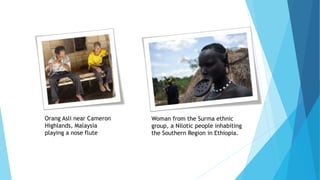
Orang Asli near Cameron
Highlands, Malaysia
playing a nose flute
Woman from the Surma ethnic
group, a Nilotic people inhabiting
the Southern Region in Ethiopia.
Indigenous People in India
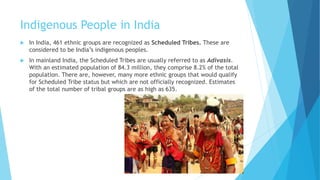
 In India, 461 ethnic groups are recognized as Scheduled Tribes. These are
considered to be India’s indigenous peoples.
 In mainland India, the Scheduled Tribes are usually referred to as Adivasis.
With an estimated population of 84.3 million, they comprise 8.2% of the total
population. There are, however, many more ethnic groups that would qualify
for Scheduled Tribe status but which are not officially recognized. Estimates
of the total number of tribal groups are as high as 635.
Why International Day of the World's
Indigenous Peoples?
 The International Day of the World's Indigenous People is observed on
August 9 each year to promote and protect the rights of the world’s
indigenous population. This event also recognizes the achievements and
contributions that indigenous people make to improve world issues such as
environmental protection.
 First proclaimed by the General Assembly in December 1994, to be celebrated
every year during the first International Decade of the World's Indigenous
People (1995 – 2004).
 In 2004, the Assembly proclaimed a Second International Decade, from 2005 –
2014, with the theme of "A Decade for Action and Dignity."
Logo of the United
Nations Permanent
Forum on Indigenous
Issues
Theme of The Year: Indigenous peoples
building alliances: Honouring treaties,
agreements and other constructive
arrangements
 The theme aims to highlight the importance of honouring arrangements
between States, their citizens and indigenous peoples that were designed to
recognize indigenous peoples' rights to their lands and establish a framework
for living in proximity and entering into economic relationships. Agreements
also outline a political vision of different sovereign peoples living together on
the same land, according to the principles of friendship, cooperation and
peace.
Goals for THE DECADE
 Raise international awareness of the contribution of, and problems faced by,
indigenous people throughout the world;
 Promote and protect the rights of indigenous people;
 Empower indigenous people to make choices and enable them to retain their
cultural identity while participating in national economic and social life, with full
respect for their cultural values, languages, traditions and forms of social
organization;
 Educate indigenous and non-indigenous communities on the situation, cultures,
languages, rights and aspirations of indigenous people;
 Consult and cooperate with indigenous people in taking decisions that affect their
lives;
 Acknowledge the value and diversity of the cultures and the forms of social
organization of the world's indigenous people;
 Train and provide technical assistance to indigenous people as well as support to
indigenous initiatives;
 Improve the socio-economic conditions of indigenous populations as well as their
political participation in national decision-making.
Problems faced by indigenous people
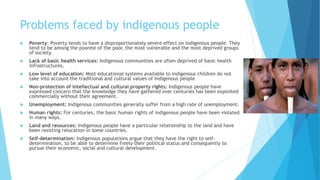
 Poverty: Poverty tends to have a disproportionately severe effect on indigenous people. They
tend to be among the poorest of the poor, the most vulnerable and the most deprived groups
of society.
 Lack of basic health services: Indigenous communities are often deprived of basic health
infrastructures.
 Low level of education: Most educational systems available to indigenous children do not
take into account the traditional and cultural values of indigenous people
 Non-protection of intellectual and cultural property rights: Indigenous people have
expressed concern that the knowledge they have gathered over centuries has been exploited
commercially without their agreement.
 Unemployment: Indigenous communities generally suffer from a high rate of unemployment.
 Human rights: For centuries, the basic human rights of indigenous people have been violated
in many ways.
 Land and resources: Indigenous people have a particular relationship to the land and have
been resisting relocation in some countries.
 Self-determination: Indigenous populations argue that they have the right to self-
determination, to be able to determine freely their political status and consequently to
pursue their economic, social and cultural development.
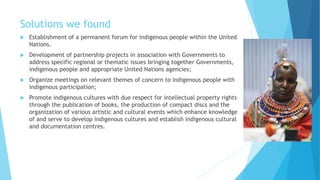
Solutions we found
 Establishment of a permanent forum for indigenous people within the United
Nations.
 Development of partnership projects in association with Governments to
address specific regional or thematic issues bringing together Governments,
indigenous people and appropriate United Nations agencies;
 Organize meetings on relevant themes of concern to indigenous people with
indigenous participation;
 Promote indigenous cultures with due respect for intellectual property rights
through the publication of books, the production of compact discs and the
organization of various artistic and cultural events which enhance knowledge
of and serve to develop indigenous cultures and establish indigenous cultural
and documentation centres.
Solution we found
 Create radio and television centres in indigenous regions when appropriate
and in accordance with national legislation to provide information on the
problems and proposals of indigenous people and to improve communications
between indigenous communities;
 Cooperate with indigenous organizations, communities and people in the
planning of activities for the Decade;
 Establish an information network which can be linked to the Coordinator for
the Decade and facilitate communications between the United Nations
system, relevant government departments and indigenous communities;
 Establish and support indigenous schools and university-level institutions and
collaborate with the relevant United Nations agencies; participate in the
revision of school texts and the contents of programmes of study in order to
eliminate discriminatory content and promote the development of indigenous
cultures and, where appropriate, in indigenous languages and scripts; develop
indigenous curricula for schools and research institutions;
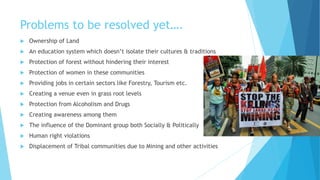
Problems to be resolved yet….
 Ownership of Land
 An education system which doesn’t isolate their cultures & traditions
 Protection of forest without hindering their interest
 Protection of women in these communities
 Providing jobs in certain sectors like Forestry, Tourism etc.
 Creating a venue even in grass root levels
 Protection from Alcoholism and Drugs
 Creating awareness among them
 The influence of the Dominant group both Socially & Politically
 Human right violations
 Displacement of Tribal communities due to Mining and other activities
Conclusion
 Solutions will not be found while Indigenous people are treated as victims for
whom someone else must find solutions : Malcolm Fraser
 Keeping the words of Malcolm Fraser let us resolve the problems of Indigenous
people by involving them in the law framing structure holding hands &
building a better tomorrow.
References
 United Nations Permanent Forum on Indigenous Issues
 The Concept Of Indigenous Peoples In Asia: A Resource Book : Christian Erni
 Asia Indigenous and Tribal Peoples Network (AITPN): www.aitpn.org
 International Work Group for Indigenous Affairs (IWGIA)
Indigenous people around the world

Indigenous people around the world

  • 1.
    Indigenous People around theworld Abby Varghese B.Sc Geography, Tourism & Travel Management Madras Christian College
  • 2.
    Who are Indigenouspeoples?  Indigenous peoples are peoples defined in international or national legislation as having a set of specific rights based on their historical ties to a particular territory, and their cultural or historical distinctiveness from other populations that are often politically dominant. The concept of indigenous peoples defines these groups as particularly vulnerable to exploitation, marginalization and oppression by nation states that may still be formed from the colonising populations, or by politically dominant ethnic groups.
  • 3.
    Orang Asli nearCameron Highlands, Malaysia playing a nose flute Woman from the Surma ethnic group, a Nilotic people inhabiting the Southern Region in Ethiopia.
  • 4.
    Indigenous People inIndia  In India, 461 ethnic groups are recognized as Scheduled Tribes. These are considered to be India’s indigenous peoples.  In mainland India, the Scheduled Tribes are usually referred to as Adivasis. With an estimated population of 84.3 million, they comprise 8.2% of the total population. There are, however, many more ethnic groups that would qualify for Scheduled Tribe status but which are not officially recognized. Estimates of the total number of tribal groups are as high as 635.
  • 5.
    Why International Dayof the World's Indigenous Peoples?  The International Day of the World's Indigenous People is observed on August 9 each year to promote and protect the rights of the world’s indigenous population. This event also recognizes the achievements and contributions that indigenous people make to improve world issues such as environmental protection.  First proclaimed by the General Assembly in December 1994, to be celebrated every year during the first International Decade of the World's Indigenous People (1995 – 2004).  In 2004, the Assembly proclaimed a Second International Decade, from 2005 – 2014, with the theme of "A Decade for Action and Dignity." Logo of the United Nations Permanent Forum on Indigenous Issues
  • 6.
    Theme of TheYear: Indigenous peoples building alliances: Honouring treaties, agreements and other constructive arrangements  The theme aims to highlight the importance of honouring arrangements between States, their citizens and indigenous peoples that were designed to recognize indigenous peoples' rights to their lands and establish a framework for living in proximity and entering into economic relationships. Agreements also outline a political vision of different sovereign peoples living together on the same land, according to the principles of friendship, cooperation and peace.
  • 7.
    Goals for THEDECADE  Raise international awareness of the contribution of, and problems faced by, indigenous people throughout the world;  Promote and protect the rights of indigenous people;  Empower indigenous people to make choices and enable them to retain their cultural identity while participating in national economic and social life, with full respect for their cultural values, languages, traditions and forms of social organization;  Educate indigenous and non-indigenous communities on the situation, cultures, languages, rights and aspirations of indigenous people;  Consult and cooperate with indigenous people in taking decisions that affect their lives;  Acknowledge the value and diversity of the cultures and the forms of social organization of the world's indigenous people;  Train and provide technical assistance to indigenous people as well as support to indigenous initiatives;  Improve the socio-economic conditions of indigenous populations as well as their political participation in national decision-making.
  • 8.
    Problems faced byindigenous people  Poverty: Poverty tends to have a disproportionately severe effect on indigenous people. They tend to be among the poorest of the poor, the most vulnerable and the most deprived groups of society.  Lack of basic health services: Indigenous communities are often deprived of basic health infrastructures.  Low level of education: Most educational systems available to indigenous children do not take into account the traditional and cultural values of indigenous people  Non-protection of intellectual and cultural property rights: Indigenous people have expressed concern that the knowledge they have gathered over centuries has been exploited commercially without their agreement.  Unemployment: Indigenous communities generally suffer from a high rate of unemployment.  Human rights: For centuries, the basic human rights of indigenous people have been violated in many ways.  Land and resources: Indigenous people have a particular relationship to the land and have been resisting relocation in some countries.  Self-determination: Indigenous populations argue that they have the right to self- determination, to be able to determine freely their political status and consequently to pursue their economic, social and cultural development.
  • 9.
    Solutions we found Establishment of a permanent forum for indigenous people within the United Nations.  Development of partnership projects in association with Governments to address specific regional or thematic issues bringing together Governments, indigenous people and appropriate United Nations agencies;  Organize meetings on relevant themes of concern to indigenous people with indigenous participation;  Promote indigenous cultures with due respect for intellectual property rights through the publication of books, the production of compact discs and the organization of various artistic and cultural events which enhance knowledge of and serve to develop indigenous cultures and establish indigenous cultural and documentation centres.
  • 10.
    Solution we found Create radio and television centres in indigenous regions when appropriate and in accordance with national legislation to provide information on the problems and proposals of indigenous people and to improve communications between indigenous communities;  Cooperate with indigenous organizations, communities and people in the planning of activities for the Decade;  Establish an information network which can be linked to the Coordinator for the Decade and facilitate communications between the United Nations system, relevant government departments and indigenous communities;  Establish and support indigenous schools and university-level institutions and collaborate with the relevant United Nations agencies; participate in the revision of school texts and the contents of programmes of study in order to eliminate discriminatory content and promote the development of indigenous cultures and, where appropriate, in indigenous languages and scripts; develop indigenous curricula for schools and research institutions;
  • 11.
    Problems to beresolved yet….  Ownership of Land  An education system which doesn’t isolate their cultures & traditions  Protection of forest without hindering their interest  Protection of women in these communities  Providing jobs in certain sectors like Forestry, Tourism etc.  Creating a venue even in grass root levels  Protection from Alcoholism and Drugs  Creating awareness among them  The influence of the Dominant group both Socially & Politically  Human right violations  Displacement of Tribal communities due to Mining and other activities
  • 12.
    Conclusion  Solutions willnot be found while Indigenous people are treated as victims for whom someone else must find solutions : Malcolm Fraser  Keeping the words of Malcolm Fraser let us resolve the problems of Indigenous people by involving them in the law framing structure holding hands & building a better tomorrow.
  • 13.
    References  United NationsPermanent Forum on Indigenous Issues  The Concept Of Indigenous Peoples In Asia: A Resource Book : Christian Erni  Asia Indigenous and Tribal Peoples Network (AITPN): www.aitpn.org  International Work Group for Indigenous Affairs (IWGIA)