Indigenous Knowledge
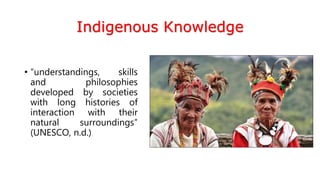
• “understandings, skills
and philosophies
developed by societies
with long histories of
interaction with their
natural surroundings”
(UNESCO, n.d.)
How the Indigenous Knowledge,
System, and Practices (IKSP)
transfer?
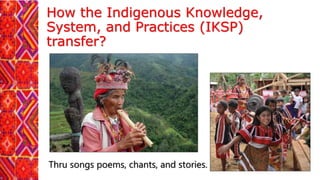
Thru songs poems, chants, and stories.
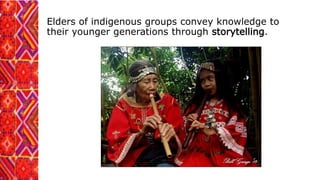
Elders of indigenous groups convey knowledge to
their younger generations through storytelling.
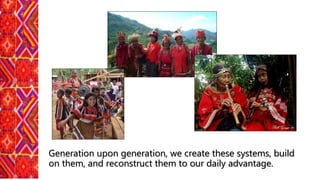
Generation upon generation, we create these systems, build
on them, and reconstruct them to our daily advantage.
Through this development, cumulative local and indigenous
knowledge “informs decision-making about fundamental aspects
of day-to-day life” (UNESCO, n.d.) and provides a “foundation for
locally-appropriate sustainable development” (UNESCO, n.d.).
These day-to-day aspects of life include agriculture, aquaculture,
health care, natural resources management, and other activities
(Calanog, 1997).
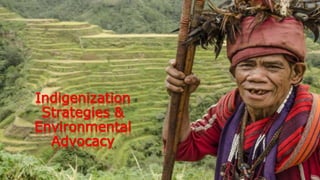
Indigenization
Strategies &
Environmental
Advocacy
Indigenization Strategies &
Environmental Advocacy
• Gaining mass support through social media
• With the advent of technology, social media has
contributed greatly to information dissemination and
influencing society’s beliefs and actions.
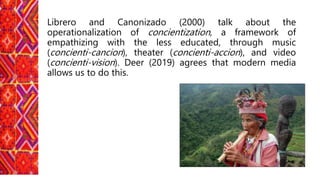
Librero and Canonizado (2000) talk about the
operationalization of concientization, a framework of
empathizing with the less educated, through music
(concienti-cancion), theater (concienti-accion), and video
(concienti-vision). Deer (2019) agrees that modern media
allows us to do this.
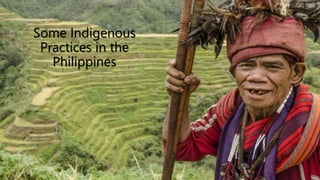
Some Indigenous
Practices in the
Philippines
Mari-it from Panay
• Mari-it is a concept present in both coastal and upland
environments, which restricts the extraction of marine
resources in sacred areas. This contributes to sustainable
development because it ensures the availability of fishes
for future generations.
• One mari-it belief is the existence of sacred trees, such as
balete and bakhaw (mangrove). Indigenous groups in
Panay believe that these trees are home to spirits and
should not be cut or disturbed.
Mari-it from Panay
• The fish they catch depends on the spirits. If the spirits are
happy, they will provide a good catch. If the spirits have
been angered because of a violation of mari-it, the
fishermen will be punished with less fish to catch and they
may be endangered at sea.
Mari-it from Panay
• The deep-sea provides sanctuaries to marine life and
mangroves serve as a nursery for fishes and other marine
organisms. By restricting its use or exploitation, marine life
will thrive, thus providing sustainable fish supply to the
community.
• In recent extreme cases, mari-it is less considered by fishermen
due to the pressure of consumerism, urbanization, technological
advancement, and poverty.
Mari-it from Panay
Muyung from Ifugao
• Muyung (sometimes spelled muyong and also referred to
as pinugo) is a traditional mode of private forest
management unique to the people of Ifugao, one of the
main ethnolinguistic groups in the Cordillera
Administrative Region (CAR) (Sumeg-ang, 2005).
Muyung from Ifugao
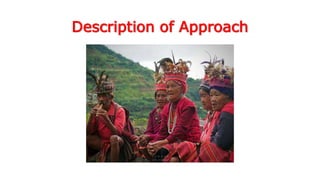
• A video produced by Kadioan Inc. shows how the Ifugao
principles and daily activities are linked to their land the
environment through the muyung. The muyung is a source
of food, fuel, lumber, and so much more for the typical
Ifugao household. Not only that, but it is also a
preventative measure against soil erosion (The Pinugo or
Muyong System of Ifugao, 2016).
• In an Inquirer report, Cinco (2013) says that “a solution to
the looming water shortage appears to have already been
available several decades ago, right before our eyes.” She
is referring to the muyung, which is a forest management
strategy recognized worldwide as a “technological
innovation”.
Muyung from Ifugao
Description of Approach
The concept of this project is to strengthen the
indigenous concepts mentioned above by maximizing the
power of social media. The project consists of three
stages: (1) documentation of practices and validation; (2)
development of social media communication plans; and
(3) implementation and evaluation.
There are many social media websites and applications available nowadays.
However, this project will utilize two popular social media apps: Facebook and
Twitter.
According to the Search Engine Journal, Facebook and Twitter are two of the
biggest social media sites in 2019. They stand at first and second place,
respectively (Kellogg, 2019).
Documentation of
practices and
validation
Development of
contextualized
communication plan
Implementation and
evaluation
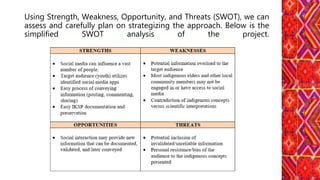
Using Strength, Weakness, Opportunity, and Threats (SWOT), we can
assess and carefully plan on strategizing the approach. Below is the
simplified SWOT analysis of the project.
Conclusions
• Mari-it has already been proven to promote environmental
protection and social media champions information
dissemination.
• The Young Men’s Christian Association (YMCA) Baguio
chapter, currently headed by Rev. Atty. Matias C. Angiwan
Jr., an Ifugao man, has incorporated the concept of
muyung into their organization’s activities. Every month,
they visit and clean their muyung as part of their
community program. What we can glean from this is that
the muyung can be incorporated by organizations, and
probably even the government if it so pleases. Through
various forms of social media, it is possible to educate
more people about the system, learn how it can be
incorporated on a larger scale, and possibly implement it
with the cooperation of local communities, researchers,
and local government units.
• Based on the presented approach and SWOT analysis,
promoting and advocating for the aforementioned
References
• Butic, M., & Ngidlo, R. (n.d.). Muyong forest of Ifugao: Assisted natural regeneration in traditional
forest management. Retrieved October 22, 2019, from
http://www.fao.org/3/AD466E/ad466e06.htm.
• Calanog, L.A. (1997). Indigenous knowledge systems and biodiversity conservation: two sides of
the same coin. In Application of Indigenous Knowledge Systems in Sustainable Upland
Development (pp.132–142). College, Laguna: Forestry Development Center.
• Camacho, L. D., Gevaña, D. T., Carandang, A. P., & Camacho, S. C. (2016). Indigenous knowledge
and practices for the sustainable management of Ifugao forests in Cordillera, Philippines.
International Journal of Biodiversity Science, Ecosystem Services & Management, 12(1-2), 5–13.
doi: 10.1080/21513732.2015.1124453
• Cinco, M. (2013, March 20). Ifugao ‘muyong’ seen answer to Philippine water shortage Read
more: https://newsinfo.inquirer.net/377075/ifugao-muyong-seen-answer-to-philippine-water-
shortage#ixzz63q2YDsDT Follow us: @inquirerdotnet on Twitter | inquirerdotnet on Facebook.
Inquirer. Retrieved from https://newsinfo.inquirer.net/377075/ifugao-muyong-seen-answer-to-
philippine-water-shortage
References
• Deer, K. (2019, September). Media as a means to transmit indigenous knowledge. Cultural
Survival Quarterly Magazine. Retrieved from
https://l.messenger.com/l.php?u=https://www.culturalsurvival.org/publications/cultural-survival-
quarterly/media-means-transmit-indigenous-knowledge
• Dunn, Michael. How is knowledge acquired in indigenous societies? (20th October 2014).
https://theoryofknowledge.net. https://www.theoryofknowledge.net/areas-of-
knowledge/indigenous-knowledge-systems/how-is-knowledge-acquired-in-indigenous-societies/
• Indigenous Corporate Training Inc. (2018, April 6). What Does Indigenous Knowledge Mean? A
Compilation of Attributes. Retrieved October 21, 2019, from https://www.ictinc.ca/blog/what-
does-indigenous-knowledge-mean.
• Kellogg, K. (2019). The 7 Biggest Social Media Sites in 2019. Search Engine Journal. Retrieved from
https://www.searchenginejournal.com/biggest-social-media-sites/308897/
• Librero, Felix, & Canonizado, Frances. (2000). Environmental advocacy. Quezon City, Philippines:
University of the Philippines Open Univerisity .
References
• Magos, A. P. (1997). The Concept of Mari-it (Dangerous Zones) in Panaynon Worldview and Its Impact on
Sustainable Human Development. SEAMEO-Jasper Fellowship Monograph, 5th ser.
• Pabito, J., & Magos, A. (2001). Coastal Anthropology. University of the Philippines, Open University.
• Serrano, R.C. (1997). Status and importance of indigenous knowledge systems in the Philippines. In
Application of Indigenous Knowledge Systems in Sustainable Upland Development (pp. 22–27). College,
Laguna: Forestry Development Center.
• Sumeg-ang, A. (2005). The Ifugaos. Ethnography of the Major Ethnolinguistic Groups in the Cordillera.
Quezon City: New Day Publishers. pp. 71–91.
• The Pinugo or Muyong System of Ifugao. (2016). Retrieved from
https://www.facebook.com/RSDI.Freedom.Wall/videos/vb.226474560761539/1057872540955066/?type=2
&theater
• UNESCO. (n.d.). What is Local and Indigenous Knowledge? Retrieved from
http://www.unesco.org/new/en/natural-sciences/priority-areas/links/related-information/what-is-local-
and-indigenous-knowledge.
• Valbuena, V. T. (1987). Using Traditional Media in Environmental Communication. Singapore: Asian Mass
Communication Research and Information Centre.
Thank you!

Indigenization strategies-virtual-report

  • 2.
    Indigenous Knowledge • “understandings,skills and philosophies developed by societies with long histories of interaction with their natural surroundings” (UNESCO, n.d.)
  • 3.
    How the IndigenousKnowledge, System, and Practices (IKSP) transfer? Thru songs poems, chants, and stories.
  • 4.
    Elders of indigenousgroups convey knowledge to their younger generations through storytelling.
  • 5.
    Generation upon generation,we create these systems, build on them, and reconstruct them to our daily advantage.
  • 6.
    Through this development,cumulative local and indigenous knowledge “informs decision-making about fundamental aspects of day-to-day life” (UNESCO, n.d.) and provides a “foundation for locally-appropriate sustainable development” (UNESCO, n.d.). These day-to-day aspects of life include agriculture, aquaculture, health care, natural resources management, and other activities (Calanog, 1997).
  • 7.
  • 8.
    Indigenization Strategies & EnvironmentalAdvocacy • Gaining mass support through social media • With the advent of technology, social media has contributed greatly to information dissemination and influencing society’s beliefs and actions.
  • 9.
    Librero and Canonizado(2000) talk about the operationalization of concientization, a framework of empathizing with the less educated, through music (concienti-cancion), theater (concienti-accion), and video (concienti-vision). Deer (2019) agrees that modern media allows us to do this.
  • 10.
  • 11.
    Mari-it from Panay •Mari-it is a concept present in both coastal and upland environments, which restricts the extraction of marine resources in sacred areas. This contributes to sustainable development because it ensures the availability of fishes for future generations.
  • 12.
    • One mari-itbelief is the existence of sacred trees, such as balete and bakhaw (mangrove). Indigenous groups in Panay believe that these trees are home to spirits and should not be cut or disturbed. Mari-it from Panay
  • 13.
    • The fishthey catch depends on the spirits. If the spirits are happy, they will provide a good catch. If the spirits have been angered because of a violation of mari-it, the fishermen will be punished with less fish to catch and they may be endangered at sea. Mari-it from Panay
  • 14.
    • The deep-seaprovides sanctuaries to marine life and mangroves serve as a nursery for fishes and other marine organisms. By restricting its use or exploitation, marine life will thrive, thus providing sustainable fish supply to the community. • In recent extreme cases, mari-it is less considered by fishermen due to the pressure of consumerism, urbanization, technological advancement, and poverty. Mari-it from Panay
  • 15.
    Muyung from Ifugao •Muyung (sometimes spelled muyong and also referred to as pinugo) is a traditional mode of private forest management unique to the people of Ifugao, one of the main ethnolinguistic groups in the Cordillera Administrative Region (CAR) (Sumeg-ang, 2005).
  • 16.
    Muyung from Ifugao •A video produced by Kadioan Inc. shows how the Ifugao principles and daily activities are linked to their land the environment through the muyung. The muyung is a source of food, fuel, lumber, and so much more for the typical Ifugao household. Not only that, but it is also a preventative measure against soil erosion (The Pinugo or Muyong System of Ifugao, 2016).
  • 17.
    • In anInquirer report, Cinco (2013) says that “a solution to the looming water shortage appears to have already been available several decades ago, right before our eyes.” She is referring to the muyung, which is a forest management strategy recognized worldwide as a “technological innovation”. Muyung from Ifugao
  • 18.
  • 19.
    The concept ofthis project is to strengthen the indigenous concepts mentioned above by maximizing the power of social media. The project consists of three stages: (1) documentation of practices and validation; (2) development of social media communication plans; and (3) implementation and evaluation.
  • 20.
    There are manysocial media websites and applications available nowadays. However, this project will utilize two popular social media apps: Facebook and Twitter. According to the Search Engine Journal, Facebook and Twitter are two of the biggest social media sites in 2019. They stand at first and second place, respectively (Kellogg, 2019). Documentation of practices and validation Development of contextualized communication plan Implementation and evaluation
  • 21.
    Using Strength, Weakness,Opportunity, and Threats (SWOT), we can assess and carefully plan on strategizing the approach. Below is the simplified SWOT analysis of the project.
  • 22.
    Conclusions • Mari-it hasalready been proven to promote environmental protection and social media champions information dissemination. • The Young Men’s Christian Association (YMCA) Baguio chapter, currently headed by Rev. Atty. Matias C. Angiwan Jr., an Ifugao man, has incorporated the concept of muyung into their organization’s activities. Every month, they visit and clean their muyung as part of their community program. What we can glean from this is that the muyung can be incorporated by organizations, and probably even the government if it so pleases. Through various forms of social media, it is possible to educate more people about the system, learn how it can be incorporated on a larger scale, and possibly implement it with the cooperation of local communities, researchers, and local government units. • Based on the presented approach and SWOT analysis, promoting and advocating for the aforementioned
  • 23.
    References • Butic, M.,& Ngidlo, R. (n.d.). Muyong forest of Ifugao: Assisted natural regeneration in traditional forest management. Retrieved October 22, 2019, from http://www.fao.org/3/AD466E/ad466e06.htm. • Calanog, L.A. (1997). Indigenous knowledge systems and biodiversity conservation: two sides of the same coin. In Application of Indigenous Knowledge Systems in Sustainable Upland Development (pp.132–142). College, Laguna: Forestry Development Center. • Camacho, L. D., Gevaña, D. T., Carandang, A. P., & Camacho, S. C. (2016). Indigenous knowledge and practices for the sustainable management of Ifugao forests in Cordillera, Philippines. International Journal of Biodiversity Science, Ecosystem Services & Management, 12(1-2), 5–13. doi: 10.1080/21513732.2015.1124453 • Cinco, M. (2013, March 20). Ifugao ‘muyong’ seen answer to Philippine water shortage Read more: https://newsinfo.inquirer.net/377075/ifugao-muyong-seen-answer-to-philippine-water- shortage#ixzz63q2YDsDT Follow us: @inquirerdotnet on Twitter | inquirerdotnet on Facebook. Inquirer. Retrieved from https://newsinfo.inquirer.net/377075/ifugao-muyong-seen-answer-to- philippine-water-shortage
  • 24.
    References • Deer, K.(2019, September). Media as a means to transmit indigenous knowledge. Cultural Survival Quarterly Magazine. Retrieved from https://l.messenger.com/l.php?u=https://www.culturalsurvival.org/publications/cultural-survival- quarterly/media-means-transmit-indigenous-knowledge • Dunn, Michael. How is knowledge acquired in indigenous societies? (20th October 2014). https://theoryofknowledge.net. https://www.theoryofknowledge.net/areas-of- knowledge/indigenous-knowledge-systems/how-is-knowledge-acquired-in-indigenous-societies/ • Indigenous Corporate Training Inc. (2018, April 6). What Does Indigenous Knowledge Mean? A Compilation of Attributes. Retrieved October 21, 2019, from https://www.ictinc.ca/blog/what- does-indigenous-knowledge-mean. • Kellogg, K. (2019). The 7 Biggest Social Media Sites in 2019. Search Engine Journal. Retrieved from https://www.searchenginejournal.com/biggest-social-media-sites/308897/ • Librero, Felix, & Canonizado, Frances. (2000). Environmental advocacy. Quezon City, Philippines: University of the Philippines Open Univerisity .
  • 25.
    References • Magos, A.P. (1997). The Concept of Mari-it (Dangerous Zones) in Panaynon Worldview and Its Impact on Sustainable Human Development. SEAMEO-Jasper Fellowship Monograph, 5th ser. • Pabito, J., & Magos, A. (2001). Coastal Anthropology. University of the Philippines, Open University. • Serrano, R.C. (1997). Status and importance of indigenous knowledge systems in the Philippines. In Application of Indigenous Knowledge Systems in Sustainable Upland Development (pp. 22–27). College, Laguna: Forestry Development Center. • Sumeg-ang, A. (2005). The Ifugaos. Ethnography of the Major Ethnolinguistic Groups in the Cordillera. Quezon City: New Day Publishers. pp. 71–91. • The Pinugo or Muyong System of Ifugao. (2016). Retrieved from https://www.facebook.com/RSDI.Freedom.Wall/videos/vb.226474560761539/1057872540955066/?type=2 &theater • UNESCO. (n.d.). What is Local and Indigenous Knowledge? Retrieved from http://www.unesco.org/new/en/natural-sciences/priority-areas/links/related-information/what-is-local- and-indigenous-knowledge. • Valbuena, V. T. (1987). Using Traditional Media in Environmental Communication. Singapore: Asian Mass Communication Research and Information Centre.
  • 26.