Annabelle Boutet  Jocelyne Trémenbert Télécom Bretagne – M@rsouin Indicators of Non-use Situation
The digital divide In France one third of the population do not use the Internet  (Crédoc   « La diffusion des technologies de l'information et de la communication dans la société française (2008) » ) Very different non use situations Different typologies often based on socio-economic factors
Aims of the paper to contribute to the knowledge of  non-internet users using the result of a dialogue between qualitative and quantitative approaches  clarify the concept of non-use following the sociology of uses’s tradition and explore survey based literature   fit qualitative determinants to quantitative indicators   develop a new quantitative typology of non-users
The concept of non use Non-users behave, develop attitudes and representations even if they do not use, As users construct their practice, non-users construct their non-practice, Non-users must be considered through their social environment, their circle.
What we know about typologies The example of Selwyn’s 2006 typology   The absolute non users The truly unconnected The lapsed users The rare users
Our hypothesis To analyse non use we need to deconstruct our users’ points of view  The typology must be based on elements of non usage such as: behaviours, attitudes and representations, the place, status and role of the non user’s circle (children, spouse,close relations, colleagues …), the place of ICT in daily activities (time allocation).
M@rsouin 2008 Survey A telephone poll, conducted in May and June 2008 ‏ Answered by 2000 Bretons 15 years and more A sample representative of population as a function of criteria of both gender, age, occupation and the size of the urban cities crossed by the main administrative areas (the departments)
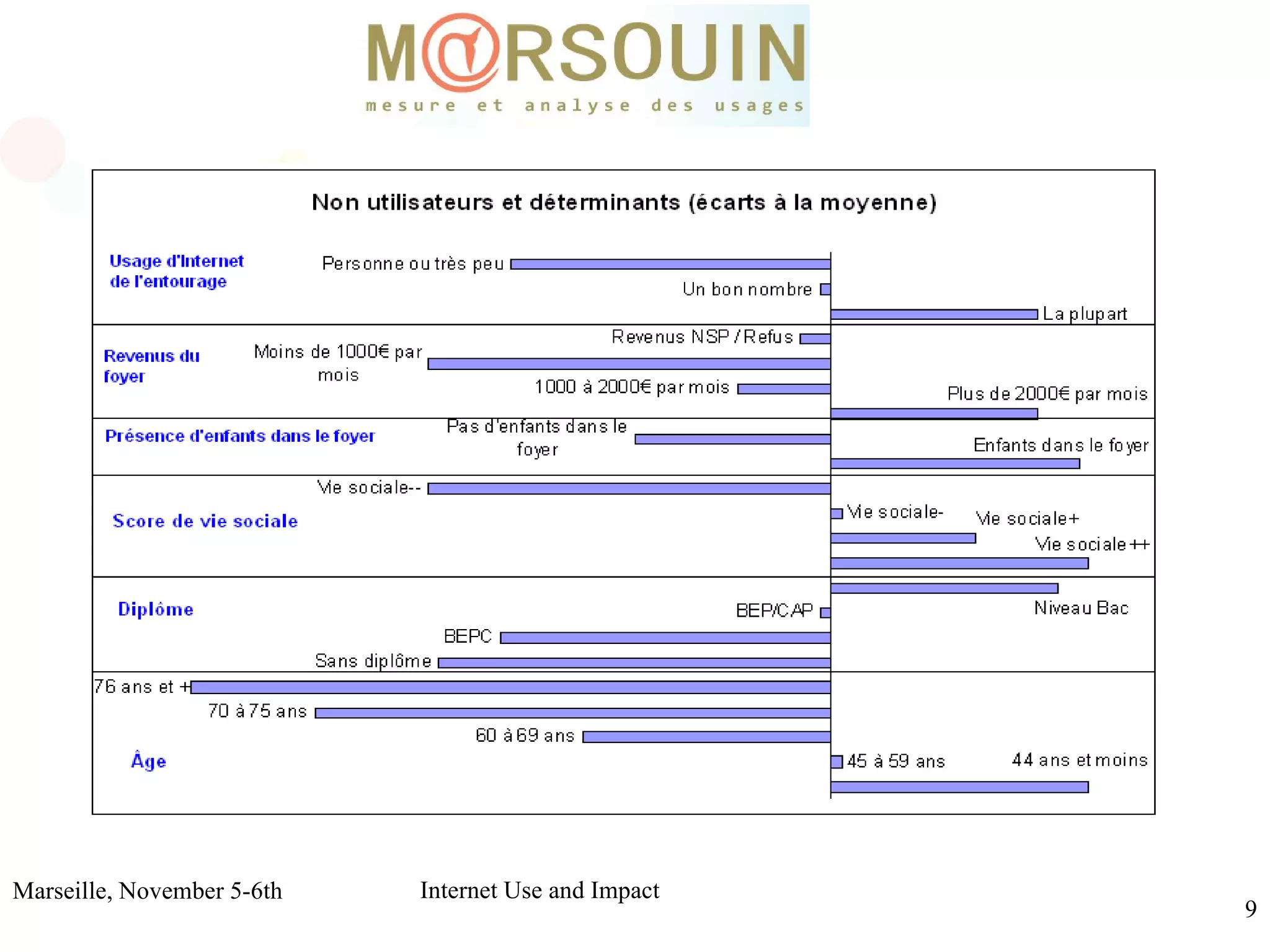
  Socio-economic results   Internet rejection explained by  age, social life, education level, children in the household, the proportion of Internet circle usage, income, household’s age, the localisation
 
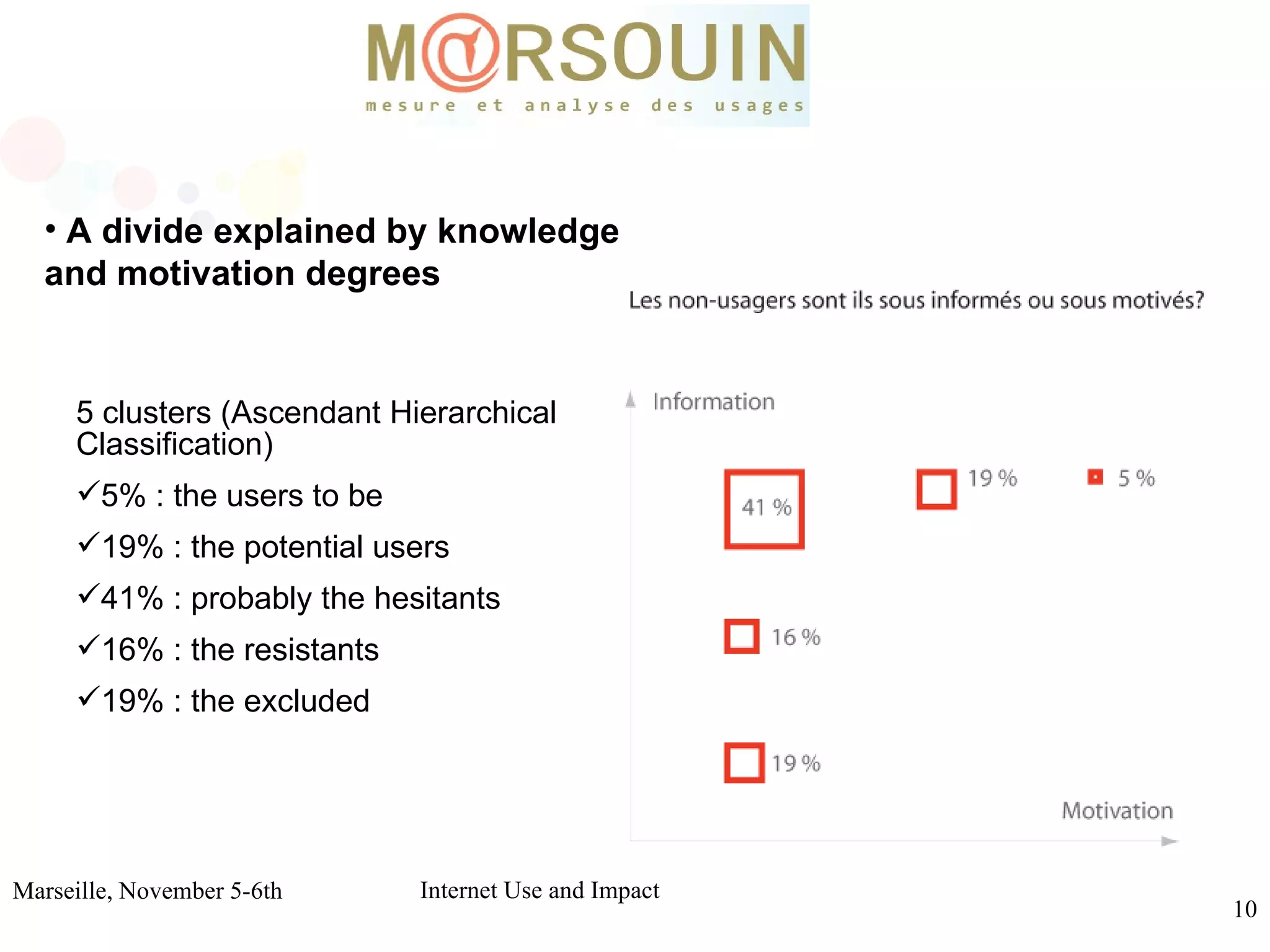
A divide explained by knowledge and motivation degrees 5 clusters (Ascendant Hierarchical Classification)  5% : the users to be 19% : the potential users 41% : probably the hesitants 16% : the resistants 19% : the excluded
  Conclusions better knowledge of users through proxies and particularly the interactions between them and their proxies  new evidence to explore the process of construction of systems of representation  that is the cognitive and social dimensions of construction experience of non-use
  Further investigations A question of access … but also of access to the knowledge and the information Non use is the result of several decisions ICT place in everyday life
[email_address] [email_address] Thank you for your attention

Methodological Questioning about the Indicators of Non-Use Situations

  • 1.
    Annabelle Boutet Jocelyne Trémenbert Télécom Bretagne – M@rsouin Indicators of Non-use Situation
  • 2.
    The digital divideIn France one third of the population do not use the Internet (Crédoc « La diffusion des technologies de l'information et de la communication dans la société française (2008) » ) Very different non use situations Different typologies often based on socio-economic factors
  • 3.
    Aims of thepaper to contribute to the knowledge of non-internet users using the result of a dialogue between qualitative and quantitative approaches clarify the concept of non-use following the sociology of uses’s tradition and explore survey based literature fit qualitative determinants to quantitative indicators develop a new quantitative typology of non-users
  • 4.
    The concept ofnon use Non-users behave, develop attitudes and representations even if they do not use, As users construct their practice, non-users construct their non-practice, Non-users must be considered through their social environment, their circle.
  • 5.
    What we knowabout typologies The example of Selwyn’s 2006 typology The absolute non users The truly unconnected The lapsed users The rare users
  • 6.
    Our hypothesis Toanalyse non use we need to deconstruct our users’ points of view The typology must be based on elements of non usage such as: behaviours, attitudes and representations, the place, status and role of the non user’s circle (children, spouse,close relations, colleagues …), the place of ICT in daily activities (time allocation).
  • 7.
    M@rsouin 2008 SurveyA telephone poll, conducted in May and June 2008 ‏ Answered by 2000 Bretons 15 years and more A sample representative of population as a function of criteria of both gender, age, occupation and the size of the urban cities crossed by the main administrative areas (the departments)
  • 8.
    Socio-economicresults Internet rejection explained by age, social life, education level, children in the household, the proportion of Internet circle usage, income, household’s age, the localisation
  • 9.
  • 10.
    A divide explainedby knowledge and motivation degrees 5 clusters (Ascendant Hierarchical Classification) 5% : the users to be 19% : the potential users 41% : probably the hesitants 16% : the resistants 19% : the excluded
  • 11.
    Conclusionsbetter knowledge of users through proxies and particularly the interactions between them and their proxies new evidence to explore the process of construction of systems of representation that is the cognitive and social dimensions of construction experience of non-use
  • 12.
    Furtherinvestigations A question of access … but also of access to the knowledge and the information Non use is the result of several decisions ICT place in everyday life
  • 13.