Indian Liberal Tradition
Kumar Anand
Centre for Civil Society
kumar@ccs.in
Then and Now
2Indian Liberal Tradition | www.ccs.in
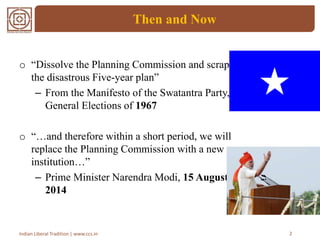
o “Dissolve the Planning Commission and scrap
the disastrous Five-year plan”
– From the Manifesto of the Swatantra Party,
General Elections of 1967
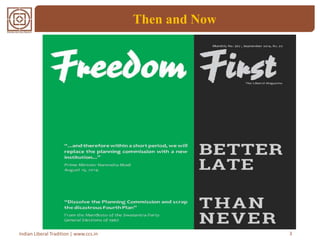
o “…and therefore within a short period, we will
replace the Planning Commission with a new
institution…”
– Prime Minister Narendra Modi, 15 August
2014
Then and Now
3Indian Liberal Tradition | www.ccs.in
LPQ to LPG
o pre-1991
– License-Permit-Quota (LPQ) Raj
– Centralised Planning (Five-year plans)
o post-1991
– Liberalisation-Privatisation-Globalisation (LPG)
– not for all (small entrepreneurs, MSMEs)
o Manmohan Singh or IMF
o Is Economic Reform (LPG) a FOREIGN idea?
4Indian Liberal Tradition | www.ccs.in
Left, Right or Centre
o Left, Right or Centre?
o Who is a liberal?
o Liberals: Indians or Foreigners?
5Indian Liberal Tradition | www.ccs.in
An Outline
6Indian Liberal Tradition | www.ccs.in
o Individuals
o Organisations
o Literature
All championed individual liberty and free
markets; and questioned India’s embrace of
socialism and the resulting big State
Free Banking
7Indian Liberal Tradition | www.ccs.in
“…what is so dangerous and ought to be done away with
is not governments' right to issue money but the
exclusive right to do so and their power to force people to
use it and to accept it at a particular price.”
– F. A. Hayek, Nobel laureate in Economics, 1976
“In Hong Kong, Scotland, and Northern Ireland, private
banks issue banknotes redeemable for the national
currency.”
- Thomas L. Hogan, Economist, 2012
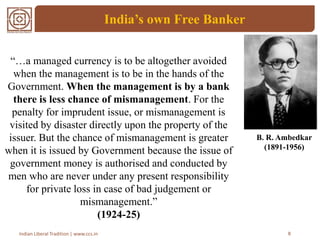
India’s own Free Banker
8Indian Liberal Tradition | www.ccs.in
“…a managed currency is to be altogether avoided
when the management is to be in the hands of the
Government. When the management is by a bank
there is less chance of mismanagement. For the
penalty for imprudent issue, or mismanagement is
visited by disaster directly upon the property of the
issuer. But the chance of mismanagement is greater
when it is issued by Government because the issue of
government money is authorised and conducted by
men who are never under any present responsibility
for private loss in case of bad judgement or
mismanagement.”
(1924-25)
B. R. Ambedkar
(1891-1956)
Central Planning
o “by centralization all progress tends to be retarded, all initiative liable
to be checked and the sense of responsibility of Local Authorities
greatly impaired….centralization conflicts with what may be regarded
as a cardinal principle of good government… the higher authority
must be less competent than the lower, because it cannot by any
possibility posses the requisite knowledge of all local conditions.”
– B. R. Ambedkar (1916)
o “… the knowledge of the circumstances of which we must make use
never exists in concentrated or integrated form, but solely as the
dispersed bits of incomplete and frequently contradictory knowledge
which all the separate individuals possess… We need
decentralization because only thus can we ensure that the
knowledge of the particular circumstances of time and place will
be promptly used.”
– F. A. Hayek (1945)
9Indian Liberal Tradition | www.ccs.in
Agriculture
10Indian Liberal Tradition | www.ccs.in
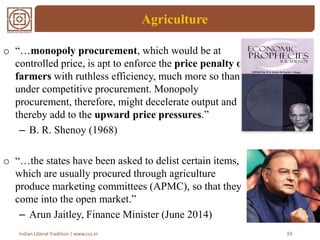
o “…monopoly procurement, which would be at
controlled price, is apt to enforce the price penalty on
farmers with ruthless efficiency, much more so than
under competitive procurement. Monopoly
procurement, therefore, might decelerate output and
thereby add to the upward price pressures.”
– B. R. Shenoy (1968)
o “…the states have been asked to delist certain items,
which are usually procured through agriculture
produce marketing committees (APMC), so that they
come into the open market.”
– Arun Jaitley, Finance Minister (June 2014)
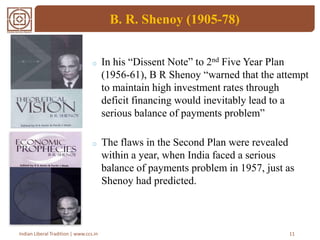
B. R. Shenoy (1905-78)
o In his “Dissent Note” to 2nd Five Year Plan
(1956-61), B R Shenoy “warned that the attempt
to maintain high investment rates through
deficit financing would inevitably lead to a
serious balance of payments problem”
o The flaws in the Second Plan were revealed
within a year, when India faced a serious
balance of payments problem in 1957, just as
Shenoy had predicted.
11Indian Liberal Tradition | www.ccs.in
Education
12Indian Liberal Tradition | www.ccs.in
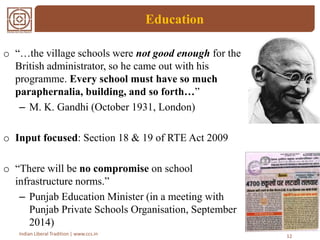
o “…the village schools were not good enough for the
British administrator, so he came out with his
programme. Every school must have so much
paraphernalia, building, and so forth…”
– M. K. Gandhi (October 1931, London)
o Input focused: Section 18 & 19 of RTE Act 2009
o “There will be no compromise on school
infrastructure norms.”
– Punjab Education Minister (in a meeting with
Punjab Private Schools Organisation, September
2014)
Gandhi
o “The State represents violence in a concentrated and organised
form. The individual has a soul, but as the state is a soulless
machine, it can never be weaned from violence to which it
owes its very existence.”
13Indian Liberal Tradition | www.ccs.in
Private Property
14Indian Liberal Tradition | www.ccs.in
o “There can be no individual freedom unless the right
to property is guaranteed protection. Where the
possession of property is treated almost as a crime and
the right denied or consigned to uncertainty,
individual freedom becomes an unreality.”
– Rajaji
o Right to Property as enshrined in Article 19(1)(f)
(read together with Article 31) of the Constitution was
a Fundamental Right.
o 44th Amendment to the Constitution, 1978, both
Article 19(1)(f) and Article 31 were deleted.
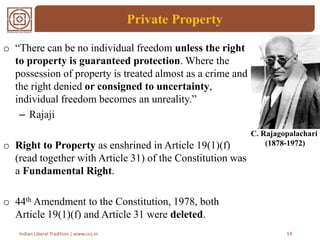
C. Rajagopalachari
(1878-1972)
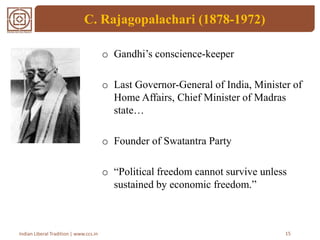
C. Rajagopalachari (1878-1972)
o Gandhi’s conscience-keeper
o Last Governor-General of India, Minister of
Home Affairs, Chief Minister of Madras
state…
o Founder of Swatantra Party
o “Political freedom cannot survive unless
sustained by economic freedom.”
15Indian Liberal Tradition | www.ccs.in
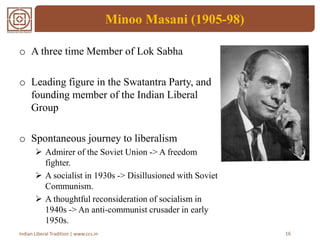
Minoo Masani (1905-98)
o A three time Member of Lok Sabha
o Leading figure in the Swatantra Party, and
founding member of the Indian Liberal
Group
o Spontaneous journey to liberalism
 Admirer of the Soviet Union -> A freedom
fighter.
 A socialist in 1930s -> Disillusioned with Soviet
Communism.
 A thoughtful reconsideration of socialism in
1940s -> An anti-communist crusader in early
1950s.
16Indian Liberal Tradition | www.ccs.in
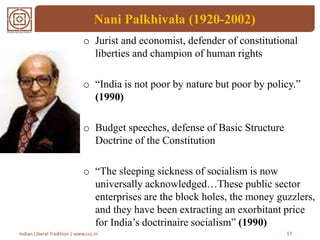
Nani Palkhivala (1920-2002)
o Jurist and economist, defender of constitutional
liberties and champion of human rights
o “India is not poor by nature but poor by policy.”
(1990)
o Budget speeches, defense of Basic Structure
Doctrine of the Constitution
o “The sleeping sickness of socialism is now
universally acknowledged…These public sector
enterprises are the block holes, the money guzzlers,
and they have been extracting an exorbitant price
for India’s doctrinaire socialism” (1990)
17Indian Liberal Tradition | www.ccs.in
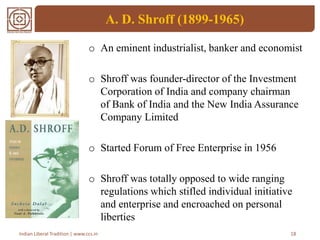
A. D. Shroff (1899-1965)
o An eminent industrialist, banker and economist
o Shroff was founder-director of the Investment
Corporation of India and company chairman
of Bank of India and the New India Assurance
Company Limited
o Started Forum of Free Enterprise in 1956
o Shroff was totally opposed to wide ranging
regulations which stifled individual initiative
and enterprise and encroached on personal
liberties
18Indian Liberal Tradition | www.ccs.in
Indian Liberals
19Indian Liberal Tradition | www.ccs.in
o B. R. Ambedkar
o B. R. Shenoy
o M. K. Gandhi
o C. Rajagopalachari
o Minoo Masani
o Nani Palkhivala
o A. D. Shroff
Forum of Free Enterprise
o “… the Forum of Free Enterprise will continue to do its good
work of educating the country against the menace of state
capitalism which socialism and communism seek to
introduce.”
– A. D. Shroff (1959)
o Battling fallacies
– First three FYPs were a success - record average GDP
growth (Nehru, Bhagwati, Panagariya)
– Thanks to the Emergency, inflation in India was kept low
and even reversed (GoI, January 1976)
– Inflation is an inevitable by-product of development
(Nehru)
20Indian Liberal Tradition | www.ccs.in
Swatantra Party (1959-74)
o “since... the Congress Party has swung to the Left, what is wanted is
not an ultra or outer-Left [viz. the CPI or the Praja Socialist Party,
PSP], but a strong and articulate Right”
- Rajaji (Our Democracy)
o founded by Rajaji in reaction to what he felt was the Jawaharlal
Nehru-dominated Indian National Congress's increasingly socialist
and statist outlook.
o Swatantra (Freedom) stood for a market-based economy with the
"Licence Raj" dismantled
o The original “Party with a Difference”
o Until Swatantra came on the scene criticising socialism was
unthinkable
o While the Congress emphasised the collective and the primacy of the
State, Swatantra stood for the primacy of the individual vis-à-vis
the State 21Indian Liberal Tradition | www.ccs.in
Swatantra Party (1959-74)
o First the Rapid Rise …
– 1962 general election (18 seats, 6.8% of popular votes)
– 1967 general election (44 seats, 8.7% of popular votes)
o … and then the Equally Rapid Crash
– 1971 general election (8 seats, 3% of popular votes)
22Indian Liberal Tradition | www.ccs.in
Liberal Periodicals
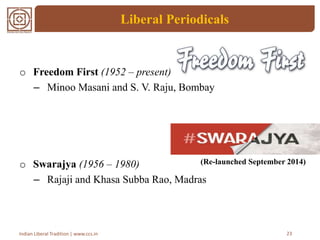
o Freedom First (1952 – present)
– Minoo Masani and S. V. Raju, Bombay
o Swarajya (1956 – 1980)
– Rajaji and Khasa Subba Rao, Madras
23Indian Liberal Tradition | www.ccs.in
(Re-launched September 2014)
Liberal Periodicals
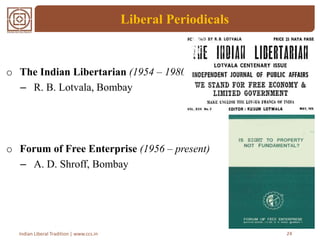
o The Indian Libertarian (1954 – 1980)
– R. B. Lotvala, Bombay
o Forum of Free Enterprise (1956 – present)
– A. D. Shroff, Bombay
24Indian Liberal Tradition | www.ccs.in
Indian Liberals Today
o Loksatta, Hyderabad
o Liberty Institute, New Delhi
o Indian Liberal Group, Mumbai
o Students for Liberty chapters around the country
o Centre for Civil Society, New Delhi and Mumbai
o Centre Right India, Takshashila Institute & Pragati, Swarajya
25Indian Liberal Tradition | www.ccs.in
Conclusion
So, is Economic Freedom (LPG) a FOREIGN idea?
26Indian Liberal Tradition | www.ccs.in
Indianliberals.in
o An online library
o Completely searchable and not-gated
o Materials also in Indian regional languages (Marathi,
Tamil, Gujarati, etc.)
o Audio/video
27Indian Liberal Tradition | www.ccs.in
Indian Liberal Tradition
28Indian Liberal Tradition | www.ccs.in
Thank You!

Indian Liberal Tradition

  • 1.
    Indian Liberal Tradition KumarAnand Centre for Civil Society kumar@ccs.in
  • 2.
    Then and Now 2IndianLiberal Tradition | www.ccs.in o “Dissolve the Planning Commission and scrap the disastrous Five-year plan” – From the Manifesto of the Swatantra Party, General Elections of 1967 o “…and therefore within a short period, we will replace the Planning Commission with a new institution…” – Prime Minister Narendra Modi, 15 August 2014
  • 3.
    Then and Now 3IndianLiberal Tradition | www.ccs.in
  • 4.
    LPQ to LPG opre-1991 – License-Permit-Quota (LPQ) Raj – Centralised Planning (Five-year plans) o post-1991 – Liberalisation-Privatisation-Globalisation (LPG) – not for all (small entrepreneurs, MSMEs) o Manmohan Singh or IMF o Is Economic Reform (LPG) a FOREIGN idea? 4Indian Liberal Tradition | www.ccs.in
  • 5.
    Left, Right orCentre o Left, Right or Centre? o Who is a liberal? o Liberals: Indians or Foreigners? 5Indian Liberal Tradition | www.ccs.in
  • 6.
    An Outline 6Indian LiberalTradition | www.ccs.in o Individuals o Organisations o Literature All championed individual liberty and free markets; and questioned India’s embrace of socialism and the resulting big State
  • 7.
    Free Banking 7Indian LiberalTradition | www.ccs.in “…what is so dangerous and ought to be done away with is not governments' right to issue money but the exclusive right to do so and their power to force people to use it and to accept it at a particular price.” – F. A. Hayek, Nobel laureate in Economics, 1976 “In Hong Kong, Scotland, and Northern Ireland, private banks issue banknotes redeemable for the national currency.” - Thomas L. Hogan, Economist, 2012
  • 8.
    India’s own FreeBanker 8Indian Liberal Tradition | www.ccs.in “…a managed currency is to be altogether avoided when the management is to be in the hands of the Government. When the management is by a bank there is less chance of mismanagement. For the penalty for imprudent issue, or mismanagement is visited by disaster directly upon the property of the issuer. But the chance of mismanagement is greater when it is issued by Government because the issue of government money is authorised and conducted by men who are never under any present responsibility for private loss in case of bad judgement or mismanagement.” (1924-25) B. R. Ambedkar (1891-1956)
  • 9.
    Central Planning o “bycentralization all progress tends to be retarded, all initiative liable to be checked and the sense of responsibility of Local Authorities greatly impaired….centralization conflicts with what may be regarded as a cardinal principle of good government… the higher authority must be less competent than the lower, because it cannot by any possibility posses the requisite knowledge of all local conditions.” – B. R. Ambedkar (1916) o “… the knowledge of the circumstances of which we must make use never exists in concentrated or integrated form, but solely as the dispersed bits of incomplete and frequently contradictory knowledge which all the separate individuals possess… We need decentralization because only thus can we ensure that the knowledge of the particular circumstances of time and place will be promptly used.” – F. A. Hayek (1945) 9Indian Liberal Tradition | www.ccs.in
  • 10.
    Agriculture 10Indian Liberal Tradition| www.ccs.in o “…monopoly procurement, which would be at controlled price, is apt to enforce the price penalty on farmers with ruthless efficiency, much more so than under competitive procurement. Monopoly procurement, therefore, might decelerate output and thereby add to the upward price pressures.” – B. R. Shenoy (1968) o “…the states have been asked to delist certain items, which are usually procured through agriculture produce marketing committees (APMC), so that they come into the open market.” – Arun Jaitley, Finance Minister (June 2014)
  • 11.
    B. R. Shenoy(1905-78) o In his “Dissent Note” to 2nd Five Year Plan (1956-61), B R Shenoy “warned that the attempt to maintain high investment rates through deficit financing would inevitably lead to a serious balance of payments problem” o The flaws in the Second Plan were revealed within a year, when India faced a serious balance of payments problem in 1957, just as Shenoy had predicted. 11Indian Liberal Tradition | www.ccs.in
  • 12.
    Education 12Indian Liberal Tradition| www.ccs.in o “…the village schools were not good enough for the British administrator, so he came out with his programme. Every school must have so much paraphernalia, building, and so forth…” – M. K. Gandhi (October 1931, London) o Input focused: Section 18 & 19 of RTE Act 2009 o “There will be no compromise on school infrastructure norms.” – Punjab Education Minister (in a meeting with Punjab Private Schools Organisation, September 2014)
  • 13.
    Gandhi o “The Staterepresents violence in a concentrated and organised form. The individual has a soul, but as the state is a soulless machine, it can never be weaned from violence to which it owes its very existence.” 13Indian Liberal Tradition | www.ccs.in
  • 14.
    Private Property 14Indian LiberalTradition | www.ccs.in o “There can be no individual freedom unless the right to property is guaranteed protection. Where the possession of property is treated almost as a crime and the right denied or consigned to uncertainty, individual freedom becomes an unreality.” – Rajaji o Right to Property as enshrined in Article 19(1)(f) (read together with Article 31) of the Constitution was a Fundamental Right. o 44th Amendment to the Constitution, 1978, both Article 19(1)(f) and Article 31 were deleted. C. Rajagopalachari (1878-1972)
  • 15.
    C. Rajagopalachari (1878-1972) oGandhi’s conscience-keeper o Last Governor-General of India, Minister of Home Affairs, Chief Minister of Madras state… o Founder of Swatantra Party o “Political freedom cannot survive unless sustained by economic freedom.” 15Indian Liberal Tradition | www.ccs.in
  • 16.
    Minoo Masani (1905-98) oA three time Member of Lok Sabha o Leading figure in the Swatantra Party, and founding member of the Indian Liberal Group o Spontaneous journey to liberalism  Admirer of the Soviet Union -> A freedom fighter.  A socialist in 1930s -> Disillusioned with Soviet Communism.  A thoughtful reconsideration of socialism in 1940s -> An anti-communist crusader in early 1950s. 16Indian Liberal Tradition | www.ccs.in
  • 17.
    Nani Palkhivala (1920-2002) oJurist and economist, defender of constitutional liberties and champion of human rights o “India is not poor by nature but poor by policy.” (1990) o Budget speeches, defense of Basic Structure Doctrine of the Constitution o “The sleeping sickness of socialism is now universally acknowledged…These public sector enterprises are the block holes, the money guzzlers, and they have been extracting an exorbitant price for India’s doctrinaire socialism” (1990) 17Indian Liberal Tradition | www.ccs.in
  • 18.
    A. D. Shroff(1899-1965) o An eminent industrialist, banker and economist o Shroff was founder-director of the Investment Corporation of India and company chairman of Bank of India and the New India Assurance Company Limited o Started Forum of Free Enterprise in 1956 o Shroff was totally opposed to wide ranging regulations which stifled individual initiative and enterprise and encroached on personal liberties 18Indian Liberal Tradition | www.ccs.in
  • 19.
    Indian Liberals 19Indian LiberalTradition | www.ccs.in o B. R. Ambedkar o B. R. Shenoy o M. K. Gandhi o C. Rajagopalachari o Minoo Masani o Nani Palkhivala o A. D. Shroff
  • 20.
    Forum of FreeEnterprise o “… the Forum of Free Enterprise will continue to do its good work of educating the country against the menace of state capitalism which socialism and communism seek to introduce.” – A. D. Shroff (1959) o Battling fallacies – First three FYPs were a success - record average GDP growth (Nehru, Bhagwati, Panagariya) – Thanks to the Emergency, inflation in India was kept low and even reversed (GoI, January 1976) – Inflation is an inevitable by-product of development (Nehru) 20Indian Liberal Tradition | www.ccs.in
  • 21.
    Swatantra Party (1959-74) o“since... the Congress Party has swung to the Left, what is wanted is not an ultra or outer-Left [viz. the CPI or the Praja Socialist Party, PSP], but a strong and articulate Right” - Rajaji (Our Democracy) o founded by Rajaji in reaction to what he felt was the Jawaharlal Nehru-dominated Indian National Congress's increasingly socialist and statist outlook. o Swatantra (Freedom) stood for a market-based economy with the "Licence Raj" dismantled o The original “Party with a Difference” o Until Swatantra came on the scene criticising socialism was unthinkable o While the Congress emphasised the collective and the primacy of the State, Swatantra stood for the primacy of the individual vis-à-vis the State 21Indian Liberal Tradition | www.ccs.in
  • 22.
    Swatantra Party (1959-74) oFirst the Rapid Rise … – 1962 general election (18 seats, 6.8% of popular votes) – 1967 general election (44 seats, 8.7% of popular votes) o … and then the Equally Rapid Crash – 1971 general election (8 seats, 3% of popular votes) 22Indian Liberal Tradition | www.ccs.in
  • 23.
    Liberal Periodicals o FreedomFirst (1952 – present) – Minoo Masani and S. V. Raju, Bombay o Swarajya (1956 – 1980) – Rajaji and Khasa Subba Rao, Madras 23Indian Liberal Tradition | www.ccs.in (Re-launched September 2014)
  • 24.
    Liberal Periodicals o TheIndian Libertarian (1954 – 1980) – R. B. Lotvala, Bombay o Forum of Free Enterprise (1956 – present) – A. D. Shroff, Bombay 24Indian Liberal Tradition | www.ccs.in
  • 25.
    Indian Liberals Today oLoksatta, Hyderabad o Liberty Institute, New Delhi o Indian Liberal Group, Mumbai o Students for Liberty chapters around the country o Centre for Civil Society, New Delhi and Mumbai o Centre Right India, Takshashila Institute & Pragati, Swarajya 25Indian Liberal Tradition | www.ccs.in
  • 26.
    Conclusion So, is EconomicFreedom (LPG) a FOREIGN idea? 26Indian Liberal Tradition | www.ccs.in
  • 27.
    Indianliberals.in o An onlinelibrary o Completely searchable and not-gated o Materials also in Indian regional languages (Marathi, Tamil, Gujarati, etc.) o Audio/video 27Indian Liberal Tradition | www.ccs.in
  • 28.
    Indian Liberal Tradition 28IndianLiberal Tradition | www.ccs.in Thank You!

Editor's Notes

  • #11  APMC Act was passed in India in 1954.
  • #12  Panel of 20 economists in April 1955 submitted to the government the draft for an ambitious development plan (“Majority report of the government panel of economists”). This Majority Report and the Mahalanobis Draft Plan frame formed the basis of Second Five Year Plan.
  • #13  APMC Act was passed in India in 1954.
  • #15  Both Article 19(1)(f) and Article 31 proved to be a substantial headache to the Indian Government, as these provisions made it very difficult for the Government to proceed with its socialist agenda of land reforms and nationalization schemes, as the Government simply could not afford to pay reasonable compensation for the lands and corporations acquired by it.  In 1977, the grand coalition of the Janata Party, had just wiped out the Congress Party, in the elections held after the lifting of the internal emergency imposed by then Prime Minister Indira Gandhi in the year 1975. A year later in 1978, the Janata Party passed the 44th Amendment to the Constitution of India. As a part of these Amendments both Article 19(1)(f) & Article 31 were deleted from the Constitution.
  • #17  From being an admirer of the Soviet Union to being a freedom fighter, from being a socialist in 1930s to become disillusioned with Soviet Communism, from a thoughtful reconsideration of Socialism in 1940s to becoming an anti-communist crusader in early 50s, Masani never took things lying down. With the formation of Swatantra Party in 1959, his spontaneous journey to liberalism was complete.
  • #21 Control prices vs. market prices
  • #22  Swatantra Party emphasised the primacy of the individual vis-à-vis the state and promoted an economic policy, which was bitterly opposed by the ruling party but is today official policy.
  • #23  Swatantra Party emphasised the primacy of the individual vis-à-vis the state and promoted an economic policy, which was bitterly opposed by the ruling party but is today official policy.