The Constitution is Broken.
Long live the Constitution!
Rajesh Jain
Free A Billion
rajesh@fab2020.com
1
Even the smallest person can
change the course of the future.
- JRR Tolkien, writing in
“The Lord of the Rings”
2
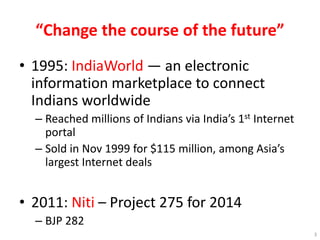
“Change the course of the future”
• 1995: IndiaWorld — an electronic
information marketplace to connect
Indians worldwide
– Reached millions of Indians via India’s 1st Internet
portal
– Sold in Nov 1999 for $115 million, among Asia’s
largest Internet deals
• 2011: Niti – Project 275 for 2014
– BJP 282
3
Make no little plans; they have
no magic to stir men's blood
and probably themselves will
not be realized. Make big plans;
aim high in hope and work.
- Daniel Burnham
4
“Make no little plans”
To create a Prosperous India,
Free A Billion Indians by 2020
via a Rules Revolution
5
Questions to consider
• Why are we all not 10X richer?
• Who is our greatest enemy?
• What is needed to counter this enemy?
• How can we do it?
• Who will do it?
6
A short tutorial
7
How our world works
1. What is the most basic activity among people?
2. What is the system in which it takes place?
3. What is the signalling mechanism?
4. Why do we need government?
5. Where are the rules of government encoded?
8
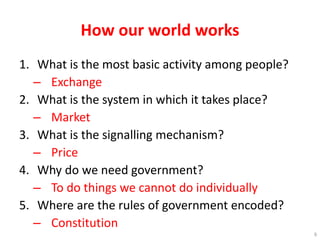
How our world works
1. What is the most basic activity among people?
– Exchange
2. What is the system in which it takes place?
– Market
3. What is the signalling mechanism?
– Price
4. Why do we need government?
– To do things we cannot do individually
5. Where are the rules of government encoded?
– Constitution
9
It is not from the
benevolence of the butcher,
the brewer, or the baker
that we expect our dinner,
but from their regard
to their own interest.
- Adam Smith
10
The most important single central
fact about a free market is that no
exchange takes place unless both
parties benefit.
- Milton Friedman
11
Building blocks - 1
• Economy: is about individual persons, their individual
preferences, their individual goals and objectives
– Not collectives and groups
– Individuals focus on their self-interest
– No such thing as a collective self-interest
• Voluntary exchange (trade) in markets
– Exchange makes all its participants better off
– Incentives matter
– Prices as signals; “order produced from freedom of choice”
– Spontaneous order; Invisible hand
– Human action not human design
12
Building blocks - 2
• Government: a set of institutions we create for collective decision-making to
do things we cannot do individually (or privately)
– Needed for some collective goods – national defence, rule of law, enforcement of
contracts, and a limited set of public goods
– Politics is the activity of persons in the context of such institutions
• Government is an agent of the people, who are the principals
– As the people’s agent, government is charged with a certain set of duties – and only those
duties – it must perform to the satisfaction of the people
• Constitution: The contract between the people and government.
– A set of rules which specifies what the government must do, what resources are available
to it to carry out those mandatory duties, and the restrictions on what the government is
prohibited from doing
– It places the people as the ultimate decision makers who have effective, though indirect,
control over the government
– The rules need to be made under veil of ignorance / uncertainty
13
Economics in one lesson
The art of economics consists in looking
not merely at the immediate
but at the longer effects
of any act or policy;
it consists in tracing the consequences
of that policy not merely for one group
but for all groups.
- Henry Hazlitt
14
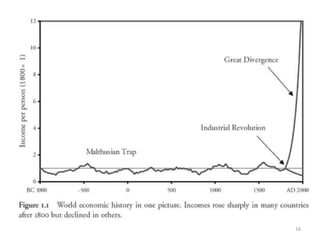
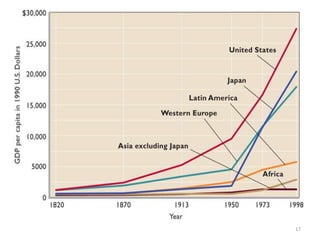
World economic history
15
16
17
0
5,000
10,000
15,000
20,000
25,000
30,000
1960 1965 1970 1975 1980 1985 1990 1995 2000 2005 2010
China
India
South Korea
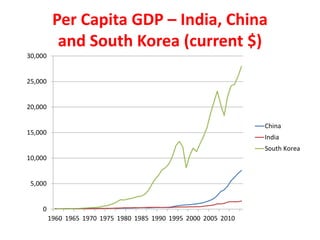
Per Capita GDP – India, China
and South Korea (current $)
The rich have got richer,
but the poor have done even better…
Despite the doubling of the world
population, even the raw number of
people living in absolute poverty
has fallen since the 1950s.
- Matt Ridley
19
The rich got richer, true.
But millions more have gas heating, cars,
smallpox vaccinations, indoor plumbing,
cheap travel, rights for women,
lower child mortality, adequate nutrition,
taller bodies, doubled life expectancy,
schooling for their kids, newspapers,
a vote, a shot at university, and respect.
- Deirdre McCloskey
20
Poverty is not
India’s destiny
Prosperity is not
a zero-sum game
21
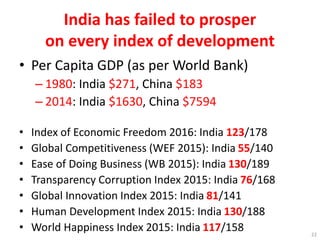
India has failed to prosper
on every index of development
• Per Capita GDP (as per World Bank)
– 1980: India $271, China $183
– 2014: India $1630, China $7594
• Index of Economic Freedom 2016: India 123/178
• Global Competitiveness (WEF 2015): India 55/140
• Ease of Doing Business (WB 2015): India 130/189
• Transparency Corruption Index 2015: India 76/168
• Global Innovation Index 2015: India 81/141
• Human Development Index 2015: India 130/188
• World Happiness Index 2015: India 117/158 22
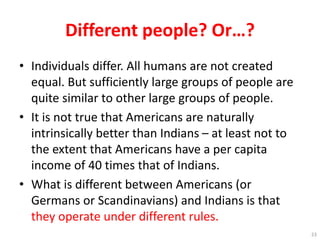
Different people? Or…?
• Individuals differ. All humans are not created
equal. But sufficiently large groups of people are
quite similar to other large groups of people.
• It is not true that Americans are naturally
intrinsically better than Indians – at least not to
the extent that Americans have a per capita
income of 40 times that of Indians.
• What is different between Americans (or
Germans or Scandinavians) and Indians is that
they operate under different rules.
23
Why is India still poor?
24
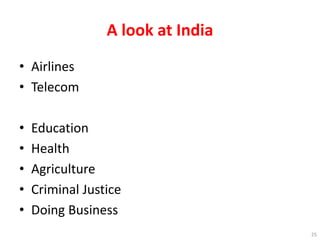
A look at India
• Airlines
• Telecom
• Education
• Health
• Agriculture
• Criminal Justice
• Doing Business
25
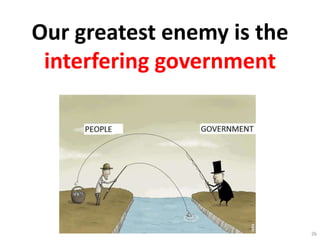
Our greatest enemy is the
interfering government
26
Government is the great fiction,
through which
everybody endeavours to live
at the expense of everybody else.
- Frederic Bastiat
27
The welfare state is the oldest con
game in the world. First you take
people's money away quietly and
then you give some of it back to
them flamboyantly.
- Thomas Sowell
28
Public Choice theory informs us
• Public choice is the study of political behaviour
using the tools of economics
– Analyse politicians, bureaucrats and voters
• A set of theories of governmental failures, as an
offset to the theories of market failures that had
previously emerged from theoretical welfare
economics.
• Public choice is like the small boy who said that
the king really has no clothes.
29
The general lesson is that if some part of
government fails in its function, it will most
likely be given greater funding and power.
Of course, the purpose of this is not to reward
failure; the thinking would be that more money
and power will enable the agency to solve the
problem. But the effect is that government
grows when social problems grow, and thus it is
not in the government’s interests to solve
society’s problems.
- Michael Huemer
30
Every election is a
sort of advance auction
of stolen goods.
- H. L. Mencken
31
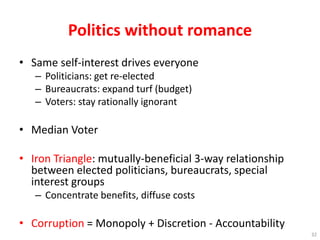
Politics without romance
• Same self-interest drives everyone
– Politicians: get re-elected
– Bureaucrats: expand turf (budget)
– Voters: stay rationally ignorant
• Median Voter
• Iron Triangle: mutually-beneficial 3-way relationship
between elected politicians, bureaucrats, special
interest groups
– Concentrate benefits, diffuse costs
• Corruption = Monopoly + Discretion - Accountability
32
The top priority of an elected official is usually to get
re-elected, and that requires a steady stream of
favorable publicity to keep the official’s name before
the public in a good light.
The opening of any major new facility, whether
urgently needed or not, creates such political
opportunities by attracting the media to ribbon-
cutting ceremonies, for example.
Filling potholes, repairing bridges, or updating the
equipment at a sewage treatment plant creates no
ribbon-cutting ceremonies or occasions for speeches
by politicians.
- Thomas Sowell
33
It is folly to think that "better men"
elected to office will help us much,
that "better policy" will
turn things around here.
– James Buchanan
34
Insanity: doing the same thing
over and over again
and expecting different results.
- Albert Einstein
There is nothing so useless
as doing efficiently that
which should not be done at all.
- Peter Drucker
35
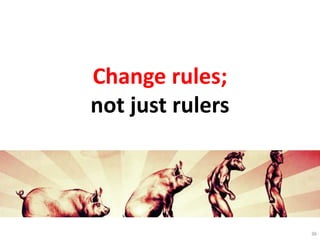
Change rules;
not just rulers
36
Two stage process of determining rules
• Constitutional stage: when the top-level rules are
chosen
– The constitution has to enumerate the limited powers
of the government. This is so because the government
is not the sovereign — the supreme ruler or ultimate
power.
• Post-constitutional stage: in-period rules selected
– These are more flexible for meeting contingencies,
more particularised in their operation and less
permanent than the constitutional rules
– The in-period rules may change from period to period
but they have to be consistent with the constitutional
level rules 37
A good set of Constitutional rules to
create a limited but strong government
• Non-discrimination. The government is
prohibited from discriminating among citizens
• Liberty. The government cannot abridge any
freedom that citizens have as their birthright
• Justice. The government protects all citizens from
coercion and delivers timely justice
• Non-interference. The government must not
interfere in voluntary exchanges among citizens
• Limited government. Government must not
engage in commercial activities
38
A look at India’s Constitution
39
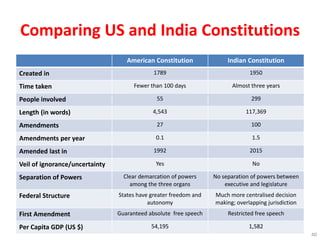
Comparing US and India Constitutions
American Constitution Indian Constitution
Created in 1789 1950
Time taken Fewer than 100 days Almost three years
People involved 55 299
Length (in words) 4,543 117,369
Amendments 27 100
Amendments per year 0.1 1.5
Amended last in 1992 2015
Veil of ignorance/uncertainty Yes No
Separation of Powers Clear demarcation of powers
among the three organs
No separation of powers between
executive and legislature
Federal Structure States have greater freedom and
autonomy
Much more centralised decision
making; overlapping jurisdiction
First Amendment Guaranteed absolute free speech Restricted free speech
Per Capita GDP (US $) 54,195 1,582
40
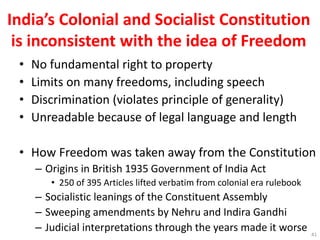
India’s Colonial and Socialist Constitution
is inconsistent with the idea of Freedom
• No fundamental right to property
• Limits on many freedoms, including speech
• Discrimination (violates principle of generality)
• Unreadable because of legal language and length
• How Freedom was taken away from the Constitution
– Origins in British 1935 Government of India Act
• 250 of 395 Articles lifted verbatim from colonial era rulebook
– Socialistic leanings of the Constituent Assembly
– Sweeping amendments by Nehru and Indira Gandhi
– Judicial interpretations through the years made it worse 41
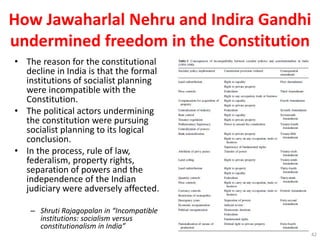
How Jawaharlal Nehru and Indira Gandhi
undermined freedom in the Constitution
• The reason for the constitutional
decline in India is that the formal
institutions of socialist planning
were incompatible with the
Constitution.
• The political actors undermining
the constitution were pursuing
socialist planning to its logical
conclusion.
• In the process, rule of law,
federalism, property rights,
separation of powers and the
independence of the Indian
judiciary were adversely affected.
– Shruti Rajagopalan in “Incompatible
institutions: socialism versus
constitutionalism in India”
42
India needs a modern Constitution
to create a platform for prosperity
For India to change its trajectory,
to move out of the trap that it is in for so long,
the rules of the game have to change.
The constitution of India has to be re-written.
Change the rules, change the game.
- Atanu Dey
43
The “Father of Indian Constitution” had
grave doubts a few years after its birth
• Sir, my friends tell me that I have made the
Constitution. My answer is that I was a hack. What I
did was against my will.
• ... I said that I wanted to burn the Constitution…The
reason is this: We built a temple for a god to come in
and reside, but before the god could be installed, if
the devil has taken possession of it, what else could
we do except destroy the temple? We did not intend
that it should be occupied by Asuras. We intended it
to be occupied by the Devas. That is the reason why I
said I would rather like to burn it.
– B R Ambedkar in Parliament in 1953 and 1955
44
A New Constitution
for India by 2020
The Second Republic
45
It is incredible how as soon as a people
becomes subject, it promptly falls into
such complete forgetfulness of its
freedom that it can hardly be roused to
the point of regaining it, obeying so easily
and so willingly that one is led to say, on
beholding such a situation, that this
people has not so much lost its liberty as
won its enslavement.
- Etienne de la Boetie
46
If you want to build a ship,
don't drum up people to collect
wood and don't assign them tasks
and work, but rather teach them
to long for the endless immensity
of the sea.
- Antoine de Saint-Exupery
47
Imagine…
• In the 2019 Lok Sabha elections, the only way for parties
(and their candidates) to win is by pledging support for the
New Constitution
• This ensures the support needed to replace the Constitution
– Two-thirds majority in Lok Sabha and Rajya Sabha
– Half the state legislatures
• On Jan 26, 2020: the Second Republic is born as India gets its
New Constitution
• Question: how to influence the voting and get the party
pledges in the 2019 elections?
48
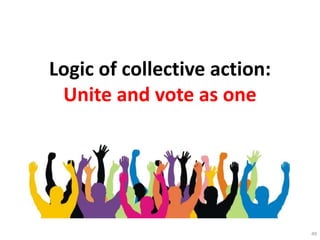
Logic of collective action:
Unite and vote as one
49
The disruptive innovation for change is
collective action via a united vote bank
• In democracies, the vote is the only weapon
• A single vote is useless – makes no difference to outcome
• But what if a united vote bank of all these votes was
created as a pressure group…
• …where the members voluntarily agreed to vote as one?
• Average winning margin in an election is ~10%
• Can make a candidate win or lose if vote bank size is more
than average winning margin
• Constituency that is invisible, inarticulate and unorganised
now becomes visible, gets a voice and is organised 50
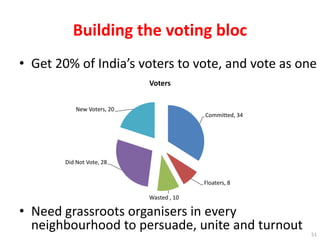
Building the voting bloc
• Get 20% of India’s voters to vote, and vote as one
• Need grassroots organisers in every
neighbourhood to persuade, unite and turnout 51
Committed, 34
Floaters, 8
Wasted , 10
Did Not Vote, 28
New Voters, 20
Voters
Free A Billion (FAB)
• Changing Minds: Create a demand for freedom
and changing rules
– Link bad outcomes to interfering government
– Create support for a new Constitution for India
• Channelling Votes: Aggregate large numbers
into a united vote bank
– Get 200 million (20%) who will vote, and vote as one
– Build a grassroots organisation with local leadership
52
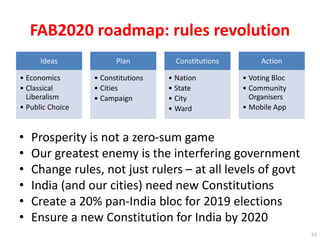
FAB2020 roadmap: rules revolution
• Prosperity is not a zero-sum game
• Our greatest enemy is the interfering government
• Change rules, not just rulers – at all levels of govt
• India (and our cities) need new Constitutions
• Create a 20% pan-India bloc for 2019 elections
• Ensure a new Constitution for India by 2020
53
Ideas
• Economics
• Classical
Liberalism
• Public Choice
Plan
• Constitutions
• Cities
• Campaign
Constitutions
• Nation
• State
• City
• Ward
Action
• Voting Bloc
• Community
Organisers
• Mobile App
How can you help free a billion
• Know more? Visit: fab2020.com
• Twitter: @freeabillion
• Facebook: facebook.com/freeabillion
• Intern with us? Email: intern@fab2020.com
• Join full-time? Email: join@fab2020.com
54

Free A Billion: The Constitution is Broken

  • 1.
    The Constitution isBroken. Long live the Constitution! Rajesh Jain Free A Billion rajesh@fab2020.com 1
  • 2.
    Even the smallestperson can change the course of the future. - JRR Tolkien, writing in “The Lord of the Rings” 2
  • 3.
    “Change the courseof the future” • 1995: IndiaWorld — an electronic information marketplace to connect Indians worldwide – Reached millions of Indians via India’s 1st Internet portal – Sold in Nov 1999 for $115 million, among Asia’s largest Internet deals • 2011: Niti – Project 275 for 2014 – BJP 282 3
  • 4.
    Make no littleplans; they have no magic to stir men's blood and probably themselves will not be realized. Make big plans; aim high in hope and work. - Daniel Burnham 4
  • 5.
    “Make no littleplans” To create a Prosperous India, Free A Billion Indians by 2020 via a Rules Revolution 5
  • 6.
    Questions to consider •Why are we all not 10X richer? • Who is our greatest enemy? • What is needed to counter this enemy? • How can we do it? • Who will do it? 6
  • 7.
  • 8.
    How our worldworks 1. What is the most basic activity among people? 2. What is the system in which it takes place? 3. What is the signalling mechanism? 4. Why do we need government? 5. Where are the rules of government encoded? 8
  • 9.
    How our worldworks 1. What is the most basic activity among people? – Exchange 2. What is the system in which it takes place? – Market 3. What is the signalling mechanism? – Price 4. Why do we need government? – To do things we cannot do individually 5. Where are the rules of government encoded? – Constitution 9
  • 10.
    It is notfrom the benevolence of the butcher, the brewer, or the baker that we expect our dinner, but from their regard to their own interest. - Adam Smith 10
  • 11.
    The most importantsingle central fact about a free market is that no exchange takes place unless both parties benefit. - Milton Friedman 11
  • 12.
    Building blocks -1 • Economy: is about individual persons, their individual preferences, their individual goals and objectives – Not collectives and groups – Individuals focus on their self-interest – No such thing as a collective self-interest • Voluntary exchange (trade) in markets – Exchange makes all its participants better off – Incentives matter – Prices as signals; “order produced from freedom of choice” – Spontaneous order; Invisible hand – Human action not human design 12
  • 13.
    Building blocks -2 • Government: a set of institutions we create for collective decision-making to do things we cannot do individually (or privately) – Needed for some collective goods – national defence, rule of law, enforcement of contracts, and a limited set of public goods – Politics is the activity of persons in the context of such institutions • Government is an agent of the people, who are the principals – As the people’s agent, government is charged with a certain set of duties – and only those duties – it must perform to the satisfaction of the people • Constitution: The contract between the people and government. – A set of rules which specifies what the government must do, what resources are available to it to carry out those mandatory duties, and the restrictions on what the government is prohibited from doing – It places the people as the ultimate decision makers who have effective, though indirect, control over the government – The rules need to be made under veil of ignorance / uncertainty 13
  • 14.
    Economics in onelesson The art of economics consists in looking not merely at the immediate but at the longer effects of any act or policy; it consists in tracing the consequences of that policy not merely for one group but for all groups. - Henry Hazlitt 14
  • 15.
  • 16.
  • 17.
  • 18.
    0 5,000 10,000 15,000 20,000 25,000 30,000 1960 1965 19701975 1980 1985 1990 1995 2000 2005 2010 China India South Korea Per Capita GDP – India, China and South Korea (current $)
  • 19.
    The rich havegot richer, but the poor have done even better… Despite the doubling of the world population, even the raw number of people living in absolute poverty has fallen since the 1950s. - Matt Ridley 19
  • 20.
    The rich gotricher, true. But millions more have gas heating, cars, smallpox vaccinations, indoor plumbing, cheap travel, rights for women, lower child mortality, adequate nutrition, taller bodies, doubled life expectancy, schooling for their kids, newspapers, a vote, a shot at university, and respect. - Deirdre McCloskey 20
  • 21.
    Poverty is not India’sdestiny Prosperity is not a zero-sum game 21
  • 22.
    India has failedto prosper on every index of development • Per Capita GDP (as per World Bank) – 1980: India $271, China $183 – 2014: India $1630, China $7594 • Index of Economic Freedom 2016: India 123/178 • Global Competitiveness (WEF 2015): India 55/140 • Ease of Doing Business (WB 2015): India 130/189 • Transparency Corruption Index 2015: India 76/168 • Global Innovation Index 2015: India 81/141 • Human Development Index 2015: India 130/188 • World Happiness Index 2015: India 117/158 22
  • 23.
    Different people? Or…? •Individuals differ. All humans are not created equal. But sufficiently large groups of people are quite similar to other large groups of people. • It is not true that Americans are naturally intrinsically better than Indians – at least not to the extent that Americans have a per capita income of 40 times that of Indians. • What is different between Americans (or Germans or Scandinavians) and Indians is that they operate under different rules. 23
  • 24.
    Why is Indiastill poor? 24
  • 25.
    A look atIndia • Airlines • Telecom • Education • Health • Agriculture • Criminal Justice • Doing Business 25
  • 26.
    Our greatest enemyis the interfering government 26
  • 27.
    Government is thegreat fiction, through which everybody endeavours to live at the expense of everybody else. - Frederic Bastiat 27
  • 28.
    The welfare stateis the oldest con game in the world. First you take people's money away quietly and then you give some of it back to them flamboyantly. - Thomas Sowell 28
  • 29.
    Public Choice theoryinforms us • Public choice is the study of political behaviour using the tools of economics – Analyse politicians, bureaucrats and voters • A set of theories of governmental failures, as an offset to the theories of market failures that had previously emerged from theoretical welfare economics. • Public choice is like the small boy who said that the king really has no clothes. 29
  • 30.
    The general lessonis that if some part of government fails in its function, it will most likely be given greater funding and power. Of course, the purpose of this is not to reward failure; the thinking would be that more money and power will enable the agency to solve the problem. But the effect is that government grows when social problems grow, and thus it is not in the government’s interests to solve society’s problems. - Michael Huemer 30
  • 31.
    Every election isa sort of advance auction of stolen goods. - H. L. Mencken 31
  • 32.
    Politics without romance •Same self-interest drives everyone – Politicians: get re-elected – Bureaucrats: expand turf (budget) – Voters: stay rationally ignorant • Median Voter • Iron Triangle: mutually-beneficial 3-way relationship between elected politicians, bureaucrats, special interest groups – Concentrate benefits, diffuse costs • Corruption = Monopoly + Discretion - Accountability 32
  • 33.
    The top priorityof an elected official is usually to get re-elected, and that requires a steady stream of favorable publicity to keep the official’s name before the public in a good light. The opening of any major new facility, whether urgently needed or not, creates such political opportunities by attracting the media to ribbon- cutting ceremonies, for example. Filling potholes, repairing bridges, or updating the equipment at a sewage treatment plant creates no ribbon-cutting ceremonies or occasions for speeches by politicians. - Thomas Sowell 33
  • 34.
    It is follyto think that "better men" elected to office will help us much, that "better policy" will turn things around here. – James Buchanan 34
  • 35.
    Insanity: doing thesame thing over and over again and expecting different results. - Albert Einstein There is nothing so useless as doing efficiently that which should not be done at all. - Peter Drucker 35
  • 36.
  • 37.
    Two stage processof determining rules • Constitutional stage: when the top-level rules are chosen – The constitution has to enumerate the limited powers of the government. This is so because the government is not the sovereign — the supreme ruler or ultimate power. • Post-constitutional stage: in-period rules selected – These are more flexible for meeting contingencies, more particularised in their operation and less permanent than the constitutional rules – The in-period rules may change from period to period but they have to be consistent with the constitutional level rules 37
  • 38.
    A good setof Constitutional rules to create a limited but strong government • Non-discrimination. The government is prohibited from discriminating among citizens • Liberty. The government cannot abridge any freedom that citizens have as their birthright • Justice. The government protects all citizens from coercion and delivers timely justice • Non-interference. The government must not interfere in voluntary exchanges among citizens • Limited government. Government must not engage in commercial activities 38
  • 39.
    A look atIndia’s Constitution 39
  • 40.
    Comparing US andIndia Constitutions American Constitution Indian Constitution Created in 1789 1950 Time taken Fewer than 100 days Almost three years People involved 55 299 Length (in words) 4,543 117,369 Amendments 27 100 Amendments per year 0.1 1.5 Amended last in 1992 2015 Veil of ignorance/uncertainty Yes No Separation of Powers Clear demarcation of powers among the three organs No separation of powers between executive and legislature Federal Structure States have greater freedom and autonomy Much more centralised decision making; overlapping jurisdiction First Amendment Guaranteed absolute free speech Restricted free speech Per Capita GDP (US $) 54,195 1,582 40
  • 41.
    India’s Colonial andSocialist Constitution is inconsistent with the idea of Freedom • No fundamental right to property • Limits on many freedoms, including speech • Discrimination (violates principle of generality) • Unreadable because of legal language and length • How Freedom was taken away from the Constitution – Origins in British 1935 Government of India Act • 250 of 395 Articles lifted verbatim from colonial era rulebook – Socialistic leanings of the Constituent Assembly – Sweeping amendments by Nehru and Indira Gandhi – Judicial interpretations through the years made it worse 41
  • 42.
    How Jawaharlal Nehruand Indira Gandhi undermined freedom in the Constitution • The reason for the constitutional decline in India is that the formal institutions of socialist planning were incompatible with the Constitution. • The political actors undermining the constitution were pursuing socialist planning to its logical conclusion. • In the process, rule of law, federalism, property rights, separation of powers and the independence of the Indian judiciary were adversely affected. – Shruti Rajagopalan in “Incompatible institutions: socialism versus constitutionalism in India” 42
  • 43.
    India needs amodern Constitution to create a platform for prosperity For India to change its trajectory, to move out of the trap that it is in for so long, the rules of the game have to change. The constitution of India has to be re-written. Change the rules, change the game. - Atanu Dey 43
  • 44.
    The “Father ofIndian Constitution” had grave doubts a few years after its birth • Sir, my friends tell me that I have made the Constitution. My answer is that I was a hack. What I did was against my will. • ... I said that I wanted to burn the Constitution…The reason is this: We built a temple for a god to come in and reside, but before the god could be installed, if the devil has taken possession of it, what else could we do except destroy the temple? We did not intend that it should be occupied by Asuras. We intended it to be occupied by the Devas. That is the reason why I said I would rather like to burn it. – B R Ambedkar in Parliament in 1953 and 1955 44
  • 45.
    A New Constitution forIndia by 2020 The Second Republic 45
  • 46.
    It is incrediblehow as soon as a people becomes subject, it promptly falls into such complete forgetfulness of its freedom that it can hardly be roused to the point of regaining it, obeying so easily and so willingly that one is led to say, on beholding such a situation, that this people has not so much lost its liberty as won its enslavement. - Etienne de la Boetie 46
  • 47.
    If you wantto build a ship, don't drum up people to collect wood and don't assign them tasks and work, but rather teach them to long for the endless immensity of the sea. - Antoine de Saint-Exupery 47
  • 48.
    Imagine… • In the2019 Lok Sabha elections, the only way for parties (and their candidates) to win is by pledging support for the New Constitution • This ensures the support needed to replace the Constitution – Two-thirds majority in Lok Sabha and Rajya Sabha – Half the state legislatures • On Jan 26, 2020: the Second Republic is born as India gets its New Constitution • Question: how to influence the voting and get the party pledges in the 2019 elections? 48
  • 49.
    Logic of collectiveaction: Unite and vote as one 49
  • 50.
    The disruptive innovationfor change is collective action via a united vote bank • In democracies, the vote is the only weapon • A single vote is useless – makes no difference to outcome • But what if a united vote bank of all these votes was created as a pressure group… • …where the members voluntarily agreed to vote as one? • Average winning margin in an election is ~10% • Can make a candidate win or lose if vote bank size is more than average winning margin • Constituency that is invisible, inarticulate and unorganised now becomes visible, gets a voice and is organised 50
  • 51.
    Building the votingbloc • Get 20% of India’s voters to vote, and vote as one • Need grassroots organisers in every neighbourhood to persuade, unite and turnout 51 Committed, 34 Floaters, 8 Wasted , 10 Did Not Vote, 28 New Voters, 20 Voters
  • 52.
    Free A Billion(FAB) • Changing Minds: Create a demand for freedom and changing rules – Link bad outcomes to interfering government – Create support for a new Constitution for India • Channelling Votes: Aggregate large numbers into a united vote bank – Get 200 million (20%) who will vote, and vote as one – Build a grassroots organisation with local leadership 52
  • 53.
    FAB2020 roadmap: rulesrevolution • Prosperity is not a zero-sum game • Our greatest enemy is the interfering government • Change rules, not just rulers – at all levels of govt • India (and our cities) need new Constitutions • Create a 20% pan-India bloc for 2019 elections • Ensure a new Constitution for India by 2020 53 Ideas • Economics • Classical Liberalism • Public Choice Plan • Constitutions • Cities • Campaign Constitutions • Nation • State • City • Ward Action • Voting Bloc • Community Organisers • Mobile App
  • 54.
    How can youhelp free a billion • Know more? Visit: fab2020.com • Twitter: @freeabillion • Facebook: facebook.com/freeabillion • Intern with us? Email: intern@fab2020.com • Join full-time? Email: join@fab2020.com 54