Successful grant
proposals Insights and
perspective
Prashanth N S, MBBS, MPH, PhD (Public Health)
Overview of our 40
mins interaction
• Why do some grants fail?
• What makes a successful grant
proposal: some interactive examples
• Review & funding decisions (typical
models in research grantmaking)
Ever failed to
get a grant?
It’s not only
about the
“writing”
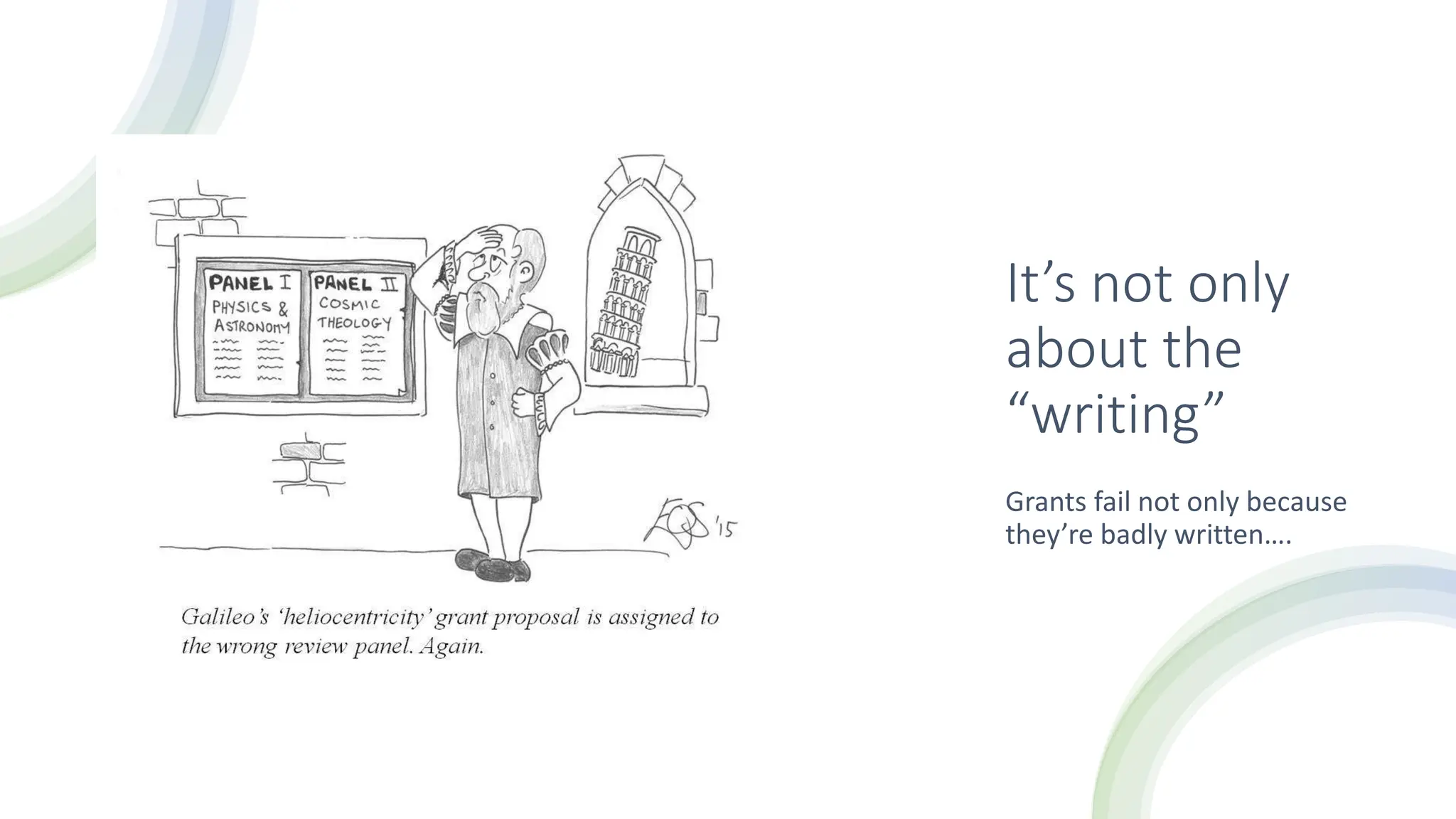
Grants fail not only because
they’re badly written….
Fit to scope: I am
good at something
so I’ll try that for
every grant call
opportunity
• Assess fit
• Carefully review guidelines, ambit
Egs.
- Ambulatory care for NCDs
- Implementation Research calls
Shallow: Limited
conceptualization of
the core proposal;
lacking in
originality/innovation
• Exploration of large number of variables that we
will collect in elaborate surveys – mining for
associations
• Unclear reasoning underlying choice of
interventions
• Limited theoretical basis for trying something
• Novel….but without underlying foundation for
novelty
• Technical jargon understandable only to a niche
reviewer
Eg.
- Descriptive RQs in public health
- Incidence/prevalence estimation
- Proposals that aim for system change through
training
Not built/building
upon existing
work/what’s
currently known
• Limited engagement with literature (who do you
cite; whom not?)
• Claims/assertions that belie lack of understanding
of state-of-the-art in the field
• Overly amplified claims of PI/team’s ability &
capacity
Eg.
- A newly designed Tele-psychiatry solution for
rural/remote primary health care settings that does
not engage with literature documenting
challenges/barriers
Wrong
person/institution/team
for a good idea/proposal
- Either due to track-record (or lack thereof), or
institutional affiliation
- Mentorship/supervisory environment lacking
- Specific training proposed is lacking in the PI/team
Eg.
- Implementation research proposal for scaling up a
hospital-based mental health intervention in
community settings that is written well but not
involving impelementers/public health
researchers/community medicine…
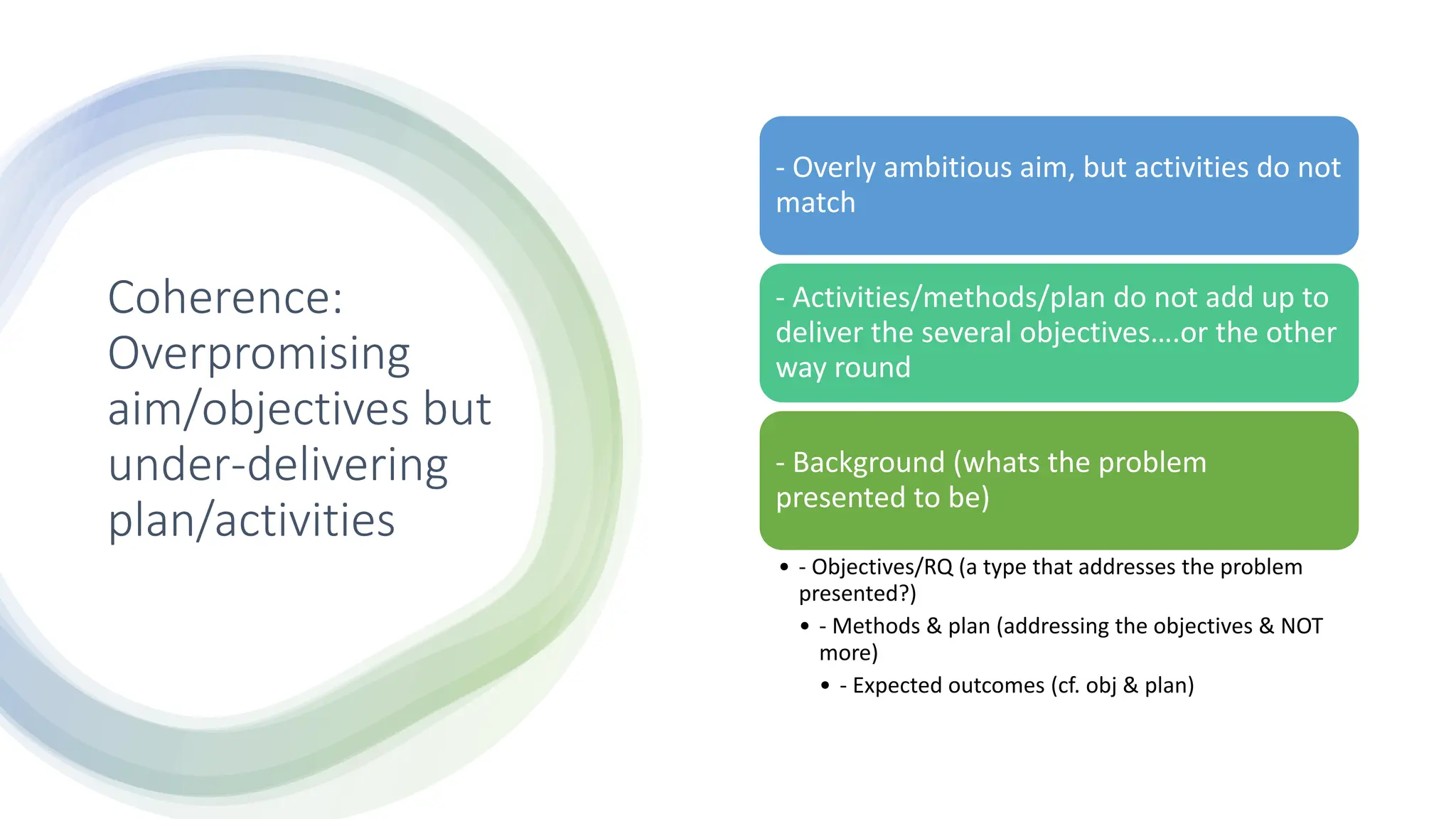
Coherence:
Overpromising
aim/objectives but
under-delivering
plan/activities
- Overly ambitious aim, but activities do not
match
- Activities/methods/plan do not add up to
deliver the several objectives….or the other
way round
- Background (whats the problem
presented to be)
• - Objectives/RQ (a type that addresses the problem
presented?)
• - Methods & plan (addressing the objectives & NOT
more)
• - Expected outcomes (cf. obj & plan)
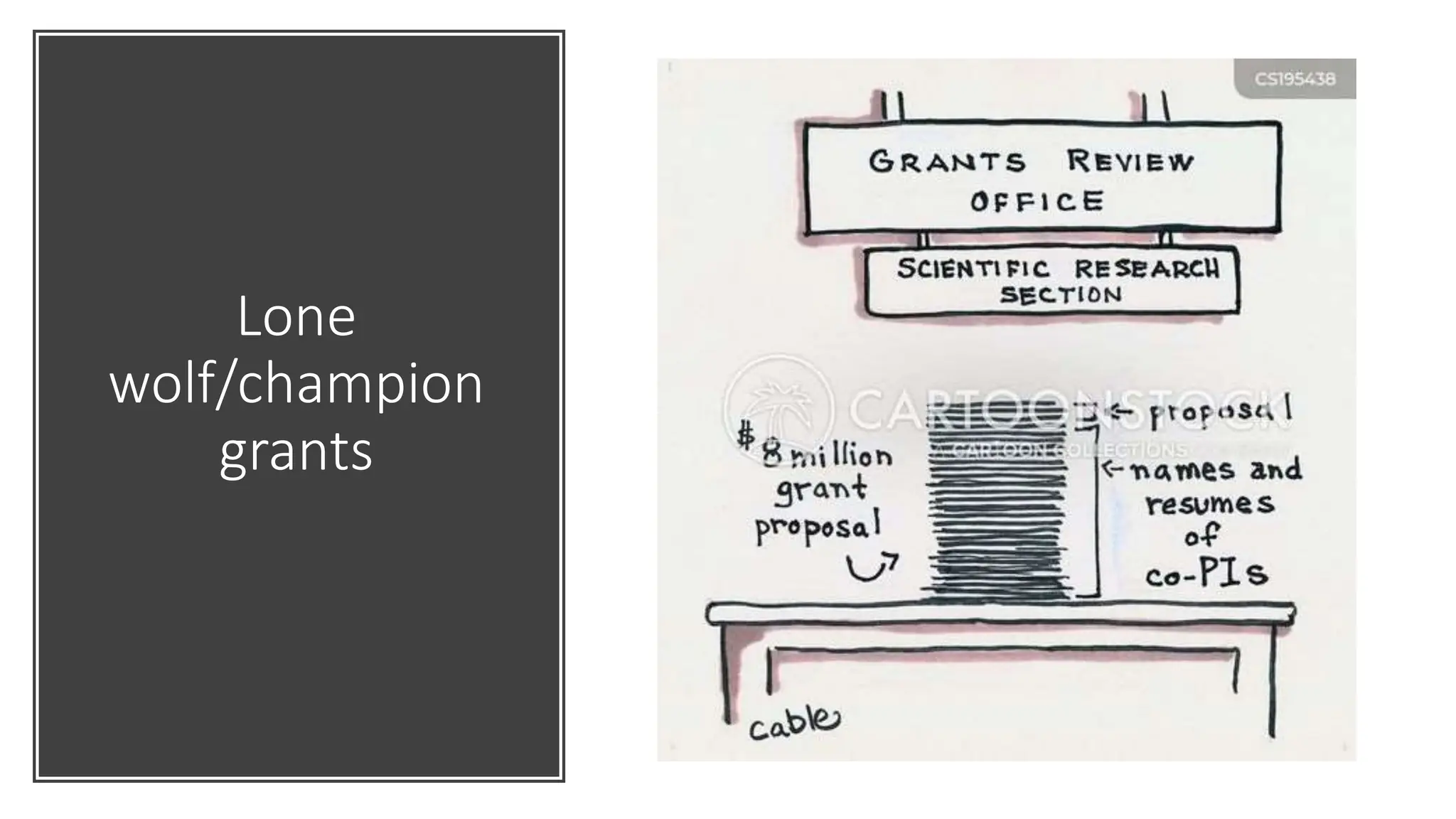
Lone
wolf/champion
grants
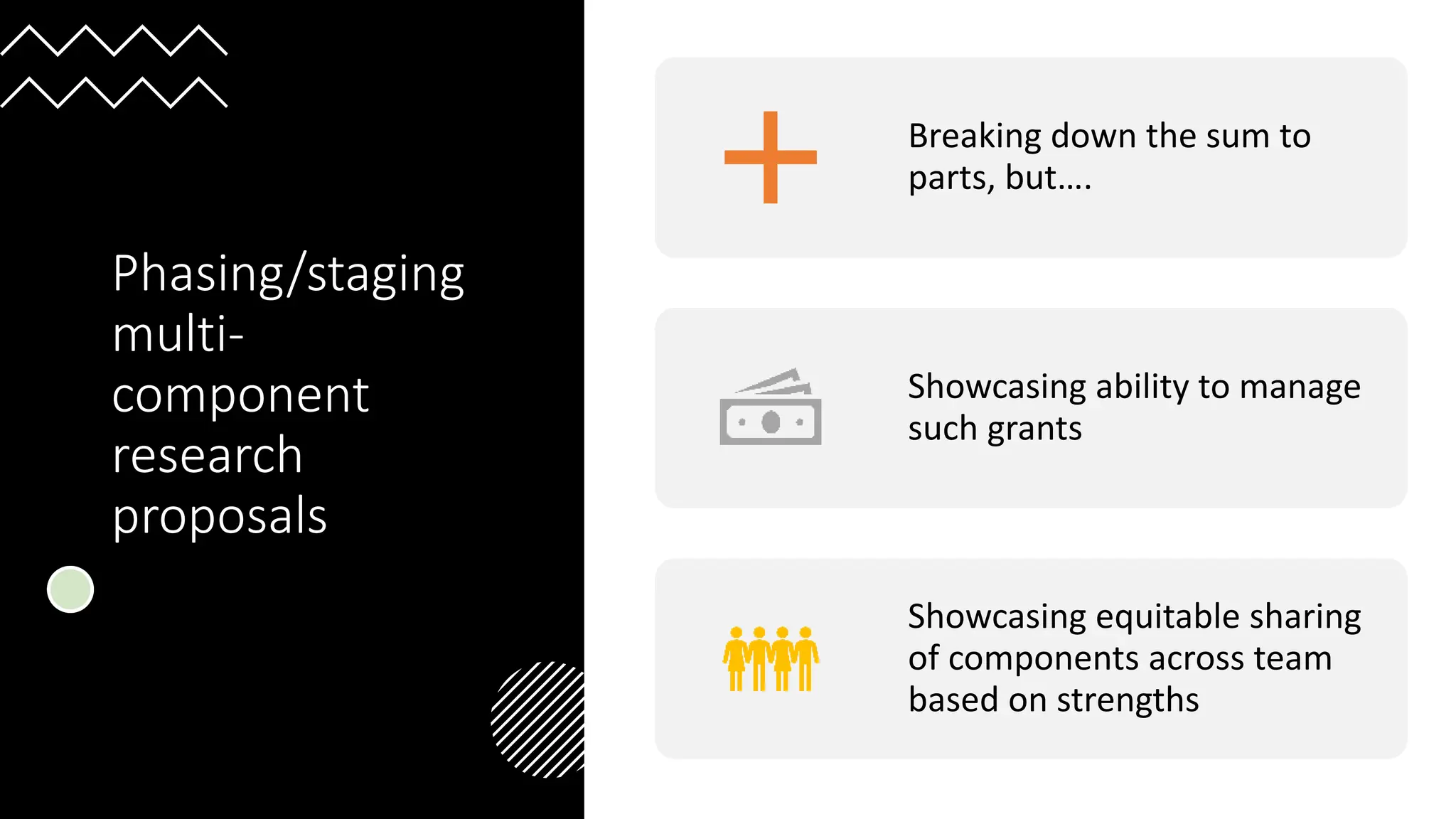
Phasing/staging
multi-
component
research
proposals
Breaking down the sum to
parts, but….
Showcasing ability to manage
such grants
Showcasing equitable sharing
of components across team
based on strengths
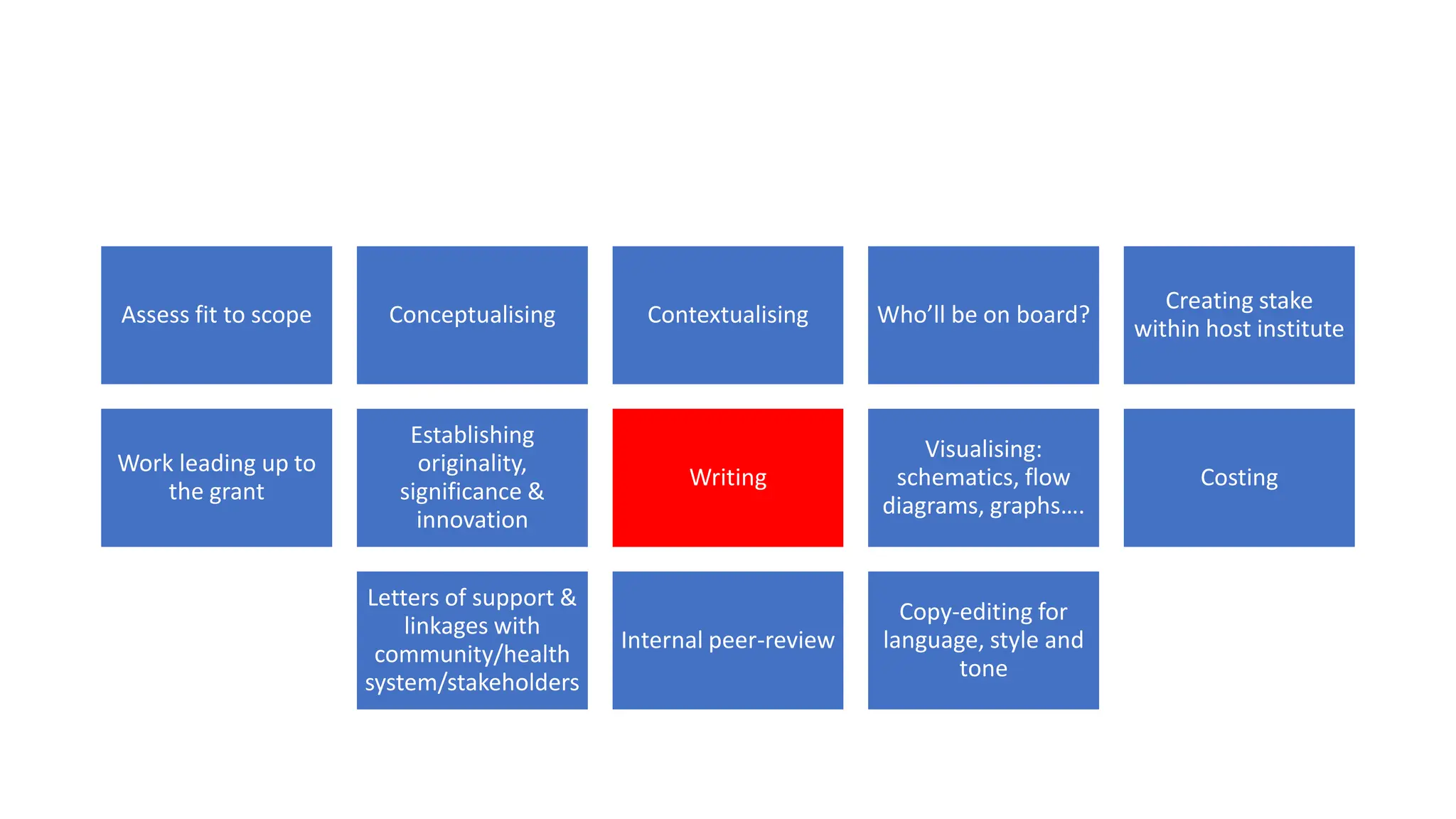
Assess fit to scope Conceptualising Contextualising Who’ll be on board?
Creating stake
within host institute
Work leading up to
the grant
Establishing
originality,
significance &
innovation
Writing
Visualising:
schematics, flow
diagrams, graphs….
Costing
Letters of support &
linkages with
community/health
system/stakeholders
Internal peer-review
Copy-editing for
language, style and
tone
How
significant/innovative
is what you
propose?
Will policy/practice change based on the results of
your proposal?
Will it challenge something we do? Or will we do
things differently based on your results?
Will there be a saving of cost? Will reduce barriers
to care?
Will it create knowledge on a
topic/area/pathway/process for which there is no
current knowledge right now?
Ensure your reviewer is able to understand the
significance of your proposal in the text –
Examples?
Thoughts?
• Aim: To achieve comprehensive screening & treatment for
depression and anxiety disorders in the XXX population through
the development and implementation of an innovative, multi-
modal therapeutic intervention, resulting in improvement in
mental health outcomes and sustained remission.
Overambitious aims
Limit Specific Aims to what you can realistically accomplish during the
grant period. Make sure you know how long the grant period is and do
not submit proposals that clearly will take longer than that time period.
Aims should concisely state how you will test your hypothesis
Source: thepsf.org
Examples (BEWARE: made up statements)
• BAD: Lung diseases are a major health issue worldwide with a
significant impact on quality of life. Hence, it is of an urgent need to
address risk factors of lung disaease and undertake research in this
area
• GOOD: Lung diseases afflict XXX, causing substantial societal and
economic burdens. Chronic obstructive pulmonary disease (COPD),
for instance, affects approximately XXX in India. It leads to
decreased lung function, reduced physical activity, and frequent
hospitalizations. COPD-related healthcare costs exceeded XXX in
2020, accounting for medical expenses, lost productivity, and
disability.4 With smoking being a prominent risk factor and air
pollution on the rise, the incidence of lung diseases is projected to
escalate further, necessitating comprehensive interventions to
alleviate both the individual and societal impacts.
Aims and Objectives
• Crafting specific, measurable, achievable, relevant, and time-
bound (SMART) aims.
• Defining clear objectives that align with the research goals.
COHERENCE!
SEVEN DEADLY SINS THAT KILL YOUR
GRANT PROPOSAL
1. WRITING FOR EXPERT REVIEWERS
2. NO HYPOTHESIS/CONCEPTUAL FRAMEWORK
3. EXPLORATORY/SCOPING PROPOSALS
4. STICKING TO GUIDELIENES & SLOPPINESS
5. OVER/UNDER-AMBITIOUS
6. LAZINESS IN ASSESSING SCOPE,
7. VERY NOVEL BUT HIGH RISK
Source: https://smartsciencecareer.com/sins-grant-proposal/
Thank you!
prashanthns@iphindia.org
@prashanthns on Twitter/X
Random writing at daktre.com

Successful grant proposals Insights and perspectives

  • 1.
    Successful grant proposals Insightsand perspective Prashanth N S, MBBS, MPH, PhD (Public Health)
  • 2.
    Overview of our40 mins interaction • Why do some grants fail? • What makes a successful grant proposal: some interactive examples • Review & funding decisions (typical models in research grantmaking)
  • 3.
  • 4.
    It’s not only aboutthe “writing” Grants fail not only because they’re badly written….
  • 5.
    Fit to scope:I am good at something so I’ll try that for every grant call opportunity • Assess fit • Carefully review guidelines, ambit Egs. - Ambulatory care for NCDs - Implementation Research calls
  • 6.
    Shallow: Limited conceptualization of thecore proposal; lacking in originality/innovation • Exploration of large number of variables that we will collect in elaborate surveys – mining for associations • Unclear reasoning underlying choice of interventions • Limited theoretical basis for trying something • Novel….but without underlying foundation for novelty • Technical jargon understandable only to a niche reviewer Eg. - Descriptive RQs in public health - Incidence/prevalence estimation - Proposals that aim for system change through training
  • 7.
    Not built/building upon existing work/what’s currentlyknown • Limited engagement with literature (who do you cite; whom not?) • Claims/assertions that belie lack of understanding of state-of-the-art in the field • Overly amplified claims of PI/team’s ability & capacity Eg. - A newly designed Tele-psychiatry solution for rural/remote primary health care settings that does not engage with literature documenting challenges/barriers
  • 8.
    Wrong person/institution/team for a goodidea/proposal - Either due to track-record (or lack thereof), or institutional affiliation - Mentorship/supervisory environment lacking - Specific training proposed is lacking in the PI/team Eg. - Implementation research proposal for scaling up a hospital-based mental health intervention in community settings that is written well but not involving impelementers/public health researchers/community medicine…
  • 9.
    Coherence: Overpromising aim/objectives but under-delivering plan/activities - Overlyambitious aim, but activities do not match - Activities/methods/plan do not add up to deliver the several objectives….or the other way round - Background (whats the problem presented to be) • - Objectives/RQ (a type that addresses the problem presented?) • - Methods & plan (addressing the objectives & NOT more) • - Expected outcomes (cf. obj & plan)
  • 10.
  • 11.
    Phasing/staging multi- component research proposals Breaking down thesum to parts, but…. Showcasing ability to manage such grants Showcasing equitable sharing of components across team based on strengths
  • 12.
    Assess fit toscope Conceptualising Contextualising Who’ll be on board? Creating stake within host institute Work leading up to the grant Establishing originality, significance & innovation Writing Visualising: schematics, flow diagrams, graphs…. Costing Letters of support & linkages with community/health system/stakeholders Internal peer-review Copy-editing for language, style and tone
  • 13.
    How significant/innovative is what you propose? Willpolicy/practice change based on the results of your proposal? Will it challenge something we do? Or will we do things differently based on your results? Will there be a saving of cost? Will reduce barriers to care? Will it create knowledge on a topic/area/pathway/process for which there is no current knowledge right now? Ensure your reviewer is able to understand the significance of your proposal in the text – Examples?
  • 14.
    Thoughts? • Aim: Toachieve comprehensive screening & treatment for depression and anxiety disorders in the XXX population through the development and implementation of an innovative, multi- modal therapeutic intervention, resulting in improvement in mental health outcomes and sustained remission.
  • 15.
    Overambitious aims Limit SpecificAims to what you can realistically accomplish during the grant period. Make sure you know how long the grant period is and do not submit proposals that clearly will take longer than that time period. Aims should concisely state how you will test your hypothesis Source: thepsf.org
  • 16.
    Examples (BEWARE: madeup statements) • BAD: Lung diseases are a major health issue worldwide with a significant impact on quality of life. Hence, it is of an urgent need to address risk factors of lung disaease and undertake research in this area • GOOD: Lung diseases afflict XXX, causing substantial societal and economic burdens. Chronic obstructive pulmonary disease (COPD), for instance, affects approximately XXX in India. It leads to decreased lung function, reduced physical activity, and frequent hospitalizations. COPD-related healthcare costs exceeded XXX in 2020, accounting for medical expenses, lost productivity, and disability.4 With smoking being a prominent risk factor and air pollution on the rise, the incidence of lung diseases is projected to escalate further, necessitating comprehensive interventions to alleviate both the individual and societal impacts.
  • 17.
    Aims and Objectives •Crafting specific, measurable, achievable, relevant, and time- bound (SMART) aims. • Defining clear objectives that align with the research goals. COHERENCE!
  • 18.
    SEVEN DEADLY SINSTHAT KILL YOUR GRANT PROPOSAL 1. WRITING FOR EXPERT REVIEWERS 2. NO HYPOTHESIS/CONCEPTUAL FRAMEWORK 3. EXPLORATORY/SCOPING PROPOSALS 4. STICKING TO GUIDELIENES & SLOPPINESS 5. OVER/UNDER-AMBITIOUS 6. LAZINESS IN ASSESSING SCOPE, 7. VERY NOVEL BUT HIGH RISK Source: https://smartsciencecareer.com/sins-grant-proposal/
  • 19.
    Thank you! prashanthns@iphindia.org @prashanthns onTwitter/X Random writing at daktre.com