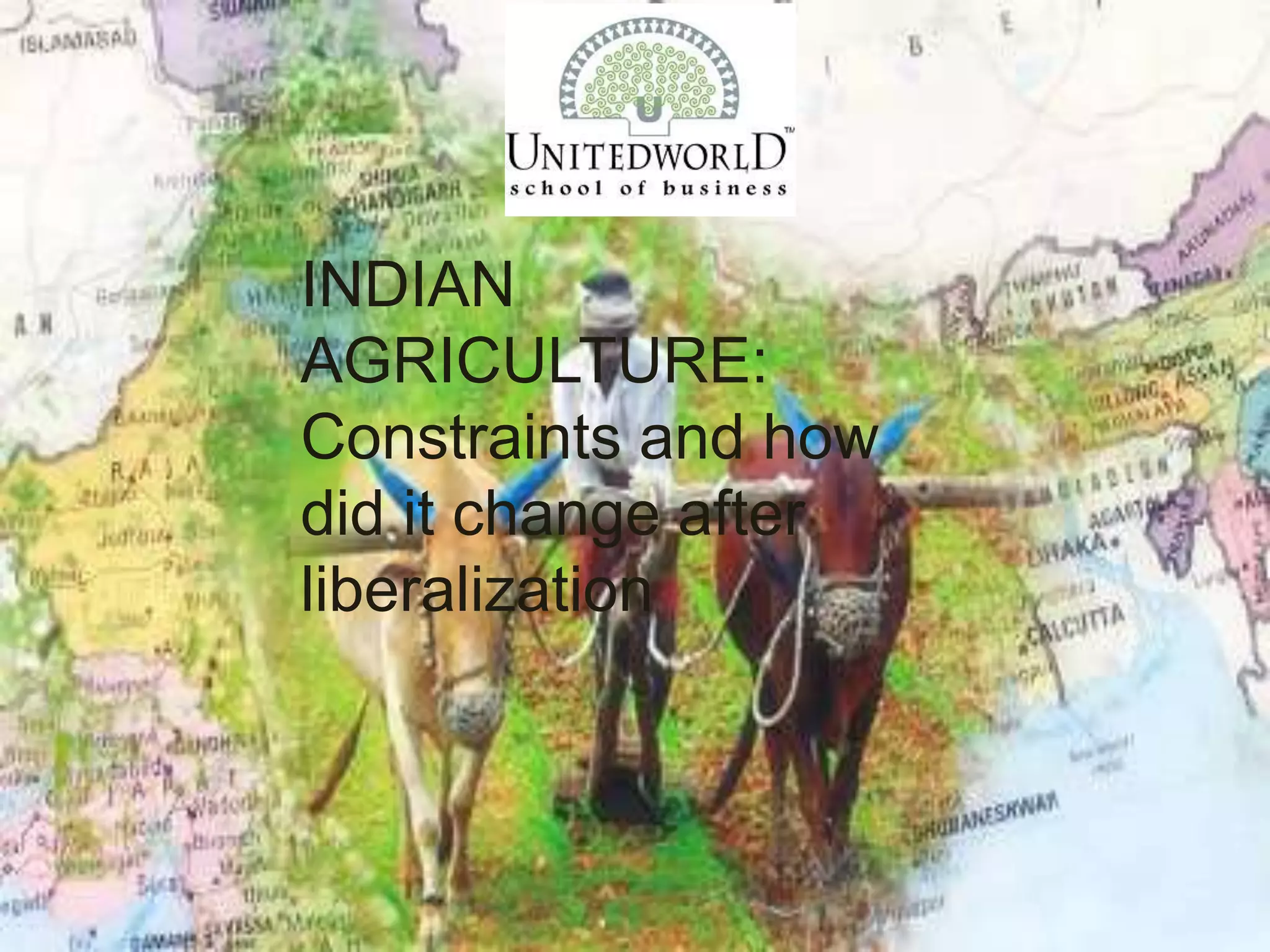


INDIAN 
AGRICULTURE: 
Constraints and how 
did it change after 
liberalization
INTRODUCTION 
Indian Agriculture had reached a stage of 
development and maturity much before 
the now advanced countries of the world 
embarked on the path of progress. Till the 
middle of the 18th century there was a proper 
balance between industry and agriculture and 
both of them flourished hand in hand.it was only 
after the advent of the alien British government 
that agriculture lost the fibre of balance and the 
economy of the country was badly shattered.
Some recent Facts on Indian 
Agriculture 
 Agriculture and allied activities 
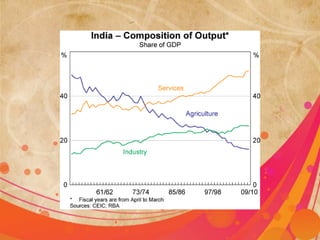
contribute to country’s GDP about 14.2% 
 India is the largest producer, processor 
and exporter of cashew in the whole 
world. 
 As per the final estimates the production 
of food grains during 2008 2009 was 
234.47 million tonnes.
Continued.. 
 National food for work programme 
was launched on November 14,2004 
 The top producer of pulses in india – 
Madhya Pradesh. 
 India is the largest producer of milk 
and spices. 
 Second largest producer of 
rice,wheat,cotton,sugarcane,farmed 
fish,sheep,goat and tea.
Importance of Agriculture in India 
• Share in national income- 14% in 2011- 
12. 
• Largest employment providing sector- 
57% in 2001. 
• Provision of food surplus to the 
expanding population. 
• Providing raw materials to industries 
• It plays a key role in international 
trade for India. 
• Role in poverty reduction.
Constraint for Agriculture in India 
• Smallholder agriculture under neo-liberalism 
small-holder agriculture which 
predominates on large tracts of land in 
the developing countries is slowly 
regaining its importance after decades 
of neglect that it was subject to under 
neo-liberal policies. 
• Lack of Infrastructure 
Indian agriculture industry is suffering of lack 
infrastructure for long period of time and those 
people are doing the agriculture work they don’t 
have that ability to build required infrastructure.
• Monsoon 
Indian agriculture industry is mostly monsoon 
depended. Unless there is good monsoon is 
hard to get agriculture to get as smooth as 
possible. 
• Diminishing rate of return 
It refers to the fact that how much I invest I get 
less return. Due to that factor the agricultural 
industry is getting affected and most of the 
farmers are opting for another profession.
• Falling Output Prices 
The real returns in agriculture were already 
declining, particularly for commercially 
cultivated crops, under the economic reforms 
period. Since the liberalization of trade in 
agricultural commodities in the mid-nineties. 
• Technological factors 
Apart from some part of the country Indian 
farmers are not so economically well off. For 
that reason farmers don’t get to access new 
technologies.
i 
g 
h 
l 
o 
a • Lack of credit 
Credit for agriculture industry was not well 
structured that is why many farmers were 
suffering from taking high debt and many 
bank as now it is we can see it was not there 
before.
Causes of low productivity 
• Social environment of villages is often stated as an 
obstacle in agriculture development. 
• Extreme pressure of population on land due that 
non-agricultural sectors of the economy not even 
expand. 
• Lack of credit and marketing facilities. 
• One of the key reason is zamindari system due to 
that land in not get the proper tenure. 
• Outdated agricultural techniques. 
• Inadequate irrigation facilities.
Green revolution 
• A new agricultural strategy was put into 
practise for the 1st time in India in the kharif 
season of 1966 and was termed high yielding 
variety of seeds and the programme was also 
called high yielding variety seeds programme 
(hyvp) since it depended crucially on 
irrigation,fertilisers,heavy seeds, pesticides 
and insecticides. However, it was mainly 
restricted to wheat,rice,jowar,bajra and maize.
continued 
• However green revolution mainly 
concentrated on wheat and an increase in 
productivity was mainly seen in states like 
Punjab, Haryana, western Uttar Pradesh 
• Poor farmers could not afford the new seeds 
or fertilisers that was required 
 Inadequate irrigation cover 
 Inadequate adoption of technology
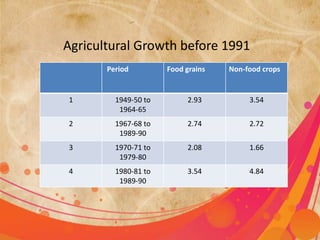
Agricultural Growth before 1991 
Period Food grains Non-food crops 
1 1949-50 to 
1964-65 
2.93 3.54 
2 1967-68 to 
1989-90 
2.74 2.72 
3 1970-71 to 
1979-80 
2.08 1.66 
4 1980-81 to 
1989-90 
3.54 4.84
Post Liberalization 
Period
Post liberalization 
Economic liberalisation and Indian agriculture is 
an in depth study that throws light on the 
changes that happened after 1991. After 1991 a 
massive change happened in Economic Policy 
that directly affect Indian Agriculture.
Structured Credit system 
After 1991 government of India forms many banks 
to give a proper credit delivery . For that reason 
government form many banks for giving loan to the 
farmers. Like 
•NABARD 
• RRB 
• National Institute Agriculture Extension 
Management. 
• Multi Commodity Exchange
Government’s Policies for agriculture 
• Krishan credit card 
• e-choupel 
• Easy loan process system for the farmers 
• waiving the processing fees for the farmers 
• Direct buy from the farmers 
• Reducing the middle man as low as possible
Causes: 
• Significant collation in the overall investment 
• Evolve new technologies 
• Shrinking farm size 
• Inadequate irrigation cover 
• Balanced use of inputs 
• Credit delivery system
Post liberalisation phase 
its generally divided into two phases: 
The period 1990-93 to 2003-6 
The period since 2005-6
The period since 2005-06 
• This period specially in the 11th 5 year plan has 
seen remarkably the recovery of agricultural 
growth. states like Andhra 
Pradesh,Gujarat,Maharashtra,Jharkhand,Tripu 
ra have recorded a 5%plus growth rate in 
agriculture. This was mainly due to the 
conscious hike in public and private 
investment
1990 to 2012 
• Agricultural growth during these years are 
mainly the reflection of the impact of 
economic reforms on agricultural 
performance. this period is marked by sharp 
deceleration in the southern and north 
western region except Gujarat. Because there 
was a rapid spread of cotton during that time 
in Gujarat.
Ahmedabad Campus: Karnavati Knowledge Village, 
A/907,Uvarsad, S.G.Highway, Gandhinagar 
Kolkata Campus: Infinity Benchmark Tower 10th Floor, 
Plot - G1, Block - EP& GP, Sec - V, Salt Lake, Kolkata. 
Reg. Office: 407, Zodiac Square, 4th Floor Opp. 
Gurudwara, S.G. Road, Bodakdev, Ahmedabad.

INDIAN AGRICULTURE

  • 1.
    INDIAN AGRICULTURE: Constraintsand how did it change after liberalization
  • 2.
    INTRODUCTION Indian Agriculturehad reached a stage of development and maturity much before the now advanced countries of the world embarked on the path of progress. Till the middle of the 18th century there was a proper balance between industry and agriculture and both of them flourished hand in hand.it was only after the advent of the alien British government that agriculture lost the fibre of balance and the economy of the country was badly shattered.
  • 3.
    Some recent Factson Indian Agriculture  Agriculture and allied activities contribute to country’s GDP about 14.2%  India is the largest producer, processor and exporter of cashew in the whole world.  As per the final estimates the production of food grains during 2008 2009 was 234.47 million tonnes.
  • 4.
    Continued..  Nationalfood for work programme was launched on November 14,2004  The top producer of pulses in india – Madhya Pradesh.  India is the largest producer of milk and spices.  Second largest producer of rice,wheat,cotton,sugarcane,farmed fish,sheep,goat and tea.
  • 5.
    Importance of Agriculturein India • Share in national income- 14% in 2011- 12. • Largest employment providing sector- 57% in 2001. • Provision of food surplus to the expanding population. • Providing raw materials to industries • It plays a key role in international trade for India. • Role in poverty reduction.
  • 6.
    Constraint for Agriculturein India • Smallholder agriculture under neo-liberalism small-holder agriculture which predominates on large tracts of land in the developing countries is slowly regaining its importance after decades of neglect that it was subject to under neo-liberal policies. • Lack of Infrastructure Indian agriculture industry is suffering of lack infrastructure for long period of time and those people are doing the agriculture work they don’t have that ability to build required infrastructure.
  • 7.
    • Monsoon Indianagriculture industry is mostly monsoon depended. Unless there is good monsoon is hard to get agriculture to get as smooth as possible. • Diminishing rate of return It refers to the fact that how much I invest I get less return. Due to that factor the agricultural industry is getting affected and most of the farmers are opting for another profession.
  • 8.
    • Falling OutputPrices The real returns in agriculture were already declining, particularly for commercially cultivated crops, under the economic reforms period. Since the liberalization of trade in agricultural commodities in the mid-nineties. • Technological factors Apart from some part of the country Indian farmers are not so economically well off. For that reason farmers don’t get to access new technologies.
  • 9.
    i g h l o a • Lack of credit Credit for agriculture industry was not well structured that is why many farmers were suffering from taking high debt and many bank as now it is we can see it was not there before.
  • 10.
    Causes of lowproductivity • Social environment of villages is often stated as an obstacle in agriculture development. • Extreme pressure of population on land due that non-agricultural sectors of the economy not even expand. • Lack of credit and marketing facilities. • One of the key reason is zamindari system due to that land in not get the proper tenure. • Outdated agricultural techniques. • Inadequate irrigation facilities.
  • 11.
    Green revolution •A new agricultural strategy was put into practise for the 1st time in India in the kharif season of 1966 and was termed high yielding variety of seeds and the programme was also called high yielding variety seeds programme (hyvp) since it depended crucially on irrigation,fertilisers,heavy seeds, pesticides and insecticides. However, it was mainly restricted to wheat,rice,jowar,bajra and maize.
  • 12.
    continued • Howevergreen revolution mainly concentrated on wheat and an increase in productivity was mainly seen in states like Punjab, Haryana, western Uttar Pradesh • Poor farmers could not afford the new seeds or fertilisers that was required  Inadequate irrigation cover  Inadequate adoption of technology
  • 13.
    Agricultural Growth before1991 Period Food grains Non-food crops 1 1949-50 to 1964-65 2.93 3.54 2 1967-68 to 1989-90 2.74 2.72 3 1970-71 to 1979-80 2.08 1.66 4 1980-81 to 1989-90 3.54 4.84
  • 14.
  • 15.
    Post liberalization Economicliberalisation and Indian agriculture is an in depth study that throws light on the changes that happened after 1991. After 1991 a massive change happened in Economic Policy that directly affect Indian Agriculture.
  • 16.
    Structured Credit system After 1991 government of India forms many banks to give a proper credit delivery . For that reason government form many banks for giving loan to the farmers. Like •NABARD • RRB • National Institute Agriculture Extension Management. • Multi Commodity Exchange
  • 17.
    Government’s Policies foragriculture • Krishan credit card • e-choupel • Easy loan process system for the farmers • waiving the processing fees for the farmers • Direct buy from the farmers • Reducing the middle man as low as possible
  • 18.
    Causes: • Significantcollation in the overall investment • Evolve new technologies • Shrinking farm size • Inadequate irrigation cover • Balanced use of inputs • Credit delivery system
  • 19.
    Post liberalisation phase its generally divided into two phases: The period 1990-93 to 2003-6 The period since 2005-6
  • 20.
    The period since2005-06 • This period specially in the 11th 5 year plan has seen remarkably the recovery of agricultural growth. states like Andhra Pradesh,Gujarat,Maharashtra,Jharkhand,Tripu ra have recorded a 5%plus growth rate in agriculture. This was mainly due to the conscious hike in public and private investment
  • 21.
    1990 to 2012 • Agricultural growth during these years are mainly the reflection of the impact of economic reforms on agricultural performance. this period is marked by sharp deceleration in the southern and north western region except Gujarat. Because there was a rapid spread of cotton during that time in Gujarat.
  • 23.
    Ahmedabad Campus: KarnavatiKnowledge Village, A/907,Uvarsad, S.G.Highway, Gandhinagar Kolkata Campus: Infinity Benchmark Tower 10th Floor, Plot - G1, Block - EP& GP, Sec - V, Salt Lake, Kolkata. Reg. Office: 407, Zodiac Square, 4th Floor Opp. Gurudwara, S.G. Road, Bodakdev, Ahmedabad.