The Institute of Chartered Accountants of India
(Setup by an Act of Parliament)

A Comparative Analysis
A Presentation by :
YASH JAIN

SIMRAN BATRA

CRO-0427695

CRO-0432268

RONAK AGRAWAL
CRO-0439329
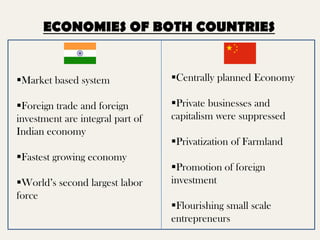
ECONOMIES OF BOTH COUNTRIES

Market based system

Centrally planned Economy

Foreign trade and foreign
investment are integral part of
Indian economy

Private businesses and
capitalism were suppressed

Fastest growing economy
World’s second largest labor
force

Privatization of Farmland
Promotion of foreign
investment
Flourishing small scale
entrepreneurs
50 yrs ago, India and China were among the poorest and
economically most isolated countries in the world.

How did China and India
emerge as economic
giants?
Comparing India and China’s Growth Stories
Indicators
Political System

Speed of
Growth

Areas of
Specialization

India

China

Multi-party
Democracy

One-party
authoritarian rule

Economic reforms
started in 1991.
Average 6% growth
rate in past two
decades.
Rising power in
software, design,
services, and
precision industry.

Economic reforms
started in 1978.
Average 9.5%
growth rate in past
two decades.
Dominant in mass
manufacturing,
electronics and
heavy industrial
plants
What are India & China famous for today?

CALL CENTRES & COMPUTER
ENGINEERS

LOW PRICED CONSUMER
GOODS
India – Economic Fact Sheet
GDP- real growth rate:
6.5% (2012 est.)
7.7% (2011 est.)
11.2% (2010 est.)
GDP – per capita (PPP – Purchasing power parity)
$3,900 (2012 est.)
$3,800 (2011 est.)
$3,600 (2010 est.)
note: data are in 2012 US dollars
GDP – Composition by sector:
agriculture: 17.4%
industries: 26.1%
services: 56.5%
(2012 est.)
China – Economic Fact Sheet
GDP – real growth rate:
7.8% (2012 est.)
9.3% (2011 est.)
10.4% (2010 est.)

GDP-Per capita (PPP-Purchasing power parity):
$9,300 (2012 est.)
$8,700 (2011 est.)
$8,000 (2010 est.)
note: data are in 2012 US dollars

GDP – composition by sector:
agriculture: 10.1%
industries: 45.3%
services: 44.6%
(2012 est.)
AGRICULTURAL SECTOR

•India is an agricultural country.
•Growth of service sector is pushing
down the contribution of agriculture.
•Contributing 17.2% of the GDP.
•Largely depends on monsoon.
•Provides employment to two-thirds of
the
total population.
•15% of export earnings
•Rural women play a vital role, 50% of
rural labor force.
•Yields per hectare of crops in India are
very low

Agriculture accounted for 10.6 % of
the GDP
33o million- over 45% of labor force
still makes living from farming.
Farming methods have been
improved in China.
China produces wheat, rice, potatoes,
peanuts, millet, cotton.
Only 15 percent of the total land
available in China can be cultivated.
More than 75 percent of the total
cultivated land is used for producing
food crops.
MANUFACTURING SECTOR
•Manufacturing contributes around 15% of
GDP of the country.
•India rank’s among top 12 producers of
manufacturing value added products.

•Chinese manufacturing sector accounts for
43% of Chinese economy.
•Its economy growth in average of almost
8% every year.

•There are many Companies who wants to
make India as their manufacturing hub, they
are:

•Chinese manufacturing sector ranks 4th in
the world after US, Japan, & Germany.

•LG wants to make India its global
manufacturing hub for its mobile handsets.

•China has 50% share of worldwide camera
market & 30% of Air conditioners .

•Hyundai has make India the manufacturing
& exporting hub for its small cars. Their i10
is being manufactured only in India &
exported to the world.

•25% of Washing Machines & 20% of
Refrigerators.
Continued ..

•Luxury brands like Louis Vuitton are
looking at India as a manufacturing base
for their products.
•Skoda Auto plans to make India its
regional manufacturing hub.
• Aircraft manufacturing Airbus is
considering India as one of the centers for
design & development of its long haul
A350 plane.
•Samsung plans to invest 100 million US
$ in its manufacturing plant near Chennai
& make it its global hub.

•China’s fast growing domestic market
worldwide demand for Chinese goods
& the cost advantage China offers to
manufacturers are fueling the growth of
manufacturing sector in China.
•In all, China is much ahead of India in
manufacturing sector

* According to Investment
Commission of India the manufacturing
sector is estimated to have 180 billion
US $ investment opportunity over next
5 years
Service sector
INDIA

CHINA

54 per cent of GDP

Below 41 per cent of GDP

Since 1978 to 2011 :
Average Annual Growth rate is 8.1%

Average Annual Growth rate is 10.8%

Employment Opportunities :
Low

Employment Opportunities :
High

Most advanced service sector :
Delhi with a GDP share of 77 per cent

Most advanced service sector :
Beijing with a GDP share of 61 per cent

A net exporter of services

A net importer of services
Service Sector Share over Total GDP
GDP shares by sector in China and
India
CURRENCIES

Indian
Rupee

Chinese
Renminbi

Current exchange rate
1.00 USD, = 62.1393
Current exchange rate
1.00 USD, = 6.05990 CNY
India’s Problem
Infrastructure sector.
Insufficient investments.
Losing the best and the brightest abroad.
Constraint's in labor market needed for
manufacturing Industry.
China’s Problem
Middle Income Trap (transition from middle income to high
income status).
Ageing population - "one child" policy.
High domestic savings rate and correspondingly low domestic
demand.

As China's per capita income rises, its 1.34 billion people will
increasingly yearn for real freedom: a free press, an open
Internet and, most crucially, democracy.
INDIA AND CHINA IN 2020
• According to a recent report from
international economic think tanks, India and
China soon plans to form a trade coalition in
Asia and that is projected to boost 65% of
world trade by near 2020.Both the countries
India and China are determined to achieve
that and create a huge impact on world
economic bodies.
India’s long-term prospects look
Stronger
India is no. 1 talent supplier in the world.
India's advantage in having a large pool of
English speaking people.
India has the advantage of having a
vibrant, energetic and creative NGO sector.
India shouldn’t try to grow as rapidly as China

“Growth has to be aimed within a relevant
country context. India has its own unique
past, a very different present, and will chart
her own version of the future. In that
future, the most critical component is to
keep democracy safe.”
PRESENTATION BY :

YASH JAIN
SIMRAN BATRA
RONAK AGARWAL
THANK YOU.
THANK-YOU 

India-china a comparative analysis

  • 1.
    The Institute ofChartered Accountants of India (Setup by an Act of Parliament) A Comparative Analysis A Presentation by : YASH JAIN SIMRAN BATRA CRO-0427695 CRO-0432268 RONAK AGRAWAL CRO-0439329
  • 2.
    ECONOMIES OF BOTHCOUNTRIES Market based system Centrally planned Economy Foreign trade and foreign investment are integral part of Indian economy Private businesses and capitalism were suppressed Fastest growing economy World’s second largest labor force Privatization of Farmland Promotion of foreign investment Flourishing small scale entrepreneurs
  • 3.
    50 yrs ago,India and China were among the poorest and economically most isolated countries in the world. How did China and India emerge as economic giants?
  • 4.
    Comparing India andChina’s Growth Stories Indicators Political System Speed of Growth Areas of Specialization India China Multi-party Democracy One-party authoritarian rule Economic reforms started in 1991. Average 6% growth rate in past two decades. Rising power in software, design, services, and precision industry. Economic reforms started in 1978. Average 9.5% growth rate in past two decades. Dominant in mass manufacturing, electronics and heavy industrial plants
  • 5.
    What are India& China famous for today? CALL CENTRES & COMPUTER ENGINEERS LOW PRICED CONSUMER GOODS
  • 6.
    India – EconomicFact Sheet GDP- real growth rate: 6.5% (2012 est.) 7.7% (2011 est.) 11.2% (2010 est.) GDP – per capita (PPP – Purchasing power parity) $3,900 (2012 est.) $3,800 (2011 est.) $3,600 (2010 est.) note: data are in 2012 US dollars GDP – Composition by sector: agriculture: 17.4% industries: 26.1% services: 56.5% (2012 est.)
  • 7.
    China – EconomicFact Sheet GDP – real growth rate: 7.8% (2012 est.) 9.3% (2011 est.) 10.4% (2010 est.) GDP-Per capita (PPP-Purchasing power parity): $9,300 (2012 est.) $8,700 (2011 est.) $8,000 (2010 est.) note: data are in 2012 US dollars GDP – composition by sector: agriculture: 10.1% industries: 45.3% services: 44.6% (2012 est.)
  • 8.
    AGRICULTURAL SECTOR •India isan agricultural country. •Growth of service sector is pushing down the contribution of agriculture. •Contributing 17.2% of the GDP. •Largely depends on monsoon. •Provides employment to two-thirds of the total population. •15% of export earnings •Rural women play a vital role, 50% of rural labor force. •Yields per hectare of crops in India are very low Agriculture accounted for 10.6 % of the GDP 33o million- over 45% of labor force still makes living from farming. Farming methods have been improved in China. China produces wheat, rice, potatoes, peanuts, millet, cotton. Only 15 percent of the total land available in China can be cultivated. More than 75 percent of the total cultivated land is used for producing food crops.
  • 9.
    MANUFACTURING SECTOR •Manufacturing contributesaround 15% of GDP of the country. •India rank’s among top 12 producers of manufacturing value added products. •Chinese manufacturing sector accounts for 43% of Chinese economy. •Its economy growth in average of almost 8% every year. •There are many Companies who wants to make India as their manufacturing hub, they are: •Chinese manufacturing sector ranks 4th in the world after US, Japan, & Germany. •LG wants to make India its global manufacturing hub for its mobile handsets. •China has 50% share of worldwide camera market & 30% of Air conditioners . •Hyundai has make India the manufacturing & exporting hub for its small cars. Their i10 is being manufactured only in India & exported to the world. •25% of Washing Machines & 20% of Refrigerators.
  • 10.
    Continued .. •Luxury brandslike Louis Vuitton are looking at India as a manufacturing base for their products. •Skoda Auto plans to make India its regional manufacturing hub. • Aircraft manufacturing Airbus is considering India as one of the centers for design & development of its long haul A350 plane. •Samsung plans to invest 100 million US $ in its manufacturing plant near Chennai & make it its global hub. •China’s fast growing domestic market worldwide demand for Chinese goods & the cost advantage China offers to manufacturers are fueling the growth of manufacturing sector in China. •In all, China is much ahead of India in manufacturing sector * According to Investment Commission of India the manufacturing sector is estimated to have 180 billion US $ investment opportunity over next 5 years
  • 11.
    Service sector INDIA CHINA 54 percent of GDP Below 41 per cent of GDP Since 1978 to 2011 : Average Annual Growth rate is 8.1% Average Annual Growth rate is 10.8% Employment Opportunities : Low Employment Opportunities : High Most advanced service sector : Delhi with a GDP share of 77 per cent Most advanced service sector : Beijing with a GDP share of 61 per cent A net exporter of services A net importer of services
  • 12.
    Service Sector Shareover Total GDP
  • 13.
    GDP shares bysector in China and India
  • 14.
    CURRENCIES Indian Rupee Chinese Renminbi Current exchange rate 1.00USD, = 62.1393 Current exchange rate 1.00 USD, = 6.05990 CNY
  • 15.
    India’s Problem Infrastructure sector. Insufficientinvestments. Losing the best and the brightest abroad. Constraint's in labor market needed for manufacturing Industry.
  • 16.
    China’s Problem Middle IncomeTrap (transition from middle income to high income status). Ageing population - "one child" policy. High domestic savings rate and correspondingly low domestic demand. As China's per capita income rises, its 1.34 billion people will increasingly yearn for real freedom: a free press, an open Internet and, most crucially, democracy.
  • 17.
    INDIA AND CHINAIN 2020 • According to a recent report from international economic think tanks, India and China soon plans to form a trade coalition in Asia and that is projected to boost 65% of world trade by near 2020.Both the countries India and China are determined to achieve that and create a huge impact on world economic bodies.
  • 18.
    India’s long-term prospectslook Stronger India is no. 1 talent supplier in the world. India's advantage in having a large pool of English speaking people. India has the advantage of having a vibrant, energetic and creative NGO sector.
  • 19.
    India shouldn’t tryto grow as rapidly as China “Growth has to be aimed within a relevant country context. India has its own unique past, a very different present, and will chart her own version of the future. In that future, the most critical component is to keep democracy safe.”
  • 20.
    PRESENTATION BY : YASHJAIN SIMRAN BATRA RONAK AGARWAL THANK YOU.
  • 21.