India: Life Sciences Investment Strategy

“Culture & Nurture”
                                           Gaithersburg, MD
                                                March 2007
Harshawardhan Bal, M.Pharm., PhD.

                                                      Draft
India is fast becoming a centerpiece of global strategy: Transition from an
outsourcing destination to an intellectual powerhouse


  Outside agencies in India to foster science collaboration
  •     National Science Foundation (Oct 2006) - World's largest basic science funding
        agency; “Nobel Prize” incubator
  •     World Bank’s private sector arm - International Finance Corporation - $43m in
        investments in four projects in India
  •     The US Agency of International Development and Cornell University - supporting
        research on improving the stock of major food crops - eggplant that is resistant to
        shoot borers, potato resistant to blight, and drought- and salt-tolerant rice


  Approach
  •     Focus on "increasing presence" in India
  •     Ensure "direct contact" with Indian scientists
  •     Priority areas - math, engineering, geo-sciences, life sciences and computers
  •     “competing through collaboration” (set up collaborative programs with Indian
        scientists)
India’s ivy leagues set up incubators to tap emerging entrepreneurial
ecosystem
   IIT Bombay - Society for Innovation (SINE)
   •     SINE is an investor in startups it supports (takes equity stake in funded
         companies)
   •     Provides office space and use of its facilities at ~ 75% of market rate
   •     Companies must “graduate” in 3 yrs and establish own infrastructure
   •     SINE currently funds < 10% of the score of applications its receives
   •     Mix of software and non-software (earth sciences, telecommunications, etc.)
   •     SINE start-ups have domestic focus but international scope

   IIM-A Centre for Innovation, Incubation and Entrepreneurship (CIIE, 2001)
   •     Established the Indian Incubator for Innovation-based Enterprises (I3E)
   •     Selects innovators to enter incubator through search program “Anveshan”
   •     Provides technical support, testing facilities, materials, prototyping facilities, legal
         assistance, venture funding, patent filing, etc.
   •     Network partners include DST, CSIR, IITs, Wadhwani Foundation, VC firms
   •     Awards companies in 3 categories
      –    "innovation in search of an enterprise“ (commercialize technology or prototype)
      –    "idea in search of an innovation" (undeveloped concept or idea)
      –    "innovation with a business plan" (business plan around an innovative idea)

      Indian incubators are becoming one-stop shops for VCs looking for smart ideas
Indian Government provides impetus to burgeoning Life Sciences
    industry through creation of Biotechnology parks

Dept. of Biotechnology & Gov of AP set up biotechnology incubator (August 2003)
•       First full-fledged biotechnology incubator in Hyderabad with investment of Rs. 27 cr.
•       State has allocated three acres of land; Capital infusion by DBT Rs. 8-9 cr. (2003-04)
•       Incubator will be managed by a consortium led by Indian Institute of Chemical
        Technology, a part of Council of Scientific and Industrial Research


India to create 10 biotech parks by 2010 (DBT Secretary M K Bhan, Feb. 2006)
•       A new Biotechnology Parks Society of India will be set up to oversee the creation and
        support of at least 10 biotech parks with incubator units
•       Biotech clusters are currently operational in Bangalore Hyderabad, Pune and Mumbai
•       Parks will offer services like contract research, clinical trials and development of
        biotechnology products
•       DBT has approved a Clinical Research Trials Institute in Hyderabad to conduct large-
        scale clinical trials
ICICI Knowledge Park Life Science Incubator: ICICI Bank Ltd. & Gov. of
Andhra Pradesh partner to facilitate business-driven R&D

Space of 3,200 sqft for 8 incubatees to encourage and nurture startup companies and
spin offs in pharmaceutical and biotechnology


Laurus Labs Private Ltd
•       Focus Area : Process development and validation
•       Lab Area Leased: 6.78 acres
Premium Phytoceuticals
•       Focus Area : Plant based therapeutics
•       Lab Area Leased: 2 Units in Life Science Incubator Lab
Regain Biotechnology
•       Focus Area : Plant based therapeutics
•       Lab Area Leased: 2 Units in Life Science Incubator Lab
Graduates
•       Biomax Life Sciences
    –    Focus Area : Plant based therapeutics
    –    Lab Area Leased: Unit 4 Life Science Incubator Lab
High-growth areas which carry potential investment opportunities for VCs

Clinical & manufacturing for Biotechnology products
•       Global biotech/pharma companies outsourcing > US$500 M worth of research to India
•       India's revenue from the custom synthesis & manufacturing business is ~ $ 1-1.5 B
•       Exports of biotech products, driven by vaccines, statins, contract research and clinical
        trials, accounted for 42% of total revenues
•       India’s clinical research market ($200 M in 2005), is expected to reach $1.5 B by 2010
•       India's biotech industry is projected to reach $5 B in annual sales by 2009, constituting
        10% of the global industry
•       India has a diverse species of flora and fauna that gives the added advantage for
        biotech companies to carry on their research and drug discovery effectively


India’s unmet medical needs
•       34 M diabetic patients
•       8-10 M people with HIV
•       8 M epileptic patients
•       3 M cancer patients
High-growth areas which carry potential investment opportunities for VCs

Agribiotechnology
•       India surpasses China in number of hectares planted with genetically-modified
        seeds. (3.8 M biotech hectares vs China’s 3.5 million hectares).
•       Research in biotechnologically enhanced crops - a major role for the rapidly
        increasing number of projects in Asia (Chairman of International Service for the
        Acquisition of Agri-biotech Applications)
•       Vit A enhanced rice likely next main crop to be commercialized in Asia after
        cotton
•       Technology related to agriculture sector is an area identified by Indian finance
        minister for tax benefits
Potential opportunities for grassroots manpower development

Intellectual capital development through academic research

•       Align with the goals of the National Biotechnology Development Policy to foster creation
        of skilled biotechnology manpower

•       The Biotechnology sector can achieve double-digit growth rates by overcoming skilled
        manpower shortage in modern science areas (molecular biology, bioinformatics, etc.)

•       India is projected to invest US$ 80 M in 2007 to develop a national network of research
        laboratories

•       The Department of chemicals and petrochemicals has sought Rs 5 B to establish
        institutes to meet the growing demand for pharmaceutical professionals
“Discontinuities” in the Indian venture scenario can be exploited by VCs to
formulate market entry strategies

  Lack of an entrepreneurial “Silicon valley” environment
  •   Social networks and clubs that nurture entrepreneur growth and facilitate
      entrepreneur-investor relations are virtually non-existent
  •   Angel networks (often started by serial entrepreneurs themselves) that provide
      budding entrepreneurs capital, advice, and mentorship are absent
  Lack of research infrastructure and orientation
  •   Indian educational institutes provide top-quality undergraduate training but lack
      depth in graduate level University research
  •   Most Indian universities (and students) are ill-equipped to tackle the complex,
      interdisciplinary nature of modern biomedical science
  •   Incubators attached to Indian schools are not comparable to US counterparts
  End-result
  •   Business plans from India lack spark and are described as “average”
  •   The number of good deals is far and few between
  •   Relationships between VCs and portfolio companies tend to be adversarial
VCs can build a “thought leader” image in Indian Life Sciences by
supporting grass-roots innovation - A “Culture & Nurture” approach

  De novo approach
  •     Enter into agreements with 1 or 2 top advanced R&D institution/Universities through local
        offices
        •      1-2 investigators selected via a program announcement or RFA
        •      Agreement includes standard VC deal terms
  •     Fund faculty led R&D in specific areas (see slide 6 & 7) with direct commercial potential for
        spinning out novel IP and technologies
        •      Appoint local project managers to work with department heads/ professors to identify
               topics for research and commercialization
  •     Focus on areas that have a strong domestic market (apart from a global market)
  •     Develop a support structure to guide the “paper to product” transition
        •      Coaching and mentorship
        •      Consultancy/advisory/technology transfer services
        •      Market/customer linkages
        •      Access to network of experts, successful entrepreneurs & managers
  •     Select projects with short life cycles – 1 yr (late stage) to 3 yrs (early to medium stage) to
        product launch
  •     Fund projects with modules of $25,000* (direct cost only), up to an upper limit (3 yrs or $
        75,000*), renewable annually based on progress up to 3 yrs

  *Place holders. Actual figures TBD
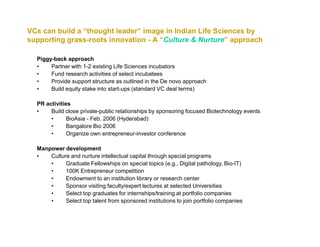
VCs can build a “thought leader” image in Indian Life Sciences by
supporting grass-roots innovation - A “Culture & Nurture” approach

  Piggy-back approach
  •    Partner with 1-2 existing Life Sciences incubators
  •    Fund research activities of select incubatees
  •    Provide support structure as outlined in the De novo approach
  •    Build equity stake into start-ups (standard VC deal terms)

  PR activities
  •    Build close private-public relationships by sponsoring focused Biotechnology events
       •      BioAsia - Feb. 2006 (Hyderabad)
       •      Bangalore Bio 2006
       •      Organize own entrepreneur-investor conference

  Manpower development
  •   Culture and nurture intellectual capital through special programs
      •     Graduate Fellowships on special topics (e.g., Digital pathology, Bio-IT)
      •     100K Entrepreneur competition
      •     Endowment to an institution library or research center
      •     Sponsor visiting faculty/expert lectures at selected Universities
      •     Select top graduates for internships/training at portfolio companies
      •     Select top talent from sponsored institutions to join portfolio companies
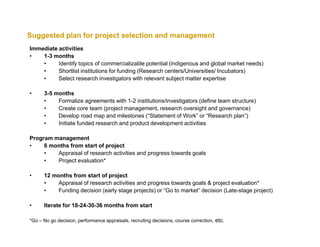
Suggested plan for project selection and management
Immediate activities
•   1-3 months
    •     Identify topics of commercializable potential (indigenous and global market needs)
    •     Shortlist institutions for funding (Research centers/Universities/ Incubators)
    •     Select research investigators with relevant subject matter expertise

•     3-5 months
      •    Formalize agreements with 1-2 institutions/investigators (define team structure)
      •    Create core team (project management, research oversight and governance)
      •    Develop road map and milestones (“Statement of Work” or “Research plan”)
      •    Initiate funded research and product development activities

Program management
•    6 months from start of project
     •   Appraisal of research activities and progress towards goals
     •   Project evaluation*

•     12 months from start of project
      •    Appraisal of research activities and progress towards goals & project evaluation*
      •    Funding decision (early stage projects) or “Go to market” decision (Late-stage project)

•     Iterate for 18-24-30-36 months from start

*Go – No go decision, performance appraisals, recruiting decisions, course correction, etc.
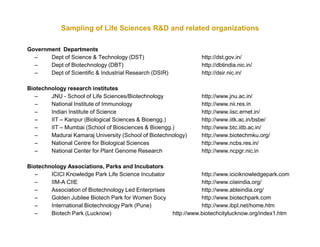
Sampling of Life Sciences R&D and related organizations

Government Departments
  –    Dept of Science & Technology (DST)                          http://dst.gov.in/
  –    Dept of Biotechnology (DBT)                                 http://dbtindia.nic.in/
  –    Dept of Scientific & Industrial Research (DSIR)             http://dsir.nic.in/

Biotechnology research institutes
   –    JNU - School of Life Sciences/Biotechnology                http://www.jnu.ac.in/
   –    National Institute of Immunology                           http://www.nii.res.in
   –    Indian Institute of Science                                http://www.iisc.ernet.in/
   –    IIT – Kanpur (Biological Sciences & Bioengg.)              http://www.iitk.ac.in/bsbe/
   –    IIT – Mumbai (School of Biosciences & Bioengg.)            http://www.btc.iitb.ac.in/
   –    Madurai Kamaraj University (School of Biotechnology)       http://www.biotechmku.org/
   –    National Centre for Biological Sciences                    http://www.ncbs.res.in/
   –    National Center for Plant Genome Research                  http://www.ncpgr.nic.in

Biotechnology Associations, Parks and Incubators
   –    ICICI Knowledge Park Life Science Incubator                 http://www.iciciknowledgepark.com
   –    IIM-A CIIE                                                  http://www.ciieindia.org/
   –    Association of Biotechnology Led Enterprises                http://www.ableindia.org/
   –    Golden Jubilee Biotech Park for Women Socy                  http://www.biotechpark.com
   –    International Biotechnology Park (Pune)                     http://www.ibpl.net/home.htm
   –    Biotech Park (Lucknow)                           http://www.biotechcitylucknow.org/index1.htm
Contact

Harshawardhan Bal, M.Pharm., PhD
harsh.bal@stemcellcapital.com

India Life Sciences Venture Strategy 2007

  • 1.
    India: Life SciencesInvestment Strategy “Culture & Nurture” Gaithersburg, MD March 2007 Harshawardhan Bal, M.Pharm., PhD. Draft
  • 2.
    India is fastbecoming a centerpiece of global strategy: Transition from an outsourcing destination to an intellectual powerhouse Outside agencies in India to foster science collaboration • National Science Foundation (Oct 2006) - World's largest basic science funding agency; “Nobel Prize” incubator • World Bank’s private sector arm - International Finance Corporation - $43m in investments in four projects in India • The US Agency of International Development and Cornell University - supporting research on improving the stock of major food crops - eggplant that is resistant to shoot borers, potato resistant to blight, and drought- and salt-tolerant rice Approach • Focus on "increasing presence" in India • Ensure "direct contact" with Indian scientists • Priority areas - math, engineering, geo-sciences, life sciences and computers • “competing through collaboration” (set up collaborative programs with Indian scientists)
  • 3.
    India’s ivy leaguesset up incubators to tap emerging entrepreneurial ecosystem IIT Bombay - Society for Innovation (SINE) • SINE is an investor in startups it supports (takes equity stake in funded companies) • Provides office space and use of its facilities at ~ 75% of market rate • Companies must “graduate” in 3 yrs and establish own infrastructure • SINE currently funds < 10% of the score of applications its receives • Mix of software and non-software (earth sciences, telecommunications, etc.) • SINE start-ups have domestic focus but international scope IIM-A Centre for Innovation, Incubation and Entrepreneurship (CIIE, 2001) • Established the Indian Incubator for Innovation-based Enterprises (I3E) • Selects innovators to enter incubator through search program “Anveshan” • Provides technical support, testing facilities, materials, prototyping facilities, legal assistance, venture funding, patent filing, etc. • Network partners include DST, CSIR, IITs, Wadhwani Foundation, VC firms • Awards companies in 3 categories – "innovation in search of an enterprise“ (commercialize technology or prototype) – "idea in search of an innovation" (undeveloped concept or idea) – "innovation with a business plan" (business plan around an innovative idea) Indian incubators are becoming one-stop shops for VCs looking for smart ideas
  • 4.
    Indian Government providesimpetus to burgeoning Life Sciences industry through creation of Biotechnology parks Dept. of Biotechnology & Gov of AP set up biotechnology incubator (August 2003) • First full-fledged biotechnology incubator in Hyderabad with investment of Rs. 27 cr. • State has allocated three acres of land; Capital infusion by DBT Rs. 8-9 cr. (2003-04) • Incubator will be managed by a consortium led by Indian Institute of Chemical Technology, a part of Council of Scientific and Industrial Research India to create 10 biotech parks by 2010 (DBT Secretary M K Bhan, Feb. 2006) • A new Biotechnology Parks Society of India will be set up to oversee the creation and support of at least 10 biotech parks with incubator units • Biotech clusters are currently operational in Bangalore Hyderabad, Pune and Mumbai • Parks will offer services like contract research, clinical trials and development of biotechnology products • DBT has approved a Clinical Research Trials Institute in Hyderabad to conduct large- scale clinical trials
  • 5.
    ICICI Knowledge ParkLife Science Incubator: ICICI Bank Ltd. & Gov. of Andhra Pradesh partner to facilitate business-driven R&D Space of 3,200 sqft for 8 incubatees to encourage and nurture startup companies and spin offs in pharmaceutical and biotechnology Laurus Labs Private Ltd • Focus Area : Process development and validation • Lab Area Leased: 6.78 acres Premium Phytoceuticals • Focus Area : Plant based therapeutics • Lab Area Leased: 2 Units in Life Science Incubator Lab Regain Biotechnology • Focus Area : Plant based therapeutics • Lab Area Leased: 2 Units in Life Science Incubator Lab Graduates • Biomax Life Sciences – Focus Area : Plant based therapeutics – Lab Area Leased: Unit 4 Life Science Incubator Lab
  • 6.
    High-growth areas whichcarry potential investment opportunities for VCs Clinical & manufacturing for Biotechnology products • Global biotech/pharma companies outsourcing > US$500 M worth of research to India • India's revenue from the custom synthesis & manufacturing business is ~ $ 1-1.5 B • Exports of biotech products, driven by vaccines, statins, contract research and clinical trials, accounted for 42% of total revenues • India’s clinical research market ($200 M in 2005), is expected to reach $1.5 B by 2010 • India's biotech industry is projected to reach $5 B in annual sales by 2009, constituting 10% of the global industry • India has a diverse species of flora and fauna that gives the added advantage for biotech companies to carry on their research and drug discovery effectively India’s unmet medical needs • 34 M diabetic patients • 8-10 M people with HIV • 8 M epileptic patients • 3 M cancer patients
  • 7.
    High-growth areas whichcarry potential investment opportunities for VCs Agribiotechnology • India surpasses China in number of hectares planted with genetically-modified seeds. (3.8 M biotech hectares vs China’s 3.5 million hectares). • Research in biotechnologically enhanced crops - a major role for the rapidly increasing number of projects in Asia (Chairman of International Service for the Acquisition of Agri-biotech Applications) • Vit A enhanced rice likely next main crop to be commercialized in Asia after cotton • Technology related to agriculture sector is an area identified by Indian finance minister for tax benefits
  • 8.
    Potential opportunities forgrassroots manpower development Intellectual capital development through academic research • Align with the goals of the National Biotechnology Development Policy to foster creation of skilled biotechnology manpower • The Biotechnology sector can achieve double-digit growth rates by overcoming skilled manpower shortage in modern science areas (molecular biology, bioinformatics, etc.) • India is projected to invest US$ 80 M in 2007 to develop a national network of research laboratories • The Department of chemicals and petrochemicals has sought Rs 5 B to establish institutes to meet the growing demand for pharmaceutical professionals
  • 9.
    “Discontinuities” in theIndian venture scenario can be exploited by VCs to formulate market entry strategies Lack of an entrepreneurial “Silicon valley” environment • Social networks and clubs that nurture entrepreneur growth and facilitate entrepreneur-investor relations are virtually non-existent • Angel networks (often started by serial entrepreneurs themselves) that provide budding entrepreneurs capital, advice, and mentorship are absent Lack of research infrastructure and orientation • Indian educational institutes provide top-quality undergraduate training but lack depth in graduate level University research • Most Indian universities (and students) are ill-equipped to tackle the complex, interdisciplinary nature of modern biomedical science • Incubators attached to Indian schools are not comparable to US counterparts End-result • Business plans from India lack spark and are described as “average” • The number of good deals is far and few between • Relationships between VCs and portfolio companies tend to be adversarial
  • 10.
    VCs can builda “thought leader” image in Indian Life Sciences by supporting grass-roots innovation - A “Culture & Nurture” approach De novo approach • Enter into agreements with 1 or 2 top advanced R&D institution/Universities through local offices • 1-2 investigators selected via a program announcement or RFA • Agreement includes standard VC deal terms • Fund faculty led R&D in specific areas (see slide 6 & 7) with direct commercial potential for spinning out novel IP and technologies • Appoint local project managers to work with department heads/ professors to identify topics for research and commercialization • Focus on areas that have a strong domestic market (apart from a global market) • Develop a support structure to guide the “paper to product” transition • Coaching and mentorship • Consultancy/advisory/technology transfer services • Market/customer linkages • Access to network of experts, successful entrepreneurs & managers • Select projects with short life cycles – 1 yr (late stage) to 3 yrs (early to medium stage) to product launch • Fund projects with modules of $25,000* (direct cost only), up to an upper limit (3 yrs or $ 75,000*), renewable annually based on progress up to 3 yrs *Place holders. Actual figures TBD
  • 11.
    VCs can builda “thought leader” image in Indian Life Sciences by supporting grass-roots innovation - A “Culture & Nurture” approach Piggy-back approach • Partner with 1-2 existing Life Sciences incubators • Fund research activities of select incubatees • Provide support structure as outlined in the De novo approach • Build equity stake into start-ups (standard VC deal terms) PR activities • Build close private-public relationships by sponsoring focused Biotechnology events • BioAsia - Feb. 2006 (Hyderabad) • Bangalore Bio 2006 • Organize own entrepreneur-investor conference Manpower development • Culture and nurture intellectual capital through special programs • Graduate Fellowships on special topics (e.g., Digital pathology, Bio-IT) • 100K Entrepreneur competition • Endowment to an institution library or research center • Sponsor visiting faculty/expert lectures at selected Universities • Select top graduates for internships/training at portfolio companies • Select top talent from sponsored institutions to join portfolio companies
  • 12.
    Suggested plan forproject selection and management Immediate activities • 1-3 months • Identify topics of commercializable potential (indigenous and global market needs) • Shortlist institutions for funding (Research centers/Universities/ Incubators) • Select research investigators with relevant subject matter expertise • 3-5 months • Formalize agreements with 1-2 institutions/investigators (define team structure) • Create core team (project management, research oversight and governance) • Develop road map and milestones (“Statement of Work” or “Research plan”) • Initiate funded research and product development activities Program management • 6 months from start of project • Appraisal of research activities and progress towards goals • Project evaluation* • 12 months from start of project • Appraisal of research activities and progress towards goals & project evaluation* • Funding decision (early stage projects) or “Go to market” decision (Late-stage project) • Iterate for 18-24-30-36 months from start *Go – No go decision, performance appraisals, recruiting decisions, course correction, etc.
  • 13.
    Sampling of LifeSciences R&D and related organizations Government Departments – Dept of Science & Technology (DST) http://dst.gov.in/ – Dept of Biotechnology (DBT) http://dbtindia.nic.in/ – Dept of Scientific & Industrial Research (DSIR) http://dsir.nic.in/ Biotechnology research institutes – JNU - School of Life Sciences/Biotechnology http://www.jnu.ac.in/ – National Institute of Immunology http://www.nii.res.in – Indian Institute of Science http://www.iisc.ernet.in/ – IIT – Kanpur (Biological Sciences & Bioengg.) http://www.iitk.ac.in/bsbe/ – IIT – Mumbai (School of Biosciences & Bioengg.) http://www.btc.iitb.ac.in/ – Madurai Kamaraj University (School of Biotechnology) http://www.biotechmku.org/ – National Centre for Biological Sciences http://www.ncbs.res.in/ – National Center for Plant Genome Research http://www.ncpgr.nic.in Biotechnology Associations, Parks and Incubators – ICICI Knowledge Park Life Science Incubator http://www.iciciknowledgepark.com – IIM-A CIIE http://www.ciieindia.org/ – Association of Biotechnology Led Enterprises http://www.ableindia.org/ – Golden Jubilee Biotech Park for Women Socy http://www.biotechpark.com – International Biotechnology Park (Pune) http://www.ibpl.net/home.htm – Biotech Park (Lucknow) http://www.biotechcitylucknow.org/index1.htm
  • 14.
    Contact Harshawardhan Bal, M.Pharm.,PhD harsh.bal@stemcellcapital.com