INDIA AND GLOBAL GOVERNANCE
• POORVI CHITALKAR & DAVID M. MALONE
INTRODUCTION
 India's rise as a vital player has rebalanced the international relation and global
governance. India is aspiring a permanent seat in the UN Security
Council. India's ambition is to put itself in the hierarchy of of superpower
nations and remodel the multipolar world.
RESEARCH
QUESTION AND
METHODOLOGY?
• Primary Question: Is India becoming the next emerging
superpower to rebalance the global governance in a
multipolar world?
• Secondary Questions:
• i. What are the progressive changes made in
Indian foreign policy to establish itself as a vital player in
global context?
• ii. What are the indicators of Indian transition as
emerging power?
• iii. What are the criticism and challenges India
facing in its meaningful quest to influence global
governance?
• Methodology: The study was carried out mainly by
content analysis of both primary and secondary sources and
using qualitative research methodology mostly.
LITERATURE
REVIEW
• Mikesell 1994
• Maddison 2003,
• Raja Mohan 2003
• Clingingsmith and Williamson 2004
• Mukharjee and Malone 2011
• Bhagavan 2012
Note: Some of the previous mentionable work on
India and global governance can be traced in the
abovementioned literatures
EARLY INDIAN IDEAS ON GLOBAL
GOVERNANCE
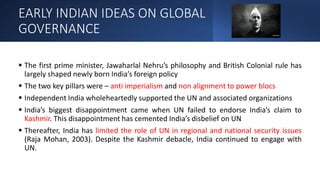
 The first prime minister, Jawaharlal Nehru’s philosophy and British Colonial rule has
largely shaped newly born India’s foreign policy
 The two key pillars were – anti imperialism and non alignment to power blocs
 Independent India wholeheartedly supported the UN and associated organizations
 India’s biggest disappointment came when UN failed to endorse India’s claim to
Kashmir. This disappointment has cemented India’s disbelief on UN
 Thereafter, India has limited the role of UN in regional and national security issues
(Raja Mohan, 2003). Despite the Kashmir debacle, India continued to engage with
UN.
THE COLD WAR PERIOD
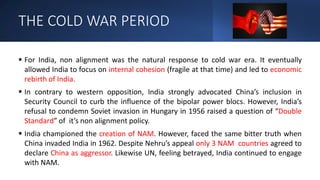
 For India, non alignment was the natural response to cold war era. It eventually
allowed India to focus on internal cohesion (fragile at that time) and led to economic
rebirth of India.
 In contrary to western opposition, India strongly advocated China’s inclusion in
Security Council to curb the influence of the bipolar power blocs. However, India’s
refusal to condemn Soviet invasion in Hungary in 1956 raised a question of “Double
Standard” of it’s non alignment policy.
 India championed the creation of NAM. However, faced the same bitter truth when
China invaded India in 1962. Despite Nehru’s appeal only 3 NAM countries agreed to
declare China as aggressor. Likewise UN, feeling betrayed, India continued to engage
with NAM.
THE COLD WAR PERIOD
 With the experience of UN and NAM, India took a cautious road to multilateral
organizations. In 1967, it remained aloof from ASEAN as it considered to be a US ploy.
 Nehru’s death marked the change in Indian foreign policy. It shifted from
multilateralism to more regional and domestic challenges.
 In 1971, India signed a “Treaty of Friendship” with the Soviet Union. Later, India
intervened militarily in the then East Pakistan with the plea of humanitarian response
but in actually for strategic cause.
 Both the actions undermined and eviscerated India’s hollow promise of non-
alignment and non-intervention.
 By the ambition of nuclear parity with China and fear of Pakistan, India conducted
nuclear test undermining its previous policy of nuclear disarmament and non-
proliferation.
INDIA'S NEW APPROACH TO INSTITUITIONS
In early 1990s, India started to get involved more with the global governance
institutions.
Un Security Council
 In 2011, India joined the security council once again as elected
member which many saw as the “rehearsal for a permanent
membership”
Climate Change Issues
 India joined BASIC – Brazil, South Africa, India and China
 At Warsaw conference on Climate Change in November 2013, India
aligned with “Like Minded Developing Countries” (LMDCs)
INDIA'S NEW APPROACH TO INSTITUITIONS
Economic Diplomacy
 For India, G-20 represents a “political graduation”. It is the main
forum among major players on global economic and financial issues.
India is seeking economic development goals through G-20
 India joined BRICS – Brazil, Russia, India, China and South Africa as a
coalition of emerging economies
 In 2003, India, Brazil and South Africa came together to form IBSA
INDIA'S NEW APPROACH TO GLOBAL
NORMS
 India set the tone of creating global norms through non-violent struggle for
independence. It displayed moral authority by effective campaign on South Africa's
"Ghetto Act"
 It was a resounding victory which set the precedent of what can be achieved by the
UN (Bhagavan 2010)
 During Nehru's phase, India championed global norms for common good rather its
own interest. Nehru focused on collective security and strongly argued to establish
the "Universal Declaration of Human Rights"
 By the end of Nehru's era, India's response to global norms began to change. It
appears to be taking middle grounds on norms- respecting global norms in principle
but remaining cautious in their implementation (Pai 2012)
INDIA'S NEW APPROACH TO GLOBAL
NORMS
 Despite being a signatory to R2P at UN Summit in 2005, India's middle ground
approach was demonstrated in 2011 on Libya issue. It abstained from voting
Resolution 1973 to authorize international military action to protect Libyan civilians
 Despite success, India has been reluctant to project and promote democracy outside
its borders.
 India diverted from nuclear disarmament and stayed out of treaties such as the Non-
Proliferation treaty (NPT) and Comprehensive Test-Ban Treaty (CTBT)
 Apparently, present India's attitude to norms is very cautious and defensive. India
appears unlikely to depart from this cautious approach to international principles and
norms (Raja Mohan 2011, Hall 2013; Virk 2013)
CHALLENGES TO INDIA’S EMBRACE OF
GLOBAL GOVERNANCE
• First, India often prefer to retain earlier ideology in foreign policy making despite the
status as emerging world power. As Prime Minister Manmohon Singh said, “Very often
we adopt political postures that are based in the past, and are out of line with our
interests as an increasingly globalized and globally integrated economy”
• Second, the software of India’s foreign policy – the itellectuals and institutional
infrastructure require specialized expertise and possibly more risk taking. Delhi needs
to rely more on technical and scientific expertise on issues beyond its generalist and
public servants for policy making
• Third, Indian negotiators are often limited strongly by domestic constraints and
accused of caving into foreign pressure. India needs to get rid of push and pull of
domestic politics
KEY FINDINGS
 Initially, India’s foreign policy was more moralistic (influenced by Nehru) and prioritized
multilateralism. India supported the structure of UN and its future as global governance
 However, with the backfire from UN and NAM, India’s foreign policy drifted towards
more on realistic approach then moralistic
 Being realistic, India limited the UN and multilateral organization’s influence and
dominance on its internal and regional issues
 India shifted from non alignment, non intervention and disarmament of nuclear
weapon policies which showed a dramatic turn of tide in Indian foreign policy
 Early 1990s saw the massive change in India’s approach to foreign policy. The booming
economy also added a color on its dream to emerge as a superpower nations
KEY FINDINGS
 At present, India is pursuing greater recognition at global level and raised a stronger
voice through global governance institutions
 India is overtly seeking a permanent seat in the “UN Security Council” to have more
influence in future global governance issues and in its institutions
 India’s approach to international organizations and treaties led it to be more vocal and
showed its acceptance
 However, India’s approach towards global norms had been very cautious and defensive.
It preferred economic prosperity above all as the biggest scope of development and
international recognition
 Despite India’s progress India needs to overcome few challenges to emerge and
establish as a global superpower
KEY ARGUMENTS OF THE PAPER
• Poorvi Chitalkar & David M. Malone have argued that the rise of Indian economy in late
1990s led to India’s dream to emerge as global power. India showed significant commitment
through its quest for a permanent seat in security council, approach to climate change
negotiations, engagement with global norms and global economic diplomacy. Despite the
success, India is equally facing multiple challenges and criticism to achieve a greater voice
and recognition internationally. India’s future foreign policy making and dealing with the
challenges will be an interesting feat to observe in future days to cement its objective.
RECOMMENDATION
 First, India needs to overcome the inertia of past foreign policy making. It needs to
overcome the limitations of pressure from the internal politics
 Second, It needs to be more pragmatic and risk taker in the terms of negotiation
 Third, Indian policy makers needs to acquire the technical and scientific expertise to
tackle ever evolving complex global governance challenges
 Fourth, India needs to shake off the status of developing countries and need to
genuinely demonstrate it’s interest/urge to share the burden of global
responsibilities

India and gobal governance

  • 1.
    INDIA AND GLOBALGOVERNANCE • POORVI CHITALKAR & DAVID M. MALONE
  • 2.
    INTRODUCTION  India's riseas a vital player has rebalanced the international relation and global governance. India is aspiring a permanent seat in the UN Security Council. India's ambition is to put itself in the hierarchy of of superpower nations and remodel the multipolar world.
  • 3.
    RESEARCH QUESTION AND METHODOLOGY? • PrimaryQuestion: Is India becoming the next emerging superpower to rebalance the global governance in a multipolar world? • Secondary Questions: • i. What are the progressive changes made in Indian foreign policy to establish itself as a vital player in global context? • ii. What are the indicators of Indian transition as emerging power? • iii. What are the criticism and challenges India facing in its meaningful quest to influence global governance? • Methodology: The study was carried out mainly by content analysis of both primary and secondary sources and using qualitative research methodology mostly.
  • 4.
    LITERATURE REVIEW • Mikesell 1994 •Maddison 2003, • Raja Mohan 2003 • Clingingsmith and Williamson 2004 • Mukharjee and Malone 2011 • Bhagavan 2012 Note: Some of the previous mentionable work on India and global governance can be traced in the abovementioned literatures
  • 5.
    EARLY INDIAN IDEASON GLOBAL GOVERNANCE  The first prime minister, Jawaharlal Nehru’s philosophy and British Colonial rule has largely shaped newly born India’s foreign policy  The two key pillars were – anti imperialism and non alignment to power blocs  Independent India wholeheartedly supported the UN and associated organizations  India’s biggest disappointment came when UN failed to endorse India’s claim to Kashmir. This disappointment has cemented India’s disbelief on UN  Thereafter, India has limited the role of UN in regional and national security issues (Raja Mohan, 2003). Despite the Kashmir debacle, India continued to engage with UN.
  • 6.
    THE COLD WARPERIOD  For India, non alignment was the natural response to cold war era. It eventually allowed India to focus on internal cohesion (fragile at that time) and led to economic rebirth of India.  In contrary to western opposition, India strongly advocated China’s inclusion in Security Council to curb the influence of the bipolar power blocs. However, India’s refusal to condemn Soviet invasion in Hungary in 1956 raised a question of “Double Standard” of it’s non alignment policy.  India championed the creation of NAM. However, faced the same bitter truth when China invaded India in 1962. Despite Nehru’s appeal only 3 NAM countries agreed to declare China as aggressor. Likewise UN, feeling betrayed, India continued to engage with NAM.
  • 7.
    THE COLD WARPERIOD  With the experience of UN and NAM, India took a cautious road to multilateral organizations. In 1967, it remained aloof from ASEAN as it considered to be a US ploy.  Nehru’s death marked the change in Indian foreign policy. It shifted from multilateralism to more regional and domestic challenges.  In 1971, India signed a “Treaty of Friendship” with the Soviet Union. Later, India intervened militarily in the then East Pakistan with the plea of humanitarian response but in actually for strategic cause.  Both the actions undermined and eviscerated India’s hollow promise of non- alignment and non-intervention.  By the ambition of nuclear parity with China and fear of Pakistan, India conducted nuclear test undermining its previous policy of nuclear disarmament and non- proliferation.
  • 8.
    INDIA'S NEW APPROACHTO INSTITUITIONS In early 1990s, India started to get involved more with the global governance institutions. Un Security Council  In 2011, India joined the security council once again as elected member which many saw as the “rehearsal for a permanent membership” Climate Change Issues  India joined BASIC – Brazil, South Africa, India and China  At Warsaw conference on Climate Change in November 2013, India aligned with “Like Minded Developing Countries” (LMDCs)
  • 9.
    INDIA'S NEW APPROACHTO INSTITUITIONS Economic Diplomacy  For India, G-20 represents a “political graduation”. It is the main forum among major players on global economic and financial issues. India is seeking economic development goals through G-20  India joined BRICS – Brazil, Russia, India, China and South Africa as a coalition of emerging economies  In 2003, India, Brazil and South Africa came together to form IBSA
  • 10.
    INDIA'S NEW APPROACHTO GLOBAL NORMS  India set the tone of creating global norms through non-violent struggle for independence. It displayed moral authority by effective campaign on South Africa's "Ghetto Act"  It was a resounding victory which set the precedent of what can be achieved by the UN (Bhagavan 2010)  During Nehru's phase, India championed global norms for common good rather its own interest. Nehru focused on collective security and strongly argued to establish the "Universal Declaration of Human Rights"  By the end of Nehru's era, India's response to global norms began to change. It appears to be taking middle grounds on norms- respecting global norms in principle but remaining cautious in their implementation (Pai 2012)
  • 11.
    INDIA'S NEW APPROACHTO GLOBAL NORMS  Despite being a signatory to R2P at UN Summit in 2005, India's middle ground approach was demonstrated in 2011 on Libya issue. It abstained from voting Resolution 1973 to authorize international military action to protect Libyan civilians  Despite success, India has been reluctant to project and promote democracy outside its borders.  India diverted from nuclear disarmament and stayed out of treaties such as the Non- Proliferation treaty (NPT) and Comprehensive Test-Ban Treaty (CTBT)  Apparently, present India's attitude to norms is very cautious and defensive. India appears unlikely to depart from this cautious approach to international principles and norms (Raja Mohan 2011, Hall 2013; Virk 2013)
  • 12.
    CHALLENGES TO INDIA’SEMBRACE OF GLOBAL GOVERNANCE • First, India often prefer to retain earlier ideology in foreign policy making despite the status as emerging world power. As Prime Minister Manmohon Singh said, “Very often we adopt political postures that are based in the past, and are out of line with our interests as an increasingly globalized and globally integrated economy” • Second, the software of India’s foreign policy – the itellectuals and institutional infrastructure require specialized expertise and possibly more risk taking. Delhi needs to rely more on technical and scientific expertise on issues beyond its generalist and public servants for policy making • Third, Indian negotiators are often limited strongly by domestic constraints and accused of caving into foreign pressure. India needs to get rid of push and pull of domestic politics
  • 13.
    KEY FINDINGS  Initially,India’s foreign policy was more moralistic (influenced by Nehru) and prioritized multilateralism. India supported the structure of UN and its future as global governance  However, with the backfire from UN and NAM, India’s foreign policy drifted towards more on realistic approach then moralistic  Being realistic, India limited the UN and multilateral organization’s influence and dominance on its internal and regional issues  India shifted from non alignment, non intervention and disarmament of nuclear weapon policies which showed a dramatic turn of tide in Indian foreign policy  Early 1990s saw the massive change in India’s approach to foreign policy. The booming economy also added a color on its dream to emerge as a superpower nations
  • 14.
    KEY FINDINGS  Atpresent, India is pursuing greater recognition at global level and raised a stronger voice through global governance institutions  India is overtly seeking a permanent seat in the “UN Security Council” to have more influence in future global governance issues and in its institutions  India’s approach to international organizations and treaties led it to be more vocal and showed its acceptance  However, India’s approach towards global norms had been very cautious and defensive. It preferred economic prosperity above all as the biggest scope of development and international recognition  Despite India’s progress India needs to overcome few challenges to emerge and establish as a global superpower
  • 15.
    KEY ARGUMENTS OFTHE PAPER • Poorvi Chitalkar & David M. Malone have argued that the rise of Indian economy in late 1990s led to India’s dream to emerge as global power. India showed significant commitment through its quest for a permanent seat in security council, approach to climate change negotiations, engagement with global norms and global economic diplomacy. Despite the success, India is equally facing multiple challenges and criticism to achieve a greater voice and recognition internationally. India’s future foreign policy making and dealing with the challenges will be an interesting feat to observe in future days to cement its objective.
  • 16.
    RECOMMENDATION  First, Indianeeds to overcome the inertia of past foreign policy making. It needs to overcome the limitations of pressure from the internal politics  Second, It needs to be more pragmatic and risk taker in the terms of negotiation  Third, Indian policy makers needs to acquire the technical and scientific expertise to tackle ever evolving complex global governance challenges  Fourth, India needs to shake off the status of developing countries and need to genuinely demonstrate it’s interest/urge to share the burden of global responsibilities