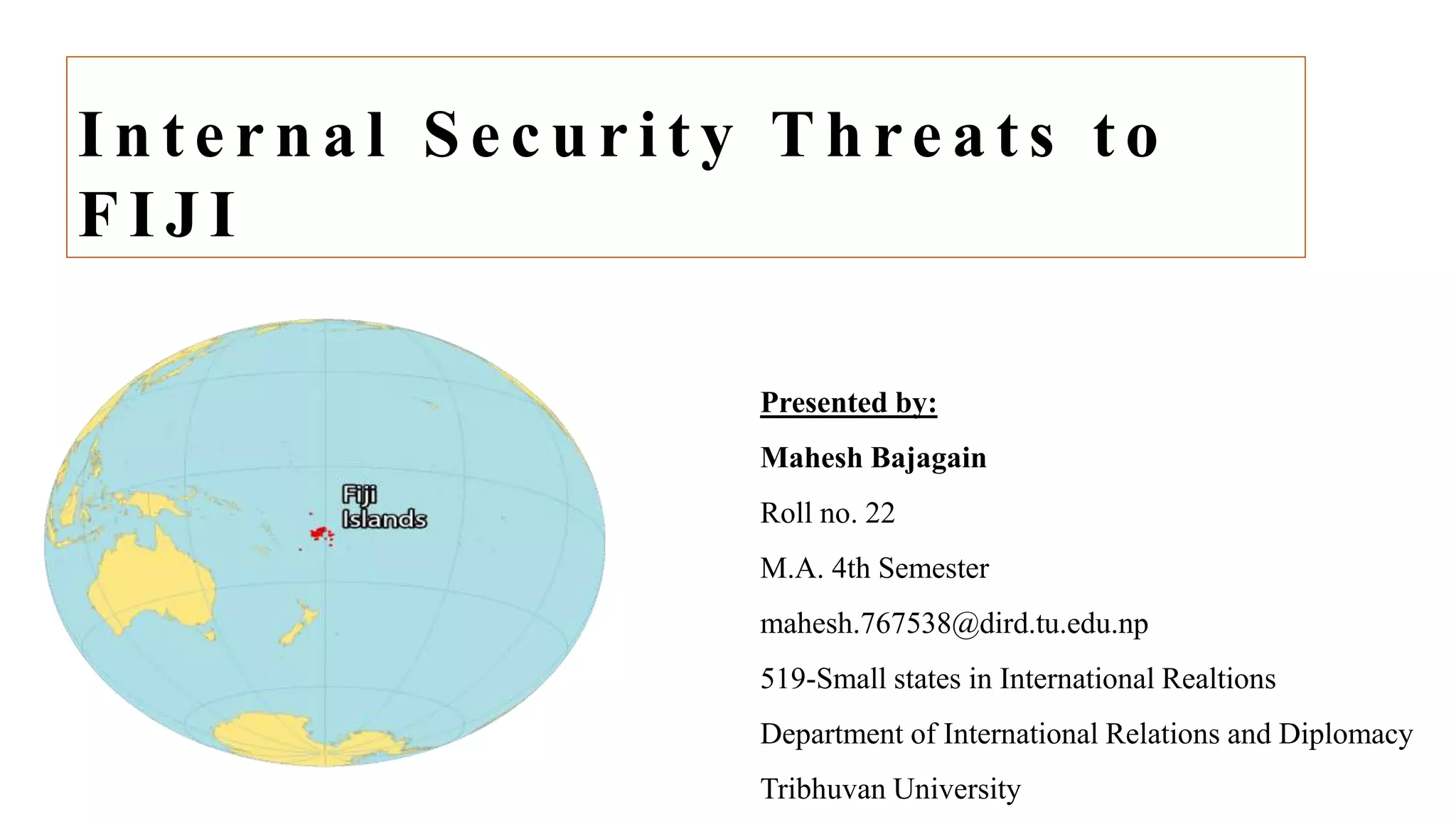
I n t e r n a l S e c u r i t y T h re a t s t o
F I J I
Presented by:
Mahesh Bajagain
Roll no. 22
M.A. 4th Semester
mahesh.767538@dird.tu.edu.np
519-Small states in International Realtions
Department of International Relations and Diplomacy
Tribhuvan University
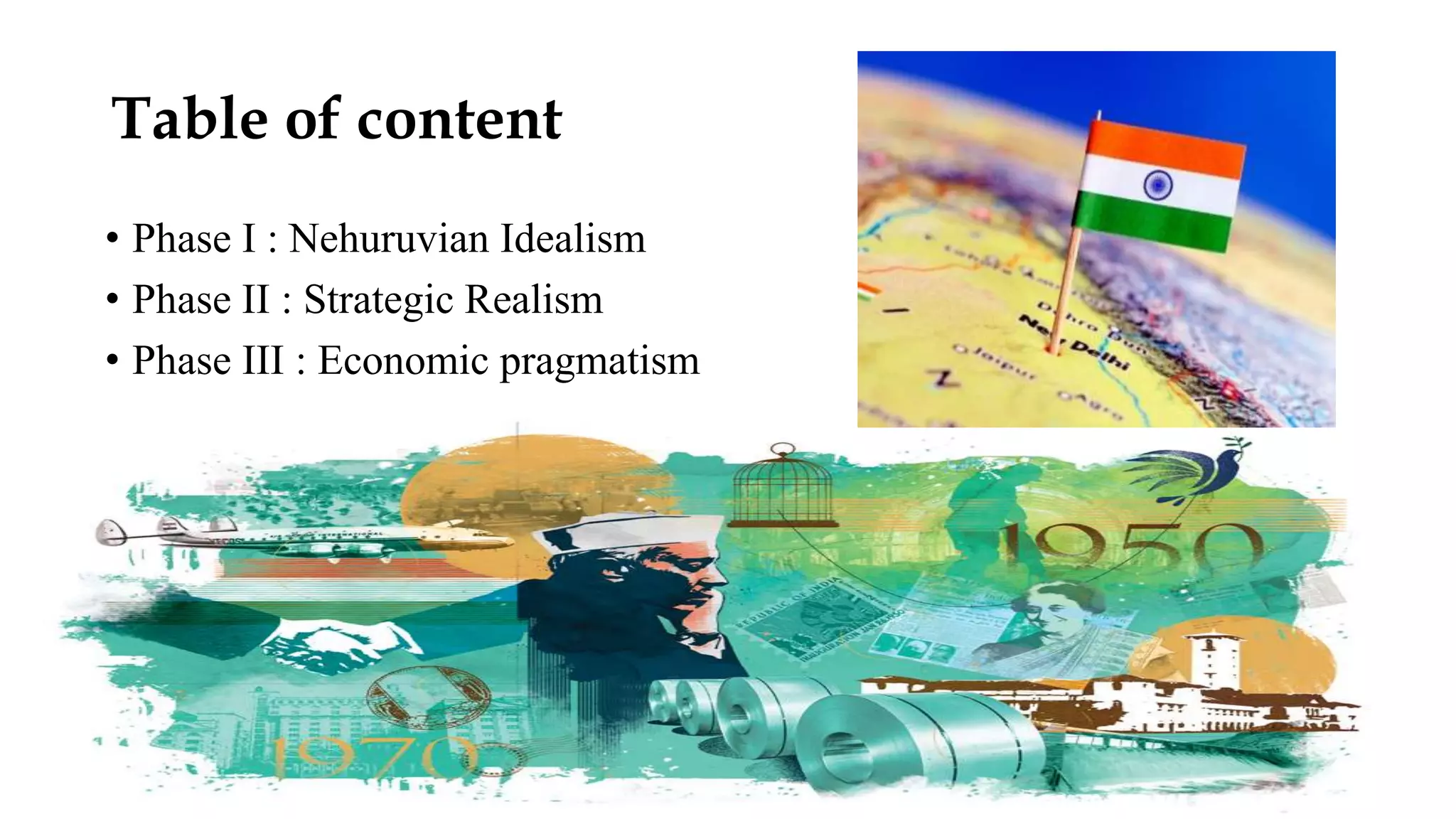
Table of content
• Phase I : Nehuruvian Idealism
• Phase II : Strategic Realism
• Phase III : Economic pragmatism
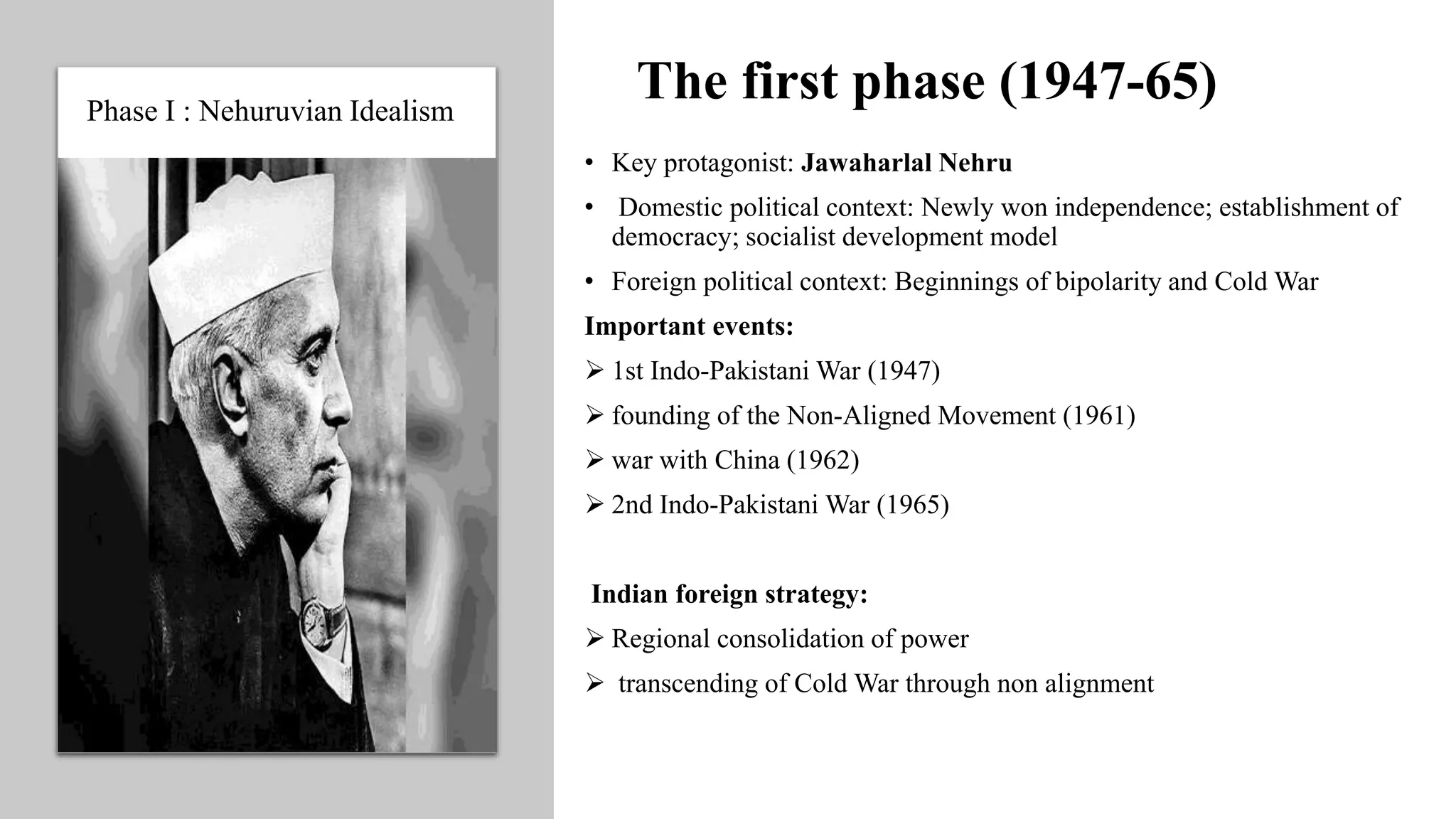
The first phase (1947-65)
• Key protagonist: Jawaharlal Nehru
• Domestic political context: Newly won independence; establishment of
democracy; socialist development model
• Foreign political context: Beginnings of bipolarity and Cold War
Important events:
 1st Indo-Pakistani War (1947)
 founding of the Non-Aligned Movement (1961)
 war with China (1962)
 2nd Indo-Pakistani War (1965)
Indian foreign strategy:
 Regional consolidation of power
 transcending of Cold War through non alignment
Phase I : Nehuruvian Idealism
• Jawaharlal Nehru holds a unique place in Indian foreign policy history. He rose to prominence as a leading
proponent of progressive internationalism and the architect of independent India's foreign policy from the 1920s
until his death in 1964 (M. Malone et.al 2015)
• Bipolar world. The cold war was the major context of the Nehruvian period, and Nehruvian foreign policy
revolved around non-aligned foreign policy. During this time, India's foreign policy was mostly idealistic (Rauch,
1947)
• Nehru was more focused on peace, disarmament, international cooperation, and anti-racism as major foreign policy
goals
• India’s objectives in this phase were to resist dilution of its sovereignty, rebuild its economy and consolidate its
integrity
 Made three major contributions in Indian foreign policy
 significant contribution to multilateral organizations, especially United Nations peacekeeping missions
 gave emphasis to peaceful co-existence, cooperation, non-alignment and non-interference as per the principles of
Panchasheel
 aided in the process of decolonization as a leader of the nonaligned movement (Ganguly & Pardesi, 2009)
The major achievement of Nehruvian idealism is the birth of Non-Alignment policy, which advocates the
solidarity of third world nations who do not want to join any bloc during the cold war period
Phase II(1965–1989)
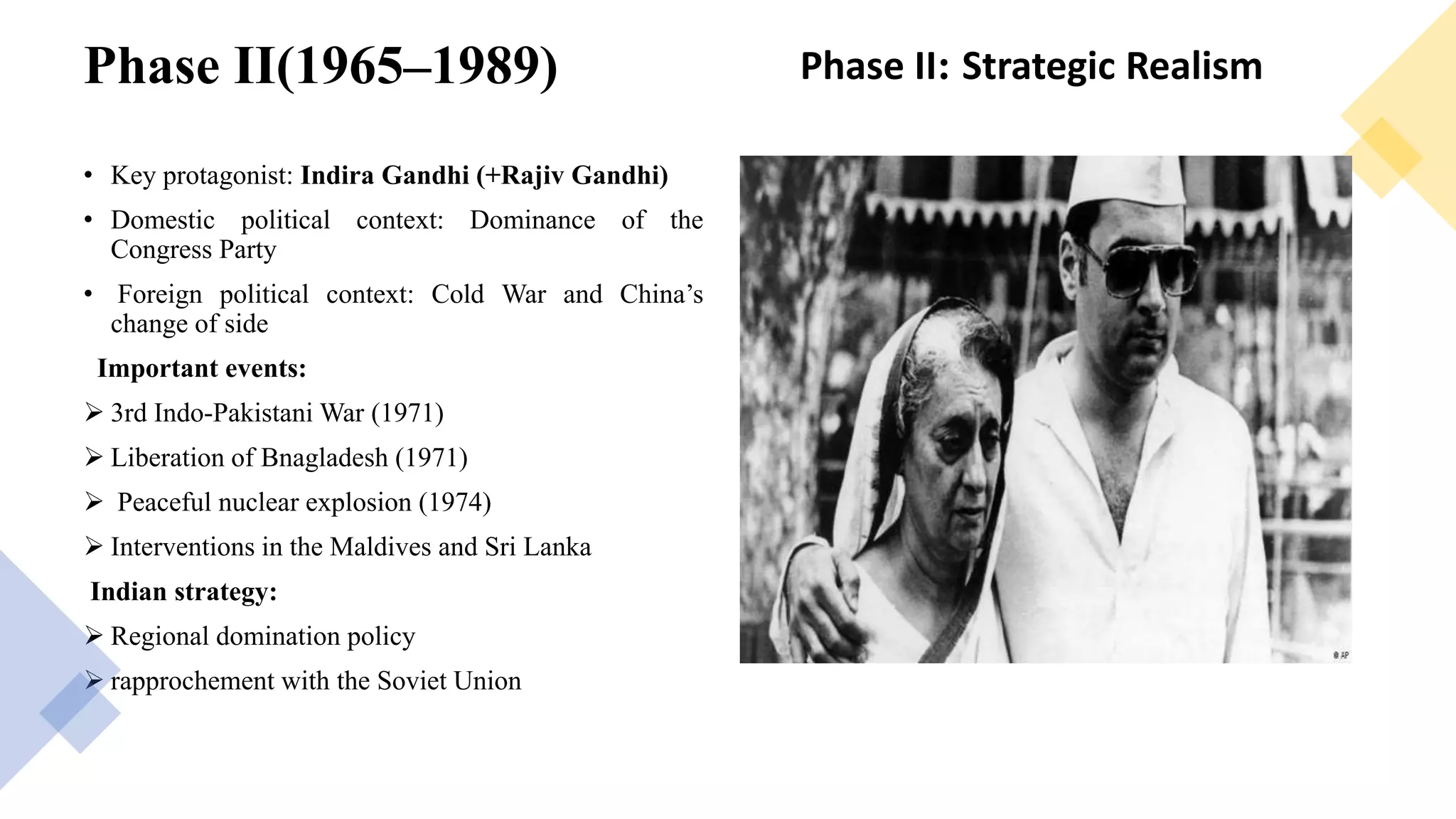
• Key protagonist: Indira Gandhi (+Rajiv Gandhi)
• Domestic political context: Dominance of the
Congress Party
• Foreign political context: Cold War and China’s
change of side
Important events:
 3rd Indo-Pakistani War (1971)
 Liberation of Bnagladesh (1971)
 Peaceful nuclear explosion (1974)
 Interventions in the Maldives and Sri Lanka
Indian strategy:
 Regional domination policy
 rapprochement with the Soviet Union
Phase II: Strategic Realism
• Following the passing of Jawaharlal Nehru in 1964, his daughter Indira Gandhi was appointed prime
minister following a brief period of transition. She was the main figure who left her stamp on the second
phase of Indian foreign policy, which spanned from 1966 to 1989, as was her son Rajiv Gandhi, who
eventually succeeded her as head of state (Carsten Rauch, 2008)
• Indira Gandhi represented a policy of regional domination that had the hegemony of India in South Asia
as its objective more clearly than the previous leadership
• leaned more clearly toward the Soviet Union as a key international partner than the previous leadership
(distanced herself even more from the USA in the process) (Carsten Rauch, 2008)
• Gandhi played a crucial role in the formation of Bangladesh in 1971 and the nuclear test in Pokhran in
1974
• Rajiv Gandhi believed that the best way to stop proliferation was through complete nuclear disarmament
(M. Malone et.al, 2015)
• Gandhi's recognition that greater and more skillful engagement with the rest of the world was necessary
for India's modernization and economic development marked the most fundamental shift in foreign
policy.(M. Malone et.al, 2015)
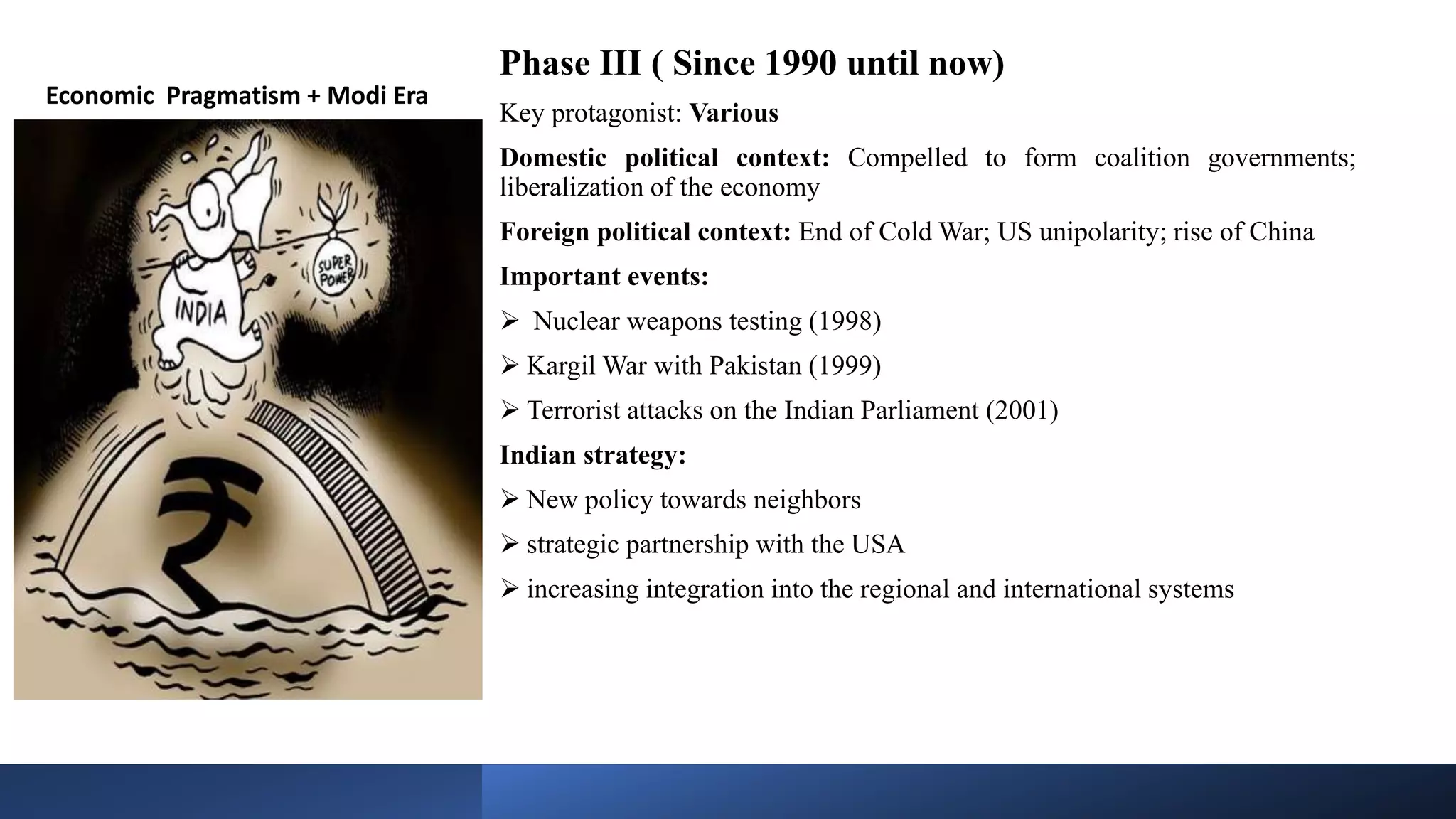
Phase III ( Since 1990 until now)
Key protagonist: Various
Domestic political context: Compelled to form coalition governments;
liberalization of the economy
Foreign political context: End of Cold War; US unipolarity; rise of China
Important events:
 Nuclear weapons testing (1998)
 Kargil War with Pakistan (1999)
 Terrorist attacks on the Indian Parliament (2001)
Indian strategy:
 New policy towards neighbors
 strategic partnership with the USA
 increasing integration into the regional and international systems
Economic Pragmatism + Modi Era
India made more of an effort to interact with the US, Israel, and ASEAN nations during this time.
Economic Pragmatism + Modi Era
• India made more of an effort to interact with the US, Israel, and ASEAN nations during this
time
• After the end of the cold war, India adopted the "look east" policy for the economic
reformation of south-east Asian nations, including Japan, Korea, and China
• The tenure of IK Gujral was more focused on the idealism adopted by Nehru. So, the India-
China agreement in 1996 was done during his tenure to maintain peace and tranquility at the
border
• During the tenure of P.V. Narasimha Rao, India’s relationship with Pakistan worsened and war
occurred in 1999. Similarly, the Babri Masjid violence, the Gulf War, and the global war
against terrorism were some of the events that affected the foreign policy of India
• Bus diplomacy during the tenure of Atal Bihari Bajpaye
India’s major foreign policy goal after 1990 was economic liberalization and the overall
development of the state along with maintaining ties with its neighbors and major powers.
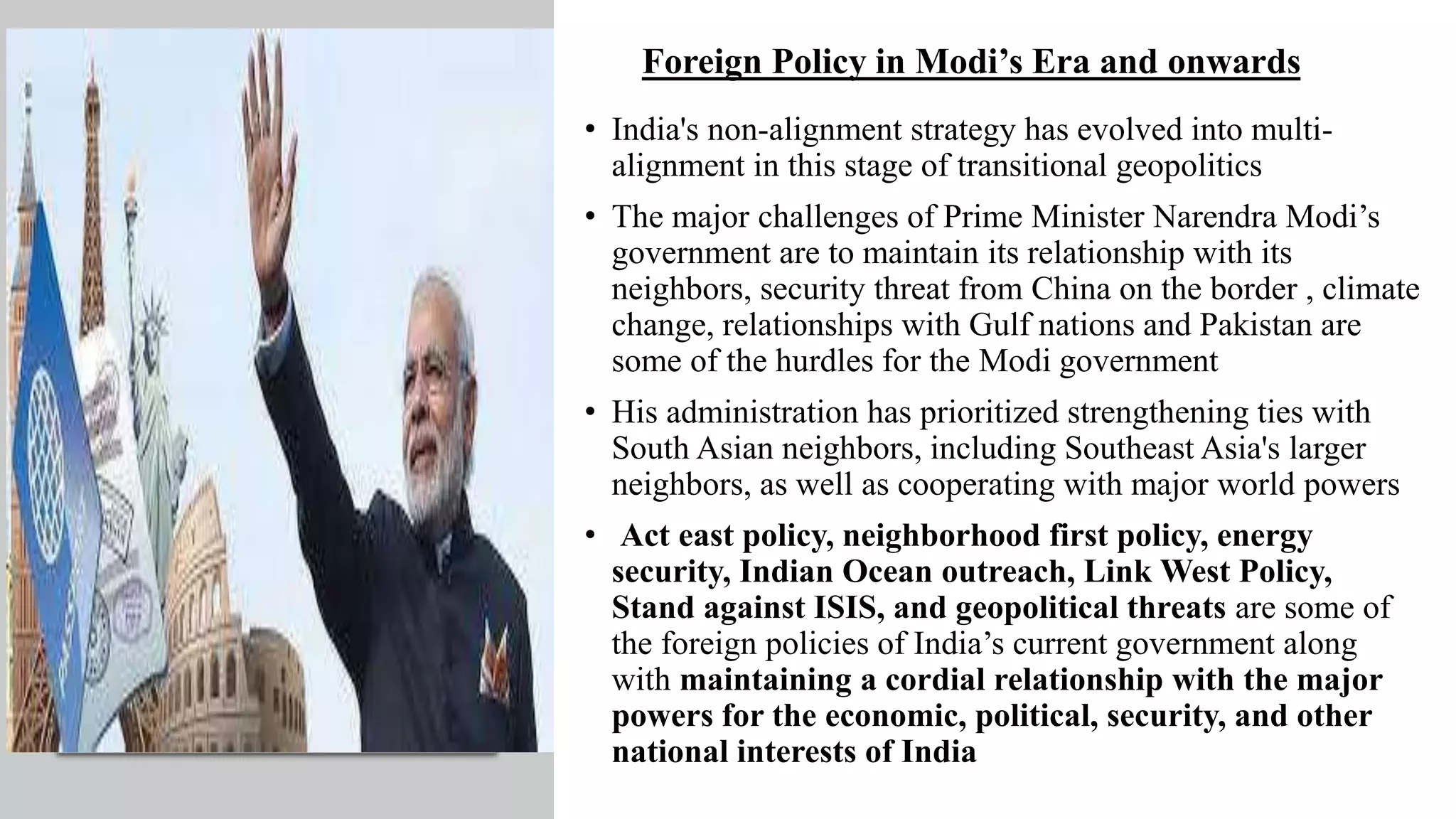
Foreign Policy in Modi’s Era and onwards
• India's non-alignment strategy has evolved into multi-
alignment in this stage of transitional geopolitics
• The major challenges of Prime Minister Narendra Modi’s
government are to maintain its relationship with its
neighbors, security threat from China on the border , climate
change, relationships with Gulf nations and Pakistan are
some of the hurdles for the Modi government
• His administration has prioritized strengthening ties with
South Asian neighbors, including Southeast Asia's larger
neighbors, as well as cooperating with major world powers
• Act east policy, neighborhood first policy, energy
security, Indian Ocean outreach, Link West Policy,
Stand against ISIS, and geopolitical threats are some of
the foreign policies of India’s current government along
with maintaining a cordial relationship with the major
powers for the economic, political, security, and other
national interests of India
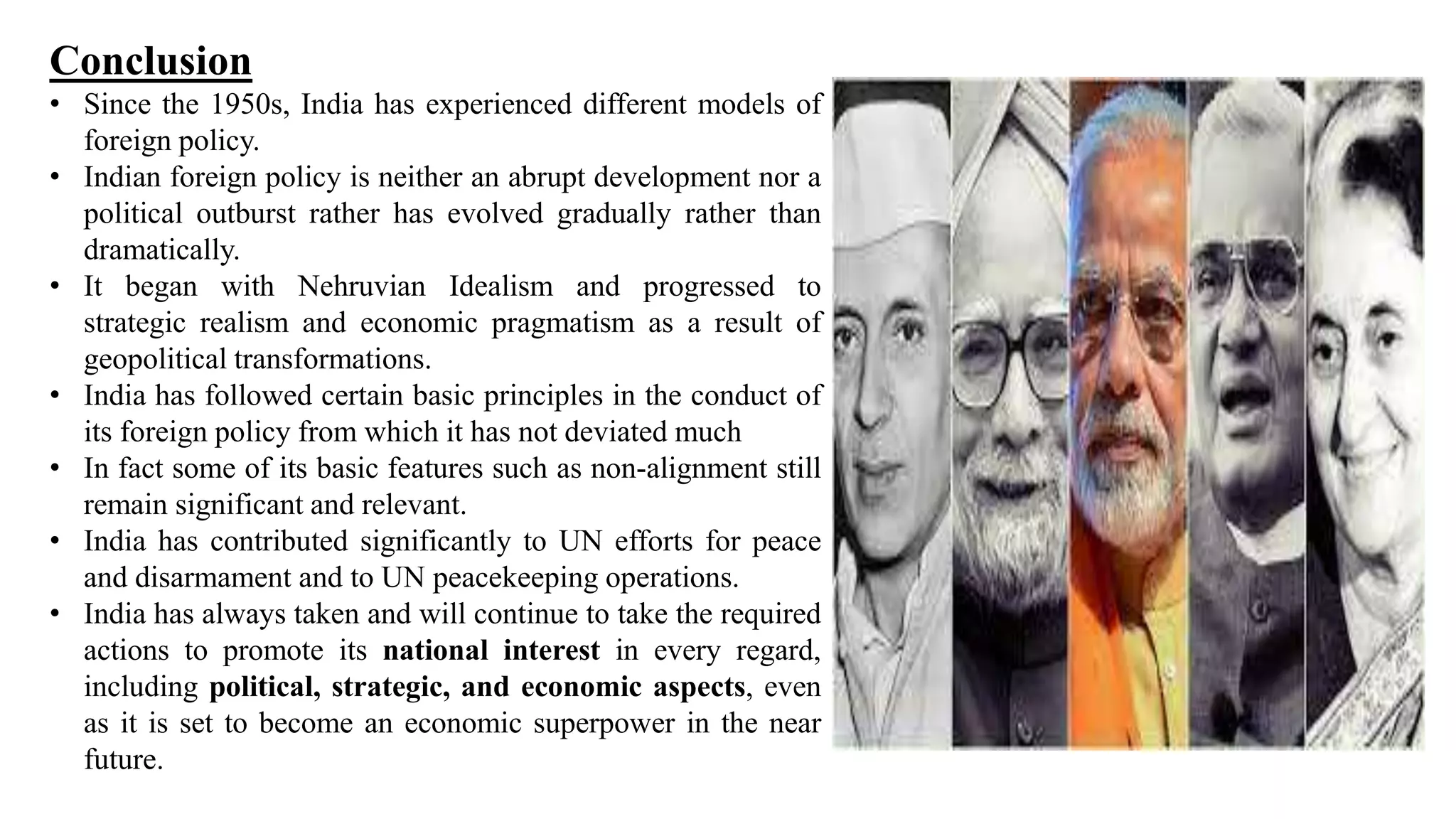
Conclusion
• Since the 1950s, India has experienced different models of
foreign policy.
• Indian foreign policy is neither an abrupt development nor a
political outburst rather has evolved gradually rather than
dramatically.
• It began with Nehruvian Idealism and progressed to
strategic realism and economic pragmatism as a result of
geopolitical transformations.
• India has followed certain basic principles in the conduct of
its foreign policy from which it has not deviated much
• In fact some of its basic features such as non-alignment still
remain significant and relevant.
• India has contributed significantly to UN efforts for peace
and disarmament and to UN peacekeeping operations.
• India has always taken and will continue to take the required
actions to promote its national interest in every regard,
including political, strategic, and economic aspects, even
as it is set to become an economic superpower in the near
future.
THANK YOU
Refrences
Carsten Rauch. (2008). Report Part Title : Phases of Indian foreign policy since independence Report
Title : Farewell Non-Alignment ? Report Subtitle : Constancy and change of foreign policy in post-
colonial India Report Author ( s ): Carsten Rauch.
David M. Malone, C.Raja Mohan, S. R. (2015). The Oxford Handbook of Indian Foreign Policy. In
Oxford University Press (Vol. 18, Issue 3). https://doi.org/10.1525/nr.2015.18.3.120
Ganguly, S., & Pardesi, M. S. (2009). Explaining Sixty Years of India’s Foreign Policy. India Review,
8(1), 4–19. https://doi.org/10.1080/14736480802665162

518_Mahesh_Bajagain.pptx

  • 1.
    I n te r n a l S e c u r i t y T h re a t s t o F I J I Presented by: Mahesh Bajagain Roll no. 22 M.A. 4th Semester mahesh.767538@dird.tu.edu.np 519-Small states in International Realtions Department of International Relations and Diplomacy Tribhuvan University
  • 2.
    Table of content •Phase I : Nehuruvian Idealism • Phase II : Strategic Realism • Phase III : Economic pragmatism
  • 3.
    The first phase(1947-65) • Key protagonist: Jawaharlal Nehru • Domestic political context: Newly won independence; establishment of democracy; socialist development model • Foreign political context: Beginnings of bipolarity and Cold War Important events:  1st Indo-Pakistani War (1947)  founding of the Non-Aligned Movement (1961)  war with China (1962)  2nd Indo-Pakistani War (1965) Indian foreign strategy:  Regional consolidation of power  transcending of Cold War through non alignment Phase I : Nehuruvian Idealism
  • 4.
    Phase I :Nehuruvian Idealism • Jawaharlal Nehru holds a unique place in Indian foreign policy history. He rose to prominence as a leading proponent of progressive internationalism and the architect of independent India's foreign policy from the 1920s until his death in 1964 (M. Malone et.al 2015) • Bipolar world. The cold war was the major context of the Nehruvian period, and Nehruvian foreign policy revolved around non-aligned foreign policy. During this time, India's foreign policy was mostly idealistic (Rauch, 1947) • Nehru was more focused on peace, disarmament, international cooperation, and anti-racism as major foreign policy goals • India’s objectives in this phase were to resist dilution of its sovereignty, rebuild its economy and consolidate its integrity  Made three major contributions in Indian foreign policy  significant contribution to multilateral organizations, especially United Nations peacekeeping missions  gave emphasis to peaceful co-existence, cooperation, non-alignment and non-interference as per the principles of Panchasheel  aided in the process of decolonization as a leader of the nonaligned movement (Ganguly & Pardesi, 2009) The major achievement of Nehruvian idealism is the birth of Non-Alignment policy, which advocates the solidarity of third world nations who do not want to join any bloc during the cold war period
  • 5.
    Phase II(1965–1989) • Keyprotagonist: Indira Gandhi (+Rajiv Gandhi) • Domestic political context: Dominance of the Congress Party • Foreign political context: Cold War and China’s change of side Important events:  3rd Indo-Pakistani War (1971)  Liberation of Bnagladesh (1971)  Peaceful nuclear explosion (1974)  Interventions in the Maldives and Sri Lanka Indian strategy:  Regional domination policy  rapprochement with the Soviet Union Phase II: Strategic Realism
  • 6.
    Phase II: StrategicRealism • Following the passing of Jawaharlal Nehru in 1964, his daughter Indira Gandhi was appointed prime minister following a brief period of transition. She was the main figure who left her stamp on the second phase of Indian foreign policy, which spanned from 1966 to 1989, as was her son Rajiv Gandhi, who eventually succeeded her as head of state (Carsten Rauch, 2008) • Indira Gandhi represented a policy of regional domination that had the hegemony of India in South Asia as its objective more clearly than the previous leadership • leaned more clearly toward the Soviet Union as a key international partner than the previous leadership (distanced herself even more from the USA in the process) (Carsten Rauch, 2008) • Gandhi played a crucial role in the formation of Bangladesh in 1971 and the nuclear test in Pokhran in 1974 • Rajiv Gandhi believed that the best way to stop proliferation was through complete nuclear disarmament (M. Malone et.al, 2015) • Gandhi's recognition that greater and more skillful engagement with the rest of the world was necessary for India's modernization and economic development marked the most fundamental shift in foreign policy.(M. Malone et.al, 2015)
  • 7.
    Phase III (Since 1990 until now) Key protagonist: Various Domestic political context: Compelled to form coalition governments; liberalization of the economy Foreign political context: End of Cold War; US unipolarity; rise of China Important events:  Nuclear weapons testing (1998)  Kargil War with Pakistan (1999)  Terrorist attacks on the Indian Parliament (2001) Indian strategy:  New policy towards neighbors  strategic partnership with the USA  increasing integration into the regional and international systems Economic Pragmatism + Modi Era
  • 8.
    India made moreof an effort to interact with the US, Israel, and ASEAN nations during this time. Economic Pragmatism + Modi Era • India made more of an effort to interact with the US, Israel, and ASEAN nations during this time • After the end of the cold war, India adopted the "look east" policy for the economic reformation of south-east Asian nations, including Japan, Korea, and China • The tenure of IK Gujral was more focused on the idealism adopted by Nehru. So, the India- China agreement in 1996 was done during his tenure to maintain peace and tranquility at the border • During the tenure of P.V. Narasimha Rao, India’s relationship with Pakistan worsened and war occurred in 1999. Similarly, the Babri Masjid violence, the Gulf War, and the global war against terrorism were some of the events that affected the foreign policy of India • Bus diplomacy during the tenure of Atal Bihari Bajpaye India’s major foreign policy goal after 1990 was economic liberalization and the overall development of the state along with maintaining ties with its neighbors and major powers.
  • 9.
    Foreign Policy inModi’s Era and onwards • India's non-alignment strategy has evolved into multi- alignment in this stage of transitional geopolitics • The major challenges of Prime Minister Narendra Modi’s government are to maintain its relationship with its neighbors, security threat from China on the border , climate change, relationships with Gulf nations and Pakistan are some of the hurdles for the Modi government • His administration has prioritized strengthening ties with South Asian neighbors, including Southeast Asia's larger neighbors, as well as cooperating with major world powers • Act east policy, neighborhood first policy, energy security, Indian Ocean outreach, Link West Policy, Stand against ISIS, and geopolitical threats are some of the foreign policies of India’s current government along with maintaining a cordial relationship with the major powers for the economic, political, security, and other national interests of India
  • 10.
    Conclusion • Since the1950s, India has experienced different models of foreign policy. • Indian foreign policy is neither an abrupt development nor a political outburst rather has evolved gradually rather than dramatically. • It began with Nehruvian Idealism and progressed to strategic realism and economic pragmatism as a result of geopolitical transformations. • India has followed certain basic principles in the conduct of its foreign policy from which it has not deviated much • In fact some of its basic features such as non-alignment still remain significant and relevant. • India has contributed significantly to UN efforts for peace and disarmament and to UN peacekeeping operations. • India has always taken and will continue to take the required actions to promote its national interest in every regard, including political, strategic, and economic aspects, even as it is set to become an economic superpower in the near future.
  • 11.
  • 12.
    Refrences Carsten Rauch. (2008).Report Part Title : Phases of Indian foreign policy since independence Report Title : Farewell Non-Alignment ? Report Subtitle : Constancy and change of foreign policy in post- colonial India Report Author ( s ): Carsten Rauch. David M. Malone, C.Raja Mohan, S. R. (2015). The Oxford Handbook of Indian Foreign Policy. In Oxford University Press (Vol. 18, Issue 3). https://doi.org/10.1525/nr.2015.18.3.120 Ganguly, S., & Pardesi, M. S. (2009). Explaining Sixty Years of India’s Foreign Policy. India Review, 8(1), 4–19. https://doi.org/10.1080/14736480802665162