MIT Arts, commerce and science college, alandi
Index Numbers
Presented
by
Prof. Dr. Sangita Birajdar
Assistant Professor,
Department of Science & Computer Science
MIT Arts, Commerce and Science College, Alandi,
Pune, Maharashtra -412105
Copyright @ Dr. Sangita Birajdar 1
OBJECTIVES
In this unit you are going to :
•Understand concept, meaning and notations of Index numbers.
•Understand the measures of Index numbers and its types.
•Construction of Price Index numbers.
•Problems in the construction of Price Index numbers.
•Cost of Living Index Numbers.
•Family Budget Index Numbers.
•Uses of Index Numbers.
•Numerical Examples on Index Numbers.
Copyright @ Dr. Sangita Birajdar 2
Concept, and Meaning of Index Numbers
• Index number is a tool which measures the changes in price or
quantity of industrial and mineral production, sales, import, export
etc.
• It was first developed by an Italian economist Mr. Carli 1764 for
comparison of prices of commodities.
• We observe that:
• The prices of commodities change from time to time, place to place.
• Wages of workers also change from time to time, place to place.
• Prices of shares exhibit up and down movements.
• Industrial production also undergoes changes.
• Index numbers measures the above mentioned changes.
• It serves the purpose of economic barometer.
Copyright @ Dr. Sangita Birajdar 3
Definition and Uses of Index Numbers
• Definition: An index number is a number designated to measure the
average change in the values of a group of related variables over two
different situations.
• The group of variables may be prices of specified commodities, quantities of
• Index numbers are used in various fields like economics, trade, stock
market, government organizations etc.
• The popularly used index numbers are:
1) Bombay Stock Exchange (BSE) SENSEX index number.
2) NSE index numbers.
3) All India wholesale price index numbers.
4) Consumer price index numbers.
5) Index number of industrial production.
6) Cost inflation index.
Copyright @ Dr. Sangita Birajdar 4
Problems in the construction of Index Numbers
1) Purpose of Index of Numbers:
• The purpose for which the index number is constructed should be
clearly mentioned.
• The scope of index numbers should be also be defined clearly.
• For example, while constructing the consumer’s index numbers, the
appropriate commodities are to be selected. Similarly, the class of
people for which this index number is to be constructed should be
clearly defined.
Copyright @ Dr. Sangita Birajdar 5
Problems in the construction of Index Numbers
2) Selection of Commodities:
• There are no rigid rules regarding selection of commodities.
However, the number of commodities should not be too large
otherwise it will result into greater expense, more time, more
volume of work.
• The number of commodities should not be too small otherwise the
associated index number will not remain proper representative.
• Hence, the number of commodities to be included should be
reasonable in number.
• For Example, if we want to construct a cost of living index number
for poor families then we should not include luxury goods like car,
washing machine, AC etc. Stable commodities are to be selected
means the commodities selected should not disappear from
market.
Copyright @ Dr. Sangita Birajdar 6
Problems in the construction of Index Numbers
3) Collection of data :
• After selecting the commodities, the next problem is data collection
of data.
• Data my be price quotations or quantity consumed or quantity
produced or quantity imported etc. depending upon the purpose of
index numbers.
• The data should be accurate and proper representative.
• It should be collected from reliable agencies, standard trade
journals, periodical reports, official publications etc.
• Prices vary from place to place, shop to shop, and quality to quality
therefore prices should collected with utmost care.
Copyright @ Dr. Sangita Birajdar 7
Problems in the construction of Index Numbers
4) Choice of base period:
• Index number uses two time periods.
• A period for which the index number is determined is called as current
period and the period of comparison or with respect to which index number
is determined is called as base period.
• The base period should be a normal period. It means that there should not
be incidents like war, floods, famine, earthquakes, labor strikes etc.
• The base period should not be too distant. The customs, habits, tastes of
people change gradually. Therefore, comparison pattern is subject to
change. Hence, for proper comparison, base period should not be too
distant.
• The base period should not be too small or too large. If base period is too
short (e.g. a single day) the prices are highly unstable. On the other hand if
the period is too large (e.g. five years) then prices undergo many variations.
• Some times base year is taken as average of many years.
Copyright @ Dr. Sangita Birajdar 8
Problems in the construction of Index Numbers
5) Selection of Average:
• As the Index number is average change in prices or quantities, we
need to use appropriate average to summarize the data.
• Arithmetic Mean (A.M.) is a good measure of central tendency as it
fulfill most of the requirements of a good measure of central
tendency and hence it is suitable in most of the situations. Hence,
many times for simplicity A.M. is used.
• However, Geometric Mean (G.M.) is more suitable and gives more
accurate result. Index numbers based on G.M. satisfy certain tests
which is the requirement of good index number but G.M. is difficult
to compute.
Copyright @ Dr. Sangita Birajdar 9
Problems in the construction of Index Numbers
6) Selection of weights:
• Weighted averages are more appropriate for constructing the Index
number as compared to simple averages.
• In simple average equal weight is assigned for all the observations
whereas in weighted average proper importance is given to all the
observations.
• If we use weighted Index numbers it gives proper importance to the
commodities.
• Weight plays the role of frequency but it can be fractional in nature.
• For example, increase in the price of salt and that of wheat or rice
will have different influence on index number. Thus to get true
reflection of changes, weighted average is used.
Copyright @ Dr. Sangita Birajdar 10
Problems in the construction of Index Numbers
6) Selection of weights:
• There are two types of weights:
(i) Quantity weights (q): Amount of commodity consumed or
produced or exported etc. is used as weight.
(ii) Value weights (V) : The product of price and quantity used or
produced is used as weight.
Copyright @ Dr. Sangita Birajdar 11
Types of Index Numbers
• There are three types of index numbers:
• Price Index Numbers: Price Index Numbers are computed to
measure the relative changes in prices of group of commodities or
single commodity. For example, Government of India computes, two
series of price index numbers:
(i) Wholesale price index numbers
(ii) Consumer price index numbers. BSE and NSE are two important
price index numbers.
Copyright @ Dr. Sangita Birajdar 12
Types of Index Numbers
• Quantity Index Numbers: Quantity Index Numbers are constructed
to measure the changes in volume. Like volume of industrial
production, agricultural production, mineral production, import,
export etc. For example, government of India calculates yearly index
of industrial production with the help of Central Statistical
Organization (CSO).
• Value Index Numbers: Value is taken as a product of price and
quantity. To find the changes in worth of total production, inventory,
foreign trade etc. value index numbers re used
Copyright @ Dr. Sangita Birajdar 13
Construction of Index Numbers
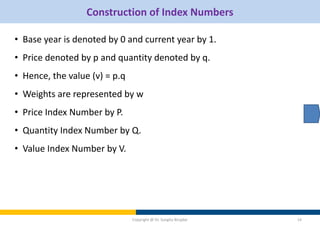
• Base year is denoted by 0 and current year by 1.
• Price denoted by p and quantity denoted by q.
• Hence, the value (v) = p.q
• Weights are represented by w
• Price Index Number by P.
• Quantity Index Number by Q.
• Value Index Number by V.
Copyright @ Dr. Sangita Birajdar 14
Construction of Index Numbers
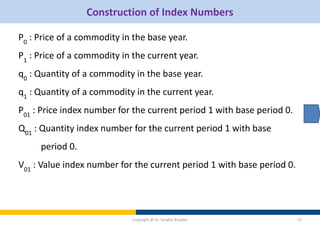
P0
: Price of a commodity in the base year.
P1
: Price of a commodity in the current year.
q0
: Quantity of a commodity in the base year.
q1
: Quantity of a commodity in the current year.
P01
: Price index number for the current period 1 with base period 0.
Q01
: Quantity index number for the current period 1 with base
period 0.
V01
: Value index number for the current period 1 with base period 0.
Copyright @ Dr. Sangita Birajdar 15
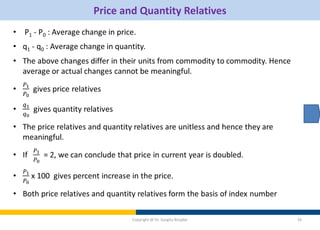
Price and Quantity Relatives
Copyright @ Dr. Sangita Birajdar 16
Classification of Index Number
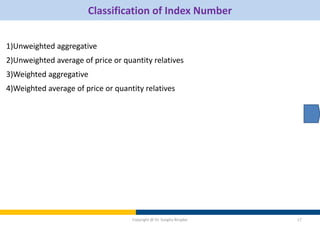
1)Unweighted aggregative
2)Unweighted average of price or quantity relatives
3)Weighted aggregative
4)Weighted average of price or quantity relatives
Copyright @ Dr. Sangita Birajdar 17
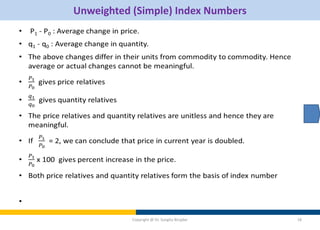
Unweighted (Simple) Index Numbers
Copyright @ Dr. Sangita Birajdar 18
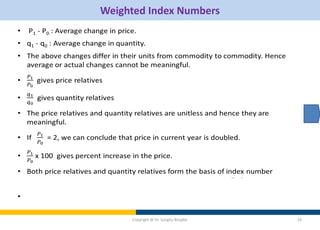
Weighted Index Numbers
Copyright @ Dr. Sangita Birajdar 19
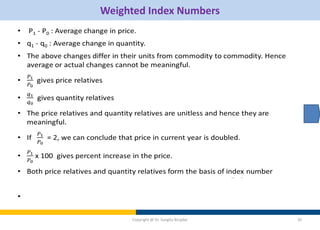
Weighted Index Numbers
Copyright @ Dr. Sangita Birajdar 20
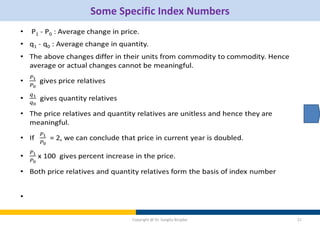
Some Specific Index Numbers
Copyright @ Dr. Sangita Birajdar 21
Some Specific Index Numbers
Copyright @ Dr. Sangita Birajdar 22
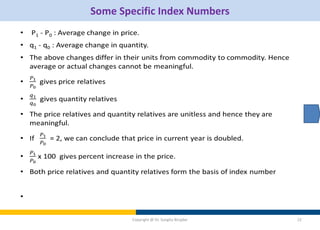
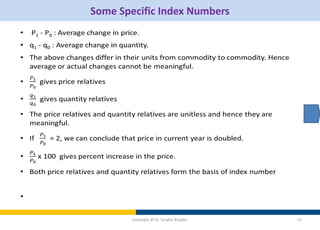
Some Specific Index Numbers
Copyright @ Dr. Sangita Birajdar 23
Some Specific Index Numbers
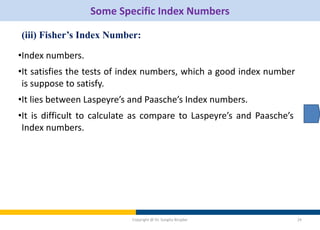
(iii) Fisher’s Index Number:
•Index numbers.
•It satisfies the tests of index numbers, which a good index number
is suppose to satisfy.
•It lies between Laspeyre’s and Paasche’s Index numbers.
•It is difficult to calculate as compare to Laspeyre’s and Paasche’s
Index numbers.
Copyright @ Dr. Sangita Birajdar 24
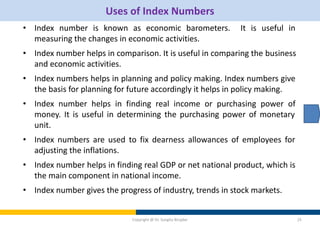
Uses of Index Numbers
• Index number is known as economic barometers. It is useful in
measuring the changes in economic activities.
• Index number helps in comparison. It is useful in comparing the business
and economic activities.
• Index numbers helps in planning and policy making. Index numbers give
the basis for planning for future accordingly it helps in policy making.
• Index number helps in finding real income or purchasing power of
money. It is useful in determining the purchasing power of monetary
unit.
• Index numbers are used to fix dearness allowances of employees for
adjusting the inflations.
• Index number helps in finding real GDP or net national product, which is
the main component in national income.
• Index number gives the progress of industry, trends in stock markets.
Copyright @ Dr. Sangita Birajdar 25
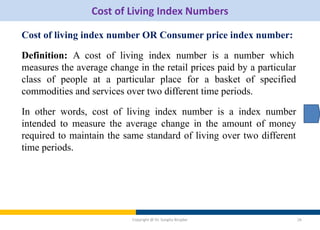
Cost of Living Index Numbers
Cost of living index number OR Consumer price index number:
Definition: A cost of living index number is a number which
measures the average change in the retail prices paid by a particular
class of people at a particular place for a basket of specified
commodities and services over two different time periods.
In other words, cost of living index number is a index number
intended to measure the average change in the amount of money
required to maintain the same standard of living over two different
time periods.
Copyright @ Dr. Sangita Birajdar 26
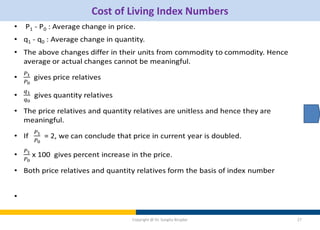
Cost of Living Index Numbers
Copyright @ Dr. Sangita Birajdar 27
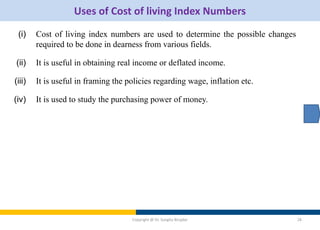
Uses of Cost of living Index Numbers
(i) Cost of living index numbers are used to determine the possible changes
required to be done in dearness from various fields.
(ii) It is useful in obtaining real income or deflated income.
(iii) It is useful in framing the policies regarding wage, inflation etc.
(iv) It is used to study the purchasing power of money.
Copyright @ Dr. Sangita Birajdar 28

Index NumbersI.ppt.pdf

  • 1.
    MIT Arts, commerceand science college, alandi Index Numbers Presented by Prof. Dr. Sangita Birajdar Assistant Professor, Department of Science & Computer Science MIT Arts, Commerce and Science College, Alandi, Pune, Maharashtra -412105 Copyright @ Dr. Sangita Birajdar 1
  • 2.
    OBJECTIVES In this unityou are going to : •Understand concept, meaning and notations of Index numbers. •Understand the measures of Index numbers and its types. •Construction of Price Index numbers. •Problems in the construction of Price Index numbers. •Cost of Living Index Numbers. •Family Budget Index Numbers. •Uses of Index Numbers. •Numerical Examples on Index Numbers. Copyright @ Dr. Sangita Birajdar 2
  • 3.
    Concept, and Meaningof Index Numbers • Index number is a tool which measures the changes in price or quantity of industrial and mineral production, sales, import, export etc. • It was first developed by an Italian economist Mr. Carli 1764 for comparison of prices of commodities. • We observe that: • The prices of commodities change from time to time, place to place. • Wages of workers also change from time to time, place to place. • Prices of shares exhibit up and down movements. • Industrial production also undergoes changes. • Index numbers measures the above mentioned changes. • It serves the purpose of economic barometer. Copyright @ Dr. Sangita Birajdar 3
  • 4.
    Definition and Usesof Index Numbers • Definition: An index number is a number designated to measure the average change in the values of a group of related variables over two different situations. • The group of variables may be prices of specified commodities, quantities of • Index numbers are used in various fields like economics, trade, stock market, government organizations etc. • The popularly used index numbers are: 1) Bombay Stock Exchange (BSE) SENSEX index number. 2) NSE index numbers. 3) All India wholesale price index numbers. 4) Consumer price index numbers. 5) Index number of industrial production. 6) Cost inflation index. Copyright @ Dr. Sangita Birajdar 4
  • 5.
    Problems in theconstruction of Index Numbers 1) Purpose of Index of Numbers: • The purpose for which the index number is constructed should be clearly mentioned. • The scope of index numbers should be also be defined clearly. • For example, while constructing the consumer’s index numbers, the appropriate commodities are to be selected. Similarly, the class of people for which this index number is to be constructed should be clearly defined. Copyright @ Dr. Sangita Birajdar 5
  • 6.
    Problems in theconstruction of Index Numbers 2) Selection of Commodities: • There are no rigid rules regarding selection of commodities. However, the number of commodities should not be too large otherwise it will result into greater expense, more time, more volume of work. • The number of commodities should not be too small otherwise the associated index number will not remain proper representative. • Hence, the number of commodities to be included should be reasonable in number. • For Example, if we want to construct a cost of living index number for poor families then we should not include luxury goods like car, washing machine, AC etc. Stable commodities are to be selected means the commodities selected should not disappear from market. Copyright @ Dr. Sangita Birajdar 6
  • 7.
    Problems in theconstruction of Index Numbers 3) Collection of data : • After selecting the commodities, the next problem is data collection of data. • Data my be price quotations or quantity consumed or quantity produced or quantity imported etc. depending upon the purpose of index numbers. • The data should be accurate and proper representative. • It should be collected from reliable agencies, standard trade journals, periodical reports, official publications etc. • Prices vary from place to place, shop to shop, and quality to quality therefore prices should collected with utmost care. Copyright @ Dr. Sangita Birajdar 7
  • 8.
    Problems in theconstruction of Index Numbers 4) Choice of base period: • Index number uses two time periods. • A period for which the index number is determined is called as current period and the period of comparison or with respect to which index number is determined is called as base period. • The base period should be a normal period. It means that there should not be incidents like war, floods, famine, earthquakes, labor strikes etc. • The base period should not be too distant. The customs, habits, tastes of people change gradually. Therefore, comparison pattern is subject to change. Hence, for proper comparison, base period should not be too distant. • The base period should not be too small or too large. If base period is too short (e.g. a single day) the prices are highly unstable. On the other hand if the period is too large (e.g. five years) then prices undergo many variations. • Some times base year is taken as average of many years. Copyright @ Dr. Sangita Birajdar 8
  • 9.
    Problems in theconstruction of Index Numbers 5) Selection of Average: • As the Index number is average change in prices or quantities, we need to use appropriate average to summarize the data. • Arithmetic Mean (A.M.) is a good measure of central tendency as it fulfill most of the requirements of a good measure of central tendency and hence it is suitable in most of the situations. Hence, many times for simplicity A.M. is used. • However, Geometric Mean (G.M.) is more suitable and gives more accurate result. Index numbers based on G.M. satisfy certain tests which is the requirement of good index number but G.M. is difficult to compute. Copyright @ Dr. Sangita Birajdar 9
  • 10.
    Problems in theconstruction of Index Numbers 6) Selection of weights: • Weighted averages are more appropriate for constructing the Index number as compared to simple averages. • In simple average equal weight is assigned for all the observations whereas in weighted average proper importance is given to all the observations. • If we use weighted Index numbers it gives proper importance to the commodities. • Weight plays the role of frequency but it can be fractional in nature. • For example, increase in the price of salt and that of wheat or rice will have different influence on index number. Thus to get true reflection of changes, weighted average is used. Copyright @ Dr. Sangita Birajdar 10
  • 11.
    Problems in theconstruction of Index Numbers 6) Selection of weights: • There are two types of weights: (i) Quantity weights (q): Amount of commodity consumed or produced or exported etc. is used as weight. (ii) Value weights (V) : The product of price and quantity used or produced is used as weight. Copyright @ Dr. Sangita Birajdar 11
  • 12.
    Types of IndexNumbers • There are three types of index numbers: • Price Index Numbers: Price Index Numbers are computed to measure the relative changes in prices of group of commodities or single commodity. For example, Government of India computes, two series of price index numbers: (i) Wholesale price index numbers (ii) Consumer price index numbers. BSE and NSE are two important price index numbers. Copyright @ Dr. Sangita Birajdar 12
  • 13.
    Types of IndexNumbers • Quantity Index Numbers: Quantity Index Numbers are constructed to measure the changes in volume. Like volume of industrial production, agricultural production, mineral production, import, export etc. For example, government of India calculates yearly index of industrial production with the help of Central Statistical Organization (CSO). • Value Index Numbers: Value is taken as a product of price and quantity. To find the changes in worth of total production, inventory, foreign trade etc. value index numbers re used Copyright @ Dr. Sangita Birajdar 13
  • 14.
    Construction of IndexNumbers • Base year is denoted by 0 and current year by 1. • Price denoted by p and quantity denoted by q. • Hence, the value (v) = p.q • Weights are represented by w • Price Index Number by P. • Quantity Index Number by Q. • Value Index Number by V. Copyright @ Dr. Sangita Birajdar 14
  • 15.
    Construction of IndexNumbers P0 : Price of a commodity in the base year. P1 : Price of a commodity in the current year. q0 : Quantity of a commodity in the base year. q1 : Quantity of a commodity in the current year. P01 : Price index number for the current period 1 with base period 0. Q01 : Quantity index number for the current period 1 with base period 0. V01 : Value index number for the current period 1 with base period 0. Copyright @ Dr. Sangita Birajdar 15
  • 16.
    Price and QuantityRelatives Copyright @ Dr. Sangita Birajdar 16
  • 17.
    Classification of IndexNumber 1)Unweighted aggregative 2)Unweighted average of price or quantity relatives 3)Weighted aggregative 4)Weighted average of price or quantity relatives Copyright @ Dr. Sangita Birajdar 17
  • 18.
    Unweighted (Simple) IndexNumbers Copyright @ Dr. Sangita Birajdar 18
  • 19.
    Weighted Index Numbers Copyright@ Dr. Sangita Birajdar 19
  • 20.
    Weighted Index Numbers Copyright@ Dr. Sangita Birajdar 20
  • 21.
    Some Specific IndexNumbers Copyright @ Dr. Sangita Birajdar 21
  • 22.
    Some Specific IndexNumbers Copyright @ Dr. Sangita Birajdar 22
  • 23.
    Some Specific IndexNumbers Copyright @ Dr. Sangita Birajdar 23
  • 24.
    Some Specific IndexNumbers (iii) Fisher’s Index Number: •Index numbers. •It satisfies the tests of index numbers, which a good index number is suppose to satisfy. •It lies between Laspeyre’s and Paasche’s Index numbers. •It is difficult to calculate as compare to Laspeyre’s and Paasche’s Index numbers. Copyright @ Dr. Sangita Birajdar 24
  • 25.
    Uses of IndexNumbers • Index number is known as economic barometers. It is useful in measuring the changes in economic activities. • Index number helps in comparison. It is useful in comparing the business and economic activities. • Index numbers helps in planning and policy making. Index numbers give the basis for planning for future accordingly it helps in policy making. • Index number helps in finding real income or purchasing power of money. It is useful in determining the purchasing power of monetary unit. • Index numbers are used to fix dearness allowances of employees for adjusting the inflations. • Index number helps in finding real GDP or net national product, which is the main component in national income. • Index number gives the progress of industry, trends in stock markets. Copyright @ Dr. Sangita Birajdar 25
  • 26.
    Cost of LivingIndex Numbers Cost of living index number OR Consumer price index number: Definition: A cost of living index number is a number which measures the average change in the retail prices paid by a particular class of people at a particular place for a basket of specified commodities and services over two different time periods. In other words, cost of living index number is a index number intended to measure the average change in the amount of money required to maintain the same standard of living over two different time periods. Copyright @ Dr. Sangita Birajdar 26
  • 27.
    Cost of LivingIndex Numbers Copyright @ Dr. Sangita Birajdar 27
  • 28.
    Uses of Costof living Index Numbers (i) Cost of living index numbers are used to determine the possible changes required to be done in dearness from various fields. (ii) It is useful in obtaining real income or deflated income. (iii) It is useful in framing the policies regarding wage, inflation etc. (iv) It is used to study the purchasing power of money. Copyright @ Dr. Sangita Birajdar 28