IN-DEPTH LOOK AT THE FLEX
   COMPILER AND HFCD

               Clement Wong
         clement@stopcoding.org
     http://stopcoding.wordpress.com
AGENDA

• Basic Architecture   of Flex Compiler

• Compiler    Extensibility

• Overview    of Flex Compiler API

• HellFire   Compiler Daemon (HFCD)

• Demo, Q/A
SPEAKER BIO

• Founder    of Bytecode Workshop; Creator of HFCD

• Former    Flex Compiler/Profiler Architect & Engineering Lead

• Former    ColdFusion MX Architect & Engineering Lead

• Licensed   Professional Engineer in the Province of Ontario

• Studied   CS and Mech. Eng. at the University of Waterloo
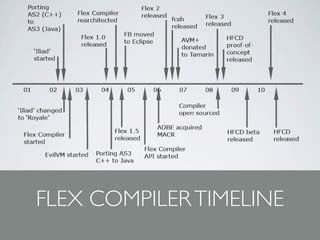
FLEX COMPILER TIMELINE
FLEX COMPILER 1.0-1.5


• Supports   MXML and AS2 (not AS3).

• Based   on the AS2 compiler from Flash Authoring.

• Ported   from C++ to Java for J2EE.

• Invoked   by a MXML servlet.
FLEX COMPILER 1.0-1.5

• Major   challenges from the AS2 compiler.

• Notarchitected or partitioned for Flex - no clear compilation
 phases defined - at least not clear enough for MXML.

• Difficult   to extend; not MXML friendly.

• Pre AS3/AVM+: classes   and assets were both first-class citizens
 - very difficult to implement a good linker.
FLEX COMPILER 2.0 - 4.0

• Itis a multi-language compiler. It supports mxml, as, css,
  properties and now fxg.

• There is a “mini compiler” for each language. Each “mini
  compiler” implements some well-defined compilation phases.

• The “top level” Flex compiler becomes a coordinator -
  responsible for looking up source and SWC files; determines
  when and which “mini compiler” to call; etc...
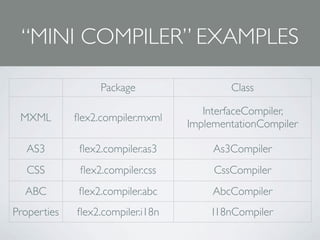
“MINI COMPILER” EXAMPLES

                  Package                 Class

                                     InterfaceCompiler,
 MXML        flex2.compiler.mxml
                                  ImplementationCompiler

   AS3        flex2.compiler.as3        As3Compiler
   CSS        flex2.compiler.css        CssCompiler
  ABC        flex2.compiler.abc         AbcCompiler
Properties   flex2.compiler.i18n       I18nCompiler
SPECIAL CASE: MXML

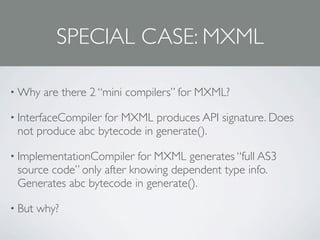
• Why    are there 2 “mini compilers” for MXML?

• InterfaceCompiler
                  for MXML produces API signature. Does
 not produce abc bytecode in generate().

• ImplementationCompiler   for MXML generates “full AS3
 source code” only after knowing dependent type info.
 Generates abc bytecode in generate().

• But   why?
SPECIAL CASE: MXML

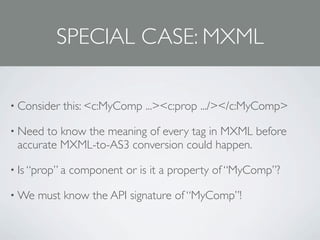
• Consider   this: <c:MyComp ...><c:prop .../></c:MyComp>

• Need to know the meaning of every tag in MXML before
 accurate MXML-to-AS3 conversion could happen.

• Is “prop” a   component or is it a property of “MyComp”?

• We   must know the API signature of “MyComp”!
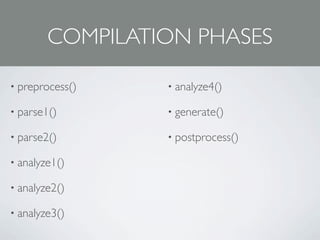
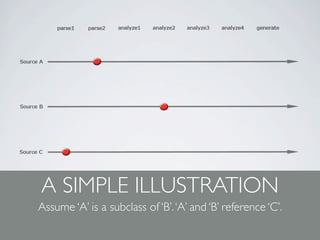
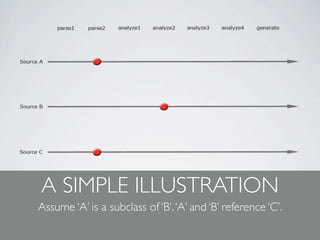
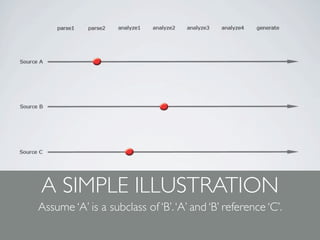
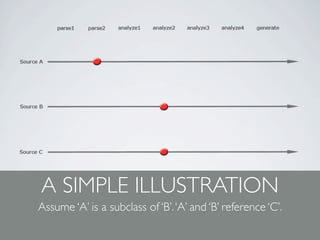
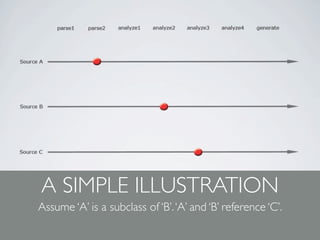
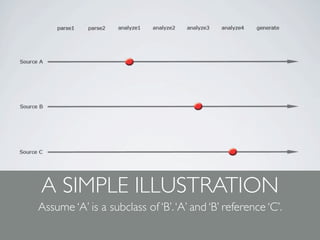
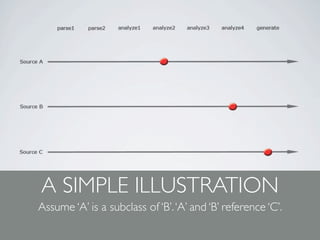
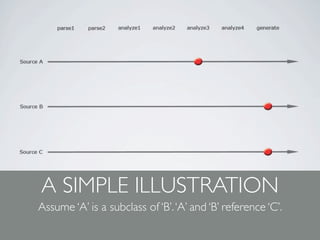
COMPILATION PHASES

• preprocess()   • analyze4()

• parse1()       • generate()

• parse2()       • postprocess()

• analyze1()

• analyze2()

• analyze3()
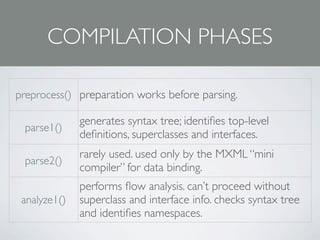
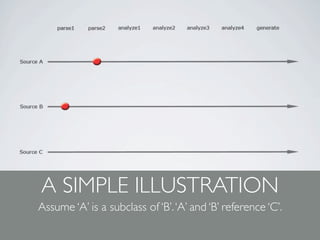
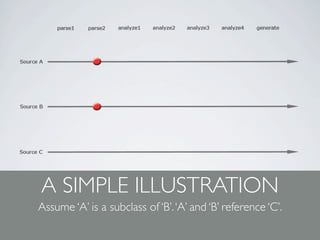
COMPILATION PHASES

preprocess() preparation works before parsing.

              generates syntax tree; identifies top-level
 parse1()
              definitions, superclasses and interfaces.
              rarely used. used only by the MXML “mini
 parse2()
              compiler” for data binding.
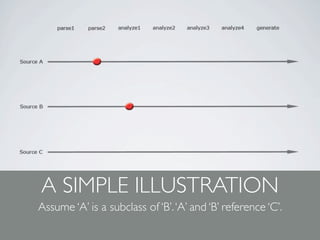
              performs flow analysis. can’t proceed without
 analyze1()   superclass and interface info. checks syntax tree
              and identifies namespaces.
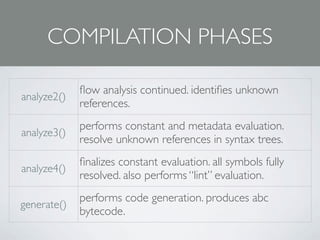
COMPILATION PHASES

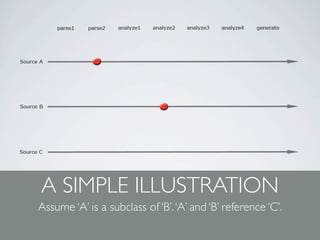
             flow analysis continued. identifies unknown
analyze2()
             references.
             performs constant and metadata evaluation.
analyze3()
             resolve unknown references in syntax trees.
             finalizes constant evaluation. all symbols fully
analyze4()
             resolved. also performs “lint” evaluation.
             performs code generation. produces abc
generate()
             bytecode.
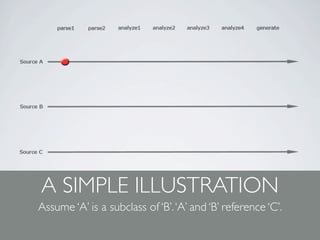
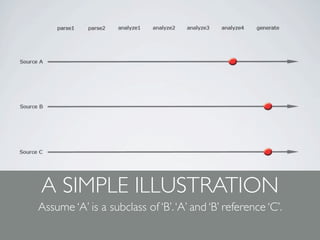
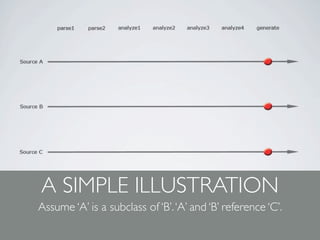
A SIMPLE ILLUSTRATION
Assume ‘A’ is a subclass of ‘B’. ‘A’ and ‘B’ reference ‘C’.
A SIMPLE ILLUSTRATION
Assume ‘A’ is a subclass of ‘B’. ‘A’ and ‘B’ reference ‘C’.
A SIMPLE ILLUSTRATION
Assume ‘A’ is a subclass of ‘B’. ‘A’ and ‘B’ reference ‘C’.
A SIMPLE ILLUSTRATION
Assume ‘A’ is a subclass of ‘B’. ‘A’ and ‘B’ reference ‘C’.
A SIMPLE ILLUSTRATION
Assume ‘A’ is a subclass of ‘B’. ‘A’ and ‘B’ reference ‘C’.
A SIMPLE ILLUSTRATION
Assume ‘A’ is a subclass of ‘B’. ‘A’ and ‘B’ reference ‘C’.
A SIMPLE ILLUSTRATION
Assume ‘A’ is a subclass of ‘B’. ‘A’ and ‘B’ reference ‘C’.
A SIMPLE ILLUSTRATION
Assume ‘A’ is a subclass of ‘B’. ‘A’ and ‘B’ reference ‘C’.
A SIMPLE ILLUSTRATION
Assume ‘A’ is a subclass of ‘B’. ‘A’ and ‘B’ reference ‘C’.
A SIMPLE ILLUSTRATION
Assume ‘A’ is a subclass of ‘B’. ‘A’ and ‘B’ reference ‘C’.
A SIMPLE ILLUSTRATION
Assume ‘A’ is a subclass of ‘B’. ‘A’ and ‘B’ reference ‘C’.
A SIMPLE ILLUSTRATION
Assume ‘A’ is a subclass of ‘B’. ‘A’ and ‘B’ reference ‘C’.
A SIMPLE ILLUSTRATION
Assume ‘A’ is a subclass of ‘B’. ‘A’ and ‘B’ reference ‘C’.
A SIMPLE ILLUSTRATION
Assume ‘A’ is a subclass of ‘B’. ‘A’ and ‘B’ reference ‘C’.
A SIMPLE ILLUSTRATION
Assume ‘A’ is a subclass of ‘B’. ‘A’ and ‘B’ reference ‘C’.
COMPILER EXTENSIONS

• The “mini
         compiler” implementations are “shared” code
 among SDK tools.

• mxmlc, compc   and asdoc all use the “mini compilers” but they
 serve different purposes. They need to do different things at
 the end of each compilation phase.

• Solution: “mini   compiler” supports “compiler extension”.

• Implement   the “flex2.compiler.as3.Extension” interface.
EXTENSION EXAMPLES

• ASDocExtension

• DataBindingExtension

• EmbedExtension

• SignatureExtension

• StyleExtension
FLEX 4: YAFCEM

• YAFCEM?? Yet Another    Flex Compiler Extension Mechanism

• Introducedin Flex 4. Flex developers could insert Java code
 into the compiler. The compiler would execute the Java code
 at a number of locations defined by the extension interfaces.

• e.g. IApplicationExtension, ILibraryExtension.

• Note: Theyare not executed at the end of the mini compiler
 compilation phases. e.g. IApplicationExtension executed at the
 end of Application.build().
TRANSCODERS

• When there is an [Embed] in your code, how does the
 compiler process it?

• Answer: EmbedExtension. EmbedExtension        uses transcoders.

• Typically   generates an AS3 class and a SWF asset tag.

• The generated classes are handed to the “top-level” compiler
 “coordinator”. The classes are then scheduled to be compiled
 and linked.
TRANSCODERS

• Transcoders   implement the “flex2.compiler.Transcoder”
 interface.

• The interface looks simple. However, implementation could be
 tricky because:

 • one   must be familiar with the SWF file format.

 • one   must know what to generate for the asset classes.

 • use   -keep-generated-actionscript to learn about codegen.
TRANSCODER EXAMPLES

• DataTranscoder            • SVGTranscoder

• FontTranscoder            • morein the
                             “flex2.compiler.media”
• JPEGTranscoder             package.
• LosslessImageTranscoder

• MovieTranscoder

• SoundTranscoder
LINKER

• The   Flex compiler not just compiles. It also links.

• Application   SWFs and library (SWC) SWFs are different.

• Application SWFs typically have 2 frames: Preloader and
 essential Flex framework classes in the 1st frame. The rest of
 the application and framework classes in the 2nd frame.

• LibrarySWFs are simpler: everything in one frame. Debug info
 is always embedded. No SWF optimizations.
LINKER

• The SWF structure of these 2 SWF types are encapsulated in
 2 Flex classes.

• Application: flex2.linker.FlexMovie

• Library: flex2.compiler.swc.SwcMovie

• Both  classes (the generate() method) take a list of compilation
 units; run dependency analysis; determine export order and
 generate SWF.
LINKER

• Theexport order of application SWFs is important because
 the ActionScript VM in the Player demands the export order
 be based on type dependencies. It is a reasonable demand
 because that simplifies VM class loading and verification.

• Use topological sort to determine export order. In fact,
 topological sort is used in the compile phase as well (for
 processing AS3 inheritance chains in the AS3 compiler and for
 circular dependency detection).
TOPOLOGICAL SORT

•A     vertex represents a definition (e.g. a class or a function).

•A  directed edge between two vertices represents the
  dependency between the two definitions. For example, when
  vertex B points to vertex A, that means A depends on B.

• Ifa vertex has no arrow pointing towards it, it goes to the
  export order. The vertex is then removed. Its edges (all
  pointing outwards) are also removed. This step continues.
TOPOLOGICAL SORT


• The sorting ends when the in-degrees of all the vertices in the
  dependency graph are not zero.

• Ifthere are still vertices in the graph, those definitions are in
  some circular dependency loops.
POST-LINK

• Foreach file compiled, the compiler generates a set of
 ActionScript bytecode. It is self-contained, completed with a
 constant pool, a set of API signatures and a set of function
 bodies.

• Anapplication SWF, if un-optimized, can have a lot of constant
 pools. They can be quite overlapping.

• One   of the key steps in the post-link phase is “abc merging”.
FLEX COMPILER API

• Flex   toolchains need a simple way to invoke the compiler.

• Users    of the Flex Compiler API:

  • Flex   Builder

  • SAP

  • Flex   Data Services
FLEX COMPILER API

• Recently, one
             of the users of the Flex Compiler API is HellFire
 Compiler Daemon (HFCD).

• The APIclasses are in the flex2.tools.oem and
 flex2.tools.flexbuilder packages.

• Use
    flex2.tools.oem.Application to build applications and
 modules.

• Use   flex2.tools.oem.Library to build libraries.
FLEX COMPILER API

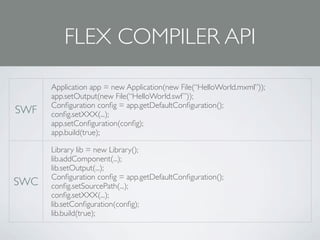
      Application app = new Application(new File(“HelloWorld.mxml”));
      app.setOutput(new File(“HelloWorld.swf ”));
      Configuration config = app.getDefaultConfiguration();
SWF   config.setXXX(...);
      app.setConfiguration(config);
      app.build(true);

      Library lib = new Library();
      lib.addComponent(...);
      lib.setOutput(...);
      Configuration config = app.getDefaultConfiguration();
SWC   config.setSourcePath(...);
      config.setXXX(...);
      lib.setConfiguration(config);
      lib.build(true);
FLEX COMPILER API

• The API
        usage is simple, but toolchains usually do more... They
 implement some of the following compiler interfaces.

 • Logger

 • ProgressMeter

 • PathResolver

 • Report
HELLFIRE COMPILER DAEMON

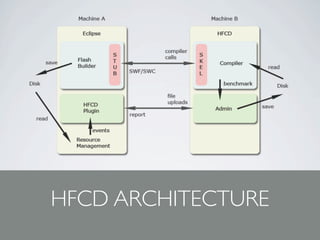
• What   is HFCD? It is an out-of-process Flex compiler.

• Socket, TCP/IP   based. Implemented a RPC version of the Flex
 Compiler API.

• Usehardware, multicore technologies to speed up build
 performance.

• Eclipse   based. Flex Builder compatible. FDT support coming
 soon.
HFCD ARCHITECTURE
HFCD ADVANTAGES

• Socket based. Could run HFCD on a second machine (i.e.
 access to more CPU and memory resources).

• Use Java server VM to run the compiler. Consistently 30%
 faster than Java client VM.

• Withmultiple CPU cores, HFCD builds applications/libraries
 concurrently if possible. Build speedup factor could reach the
 number of available CPUs.
HFCD ADVANTAGES

• Use
    HFCD ant tasks, the ant <parallel> task and multiple
 HFCD servers to build.

• For   more information, please visit:

  • http://bytecode-workshop.com

  • http://stopcoding.wordpress.com
HFCD DEMO
Q/A

In-depth look at the Flex compiler and HFCD

  • 1.
    IN-DEPTH LOOK ATTHE FLEX COMPILER AND HFCD Clement Wong clement@stopcoding.org http://stopcoding.wordpress.com
  • 2.
    AGENDA • Basic Architecture of Flex Compiler • Compiler Extensibility • Overview of Flex Compiler API • HellFire Compiler Daemon (HFCD) • Demo, Q/A
  • 3.
    SPEAKER BIO • Founder of Bytecode Workshop; Creator of HFCD • Former Flex Compiler/Profiler Architect & Engineering Lead • Former ColdFusion MX Architect & Engineering Lead • Licensed Professional Engineer in the Province of Ontario • Studied CS and Mech. Eng. at the University of Waterloo
  • 4.
  • 5.
    FLEX COMPILER 1.0-1.5 •Supports MXML and AS2 (not AS3). • Based on the AS2 compiler from Flash Authoring. • Ported from C++ to Java for J2EE. • Invoked by a MXML servlet.
  • 6.
    FLEX COMPILER 1.0-1.5 •Major challenges from the AS2 compiler. • Notarchitected or partitioned for Flex - no clear compilation phases defined - at least not clear enough for MXML. • Difficult to extend; not MXML friendly. • Pre AS3/AVM+: classes and assets were both first-class citizens - very difficult to implement a good linker.
  • 7.
    FLEX COMPILER 2.0- 4.0 • Itis a multi-language compiler. It supports mxml, as, css, properties and now fxg. • There is a “mini compiler” for each language. Each “mini compiler” implements some well-defined compilation phases. • The “top level” Flex compiler becomes a coordinator - responsible for looking up source and SWC files; determines when and which “mini compiler” to call; etc...
  • 8.
    “MINI COMPILER” EXAMPLES Package Class InterfaceCompiler, MXML flex2.compiler.mxml ImplementationCompiler AS3 flex2.compiler.as3 As3Compiler CSS flex2.compiler.css CssCompiler ABC flex2.compiler.abc AbcCompiler Properties flex2.compiler.i18n I18nCompiler
  • 9.
    SPECIAL CASE: MXML •Why are there 2 “mini compilers” for MXML? • InterfaceCompiler for MXML produces API signature. Does not produce abc bytecode in generate(). • ImplementationCompiler for MXML generates “full AS3 source code” only after knowing dependent type info. Generates abc bytecode in generate(). • But why?
  • 10.
    SPECIAL CASE: MXML •Consider this: <c:MyComp ...><c:prop .../></c:MyComp> • Need to know the meaning of every tag in MXML before accurate MXML-to-AS3 conversion could happen. • Is “prop” a component or is it a property of “MyComp”? • We must know the API signature of “MyComp”!
  • 11.
    COMPILATION PHASES • preprocess() • analyze4() • parse1() • generate() • parse2() • postprocess() • analyze1() • analyze2() • analyze3()
  • 12.
    COMPILATION PHASES preprocess() preparationworks before parsing. generates syntax tree; identifies top-level parse1() definitions, superclasses and interfaces. rarely used. used only by the MXML “mini parse2() compiler” for data binding. performs flow analysis. can’t proceed without analyze1() superclass and interface info. checks syntax tree and identifies namespaces.
  • 13.
    COMPILATION PHASES flow analysis continued. identifies unknown analyze2() references. performs constant and metadata evaluation. analyze3() resolve unknown references in syntax trees. finalizes constant evaluation. all symbols fully analyze4() resolved. also performs “lint” evaluation. performs code generation. produces abc generate() bytecode.
  • 14.
    A SIMPLE ILLUSTRATION Assume‘A’ is a subclass of ‘B’. ‘A’ and ‘B’ reference ‘C’.
  • 15.
    A SIMPLE ILLUSTRATION Assume‘A’ is a subclass of ‘B’. ‘A’ and ‘B’ reference ‘C’.
  • 16.
    A SIMPLE ILLUSTRATION Assume‘A’ is a subclass of ‘B’. ‘A’ and ‘B’ reference ‘C’.
  • 17.
    A SIMPLE ILLUSTRATION Assume‘A’ is a subclass of ‘B’. ‘A’ and ‘B’ reference ‘C’.
  • 18.
    A SIMPLE ILLUSTRATION Assume‘A’ is a subclass of ‘B’. ‘A’ and ‘B’ reference ‘C’.
  • 19.
    A SIMPLE ILLUSTRATION Assume‘A’ is a subclass of ‘B’. ‘A’ and ‘B’ reference ‘C’.
  • 20.
    A SIMPLE ILLUSTRATION Assume‘A’ is a subclass of ‘B’. ‘A’ and ‘B’ reference ‘C’.
  • 21.
    A SIMPLE ILLUSTRATION Assume‘A’ is a subclass of ‘B’. ‘A’ and ‘B’ reference ‘C’.
  • 22.
    A SIMPLE ILLUSTRATION Assume‘A’ is a subclass of ‘B’. ‘A’ and ‘B’ reference ‘C’.
  • 23.
    A SIMPLE ILLUSTRATION Assume‘A’ is a subclass of ‘B’. ‘A’ and ‘B’ reference ‘C’.
  • 24.
    A SIMPLE ILLUSTRATION Assume‘A’ is a subclass of ‘B’. ‘A’ and ‘B’ reference ‘C’.
  • 25.
    A SIMPLE ILLUSTRATION Assume‘A’ is a subclass of ‘B’. ‘A’ and ‘B’ reference ‘C’.
  • 26.
    A SIMPLE ILLUSTRATION Assume‘A’ is a subclass of ‘B’. ‘A’ and ‘B’ reference ‘C’.
  • 27.
    A SIMPLE ILLUSTRATION Assume‘A’ is a subclass of ‘B’. ‘A’ and ‘B’ reference ‘C’.
  • 28.
    A SIMPLE ILLUSTRATION Assume‘A’ is a subclass of ‘B’. ‘A’ and ‘B’ reference ‘C’.
  • 29.
    COMPILER EXTENSIONS • The“mini compiler” implementations are “shared” code among SDK tools. • mxmlc, compc and asdoc all use the “mini compilers” but they serve different purposes. They need to do different things at the end of each compilation phase. • Solution: “mini compiler” supports “compiler extension”. • Implement the “flex2.compiler.as3.Extension” interface.
  • 30.
    EXTENSION EXAMPLES • ASDocExtension •DataBindingExtension • EmbedExtension • SignatureExtension • StyleExtension
  • 31.
    FLEX 4: YAFCEM •YAFCEM?? Yet Another Flex Compiler Extension Mechanism • Introducedin Flex 4. Flex developers could insert Java code into the compiler. The compiler would execute the Java code at a number of locations defined by the extension interfaces. • e.g. IApplicationExtension, ILibraryExtension. • Note: Theyare not executed at the end of the mini compiler compilation phases. e.g. IApplicationExtension executed at the end of Application.build().
  • 32.
    TRANSCODERS • When thereis an [Embed] in your code, how does the compiler process it? • Answer: EmbedExtension. EmbedExtension uses transcoders. • Typically generates an AS3 class and a SWF asset tag. • The generated classes are handed to the “top-level” compiler “coordinator”. The classes are then scheduled to be compiled and linked.
  • 33.
    TRANSCODERS • Transcoders implement the “flex2.compiler.Transcoder” interface. • The interface looks simple. However, implementation could be tricky because: • one must be familiar with the SWF file format. • one must know what to generate for the asset classes. • use -keep-generated-actionscript to learn about codegen.
  • 34.
    TRANSCODER EXAMPLES • DataTranscoder • SVGTranscoder • FontTranscoder • morein the “flex2.compiler.media” • JPEGTranscoder package. • LosslessImageTranscoder • MovieTranscoder • SoundTranscoder
  • 35.
    LINKER • The Flex compiler not just compiles. It also links. • Application SWFs and library (SWC) SWFs are different. • Application SWFs typically have 2 frames: Preloader and essential Flex framework classes in the 1st frame. The rest of the application and framework classes in the 2nd frame. • LibrarySWFs are simpler: everything in one frame. Debug info is always embedded. No SWF optimizations.
  • 36.
    LINKER • The SWFstructure of these 2 SWF types are encapsulated in 2 Flex classes. • Application: flex2.linker.FlexMovie • Library: flex2.compiler.swc.SwcMovie • Both classes (the generate() method) take a list of compilation units; run dependency analysis; determine export order and generate SWF.
  • 37.
    LINKER • Theexport orderof application SWFs is important because the ActionScript VM in the Player demands the export order be based on type dependencies. It is a reasonable demand because that simplifies VM class loading and verification. • Use topological sort to determine export order. In fact, topological sort is used in the compile phase as well (for processing AS3 inheritance chains in the AS3 compiler and for circular dependency detection).
  • 38.
    TOPOLOGICAL SORT •A vertex represents a definition (e.g. a class or a function). •A directed edge between two vertices represents the dependency between the two definitions. For example, when vertex B points to vertex A, that means A depends on B. • Ifa vertex has no arrow pointing towards it, it goes to the export order. The vertex is then removed. Its edges (all pointing outwards) are also removed. This step continues.
  • 39.
    TOPOLOGICAL SORT • Thesorting ends when the in-degrees of all the vertices in the dependency graph are not zero. • Ifthere are still vertices in the graph, those definitions are in some circular dependency loops.
  • 40.
    POST-LINK • Foreach filecompiled, the compiler generates a set of ActionScript bytecode. It is self-contained, completed with a constant pool, a set of API signatures and a set of function bodies. • Anapplication SWF, if un-optimized, can have a lot of constant pools. They can be quite overlapping. • One of the key steps in the post-link phase is “abc merging”.
  • 41.
    FLEX COMPILER API •Flex toolchains need a simple way to invoke the compiler. • Users of the Flex Compiler API: • Flex Builder • SAP • Flex Data Services
  • 42.
    FLEX COMPILER API •Recently, one of the users of the Flex Compiler API is HellFire Compiler Daemon (HFCD). • The APIclasses are in the flex2.tools.oem and flex2.tools.flexbuilder packages. • Use flex2.tools.oem.Application to build applications and modules. • Use flex2.tools.oem.Library to build libraries.
  • 43.
    FLEX COMPILER API Application app = new Application(new File(“HelloWorld.mxml”)); app.setOutput(new File(“HelloWorld.swf ”)); Configuration config = app.getDefaultConfiguration(); SWF config.setXXX(...); app.setConfiguration(config); app.build(true); Library lib = new Library(); lib.addComponent(...); lib.setOutput(...); Configuration config = app.getDefaultConfiguration(); SWC config.setSourcePath(...); config.setXXX(...); lib.setConfiguration(config); lib.build(true);
  • 44.
    FLEX COMPILER API •The API usage is simple, but toolchains usually do more... They implement some of the following compiler interfaces. • Logger • ProgressMeter • PathResolver • Report
  • 45.
    HELLFIRE COMPILER DAEMON •What is HFCD? It is an out-of-process Flex compiler. • Socket, TCP/IP based. Implemented a RPC version of the Flex Compiler API. • Usehardware, multicore technologies to speed up build performance. • Eclipse based. Flex Builder compatible. FDT support coming soon.
  • 46.
  • 47.
    HFCD ADVANTAGES • Socketbased. Could run HFCD on a second machine (i.e. access to more CPU and memory resources). • Use Java server VM to run the compiler. Consistently 30% faster than Java client VM. • Withmultiple CPU cores, HFCD builds applications/libraries concurrently if possible. Build speedup factor could reach the number of available CPUs.
  • 48.
    HFCD ADVANTAGES • Use HFCD ant tasks, the ant <parallel> task and multiple HFCD servers to build. • For more information, please visit: • http://bytecode-workshop.com • http://stopcoding.wordpress.com
  • 49.
  • 50.