Volume XVI Part 2 July 25, 2016 20 Business Advisor
Income Disclosure Scheme, 2016 –
Clarifications
V. K. Subramani
In the previous article on Income Disclosure Scheme,
2016 (IDS), the provisions of the Scheme as such were
presented without discussing the clarifications issued by
the CBDT to dispel the doubts of various stakeholders. In
fact, while passing the Finance Bill, 2016, adoption of the
amounts being fair market value of the assets declared
under IDS to be taken as cost of acquisition has already
been incorporated in section 55.
The CBDT and the Government have been vying with
each other to propagate and clarify the Scheme in order to make it
successful. In fact, even myopic planning ideas suggested in certain public
forums have been clarified by the authorities to clear the doubts of the
stakeholders.
Having said that, the Scheme suffers from certain inbuilt limitations such
as: (i) high tax rate at 45% (including penalty); (ii) adoption of fair market
value of undisclosed income held in the form of assets as on 01.06.2016 as
base for payment of tax; (iii) not providing immunity under FEMA or Money
Laundering Act; and (iv) adoption of uniform tax rate for all declarants, viz.
corporates and non-corporates.
All these features may not encourage the taxpayers to look into the Scheme
with an open mind. Recently, it was suggested that the tax on the amount
declared under the Scheme need not be supported by a source and in that
pretext the effective rate of tax was claimed as 31%. This however does not
seem to be rational or logical and the CBDT has clarified such claims as
incorrect by narrating an example in Circular No.27 of 2016 dated
The CBDT and the Government have been vying with each
other to propagate and clarify the Scheme in order to make it
successful.
Volume XVI Part 2 July 25, 2016 21 Business Advisor
14.07.2016.
This write-up is a summary of various clarifications issued in this regard
and possible areas where those clarifications may not stand the test of legal
scrutiny.
List of press releases, Circulars and Clarifications
i. Press release dated 14.05.2016 explaining the features of the Scheme;
ii. Circular No.16 of 2016 dated 20.05.2016 providing explanatory notes
on provisions of the Scheme;
iii. Circular No.17 of 2016 dated 20.05.2016 providing clarifications on
the Scheme;
iv. Circular No.19 of 2016 dated 25.5.2016 clarifying jurisdictional
Principal Commissioner or Commissioner to whom the declaration
under the Scheme is to be made;
v. Circular No.24 of 2016 providing clarifications on the Scheme;
vi. Circular No.25 of 2016 providing clarifications to Circular No.17 of
2016 and Circular No.24 of 2016 for the clarifications to queries 14
and 11 respectively;
vii. Press release dated 30.06.2016 to discourage disclosure of current
income, i.e. income of assessment year 2017-18 as income disclosure
under the Scheme;
viii. Press release dated 14.07.2016 to provide extended time limit for
payment of tax on income declared under the Scheme;
ix. Circular No.27 of 2016 dated 14.07.2016 answering queries received
from the public relating to the Scheme;
x. Press release dated 14.07.2016 clarifying negatively that the tax paid
on undisclosed income under the Scheme is not eligible for immunity
and hence tax is payable on such amount paid by way of tax.
(i) Press release dated 14.05.2016: In this press release, it was stated that
the Scheme will be in force for 4 months, i.e. from 01.06.2016 to
30.09.2016, for filing declaration of income/ assets and the time limit for
payment of tax as 30.11.2016. The declaration can be filed online or with
jurisdictional Principal CIT or CIT across the country. No scrutiny or
enquiry will be undertaken in respect of such declaration under the Income-
tax Act or Wealth tax Act. Immunity from prosecution is available under the
Income-tax Act, Wealth tax Act, and Benami Transactions (Prohibition) Act,
1988, if the asset is transferred to actual owner within the specified time.
Non-declaration will render such undisclosed income being subjected to
tax in the previous year in which it is detected by the Income-tax
Department.
Volume XVI Part 2 July 25, 2016 22 Business Advisor
(ii) Circular No.16 of 2016: This Circular provided the scope of the Scheme
by stating clearly that income or income in the form of investments in any
asset located in India and acquired from income chargeable to tax for any
assessment year prior to assessment year 2017-18 is eligible for disclosure.
The assessee who has either failed to furnish the return or failed to disclose
such income in the return furnished before the commencement of the
Scheme is eligible to make the declaration. The fair market value of the
asset computed in accordance with Rule 3 of the Income Declaration
Scheme Rules, 2016 shall be deemed to be the undisclosed income held in
the form of investment in asset(s).
It has listed who must sign the declaration and persons who are not eligible
for filing declaration under the Scheme. Where the declarant fails to pay tax
before the specified date under the Scheme or the declaration is made by
misrepresentation or suppression of facts or information, such declaration
shall be invalid. In consequence, penalty and prosecution proceedings shall
be launched against such declarant.
(iii) Circular No.17 of 2016 dated 20.05.2016: In this Circular, it was
clarified that where tax is paid in respect of undisclosed income held
in the form of investment by adopting the fair market value as on
01.06.2016, such value will be taken as the cost of acquisition when
such asset is sold/ transferred subsequently. The period of holding
shall also start from the said date, i.e. the date of determination of
FMV for the purposes of the Scheme.
 In other words, the period of holding shall be reckoned from 01.06.2016.
Where a notice is issued under sections 142(1)/ 143(2)/ 148/ 153A/153C
then for those assessment years, the taxpayer cannot file declaration
under the Scheme. However, he is free to make disclosure of undisclosed
income for other years for which no notice was issued.
 Where the undisclosed income held in the form of asset is partly disclosed
and partly undisclosed, such part undisclosed previously could be
disclosed under the Scheme by ascertaining its share of fair market value
as on 01.06.2016 for the purpose of declaration.
 In respect of matters which have been completed and which are pending
before an appellate authority, the taxpayer cannot make disclosure under
the Scheme. However, he can declare other undisclosed income for the
said assessment year which has not been assessed under the Income-tax
Act.
Volume XVI Part 2 July 25, 2016 23 Business Advisor
 Similarly, where a search has been conducted, a person is entitled to
make declaration of undisclosed income for assessment years prior to the
assessment years to which notice under section 153A could be served.
 In the case of survey, declaration cannot be made in respect of
undisclosed income of the previous year in which the survey was
conducted. However the assessee is eligible to make a declaration in
respect of undisclosed income of any other previous year.
 Where search and survey has been conducted and completed but certain
income was neither disclosed nor assessed then such unassessed income
can be declared under the Scheme.
 In the case of declaration of part of undisclosed income, the immunity will
cover only to the extent of declaration and the undeclared income/ asset
would be subject to regular provisions of the Act.
 The Scheme will not apply in the case of persons where prosecution has
been launched under the Prevention of Corruption Act, 1988. Hence,
where a declaration is made in respect of money earned through
corruption, no immunity will be granted and the declaration would be
held as void.
 In the case of undisclosed income held in the form of investment in asset,
the valuation report for the investment need not be filed along with the
declaration. In other words, it is not mandatory. However, the declarant
should have the valuation report. While e-filing the declaration a facility
for uploading the documents would be made available.
(iv) Circular No.19 of 2016 dated 25.05.2016: As regards the filing of
declaration under the Scheme, it has been clarified that the Principal CIT or
CIT who exercises jurisdiction under section 120 of the Income-tax Act shall
be the Principal Commissioner or Commissioner referred to in section 183 of
the Income Declaration Scheme, 2016.
(v) Circular No.24 of 2016 dated 27.06.2016: In this Circular, it has been
clarified that where the declarant makes only part payment of tax the entire
declaration shall be invalid. It has also clarified that where the erstwhile
amalgamated company or LLP wants to make declaration for the year(s)
prior to amalgamation/ conversion the declaration has to be made for the
year in which the amalgamation/ conversion takes place.
 It is also clarified that the Scheme is available both for residents and non-
residents.
Volume XVI Part 2 July 25, 2016 24 Business Advisor
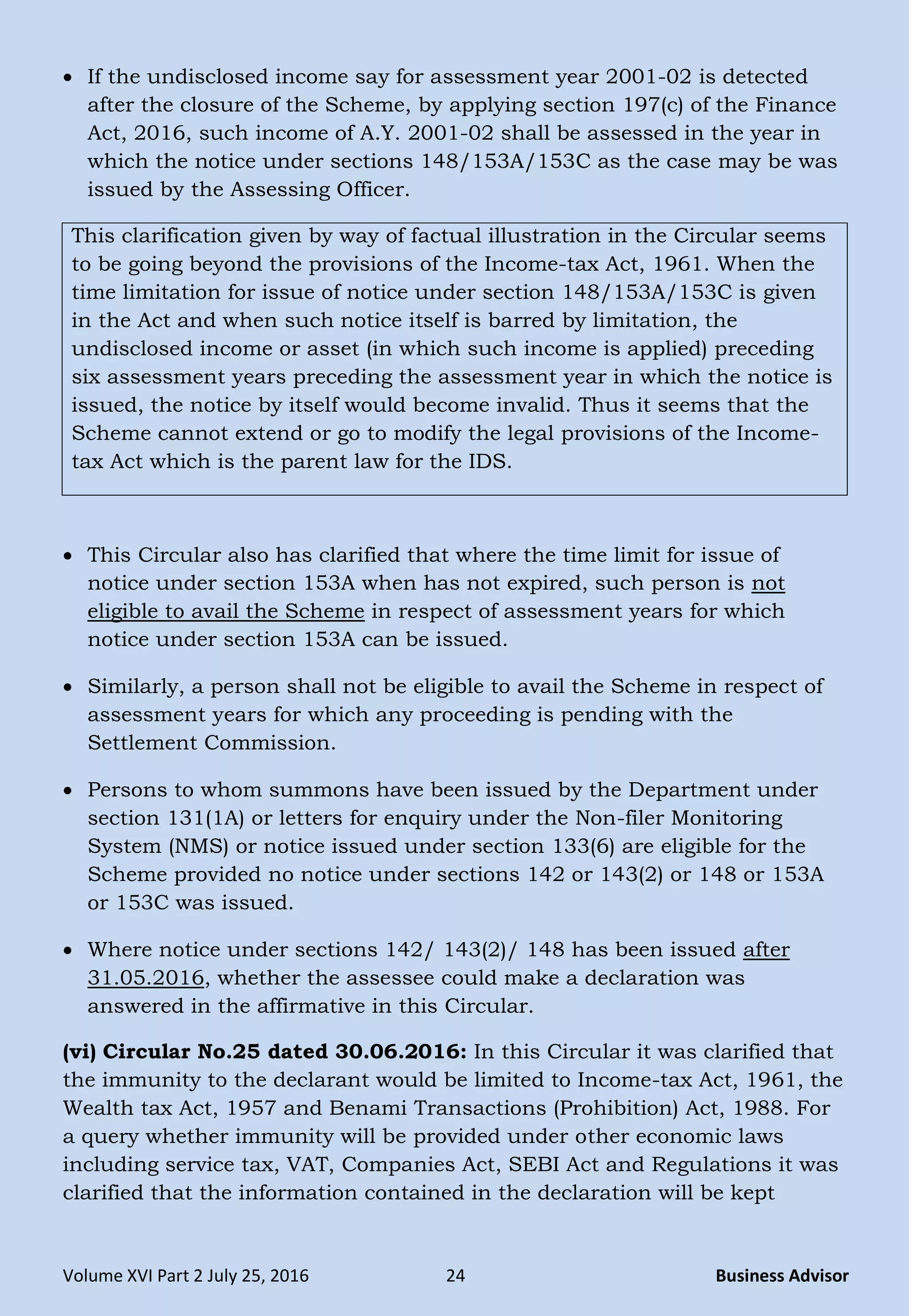
 If the undisclosed income say for assessment year 2001-02 is detected
after the closure of the Scheme, by applying section 197(c) of the Finance
Act, 2016, such income of A.Y. 2001-02 shall be assessed in the year in
which the notice under sections 148/153A/153C as the case may be was
issued by the Assessing Officer.
This clarification given by way of factual illustration in the Circular seems
to be going beyond the provisions of the Income-tax Act, 1961. When the
time limitation for issue of notice under section 148/153A/153C is given
in the Act and when such notice itself is barred by limitation, the
undisclosed income or asset (in which such income is applied) preceding
six assessment years preceding the assessment year in which the notice is
issued, the notice by itself would become invalid. Thus it seems that the
Scheme cannot extend or go to modify the legal provisions of the Income-
tax Act which is the parent law for the IDS.
 This Circular also has clarified that where the time limit for issue of
notice under section 153A when has not expired, such person is not
eligible to avail the Scheme in respect of assessment years for which
notice under section 153A can be issued.
 Similarly, a person shall not be eligible to avail the Scheme in respect of
assessment years for which any proceeding is pending with the
Settlement Commission.
 Persons to whom summons have been issued by the Department under
section 131(1A) or letters for enquiry under the Non-filer Monitoring
System (NMS) or notice issued under section 133(6) are eligible for the
Scheme provided no notice under sections 142 or 143(2) or 148 or 153A
or 153C was issued.
 Where notice under sections 142/ 143(2)/ 148 has been issued after
31.05.2016, whether the assessee could make a declaration was
answered in the affirmative in this Circular.
(vi) Circular No.25 dated 30.06.2016: In this Circular it was clarified that
the immunity to the declarant would be limited to Income-tax Act, 1961, the
Wealth tax Act, 1957 and Benami Transactions (Prohibition) Act, 1988. For
a query whether immunity will be provided under other economic laws
including service tax, VAT, Companies Act, SEBI Act and Regulations it was
clarified that the information contained in the declaration will be kept
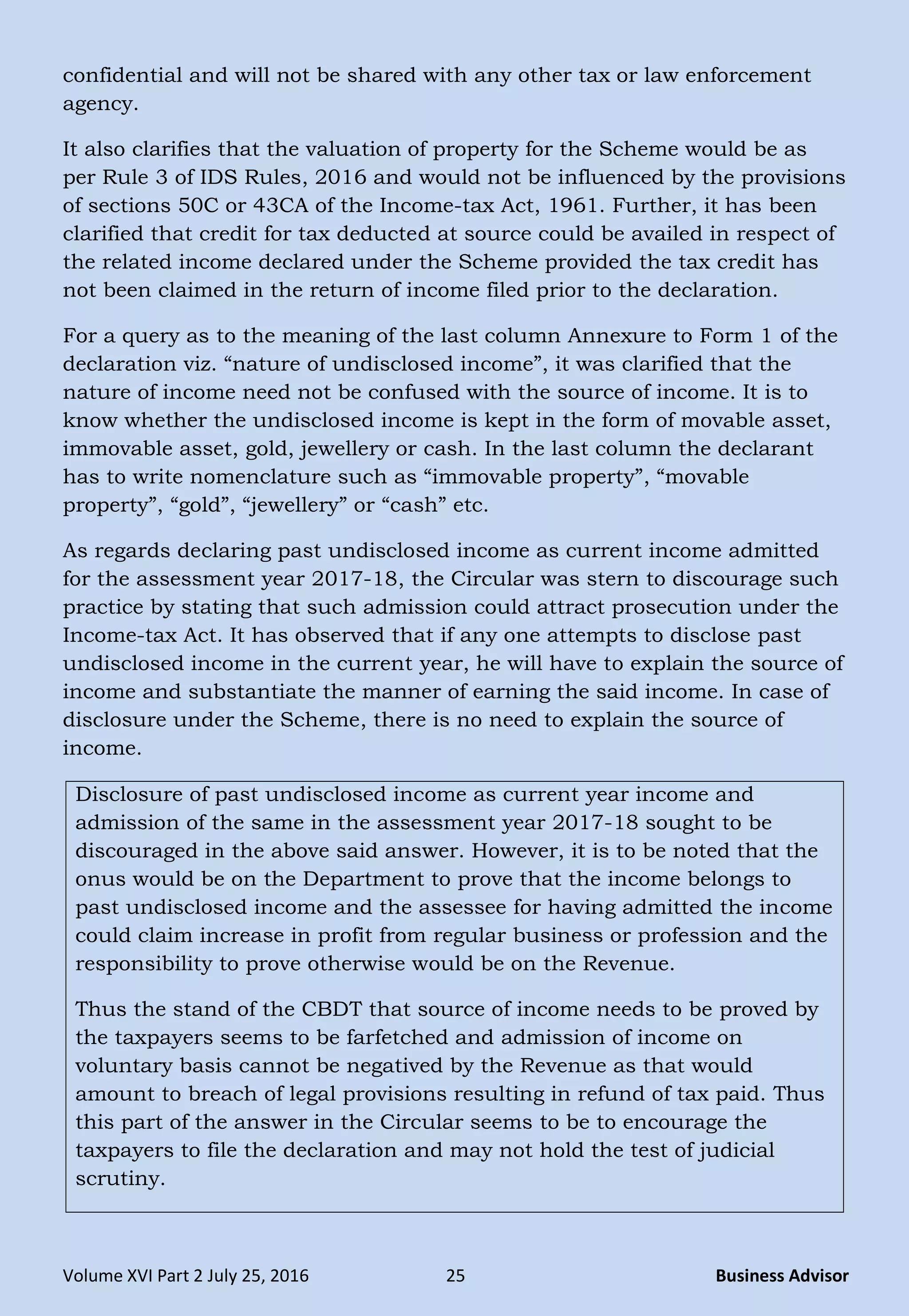
Volume XVI Part 2 July 25, 2016 25 Business Advisor
confidential and will not be shared with any other tax or law enforcement
agency.
It also clarifies that the valuation of property for the Scheme would be as
per Rule 3 of IDS Rules, 2016 and would not be influenced by the provisions
of sections 50C or 43CA of the Income-tax Act, 1961. Further, it has been
clarified that credit for tax deducted at source could be availed in respect of
the related income declared under the Scheme provided the tax credit has
not been claimed in the return of income filed prior to the declaration.
For a query as to the meaning of the last column Annexure to Form 1 of the
declaration viz. “nature of undisclosed income”, it was clarified that the
nature of income need not be confused with the source of income. It is to
know whether the undisclosed income is kept in the form of movable asset,
immovable asset, gold, jewellery or cash. In the last column the declarant
has to write nomenclature such as “immovable property”, “movable
property”, “gold”, “jewellery” or “cash” etc.
As regards declaring past undisclosed income as current income admitted
for the assessment year 2017-18, the Circular was stern to discourage such
practice by stating that such admission could attract prosecution under the
Income-tax Act. It has observed that if any one attempts to disclose past
undisclosed income in the current year, he will have to explain the source of
income and substantiate the manner of earning the said income. In case of
disclosure under the Scheme, there is no need to explain the source of
income.
Disclosure of past undisclosed income as current year income and
admission of the same in the assessment year 2017-18 sought to be
discouraged in the above said answer. However, it is to be noted that the
onus would be on the Department to prove that the income belongs to
past undisclosed income and the assessee for having admitted the income
could claim increase in profit from regular business or profession and the
responsibility to prove otherwise would be on the Revenue.
Thus the stand of the CBDT that source of income needs to be proved by
the taxpayers seems to be farfetched and admission of income on
voluntary basis cannot be negatived by the Revenue as that would
amount to breach of legal provisions resulting in refund of tax paid. Thus
this part of the answer in the Circular seems to be to encourage the
taxpayers to file the declaration and may not hold the test of judicial
scrutiny.
Volume XVI Part 2 July 25, 2016 26 Business Advisor
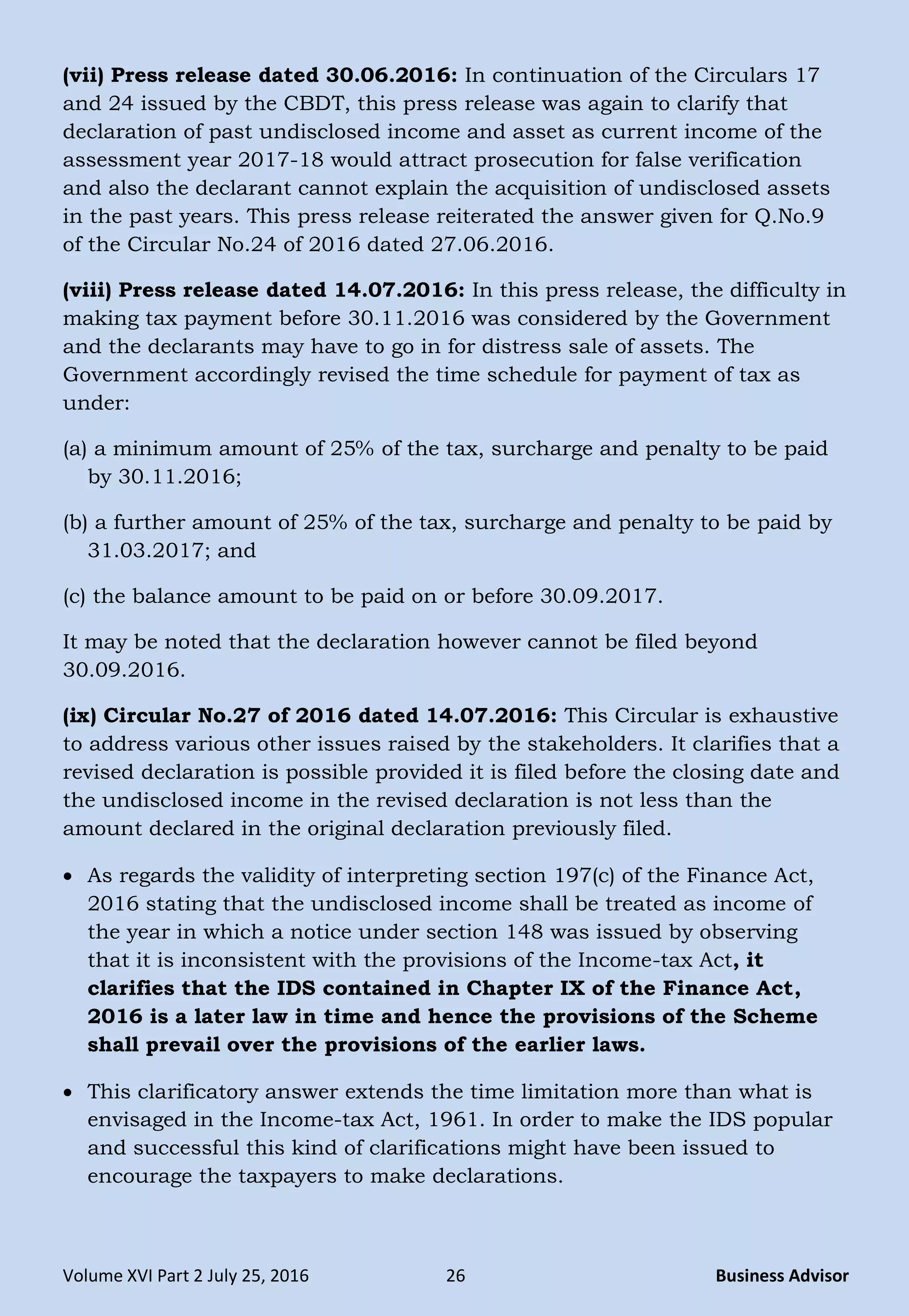
(vii) Press release dated 30.06.2016: In continuation of the Circulars 17
and 24 issued by the CBDT, this press release was again to clarify that
declaration of past undisclosed income and asset as current income of the
assessment year 2017-18 would attract prosecution for false verification
and also the declarant cannot explain the acquisition of undisclosed assets
in the past years. This press release reiterated the answer given for Q.No.9
of the Circular No.24 of 2016 dated 27.06.2016.
(viii) Press release dated 14.07.2016: In this press release, the difficulty in
making tax payment before 30.11.2016 was considered by the Government
and the declarants may have to go in for distress sale of assets. The
Government accordingly revised the time schedule for payment of tax as
under:
(a) a minimum amount of 25% of the tax, surcharge and penalty to be paid
by 30.11.2016;
(b) a further amount of 25% of the tax, surcharge and penalty to be paid by
31.03.2017; and
(c) the balance amount to be paid on or before 30.09.2017.
It may be noted that the declaration however cannot be filed beyond
30.09.2016.
(ix) Circular No.27 of 2016 dated 14.07.2016: This Circular is exhaustive
to address various other issues raised by the stakeholders. It clarifies that a
revised declaration is possible provided it is filed before the closing date and
the undisclosed income in the revised declaration is not less than the
amount declared in the original declaration previously filed.
 As regards the validity of interpreting section 197(c) of the Finance Act,
2016 stating that the undisclosed income shall be treated as income of
the year in which a notice under section 148 was issued by observing
that it is inconsistent with the provisions of the Income-tax Act, it
clarifies that the IDS contained in Chapter IX of the Finance Act,
2016 is a later law in time and hence the provisions of the Scheme
shall prevail over the provisions of the earlier laws.
 This clarificatory answer extends the time limitation more than what is
envisaged in the Income-tax Act, 1961. In order to make the IDS popular
and successful this kind of clarifications might have been issued to
encourage the taxpayers to make declarations.
Volume XVI Part 2 July 25, 2016 27 Business Advisor
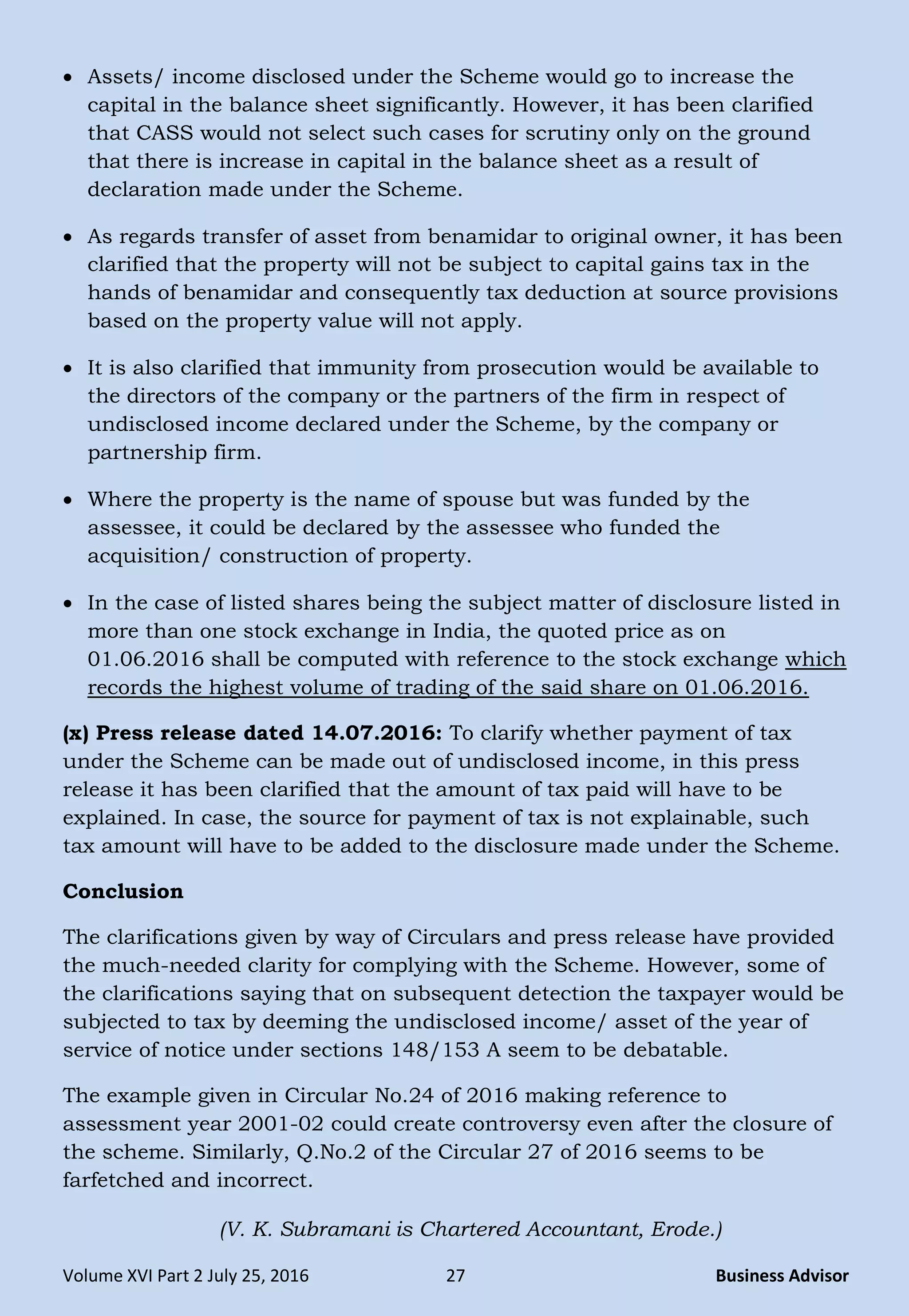
 Assets/ income disclosed under the Scheme would go to increase the
capital in the balance sheet significantly. However, it has been clarified
that CASS would not select such cases for scrutiny only on the ground
that there is increase in capital in the balance sheet as a result of
declaration made under the Scheme.
 As regards transfer of asset from benamidar to original owner, it has been
clarified that the property will not be subject to capital gains tax in the
hands of benamidar and consequently tax deduction at source provisions
based on the property value will not apply.
 It is also clarified that immunity from prosecution would be available to
the directors of the company or the partners of the firm in respect of
undisclosed income declared under the Scheme, by the company or
partnership firm.
 Where the property is the name of spouse but was funded by the
assessee, it could be declared by the assessee who funded the
acquisition/ construction of property.
 In the case of listed shares being the subject matter of disclosure listed in
more than one stock exchange in India, the quoted price as on
01.06.2016 shall be computed with reference to the stock exchange which
records the highest volume of trading of the said share on 01.06.2016.
(x) Press release dated 14.07.2016: To clarify whether payment of tax
under the Scheme can be made out of undisclosed income, in this press
release it has been clarified that the amount of tax paid will have to be
explained. In case, the source for payment of tax is not explainable, such
tax amount will have to be added to the disclosure made under the Scheme.
Conclusion
The clarifications given by way of Circulars and press release have provided
the much-needed clarity for complying with the Scheme. However, some of
the clarifications saying that on subsequent detection the taxpayer would be
subjected to tax by deeming the undisclosed income/ asset of the year of
service of notice under sections 148/153 A seem to be debatable.
The example given in Circular No.24 of 2016 making reference to
assessment year 2001-02 could create controversy even after the closure of
the scheme. Similarly, Q.No.2 of the Circular 27 of 2016 seems to be
farfetched and incorrect.
(V. K. Subramani is Chartered Accountant, Erode.)

Income Disclosure Scheme, 2016 – Clarifications - V. K. Subramani

  • 1.
    Volume XVI Part2 July 25, 2016 20 Business Advisor Income Disclosure Scheme, 2016 – Clarifications V. K. Subramani In the previous article on Income Disclosure Scheme, 2016 (IDS), the provisions of the Scheme as such were presented without discussing the clarifications issued by the CBDT to dispel the doubts of various stakeholders. In fact, while passing the Finance Bill, 2016, adoption of the amounts being fair market value of the assets declared under IDS to be taken as cost of acquisition has already been incorporated in section 55. The CBDT and the Government have been vying with each other to propagate and clarify the Scheme in order to make it successful. In fact, even myopic planning ideas suggested in certain public forums have been clarified by the authorities to clear the doubts of the stakeholders. Having said that, the Scheme suffers from certain inbuilt limitations such as: (i) high tax rate at 45% (including penalty); (ii) adoption of fair market value of undisclosed income held in the form of assets as on 01.06.2016 as base for payment of tax; (iii) not providing immunity under FEMA or Money Laundering Act; and (iv) adoption of uniform tax rate for all declarants, viz. corporates and non-corporates. All these features may not encourage the taxpayers to look into the Scheme with an open mind. Recently, it was suggested that the tax on the amount declared under the Scheme need not be supported by a source and in that pretext the effective rate of tax was claimed as 31%. This however does not seem to be rational or logical and the CBDT has clarified such claims as incorrect by narrating an example in Circular No.27 of 2016 dated The CBDT and the Government have been vying with each other to propagate and clarify the Scheme in order to make it successful.
  • 2.
    Volume XVI Part2 July 25, 2016 21 Business Advisor 14.07.2016. This write-up is a summary of various clarifications issued in this regard and possible areas where those clarifications may not stand the test of legal scrutiny. List of press releases, Circulars and Clarifications i. Press release dated 14.05.2016 explaining the features of the Scheme; ii. Circular No.16 of 2016 dated 20.05.2016 providing explanatory notes on provisions of the Scheme; iii. Circular No.17 of 2016 dated 20.05.2016 providing clarifications on the Scheme; iv. Circular No.19 of 2016 dated 25.5.2016 clarifying jurisdictional Principal Commissioner or Commissioner to whom the declaration under the Scheme is to be made; v. Circular No.24 of 2016 providing clarifications on the Scheme; vi. Circular No.25 of 2016 providing clarifications to Circular No.17 of 2016 and Circular No.24 of 2016 for the clarifications to queries 14 and 11 respectively; vii. Press release dated 30.06.2016 to discourage disclosure of current income, i.e. income of assessment year 2017-18 as income disclosure under the Scheme; viii. Press release dated 14.07.2016 to provide extended time limit for payment of tax on income declared under the Scheme; ix. Circular No.27 of 2016 dated 14.07.2016 answering queries received from the public relating to the Scheme; x. Press release dated 14.07.2016 clarifying negatively that the tax paid on undisclosed income under the Scheme is not eligible for immunity and hence tax is payable on such amount paid by way of tax. (i) Press release dated 14.05.2016: In this press release, it was stated that the Scheme will be in force for 4 months, i.e. from 01.06.2016 to 30.09.2016, for filing declaration of income/ assets and the time limit for payment of tax as 30.11.2016. The declaration can be filed online or with jurisdictional Principal CIT or CIT across the country. No scrutiny or enquiry will be undertaken in respect of such declaration under the Income- tax Act or Wealth tax Act. Immunity from prosecution is available under the Income-tax Act, Wealth tax Act, and Benami Transactions (Prohibition) Act, 1988, if the asset is transferred to actual owner within the specified time. Non-declaration will render such undisclosed income being subjected to tax in the previous year in which it is detected by the Income-tax Department.
  • 3.
    Volume XVI Part2 July 25, 2016 22 Business Advisor (ii) Circular No.16 of 2016: This Circular provided the scope of the Scheme by stating clearly that income or income in the form of investments in any asset located in India and acquired from income chargeable to tax for any assessment year prior to assessment year 2017-18 is eligible for disclosure. The assessee who has either failed to furnish the return or failed to disclose such income in the return furnished before the commencement of the Scheme is eligible to make the declaration. The fair market value of the asset computed in accordance with Rule 3 of the Income Declaration Scheme Rules, 2016 shall be deemed to be the undisclosed income held in the form of investment in asset(s). It has listed who must sign the declaration and persons who are not eligible for filing declaration under the Scheme. Where the declarant fails to pay tax before the specified date under the Scheme or the declaration is made by misrepresentation or suppression of facts or information, such declaration shall be invalid. In consequence, penalty and prosecution proceedings shall be launched against such declarant. (iii) Circular No.17 of 2016 dated 20.05.2016: In this Circular, it was clarified that where tax is paid in respect of undisclosed income held in the form of investment by adopting the fair market value as on 01.06.2016, such value will be taken as the cost of acquisition when such asset is sold/ transferred subsequently. The period of holding shall also start from the said date, i.e. the date of determination of FMV for the purposes of the Scheme.  In other words, the period of holding shall be reckoned from 01.06.2016. Where a notice is issued under sections 142(1)/ 143(2)/ 148/ 153A/153C then for those assessment years, the taxpayer cannot file declaration under the Scheme. However, he is free to make disclosure of undisclosed income for other years for which no notice was issued.  Where the undisclosed income held in the form of asset is partly disclosed and partly undisclosed, such part undisclosed previously could be disclosed under the Scheme by ascertaining its share of fair market value as on 01.06.2016 for the purpose of declaration.  In respect of matters which have been completed and which are pending before an appellate authority, the taxpayer cannot make disclosure under the Scheme. However, he can declare other undisclosed income for the said assessment year which has not been assessed under the Income-tax Act.
  • 4.
    Volume XVI Part2 July 25, 2016 23 Business Advisor  Similarly, where a search has been conducted, a person is entitled to make declaration of undisclosed income for assessment years prior to the assessment years to which notice under section 153A could be served.  In the case of survey, declaration cannot be made in respect of undisclosed income of the previous year in which the survey was conducted. However the assessee is eligible to make a declaration in respect of undisclosed income of any other previous year.  Where search and survey has been conducted and completed but certain income was neither disclosed nor assessed then such unassessed income can be declared under the Scheme.  In the case of declaration of part of undisclosed income, the immunity will cover only to the extent of declaration and the undeclared income/ asset would be subject to regular provisions of the Act.  The Scheme will not apply in the case of persons where prosecution has been launched under the Prevention of Corruption Act, 1988. Hence, where a declaration is made in respect of money earned through corruption, no immunity will be granted and the declaration would be held as void.  In the case of undisclosed income held in the form of investment in asset, the valuation report for the investment need not be filed along with the declaration. In other words, it is not mandatory. However, the declarant should have the valuation report. While e-filing the declaration a facility for uploading the documents would be made available. (iv) Circular No.19 of 2016 dated 25.05.2016: As regards the filing of declaration under the Scheme, it has been clarified that the Principal CIT or CIT who exercises jurisdiction under section 120 of the Income-tax Act shall be the Principal Commissioner or Commissioner referred to in section 183 of the Income Declaration Scheme, 2016. (v) Circular No.24 of 2016 dated 27.06.2016: In this Circular, it has been clarified that where the declarant makes only part payment of tax the entire declaration shall be invalid. It has also clarified that where the erstwhile amalgamated company or LLP wants to make declaration for the year(s) prior to amalgamation/ conversion the declaration has to be made for the year in which the amalgamation/ conversion takes place.  It is also clarified that the Scheme is available both for residents and non- residents.
  • 5.
    Volume XVI Part2 July 25, 2016 24 Business Advisor  If the undisclosed income say for assessment year 2001-02 is detected after the closure of the Scheme, by applying section 197(c) of the Finance Act, 2016, such income of A.Y. 2001-02 shall be assessed in the year in which the notice under sections 148/153A/153C as the case may be was issued by the Assessing Officer. This clarification given by way of factual illustration in the Circular seems to be going beyond the provisions of the Income-tax Act, 1961. When the time limitation for issue of notice under section 148/153A/153C is given in the Act and when such notice itself is barred by limitation, the undisclosed income or asset (in which such income is applied) preceding six assessment years preceding the assessment year in which the notice is issued, the notice by itself would become invalid. Thus it seems that the Scheme cannot extend or go to modify the legal provisions of the Income- tax Act which is the parent law for the IDS.  This Circular also has clarified that where the time limit for issue of notice under section 153A when has not expired, such person is not eligible to avail the Scheme in respect of assessment years for which notice under section 153A can be issued.  Similarly, a person shall not be eligible to avail the Scheme in respect of assessment years for which any proceeding is pending with the Settlement Commission.  Persons to whom summons have been issued by the Department under section 131(1A) or letters for enquiry under the Non-filer Monitoring System (NMS) or notice issued under section 133(6) are eligible for the Scheme provided no notice under sections 142 or 143(2) or 148 or 153A or 153C was issued.  Where notice under sections 142/ 143(2)/ 148 has been issued after 31.05.2016, whether the assessee could make a declaration was answered in the affirmative in this Circular. (vi) Circular No.25 dated 30.06.2016: In this Circular it was clarified that the immunity to the declarant would be limited to Income-tax Act, 1961, the Wealth tax Act, 1957 and Benami Transactions (Prohibition) Act, 1988. For a query whether immunity will be provided under other economic laws including service tax, VAT, Companies Act, SEBI Act and Regulations it was clarified that the information contained in the declaration will be kept
  • 6.
    Volume XVI Part2 July 25, 2016 25 Business Advisor confidential and will not be shared with any other tax or law enforcement agency. It also clarifies that the valuation of property for the Scheme would be as per Rule 3 of IDS Rules, 2016 and would not be influenced by the provisions of sections 50C or 43CA of the Income-tax Act, 1961. Further, it has been clarified that credit for tax deducted at source could be availed in respect of the related income declared under the Scheme provided the tax credit has not been claimed in the return of income filed prior to the declaration. For a query as to the meaning of the last column Annexure to Form 1 of the declaration viz. “nature of undisclosed income”, it was clarified that the nature of income need not be confused with the source of income. It is to know whether the undisclosed income is kept in the form of movable asset, immovable asset, gold, jewellery or cash. In the last column the declarant has to write nomenclature such as “immovable property”, “movable property”, “gold”, “jewellery” or “cash” etc. As regards declaring past undisclosed income as current income admitted for the assessment year 2017-18, the Circular was stern to discourage such practice by stating that such admission could attract prosecution under the Income-tax Act. It has observed that if any one attempts to disclose past undisclosed income in the current year, he will have to explain the source of income and substantiate the manner of earning the said income. In case of disclosure under the Scheme, there is no need to explain the source of income. Disclosure of past undisclosed income as current year income and admission of the same in the assessment year 2017-18 sought to be discouraged in the above said answer. However, it is to be noted that the onus would be on the Department to prove that the income belongs to past undisclosed income and the assessee for having admitted the income could claim increase in profit from regular business or profession and the responsibility to prove otherwise would be on the Revenue. Thus the stand of the CBDT that source of income needs to be proved by the taxpayers seems to be farfetched and admission of income on voluntary basis cannot be negatived by the Revenue as that would amount to breach of legal provisions resulting in refund of tax paid. Thus this part of the answer in the Circular seems to be to encourage the taxpayers to file the declaration and may not hold the test of judicial scrutiny.
  • 7.
    Volume XVI Part2 July 25, 2016 26 Business Advisor (vii) Press release dated 30.06.2016: In continuation of the Circulars 17 and 24 issued by the CBDT, this press release was again to clarify that declaration of past undisclosed income and asset as current income of the assessment year 2017-18 would attract prosecution for false verification and also the declarant cannot explain the acquisition of undisclosed assets in the past years. This press release reiterated the answer given for Q.No.9 of the Circular No.24 of 2016 dated 27.06.2016. (viii) Press release dated 14.07.2016: In this press release, the difficulty in making tax payment before 30.11.2016 was considered by the Government and the declarants may have to go in for distress sale of assets. The Government accordingly revised the time schedule for payment of tax as under: (a) a minimum amount of 25% of the tax, surcharge and penalty to be paid by 30.11.2016; (b) a further amount of 25% of the tax, surcharge and penalty to be paid by 31.03.2017; and (c) the balance amount to be paid on or before 30.09.2017. It may be noted that the declaration however cannot be filed beyond 30.09.2016. (ix) Circular No.27 of 2016 dated 14.07.2016: This Circular is exhaustive to address various other issues raised by the stakeholders. It clarifies that a revised declaration is possible provided it is filed before the closing date and the undisclosed income in the revised declaration is not less than the amount declared in the original declaration previously filed.  As regards the validity of interpreting section 197(c) of the Finance Act, 2016 stating that the undisclosed income shall be treated as income of the year in which a notice under section 148 was issued by observing that it is inconsistent with the provisions of the Income-tax Act, it clarifies that the IDS contained in Chapter IX of the Finance Act, 2016 is a later law in time and hence the provisions of the Scheme shall prevail over the provisions of the earlier laws.  This clarificatory answer extends the time limitation more than what is envisaged in the Income-tax Act, 1961. In order to make the IDS popular and successful this kind of clarifications might have been issued to encourage the taxpayers to make declarations.
  • 8.
    Volume XVI Part2 July 25, 2016 27 Business Advisor  Assets/ income disclosed under the Scheme would go to increase the capital in the balance sheet significantly. However, it has been clarified that CASS would not select such cases for scrutiny only on the ground that there is increase in capital in the balance sheet as a result of declaration made under the Scheme.  As regards transfer of asset from benamidar to original owner, it has been clarified that the property will not be subject to capital gains tax in the hands of benamidar and consequently tax deduction at source provisions based on the property value will not apply.  It is also clarified that immunity from prosecution would be available to the directors of the company or the partners of the firm in respect of undisclosed income declared under the Scheme, by the company or partnership firm.  Where the property is the name of spouse but was funded by the assessee, it could be declared by the assessee who funded the acquisition/ construction of property.  In the case of listed shares being the subject matter of disclosure listed in more than one stock exchange in India, the quoted price as on 01.06.2016 shall be computed with reference to the stock exchange which records the highest volume of trading of the said share on 01.06.2016. (x) Press release dated 14.07.2016: To clarify whether payment of tax under the Scheme can be made out of undisclosed income, in this press release it has been clarified that the amount of tax paid will have to be explained. In case, the source for payment of tax is not explainable, such tax amount will have to be added to the disclosure made under the Scheme. Conclusion The clarifications given by way of Circulars and press release have provided the much-needed clarity for complying with the Scheme. However, some of the clarifications saying that on subsequent detection the taxpayer would be subjected to tax by deeming the undisclosed income/ asset of the year of service of notice under sections 148/153 A seem to be debatable. The example given in Circular No.24 of 2016 making reference to assessment year 2001-02 could create controversy even after the closure of the scheme. Similarly, Q.No.2 of the Circular 27 of 2016 seems to be farfetched and incorrect. (V. K. Subramani is Chartered Accountant, Erode.)