




BLACK MONEY
Background
 India is going through a revolutionary decade where there has been strong
moves to bring black money into circulation.
 Govt. is fully committed to remove Black money from the economy.
 The main aim of the scheme is to provide good opportunities for assessee to
clean up the past act and move forward.
 In the Budget 2015 also, the Indian Government introduced a scheme for
voluntary declaration of undisclosed foreign income and assets for resident
taxpayers under the Black Money Act.
Highlights of “undisclosed foreign income and assets
Scheme”
 The Black Money Act is a declaration scheme under which all resident taxpayers
can declare the undisclosed foreign income and assets
 On such undisclosed income and assets the taxpayer was required to pay up to
60% as both tax and penalty under that scheme.
 However, the officer designated had received 638 declarations only amounting to
Rs 4,147 crores of undisclosed foreign income and assets by the end of
compliance window (i.e., 30th September, 2015).
 Hence, one can conclude that this declaration Scheme was not successful.
Income Declaration Scheme,
2016
By Rohit Maheshwari
Income Declaration Scheme,2016
INTRODUCTION
 A new scheme has been designed to declare any ‘undisclosed income’ vide the
Finance Bill, 2016 for persons who have not paid full taxes in the past.
 The scheme provides for declaration by any person of his undisclosed income by
paying tax, surcharge and penalty on such declared income.
 Thus through announcing this scheme, Finance Minister has provided one more
opportunity to permit the non-filers, stop filers and persons with unaccounted
income/investments to pay a moderate tax by declaring their untaxed incomes
Points to be covered under the scheme
 Scope and Definitions
 Period of scheme
 Applicable year
 Amount payable under the scheme
 Scope or person Eligible
 Person not Eligible under the scheme
 Exemptions/Immunities Available
Points to be covered under the scheme
 Valuation of Assets
 Payment
 Important issue
 Other Matter
 Analysis
 Conclusions
Scope and Definitions
 Applicable to Residents as well as Non-residents
 What is an Undisclosed Asset and Undisclosed Income
 Undisclosed Asset: An asset(including bank balances) located Within and outside
India which the assessee owns and does not disclose or fails to show the source to
purchase the asset. The Fair Market Value of the asset will be considered for
taxation.
 Undisclosed Income: Any income derived from any source from by the assessee,
that is not disclosed will be considered for taxation
PERIOD OF SCHEME
The Scheme will come into force from 1st of June, 2016 and shall remain open up
to the date to be notified by the Central Government(30th september by finance
minister in his speech)
APPLICABLE YEAR
It is proposed to be made applicable in respect of undisclosed income of any
financial year up to 2015-16.
AMOUNT PAYABLE
The income tax will be charged @30% on the declared income. It will be increased
by a surcharge @ 25% of tax payable (to be called the Krishi Kalyan Cess) and a
penalty @ 25% of the tax. Thus, the declared income will suffer a tax burden of
45% in aggregate.
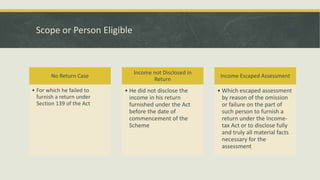
Scope or Person Eligible
No Return Case
• For which he failed to
furnish a return under
Section 139 of the Act
Income not Disclosed in
Return
• He did not disclose the
income in his return
furnished under the Act
before the date of
commencement of the
Scheme
Income Escaped Assessment
• Which escaped assessment
by reason of the omission
or failure on the part of
such person to furnish a
return under the Income-
tax Act or to disclose fully
and truly all material facts
necessary for the
assessment
Cases Not Covered
Pending Matters under the IT Act
Cases cover under other Act
Pending Cases under IT Act
 Where a notice u/s 142 or 143(2) or 148 or 153A or 153C has been issued in
respect of such asset year and pending before the AO.
 Where a search or survey has been conducted, and no notice u/s 142(2) or 153A
or 153C has been issued and the time limit for issuing such notice has not
expired.
 Where any information has been received under an agreement with foreign
countries by the competent authority u/s 90 or 90A of the Act.
Cases covered under other Acts
Black Money and Imposition of Tax Act, 2015
Special Court (Trial of offences relating to Transaction in Securities) Act,1992
 Indian Panel Code
The Narcotic Drugs and Psychotropic Substance Act ,1985
The unlawful Activities (Prevention) Act,1967
The prevention of Corruption Act,1988
Exemptions/Immunities
 Exemption from wealth-tax in respect of assets specified in declaration.
 No scrutiny and enquiry under the Income-tax Act and Wealth-tax Act be
undertaken related to the declaration.
 Immunity from prosecution under Income-tax Act and Wealth-tax provided.
 Immunity from the Benami Transactions (Prohibition) Act, 1988 provided
Valuation of Asset
 In this regard, the fair market value of such asset as on the date of
commencement of this scheme i.e. 01-06-2016 shall be deemed to be the
undisclosed income.
 Thus Appreciation in the value of asset, from the date of purchase till date of
commencement of the scheme shall be taxed.
Payment related matters
 Payment shall be required to be made on or before a date to be notified by
central government (as in speech it is decided to make payment within 2 months
from the date of declaration)
 Failure to pay the taxes and penalty as aforesaid, the declaration shall be deemed
never to have been filed and such declaration shall be void.
 Income so declared and paid under the scheme shall not be included in the total
income for any assessment year.
 If declaration is made but payment is not made then such undisclosed income
shall be chargeable to tax under the income tax act in the P.Y. in which such
declaration is made and provisions of IT act shall apply.
Important Issue
 A declarant under the scheme shall not be entitled to reopen any assessment or
claim any setoffs or relief in any appeal or other procedings.
 Where the asset has been understated in the return of wealth, then excess of
voluntarily disclosed income over the understatement of asset shall be taken into
account in computing the net wealth for the asst. years.
 No deduction in respect off any expenditure or allowance against such declared
income.
Other matter
 The declaration shall be treated as void where the same is made by
misinterpretation or suppressions of facts.
 No benefit, concession or immunity on any person other than the person
making the declaration under this scheme.
 Any income accrued or asset acquired out of such declared income in respect of
which no declaration is made , such income or asset shall be deemed to have
been earned or acquired in the year in which notice u/s 142 or 143(2) or 148 or
153A or 153C is issued by the AO.
Analysis-1
Comparision Between Black Money Act v/s IDS,2016
 Tax payers
 Tax Liability
 Income
Thus, the net liability to be discharged under the IDS, 2016 is lower than the
declaration made under Black Money Act, IDS, 2016 it obviously appears to be
more beneficial.
Analysis-2
What will happen if income is not Disclosed
Any wilful attempt to evade tax under the current provisions of the Act attracts
penalty under Section 271 and prosecution under Section 276C.
 Penalty shall be levied for concealing or for furnishing inaccurate particulars of
income and it would be ranging from 100% to 300% of the amount of tax sought
to be evaded.
 Prosecution proceedings may lead to imprisonment ranging from 3 months to 7
years along with fine.
Analysis-2
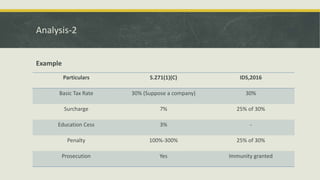
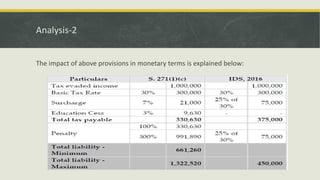
 However, under the IDS, 2016, the penalty will be just 25% of the tax evaded
(i.e., 25% of 30%) and the declarant will be deemed to be immune from all
prosecution proceedings under the Income-tax Act and Wealth-tax Act.
Analysis-2
Example
Particulars S.271(1)(C) IDS,2016
Basic Tax Rate 30% (Suppose a company) 30%
Surcharge 7% 25% of 30%
Education Cess 3% -
Penalty 100%-300% 25% of 30%
Prosecution Yes Immunity granted
Analysis-2
The impact of above provisions in monetary terms is explained below:
Analysis-3
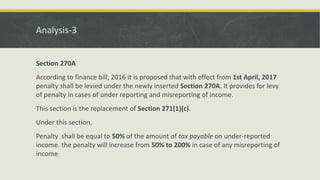
Section 270A
According to finance bill, 2016 it is proposed that with effect from 1st April, 2017
penalty shall be levied under the newly inserted Section 270A. It provides for levy
of penalty in cases of under reporting and misreporting of income.
This section is the replacement of Section 271(1)(c).
Under this section,
Penalty shall be equal to 50% of the amount of tax payable on under-reported
income. the penalty will increase from 50% to 200% in case of any misreporting of
income
Conclusion
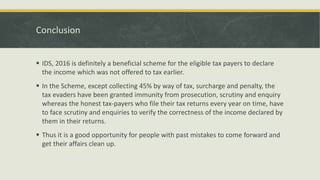
 IDS, 2016 is definitely a beneficial scheme for the eligible tax payers to declare
the income which was not offered to tax earlier.
 In the Scheme, except collecting 45% by way of tax, surcharge and penalty, the
tax evaders have been granted immunity from prosecution, scrutiny and enquiry
whereas the honest tax-payers who file their tax returns every year on time, have
to face scrutiny and enquiries to verify the correctness of the income declared by
them in their returns.
 Thus it is a good opportunity for people with past mistakes to come forward and
get their affairs clean up.
THANK YOU

IDS 2016

  • 1.
  • 2.
    Background  India isgoing through a revolutionary decade where there has been strong moves to bring black money into circulation.  Govt. is fully committed to remove Black money from the economy.  The main aim of the scheme is to provide good opportunities for assessee to clean up the past act and move forward.  In the Budget 2015 also, the Indian Government introduced a scheme for voluntary declaration of undisclosed foreign income and assets for resident taxpayers under the Black Money Act.
  • 3.
    Highlights of “undisclosedforeign income and assets Scheme”  The Black Money Act is a declaration scheme under which all resident taxpayers can declare the undisclosed foreign income and assets  On such undisclosed income and assets the taxpayer was required to pay up to 60% as both tax and penalty under that scheme.  However, the officer designated had received 638 declarations only amounting to Rs 4,147 crores of undisclosed foreign income and assets by the end of compliance window (i.e., 30th September, 2015).  Hence, one can conclude that this declaration Scheme was not successful.
  • 4.
  • 5.
    Income Declaration Scheme,2016 INTRODUCTION A new scheme has been designed to declare any ‘undisclosed income’ vide the Finance Bill, 2016 for persons who have not paid full taxes in the past.  The scheme provides for declaration by any person of his undisclosed income by paying tax, surcharge and penalty on such declared income.  Thus through announcing this scheme, Finance Minister has provided one more opportunity to permit the non-filers, stop filers and persons with unaccounted income/investments to pay a moderate tax by declaring their untaxed incomes
  • 6.
    Points to becovered under the scheme  Scope and Definitions  Period of scheme  Applicable year  Amount payable under the scheme  Scope or person Eligible  Person not Eligible under the scheme  Exemptions/Immunities Available
  • 7.
    Points to becovered under the scheme  Valuation of Assets  Payment  Important issue  Other Matter  Analysis  Conclusions
  • 8.
    Scope and Definitions Applicable to Residents as well as Non-residents  What is an Undisclosed Asset and Undisclosed Income  Undisclosed Asset: An asset(including bank balances) located Within and outside India which the assessee owns and does not disclose or fails to show the source to purchase the asset. The Fair Market Value of the asset will be considered for taxation.  Undisclosed Income: Any income derived from any source from by the assessee, that is not disclosed will be considered for taxation
  • 9.
    PERIOD OF SCHEME TheScheme will come into force from 1st of June, 2016 and shall remain open up to the date to be notified by the Central Government(30th september by finance minister in his speech)
  • 10.
    APPLICABLE YEAR It isproposed to be made applicable in respect of undisclosed income of any financial year up to 2015-16.
  • 11.
    AMOUNT PAYABLE The incometax will be charged @30% on the declared income. It will be increased by a surcharge @ 25% of tax payable (to be called the Krishi Kalyan Cess) and a penalty @ 25% of the tax. Thus, the declared income will suffer a tax burden of 45% in aggregate.
  • 12.
    Scope or PersonEligible No Return Case • For which he failed to furnish a return under Section 139 of the Act Income not Disclosed in Return • He did not disclose the income in his return furnished under the Act before the date of commencement of the Scheme Income Escaped Assessment • Which escaped assessment by reason of the omission or failure on the part of such person to furnish a return under the Income- tax Act or to disclose fully and truly all material facts necessary for the assessment
  • 13.
    Cases Not Covered PendingMatters under the IT Act Cases cover under other Act
  • 14.
    Pending Cases underIT Act  Where a notice u/s 142 or 143(2) or 148 or 153A or 153C has been issued in respect of such asset year and pending before the AO.  Where a search or survey has been conducted, and no notice u/s 142(2) or 153A or 153C has been issued and the time limit for issuing such notice has not expired.  Where any information has been received under an agreement with foreign countries by the competent authority u/s 90 or 90A of the Act.
  • 15.
    Cases covered underother Acts Black Money and Imposition of Tax Act, 2015 Special Court (Trial of offences relating to Transaction in Securities) Act,1992  Indian Panel Code The Narcotic Drugs and Psychotropic Substance Act ,1985 The unlawful Activities (Prevention) Act,1967 The prevention of Corruption Act,1988
  • 16.
    Exemptions/Immunities  Exemption fromwealth-tax in respect of assets specified in declaration.  No scrutiny and enquiry under the Income-tax Act and Wealth-tax Act be undertaken related to the declaration.  Immunity from prosecution under Income-tax Act and Wealth-tax provided.  Immunity from the Benami Transactions (Prohibition) Act, 1988 provided
  • 17.
    Valuation of Asset In this regard, the fair market value of such asset as on the date of commencement of this scheme i.e. 01-06-2016 shall be deemed to be the undisclosed income.  Thus Appreciation in the value of asset, from the date of purchase till date of commencement of the scheme shall be taxed.
  • 18.
    Payment related matters Payment shall be required to be made on or before a date to be notified by central government (as in speech it is decided to make payment within 2 months from the date of declaration)  Failure to pay the taxes and penalty as aforesaid, the declaration shall be deemed never to have been filed and such declaration shall be void.  Income so declared and paid under the scheme shall not be included in the total income for any assessment year.  If declaration is made but payment is not made then such undisclosed income shall be chargeable to tax under the income tax act in the P.Y. in which such declaration is made and provisions of IT act shall apply.
  • 19.
    Important Issue  Adeclarant under the scheme shall not be entitled to reopen any assessment or claim any setoffs or relief in any appeal or other procedings.  Where the asset has been understated in the return of wealth, then excess of voluntarily disclosed income over the understatement of asset shall be taken into account in computing the net wealth for the asst. years.  No deduction in respect off any expenditure or allowance against such declared income.
  • 20.
    Other matter  Thedeclaration shall be treated as void where the same is made by misinterpretation or suppressions of facts.  No benefit, concession or immunity on any person other than the person making the declaration under this scheme.  Any income accrued or asset acquired out of such declared income in respect of which no declaration is made , such income or asset shall be deemed to have been earned or acquired in the year in which notice u/s 142 or 143(2) or 148 or 153A or 153C is issued by the AO.
  • 21.
    Analysis-1 Comparision Between BlackMoney Act v/s IDS,2016  Tax payers  Tax Liability  Income Thus, the net liability to be discharged under the IDS, 2016 is lower than the declaration made under Black Money Act, IDS, 2016 it obviously appears to be more beneficial.
  • 22.
    Analysis-2 What will happenif income is not Disclosed Any wilful attempt to evade tax under the current provisions of the Act attracts penalty under Section 271 and prosecution under Section 276C.  Penalty shall be levied for concealing or for furnishing inaccurate particulars of income and it would be ranging from 100% to 300% of the amount of tax sought to be evaded.  Prosecution proceedings may lead to imprisonment ranging from 3 months to 7 years along with fine.
  • 23.
    Analysis-2  However, underthe IDS, 2016, the penalty will be just 25% of the tax evaded (i.e., 25% of 30%) and the declarant will be deemed to be immune from all prosecution proceedings under the Income-tax Act and Wealth-tax Act.
  • 24.
    Analysis-2 Example Particulars S.271(1)(C) IDS,2016 BasicTax Rate 30% (Suppose a company) 30% Surcharge 7% 25% of 30% Education Cess 3% - Penalty 100%-300% 25% of 30% Prosecution Yes Immunity granted
  • 25.
    Analysis-2 The impact ofabove provisions in monetary terms is explained below:
  • 26.
    Analysis-3 Section 270A According tofinance bill, 2016 it is proposed that with effect from 1st April, 2017 penalty shall be levied under the newly inserted Section 270A. It provides for levy of penalty in cases of under reporting and misreporting of income. This section is the replacement of Section 271(1)(c). Under this section, Penalty shall be equal to 50% of the amount of tax payable on under-reported income. the penalty will increase from 50% to 200% in case of any misreporting of income
  • 27.
    Conclusion  IDS, 2016is definitely a beneficial scheme for the eligible tax payers to declare the income which was not offered to tax earlier.  In the Scheme, except collecting 45% by way of tax, surcharge and penalty, the tax evaders have been granted immunity from prosecution, scrutiny and enquiry whereas the honest tax-payers who file their tax returns every year on time, have to face scrutiny and enquiries to verify the correctness of the income declared by them in their returns.  Thus it is a good opportunity for people with past mistakes to come forward and get their affairs clean up.
  • 28.