1
Committed to you
Welcome to
INCO Terms
2
Committed to you
International Chamber Of Commerce
 It is world business organization, the only representative body that
speaks with authority on behalf of enterprises from all sectors in
every part of the world.
 Founded in 1919
 Head office is in Paris
 ICC has members in more than 140 countries.
 National Committees in different countries coordinate with members
to address the concerns of the business community and to convey to
their governments the business views formulated by ICC.
3
Committed to you
Various Publications of ICC
 ICC Commission on Banking Techniques & Practices draws up
rules for various banking operations and offers over 60 guides
and handbooks on topics ranging from banking practices and
arbitration to advertising and telecommunications such as:
 Uniform Customs & Practices for Documentary Credits (UCP –
600)
 Uniform Rules for Collections (URC – 522)
 Uniform Rules for Bank to Bank Reimbursements (currently
URR – 525).
 Rules for Doc. Credit Dispute Resolution, (DOCDEX – 811).
 Inco terms – 2010, ICC publication – 560.
 International Standard Banking Practice under LC.
4
Committed to you
Inco terms 2010
• The global economy has given businesses broader access than
ever before to markets all over the world
• Goods are sold in more countries, in larger quantities, and in
greater variety
• As the volume and complexity of international sales increase, so
do possibilities for misunderstandings and costly disputes when
sales contracts are not adequately drafted
• Inco terms 2010, the official ICC rules for the interpretation of
trade terms, facilitate the conduct of international trade
• Reference to Inco terms 2010 in a sales contract defines clearly
the parties’ respective obligations and reduces the risk of legal
complications
5
Committed to you
Inco terms 2010
• The purpose of Incoterms is to provide a set of international
rules for the interpretation of the most commonly used trade
terms in foreign trade (thus, the uncertainties of different
interpretations of such terms in different countries can be
avoided or at least reduced to a considerable degree)
• The scope of Incoterms is limited to matters relating to the
rights and obligations of the parties to the contract of sale with
respect to the delivery of goods sold (in the sense of ‘tangibles’,
not including ‘intangibles’ such as computer software)
6
Committed to you
Misconceptions
• Two particular misconceptions about Inco terms are very
common:
1. Inco terms apply to contract of carriage rather than to the
contract of sale
2. Inco terms provide for all the duties which parties may wish to
include in a contract of sale
• Inco terms, however, only deal with the relation between sellers
and buyers under the contract of sale, and moreover, only do so
in some very distinct respects
7
Committed to you
International Commercial Terms
• Inco terms’ are internationally recognized standard trade terms used
in sales contracts. They’re used to make sure buyer and seller know:
• Who is responsible for the cost of transporting the goods, including
insurance, taxes and duties
• Where the goods should be picked up from and transported to
• Who is responsible for the goods at each step during transportation
• What the terms mean :Inco terms are used in contracts in a 3-letter
format followed by the place specified in the contract (e.g. the port or
where the goods are to be picked up).
• There are different terms for sea and inland waterways (e.g. rivers and
canals) compared to all other modes of transport.
8
Committed to you
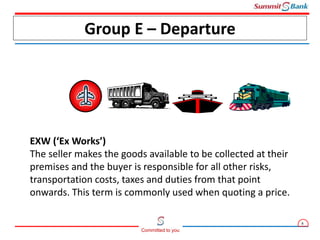
Group E – Departure
EXW (‘Ex Works’)
The seller makes the goods available to be collected at their
premises and the buyer is responsible for all other risks,
transportation costs, taxes and duties from that point
onwards. This term is commonly used when quoting a price.
9
Committed to you
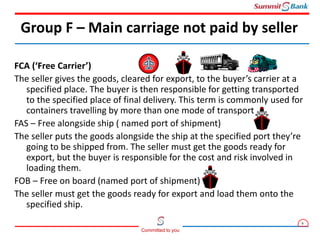
Group F – Main carriage not paid by seller
FCA (‘Free Carrier’)
The seller gives the goods, cleared for export, to the buyer’s carrier at a
specified place. The buyer is then responsible for getting transported
to the specified place of final delivery. This term is commonly used for
containers travelling by more than one mode of transport
FAS – Free alongside ship ( named port of shipment)
The seller puts the goods alongside the ship at the specified port they’re
going to be shipped from. The seller must get the goods ready for
export, but the buyer is responsible for the cost and risk involved in
loading them.
FOB – Free on board (named port of shipment)
The seller must get the goods ready for export and load them onto the
specified ship.
10
Committed to you
Group C – Main carriage paid by seller
CFR – Cost and freight : The seller must pay the costs of bringing
the goods to the specified port. The buyer is responsible for risks
when the goods are loaded onto the ship.
CIF – Cost, insurance and freight (named port of destination)
The seller must pay the costs of bringing the goods to the specified
port. They also pay for insurance. The buyer is responsible for
risks when the goods are loaded onto the ship.
CPT – Carriage paid to ( named place of destination)
The seller pays to transport the goods to the specified destination.
Responsibility for the goods transfers to the buyer when the
seller passes them to the first carrier
11
Committed to you
Group C – Main carriage paid by seller
CIP – Carriage and insurance paid to : The seller pays for insurance
as well as transport to the specified destination. Responsibility
for the goods transfers to the buyer when the seller passes them
to the first carrier. CIP is commonly used for goods being
transported by container by more than one mode of transport. If
transporting only by sea,
12
Committed to you
Group D – Arrival
DDP – Delivered duty paid : The seller is responsible for delivering
the goods to the named destination in the buyer’s country,
including all costs involved
DAT -Delivered at Terminal : The seller pays for transport to a
specified terminal at the agreed destination. The buyer is
responsible for the cost of importing the goods. The buyer takes
responsibility once the goods are unloaded at the terminal
DAP – Delivered at place: The seller pays for transport to the
specified destination, but the buyer pays the cost of importing
the goods. The seller takes responsibility for the goods until
they’re ready to be unloaded by the buyer.
13
Committed to you
• The Seller’s obligations
a)General obligations of the seller
b)Licenses ,authorizations, security clearance and other formalities
c)Contracts of carriage and Insurance
• Delivery
• The Buyer’s obligations
a) General obligations of the seller
b) Licenses ,authorizations, security clearance and other formalities
c) Contracts of carriage and Insurance
d) Taking Delivery
e) Transfer of risk
f) Allocation of cost
14
Committed to you
Incorporation of Inco terms into the Contract of
sale
• It is important to ensure that where the parties intend to
incorporate Inco terms into their contract of sale, an express
reference is always made to the current version of Inco terms
• This may easily be overlooked, when, for example, a reference
has been made to an earlier version in standard contract forms
or in order forms used by merchants
• A failure to refer to the current version may then result in
disputes as to whether the parties intended to incorporate that
version or an earlier version as a part of their contract
• Merchants wishing to use Inco terms 2010 should therefore
clearly specify that their contract is governed by ‘Inco terms
2010’
15
Committed to you
Incorporation of Inco terms into the Contract of
sale
• A seller having agreed to a CFR or CIF contract cannot perform
such a contract by any other mode of transport than carriage by
sea, since under these terms he must present a bill of lading or
other maritime document to the buyer which is simply not
possible if other modes of transport are used
• Inco terms deal with a number of identified obligations imposed
on the parties, such as the seller’s obligation to place the goods
at the disposal of the buyer of hand them over for carriage or
deliver them at destination and with the distribution of risk
between the parties in these cases
16
Committed to you
Incorporation of Inco terms into the Contract of
sale
• Incoterms deal with the obligations to clear the goods for export
and import, the packing of the goods, the buyer’s obligation to
take delivery as well as the obligation to provide proof that the
respective obligations have been duly fulfilled
• Incoterms do not deal with the consequences of breach of
contract and any exemptions from liability owing to various
impediments

INCO Terms: Unit 2

  • 1.
  • 2.
    2 Committed to you InternationalChamber Of Commerce  It is world business organization, the only representative body that speaks with authority on behalf of enterprises from all sectors in every part of the world.  Founded in 1919  Head office is in Paris  ICC has members in more than 140 countries.  National Committees in different countries coordinate with members to address the concerns of the business community and to convey to their governments the business views formulated by ICC.
  • 3.
    3 Committed to you VariousPublications of ICC  ICC Commission on Banking Techniques & Practices draws up rules for various banking operations and offers over 60 guides and handbooks on topics ranging from banking practices and arbitration to advertising and telecommunications such as:  Uniform Customs & Practices for Documentary Credits (UCP – 600)  Uniform Rules for Collections (URC – 522)  Uniform Rules for Bank to Bank Reimbursements (currently URR – 525).  Rules for Doc. Credit Dispute Resolution, (DOCDEX – 811).  Inco terms – 2010, ICC publication – 560.  International Standard Banking Practice under LC.
  • 4.
    4 Committed to you Incoterms 2010 • The global economy has given businesses broader access than ever before to markets all over the world • Goods are sold in more countries, in larger quantities, and in greater variety • As the volume and complexity of international sales increase, so do possibilities for misunderstandings and costly disputes when sales contracts are not adequately drafted • Inco terms 2010, the official ICC rules for the interpretation of trade terms, facilitate the conduct of international trade • Reference to Inco terms 2010 in a sales contract defines clearly the parties’ respective obligations and reduces the risk of legal complications
  • 5.
    5 Committed to you Incoterms 2010 • The purpose of Incoterms is to provide a set of international rules for the interpretation of the most commonly used trade terms in foreign trade (thus, the uncertainties of different interpretations of such terms in different countries can be avoided or at least reduced to a considerable degree) • The scope of Incoterms is limited to matters relating to the rights and obligations of the parties to the contract of sale with respect to the delivery of goods sold (in the sense of ‘tangibles’, not including ‘intangibles’ such as computer software)
  • 6.
    6 Committed to you Misconceptions •Two particular misconceptions about Inco terms are very common: 1. Inco terms apply to contract of carriage rather than to the contract of sale 2. Inco terms provide for all the duties which parties may wish to include in a contract of sale • Inco terms, however, only deal with the relation between sellers and buyers under the contract of sale, and moreover, only do so in some very distinct respects
  • 7.
    7 Committed to you InternationalCommercial Terms • Inco terms’ are internationally recognized standard trade terms used in sales contracts. They’re used to make sure buyer and seller know: • Who is responsible for the cost of transporting the goods, including insurance, taxes and duties • Where the goods should be picked up from and transported to • Who is responsible for the goods at each step during transportation • What the terms mean :Inco terms are used in contracts in a 3-letter format followed by the place specified in the contract (e.g. the port or where the goods are to be picked up). • There are different terms for sea and inland waterways (e.g. rivers and canals) compared to all other modes of transport.
  • 8.
    8 Committed to you GroupE – Departure EXW (‘Ex Works’) The seller makes the goods available to be collected at their premises and the buyer is responsible for all other risks, transportation costs, taxes and duties from that point onwards. This term is commonly used when quoting a price.
  • 9.
    9 Committed to you GroupF – Main carriage not paid by seller FCA (‘Free Carrier’) The seller gives the goods, cleared for export, to the buyer’s carrier at a specified place. The buyer is then responsible for getting transported to the specified place of final delivery. This term is commonly used for containers travelling by more than one mode of transport FAS – Free alongside ship ( named port of shipment) The seller puts the goods alongside the ship at the specified port they’re going to be shipped from. The seller must get the goods ready for export, but the buyer is responsible for the cost and risk involved in loading them. FOB – Free on board (named port of shipment) The seller must get the goods ready for export and load them onto the specified ship.
  • 10.
    10 Committed to you GroupC – Main carriage paid by seller CFR – Cost and freight : The seller must pay the costs of bringing the goods to the specified port. The buyer is responsible for risks when the goods are loaded onto the ship. CIF – Cost, insurance and freight (named port of destination) The seller must pay the costs of bringing the goods to the specified port. They also pay for insurance. The buyer is responsible for risks when the goods are loaded onto the ship. CPT – Carriage paid to ( named place of destination) The seller pays to transport the goods to the specified destination. Responsibility for the goods transfers to the buyer when the seller passes them to the first carrier
  • 11.
    11 Committed to you GroupC – Main carriage paid by seller CIP – Carriage and insurance paid to : The seller pays for insurance as well as transport to the specified destination. Responsibility for the goods transfers to the buyer when the seller passes them to the first carrier. CIP is commonly used for goods being transported by container by more than one mode of transport. If transporting only by sea,
  • 12.
    12 Committed to you GroupD – Arrival DDP – Delivered duty paid : The seller is responsible for delivering the goods to the named destination in the buyer’s country, including all costs involved DAT -Delivered at Terminal : The seller pays for transport to a specified terminal at the agreed destination. The buyer is responsible for the cost of importing the goods. The buyer takes responsibility once the goods are unloaded at the terminal DAP – Delivered at place: The seller pays for transport to the specified destination, but the buyer pays the cost of importing the goods. The seller takes responsibility for the goods until they’re ready to be unloaded by the buyer.
  • 13.
    13 Committed to you •The Seller’s obligations a)General obligations of the seller b)Licenses ,authorizations, security clearance and other formalities c)Contracts of carriage and Insurance • Delivery • The Buyer’s obligations a) General obligations of the seller b) Licenses ,authorizations, security clearance and other formalities c) Contracts of carriage and Insurance d) Taking Delivery e) Transfer of risk f) Allocation of cost
  • 14.
    14 Committed to you Incorporationof Inco terms into the Contract of sale • It is important to ensure that where the parties intend to incorporate Inco terms into their contract of sale, an express reference is always made to the current version of Inco terms • This may easily be overlooked, when, for example, a reference has been made to an earlier version in standard contract forms or in order forms used by merchants • A failure to refer to the current version may then result in disputes as to whether the parties intended to incorporate that version or an earlier version as a part of their contract • Merchants wishing to use Inco terms 2010 should therefore clearly specify that their contract is governed by ‘Inco terms 2010’
  • 15.
    15 Committed to you Incorporationof Inco terms into the Contract of sale • A seller having agreed to a CFR or CIF contract cannot perform such a contract by any other mode of transport than carriage by sea, since under these terms he must present a bill of lading or other maritime document to the buyer which is simply not possible if other modes of transport are used • Inco terms deal with a number of identified obligations imposed on the parties, such as the seller’s obligation to place the goods at the disposal of the buyer of hand them over for carriage or deliver them at destination and with the distribution of risk between the parties in these cases
  • 16.
    16 Committed to you Incorporationof Inco terms into the Contract of sale • Incoterms deal with the obligations to clear the goods for export and import, the packing of the goods, the buyer’s obligation to take delivery as well as the obligation to provide proof that the respective obligations have been duly fulfilled • Incoterms do not deal with the consequences of breach of contract and any exemptions from liability owing to various impediments