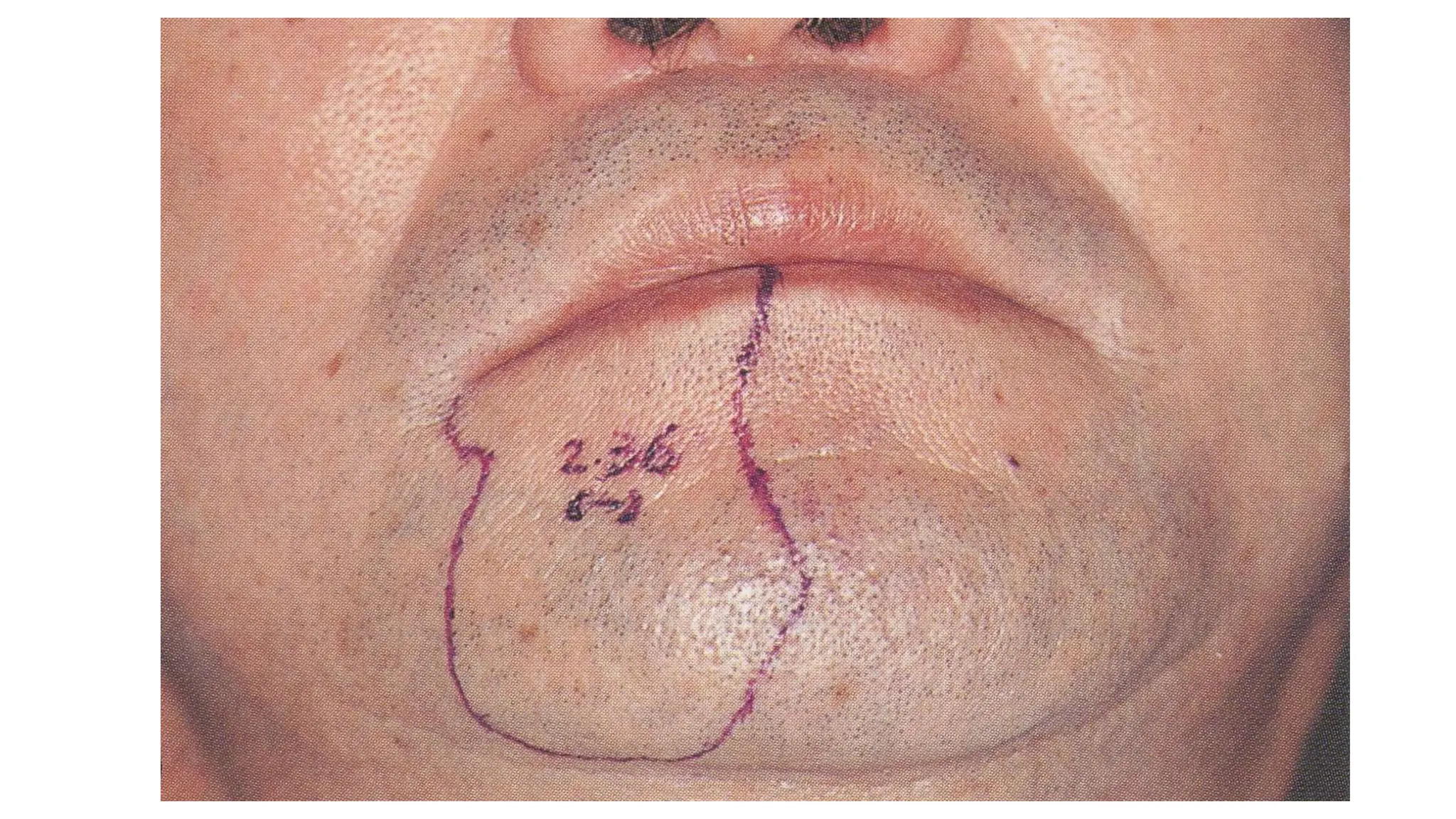
NEVER PERFORM ANY VERTICAL INCISION
ON THE MANDIBULAR LINGUAL AREA
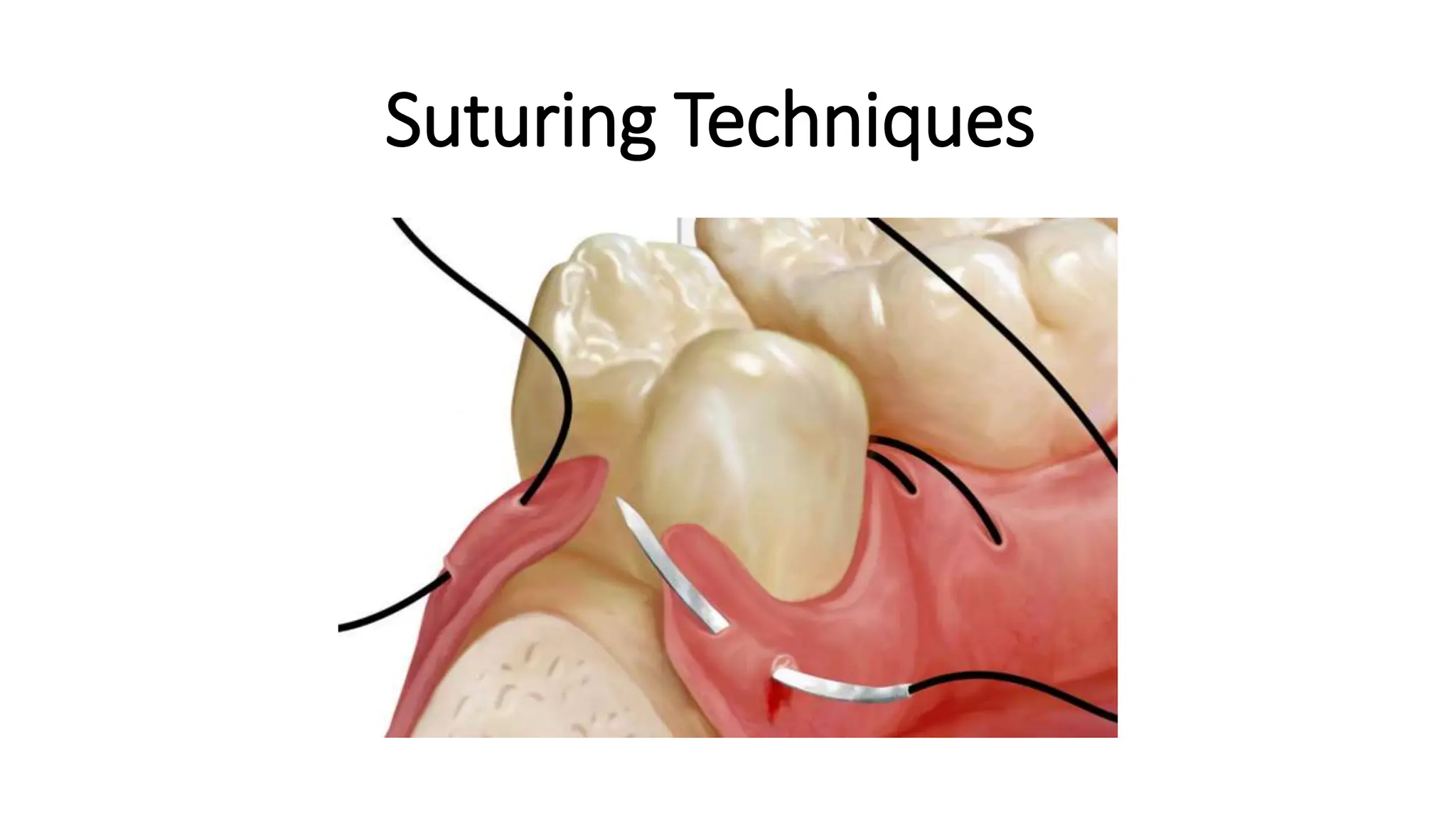
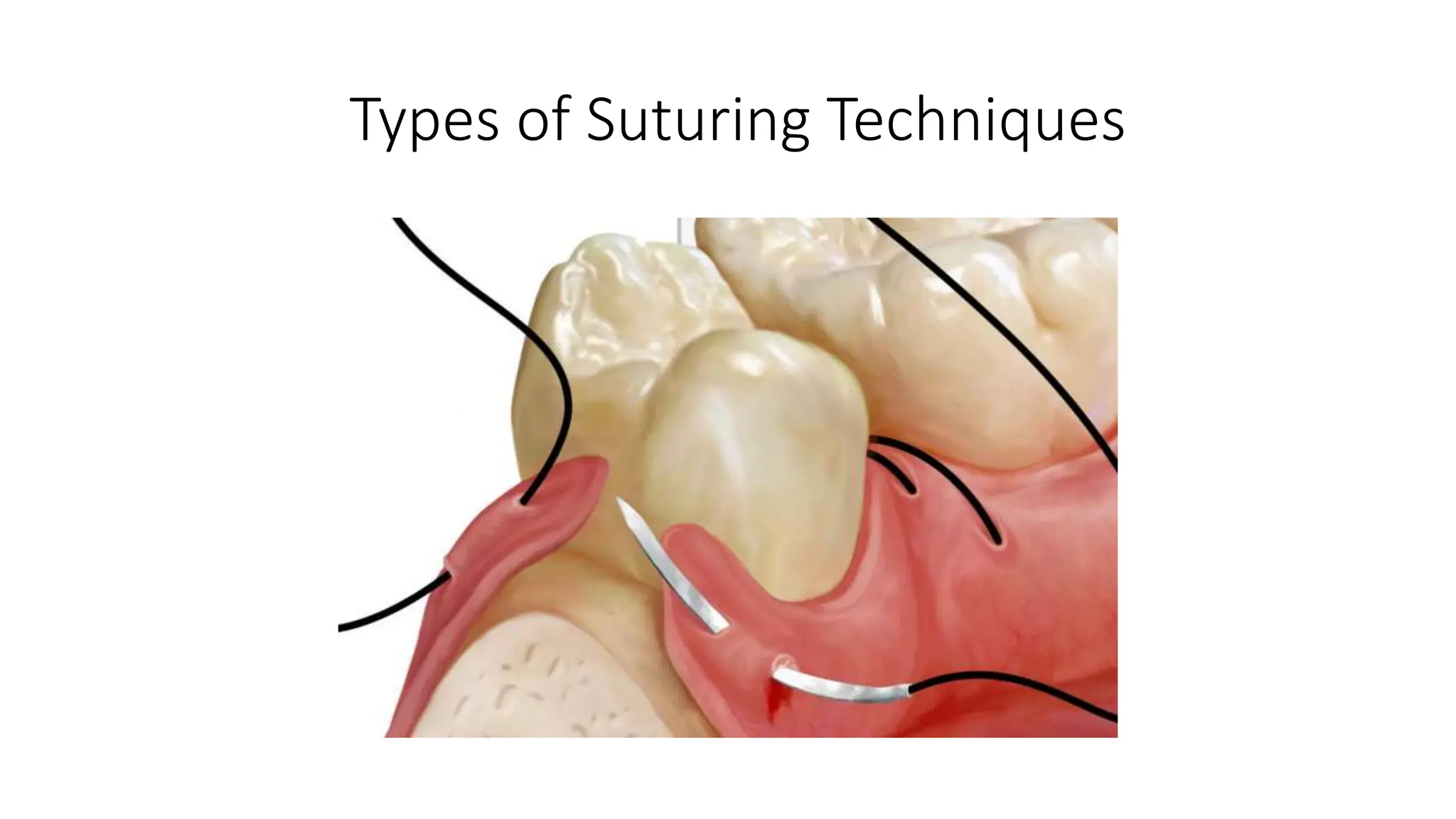
Suturing Techniques
Anatomy of Needle
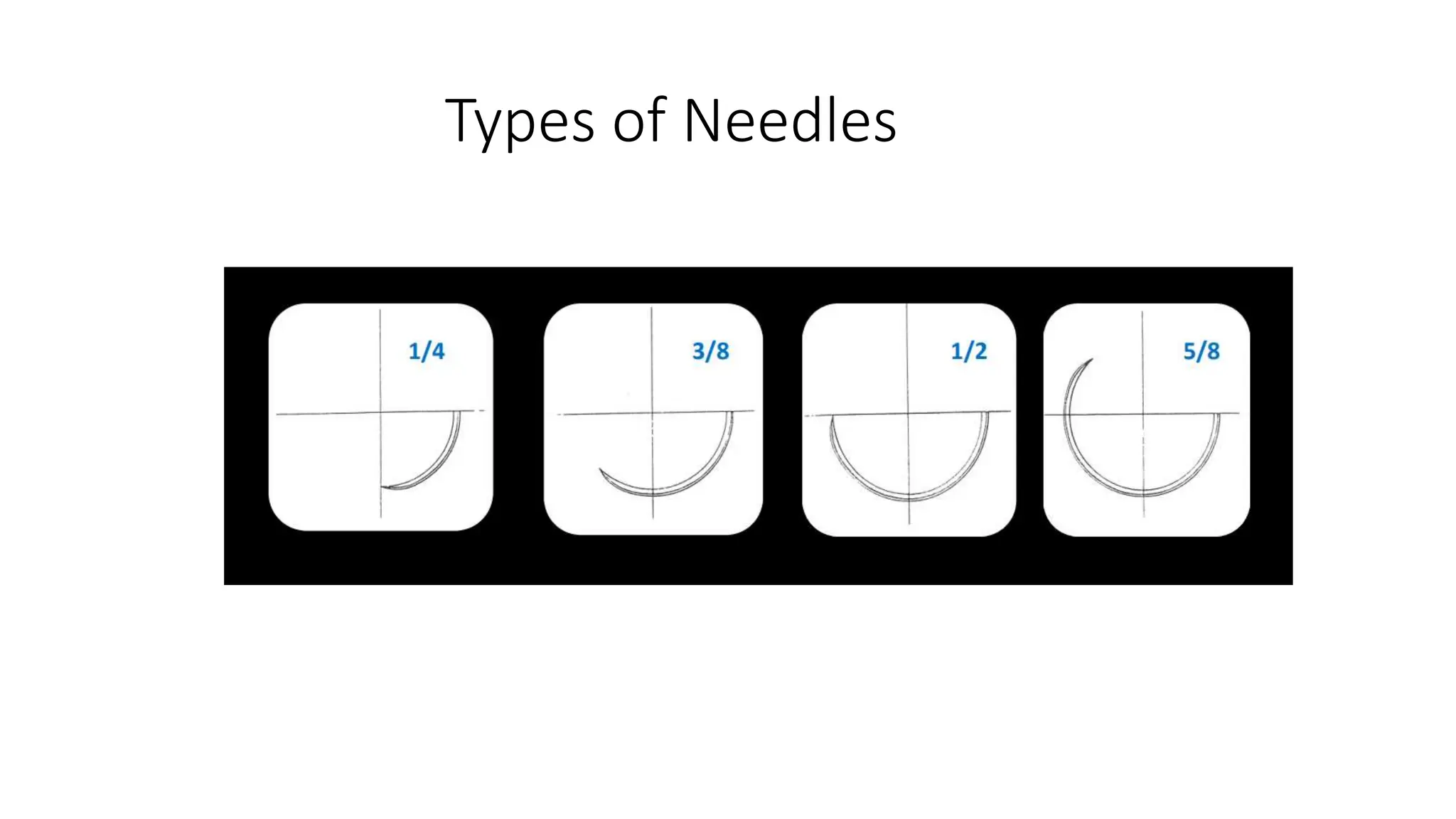
Types of Needles
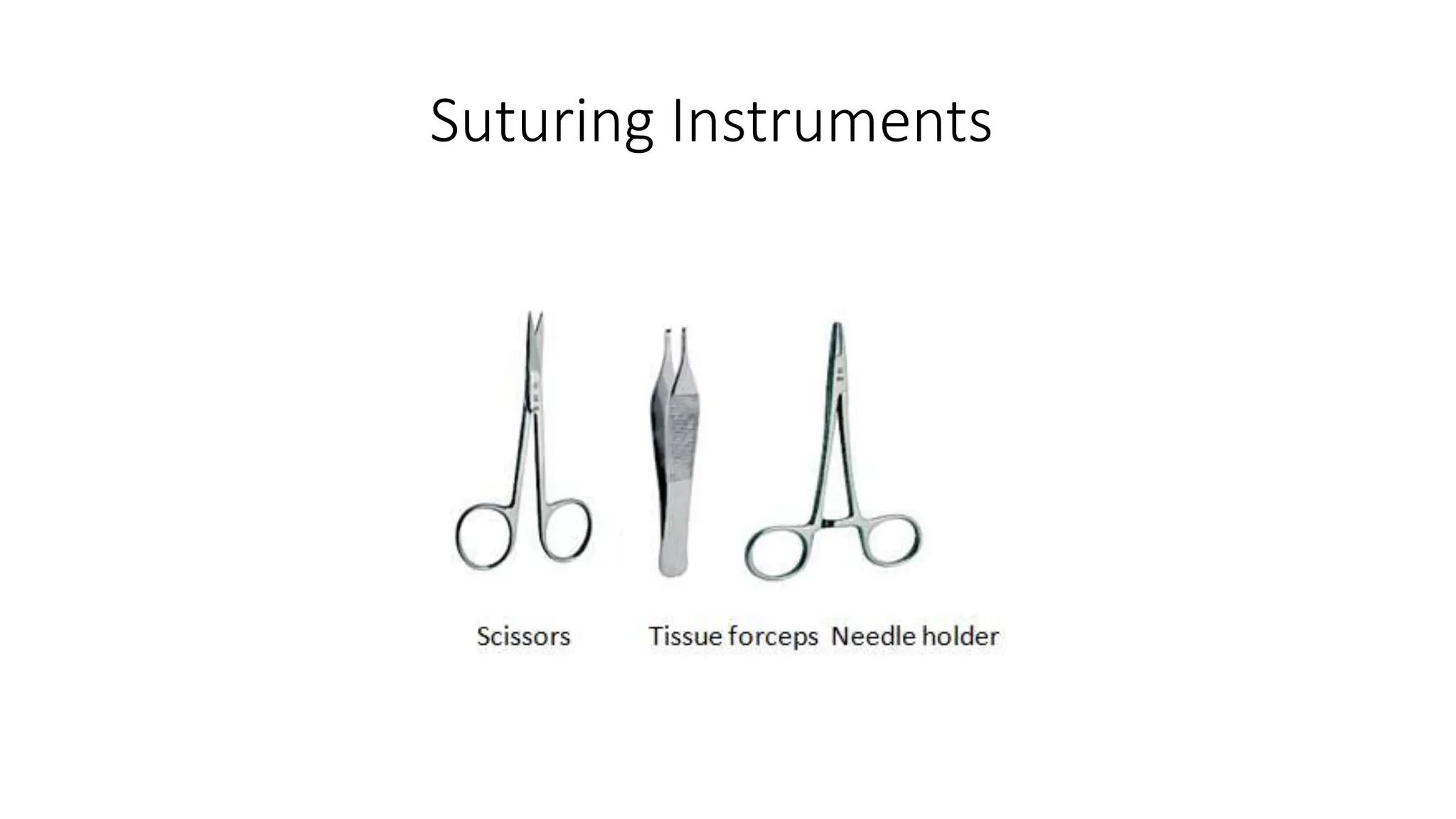
Suturing Instruments
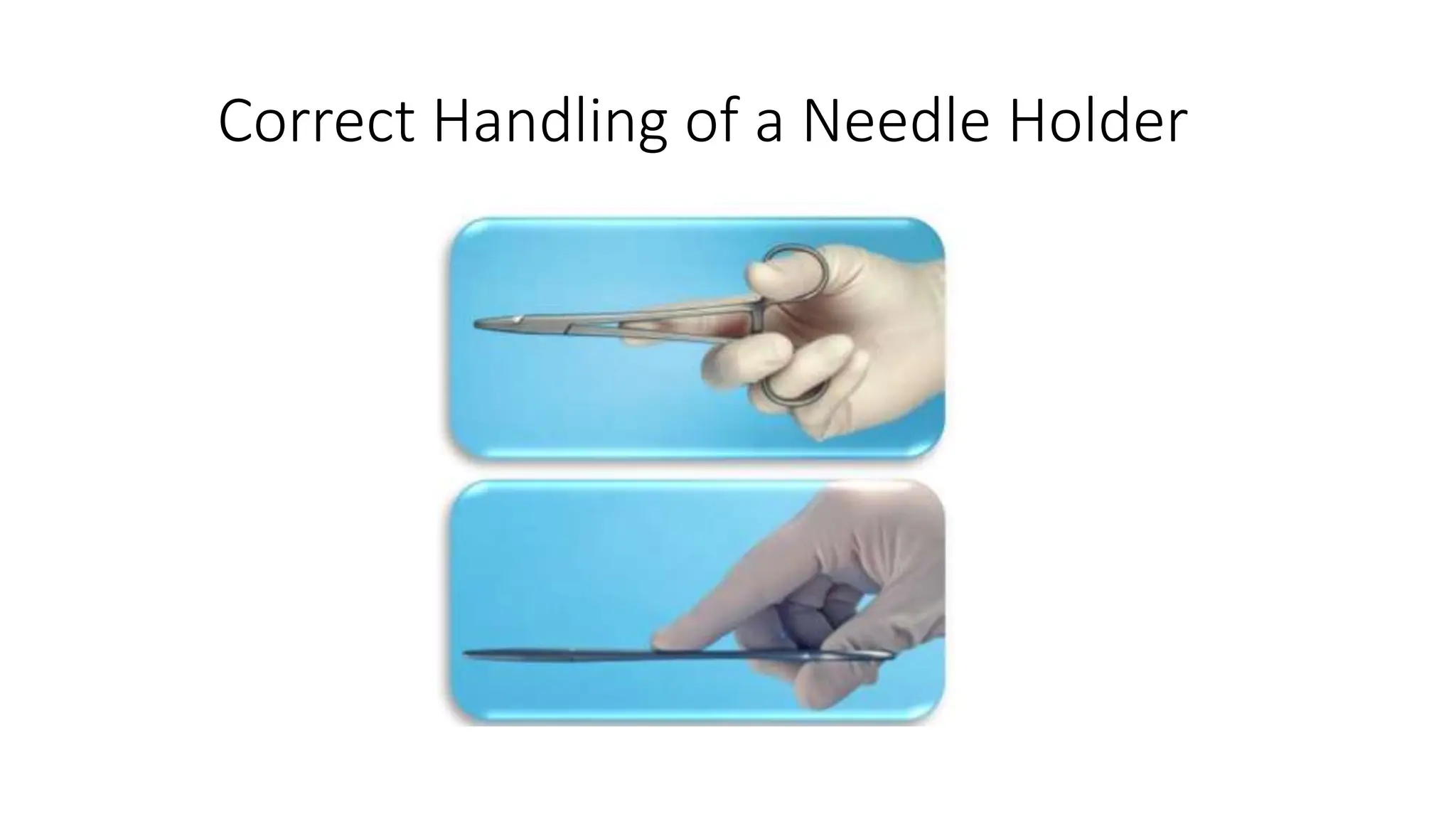
Correct Handling of a Needle Holder
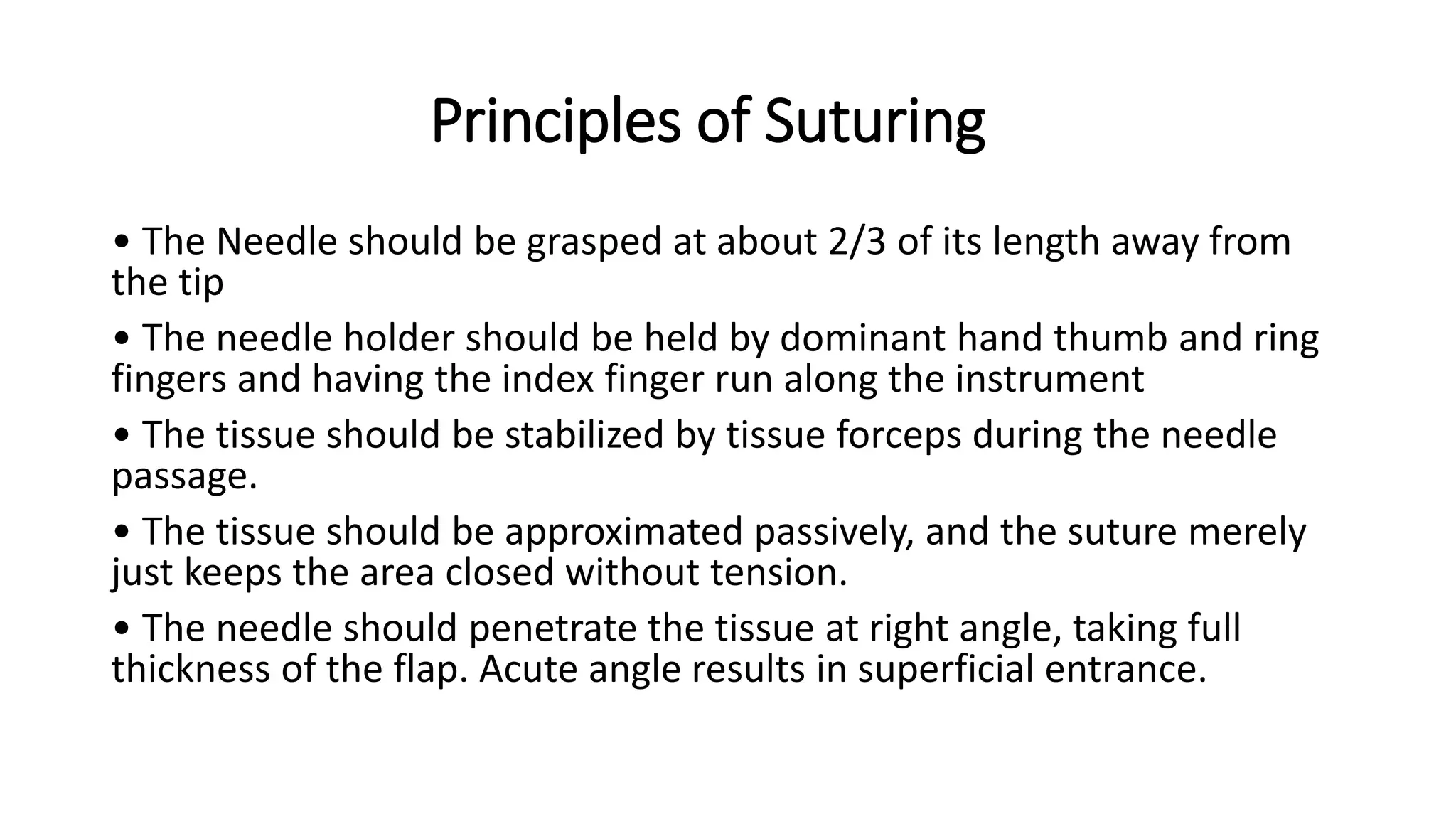
Principles of Suturing
• The Needle should be grasped at about 2/3 of its length away from
the tip
• The needle holder should be held by dominant hand thumb and ring
fingers and having the index finger run along the instrument
• The tissue should be stabilized by tissue forceps during the needle
passage.
• The tissue should be approximated passively, and the suture merely
just keeps the area closed without tension.
• The needle should penetrate the tissue at right angle, taking full
thickness of the flap. Acute angle results in superficial entrance.
• The needle should be 3m away from the margin of incision, allowing
sufficient bulk of tissue and minimizing the risk of tearing.
• Non-resorbable sutures are kept for about 7 days and then it best to
be removed to minimize the risk of infection of the wound.
Types of Suturing Techniques
Interrupted Sutures
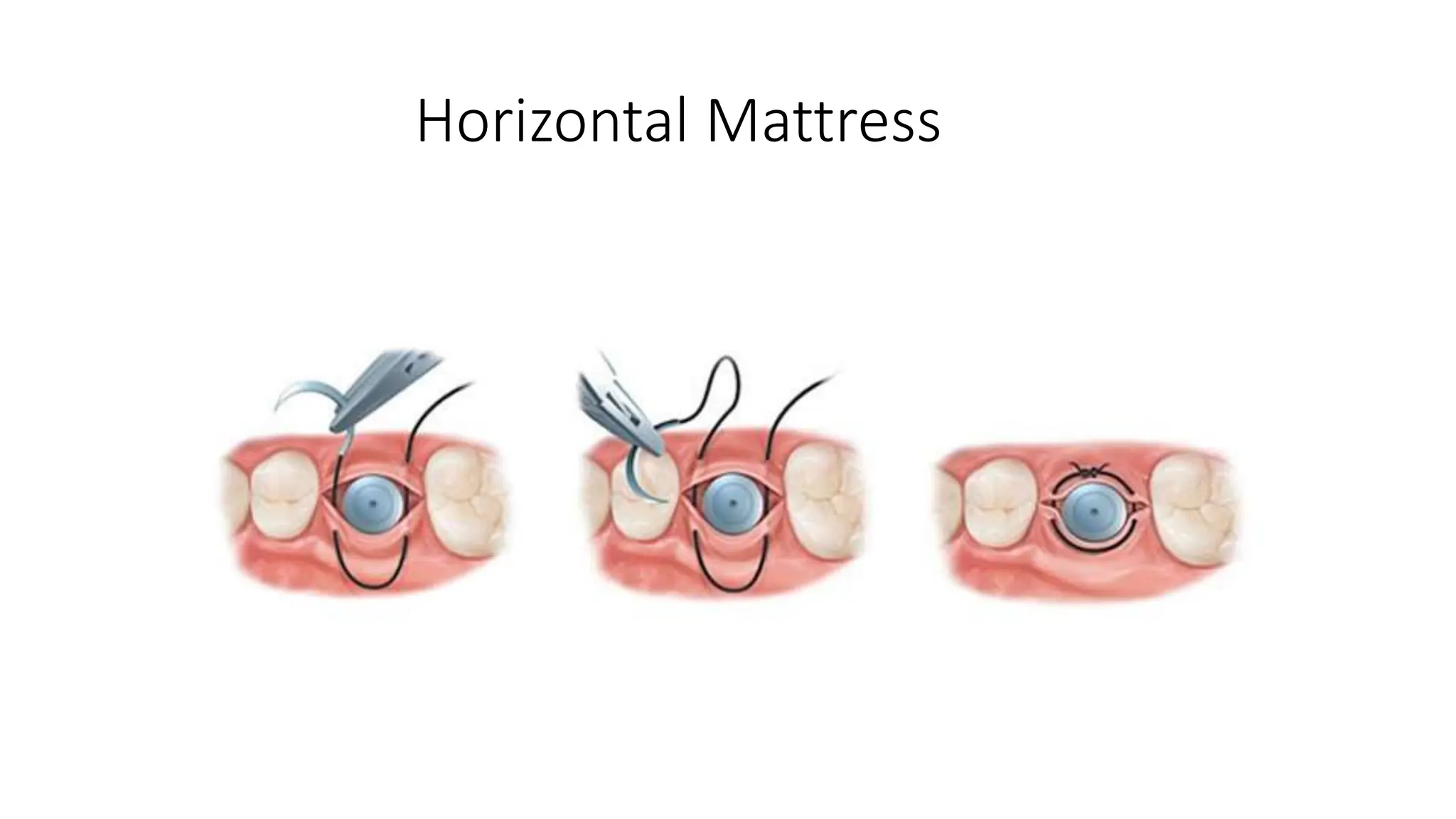
Horizontal Mattress
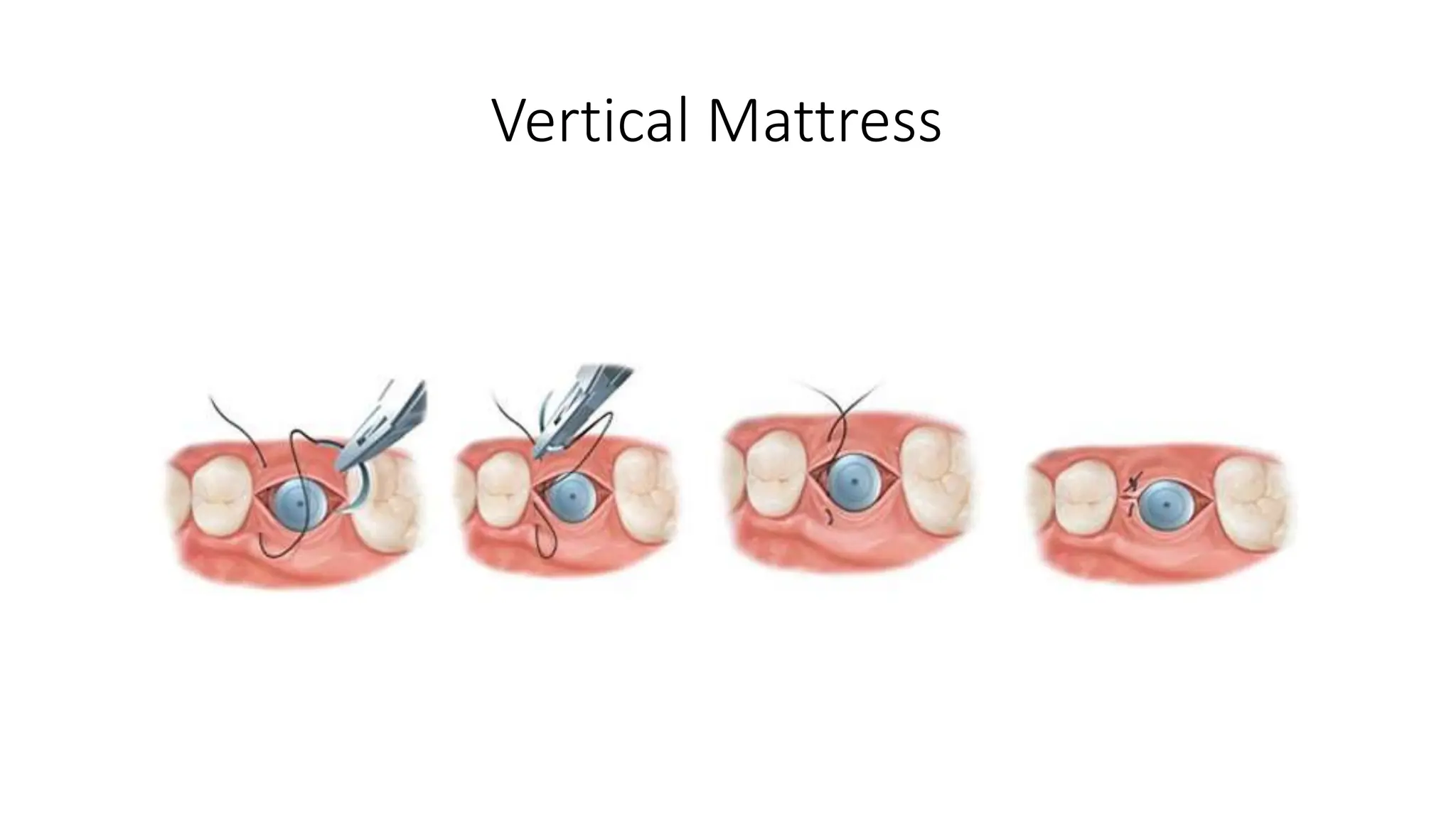
Vertical Mattress
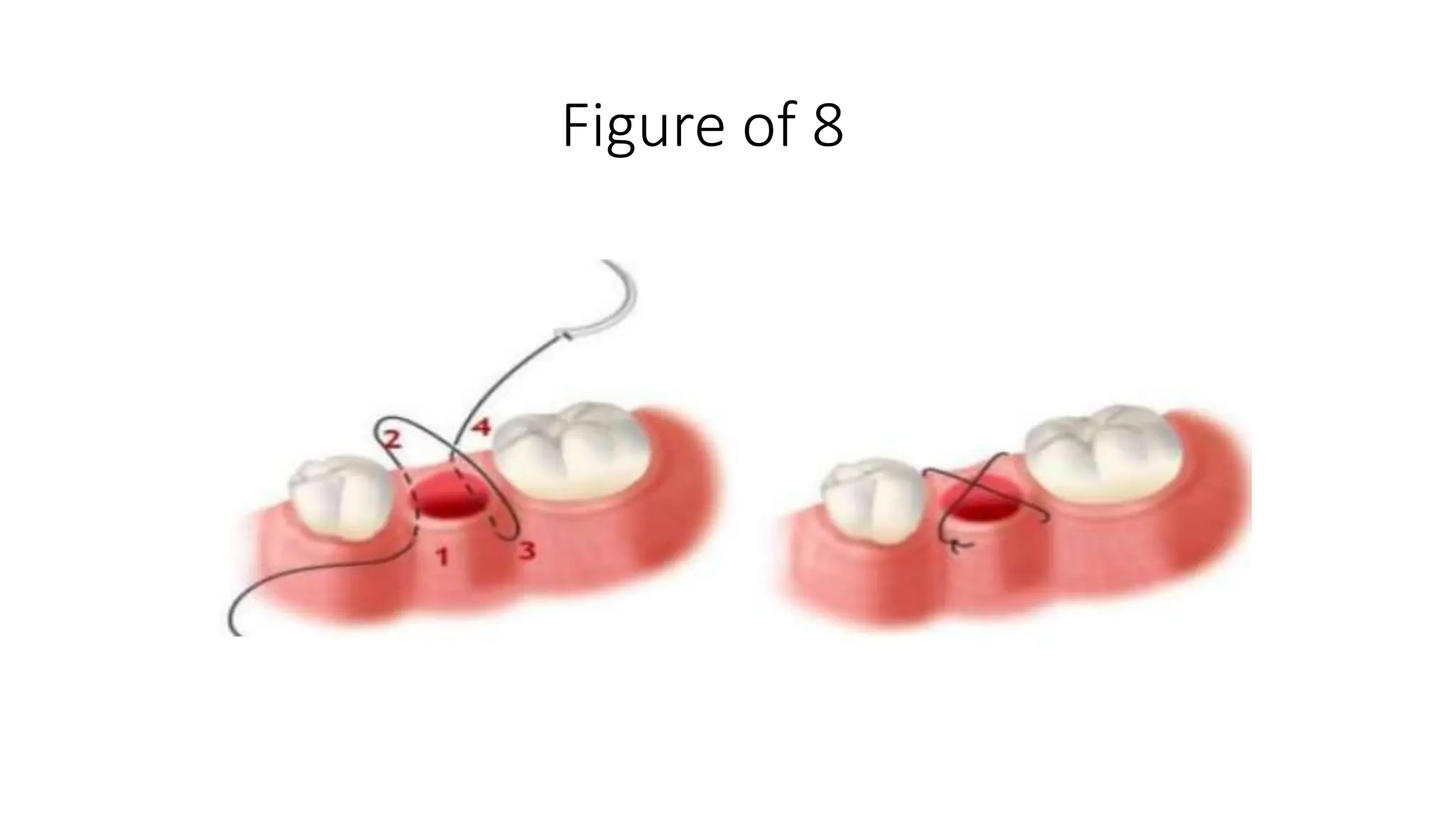
Figure of 8
Continous Suture
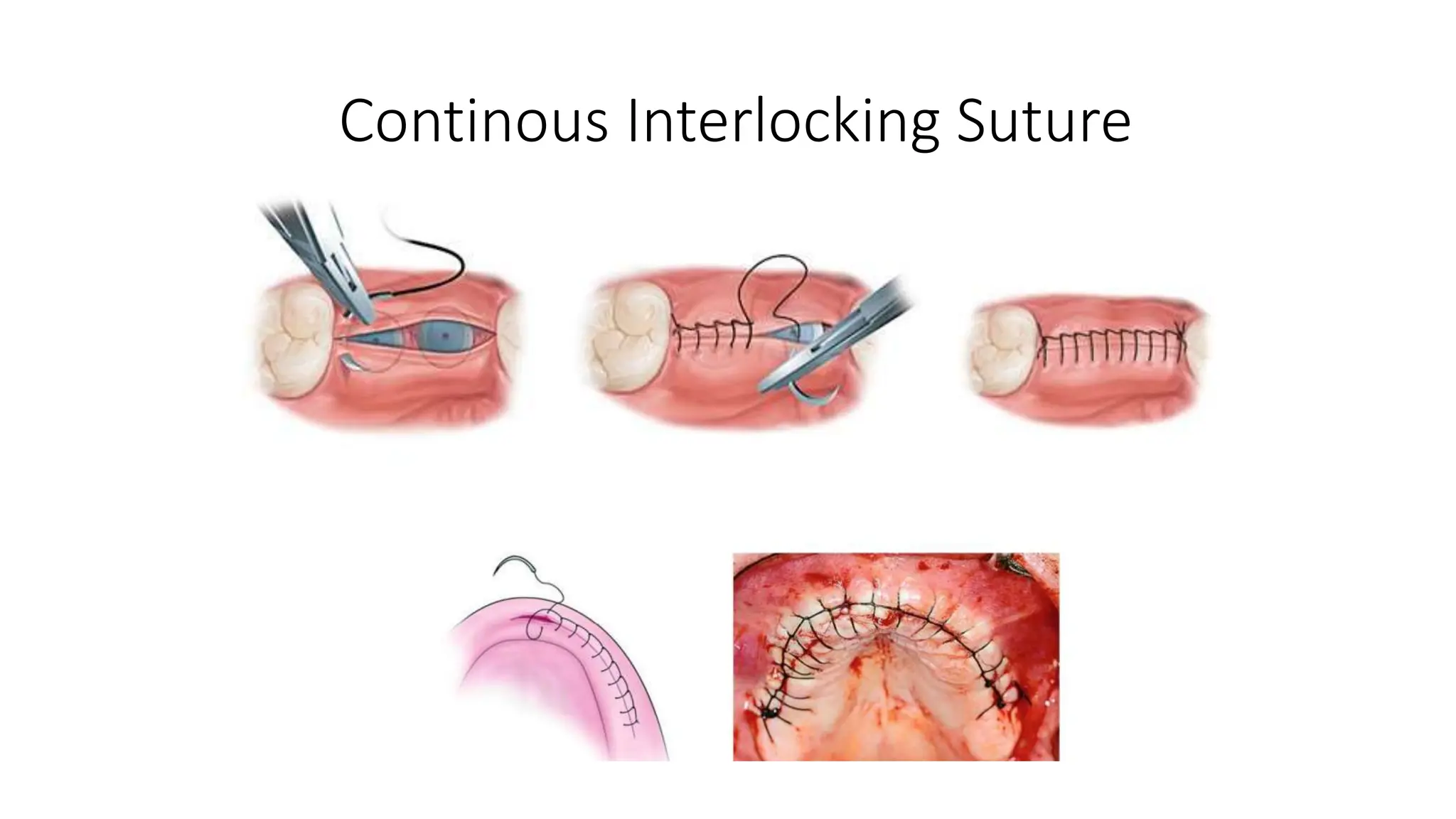
Continous Interlocking Suture
Components of a Knot
Types of Knot
• Square Knot
• Granny’s Knot
• Surgeon’s Knot
Postoperative Management
► A radiograph should be taken postoperatively to evaluate the
position of each implant placed in relation to the adjacent
structures such as the sinus or inferior alveolar canal and relative to
the teeth and other implants.
► The radiograph should also be viewed to help ensure that the cover
screw or healing abutment is fully seated.
► The patients should be given analgesics for pain control
postoperatively. Mild to moderate strength analgesics are usually
sufficient. Antibiotics are also given prophylactically.
► The patient should be evaluated weekly until soft tissue wound
healing is complete.
V. Inferior Alveolar Nerve Injury
INFERIOR ALVEOLAR
NERVE INJURY
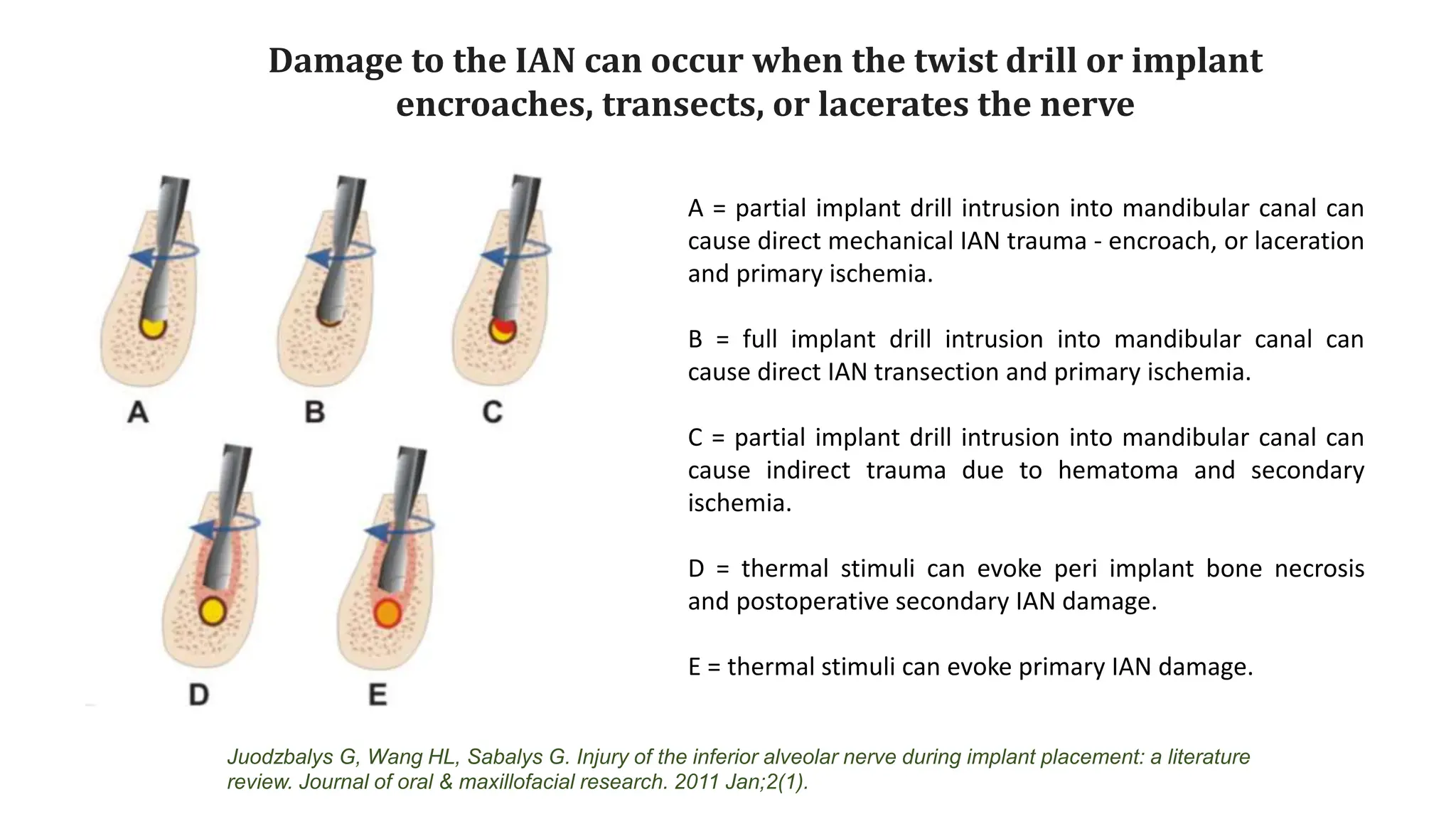
Damage to the IAN can occur when the twist drill or implant
encroaches, transects, or lacerates the nerve
A = partial implant drill intrusion into mandibular canal can
cause direct mechanical IAN trauma - encroach, or laceration
and primary ischemia.
B = full implant drill intrusion into mandibular canal can
cause direct IAN transection and primary ischemia.
C = partial implant drill intrusion into mandibular canal can
cause indirect trauma due to hematoma and secondary
ischemia.
D = thermal stimuli can evoke peri implant bone necrosis
and postoperative secondary IAN damage.
E = thermal stimuli can evoke primary IAN damage.
Juodzbalys G, Wang HL, Sabalys G. Injury of the inferior alveolar nerve during implant placement: a literature
review. Journal of oral & maxillofacial research. 2011 Jan;2(1).
A = partial implant intrusion into mandibular canal can cause
direct mechanical IAN trauma - encroach, or laceration and
primary ischemia.
B = full implant intrusion into mandibular canal can cause
direct IAN transection, and/or compression and primary
ischemia.
C = dental implant is too close to the mandibular canal, it can
cause IAN compression.
D = partial implant intrusion into mandibular canal can cause
indirect trauma due to hematoma and secondary ischemia.
E = partial implant intrusion into mandibular canal can cause
indirect trauma due to bone debris and secondary ischemia.
F = "cracking" of the IAN canal roof by its close proximity to
preparation of the implant bed. It can cause compression and
primary ischemia.
Inferior alveolar nerve injury by Dental Implant
Juodzbalys G, Wang HL, Sabalys G. Injury of the inferior alveolar nerve during implant
placement: a literature review. Journal of oral & maxillofacial research. 2011 Jan;2(1).
• Adequate anesthesia is required before surgery
• Use radiographs whenever possible
• Once nerve damage occurs, the patient must be fully explained about the abnormal
perception. You must not tell patients that they will return to normal within 6
months to 1 year.
According to relevant papers, after nerve damage, about 10% of patients cannot
recover even after a year (that is, permanent damage)
• Maintain a satisfactory relationship with patients
• The surgical consent form must be signed with the patient before surgery, or the
instructions given to the patient must be recorded in the medical record.
• Possible complications, disputes that arise after obtaining the patient’s consent, and
the surgeon’s responsibilities can be reduced. When problems occur, you should not
be emotional when dealing with patients. You need to deal with them through
correct process and request expert help.
• In the early stage of nerve injury, drug treatment should be actively carried out and
surgery should be performed as early as possible.
Prevention and Counter measures of Paraesthesia
 INADEQUATE SUTURING
LEADING TO OPENING OF
INCISION LINE
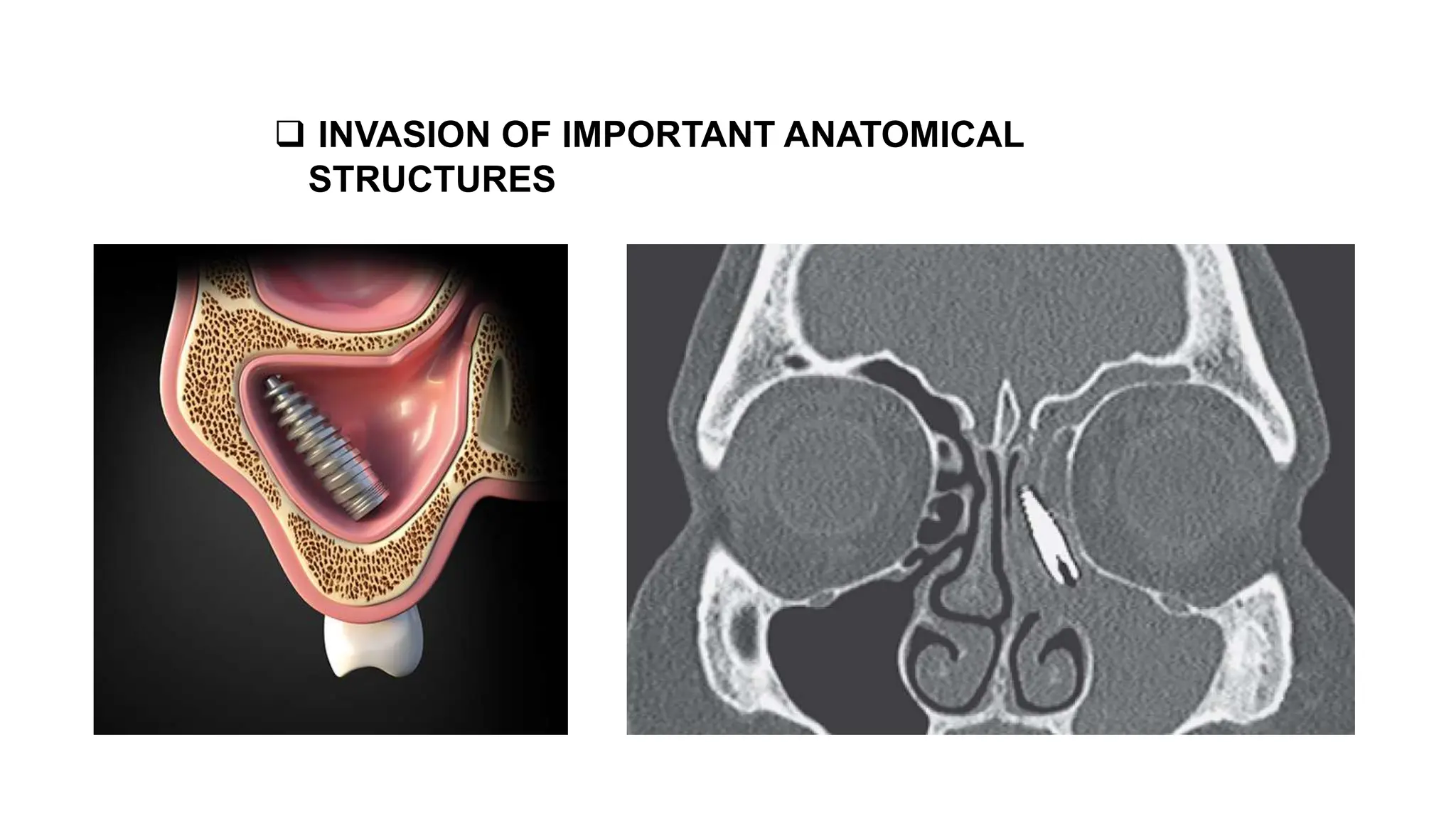
 INVASION OF IMPORTANT ANATOMICAL
STRUCTURES
 A POSITIONAL ERROR
Dr Avantika
Dr Avantika
 HEMATOMA
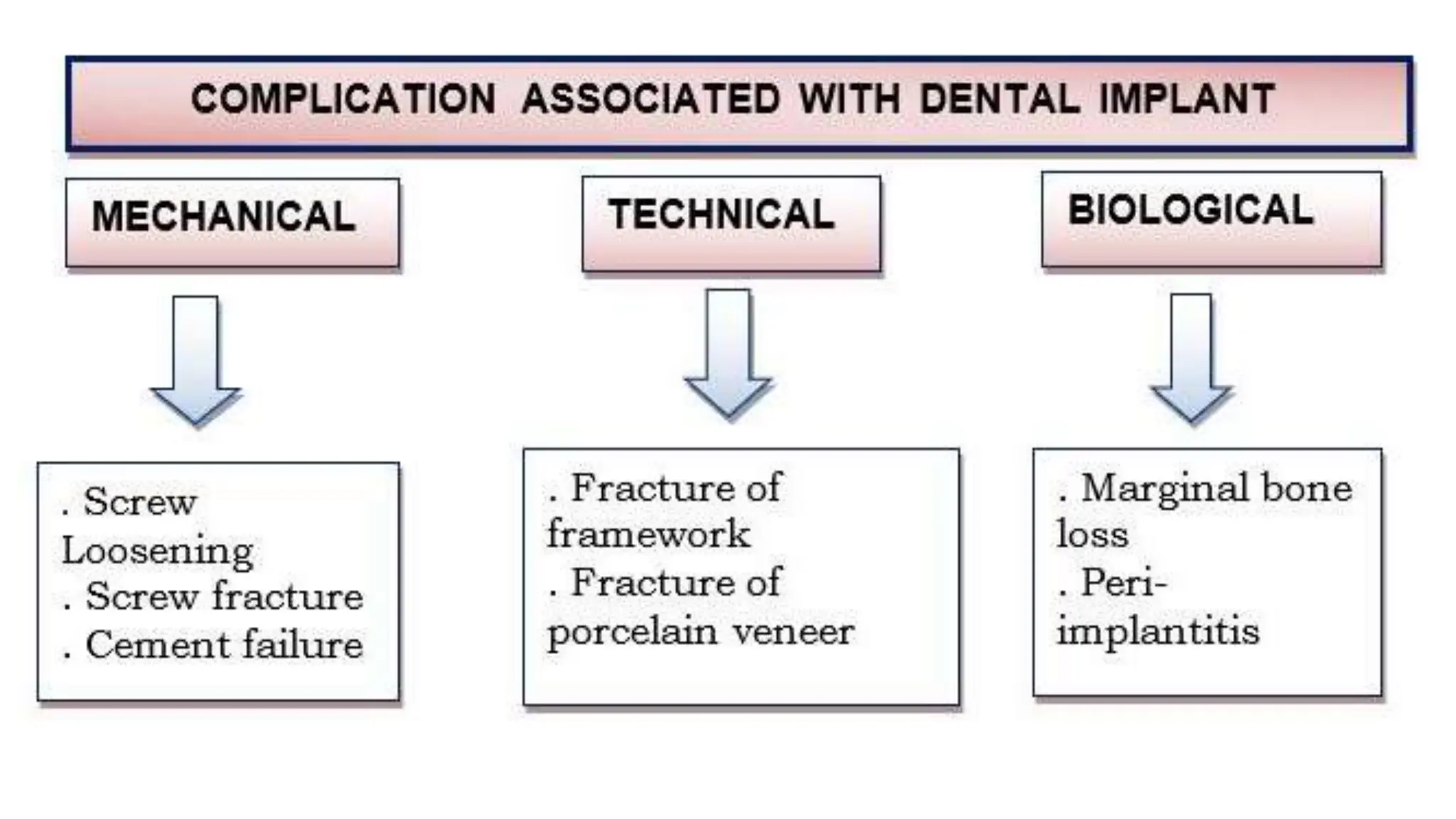
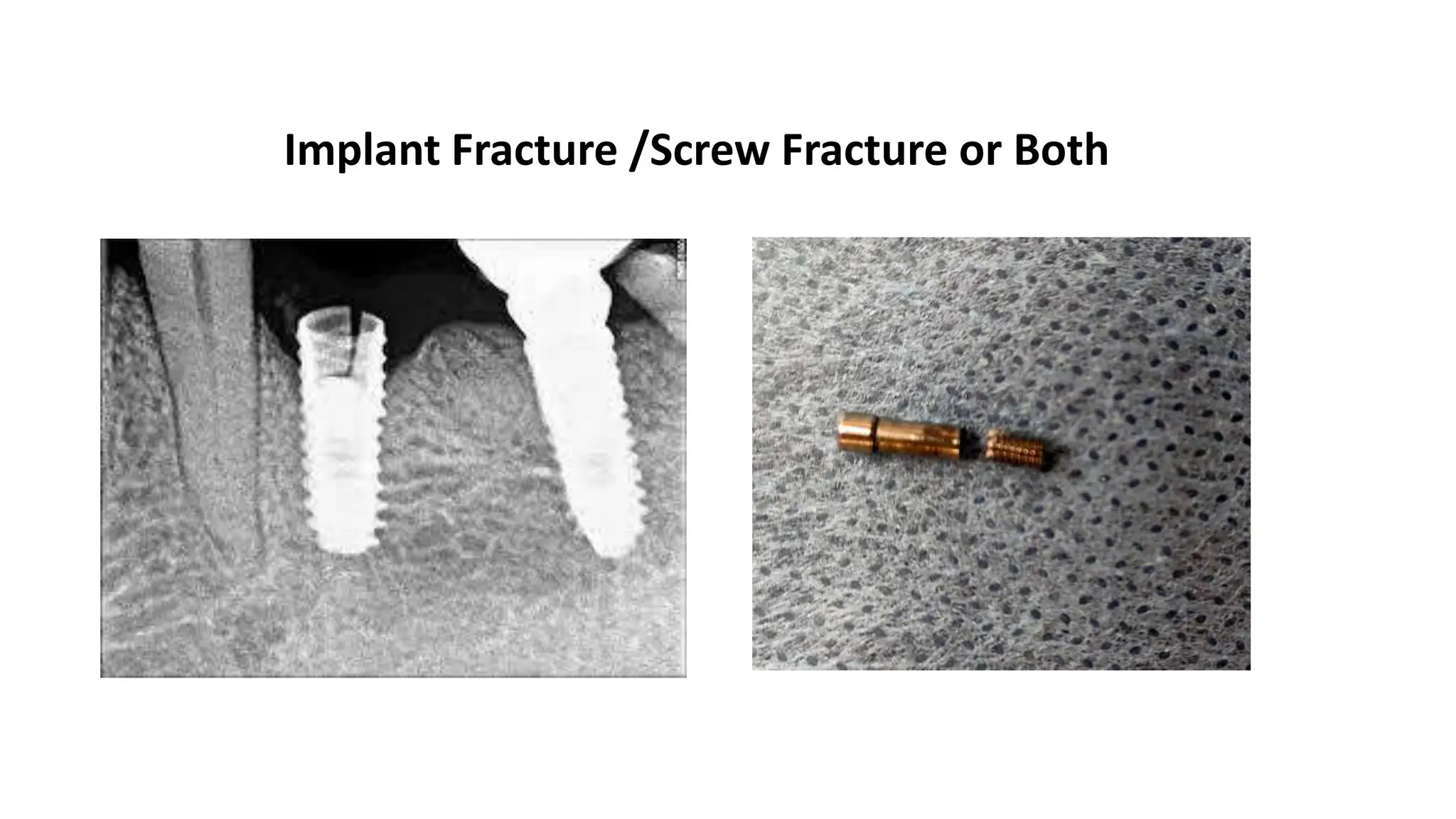
Implant Fracture /Screw Fracture or Both
• Implant Placement is not a complicated procedure.. If one has an
adequate knowledge of the Anatomical Structures
• ANATOMICAL CONSIDERATIONS should be taken care of….NOT
ANATOMICAL COMPLICATIONS.
• Care should be taken at time of flap reflections.
• No uncontrolled forces should be applied.
BEFORE PLACING PLAN IT WISELY!!
The typical starting point is the determination of:
1. What needs to be replaced (single tooth, multiple teeth, or all the patient’s teeth.
2. Whether the replacement will be more functional (eg, a mandibular first molar) or will
have a strong esthetic consideration (eg, maxillary central incisor)
3. Whether the patient is expecting a fixed prosthetic option or one that is removable
4. Whether the prosthetic solution includes replacing just the tooth, the tooth and gingival
tissue, or the tooth, bone, and gingival tissue
The factors for the key to successful
implant Osseointegration:
1. Use of biologically compatible material such as pure titanium
2. Implant surface free of contamination and implantation site free of infections and other diseases
3. Use of an atraumatic insertion technique that minimizes heat damage to bone adjacent to the implant surface
A. Sharp drill bits
B. Gradual increase in width of implant site using graduated drills
C. Cooling of drill bit during drilling
D. Ultra-low speed, high torque drill for implant site tapping and implant insertion
4. Close approximation of the implant surface to the surrounding bone
A. Precision in site development and implant insertion
B. Tapping of dense cortical bone
5. Delayed implant loading (prosthesis placement), giving time for the biologic process of
osseointegration to occur
Dr Avantika
Dr Avantika

Incision, Suturing Techniques and Complications.pptx

  • 1.
    NEVER PERFORM ANYVERTICAL INCISION ON THE MANDIBULAR LINGUAL AREA
  • 2.
  • 3.
  • 4.
  • 6.
  • 7.
    Correct Handling ofa Needle Holder
  • 8.
    Principles of Suturing •The Needle should be grasped at about 2/3 of its length away from the tip • The needle holder should be held by dominant hand thumb and ring fingers and having the index finger run along the instrument • The tissue should be stabilized by tissue forceps during the needle passage. • The tissue should be approximated passively, and the suture merely just keeps the area closed without tension. • The needle should penetrate the tissue at right angle, taking full thickness of the flap. Acute angle results in superficial entrance.
  • 9.
    • The needleshould be 3m away from the margin of incision, allowing sufficient bulk of tissue and minimizing the risk of tearing. • Non-resorbable sutures are kept for about 7 days and then it best to be removed to minimize the risk of infection of the wound.
  • 10.
  • 11.
  • 12.
  • 13.
  • 14.
  • 15.
  • 16.
  • 17.
  • 18.
    Types of Knot •Square Knot • Granny’s Knot • Surgeon’s Knot
  • 19.
    Postoperative Management ► Aradiograph should be taken postoperatively to evaluate the position of each implant placed in relation to the adjacent structures such as the sinus or inferior alveolar canal and relative to the teeth and other implants. ► The radiograph should also be viewed to help ensure that the cover screw or healing abutment is fully seated. ► The patients should be given analgesics for pain control postoperatively. Mild to moderate strength analgesics are usually sufficient. Antibiotics are also given prophylactically. ► The patient should be evaluated weekly until soft tissue wound healing is complete.
  • 22.
    V. Inferior AlveolarNerve Injury INFERIOR ALVEOLAR NERVE INJURY
  • 23.
    Damage to theIAN can occur when the twist drill or implant encroaches, transects, or lacerates the nerve A = partial implant drill intrusion into mandibular canal can cause direct mechanical IAN trauma - encroach, or laceration and primary ischemia. B = full implant drill intrusion into mandibular canal can cause direct IAN transection and primary ischemia. C = partial implant drill intrusion into mandibular canal can cause indirect trauma due to hematoma and secondary ischemia. D = thermal stimuli can evoke peri implant bone necrosis and postoperative secondary IAN damage. E = thermal stimuli can evoke primary IAN damage. Juodzbalys G, Wang HL, Sabalys G. Injury of the inferior alveolar nerve during implant placement: a literature review. Journal of oral & maxillofacial research. 2011 Jan;2(1).
  • 24.
    A = partialimplant intrusion into mandibular canal can cause direct mechanical IAN trauma - encroach, or laceration and primary ischemia. B = full implant intrusion into mandibular canal can cause direct IAN transection, and/or compression and primary ischemia. C = dental implant is too close to the mandibular canal, it can cause IAN compression. D = partial implant intrusion into mandibular canal can cause indirect trauma due to hematoma and secondary ischemia. E = partial implant intrusion into mandibular canal can cause indirect trauma due to bone debris and secondary ischemia. F = "cracking" of the IAN canal roof by its close proximity to preparation of the implant bed. It can cause compression and primary ischemia. Inferior alveolar nerve injury by Dental Implant Juodzbalys G, Wang HL, Sabalys G. Injury of the inferior alveolar nerve during implant placement: a literature review. Journal of oral & maxillofacial research. 2011 Jan;2(1).
  • 25.
    • Adequate anesthesiais required before surgery • Use radiographs whenever possible • Once nerve damage occurs, the patient must be fully explained about the abnormal perception. You must not tell patients that they will return to normal within 6 months to 1 year. According to relevant papers, after nerve damage, about 10% of patients cannot recover even after a year (that is, permanent damage) • Maintain a satisfactory relationship with patients • The surgical consent form must be signed with the patient before surgery, or the instructions given to the patient must be recorded in the medical record. • Possible complications, disputes that arise after obtaining the patient’s consent, and the surgeon’s responsibilities can be reduced. When problems occur, you should not be emotional when dealing with patients. You need to deal with them through correct process and request expert help. • In the early stage of nerve injury, drug treatment should be actively carried out and surgery should be performed as early as possible. Prevention and Counter measures of Paraesthesia
  • 27.
     INADEQUATE SUTURING LEADINGTO OPENING OF INCISION LINE
  • 28.
     INVASION OFIMPORTANT ANATOMICAL STRUCTURES
  • 29.
     A POSITIONALERROR Dr Avantika Dr Avantika
  • 30.
  • 31.
    Implant Fracture /ScrewFracture or Both
  • 32.
    • Implant Placementis not a complicated procedure.. If one has an adequate knowledge of the Anatomical Structures • ANATOMICAL CONSIDERATIONS should be taken care of….NOT ANATOMICAL COMPLICATIONS. • Care should be taken at time of flap reflections. • No uncontrolled forces should be applied.
  • 33.
    BEFORE PLACING PLANIT WISELY!! The typical starting point is the determination of: 1. What needs to be replaced (single tooth, multiple teeth, or all the patient’s teeth. 2. Whether the replacement will be more functional (eg, a mandibular first molar) or will have a strong esthetic consideration (eg, maxillary central incisor) 3. Whether the patient is expecting a fixed prosthetic option or one that is removable 4. Whether the prosthetic solution includes replacing just the tooth, the tooth and gingival tissue, or the tooth, bone, and gingival tissue
  • 34.
    The factors forthe key to successful implant Osseointegration: 1. Use of biologically compatible material such as pure titanium 2. Implant surface free of contamination and implantation site free of infections and other diseases 3. Use of an atraumatic insertion technique that minimizes heat damage to bone adjacent to the implant surface A. Sharp drill bits B. Gradual increase in width of implant site using graduated drills C. Cooling of drill bit during drilling D. Ultra-low speed, high torque drill for implant site tapping and implant insertion 4. Close approximation of the implant surface to the surrounding bone A. Precision in site development and implant insertion B. Tapping of dense cortical bone 5. Delayed implant loading (prosthesis placement), giving time for the biologic process of osseointegration to occur Dr Avantika Dr Avantika