Incineration
• Incineration isa controlled combustion process for burning solid, liquid,
or gaseous combustible waste to gases and residue containing little or
no combustible material when properly carried out.
• High-temperature incineration is carried out at 3000 0
F to 3400 0
F (1649 to 1871 0
C).
• It is a hygienic way of disposing solid waste. It is suitable if waste contains more hazardous material
and organic content. This process is the most effective process for completely destroying plastic waste
and pathogenic medical waste. It is expensive process, compared to other methods of waste disposal.
• Municipal solid wastes are burnt at high temperature in big furnaces
called incinerators. Combustible substances such as plastic materials, rubbish, garbage,
dead organisms are separated for burning in incinerators. The non-combustible materials
can be left out for recycling and reuse. About 10 % solid material and ash remains after
combustion which can be disposed off by other means.
3.
Contd…
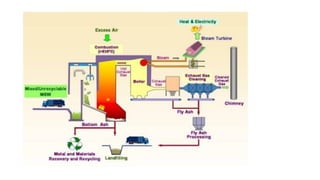
• The heatproduced in the incinerator during burning of refuse is used
for generation of electricity through turbines.
• Municipal solid waste is generally wet and has a high calorific value.
Therefore, it has to be dried first before burning. Waste is dried in a
preheater from where it is taken to a large incinerating furnace called
"destructor" which can incinerate about 100 to 150 tonnes per hour.
Temperature normally maintained in a combustion chamber is about
7000
C which may be increased to 10000
C when electricity is to be
generated.
4.
Incineration- Advantages
• Itreduces the waste volume by 90 per cent
• Requires very little space
• Safest from hygienic point of view
• The only method available for safe and complete
decomposition/destruction of plastic waste
• An incinerator plant of 3000 tonnes per day capacity can generate
3MW of power.
5.
Incineration- Disadvantages
• Itscapital and operating cost is very high
• Operation needs skilled personnel
• Formation of smoke, dust and ashes needs further disposal and that
may cause air pollution.
• During incineration high levels of dioxins, furans, lead and cadmium
may be emitted with the fly ash of incinerator.
6.
Incineration objectives
• Volumereduction: Depending on its composition, incineration reduces the
volume of solid wastes to be disposed of by an average of 90%
• Stabilisation of waste: Incinerator output (i.e., ash) is considerably more inert
than incinerator input (i.e., solid wastes), mainly due to the oxidation of the
organic components of the waste stream. This leads to a reduction of landfill
management problems (since the organic fraction is responsible for landfill gas
production) and the organic compounds present in landfill leachate
• Recovery of energy from waste (EFW): Energy recovered from burning the
wastes is used to generate steam for use in onsite electricity generation or
export to local factories or district heating schemes.
• Sterilization of waste: This is of primary importance in the incineration of
clinical or biomedical waste. Incineration of solid wastes will also ensure
destruction of pathogens prior to final disposal in a landfill
Incineration Technologies
(1)Grate FiringSystems for Municipal Waste Incineration
Moving Grate:
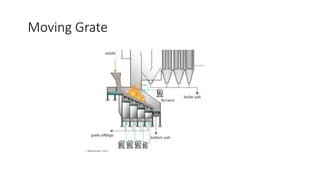
• A moving grate is a typical combustion design of a municipal solid waste
incinerator.
• Waste is dropped by a crane on to the descending grate, which moves into
the combustion chamber and eventually moves down to drop the burnt
residuals into an ash pit at the other end of the grate .
• The moving grate is a metallic porous bed, allowing primary combustion air
to flow through from the bottom.
• Secondary combustion air is supplied by nozzles from above the grate,
facilitating a complete combustion by the introduction of turbulence
Contd…
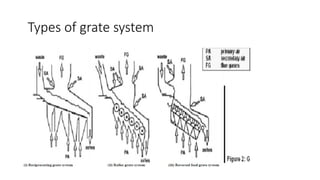
• Different typesof grate firing systems for refuse incineration are shown in
Figure : (i). Reciprocating grates, (ii). Roller grates and, (iii). Reversed feed
grates.
• Depending on the grate type, the furnace geometry and the secondary air
injection concept have to be optimized. Typically, the primary combustion air
cools the grate bars.
• Besides the air cooling effect is limited for very high calorific values of the
refuse and the bars can be damaged or destroyed by intense heating. For this
reason water cooled bars have been developed and successfully applied in
various plants.
• The primary stoichiometry can be optimized with respect to the burnout
behaviour or gaseous emissions such as CO and NO.
• Greater complexity and a higher susceptibility to malfunctions are the main
disadvantages
(2)Furnace burning incinerationsystem
(1) Mass-burning system
• Mass-burning systems are the predominant form of MSW incineration.
• A mass burn facility typically consists of a reciprocating grate combustion
system and a refractory-lined, water-walled steam generator.
• Mass-burn systems generally consist of either two or three incineration
units ranging in capacity from 50 to 1,000 tonnes per day.
• These facilities can accept refuse that has undergone little preprocessing
other than the removal of oversized items.
• This versatility makes mass-burn facilities convenient and flexible, local
programmes to separate household hazardous wastes (e.g., cleaners and
pesticides) and recover certain materials (e.g., iron scrap) are necessary to
help ensure environmentally viable incineration and resource conservation.
14.
Contd…
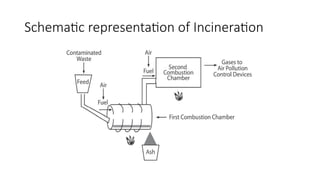
• Mass-burning ofwaste can also be achieved by the use of a rotary
kiln. Rotary kilns use a turning cylinder, either refractor or water wall
design, to tumble the waste through the system. The kiln is reclined,
with waste entering at the high elevation end and ash and non-
combustibles leaving at the lower end.
Contd…
(2) Refuse derivedfuel (RDF) system
• The term RDF is commonly used to refer to solid waste that has been
mechanically processed to produce a storable, transportable and
more homogeneous fuel for combustion.
• RDF systems have two basic components: RDF production and RDF
incineration
• RDF production facilities make RDF in various forms through material
separation, size reduction and pelletising. Although RDF processing
has the advantage of removing recyclables and contaminants from
the combustion stream, on an average, capital costs per tonne for
incineration units that use RDF are higher than for other incineration
options
17.
Contd…
There are twoprimary types of systems in operation
(i) Shred-and-burn systems:
• Shred-and-burn systems are the simplest form of RDF production.
• The process system typically consists of shredding the MSW to the desired
particle size that allows effective feeding to the combustor and magnetic removal
of ferrous metal, with the remaining portion delivered to the combustor.
• There is no attempt to remove other non-combustible materials in the MSW
before combustion.
• This, in essence, is a system with minimal processing and removal of
noncombustibles
18.
Contd…
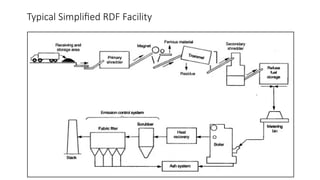
(ii)Simplified process systems:
•This is a system that removes a significant portion of the non-
combustibles.
• A simplified process system involves processing the MSW to produce
an RDF with a significant portion of the non-combustibles removed
before combustion.
• The MSW process removes more than 85% of the ferrous metals, a
significant percentage of the remaining non-combustible (i.e., glass,
nonferrous metals, dirt, sand, etc.), and shreds the material to a
nominal particle top size of 10 to 15 cm to allow effective firing in the
combustion unit
Contd…
(3) Modular incineration
•Modular incinerator units are usually prefabricated units with
relatively small capacities between 5 and 120 tonnes of solid waste
per day.
• Typical facilities have between 1 and 4 units with a total plant
capacity of about 15 to 400 tonnes per day.
• The majority of modular units produce steam as the sole energy
product.
• Due to their small capacity, modular incinerators are generally used
in small communities or for commercial and industrial operations.
21.
Contd…
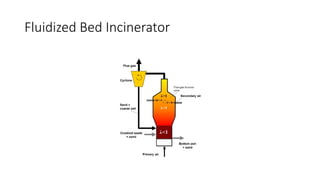
(4)Fluidized-bed incineration
• Fluidizedbed combustion has recently increased in application in
municipal solid waste incinerators, although it is still mainly used for
the combustion of hazardous waste
• Fluidized-bed incineration of MSW is typically medium scale, with
processing capacity from 50 to 150 tonnes per day.
• In this system, a bed of limestone or sand that can withstand high
temperatures, fed by an air distribution system, replaces the grate.
• The heating of the bed and an increase in the air velocities cause the
bed to bubble, which gives rise to the term fluidised.
22.
Contd…
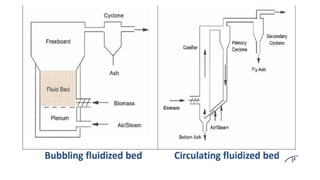
• There aredifferent types of fluidized bed combustors (bubbling,
rotating and circulating fluidized bed), but the principle of the design
remains the same.
• Waste particles are suspended by the upward flow of combustion air
injected from beneath so that it seems like a fluid, by which the
turbulence created enhances uniform mixing and heat transfer hence
an increased combustion efficiency.
• Fluidised-bed systems are more consistent in their operation than mass
burn and can be controlled more effectively to achieve higher energy
conversion efficiency, less residual ash and lower air emissions.
• Fluidised-bed incinerators require front-end preprocessing, also called
fuel preparation
Advantages and Disadvantages
•Advantages
Good gas-solid contact & mixing
High specific heat capacity
Can accommodate variations in fuel quality
• Disadvantages
Carbon loss with ash
Feed pre-processing required
26.
Contd..
(5) Rotary kiln
•A rotary kiln are commonly used for combusting industrial and hazardous
wastes, but is also used in some municipal solid waste incinerators.
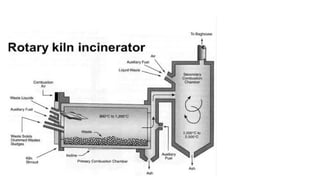
• The principle design consists of two thermal treatment chambers: a
slightly inclined primary chamber where waste is fed in (together with
inlet of hot exhaust air with oxygen), rotated and thermally decomposed
by the heat radiation from the secondary chamber.
• The re combustion chamber positioned at the rear of the kiln where the
‐
decomposition air and the rest waste is completely burnt with the supply
of secondary air.
• Rotary kiln have the advantage of producing a low level of NOx and
thermal destruction of hazardous chemicals