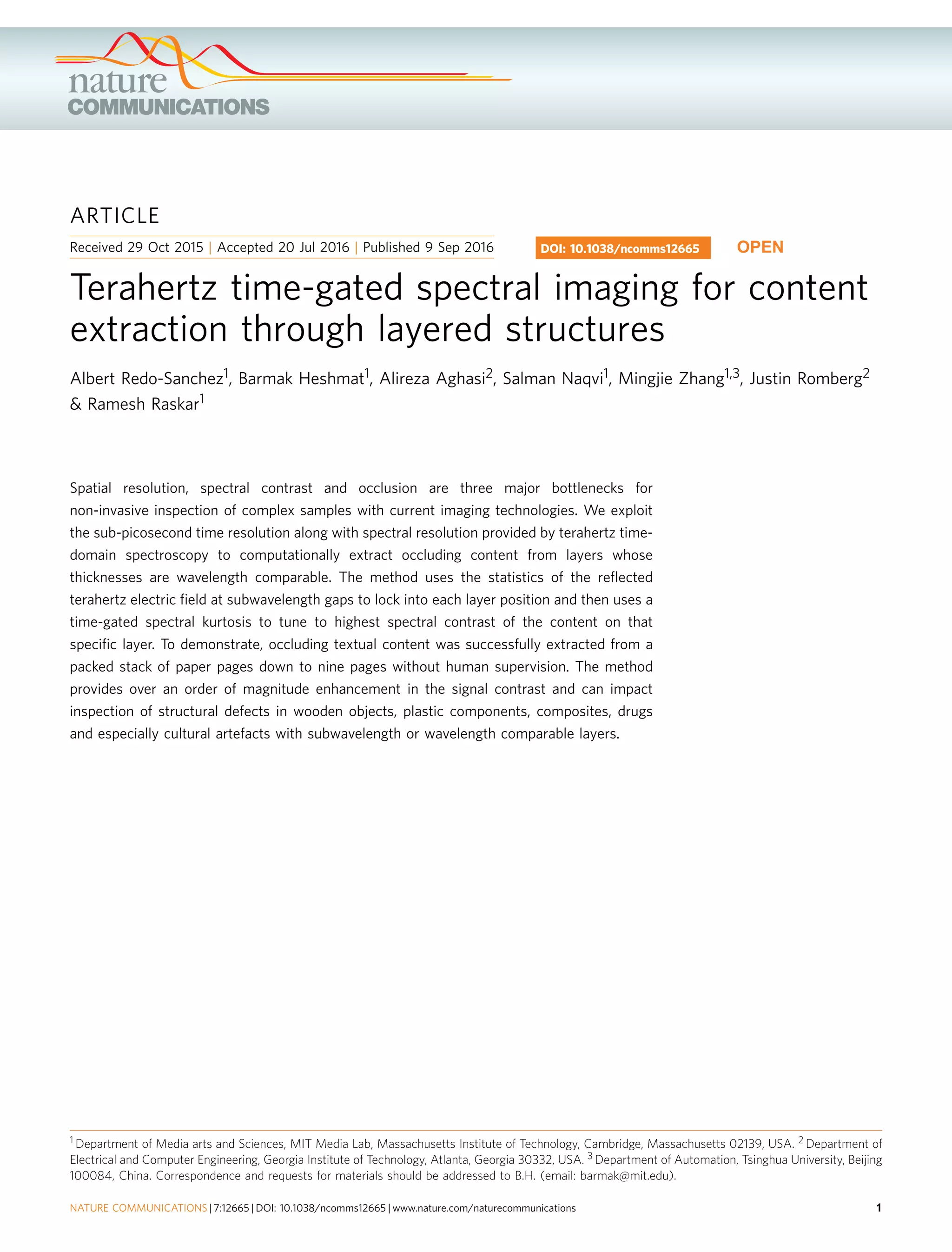
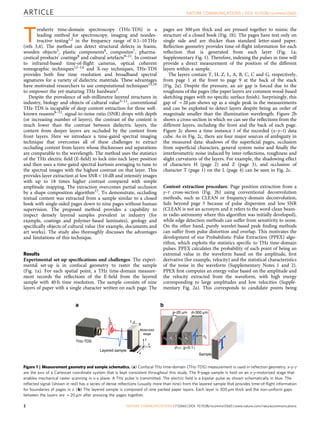
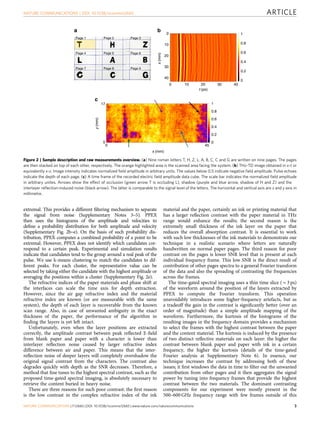
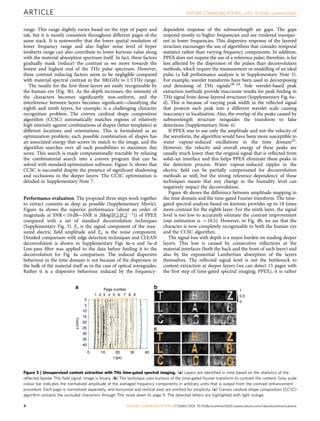
ARTICLE
Received 29 Oct 2015 | Accepted 20 Jul 2016 | Published 9 Sep 2016
Terahertz time-gated spectral imaging for content
extraction through layered structures
Albert Redo-Sanchez1, Barmak Heshmat1, Alireza Aghasi2, Salman Naqvi1, Mingjie Zhang1,3, Justin Romberg2
& Ramesh Raskar1
Spatial resolution, spectral contrast and occlusion are three major bottlenecks for
non-invasive inspection of complex samples with current imaging technologies. We exploit
the sub-picosecond time resolution along with spectral resolution provided by terahertz time-
domain spectroscopy to computationally extract occluding content from layers whose
thicknesses are wavelength comparable. The method uses the statistics of the reflected
terahertz electric field at subwavelength gaps to lock into each layer position and then uses a
time-gated spectral kurtosis to tune to highest spectral contrast of the content on that
specific layer. To demonstrate, occluding textual content was successfully extracted from a
packed stack of paper pages down to nine pages without human supervision. The method
provides over an order of magnitude enhancement in the signal contrast and can impact
inspection of structural defects in wooden objects, plastic components, composites, drugs
and especially cultural artefacts with subwavelength or wavelength comparable layers.
DOI: 10.1038/ncomms12665 OPEN
1 Department of Media arts and Sciences, MIT Media Lab, Massachusetts Institute of Technology, Cambridge, Massachusetts 02139, USA. 2 Department of
Electrical and Computer Engineering, Georgia Institute of Technology, Atlanta, Georgia 30332, USA. 3 Department of Automation, Tsinghua University, Beijing
100084, China. Correspondence and requests for materials should be addressed to B.H. (email: barmak@mit.edu).
NATURE COMMUNICATIONS | 7:12665 | DOI: 10.1038/ncomms12665 | www.nature.com/naturecommunications 1
T
erahertz time-domain spectroscopy (THz-TDS) is a
leading method for spectroscopy, imaging and nondes-
tructive testing1,2 in the frequency range of 0.1–10 THz
(refs 3,4). The method can detect structural defects in foams,
wooden objects5, plastic components6, composites7, pharma-
ceutical products’ coatings8 and cultural artefacts9–11. In contrast
to infrared-based time-of-flight cameras, optical coherent
tomographic techniques12–14 and X-ray techniques, THz-TDS
provides both fine time resolution and broadband spectral
signatures for a variety of dielectric materials. These advantages
have motivated researchers to use computational techniques15,16
to empower the yet-maturing THz hardware3.
Despite the prevalence of sub-millimetre layered structures in
industry, biology and objects of cultural value5–11, conventional
THz-TDS is incapable of deep content extraction for three well-
known reasons8–11: signal-to-noise ratio (SNR) drops with depth
(or increasing number of layers), the contrast of the content is
much lower than the contrast between dielectric layers, the
content from deeper layers are occluded by the content from
front layers. Here we introduce a time-gated spectral imaging
technique that overcomes all of these challenges to extract
occluding content from layers whose thicknesses and separations
are comparable to the wavelength. The method uses the statistics
of the THz electric field (E-field) to lock into each layer position
and then uses a time-gated spectral kurtosis averaging to tune to
the spectral images with the highest contrast on that layer. This
provides layer extraction at low SNRo10 dB and intensity images
with up to 18 times higher contrast compared with simple
amplitude mapping. The extraction overcomes partial occlusion
by a shape composition algorithm17. To demonstrate, occluding
textual content was extracted from a sample similar to a closed
book with single-sided pages down to nine pages without human
supervision. The proposed method provides a capability to
inspect densely layered samples prevalent in industry (for
example, coatings and polymer-based laminates), geology and
specifically objects of cultural value (for example, documents and
art works). The study also thoroughly discusses the advantages
and limitations of this technique.
Results
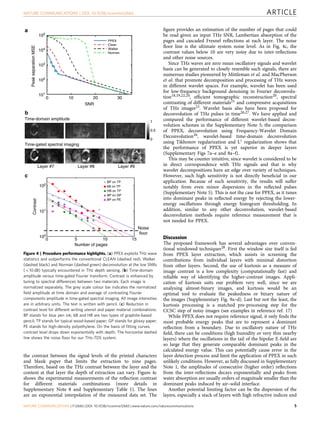
Experimental set-up specifications and challenges. The experi-
mental set-up is in confocal geometry to raster the sample
(Fig. 1a). For each spatial point, a THz time-domain measure-
ment records the reflections of the E-field from the layered
sample with 40 fs time resolution. The sample consists of nine
layers of paper with a single character written on each page. The
pages are 300 mm thick and are pressed together to mimic the
structure of a closed book (Fig. 1b). The pages have text only on
single side and are thicker than standard letter-sized paper.
Reflection geometry provides time-of-flight information for each
reflection that is generated from each layer (Fig. 1a;
Supplementary Fig. 1). Therefore, indexing the pulses in time will
provide a direct measurement of the position of the different
layers within a sample.
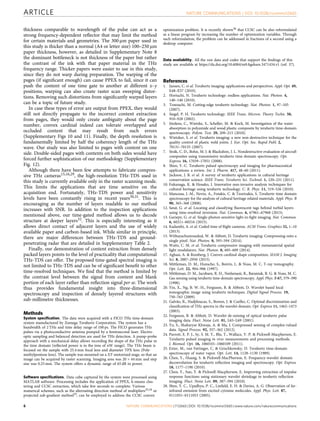
The layers contain T, H, Z, L, A, B, C, C and G, respectively,
from page 1 at the front to page 9 at the back of the stack
(Fig. 2a). Despite the pressure, an air gap is forced due to the
roughness of the pages (the paper layers are common wood-based
sketching pages with no specific surface finish). Surprisingly, this
gap of B20 mm shows up as a single peak in the measurements
and can be exploited to detect layers despite being an order of
magnitude smaller than the illumination wavelength. Figure 2b
shows a cross-section in which we can see the reflections from the
different layers, including the front and the back of each page.
Figure 2c shows a time instance t of the recorded (x–y–t) data
cube. As in Fig. 2c, there are four major sources of ambiguity in
the measured data: shadows of the superficial pages, occlusion
from superficial characters, general system noise and finally the
interferometric noise induced by inter-reflections, roughness and
slight curvatures of the layers. For example, the shadowing effect
of characters H (page 2) and Z (page 3), and occlusion of
character T (page 1) on the L (page 4) can be seen in Fig. 2c.
Content extraction procedure. Page position extraction from a
y–t cross-section (Fig. 2b) using conventional deconvolution
methods, such as CLEAN or frequency-domain deconvolution,
fails beyond page 5 because of pulse dispersion and low SNR
(CLEAN is not an acronym and it refers to the word-clean beam-
in radio astronomy where this algorithm was initially developed),
while edge detection methods can suffer from sensitivity to noise.
On the other hand, purely wavelet-based peak finding methods
can suffer from pulse distortion and overlap. This motivates the
development of our Probabilistic Pulse Extraction (PPEX) algo-
rithm, which exploits the statistics specific to THz time-domain
pulses. PPEX calculates the probability of each point of being an
extremal value in the waveform based on the amplitude, first
derivative (for example, velocity) and the statistical characteristics
of the noise in the waveform (Supplementary Notes 1 and 2).
PPEX first computes an energy value based on the amplitude and
the velocity extracted from the waveform, with high energy
corresponding to large amplitudes and low velocities (Supple-
mentary Fig. 2a). This corresponds to candidate points being
Sample
n2n1n0n1n0
1,
92,..2,..
1,
Layered sample
Motorized
stage
z
y
x
THz-TDS
d< , g<0.1
g~20 µm d~300 µm
ba
Figure 1 | Measurement geometry and sample schematics. (a) Confocal THz time-domain (THz-TDS) measurement is used in reflection geometry. x–y–z
are the axis of a Cartesian coordinate system that is kept consistent throughout this study. The 9-page sample is held on an x–y-motorized stage that
enables mechanical raster scanning in x–y plane. A THz pulse is transmitted. The electric field is a bipolar pulse as shown schematically in blue. The
reflected signal (shown in red) has a series of dense reflections (usually more than nine) from the layered sample that provides time-of-flight information
for boundaries of pages in z. (b) The layered sample is composed of nine packed paper layers. Each layer is 300 mm thick and the non-uniform gaps
between the layers are B20 mm after pressing the pages together.
ARTICLE NATURE COMMUNICATIONS | DOI: 10.1038/ncomms12665
2 NATURE COMMUNICATIONS | 7:12665 | DOI: 10.1038/ncomms12665 | www.nature.com/naturecommunications
extremal. This provides a different filtering mechanism to separate
the signal from noise (Supplementary Notes 3–5). PPEX
then uses the histograms of the amplitude and velocities to
define a probability distribution for both amplitude and velocity
(Supplementary Fig. 2b–e). On the basis of such probability dis-
tribution, PPEX computes a combined probability of a point to be
extremal. However, PPEX does not identify which candidates cor-
respond to a certain peak. Experimental and simulation results
indicate that candidates tend to the group around a real peak of the
pulse. We use k-means clustering to match the candidates to dif-
ferent peaks. For each cluster, the representative value can be
selected by taking either the candidate with the highest amplitude or
averaging the positions within a cluster (Supplementary Fig. 2e).
The refractive indices of the paper materials and phase shift at
the interfaces can scale the time axis for depth extraction.
However, since the air gap refractive index and the material
refractive index are known (or are measurable with the same
system), the depth of each layer is recoverable from the known
scan range. Also, in case of unwanted ambiguity in the exact
thickness of the paper, the performance of the algorithm in
finding the layers is yet left intact.
Unfortunately, even when the layer positions are extracted
correctly, the amplitude contrast between peak reflected E-field
from blank paper and paper with a character is lower than
interlayer reflection noise caused by larger refractive index
difference between air and paper. This means that the inter-
reflection noise of deeper layers will completely overshadow the
original signal contrast from the characters. The contrast also
degrades quickly with depth as the SNR decreases. Therefore, a
method that fine tunes to the highest spectral contrast, such as the
proposed time-gated spectral imaging, is absolutely necessary to
retrieve the content buried in heavy noise.
There are three reasons for such poor contrast: the first reason
is the low contrast in the complex refractive index of the ink
material and the paper, certainly an ink or printing material that
has a larger reflection contrast with the paper material in THz
range would enhance the results; the second reason is the
extremely small thickness of the ink layer on the paper that
reduces the overall absorption contrast. It is essential to work
with such low thicknesses of the ink materials to demonstrate our
technique in a realistic scenario where letters are naturally
handwritten on normal paper pages. The third reason for poor
contrast on the pages is lower SNR level that is present at each
individual frequency frame. This low SNR is the direct result of
contribution of other pages spectra to a general Fourier transform
of the data and also the spreading of contrasting the frequencies
across the frames.
The time-gated spectral imaging uses a thin time slice (B3 ps)
of the waveform around the position of the layers extracted by
PPEX to compute the Fourier transform. This operation
unavoidably introduces some higher-frequency artefacts, but as
a tradeoff the gain in the contrast is significantly better (over an
order of magnitude) than a simple amplitude mapping of the
waveform. Furthermore, the kurtosis of the histograms of the
resulting images in the frequency domain provides a mechanism
to select the frames with the highest contrast between the paper
and the content material. The kurtosis is induced by the presence
of two distinct reflective materials on each layer: the higher the
contrast between blank paper and paper with ink in a certain
frequency, the higher the kurtosis (details of the time-gated
Fourier analysis at Supplementary Note 6). In essence, our
technique increases the contrast by addressing both of these
issues; it first windows the data in time to filter out the unwanted
contribution from other pages and it then aggregates the signal
power by tuning into frequency frames that provide the highest
contrast between the two materials. The dominant contrasting
components for our experiment were mostly present in the
500–600 GHz frequency range with few frames outside of this
a b
c
0 45
17
0
0
Page 1 Page 2 Page 3
Page 4 Page 5 Page 6
Page 7 Page 8 Page 9
0
10
10
1
0.8
0.6
0.4
0.2
0
1
0.8
0.6
0.4
0.2
0
20
20
30
30
40
40
x(mm)
t (ps)
x (mm)
y(mm)
Figure 2 | Sample description and raw measurements overview. (a) Nine roman letters T, H, Z, L, A, B, C, C and G are written on nine pages. The pages
are then stacked on top of each other, respectively. The orange highlighted area is the scanned area facing the system. (b) THz-TD image obtained in x–t or
equivalently x–z. Image intensity indicates normalized field amplitude in arbitrary units. The values below 0.5 indicate negative field amplitude. Pulse echoes
indicate the depth of each page. (c) A time frame of the recorded electric field amplitude data cube. The scale bar indicates the normalized field amplitude
in arbitrary unites. Arrows show the effect of occlusion (green arrow T is occluding L), shadow (purple and blue arrow, shadow of H and Z) and the
interlayer reflection-induced noise (black arrow). The latter is comparable to the signal level of the letters. The horizontal and vertical axis are x and y axis in
millimetre.
NATURE COMMUNICATIONS | DOI: 10.1038/ncomms12665 ARTICLE
NATURE COMMUNICATIONS | 7:12665 | DOI: 10.1038/ncomms12665 | www.nature.com/naturecommunications 3
range. This range slightly varies based on the type of paper and
ink, but it is mostly consistent throughout different pages of the
same stack. It is noteworthy that the lower spatial resolution of
lower frequency range and also higher noise level of hyper
terahertz range can also contribute to lower kurtosis value along
with the material absorption spectrum itself. In fact, these factors
gradually mask (reduce) the contrast as we move towards the
lowest and highest end of the THz pulse spectrum. However,
these contrast reducing factors seem to be negligible compared
with material spectral contrast in the 300 GHz to 1.5 THz range.
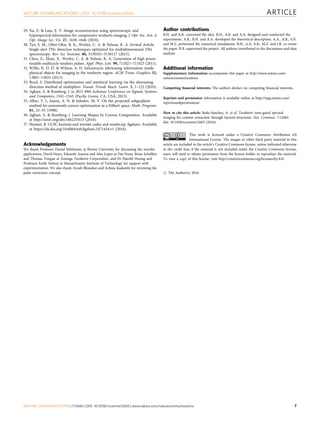
The results for the first three layers are easily recognizable by
the human eye (Fig. 3b). As the depth increases, the intensity of
the characters becomes significantly non-uniform, and the
interference between layers becomes significant—classifying the
eighth and ninth layers, for example, is a challenging character
recognition problem. The convex cardinal shape composition
algorithm (CCSC) automatically matches regions of relatively
high intensity against combinations of shapes (letter templates) at
different locations and orientations. This is formulated as an
optimization problem; each possible combination of shapes has
an associated energy that scores its match to the image, and the
algorithm searches over all such possibilities to maximize this
score. This search is made computationally tractable by relaxing
the combinatorial search into a convex program that can be
solved with standard optimization software. Figure 3c shows that
CCSC is successful despite the presence of significant shadowing
and occlusions in the deeper layers. The CCSC optimization is
detailed in Supplementary Note 7.
Performance evaluation. The proposed three steps work together
to extract contents as deep as possible (Supplementary Movie).
Figure 4a shows the superior performance (about an order of
magnitude at SNRo10 dB—SNR is 20log(|Es|.|En|À 1)) of PPEX
compared with a set of standard deconvolution techniques
(Supplementary Fig. 3). Es is the signal component of the mea-
sured electric field amplitude and En is the noise component.
Detailed comparison with edge detection techniques and CLEAN
deconvolution is shown in Supplementary Figs 4a–e and 5a–d
Low-pass filter was applied to the data before feeding it to the
deconvolution for Fig. 4a comparison. The induced dispersive
behaviour in the time domain is not because of the dispersion in
the bulk of the material itself as in the case of optical waveguides.
Rather it is a dispersive behaviour induced by the frequency-
dependent response of the subwavelength air gaps. The gaps
respond mostly to higher frequencies and are rendered transpar-
ent in lower frequencies. This dispersive response of the layered
structure encourages the use of algorithms that consider temporal
statistics rather than varying frequency components. In addition,
PPEX does not require the use of a reference pulse; therefore, is far
less affected by the dispersion of the pulses than deconvolution
methods, which require the measurement or modelling of an ideal
pulse (a full performance analysis is in Supplementary Note 3).
For example, wavelet transforms have been used in decomposing
and denoising of THz signals18–24. Sole wavelet-based peak
extraction methods provide inaccurate results for peak finding in
THz signal from dense-layered structures (Supplementary Fig. 6a–
d). This is because of varying peak width in the reflected signal
that projects each peak into a different wavelet scale causing
inaccuracy in localization. Also, the overlap of the peaks caused by
subwavelength structure misguides the transform to false
detections (Supplementary Note 4).
If PPEX was to use only the amplitude and not the velocity of
the waveform, the algorithm would have been more susceptible to
water vapour-induced oscillations in the time domain25.
However, the velocity and overall energy of these peaks are
usually much lower than the original signal that is reflected from
solid–air interface and this helps PPEX eliminate these peaks in
the detection process. Water vapour-induced ripples in the
electric field can be partially compensated for deconvolution
methods as well, but the strong reference dependency of these
techniques means that any change in the humidity level can
negatively impact the deconvolution.
Figure 4b shows the difference between amplitude mapping in
the time domain and the time-gated Fourier transform. The time-
gated spectral analysis based on kurtosis provides up to 18 times
more contrast for the eighth layer. For the ninth layer, the signal
level is too low to accurately estimate the contrast improvement
(our estimation is B10.5). However, in Fig. 4b, we see that the
character is now completely recognizable to both the human eye
and the CCSC algorithm.
The signal loss with depth is a major burden on reading deeper
layers. This loss is caused by consecutive reflections at the
material interfaces (both the back and the front of each layer) and
also by the exponential Lambertian absorption of the layers
themselves. The reflected signal level is not the bottleneck to
content extraction at deeper layers (we can detect 15 pages with
the first step of time-gated spectral imaging; PPEX), it is rather
Page number
0
1
0.51
0
5
10
15
20
20100
25
30
30
35
40
40
2 3 4 5 6 7 8 9
x(mm)
t (ps)
a b
c
Figure 3 | Unsupervised content extraction with THz time-gated spectral imaging. (a) Layers are identified in time based on the statistics of the
reflected bipolar THz field signal. Image is binary. (b) The technique uses kurtosis of the time-gated Fourier transform to contrast the content. Grey scale
colour bar indicates the normalized amplitude of the averaged frequency components in arbitrary units that is output from the contrast enhancement
procedure. Each page is normalized separately, and horizontal and vertical axes are omitted for simplicity. (c) Convex cardinal shape composition (CCSC)
algorithm extracts the occluded characters through THz noise down to page 9. The detected letters are highlighted with light orange.
ARTICLE NATURE COMMUNICATIONS | DOI: 10.1038/ncomms12665
4 NATURE COMMUNICATIONS | 7:12665 | DOI: 10.1038/ncomms12665 | www.nature.com/naturecommunications
the contrast between the signal levels of the printed characters
and blank paper that limits the extraction to nine pages.
Therefore, based on the THz contrast between the layer and the
content at that layer the depth of extraction can vary. Figure 4c
shows the experimental measurements of the reflection contrast
for different materials combinations (more details in
Supplementary Note 8 and Supplementary Table 1). The lines
are an exponential interpolation of the measured data set. The
figure provides an estimation of the number of pages that could
be read given an input THz SNR, Lambertian absorption of the
pages and cascaded Fresnel reflections at each layer. The noise
floor line is the ultimate system noise level. As in Fig. 4c, the
contrast values below 10 are very noisy due to inter-reflections
and other noise sources.
Since THz waves are zero mean oscillatory signals and wavelet
basis can be generated to closely resemble such signals, there are
numerous studies pioneered by Mittleman et al. and MacPherson
et al. that promote decomposition and processing of THz waves
in different wavelet spaces. For example, wavelet has been used
for low-frequency background denoising in Fourier deconvolu-
tion18,19,22,24, efficient tomographic reconstruction20, spectral
contrasting of different materials21 and compressive acquisitions
of THz images23. Wavelet basis also have been proposed for
deconvolution of THz pulses in time26,27. We have applied and
compared the performance of different wavelet-based decon-
volution schemes in the Supplementary Note 5; the comparison
of PPEX, deconvolution using Frequency-Wavelet Domain
Deconvolution26, wavelet-based time-domain deconvolution
using Tikhonov regularization and L1
regularization shows that
the performance of PPEX is yet superior in deeper layers
(Supplementary Figs 7a–e and 8a–f).
This may be counter intuitive, since wavelet is considered to be
in direct correspondence with THz signals and that is why
wavelet decompositions have an edge over variety of techniques.
However, such high sensitivity is not directly beneficial in our
application. Because of such sensitivity, the results will suffer
notably from even minor dispersions in the reflected pulses
(Supplementary Note 5). This is not the case for PPEX, as it tunes
into dominant peaks in reflected energy by rejecting the lower-
energy oscillations through energy histogram thresholding. In
addition, similar to any other deconvolution, wavelet-based
deconvolution methods require reference measurement that is
not needed for PPEX.
Discussion
The proposed framework has several advantages over conven-
tional windowed techniques28. First the window size itself is fed
from PPEX layer extraction, which assists in screening the
contributions from individual layers with minimal distortion
from other layers. Second, the use of kurtosis as a measure of
image contrast is a low complexity (computationally fast) and
reliable way of identifying the higher-contrast images. Appli-
cation of kurtosis suits our problem very well, since we are
analysing almost-binary images, and kurtosis would be an
optimal tool to evaluate the peakedness or binary nature of
the images (Supplementary Fig. 9a–d). Last but not the least, the
kurtosis processing is a matched pre-processing step for the
CCSC step of noisy images (see examples in reference ref. 17)
While PPEX does not require reference signal, it only finds the
most probable energy peaks that are to represent a dominant
reflection from a boundary. Due to oscillatory nature of THz
field, there can be conditions (high humidity or very thin nearby
layers) where the oscillations in the tail of the bipolar E-field are
so large that they generate comparable dominant peaks in the
calculated energy value. This can potentially cause error in the
layer detection process and limit the application of PPEX in such
unlikely conditions. However, as fully discussed in Supplementary
Note 1, the amplitudes of consecutive (higher order) reflections
from the inter-reflections decays exponentially and peaks from
water absorption are usually orders of magnitude smaller than the
dominant peaks induced by air–solid interface.
Another potential limiting factor can be the dispersion of the
layers, especially a stack of layers with high refractive indices and
0
1
0.5
Layer #7 Layer #8 Layer #9
105
104
103
102
101
PeakseparationMSEContrast
SNR
0 10 20 30
PPEX
Clean
Walker
Norman
Number of pages
0
102
101
100
5 10 15
Noise
floor
BP on TP
6B on TP
HB on TP
BP on GP
BP on PE
Time-domain amplitude
Time-gated spectral imaging
a
b
c
Figure 4 | Procedure performance highlights. (a) PPEX exploits THz wave
statistics and outperforms the conventional CLEAN (dashed red), Walker
(dashed black) and Norman (dashed green) deconvolution at the low SNRs
(o10 dB) typically encountered in THz depth sensing. (b) Time-domain
amplitude versus time-gated Fourier transform. Contrast is enhanced by
tuning to spectral differences between two materials. Each image is
normalized separately. The grey scale colour bar indicates the normalized
field amplitude at time domain and average of contrasting Fourier
components amplitude in time-gated spectral imaging. All image intensities
are in arbitrary units. The text is written with pencil. (c) Reduction in
contrast level for different writing utensil and paper material combinations.
BP stands for blue pen ink; 6B and HB are two types of graphite-based
pencil; TP stands for typical wood-based paper; GP stands for glossy paper;
PE stands for high-density polyethylene. On the basis of fitting curves,
contrast level drops down exponentially with depth. The horizontal dashed
line shows the noise floor for our THz-TDS system.
NATURE COMMUNICATIONS | DOI: 10.1038/ncomms12665 ARTICLE
NATURE COMMUNICATIONS | 7:12665 | DOI: 10.1038/ncomms12665 | www.nature.com/naturecommunications 5
thickness comparable to wavelength of the pulse can act as a
strong frequency-dependent reflector that may limit the method
for certain materials and geometries. The 300 mm paper used in
this study is thicker than a normal (A4 or letter size) 100–250 mm
paper thickness, however, as detailed in Supplementary Note 8
the dominant bottleneck is not thickness of the paper but rather
the contrast of the ink with that paper material in the THz
frequency range. Thicker papers were easier to use in this study,
since they do not warp during preparation. The warping of the
pages (if significant enough) can cause PPEX to fail, since it can
push the content of one time gate to another at different x–y
positions, warping can also create raster scan sweeping distor-
tions. Removing such distortions from significantly warped layers
can be a topic of future study.
In case these types of error are output from PPEX, they would
still not directly propagate to the incorrect content extraction
from pages, they would only create ambiguity about the page
number, convex cardinal indeed can tolerate overlapped and
occluded content that may result from such errors
(Supplementary Figs 10 and 11). Finally, the depth resolution is
fundamentally limited by half the coherency length of the THz
wave. Our study was also limited to pages with content on one
side. Double-sided pages with contents on both sides would have
forced further sophistication of our methodology (Supplementary
Fig. 12).
Although there have been few attempts to fabricate compres-
sive THz cameras15,16,29, the high-resolution THz-TDS used in
this study is currently available only in the raster scanning mode.
This limits the applications that are time sensitive on the
acquisition end. Fortunately, THz-TDS power and sensitivity
levels have been constantly rising in recent years30,31. This is
encouraging as the number of layers readable to our method
increases with SNR. In addition to the inspection applications
mentioned above, our time-gated method allows us to decode
structure at deeper layers32. This is especially interesting as it
allows direct contact of adjacent layers and the use of widely
available paper and carbon-based ink. While similar in principle,
there are major differences between THz-TDS and ground-
penetrating radar that are detailed in Supplementary Table 2.
Finally, our demonstration of content extraction from densely
packed layers points to the level of practicality that computational
THz-TDS can offer. The proposed time-gated spectral imaging is
not limited to THz-TDS and can be of significant benefit to other
time-resolved techniques. We find that the method is limited by
the contrast level between the signal from content and blank
portion of each layer rather than reflection signal per se. The work
thus provides fundamental insight into three-dimensional
spectroscopy and inspection of densely layered structures with
sub-millimetre thicknesses.
Methods
System specification. The data were acquired with a FICO THz time-domain
system manufactured by Zomega Terahertz Corporation. The system has a
bandwidth of 2 THz and time delay range of 100 ps. The FICO generates THz
pulses via a photoconductive antenna pumped by a femtosecond laser. Electro-
optic sampling and balanced detection are used for THz detection. A pump-probe
approach with a mechanical delay allows recording the shape of the THz pulse in
the time domain (reflected power is in the tens of nW range). The THz beam is
focused on the sample with 25.4 mm focal lens and diameter TPX lens (Poly-
methylpentene lens). The sample was mounted on a XY-motorized stage, so that an
image can be acquired by raster scanning. Imaging area was 20 Â 44 mm and step
size was 0.25 mm. The system offers a dynamic range of 65 dB in power.
Software specifications. Data cube captured by the system were processed using
MATLAB software. Processing includes the application of PPEX, k-means clus-
tering and CCSC extraction, which take few seconds to complete. Various
numerical schemes, such as the alternating direction method of multipliers33,34 or
projected sub-gradient method35, can be employed to address the CCSC convex
optimization problem. It is recently shown36 that CCSC can be also reformulated
as a linear program by increasing the number of optimization variables. Through
such reformulation, the problem can be addressed in fractions of a second using a
desktop computer.
Data availability. All the raw data and codes that support the findings of this
study are available at https://dx.doi.org/10.6084/m9.figshare.3471434.v1 (ref. 37).
References
1. Jansen, C. et al. Terahertz imaging: applications and perspectives. Appl. Opt. 49,
E48–E57 (2010).
2. Horiuchi, N. Terahertz technology: endless applications. Nat. Photon. 4,
140–140 (2010).
3. Tonouchi, M. Cutting-edge terahertz technology. Nat. Photon. 1, 97–105
(2007).
4. Siegel, P. H. Terahertz technology. IEEE Trans. Microw. Theory Techn. 50,
910–928 (2002).
5. Jo¨rdens, C., Wietzke, S., Scheller, M. & Koch, M. Investigation of the water
absorption in polyamide and wood plastic composite by terahertz time-domain
spectroscopy. Polym. Test. 29, 209–215 (2010).
6. Wietzker, S. et al. Terahertz imaging: a new non-destructive technique for the
quality control of plastic weld joints. J. Eur. Opt. Soc. Rapid Publ. 2,
70131–70135 (2007).
7. Stoik, C. D., Bohn, M. J. & Blackshire, J. L. Nondestructive evaluation of aircraft
composites using transmissive terahertz time domain spectroscopy. Opt.
Express 16, 17039–17051 (2008).
8. Shen, Y.-C. Terahertz pulsed spectroscopy and imaging for pharmaceutical
applications: a review. Int. J. Pharm. 417, 48–60 (2011).
9. Jackson, J. B. et al. A survey of terahertz applications in cultural heritage
conservation science. IEEE Trans. Terahertz Sci. Technol. 1, 220–231 (2011).
10. Fukunaga, K. & Hosako, I. Innovative non-invasive analysis techniques for
cultural heritage using terahertz technology. C. R. Phys. 11, 519–526 (2010).
11. Manceau, J.-M., Nevin, A., Fotakis, C. & Tzortzakis, S. Terahertz time domain
spectroscopy for the analysis of cultural heritage related materials. Appl. Phys. B
90, 365–368 (2008).
12. Satat, G. et al. Locating and classifying fluorescent tags behind turbid layers
using time-resolved inversion. Nat. Commun. 6, 67961–67968 (2015).
13. Gariepy, G. et al. Single-photon sensitive light-in-fight imaging. Nat. Commun.
6, 60211–60216 (2015).
14. Kadambi, A. et al. Coded time of flight cameras. ACM Trans. Graphics 32, 1–10
(2013).
15. Withayachumnankul, W. & Abbott, D. Terahertz imaging: Compressing onto a
single pixel. Nat. Photon. 8, 593–594 (2014).
16. Watts, C. M. et al. Terahertz compressive imaging with metamaterial spatial
light modulators. Nat. Photon. 8, 605–609 (2014).
17. Aghasi, A. & Romberg, J. Convex cardinal shape composition. SIAM J. Imaging
Sci. 8, 2887–2950 (2015).
18. Mittleman, D. M., Hunsche, S., Boivin, L. & Nuss, M. C. T-ray tomography.
Opt. Lett. 22, 904–906 (1997).
19. Mittleman, D. M., Jacobsen, R. H., Neelamani, R., Baraniuk, R. G. & Nuss, M. C.
Gas sensing using terahertz time-domain spectroscopy. Appl. Phys. B 67, 379–390
(1998).
20. Yin, X., Ng, B. W.-H., Ferguson, B. & Abbott, D. Wavelet based local
tomographic image using terahertz techniques. Digital Signal Process. 19,
750–763 (2009).
21. Galva˜o, R., Hadjiloucas, S., Bowen, J. & Coelho, C. Optimal discrimination and
classification of THz spectra in the wavelet domain. Opt. Express 11, 1462–1473
(2003).
22. Ferguson, B. & Abbott, D. Wavelet de-noising of optical terahertz pulse
imaging data. Fluct. Noise Lett. 01, L65–L69 (2001).
23. Yu, S., Shaharyar Khwaja, A. & Ma, J. Compressed sensing of complex-valued
data. Signal Process. 92, 357–362 (2012).
24. Parrott, E. P. J., Sy, S. M. Y., Blu, T., Wallace, V. P. & Pickwell-Macpherson, E.
Terahertz pulsed imaging in vivo: measurements and processing methods.
J. Biomed. Opt. 16, 1060101–1060109 (2011).
25. Exter, M., van Fattinger, C. & Grischkowsky, D. Terahertz time-domain
spectroscopy of water vapor. Opt. Lett. 14, 1128–1130 (1989).
26. Chen, Y., Huang, S. & Pickwell-MacPherson, E. Frequency-wavelet domain
deconvolution for terahertz reflection imaging and spectroscopy. Opt. Express
18, 1177–1190 (2010).
27. Chen, Y., Sun, Y. & Pickwell-Macpherson, E. Improving extraction of impulse
response functions using stationary wavelet shrinkage in terahertz reflection
imaging. Fluct. Noise Lett. 09, 387–394 (2010).
28. Shen, Y. C., Upadhya, P. C., Linfield, E. H. & Davies, A. G. Observation of far-
infrared emission from excited cytosine molecules. Appl. Phys. Lett. 87,
0111051–0111053 (2005).
ARTICLE NATURE COMMUNICATIONS | DOI: 10.1038/ncomms12665
6 NATURE COMMUNICATIONS | 7:12665 | DOI: 10.1038/ncomms12665 | www.nature.com/naturecommunications
29. Xu, Z. & Lam, E. Y. Image reconstruction using spectroscopic and
hyperspectral information for compressive terahertz imaging. J. Opt. Soc. Am. A
Opt. Image Sci. Vis. 27, 1638–1646 (2010).
30. Teo, S. M., Ofori-Okai, B. K., Werley, C. A. & Nelson, K. A. Invited Article:
Single-shot THz detection techniques optimized for multidimensional THz
spectroscopy. Rev. Sci. Instrum. 86, 5130101–5130117 (2015).
31. Chen, Z., Zhou, X., Werley, C. A. & Nelson, K. A. Generation of high power
tunable multicycle teraherz pulses. Appl. Phys. Lett. 99, 711021–711023 (2011).
32. Willis, K. D. D. & Wilson, A. D. Infrastructs: fabricating information inside
physical objects for imaging in the terahertz region. ACM Trans. Graphics 32,
13801–13810 (2013).
33. Boyd, S. Distributed optimization and statistical learning via the alternating
direction method of multipliers. Found. Trends Mach. Learn. 3, 1–122 (2010).
34. Aghasi, A. & Romberg, J. in 2015 49th Asilomar Conference on Signals, Systems
and Computers, 1541–1545 (Pacific Grove, CA, USA, 2015).
35. Alber, Y. I., Iusem, A. N. & Solodov, M. V. On the projected subgradient
method for nonsmooth convex optimization in a Hilbert space. Math. Program.
81, 23–35 (1998).
36. Aghasi, A. & Romberg, J. Learning Shapes by Convex Composition. Available
at http://arxiv.org/abs/1602.07613 (2016).
37. Hesmet, B. CCSC kurtosis and wavelet codes and results.zip. figshare. Available
at https://dx.doi.org/10.6084/m9.figshare.3471434.v1 (2016).
Acknowledgements
We thank Professor Daniel Mittleman at Brown University for discussing the wavelet
applications, David Etayo, Eduardo Azanza and Alex Lopez at Das Nano, Brian Schulkin
and Thomas Tongue at Zomega Terahertz Corporation, and Dr Harold Hwang and
Professor Keith Nelson at Massachusetts Institute of Technology for support with
experimentation. We also thank Ayush Bhandari and Achuta Kadambi for reviewing the
pulse extraction concept.
Author contributions
B.H. and A.R. conceived the idea. B.H., A.R. and A.A. designed and conducted the
experiments. A.R., B.H. and A.A. developed the theoretical description. A.A., A.R., S.N.
and M.Z. performed the numerical simulations. B.H., A.A, A.R., M.Z. and J.R. co-wrote
the paper. R.R. supervised the project. All authors contributed to the discussions and data
analysis.
Additional information
Supplementary Information accompanies this paper at http://www.nature.com/
naturecommunications
Competing financial interests: The authors declare no competing financial interests.
Reprints and permission information is available online at http://npg.nature.com/
reprintsandpermissions/
How to cite this article: Redo-Sanchez, A. et al. Terahertz time-gated spectral
imaging for content extraction through layered structures. Nat. Commun. 7:12665
doi: 10.1038/ncomms12665 (2016).
This work is licensed under a Creative Commons Attribution 4.0
International License. The images or other third party material in this
article are included in the article’s Creative Commons license, unless indicated otherwise
in the credit line; if the material is not included under the Creative Commons license,
users will need to obtain permission from the license holder to reproduce the material.
To view a copy of this license, visit http://creativecommons.org/licenses/by/4.0/
r The Author(s) 2016
NATURE COMMUNICATIONS | DOI: 10.1038/ncomms12665 ARTICLE
NATURE COMMUNICATIONS | 7:12665 | DOI: 10.1038/ncomms12665 | www.nature.com/naturecommunications 7

Терагерцовая камера MIT сканирует закрытые книги

  • 1.
    ARTICLE Received 29 Oct2015 | Accepted 20 Jul 2016 | Published 9 Sep 2016 Terahertz time-gated spectral imaging for content extraction through layered structures Albert Redo-Sanchez1, Barmak Heshmat1, Alireza Aghasi2, Salman Naqvi1, Mingjie Zhang1,3, Justin Romberg2 & Ramesh Raskar1 Spatial resolution, spectral contrast and occlusion are three major bottlenecks for non-invasive inspection of complex samples with current imaging technologies. We exploit the sub-picosecond time resolution along with spectral resolution provided by terahertz time- domain spectroscopy to computationally extract occluding content from layers whose thicknesses are wavelength comparable. The method uses the statistics of the reflected terahertz electric field at subwavelength gaps to lock into each layer position and then uses a time-gated spectral kurtosis to tune to highest spectral contrast of the content on that specific layer. To demonstrate, occluding textual content was successfully extracted from a packed stack of paper pages down to nine pages without human supervision. The method provides over an order of magnitude enhancement in the signal contrast and can impact inspection of structural defects in wooden objects, plastic components, composites, drugs and especially cultural artefacts with subwavelength or wavelength comparable layers. DOI: 10.1038/ncomms12665 OPEN 1 Department of Media arts and Sciences, MIT Media Lab, Massachusetts Institute of Technology, Cambridge, Massachusetts 02139, USA. 2 Department of Electrical and Computer Engineering, Georgia Institute of Technology, Atlanta, Georgia 30332, USA. 3 Department of Automation, Tsinghua University, Beijing 100084, China. Correspondence and requests for materials should be addressed to B.H. (email: barmak@mit.edu). NATURE COMMUNICATIONS | 7:12665 | DOI: 10.1038/ncomms12665 | www.nature.com/naturecommunications 1
  • 2.
    T erahertz time-domain spectroscopy(THz-TDS) is a leading method for spectroscopy, imaging and nondes- tructive testing1,2 in the frequency range of 0.1–10 THz (refs 3,4). The method can detect structural defects in foams, wooden objects5, plastic components6, composites7, pharma- ceutical products’ coatings8 and cultural artefacts9–11. In contrast to infrared-based time-of-flight cameras, optical coherent tomographic techniques12–14 and X-ray techniques, THz-TDS provides both fine time resolution and broadband spectral signatures for a variety of dielectric materials. These advantages have motivated researchers to use computational techniques15,16 to empower the yet-maturing THz hardware3. Despite the prevalence of sub-millimetre layered structures in industry, biology and objects of cultural value5–11, conventional THz-TDS is incapable of deep content extraction for three well- known reasons8–11: signal-to-noise ratio (SNR) drops with depth (or increasing number of layers), the contrast of the content is much lower than the contrast between dielectric layers, the content from deeper layers are occluded by the content from front layers. Here we introduce a time-gated spectral imaging technique that overcomes all of these challenges to extract occluding content from layers whose thicknesses and separations are comparable to the wavelength. The method uses the statistics of the THz electric field (E-field) to lock into each layer position and then uses a time-gated spectral kurtosis averaging to tune to the spectral images with the highest contrast on that layer. This provides layer extraction at low SNRo10 dB and intensity images with up to 18 times higher contrast compared with simple amplitude mapping. The extraction overcomes partial occlusion by a shape composition algorithm17. To demonstrate, occluding textual content was extracted from a sample similar to a closed book with single-sided pages down to nine pages without human supervision. The proposed method provides a capability to inspect densely layered samples prevalent in industry (for example, coatings and polymer-based laminates), geology and specifically objects of cultural value (for example, documents and art works). The study also thoroughly discusses the advantages and limitations of this technique. Results Experimental set-up specifications and challenges. The experi- mental set-up is in confocal geometry to raster the sample (Fig. 1a). For each spatial point, a THz time-domain measure- ment records the reflections of the E-field from the layered sample with 40 fs time resolution. The sample consists of nine layers of paper with a single character written on each page. The pages are 300 mm thick and are pressed together to mimic the structure of a closed book (Fig. 1b). The pages have text only on single side and are thicker than standard letter-sized paper. Reflection geometry provides time-of-flight information for each reflection that is generated from each layer (Fig. 1a; Supplementary Fig. 1). Therefore, indexing the pulses in time will provide a direct measurement of the position of the different layers within a sample. The layers contain T, H, Z, L, A, B, C, C and G, respectively, from page 1 at the front to page 9 at the back of the stack (Fig. 2a). Despite the pressure, an air gap is forced due to the roughness of the pages (the paper layers are common wood-based sketching pages with no specific surface finish). Surprisingly, this gap of B20 mm shows up as a single peak in the measurements and can be exploited to detect layers despite being an order of magnitude smaller than the illumination wavelength. Figure 2b shows a cross-section in which we can see the reflections from the different layers, including the front and the back of each page. Figure 2c shows a time instance t of the recorded (x–y–t) data cube. As in Fig. 2c, there are four major sources of ambiguity in the measured data: shadows of the superficial pages, occlusion from superficial characters, general system noise and finally the interferometric noise induced by inter-reflections, roughness and slight curvatures of the layers. For example, the shadowing effect of characters H (page 2) and Z (page 3), and occlusion of character T (page 1) on the L (page 4) can be seen in Fig. 2c. Content extraction procedure. Page position extraction from a y–t cross-section (Fig. 2b) using conventional deconvolution methods, such as CLEAN or frequency-domain deconvolution, fails beyond page 5 because of pulse dispersion and low SNR (CLEAN is not an acronym and it refers to the word-clean beam- in radio astronomy where this algorithm was initially developed), while edge detection methods can suffer from sensitivity to noise. On the other hand, purely wavelet-based peak finding methods can suffer from pulse distortion and overlap. This motivates the development of our Probabilistic Pulse Extraction (PPEX) algo- rithm, which exploits the statistics specific to THz time-domain pulses. PPEX calculates the probability of each point of being an extremal value in the waveform based on the amplitude, first derivative (for example, velocity) and the statistical characteristics of the noise in the waveform (Supplementary Notes 1 and 2). PPEX first computes an energy value based on the amplitude and the velocity extracted from the waveform, with high energy corresponding to large amplitudes and low velocities (Supple- mentary Fig. 2a). This corresponds to candidate points being Sample n2n1n0n1n0 1, 92,..2,.. 1, Layered sample Motorized stage z y x THz-TDS d< , g<0.1 g~20 µm d~300 µm ba Figure 1 | Measurement geometry and sample schematics. (a) Confocal THz time-domain (THz-TDS) measurement is used in reflection geometry. x–y–z are the axis of a Cartesian coordinate system that is kept consistent throughout this study. The 9-page sample is held on an x–y-motorized stage that enables mechanical raster scanning in x–y plane. A THz pulse is transmitted. The electric field is a bipolar pulse as shown schematically in blue. The reflected signal (shown in red) has a series of dense reflections (usually more than nine) from the layered sample that provides time-of-flight information for boundaries of pages in z. (b) The layered sample is composed of nine packed paper layers. Each layer is 300 mm thick and the non-uniform gaps between the layers are B20 mm after pressing the pages together. ARTICLE NATURE COMMUNICATIONS | DOI: 10.1038/ncomms12665 2 NATURE COMMUNICATIONS | 7:12665 | DOI: 10.1038/ncomms12665 | www.nature.com/naturecommunications
  • 3.
    extremal. This providesa different filtering mechanism to separate the signal from noise (Supplementary Notes 3–5). PPEX then uses the histograms of the amplitude and velocities to define a probability distribution for both amplitude and velocity (Supplementary Fig. 2b–e). On the basis of such probability dis- tribution, PPEX computes a combined probability of a point to be extremal. However, PPEX does not identify which candidates cor- respond to a certain peak. Experimental and simulation results indicate that candidates tend to the group around a real peak of the pulse. We use k-means clustering to match the candidates to dif- ferent peaks. For each cluster, the representative value can be selected by taking either the candidate with the highest amplitude or averaging the positions within a cluster (Supplementary Fig. 2e). The refractive indices of the paper materials and phase shift at the interfaces can scale the time axis for depth extraction. However, since the air gap refractive index and the material refractive index are known (or are measurable with the same system), the depth of each layer is recoverable from the known scan range. Also, in case of unwanted ambiguity in the exact thickness of the paper, the performance of the algorithm in finding the layers is yet left intact. Unfortunately, even when the layer positions are extracted correctly, the amplitude contrast between peak reflected E-field from blank paper and paper with a character is lower than interlayer reflection noise caused by larger refractive index difference between air and paper. This means that the inter- reflection noise of deeper layers will completely overshadow the original signal contrast from the characters. The contrast also degrades quickly with depth as the SNR decreases. Therefore, a method that fine tunes to the highest spectral contrast, such as the proposed time-gated spectral imaging, is absolutely necessary to retrieve the content buried in heavy noise. There are three reasons for such poor contrast: the first reason is the low contrast in the complex refractive index of the ink material and the paper, certainly an ink or printing material that has a larger reflection contrast with the paper material in THz range would enhance the results; the second reason is the extremely small thickness of the ink layer on the paper that reduces the overall absorption contrast. It is essential to work with such low thicknesses of the ink materials to demonstrate our technique in a realistic scenario where letters are naturally handwritten on normal paper pages. The third reason for poor contrast on the pages is lower SNR level that is present at each individual frequency frame. This low SNR is the direct result of contribution of other pages spectra to a general Fourier transform of the data and also the spreading of contrasting the frequencies across the frames. The time-gated spectral imaging uses a thin time slice (B3 ps) of the waveform around the position of the layers extracted by PPEX to compute the Fourier transform. This operation unavoidably introduces some higher-frequency artefacts, but as a tradeoff the gain in the contrast is significantly better (over an order of magnitude) than a simple amplitude mapping of the waveform. Furthermore, the kurtosis of the histograms of the resulting images in the frequency domain provides a mechanism to select the frames with the highest contrast between the paper and the content material. The kurtosis is induced by the presence of two distinct reflective materials on each layer: the higher the contrast between blank paper and paper with ink in a certain frequency, the higher the kurtosis (details of the time-gated Fourier analysis at Supplementary Note 6). In essence, our technique increases the contrast by addressing both of these issues; it first windows the data in time to filter out the unwanted contribution from other pages and it then aggregates the signal power by tuning into frequency frames that provide the highest contrast between the two materials. The dominant contrasting components for our experiment were mostly present in the 500–600 GHz frequency range with few frames outside of this a b c 0 45 17 0 0 Page 1 Page 2 Page 3 Page 4 Page 5 Page 6 Page 7 Page 8 Page 9 0 10 10 1 0.8 0.6 0.4 0.2 0 1 0.8 0.6 0.4 0.2 0 20 20 30 30 40 40 x(mm) t (ps) x (mm) y(mm) Figure 2 | Sample description and raw measurements overview. (a) Nine roman letters T, H, Z, L, A, B, C, C and G are written on nine pages. The pages are then stacked on top of each other, respectively. The orange highlighted area is the scanned area facing the system. (b) THz-TD image obtained in x–t or equivalently x–z. Image intensity indicates normalized field amplitude in arbitrary units. The values below 0.5 indicate negative field amplitude. Pulse echoes indicate the depth of each page. (c) A time frame of the recorded electric field amplitude data cube. The scale bar indicates the normalized field amplitude in arbitrary unites. Arrows show the effect of occlusion (green arrow T is occluding L), shadow (purple and blue arrow, shadow of H and Z) and the interlayer reflection-induced noise (black arrow). The latter is comparable to the signal level of the letters. The horizontal and vertical axis are x and y axis in millimetre. NATURE COMMUNICATIONS | DOI: 10.1038/ncomms12665 ARTICLE NATURE COMMUNICATIONS | 7:12665 | DOI: 10.1038/ncomms12665 | www.nature.com/naturecommunications 3
  • 4.
    range. This rangeslightly varies based on the type of paper and ink, but it is mostly consistent throughout different pages of the same stack. It is noteworthy that the lower spatial resolution of lower frequency range and also higher noise level of hyper terahertz range can also contribute to lower kurtosis value along with the material absorption spectrum itself. In fact, these factors gradually mask (reduce) the contrast as we move towards the lowest and highest end of the THz pulse spectrum. However, these contrast reducing factors seem to be negligible compared with material spectral contrast in the 300 GHz to 1.5 THz range. The results for the first three layers are easily recognizable by the human eye (Fig. 3b). As the depth increases, the intensity of the characters becomes significantly non-uniform, and the interference between layers becomes significant—classifying the eighth and ninth layers, for example, is a challenging character recognition problem. The convex cardinal shape composition algorithm (CCSC) automatically matches regions of relatively high intensity against combinations of shapes (letter templates) at different locations and orientations. This is formulated as an optimization problem; each possible combination of shapes has an associated energy that scores its match to the image, and the algorithm searches over all such possibilities to maximize this score. This search is made computationally tractable by relaxing the combinatorial search into a convex program that can be solved with standard optimization software. Figure 3c shows that CCSC is successful despite the presence of significant shadowing and occlusions in the deeper layers. The CCSC optimization is detailed in Supplementary Note 7. Performance evaluation. The proposed three steps work together to extract contents as deep as possible (Supplementary Movie). Figure 4a shows the superior performance (about an order of magnitude at SNRo10 dB—SNR is 20log(|Es|.|En|À 1)) of PPEX compared with a set of standard deconvolution techniques (Supplementary Fig. 3). Es is the signal component of the mea- sured electric field amplitude and En is the noise component. Detailed comparison with edge detection techniques and CLEAN deconvolution is shown in Supplementary Figs 4a–e and 5a–d Low-pass filter was applied to the data before feeding it to the deconvolution for Fig. 4a comparison. The induced dispersive behaviour in the time domain is not because of the dispersion in the bulk of the material itself as in the case of optical waveguides. Rather it is a dispersive behaviour induced by the frequency- dependent response of the subwavelength air gaps. The gaps respond mostly to higher frequencies and are rendered transpar- ent in lower frequencies. This dispersive response of the layered structure encourages the use of algorithms that consider temporal statistics rather than varying frequency components. In addition, PPEX does not require the use of a reference pulse; therefore, is far less affected by the dispersion of the pulses than deconvolution methods, which require the measurement or modelling of an ideal pulse (a full performance analysis is in Supplementary Note 3). For example, wavelet transforms have been used in decomposing and denoising of THz signals18–24. Sole wavelet-based peak extraction methods provide inaccurate results for peak finding in THz signal from dense-layered structures (Supplementary Fig. 6a– d). This is because of varying peak width in the reflected signal that projects each peak into a different wavelet scale causing inaccuracy in localization. Also, the overlap of the peaks caused by subwavelength structure misguides the transform to false detections (Supplementary Note 4). If PPEX was to use only the amplitude and not the velocity of the waveform, the algorithm would have been more susceptible to water vapour-induced oscillations in the time domain25. However, the velocity and overall energy of these peaks are usually much lower than the original signal that is reflected from solid–air interface and this helps PPEX eliminate these peaks in the detection process. Water vapour-induced ripples in the electric field can be partially compensated for deconvolution methods as well, but the strong reference dependency of these techniques means that any change in the humidity level can negatively impact the deconvolution. Figure 4b shows the difference between amplitude mapping in the time domain and the time-gated Fourier transform. The time- gated spectral analysis based on kurtosis provides up to 18 times more contrast for the eighth layer. For the ninth layer, the signal level is too low to accurately estimate the contrast improvement (our estimation is B10.5). However, in Fig. 4b, we see that the character is now completely recognizable to both the human eye and the CCSC algorithm. The signal loss with depth is a major burden on reading deeper layers. This loss is caused by consecutive reflections at the material interfaces (both the back and the front of each layer) and also by the exponential Lambertian absorption of the layers themselves. The reflected signal level is not the bottleneck to content extraction at deeper layers (we can detect 15 pages with the first step of time-gated spectral imaging; PPEX), it is rather Page number 0 1 0.51 0 5 10 15 20 20100 25 30 30 35 40 40 2 3 4 5 6 7 8 9 x(mm) t (ps) a b c Figure 3 | Unsupervised content extraction with THz time-gated spectral imaging. (a) Layers are identified in time based on the statistics of the reflected bipolar THz field signal. Image is binary. (b) The technique uses kurtosis of the time-gated Fourier transform to contrast the content. Grey scale colour bar indicates the normalized amplitude of the averaged frequency components in arbitrary units that is output from the contrast enhancement procedure. Each page is normalized separately, and horizontal and vertical axes are omitted for simplicity. (c) Convex cardinal shape composition (CCSC) algorithm extracts the occluded characters through THz noise down to page 9. The detected letters are highlighted with light orange. ARTICLE NATURE COMMUNICATIONS | DOI: 10.1038/ncomms12665 4 NATURE COMMUNICATIONS | 7:12665 | DOI: 10.1038/ncomms12665 | www.nature.com/naturecommunications
  • 5.
    the contrast betweenthe signal levels of the printed characters and blank paper that limits the extraction to nine pages. Therefore, based on the THz contrast between the layer and the content at that layer the depth of extraction can vary. Figure 4c shows the experimental measurements of the reflection contrast for different materials combinations (more details in Supplementary Note 8 and Supplementary Table 1). The lines are an exponential interpolation of the measured data set. The figure provides an estimation of the number of pages that could be read given an input THz SNR, Lambertian absorption of the pages and cascaded Fresnel reflections at each layer. The noise floor line is the ultimate system noise level. As in Fig. 4c, the contrast values below 10 are very noisy due to inter-reflections and other noise sources. Since THz waves are zero mean oscillatory signals and wavelet basis can be generated to closely resemble such signals, there are numerous studies pioneered by Mittleman et al. and MacPherson et al. that promote decomposition and processing of THz waves in different wavelet spaces. For example, wavelet has been used for low-frequency background denoising in Fourier deconvolu- tion18,19,22,24, efficient tomographic reconstruction20, spectral contrasting of different materials21 and compressive acquisitions of THz images23. Wavelet basis also have been proposed for deconvolution of THz pulses in time26,27. We have applied and compared the performance of different wavelet-based decon- volution schemes in the Supplementary Note 5; the comparison of PPEX, deconvolution using Frequency-Wavelet Domain Deconvolution26, wavelet-based time-domain deconvolution using Tikhonov regularization and L1 regularization shows that the performance of PPEX is yet superior in deeper layers (Supplementary Figs 7a–e and 8a–f). This may be counter intuitive, since wavelet is considered to be in direct correspondence with THz signals and that is why wavelet decompositions have an edge over variety of techniques. However, such high sensitivity is not directly beneficial in our application. Because of such sensitivity, the results will suffer notably from even minor dispersions in the reflected pulses (Supplementary Note 5). This is not the case for PPEX, as it tunes into dominant peaks in reflected energy by rejecting the lower- energy oscillations through energy histogram thresholding. In addition, similar to any other deconvolution, wavelet-based deconvolution methods require reference measurement that is not needed for PPEX. Discussion The proposed framework has several advantages over conven- tional windowed techniques28. First the window size itself is fed from PPEX layer extraction, which assists in screening the contributions from individual layers with minimal distortion from other layers. Second, the use of kurtosis as a measure of image contrast is a low complexity (computationally fast) and reliable way of identifying the higher-contrast images. Appli- cation of kurtosis suits our problem very well, since we are analysing almost-binary images, and kurtosis would be an optimal tool to evaluate the peakedness or binary nature of the images (Supplementary Fig. 9a–d). Last but not the least, the kurtosis processing is a matched pre-processing step for the CCSC step of noisy images (see examples in reference ref. 17) While PPEX does not require reference signal, it only finds the most probable energy peaks that are to represent a dominant reflection from a boundary. Due to oscillatory nature of THz field, there can be conditions (high humidity or very thin nearby layers) where the oscillations in the tail of the bipolar E-field are so large that they generate comparable dominant peaks in the calculated energy value. This can potentially cause error in the layer detection process and limit the application of PPEX in such unlikely conditions. However, as fully discussed in Supplementary Note 1, the amplitudes of consecutive (higher order) reflections from the inter-reflections decays exponentially and peaks from water absorption are usually orders of magnitude smaller than the dominant peaks induced by air–solid interface. Another potential limiting factor can be the dispersion of the layers, especially a stack of layers with high refractive indices and 0 1 0.5 Layer #7 Layer #8 Layer #9 105 104 103 102 101 PeakseparationMSEContrast SNR 0 10 20 30 PPEX Clean Walker Norman Number of pages 0 102 101 100 5 10 15 Noise floor BP on TP 6B on TP HB on TP BP on GP BP on PE Time-domain amplitude Time-gated spectral imaging a b c Figure 4 | Procedure performance highlights. (a) PPEX exploits THz wave statistics and outperforms the conventional CLEAN (dashed red), Walker (dashed black) and Norman (dashed green) deconvolution at the low SNRs (o10 dB) typically encountered in THz depth sensing. (b) Time-domain amplitude versus time-gated Fourier transform. Contrast is enhanced by tuning to spectral differences between two materials. Each image is normalized separately. The grey scale colour bar indicates the normalized field amplitude at time domain and average of contrasting Fourier components amplitude in time-gated spectral imaging. All image intensities are in arbitrary units. The text is written with pencil. (c) Reduction in contrast level for different writing utensil and paper material combinations. BP stands for blue pen ink; 6B and HB are two types of graphite-based pencil; TP stands for typical wood-based paper; GP stands for glossy paper; PE stands for high-density polyethylene. On the basis of fitting curves, contrast level drops down exponentially with depth. The horizontal dashed line shows the noise floor for our THz-TDS system. NATURE COMMUNICATIONS | DOI: 10.1038/ncomms12665 ARTICLE NATURE COMMUNICATIONS | 7:12665 | DOI: 10.1038/ncomms12665 | www.nature.com/naturecommunications 5
  • 6.
    thickness comparable towavelength of the pulse can act as a strong frequency-dependent reflector that may limit the method for certain materials and geometries. The 300 mm paper used in this study is thicker than a normal (A4 or letter size) 100–250 mm paper thickness, however, as detailed in Supplementary Note 8 the dominant bottleneck is not thickness of the paper but rather the contrast of the ink with that paper material in the THz frequency range. Thicker papers were easier to use in this study, since they do not warp during preparation. The warping of the pages (if significant enough) can cause PPEX to fail, since it can push the content of one time gate to another at different x–y positions, warping can also create raster scan sweeping distor- tions. Removing such distortions from significantly warped layers can be a topic of future study. In case these types of error are output from PPEX, they would still not directly propagate to the incorrect content extraction from pages, they would only create ambiguity about the page number, convex cardinal indeed can tolerate overlapped and occluded content that may result from such errors (Supplementary Figs 10 and 11). Finally, the depth resolution is fundamentally limited by half the coherency length of the THz wave. Our study was also limited to pages with content on one side. Double-sided pages with contents on both sides would have forced further sophistication of our methodology (Supplementary Fig. 12). Although there have been few attempts to fabricate compres- sive THz cameras15,16,29, the high-resolution THz-TDS used in this study is currently available only in the raster scanning mode. This limits the applications that are time sensitive on the acquisition end. Fortunately, THz-TDS power and sensitivity levels have been constantly rising in recent years30,31. This is encouraging as the number of layers readable to our method increases with SNR. In addition to the inspection applications mentioned above, our time-gated method allows us to decode structure at deeper layers32. This is especially interesting as it allows direct contact of adjacent layers and the use of widely available paper and carbon-based ink. While similar in principle, there are major differences between THz-TDS and ground- penetrating radar that are detailed in Supplementary Table 2. Finally, our demonstration of content extraction from densely packed layers points to the level of practicality that computational THz-TDS can offer. The proposed time-gated spectral imaging is not limited to THz-TDS and can be of significant benefit to other time-resolved techniques. We find that the method is limited by the contrast level between the signal from content and blank portion of each layer rather than reflection signal per se. The work thus provides fundamental insight into three-dimensional spectroscopy and inspection of densely layered structures with sub-millimetre thicknesses. Methods System specification. The data were acquired with a FICO THz time-domain system manufactured by Zomega Terahertz Corporation. The system has a bandwidth of 2 THz and time delay range of 100 ps. The FICO generates THz pulses via a photoconductive antenna pumped by a femtosecond laser. Electro- optic sampling and balanced detection are used for THz detection. A pump-probe approach with a mechanical delay allows recording the shape of the THz pulse in the time domain (reflected power is in the tens of nW range). The THz beam is focused on the sample with 25.4 mm focal lens and diameter TPX lens (Poly- methylpentene lens). The sample was mounted on a XY-motorized stage, so that an image can be acquired by raster scanning. Imaging area was 20 Â 44 mm and step size was 0.25 mm. The system offers a dynamic range of 65 dB in power. Software specifications. Data cube captured by the system were processed using MATLAB software. Processing includes the application of PPEX, k-means clus- tering and CCSC extraction, which take few seconds to complete. Various numerical schemes, such as the alternating direction method of multipliers33,34 or projected sub-gradient method35, can be employed to address the CCSC convex optimization problem. It is recently shown36 that CCSC can be also reformulated as a linear program by increasing the number of optimization variables. Through such reformulation, the problem can be addressed in fractions of a second using a desktop computer. Data availability. All the raw data and codes that support the findings of this study are available at https://dx.doi.org/10.6084/m9.figshare.3471434.v1 (ref. 37). References 1. Jansen, C. et al. Terahertz imaging: applications and perspectives. Appl. Opt. 49, E48–E57 (2010). 2. Horiuchi, N. Terahertz technology: endless applications. Nat. Photon. 4, 140–140 (2010). 3. Tonouchi, M. Cutting-edge terahertz technology. Nat. Photon. 1, 97–105 (2007). 4. Siegel, P. H. Terahertz technology. IEEE Trans. Microw. Theory Techn. 50, 910–928 (2002). 5. Jo¨rdens, C., Wietzke, S., Scheller, M. & Koch, M. Investigation of the water absorption in polyamide and wood plastic composite by terahertz time-domain spectroscopy. Polym. Test. 29, 209–215 (2010). 6. Wietzker, S. et al. Terahertz imaging: a new non-destructive technique for the quality control of plastic weld joints. J. Eur. Opt. Soc. Rapid Publ. 2, 70131–70135 (2007). 7. Stoik, C. D., Bohn, M. J. & Blackshire, J. L. Nondestructive evaluation of aircraft composites using transmissive terahertz time domain spectroscopy. Opt. Express 16, 17039–17051 (2008). 8. Shen, Y.-C. Terahertz pulsed spectroscopy and imaging for pharmaceutical applications: a review. Int. J. Pharm. 417, 48–60 (2011). 9. Jackson, J. B. et al. A survey of terahertz applications in cultural heritage conservation science. IEEE Trans. Terahertz Sci. Technol. 1, 220–231 (2011). 10. Fukunaga, K. & Hosako, I. Innovative non-invasive analysis techniques for cultural heritage using terahertz technology. C. R. Phys. 11, 519–526 (2010). 11. Manceau, J.-M., Nevin, A., Fotakis, C. & Tzortzakis, S. Terahertz time domain spectroscopy for the analysis of cultural heritage related materials. Appl. Phys. B 90, 365–368 (2008). 12. Satat, G. et al. Locating and classifying fluorescent tags behind turbid layers using time-resolved inversion. Nat. Commun. 6, 67961–67968 (2015). 13. Gariepy, G. et al. Single-photon sensitive light-in-fight imaging. Nat. Commun. 6, 60211–60216 (2015). 14. Kadambi, A. et al. Coded time of flight cameras. ACM Trans. Graphics 32, 1–10 (2013). 15. Withayachumnankul, W. & Abbott, D. Terahertz imaging: Compressing onto a single pixel. Nat. Photon. 8, 593–594 (2014). 16. Watts, C. M. et al. Terahertz compressive imaging with metamaterial spatial light modulators. Nat. Photon. 8, 605–609 (2014). 17. Aghasi, A. & Romberg, J. Convex cardinal shape composition. SIAM J. Imaging Sci. 8, 2887–2950 (2015). 18. Mittleman, D. M., Hunsche, S., Boivin, L. & Nuss, M. C. T-ray tomography. Opt. Lett. 22, 904–906 (1997). 19. Mittleman, D. M., Jacobsen, R. H., Neelamani, R., Baraniuk, R. G. & Nuss, M. C. Gas sensing using terahertz time-domain spectroscopy. Appl. Phys. B 67, 379–390 (1998). 20. Yin, X., Ng, B. W.-H., Ferguson, B. & Abbott, D. Wavelet based local tomographic image using terahertz techniques. Digital Signal Process. 19, 750–763 (2009). 21. Galva˜o, R., Hadjiloucas, S., Bowen, J. & Coelho, C. Optimal discrimination and classification of THz spectra in the wavelet domain. Opt. Express 11, 1462–1473 (2003). 22. Ferguson, B. & Abbott, D. Wavelet de-noising of optical terahertz pulse imaging data. Fluct. Noise Lett. 01, L65–L69 (2001). 23. Yu, S., Shaharyar Khwaja, A. & Ma, J. Compressed sensing of complex-valued data. Signal Process. 92, 357–362 (2012). 24. Parrott, E. P. J., Sy, S. M. Y., Blu, T., Wallace, V. P. & Pickwell-Macpherson, E. Terahertz pulsed imaging in vivo: measurements and processing methods. J. Biomed. Opt. 16, 1060101–1060109 (2011). 25. Exter, M., van Fattinger, C. & Grischkowsky, D. Terahertz time-domain spectroscopy of water vapor. Opt. Lett. 14, 1128–1130 (1989). 26. Chen, Y., Huang, S. & Pickwell-MacPherson, E. Frequency-wavelet domain deconvolution for terahertz reflection imaging and spectroscopy. Opt. Express 18, 1177–1190 (2010). 27. Chen, Y., Sun, Y. & Pickwell-Macpherson, E. Improving extraction of impulse response functions using stationary wavelet shrinkage in terahertz reflection imaging. Fluct. Noise Lett. 09, 387–394 (2010). 28. Shen, Y. C., Upadhya, P. C., Linfield, E. H. & Davies, A. G. Observation of far- infrared emission from excited cytosine molecules. Appl. Phys. Lett. 87, 0111051–0111053 (2005). ARTICLE NATURE COMMUNICATIONS | DOI: 10.1038/ncomms12665 6 NATURE COMMUNICATIONS | 7:12665 | DOI: 10.1038/ncomms12665 | www.nature.com/naturecommunications
  • 7.
    29. Xu, Z.& Lam, E. Y. Image reconstruction using spectroscopic and hyperspectral information for compressive terahertz imaging. J. Opt. Soc. Am. A Opt. Image Sci. Vis. 27, 1638–1646 (2010). 30. Teo, S. M., Ofori-Okai, B. K., Werley, C. A. & Nelson, K. A. Invited Article: Single-shot THz detection techniques optimized for multidimensional THz spectroscopy. Rev. Sci. Instrum. 86, 5130101–5130117 (2015). 31. Chen, Z., Zhou, X., Werley, C. A. & Nelson, K. A. Generation of high power tunable multicycle teraherz pulses. Appl. Phys. Lett. 99, 711021–711023 (2011). 32. Willis, K. D. D. & Wilson, A. D. Infrastructs: fabricating information inside physical objects for imaging in the terahertz region. ACM Trans. Graphics 32, 13801–13810 (2013). 33. Boyd, S. Distributed optimization and statistical learning via the alternating direction method of multipliers. Found. Trends Mach. Learn. 3, 1–122 (2010). 34. Aghasi, A. & Romberg, J. in 2015 49th Asilomar Conference on Signals, Systems and Computers, 1541–1545 (Pacific Grove, CA, USA, 2015). 35. Alber, Y. I., Iusem, A. N. & Solodov, M. V. On the projected subgradient method for nonsmooth convex optimization in a Hilbert space. Math. Program. 81, 23–35 (1998). 36. Aghasi, A. & Romberg, J. Learning Shapes by Convex Composition. Available at http://arxiv.org/abs/1602.07613 (2016). 37. Hesmet, B. CCSC kurtosis and wavelet codes and results.zip. figshare. Available at https://dx.doi.org/10.6084/m9.figshare.3471434.v1 (2016). Acknowledgements We thank Professor Daniel Mittleman at Brown University for discussing the wavelet applications, David Etayo, Eduardo Azanza and Alex Lopez at Das Nano, Brian Schulkin and Thomas Tongue at Zomega Terahertz Corporation, and Dr Harold Hwang and Professor Keith Nelson at Massachusetts Institute of Technology for support with experimentation. We also thank Ayush Bhandari and Achuta Kadambi for reviewing the pulse extraction concept. Author contributions B.H. and A.R. conceived the idea. B.H., A.R. and A.A. designed and conducted the experiments. A.R., B.H. and A.A. developed the theoretical description. A.A., A.R., S.N. and M.Z. performed the numerical simulations. B.H., A.A, A.R., M.Z. and J.R. co-wrote the paper. R.R. supervised the project. All authors contributed to the discussions and data analysis. Additional information Supplementary Information accompanies this paper at http://www.nature.com/ naturecommunications Competing financial interests: The authors declare no competing financial interests. Reprints and permission information is available online at http://npg.nature.com/ reprintsandpermissions/ How to cite this article: Redo-Sanchez, A. et al. Terahertz time-gated spectral imaging for content extraction through layered structures. Nat. Commun. 7:12665 doi: 10.1038/ncomms12665 (2016). This work is licensed under a Creative Commons Attribution 4.0 International License. The images or other third party material in this article are included in the article’s Creative Commons license, unless indicated otherwise in the credit line; if the material is not included under the Creative Commons license, users will need to obtain permission from the license holder to reproduce the material. To view a copy of this license, visit http://creativecommons.org/licenses/by/4.0/ r The Author(s) 2016 NATURE COMMUNICATIONS | DOI: 10.1038/ncomms12665 ARTICLE NATURE COMMUNICATIONS | 7:12665 | DOI: 10.1038/ncomms12665 | www.nature.com/naturecommunications 7