What to Do When A Child Won’t Eat:
Feeding Disorders &
Developmental Disabilities
John Galle
Center for Autism & Related Disorders
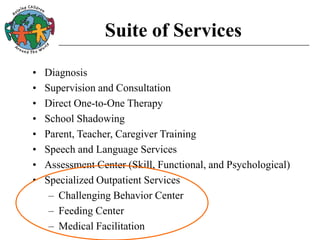
Suite of Services
• Diagnosis
• Supervision and Consultation
• Direct One-to-One Therapy
• School Shadowing
• Parent, Teacher, Caregiver Training
• Speech and Language Services
• Assessment Center (Skill, Functional, and Psychological)
• Specialized Outpatient Services
– Challenging Behavior Center
– Feeding Center
– Medical Facilitation
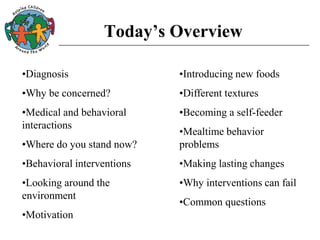
Today’s Overview
•Diagnosis
•Why be concerned?
•Medical and behavioral
interactions
•Where do you stand now?
•Behavioral interventions
•Looking around the
environment
•Motivation
•Introducing new foods
•Different textures
•Becoming a self-feeder
•Mealtime behavior
problems
•Making lasting changes
•Why interventions can fail
•Common questions
What is a Feeding Disorder?
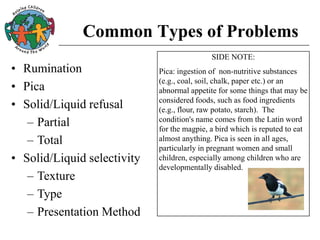
Feeding disorders by
definition are…
• Difficulties with eating/drinking that
affect weight and nutrition
• Food or fluid refusal
• Food or fluid selectivity
• Possible behavior problems during
mealtimes
• Skill deficits
• Implications from medical problems
Common Types of Problems
• Rumination
• Pica
• Solid/Liquid refusal
– Partial
– Total
• Solid/Liquid selectivity
– Texture
– Type
– Presentation Method
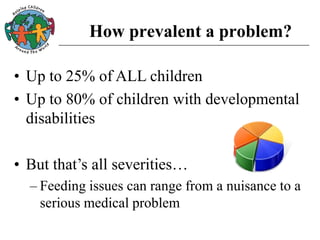
SIDE NOTE:
Pica: ingestion of non-nutritive substances
(e.g., coal, soil, chalk, paper etc.) or an
abnormal appetite for some things that may be
considered foods, such as food ingredients
(e.g., flour, raw potato, starch). The
condition's name comes from the Latin word
for the magpie, a bird which is reputed to eat
almost anything. Pica is seen in all ages,
particularly in pregnant women and small
children, especially among children who are
developmentally disabled.
How prevalent a problem?
• Up to 25% of ALL children
• Up to 80% of children with developmental
disabilities
• But that’s all severities…
– Feeding issues can range from a nuisance to a
serious medical problem
Where the differences lay
• Family food questionnaire (Ledford, 2006)
– Children with autism display higher incidence of
feeding problems:
• Greater food refusal
• Needed specific utensils
• Needed specific food presentation
• Accept only foods of a lower texture
• Displayed a narrower variety of food that would be eaten
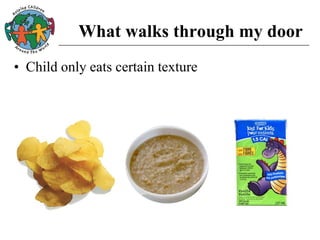
What walks through my door
• Child only eats certain texture
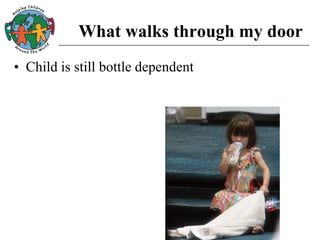
What walks through my door
• Child is still bottle dependent
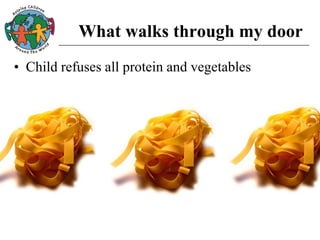
What walks through my door
• Child refuses all protein and vegetables
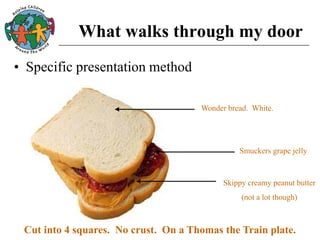
What walks through my door
• Specific presentation method
Wonder bread. White.
Smuckers grape jelly
Skippy creamy peanut butter
(not a lot though)
Cut into 4 squares. No crust. On a Thomas the Train plate.
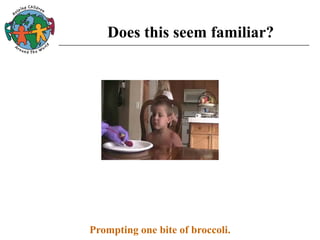
Does this seem familiar?
Prompting one bite of broccoli.
Where Does it Start?
Medical & Behavioral Interactions
Biological factors
• Physical complications
– Cleft palate
– Oral motor difficulties
• Medical complications
– Reflux
– Allergies
– Constipation/diarrhea
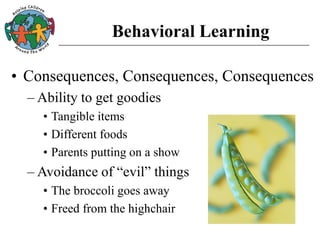
Behavioral Learning
• Consequences, Consequences, Consequences
– Ability to get goodies
• Tangible items
• Different foods
• Parents putting on a show
– Avoidance of “evil” things
• The broccoli goes away
• Freed from the highchair
The Interaction of the Two
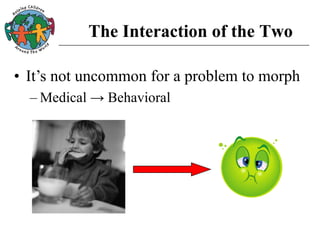
• It’s not uncommon for a problem to morph
– Medical → Behavioral
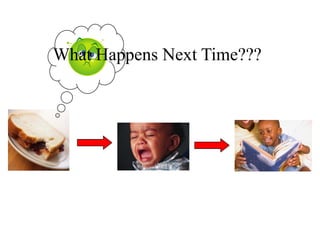
What Happens Next Time???
Functional Analysis of Feeding Disorders
Purpose: To find out what maintains problem
behavior during meals
• Natural setting
– Watch parents feed their children
– Note consequences provided for problem behaviors
• Clinical setting
– Provide pre-determined consequences for problem
behavior
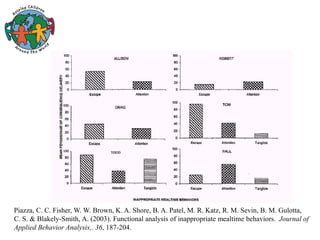
Piazza, C. C. Fisher, W. W. Brown, K. A. Shore, B. A. Patel, M. R. Katz, R. M. Sevin, B. M. Gulotta,
C. S. & Blakely-Smith, A. (2003). Functional analysis of inappropriate mealtime behaviors. Journal of
Applied Behavior Analysis,. 36, 187-204.
Behavioral Learning
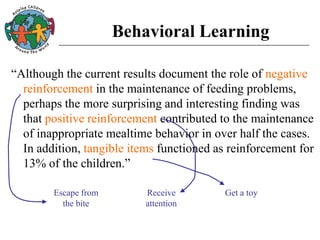
“Although the current results document the role of negative
reinforcement in the maintenance of feeding problems,
perhaps the more surprising and interesting finding was
that positive reinforcement contributed to the maintenance
of inappropriate mealtime behavior in over half the cases.
In addition, tangible items functioned as reinforcement for
13% of the children.”
Escape from
the bite
Receive
attention
Get a toy
Eating as Behavior(s)?
Eating as One Behavior?
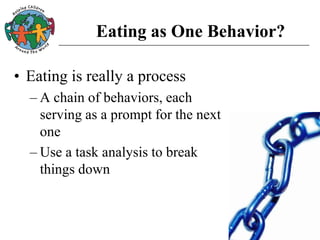
• Eating is really a process
– A chain of behaviors, each
serving as a prompt for the next
one
– Use a task analysis to break
things down
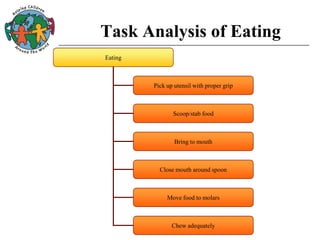
Task Analysis of Eating
Eating
Pick up utensil with proper grip
Scoop/stab food
Bring to mouth
Close mouth around spoon
Chew adequately
Move food to molars
Task Analysis of Eating
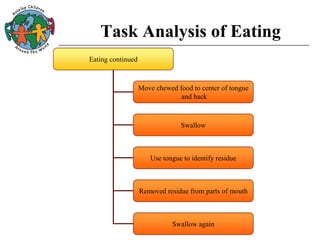
Eating continued
Move chewed food to center of tongue
and back
Swallow
Use tongue to identify residue
Removed residue from parts of mouth
Swallow again
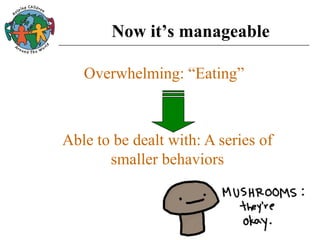
Now it’s manageable
Overwhelming: “Eating”
Able to be dealt with: A series of
smaller behaviors
Behavior can be seen…
• And data collected upon it!
– Visual representation tells us
–What we are doing right,
–What we are doing wrong,
–And when to make changes
When Should I be Concerned?
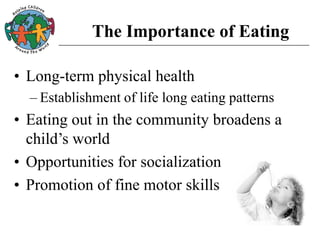
The Importance of Eating
• Long-term physical health
– Establishment of life long eating patterns
• Eating out in the community broadens a
child’s world
• Opportunities for socialization
• Promotion of fine motor skills
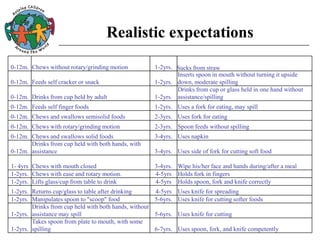
Realistic expectations
Uses spoon, fork, and knife competently6-7yrs.
Takes spoon from plate to mouth, with some
spilling1-2yrs.
Uses knife for cutting5-6yrs.
Drinks from cup held with both hands, without
assistance may spill1-2yrs.
Uses knife for cutting softer foods5-6yrs.Manipulates spoon to "scoop" food1-2yrs.
Uses knife for spreading4-5yrsReturns cup/glass to table after drinking1-2yrs.
Holds spoon, fork and knife correctly4-5yrsLifts glass/cup from table to drink1-2yrs.
Holds fork in fingers4-5yrsChews with ease and rotary motion.1-2yrs.
Wipe his/her face and hands during/after a meal3-4yrs.Chews with mouth closed1- 4yrs
Uses side of fork for cutting soft food3-4yrs.
Drinks from cup held with both hands, with
assistance0-12m.
Uses napkin3-4yrs.Chews and swallows solid foods0-12m.
Spoon feeds without spilling2-3yrs.Chews with rotary/grinding motion0-12m.
Uses fork for eating2-3yrs.Chews and swallows semisolid foods0-12m.
Uses a fork for eating, may spill1-2yrs.Feeds self finger foods0-12m.
Drinks from cup or glass held in one hand without
assistance/spilling1-2yrs.Drinks from cup held by adult0-12m.
Inserts spoon in mouth without turning it upside
down, moderate spilling1-2yrs.Feeds self cracker or snack0-12m.
Sucks from straw1-2yrs.Chews without rotary/grinding motion0-12m.
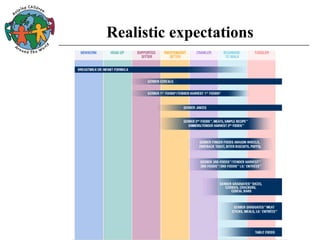
Realistic expectations
How bad is it really?
• Missed meals
• Malnourishment
• Failure to thrive
• Lack of growth
• Tube dependence
• Added family stress
• Problematic mealtime behaviors
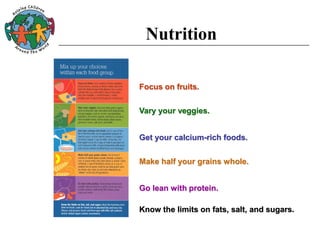
Nutrition
Focus on fruits.
Vary your veggies.
Get your calcium-rich foods.
Make half your grains whole.
Go lean with protein.
Know the limits on fats, salt, and sugars.
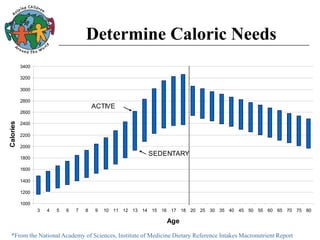
Determine Caloric Needs
1000
1200
1400
1600
1800
2000
2200
2400
2600
2800
3000
3200
3400
3 4 5 6 7 8 9 10 11 12 13 14 15 16 17 18 20 25 30 35 40 45 50 55 60 65 70 75 80
Age
Calories
ACTIVE
SEDENTARY
*From the National Academy of Sciences, Institute of Medicine Dietary Reference Intakes Macronutrient Report
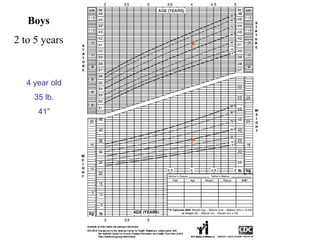
Growth Curves
• Shows where a child compares to
chronologically aged peers for:
– Height
– Weight
Boys
2 to 5 years
4 year old
35 lb.
41”
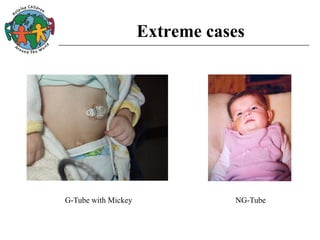
Extreme cases
NG-TubeG-Tube with Mickey
Other than Medical Concerns
• Does your family not go out in public to eat?
• Does the child not eat the “family meal”?
• Do you find yourself giving in to ritualistic
behavior?
• Do you find yourself cooking the exact same
thing everyday?
• Is your child eating approximately what
same-aged peers eat?
When Should I Seek Professional Help?
• Consider the effects of the child’s feeding
problem on the child and the family
– Minor problems may dissipate over time
– Marginal problems may be mediated by parental
intervention
– Major cases require attention by behavioral
experts
Before you Begin Intervention…
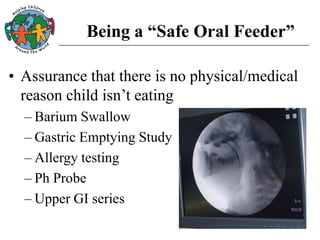
Being a “Safe Oral Feeder”
• Assurance that there is no physical/medical
reason child isn’t eating
– Barium Swallow
– Gastric Emptying Study
– Allergy testing
– Ph Probe
– Upper GI series
Rule Out Medical Problems
• Gastro esophageal reflux
• Constipation
• Diarrhea
• Food intolerances/allergies
• Oral motor delays
• Dysphasia
• Delayed gastric emptying/motility problems
Addressing Behavior Problems
• May need to be dealt with prior to
intervention
– Sleep dysregulation
– Aggression
– Tantrums
Step Back and Watch
• Try to see what truly goes on during mealtime
• Each feeder has his/her own technique
– Common approaches to meals:
• Terminate the meal/avoidance
• Coaxing/begging
• Games/toys
• Change foods
• Random threats
• Airplane/train method
Define a Goal
• What do you want out of intervention
– Be specific!
– Communicate priorities with service provider
• Determine a terminal goal
– Find intermediary steps within
Long-term Planning
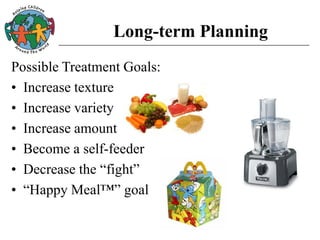
Possible Treatment Goals:
• Increase texture
• Increase variety
• Increase amount
• Become a self-feeder
• Decrease the “fight”
• “Happy Meal™” goal
Family Contribution
Determine family requirements during intervention
• Prepare food?
• Run session?
• Take data?
• Emotional upheaval?
• Withhold specific reinforcers at other times?
• Transportation to session?
Motivation
Never Reward a Child for Eating??
•Which children are they talking about?
•For children needing this amount of extra effort, the
“internal” motivation of hunger and reward of the taste of
food is not enough
•When are rewards used?
•Initial goal: YES!
•Mid-goal: Quite possibly, but maybe not so often
•Terminal goal: Ideally, no
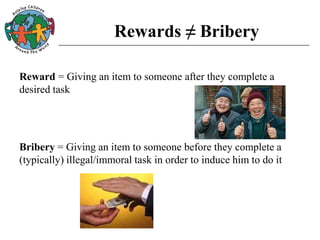
Rewards ≠ Bribery
Reward = Giving an item to someone after they complete a
desired task
Bribery = Giving an item to someone before they complete a
(typically) illegal/immoral task in order to induce him to do it
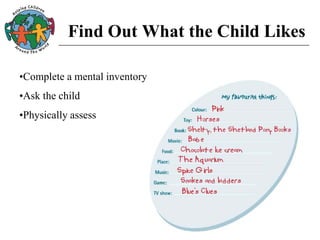
Find Out What the Child Likes
•Complete a mental inventory
•Ask the child
•Physically assess
I know what you’re thinking…
I know what my child likes and doesn’t like!
Just because you like something
does not mean that you will work for it.
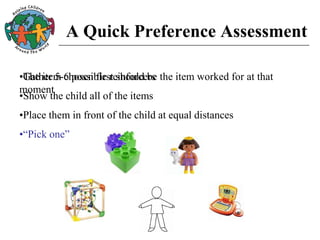
A Quick Preference Assessment
•Gather 5-6 possible reinforcers
•Show the child all of the items
•Place them in front of the child at equal distances
•“Pick one”
•The item chosen first should be the item worked for at that
moment
Top 5 Preference Facts
1. Preferences change over time
2. Preferences change when items are put into competition with
other items
3. Preferences change with other environmental influences
4. Verbal self-report does not equate to behavioral practice
5. Assess often
Using Food as a Reward
Use a highly preferred food as the reward
Limit total access to the “reward food” outside of meals
Concerns:
Child will begin to associate preferred food with “bad food”
Simple fact: Literature shows that food rewards increase the
consumption of new foods
Using Toys as a Reward
Sometimes we don’t have “preferred foods”
Easy to give and take away
Limited time access (10-30 seconds)
Concerns:
Disruptive to family meals
Possible Solution: Work during snacks or other non-family
meal times
Once you know what someone wants,
How do you get them to do what you want?
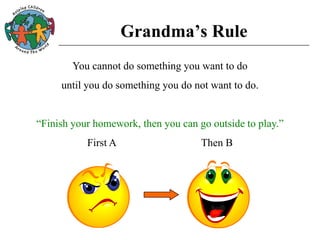
Grandma’s Rule
You cannot do something you want to do
until you do something you do not want to do.
“Finish your homework, then you can go outside to play.”
First A Then B
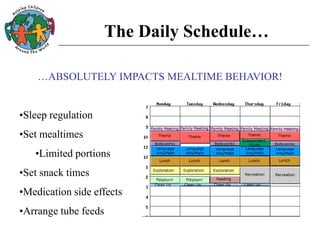
The Daily Schedule…
…ABSOLUTELY IMPACTS MEALTIME BEHAVIOR!
•Sleep regulation
•Set mealtimes
•Limited portions
•Set snack times
•Medication side effects
•Arrange tube feeds
The Eating Environment
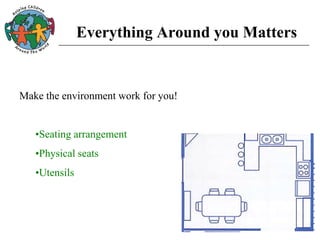
Everything Around you Matters
Make the environment work for you!
•Seating arrangement
•Physical seats
•Utensils
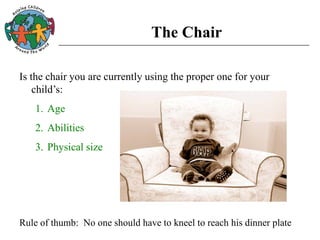
The Chair
Is the chair you are currently using the proper one for your
child’s:
1. Age
2. Abilities
3. Physical size
Rule of thumb: No one should have to kneel to reach his dinner plate
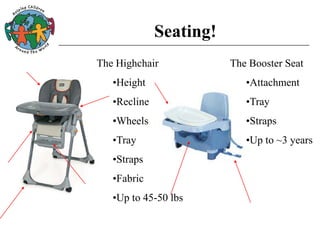
Seating!
The Highchair
•Height
•Recline
•Wheels
•Tray
•Straps
•Fabric
•Up to 45-50 lbs
The Booster Seat
•Attachment
•Tray
•Straps
•Up to ~3 years
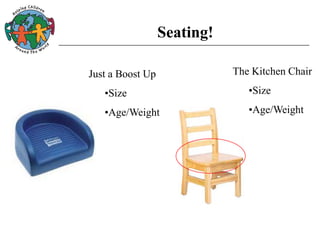
Seating!
The Kitchen Chair
•Size
•Age/Weight
Just a Boost Up
•Size
•Age/Weight
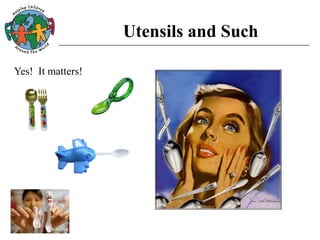
Utensils and Such
Yes! It matters!
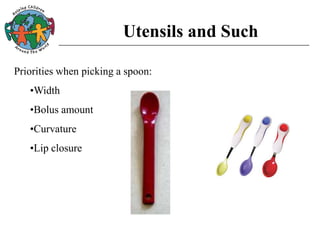
Utensils and Such
Priorities when picking a spoon:
•Width
•Bolus amount
•Curvature
•Lip closure
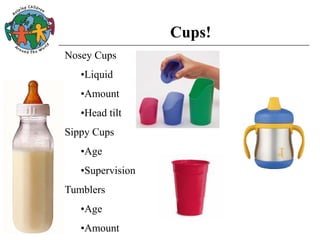
Cups!
Nosey Cups
•Liquid
•Amount
•Head tilt
Sippy Cups
•Age
•Supervision
Tumblers
•Age
•Amount
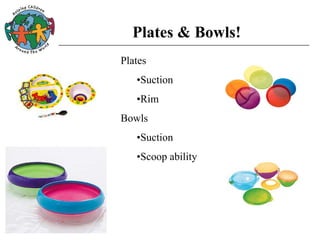
Plates & Bowls!
Plates
•Suction
•Rim
Bowls
•Suction
•Scoop ability
Is that bite too big?
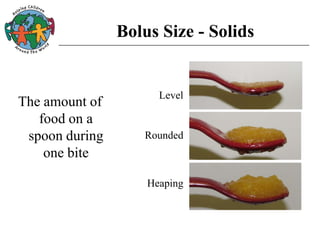
Bolus Size - Solids
The amount of
food on a
spoon during
one bite
Heaping
Level
Rounded
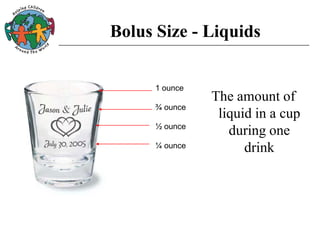
Bolus Size - Liquids
The amount of
liquid in a cup
during one
drink
1 ounce
¾ ounce
½ ounce
¼ ounce
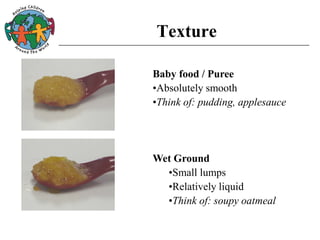
Texture
Texture
Baby food / Puree
•Absolutely smooth
•Think of: pudding, applesauce
Wet Ground
•Small lumps
•Relatively liquid
•Think of: soupy oatmeal
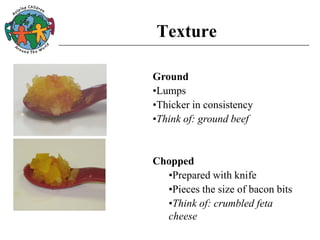
Texture
Ground
•Lumps
•Thicker in consistency
•Think of: ground beef
Chopped
•Prepared with knife
•Pieces the size of bacon bits
•Think of: crumbled feta
cheese
Texture
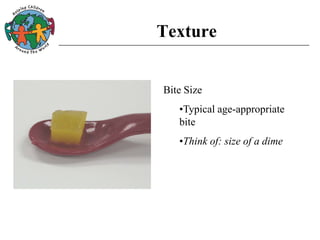
Bite Size
•Typical age-appropriate
bite
•Think of: size of a dime
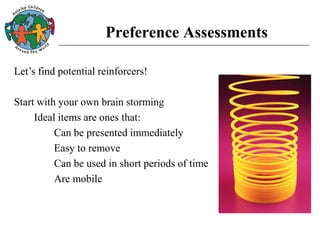
Preference Assessments
Let’s find potential reinforcers!
Start with your own brain storming
Ideal items are ones that:
Can be presented immediately
Easy to remove
Can be used in short periods of time
Are mobile
Goal Planning
Scenario goals
What should we work toward?
Personal goals
Where are you hoping to go?
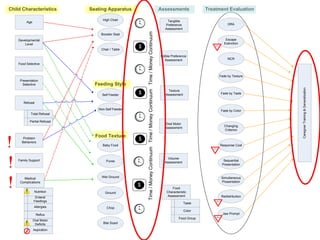
Can’t you just make us a decision tree?
Assessments
Tangible
Preference
Assessment
Edible Preference
Assessment
Texture
Assessment
Food
Characteristic
Assessment
Oral Motor
Assessment
Volume
Assessment
Food Group
Color
Taste
Treatment Evaluation
CaregiverTraining&Generalization
DRA
Escape
Extinction
NCR
Fade by Texture
Fade by Taste
Fade by Color
Response Cost
Sequential
Presentation
Simultaneous
Presentation
Redistribution
Jaw Prompt
Changing
Criterion
YIELD
YIELD
YIELD
Developmental
Level
Age
Medical
Complications
Food Selective
Refusal
Presentation
Selective
Problem
Behaviors
Family Support
Child Characteristics
Allergies
Reflux
Oral Motor
Deficits
Aspiration
Enteral
Feedings
Nutrition
Partial Refusal
Total Refusal
Food Texture
Baby Food
Puree
Wet Ground
Ground
Chop
Bite Sized
Feeding Style
Self Feeder
Non-Self Feeder
Seating Apparatus
High Chair
Booster Seat
Chair / Table
$
Time/MoneyContinuumTime/MoneyContinuumTime/MoneyContinuum
$
$
$
YIELD
Introducing New Foods
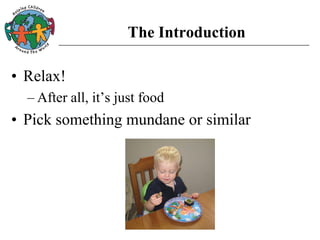
The Introduction
• Relax!
– After all, it’s just food
• Pick something mundane or similar
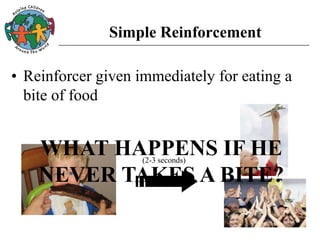
Simple Reinforcement
• Reinforcer given immediately for eating a
bite of food
(2-3 seconds)
WHAT HAPPENS IF HE
NEVER TAKES A BITE?
Options
• New Reinforcer
– The reinforcer isn’t powerful enough
• Lower the requirement
– The response effort is too great
• Let him go
• Wait it out for a bit
• Different approach is needed
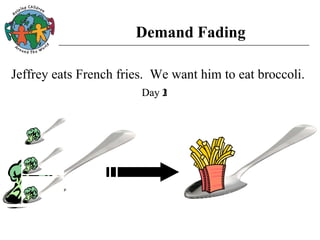
Demand Fading
You only have to work a little bit for a big goodie –
at first
The amount of work needed increases as the child
performs better
Demand Fading
Jeffrey eats French fries. We want him to eat broccoli.
Day 1Day 2Day 3
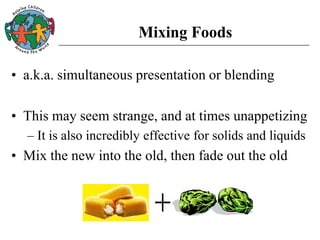
Mixing Foods
• a.k.a. simultaneous presentation or blending
• This may seem strange, and at times unappetizing
– It is also incredibly effective for solids and liquids
• Mix the new into the old, then fade out the old
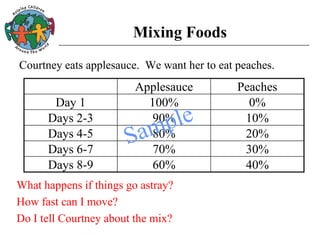
Mixing Foods
Courtney eats applesauce. We want her to eat peaches.
Applesauce Peaches
Day 1 100% 0%
Days 2-3 90% 10%
Days 4-5 80% 20%
Days 6-7 70% 30%
Days 8-9 60% 40%
What happens if things go astray?
How fast can I move?
Do I tell Courtney about the mix?
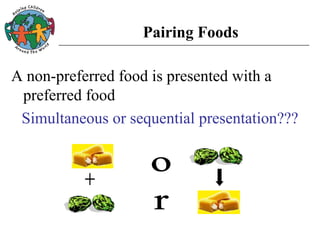
Pairing Foods
A non-preferred food is presented with a
preferred food
Simultaneous or sequential presentation???
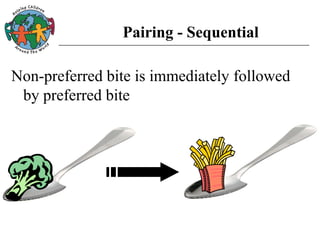
Pairing - Sequential
Non-preferred bite is immediately followed
by preferred bite
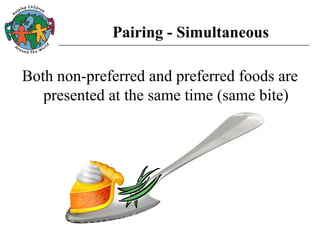
Pairing - Simultaneous
Both non-preferred and preferred foods are
presented at the same time (same bite)
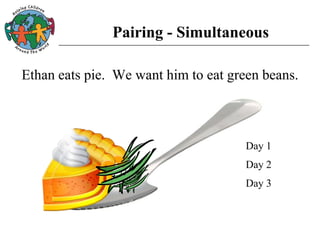
Pairing - Simultaneous
Ethan eats pie. We want him to eat green beans.
Day 1
Day 2
Day 3
Self-feeding
Teaching Self-Feeding
• May be beneficial to address food refusal
and self-feeding independently
• Manipulation of prompting and
consequences
Prompting
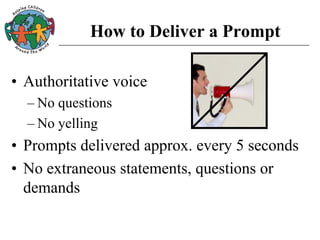
• Cues to a person that you want him/her to
perform a certain task
• Prompts come in various forms:
– Gestures
– Verbal
– Model
– Physical
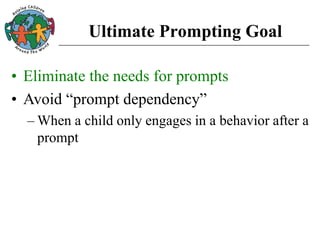
How to Deliver a Prompt
• Authoritative voice
– No questions
– No yelling
• Prompts delivered approx. every 5 seconds
• No extraneous statements, questions or
demands
Ultimate Prompting Goal
• Eliminate the needs for prompts
• Avoid “prompt dependency”
– When a child only engages in a behavior after a
prompt
Praising during Prompting
Rule #1: Never praise physical guidance
Rule #2: Decide what gets praise
Rule #3: Be consistent
Sometimes tangible reinforcement may be
necessary to fade prompts
General Strategies
Think Before you Speak
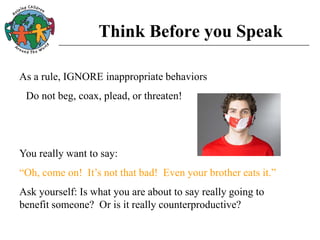
As a rule, IGNORE inappropriate behaviors
Do not beg, coax, plead, or threaten!
You really want to say:
“Oh, come on! It’s not that bad! Even your brother eats it.”
Ask yourself: Is what you are about to say really going to
benefit someone? Or is it really counterproductive?
Be a Model Caregiver
Observational learning = learning from others by watching them
perform a behavior
Both good and bad behaviors can be learned and imitated
There is a better chance that a child will try novel foods if he
sees someone else eating it
Attention may have to be drawn to the modeled behavior.
How to Model New Food
Model with enthusiasm
“Yummy! I love kiwi!”
Silent modeling is not effective
Do not have people at the table who will make negative
comments and/or refuse food
Addressing Behavior Problems
Problem Behaviors
Keep this in mind…
You will be asking a child to do a non-preferred task
Expect unhappiness
Meals can be Hard
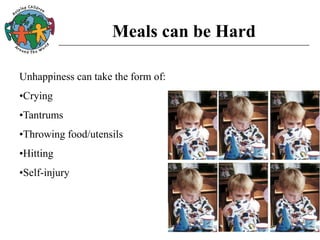
Unhappiness can take the form of:
•Crying
•Tantrums
•Throwing food/utensils
•Hitting
•Self-injury
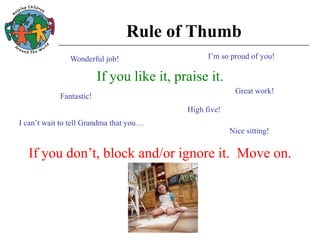
Rule of Thumb
If you like it, praise it.
If you don’t, block and/or ignore it. Move on.
Fantastic!
I’m so proud of you!
High five!
Wonderful job!
Nice sitting!
Great work!
I can’t wait to tell Grandma that you…
Every Intervention Should Include
1. A way for the child to earn “good stuff”
2. A way for the child to avoid “bad stuff”
It should always pay off to follow the new food rules
Modify your Surroundings
Keep items out of the child’s reach.
Have extras on hand
Stay in close proximity.
Time Out
Tricky to use…
Time out involves no fun things and no social contact.
1. Remove child from table for predetermined time
2. Turn chair around at table for predetermined time
3. Remove plate/glass for predetermined time
What happens if my child likes to escape the meal already?
Use at conclusion of the meal
Making Change Last –
Preventative Changes
Lots of Tips
•Monitor progress
•Avoid eating from original containers
•Vary things up
•Use visual clocks as prompts when able
•Structure when you can
•Repeatedly offer new foods
•Offer foods in age appropriate portions
•Serve meals in “eating locations”
Lots of Tips
•Do what you say AND what you do
•Ignore minor issues
•Shoot for 15 minute snacks and 30 minute meals
•Encourage independence
•Limit environmental distractions
•Use mealtime to engage in pleasant interactions
Why Interventions Sometimes Fail
Failure Should Not be an Option
• Interventions discussed have shown to be
successful
– Not all interventions are successful for every child
Be Prepared: Things Can Worsen
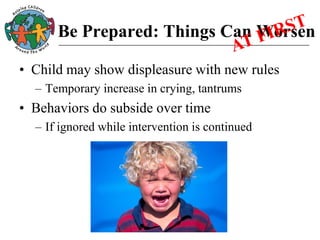
• Child may show displeasure with new rules
– Temporary increase in crying, tantrums
• Behaviors do subside over time
– If ignored while intervention is continued
Discontinuation
• Interventions discontinued prematurely
– It may take time to see huge results
– Continue even when you do see huge results!
Child’s Resistance
• Consistency of intervention
• Past history
• Amount of effort required by the child
Using the Wrong Reward
• Hold the reward for eating only
• At first require small effort behaviors
• Make sure you use the
“best” item
• Rotate items
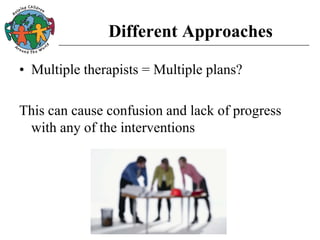
Different Approaches
• Multiple therapists = Multiple plans?
This can cause confusion and lack of progress
with any of the interventions
What does Feeding Therapy Look Like?
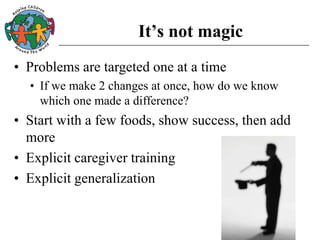
It’s not magic
• Problems are targeted one at a time
• If we make 2 changes at once, how do we know
which one made a difference?
• Start with a few foods, show success, then add
more
• Explicit caregiver training
• Explicit generalization
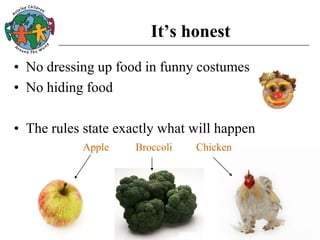
It’s honest
• No dressing up food in funny costumes
• No hiding food
• The rules state exactly what will happen
Apple Broccoli Chicken
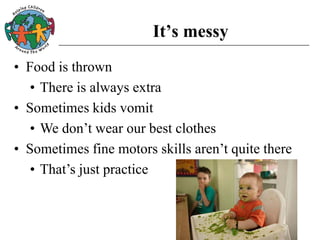
It’s messy
• Food is thrown
• There is always extra
• Sometimes kids vomit
• We don’t wear our best clothes
• Sometimes fine motors skills aren’t quite there
• That’s just practice
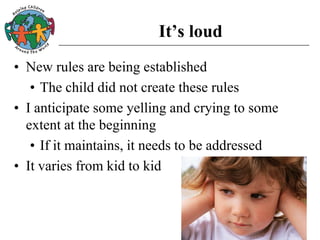
It’s loud
• New rules are being established
• The child did not create these rules
• I anticipate some yelling and crying to some
extent at the beginning
• If it maintains, it needs to be addressed
• It varies from kid to kid
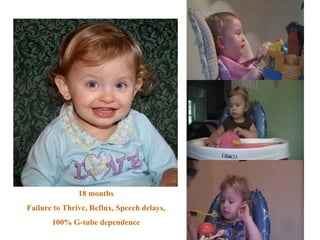
18 months
Failure to Thrive, Reflux, Speech delays,
100% G-tube dependence
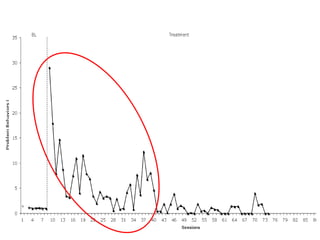
(the extinction burst)
• We all have them…
• When there is a change in our “rules”, we test
them out:
1st – an increase in behavior
2nd – behaviors go down
3rd – random increases, then decreases
It’s realistic expectations
• Ask for something a child has the ability to do
• Does not coddle
• It’s just an apple!
• Celebrates success
• No sub-age appropriate expectations unless there
is a REALLY good reason
It’s exciting
• We tend to see progress quickly and often in
“jumps”
• This often makes caregivers want to spring way
ahead!!!
• A decent therapist will curtail you, not your
enthusiasm
It can even be fun
• Begins with a dense schedule of reinforcement
• One-on-one attention
• Experience of pride in achievements
• Visual charting can be used for older kids
• Experiencing true consistency
• Novel foods even become preferred
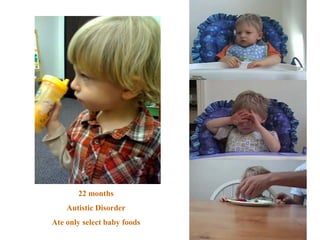
22 months
Autistic Disorder
Ate only select baby foods
Common Questions
& Discussion
Common questions
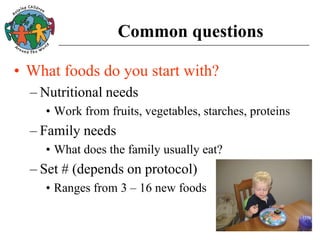
• What foods do you start with?
– Nutritional needs
• Work from fruits, vegetables, starches, proteins
– Family needs
• What does the family usually eat?
– Set # (depends on protocol)
• Ranges from 3 – 16 new foods
Common questions
• How long is a meal/session?
– Depends on child’s age
– Depends on approach used
• Trial based versus time based
• Time cap on escape extinction sessions?
– Shorter sessions allow multiple attempts
– You can only eat for so long/so much
Common questions
• Which behaviors do you reinforce?
– If the child refuses totally, acceptance
– If the child accepts but doesn’t swallow, fast
swallowing
– If the child disrupts or gags, the absence of the
problem behavior
Common questions
• What do I do at home when my child is in
treatment?
– Until parents are fully trained, we ask that they
continue life as normal
– Treatment gains generalized to caregivers
– Treatment gains generalized to different settings
• Small steps tend to bring greater success
Common questions
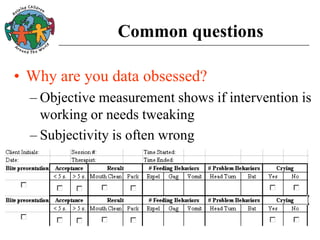
• Why are you data obsessed?
– Objective measurement shows if intervention is
working or needs tweaking
– Subjectivity is often wrong
Common questions
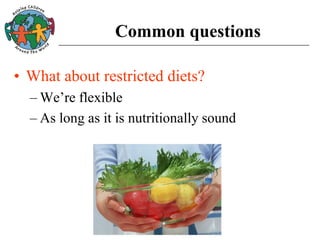
• What about restricted diets?
– We’re flexible
– As long as it is nutritionally sound
Common questions
• What if it doesn’t work with my child?
– There are numerous approaches to take
• The first approach may not work
– Data collection is imperative
• Figure out the parts that do work
– Find specific reinforcers, establishing
operations, and consequences that make each
child successful
Common questions
• What is the research on long term success?
– Currently, limited published research
– Follow-up probes show promise
– Dependent upon protocol implementation
Center for Autism and Related Disorders
Specialized Outpatient Services
19019 Ventura Blvd
Suite 300
Tarzana, CA 91303
CARDSOS@centerforautism.com

Alimentação

  • 1.
    What to DoWhen A Child Won’t Eat: Feeding Disorders & Developmental Disabilities John Galle Center for Autism & Related Disorders
  • 2.
    Suite of Services •Diagnosis • Supervision and Consultation • Direct One-to-One Therapy • School Shadowing • Parent, Teacher, Caregiver Training • Speech and Language Services • Assessment Center (Skill, Functional, and Psychological) • Specialized Outpatient Services – Challenging Behavior Center – Feeding Center – Medical Facilitation
  • 3.
    Today’s Overview •Diagnosis •Why beconcerned? •Medical and behavioral interactions •Where do you stand now? •Behavioral interventions •Looking around the environment •Motivation •Introducing new foods •Different textures •Becoming a self-feeder •Mealtime behavior problems •Making lasting changes •Why interventions can fail •Common questions
  • 4.
    What is aFeeding Disorder?
  • 5.
    Feeding disorders by definitionare… • Difficulties with eating/drinking that affect weight and nutrition • Food or fluid refusal • Food or fluid selectivity • Possible behavior problems during mealtimes • Skill deficits • Implications from medical problems
  • 6.
    Common Types ofProblems • Rumination • Pica • Solid/Liquid refusal – Partial – Total • Solid/Liquid selectivity – Texture – Type – Presentation Method SIDE NOTE: Pica: ingestion of non-nutritive substances (e.g., coal, soil, chalk, paper etc.) or an abnormal appetite for some things that may be considered foods, such as food ingredients (e.g., flour, raw potato, starch). The condition's name comes from the Latin word for the magpie, a bird which is reputed to eat almost anything. Pica is seen in all ages, particularly in pregnant women and small children, especially among children who are developmentally disabled.
  • 7.
    How prevalent aproblem? • Up to 25% of ALL children • Up to 80% of children with developmental disabilities • But that’s all severities… – Feeding issues can range from a nuisance to a serious medical problem
  • 8.
    Where the differenceslay • Family food questionnaire (Ledford, 2006) – Children with autism display higher incidence of feeding problems: • Greater food refusal • Needed specific utensils • Needed specific food presentation • Accept only foods of a lower texture • Displayed a narrower variety of food that would be eaten
  • 9.
    What walks throughmy door • Child only eats certain texture
  • 10.
    What walks throughmy door • Child is still bottle dependent
  • 11.
    What walks throughmy door • Child refuses all protein and vegetables
  • 12.
    What walks throughmy door • Specific presentation method Wonder bread. White. Smuckers grape jelly Skippy creamy peanut butter (not a lot though) Cut into 4 squares. No crust. On a Thomas the Train plate.
  • 13.
    Does this seemfamiliar? Prompting one bite of broccoli.
  • 14.
    Where Does itStart? Medical & Behavioral Interactions
  • 15.
    Biological factors • Physicalcomplications – Cleft palate – Oral motor difficulties • Medical complications – Reflux – Allergies – Constipation/diarrhea
  • 16.
    Behavioral Learning • Consequences,Consequences, Consequences – Ability to get goodies • Tangible items • Different foods • Parents putting on a show – Avoidance of “evil” things • The broccoli goes away • Freed from the highchair
  • 17.
    The Interaction ofthe Two • It’s not uncommon for a problem to morph – Medical → Behavioral
  • 18.
  • 19.
    Functional Analysis ofFeeding Disorders Purpose: To find out what maintains problem behavior during meals • Natural setting – Watch parents feed their children – Note consequences provided for problem behaviors • Clinical setting – Provide pre-determined consequences for problem behavior
  • 20.
    Piazza, C. C.Fisher, W. W. Brown, K. A. Shore, B. A. Patel, M. R. Katz, R. M. Sevin, B. M. Gulotta, C. S. & Blakely-Smith, A. (2003). Functional analysis of inappropriate mealtime behaviors. Journal of Applied Behavior Analysis,. 36, 187-204.
  • 21.
    Behavioral Learning “Although thecurrent results document the role of negative reinforcement in the maintenance of feeding problems, perhaps the more surprising and interesting finding was that positive reinforcement contributed to the maintenance of inappropriate mealtime behavior in over half the cases. In addition, tangible items functioned as reinforcement for 13% of the children.” Escape from the bite Receive attention Get a toy
  • 22.
  • 23.
    Eating as OneBehavior? • Eating is really a process – A chain of behaviors, each serving as a prompt for the next one – Use a task analysis to break things down
  • 24.
    Task Analysis ofEating Eating Pick up utensil with proper grip Scoop/stab food Bring to mouth Close mouth around spoon Chew adequately Move food to molars
  • 25.
    Task Analysis ofEating Eating continued Move chewed food to center of tongue and back Swallow Use tongue to identify residue Removed residue from parts of mouth Swallow again
  • 26.
    Now it’s manageable Overwhelming:“Eating” Able to be dealt with: A series of smaller behaviors
  • 27.
    Behavior can beseen… • And data collected upon it! – Visual representation tells us –What we are doing right, –What we are doing wrong, –And when to make changes
  • 28.
    When Should Ibe Concerned?
  • 29.
    The Importance ofEating • Long-term physical health – Establishment of life long eating patterns • Eating out in the community broadens a child’s world • Opportunities for socialization • Promotion of fine motor skills
  • 30.
    Realistic expectations Uses spoon,fork, and knife competently6-7yrs. Takes spoon from plate to mouth, with some spilling1-2yrs. Uses knife for cutting5-6yrs. Drinks from cup held with both hands, without assistance may spill1-2yrs. Uses knife for cutting softer foods5-6yrs.Manipulates spoon to "scoop" food1-2yrs. Uses knife for spreading4-5yrsReturns cup/glass to table after drinking1-2yrs. Holds spoon, fork and knife correctly4-5yrsLifts glass/cup from table to drink1-2yrs. Holds fork in fingers4-5yrsChews with ease and rotary motion.1-2yrs. Wipe his/her face and hands during/after a meal3-4yrs.Chews with mouth closed1- 4yrs Uses side of fork for cutting soft food3-4yrs. Drinks from cup held with both hands, with assistance0-12m. Uses napkin3-4yrs.Chews and swallows solid foods0-12m. Spoon feeds without spilling2-3yrs.Chews with rotary/grinding motion0-12m. Uses fork for eating2-3yrs.Chews and swallows semisolid foods0-12m. Uses a fork for eating, may spill1-2yrs.Feeds self finger foods0-12m. Drinks from cup or glass held in one hand without assistance/spilling1-2yrs.Drinks from cup held by adult0-12m. Inserts spoon in mouth without turning it upside down, moderate spilling1-2yrs.Feeds self cracker or snack0-12m. Sucks from straw1-2yrs.Chews without rotary/grinding motion0-12m.
  • 31.
  • 32.
  • 33.
    How bad isit really? • Missed meals • Malnourishment • Failure to thrive • Lack of growth • Tube dependence • Added family stress • Problematic mealtime behaviors
  • 34.
    Nutrition Focus on fruits. Varyyour veggies. Get your calcium-rich foods. Make half your grains whole. Go lean with protein. Know the limits on fats, salt, and sugars.
  • 35.
    Determine Caloric Needs 1000 1200 1400 1600 1800 2000 2200 2400 2600 2800 3000 3200 3400 34 5 6 7 8 9 10 11 12 13 14 15 16 17 18 20 25 30 35 40 45 50 55 60 65 70 75 80 Age Calories ACTIVE SEDENTARY *From the National Academy of Sciences, Institute of Medicine Dietary Reference Intakes Macronutrient Report
  • 36.
    Growth Curves • Showswhere a child compares to chronologically aged peers for: – Height – Weight
  • 37.
    Boys 2 to 5years 4 year old 35 lb. 41”
  • 38.
  • 39.
    Other than MedicalConcerns • Does your family not go out in public to eat? • Does the child not eat the “family meal”? • Do you find yourself giving in to ritualistic behavior? • Do you find yourself cooking the exact same thing everyday? • Is your child eating approximately what same-aged peers eat?
  • 40.
    When Should ISeek Professional Help? • Consider the effects of the child’s feeding problem on the child and the family – Minor problems may dissipate over time – Marginal problems may be mediated by parental intervention – Major cases require attention by behavioral experts
  • 41.
    Before you BeginIntervention…
  • 42.
    Being a “SafeOral Feeder” • Assurance that there is no physical/medical reason child isn’t eating – Barium Swallow – Gastric Emptying Study – Allergy testing – Ph Probe – Upper GI series
  • 43.
    Rule Out MedicalProblems • Gastro esophageal reflux • Constipation • Diarrhea • Food intolerances/allergies • Oral motor delays • Dysphasia • Delayed gastric emptying/motility problems
  • 44.
    Addressing Behavior Problems •May need to be dealt with prior to intervention – Sleep dysregulation – Aggression – Tantrums
  • 45.
    Step Back andWatch • Try to see what truly goes on during mealtime • Each feeder has his/her own technique – Common approaches to meals: • Terminate the meal/avoidance • Coaxing/begging • Games/toys • Change foods • Random threats • Airplane/train method
  • 46.
    Define a Goal •What do you want out of intervention – Be specific! – Communicate priorities with service provider • Determine a terminal goal – Find intermediary steps within
  • 47.
    Long-term Planning Possible TreatmentGoals: • Increase texture • Increase variety • Increase amount • Become a self-feeder • Decrease the “fight” • “Happy Meal™” goal
  • 48.
    Family Contribution Determine familyrequirements during intervention • Prepare food? • Run session? • Take data? • Emotional upheaval? • Withhold specific reinforcers at other times? • Transportation to session?
  • 49.
  • 50.
    Never Reward aChild for Eating?? •Which children are they talking about? •For children needing this amount of extra effort, the “internal” motivation of hunger and reward of the taste of food is not enough •When are rewards used? •Initial goal: YES! •Mid-goal: Quite possibly, but maybe not so often •Terminal goal: Ideally, no
  • 51.
    Rewards ≠ Bribery Reward= Giving an item to someone after they complete a desired task Bribery = Giving an item to someone before they complete a (typically) illegal/immoral task in order to induce him to do it
  • 52.
    Find Out Whatthe Child Likes •Complete a mental inventory •Ask the child •Physically assess
  • 53.
    I know whatyou’re thinking… I know what my child likes and doesn’t like! Just because you like something does not mean that you will work for it.
  • 54.
    A Quick PreferenceAssessment •Gather 5-6 possible reinforcers •Show the child all of the items •Place them in front of the child at equal distances •“Pick one” •The item chosen first should be the item worked for at that moment
  • 55.
    Top 5 PreferenceFacts 1. Preferences change over time 2. Preferences change when items are put into competition with other items 3. Preferences change with other environmental influences 4. Verbal self-report does not equate to behavioral practice 5. Assess often
  • 56.
    Using Food asa Reward Use a highly preferred food as the reward Limit total access to the “reward food” outside of meals Concerns: Child will begin to associate preferred food with “bad food” Simple fact: Literature shows that food rewards increase the consumption of new foods
  • 57.
    Using Toys asa Reward Sometimes we don’t have “preferred foods” Easy to give and take away Limited time access (10-30 seconds) Concerns: Disruptive to family meals Possible Solution: Work during snacks or other non-family meal times
  • 58.
    Once you knowwhat someone wants, How do you get them to do what you want?
  • 59.
    Grandma’s Rule You cannotdo something you want to do until you do something you do not want to do. “Finish your homework, then you can go outside to play.” First A Then B
  • 60.
    The Daily Schedule… …ABSOLUTELYIMPACTS MEALTIME BEHAVIOR! •Sleep regulation •Set mealtimes •Limited portions •Set snack times •Medication side effects •Arrange tube feeds
  • 61.
  • 62.
    Everything Around youMatters Make the environment work for you! •Seating arrangement •Physical seats •Utensils
  • 63.
    The Chair Is thechair you are currently using the proper one for your child’s: 1. Age 2. Abilities 3. Physical size Rule of thumb: No one should have to kneel to reach his dinner plate
  • 64.
    Seating! The Highchair •Height •Recline •Wheels •Tray •Straps •Fabric •Up to45-50 lbs The Booster Seat •Attachment •Tray •Straps •Up to ~3 years
  • 65.
  • 66.
  • 67.
    Utensils and Such Prioritieswhen picking a spoon: •Width •Bolus amount •Curvature •Lip closure
  • 68.
    Cups! Nosey Cups •Liquid •Amount •Head tilt SippyCups •Age •Supervision Tumblers •Age •Amount
  • 69.
  • 70.
    Is that bitetoo big?
  • 71.
    Bolus Size -Solids The amount of food on a spoon during one bite Heaping Level Rounded
  • 72.
    Bolus Size -Liquids The amount of liquid in a cup during one drink 1 ounce ¾ ounce ½ ounce ¼ ounce
  • 73.
  • 74.
    Texture Baby food /Puree •Absolutely smooth •Think of: pudding, applesauce Wet Ground •Small lumps •Relatively liquid •Think of: soupy oatmeal
  • 75.
    Texture Ground •Lumps •Thicker in consistency •Thinkof: ground beef Chopped •Prepared with knife •Pieces the size of bacon bits •Think of: crumbled feta cheese
  • 76.
  • 77.
    Preference Assessments Let’s findpotential reinforcers! Start with your own brain storming Ideal items are ones that: Can be presented immediately Easy to remove Can be used in short periods of time Are mobile
  • 78.
    Goal Planning Scenario goals Whatshould we work toward? Personal goals Where are you hoping to go?
  • 79.
    Can’t you justmake us a decision tree?
  • 80.
    Assessments Tangible Preference Assessment Edible Preference Assessment Texture Assessment Food Characteristic Assessment Oral Motor Assessment Volume Assessment FoodGroup Color Taste Treatment Evaluation CaregiverTraining&Generalization DRA Escape Extinction NCR Fade by Texture Fade by Taste Fade by Color Response Cost Sequential Presentation Simultaneous Presentation Redistribution Jaw Prompt Changing Criterion YIELD YIELD YIELD Developmental Level Age Medical Complications Food Selective Refusal Presentation Selective Problem Behaviors Family Support Child Characteristics Allergies Reflux Oral Motor Deficits Aspiration Enteral Feedings Nutrition Partial Refusal Total Refusal Food Texture Baby Food Puree Wet Ground Ground Chop Bite Sized Feeding Style Self Feeder Non-Self Feeder Seating Apparatus High Chair Booster Seat Chair / Table $ Time/MoneyContinuumTime/MoneyContinuumTime/MoneyContinuum $ $ $ YIELD
  • 81.
  • 82.
    The Introduction • Relax! –After all, it’s just food • Pick something mundane or similar
  • 83.
    Simple Reinforcement • Reinforcergiven immediately for eating a bite of food (2-3 seconds) WHAT HAPPENS IF HE NEVER TAKES A BITE?
  • 84.
    Options • New Reinforcer –The reinforcer isn’t powerful enough • Lower the requirement – The response effort is too great • Let him go • Wait it out for a bit • Different approach is needed
  • 85.
    Demand Fading You onlyhave to work a little bit for a big goodie – at first The amount of work needed increases as the child performs better
  • 86.
    Demand Fading Jeffrey eatsFrench fries. We want him to eat broccoli. Day 1Day 2Day 3
  • 87.
    Mixing Foods • a.k.a.simultaneous presentation or blending • This may seem strange, and at times unappetizing – It is also incredibly effective for solids and liquids • Mix the new into the old, then fade out the old
  • 88.
    Mixing Foods Courtney eatsapplesauce. We want her to eat peaches. Applesauce Peaches Day 1 100% 0% Days 2-3 90% 10% Days 4-5 80% 20% Days 6-7 70% 30% Days 8-9 60% 40% What happens if things go astray? How fast can I move? Do I tell Courtney about the mix?
  • 89.
    Pairing Foods A non-preferredfood is presented with a preferred food Simultaneous or sequential presentation???
  • 90.
    Pairing - Sequential Non-preferredbite is immediately followed by preferred bite
  • 91.
    Pairing - Simultaneous Bothnon-preferred and preferred foods are presented at the same time (same bite)
  • 92.
    Pairing - Simultaneous Ethaneats pie. We want him to eat green beans. Day 1 Day 2 Day 3
  • 93.
  • 94.
    Teaching Self-Feeding • Maybe beneficial to address food refusal and self-feeding independently • Manipulation of prompting and consequences
  • 95.
    Prompting • Cues toa person that you want him/her to perform a certain task • Prompts come in various forms: – Gestures – Verbal – Model – Physical
  • 96.
    How to Delivera Prompt • Authoritative voice – No questions – No yelling • Prompts delivered approx. every 5 seconds • No extraneous statements, questions or demands
  • 97.
    Ultimate Prompting Goal •Eliminate the needs for prompts • Avoid “prompt dependency” – When a child only engages in a behavior after a prompt
  • 98.
    Praising during Prompting Rule#1: Never praise physical guidance Rule #2: Decide what gets praise Rule #3: Be consistent Sometimes tangible reinforcement may be necessary to fade prompts
  • 99.
  • 100.
    Think Before youSpeak As a rule, IGNORE inappropriate behaviors Do not beg, coax, plead, or threaten! You really want to say: “Oh, come on! It’s not that bad! Even your brother eats it.” Ask yourself: Is what you are about to say really going to benefit someone? Or is it really counterproductive?
  • 101.
    Be a ModelCaregiver Observational learning = learning from others by watching them perform a behavior Both good and bad behaviors can be learned and imitated There is a better chance that a child will try novel foods if he sees someone else eating it Attention may have to be drawn to the modeled behavior.
  • 102.
    How to ModelNew Food Model with enthusiasm “Yummy! I love kiwi!” Silent modeling is not effective Do not have people at the table who will make negative comments and/or refuse food
  • 103.
  • 104.
    Problem Behaviors Keep thisin mind… You will be asking a child to do a non-preferred task Expect unhappiness
  • 105.
    Meals can beHard Unhappiness can take the form of: •Crying •Tantrums •Throwing food/utensils •Hitting •Self-injury
  • 106.
    Rule of Thumb Ifyou like it, praise it. If you don’t, block and/or ignore it. Move on. Fantastic! I’m so proud of you! High five! Wonderful job! Nice sitting! Great work! I can’t wait to tell Grandma that you…
  • 107.
    Every Intervention ShouldInclude 1. A way for the child to earn “good stuff” 2. A way for the child to avoid “bad stuff” It should always pay off to follow the new food rules
  • 108.
    Modify your Surroundings Keepitems out of the child’s reach. Have extras on hand Stay in close proximity.
  • 109.
    Time Out Tricky touse… Time out involves no fun things and no social contact. 1. Remove child from table for predetermined time 2. Turn chair around at table for predetermined time 3. Remove plate/glass for predetermined time What happens if my child likes to escape the meal already? Use at conclusion of the meal
  • 110.
    Making Change Last– Preventative Changes
  • 111.
    Lots of Tips •Monitorprogress •Avoid eating from original containers •Vary things up •Use visual clocks as prompts when able •Structure when you can •Repeatedly offer new foods •Offer foods in age appropriate portions •Serve meals in “eating locations”
  • 112.
    Lots of Tips •Dowhat you say AND what you do •Ignore minor issues •Shoot for 15 minute snacks and 30 minute meals •Encourage independence •Limit environmental distractions •Use mealtime to engage in pleasant interactions
  • 113.
  • 114.
    Failure Should Notbe an Option • Interventions discussed have shown to be successful – Not all interventions are successful for every child
  • 115.
    Be Prepared: ThingsCan Worsen • Child may show displeasure with new rules – Temporary increase in crying, tantrums • Behaviors do subside over time – If ignored while intervention is continued
  • 116.
    Discontinuation • Interventions discontinuedprematurely – It may take time to see huge results – Continue even when you do see huge results!
  • 117.
    Child’s Resistance • Consistencyof intervention • Past history • Amount of effort required by the child
  • 118.
    Using the WrongReward • Hold the reward for eating only • At first require small effort behaviors • Make sure you use the “best” item • Rotate items
  • 119.
    Different Approaches • Multipletherapists = Multiple plans? This can cause confusion and lack of progress with any of the interventions
  • 120.
    What does FeedingTherapy Look Like?
  • 121.
    It’s not magic •Problems are targeted one at a time • If we make 2 changes at once, how do we know which one made a difference? • Start with a few foods, show success, then add more • Explicit caregiver training • Explicit generalization
  • 122.
    It’s honest • Nodressing up food in funny costumes • No hiding food • The rules state exactly what will happen Apple Broccoli Chicken
  • 123.
    It’s messy • Foodis thrown • There is always extra • Sometimes kids vomit • We don’t wear our best clothes • Sometimes fine motors skills aren’t quite there • That’s just practice
  • 124.
    It’s loud • Newrules are being established • The child did not create these rules • I anticipate some yelling and crying to some extent at the beginning • If it maintains, it needs to be addressed • It varies from kid to kid
  • 125.
    18 months Failure toThrive, Reflux, Speech delays, 100% G-tube dependence
  • 126.
    (the extinction burst) •We all have them… • When there is a change in our “rules”, we test them out: 1st – an increase in behavior 2nd – behaviors go down 3rd – random increases, then decreases
  • 128.
    It’s realistic expectations •Ask for something a child has the ability to do • Does not coddle • It’s just an apple! • Celebrates success • No sub-age appropriate expectations unless there is a REALLY good reason
  • 129.
    It’s exciting • Wetend to see progress quickly and often in “jumps” • This often makes caregivers want to spring way ahead!!! • A decent therapist will curtail you, not your enthusiasm
  • 130.
    It can evenbe fun • Begins with a dense schedule of reinforcement • One-on-one attention • Experience of pride in achievements • Visual charting can be used for older kids • Experiencing true consistency • Novel foods even become preferred
  • 131.
    22 months Autistic Disorder Ateonly select baby foods
  • 132.
  • 133.
    Common questions • Whatfoods do you start with? – Nutritional needs • Work from fruits, vegetables, starches, proteins – Family needs • What does the family usually eat? – Set # (depends on protocol) • Ranges from 3 – 16 new foods
  • 134.
    Common questions • Howlong is a meal/session? – Depends on child’s age – Depends on approach used • Trial based versus time based • Time cap on escape extinction sessions? – Shorter sessions allow multiple attempts – You can only eat for so long/so much
  • 135.
    Common questions • Whichbehaviors do you reinforce? – If the child refuses totally, acceptance – If the child accepts but doesn’t swallow, fast swallowing – If the child disrupts or gags, the absence of the problem behavior
  • 136.
    Common questions • Whatdo I do at home when my child is in treatment? – Until parents are fully trained, we ask that they continue life as normal – Treatment gains generalized to caregivers – Treatment gains generalized to different settings • Small steps tend to bring greater success
  • 137.
    Common questions • Whyare you data obsessed? – Objective measurement shows if intervention is working or needs tweaking – Subjectivity is often wrong
  • 138.
    Common questions • Whatabout restricted diets? – We’re flexible – As long as it is nutritionally sound
  • 139.
    Common questions • Whatif it doesn’t work with my child? – There are numerous approaches to take • The first approach may not work – Data collection is imperative • Figure out the parts that do work – Find specific reinforcers, establishing operations, and consequences that make each child successful
  • 140.
    Common questions • Whatis the research on long term success? – Currently, limited published research – Follow-up probes show promise – Dependent upon protocol implementation
  • 141.
    Center for Autismand Related Disorders Specialized Outpatient Services 19019 Ventura Blvd Suite 300 Tarzana, CA 91303 CARDSOS@centerforautism.com