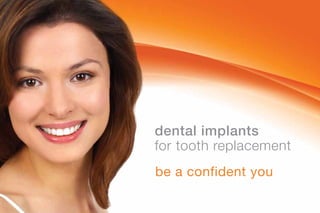
dental implants
for tooth replacement
be a confident you
Anyone missing one or more teeth understands how tooth
loss can make you feel uncomfortable about smiling or
eating in public. You may avoid social situations and
as a result begin to feel isolated. This could
impact your daily life and your self-confidence.
smile big
Current dental implant treatments can change your life.
From a single missing tooth to an entire set of teeth,
dental implants restore your appearance, speech,
nutrition, oral health, comfort, and self-esteem. So
smile big, eat what you want, and be a confident you!
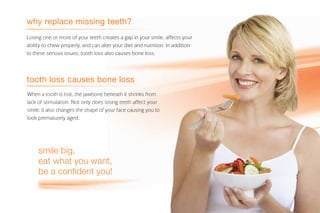
why replace missing teeth?
Losing one or more of your teeth creates a gap in your smile, affects your
ability to chew properly, and can alter your diet and nutrition. In addition
to these serious issues, tooth loss also causes bone loss.
tooth loss causes bone loss
When a tooth is lost, the jawbone beneath it shrinks from
lack of stimulation. Not only does losing teeth affect your
smile, it also changes the shape of your face causing you to
look prematurely aged.
smile big,
eat what you want,
be a confident you!
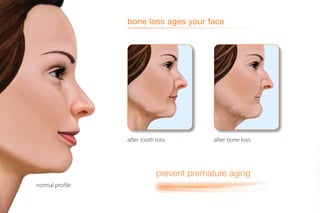
normal profile
after tooth loss after bone loss
bone loss ages your face
prevent premature aging
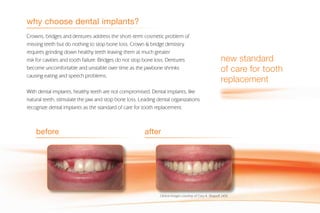
Crowns, bridges and dentures address the short-term cosmetic problem of
missing teeth but do nothing to stop bone loss. Crown & bridge dentistry
requires grinding down healthy teeth leaving them at much greater
risk for cavities and tooth failure. Bridges do not stop bone loss. Dentures
become uncomfortable and unstable over time as the jawbone shrinks
causing eating and speech problems.
With dental implants, healthy teeth are not compromised. Dental implants, like
natural teeth, stimulate the jaw and stop bone loss. Leading dental organizations
recognize dental implants as the standard of care for tooth replacement.
why choose dental implants?
afterbefore
Clinical images courtesy of Cary A. Shapoff, DDS
new standard
of care for tooth
replacement
traditional
crown & bridge
dental implants
with a crown
• full chewing ability
• preserve healthy teeth
• stop bone loss
• grinds down healthy teeth
• bone loss continues
• greater risk for cavities and
tooth failure
untreated
missing teeth
• unattractive smile
• loss of chewing ability
• accelerated bone loss
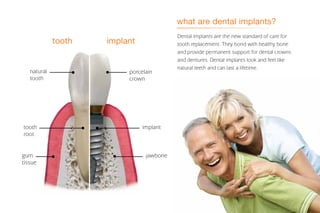
what are dental implants?
tooth implant
gum
tissue
porcelain
crown
natural
tooth
implanttooth
root
jawbone
Dental implants are the new standard of care for
tooth replacement. They bond with healthy bone
and provide permanent support for dental crowns
and dentures. Dental implants look and feel like
natural teeth and can last a lifetime.
advancements in implant dentistry
BioHorizons implants are treated with our proprietary Laser-Lok
technology. This helps your smile remain beautiful over time.
Ask your dentist for more information about restoring and
maintaining your natural smile with individual dental implants
or implant-supported dentures from BioHorizons.
the Laser-Lok®
advantage
BioHorizons uses science and innovation to create unique dental
implant products with proven esthetic results. Our implants are
lightweight, durable, biocompatible and made from titanium,
the most widely used material in implant dentistry. Our dental
implants carry a lifetime warranty and are clinically-proven by
some of the most thorough and in-depth research in the industry.
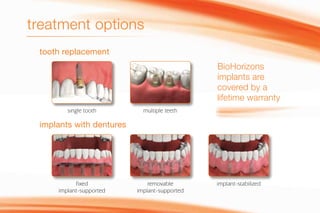
implants with dentures
tooth replacement
single tooth multiple teeth
removable
implant-supported
fixed
implant-supported
implant-stabilized
treatment options
BioHorizons
implants are
covered by a
lifetime warranty
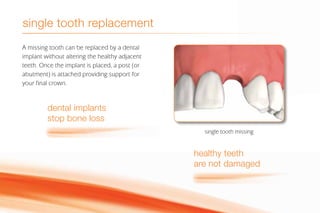
single tooth replacement
A missing tooth can be replaced by a dental
implant without altering the healthy adjacent
teeth. Once the implant is placed, a post (or
abutment) is attached providing support for
your final crown.
dental implants
stop bone loss
healthy teeth
are not damaged
single tooth missing
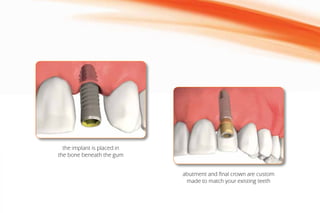
the implant is placed in
the bone beneath the gum
abutment and final crown are custom
made to match your existing teeth
multiple teeth replacement
If you are missing more than one tooth,
dental implants may be your best treatment
option. Multiple implants are placed with
individual crowns or a multi-unit bridge to
rejuvenate your smile.
be proud
of your smile
maintain your
jawbone and gums
missing multiple teeth
abutments and final crowns are custom
made to match your existing teeth
implants are placed in the
bone beneath the gum
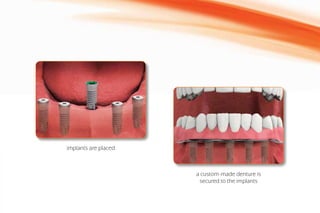
fixed implant-supported denture
If all your upper or lower teeth are missing, a
custom-made denture may be permanently
secured using implants. The number of
implants will vary for each patient. Your new
teeth are firmly supported by the implants,
stimulating the jaw and halting bone loss. Your
dentist can remove the denture when needed
for maintenance and cleaning.
implant-supported dentures
are stable and secure
missing all lower teeth
a custom-made denture is
secured to the implants
implants are placed
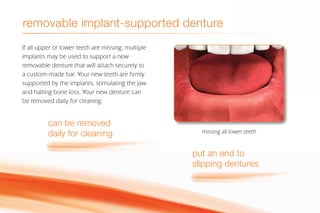
removable implant-supported denture
If all upper or lower teeth are missing, multiple
implants may be used to support a new
removable denture that will attach securely to
a custom-made bar. Your new teeth are firmly
supported by the implants, stimulating the jaw
and halting bone loss. Your new denture can
be removed daily for cleaning.
can be removed
daily for cleaning
put an end to
slipping dentures
missing all lower teeth
implants are placed
a custom-made bar is placed
to secure a removable denture
implant-stabilized denture
If all your lower teeth are missing, another option
may be to stabilize your removable denture using a
small number of implants. This can sometimes be
a cost-effective solution. After healing, abutment
posts are attached to the implants. Your current
denture can sometimes be modified, or a new
denture can be created. Your denture is snapped
into place and can be removed daily for cleaning.
your current denture
can sometimes be used
a cost-effective solution missing all lower teeth
two or more implants are placed
denture is stabilized on implant posts
treatment planning
Your dentist will take x-rays and create a model of your
existing teeth to determine the optimal implant position.
Occasionally, a bone or gum tissue graft will be necessary
to create adequate space for the implants.
implant placement
Dental implants are placed into the bone in a relatively
pain-free procedure. The bone and gums will be given time
to heal before an abutment and crown are attached. In
most cases, you can receive some type of temporary teeth
the same day the implant is placed.
crown placement
Your final crown will be placed once the implant has
bonded, restoring your natural smile.
what to expect
The value of dental implants far exceeds
conventional treatment options. Insurance
policies vary but most cover a portion of the
restorative procedure. Financing options are
often available with competitive interest rates,
and payments can be tailored to your budget.
Contact your dentist or dental implant
specialist for more information about
BioHorizons implants.
implants & insurance
are you a candidate?
Dental implants can be placed in most adults. Adolescents may be
eligible once their facial structure has matured. Certain uncontrolled
medical conditions may decrease implant treatment effectiveness, so
first discuss your full medical history with your dental implant specialist.
Patient results may vary. Only a trained clinician can determine the best
treatment plan. Please ask your dentist to explain the benefits and risks
to see if dental implants are right for you.
renew your
confidence
with dental
implants
Q	 What are dental implants?
A	 Dental implants are the standard of care for tooth replacement. They are bonded with the bone to provide permanent
support for crowns and dentures.
Q	 What will happen without treatment?
A 	 Your jawbone begins to shrink from lack of stimulation. Losing your teeth will affect your smile and change the shape of
	 your face, causing you to look prematurely aged.
Q	 Who is a candidate?
A 	 Dental implants can be placed in most adults. Adolescents may be eligible once their face structure has matured. Please
	 ask your dental implant specialist to explain the benefits and risks to see if dental implants are right for you.
Q	 Is implant placement painful?
A	 No, dental implants are typically placed under local anesthesia. Most treatments can be completed in your clinician’s office.
Q	 How soon may I return to work after treatment?
A	 You may return to work the next day unless otherwise instructed by your clinician. You may be prescribed medication to
alleviate any minor discomfort you may have.
Q	 How long does it take to place dental implants?
A	 They may be placed in as little as 30 to 60 minutes depending on the location and the number of implants placed.
Q	 What if there is not enough bone or gum tissue for the dental implant?
A	 A graft may be needed if your clinician determines there is not sufficient bone or gum tissue.
frequently asked questions
Q	 When will I receive my new teeth?
A	 Treatment time varies by patient.  Typically, you will have some type of temporary teeth until your implants bond to
the bone.  Your clinician can provide a time estimate based on your treatment needs.
Q	 How do I care for my implants?
A	 Home care for your implants consists of brushing and flossing. Regular dental visits are required for long-term
health and success.
Q	 How long can implants last?
A	 Implants can last many years if cared for properly. Many implants have been in place for more than 40 years.
Q	 What is the success rate of dental implants?
A	 BioHorizons dental implants have an extremely high average success rate (99.2%).1
Q	 How does the long-term value of implants compare to other treatment options?
A	 Dental implants are low maintenance and provide stability and confidence in your smile.  Therefore, the long-term
value of dental implants far exceeds conventional treatment options.
Q	 Are dental implants covered by insurance?
A	 Insurance policies vary but most cover a portion of the restorative procedure. Financing options are often available
with competitive interest rates, and payments can be tailored to your budget.
1. Please see Implant Clinical Overview (BioHorizons document ML0130)
For more information visit: www.biohorizons.com
*ML0131*
ML0131
REV B APR 2011

Dental implants

  • 1.
    dental implants for toothreplacement be a confident you
  • 2.
    Anyone missing oneor more teeth understands how tooth loss can make you feel uncomfortable about smiling or eating in public. You may avoid social situations and as a result begin to feel isolated. This could impact your daily life and your self-confidence. smile big Current dental implant treatments can change your life. From a single missing tooth to an entire set of teeth, dental implants restore your appearance, speech, nutrition, oral health, comfort, and self-esteem. So smile big, eat what you want, and be a confident you!
  • 3.
    why replace missingteeth? Losing one or more of your teeth creates a gap in your smile, affects your ability to chew properly, and can alter your diet and nutrition. In addition to these serious issues, tooth loss also causes bone loss. tooth loss causes bone loss When a tooth is lost, the jawbone beneath it shrinks from lack of stimulation. Not only does losing teeth affect your smile, it also changes the shape of your face causing you to look prematurely aged. smile big, eat what you want, be a confident you!
  • 4.
    normal profile after toothloss after bone loss bone loss ages your face prevent premature aging
  • 5.
    Crowns, bridges anddentures address the short-term cosmetic problem of missing teeth but do nothing to stop bone loss. Crown & bridge dentistry requires grinding down healthy teeth leaving them at much greater risk for cavities and tooth failure. Bridges do not stop bone loss. Dentures become uncomfortable and unstable over time as the jawbone shrinks causing eating and speech problems. With dental implants, healthy teeth are not compromised. Dental implants, like natural teeth, stimulate the jaw and stop bone loss. Leading dental organizations recognize dental implants as the standard of care for tooth replacement. why choose dental implants? afterbefore Clinical images courtesy of Cary A. Shapoff, DDS new standard of care for tooth replacement
  • 6.
    traditional crown & bridge dentalimplants with a crown • full chewing ability • preserve healthy teeth • stop bone loss • grinds down healthy teeth • bone loss continues • greater risk for cavities and tooth failure untreated missing teeth • unattractive smile • loss of chewing ability • accelerated bone loss
  • 7.
    what are dentalimplants? tooth implant gum tissue porcelain crown natural tooth implanttooth root jawbone Dental implants are the new standard of care for tooth replacement. They bond with healthy bone and provide permanent support for dental crowns and dentures. Dental implants look and feel like natural teeth and can last a lifetime.
  • 8.
    advancements in implantdentistry BioHorizons implants are treated with our proprietary Laser-Lok technology. This helps your smile remain beautiful over time. Ask your dentist for more information about restoring and maintaining your natural smile with individual dental implants or implant-supported dentures from BioHorizons. the Laser-Lok® advantage BioHorizons uses science and innovation to create unique dental implant products with proven esthetic results. Our implants are lightweight, durable, biocompatible and made from titanium, the most widely used material in implant dentistry. Our dental implants carry a lifetime warranty and are clinically-proven by some of the most thorough and in-depth research in the industry.
  • 9.
    implants with dentures toothreplacement single tooth multiple teeth removable implant-supported fixed implant-supported implant-stabilized treatment options BioHorizons implants are covered by a lifetime warranty
  • 10.
    single tooth replacement Amissing tooth can be replaced by a dental implant without altering the healthy adjacent teeth. Once the implant is placed, a post (or abutment) is attached providing support for your final crown. dental implants stop bone loss healthy teeth are not damaged single tooth missing
  • 11.
    the implant isplaced in the bone beneath the gum abutment and final crown are custom made to match your existing teeth
  • 12.
    multiple teeth replacement Ifyou are missing more than one tooth, dental implants may be your best treatment option. Multiple implants are placed with individual crowns or a multi-unit bridge to rejuvenate your smile. be proud of your smile maintain your jawbone and gums missing multiple teeth
  • 13.
    abutments and finalcrowns are custom made to match your existing teeth implants are placed in the bone beneath the gum
  • 14.
    fixed implant-supported denture Ifall your upper or lower teeth are missing, a custom-made denture may be permanently secured using implants. The number of implants will vary for each patient. Your new teeth are firmly supported by the implants, stimulating the jaw and halting bone loss. Your dentist can remove the denture when needed for maintenance and cleaning. implant-supported dentures are stable and secure missing all lower teeth
  • 15.
    a custom-made dentureis secured to the implants implants are placed
  • 16.
    removable implant-supported denture Ifall upper or lower teeth are missing, multiple implants may be used to support a new removable denture that will attach securely to a custom-made bar. Your new teeth are firmly supported by the implants, stimulating the jaw and halting bone loss. Your new denture can be removed daily for cleaning. can be removed daily for cleaning put an end to slipping dentures missing all lower teeth
  • 17.
    implants are placed acustom-made bar is placed to secure a removable denture
  • 18.
    implant-stabilized denture If allyour lower teeth are missing, another option may be to stabilize your removable denture using a small number of implants. This can sometimes be a cost-effective solution. After healing, abutment posts are attached to the implants. Your current denture can sometimes be modified, or a new denture can be created. Your denture is snapped into place and can be removed daily for cleaning. your current denture can sometimes be used a cost-effective solution missing all lower teeth
  • 19.
    two or moreimplants are placed denture is stabilized on implant posts
  • 20.
    treatment planning Your dentistwill take x-rays and create a model of your existing teeth to determine the optimal implant position. Occasionally, a bone or gum tissue graft will be necessary to create adequate space for the implants. implant placement Dental implants are placed into the bone in a relatively pain-free procedure. The bone and gums will be given time to heal before an abutment and crown are attached. In most cases, you can receive some type of temporary teeth the same day the implant is placed. crown placement Your final crown will be placed once the implant has bonded, restoring your natural smile. what to expect
  • 21.
    The value ofdental implants far exceeds conventional treatment options. Insurance policies vary but most cover a portion of the restorative procedure. Financing options are often available with competitive interest rates, and payments can be tailored to your budget. Contact your dentist or dental implant specialist for more information about BioHorizons implants. implants & insurance are you a candidate? Dental implants can be placed in most adults. Adolescents may be eligible once their facial structure has matured. Certain uncontrolled medical conditions may decrease implant treatment effectiveness, so first discuss your full medical history with your dental implant specialist. Patient results may vary. Only a trained clinician can determine the best treatment plan. Please ask your dentist to explain the benefits and risks to see if dental implants are right for you. renew your confidence with dental implants
  • 22.
    Q What aredental implants? A Dental implants are the standard of care for tooth replacement. They are bonded with the bone to provide permanent support for crowns and dentures. Q What will happen without treatment? A Your jawbone begins to shrink from lack of stimulation. Losing your teeth will affect your smile and change the shape of your face, causing you to look prematurely aged. Q Who is a candidate? A Dental implants can be placed in most adults. Adolescents may be eligible once their face structure has matured. Please ask your dental implant specialist to explain the benefits and risks to see if dental implants are right for you. Q Is implant placement painful? A No, dental implants are typically placed under local anesthesia. Most treatments can be completed in your clinician’s office. Q How soon may I return to work after treatment? A You may return to work the next day unless otherwise instructed by your clinician. You may be prescribed medication to alleviate any minor discomfort you may have. Q How long does it take to place dental implants? A They may be placed in as little as 30 to 60 minutes depending on the location and the number of implants placed. Q What if there is not enough bone or gum tissue for the dental implant? A A graft may be needed if your clinician determines there is not sufficient bone or gum tissue. frequently asked questions
  • 23.
    Q When willI receive my new teeth? A Treatment time varies by patient. Typically, you will have some type of temporary teeth until your implants bond to the bone. Your clinician can provide a time estimate based on your treatment needs. Q How do I care for my implants? A Home care for your implants consists of brushing and flossing. Regular dental visits are required for long-term health and success. Q How long can implants last? A Implants can last many years if cared for properly. Many implants have been in place for more than 40 years. Q What is the success rate of dental implants? A BioHorizons dental implants have an extremely high average success rate (99.2%).1 Q How does the long-term value of implants compare to other treatment options? A Dental implants are low maintenance and provide stability and confidence in your smile. Therefore, the long-term value of dental implants far exceeds conventional treatment options. Q Are dental implants covered by insurance? A Insurance policies vary but most cover a portion of the restorative procedure. Financing options are often available with competitive interest rates, and payments can be tailored to your budget. 1. Please see Implant Clinical Overview (BioHorizons document ML0130)
  • 24.
    For more informationvisit: www.biohorizons.com *ML0131* ML0131 REV B APR 2011