©The McGraw-Hill Companies, 2002
Imperfect competition
©The McGraw-Hill Companies, 2002
1
Most markets fall between the two
extremes of monopoly and perfect
competition
• An imperfectly competitive firm
– would like to sell more at the going price
– faces a downward-sloping demand curve
– recognises its output price depends on the
quantity of goods produced and sold
©The McGraw-Hill Companies, 2002
2
Imperfect competition
• An oligopoly
– an industry with a few producers
– each recognising that its own price depends
both on its own actions and those of its rivals.
• In an industry with monopolistic
competition
– there are many sellers producing products that
are close substitutes for one another
– each firm has only limited ability to influence its
output price.
©The McGraw-Hill Companies, 2002
3
Market structure
Number
of firms
Ability to
affect
price
Entry
barriers
Example
Perfect competition
Imperfect competition:
Monopolistic competition
Oligopoly
Monopoly
Many
Many
Few
One
Nil
Small
Medium
Large
None
None
Some
Huge
Fruit stall
Corner shop
Cars
Post Office
©The McGraw-Hill Companies, 2002
4
The minimum efficient scale and market
demand
• The minimum efficient scale (mes) is the output at
which a firm’s long-run average cost curve stops falling.
• The size of the mes relative to market demand has a
strong influence on market structure.
D
LAC1
LAC2
LAC3
Output
£
©The McGraw-Hill Companies, 2002
5
Monopolistic competition
• Characteristics:
– many firms
– no barriers to entry
– product differentiation
• so the firm faces a downward-sloping demand curve
– The absence of entry barriers means that profits
are competed away...
©The McGraw-Hill Companies, 2002
6
Monopolistic competition (2)
• Firms end up in TANGENCY
EQUILIBRIUM, making
normal profits.
• Firms do not operate at
minimum LAC.
• Price exceeds marginal cost.
• Unlike perfect competition,
the firm here is eager to sell
more at the going market
price.
P1=AC1
£
Output
Q1
D
MR
AC
MC
F
©The McGraw-Hill Companies, 2002
7
Oligopoly
• A market with a few sellers.
• The essence of an oligopolistic industry is the
need for each firm to consider how its own
actions affect the decisions of its relatively
few competitors.
• Oligopoly may be characterised by collusion
or by non-co-operation.
©The McGraw-Hill Companies, 2002
8
Collusion and cartels
• COLLUSION
– an explicit or implicit agreement between existing
firms to avoid or limit competition with one
another.
• CARTEL
– is a situation in which formal agreements between
firms are legally permitted.
• e.g. OPEC
©The McGraw-Hill Companies, 2002
9
Collusion is difficult if
• There are many firms in the industry
• The product is not standardised
• Demand and cost conditions are changing
rapidly
• There are no barriers to entry
• Firms have surplus capacity
©The McGraw-Hill Companies, 2002
10
More on collusion
• The probability of cheating may be affected
by agreement or threats.
• Pre-commitment
– an arrangement, entered voluntarily, restricting
future options.
• Credible threat
– a threat which, after the fact, is optimal to carry
out.
©The McGraw-Hill Companies, 2002
11
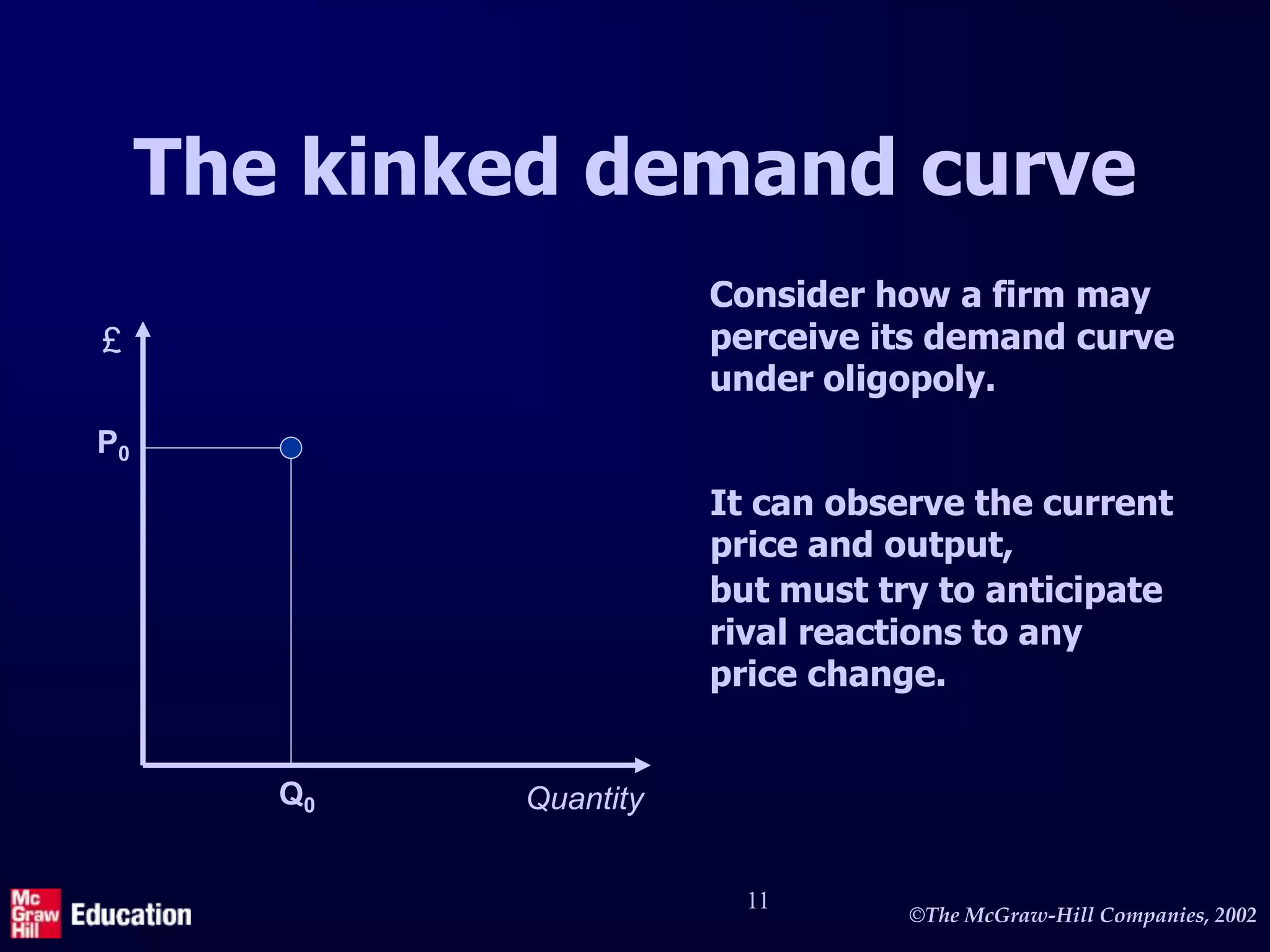
The kinked demand curve
Q0
P0
Quantity
£
Consider how a firm may
perceive its demand curve
under oligopoly.
It can observe the current
price and output,
but must try to anticipate
rival reactions to any
price change.
©The McGraw-Hill Companies, 2002
12
Q0
P0
Quantity
£
The kinked demand curve (2)
The firm may expect rivals
to respond if it reduces
its price, as this will be seen
as an aggressive move
… so demand in response
to a price reduction is likely
to be relatively inelastic.
The demand curve will
be steep below P0.
D
©The McGraw-Hill Companies, 2002
13
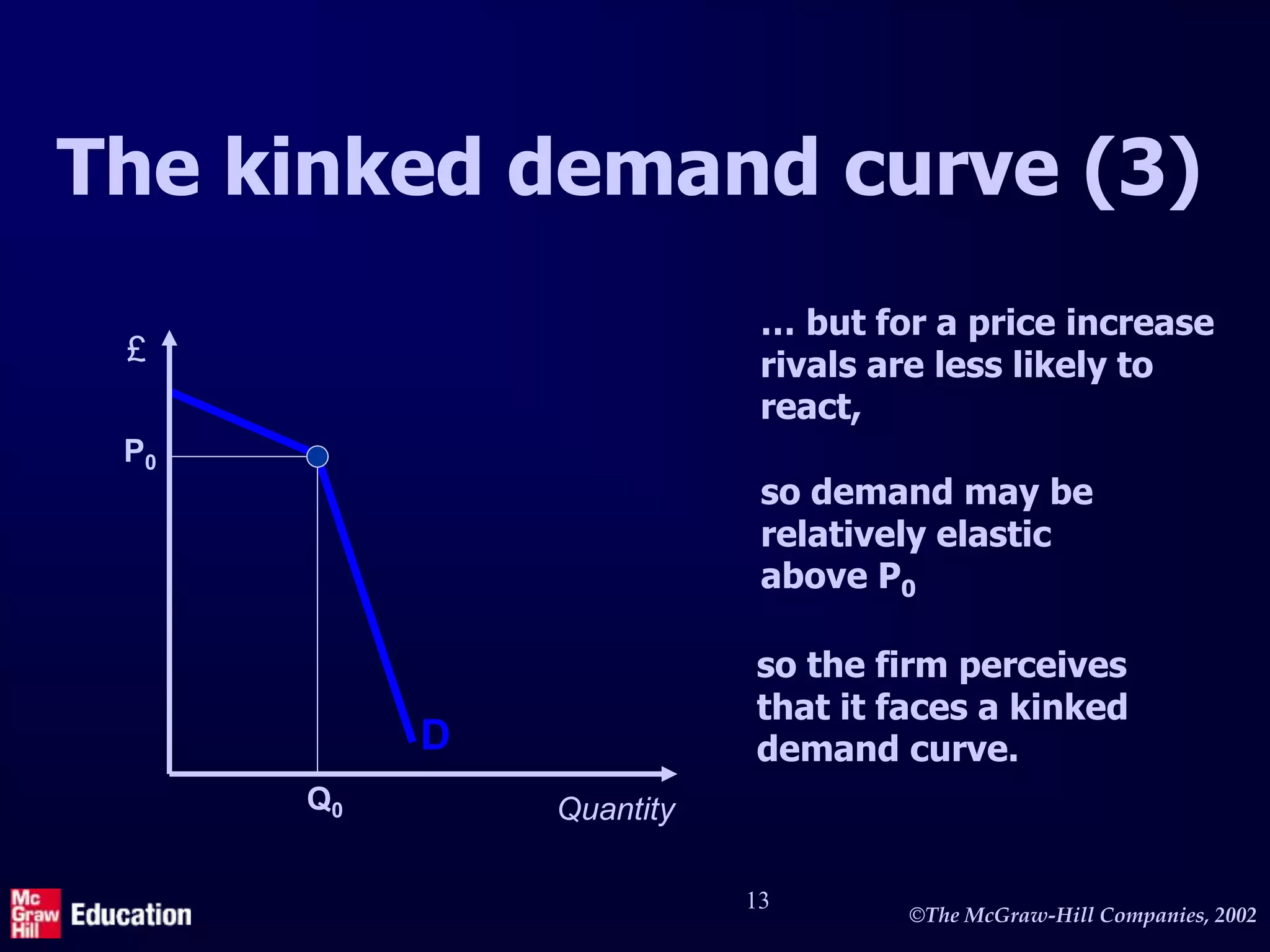
The kinked demand curve (3)
… but for a price increase
rivals are less likely to
react,
so demand may be
relatively elastic
above P0
so the firm perceives
that it faces a kinked
demand curve.
D
Q0
P0
Quantity
£
©The McGraw-Hill Companies, 2002
14
The kinked demand curve (4)
Given this perception, the
firm sees that revenue will
fall whether price is increased
or decreased,
so the best strategy is to keep
price at P0.
Price will tend to be stable,
even in the face of an increase
in marginal cost.
D
Q0
P0
Quantity
£
MC1
MC2
MR
©The McGraw-Hill Companies, 2002
15
RA
The result is the reaction function in
panel (b): the larger the output firm
B is expected to sell the smaller is
the optimal output of A.
Derivation of a firm’s reaction function
MC
QA
QB
QA
£
MR0
D0
QA
0
p0
Assuming firm B produces zero
output, A faces the market demand
curve D0 and it maximises profits by
setting MR0 = MC and producing
QA
0.
p1
QA
1
MR1
D1
When B produces some positive
output, A faces the residual demand
curve D1,sets MR1 = MC and
produces QA
1.
p2
QA
2
MR2
D2
When firm B increases its output, A
sets MR2 = MC and produces QA
2.
©The McGraw-Hill Companies, 2002
16
Nash-Cournot equilibrium
RA
*
A
q A
q
*
B
q E
RB

QA*
QB*
QB
QA
• RA and RB are the
reaction functions for
firms A and B
respectively. Each shows
the best each firm can do
given its expectations
about the other
• E is the Nash-Cournot
equilibrium
• At E, each firm’s guess
about its rival is correct
and neither will wish to
change its behaviour
©The McGraw-Hill Companies, 2002
17
Contestable markets
• A contestable market is characterised by free
entry and free exit
– no sunk costs
– allows hit-and-run entry
• Contestability may constrain incumbent firms
from exploiting their market power.
©The McGraw-Hill Companies, 2002
18
Strategic entry deterrence
• Some entry barriers are deliberately erected
by incumbent firms:
– threat of predatory pricing
– spare capacity
– advertising and R&D
– product proliferation
• Actions that enforce sunk costs on potential
entrants
©The McGraw-Hill Companies, 2002
19
Summary….
• The polar extremes of perfect competition
and monopoly are rarely encountered in
practice.
• Imperfect competition is more the norm.
• Economists used to say ‘market structure
affects conduct which affects performance’.
©The McGraw-Hill Companies, 2002
20
• We now recognise that structure and conduct
are determined simultaneously.
• Potential competition can have an impact on
the behaviour of incumbent firms.
• Many business practices can be rationalised
as strategic competition.
Summary (cont.)

imperfect competition issues.ppt

  • 1.
    ©The McGraw-Hill Companies,2002 Imperfect competition
  • 2.
    ©The McGraw-Hill Companies,2002 1 Most markets fall between the two extremes of monopoly and perfect competition • An imperfectly competitive firm – would like to sell more at the going price – faces a downward-sloping demand curve – recognises its output price depends on the quantity of goods produced and sold
  • 3.
    ©The McGraw-Hill Companies,2002 2 Imperfect competition • An oligopoly – an industry with a few producers – each recognising that its own price depends both on its own actions and those of its rivals. • In an industry with monopolistic competition – there are many sellers producing products that are close substitutes for one another – each firm has only limited ability to influence its output price.
  • 4.
    ©The McGraw-Hill Companies,2002 3 Market structure Number of firms Ability to affect price Entry barriers Example Perfect competition Imperfect competition: Monopolistic competition Oligopoly Monopoly Many Many Few One Nil Small Medium Large None None Some Huge Fruit stall Corner shop Cars Post Office
  • 5.
    ©The McGraw-Hill Companies,2002 4 The minimum efficient scale and market demand • The minimum efficient scale (mes) is the output at which a firm’s long-run average cost curve stops falling. • The size of the mes relative to market demand has a strong influence on market structure. D LAC1 LAC2 LAC3 Output £
  • 6.
    ©The McGraw-Hill Companies,2002 5 Monopolistic competition • Characteristics: – many firms – no barriers to entry – product differentiation • so the firm faces a downward-sloping demand curve – The absence of entry barriers means that profits are competed away...
  • 7.
    ©The McGraw-Hill Companies,2002 6 Monopolistic competition (2) • Firms end up in TANGENCY EQUILIBRIUM, making normal profits. • Firms do not operate at minimum LAC. • Price exceeds marginal cost. • Unlike perfect competition, the firm here is eager to sell more at the going market price. P1=AC1 £ Output Q1 D MR AC MC F
  • 8.
    ©The McGraw-Hill Companies,2002 7 Oligopoly • A market with a few sellers. • The essence of an oligopolistic industry is the need for each firm to consider how its own actions affect the decisions of its relatively few competitors. • Oligopoly may be characterised by collusion or by non-co-operation.
  • 9.
    ©The McGraw-Hill Companies,2002 8 Collusion and cartels • COLLUSION – an explicit or implicit agreement between existing firms to avoid or limit competition with one another. • CARTEL – is a situation in which formal agreements between firms are legally permitted. • e.g. OPEC
  • 10.
    ©The McGraw-Hill Companies,2002 9 Collusion is difficult if • There are many firms in the industry • The product is not standardised • Demand and cost conditions are changing rapidly • There are no barriers to entry • Firms have surplus capacity
  • 11.
    ©The McGraw-Hill Companies,2002 10 More on collusion • The probability of cheating may be affected by agreement or threats. • Pre-commitment – an arrangement, entered voluntarily, restricting future options. • Credible threat – a threat which, after the fact, is optimal to carry out.
  • 12.
    ©The McGraw-Hill Companies,2002 11 The kinked demand curve Q0 P0 Quantity £ Consider how a firm may perceive its demand curve under oligopoly. It can observe the current price and output, but must try to anticipate rival reactions to any price change.
  • 13.
    ©The McGraw-Hill Companies,2002 12 Q0 P0 Quantity £ The kinked demand curve (2) The firm may expect rivals to respond if it reduces its price, as this will be seen as an aggressive move … so demand in response to a price reduction is likely to be relatively inelastic. The demand curve will be steep below P0. D
  • 14.
    ©The McGraw-Hill Companies,2002 13 The kinked demand curve (3) … but for a price increase rivals are less likely to react, so demand may be relatively elastic above P0 so the firm perceives that it faces a kinked demand curve. D Q0 P0 Quantity £
  • 15.
    ©The McGraw-Hill Companies,2002 14 The kinked demand curve (4) Given this perception, the firm sees that revenue will fall whether price is increased or decreased, so the best strategy is to keep price at P0. Price will tend to be stable, even in the face of an increase in marginal cost. D Q0 P0 Quantity £ MC1 MC2 MR
  • 16.
    ©The McGraw-Hill Companies,2002 15 RA The result is the reaction function in panel (b): the larger the output firm B is expected to sell the smaller is the optimal output of A. Derivation of a firm’s reaction function MC QA QB QA £ MR0 D0 QA 0 p0 Assuming firm B produces zero output, A faces the market demand curve D0 and it maximises profits by setting MR0 = MC and producing QA 0. p1 QA 1 MR1 D1 When B produces some positive output, A faces the residual demand curve D1,sets MR1 = MC and produces QA 1. p2 QA 2 MR2 D2 When firm B increases its output, A sets MR2 = MC and produces QA 2.
  • 17.
    ©The McGraw-Hill Companies,2002 16 Nash-Cournot equilibrium RA * A q A q * B q E RB  QA* QB* QB QA • RA and RB are the reaction functions for firms A and B respectively. Each shows the best each firm can do given its expectations about the other • E is the Nash-Cournot equilibrium • At E, each firm’s guess about its rival is correct and neither will wish to change its behaviour
  • 18.
    ©The McGraw-Hill Companies,2002 17 Contestable markets • A contestable market is characterised by free entry and free exit – no sunk costs – allows hit-and-run entry • Contestability may constrain incumbent firms from exploiting their market power.
  • 19.
    ©The McGraw-Hill Companies,2002 18 Strategic entry deterrence • Some entry barriers are deliberately erected by incumbent firms: – threat of predatory pricing – spare capacity – advertising and R&D – product proliferation • Actions that enforce sunk costs on potential entrants
  • 20.
    ©The McGraw-Hill Companies,2002 19 Summary…. • The polar extremes of perfect competition and monopoly are rarely encountered in practice. • Imperfect competition is more the norm. • Economists used to say ‘market structure affects conduct which affects performance’.
  • 21.
    ©The McGraw-Hill Companies,2002 20 • We now recognise that structure and conduct are determined simultaneously. • Potential competition can have an impact on the behaviour of incumbent firms. • Many business practices can be rationalised as strategic competition. Summary (cont.)