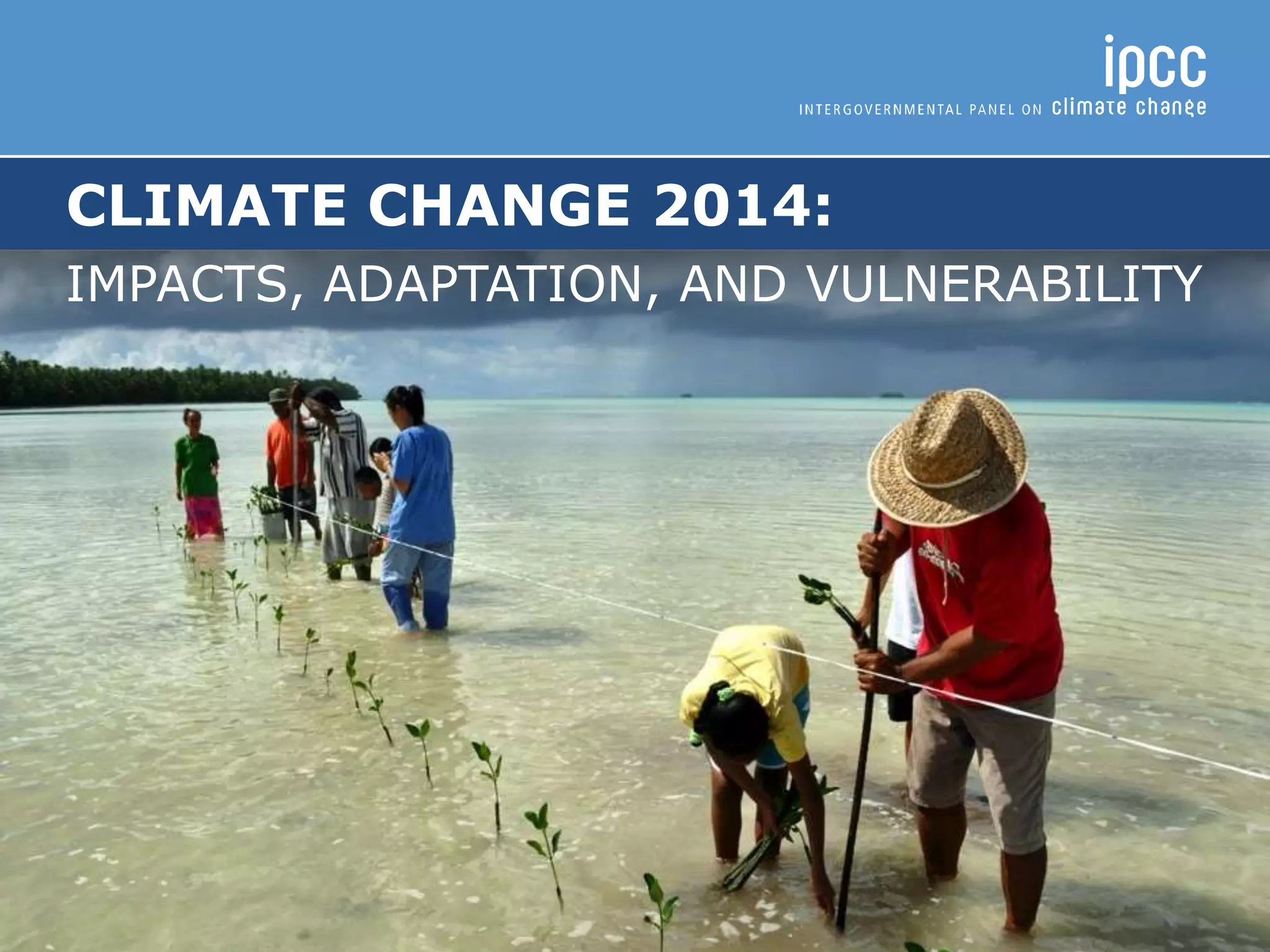
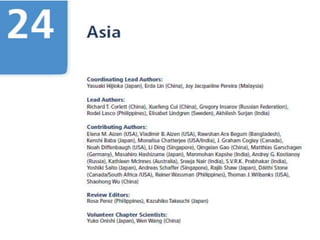
CLIMATE CHANGE 2014:
IMPACTS, ADAPTATION, AND VULNERABILITY
A CHANGING WORLD
WIDESPREAD
OBSERVED IMPACTS
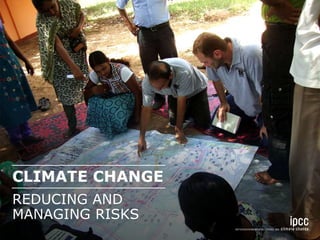
CLIMATE CHANGE
REDUCING AND
MANAGING RISKS
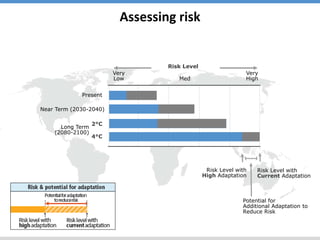
Risk Level with
Current Adaptation
Risk Level
Very
Low Med
Very
High
4°C
2°C
Present
Long Term
(2080-2100)
Near Term (2030-2040)
Assessing risk
Potential for
Additional Adaptation to
Reduce Risk
Risk Level with
High Adaptation
6
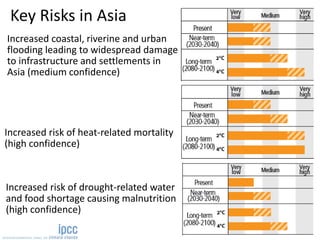
Increased coastal, riverine and urban
flooding leading to widespread damage
to infrastructure and settlements in
Asia (medium confidence)
Increased risk of heat-related mortality
(high confidence)
Increased risk of drought-related water
and food shortage causing malnutrition
(high confidence)
Key Risks in Asia
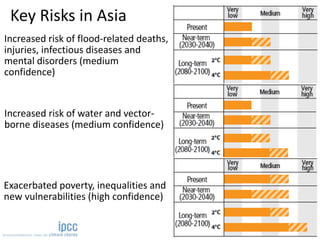
Exacerbated poverty, inequalities and
new vulnerabilities (high confidence)
Increased risk of flood-related deaths,
injuries, infectious diseases and
mental disorders (medium
confidence)
Increased risk of water and vector-
borne diseases (medium confidence)
Key Risks in Asia
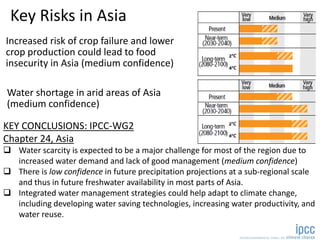
Increased risk of crop failure and lower
crop production could lead to food
insecurity in Asia (medium confidence)
Key Risks in Asia
Water shortage in arid areas of Asia
(medium confidence)
KEY CONCLUSIONS: IPCC-WG2
Chapter 24, Asia
 Water scarcity is expected to be a major challenge for most of the region due to
increased water demand and lack of good management (medium confidence)
 There is low confidence in future precipitation projections at a sub-regional scale
and thus in future freshwater availability in most parts of Asia.
 Integrated water management strategies could help adapt to climate change,
including developing water saving technologies, increasing water productivity, and
water reuse.
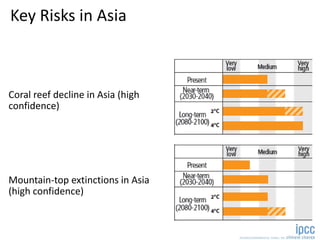
Mountain-top extinctions in Asia
(high confidence)
Coral reef decline in Asia (high
confidence)
Key Risks in Asia
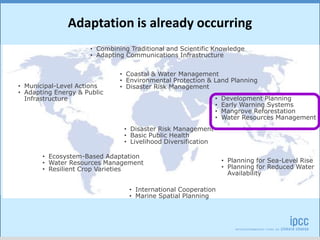
• Disaster Risk Management
• Basic Public Health
• Livelihood Diversification
• Coastal & Water Management
• Environmental Protection & Land Planning
• Disaster Risk Management
• Development Planning
• Early Warning Systems
• Mangrove Reforestation
• Water Resources Management
• Planning for Sea-Level Rise
• Planning for Reduced Water
Availability
• Municipal-Level Actions
• Adapting Energy & Public
Infrastructure
• Ecosystem-Based Adaptation
• Water Resources Management
• Resilient Crop Varieties
• Combining Traditional and Scientific Knowledge
• Adapting Communications Infrastructure
• International Cooperation
• Marine Spatial Planning
Adaptation is already occurring
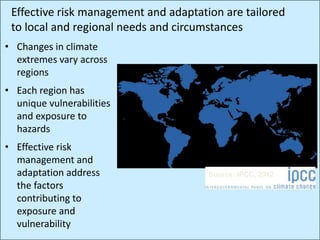
• Changes in climate
extremes vary across
regions
• Each region has
unique vulnerabilities
and exposure to
hazards
• Effective risk
management and
adaptation address
the factors
contributing to
exposure and
vulnerability
Effective risk management and adaptation are tailored
to local and regional needs and circumstances
Source: IPCC, 2012
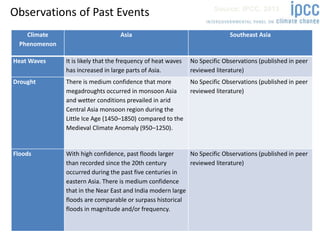
Climate
Phenomenon
Asia Southeast Asia
Heat Waves It is likely that the frequency of heat waves
has increased in large parts of Asia.
No Specific Observations (published in peer
reviewed literature)
Drought There is medium confidence that more
megadroughts occurred in monsoon Asia
and wetter conditions prevailed in arid
Central Asia monsoon region during the
Little Ice Age (1450–1850) compared to the
Medieval Climate Anomaly (950–1250).
No Specific Observations (published in peer
reviewed literature)
Floods With high confidence, past floods larger
than recorded since the 20th century
occurred during the past five centuries in
eastern Asia. There is medium confidence
that in the Near East and India modern large
floods are comparable or surpass historical
floods in magnitude and/or frequency.
No Specific Observations (published in peer
reviewed literature)
Observations of Past Events Source: IPCC, 2013
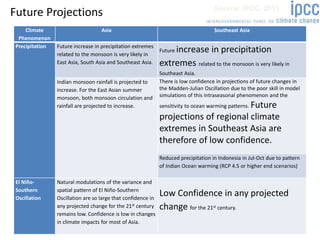
Climate
Phenomenon
Asia Southeast Asia
Precipitation Future increase in precipitation extremes
related to the monsoon is very likely in
East Asia, South Asia and Southeast Asia.
Future increase in precipitation
extremes related to the monsoon is very likely in
Southeast Asia.
Indian monsoon rainfall is projected to
increase. For the East Asian summer
monsoon, both monsoon circulation and
rainfall are projected to increase.
There is low confidence in projections of future changes in
the Madden-Julian Oscillation due to the poor skill in model
simulations of this intraseasonal phenomenon and the
sensitivity to ocean warming patterns. Future
projections of regional climate
extremes in Southeast Asia are
therefore of low confidence.
Reduced precipitation in Indonesia in Jul-Oct due to pattern
of Indian Ocean warming (RCP 4.5 or higher end scenarios)
El Niño-
Southern
Oscillation
Natural modulations of the variance and
spatial pattern of El Niño-Southern
Oscillation are so large that confidence in
any projected change for the 21st century
remains low. Confidence is low in changes
in climate impacts for most of Asia.
Low Confidence in any projected
change for the 21st century.
Future Projections Source: IPCC, 2013
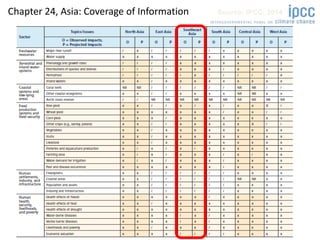
Chapter 24, Asia: Coverage of Information Source: IPCC, 2014
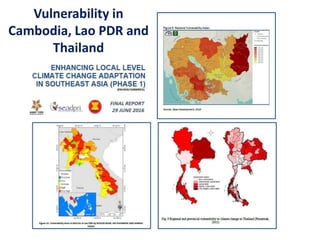
Vulnerability in
Cambodia, Lao PDR and
Thailand

Impacts, Adaptation, and Vulnerability

  • 1.
    CLIMATE CHANGE 2014: IMPACTS,ADAPTATION, AND VULNERABILITY
  • 3.
  • 4.
  • 5.
    Risk Level with CurrentAdaptation Risk Level Very Low Med Very High 4°C 2°C Present Long Term (2080-2100) Near Term (2030-2040) Assessing risk Potential for Additional Adaptation to Reduce Risk Risk Level with High Adaptation
  • 6.
  • 7.
    Increased coastal, riverineand urban flooding leading to widespread damage to infrastructure and settlements in Asia (medium confidence) Increased risk of heat-related mortality (high confidence) Increased risk of drought-related water and food shortage causing malnutrition (high confidence) Key Risks in Asia
  • 8.
    Exacerbated poverty, inequalitiesand new vulnerabilities (high confidence) Increased risk of flood-related deaths, injuries, infectious diseases and mental disorders (medium confidence) Increased risk of water and vector- borne diseases (medium confidence) Key Risks in Asia
  • 9.
    Increased risk ofcrop failure and lower crop production could lead to food insecurity in Asia (medium confidence) Key Risks in Asia Water shortage in arid areas of Asia (medium confidence) KEY CONCLUSIONS: IPCC-WG2 Chapter 24, Asia  Water scarcity is expected to be a major challenge for most of the region due to increased water demand and lack of good management (medium confidence)  There is low confidence in future precipitation projections at a sub-regional scale and thus in future freshwater availability in most parts of Asia.  Integrated water management strategies could help adapt to climate change, including developing water saving technologies, increasing water productivity, and water reuse.
  • 10.
    Mountain-top extinctions inAsia (high confidence) Coral reef decline in Asia (high confidence) Key Risks in Asia
  • 11.
    • Disaster RiskManagement • Basic Public Health • Livelihood Diversification • Coastal & Water Management • Environmental Protection & Land Planning • Disaster Risk Management • Development Planning • Early Warning Systems • Mangrove Reforestation • Water Resources Management • Planning for Sea-Level Rise • Planning for Reduced Water Availability • Municipal-Level Actions • Adapting Energy & Public Infrastructure • Ecosystem-Based Adaptation • Water Resources Management • Resilient Crop Varieties • Combining Traditional and Scientific Knowledge • Adapting Communications Infrastructure • International Cooperation • Marine Spatial Planning Adaptation is already occurring
  • 12.
    • Changes inclimate extremes vary across regions • Each region has unique vulnerabilities and exposure to hazards • Effective risk management and adaptation address the factors contributing to exposure and vulnerability Effective risk management and adaptation are tailored to local and regional needs and circumstances Source: IPCC, 2012
  • 13.
    Climate Phenomenon Asia Southeast Asia HeatWaves It is likely that the frequency of heat waves has increased in large parts of Asia. No Specific Observations (published in peer reviewed literature) Drought There is medium confidence that more megadroughts occurred in monsoon Asia and wetter conditions prevailed in arid Central Asia monsoon region during the Little Ice Age (1450–1850) compared to the Medieval Climate Anomaly (950–1250). No Specific Observations (published in peer reviewed literature) Floods With high confidence, past floods larger than recorded since the 20th century occurred during the past five centuries in eastern Asia. There is medium confidence that in the Near East and India modern large floods are comparable or surpass historical floods in magnitude and/or frequency. No Specific Observations (published in peer reviewed literature) Observations of Past Events Source: IPCC, 2013
  • 14.
    Climate Phenomenon Asia Southeast Asia PrecipitationFuture increase in precipitation extremes related to the monsoon is very likely in East Asia, South Asia and Southeast Asia. Future increase in precipitation extremes related to the monsoon is very likely in Southeast Asia. Indian monsoon rainfall is projected to increase. For the East Asian summer monsoon, both monsoon circulation and rainfall are projected to increase. There is low confidence in projections of future changes in the Madden-Julian Oscillation due to the poor skill in model simulations of this intraseasonal phenomenon and the sensitivity to ocean warming patterns. Future projections of regional climate extremes in Southeast Asia are therefore of low confidence. Reduced precipitation in Indonesia in Jul-Oct due to pattern of Indian Ocean warming (RCP 4.5 or higher end scenarios) El Niño- Southern Oscillation Natural modulations of the variance and spatial pattern of El Niño-Southern Oscillation are so large that confidence in any projected change for the 21st century remains low. Confidence is low in changes in climate impacts for most of Asia. Low Confidence in any projected change for the 21st century. Future Projections Source: IPCC, 2013
  • 15.
    Chapter 24, Asia:Coverage of Information Source: IPCC, 2014
  • 16.