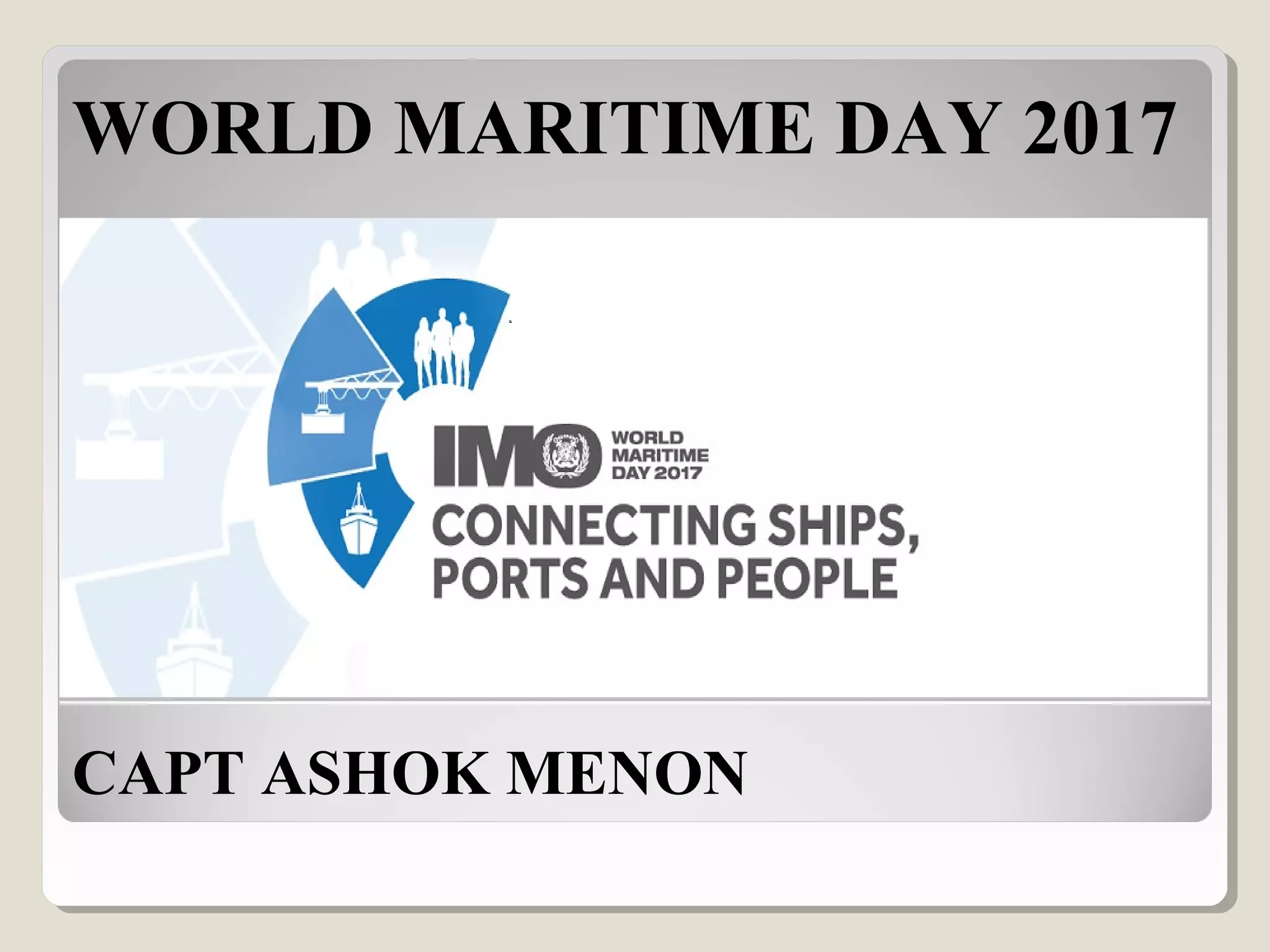

WORLD MARITIME DAY 2017
CAPT ASHOK MENON
World Maritime Day is an official
United Nations day.
World Maritime Day was first held on
March 17, 1978 to mark the date of
the IMO Convention’s entry into force
in 1958.
There is no doubt that the Maritime
Industry is all about connecting people
and their resources.
Today the world is dependent on the
Maritime Industry for the majority of
our needs.
When we discuss World Maritime Day,
we need to look at it in three
perspectives.
1.History
2.Present Day scenario
3.Challenges for the future
1. History
History helps us to understand our
beginnings and thereby, where we
stand today as we prepare for a better
tomorrow. It teaches us many lessons
of life.
Let us go back a few thousands of
years.
We see people in coastal areas
venturing out to sea for fishing.
Later on the sea began to be used for
trade and commerce.
The Phoenicians were arguably the
first people to trade via the high seas.
They flourished between 3000 BC
and 500 BC a period spanning nearly
2500 years in Phoenicia, now divided
between Syria, Lebanon and Israel.
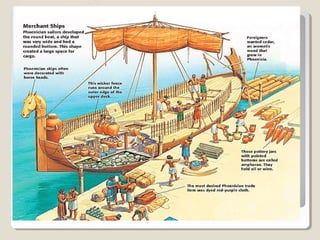
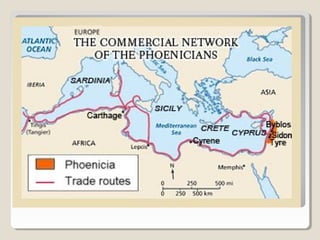
The Phoenicians traded in a variety
of items such as dates, dye, wood,
oil, wine and other items found
locally. Their empire flourished
across the Mediterranean sea.
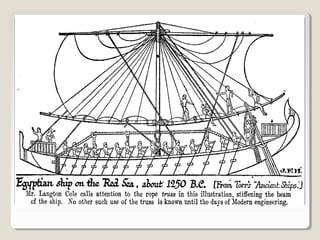
By around 1300 BC the Egyptians
made their mark in International
shipping connecting peoples
across the continents of Asia and
Africa through trade and
commerce.
At around the same time India’s
Maritime History made a good
beginning with trade with
Mesopotamia and the Romans via
the sea link and started the spice
and silk trade..
India’s maritime history predates
the birth of Western civilization.
The world’s first tidal dock is
believed to have been built at
Lothal (Gujarat )around 2300 BCE
during the Harappan civilization.
Since then India has had robust
maritime trade links with countries
near and far especially Greece,
Mediterranean countries, East and
South Asia.
By the third century BC the
Macedonians became a force to
reckon with and took over the
interests of the Phoenicians. The
greatest of them was Alexander
the Great.
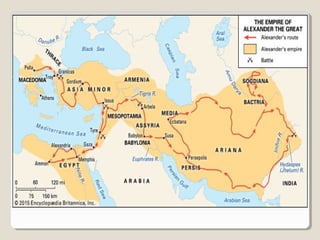
Alexander created the greatest
empire stretching from Greece to
India. He connected the cultures
and people across oceans and
deserts. He was perhaps the
greatest Emperor of them all.
After the Macedonians the
Chinese Junks, the Polynesians
and the Vikings ruled the seas, till
1000 A.D.
Meanwhile the Arabs established
their domain in the Middle East.
From the thirteenth century
Northern European countries
formed the Hanseatic League and
took over the maritime trade over
most of Europe.
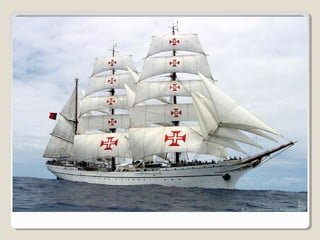
The European  Maritime  Industry 
received a boost with Portugal, when  
a  maritime  school  in was  started 
there. This led Portugal to develop the 
most  advanced  ships,  and  take  over 
world trade
Soon the British, French and
Spain joined the bandwagon of
global maritime trade and
commerce resulting finally in
where we stand today.
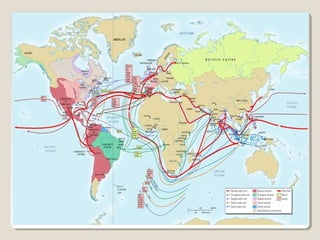
2. Present Day scenario
Today  the  world  is  connected  across 
boundaries  resulting  in  a  complete 
connectivity between ships, ports and 
people.  Maritime  Industry  is  central 
to this connectivity.
Huge passenger ships carrying
thousands of passengers connect
them across the oceans in a
matter of days. They bring with
them the wealth of their culture
and improve the economy.
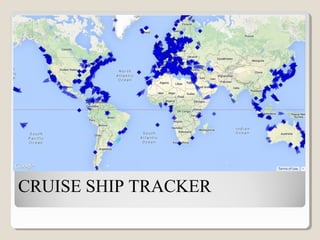
CRUISE SHIP TRACKER
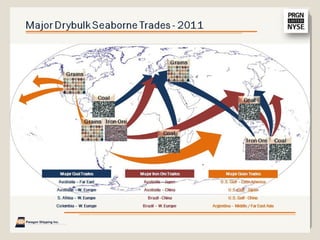
Cargo ships carry cargoes to
every corner of the world touching
the life of each one of us. Most of
the items we use in our daily life
has been transported across the
oceans by these ships.
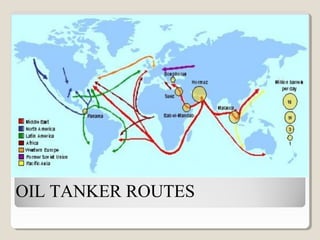
Tankers carry millions of tons of oil
to remote places providing much
needed fuel for transport, heating,
cooking etc. The world would have
been out of connect without the
services of these ships.
OIL TANKER ROUTES
Ports are the facilitators of ship and
cargo movement. They are central to
the connectivity provided by ships.
No ship can travel anywhere without
safe and efficient ports. Thus ports are
an important aspect of this connect.
People are perhaps the most essential
and important connection for the
maritime industry. No matter what
developments in technolgy comes
about in the future ship will always
need to be connected by seafarers.
Today’s world is all about
connectivity.
Technology has led the way for people
to connect with each other.
Earlier once a seafarer joined the ship
he could only connect with people
ashore once he reached port.
With satellite technology this changed
and vessels could contact and be
contacted at any time.
This facilitated both official
communication as well as the seafarers
personal communication needs.
Today, with the social media explosion
vessels have internet on board with
Skype , Facebook , Whatsapp, etc,
which ensured 24 hours connectivity
with the people ashore. This perhaps
has been a major boon for seafarers.
3. Challenges for the future
There is no doubt that the major
challenge for shipping is Security,
Safety and Sustainability.
Two recent incidents have highlighted
our vulnerability both ashore and at sea
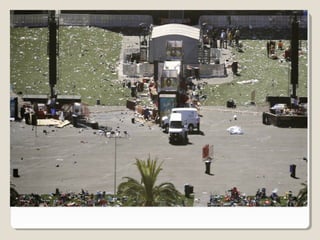
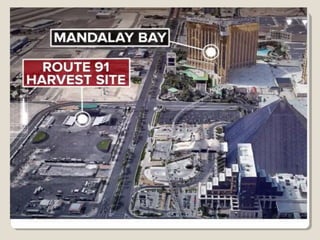
First was the Las Vegas incident where
a lone wolf managed to elude the
sophisticated security set up of the
worlds Super Cop, killing over 59
people and injuring more than five
hundred people at a music festival.
Thus we worry about the future safety
of ports and the consequence if a
similar lone psychopath were to board
the ship and unleash violence and death
on the innocent seafarers.
What needs to be done??
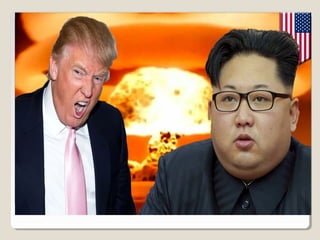
Second is the standoff between USA
and North Korea. One shudders at the
repercussions of an attack or a war
between the two of them, which would
surely escalate into the World War in
no time, needlessly dragging the world
into a crisis.
The question that arises is : Are we
prepared for such a scenario ?
As a country??
As a Flag State?
As a Shipping Company?
As individuals?
IMO's efforts to connect ships, ports
and people requires ports and port
facilities to have a well-coordinated,
risk-based preventive strategy to beef
up their security, and this should be a
vital element in port operations.
Similarly there is a real fear that the
ISPS on board may be reduced to an
exercise in documentation which may
well result in a security related
incident. Thus we have to prepared in
advance and take it seriously.
Safety is another thrust of IMO’s effort
this World Maritime Day. Whether in
port or on board vessels safety is
unfortunately found wanting at the
hands of commercial exigencies. There
is no doubt that Safety must be First.
Seafarers can show their concern for
safety in very simple manner – follow
the company SMS in letter and spirit.
Similarly Ship managers must not
count the bucks while maintaining
safety on board vessels.
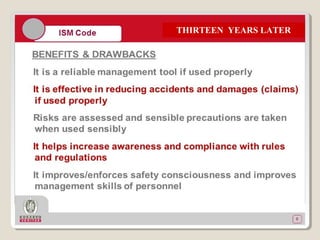
Once again there is a real fear that the
ISM implementation on board many
ships is reduced to documentation.
Reporting of ten Near Misses in a week
do not make for a safe ship. Safety is a
culture which needs to be imbibed.
THIRTEEN YEARS LATER
Ports and Port Facilities can improve
safety in many ways. Although the list
is large, some of them are as follows:
- Ensuring vessels safety and security
when waiting for and picking up pilots
-Ensure proper navigational buoys,
channel markers and so on is in place
-Providing alternative power supplies
for ships in port,
- Perform their functions cleanly and
efficiently.
- Include garbage and sludge collection
in port dues and ensure facilities
available at all ports for garbage and
sludge collection. This will be a big
boost towards prevention of pollution
at sea without headache for ships.
Sustainability
Energy efficiency and sustainable
development go hand in hand.
IMO has mooted many measures for
energy efficiency such as SEEMP,
VOC Management Plan etc.
Now, it is upto the Ship Managers and
Ship staff to ensure holistic
implementation of the same as we look
towards a better and brighter future.
Only then can we bequeath a better
world to our next generations.
THANK YOU

Imo world maritime day 2017

  • 1.
    WORLD MARITIME DAY2017 CAPT ASHOK MENON
  • 2.
    World Maritime Dayis an official United Nations day. World Maritime Day was first held on March 17, 1978 to mark the date of the IMO Convention’s entry into force in 1958.
  • 3.
    There is nodoubt that the Maritime Industry is all about connecting people and their resources. Today the world is dependent on the Maritime Industry for the majority of our needs.
  • 4.
    When we discussWorld Maritime Day, we need to look at it in three perspectives. 1.History 2.Present Day scenario 3.Challenges for the future
  • 5.
    1. History History helpsus to understand our beginnings and thereby, where we stand today as we prepare for a better tomorrow. It teaches us many lessons of life.
  • 6.
    Let us goback a few thousands of years. We see people in coastal areas venturing out to sea for fishing. Later on the sea began to be used for trade and commerce.
  • 7.
    The Phoenicians werearguably the first people to trade via the high seas. They flourished between 3000 BC and 500 BC a period spanning nearly 2500 years in Phoenicia, now divided between Syria, Lebanon and Israel.
  • 9.
    The Phoenicians tradedin a variety of items such as dates, dye, wood, oil, wine and other items found locally. Their empire flourished across the Mediterranean sea.
  • 11.
    By around 1300BC the Egyptians made their mark in International shipping connecting peoples across the continents of Asia and Africa through trade and commerce.
  • 13.
    At around thesame time India’s Maritime History made a good beginning with trade with Mesopotamia and the Romans via the sea link and started the spice and silk trade..
  • 14.
    India’s maritime historypredates the birth of Western civilization. The world’s first tidal dock is believed to have been built at Lothal (Gujarat )around 2300 BCE during the Harappan civilization.
  • 15.
    Since then Indiahas had robust maritime trade links with countries near and far especially Greece, Mediterranean countries, East and South Asia.
  • 17.
    By the thirdcentury BC the Macedonians became a force to reckon with and took over the interests of the Phoenicians. The greatest of them was Alexander the Great.
  • 18.
    Alexander created thegreatest empire stretching from Greece to India. He connected the cultures and people across oceans and deserts. He was perhaps the greatest Emperor of them all.
  • 20.
    After the Macedoniansthe Chinese Junks, the Polynesians and the Vikings ruled the seas, till 1000 A.D. Meanwhile the Arabs established their domain in the Middle East.
  • 21.
    From the thirteenthcentury Northern European countries formed the Hanseatic League and took over the maritime trade over most of Europe.
  • 22.
    The European  Maritime  Industry  received a boost with Portugal, when   a maritime  school  in was  started  there. This led Portugal to develop the  most  advanced  ships,  and  take  over  world trade
  • 24.
    Soon the British,French and Spain joined the bandwagon of global maritime trade and commerce resulting finally in where we stand today.
  • 25.
    2. Present Dayscenario Today  the  world  is  connected  across  boundaries  resulting  in  a  complete  connectivity between ships, ports and  people.  Maritime  Industry  is  central  to this connectivity.
  • 27.
    Huge passenger shipscarrying thousands of passengers connect them across the oceans in a matter of days. They bring with them the wealth of their culture and improve the economy.
  • 28.
  • 29.
    Cargo ships carrycargoes to every corner of the world touching the life of each one of us. Most of the items we use in our daily life has been transported across the oceans by these ships.
  • 31.
    Tankers carry millionsof tons of oil to remote places providing much needed fuel for transport, heating, cooking etc. The world would have been out of connect without the services of these ships.
  • 32.
  • 33.
    Ports are thefacilitators of ship and cargo movement. They are central to the connectivity provided by ships. No ship can travel anywhere without safe and efficient ports. Thus ports are an important aspect of this connect.
  • 34.
    People are perhapsthe most essential and important connection for the maritime industry. No matter what developments in technolgy comes about in the future ship will always need to be connected by seafarers.
  • 37.
    Today’s world isall about connectivity. Technology has led the way for people to connect with each other. Earlier once a seafarer joined the ship he could only connect with people ashore once he reached port.
  • 38.
    With satellite technologythis changed and vessels could contact and be contacted at any time. This facilitated both official communication as well as the seafarers personal communication needs.
  • 39.
    Today, with thesocial media explosion vessels have internet on board with Skype , Facebook , Whatsapp, etc, which ensured 24 hours connectivity with the people ashore. This perhaps has been a major boon for seafarers.
  • 40.
    3. Challenges forthe future There is no doubt that the major challenge for shipping is Security, Safety and Sustainability. Two recent incidents have highlighted our vulnerability both ashore and at sea
  • 41.
    First was theLas Vegas incident where a lone wolf managed to elude the sophisticated security set up of the worlds Super Cop, killing over 59 people and injuring more than five hundred people at a music festival.
  • 44.
    Thus we worryabout the future safety of ports and the consequence if a similar lone psychopath were to board the ship and unleash violence and death on the innocent seafarers. What needs to be done??
  • 45.
    Second is thestandoff between USA and North Korea. One shudders at the repercussions of an attack or a war between the two of them, which would surely escalate into the World War in no time, needlessly dragging the world into a crisis.
  • 47.
    The question thatarises is : Are we prepared for such a scenario ? As a country?? As a Flag State? As a Shipping Company? As individuals?
  • 48.
    IMO's efforts toconnect ships, ports and people requires ports and port facilities to have a well-coordinated, risk-based preventive strategy to beef up their security, and this should be a vital element in port operations.
  • 49.
    Similarly there isa real fear that the ISPS on board may be reduced to an exercise in documentation which may well result in a security related incident. Thus we have to prepared in advance and take it seriously.
  • 50.
    Safety is anotherthrust of IMO’s effort this World Maritime Day. Whether in port or on board vessels safety is unfortunately found wanting at the hands of commercial exigencies. There is no doubt that Safety must be First.
  • 51.
    Seafarers can showtheir concern for safety in very simple manner – follow the company SMS in letter and spirit. Similarly Ship managers must not count the bucks while maintaining safety on board vessels.
  • 52.
    Once again thereis a real fear that the ISM implementation on board many ships is reduced to documentation. Reporting of ten Near Misses in a week do not make for a safe ship. Safety is a culture which needs to be imbibed.
  • 53.
  • 54.
    Ports and PortFacilities can improve safety in many ways. Although the list is large, some of them are as follows: - Ensuring vessels safety and security when waiting for and picking up pilots
  • 55.
    -Ensure proper navigationalbuoys, channel markers and so on is in place -Providing alternative power supplies for ships in port, - Perform their functions cleanly and efficiently.
  • 56.
    - Include garbageand sludge collection in port dues and ensure facilities available at all ports for garbage and sludge collection. This will be a big boost towards prevention of pollution at sea without headache for ships.
  • 57.
    Sustainability Energy efficiency andsustainable development go hand in hand. IMO has mooted many measures for energy efficiency such as SEEMP, VOC Management Plan etc.
  • 58.
    Now, it isupto the Ship Managers and Ship staff to ensure holistic implementation of the same as we look towards a better and brighter future. Only then can we bequeath a better world to our next generations.
  • 60.