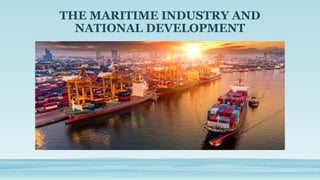
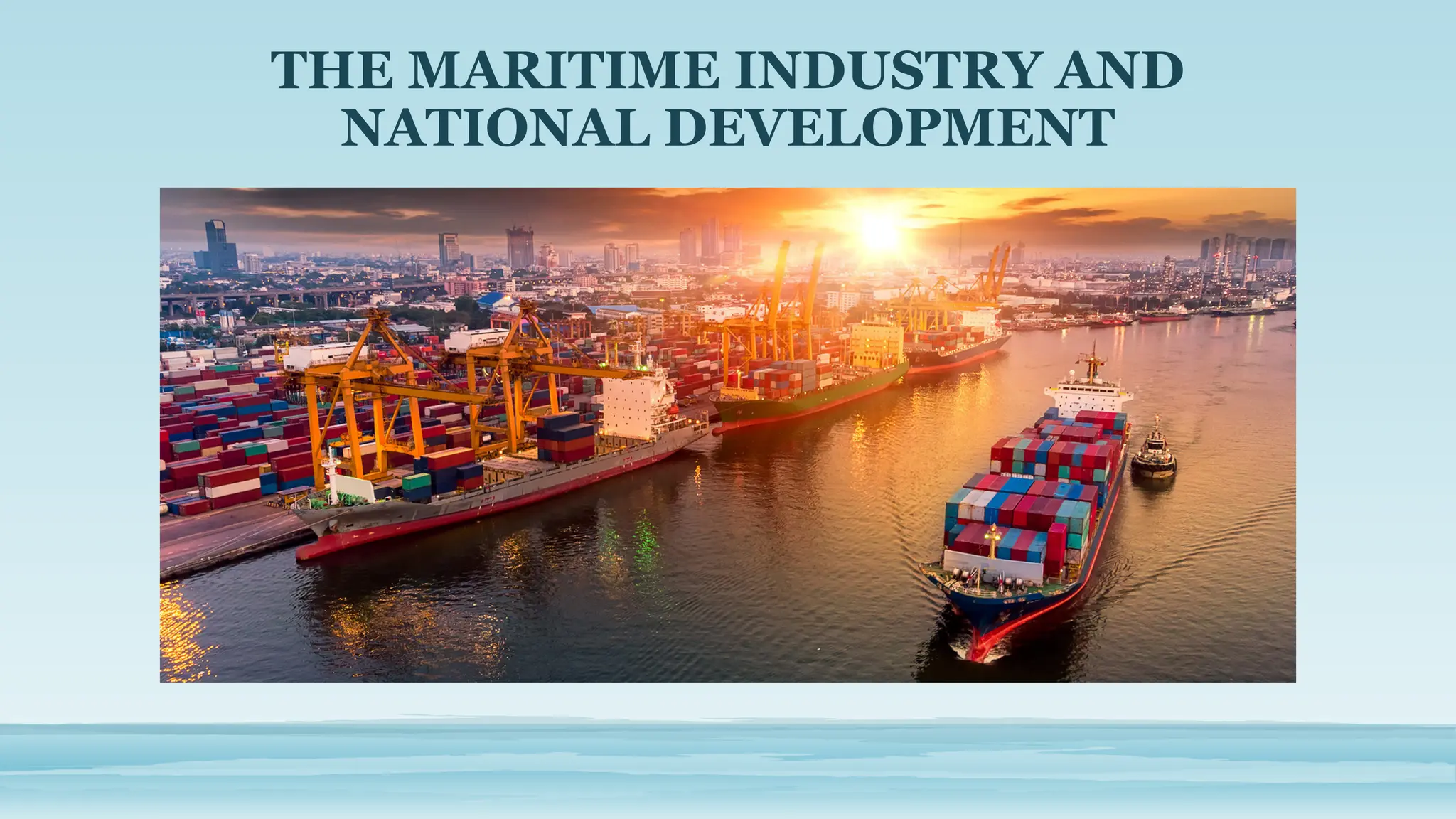
THE MARITIME INDUSTRY AND
NATIONAL DEVELOPMENT
Learning Outcomes
• Explain the economic, ecological, and social importance of
oceans.
• Discuss the role of maritime industry in the global ocean
trading.
• Appreciate the important functions of the Philippine maritime
industry towards national development.
• Produce and present a documentary focused on the role and
achievement of the Philippine maritime industry in the
country’s economic and national development.
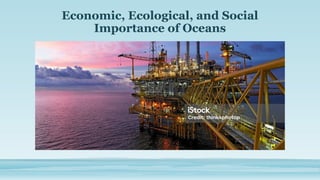
Economic, Ecological, and Social
Importance of Oceans
The oceans have long been
recognized as one of
humanity's most important
natural resources. Their
vastness has made them
appear to be limitless
sources of food,
transportation, recreation,
and awe. The difficulty of
fencing and policing them
has left them largely as open
access resources to be
exploited by anyone with
the means.
However, in recent times we
have begun to reach the
limits of the oceans and
must now begin to utilize
and govern them in a more
sustainable way. In addition
to their traditional
importance as sources of
primary and secondary
production, and
biodiversity, the importance
of the oceans in global
material and energy cycles
is now beginning to be
better appreciated.
The oceans have been
estimated to contribute a
total of like 21 trillion
US$/year to human welfare
(compared with a global
GNP of like 25 trillion
US$), with like 60% of this
from coastal and shelf
systems and the other 40%
from the open ocean, and
with the oceans contributing
similar to 60% of the total
economic value of the
biosphere.
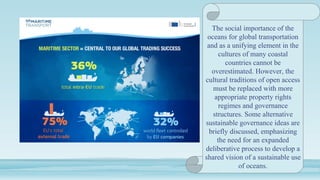
The social importance of the
oceans for global transportation
and as a unifying element in the
cultures of many coastal
countries cannot be
overestimated. However, the
cultural traditions of open access
must be replaced with more
appropriate property rights
regimes and governance
structures. Some alternative
sustainable governance ideas are
briefly discussed, emphasizing
the need for an expanded
deliberative process to develop a
shared vision of a sustainable use
of oceans.
The Maritime
Industry’s Roles in
the Global Ocean
Trading
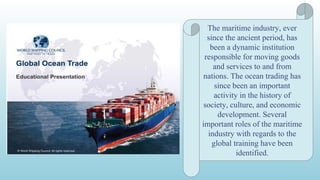
The maritime industry, ever
since the ancient period, has
been a dynamic institution
responsible for moving goods
and services to and from
nations. The ocean trading has
since been an important
activity in the history of
society, culture, and economic
development. Several
important roles of the maritime
industry with regards to the
global training have been
identified.
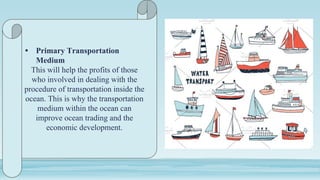
• Primary Transportation
Medium
This will help the profits of those
who involved in dealing with the
procedure of transportation inside the
ocean. This is why the transportation
medium within the ocean can
improve ocean trading and the
economic development.
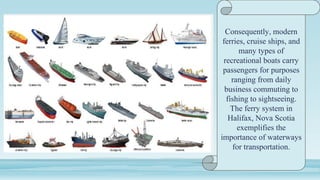
Consequently, modern
ferries, cruise ships, and
many types of
recreational boats carry
passengers for purposes
ranging from daily
business commuting to
fishing to sightseeing.
The ferry system in
Halifax, Nova Scotia
exemplifies the
importance of waterways
for transportation.
Nicolaus Copernicus, Charles Darwin, and Sigmund Freud
agreed that the whole thing on this planet is in constant motion
as dictated by means of natural law. The maritime transactions
are not exempted. In fact, seafaring is a very dynamic
institution. It makes peoples, things and services move from
one continent to another efficiently and effectively.
Source of Government
Revenue
For the Philippines, seafarers
belong to the hundreds of
foreign places Filipino people
(OFW), taken into
consideration as "cutting-edge
heroes" or bagong bayani.
Those sales assist finance
authorities projects together
with infrastructure, roads and
highways, economics zones,
and others that broadly
speaking generate jobs and
possibilities for low and
medium enterprise.
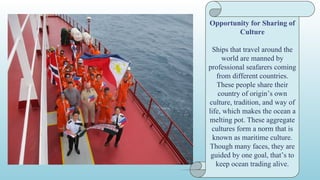
Opportunity for Sharing of
Culture
Ships that travel around the
world are manned by
professional seafarers coming
from different countries.
These people share their
country of origin’s own
culture, tradition, and way of
life, which makes the ocean a
melting pot. These aggregate
cultures form a norm that is
known as maritime culture.
Though many faces, they are
guided by one goal, that’s to
keep ocean trading alive.
Backbone of the Global Trade and
Economy
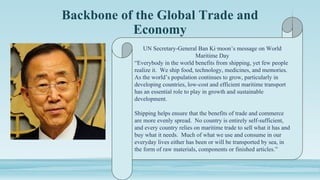
UN Secretary-General Ban Ki‑moon’s message on World
Maritime Day
“Everybody in the world benefits from shipping, yet few people
realize it. We ship food, technology, medicines, and memories.
As the world’s population continues to grow, particularly in
developing countries, low-cost and efficient maritime transport
has an essential role to play in growth and sustainable
development.
Shipping helps ensure that the benefits of trade and commerce
are more evenly spread. No country is entirely self-sufficient,
and every country relies on maritime trade to sell what it has and
buy what it needs. Much of what we use and consume in our
everyday lives either has been or will be transported by sea, in
the form of raw materials, components or finished articles.”
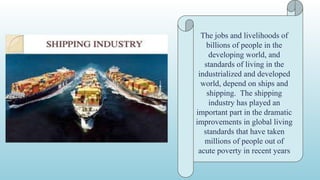
The jobs and livelihoods of
billions of people in the
developing world, and
standards of living in the
industrialized and developed
world, depend on ships and
shipping. The shipping
industry has played an
important part in the dramatic
improvements in global living
standards that have taken
millions of people out of
acute poverty in recent years
The Philippine Maritime Industry as a
Backbone of National Development
Presidential Decree No. 474, Section3.a, defines maritime industry as “all
enterprise engaged in the business of designing, constructing,
manufacturing, acquiring, operating, supplying, repairing, and/or
maintaining vessels, or component parts thereof; of managing and/or
operating shipping lines, stevedoring arrastre and customs brokerage
services, shipyards, drydocks, marine railways, marine repair shops,
shipping and freight forwarding agencies and similar enterprise.”
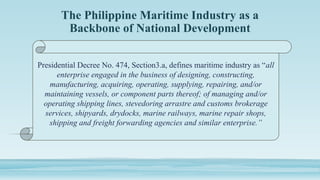
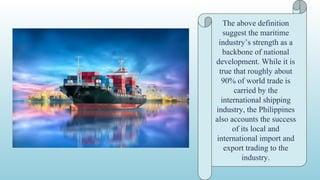
The above definition
suggest the maritime
industry’s strength as a
backbone of national
development. While it is
true that roughly about
90% of world trade is
carried by the
international shipping
industry, the Philippines
also accounts the success
of its local and
international import and
export trading to the
industry.
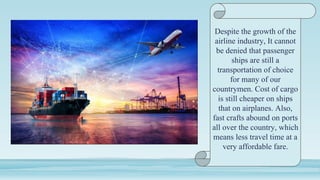
Despite the growth of the
airline industry, It cannot
be denied that passenger
ships are still a
transportation of choice
for many of our
countrymen. Cost of cargo
is still cheaper on ships
that on airplanes. Also,
fast crafts abound on ports
all over the country, which
means less travel time at a
very affordable fare.
The maritime-government agencies recognize the critical role of maritime transport
in ensuring an integrated and coordinated transport network for the country and
extending into the world. Shipping undeniably remains a major infrastructure
linking and connecting to the Philippines to the international commerce and ocean
trading. In turn progress of the country. The domestic shipping alone, in 2012,
posted 74 million tons of cargoes and 50 million passengers. Speaking of economic
benefits, one of which is the international seafarers’ remittance amounting to
US$4.8 billion also contributed to the Philippines economy that same year. The
shipping industry also provides jobs for Filipinos seafarers that account the largest
number deployed on board International vessels
Thank You!

Maritime Industry and National Development

  • 1.
    THE MARITIME INDUSTRYAND NATIONAL DEVELOPMENT
  • 2.
    Learning Outcomes • Explainthe economic, ecological, and social importance of oceans. • Discuss the role of maritime industry in the global ocean trading. • Appreciate the important functions of the Philippine maritime industry towards national development. • Produce and present a documentary focused on the role and achievement of the Philippine maritime industry in the country’s economic and national development.
  • 3.
    Economic, Ecological, andSocial Importance of Oceans
  • 4.
    The oceans havelong been recognized as one of humanity's most important natural resources. Their vastness has made them appear to be limitless sources of food, transportation, recreation, and awe. The difficulty of fencing and policing them has left them largely as open access resources to be exploited by anyone with the means. However, in recent times we have begun to reach the limits of the oceans and must now begin to utilize and govern them in a more sustainable way. In addition to their traditional importance as sources of primary and secondary production, and biodiversity, the importance of the oceans in global material and energy cycles is now beginning to be better appreciated. The oceans have been estimated to contribute a total of like 21 trillion US$/year to human welfare (compared with a global GNP of like 25 trillion US$), with like 60% of this from coastal and shelf systems and the other 40% from the open ocean, and with the oceans contributing similar to 60% of the total economic value of the biosphere.
  • 5.
    The social importanceof the oceans for global transportation and as a unifying element in the cultures of many coastal countries cannot be overestimated. However, the cultural traditions of open access must be replaced with more appropriate property rights regimes and governance structures. Some alternative sustainable governance ideas are briefly discussed, emphasizing the need for an expanded deliberative process to develop a shared vision of a sustainable use of oceans.
  • 6.
    The Maritime Industry’s Rolesin the Global Ocean Trading
  • 7.
    The maritime industry,ever since the ancient period, has been a dynamic institution responsible for moving goods and services to and from nations. The ocean trading has since been an important activity in the history of society, culture, and economic development. Several important roles of the maritime industry with regards to the global training have been identified.
  • 8.
    • Primary Transportation Medium Thiswill help the profits of those who involved in dealing with the procedure of transportation inside the ocean. This is why the transportation medium within the ocean can improve ocean trading and the economic development.
  • 9.
    Consequently, modern ferries, cruiseships, and many types of recreational boats carry passengers for purposes ranging from daily business commuting to fishing to sightseeing. The ferry system in Halifax, Nova Scotia exemplifies the importance of waterways for transportation.
  • 10.
    Nicolaus Copernicus, CharlesDarwin, and Sigmund Freud agreed that the whole thing on this planet is in constant motion as dictated by means of natural law. The maritime transactions are not exempted. In fact, seafaring is a very dynamic institution. It makes peoples, things and services move from one continent to another efficiently and effectively.
  • 11.
    Source of Government Revenue Forthe Philippines, seafarers belong to the hundreds of foreign places Filipino people (OFW), taken into consideration as "cutting-edge heroes" or bagong bayani. Those sales assist finance authorities projects together with infrastructure, roads and highways, economics zones, and others that broadly speaking generate jobs and possibilities for low and medium enterprise. Opportunity for Sharing of Culture Ships that travel around the world are manned by professional seafarers coming from different countries. These people share their country of origin’s own culture, tradition, and way of life, which makes the ocean a melting pot. These aggregate cultures form a norm that is known as maritime culture. Though many faces, they are guided by one goal, that’s to keep ocean trading alive.
  • 12.
    Backbone of theGlobal Trade and Economy UN Secretary-General Ban Ki‑moon’s message on World Maritime Day “Everybody in the world benefits from shipping, yet few people realize it. We ship food, technology, medicines, and memories. As the world’s population continues to grow, particularly in developing countries, low-cost and efficient maritime transport has an essential role to play in growth and sustainable development. Shipping helps ensure that the benefits of trade and commerce are more evenly spread. No country is entirely self-sufficient, and every country relies on maritime trade to sell what it has and buy what it needs. Much of what we use and consume in our everyday lives either has been or will be transported by sea, in the form of raw materials, components or finished articles.”
  • 13.
    The jobs andlivelihoods of billions of people in the developing world, and standards of living in the industrialized and developed world, depend on ships and shipping. The shipping industry has played an important part in the dramatic improvements in global living standards that have taken millions of people out of acute poverty in recent years
  • 14.
    The Philippine MaritimeIndustry as a Backbone of National Development Presidential Decree No. 474, Section3.a, defines maritime industry as “all enterprise engaged in the business of designing, constructing, manufacturing, acquiring, operating, supplying, repairing, and/or maintaining vessels, or component parts thereof; of managing and/or operating shipping lines, stevedoring arrastre and customs brokerage services, shipyards, drydocks, marine railways, marine repair shops, shipping and freight forwarding agencies and similar enterprise.”
  • 15.
    The above definition suggestthe maritime industry’s strength as a backbone of national development. While it is true that roughly about 90% of world trade is carried by the international shipping industry, the Philippines also accounts the success of its local and international import and export trading to the industry.
  • 16.
    Despite the growthof the airline industry, It cannot be denied that passenger ships are still a transportation of choice for many of our countrymen. Cost of cargo is still cheaper on ships that on airplanes. Also, fast crafts abound on ports all over the country, which means less travel time at a very affordable fare.
  • 17.
    The maritime-government agenciesrecognize the critical role of maritime transport in ensuring an integrated and coordinated transport network for the country and extending into the world. Shipping undeniably remains a major infrastructure linking and connecting to the Philippines to the international commerce and ocean trading. In turn progress of the country. The domestic shipping alone, in 2012, posted 74 million tons of cargoes and 50 million passengers. Speaking of economic benefits, one of which is the international seafarers’ remittance amounting to US$4.8 billion also contributed to the Philippines economy that same year. The shipping industry also provides jobs for Filipinos seafarers that account the largest number deployed on board International vessels
  • 18.