Immersive Planning
From Research to Realization:
An Experience-based Workplace
Knoll Workplace Research
Immersive Planning Page 1© 2016 Knoll, Inc.
Immersive Planning
From Research to Realization: An Experience-based Workplace
Executive Summary
The workplace today is a mass of blurred
boundaries. Driven by changing workstyles,
the experience economy and the influence of
startup culture, the lines separating the worlds
of work, life and play continue to fade.
As group-based work becomes the norm, and
companies assemble networks of partners,
a singular output emerges. Outcomes are
emphasized over process. Group work
dominates for good reason. Not only is it
the demonstrated linchpin of creativity and
productivity, but also it plays a key role in
workers’ happiness and satisfaction with their
jobs, company and workplace.
Empowered workers move frequently
throughout the day to their choice of
workspace, using the tools they select and
meeting with the team they need at the time
and place they prefer.
As mobility lifts limitations on where work is
done, organizations are challenged to create
engaging environments that draw workers
to the office. In response, the workplace
has taken on new life, functioning as a town
square-like hub energized by the hum of
the occupants. Elements of residential and
hospitality design add welcomed comfort
for employees who come together to
collaborate, connect or need a place to relax,
ideate, focus, socialize or otherwise engage.
Reduced individual workspace footprints
allow companies to provide a greater number
of amenities and social spaces, while
still maintaining a tight rein on real estate
portfolio expenses.
An Experience-based Workplace
Changing dynamics call for a new,
“Immersive” workplace planning approach
that is as fluid as teams themselves.
As workspaces become defined by an
individual’s actions rather than job function,
the lines between space types diminish;
enhancing interaction, inviting connected
experiences and radiating a sense of
hospitality at every exchange.
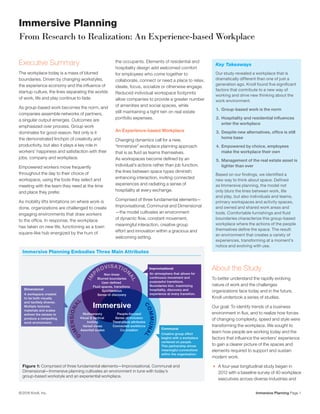
Comprised of three fundamental elements—
Improvisational, Communal and Dimensional
—the model cultivates an environment
of dynamic flow, constant movement,
meaningful interaction, creative group
effort and innovation within a gracious and
welcoming setting.
About the Study
To better understand the rapidly evolving
nature of work and the challenges
organizations face today and in the future,
Knoll undertook a series of studies.
Our goal: To identify trends of a business
environment in flux, and to realize how forces
of changing complexity, speed and style were
transforming the workplace. We sought to
learn how people are working today and the
factors that influence the workers’ experience
to gain a clearer picture of the spaces and
elements required to support and sustain
modern work.
4	A four-year longitudinal study began in
2012 with a baseline survey of 40 workplace
executives across diverse industries and
Key Takeaways
Our study revealed a workplace that is
dramatically different than one of just a
generation ago. Knoll found five significant
factors that contribute to a new way of
working and drive new thinking about the
work environment.
1.	Group-based work is the norm
2.	Hospitality and residential influences
enter the workplace
3.	Despite new alternatives, office is still
home base
4.	Empowered by choice, employees
make the workplace their own
5.	Management of the real estate asset is
tighter than ever
Based on our findings, we identified a
new way to think about space. Defined
as Immersive planning, the model not
only blurs the lines between work, life
and play, but also individuals and teams,
primary workspaces and activity spaces,
and owned and shared work areas and
tools. Comfortable furnishings and fluid
boundaries characterize this group-based
workplace where the actions of the people
themselves define the space. The result:
an environment that creates a variety of
experiences, transforming at a moment’s
notice and evolving with use.
Immersive Planning Embodies Three Main Attributes
Figure 1: Comprised of three fundamental elements—Improvisational, Communal and
Dimensional—Immersive planning cultivates an environment in tune with today’s
group-based workstyle and an experiential workplace.
Non-linear
Blurred boundaries
User-defined
Fluid spaces, transitions
Spontaneous
Sense of discovery
Immersive
IM
PROVISATION
AL
IM
PROVISATION
AL
COMMUNALCOMMUNAL
D
IMENSIONA
L
D
IMENSIONA
L
Multisensory
Visual  tactical
Inviting
Varied vistas
Assorted scales
People-focused
Sense of inclusion
Third-place attributes
Connected workforce
Co-creation
Creative group effort
begins with a workplace
centered on people.
This partnership drives
meaningful connections
within the organization.
Communal
Improvisational
A workspace created
to be both visually
and tactilely diverse.
Multiple textures,
materials and scales
enliven the senses to
produce a compelling
work environment.
An atmosphere that allows for
continuous movement and
purposeful transitions.
Boundaries blur, maximizing
hospitality, discovery and
experience at every transition.
Dimensional
Immersive Planning Page 2© 2016 Knoll, Inc.
locations, and observation studies of
their corporate workplaces to uncover
work trends and ways organizations
were planning and allocating space.
4	In 2015 and 2016, we conducted a
second phase of research, surveying
110 workplace executives worldwide.
We also spoke at length with varied
workplace experts, interviewing some
40 workplace executives, real estate
professionals, architects, designers,
leading academics and workplace
strategists across three continents.
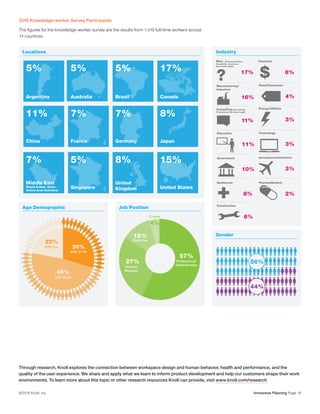
4	In early 2016, we performed a separate
global study of more than 1,400
knowledge workers across 14 countries
to determine the relationships of office
features and design to work outcomes
such as creativity, productivity, happiness,
stress and satisfaction. In contrast to the
phase one and phase two longitudinal
study, in which we surveyed and spoke
primarily to workplace executives and
planners, this study was designed and
conducted to survey the user experience.
(See appendix, page 17, for more
information on studies)
This paper is the culmination of this
multilayered research initiative and our
opportunity to share our insights on a
new way of workplace planning.
An Evolution is Underway
Modern advancements continue to
accelerate, disrupt and otherwise rewrite how
we connect, communicate and collaborate
today. Additional challenges ensue from
the unrelenting pace of business, forces of
globalization, changing demographics and
escalating economic, political, social and
environmental pressures. The confluence
of these changing dynamics gives rise
to dramatic shifts in the way we work,
profoundly impacting today’s workplaces.
Changing Workstyles
As the highly-process driven, task-based
workstyle of the 20th century has faded away,
so too has the deskbound worker, hierarchical
leadership and staid workplace model.
A spirit of collaboration characterizes the
modern environment. Highly connected
workers with multi-layered responsibilities work
within self-directed cross-functional teams—
meeting, ideating, relaxing and performing
tasks and activities that keep them in motion
throughout the day.
Priorities have shifted as well. In the
new economy, where knowledge and
experience are highly valued, immediacy,
information and innovation are the most
highly prized currency.
The Experience Economy Has Arrived
Creating a holistic, engaging customer
experience is one strategy companies use
to differentiate their brands in a competitive
global marketplace in which goods and
services are highly commoditized. Eliciting
a powerful sensory or cognitive response
produces a lasting experience that builds
greater loyalty.
Some firms are adopting the strategy of
creating memorable experiences to keep
their own employees engaged and happy.
In the workplace-as-experience scenario,
organizations address the physical, emotional,
intellectual, virtual and aspirational elements
of work in an approach that inspires and
engages employees and is on point with their
brand’s mission.
Startup Culture Permeates Mainstream
Corporate Environments
Inspired by the success of technology
firms and creative agencies, established
companies from myriad industries are
reinventing their culture to model startups.
They hope to foster a similar level of
innovation and productivity to generate
the growth that will propel their firm to new
levels of success and market leadership.
Introducing a more casual atmosphere,
providing abundant choices for places to
work, and integrating social spaces and a
wealth of amenities are among the ways
mainstream firms support engagement,
teamwork and creativity.
A New Way of Working
Our research revealed five significant
factors that contribute to a new way of
working and drive new thinking about
the work environment.
1.	 Group-Based Work is the Norm
Networks Replace Hierarchies
To meet today’s complex and changing
business challenges calls for equally
multifaceted networks of individuals and
teams culled from a large, extended
ecosystem. Sometimes referred to as a “flash
team,” the network could include internal
employees, vendors, consultants, strategic
alliance partners (suppliers, customers, even
competitors) and “contingent” workers who
work on a project basis. As a frequently fluid
assemblage, the makeup of the team can
adapt as the needs of a project evolve. Teams
There is no one office of the future.
There is only change.
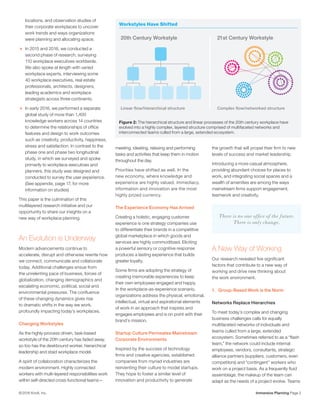
Workstyles Have Shifted
Figure 2: The hierarchical structure and linear processes of the 20th century workplace have
evolved into a highly complex, layered structure comprised of multifaceted networks and
interconnected teams culled from a large, extended ecosystem.
20th Century Workstyle
Linear flow/hierarchical structure
21st Century Workstyle
Complex flow/networked structure
Immersive Planning Page 3© 2016 Knoll, Inc.
may dissolve when the project is completed,
and re-group with the same or different
makeup for the next project.
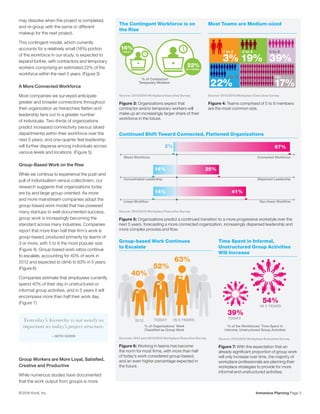
This contingent model, which currently
accounts for a relatively small (16%) portion
of the workforce in our study, is expected to
expand further, with contractors and temporary
workers comprising an estimated 22% of the
workforce within the next 5 years. (Figure 3)
A More Connected Workforce
Most companies we surveyed anticipate
greater and broader connections throughout
their organization as hierarchies flatten and
leadership fans out to a greater number
of individuals. Two-thirds of organizations
predict increased connectivity (versus siloed
departments) within their workforce over the
next 5 years, and one-quarter feel leadership
will further disperse among individuals across
various levels and locations. (Figure 5)
Group-Based Work on the Rise
While we continue to experience the push and
pull of individualism versus collectivism, our
research suggests that organizations today
are by and large group-oriented. As more
and more mainstream companies adopt the
group-based work model that has powered
many startups to well-documented success,
group work is increasingly becoming the
standard across many industries. Companies
report that more than half their firm’s work is
group-based, produced primarily by teams of
3 or more, with 5 to 8 the most popular size
(Figure 4). Group-based work ratios continue
to escalate, accounting for 40% of work in
2012 and expected to climb to 63% in 5 years.
(Figure 6)
Companies estimate that employees currently
spend 40% of their day in unstructured or
informal group activities, and in 5 years it will
encompass more than half their work day.
(Figure 7)
Group Workers are More Loyal, Satisfied,
Creative and Productive
While numerous studies have documented
that the work output from groups is more
Continued Shift Toward Connected, Flattened Organizations
Source: 2015/2016 Workplace Executive Survey
Figure 5: Organizations predict a continued transition to a more progressive workstyle over the
next 5 years, forecasting a more connected organization, increasingly dispersed leadership and
more complex process and flow.
Group-based Work Continues
to Escalate
Sources: 2012 and 2015/2016 Workplace Executive Survey
Figure 6: Working in teams has become
the norm for most firms, with more than half
of today’s work considered group-based,
and an even higher percentage expected in
the future.
Time Spent in Informal,
Unstructured Group Activities
Will Increase
Source: 2015/2016 Workplace Executive Survey
Figure 7: With the expectation that an
already significant proportion of group work
will only increase over time, the majority of
workplace professionals are planning their
workplace strategies to provide for more
informal and unstructured activities.
2%
14%
14% 41%
25%
67%
Siloed Workforce
Concentrated Leadership
Linear Workflow Non-linear Workflow
Dispersed Leadership
Connected Workforce
Yesterday’s hierarchy is not nearly as
important as today’s project structure.
—SETH GODIN
2012
40%
52%
63%
TODAY IN 5 YEARS
IN 5 YEARS
TODAY
39%
54%
% of the Workforces’ Time Spent in
Informal, Unstructured Group Activities
% of Organizations’ Work
Classified as Group Work
The Contingent Workforce is on
the Rise
Source: 2015/2016 Workplace Executive Survey
Figure 3: Organizations expect that
contractor and/or temporary workers will
make up an increasingly larger share of their
workforce in the future.
IN 5 YEARS
22%
TODAY
16%
% of Contractor/
Temporary Workers
Most Teams are Medium-sized
Source: 2015/2016 Workplace Executive Survey
Figure 4: Teams comprised of 5 to 8 members
are the most common size.
1 to 21 to 2
3%3% 19%19% 39%39%
22%22% 17%17%
5 to 85 to 8
8 to 158 to 15
3 to 4
15+
Immersive Planning Page 4© 2016 Knoll, Inc.
Top Drivers for Workplace
Planning
Sources: 2012 and 2015/2016 Workplace Executive
Survey
Figure 9: Current planning priorities
shaped up remarkably similar to the drivers
executives reported 4 years ago.
2012 Today
1
2
3
Collaboration
Maximize space
utilization
Attraction/
Retention
Collaboration
Attraction/
Retention
Support work
process/flow
4
Cost Cost
5
Support work
process/flow
Maximize space
utilization
$$
Group Workers are More Loyal, Satisfied, Innovative and Productive
Source: 2016 Knowledge-worker Survey
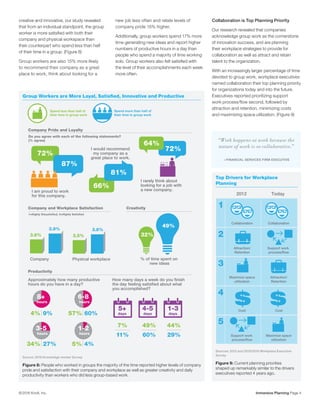
Figure 8: People who worked in groups the majority of the time reported higher levels of company
pride and satisfaction with their company and workplace as well as greater creativity and daily
productivity than workers who did less group-based work.
Company and Workplace Satisfaction
3.9%
3.6%3.6%
CompanyCompany
Creativity
% of time spent on
new ideas
% of time spent on
new ideas
3.5%3.5%
Physical workplacePhysical workplace
3.8%
I would recommend
my company as a
great place to work.
I would recommend
my company as a
great place to work.
I rarely think about
looking for a job with
a new company.
I rarely think about
looking for a job with
a new company.
Productivity
Approximately how many productive
hours do you have in a day?
Approximately how many productive
hours do you have in a day?
How many days a week do you finish
the day feeling satisfied about what
you accomplished?
How many days a week do you finish
the day feeling satisfied about what
you accomplished?
4%
72%
66%
72%
64%
49%
32%
81%
87%
Spend more than half of
their time in group work
Spend less than half of
their time in group work
8+
hours
6-8
hours
5+
days
4-5
days
1-3
days
3-5
hours
1-2
hours
9%
7%
11%
49%
60%
44%
29%
57% 60%
34% 27% 5% 4%
I am proud to work
for this company.
I am proud to work
for this company.
Company Pride and Loyalty
Do you agree with each of the following statements?
(% agree)
1=Highly Dissatisfied, 5=Highly Satisfied
creative and innovative, our study revealed
that from an individual standpoint, the group
worker is more satisfied with both their
company and physical workspace than
their counterpart who spend less than half
of their time in a group. (Figure 8)
Group workers are also 15% more likely
to recommend their company as a great
place to work, think about looking for a
new job less often and relate levels of
company pride 15% higher.
Additionally, group workers spend 17% more
time generating new ideas and report higher
numbers of productive hours in a day than
people who spend a majority of time working
solo. Group workers also felt satisfied with
the level of their accomplishments each week
more often.
Collaboration is Top Planning Priority
Our research revealed that companies
acknowledge group work as the cornerstone
of innovation success, and are planning
their workplace strategies to provide for
collaboration as well as attract and retain
talent to the organization.
With an increasingly larger percentage of time
devoted to group work, workplace executives
named collaboration their top planning priority
for organizations today and into the future.
Executives reported prioritizing support
work process/flow second, followed by
attraction and retention, minimizing costs
and maximizing space utilization. (Figure 9)
“Work happens at work because the
nature of work is so collaborative.”
—FINANCIAL SERVICES FIRM EXECUTIVE
Immersive Planning Page 5© 2016 Knoll, Inc.
2.	 Residential and Hospitality Influences 	
	 Enter the Workplace
A Casual Atmosphere Prevails
Inspired by the relaxed environments of their
founders’ very recent college days, in which
crews seamlessly shifted from work to play,
technology startups were among the first
companies to have offices that resembled
rec rooms, garages, basements or other
variations of living spaces.
While a ping pong table or hovercraft on-site
in a former factory loft is not appropriate for
every office, today most organizations do
embrace a more casual workplace standard
with an overall relaxed, open environment.
Dress codes are becoming a thing of the past
for all but the most traditional firms. Suites of
formal meeting spaces are equally diminishing
as greater numbers of companies devote
an increasingly larger proportion of space to
informal meeting areas. More than 40% of the
workplace executives we surveyed anticipate
their companies will transition to an even more
informal environment in the next 5 years. In
contrast, a scant 3% plan a move to a more
formal atmosphere. To provide for the relaxed
environments their people are seeking, firms
are planning for more informal areas, rising to
encompass nearly 40% of their meeting space
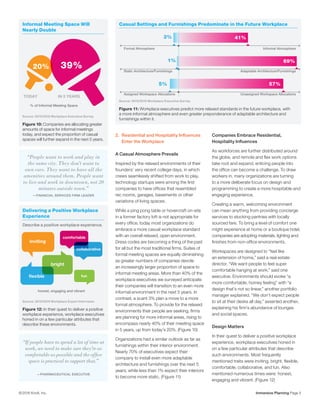
in 5 years, up from today’s 20%. (Figure 10)
Organizations had a similar outlook as far as
furnishings within their interior environment.
Nearly 70% of executives expect their
company to install even more adaptable
architecture and furnishings over the next 5
years; while less than 1% expect their interiors
to become more static. (Figure 11)
Companies Embrace Residential,
Hospitality Influences
As workforces are further distributed around
the globe, and remote and flex work options
take root and expand, enticing people into
the office can become a challenge. To draw
workers in, many organizations are turning
to a more deliberate focus on design and
programming to create a more hospitable and
engaging experience.
Creating a warm, welcoming environment
can mean anything from providing concierge
services to stocking pantries with locally
sourced fare. To bring a level of comfort one
might experience at home or a boutique hotel,
companies are adopting materials, lighting and
finishes from non-office environments.
Workspaces are designed to “feel like
an extension of home,” said a real estate
director. “We want people to feel super
comfortable hanging at work,” said one
executive. Environments should evoke “a
more comfortable, homey feeling” with “a
design that’s not so linear,” another portfolio
manager explained. “We don’t expect people
to sit at their desks all day,” asserted another,
explaining his firm’s abundance of lounges
and social spaces.
Design Matters
In their quest to deliver a positive workplace
experience, workplace executives honed in
on a few particular attributes that describe
such environments. Most frequently
mentioned traits were inviting, bright, flexible,
comfortable, collaborative, and fun. Also
mentioned numerous times were: honest,
engaging and vibrant. (Figure 12)
Delivering a Positive Workplace
Experience
Describe a positive workplace experience.
Source: 2015/2016 Workplace Expert Interviews
Figure 12: In their quest to deliver a positive
workplace experience, workplace executives
honed in on a few particular attributes that
describe these environments.
What would you describe as a positive workplace
experience?
honest, engaging and vibrant
comfortable
collaborative
inviting
flexible fun
bright
“If people have to spend a lot of time at
work, we need to make sure they’re as
comfortable as possible and the office
space is practical to support that.”
—PHARMACEUTICAL EXECUTIVE
Informal Meeting Space Will
Nearly Double
Source: 2015/2016 Workplace Executive Survey
Figure 10: Companies are allocating greater
amounts of space for informal meetings
today, and expect the proportion of casual
spaces will further expand in the next 5 years.
Casual Settings and Furnishings Predominate in the Future Workplace
Source: 2015/2016 Workplace Executive Survey
Figure 11: Workplace executives predict more relaxed standards in the future workplace, with
a more informal atmosphere and even greater preponderance of adaptable architecture and
furnishings within it.
TODAY IN 5 YEARS
39%20%
% of Informal Meeting Space
5% 57%
Formal Atmosphere
Static Architecture/Furnishings
Assigned Workspace Allocations Unassigned Workspace Allocations
Adaptable Architecture/Furnishings
Informal Atmosphere
3% 41%
1% 69%69%
“People want to work and play in
the same city. They don’t want to
own cars. They want to have all the
amenities around them. People want
to live and work in downtown, not 20
minutes outside town.”
—FINANCIAL SERVICES FIRM LEADER
Immersive Planning Page 6© 2016 Knoll, Inc.
Our research of knowledge workers suggests
workspaces that integrated the executives’
most oft-mentioned factors–bright, flexible,
inviting–were much more successful in
achieving high levels of worker satisfaction.
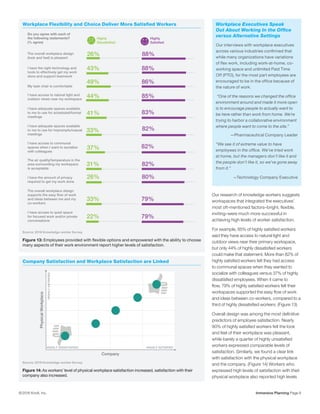
For example, 85% of highly satisfied workers
said they have access to natural light and
outdoor views near their primary workspace,
but only 44% of highly dissatisfied workers
could make that statement. More than 82% of
highly satisfied workers felt they had access
to communal spaces when they wanted to
socialize with colleagues versus 37% of highly
dissatisfied employees. When it came to
flow, 79% of highly satisfied workers felt their
workspaces supported the easy flow of work
and ideas between co-workers, compared to a
third of highly dissatisfied workers. (Figure 13)
Overall design was among the most definitive
predictors of employee satisfaction. Nearly
90% of highly satisfied workers felt the look
and feel of their workplace was pleasant,
while barely a quarter of highly unsatisfied
workers expressed comparable levels of
satisfaction. Similarly, we found a clear link
with satisfaction with the physical workplace
and the company. (Figure 14) Workers who
expressed high levels of satisfaction with their
physical workplace also reported high levels
Workplace Executives Speak
Out About Working In the Office
versus Alternative Settings
Our interviews with workplace executives
across various industries confirmed that
while many organizations have variations
of flex work, including work-at-home, co-
working space and unlimited Paid Time
Off (PTO), for the most part employees are
encouraged to be in the office because of
the nature of work.
“One of the reasons we changed the office
environment around and made it more open
is to encourage people to actually want to
be here rather than work from home. We’re
trying to harbor a collaborative environment
where people want to come to the site.”
—Pharmaceutical Company Leader
“We see it of extreme value to have
employees in the office. We’ve tried work
at home, but the managers don’t like it and
the people don’t like it, so we’ve gone away
from it.”
—Technology Company Executive
Workplace Flexibility and Choice Deliver More Satisfied Workers
Source: 2016 Knowledge-worker Survey
Figure 13: Employees provided with flexible options and empowered with the ability to choose
many aspects of their work environment report higher levels of satisfaction.
Highly
Satisfied
Highly
Dissatisfied
The overall workplace design
(look and feel) is pleasant
Do you agree with each of
the following statements?
(% agree)
I have the right technology and
tools to effectively get my work
done and support teamwork
My task chair is comfortable
I have access to natural light and
outdoor views near my workspace
I have adequate spaces available
to me to use for scheduled/formal
meetings
I have adequate spaces available
to me to use for impromptu/casual
meetings
I have access to communal
spaces when I want to socialize
with colleagues
The air quality/temperature in the
area surrounding my workspace
is acceptable
I have the amount of privacy
required to get my work done
The overall workplace design
supports the easy flow of work
and ideas between me and my
co-workers
I have access to quiet space
for focused work and/or private
conversations
43%
49%
44%
41%
33%
37%
31%
26%
33%
22%
26% 88%
88%
86%
85%
83%
82%
82%
82%
80%
79%
79%
Company Satisfaction and Workplace Satisfaction are Linked
Source: 2016 Knowledge-worker Survey
Figure 14: As workers’ level of physical workplace satisfaction increased, satisfaction with their
company also increased.
HIGHLY DISSATISFIED
Company
HIGHLY SATISFIED
HIGHLYSATISFIED
PhysicalWorkplace
Immersive Planning Page 7© 2016 Knoll, Inc.
of satisfaction with their company. In contrast,
workers who were highly dissatisfied with
their physical workplace also expressed high
levels of dissatisfaction with their company.
The relationships support the investment in
the workplace not only as a recruitment and
branding tool, but also as an invaluable means
of achieving employee retention and high
levels of worker satisfaction that contribute to
good outcomes.
Companies Planning Expanded Amenities
for Their Workforce
Whether it’s a growing focus on wellness, an
effort toward recruitment and retention or a
combination, companies are integrating new
levels of amenities into their workspaces.
In some cases employers provide a broad
suite of amenities within a campus setting;
other times, organizations take advantage
of their urban location with multiple services
and conveniences in close proximity. But
whatever the location, amenities were found to
definitively have a positive effect on employees.
Our research showed a correlation between
the amount and type of amenities provided
and levels of the satisfaction of workers. (Figure
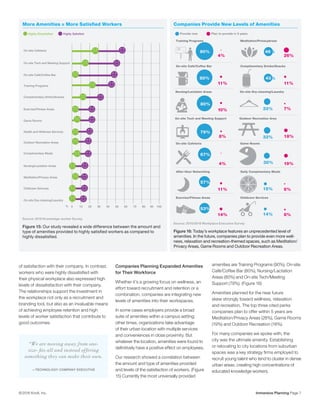
15) Currently the most universally provided
amenities are Training Programs (90%), On-site
Café/Coffee Bar (80%), Nursing/Lactation
Areas (80%) and On-site Tech/Meeting
Support (79%). (Figure 16)
Amenities planned for the near future
skew strongly toward wellness, relaxation
and recreation. The top three cited perks
companies plan to offer within 5 years are
Meditation/Privacy Areas (26%), Game Rooms
(19%) and Outdoor Recreation (18%).
For many companies we spoke with, the
city was the ultimate amenity. Establishing
or relocating to city locations from suburban
spaces was a key strategy firms employed to
recruit young talent who tend to cluster in dense
urban areas, creating high concentrations of
educated knowledge workers.
“We are moving away from one-
size- fits all and instead offering
something they can make their own.
—TECHNOLOGY COMPANY EXECUTIVE
Companies Provide New Levels of Amenities
Source: 2015/2016 Workplace Executive Survey
Figure 16: Today’s workplace features an unprecedented level of
amenities. In the future, companies plan to provide even more well-
ness, relaxation and recreation-themed spaces, such as Meditation/
Privacy Areas, Game Rooms and Outdoor Recreation Areas.
More Amenities = More Satisfied Workers
Source: 2016 Knowledge-worker Survey
Figure 15: Our study revealed a wide difference between the amount and
type of amenities provided to highly satisfied workers as compared to
highly dissatisfied.
Plan to provide in 5 yearsProvide now
Training Programs
Nursing/Lactation Areas
On-site Tech and Meeting Support
Exercise/Fitness Areas
Health and Wellness Services
90%
80%
4%
46%
43%
33%
33%
30%
15%
14%
26%
11%
7%
18%
19%
6%
8%
11%
80%
10%
79%
8%
On-site Cafeteria
On-site Café/Coffee Bar
67%
4%
57%
11%
53%
14%
50%
14%
After-Hour Networking
Meditation/PrivacyAreas
On-site Dry-cleaning/Laundry
Outdoor Recreation Area
Childcare Services
Game Rooms
Complimentary Drinks/Snacks
Daily Compimentary Meals
On-site Tech and Meeting Support
On-site Cafeteria
On-site Café/Coffee Bar
Exercise/Fitness Areas
Game Rooms
Training Programs
Complimentary Drinks/Snacks
Health and Wellness Services
Nursing/Lactation Areas
Meditation/Privacy Areas
Outdoor Recreation Areas
Complimentary Meals
Childcare Services
On-site Dry-cleaning/Laundry
1000 10 20 30 40 50 60 70 80 90%
Highly SatisfiedHighly Dissatisfied
Immersive Planning Page 8© 2016 Knoll, Inc.
3.	 Despite Alternatives, the Office is
	 Still Home Base
The Building as the Social Network
The concept of the workplace is being
reinvented. In order to encourage employees
to work on-site when they have other options,
companies are providing compelling environ-
ments that draw workers together with the
goal of building engagement and community.
With its welcoming environment, plethora
of social spaces and bottomless coffee and
snacks, the office is increasingly functioning
as the hub of the company. Much like town
squares that buzz with energy and function
as a central meeting place, the office is where
the workforce gathers to work, share and
connect, even when they have other options.
Engagement is very much by design. In
addition to workplace features that encourage
random collisions and support collaboration
and cross-pollination, companies sponsor
and/or present programming to build a
cohesive community. Currently, 57% of
companies provide after-hour networking,
with 11% planning to provide such activities
in the next 5 years. Our research found such
efforts to be productive, as highly satisfied
workers were shown to have more networking
and idea-sharing opportunities than less
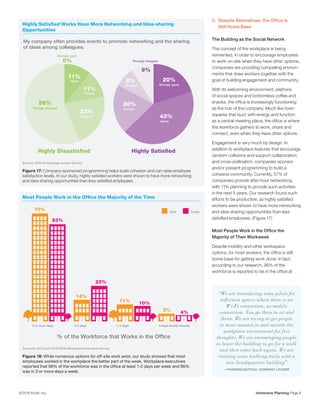
satisfied employees. (Figure 17)
Most People Work in the Office the
Majority of Their Workweek
Despite mobility and other workspace
options, for most workers, the office is still
home base for getting work done. In fact,
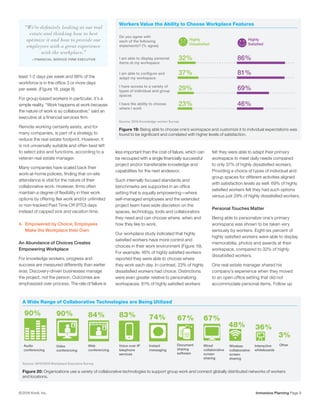
according to our research, 96% of the
workforce is reported to be in the office at
Highly Satisfied Works Have More Networking and Idea-sharing
Opportunities
Source: 2016 Knowledge-worker Survey
Figure 17: Company-sponsored programming helps build cohesion and can raise employee
satisfaction levels. In our study, highly satisfied workers were shown to have more networking
and idea-sharing opportunities than less satisfied employees.
Most People Work in the Office the Majority of the Time
Sources: 2012 and 2015/2016 Workplace Executive Survey
Figure 18: While numerous options for off-site work exist, our study showed that most
employees worked in the workplace the better part of the week. Workplace executives
reported that 96% of the workforce was in the office at least 1-2 days per week and 86%
was in 3 or more days a week.
70%
63%
14%
23%
5% 4%
11% 10%
5 or more days
2012
3-4 days 1-2 days 0 days (totally remote)
Today
% of the Workforce that Works in the Office
My company often provides events to promote networking and the sharing
of ideas among colleagues.
Highly SatisfiedHighly Dissatisfied
Agree
11%
Neutral
11%
Strongly disagree
56%
Disagree
22%
Strongly agree
0%
43%43%
Strongly disagree
Neutral
20%20%
8%8%
9%9%
Disagree
Agree
Strongly agree
20%20%
“We are introducing some pilots for
reflection spaces where there is no
Wi-Fi connection, no mobile
connection. You go there to sit and
think. We are trying to get people
to move around in and outside the
workplace environment for free
thoughts. We are encouraging people
to leave the building to go for a walk
and then come back again. We are
creating some walking trails with a
new headquarters building”
—PHARMACEUTICAL COMPANY LEADER
Immersive Planning Page 9© 2016 Knoll, Inc.
least 1-2 days per week and 86% of the
workforce is in the office 3 or more days
per week. (Figure 18, page 8)
For group-based workers in particular, it’s a
simple reality. “Work happens at work because
the nature of work is so collaborative,” said an
executive at a financial services firm.
Remote working certainly exists, and for
many companies, is part of a strategy to
reduce the real estate footprint. However, it
is not universally suitable and often best left
to select jobs and functions, according to a
veteran real estate manager.
Many companies have scaled back their
work-at-home policies, finding that on-site
attendance is vital for the nature of their
collaborative work. However, firms often
maintain a degree of flexibility in their work
options by offering flex work and/or unlimited
or non-tracked Paid Time Off (PTO) days
instead of capped sick and vacation time.
4.	 Empowered by Choice, Employees
	 Make the Workplace their Own
An Abundance of Choices Creates
Empowering Workplace
For knowledge workers, progress and
success are measured differently than earlier
eras. Discovery-driven businesses manage
the project, not the person. Outcomes are
emphasized over process. The rate of failure is
less important than the cost of failure, which can
be recouped with a single financially successful
project and/or transferable knowledge and
capabilities for the next endeavor.
Such internally focused standards and
benchmarks are supported in an office
setting that is equally empowering—where
self-managed employees and the extended
project team have wide discretion on the
spaces, technology, tools and collaborators
they need and can choose where, when and
how they like to work.
Our workplace study indicated that highly
satisfied workers have more control and
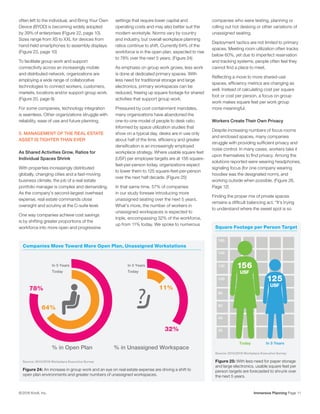
choices in their work environment (Figure 19).
For example, 46% of highly satisfied workers
reported they were able to choose where
they work each day. In contrast, 23% of highly
dissatisfied workers had choice. Distinctions
were even greater relative to personalizing
workspaces: 81% of highly satisfied workers
felt they were able to adapt their primary
workspace to meet daily needs compared
to only 37% of highly dissatisfied workers.
Providing a choice of types of individual and
group spaces for different activities aligned
with satisfaction levels as well: 69% of highly
satisfied workers felt they had such options
versus just 29% of highly dissatisfied workers.
Personal Touches Matter
Being able to personalize one’s primary
workspace was shown to be taken very
seriously by workers. Eight-six percent of
highly satisfied workers were able to display
memorabilia, photos and awards at their
workspace, compared to 32% of highly
dissatisfied workers.
One real estate manager shared his
company’s experience when they moved
to an open office setting that did not
accommodate personal items. Follow up
A Wide Range of Collaborative Technologies are Being Utilized
Source: 2015/2016 Workplace Executive Survey
Figure 20: Organizations use a variety of collaborative technologies to support group work and connect globally distributed networks of workers
and locations.
Other
3%
67%
Wired
collaborative
screen
sharing
48%
Wireless
collaborative
screen
sharing
Interactive
whiteboards
36%
Audio
conferencing
90%
Video
conferencing
90% 84%
Web
conferencing
83%
Voice over IP
telephone
services
74%
Instant
messaging
Document
sharing
software
67%
Workers Value the Ability to Choose Workplace Features
Source: 2016 Knowledge-worker Survey
Figure 19: Being able to choose one’s workspace and customize it to individual expectations was
found to be significant and correlated with higher levels of satisfaction.
I am able to display personal
items at my workspace
Do you agree with
each of the following
statements? (% agree)
I am able to configure and
adapt my workspace
I have access to a variety of
types of individual and group
spaces
I have the ability to choose
where I work
46%
69%
32%
37%
23%
29%
86%
81%
Highly
Satisfied
Highly
Dissatisfied
“We’re definitely looking at our real
estate and thinking how to best
optimize it and how to provide our
employees with a great experience
with the workplace.”
—FINANCIAL SERVICE FIRM EXECUTIVE
Immersive Planning Page 10© 2016 Knoll, Inc.
Offices Have High Levels of
Mobility
Source: 2015/2016 Workplace Executive Survey
Figure 21: Mobilized by technology and
portability, 98% of workplace leaders report
their workforce moves within their work
environment throughout the day. Nearly
60% say their workforce moves quite or very
often, shifting from setting to setting as the
day goes on.
Organizations are Deploying Smaller and More Personalized Technology
Devices
Sources: 2012 and 2015/2016 Workplace Executive Survey
Figure 23: Office mobility is supported by greater adaptation of small devices such as tablets,
and a decline in desktop and laptop use. Smartphones provided by employers show a decline
over the last 4 years, likely offset by growth in the number of firms that allow employees to provide
their own phone.
Bring Your Own Device (BYOD) Policies are on the Rise
Sources: 2012 and 2015/2016 Workplace Executive Survey
Figure 22: To support high levels of mobility within the workplace, companies are increasingly
leaving decision-making to the individual when it comes to personal technology. More companies
have adopted a Bring Your Own Device (BYOD) approach in the last 4 years, though others
evaluate on a case-by-case basis.
RarelyRarely
Sometimes
38%38%
Very often
14%14%
Quite Often
46%
2%2%
Movement Frequency
0 10 20 30 40 50 60
39%
27%
BYOD
Integration
34%
50%Case-by-case
BYOD
Integration
27%
23%
No BYOD
Integration
2012 Today
Today2012
Laptop
Smartphone
Desktop
Tablet
None
Other
97%
70%80%
62%75%
100%
37%
4%
0%
25%
research revealed the pushback was not
about the open office, but rather eliminating
the space to display personal items.
“After we moved people into an open plan,
55% said they would not want to go back
into an office room if they could,” he recalled.
“We started to look at the reasons why the
other 45% wanted to go back. It was actually
some pretty small [personalization] things on
the top of their list,” he recalled, which turned
out to be easy to fix.
Mobility is the Norm
As the desk-bound worker surrounded by
equipment goes by the wayside, replaced by
cloud-based storage, portable computing,
smartphones and headsets, mobility
becomes the default workstyle.
Our survey confirmed that offices have high
levels of mobility within the workspace,
with 98% of workplace leaders saying their
workforce moves at least occasionally
throughout the day to different locations.
Nearly 60% report their workforce moves
quite or very often depending on the type of
work they’re doing and with whom they’re
doing it. (Figure 21)
To support individual mobility, organizations
are deploying smaller and more user-
personalized technology devices. Choices are
Immersive Planning Page 11© 2016 Knoll, Inc.
often left to the individual, and Bring Your Own
Device (BYOD) is becoming widely adopted
by 39% of enterprises (Figure 22, page 10).
Sizes range from XS to XXL for devices from
hand-held smartphones to assembly displays.
(Figure 23, page 10)
To facilitate group work and support
connectivity across an increasingly mobile
and distributed network, organizations are
employing a wide range of collaborative
technologies to connect workers, customers,
markets, locations and/or support group work.
(Figure 20, page 9)
For some companies, technology integration
is seamless. Other organizations struggle with
reliability, ease of use and future planning.
5. MANAGEMENT OF THE REAL ESTATE
ASSET IS TIGHTER THAN EVER
As Shared Activities Grow, Ratios for
Individual Spaces Shrink
With properties increasingly distributed
globally, changing cities and a fast-moving
business climate, the job of a real estate
portfolio manager is complex and demanding.
As the company’s second-largest overhead
expense, real estate commands close
oversight and scrutiny at the C-suite level.
One way companies achieve cost savings
is by shifting greater proportions of the
workforce into more open and progressive
settings that require lower capital and
operating costs and may also better suit the
modern workstyle. Norms vary by country
and industry, but overall workplace planning
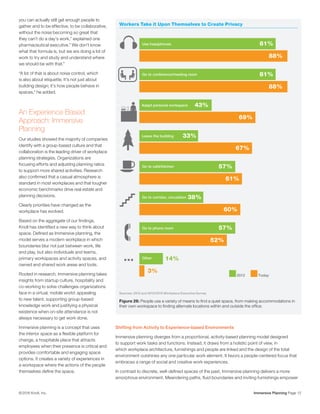
ratios continue to shift. Currently 64% of the
workforce is in the open plan, expected to rise
to 78% over the next 5 years. (Figure 24)
As emphasis on group work grows, less work
is done at dedicated primary spaces. With
less need for traditional storage and large
electronics, primary workspaces can be
reduced, freeing up square footage for shared
activities that support group work.
Pressured by cost containment mandates,
many organizations have abandoned the
one-to-one model of people to desk ratio.
Informed by space utilization studies that
show on a typical day, desks are in use only
about half of the time, efficiency and greater
densification is an increasingly employed
workplace strategy. Where usable square feet
(USF) per employee targets are at 156 square-
feet-per-person today, organizations expect
to lower them to 125 square-feet-per-person
over the next half decade. (Figure 25)
In that same time, 57% of companies
in our study foresee introducing more
unassigned seating over the next 5 years.
What’s more, the number of workers in
unassigned workspaces is expected to
triple, encompassing 32% of the workforce,
up from 11% today. We spoke to numerous
companies who were testing, planning or
rolling out hot desking or other variations of
unassigned seating.
Deployment tactics are not limited to primary
spaces. Meeting room utilization often tracks
below 60%, yet due to imperfect reservation
and tracking systems, people often feel they
cannot find a place to meet.
Reflecting a move to more shared-use
spaces, efficiency metrics are changing as
well. Instead of calculating cost per square
foot or cost per person, a focus on group
work makes square feet per work group
more meaningful.
Workers Create Their Own Privacy
Despite increasing numbers of focus rooms
and enclosed spaces, many companies
struggle with providing sufficient privacy and
noise control. In many cases, workers take it
upon themselves to find privacy. Among the
solutions reported were wearing headphones,
signaling focus (for one company wearing
hoodies was the designated norm), and
working outside when possible. (Figure 26,
Page 12)
Finding the proper mix of private spaces
remains a difficult balancing act. “It’s trying
to understand where the sweet spot is so
Square Footage per Person Target
Source: 2015/2016 Workplace Executive Survey
Figure 25: With less need for paper storage
and large electronics, usable square feet per
person targets are forecasted to shrunk over
the next 5 years.
Companies Move Toward More Open Plan, Unassigned Workstations
Source: 2015/2016 Workplace Executive Survey
Figure 24: An increase in group work and an eye on real estate expense are driving a shift to
open plan environments and greater numbers of unassigned workspaces.
78%
64%
% in Open Plan % in Unassigned Workspace
In 5 Years
Today
32%
11%
In 5 Years
Today
??
Today In 5 Years
20
40
60
80
100
120
140
160
156
USF
125
USF
Immersive Planning Page 12© 2016 Knoll, Inc.
you can actually still get enough people to
gather and to be effective, to be collaborative,
without the noise becoming so great that
they can’t do a day’s work,” explained one
pharmaceutical executive.” We don’t know
what that formula is, but we are doing a lot of
work to try and study and understand where
we should be with that.”
“A lot of that is about noise control, which
is also about etiquette. It’s not just about
building design; it’s how people behave in
spaces,“ he added.
An Experience Based
Approach: Immersive
Planning
Our studies showed the majority of companies
identify with a group-based culture and that
collaboration is the leading driver of workplace
planning strategies. Organizations are
focusing efforts and adjusting planning ratios
to support more shared activities. Research
also confirmed that a casual atmosphere is
standard in most workplaces and that tougher
economic benchmarks drive real estate and
planning decisions.
Clearly priorities have changed as the
workplace has evolved.
Based on the aggregate of our findings,
Knoll has identified a new way to think about
space. Defined as Immersive planning, the
model serves a modern workplace in which
boundaries blur not just between work, life
and play, but also individuals and teams,
primary workspaces and activity spaces, and
owned and shared work areas and tools.
Rooted in research, Immersive planning takes
insights from startup culture, hospitality and
co-working to solve challenges organizations
face in a virtual, mobile world: appealing
to new talent, supporting group-based
knowledge work and justifying a physical
existence when on-site attendance is not
always necessary to get work done.
Immersive planning is a concept that uses
the interior space as a flexible platform for
change, a hospitable place that attracts
employees when their presence is critical and
provides comfortable and engaging space
options. It creates a variety of experiences in
a workspace where the actions of the people
themselves define the space.
Workers Take it Upon Themselves to Create Privacy
Sources: 2012 and 2015/2016 Workplace Executive Survey
Figure 26: People use a variety of means to find a quiet space, from making accommodations in
their own workspace to finding alternate locations within and outside the office.
43%
69%
Adapt personal workspace
81%
88%
Use headphones
57%
52%
Go to phone room
57%
61%
Go to café/kitchen
38%
60%
Go to corridor, circulation
33%
67%
Leave the building
81%
88%
Go to conference/meeting room
14%
3%
Other…
Today2012
Shifting from Activity to Experience-based Environments
Immersive planning diverges from a proportional, activity-based planning model designed
to support work tasks and functions. Instead, it draws from a holistic point of view, in
which workplace architecture, furnishings and people are linked and the design of the total
environment outshines any one particular work element. It favors a people-centered focus that
embraces a range of social and creative work experiences.
In contrast to discrete, well-defined spaces of the past, Immersive planning delivers a more
amorphous environment. Meandering paths, fluid boundaries and inviting furnishings empower
Immersive Planning Page 13© 2016 Knoll, Inc.
users to shape their own experiences from
their personal perspective.
Collaboration, Mobility Drive Shift to
Communally Owned Spaces
As work and the workplace have changed,
so too have planning strategies. Independent
planning focused on individual spaces—
private offices and high-wall cubicles—and
its successor, activity-based planning,
balanced primary workspaces for individuals
with a mix of activity spaces to suit groups.
In all cases, primary workspaces and activity
spaces are proportionally planned to create a
combination of distinct spaces.
Immersive planning abandons defined primary
workspaces and activity spaces to suit a
highly mobile workforce that spends more
than half their day in group work and away
from a primary location. Recognizing that
activity and primary spaces can be one and
the same in the collaborative, group-based
office, Immersive planning invites connected
experiences where people own and share all
spaces equally.
In essence, nothing is owned individually, but
everything is shared communally.
With increasing numbers of companies moving
to a greater proportion of unassigned spaces,
and our research forecasting an even higher
volume in the near future, Immersive is a model
in tune with a rapidly evolving workplace.
The Workplace Becomes the Third Place
As the workplace sheds its former structured,
productivity-focused existence, it increasingly
takes on the relaxing elements of home
and interactive nature of the “third place”:
community spaces that encompass cafés,
coffee shops, bookstores, bars, hair salons
and other public hangouts that provide
the conversation, meet-ups, friendships,
companionship and humor that nurture and
sustain society.
In our research, we heard from many
workplace executives that their goal was to
create a warm, welcoming environment for
their employees. Furthermore, our research
concluded that employees are happier and
more creative and productive when they
are in an inspiring workspace that they are
empowered to make their own.
The ambiance of the third place is the
foundation of the experience-based
workplace, enhanced with the best of
hospitality and linked with modern-day
creative culture. Immersive planning offers the
lively buzz of a neighborhood café shop, as
well as a productive setting in which to work,
create, innovate and socialize.
Predictably Unpredictable
An Immersive workplace addresses a world
in which every workday can be different and
every interaction holds potential. The ad hoc
flow of people and projects, occurrences and
interactions—sometimes planned, sometimes
spontaneous—happens throughout the
workday, in rhythms ranging from fits and
spurts to rivers of activity that ebb and flow
into pools of quiet.
Immersive planning connects people to
each other and the organization by creating
spaces for shared work and social activity.
And through both stationary and movable
elements, it offers choice and flexibility to
meet changing needs.
Instead of fixed walls that separate linear work
processes, spaces use adaptable architecture
to support a non-linear workflow and an equally
multi-faceted team drawn from many levels,
experiences and backgrounds. Rather than
disconnected individual areas, the workspace
in an Immersive space is unified, allowing
work and social interactions to take place in a
range of intermingled, multifunction spaces.
The Workplace as an Experience
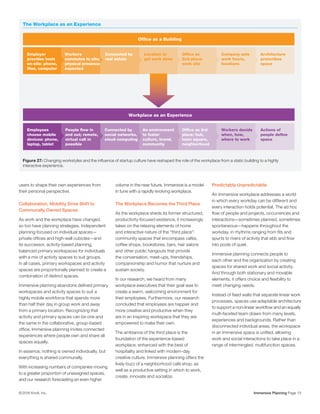
Figure 27: Changing workstyles and the influence of startup culture have reshaped the role of the workplace from a static building to a highly
interactive experience.
Workers
commutes to site;
physical presence
expected
Connected by
real estate
Location to
get work done
Office as
2nd place:
work site
Company sets
work hours,
locations
Architecture
prescribes
space
Employer
provides tools
on-site: phone,
files, computer
Office as a Building
Workers decide
when, how,
where to work
Actions of
people define
space
Employees
choose mobile
devices: phone,
laptop, tablet
People flow in
and out; remote,
virtual call in
possible
Connected by
social networks,
cloud computing
An environment
to foster
culture, brand,
community
Office as 3rd
place: hub,
town square,
neighborhood
Workplace as an Experience
Immersive Planning Page 14© 2016 Knoll, Inc.
Attributes of Immersive Planning
1. Immersive Planning is
	IMPROVISATIONAL
In a workplace in which group work and
mobility are norms and informality reigns,
Immersive planning embodies the fluid nature
of how work, people and information move
throughout the workday. Boundaries and
transitions are sinuous and ever-changing.
Environments respond to rather than
prescribe individual movement. Architectural
elements act to ground the environment,
while movable features offer a setting that
allows people to seamlessly and purposefully
transition from space to space—enabling their
individual actions to shape the space and
their experience.
Immersive environments transition at a
moment’s notice and evolve with use.
Undefined circulation paths and ambiguous
edges facilitate subtle transition from gathering
areas to refuge spaces, inviting connection
and enhancing interaction along the way.
Formality and definition give way to a series of
discrete personal and communal experiences,
connected seamlessly in a singular setting.
Immersive workplaces allow space to be
easily reorganized around varied activities
throughout the course of a day.
2. Immersive Planning is
	COMMUNAL
Communal expresses the sense of inclusion,
culture and connections within an organization.
Centered on the human element, Immersive
planning fosters the co-creation and
connections that drive inventiveness and
collaborative problem-solving and development
of new information, ideas and resources.
A communal environment creates chances
for cross-functional information sharing,
interpersonal feedback and communication
across the organization, regardless of position
or title, leading to more informed and better
decision-making.
A welcoming atmosphere provides people a
feeling of belonging—caring about their work,
their colleagues and the organization at large.
Connected spaces and workers promote
a sense of sharing and inclusion in an
environment where little formal ownership of
specific elements exists, resulting in teams
that not only thrive, but generate ever higher
levels of creativity and productivity.
3.	Immersive Planning is
	DIMENSIONAL
Inspired by innovations in hospitality, public
space and entertainment design, Immersive
planning transforms work into a multisensory
experience that engages multiple touch points.
Relaxed furnishings create a welcoming
hospitality-style setting that invites personal
and communal engagement. Diverse visual and
tactile elements in multiple textures, materials
and scales enliven the senses to produce a
compelling work environment where people
want to be—even if they don’t have to be.
Realizing Immersive Planning
An Immersive workplace puts people in control
of their own experiences. Inviting spaces, like a
good hotel or coffee shop, hinge on ambiance
and social experience—important components
of work. Optimizing the needs of not only
teams but individuals alike, discrete spaces for
focused work intermix with areas that facilitate
conversation, collaboration and social activity.
In light of our findings, below are number
of planning principles to consider when
designing for an Immersive environment:
Promote Continuous Movement,
Fluid Transitions
Workflow can proceed unconstrained
when spaces are designed with continuous
movement in mind. To support a constant
flow of information and people requires highly
adaptable and flexible spaces that support a
continuous state of motion.
Integrating transition spaces between shared
spaces further supports an uninterrupted
flow of people and ideas. Auxiliary spaces
can encourage informal discourse between
colleagues, or even continuation of a
discussion or brainstorming meeting.
Variations in scale, height and materials
not only create varied vistas, but present
options for ad hoc use selected by users.
Screens and lightweight storage elements can
demarcate pathways, but can also cordon off
a more private meeting space. Bleacher-style
seating hosts quick drop-in chats, or can be
rearranged and assembled en masse for an
impromptu all-hands meeting.
New Ways of Working Present
New Workplace Challenges
While new workstyles, organizational
progressions and changing real estate
priorities provide many opportunities to re-
envision the workplace, they also present
some challenges. Our interviewees
described experiencing hurdles such as:  
4Providing flexibility and agility while
maintaining design standards. “By
the time we catch up, the organization
has changed. It’s a challenge to be
adaptable, flexible and create purpose-
built space but not generic space. You
need to adapt as changes happen when
you’re growing as fast as we are.”
4Managing expectations. “Our
employees bring a huge variety of
experience and are much more design-
aware than previous generations. They
expect their employer to provide the
same great experience they would
receive in a hotel or restaurant.”
4Planning unpredictability. “Within
teams we have moving issues because
we don’t know where people are going
to land when we’re designing space and
we are not able to predict things.”
4Keeping up with pace of change. “The
desire to move lots of people as the
organization changes gets expensive
after a while. If we can eliminate some
of that we’re ahead of the curve. When
we have to move 600 people, it’s a
monumental exercise. It’s like planning
a little war.”
4Finding ratios that meet standards
of cost, functionality and comfort.
“Challenges we have going forward are
to try and get more out of each building.
We are increasing the densification of
buildings and are finding satisfaction
levels are dropping. When you shoehorn
people into a location, people will
become less and less satisfied.”
Immersive Planning Page 15© 2016 Knoll, Inc.
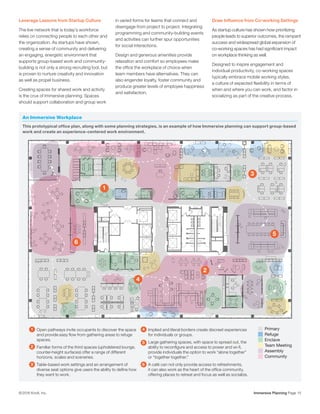
An Immersive Workplace
This prototypical office plan, along with some planning strategies, is an example of how Immersive planning can support group-based
work and create an experience-centered work environment.
IMMERSIVE
Primary
Refuge
Enclave
Team Meeting
Assembly
Community
Leverage Lessons from Startup Culture
The live network that is today’s workforce
relies on connecting people to each other and
the organization. As startups have shown,
creating a sense of community and delivering
an engaging, energetic environment that
supports group-based work and community-
building is not only a strong recruiting tool, but
is proven to nurture creativity and innovation
as well as propel business.
Creating spaces for shared work and activity
is the crux of Immersive planning. Spaces
should support collaboration and group work
in varied forms for teams that connect and
disengage from project to project. Integrating
programming and community-building events
and activities can further spur opportunities
for social interactions.
Design and generous amenities provide
relaxation and comfort so employees make
the office the workplace of choice when
team members have alternatives. They can
also engender loyalty, foster community and
produce greater levels of employee happiness
and satisfaction.
Draw Influence from Co-working Settings
As startup culture has shown how prioritizing
people leads to superior outcomes, the rampant
success and widespread global expansion of
co-working spaces has had significant impact
on workplace thinking as well.
Designed to inspire engagement and
individual productivity, co-working spaces
typically embrace mobile working styles,
a culture of expected flexibility in terms of
when and where you can work, and factor in
socializing as part of the creative process.
1.	 Open pathways invite occupants to discover the space
and provide easy flow from gathering areas to refuge
spaces.
2.	 Familiar forms of the third spaces (upholstered lounge,
counter-height surfaces) offer a range of different
horizons, scales and sceneries.
3.	 Table-based work settings and an arrangement of
diverse seat options give users the ability to define how
they want to work.
4.	 Implied and literal borders create discreet experiences
for individuals or groups.
5.	 Large gathering spaces, with space to spread out, the
ability to reconfigure and access to power and wi-fi,
provide individuals the option to work “alone together”
or “together together.”
6.	 A café can not only provide access to refreshments,
it can also work as the heart of the office community,
offering places to retreat and focus as well as socialize.
1
5
2
63
4
5
3
4
2
1
6
Immersive Planning Page 16© 2016 Knoll, Inc.
Often structured as a hosted, concierge-
style facility, co-working spaces illustrate
the power of serendipitous encounters that
lead to connections and innovative ideas and
collaboration. They often offer programming
and provide tools to create strong
relationships among members that lead to
cross-pollination and new opportunities.
With a transient day population from a broad
range of industries and functions, co-working
spaces are often furnished with a bevy of
worktables and lounge-style work and social
areas to accommodate individuals and teams
with varied requirements and workstyles that
change from day to day.
They also provide members the types of
space they need to do the type of work they
need, whether it’s a café with just enough
background buzz to get a bit of quiet work
done, a spacious setting to work together or
independently, a focus room for concentration
or a team suite for creative collaboration.
Exhibit Hospitality-style Environments
Inspirations from hospitality environments
can be adapted to create a holistic and
satisfying workplace experience that is
authentic to the organization.
Previously associated primarily with luxury
hotels, the concierge concept has extended
to the workplace. At some offices, a host,
often created from a combined facilities
management and IT support function,
provides a one-stop shop for all support
needs—from travel to technology and
personal shopping, dry-cleaning and
bicycle repair.
Express Company Brand and Culture
Expressing the brand via the physical
workplace is an opportunity to reinforce
company mission and culture. For companies
with multiple locations, it is also a way to
offer consistency across locations, much
like a branded hotel experience, in which
a organized operating model visually and
operationally delivers a reliable experience,
regardless of location.
Leading hotels have also perfected the art of
providing personalized experiences based
on the needs, attitudes and behaviors of their
customers, and the workplace can learn from
this model. Likewise, work environments can
gain inspiration from the “residential vibe” and
welcoming environment hotels shape utilizing
elements of the home and the third place.
Conclusion
As organizations everywhere are challenged
to keep pace in a more complex business
environment, they are seeking out new
ways to heighten innovation, build employee
camaraderie and support the ever-
changing needs of their global workforce.
The workplace must stay in stride. A work
environment designed to support people,
the flow of information, promote creativity
and enhance a company culture can help a
company solve challenging business problems
and remain competitive in the marketplace.
Rising from the blurred boundaries that are
today’s world is a planning approach that is
fluid enough to adapt to fluctuating teams
and project-based work. An experience-
based workplace supports workers by
offering them choice and mobility in where
they want to work and allowing them to
adapt the space they need.
Immersive planning sets the foundation and
allows workers to define their own path, as
they meander through an inviting environment
inspired by the warmth of hospitality,
creating diverse experiences and enhancing
interaction along the way.
Immersive Planning Page 17© 2016 Knoll, Inc.
Industry Headcount
15%
Consulting (Accounting,
Professional Services, Legal)
Technology
16%
Construction
2%
Energy/Utilities
6%
Education
4%
Government
2%
Healthcare
5%
Misc. (Communications, Hospitality,
Insurance, Non-profit, Other)
? 23%
Aerospace/Automotive
2%
Financial
12%
$
Pharma/Biotech
4%
Retail/Consumer
8%
Manufacturing/
Industrial
1%
0 20 40 60 80 100%
21% 1-999
33% 1,000-9,999
25% 10,000-49,999
12% 50,000-149,999
9% 150,000+
Corporate Locations
North
America
96%
Europe
60%
Asia
50%
South
America
40%
Australia/
New Zealand
39%
Other
2%
Africa
24%
Middle East
33%
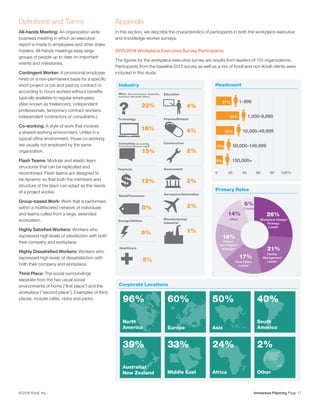
Appendix
In this section, we describe the characteristics of participants in both the workplace executive
and knowledge-worker surveys.
2015/2016 Workplace Executive Survey Participants
The figures for the workplace executive survey are results from leaders of 110 organizations.
Participants from the baseline 2012 survey as well as a mix of Knoll and non-Knoll clients were
included in this study.
Definitions and Terms
All-hands Meeting: An organization wide
business meeting in which an executive
report is made to employees and other stake
holders. All-hands meetings keep large
groups of people up to date on important
events and milestones.
Contingent Worker: A provisional employee
hired on a non-permanent basis for a specific
short project or job and paid by contract or
according to hours worked without benefits
typically available to regular employees.
(Also known as freelancers, independent
professionals, temporary contract workers,
independent contractors or consultants.)
Co-working: A style of work that involves
a shared working environment. Unlike in a
typical office environment, those co-working
are usually not employed by the same
organization.
Flash Teams: Modular and elastic team
structures that can be replicated and
recombined. Flash teams are designed to
be dynamic so that both the members and
structure of the team can adapt as the needs
of a project evolve.
Group-based Work: Work that is performed
within a multifaceted network of individuals
and teams culled from a large, extended
ecosystem.
Highly Satisfied Workers: Workers who
expressed high levels of satisfaction with both
their company and workplace.
Highly Dissatisfied Workers: Workers who
expressed high levels of dissatisfaction with
both their company and workplace.
Third Place: The social surroundings
separate from the two usual social
environments of home (“first place”) and the
workplace (“second place”). Examples of third
places, include cafés, clubs and parks.
Primary Roles
C-suite
14% 26%
Workplace Design/
Strategy
Leader
21%
Facility
Management
Leader
17%
16%
Real Estate
Leader
Project
and Program
Manager
Other
6%
Immersive Planning Page 18© 2016 Knoll, Inc.
Gender
Age Demographic
Locations
Job Position
Argentina
5%
Canada
17%
China France
7%
Germany Japan
8%
5% 5%
Australia Brazil
11% 7%
5%
United States
15%7% 8%
Middle East
(Saudi Arabia, Qatar,
Untied Arab Emirates)
Singapore
United
Kingdom
C-suite
57%
Professional/
Administrative
27%
Director/
Manager
12%
Executive
4%
30%
22%
48%
AGE 21-34
AGE 35-50
AGE 51+
56%
44%
Industry
Construction
6%
Education
11%
Government
10%
Healthcare
8%
Misc. (Communications,
Hospitality, Insurance,
Non-profit, Other)
? 17%
Consulting (Accounting,
Professional Services, Legal)
11%
Pharma/Biotech
2%
Manufacturing/
Industrial
16%
Technology
3%
Energy/Utilities
3%
Aerospace/Automotive
3%
Financial
6%
$
Retail/Consumer
4%
2016 Knowledge-worker Survey Participants
The figures for the knowledge-worker survey are the results from 1,419 full-time workers across
14 countries.
Through research, Knoll explores the connection between workspace design and human behavior, health and performance, and the
quality of the user experience. We share and apply what we learn to inform product development and help our customers shape their work
environments. To learn more about this topic or other research resources Knoll can provide, visit www.knoll.com/research

Immersive-Planning_wp

  • 1.
    Immersive Planning From Researchto Realization: An Experience-based Workplace Knoll Workplace Research
  • 2.
    Immersive Planning Page1© 2016 Knoll, Inc. Immersive Planning From Research to Realization: An Experience-based Workplace Executive Summary The workplace today is a mass of blurred boundaries. Driven by changing workstyles, the experience economy and the influence of startup culture, the lines separating the worlds of work, life and play continue to fade. As group-based work becomes the norm, and companies assemble networks of partners, a singular output emerges. Outcomes are emphasized over process. Group work dominates for good reason. Not only is it the demonstrated linchpin of creativity and productivity, but also it plays a key role in workers’ happiness and satisfaction with their jobs, company and workplace. Empowered workers move frequently throughout the day to their choice of workspace, using the tools they select and meeting with the team they need at the time and place they prefer. As mobility lifts limitations on where work is done, organizations are challenged to create engaging environments that draw workers to the office. In response, the workplace has taken on new life, functioning as a town square-like hub energized by the hum of the occupants. Elements of residential and hospitality design add welcomed comfort for employees who come together to collaborate, connect or need a place to relax, ideate, focus, socialize or otherwise engage. Reduced individual workspace footprints allow companies to provide a greater number of amenities and social spaces, while still maintaining a tight rein on real estate portfolio expenses. An Experience-based Workplace Changing dynamics call for a new, “Immersive” workplace planning approach that is as fluid as teams themselves. As workspaces become defined by an individual’s actions rather than job function, the lines between space types diminish; enhancing interaction, inviting connected experiences and radiating a sense of hospitality at every exchange. Comprised of three fundamental elements— Improvisational, Communal and Dimensional —the model cultivates an environment of dynamic flow, constant movement, meaningful interaction, creative group effort and innovation within a gracious and welcoming setting. About the Study To better understand the rapidly evolving nature of work and the challenges organizations face today and in the future, Knoll undertook a series of studies. Our goal: To identify trends of a business environment in flux, and to realize how forces of changing complexity, speed and style were transforming the workplace. We sought to learn how people are working today and the factors that influence the workers’ experience to gain a clearer picture of the spaces and elements required to support and sustain modern work. 4 A four-year longitudinal study began in 2012 with a baseline survey of 40 workplace executives across diverse industries and Key Takeaways Our study revealed a workplace that is dramatically different than one of just a generation ago. Knoll found five significant factors that contribute to a new way of working and drive new thinking about the work environment. 1. Group-based work is the norm 2. Hospitality and residential influences enter the workplace 3. Despite new alternatives, office is still home base 4. Empowered by choice, employees make the workplace their own 5. Management of the real estate asset is tighter than ever Based on our findings, we identified a new way to think about space. Defined as Immersive planning, the model not only blurs the lines between work, life and play, but also individuals and teams, primary workspaces and activity spaces, and owned and shared work areas and tools. Comfortable furnishings and fluid boundaries characterize this group-based workplace where the actions of the people themselves define the space. The result: an environment that creates a variety of experiences, transforming at a moment’s notice and evolving with use. Immersive Planning Embodies Three Main Attributes Figure 1: Comprised of three fundamental elements—Improvisational, Communal and Dimensional—Immersive planning cultivates an environment in tune with today’s group-based workstyle and an experiential workplace. Non-linear Blurred boundaries User-defined Fluid spaces, transitions Spontaneous Sense of discovery Immersive IM PROVISATION AL IM PROVISATION AL COMMUNALCOMMUNAL D IMENSIONA L D IMENSIONA L Multisensory Visual tactical Inviting Varied vistas Assorted scales People-focused Sense of inclusion Third-place attributes Connected workforce Co-creation Creative group effort begins with a workplace centered on people. This partnership drives meaningful connections within the organization. Communal Improvisational A workspace created to be both visually and tactilely diverse. Multiple textures, materials and scales enliven the senses to produce a compelling work environment. An atmosphere that allows for continuous movement and purposeful transitions. Boundaries blur, maximizing hospitality, discovery and experience at every transition. Dimensional
  • 3.
    Immersive Planning Page2© 2016 Knoll, Inc. locations, and observation studies of their corporate workplaces to uncover work trends and ways organizations were planning and allocating space. 4 In 2015 and 2016, we conducted a second phase of research, surveying 110 workplace executives worldwide. We also spoke at length with varied workplace experts, interviewing some 40 workplace executives, real estate professionals, architects, designers, leading academics and workplace strategists across three continents. 4 In early 2016, we performed a separate global study of more than 1,400 knowledge workers across 14 countries to determine the relationships of office features and design to work outcomes such as creativity, productivity, happiness, stress and satisfaction. In contrast to the phase one and phase two longitudinal study, in which we surveyed and spoke primarily to workplace executives and planners, this study was designed and conducted to survey the user experience. (See appendix, page 17, for more information on studies) This paper is the culmination of this multilayered research initiative and our opportunity to share our insights on a new way of workplace planning. An Evolution is Underway Modern advancements continue to accelerate, disrupt and otherwise rewrite how we connect, communicate and collaborate today. Additional challenges ensue from the unrelenting pace of business, forces of globalization, changing demographics and escalating economic, political, social and environmental pressures. The confluence of these changing dynamics gives rise to dramatic shifts in the way we work, profoundly impacting today’s workplaces. Changing Workstyles As the highly-process driven, task-based workstyle of the 20th century has faded away, so too has the deskbound worker, hierarchical leadership and staid workplace model. A spirit of collaboration characterizes the modern environment. Highly connected workers with multi-layered responsibilities work within self-directed cross-functional teams— meeting, ideating, relaxing and performing tasks and activities that keep them in motion throughout the day. Priorities have shifted as well. In the new economy, where knowledge and experience are highly valued, immediacy, information and innovation are the most highly prized currency. The Experience Economy Has Arrived Creating a holistic, engaging customer experience is one strategy companies use to differentiate their brands in a competitive global marketplace in which goods and services are highly commoditized. Eliciting a powerful sensory or cognitive response produces a lasting experience that builds greater loyalty. Some firms are adopting the strategy of creating memorable experiences to keep their own employees engaged and happy. In the workplace-as-experience scenario, organizations address the physical, emotional, intellectual, virtual and aspirational elements of work in an approach that inspires and engages employees and is on point with their brand’s mission. Startup Culture Permeates Mainstream Corporate Environments Inspired by the success of technology firms and creative agencies, established companies from myriad industries are reinventing their culture to model startups. They hope to foster a similar level of innovation and productivity to generate the growth that will propel their firm to new levels of success and market leadership. Introducing a more casual atmosphere, providing abundant choices for places to work, and integrating social spaces and a wealth of amenities are among the ways mainstream firms support engagement, teamwork and creativity. A New Way of Working Our research revealed five significant factors that contribute to a new way of working and drive new thinking about the work environment. 1. Group-Based Work is the Norm Networks Replace Hierarchies To meet today’s complex and changing business challenges calls for equally multifaceted networks of individuals and teams culled from a large, extended ecosystem. Sometimes referred to as a “flash team,” the network could include internal employees, vendors, consultants, strategic alliance partners (suppliers, customers, even competitors) and “contingent” workers who work on a project basis. As a frequently fluid assemblage, the makeup of the team can adapt as the needs of a project evolve. Teams There is no one office of the future. There is only change. Workstyles Have Shifted Figure 2: The hierarchical structure and linear processes of the 20th century workplace have evolved into a highly complex, layered structure comprised of multifaceted networks and interconnected teams culled from a large, extended ecosystem. 20th Century Workstyle Linear flow/hierarchical structure 21st Century Workstyle Complex flow/networked structure
  • 4.
    Immersive Planning Page3© 2016 Knoll, Inc. may dissolve when the project is completed, and re-group with the same or different makeup for the next project. This contingent model, which currently accounts for a relatively small (16%) portion of the workforce in our study, is expected to expand further, with contractors and temporary workers comprising an estimated 22% of the workforce within the next 5 years. (Figure 3) A More Connected Workforce Most companies we surveyed anticipate greater and broader connections throughout their organization as hierarchies flatten and leadership fans out to a greater number of individuals. Two-thirds of organizations predict increased connectivity (versus siloed departments) within their workforce over the next 5 years, and one-quarter feel leadership will further disperse among individuals across various levels and locations. (Figure 5) Group-Based Work on the Rise While we continue to experience the push and pull of individualism versus collectivism, our research suggests that organizations today are by and large group-oriented. As more and more mainstream companies adopt the group-based work model that has powered many startups to well-documented success, group work is increasingly becoming the standard across many industries. Companies report that more than half their firm’s work is group-based, produced primarily by teams of 3 or more, with 5 to 8 the most popular size (Figure 4). Group-based work ratios continue to escalate, accounting for 40% of work in 2012 and expected to climb to 63% in 5 years. (Figure 6) Companies estimate that employees currently spend 40% of their day in unstructured or informal group activities, and in 5 years it will encompass more than half their work day. (Figure 7) Group Workers are More Loyal, Satisfied, Creative and Productive While numerous studies have documented that the work output from groups is more Continued Shift Toward Connected, Flattened Organizations Source: 2015/2016 Workplace Executive Survey Figure 5: Organizations predict a continued transition to a more progressive workstyle over the next 5 years, forecasting a more connected organization, increasingly dispersed leadership and more complex process and flow. Group-based Work Continues to Escalate Sources: 2012 and 2015/2016 Workplace Executive Survey Figure 6: Working in teams has become the norm for most firms, with more than half of today’s work considered group-based, and an even higher percentage expected in the future. Time Spent in Informal, Unstructured Group Activities Will Increase Source: 2015/2016 Workplace Executive Survey Figure 7: With the expectation that an already significant proportion of group work will only increase over time, the majority of workplace professionals are planning their workplace strategies to provide for more informal and unstructured activities. 2% 14% 14% 41% 25% 67% Siloed Workforce Concentrated Leadership Linear Workflow Non-linear Workflow Dispersed Leadership Connected Workforce Yesterday’s hierarchy is not nearly as important as today’s project structure. —SETH GODIN 2012 40% 52% 63% TODAY IN 5 YEARS IN 5 YEARS TODAY 39% 54% % of the Workforces’ Time Spent in Informal, Unstructured Group Activities % of Organizations’ Work Classified as Group Work The Contingent Workforce is on the Rise Source: 2015/2016 Workplace Executive Survey Figure 3: Organizations expect that contractor and/or temporary workers will make up an increasingly larger share of their workforce in the future. IN 5 YEARS 22% TODAY 16% % of Contractor/ Temporary Workers Most Teams are Medium-sized Source: 2015/2016 Workplace Executive Survey Figure 4: Teams comprised of 5 to 8 members are the most common size. 1 to 21 to 2 3%3% 19%19% 39%39% 22%22% 17%17% 5 to 85 to 8 8 to 158 to 15 3 to 4 15+
  • 5.
    Immersive Planning Page4© 2016 Knoll, Inc. Top Drivers for Workplace Planning Sources: 2012 and 2015/2016 Workplace Executive Survey Figure 9: Current planning priorities shaped up remarkably similar to the drivers executives reported 4 years ago. 2012 Today 1 2 3 Collaboration Maximize space utilization Attraction/ Retention Collaboration Attraction/ Retention Support work process/flow 4 Cost Cost 5 Support work process/flow Maximize space utilization $$ Group Workers are More Loyal, Satisfied, Innovative and Productive Source: 2016 Knowledge-worker Survey Figure 8: People who worked in groups the majority of the time reported higher levels of company pride and satisfaction with their company and workplace as well as greater creativity and daily productivity than workers who did less group-based work. Company and Workplace Satisfaction 3.9% 3.6%3.6% CompanyCompany Creativity % of time spent on new ideas % of time spent on new ideas 3.5%3.5% Physical workplacePhysical workplace 3.8% I would recommend my company as a great place to work. I would recommend my company as a great place to work. I rarely think about looking for a job with a new company. I rarely think about looking for a job with a new company. Productivity Approximately how many productive hours do you have in a day? Approximately how many productive hours do you have in a day? How many days a week do you finish the day feeling satisfied about what you accomplished? How many days a week do you finish the day feeling satisfied about what you accomplished? 4% 72% 66% 72% 64% 49% 32% 81% 87% Spend more than half of their time in group work Spend less than half of their time in group work 8+ hours 6-8 hours 5+ days 4-5 days 1-3 days 3-5 hours 1-2 hours 9% 7% 11% 49% 60% 44% 29% 57% 60% 34% 27% 5% 4% I am proud to work for this company. I am proud to work for this company. Company Pride and Loyalty Do you agree with each of the following statements? (% agree) 1=Highly Dissatisfied, 5=Highly Satisfied creative and innovative, our study revealed that from an individual standpoint, the group worker is more satisfied with both their company and physical workspace than their counterpart who spend less than half of their time in a group. (Figure 8) Group workers are also 15% more likely to recommend their company as a great place to work, think about looking for a new job less often and relate levels of company pride 15% higher. Additionally, group workers spend 17% more time generating new ideas and report higher numbers of productive hours in a day than people who spend a majority of time working solo. Group workers also felt satisfied with the level of their accomplishments each week more often. Collaboration is Top Planning Priority Our research revealed that companies acknowledge group work as the cornerstone of innovation success, and are planning their workplace strategies to provide for collaboration as well as attract and retain talent to the organization. With an increasingly larger percentage of time devoted to group work, workplace executives named collaboration their top planning priority for organizations today and into the future. Executives reported prioritizing support work process/flow second, followed by attraction and retention, minimizing costs and maximizing space utilization. (Figure 9) “Work happens at work because the nature of work is so collaborative.” —FINANCIAL SERVICES FIRM EXECUTIVE
  • 6.
    Immersive Planning Page5© 2016 Knoll, Inc. 2. Residential and Hospitality Influences Enter the Workplace A Casual Atmosphere Prevails Inspired by the relaxed environments of their founders’ very recent college days, in which crews seamlessly shifted from work to play, technology startups were among the first companies to have offices that resembled rec rooms, garages, basements or other variations of living spaces. While a ping pong table or hovercraft on-site in a former factory loft is not appropriate for every office, today most organizations do embrace a more casual workplace standard with an overall relaxed, open environment. Dress codes are becoming a thing of the past for all but the most traditional firms. Suites of formal meeting spaces are equally diminishing as greater numbers of companies devote an increasingly larger proportion of space to informal meeting areas. More than 40% of the workplace executives we surveyed anticipate their companies will transition to an even more informal environment in the next 5 years. In contrast, a scant 3% plan a move to a more formal atmosphere. To provide for the relaxed environments their people are seeking, firms are planning for more informal areas, rising to encompass nearly 40% of their meeting space in 5 years, up from today’s 20%. (Figure 10) Organizations had a similar outlook as far as furnishings within their interior environment. Nearly 70% of executives expect their company to install even more adaptable architecture and furnishings over the next 5 years; while less than 1% expect their interiors to become more static. (Figure 11) Companies Embrace Residential, Hospitality Influences As workforces are further distributed around the globe, and remote and flex work options take root and expand, enticing people into the office can become a challenge. To draw workers in, many organizations are turning to a more deliberate focus on design and programming to create a more hospitable and engaging experience. Creating a warm, welcoming environment can mean anything from providing concierge services to stocking pantries with locally sourced fare. To bring a level of comfort one might experience at home or a boutique hotel, companies are adopting materials, lighting and finishes from non-office environments. Workspaces are designed to “feel like an extension of home,” said a real estate director. “We want people to feel super comfortable hanging at work,” said one executive. Environments should evoke “a more comfortable, homey feeling” with “a design that’s not so linear,” another portfolio manager explained. “We don’t expect people to sit at their desks all day,” asserted another, explaining his firm’s abundance of lounges and social spaces. Design Matters In their quest to deliver a positive workplace experience, workplace executives honed in on a few particular attributes that describe such environments. Most frequently mentioned traits were inviting, bright, flexible, comfortable, collaborative, and fun. Also mentioned numerous times were: honest, engaging and vibrant. (Figure 12) Delivering a Positive Workplace Experience Describe a positive workplace experience. Source: 2015/2016 Workplace Expert Interviews Figure 12: In their quest to deliver a positive workplace experience, workplace executives honed in on a few particular attributes that describe these environments. What would you describe as a positive workplace experience? honest, engaging and vibrant comfortable collaborative inviting flexible fun bright “If people have to spend a lot of time at work, we need to make sure they’re as comfortable as possible and the office space is practical to support that.” —PHARMACEUTICAL EXECUTIVE Informal Meeting Space Will Nearly Double Source: 2015/2016 Workplace Executive Survey Figure 10: Companies are allocating greater amounts of space for informal meetings today, and expect the proportion of casual spaces will further expand in the next 5 years. Casual Settings and Furnishings Predominate in the Future Workplace Source: 2015/2016 Workplace Executive Survey Figure 11: Workplace executives predict more relaxed standards in the future workplace, with a more informal atmosphere and even greater preponderance of adaptable architecture and furnishings within it. TODAY IN 5 YEARS 39%20% % of Informal Meeting Space 5% 57% Formal Atmosphere Static Architecture/Furnishings Assigned Workspace Allocations Unassigned Workspace Allocations Adaptable Architecture/Furnishings Informal Atmosphere 3% 41% 1% 69%69% “People want to work and play in the same city. They don’t want to own cars. They want to have all the amenities around them. People want to live and work in downtown, not 20 minutes outside town.” —FINANCIAL SERVICES FIRM LEADER
  • 7.
    Immersive Planning Page6© 2016 Knoll, Inc. Our research of knowledge workers suggests workspaces that integrated the executives’ most oft-mentioned factors–bright, flexible, inviting–were much more successful in achieving high levels of worker satisfaction. For example, 85% of highly satisfied workers said they have access to natural light and outdoor views near their primary workspace, but only 44% of highly dissatisfied workers could make that statement. More than 82% of highly satisfied workers felt they had access to communal spaces when they wanted to socialize with colleagues versus 37% of highly dissatisfied employees. When it came to flow, 79% of highly satisfied workers felt their workspaces supported the easy flow of work and ideas between co-workers, compared to a third of highly dissatisfied workers. (Figure 13) Overall design was among the most definitive predictors of employee satisfaction. Nearly 90% of highly satisfied workers felt the look and feel of their workplace was pleasant, while barely a quarter of highly unsatisfied workers expressed comparable levels of satisfaction. Similarly, we found a clear link with satisfaction with the physical workplace and the company. (Figure 14) Workers who expressed high levels of satisfaction with their physical workplace also reported high levels Workplace Executives Speak Out About Working In the Office versus Alternative Settings Our interviews with workplace executives across various industries confirmed that while many organizations have variations of flex work, including work-at-home, co- working space and unlimited Paid Time Off (PTO), for the most part employees are encouraged to be in the office because of the nature of work. “One of the reasons we changed the office environment around and made it more open is to encourage people to actually want to be here rather than work from home. We’re trying to harbor a collaborative environment where people want to come to the site.” —Pharmaceutical Company Leader “We see it of extreme value to have employees in the office. We’ve tried work at home, but the managers don’t like it and the people don’t like it, so we’ve gone away from it.” —Technology Company Executive Workplace Flexibility and Choice Deliver More Satisfied Workers Source: 2016 Knowledge-worker Survey Figure 13: Employees provided with flexible options and empowered with the ability to choose many aspects of their work environment report higher levels of satisfaction. Highly Satisfied Highly Dissatisfied The overall workplace design (look and feel) is pleasant Do you agree with each of the following statements? (% agree) I have the right technology and tools to effectively get my work done and support teamwork My task chair is comfortable I have access to natural light and outdoor views near my workspace I have adequate spaces available to me to use for scheduled/formal meetings I have adequate spaces available to me to use for impromptu/casual meetings I have access to communal spaces when I want to socialize with colleagues The air quality/temperature in the area surrounding my workspace is acceptable I have the amount of privacy required to get my work done The overall workplace design supports the easy flow of work and ideas between me and my co-workers I have access to quiet space for focused work and/or private conversations 43% 49% 44% 41% 33% 37% 31% 26% 33% 22% 26% 88% 88% 86% 85% 83% 82% 82% 82% 80% 79% 79% Company Satisfaction and Workplace Satisfaction are Linked Source: 2016 Knowledge-worker Survey Figure 14: As workers’ level of physical workplace satisfaction increased, satisfaction with their company also increased. HIGHLY DISSATISFIED Company HIGHLY SATISFIED HIGHLYSATISFIED PhysicalWorkplace
  • 8.
    Immersive Planning Page7© 2016 Knoll, Inc. of satisfaction with their company. In contrast, workers who were highly dissatisfied with their physical workplace also expressed high levels of dissatisfaction with their company. The relationships support the investment in the workplace not only as a recruitment and branding tool, but also as an invaluable means of achieving employee retention and high levels of worker satisfaction that contribute to good outcomes. Companies Planning Expanded Amenities for Their Workforce Whether it’s a growing focus on wellness, an effort toward recruitment and retention or a combination, companies are integrating new levels of amenities into their workspaces. In some cases employers provide a broad suite of amenities within a campus setting; other times, organizations take advantage of their urban location with multiple services and conveniences in close proximity. But whatever the location, amenities were found to definitively have a positive effect on employees. Our research showed a correlation between the amount and type of amenities provided and levels of the satisfaction of workers. (Figure 15) Currently the most universally provided amenities are Training Programs (90%), On-site Café/Coffee Bar (80%), Nursing/Lactation Areas (80%) and On-site Tech/Meeting Support (79%). (Figure 16) Amenities planned for the near future skew strongly toward wellness, relaxation and recreation. The top three cited perks companies plan to offer within 5 years are Meditation/Privacy Areas (26%), Game Rooms (19%) and Outdoor Recreation (18%). For many companies we spoke with, the city was the ultimate amenity. Establishing or relocating to city locations from suburban spaces was a key strategy firms employed to recruit young talent who tend to cluster in dense urban areas, creating high concentrations of educated knowledge workers. “We are moving away from one- size- fits all and instead offering something they can make their own. —TECHNOLOGY COMPANY EXECUTIVE Companies Provide New Levels of Amenities Source: 2015/2016 Workplace Executive Survey Figure 16: Today’s workplace features an unprecedented level of amenities. In the future, companies plan to provide even more well- ness, relaxation and recreation-themed spaces, such as Meditation/ Privacy Areas, Game Rooms and Outdoor Recreation Areas. More Amenities = More Satisfied Workers Source: 2016 Knowledge-worker Survey Figure 15: Our study revealed a wide difference between the amount and type of amenities provided to highly satisfied workers as compared to highly dissatisfied. Plan to provide in 5 yearsProvide now Training Programs Nursing/Lactation Areas On-site Tech and Meeting Support Exercise/Fitness Areas Health and Wellness Services 90% 80% 4% 46% 43% 33% 33% 30% 15% 14% 26% 11% 7% 18% 19% 6% 8% 11% 80% 10% 79% 8% On-site Cafeteria On-site Café/Coffee Bar 67% 4% 57% 11% 53% 14% 50% 14% After-Hour Networking Meditation/PrivacyAreas On-site Dry-cleaning/Laundry Outdoor Recreation Area Childcare Services Game Rooms Complimentary Drinks/Snacks Daily Compimentary Meals On-site Tech and Meeting Support On-site Cafeteria On-site Café/Coffee Bar Exercise/Fitness Areas Game Rooms Training Programs Complimentary Drinks/Snacks Health and Wellness Services Nursing/Lactation Areas Meditation/Privacy Areas Outdoor Recreation Areas Complimentary Meals Childcare Services On-site Dry-cleaning/Laundry 1000 10 20 30 40 50 60 70 80 90% Highly SatisfiedHighly Dissatisfied
  • 9.
    Immersive Planning Page8© 2016 Knoll, Inc. 3. Despite Alternatives, the Office is Still Home Base The Building as the Social Network The concept of the workplace is being reinvented. In order to encourage employees to work on-site when they have other options, companies are providing compelling environ- ments that draw workers together with the goal of building engagement and community. With its welcoming environment, plethora of social spaces and bottomless coffee and snacks, the office is increasingly functioning as the hub of the company. Much like town squares that buzz with energy and function as a central meeting place, the office is where the workforce gathers to work, share and connect, even when they have other options. Engagement is very much by design. In addition to workplace features that encourage random collisions and support collaboration and cross-pollination, companies sponsor and/or present programming to build a cohesive community. Currently, 57% of companies provide after-hour networking, with 11% planning to provide such activities in the next 5 years. Our research found such efforts to be productive, as highly satisfied workers were shown to have more networking and idea-sharing opportunities than less satisfied employees. (Figure 17) Most People Work in the Office the Majority of Their Workweek Despite mobility and other workspace options, for most workers, the office is still home base for getting work done. In fact, according to our research, 96% of the workforce is reported to be in the office at Highly Satisfied Works Have More Networking and Idea-sharing Opportunities Source: 2016 Knowledge-worker Survey Figure 17: Company-sponsored programming helps build cohesion and can raise employee satisfaction levels. In our study, highly satisfied workers were shown to have more networking and idea-sharing opportunities than less satisfied employees. Most People Work in the Office the Majority of the Time Sources: 2012 and 2015/2016 Workplace Executive Survey Figure 18: While numerous options for off-site work exist, our study showed that most employees worked in the workplace the better part of the week. Workplace executives reported that 96% of the workforce was in the office at least 1-2 days per week and 86% was in 3 or more days a week. 70% 63% 14% 23% 5% 4% 11% 10% 5 or more days 2012 3-4 days 1-2 days 0 days (totally remote) Today % of the Workforce that Works in the Office My company often provides events to promote networking and the sharing of ideas among colleagues. Highly SatisfiedHighly Dissatisfied Agree 11% Neutral 11% Strongly disagree 56% Disagree 22% Strongly agree 0% 43%43% Strongly disagree Neutral 20%20% 8%8% 9%9% Disagree Agree Strongly agree 20%20% “We are introducing some pilots for reflection spaces where there is no Wi-Fi connection, no mobile connection. You go there to sit and think. We are trying to get people to move around in and outside the workplace environment for free thoughts. We are encouraging people to leave the building to go for a walk and then come back again. We are creating some walking trails with a new headquarters building” —PHARMACEUTICAL COMPANY LEADER
  • 10.
    Immersive Planning Page9© 2016 Knoll, Inc. least 1-2 days per week and 86% of the workforce is in the office 3 or more days per week. (Figure 18, page 8) For group-based workers in particular, it’s a simple reality. “Work happens at work because the nature of work is so collaborative,” said an executive at a financial services firm. Remote working certainly exists, and for many companies, is part of a strategy to reduce the real estate footprint. However, it is not universally suitable and often best left to select jobs and functions, according to a veteran real estate manager. Many companies have scaled back their work-at-home policies, finding that on-site attendance is vital for the nature of their collaborative work. However, firms often maintain a degree of flexibility in their work options by offering flex work and/or unlimited or non-tracked Paid Time Off (PTO) days instead of capped sick and vacation time. 4. Empowered by Choice, Employees Make the Workplace their Own An Abundance of Choices Creates Empowering Workplace For knowledge workers, progress and success are measured differently than earlier eras. Discovery-driven businesses manage the project, not the person. Outcomes are emphasized over process. The rate of failure is less important than the cost of failure, which can be recouped with a single financially successful project and/or transferable knowledge and capabilities for the next endeavor. Such internally focused standards and benchmarks are supported in an office setting that is equally empowering—where self-managed employees and the extended project team have wide discretion on the spaces, technology, tools and collaborators they need and can choose where, when and how they like to work. Our workplace study indicated that highly satisfied workers have more control and choices in their work environment (Figure 19). For example, 46% of highly satisfied workers reported they were able to choose where they work each day. In contrast, 23% of highly dissatisfied workers had choice. Distinctions were even greater relative to personalizing workspaces: 81% of highly satisfied workers felt they were able to adapt their primary workspace to meet daily needs compared to only 37% of highly dissatisfied workers. Providing a choice of types of individual and group spaces for different activities aligned with satisfaction levels as well: 69% of highly satisfied workers felt they had such options versus just 29% of highly dissatisfied workers. Personal Touches Matter Being able to personalize one’s primary workspace was shown to be taken very seriously by workers. Eight-six percent of highly satisfied workers were able to display memorabilia, photos and awards at their workspace, compared to 32% of highly dissatisfied workers. One real estate manager shared his company’s experience when they moved to an open office setting that did not accommodate personal items. Follow up A Wide Range of Collaborative Technologies are Being Utilized Source: 2015/2016 Workplace Executive Survey Figure 20: Organizations use a variety of collaborative technologies to support group work and connect globally distributed networks of workers and locations. Other 3% 67% Wired collaborative screen sharing 48% Wireless collaborative screen sharing Interactive whiteboards 36% Audio conferencing 90% Video conferencing 90% 84% Web conferencing 83% Voice over IP telephone services 74% Instant messaging Document sharing software 67% Workers Value the Ability to Choose Workplace Features Source: 2016 Knowledge-worker Survey Figure 19: Being able to choose one’s workspace and customize it to individual expectations was found to be significant and correlated with higher levels of satisfaction. I am able to display personal items at my workspace Do you agree with each of the following statements? (% agree) I am able to configure and adapt my workspace I have access to a variety of types of individual and group spaces I have the ability to choose where I work 46% 69% 32% 37% 23% 29% 86% 81% Highly Satisfied Highly Dissatisfied “We’re definitely looking at our real estate and thinking how to best optimize it and how to provide our employees with a great experience with the workplace.” —FINANCIAL SERVICE FIRM EXECUTIVE
  • 11.
    Immersive Planning Page10© 2016 Knoll, Inc. Offices Have High Levels of Mobility Source: 2015/2016 Workplace Executive Survey Figure 21: Mobilized by technology and portability, 98% of workplace leaders report their workforce moves within their work environment throughout the day. Nearly 60% say their workforce moves quite or very often, shifting from setting to setting as the day goes on. Organizations are Deploying Smaller and More Personalized Technology Devices Sources: 2012 and 2015/2016 Workplace Executive Survey Figure 23: Office mobility is supported by greater adaptation of small devices such as tablets, and a decline in desktop and laptop use. Smartphones provided by employers show a decline over the last 4 years, likely offset by growth in the number of firms that allow employees to provide their own phone. Bring Your Own Device (BYOD) Policies are on the Rise Sources: 2012 and 2015/2016 Workplace Executive Survey Figure 22: To support high levels of mobility within the workplace, companies are increasingly leaving decision-making to the individual when it comes to personal technology. More companies have adopted a Bring Your Own Device (BYOD) approach in the last 4 years, though others evaluate on a case-by-case basis. RarelyRarely Sometimes 38%38% Very often 14%14% Quite Often 46% 2%2% Movement Frequency 0 10 20 30 40 50 60 39% 27% BYOD Integration 34% 50%Case-by-case BYOD Integration 27% 23% No BYOD Integration 2012 Today Today2012 Laptop Smartphone Desktop Tablet None Other 97% 70%80% 62%75% 100% 37% 4% 0% 25% research revealed the pushback was not about the open office, but rather eliminating the space to display personal items. “After we moved people into an open plan, 55% said they would not want to go back into an office room if they could,” he recalled. “We started to look at the reasons why the other 45% wanted to go back. It was actually some pretty small [personalization] things on the top of their list,” he recalled, which turned out to be easy to fix. Mobility is the Norm As the desk-bound worker surrounded by equipment goes by the wayside, replaced by cloud-based storage, portable computing, smartphones and headsets, mobility becomes the default workstyle. Our survey confirmed that offices have high levels of mobility within the workspace, with 98% of workplace leaders saying their workforce moves at least occasionally throughout the day to different locations. Nearly 60% report their workforce moves quite or very often depending on the type of work they’re doing and with whom they’re doing it. (Figure 21) To support individual mobility, organizations are deploying smaller and more user- personalized technology devices. Choices are
  • 12.
    Immersive Planning Page11© 2016 Knoll, Inc. often left to the individual, and Bring Your Own Device (BYOD) is becoming widely adopted by 39% of enterprises (Figure 22, page 10). Sizes range from XS to XXL for devices from hand-held smartphones to assembly displays. (Figure 23, page 10) To facilitate group work and support connectivity across an increasingly mobile and distributed network, organizations are employing a wide range of collaborative technologies to connect workers, customers, markets, locations and/or support group work. (Figure 20, page 9) For some companies, technology integration is seamless. Other organizations struggle with reliability, ease of use and future planning. 5. MANAGEMENT OF THE REAL ESTATE ASSET IS TIGHTER THAN EVER As Shared Activities Grow, Ratios for Individual Spaces Shrink With properties increasingly distributed globally, changing cities and a fast-moving business climate, the job of a real estate portfolio manager is complex and demanding. As the company’s second-largest overhead expense, real estate commands close oversight and scrutiny at the C-suite level. One way companies achieve cost savings is by shifting greater proportions of the workforce into more open and progressive settings that require lower capital and operating costs and may also better suit the modern workstyle. Norms vary by country and industry, but overall workplace planning ratios continue to shift. Currently 64% of the workforce is in the open plan, expected to rise to 78% over the next 5 years. (Figure 24) As emphasis on group work grows, less work is done at dedicated primary spaces. With less need for traditional storage and large electronics, primary workspaces can be reduced, freeing up square footage for shared activities that support group work. Pressured by cost containment mandates, many organizations have abandoned the one-to-one model of people to desk ratio. Informed by space utilization studies that show on a typical day, desks are in use only about half of the time, efficiency and greater densification is an increasingly employed workplace strategy. Where usable square feet (USF) per employee targets are at 156 square- feet-per-person today, organizations expect to lower them to 125 square-feet-per-person over the next half decade. (Figure 25) In that same time, 57% of companies in our study foresee introducing more unassigned seating over the next 5 years. What’s more, the number of workers in unassigned workspaces is expected to triple, encompassing 32% of the workforce, up from 11% today. We spoke to numerous companies who were testing, planning or rolling out hot desking or other variations of unassigned seating. Deployment tactics are not limited to primary spaces. Meeting room utilization often tracks below 60%, yet due to imperfect reservation and tracking systems, people often feel they cannot find a place to meet. Reflecting a move to more shared-use spaces, efficiency metrics are changing as well. Instead of calculating cost per square foot or cost per person, a focus on group work makes square feet per work group more meaningful. Workers Create Their Own Privacy Despite increasing numbers of focus rooms and enclosed spaces, many companies struggle with providing sufficient privacy and noise control. In many cases, workers take it upon themselves to find privacy. Among the solutions reported were wearing headphones, signaling focus (for one company wearing hoodies was the designated norm), and working outside when possible. (Figure 26, Page 12) Finding the proper mix of private spaces remains a difficult balancing act. “It’s trying to understand where the sweet spot is so Square Footage per Person Target Source: 2015/2016 Workplace Executive Survey Figure 25: With less need for paper storage and large electronics, usable square feet per person targets are forecasted to shrunk over the next 5 years. Companies Move Toward More Open Plan, Unassigned Workstations Source: 2015/2016 Workplace Executive Survey Figure 24: An increase in group work and an eye on real estate expense are driving a shift to open plan environments and greater numbers of unassigned workspaces. 78% 64% % in Open Plan % in Unassigned Workspace In 5 Years Today 32% 11% In 5 Years Today ?? Today In 5 Years 20 40 60 80 100 120 140 160 156 USF 125 USF
  • 13.
    Immersive Planning Page12© 2016 Knoll, Inc. you can actually still get enough people to gather and to be effective, to be collaborative, without the noise becoming so great that they can’t do a day’s work,” explained one pharmaceutical executive.” We don’t know what that formula is, but we are doing a lot of work to try and study and understand where we should be with that.” “A lot of that is about noise control, which is also about etiquette. It’s not just about building design; it’s how people behave in spaces,“ he added. An Experience Based Approach: Immersive Planning Our studies showed the majority of companies identify with a group-based culture and that collaboration is the leading driver of workplace planning strategies. Organizations are focusing efforts and adjusting planning ratios to support more shared activities. Research also confirmed that a casual atmosphere is standard in most workplaces and that tougher economic benchmarks drive real estate and planning decisions. Clearly priorities have changed as the workplace has evolved. Based on the aggregate of our findings, Knoll has identified a new way to think about space. Defined as Immersive planning, the model serves a modern workplace in which boundaries blur not just between work, life and play, but also individuals and teams, primary workspaces and activity spaces, and owned and shared work areas and tools. Rooted in research, Immersive planning takes insights from startup culture, hospitality and co-working to solve challenges organizations face in a virtual, mobile world: appealing to new talent, supporting group-based knowledge work and justifying a physical existence when on-site attendance is not always necessary to get work done. Immersive planning is a concept that uses the interior space as a flexible platform for change, a hospitable place that attracts employees when their presence is critical and provides comfortable and engaging space options. It creates a variety of experiences in a workspace where the actions of the people themselves define the space. Workers Take it Upon Themselves to Create Privacy Sources: 2012 and 2015/2016 Workplace Executive Survey Figure 26: People use a variety of means to find a quiet space, from making accommodations in their own workspace to finding alternate locations within and outside the office. 43% 69% Adapt personal workspace 81% 88% Use headphones 57% 52% Go to phone room 57% 61% Go to café/kitchen 38% 60% Go to corridor, circulation 33% 67% Leave the building 81% 88% Go to conference/meeting room 14% 3% Other… Today2012 Shifting from Activity to Experience-based Environments Immersive planning diverges from a proportional, activity-based planning model designed to support work tasks and functions. Instead, it draws from a holistic point of view, in which workplace architecture, furnishings and people are linked and the design of the total environment outshines any one particular work element. It favors a people-centered focus that embraces a range of social and creative work experiences. In contrast to discrete, well-defined spaces of the past, Immersive planning delivers a more amorphous environment. Meandering paths, fluid boundaries and inviting furnishings empower
  • 14.
    Immersive Planning Page13© 2016 Knoll, Inc. users to shape their own experiences from their personal perspective. Collaboration, Mobility Drive Shift to Communally Owned Spaces As work and the workplace have changed, so too have planning strategies. Independent planning focused on individual spaces— private offices and high-wall cubicles—and its successor, activity-based planning, balanced primary workspaces for individuals with a mix of activity spaces to suit groups. In all cases, primary workspaces and activity spaces are proportionally planned to create a combination of distinct spaces. Immersive planning abandons defined primary workspaces and activity spaces to suit a highly mobile workforce that spends more than half their day in group work and away from a primary location. Recognizing that activity and primary spaces can be one and the same in the collaborative, group-based office, Immersive planning invites connected experiences where people own and share all spaces equally. In essence, nothing is owned individually, but everything is shared communally. With increasing numbers of companies moving to a greater proportion of unassigned spaces, and our research forecasting an even higher volume in the near future, Immersive is a model in tune with a rapidly evolving workplace. The Workplace Becomes the Third Place As the workplace sheds its former structured, productivity-focused existence, it increasingly takes on the relaxing elements of home and interactive nature of the “third place”: community spaces that encompass cafés, coffee shops, bookstores, bars, hair salons and other public hangouts that provide the conversation, meet-ups, friendships, companionship and humor that nurture and sustain society. In our research, we heard from many workplace executives that their goal was to create a warm, welcoming environment for their employees. Furthermore, our research concluded that employees are happier and more creative and productive when they are in an inspiring workspace that they are empowered to make their own. The ambiance of the third place is the foundation of the experience-based workplace, enhanced with the best of hospitality and linked with modern-day creative culture. Immersive planning offers the lively buzz of a neighborhood café shop, as well as a productive setting in which to work, create, innovate and socialize. Predictably Unpredictable An Immersive workplace addresses a world in which every workday can be different and every interaction holds potential. The ad hoc flow of people and projects, occurrences and interactions—sometimes planned, sometimes spontaneous—happens throughout the workday, in rhythms ranging from fits and spurts to rivers of activity that ebb and flow into pools of quiet. Immersive planning connects people to each other and the organization by creating spaces for shared work and social activity. And through both stationary and movable elements, it offers choice and flexibility to meet changing needs. Instead of fixed walls that separate linear work processes, spaces use adaptable architecture to support a non-linear workflow and an equally multi-faceted team drawn from many levels, experiences and backgrounds. Rather than disconnected individual areas, the workspace in an Immersive space is unified, allowing work and social interactions to take place in a range of intermingled, multifunction spaces. The Workplace as an Experience Figure 27: Changing workstyles and the influence of startup culture have reshaped the role of the workplace from a static building to a highly interactive experience. Workers commutes to site; physical presence expected Connected by real estate Location to get work done Office as 2nd place: work site Company sets work hours, locations Architecture prescribes space Employer provides tools on-site: phone, files, computer Office as a Building Workers decide when, how, where to work Actions of people define space Employees choose mobile devices: phone, laptop, tablet People flow in and out; remote, virtual call in possible Connected by social networks, cloud computing An environment to foster culture, brand, community Office as 3rd place: hub, town square, neighborhood Workplace as an Experience
  • 15.
    Immersive Planning Page14© 2016 Knoll, Inc. Attributes of Immersive Planning 1. Immersive Planning is IMPROVISATIONAL In a workplace in which group work and mobility are norms and informality reigns, Immersive planning embodies the fluid nature of how work, people and information move throughout the workday. Boundaries and transitions are sinuous and ever-changing. Environments respond to rather than prescribe individual movement. Architectural elements act to ground the environment, while movable features offer a setting that allows people to seamlessly and purposefully transition from space to space—enabling their individual actions to shape the space and their experience. Immersive environments transition at a moment’s notice and evolve with use. Undefined circulation paths and ambiguous edges facilitate subtle transition from gathering areas to refuge spaces, inviting connection and enhancing interaction along the way. Formality and definition give way to a series of discrete personal and communal experiences, connected seamlessly in a singular setting. Immersive workplaces allow space to be easily reorganized around varied activities throughout the course of a day. 2. Immersive Planning is COMMUNAL Communal expresses the sense of inclusion, culture and connections within an organization. Centered on the human element, Immersive planning fosters the co-creation and connections that drive inventiveness and collaborative problem-solving and development of new information, ideas and resources. A communal environment creates chances for cross-functional information sharing, interpersonal feedback and communication across the organization, regardless of position or title, leading to more informed and better decision-making. A welcoming atmosphere provides people a feeling of belonging—caring about their work, their colleagues and the organization at large. Connected spaces and workers promote a sense of sharing and inclusion in an environment where little formal ownership of specific elements exists, resulting in teams that not only thrive, but generate ever higher levels of creativity and productivity. 3. Immersive Planning is DIMENSIONAL Inspired by innovations in hospitality, public space and entertainment design, Immersive planning transforms work into a multisensory experience that engages multiple touch points. Relaxed furnishings create a welcoming hospitality-style setting that invites personal and communal engagement. Diverse visual and tactile elements in multiple textures, materials and scales enliven the senses to produce a compelling work environment where people want to be—even if they don’t have to be. Realizing Immersive Planning An Immersive workplace puts people in control of their own experiences. Inviting spaces, like a good hotel or coffee shop, hinge on ambiance and social experience—important components of work. Optimizing the needs of not only teams but individuals alike, discrete spaces for focused work intermix with areas that facilitate conversation, collaboration and social activity. In light of our findings, below are number of planning principles to consider when designing for an Immersive environment: Promote Continuous Movement, Fluid Transitions Workflow can proceed unconstrained when spaces are designed with continuous movement in mind. To support a constant flow of information and people requires highly adaptable and flexible spaces that support a continuous state of motion. Integrating transition spaces between shared spaces further supports an uninterrupted flow of people and ideas. Auxiliary spaces can encourage informal discourse between colleagues, or even continuation of a discussion or brainstorming meeting. Variations in scale, height and materials not only create varied vistas, but present options for ad hoc use selected by users. Screens and lightweight storage elements can demarcate pathways, but can also cordon off a more private meeting space. Bleacher-style seating hosts quick drop-in chats, or can be rearranged and assembled en masse for an impromptu all-hands meeting. New Ways of Working Present New Workplace Challenges While new workstyles, organizational progressions and changing real estate priorities provide many opportunities to re- envision the workplace, they also present some challenges. Our interviewees described experiencing hurdles such as:   4Providing flexibility and agility while maintaining design standards. “By the time we catch up, the organization has changed. It’s a challenge to be adaptable, flexible and create purpose- built space but not generic space. You need to adapt as changes happen when you’re growing as fast as we are.” 4Managing expectations. “Our employees bring a huge variety of experience and are much more design- aware than previous generations. They expect their employer to provide the same great experience they would receive in a hotel or restaurant.” 4Planning unpredictability. “Within teams we have moving issues because we don’t know where people are going to land when we’re designing space and we are not able to predict things.” 4Keeping up with pace of change. “The desire to move lots of people as the organization changes gets expensive after a while. If we can eliminate some of that we’re ahead of the curve. When we have to move 600 people, it’s a monumental exercise. It’s like planning a little war.” 4Finding ratios that meet standards of cost, functionality and comfort. “Challenges we have going forward are to try and get more out of each building. We are increasing the densification of buildings and are finding satisfaction levels are dropping. When you shoehorn people into a location, people will become less and less satisfied.”
  • 16.
    Immersive Planning Page15© 2016 Knoll, Inc. An Immersive Workplace This prototypical office plan, along with some planning strategies, is an example of how Immersive planning can support group-based work and create an experience-centered work environment. IMMERSIVE Primary Refuge Enclave Team Meeting Assembly Community Leverage Lessons from Startup Culture The live network that is today’s workforce relies on connecting people to each other and the organization. As startups have shown, creating a sense of community and delivering an engaging, energetic environment that supports group-based work and community- building is not only a strong recruiting tool, but is proven to nurture creativity and innovation as well as propel business. Creating spaces for shared work and activity is the crux of Immersive planning. Spaces should support collaboration and group work in varied forms for teams that connect and disengage from project to project. Integrating programming and community-building events and activities can further spur opportunities for social interactions. Design and generous amenities provide relaxation and comfort so employees make the office the workplace of choice when team members have alternatives. They can also engender loyalty, foster community and produce greater levels of employee happiness and satisfaction. Draw Influence from Co-working Settings As startup culture has shown how prioritizing people leads to superior outcomes, the rampant success and widespread global expansion of co-working spaces has had significant impact on workplace thinking as well. Designed to inspire engagement and individual productivity, co-working spaces typically embrace mobile working styles, a culture of expected flexibility in terms of when and where you can work, and factor in socializing as part of the creative process. 1. Open pathways invite occupants to discover the space and provide easy flow from gathering areas to refuge spaces. 2. Familiar forms of the third spaces (upholstered lounge, counter-height surfaces) offer a range of different horizons, scales and sceneries. 3. Table-based work settings and an arrangement of diverse seat options give users the ability to define how they want to work. 4. Implied and literal borders create discreet experiences for individuals or groups. 5. Large gathering spaces, with space to spread out, the ability to reconfigure and access to power and wi-fi, provide individuals the option to work “alone together” or “together together.” 6. A café can not only provide access to refreshments, it can also work as the heart of the office community, offering places to retreat and focus as well as socialize. 1 5 2 63 4 5 3 4 2 1 6
  • 17.
    Immersive Planning Page16© 2016 Knoll, Inc. Often structured as a hosted, concierge- style facility, co-working spaces illustrate the power of serendipitous encounters that lead to connections and innovative ideas and collaboration. They often offer programming and provide tools to create strong relationships among members that lead to cross-pollination and new opportunities. With a transient day population from a broad range of industries and functions, co-working spaces are often furnished with a bevy of worktables and lounge-style work and social areas to accommodate individuals and teams with varied requirements and workstyles that change from day to day. They also provide members the types of space they need to do the type of work they need, whether it’s a café with just enough background buzz to get a bit of quiet work done, a spacious setting to work together or independently, a focus room for concentration or a team suite for creative collaboration. Exhibit Hospitality-style Environments Inspirations from hospitality environments can be adapted to create a holistic and satisfying workplace experience that is authentic to the organization. Previously associated primarily with luxury hotels, the concierge concept has extended to the workplace. At some offices, a host, often created from a combined facilities management and IT support function, provides a one-stop shop for all support needs—from travel to technology and personal shopping, dry-cleaning and bicycle repair. Express Company Brand and Culture Expressing the brand via the physical workplace is an opportunity to reinforce company mission and culture. For companies with multiple locations, it is also a way to offer consistency across locations, much like a branded hotel experience, in which a organized operating model visually and operationally delivers a reliable experience, regardless of location. Leading hotels have also perfected the art of providing personalized experiences based on the needs, attitudes and behaviors of their customers, and the workplace can learn from this model. Likewise, work environments can gain inspiration from the “residential vibe” and welcoming environment hotels shape utilizing elements of the home and the third place. Conclusion As organizations everywhere are challenged to keep pace in a more complex business environment, they are seeking out new ways to heighten innovation, build employee camaraderie and support the ever- changing needs of their global workforce. The workplace must stay in stride. A work environment designed to support people, the flow of information, promote creativity and enhance a company culture can help a company solve challenging business problems and remain competitive in the marketplace. Rising from the blurred boundaries that are today’s world is a planning approach that is fluid enough to adapt to fluctuating teams and project-based work. An experience- based workplace supports workers by offering them choice and mobility in where they want to work and allowing them to adapt the space they need. Immersive planning sets the foundation and allows workers to define their own path, as they meander through an inviting environment inspired by the warmth of hospitality, creating diverse experiences and enhancing interaction along the way.
  • 18.
    Immersive Planning Page17© 2016 Knoll, Inc. Industry Headcount 15% Consulting (Accounting, Professional Services, Legal) Technology 16% Construction 2% Energy/Utilities 6% Education 4% Government 2% Healthcare 5% Misc. (Communications, Hospitality, Insurance, Non-profit, Other) ? 23% Aerospace/Automotive 2% Financial 12% $ Pharma/Biotech 4% Retail/Consumer 8% Manufacturing/ Industrial 1% 0 20 40 60 80 100% 21% 1-999 33% 1,000-9,999 25% 10,000-49,999 12% 50,000-149,999 9% 150,000+ Corporate Locations North America 96% Europe 60% Asia 50% South America 40% Australia/ New Zealand 39% Other 2% Africa 24% Middle East 33% Appendix In this section, we describe the characteristics of participants in both the workplace executive and knowledge-worker surveys. 2015/2016 Workplace Executive Survey Participants The figures for the workplace executive survey are results from leaders of 110 organizations. Participants from the baseline 2012 survey as well as a mix of Knoll and non-Knoll clients were included in this study. Definitions and Terms All-hands Meeting: An organization wide business meeting in which an executive report is made to employees and other stake holders. All-hands meetings keep large groups of people up to date on important events and milestones. Contingent Worker: A provisional employee hired on a non-permanent basis for a specific short project or job and paid by contract or according to hours worked without benefits typically available to regular employees. (Also known as freelancers, independent professionals, temporary contract workers, independent contractors or consultants.) Co-working: A style of work that involves a shared working environment. Unlike in a typical office environment, those co-working are usually not employed by the same organization. Flash Teams: Modular and elastic team structures that can be replicated and recombined. Flash teams are designed to be dynamic so that both the members and structure of the team can adapt as the needs of a project evolve. Group-based Work: Work that is performed within a multifaceted network of individuals and teams culled from a large, extended ecosystem. Highly Satisfied Workers: Workers who expressed high levels of satisfaction with both their company and workplace. Highly Dissatisfied Workers: Workers who expressed high levels of dissatisfaction with both their company and workplace. Third Place: The social surroundings separate from the two usual social environments of home (“first place”) and the workplace (“second place”). Examples of third places, include cafés, clubs and parks. Primary Roles C-suite 14% 26% Workplace Design/ Strategy Leader 21% Facility Management Leader 17% 16% Real Estate Leader Project and Program Manager Other 6%
  • 19.
    Immersive Planning Page18© 2016 Knoll, Inc. Gender Age Demographic Locations Job Position Argentina 5% Canada 17% China France 7% Germany Japan 8% 5% 5% Australia Brazil 11% 7% 5% United States 15%7% 8% Middle East (Saudi Arabia, Qatar, Untied Arab Emirates) Singapore United Kingdom C-suite 57% Professional/ Administrative 27% Director/ Manager 12% Executive 4% 30% 22% 48% AGE 21-34 AGE 35-50 AGE 51+ 56% 44% Industry Construction 6% Education 11% Government 10% Healthcare 8% Misc. (Communications, Hospitality, Insurance, Non-profit, Other) ? 17% Consulting (Accounting, Professional Services, Legal) 11% Pharma/Biotech 2% Manufacturing/ Industrial 16% Technology 3% Energy/Utilities 3% Aerospace/Automotive 3% Financial 6% $ Retail/Consumer 4% 2016 Knowledge-worker Survey Participants The figures for the knowledge-worker survey are the results from 1,419 full-time workers across 14 countries. Through research, Knoll explores the connection between workspace design and human behavior, health and performance, and the quality of the user experience. We share and apply what we learn to inform product development and help our customers shape their work environments. To learn more about this topic or other research resources Knoll can provide, visit www.knoll.com/research