IMIQUIMOD in Dermatology
Dr. RANJAN DASH
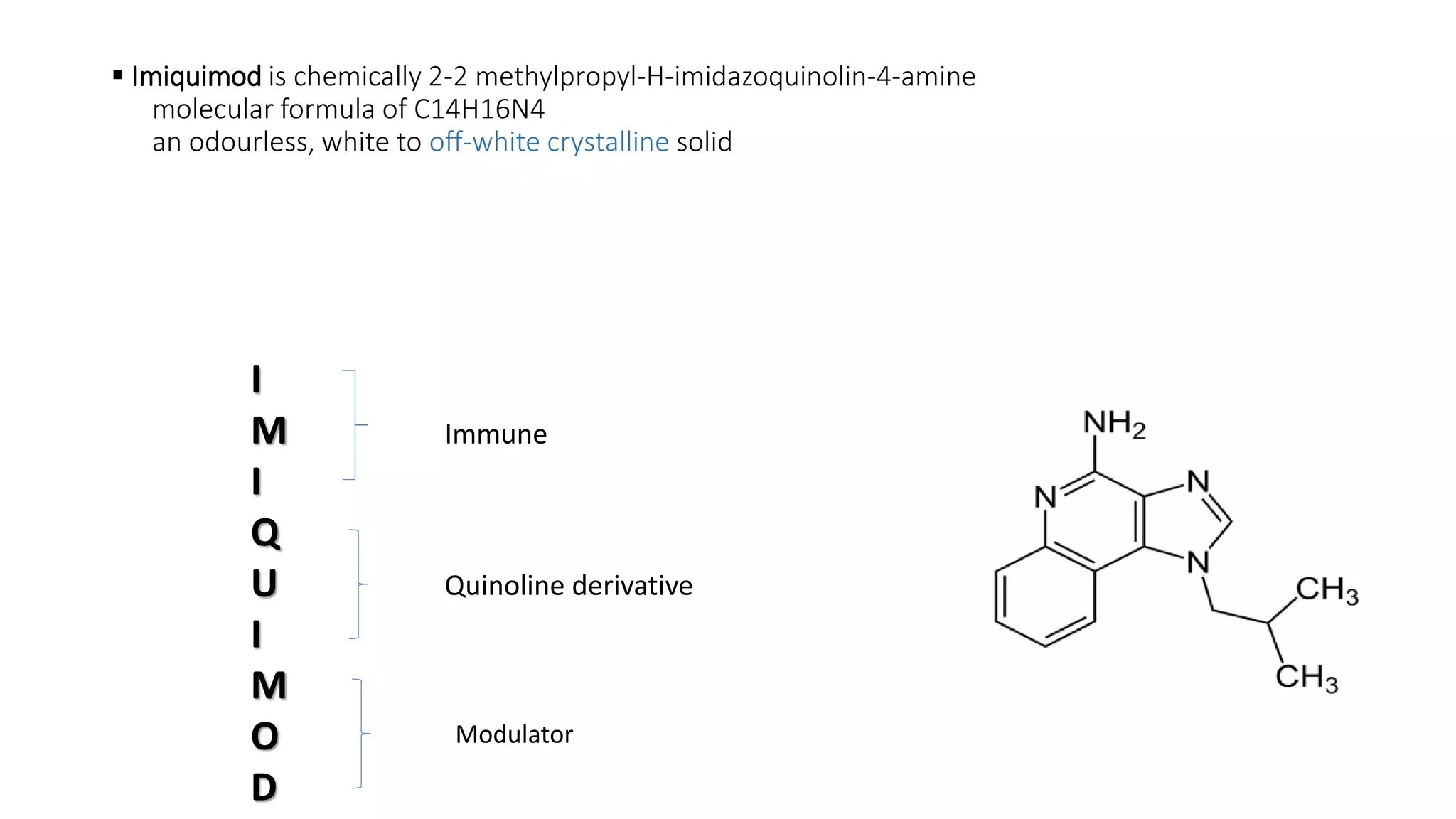
 Imiquimod is chemically 2-2 methylpropyl-H-imidazoquinolin-4-amine
molecular formula of C14H16N4
an odourless, white to off-white crystalline solid
I
M
I
Q
U
I
M
O
D
Immune
Quinoline derivative
Modulator
Pharmacokinetics
• Available as topical formulation (2.5% , 3.75% , 5%)
• Elimination t1/2 : 30 hr
• Systemic absorption is minimal
Mechanism of action
Activates immune cells by engaging TLR7 and (to a lesser extent) Toll-like receptor-8 (TLR8) signalling
Activation of nuclear factor-kappa B (NF-κB)
Induces pro-inflammatory cytokines, such as IFNα, tumour necrosis factor (TNFα), interleukin IL-2, IL-6,
IL-8, IL-12
Imiquimod induces an increase in markers for IFN-γ and the interferon inducible gene product 2’5’-
oligoadenylate synthetase at the treatment site
The antiviral activity is indirect through cytokine induction of IFN-alpha
 Enhances costimulatory marker expression, increase CCR7and improve pDC viability
Interfere with adenosine receptor (AR) signalling pathways, particularly A2A
Receptor-independent reduction of adenylyl cyclase activity augmenting the pro-inflammatory
activity of imiquimod
Infiltrate of tumour-destructive cells (T lymphocytes, dendritic cells and macrophages) at the
superficial basal cell carcinoma lesions
 Exert some pro-apoptotic activity against tumour cells
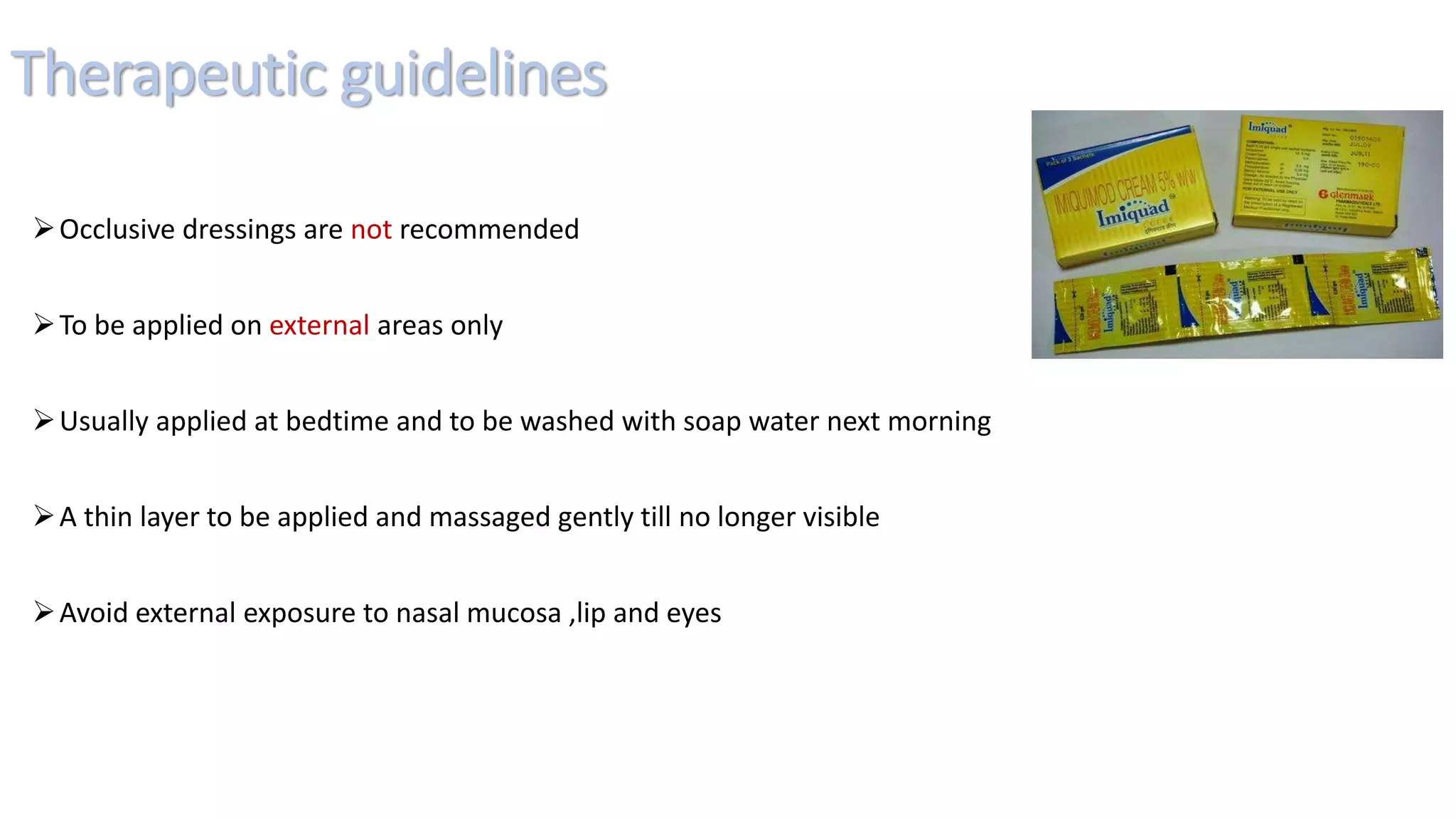
Therapeutic guidelines
Occlusive dressings are not recommended
To be applied on external areas only
Usually applied at bedtime and to be washed with soap water next morning
A thin layer to be applied and massaged gently till no longer visible
Avoid external exposure to nasal mucosa ,lip and eyes
FDA Approved Indications
 Approved for the first time in 1997 for external genital and perianal wart
 Other non viral indications
1. Actinic keratosis
2. Superficial BCC(non facial)
Off Label Indications
INFECTIOUS NEOPLASTC INFLAMMATORY OTHERS
Non genital wart Bowen disease Granuloma annulare Keloid
Herpes labialis/genitalis Melanoma in situ Morphea Follicular mucinosis
Molluscum contagiosum keratoacanthoma Porokeratosis of mibelli
Leshmaniasis Extramammary Pagets disease
Epidermodysplsia
verruciformis
Kaposi sarcoma
Pyogenic granuloma
Miscellaneous non approved use of topical Imiquimod
Contraindications
• Absolute
Known hypersensitivity(benzyl alcohol,paraben)
Children below 12 years
Internal urethral , intravaginal , intracervical and intra rectal
• Relative
Immunosuppression(HIV , post transplant )
Pregnancy ( Cat C) and Lactation
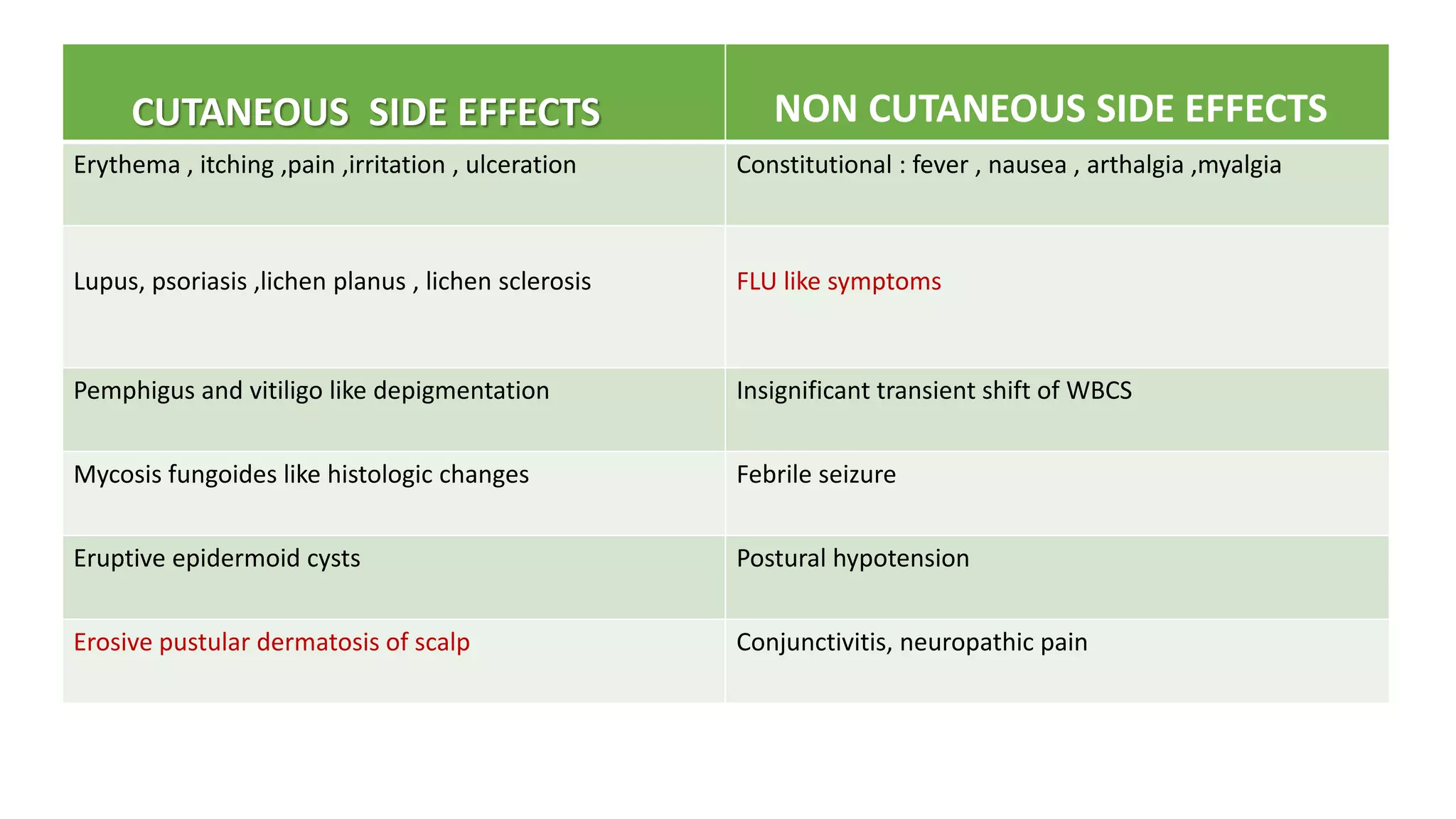
CUTANEOUS SIDE EFFECTS NON CUTANEOUS SIDE EFFECTS
Erythema , itching ,pain ,irritation , ulceration Constitutional : fever , nausea , arthalgia ,myalgia
Lupus, psoriasis ,lichen planus , lichen sclerosis FLU like symptoms
Pemphigus and vitiligo like depigmentation Insignificant transient shift of WBCS
Mycosis fungoides like histologic changes Febrile seizure
Eruptive epidermoid cysts Postural hypotension
Erosive pustular dermatosis of scalp Conjunctivitis, neuropathic pain
Imiquimod in external genital and peri anal wart
 3.75% Imiquimod cream approved by FDA for Actinic Keratoses and Anogenital warts
Two studies comparing 2.5% vs 3.75% with once daily application for 8weeks revealed complete clearance
in 28.3 36.6 of patients
A study of in HIV+patient on HAART treated with 5 Imiquimod thrice a week showed total clearance in 32
of patients at week 16
Imiquimod in superficial BCC
Not a first line treatment for any BCC
FDA approved 5% cream for small<2cm non facial superficial BCC once daily 5days/wk for 6-12 wk
Clearance rate reported range from 43 to100 with various dosage frequency
Difficult to evaluate the efficacy of a cancer : 5 yr clearance rate (follow up)
Imiquimod induced scarring and hypopigmentation can mask the residual tumor
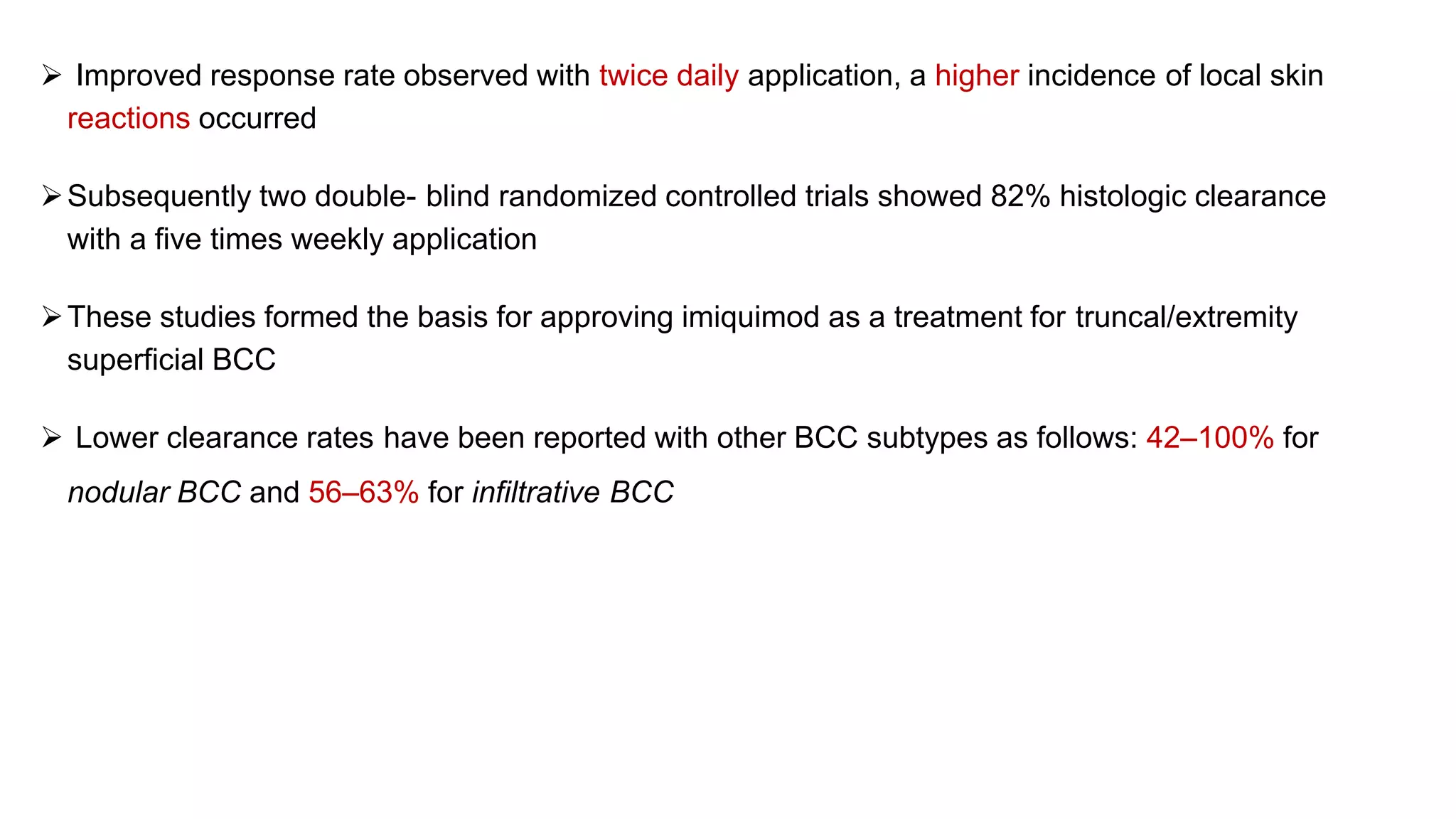
 Improved response rate observed with twice daily application, a higher incidence of local skin
reactions occurred
Subsequently two double- blind randomized controlled trials showed 82% histologic clearance
with a five times weekly application
These studies formed the basis for approving imiquimod as a treatment for truncal/extremity
superficial BCC
 Lower clearance rates have been reported with other BCC subtypes as follows: 42–100% for
nodular BCC and 56–63% for infiltrative BCC
Imiquimod in Actinic keratoses
Indicated for AKs on scalp and face
 5% Imiquimod approved for a treatment area of approx. 25 sqcm on scalp or face (never both
simultaneously)
Duration : twice a wk for 16 wks
After an overnight stay on ,it is to be washed with soap water next morning
Complete clearance rates with thrice a wk have been reported between 45 and 84 cases for 16wk
Imiquimod can be an alternative to other first line topical treatments like 5FU
Recently, a new standard in managing patients with AK has been set with the target being the
detection and clearance of clinical and subclinical AK lesions across an entire sun-exposed
field
 This concept has centered on using imiquimod 3.75% cream (used daily on two 2-week
treatment cycles that are separated by a 2-week treatment-free interval) and reduction in
lesions from Lmax
This treatment resulted in 92% median percentage reduction in AK lesions with sustained
lesion clearance for at least 1 year and acceptable tolerability profile
Conclusion
 Effective immune response modifier
 Contraindicated in known hypersensitivity children below 12 yr
 Better to be avoided in pregnancy and lactation
 FDA approved and effective in treatment external genital wart , Actinic keratoses and Superficial BCC
 Significant efficacy in a few other dermatoses like keratoacanthoma , follicular mucinosis , granuloma annulare ,
porokeratosis ,Kaposi sarcoma ,etc.
 But further evidence based studied needed to explore its potential in a variety of ever expanding dermatoses
Imiquimod in dermatology

Imiquimod in dermatology

  • 1.
  • 2.
     Imiquimod ischemically 2-2 methylpropyl-H-imidazoquinolin-4-amine molecular formula of C14H16N4 an odourless, white to off-white crystalline solid I M I Q U I M O D Immune Quinoline derivative Modulator
  • 3.
    Pharmacokinetics • Available astopical formulation (2.5% , 3.75% , 5%) • Elimination t1/2 : 30 hr • Systemic absorption is minimal
  • 4.
    Mechanism of action Activatesimmune cells by engaging TLR7 and (to a lesser extent) Toll-like receptor-8 (TLR8) signalling Activation of nuclear factor-kappa B (NF-κB) Induces pro-inflammatory cytokines, such as IFNα, tumour necrosis factor (TNFα), interleukin IL-2, IL-6, IL-8, IL-12 Imiquimod induces an increase in markers for IFN-γ and the interferon inducible gene product 2’5’- oligoadenylate synthetase at the treatment site The antiviral activity is indirect through cytokine induction of IFN-alpha
  • 5.
     Enhances costimulatorymarker expression, increase CCR7and improve pDC viability Interfere with adenosine receptor (AR) signalling pathways, particularly A2A Receptor-independent reduction of adenylyl cyclase activity augmenting the pro-inflammatory activity of imiquimod Infiltrate of tumour-destructive cells (T lymphocytes, dendritic cells and macrophages) at the superficial basal cell carcinoma lesions  Exert some pro-apoptotic activity against tumour cells
  • 7.
    Therapeutic guidelines Occlusive dressingsare not recommended To be applied on external areas only Usually applied at bedtime and to be washed with soap water next morning A thin layer to be applied and massaged gently till no longer visible Avoid external exposure to nasal mucosa ,lip and eyes
  • 8.
    FDA Approved Indications Approved for the first time in 1997 for external genital and perianal wart  Other non viral indications 1. Actinic keratosis 2. Superficial BCC(non facial)
  • 9.
    Off Label Indications INFECTIOUSNEOPLASTC INFLAMMATORY OTHERS Non genital wart Bowen disease Granuloma annulare Keloid Herpes labialis/genitalis Melanoma in situ Morphea Follicular mucinosis Molluscum contagiosum keratoacanthoma Porokeratosis of mibelli Leshmaniasis Extramammary Pagets disease Epidermodysplsia verruciformis Kaposi sarcoma Pyogenic granuloma
  • 10.
    Miscellaneous non approveduse of topical Imiquimod
  • 11.
    Contraindications • Absolute Known hypersensitivity(benzylalcohol,paraben) Children below 12 years Internal urethral , intravaginal , intracervical and intra rectal • Relative Immunosuppression(HIV , post transplant ) Pregnancy ( Cat C) and Lactation
  • 12.
    CUTANEOUS SIDE EFFECTSNON CUTANEOUS SIDE EFFECTS Erythema , itching ,pain ,irritation , ulceration Constitutional : fever , nausea , arthalgia ,myalgia Lupus, psoriasis ,lichen planus , lichen sclerosis FLU like symptoms Pemphigus and vitiligo like depigmentation Insignificant transient shift of WBCS Mycosis fungoides like histologic changes Febrile seizure Eruptive epidermoid cysts Postural hypotension Erosive pustular dermatosis of scalp Conjunctivitis, neuropathic pain
  • 13.
    Imiquimod in externalgenital and peri anal wart  3.75% Imiquimod cream approved by FDA for Actinic Keratoses and Anogenital warts Two studies comparing 2.5% vs 3.75% with once daily application for 8weeks revealed complete clearance in 28.3 36.6 of patients A study of in HIV+patient on HAART treated with 5 Imiquimod thrice a week showed total clearance in 32 of patients at week 16
  • 14.
    Imiquimod in superficialBCC Not a first line treatment for any BCC FDA approved 5% cream for small<2cm non facial superficial BCC once daily 5days/wk for 6-12 wk Clearance rate reported range from 43 to100 with various dosage frequency Difficult to evaluate the efficacy of a cancer : 5 yr clearance rate (follow up) Imiquimod induced scarring and hypopigmentation can mask the residual tumor
  • 15.
     Improved responserate observed with twice daily application, a higher incidence of local skin reactions occurred Subsequently two double- blind randomized controlled trials showed 82% histologic clearance with a five times weekly application These studies formed the basis for approving imiquimod as a treatment for truncal/extremity superficial BCC  Lower clearance rates have been reported with other BCC subtypes as follows: 42–100% for nodular BCC and 56–63% for infiltrative BCC
  • 16.
    Imiquimod in Actinickeratoses Indicated for AKs on scalp and face  5% Imiquimod approved for a treatment area of approx. 25 sqcm on scalp or face (never both simultaneously) Duration : twice a wk for 16 wks After an overnight stay on ,it is to be washed with soap water next morning Complete clearance rates with thrice a wk have been reported between 45 and 84 cases for 16wk Imiquimod can be an alternative to other first line topical treatments like 5FU
  • 17.
    Recently, a newstandard in managing patients with AK has been set with the target being the detection and clearance of clinical and subclinical AK lesions across an entire sun-exposed field  This concept has centered on using imiquimod 3.75% cream (used daily on two 2-week treatment cycles that are separated by a 2-week treatment-free interval) and reduction in lesions from Lmax This treatment resulted in 92% median percentage reduction in AK lesions with sustained lesion clearance for at least 1 year and acceptable tolerability profile
  • 18.
    Conclusion  Effective immuneresponse modifier  Contraindicated in known hypersensitivity children below 12 yr  Better to be avoided in pregnancy and lactation  FDA approved and effective in treatment external genital wart , Actinic keratoses and Superficial BCC  Significant efficacy in a few other dermatoses like keratoacanthoma , follicular mucinosis , granuloma annulare , porokeratosis ,Kaposi sarcoma ,etc.  But further evidence based studied needed to explore its potential in a variety of ever expanding dermatoses

Editor's Notes

  • #14 Randomized vehicle-controlled clinical trials have shown that applying imiquimod 5% cream three times per weekfor up to 16 weeks completely cleared lesions in about 50% of patients. It was well tolerated, and men tended to have lower clearance rates than women, probably related to the lower keratinization degree and increased moisture of the vulva compared to the penile shaft
  • #15 Even though surgery is considered first-line treatment for BCC, many other therapeutic modalities can be used, …. Imiquimod is currently FDA-approved for the treatment of truncal/extremity small (<2 cm in size) superficial BCCs.19,20 An initial randomized trial demonstrated almost 90% histologic clearance rate of superficial BCC when treated with 5% imiquimod cream daily for 6 weeks
  • #17 Interventions available for AK include destructive therapies, topical medications, chemical peels, and photodynamic Therapy… Isolated lesions can be treated with cryotherapy or surgery…. multiple lesions benefit most from field-directed therapies such as topical 5-fluorouracil, imiquimod, ingenol mebutate, and diclofenac……Head to head comparing imiquimod and 5FU are lacking