COMMUNICATING VALUE
NAMES RNO
G.SUSHANTH 19M044
G.VENKATESH 19M050
R.SOJI KRISHNA 19M052
N.SAI KRISHNA 19M094
7
Marketing Communications
Marketing Communications Mix
The Communications Process Models
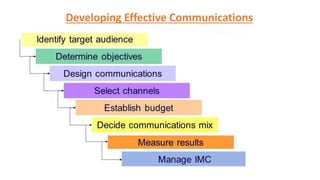
Developing Effective Communications
Marketing Communications
Marketing communications are the means
by which firms attempt to inform, persuade,
and remind consumers, directly or indirectly,
about the products and brands they sell.
 Modern marketing calls for more than developing a good product, pricing it
attractively, and making accessible.
 Integrated marketing communication played an important role in the success of
one of Bollywood’s biggest box-office successes, 3 idiots.
Changing marketing communications environment
 Technology and other factors have change the way consumers process communications,
and even whether they choose to process them at all
 It is estimated that India will soon be the largest direct to home television broadcast
market in the world
 Marketing communications is almost every medium and form have been on the rise, and
some consumers feel they are increasingly in massive.
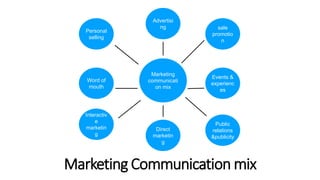
Marketing Communication mix
Advertisi
ng sale
promotio
n
Events &
experienc
es
Word of
mouth
Marketing
communicati
on mix
Interactiv
e
marketin
g
Personal
selling
Public
relations
&publicity
Direct
marketin
g
Advertising: printing & broad cast adds, cinema, brochures & booklets, point of
purchase displays.
sale promotion: coupons, contests, function premiums & gifts.
Events & experiences: sports, entertainment, festivals, arts, street activities, events.
Public relations & publicity: speeches, seminars, company magazine.
Direct & interactive marketing: catalogues, mailing, telemarketing, fax, company blogs.
Word of mouth marketing: person-to-person, chat rooms.
Personal selling: sale presentations, sale meetings, samples.
Marketers should understand the fundamental elements of effective
communications. The two models are :
 Macro model
 Micro model
The Communications Process Models
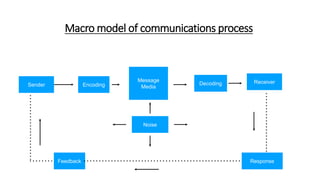
Macro model of the Communications Process shows nine key factors in effective
communication:
•Two represent the major parties sender and receiver
•Two represent the major tools message and media
•Four represent major communication functions encoding, decoding, response, and
feedback
•The last element in the system is noise, random and competing messages that may
interfere with the intended communication
Macro model of the Communications Process
Macro model of communications process
Sender
Message
Media
Decoding
Noise
Encoding
Receiver
ResponseFeedback
Micro model of the Communications Process
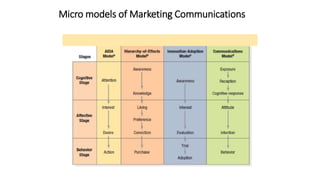
Micro models of marketing communications concentrate on
consumers’ specific responses to communications.All these
models assume the buyer passes through cognitive,
affective, and behavioral stages, in that order
Micro models of Marketing Communications
Developing Effective Communications
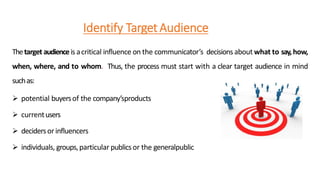
Identify TargetAudience
Thetarget audienceis acritical influence on the communicator’s decisions about what to say,how,
when, where, and to whom. Thus, the process must start with a clear target audience in mind
suchas:
 potential buyersof the company’sproducts
 currentusers
 decidersorinfluencers
 individuals, groups,particular publicsor the generalpublic
Communications Objectives
 Category need: Establishingaproduct or servicecategory as necessaryto removeor satisfya
perceived discrepancy between a current motivational state and a desired motivational
state.
 Brand Awareness : Fostering the consumer’s ability to recognize or recall the brand within
the category, in sufficient detail to makeapurchase.
 Brand Attitude: Helping consumers evaluate the brand’s perceived ability to meet a
currently relevant need.
 Brand Purchase Intention: Moving consumers to decide to purchase the brand or take
purchase-relatedaction.
Design the communication
Formulating the communications to achieve the
desired response requires solving three
problems:
•What to say (message strategy)
•How to say it (creative strategy)
•Who should say it (message source)
MessagestrategyIn determining message,
managementsearches for appeals,themes,or
ideasin line with the brand positioning to help
establishpointsof parity or pointsof differences.
Design The Communications
CreativeStrategyCreativestrategy arehow marketers
translate their message into aspecific
communication:
 Informational Appeals elaborate on product or service attributes or benefits.They assume very
rational andlogicalprocessingof the communicationonthe part of the consumer.
 Transformational Appeals elaborate on a non-product-related benefit or image.They often
attempt to stir up emotions that will motivate purchase.
Design The Communications
Message Source message delivered by attractive or popular sources can achieve higher
attention and recall, which is why advertisers often use celebrities as spokes people. They are
likely to be effective when they are credible or personify a key product attribute. Celebrity
Characteristics:
• Expertise
• Trustworthiness
• Likeability
Personal Communications Channels involve two or more persons communicating directly face-to-
face, persons-to-audience, over the telephone, or through e-mail.
Thekindsof personalcommunications channels are:
– Advocatechannels:companysalepeoplecontacting buyersin the targetmarket.
– Expertchannel: experts making statementsto targetbuyers.
– Socialchannelsconsistof neighbors,friends, family members, andassociatestalking to target
buyers.
Select Communication Channels
Non-personal channels are communications directed to more than a one person and
includes:
 Media
 Sales performance
 Events and experiences
 Public relations
Integration of communications channel
Although personal communication is often more effective than mass communication,
mass media might be the major means of stimulating personal communication
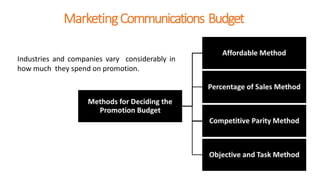
MarketingCommunications Budget
Industries and companies vary considerably in
how much they spend on promotion.
Methods for Deciding the Promotion Budget
Affordable method set the promotion budget at what they think the company can
afford.
Percentage of sales method set promotion expenditures at a specified percentage
of sales.
Competitive parity method set the promotion budget to achieve share-of-voice
parity with competitors.
Objective and task method
Deciding on the marketing communication mix
 Companies must allocate the marketing communications budget over the eight
major modes of communication—advertising, sale promotion, public relations
and publicity, events and experiences, direct marketing, interactive marketing,
word-of- mouth marketing andpersonalselling.
 Within the sameindustry, companiescandiffer considerablyin their mediaand
channelchoices.
 Companiesarealwayssearchingfor waysto gainefficiency by substituting one
communications tool forothers.
FactorsinSettingtheMarketingCommunicationsMix
• Typeof ProductMarket Communications mix allocations vary between consumerandbusiness
markets.
Consumermarketers tend to spendcomparativelymore on salepromotion and advertising
businessmarketers tend to spendcomparatively more on personalselling.
• BuyerReadinessStageCommunicationtools varyin cost effectivenessat different stagesof buyer
readiness.
 Advertising andpublicity playthe mostimportant roles in the Awareness- building stage.
 Customercomprehensionisprimarily affected by advertising andpersonalselling.
 Customerconviction isinfluenced mostly bypersonalselling.
 Closingthe saleisinfluenced mostly by personalsellingandsalepromotion.
 Reorderingisalsoaffected mostly bypersonalsellingandsalepromotion.
 In order to measure the Communication Results/Impact, members of the target audience
areasked:
 whether they recognizeor recall themessage
 how manytimes they saw it
 what points theyre call the message
 how they felt about what aretheir previous andcurrent attitudes toward the product
andthecompany.
 The communicator should also collect behavioral measures of audience response, such as
how manypeople bought the product,likedit andtalkedto othersabout it.
MeasuringCommunicationResults
Integrated marketing communication:
 Marketing communication planning that recognizes the added value of comprehensive plan &
evaluates the strategic roles of a variety of communication such as general advertising , direct
marketing , sales promotion , public relations.
Co-ordinating media :
media coordination can occurs across and with in media types, but marketers should combine
personal & non personal communications channels through multiple vehicle.
Implementingimc : improve the company’s ability to reach the right customers with the right
messages at right time in the right place
Managing integrated marketing communication
Communicating value  grp 7

Communicating value grp 7

  • 1.
  • 2.
    NAMES RNO G.SUSHANTH 19M044 G.VENKATESH19M050 R.SOJI KRISHNA 19M052 N.SAI KRISHNA 19M094 7
  • 3.
    Marketing Communications Marketing CommunicationsMix The Communications Process Models Developing Effective Communications
  • 4.
    Marketing Communications Marketing communicationsare the means by which firms attempt to inform, persuade, and remind consumers, directly or indirectly, about the products and brands they sell.
  • 5.
     Modern marketingcalls for more than developing a good product, pricing it attractively, and making accessible.  Integrated marketing communication played an important role in the success of one of Bollywood’s biggest box-office successes, 3 idiots.
  • 6.
    Changing marketing communicationsenvironment  Technology and other factors have change the way consumers process communications, and even whether they choose to process them at all  It is estimated that India will soon be the largest direct to home television broadcast market in the world  Marketing communications is almost every medium and form have been on the rise, and some consumers feel they are increasingly in massive.
  • 7.
    Marketing Communication mix Advertisi ngsale promotio n Events & experienc es Word of mouth Marketing communicati on mix Interactiv e marketin g Personal selling Public relations &publicity Direct marketin g
  • 8.
    Advertising: printing &broad cast adds, cinema, brochures & booklets, point of purchase displays. sale promotion: coupons, contests, function premiums & gifts. Events & experiences: sports, entertainment, festivals, arts, street activities, events. Public relations & publicity: speeches, seminars, company magazine. Direct & interactive marketing: catalogues, mailing, telemarketing, fax, company blogs. Word of mouth marketing: person-to-person, chat rooms. Personal selling: sale presentations, sale meetings, samples.
  • 9.
    Marketers should understandthe fundamental elements of effective communications. The two models are :  Macro model  Micro model The Communications Process Models
  • 10.
    Macro model ofthe Communications Process shows nine key factors in effective communication: •Two represent the major parties sender and receiver •Two represent the major tools message and media •Four represent major communication functions encoding, decoding, response, and feedback •The last element in the system is noise, random and competing messages that may interfere with the intended communication Macro model of the Communications Process
  • 11.
    Macro model ofcommunications process Sender Message Media Decoding Noise Encoding Receiver ResponseFeedback
  • 12.
    Micro model ofthe Communications Process Micro models of marketing communications concentrate on consumers’ specific responses to communications.All these models assume the buyer passes through cognitive, affective, and behavioral stages, in that order
  • 13.
    Micro models ofMarketing Communications
  • 14.
  • 15.
    Identify TargetAudience Thetarget audienceisacritical influence on the communicator’s decisions about what to say,how, when, where, and to whom. Thus, the process must start with a clear target audience in mind suchas:  potential buyersof the company’sproducts  currentusers  decidersorinfluencers  individuals, groups,particular publicsor the generalpublic
  • 16.
    Communications Objectives  Categoryneed: Establishingaproduct or servicecategory as necessaryto removeor satisfya perceived discrepancy between a current motivational state and a desired motivational state.  Brand Awareness : Fostering the consumer’s ability to recognize or recall the brand within the category, in sufficient detail to makeapurchase.  Brand Attitude: Helping consumers evaluate the brand’s perceived ability to meet a currently relevant need.  Brand Purchase Intention: Moving consumers to decide to purchase the brand or take purchase-relatedaction.
  • 17.
    Design the communication Formulatingthe communications to achieve the desired response requires solving three problems: •What to say (message strategy) •How to say it (creative strategy) •Who should say it (message source)
  • 18.
    MessagestrategyIn determining message, managementsearchesfor appeals,themes,or ideasin line with the brand positioning to help establishpointsof parity or pointsof differences. Design The Communications
  • 19.
    CreativeStrategyCreativestrategy arehow marketers translatetheir message into aspecific communication:  Informational Appeals elaborate on product or service attributes or benefits.They assume very rational andlogicalprocessingof the communicationonthe part of the consumer.  Transformational Appeals elaborate on a non-product-related benefit or image.They often attempt to stir up emotions that will motivate purchase. Design The Communications
  • 20.
    Message Source messagedelivered by attractive or popular sources can achieve higher attention and recall, which is why advertisers often use celebrities as spokes people. They are likely to be effective when they are credible or personify a key product attribute. Celebrity Characteristics: • Expertise • Trustworthiness • Likeability
  • 21.
    Personal Communications Channelsinvolve two or more persons communicating directly face-to- face, persons-to-audience, over the telephone, or through e-mail. Thekindsof personalcommunications channels are: – Advocatechannels:companysalepeoplecontacting buyersin the targetmarket. – Expertchannel: experts making statementsto targetbuyers. – Socialchannelsconsistof neighbors,friends, family members, andassociatestalking to target buyers. Select Communication Channels
  • 22.
    Non-personal channels arecommunications directed to more than a one person and includes:  Media  Sales performance  Events and experiences  Public relations Integration of communications channel Although personal communication is often more effective than mass communication, mass media might be the major means of stimulating personal communication
  • 23.
    MarketingCommunications Budget Industries andcompanies vary considerably in how much they spend on promotion.
  • 24.
    Methods for Decidingthe Promotion Budget Affordable method set the promotion budget at what they think the company can afford. Percentage of sales method set promotion expenditures at a specified percentage of sales. Competitive parity method set the promotion budget to achieve share-of-voice parity with competitors. Objective and task method
  • 25.
    Deciding on themarketing communication mix  Companies must allocate the marketing communications budget over the eight major modes of communication—advertising, sale promotion, public relations and publicity, events and experiences, direct marketing, interactive marketing, word-of- mouth marketing andpersonalselling.  Within the sameindustry, companiescandiffer considerablyin their mediaand channelchoices.  Companiesarealwayssearchingfor waysto gainefficiency by substituting one communications tool forothers.
  • 26.
    FactorsinSettingtheMarketingCommunicationsMix • Typeof ProductMarketCommunications mix allocations vary between consumerandbusiness markets. Consumermarketers tend to spendcomparativelymore on salepromotion and advertising businessmarketers tend to spendcomparatively more on personalselling. • BuyerReadinessStageCommunicationtools varyin cost effectivenessat different stagesof buyer readiness.  Advertising andpublicity playthe mostimportant roles in the Awareness- building stage.  Customercomprehensionisprimarily affected by advertising andpersonalselling.  Customerconviction isinfluenced mostly bypersonalselling.  Closingthe saleisinfluenced mostly by personalsellingandsalepromotion.  Reorderingisalsoaffected mostly bypersonalsellingandsalepromotion.
  • 27.
     In orderto measure the Communication Results/Impact, members of the target audience areasked:  whether they recognizeor recall themessage  how manytimes they saw it  what points theyre call the message  how they felt about what aretheir previous andcurrent attitudes toward the product andthecompany.  The communicator should also collect behavioral measures of audience response, such as how manypeople bought the product,likedit andtalkedto othersabout it. MeasuringCommunicationResults
  • 28.
    Integrated marketing communication: Marketing communication planning that recognizes the added value of comprehensive plan & evaluates the strategic roles of a variety of communication such as general advertising , direct marketing , sales promotion , public relations. Co-ordinating media : media coordination can occurs across and with in media types, but marketers should combine personal & non personal communications channels through multiple vehicle. Implementingimc : improve the company’s ability to reach the right customers with the right messages at right time in the right place Managing integrated marketing communication

Editor's Notes