Graphics are visual presentations on some surface, such as a wall, computer screen, paper, or stone to brand, or entertain. Examples are photographs, drawings, graphs, diagrams, maps, engineering drawings, or other images
4
What is animage? - The bitmap
(iconic) representation
Also called “raster or pixel maps”
representation
An image is broken up into a grid
pixel
Gray level
Original picture Digital image
f(x, y) I[i, j] or I[x, y]
x
y
5.
5
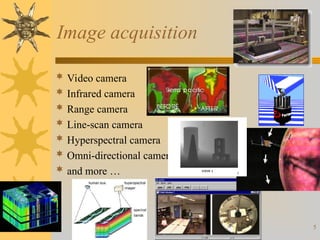
Image acquisition
Videocamera
Infrared camera
Range camera
Line-scan camera
Hyperspectral camera
Omni-directional camera
and more …
6.
6
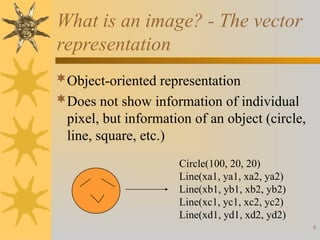
What is animage? - The vector
representation
Object-oriented representation
Does not show information of individual
pixel, but information of an object (circle,
line, square, etc.)
Circle(100, 20, 20)
Line(xa1, ya1, xa2, ya2)
Line(xb1, yb1, xb2, yb2)
Line(xc1, yc1, xc2, yc2)
Line(xd1, yd1, xd2, yd2)
7.
7
What is animage? (cont’d)
The functional representation
– z = ax2
+by2
+cxy+dx+ey+f
The linear (vector representation)
– [5 10; 6 4] [5 10 6 4]T
The probabilistic representation (random
field)
The graphical representation
8.
8
j
(i, j) (i,j+1)
(i, j-1)
(i-1, j) (i-1, j+1)
(i+1, j+1)
(i+1, j)
(i-1, j-1)
(i+1, j-1)
i
(row)
(column)
4-neighborhood 8-neighborhood
Types of neighborhoods
Neighbors of a pixel
13
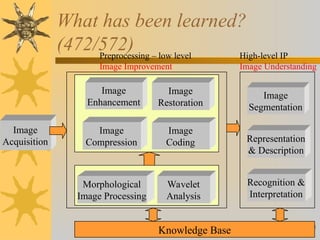
What has beenlearned?
(472/572)
Image
Acquisition
Image
Enhancement
Image
Restoration
Image
Compression
Image
Segmentation
Representation
& Description
Recognition &
Interpretation
Knowledge Base
Preprocessing – low level
Image Improvement
Image
Coding
Morphological
Image Processing
Wavelet
Analysis
High-level IP
Image Understanding
14.
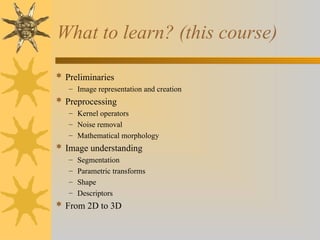
What to learn?(this course)
Preliminaries
– Image representation and creation
Preprocessing
– Kernel operators
– Noise removal
– Mathematical morphology
Image understanding
– Segmentation
– Parametric transforms
– Shape
– Descriptors
From 2D to 3D
15.
Objectives
In-depth study ofcomputer vision
algorithms
Study the trend and predict the future
Optimization and consistency
CVPR/WACV/ECCV submissions
15
Editor's Notes
#8 Explain like
The current pixel of interest is (I,j),
The origin is at the upper-left corner
Then its neighbors would be …


![4
What is an image? - The bitmap
(iconic) representation
Also called “raster or pixel maps”
representation
An image is broken up into a grid
pixel
Gray level
Original picture Digital image
f(x, y) I[i, j] or I[x, y]
x
y](https://image.slidesharecdn.com/lecture01intro-250412193024-7aa19319/85/Image-Graphics-Image-processing-Computer-vision-ppt-4-320.jpg)
![7
What is an image? (cont’d)
The functional representation
– z = ax2
+by2
+cxy+dx+ey+f
The linear (vector representation)
– [5 10; 6 4] [5 10 6 4]T
The probabilistic representation (random
field)
The graphical representation](https://image.slidesharecdn.com/lecture01intro-250412193024-7aa19319/85/Image-Graphics-Image-processing-Computer-vision-ppt-7-320.jpg)