   Social media marketing is the best step a
    business or organization can take in this
    day and age to send effective messages
    about their product or organization in
    general.
 Social media as a marketing tool is
  developing rapidly.
 Wikipedia definition: “Social media
  marketing is an addition to personal,
  small business, corporate, and non-profit
  organizations’ integrated marketing
  communications plans.”
 It is a set of internet-based applications
  used to expand on the basic
  mechanical foundations of Web 2.0
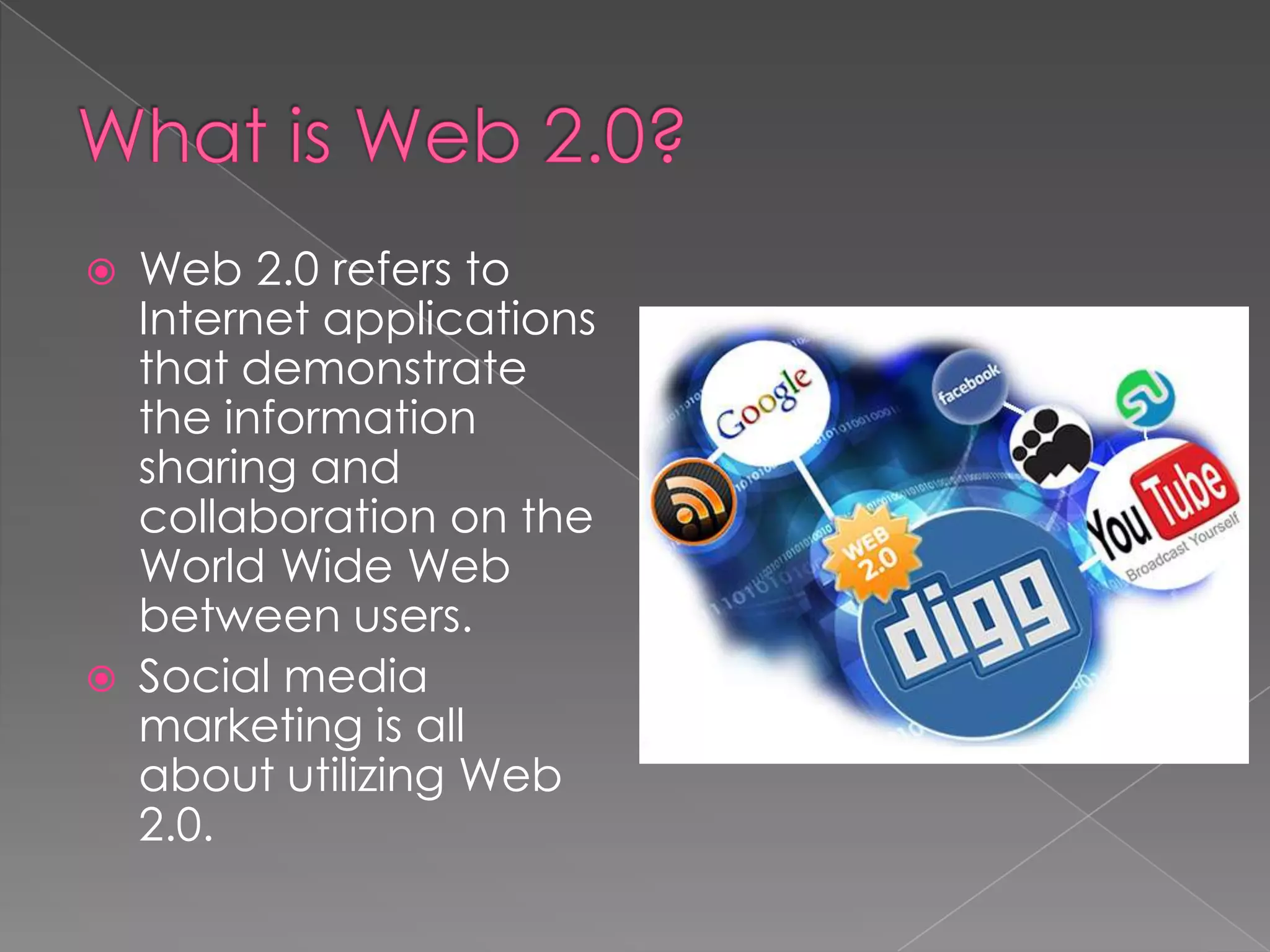
   Web 2.0 refers to
    Internet applications
    that demonstrate
    the information
    sharing and
    collaboration on the
    World Wide Web
    between users.
   Social media
    marketing is all
    about utilizing Web
    2.0.
   Traditional marketing
    is about delivering
    an idea.
   Social media
    marketing is the
    same, but leaves
    room for feedback.
   It builds a
    relationship and
    conversation.
   Every decision and
    activity marketers
    partake in must deliver
    a form of return on
    their investment.
   Social media
    marketing must
    somehow impact a
    company and its
    brand and their
    business in general.
   Examples: viral
    campaigns and
    mobile marketing.
 Social media as a marketing tool is an
  overall great investment of both time
  and money.
 It will help your organization reach a
  broader range of publics than using only
  traditional forms of marketing in the
  media.
 Technology is always evolving. In the
  future, we could see the development of
  Web 3.0.
   "Internet Marketing." Business Dictionary. WebFinance, Inc., n.d. Web. 1 Nov 2011.
    <http://www.businessdictionary.com/definition/integrated-marketing-communications-
    IMC.html>.
   Yost, Lauren. "You've Got... Tweets.." Parks & Recreation. 45.2 (2010): 48-53. Web. 1 Nov.
    2011. <http://web.ebscohost.com/ehost/detail?sid=dd97ed9d-d9d9-4995-8954-
    f8dc385e8262@sessionmgr11&vid=1&hid=15&bdata=JnNpdGU9ZWhvc3QtbGl2ZQ==
   O'Reilly, Tim. "What is Web 2.0." O'Reilly Media. O'Reilly Media, Inc., 30 09 2005. Web. 1
    Nov 2011. <http://oreilly.com/web2/archive/what-is-web-20.html>.
   Drury, Glen. "Social Media: Should Marketers Engage and How Can it be Done
    Effectively?." Journal of Direct, Data and Digital Marketing Practice. (2007): 274-277.
    Web. 1 Nov. 2011. <http://www.palgrave-
    journals.com/dddmp/journal/v9/n3/full/4350096a.html>.
   Fred Palumbo, Paul Herbig, (1998) "International marketing tool: the Internet", Industrial
    Management & Data Systems, Vol. 98 Iss: 6, pp.253 – 261. Web. 1 Nov. 2011.
    <http://www.emeraldinsight.com/journals.htm?articleid=849917&show=abstract>
   Journal of Direct, Data and Digital Marketing Practice (2008) 9, 231–244.
    doi:10.1057/palgrave.dddmp.4350098. Web. 1 Nov. 2011.< http://www.palgrave-
    journals.com/dddmp/journal/v9/n3/abs/4350098a.html>
   Kaplan, Andreas, and Haenlein, Michael. “Users of the World, Unite! The Challenges
    and Opportunities of Social Media.” Business Horizons. 53.1 (2010): 59-68. Web. 3 Nov.
    2011 <http://www.sciencedirect.com/science/article/pii/S0007681309001232.>
   Kotler, Phillip, and Zaltman, Gerald. “Social Marketing: An Approach to Planned Social
    Change.” Journal of Marketing. 35.3 (2005): 3-12. Web. 3 Nov. 2011.
    <http://www.jstor.org/stable/1249783>.

Im260 presentation

  • 2.
    Social media marketing is the best step a business or organization can take in this day and age to send effective messages about their product or organization in general.
  • 3.
     Social mediaas a marketing tool is developing rapidly.  Wikipedia definition: “Social media marketing is an addition to personal, small business, corporate, and non-profit organizations’ integrated marketing communications plans.”  It is a set of internet-based applications used to expand on the basic mechanical foundations of Web 2.0
  • 4.
    Web 2.0 refers to Internet applications that demonstrate the information sharing and collaboration on the World Wide Web between users.  Social media marketing is all about utilizing Web 2.0.
  • 5.
    Traditional marketing is about delivering an idea.  Social media marketing is the same, but leaves room for feedback.  It builds a relationship and conversation.
  • 6.
    Every decision and activity marketers partake in must deliver a form of return on their investment.  Social media marketing must somehow impact a company and its brand and their business in general.  Examples: viral campaigns and mobile marketing.
  • 7.
     Social mediaas a marketing tool is an overall great investment of both time and money.  It will help your organization reach a broader range of publics than using only traditional forms of marketing in the media.  Technology is always evolving. In the future, we could see the development of Web 3.0.
  • 8.
    "Internet Marketing." Business Dictionary. WebFinance, Inc., n.d. Web. 1 Nov 2011. <http://www.businessdictionary.com/definition/integrated-marketing-communications- IMC.html>.  Yost, Lauren. "You've Got... Tweets.." Parks & Recreation. 45.2 (2010): 48-53. Web. 1 Nov. 2011. <http://web.ebscohost.com/ehost/detail?sid=dd97ed9d-d9d9-4995-8954- f8dc385e8262@sessionmgr11&vid=1&hid=15&bdata=JnNpdGU9ZWhvc3QtbGl2ZQ==  O'Reilly, Tim. "What is Web 2.0." O'Reilly Media. O'Reilly Media, Inc., 30 09 2005. Web. 1 Nov 2011. <http://oreilly.com/web2/archive/what-is-web-20.html>.  Drury, Glen. "Social Media: Should Marketers Engage and How Can it be Done Effectively?." Journal of Direct, Data and Digital Marketing Practice. (2007): 274-277. Web. 1 Nov. 2011. <http://www.palgrave- journals.com/dddmp/journal/v9/n3/full/4350096a.html>.  Fred Palumbo, Paul Herbig, (1998) "International marketing tool: the Internet", Industrial Management & Data Systems, Vol. 98 Iss: 6, pp.253 – 261. Web. 1 Nov. 2011. <http://www.emeraldinsight.com/journals.htm?articleid=849917&show=abstract>  Journal of Direct, Data and Digital Marketing Practice (2008) 9, 231–244. doi:10.1057/palgrave.dddmp.4350098. Web. 1 Nov. 2011.< http://www.palgrave- journals.com/dddmp/journal/v9/n3/abs/4350098a.html>  Kaplan, Andreas, and Haenlein, Michael. “Users of the World, Unite! The Challenges and Opportunities of Social Media.” Business Horizons. 53.1 (2010): 59-68. Web. 3 Nov. 2011 <http://www.sciencedirect.com/science/article/pii/S0007681309001232.>  Kotler, Phillip, and Zaltman, Gerald. “Social Marketing: An Approach to Planned Social Change.” Journal of Marketing. 35.3 (2005): 3-12. Web. 3 Nov. 2011. <http://www.jstor.org/stable/1249783>.