1 Confidential | Copyright © 2009 The TriZetto Group, Inc.
Boy Scouting
Youth Leadership
Training
Introduction to
Leadership
Skills for Troops
2
Today’s Agenda
► Module One—Troop Organization includes a description of each
leadership position in the troop, including roles and responsibilities,
troop organization, and introductions to vision and servant
leadership. (About an hour…)
► Module Two—Tools of the Trade covers some core skill sets to
help the Scout lead, including communicating, planning, and
teaching. (About an hour and a half…)
► Module Three—Leadership and Teamwork incorporates
additional leadership tools for the Scout, including discussions of
teams and team characteristics, the stages of team development
and leadership, inclusion/using your team, ethics and values of a
leader, and a more in-depth review of vision. (About an hour…)
3
Introduction to this Course
►Leadership in Boy Scouting
 Leadership is a vital part of the Scouting program.
 Opportunities to develop leadership skills are a key
part of Scouting – every bit as important as rank!
 Key activities of youth leaders…
► Organizing the troop
► Planning and organizing
activities and meetings
► Assigning duties to others
► Planning menus and figuring
out food costs
► Encouraging advancement
► Guiding a troop’s involvement in
problem-solving
► Teaching outdoor, sports, or craft skills
► Ensuring the troop’s safety during
meetings and outings
► Handling the troop’s finances
► Helping other Boy Scouts make the
most of their own leadership
opportunities
► Encouraging participation
4
Youth Training Continuum
Enables
Enables
Enables
Enables
Enables
Enables
Taught at the
Unit Level
Taught at the
Council Level
Taught at the
Regional/National
Level
Kodiak is an adventure –
to push your boundaries and
apply your leadership skills
5
Module One – Unit Organization
►Module Overview
 Introduction to the Course - 5 minutes
 Introduction to Vision - 5 to 10 minutes
 Troop Organization - 20 to 35 minutes
 The Team-Based Troop - 25 to 30 minutes
 Introduction to Servant Leadership - 5 to 10 minutes
6
Introduction to Vision
►Critical to success in any role or project
►Developed and shared by all members
►Share and discuss the vision of the Troop
7
Troop Organization
►How is Your Troop Organized?
8
New
New
New
9
New
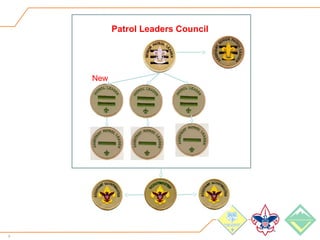
Patrol Leaders Council
10
11
Scout Positions
►Senior Patrol Leader
►Assistant Senior
Patrol Leader
►Patrol Leader
►Assistant Patrol
Leader
►Troop Guide
►Den Chief
►Historian
►Librarian
►Order of the Arrow
Representative
►Quartermaster
►Scribe
►Instructor
►Chaplain’s Aide
►Webmaster
►LNT Trainer
►Jr. Ass’t Scoutmaster
12
Senior Patrol Leader
► Preside at all troop meetings,
events, activities, and annual
program planning conference.
► Chair the patrol leaders’
council.
► Appoint Scout leaders with the
advice and consent of the
Scoutmaster.
► Assign duties and
responsibilities to other Scout
leaders.
► Work with the Scoutmaster in
training Scout leaders.
► Set and enforce the tone for
good Scout behavior within the
troop.
► Set a good example.
► Wear the Scout uniform
correctly.
► Live by the Scout Oath and
Scout Law.
► Show and help develop Scout
spirit.
13
Assistant Senior Patrol Leader
► Be responsible for training and
giving direct leadership to the
following appointed Scout
leaders:
 historian,
 Order of the Arrow troop
representative,
 scribe,
 librarian,
 instructor,
 quartermaster, and
 chaplain aide
► Help lead meetings and
activities as called upon by the
senior patrol leader.
► Guide the troop in the senior
patrol leader’s absence.
► Perform tasks assigned by the
senior patrol leader.
► Function as a member of the
patrol leaders’ council.
► Help set and enforce the tone
for good Scout behavior within
the troop.
► Set a good example.
► Wear the Scout uniform
correctly.
► Live by the Scout Oath and
Scout Law.
14
Patrol Leader
► Plan and lead patrol meetings
and activities.
► Keep patrol members
informed.
► Assign each patrol member
needed tasks and help them
succeed.
► Represent the patrol at all
patrol leaders’ council
meetings and the annual
program planning conference.
► Prepare the patrol to take part
in all troop activities.
► Show and help develop patrol
spirit.
► Work with other troop leaders
to make the troop run well.
► Know what patrol members
and other leaders can do.
► Set a good example.
► Wear the Scout uniform
correctly.
► Live by the Scout Oath and
Scout Law.
15
Assistant Patrol Leader
► Help the patrol leader plan and
lead patrol meetings and
activities.
► Help the patrol leader keep
patrol members informed.
► Help the patrol leader prepare
the patrol to take part in all
troop activities.
► Lead the patrol in the patrol
leader’s absence.
► Show and help develop patrol
spirit.
► Represent the patrol at all
patrol leaders’ council
meetings in the patrol leader’s
absence.
► Work with other troop leaders
to make the troop run well.
► Set a good example.
► Wear the Scout uniform
correctly.
► Live by the Scout Oath and
Scout Law.
16
Troop Guide
► Introduce new Scouts to troop
operations.
► Guide new Scouts through early
Scouting activities.
► Help set and enforce the tone for
good Scout behavior within the
troop.
► Ensure older Scouts never
harass or bully new Scouts.
► Help new Scouts earn the First
Class rank in their first year.
► Coach the patrol leader of the
new-Scout patrol on his duties.
► Work with the patrol leader at
patrol leaders’ council meetings.
► Attend patrol leaders’ council
meetings with the patrol leader of
the new-Scout patrol.
► Assist the assistant Scoutmaster
with training.
► Coach individual Scouts on
Scouting challenges.
► Set a good example.
► Wear the Scout uniform correctly.
► Live by the Scout Oath and Scout
Law.
► Show and help develop Scout
17
Den Chief
► Serve as the activities
assistant at den meetings.
► Meet regularly with the den
leader to review the den and
pack meeting plans.
► If serving as a Webelos den
chief; help prepare boys to join
Boy Scouting.
► Project a positive image of Boy
Scouting.
► Set a good example.
► Wear the Scout uniform
correctly.
► Live by the Scout Oath and
Scout Law.
► Show and help develop Scout
spirit.
18
Historian
► Gather pictures and facts
about past activities of the
troop and keep them in
scrapbooks, wall displays, or
information files.
► Take care of troop trophies
and keepsakes.
► Keep information about troop
alumni.
► Set a good example.
► Wear the Scout uniform
correctly.
► Live by the Scout Oath and
Scout Law.
► Show and help develop Scout
spirit.
19
Order of the Arrow Troop Representative
► Serve as a communication link
between the lodge or chapter
and the troop.
► Encourage year-round and
resident camping in the troop.
► Encourage older-Scout
participation in high-adventure
programs.
► Encourage Scouts to actively
participate in community
service projects.
► Assist with leadership skills
training in the troop.
► Encourage Arrowmen to
assume leadership positions in
the troop.
► Encourage Arrowmen in the
troop to be active participants
in lodge and/or chapter
activities and to seal their
membership in the Order by
becoming Brotherhood
members.
► Set a good example.
► Wear the Scout uniform
correctly.
► Live by the Scout Oath, Scout
Law, and OA Obligation.
► Show and help develop Scout
spirit.
20
Librarian
► Establish and maintain a troop
library.
► Keep records on literature
owned by the troop.
► Add new or replacement items
as needed.
► Have literature available for
borrowing at troop meetings.
► Maintain a system to check
literature in and out.
► Follow up on late returns.
► Set a good example.
► Wear the Scout uniform
correctly.
► Live by the Scout Oath and
Scout Law.
► Show and help develop Scout
spirit.
21
Quartermaster
► Keep records of patrol and
troop equipment.
► Keep equipment in good
repair.
► Keep equipment storage area
neat an
► Issue equipment and see that
it is returned in good order.
► Suggest new or replacement
items.
► Work with the troop committee
member responsible for
equipment.
► Set a good example.
► Wear the Scout uniform
correctly.
► Live by the Scout Oath and
Scout Law.
► Show and help develop Scout
spirit.
22
Scribe
► Attend and keep a log of patrol
leaders’ council meetings.
► Record attendance and dues
payments of all troop
members.
► Record advancement in troop
records and on the troop
advancement chart.
► Set a good example.
► Wear the Scout uniform
correctly.
► Work with the appropriate
troop committee members
responsible for finance,
records, and advancement.
► Live by the Scout Oath and
Scout Law.
► Show and help develop Scout
spirit.
► Handle correspondence
appropriately.
23
Instructor
► Instruct Scouting skills as
needed within the troop or
patrols.
► Prepare well in advance for
each teaching assignment.
► Set a good example.
► Wear the Scout uniform
correctly.
► Live by the Scout Oath and
Scout Law.
► Show and help develop Scout
spirit.
24
Chaplain’s Aide
► Keep troop leaders apprised of
religious holidays when
planning activities.
► Assist the troop chaplain or
religious coordinator in
meeting the religious needs of
troop members while on
activities.
► Encourage saying grace at
meals while camping or on
activities.
► Lead worship services on
campouts.
► Tell troop members about the
religious emblems program for
their faith.
► Set a good example.
► Wear the Scout uniform
correctly.
► Live by the Scout Oath and
Scout Law.
► Show and help develop Scout
spirit.
25
Webmaster
► Establish and maintain a safe
and secure troop website.
► Ensure the troop website is a
positive reflection of Scouting
for the public.
► Manage the troop’s electronic
communication tools.
► Work with the Scouts to
provide up-to-date troop
information.
► Work with the scribe.
► Set a good example.
► Wear the Scout uniform
correctly.
► Live by the Scout Oath and
Scout Law.
► Show and help develop Scout
spirit.
26
Leave No Trace Trainer
► Have a thorough
understanding of and
commitment to Leave No
Trace.
► Successfully complete the
Leave No Trace Trainer
training course.
► Help minimize the troop’s
impact on the land by teaching
Scouts the principles of Leave
No Trace.
► Help ensure that the troop
follows Leave No Trace
principles on outings.
► Set a good example.
► Wear the Scout uniform
correctly.
► Live by the Scout Oath and
Scout Law.
► Show and help develop Scout
spirit.
27
Junior Assistant Scoutmaster
► Function as an assistant
Scoutmaster (except for
leadership responsibilities
reserved for adults 18 and 21
years of age or older).
► Accomplish any duties
assigned by the Scoutmaster.
► Set a good example.
► Wear the Scout uniform
correctly.
► Live by the Scout Oath and
Scout Law.
► Show and help develop Scout
spirit.
28
Adult Troop Positions
►Adults in the troop are responsible for
providing training to troop leadership and
enabling them to carry out their duties.
►They also provide resources for the troop
leaders and serve as mentors to all Scouts in
the troop.
►The number of adult leaders and committee
members needed is dependent on the size
and needs of the troop.
29
Scoutmaster
► Train and guide boy leaders.
► Work with other responsible adults
to bring Scouting to boys.
► Use the methods of Scouting to
achieve the aims of Scouting.
► Meet regularly with the patrol
leaders’ council for training and
coordination in planning troop
activities.
► Attend all troop meetings or, when
necessary, arrange for a qualified
adult substitute.
► Attend troop committee meetings.
► Conduct Scoutmaster conferences
for all rank advancement.
► Conduct periodic parents’ sessions
to share the program and encourage
parent participation and cooperation.
► Provide a systematic recruiting plan
for new members and see that they
are promptly registered.
► Delegate responsibility to other
adults and groups (assistants, troop
committee) so they have a real part
in troop operations.
► Conduct all activities under qualified
leadership, safe conditions, and the
policies of the chartered organization
and the Boy Scouts of America.
30
Assistant Scoutmasters
► To fulfill his or her obligation to the troop, the Scoutmaster, with the
assistance of the troop committee, recruits assistant Scoutmasters
to help operate the troop.
► Each assistant Scoutmaster is assigned specific program duties and
reports to the Scoutmaster.
► They also provide the two-deep leadership required by the Boy
Scouts of America (there must be at least two adults present at any
Boy Scout activity).
► An assistant Scoutmaster may be 18 years old, but at least one in
each troop should be 21 or older so he or she can serve in the
Scoutmaster’s absence.
31
Committee Chair
► Supervises the Scoutmaster and committee members.
► Recruits and approves Scoutmasters and committee members.
32
Committee Member
► Serves as a resource to the troop.
► Works with an assigned officer.
► Recruits consultants.
► Potential Roles
 Webmaster
 Treasurer
 Secretary
 Merit Badge Coordinator
 Quartermaster
 Eagle Scout Coordinator
 Camping Coordinator
33
Chatered Organization Representative
► Serves as the liaison between the troop and the chartered
organization.
► Recruits the troop committee; approves Scoutmasters and
committee members.
► Participates in district leadership.
34
Roles & Responsibilities - Breakout
►Role Balancing – Balloon Toss
 Reflection…
35
The Scout-Led Troop
►Group Discussion: Leadership in Scouting
 Discuss leadership in Scouting and the value of
the Scout-led troop
►Game: Yurt Circle
 Reflection:
 Key teaching points:
36
The Scout-Led Troop
►Group Discussion: Patrol Leader’s Council
►Game: Helium Stick
 Reflection:
 Key points:
37
The Scout-Led Troop
►Group Discussion: Define leadership
38
The Scout-Led Troop
► Tips for Being a Good Leader in the Troop
 Keep Your Word
 Be Fair to all
 Be a Good Communicator
 Be Flexible
 Be Organized
 Delegate
 Set an Example
 Be Consistent
 Give Praise
 Ask for Help
39
The Scout-Led Troop
►Game: Willow in the Wind
40
Introduction to Servant Leadership
►Group Discussion: Why Should Scouts
Choose to Be Leaders?
 Reflection:
 Key points:
41
BREAK!
Take 10 minutes…
42
Module Two– Tools of the Trade
►Module Overview
 Introduction to the Tools of the Trade Session – 5 mins
 Communications – 20 to 30 minutes
 Planning – 20 to 30 minutes
 The Teaching EDGE – 15 to 25 minutes
43
Introduction to the Tools of the Trade
►Communications – The skills of being an
effective listener and an effective communicator
are valuable tools for any leader.
►Planning – Proper planning makes the
difference in almost all Scouting activities.
►Teaching EDGE – The Teaching EDGE method
can be used any time a leader is helping others
learn.
44
Communications
►Basic Parts of ANY communication:
A Sender
A Receiver
A Message
45
Communications
►Game: Receiving
 Reflection:
 Key points:
46
Key Listening Tips:
► Listen with your eyes as well
as with your ears. Watch for
nonverbal cues.
► Avoid distractions, both
physical and mental. Give the
speaker your full attention.
► Try to see things from the
speaker’s point of view. In
other words, try to put yourself
in the speaker’s shoes.
► Apply the ideas to yourself.
Think about how the speaker’s
message relates to you and
your experiences.
► Ask questions if you are
unclear about anything.
► Review the speaker’s points
and think what logically might
come next in the message.
► Curb your desire to talk until
the speaker has finished.
► Respond nonverbally (nod
your head or smile) to the
speaker.
► Practice listening with respect
for the speaker. Work hard not
to interrupt even when you
have a burning desire to make
a point.
47
Effective Messages
►Game: The Whole Picture
 Reflection:
48
Effective Messages - Tips
►Organize your thoughts
►Minimize distractions
►Get the audience’s attention first
►Speak clearly and make eye contact
►Repeat facts such as dates, times, and
places.
►Distribute notes
49
Planning
►Second only to communicating, good
planning is an essential skill for every
effective leader.
 At its core, planning is really just thinking ahead
►Ask questions – develop answers
►After initial planning (also called “happy
path” planning), start asking “what if”
questions
 Adjust your plan to accommodate the unexpected
 Next add the “who” – the resources to make it happen
50
Planning
►Group Exercise: Planning
 Plan as a group a sample troop service project
 Scenario: On a Saturday, six weeks from now, the
troop will conduct a service project at a local city park.
The project involves:
 Installing 50 feet of split-rail fence around a tree (to protect it)
 Removing old plants and undergrowth from a nearby area
(approximately 500 square feet in area).
 Laying down weed block in the cleared area.
51
Planning
►Group Exercise: Planning
 Laying down weed block in the cleared area.
 Spreading 6 cubic yards of mulch in the area just cleared
and under the fenced-in tree
 Planting 15 to 20 small plants and shrubs in a small garden
in a third area nearby
52
Planning (exercise)
►Task:
 Plan what equipment you need for the project and
how you’re going to get it.
 Plan how to use and manage your team on the day of
the project.
 Reflection – about the planning session
 Reflection – about the project
 Key points:
53
Teaching EDGE
►The EDGE (Explain, Demonstrate, Guide,
Enable) method is the primary training
method to teach skills in the troop.
►EDGE should be used for all teaching
opportunities. Make it a habit.
►It can be used anytime a leader is helping
others learn.
54
The Four-Step EDGE Process
1. Explain -The trainer explains how something is done.
2. Demonstrate - After the trainer explains, the trainer
demonstrates while explaining again. This gives the
learner a clear understanding of what success looks like.
3. Guide - The learner tries the skill while the trainer guides
him through it. The trainer gives instant feedback as the
learner practices the skill.
4. Enable - The learner works independently under the
watchful eye of the trainer. The trainer helps remove any
obstacles to success, thus enabling the learner to
succeed.
► Sample skill instruction
► Reflection:
55
Tools of the Trade (Wrap-up)
►Communications, planning, and teaching —
are core skills leaders can use any time they are
working with their team
►Good planning is foundational to everything
►As you grow in Scouting and take on more
leadership roles, your leadership skills and
strengths will continue to grow over time.
56
BREAK!
Take 15 minutes…
57
Module Three – Leadership & Teamwork
►Module Overview
 Introduction to Leadership and Teamwork Session - 5
minutes
 Teams and Team Characteristics - 5 to 10 minutes
 Stages of Team Development and Styles of
Leadership - 15 to 25 minutes
 Inclusion - 10 to 15 minutes
 Leadership Ethics and Values - 15 to 25 minutes
 Vision - 5 minutes
 Wrap Up the Introduction to Leadership Skills for
Troops Course - 5 minutes
58
Introduction to Leadership and
Teamwork Session
►Discussion: What do we mean by “team”?
 Characteristics of effective teams? (list on a board)
59
Stages of Team Development
►Discussion: How do teams develop?
 Review team development through a discussion
60
Where the Group Is
►Stages:
 Starting out (skills are low, enthusiasm is high)
 Becoming discouraged (skills and enthusiasm are low)
 Making progress (skills and enthusiasm is rising)
 Finding success (skills and enthusiasm are high)
►Team Skill Level and Enthusiasm
 Skill Level – rises over time
 Enthusiasm – varies as the team develops
►Discussion: How can the leader affect the team’s
development?
61
Inclusion
Effective engagement, inclusion and the use of
each member of your team is an important skill
 Discussion: The Potato Game
 Reflection:
62
Inclusion (Rocks)
63
Leadership Ethics and Values
►Discussion: Scout Oath
 “On my honor…”
 “…I will do my best…”
 “…to do my duty…”
 “…to God and my country…”
 “… and to obey the Scout Law…”
 “…to help other people at all times…”
 …to keep myself physically strong…”
 “…mentally awake…”
 “…and morally straight.”
64
Leadership Ethics and Values
►Discussion: Scout Law
 A Leader is... Trustworthy,
 A Leader is... Loyal,
 A Leader is... Helpful,
 A Leader is... Friendly,
 A Leader is... Courteous,
 A Leader is... Kind,
 A Leader is... Obedient,
 A Leader is... Cheerful,
 A Leader is... Thrifty,
 A Leader is... Brave,
 A Leader is... Clean,
 A Leader is... and Reverent.
65
Leadership Ethics and Values
►Did you know you’ve been playing the
Integrity Game?
 Leader comments…
66
Leadership Ethics and Values
►The Servant Leader
 Relationship between a leader and the team?
 The role of a leader
 Recognizing responsibilities
 A leader enables the success of the team
 Good and bad examples of leadership
 Be tuned in to the needs and communications
of the team
67
Leadership Ethics and Values
►Servant Leaders:
 Need to listen and know when the time for
discussion is over.
 Achieve consensus and know when to preserve
things that are good without foundering in a constant
storm of question and reinvention.
 Set/maintain standards and know when to reject
what does not maintain those standards or the team
vision.
 Serve their customers and know how to make a
difference with the team.
68
Vision
►Discussion: What is YOUR Vision of
Success for Troop 1?
 How will we use our leadership skills to reach this
success?
 How can we support our new Scout leaders achieve
their goals and be successful?
69
Wrap-Up to the Course
►Thanks for attending!
►Bring this new enthusiasm and training to
your roles and your patrols
►Use the other leaders around you
►Make a difference!
70 Confidential | Copyright © 2009 The TriZetto Group, Inc.
Boy Scouting
Youth Leadership
Training
70
QUESTIONS?

ILST Troop 1

  • 1.
    1 Confidential |Copyright © 2009 The TriZetto Group, Inc. Boy Scouting Youth Leadership Training Introduction to Leadership Skills for Troops
  • 2.
    2 Today’s Agenda ► ModuleOne—Troop Organization includes a description of each leadership position in the troop, including roles and responsibilities, troop organization, and introductions to vision and servant leadership. (About an hour…) ► Module Two—Tools of the Trade covers some core skill sets to help the Scout lead, including communicating, planning, and teaching. (About an hour and a half…) ► Module Three—Leadership and Teamwork incorporates additional leadership tools for the Scout, including discussions of teams and team characteristics, the stages of team development and leadership, inclusion/using your team, ethics and values of a leader, and a more in-depth review of vision. (About an hour…)
  • 3.
    3 Introduction to thisCourse ►Leadership in Boy Scouting  Leadership is a vital part of the Scouting program.  Opportunities to develop leadership skills are a key part of Scouting – every bit as important as rank!  Key activities of youth leaders… ► Organizing the troop ► Planning and organizing activities and meetings ► Assigning duties to others ► Planning menus and figuring out food costs ► Encouraging advancement ► Guiding a troop’s involvement in problem-solving ► Teaching outdoor, sports, or craft skills ► Ensuring the troop’s safety during meetings and outings ► Handling the troop’s finances ► Helping other Boy Scouts make the most of their own leadership opportunities ► Encouraging participation
  • 4.
    4 Youth Training Continuum Enables Enables Enables Enables Enables Enables Taughtat the Unit Level Taught at the Council Level Taught at the Regional/National Level Kodiak is an adventure – to push your boundaries and apply your leadership skills
  • 5.
    5 Module One –Unit Organization ►Module Overview  Introduction to the Course - 5 minutes  Introduction to Vision - 5 to 10 minutes  Troop Organization - 20 to 35 minutes  The Team-Based Troop - 25 to 30 minutes  Introduction to Servant Leadership - 5 to 10 minutes
  • 6.
    6 Introduction to Vision ►Criticalto success in any role or project ►Developed and shared by all members ►Share and discuss the vision of the Troop
  • 7.
    7 Troop Organization ►How isYour Troop Organized?
  • 8.
  • 9.
  • 10.
  • 11.
    11 Scout Positions ►Senior PatrolLeader ►Assistant Senior Patrol Leader ►Patrol Leader ►Assistant Patrol Leader ►Troop Guide ►Den Chief ►Historian ►Librarian ►Order of the Arrow Representative ►Quartermaster ►Scribe ►Instructor ►Chaplain’s Aide ►Webmaster ►LNT Trainer ►Jr. Ass’t Scoutmaster
  • 12.
    12 Senior Patrol Leader ►Preside at all troop meetings, events, activities, and annual program planning conference. ► Chair the patrol leaders’ council. ► Appoint Scout leaders with the advice and consent of the Scoutmaster. ► Assign duties and responsibilities to other Scout leaders. ► Work with the Scoutmaster in training Scout leaders. ► Set and enforce the tone for good Scout behavior within the troop. ► Set a good example. ► Wear the Scout uniform correctly. ► Live by the Scout Oath and Scout Law. ► Show and help develop Scout spirit.
  • 13.
    13 Assistant Senior PatrolLeader ► Be responsible for training and giving direct leadership to the following appointed Scout leaders:  historian,  Order of the Arrow troop representative,  scribe,  librarian,  instructor,  quartermaster, and  chaplain aide ► Help lead meetings and activities as called upon by the senior patrol leader. ► Guide the troop in the senior patrol leader’s absence. ► Perform tasks assigned by the senior patrol leader. ► Function as a member of the patrol leaders’ council. ► Help set and enforce the tone for good Scout behavior within the troop. ► Set a good example. ► Wear the Scout uniform correctly. ► Live by the Scout Oath and Scout Law.
  • 14.
    14 Patrol Leader ► Planand lead patrol meetings and activities. ► Keep patrol members informed. ► Assign each patrol member needed tasks and help them succeed. ► Represent the patrol at all patrol leaders’ council meetings and the annual program planning conference. ► Prepare the patrol to take part in all troop activities. ► Show and help develop patrol spirit. ► Work with other troop leaders to make the troop run well. ► Know what patrol members and other leaders can do. ► Set a good example. ► Wear the Scout uniform correctly. ► Live by the Scout Oath and Scout Law.
  • 15.
    15 Assistant Patrol Leader ►Help the patrol leader plan and lead patrol meetings and activities. ► Help the patrol leader keep patrol members informed. ► Help the patrol leader prepare the patrol to take part in all troop activities. ► Lead the patrol in the patrol leader’s absence. ► Show and help develop patrol spirit. ► Represent the patrol at all patrol leaders’ council meetings in the patrol leader’s absence. ► Work with other troop leaders to make the troop run well. ► Set a good example. ► Wear the Scout uniform correctly. ► Live by the Scout Oath and Scout Law.
  • 16.
    16 Troop Guide ► Introducenew Scouts to troop operations. ► Guide new Scouts through early Scouting activities. ► Help set and enforce the tone for good Scout behavior within the troop. ► Ensure older Scouts never harass or bully new Scouts. ► Help new Scouts earn the First Class rank in their first year. ► Coach the patrol leader of the new-Scout patrol on his duties. ► Work with the patrol leader at patrol leaders’ council meetings. ► Attend patrol leaders’ council meetings with the patrol leader of the new-Scout patrol. ► Assist the assistant Scoutmaster with training. ► Coach individual Scouts on Scouting challenges. ► Set a good example. ► Wear the Scout uniform correctly. ► Live by the Scout Oath and Scout Law. ► Show and help develop Scout
  • 17.
    17 Den Chief ► Serveas the activities assistant at den meetings. ► Meet regularly with the den leader to review the den and pack meeting plans. ► If serving as a Webelos den chief; help prepare boys to join Boy Scouting. ► Project a positive image of Boy Scouting. ► Set a good example. ► Wear the Scout uniform correctly. ► Live by the Scout Oath and Scout Law. ► Show and help develop Scout spirit.
  • 18.
    18 Historian ► Gather picturesand facts about past activities of the troop and keep them in scrapbooks, wall displays, or information files. ► Take care of troop trophies and keepsakes. ► Keep information about troop alumni. ► Set a good example. ► Set a good example. ► Wear the Scout uniform correctly. ► Live by the Scout Oath and Scout Law. ► Show and help develop Scout spirit.
  • 19.
    19 Order of theArrow Troop Representative ► Serve as a communication link between the lodge or chapter and the troop. ► Encourage year-round and resident camping in the troop. ► Encourage older-Scout participation in high-adventure programs. ► Encourage Scouts to actively participate in community service projects. ► Assist with leadership skills training in the troop. ► Encourage Arrowmen to assume leadership positions in the troop. ► Encourage Arrowmen in the troop to be active participants in lodge and/or chapter activities and to seal their membership in the Order by becoming Brotherhood members. ► Set a good example. ► Wear the Scout uniform correctly. ► Live by the Scout Oath, Scout Law, and OA Obligation. ► Show and help develop Scout spirit.
  • 20.
    20 Librarian ► Establish andmaintain a troop library. ► Keep records on literature owned by the troop. ► Add new or replacement items as needed. ► Have literature available for borrowing at troop meetings. ► Maintain a system to check literature in and out. ► Follow up on late returns. ► Set a good example. ► Wear the Scout uniform correctly. ► Live by the Scout Oath and Scout Law. ► Show and help develop Scout spirit.
  • 21.
    21 Quartermaster ► Keep recordsof patrol and troop equipment. ► Keep equipment in good repair. ► Keep equipment storage area neat an ► Issue equipment and see that it is returned in good order. ► Suggest new or replacement items. ► Work with the troop committee member responsible for equipment. ► Set a good example. ► Wear the Scout uniform correctly. ► Live by the Scout Oath and Scout Law. ► Show and help develop Scout spirit.
  • 22.
    22 Scribe ► Attend andkeep a log of patrol leaders’ council meetings. ► Record attendance and dues payments of all troop members. ► Record advancement in troop records and on the troop advancement chart. ► Set a good example. ► Wear the Scout uniform correctly. ► Work with the appropriate troop committee members responsible for finance, records, and advancement. ► Live by the Scout Oath and Scout Law. ► Show and help develop Scout spirit. ► Handle correspondence appropriately.
  • 23.
    23 Instructor ► Instruct Scoutingskills as needed within the troop or patrols. ► Prepare well in advance for each teaching assignment. ► Set a good example. ► Wear the Scout uniform correctly. ► Live by the Scout Oath and Scout Law. ► Show and help develop Scout spirit.
  • 24.
    24 Chaplain’s Aide ► Keeptroop leaders apprised of religious holidays when planning activities. ► Assist the troop chaplain or religious coordinator in meeting the religious needs of troop members while on activities. ► Encourage saying grace at meals while camping or on activities. ► Lead worship services on campouts. ► Tell troop members about the religious emblems program for their faith. ► Set a good example. ► Wear the Scout uniform correctly. ► Live by the Scout Oath and Scout Law. ► Show and help develop Scout spirit.
  • 25.
    25 Webmaster ► Establish andmaintain a safe and secure troop website. ► Ensure the troop website is a positive reflection of Scouting for the public. ► Manage the troop’s electronic communication tools. ► Work with the Scouts to provide up-to-date troop information. ► Work with the scribe. ► Set a good example. ► Wear the Scout uniform correctly. ► Live by the Scout Oath and Scout Law. ► Show and help develop Scout spirit.
  • 26.
    26 Leave No TraceTrainer ► Have a thorough understanding of and commitment to Leave No Trace. ► Successfully complete the Leave No Trace Trainer training course. ► Help minimize the troop’s impact on the land by teaching Scouts the principles of Leave No Trace. ► Help ensure that the troop follows Leave No Trace principles on outings. ► Set a good example. ► Wear the Scout uniform correctly. ► Live by the Scout Oath and Scout Law. ► Show and help develop Scout spirit.
  • 27.
    27 Junior Assistant Scoutmaster ►Function as an assistant Scoutmaster (except for leadership responsibilities reserved for adults 18 and 21 years of age or older). ► Accomplish any duties assigned by the Scoutmaster. ► Set a good example. ► Wear the Scout uniform correctly. ► Live by the Scout Oath and Scout Law. ► Show and help develop Scout spirit.
  • 28.
    28 Adult Troop Positions ►Adultsin the troop are responsible for providing training to troop leadership and enabling them to carry out their duties. ►They also provide resources for the troop leaders and serve as mentors to all Scouts in the troop. ►The number of adult leaders and committee members needed is dependent on the size and needs of the troop.
  • 29.
    29 Scoutmaster ► Train andguide boy leaders. ► Work with other responsible adults to bring Scouting to boys. ► Use the methods of Scouting to achieve the aims of Scouting. ► Meet regularly with the patrol leaders’ council for training and coordination in planning troop activities. ► Attend all troop meetings or, when necessary, arrange for a qualified adult substitute. ► Attend troop committee meetings. ► Conduct Scoutmaster conferences for all rank advancement. ► Conduct periodic parents’ sessions to share the program and encourage parent participation and cooperation. ► Provide a systematic recruiting plan for new members and see that they are promptly registered. ► Delegate responsibility to other adults and groups (assistants, troop committee) so they have a real part in troop operations. ► Conduct all activities under qualified leadership, safe conditions, and the policies of the chartered organization and the Boy Scouts of America.
  • 30.
    30 Assistant Scoutmasters ► Tofulfill his or her obligation to the troop, the Scoutmaster, with the assistance of the troop committee, recruits assistant Scoutmasters to help operate the troop. ► Each assistant Scoutmaster is assigned specific program duties and reports to the Scoutmaster. ► They also provide the two-deep leadership required by the Boy Scouts of America (there must be at least two adults present at any Boy Scout activity). ► An assistant Scoutmaster may be 18 years old, but at least one in each troop should be 21 or older so he or she can serve in the Scoutmaster’s absence.
  • 31.
    31 Committee Chair ► Supervisesthe Scoutmaster and committee members. ► Recruits and approves Scoutmasters and committee members.
  • 32.
    32 Committee Member ► Servesas a resource to the troop. ► Works with an assigned officer. ► Recruits consultants. ► Potential Roles  Webmaster  Treasurer  Secretary  Merit Badge Coordinator  Quartermaster  Eagle Scout Coordinator  Camping Coordinator
  • 33.
    33 Chatered Organization Representative ►Serves as the liaison between the troop and the chartered organization. ► Recruits the troop committee; approves Scoutmasters and committee members. ► Participates in district leadership.
  • 34.
    34 Roles & Responsibilities- Breakout ►Role Balancing – Balloon Toss  Reflection…
  • 35.
    35 The Scout-Led Troop ►GroupDiscussion: Leadership in Scouting  Discuss leadership in Scouting and the value of the Scout-led troop ►Game: Yurt Circle  Reflection:  Key teaching points:
  • 36.
    36 The Scout-Led Troop ►GroupDiscussion: Patrol Leader’s Council ►Game: Helium Stick  Reflection:  Key points:
  • 37.
    37 The Scout-Led Troop ►GroupDiscussion: Define leadership
  • 38.
    38 The Scout-Led Troop ►Tips for Being a Good Leader in the Troop  Keep Your Word  Be Fair to all  Be a Good Communicator  Be Flexible  Be Organized  Delegate  Set an Example  Be Consistent  Give Praise  Ask for Help
  • 39.
  • 40.
    40 Introduction to ServantLeadership ►Group Discussion: Why Should Scouts Choose to Be Leaders?  Reflection:  Key points:
  • 41.
  • 42.
    42 Module Two– Toolsof the Trade ►Module Overview  Introduction to the Tools of the Trade Session – 5 mins  Communications – 20 to 30 minutes  Planning – 20 to 30 minutes  The Teaching EDGE – 15 to 25 minutes
  • 43.
    43 Introduction to theTools of the Trade ►Communications – The skills of being an effective listener and an effective communicator are valuable tools for any leader. ►Planning – Proper planning makes the difference in almost all Scouting activities. ►Teaching EDGE – The Teaching EDGE method can be used any time a leader is helping others learn.
  • 44.
    44 Communications ►Basic Parts ofANY communication: A Sender A Receiver A Message
  • 45.
  • 46.
    46 Key Listening Tips: ►Listen with your eyes as well as with your ears. Watch for nonverbal cues. ► Avoid distractions, both physical and mental. Give the speaker your full attention. ► Try to see things from the speaker’s point of view. In other words, try to put yourself in the speaker’s shoes. ► Apply the ideas to yourself. Think about how the speaker’s message relates to you and your experiences. ► Ask questions if you are unclear about anything. ► Review the speaker’s points and think what logically might come next in the message. ► Curb your desire to talk until the speaker has finished. ► Respond nonverbally (nod your head or smile) to the speaker. ► Practice listening with respect for the speaker. Work hard not to interrupt even when you have a burning desire to make a point.
  • 47.
    47 Effective Messages ►Game: TheWhole Picture  Reflection:
  • 48.
    48 Effective Messages -Tips ►Organize your thoughts ►Minimize distractions ►Get the audience’s attention first ►Speak clearly and make eye contact ►Repeat facts such as dates, times, and places. ►Distribute notes
  • 49.
    49 Planning ►Second only tocommunicating, good planning is an essential skill for every effective leader.  At its core, planning is really just thinking ahead ►Ask questions – develop answers ►After initial planning (also called “happy path” planning), start asking “what if” questions  Adjust your plan to accommodate the unexpected  Next add the “who” – the resources to make it happen
  • 50.
    50 Planning ►Group Exercise: Planning Plan as a group a sample troop service project  Scenario: On a Saturday, six weeks from now, the troop will conduct a service project at a local city park. The project involves:  Installing 50 feet of split-rail fence around a tree (to protect it)  Removing old plants and undergrowth from a nearby area (approximately 500 square feet in area).  Laying down weed block in the cleared area.
  • 51.
    51 Planning ►Group Exercise: Planning Laying down weed block in the cleared area.  Spreading 6 cubic yards of mulch in the area just cleared and under the fenced-in tree  Planting 15 to 20 small plants and shrubs in a small garden in a third area nearby
  • 52.
    52 Planning (exercise) ►Task:  Planwhat equipment you need for the project and how you’re going to get it.  Plan how to use and manage your team on the day of the project.  Reflection – about the planning session  Reflection – about the project  Key points:
  • 53.
    53 Teaching EDGE ►The EDGE(Explain, Demonstrate, Guide, Enable) method is the primary training method to teach skills in the troop. ►EDGE should be used for all teaching opportunities. Make it a habit. ►It can be used anytime a leader is helping others learn.
  • 54.
    54 The Four-Step EDGEProcess 1. Explain -The trainer explains how something is done. 2. Demonstrate - After the trainer explains, the trainer demonstrates while explaining again. This gives the learner a clear understanding of what success looks like. 3. Guide - The learner tries the skill while the trainer guides him through it. The trainer gives instant feedback as the learner practices the skill. 4. Enable - The learner works independently under the watchful eye of the trainer. The trainer helps remove any obstacles to success, thus enabling the learner to succeed. ► Sample skill instruction ► Reflection:
  • 55.
    55 Tools of theTrade (Wrap-up) ►Communications, planning, and teaching — are core skills leaders can use any time they are working with their team ►Good planning is foundational to everything ►As you grow in Scouting and take on more leadership roles, your leadership skills and strengths will continue to grow over time.
  • 56.
  • 57.
    57 Module Three –Leadership & Teamwork ►Module Overview  Introduction to Leadership and Teamwork Session - 5 minutes  Teams and Team Characteristics - 5 to 10 minutes  Stages of Team Development and Styles of Leadership - 15 to 25 minutes  Inclusion - 10 to 15 minutes  Leadership Ethics and Values - 15 to 25 minutes  Vision - 5 minutes  Wrap Up the Introduction to Leadership Skills for Troops Course - 5 minutes
  • 58.
    58 Introduction to Leadershipand Teamwork Session ►Discussion: What do we mean by “team”?  Characteristics of effective teams? (list on a board)
  • 59.
    59 Stages of TeamDevelopment ►Discussion: How do teams develop?  Review team development through a discussion
  • 60.
    60 Where the GroupIs ►Stages:  Starting out (skills are low, enthusiasm is high)  Becoming discouraged (skills and enthusiasm are low)  Making progress (skills and enthusiasm is rising)  Finding success (skills and enthusiasm are high) ►Team Skill Level and Enthusiasm  Skill Level – rises over time  Enthusiasm – varies as the team develops ►Discussion: How can the leader affect the team’s development?
  • 61.
    61 Inclusion Effective engagement, inclusionand the use of each member of your team is an important skill  Discussion: The Potato Game  Reflection:
  • 62.
  • 63.
    63 Leadership Ethics andValues ►Discussion: Scout Oath  “On my honor…”  “…I will do my best…”  “…to do my duty…”  “…to God and my country…”  “… and to obey the Scout Law…”  “…to help other people at all times…”  …to keep myself physically strong…”  “…mentally awake…”  “…and morally straight.”
  • 64.
    64 Leadership Ethics andValues ►Discussion: Scout Law  A Leader is... Trustworthy,  A Leader is... Loyal,  A Leader is... Helpful,  A Leader is... Friendly,  A Leader is... Courteous,  A Leader is... Kind,  A Leader is... Obedient,  A Leader is... Cheerful,  A Leader is... Thrifty,  A Leader is... Brave,  A Leader is... Clean,  A Leader is... and Reverent.
  • 65.
    65 Leadership Ethics andValues ►Did you know you’ve been playing the Integrity Game?  Leader comments…
  • 66.
    66 Leadership Ethics andValues ►The Servant Leader  Relationship between a leader and the team?  The role of a leader  Recognizing responsibilities  A leader enables the success of the team  Good and bad examples of leadership  Be tuned in to the needs and communications of the team
  • 67.
    67 Leadership Ethics andValues ►Servant Leaders:  Need to listen and know when the time for discussion is over.  Achieve consensus and know when to preserve things that are good without foundering in a constant storm of question and reinvention.  Set/maintain standards and know when to reject what does not maintain those standards or the team vision.  Serve their customers and know how to make a difference with the team.
  • 68.
    68 Vision ►Discussion: What isYOUR Vision of Success for Troop 1?  How will we use our leadership skills to reach this success?  How can we support our new Scout leaders achieve their goals and be successful?
  • 69.
    69 Wrap-Up to theCourse ►Thanks for attending! ►Bring this new enthusiasm and training to your roles and your patrols ►Use the other leaders around you ►Make a difference!
  • 70.
    70 Confidential |Copyright © 2009 The TriZetto Group, Inc. Boy Scouting Youth Leadership Training 70 QUESTIONS?

Editor's Notes

  • #8 Organization (chart) for Troop 1 Note youth alignment to adult positions Note the youth positions have responsibilities to one another Youth positions are both elected and appointed
  • #55 Some sample skills to teach: • How to build/fold a paper airplane • How to properly fold the U.S. flag (refer to page 31, of the BSA publication Your Flag) • How to tie a knot • How to perform a basic first-aid activity • How to toss a small object into a coffee can from a short distance • How to properly lace up a hiking boot (or tie a shoe)
  • #59 Setup Required - Game: Integrity Game—Part 1, Setting the Stage. Sometime during the first 15 to 20 minutes of Module Three, put out a tray of cookies or small wrapped candies for the Scouts. Before putting out the tray—and without the Scouts seeing you—count the number of Scouts in attendance. Then count out enough cookies or candies so each Scout can get two pieces, plus have a few more (one to four) pieces left over on the tray. The Scouts should not be aware of this counting and preparing. Simply put the tray out and tell the Scouts that they may take two pieces any time during the session as a reward for their participation in the class.
  • #60 Teams go through various stages of development as they come together. Individual people go through the same stages—and their natural ups and downs—as they take on new tasks or roles. To get a better sense for how this might work in a team, let’s first look at how it works in us as individuals.
  • #61 Team Skill Level and Enthusiasm • Skill Level—Generally, the skill level of the team starts low and increases as the team grows together and gets better at working as a team. • Enthusiasm—Often, unlike skill level, enthusiasm usually starts out high but can then take a sudden dip. Then, as the team members explore their differences and align their expectations with reality, the team begins to achieve results and enthusiasm begins to rise again. Ultimately, both enthusiasm and skill level are high as the team becomes a high-performing team.
  • #65 The Scout Law. As in the Boy Scout Handbook, break out each word of the Scout Law individually and discuss it together briefly—with a focus on applying it as a leader in the troop. Remember, the Scout Law is for everyone. Before each point of the Scout Law, insert “A Scout leader is.” For example: • A Scout leader is trustworthy . . . • A Scout leader is loyal . .
  • #68 Go through this slide, and then ask the group: Please think about how you can be a servant leader in your current role in the troop.