Counting and Looping
Unit 3 Lecture for
Intro to Computer Programming
Introduction
• Counting in programming can
be a very useful tool for,
among other things,
mathematical calculations.
• The primary function for
counting in c++ is the for loop.
• Loops are used when a
process needs to be repeated
either a certain number of
times, or arbitrarily until a
certain set of conditions
become true.
• The primary looping function
(aside from for loops) we will
look at is the while loop.
For Loops
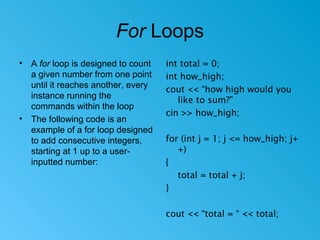
• A for loop is designed to count
a given number from one point
until it reaches another, every
instance running the
commands within the loop
• The following code is an
example of a for loop designed
to add consecutive integers,
starting at 1 up to a user-
inputted number:
int total = 0;
int how_high;
cout << “how high would you
like to sum?”
cin >> how_high;
for (int j = 1; j <= how_high; j+
+)
{
total = total + j;
}
cout << “total = “ << total;
For Loops
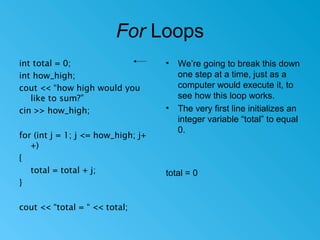
• We’re going to break this down
one step at a time, just as a
computer would execute it, to
see how this loop works.
• The very first line initializes an
integer variable “total” to equal
0.
int total = 0;
int how_high;
cout << “how high would you
like to sum?”
cin >> how_high;
for (int j = 1; j <= how_high; j+
+)
{
total = total + j;
}
cout << “total = “ << total;
total = 0
For Loops
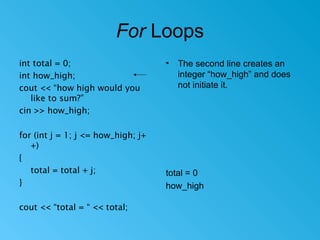
• The second line creates an
integer “how_high” and does
not initiate it.
int total = 0;
int how_high;
cout << “how high would you
like to sum?”
cin >> how_high;
for (int j = 1; j <= how_high; j+
+)
{
total = total + j;
}
cout << “total = “ << total;
total = 0
how_high
For Loops
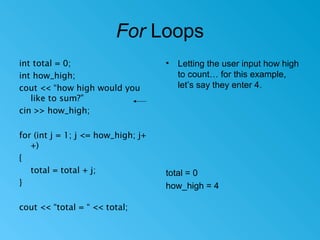
• Letting the user input how high
to count… for this example,
let’s say they enter 4.
int total = 0;
int how_high;
cout << “how high would you
like to sum?”
cin >> how_high;
for (int j = 1; j <= how_high; j+
+)
{
total = total + j;
}
cout << “total = “ << total;
total = 0
how_high = 4
For Loops
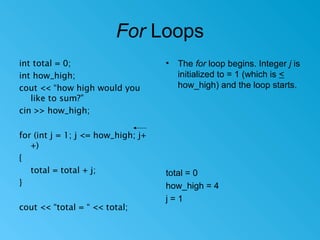
• The for loop begins. Integer j is
initialized to = 1 (which is <
how_high) and the loop starts.
int total = 0;
int how_high;
cout << “how high would you
like to sum?”
cin >> how_high;
for (int j = 1; j <= how_high; j+
+)
{
total = total + j;
}
cout << “total = “ << total;
total = 0
how_high = 4
j = 1
For Loops
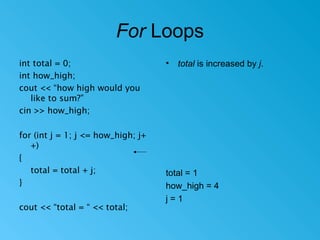
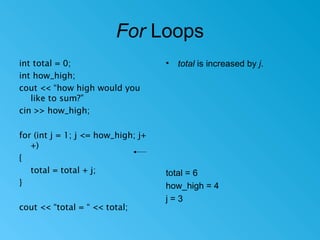
• total is increased by j.int total = 0;
int how_high;
cout << “how high would you
like to sum?”
cin >> how_high;
for (int j = 1; j <= how_high; j+
+)
{
total = total + j;
}
cout << “total = “ << total;
total = 1
how_high = 4
j = 1
For Loops
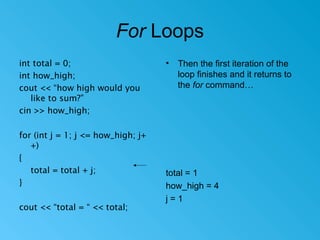
• Then the first iteration of the
loop finishes and it returns to
the for command…
int total = 0;
int how_high;
cout << “how high would you
like to sum?”
cin >> how_high;
for (int j = 1; j <= how_high; j+
+)
{
total = total + j;
}
cout << “total = “ << total;
total = 1
how_high = 4
j = 1
For Loops
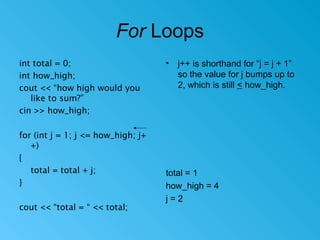
• j++ is shorthand for “j = j + 1”
so the value for j bumps up to
2, which is still < how_high.
int total = 0;
int how_high;
cout << “how high would you
like to sum?”
cin >> how_high;
for (int j = 1; j <= how_high; j+
+)
{
total = total + j;
}
cout << “total = “ << total;
total = 1
how_high = 4
j = 2
For Loops
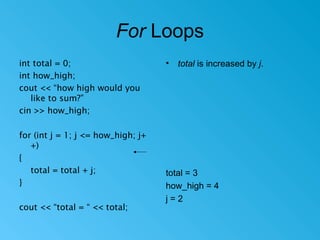
• total is increased by j.int total = 0;
int how_high;
cout << “how high would you
like to sum?”
cin >> how_high;
for (int j = 1; j <= how_high; j+
+)
{
total = total + j;
}
cout << “total = “ << total;
total = 3
how_high = 4
j = 2
For Loops
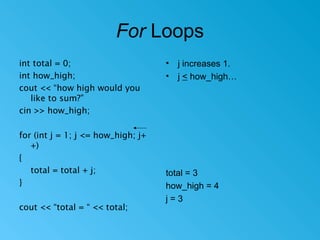
• j increases 1.
• j < how_high…
int total = 0;
int how_high;
cout << “how high would you
like to sum?”
cin >> how_high;
for (int j = 1; j <= how_high; j+
+)
{
total = total + j;
}
cout << “total = “ << total;
total = 3
how_high = 4
j = 3
For Loops
• total is increased by j.int total = 0;
int how_high;
cout << “how high would you
like to sum?”
cin >> how_high;
for (int j = 1; j <= how_high; j+
+)
{
total = total + j;
}
cout << “total = “ << total;
total = 6
how_high = 4
j = 3
For Loops
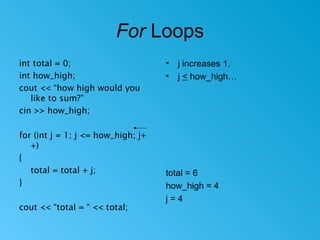
• j increases 1.
• j < how_high…
int total = 0;
int how_high;
cout << “how high would you
like to sum?”
cin >> how_high;
for (int j = 1; j <= how_high; j+
+)
{
total = total + j;
}
cout << “total = “ << total;
total = 6
how_high = 4
j = 4
For Loops
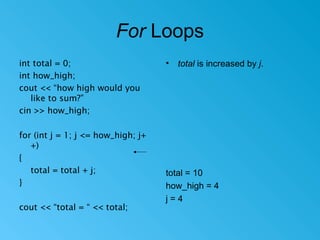
• total is increased by j.int total = 0;
int how_high;
cout << “how high would you
like to sum?”
cin >> how_high;
for (int j = 1; j <= how_high; j+
+)
{
total = total + j;
}
cout << “total = “ << total;
total = 10
how_high = 4
j = 4
For Loops
• The next value of j is >
how_high, so the for loop ends
and continues on in the
program, outputting “total = 10”
int total = 0;
int how_high;
cout << “how high would you
like to sum?”
cin >> how_high;
for (int j = 1; j <= how_high; j+
+)
{
total = total + j;
}
cout << “total = “ << total;
total = 10
how_high = 4
j = 5
While Loops
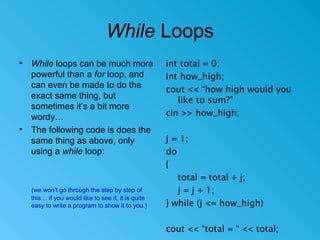
• While loops can be much more
powerful than a for loop, and
can even be made to do the
exact same thing, but
sometimes it’s a bit more
wordy…
• The following code is does the
same thing as above, only
using a while loop:
(we won’t go through the step by step of
this… if you would like to see it, it is quite
easy to write a program to show it to you.)
int total = 0;
int how_high;
cout << “how high would you
like to sum?”
cin >> how_high;
j = 1;
do
{
total = total + j;
j = j + 1;
} while (j <= how_high)
cout << “total = “ << total;

Counting and looping

  • 1.
    Counting and Looping Unit3 Lecture for Intro to Computer Programming
  • 2.
    Introduction • Counting inprogramming can be a very useful tool for, among other things, mathematical calculations. • The primary function for counting in c++ is the for loop. • Loops are used when a process needs to be repeated either a certain number of times, or arbitrarily until a certain set of conditions become true. • The primary looping function (aside from for loops) we will look at is the while loop.
  • 3.
    For Loops • Afor loop is designed to count a given number from one point until it reaches another, every instance running the commands within the loop • The following code is an example of a for loop designed to add consecutive integers, starting at 1 up to a user- inputted number: int total = 0; int how_high; cout << “how high would you like to sum?” cin >> how_high; for (int j = 1; j <= how_high; j+ +) { total = total + j; } cout << “total = “ << total;
  • 4.
    For Loops • We’regoing to break this down one step at a time, just as a computer would execute it, to see how this loop works. • The very first line initializes an integer variable “total” to equal 0. int total = 0; int how_high; cout << “how high would you like to sum?” cin >> how_high; for (int j = 1; j <= how_high; j+ +) { total = total + j; } cout << “total = “ << total; total = 0
  • 5.
    For Loops • Thesecond line creates an integer “how_high” and does not initiate it. int total = 0; int how_high; cout << “how high would you like to sum?” cin >> how_high; for (int j = 1; j <= how_high; j+ +) { total = total + j; } cout << “total = “ << total; total = 0 how_high
  • 6.
    For Loops • Lettingthe user input how high to count… for this example, let’s say they enter 4. int total = 0; int how_high; cout << “how high would you like to sum?” cin >> how_high; for (int j = 1; j <= how_high; j+ +) { total = total + j; } cout << “total = “ << total; total = 0 how_high = 4
  • 7.
    For Loops • Thefor loop begins. Integer j is initialized to = 1 (which is < how_high) and the loop starts. int total = 0; int how_high; cout << “how high would you like to sum?” cin >> how_high; for (int j = 1; j <= how_high; j+ +) { total = total + j; } cout << “total = “ << total; total = 0 how_high = 4 j = 1
  • 8.
    For Loops • totalis increased by j.int total = 0; int how_high; cout << “how high would you like to sum?” cin >> how_high; for (int j = 1; j <= how_high; j+ +) { total = total + j; } cout << “total = “ << total; total = 1 how_high = 4 j = 1
  • 9.
    For Loops • Thenthe first iteration of the loop finishes and it returns to the for command… int total = 0; int how_high; cout << “how high would you like to sum?” cin >> how_high; for (int j = 1; j <= how_high; j+ +) { total = total + j; } cout << “total = “ << total; total = 1 how_high = 4 j = 1
  • 10.
    For Loops • j++is shorthand for “j = j + 1” so the value for j bumps up to 2, which is still < how_high. int total = 0; int how_high; cout << “how high would you like to sum?” cin >> how_high; for (int j = 1; j <= how_high; j+ +) { total = total + j; } cout << “total = “ << total; total = 1 how_high = 4 j = 2
  • 11.
    For Loops • totalis increased by j.int total = 0; int how_high; cout << “how high would you like to sum?” cin >> how_high; for (int j = 1; j <= how_high; j+ +) { total = total + j; } cout << “total = “ << total; total = 3 how_high = 4 j = 2
  • 12.
    For Loops • jincreases 1. • j < how_high… int total = 0; int how_high; cout << “how high would you like to sum?” cin >> how_high; for (int j = 1; j <= how_high; j+ +) { total = total + j; } cout << “total = “ << total; total = 3 how_high = 4 j = 3
  • 13.
    For Loops • totalis increased by j.int total = 0; int how_high; cout << “how high would you like to sum?” cin >> how_high; for (int j = 1; j <= how_high; j+ +) { total = total + j; } cout << “total = “ << total; total = 6 how_high = 4 j = 3
  • 14.
    For Loops • jincreases 1. • j < how_high… int total = 0; int how_high; cout << “how high would you like to sum?” cin >> how_high; for (int j = 1; j <= how_high; j+ +) { total = total + j; } cout << “total = “ << total; total = 6 how_high = 4 j = 4
  • 15.
    For Loops • totalis increased by j.int total = 0; int how_high; cout << “how high would you like to sum?” cin >> how_high; for (int j = 1; j <= how_high; j+ +) { total = total + j; } cout << “total = “ << total; total = 10 how_high = 4 j = 4
  • 16.
    For Loops • Thenext value of j is > how_high, so the for loop ends and continues on in the program, outputting “total = 10” int total = 0; int how_high; cout << “how high would you like to sum?” cin >> how_high; for (int j = 1; j <= how_high; j+ +) { total = total + j; } cout << “total = “ << total; total = 10 how_high = 4 j = 5
  • 17.
    While Loops • Whileloops can be much more powerful than a for loop, and can even be made to do the exact same thing, but sometimes it’s a bit more wordy… • The following code is does the same thing as above, only using a while loop: (we won’t go through the step by step of this… if you would like to see it, it is quite easy to write a program to show it to you.) int total = 0; int how_high; cout << “how high would you like to sum?” cin >> how_high; j = 1; do { total = total + j; j = j + 1; } while (j <= how_high) cout << “total = “ << total;