UNIT 1
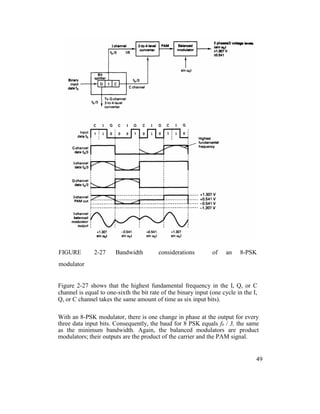
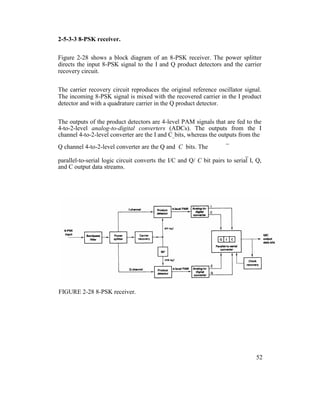
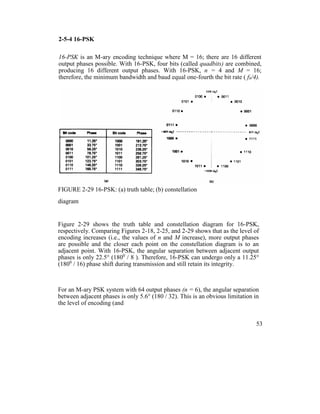
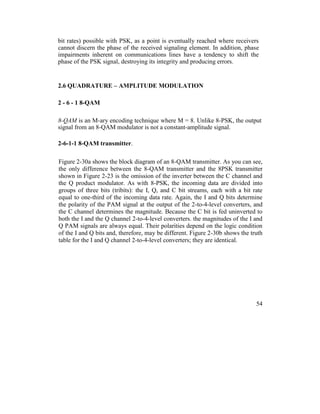
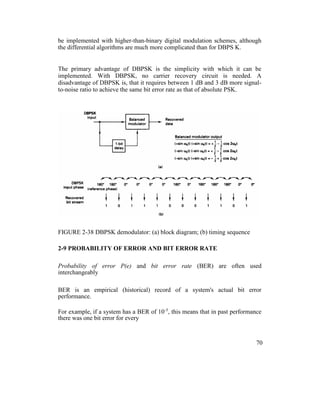
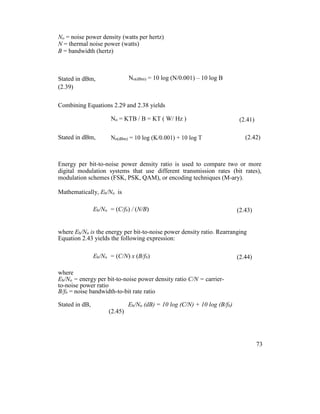
SOURCE CODING
INTRODUCTION
The purpose of a Communication System is to transport an information bearing signal
from a source to a user destination via a communication channel.
MODEL OF A COMMUNICATION SYSTEM (ANALOG)
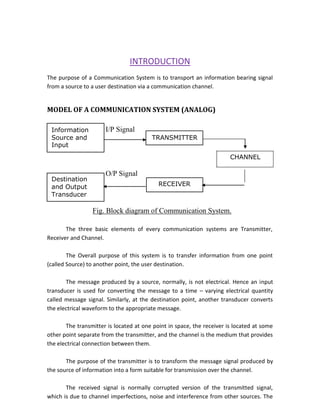
Information I/P Signal
TRANSMITTERSource and
Input
CHANNEL
O/P Signal
Destination
RECEIVERand Output
Transducer
Fig. Block diagram of Communication System.
The three basic elements of every communication systems are Transmitter,
Receiver and Channel.
The Overall purpose of this system is to transfer information from one point
(called Source) to another point, the user destination.
The message produced by a source, normally, is not electrical. Hence an input
transducer is used for converting the message to a time – varying electrical quantity
called message signal. Similarly, at the destination point, another transducer converts
the electrical waveform to the appropriate message.
The transmitter is located at one point in space, the receiver is located at some
other point separate from the transmitter, and the channel is the medium that provides
the electrical connection between them.
The purpose of the transmitter is to transform the message signal produced by
the source of information into a form suitable for transmission over the channel.
The received signal is normally corrupted version of the transmitted signal,
which is due to channel imperfections, noise and interference from other sources. The
receiver has the task of operating on the received signal so as to reconstruct a
recognizable form of the original message signal and to deliver it to the user destination.
Communication Systems are divided into 3 categories:
1. Analog Communication Systems are designed to transmit analog
information using analog modulation methods.
2. Digital Communication Systems are designed for transmitting digital
information using digital modulation schemes, and
3. Hybrid Systems that use digital modulation schemes for transmitting
sampled and quantized values of an analog message signal.
ELEMENTS OF DIGITAL COMMUNICATION SYSTEMS:
The figure below shows the functional elements of a digital
communication system.
Source of Information: 1. Analog Information Sources.
2. Digital Information Sources.
Analog Information Sources → Microphone actuated by a speech, TV Camera
scanning a scene, continuous amplitude signals.
Digital Information Sources → These are teletype or the numerical output of
computer which consists of a sequence of discrete symbols or letters.
An Analog information is transformed into a discrete information through
the process of sampling and quantizing.
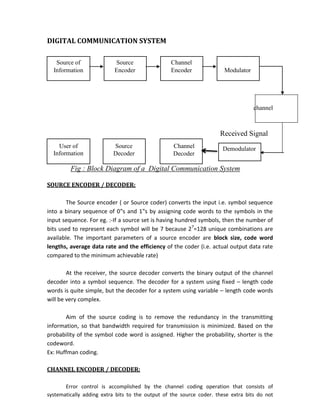
DIGITAL COMMUNICATION SYSTEM
Source of Source Channel
Information Encoder Encoder Modulator
channel
Received Signal
User of Source Channel Demodulator
Information Decoder Decoder
Fig : Block Diagram of a Digital Communication System
SOURCE ENCODER / DECODER:
The Source encoder ( or Source coder) converts the input i.e. symbol sequence
into a binary sequence of 0‟s and 1‟s by assigning code words to the symbols in the
input sequence. For eg. :-If a source set is having hundred symbols, then the number of
bits used to represent each symbol will be 7 because 27
=128 unique combinations are
available. The important parameters of a source encoder are block size, code word
lengths, average data rate and the efficiency of the coder (i.e. actual output data rate
compared to the minimum achievable rate)
At the receiver, the source decoder converts the binary output of the channel
decoder into a symbol sequence. The decoder for a system using fixed – length code
words is quite simple, but the decoder for a system using variable – length code words
will be very complex.
Aim of the source coding is to remove the redundancy in the transmitting
information, so that bandwidth required for transmission is minimized. Based on the
probability of the symbol code word is assigned. Higher the probability, shorter is the
codeword.
Ex: Huffman coding.
CHANNEL ENCODER / DECODER:
Error control is accomplished by the channel coding operation that consists of
systematically adding extra bits to the output of the source coder. these extra bits do not
convey any information but helps the receiver to detect and / or correct some of the errors in
the information bearing bits.
There are two methods of channel coding:
1. Block Coding: The encoder takes a block of „k‟ information bits from the source encoder
and adds „r‟ error control bits, where „r‟ is dependent on „k‟ and error control
capabilities desired.
2. Convolution Coding: The information bearing message stream is encoded in a
continuous fashion by continuously interleaving information bits and error control bits.
The Channel decoder recovers the information bearing bits from the coded binary
stream. Error detection and possible correction is also performed by the channel
decoder.
The important parameters of coder / decoder are: Method of coding, efficiency, error
control capabilities and complexity of the circuit.
MODULATOR:
The Modulator converts the input bit stream into an electrical waveform suitable
for transmission over the communication channel. Modulator can be effectively used to
minimize the effects of channel noise, to match the frequency spectrum of transmitted
signal with channel characteristics, to provide the capability to multiplex many signals.
DEMODULATOR:
The extraction of the message from the information bearing waveform produced
by the modulation is accomplished by the demodulator. The output of the demodulator
is bit stream. The important parameter is the method of demodulation.
CHANNEL:
The Channel provides the electrical connection between the source and
destination. The different channels are: Pair of wires, Coaxial cable, Optical fibre, Radio
channel, Satellite channel or combination of any of these.
The communication channels have only finite Bandwidth, non-ideal frequency
response, the signal often suffers amplitude and phase distortion as it travels over the
channel. Also, the signal power decreases due to the attenuation of the channel. The
signal is corrupted by unwanted, unpredictable electrical signals referred to as noise.
The important parameters of the channel are Signal to Noise power Ratio (SNR),
usable bandwidth, amplitude and phase response and the statistical properties of noise.
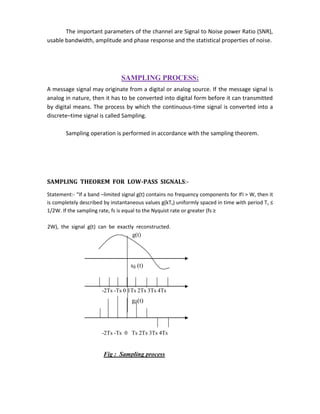
SAMPLING PROCESS:
A message signal may originate from a digital or analog source. If the message signal is
analog in nature, then it has to be converted into digital form before it can transmitted
by digital means. The process by which the continuous-time signal is converted into a
discrete–time signal is called Sampling.
Sampling operation is performed in accordance with the sampling theorem.
SAMPLING THEOREM FOR LOW-PASS SIGNALS:-
Statement:- “If a band –limited signal g(t) contains no frequency components for ‫׀‬f‫׀‬ > W, then it
is completely described by instantaneous values g(kTs) uniformly spaced in time with period Ts ≤
1/2W. If the sampling rate, fs is equal to the Nyquist rate or greater (fs ≥
2W), the signal g(t) can be exactly reconstructed.
g(t)
sδ (t)
-2Ts -Ts 0 1Ts 2Ts 3Ts 4Ts
gδ(t)
-2Ts -Ts 0 Ts 2Ts 3Ts 4Ts
Fig : Sampling process
QUANTIZATION
The process of transforming Sampled amplitude values of a message signal into a
discrete amplitude value is referred to as Quantization.
The quantization Process has a two-fold effect:
1. the peak-to-peak range of the input sample values is subdivided into a finite set
of decision levels or decision thresholds that are aligned with the risers of the
staircase, and
2. the output is assigned a discrete value selected from a finite set of
representation levels that are aligned with the treads of the staircase..
A quantizer is memory less in that the quantizer output is determined only by the value
of a corresponding input sample, independently of earlier analog samples applied to the
input.
Analog Signal
Discrete Samples
( Quantized )
0 Ts 2Ts 3Ts Tim
Fig: Typical Quantization process.
Types of Quantizers:
1. Uniform Quantizer
2. Non- Uniform Quantizer
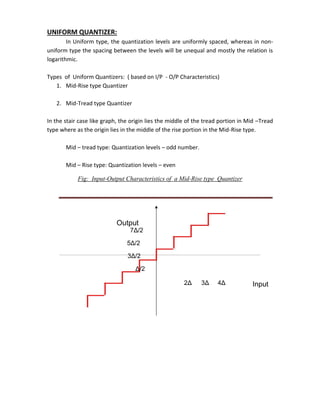
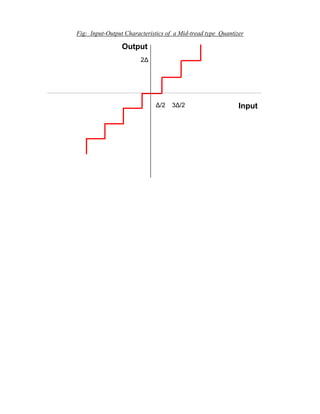
UNIFORM QUANTIZER:
In Uniform type, the quantization levels are uniformly spaced, whereas in non-
uniform type the spacing between the levels will be unequal and mostly the relation is
logarithmic.
Types of Uniform Quantizers: ( based on I/P - O/P Characteristics)
1. Mid-Rise type Quantizer
2. Mid-Tread type Quantizer
In the stair case like graph, the origin lies the middle of the tread portion in Mid –Tread
type where as the origin lies in the middle of the rise portion in the Mid-Rise type.
Mid – tread type: Quantization levels – odd number.
Mid – Rise type: Quantization levels – even
Fig: Input-Output Characteristics of a Mid-Rise type Quantizer
Output
7Δ/2
5Δ/2
3Δ/2
Δ/2
2Δ 3Δ 4Δ Input
Fig: Input-Output Characteristics of a Mid-tread type Quantizer
Output
2Δ
Δ/2 3Δ/2 Input
QUANTIZATION NOISE AND SIGNAL-TO-NOISE:
“The Quantization process introduces an error defined as the difference between the
input signal, x(t) and the output signal, yt). This error is called the Quantization Noise.”
q(t) = x(t) – y(t)
Quantization noise is produced in the transmitter end of a PCM system by
rounding off sample values of an analog base-band signal to the nearest permissible
representation levels of the quantizer. As such quantization noise differs from channel
noise in that it is signal dependent.
Let „Δ‟ be the step size of a quantizer and L be the total number of quantization levels.
Quantization levels are 0, ± ., ± 2 ., ±3 . . . . . . .
The Quantization error, Q is a random variable and will have its sample values bounded
by [-(Δ/2) < q < (Δ/2)]. If is small, the quantization error can be assumed to a uniformly
distributed random variable.
Consider a memory less quantizer that is both uniform and
symmetric. L = Number of quantization levels
X = Quantizer input
Y = Quantizer output
The output y is given by
Y=Q(x)
which is a staircase function that befits the type of mid tread or mid riser quantizer of
interest.
Non – Uniform Quantizer:
In Non – Uniform Quantizer the step size varies. The use of a non – uniform quantizer is
equivalent to passing the baseband signal through a compressor and then applying the
compressed signal to a uniform quantizer. The resultant signal is then transmitted.
UNIFORM
COMPRESSOR QUANTIZER EXPANDER
Fig: 2.14 MODEL OF NON UNIFORM QUANTIZER
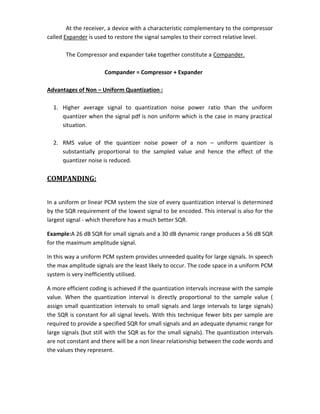
At the receiver, a device with a characteristic complementary to the compressor
called Expander is used to restore the signal samples to their correct relative level.
The Compressor and expander take together constitute a Compander.
Compander = Compressor + Expander
Advantages of Non – Uniform Quantization :
1. Higher average signal to quantization noise power ratio than the uniform
quantizer when the signal pdf is non uniform which is the case in many practical
situation.
2. RMS value of the quantizer noise power of a non – uniform quantizer is
substantially proportional to the sampled value and hence the effect of the
quantizer noise is reduced.
COMPANDING:
In a uniform or linear PCM system the size of every quantization interval is determined
by the SQR requirement of the lowest signal to be encoded. This interval is also for the
largest signal - which therefore has a much better SQR.
Example:A 26 dB SQR for small signals and a 30 dB dynamic range produces a 56 dB SQR
for the maximum amplitude signal.
In this way a uniform PCM system provides unneeded quality for large signals. In speech
the max amplitude signals are the least likely to occur. The code space in a uniform PCM
system is very inefficiently utilised.
A more efficient coding is achieved if the quantization intervals increase with the sample
value. When the quantization interval is directly proportional to the sample value (
assign small quantization intervals to small signals and large intervals to large signals)
the SQR is constant for all signal levels. With this technique fewer bits per sample are
required to provide a specified SQR for small signals and an adequate dynamic range for
large signals (but still with the SQR as for the small signals). The quantization intervals
are not constant and there will be a non linear relationship between the code words and
the values they represent.
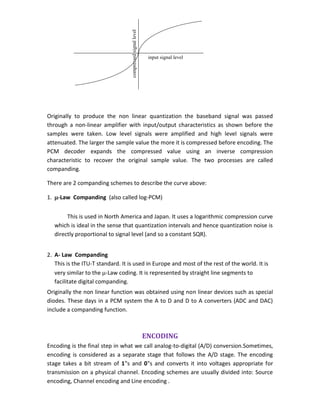
Originally to produce the non linear quantization the baseband signal was passed
through a non-linear amplifier with input/output characteristics as shown before the
samples were taken. Low level signals were amplified and high level signals were
attenuated. The larger the sample value the more it is compressed before encoding. The
PCM decoder expands the compressed value using an inverse compression
characteristic to recover the original sample value. The two processes are called
companding.
There are 2 companding schemes to describe the curve above:
1. -Law Companding (also called log-PCM)
This is used in North America and Japan. It uses a logarithmic compression curve
which is ideal in the sense that quantization intervals and hence quantization noise is
directly proportional to signal level (and so a constant SQR).
2. A- Law Companding
This is the ITU-T standard. It is used in Europe and most of the rest of the world. It is
very similar to the -Law coding. It is represented by straight line segments to
facilitate digital companding.
Originally the non linear function was obtained using non linear devices such as special
diodes. These days in a PCM system the A to D and D to A converters (ADC and DAC)
include a companding function.
ENCODING
Encoding is the final step in what we call analog-to-digital (A/D) conversion.Sometimes,
encoding is considered as a separate stage that follows the A/D stage. The encoding
stage takes a bit stream of 1‟s and 0‟s and converts it into voltages appropriate for
transmission on a physical channel. Encoding schemes are usually divided into: Source
encoding, Channel encoding and Line encoding .
input signal level
compressedsignallevel
PULSE CODE MODULATION (PCM)
Pulse Code Modulation (PCM) is an extension of PAM wherein each analogue sample
value is quantized into a discrete value for representation as a digital code word.
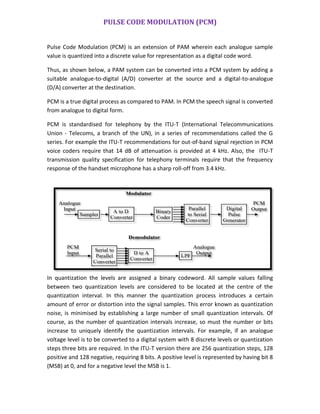
Thus, as shown below, a PAM system can be converted into a PCM system by adding a
suitable analogue-to-digital (A/D) converter at the source and a digital-to-analogue
(D/A) converter at the destination.
PCM is a true digital process as compared to PAM. In PCM the speech signal is converted
from analogue to digital form.
PCM is standardised for telephony by the ITU-T (International Telecommunications
Union - Telecoms, a branch of the UN), in a series of recommendations called the G
series. For example the ITU-T recommendations for out-of-band signal rejection in PCM
voice coders require that 14 dB of attenuation is provided at 4 kHz. Also, the ITU-T
transmission quality specification for telephony terminals require that the frequency
response of the handset microphone has a sharp roll-off from 3.4 kHz.
In quantization the levels are assigned a binary codeword. All sample values falling
between two quantization levels are considered to be located at the centre of the
quantization interval. In this manner the quantization process introduces a certain
amount of error or distortion into the signal samples. This error known as quantization
noise, is minimised by establishing a large number of small quantization intervals. Of
course, as the number of quantization intervals increase, so must the number or bits
increase to uniquely identify the quantization intervals. For example, if an analogue
voltage level is to be converted to a digital system with 8 discrete levels or quantization
steps three bits are required. In the ITU-T version there are 256 quantization steps, 128
positive and 128 negative, requiring 8 bits. A positive level is represented by having bit 8
(MSB) at 0, and for a negative level the MSB is 1.
A to D
Converter
Binary
Coder
Parallel
to Serial
Converter
Digital
Pulse
Generator
Serial to
Parallel
Converter
D to A
Converter
LPF
Sampler
Analogue
Input
PCM
Output
Modulator
PCM
Input
Analogue
Output
Demodulator
LINE CODES
Line coding refers to the process of representing the bit stream (1‟s and
0‟s) in the form of voltage or current variations optimally tuned for the specific
properties of the physical channel being used.
The selection of a proper line code can help in so many ways: One possibility is to aid in
clock recovery at the receiver. A clock signal is recovered by observing transitions in the
received bit sequence, and if enough transitions exist, a good recovery of the clock is
guaranteed, and the signal is said to be self-clocking.
Another advantage is to get rid of DC shifts. The DC component in a line code is called
the bias or the DC coefficient. Unfortunately, most long-distance communication
channels cannot transport a DC component. This is why most line codes try to eliminate
the DC component before being transmitted on the channel.Such codes are called DC
balanced, zero-DC, zero-bias, or DC equalized.Some common types of line encoding in
common-use nowadays are unipolar, polar, bipolar, Manchester, MLT-3 and Duobinary
encoding. These codes are explained here:
1. Unipolar (Unipolar NRZ and Unipolar RZ):
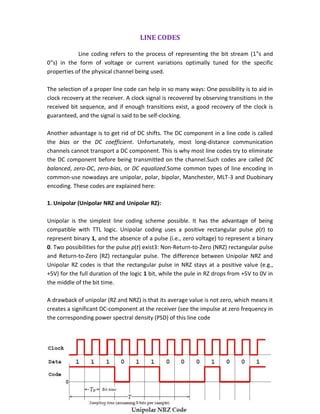
Unipolar is the simplest line coding scheme possible. It has the advantage of being
compatible with TTL logic. Unipolar coding uses a positive rectangular pulse p(t) to
represent binary 1, and the absence of a pulse (i.e., zero voltage) to represent a binary
0. Two possibilities for the pulse p(t) exist3: Non-Return-to-Zero (NRZ) rectangular pulse
and Return-to-Zero (RZ) rectangular pulse. The difference between Unipolar NRZ and
Unipolar RZ codes is that the rectangular pulse in NRZ stays at a positive value (e.g.,
+5V) for the full duration of the logic 1 bit, while the pule in RZ drops from +5V to 0V in
the middle of the bit time.
A drawback of unipolar (RZ and NRZ) is that its average value is not zero, which means it
creates a significant DC-component at the receiver (see the impulse at zero frequency in
the corresponding power spectral density (PSD) of this line code
The disadvantage of unipolar RZ compared to unipolar NRZ is that each rectangular
pulse in RZ is only half the length of NRZ pulse. This means that unipolar RZ
requires twice the bandwidth of the NRZ code.
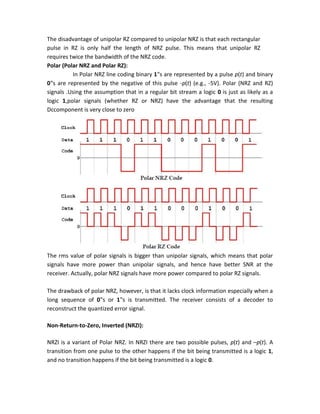
Polar (Polar NRZ and Polar RZ):
In Polar NRZ line coding binary 1‟s are represented by a pulse p(t) and binary
0‟s are represented by the negative of this pulse -p(t) (e.g., -5V). Polar (NRZ and RZ)
signals .Using the assumption that in a regular bit stream a logic 0 is just as likely as a
logic 1,polar signals (whether RZ or NRZ) have the advantage that the resulting
Dccomponent is very close to zero
The rms value of polar signals is bigger than unipolar signals, which means that polar
signals have more power than unipolar signals, and hence have better SNR at the
receiver. Actually, polar NRZ signals have more power compared to polar RZ signals.
The drawback of polar NRZ, however, is that it lacks clock information especially when a
long sequence of 0‟s or 1‟s is transmitted. The receiver consists of a decoder to
reconstruct the quantized error signal.
Non-Return-to-Zero, Inverted (NRZI):
NRZI is a variant of Polar NRZ. In NRZI there are two possible pulses, p(t) and –p(t). A
transition from one pulse to the other happens if the bit being transmitted is a logic 1,
and no transition happens if the bit being transmitted is a logic 0.
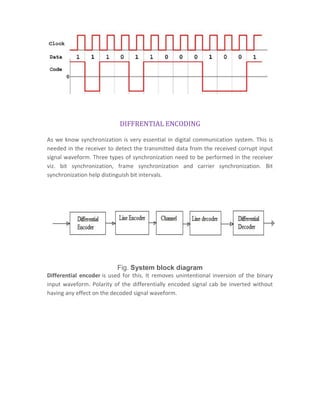
DIFFRENTIAL ENCODING
As we know synchronization is very essential in digital communication system. This is
needed in the receiver to detect the transmitted data from the received corrupt input
signal waveform. Three types of synchronization need to be performed in the receiver
viz. bit synchronization, frame synchronization and carrier synchronization. Bit
synchronization help distinguish bit intervals.
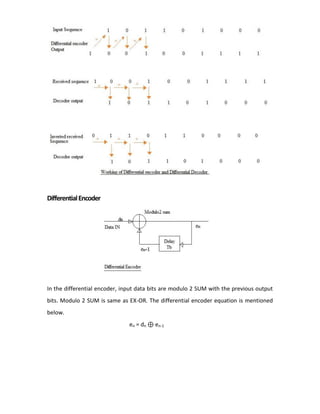
Fig. System block diagram
Differential encoder is used for this. It removes unintentional inversion of the binary
input waveform. Polarity of the differentially encoded signal cab be inverted without
having any effect on the decoded signal waveform.
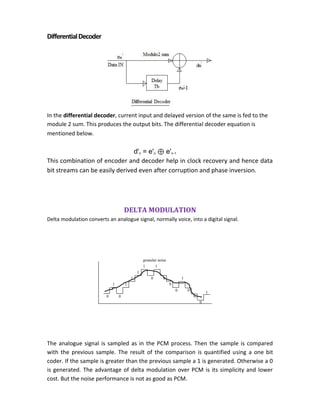
DifferentialEncoder
In the differential encoder, input data bits are modulo 2 SUM with the previous output
bits. Modulo 2 SUM is same as EX-OR. The differential encoder equation is mentioned
below.
en = dn ⊕ en-1
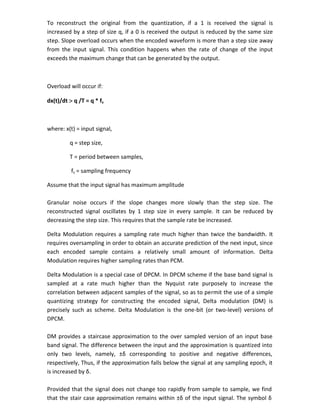
DifferentialDecoder
In the differential decoder, current input and delayed version of the same is fed to the
module 2 sum. This produces the output bits. The differential decoder equation is
mentioned below.
d'n = e'n ⊕ e'n-1
This combination of encoder and decoder help in clock recovery and hence data
bit streams can be easily derived even after corruption and phase inversion.
DELTA MODULATION
Delta modulation converts an analogue signal, normally voice, into a digital signal.
The analogue signal is sampled as in the PCM process. Then the sample is compared
with the previous sample. The result of the comparison is quantified using a one bit
coder. If the sample is greater than the previous sample a 1 is generated. Otherwise a 0
is generated. The advantage of delta modulation over PCM is its simplicity and lower
cost. But the noise performance is not as good as PCM.
0
1
0
0 0
0
1
0
0
0
1
1
1
1 1
0
1
granular noise
To reconstruct the original from the quantization, if a 1 is received the signal is
increased by a step of size q, if a 0 is received the output is reduced by the same size
step. Slope overload occurs when the encoded waveform is more than a step size away
from the input signal. This condition happens when the rate of change of the input
exceeds the maximum change that can be generated by the output.
Overload will occur if:
dx(t)/dt  q /T = q * fs
where: x(t) = input signal,
q = step size,
T = period between samples,
fs = sampling frequency
Assume that the input signal has maximum amplitude
Granular noise occurs if the slope changes more slowly than the step size. The
reconstructed signal oscillates by 1 step size in every sample. It can be reduced by
decreasing the step size. This requires that the sample rate be increased.
Delta Modulation requires a sampling rate much higher than twice the bandwidth. It
requires oversampling in order to obtain an accurate prediction of the next input, since
each encoded sample contains a relatively small amount of information. Delta
Modulation requires higher sampling rates than PCM.
Delta Modulation is a special case of DPCM. In DPCM scheme if the base band signal is
sampled at a rate much higher than the Nyquist rate purposely to increase the
correlation between adjacent samples of the signal, so as to permit the use of a simple
quantizing strategy for constructing the encoded signal, Delta modulation (DM) is
precisely such as scheme. Delta Modulation is the one-bit (or two-level) versions of
DPCM.
DM provides a staircase approximation to the over sampled version of an input base
band signal. The difference between the input and the approximation is quantized into
only two levels, namely, ±δ corresponding to positive and negative differences,
respectively, Thus, if the approximation falls below the signal at any sampling epoch, it
is increased by δ.
Provided that the signal does not change too rapidly from sample to sample, we find
that the stair case approximation remains within ±δ of the input signal. The symbol δ
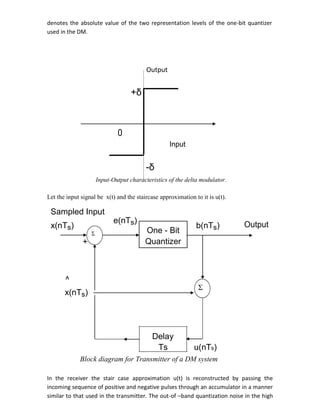
denotes the absolute value of the two representation levels of the one-bit quantizer
used in the DM.
Output
+δ
0
Input
-δ
Input-Output characteristics of the delta modulator.
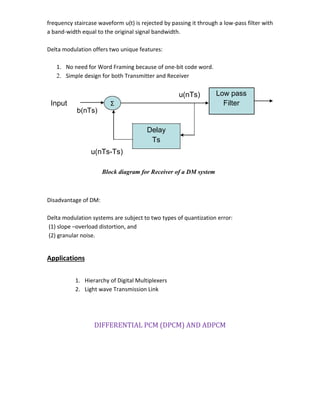
Let the input signal be x(t) and the staircase approximation to it is u(t).
Sampled Input
e(nTs)
x(nTs) b(nTs) Output
One - BitΣ
+ Quantizer
^
x(nTs)
Σ
Delay
Ts u(nTs)
Block diagram for Transmitter of a DM system
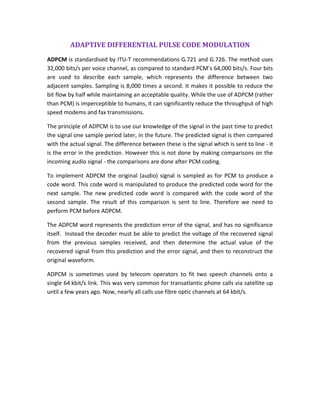
In the receiver the stair case approximation u(t) is reconstructed by passing the
incoming sequence of positive and negative pulses through an accumulator in a manner
similar to that used in the transmitter. The out-of –band quantization noise in the high
frequency staircase waveform u(t) is rejected by passing it through a low-pass filter with
a band-width equal to the original signal bandwidth.
Delta modulation offers two unique features:
1. No need for Word Framing because of one-bit code word.
2. Simple design for both Transmitter and Receiver
u(nTs) Low pass
Input Σ Filter
b(nTs)
Delay
Ts
u(nTs-Ts)
Block diagram for Receiver of a DM system
Disadvantage of DM:
Delta modulation systems are subject to two types of quantization error:
(1) slope –overload distortion, and
(2) granular noise.
Applications
1. Hierarchy of Digital Multiplexers
2. Light wave Transmission Link
DIFFERENTIAL PCM (DPCM) AND ADPCM
DPCM is also designed to take advantage of the redundancies in a typical speech
waveform. In DPCM the differences between samples are quantized with fewer bits that
would be used for quantizing an individual amplitude sample. The sampling rate is often
the same as for a comparable PCM system, unlike Delta Modulation.
For the signals which does not change rapidly from one sample to next sample, the PCM
scheme is not preferred. When such highly correlated samples are encoded the
resulting encoded signal contains redundant information. By removing this redundancy
before encoding an efficient coded signal can be obtained. One of such scheme is the
DPCM technique. By knowing the past behavior of a signal up to a certain point in time,
it is possible to make some inference about the future values.
Transmitter: Let x(t) be the signal to be sampled and x(nTs) be it‟s samples. In this
scheme the input to the quantizer is a signal
e(nTs) = x(nTs) - x^(nTs)
where x^(nTs) is the prediction for unquantized sample x(nTs). This predicted value is
produced by using a predictor whose input, consists of a quantized versions of the input
signal x(nTs). The signal e(nTs) is called the prediction error.
By encoding the quantizer output, in this method, we obtain a modified version of the
PCM called differential pulse code modulation (DPCM).
Quantizer output, v(nTs) = Q[e(nTs)]
= e(nTs) + q(nTs)
where q(nTs) is the quantization error.
Predictor input is the sum of quantizer output and predictor output,
u(nTs) = x^(nTs) + e(nTs) + q(nTs)
u(nTs) = x(nTs) + q(nTs)
Accumulator
DAC
Quantiser
Enoder
ADC
Band Limiting
Filter +
-
Differentiator
Analogue
Input
Encoded
Difference
Samples
ADAPTIVE DIFFERENTIAL PULSE CODE MODULATION
ADPCM is standardised by ITU-T recommendations G.721 and G.726. The method uses
32,000 bits/s per voice channel, as compared to standard PCM’s 64,000 bits/s. Four bits
are used to describe each sample, which represents the difference between two
adjacent samples. Sampling is 8,000 times a second. It makes it possible to reduce the
bit flow by half while maintaining an acceptable quality. While the use of ADPCM (rather
than PCM) is imperceptible to humans, it can significantly reduce the throughput of high
speed modems and fax transmissions.
The principle of ADPCM is to use our knowledge of the signal in the past time to predict
the signal one sample period later, in the future. The predicted signal is then compared
with the actual signal. The difference between these is the signal which is sent to line - it
is the error in the prediction. However this is not done by making comparisons on the
incoming audio signal - the comparisons are done after PCM coding.
To implement ADPCM the original (audio) signal is sampled as for PCM to produce a
code word. This code word is manipulated to produce the predicted code word for the
next sample. The new predicted code word is compared with the code word of the
second sample. The result of this comparison is sent to line. Therefore we need to
perform PCM before ADPCM.
The ADPCM word represents the prediction error of the signal, and has no significance
itself. Instead the decoder must be able to predict the voltage of the recovered signal
from the previous samples received, and then determine the actual value of the
recovered signal from this prediction and the error signal, and then to reconstruct the
original waveform.
ADPCM is sometimes used by telecom operators to fit two speech channels onto a
single 64 kbit/s link. This was very common for transatlantic phone calls via satellite up
until a few years ago. Now, nearly all calls use fibre optic channels at 64 kbit/s.
UNIT 2
BASEBAND PULSE TRANSMISSION
INTRODUCTION
In signal processing, a matched filter is obtained by correlating a known signal, or template,
with an unknown signal to detect the presence of the template in the unknown signal.[1][2]
This
is equivalent to convolving the unknown signal with a conjugated time-reversed version of the
template. The matched filter is the optimal linear filter for maximizing the signal to noise ratio
(SNR) in the presence of additive stochastic noise. Matched filters are commonly used in radar,
in which a known signal is sent out, and the reflected signal is examined for common elements
of the out-going signal. Pulse compression is an example of matched filtering. It is so called
because impulse response is matched to input pulse signals. Two-dimensional matched filters
are commonly used in image processing, e.g., to improve SNR for X-ray. Matched filtering is a
demodulation technique with LTI (linear time invariant) filters to maximize SNR.[3]
It was
originally also known as a North filter.
MATCHED FILTER
Science each of t he orthonormal basic functions are Φ1(t) ,Φ2(t) …….ΦM(t) is assumed to
be zero outside the interval 0<t<T. we can design a linear filter with impulse response hj(t),
with the received signal x(t) the fitter output is given by the convolution integral
where xj is the j th
correlator output produced by the received signal x(t).
A filter whose impulse response is time-reversed and delayed version of the input signal is
said to be matched. Correspondingly , the optimum receiver based on this is referred as
the matched filter receiver.
For a matched filter operating in real time to be physically realizable, it must be causal. For
causal system
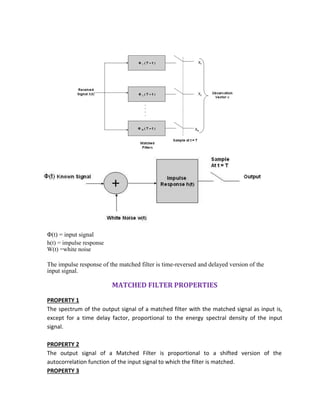
Φ(t) = input signal
h(t) = impulse response
W(t) =white noise
The impulse response of the matched filter is time-reversed and delayed version of the
input signal.
MATCHED FILTER PROPERTIES
PROPERTY 1
The spectrum of the output signal of a matched filter with the matched signal as input is,
except for a time delay factor, proportional to the energy spectral density of the input
signal.
PROPERTY 2
The output signal of a Matched Filter is proportional to a shifted version of the
autocorrelation function of the input signal to which the filter is matched.
PROPERTY 3
The output Signal to Noise Ratio of a Matched filter depends only on the ratio of the signal
energy to the power spectral density of the white noise at the filter input.
PROPERTY 4
The Matched Filtering operation may be separated into two matching conditions; namely
spectral phase matching that produces the desired output peak at time T, and the spectral
amplitude matching that gives this peak value its optimum signal to noise density ratio
MATCHED FILTER FOR RECTANGULAR PULSE
• Matched filter for causal rectangular pulse shape
Impulse response is causal rectangular pulse of same duration
• Convolve input with rectangular pulse of duration T sec and sample result at T sec is
same as
First, integrate for T sec
Second, sample at symbol period T sec
Third, reset integration for next time period
• Integrate and dump circuit
It is well-known that for a radar waveform x(t) in additive white noise of power ,
the optimum receiver frequency response, in the sense of maximizing the signal-to-
noise ratio (SNR) in the receiver output signal y(t) at a particular instant T, is the
matched filter impulse response . The corresponding frequency response is . The
constant α is arbitrary; it affects only the overall gain, but has no impact on the SNR
achieved or the shape of the receiver frequency response. Henceforth we will assume α
has been chosen to make the peak gain of equal to 1.
The definition of SNR is the square of the peak signal voltage at t = T, divided by
the output noise power obtained by integrating the filtered noise power spectral density
over all frequency:
When the matched filter is used, the peak SNR achieved can be shown to be , where E is
the signal energy
If x(t) is a simple rectangular pulse of unit amplitude and duration τ, E = τ . The problem
of interest here is what happens when the signal is a rectangular pulse, but the receiver
filter is, as may be more likely, a bandpass filter (BPF) with cutoff frequency ±B Hz. As the
BPF cutoff B increases from zero, noise is added linearly to the output. However, signal
energy is not added linearly. As B increases, the energy in the mainlobe of the pulse’s sinc-
shaped spectrum increases signal output energy fairly rapidly, but after a point, only the
sinc sidelobes are passed to the output, and the rate of signal energy growth will slow.
Consequently, there is some choice of B that produces the maximum SNR at the output. A
narrower cutoff filters out too much signal energy; a wider cutoff allows too much noise
energy to pass. The goal of this memo is to determine this optimum BPF cutoff Bopt
analytically, and to confirm the results via simulation.
ERROR RATE DUE TO NOISE
• To proceed with the analysis, consider a binary PCM system based on polar nonreturn-to-zero
(NRZ) signaling.
• symbols 1 and 0 are represented by positive and negative rectangular pulses of equal
amplitude and equal duration.
• The channel noise is modeled as additive white Gaussian noise w(t) of zero mean and power
spectral density NO/2; the Gaussian assumption is needed for later calculations. In the signaling
interval O < t < Tb the received signal written as:
where Tb is the bit duration, and A is the transmitted pulse amplitude.
• The receiver has acquired knowledge of the starting and ending times of each transmitted
pulse;
• Given the noisy signal x(t), the receiver is required to make a decision in each signaling
interval as to whether the transmitted symbol is a 1 or a 0.
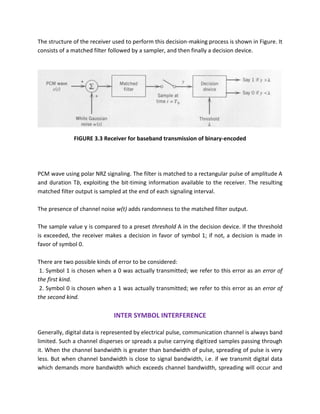
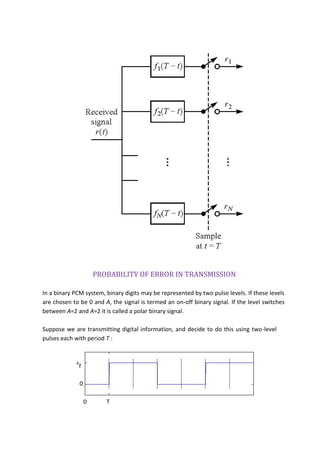
The structure of the receiver used to perform this decision-making process is shown in Figure. It
consists of a matched filter followed by a sampler, and then finally a decision device.
FIGURE 3.3 Receiver for baseband transmission of binary-encoded
PCM wave using polar NRZ signaling. The filter is matched to a rectangular pulse of amplitude A
and duration Tb, exploiting the bit-timing information available to the receiver. The resulting
matched filter output is sampled at the end of each signaling interval.
The presence of channel noise w(t) adds randomness to the matched filter output.
The sample value y is compared to a preset threshold A in the decision device. If the threshold
is exceeded, the receiver makes a decision in favor of symbol 1; if not, a decision is made in
favor of symbol 0.
There are two possible kinds of error to be considered:
1. Symbol 1 is chosen when a 0 was actually transmitted; we refer to this error as an error of
the first kind.
2. Symbol 0 is chosen when a 1 was actually transmitted; we refer to this error as an error of
the second kind.
INTER SYMBOL INTERFERENCE
Generally, digital data is represented by electrical pulse, communication channel is always band
limited. Such a channel disperses or spreads a pulse carrying digitized samples passing through
it. When the channel bandwidth is greater than bandwidth of pulse, spreading of pulse is very
less. But when channel bandwidth is close to signal bandwidth, i.e. if we transmit digital data
which demands more bandwidth which exceeds channel bandwidth, spreading will occur and
cause signal pulses to overlap. This overlapping is called Inter Symbol Interference. In short it is
called ISI. Similar to interference caused by other sources, ISI causes degradations of signal if
left uncontrolled.
This problem of ISI exists strongly in Telephone channels like coaxial cables and optical fibers. In
this chapter main objective is to study the effect of ISI, when digital data is transmitted through
band limited channel and solution to overcome the degradation of waveform by properly
shaping pulse.
1 0 1 1
Tb
Transmitted Waveform Pulse Dispersion
The effect of sequence of pulses transmitted through channel is shown in fig. The
Spreading of pulse is greater than symbol duration, as a result adjacent pulses interfere. i.e.
pulses get completely smeared, tail of smeared pulse enter into adjacent symbol intervals
making it difficult to decide actual transmitted pulse.
First let us have look at different formats of transmitting digital data.In base band
transmission best way is to map digits or symbols into pulse waveform. This waveform is
generally termed as Line codes.
NYQUIST ISI CRITERION
Raised cosine response meets the Nyquist ISI criterion. Consecutive raised-cosine impulses
demonstrate the zero ISI property between transmitted symbols at the sampling instants. At
t=0 the middle pulse is at its maximum and the sum of other impulses is zero.
In communications, the Nyquist ISI criterion describes the conditions which, when satisfied by a
communication channel (including responses of transmit and receive filters), result in no
intersymbol interference or ISI. It provides a method for constructing band-limited functions to
overcome the effects of intersymbol interference.
When consecutive symbols are transmitted over a channel by a linear modulation (such as ASK,
QAM, etc.), the impulse response (or equivalently the frequency response) of the channel
causes a transmitted symbol to be spread in the time domain. This causes intersymbol
interference because the previously transmitted symbols affect the currently received symbol,
thus reducing tolerance for noise. The Nyquist theorem relates this time-domain condition to
an equivalent frequency-domain condition.
The Nyquist criterion is closely related to the Nyquist-Shannon sampling theorem, with only a
differing point of view.
This criterion can be intuitively understood in the following way: frequency-shifted replicas of
H(f) must add up to a constant value.
In practice this criterion is applied to baseband filtering by regarding the symbol sequence as
weighted impulses (Dirac delta function). When the baseband filters in the communication
system satisfy the Nyquist criterion, symbols can be transmitted over a channel with flat
response within a limited frequency band, without ISI. Examples of such baseband filters are
the raised-cosine filter, or the sinc filter as the ideal case.
Derivation
To derive the criterion, we first express the received signal in terms of the transmitted symbol
and the channel response. Let the function h(t) be the channel impulse response, x[n] the
symbols to be sent, with a symbol period of Ts; the received signal y(t) will be in the form
(where noise has been ignored for simplicity):
only one transmitted symbol has an effect on the received y[k] at sampling instants, thus
removing any ISI. This is the time-domain condition for an ISI-free channel. Now we find a
frequency-domain equivalent for it. We start by expressing this condition in continuous time:
This is the Nyquist ISI criterion and, if a channel response satisfies it, then there is no ISI
between the different samples.
RAISED COSINE SPECTRUM
We may overcome the practical difficulties encounted with the ideal Nyquist channel by
extending the bandwidth from the minimum value W = R_b/2 to an adjustable value between
W and 2 W. We now specify the frequency function P(f) to satisfy a condition more elaborate
than that for the ideal Nyquist channel; specifically, we retain three terms and restrict the
frequency band of interest to [-W, W], as shown by
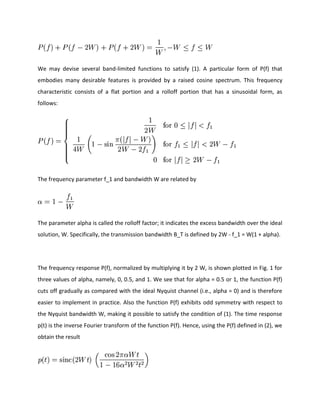
We may devise several band-limited functions to satisfy (1). A particular form of P(f) that
embodies many desirable features is provided by a raised cosine spectrum. This frequency
characteristic consists of a flat portion and a rolloff portion that has a sinusoidal form, as
follows:
The frequency parameter f_1 and bandwidth W are related by
The parameter alpha is called the rolloff factor; it indicates the excess bandwidth over the ideal
solution, W. Specifically, the transmission bandwidth B_T is defined by 2W - f_1 = W(1 + alpha).
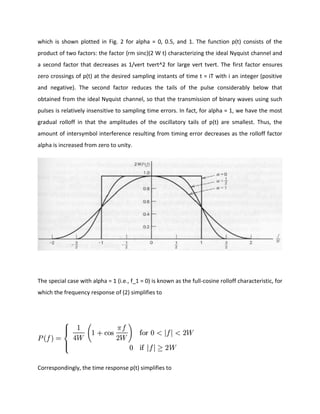
The frequency response P(f), normalized by multiplying it by 2 W, is shown plotted in Fig. 1 for
three values of alpha, namely, 0, 0.5, and 1. We see that for alpha = 0.5 or 1, the function P(f)
cuts off gradually as compared with the ideal Nyquist channel (i.e., alpha = 0) and is therefore
easier to implement in practice. Also the function P(f) exhibits odd symmetry with respect to
the Nyquist bandwidth W, making it possible to satisfy the condition of (1). The time response
p(t) is the inverse Fourier transform of the function P(f). Hence, using the P(f) defined in (2), we
obtain the result
which is shown plotted in Fig. 2 for alpha = 0, 0.5, and 1. The function p(t) consists of the
product of two factors: the factor {rm sinc}(2 W t) characterizing the ideal Nyquist channel and
a second factor that decreases as 1/vert tvert^2 for large vert tvert. The first factor ensures
zero crossings of p(t) at the desired sampling instants of time t = iT with i an integer (positive
and negative). The second factor reduces the tails of the pulse considerably below that
obtained from the ideal Nyquist channel, so that the transmission of binary waves using such
pulses is relatively insensitive to sampling time errors. In fact, for alpha = 1, we have the most
gradual rolloff in that the amplitudes of the oscillatory tails of p(t) are smallest. Thus, the
amount of intersymbol interference resulting from timing error decreases as the rolloff factor
alpha is increased from zero to unity.
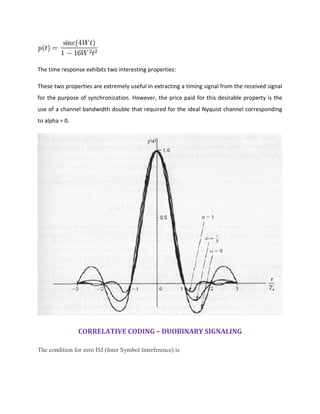
The special case with alpha = 1 (i.e., f_1 = 0) is known as the full-cosine rolloff characteristic, for
which the frequency response of (2) simplifies to
Correspondingly, the time response p(t) simplifies to
The time response exhibits two interesting properties:
These two properties are extremely useful in extracting a timing signal from the received signal
for the purpose of synchronization. However, the price paid for this desirable property is the
use of a channel bandwidth double that required for the ideal Nyquist channel corresponding
to alpha = 0.
CORRELATIVE CODING – DUOBINARY SIGNALING
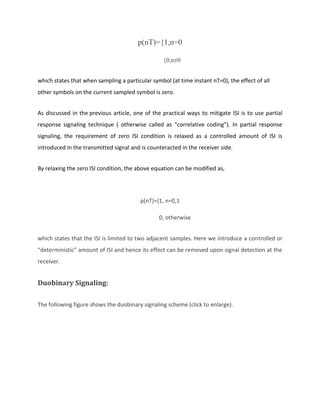
The condition for zero ISI (Inter Symbol Interference) is
p(nT)={1,n=0
{0,n≠0
which states that when sampling a particular symbol (at time instant nT=0), the effect of all
other symbols on the current sampled symbol is zero.
As discussed in the previous article, one of the practical ways to mitigate ISI is to use partial
response signaling technique ( otherwise called as “correlative coding”). In partial response
signaling, the requirement of zero ISI condition is relaxed as a controlled amount of ISI is
introduced in the transmitted signal and is counteracted in the receiver side.
By relaxing the zero ISI condition, the above equation can be modified as,
p(nT)={1, n=0,1
0, otherwise
which states that the ISI is limited to two adjacent samples. Here we introduce a controlled or
“deterministic” amount of ISI and hence its effect can be removed upon signal detection at the
receiver.
Duobinary Signaling:
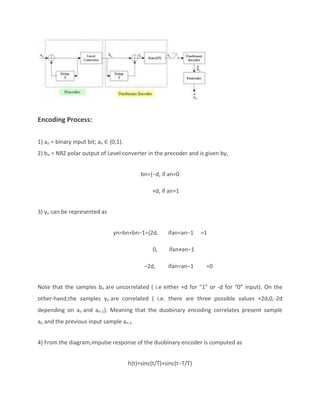
The following figure shows the duobinary signaling scheme (click to enlarge).
Encoding Process:
1) an = binary input bit; an ∈ {0,1}.
2) bn = NRZ polar output of Level converter in the precoder and is given by,
bn={−d, if an=0
+d, if an=1
3) yn can be represented as
yn=bn+bn−1={2d, ifan=an−1 =1
0, ifan≠an−1
−2d, ifan=an−1 =0
Note that the samples bn are uncorrelated ( i.e either +d for “1” or -d for “0” input). On the
other-hand,the samples yn are correlated ( i.e. there are three possible values +2d,0,-2d
depending on an and an-1). Meaning that the duobinary encoding correlates present sample
an and the previous input sample an-1.
4) From the diagram,impulse response of the duobinary encoder is computed as
h(t)=sinc(t/T)+sinc(t−T/T)
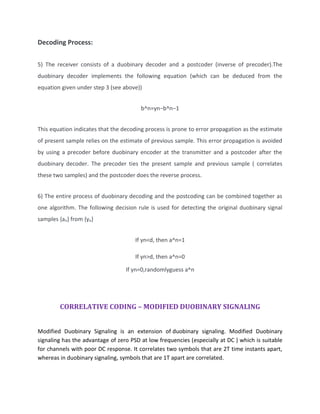
Decoding Process:
5) The receiver consists of a duobinary decoder and a postcoder (inverse of precoder).The
duobinary decoder implements the following equation (which can be deduced from the
equation given under step 3 (see above))
b^n=yn−b^n−1
This equation indicates that the decoding process is prone to error propagation as the estimate
of present sample relies on the estimate of previous sample. This error propagation is avoided
by using a precoder before duobinary encoder at the transmitter and a postcoder after the
duobinary decoder. The precoder ties the present sample and previous sample ( correlates
these two samples) and the postcoder does the reverse process.
6) The entire process of duobinary decoding and the postcoding can be combined together as
one algorithm. The following decision rule is used for detecting the original duobinary signal
samples {an} from {yn}
If yn<d, then a^n=1
If yn>d, then a^n=0
If yn=0,randomlyguess a^n
CORRELATIVE CODING – MODIFIED DUOBINARY SIGNALING
Modified Duobinary Signaling is an extension of duobinary signaling. Modified Duobinary
signaling has the advantage of zero PSD at low frequencies (especially at DC ) which is suitable
for channels with poor DC response. It correlates two symbols that are 2T time instants apart,
whereas in duobinary signaling, symbols that are 1T apart are correlated.
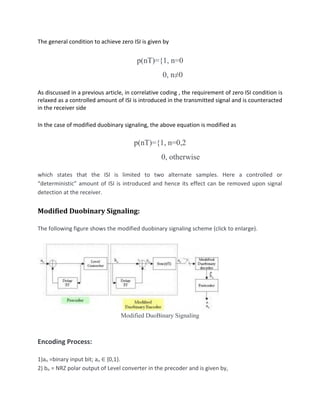
The general condition to achieve zero ISI is given by
p(nT)={1, n=0
0, n≠0
As discussed in a previous article, in correlative coding , the requirement of zero ISI condition is
relaxed as a controlled amount of ISI is introduced in the transmitted signal and is counteracted
in the receiver side
In the case of modified duobinary signaling, the above equation is modified as
p(nT)={1, n=0,2
0, otherwise
which states that the ISI is limited to two alternate samples. Here a controlled or
“deterministic” amount of ISI is introduced and hence its effect can be removed upon signal
detection at the receiver.
Modified Duobinary Signaling:
The following figure shows the modified duobinary signaling scheme (click to enlarge).
Modified DuoBinary Signaling
Encoding Process:
1)an =binary input bit; an ∈ {0,1}.
2) bn = NRZ polar output of Level converter in the precoder and is given by,
bn={−d, if ak=0
+d, if ak=1
where ak is the precoded output (before level converter).
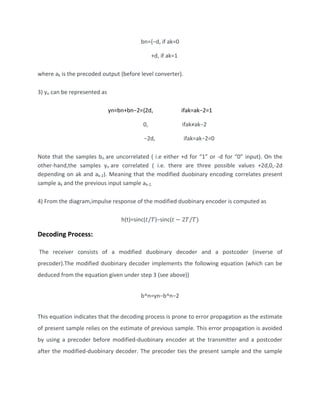
3) yn can be represented as
yn=bn+bn−2={2d, ifak=ak−2=1
0, ifak≠ak−2
−2d, ifak=ak−2=0
Note that the samples bn are uncorrelated ( i.e either +d for “1” or -d for “0” input). On the
other-hand,the samples yn are correlated ( i.e. there are three possible values +2d,0,-2d
depending on ak and ak-2). Meaning that the modified duobinary encoding correlates present
sample ak and the previous input sample ak-2.
4) From the diagram,impulse response of the modified duobinary encoder is computed as
h(t)=sinc(𝑡/𝑇)−sinc(𝑡 − 2𝑇/𝑇)
Decoding Process:
The receiver consists of a modified duobinary decoder and a postcoder (inverse of
precoder).The modified duobinary decoder implements the following equation (which can be
deduced from the equation given under step 3 (see above))
b^n=yn−b^n−2
This equation indicates that the decoding process is prone to error propagation as the estimate
of present sample relies on the estimate of previous sample. This error propagation is avoided
by using a precoder before modified-duobinary encoder at the transmitter and a postcoder
after the modified-duobinary decoder. The precoder ties the present sample and the sample
that precedes the previous sample ( correlates these two samples) and the postcoder does the
reverse process.
The entire process of modified-duobinary decoding and the postcoding can be combined
together as one algorithm. The following decision rule is used for detecting the original
modified-duobinary signal samples {an} from {yn}
If yn<d, then a^n=0
If yn>d, then a^n=1
If yn=0, randomlyguess a^n
PARTIAL RESPONSE SIGNALLING
Partial response signalling (PRS), also known as correlative coding, was introduced for the first
time in 1960s for high data rate communication [lender, 1960]. From a practical point of view,
the background of this technique is related to the Nyquist criterion.
Assume a Pulse Amplitude Modulation (PAM), according to the Nyquist criterion, the highest
possible transmission rate without Inter-symbol-interference (ISI) at the receiver over a channel
with a bandwidth of W (Hz) is 2W symbols/sec.
BASEBAND M-ARY PAM TRANSMISSION
Up to now for binary systems the pulses have two possible amplitude levels. In a baseband M-
ary PAM system, the pulse amplitude modulator produces M possible amplitude levels with
M>2. In an M-ary system, the information source emits a sequence of symbols from an
alphabet that consists of M symbols. Each amplitude level at the PAM modulator output
corresponds to a distinct symbol. The symbol duration T is also called as the signaling rate of
the system, which is expressed as symbols per second or bauds.
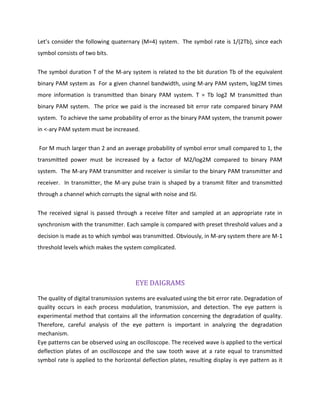
Let’s consider the following quaternary (M=4) system. The symbol rate is 1/(2Tb), since each
symbol consists of two bits.
The symbol duration T of the M-ary system is related to the bit duration Tb of the equivalent
binary PAM system as For a given channel bandwidth, using M-ary PAM system, log2M times
more information is transmitted than binary PAM system. T = Tb log2 M transmitted than
binary PAM system. The price we paid is the increased bit error rate compared binary PAM
system. To achieve the same probability of error as the binary PAM system, the transmit power
in <-ary PAM system must be increased.
For M much larger than 2 and an average probability of symbol error small compared to 1, the
transmitted power must be increased by a factor of M2/log2M compared to binary PAM
system. The M-ary PAM transmitter and receiver is similar to the binary PAM transmitter and
receiver. In transmitter, the M-ary pulse train is shaped by a transmit filter and transmitted
through a channel which corrupts the signal with noise and ISI.
The received signal is passed through a receive filter and sampled at an appropriate rate in
synchronism with the transmitter. Each sample is compared with preset threshold values and a
decision is made as to which symbol was transmitted. Obviously, in M-ary system there are M-1
threshold levels which makes the system complicated.
EYE DAIGRAMS
The quality of digital transmission systems are evaluated using the bit error rate. Degradation of
quality occurs in each process modulation, transmission, and detection. The eye pattern is
experimental method that contains all the information concerning the degradation of quality.
Therefore, careful analysis of the eye pattern is important in analyzing the degradation
mechanism.
Eye patterns can be observed using an oscilloscope. The received wave is applied to the vertical
deflection plates of an oscilloscope and the saw tooth wave at a rate equal to transmitted
symbol rate is applied to the horizontal deflection plates, resulting display is eye pattern as it
resembleshumaneye.
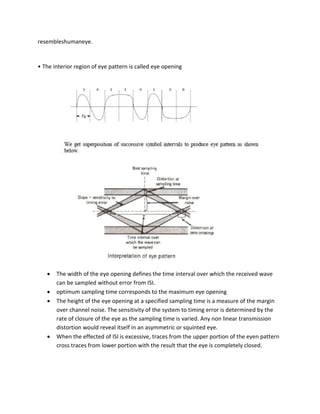
• The interior region of eye pattern is called eye opening
 The width of the eye opening defines the time interval over which the received wave
can be sampled without error from ISI.
 optimum sampling time corresponds to the maximum eye opening
 The height of the eye opening at a specified sampling time is a measure of the margin
over channel noise. The sensitivity of the system to timing error is determined by the
rate of closure of the eye as the sampling time is varied. Any non linear transmission
distortion would reveal itself in an asymmetric or squinted eye.
 When the effected of ISI is excessive, traces from the upper portion of the eyen pattern
cross traces from lower portion with the result that the eye is completely closed.
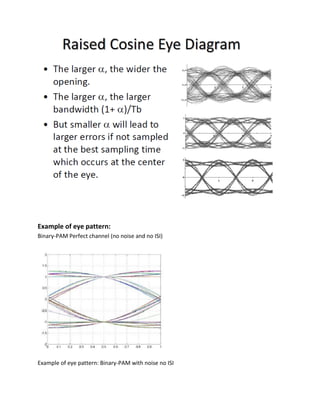
Example of eye pattern:
Binary-PAM Perfect channel (no noise and no ISI)
Example of eye pattern: Binary-PAM with noise no ISI
UNIT –III
SIGNAL SPACE ANALYSIS
INTRODUCTION
space analysis provides a mathematically elegant and highly insightful tool for the study
of digital signal transmission. Signal space analysis permits a general geometric
framework for the interpretation of digital signaling that includes both baseband and
bandpass signaling schemes. Furthermore, it provides an intuitive insight into the error
performance and spectral efficiency characteristics of the various digital signaling
schemes. Before introducing the Signal Space analysis technique, a brief review of digital
transmission is necessary.
The transmitter takes the message source output mi and codes it into a distinct signal
si(t) suitable for transmission over the communications channel. The transmission
channel is perturbed by zero-mean additive white Gaussian noise (AWGN).
The AWGN channel is one of the simplest mathematical models for various physical
communications channels.
The received signal r(t) is given by
r(t) = si(t) + n(t) for 0< t < T
The receiver has the task of observing the received signal r(t) for a duration of T
seconds and making the best estimate of the transmitted signal si(t). However, owing to
the presence of channel noise, the decision making process is statistical in nature with
the result that the receiver will make occasional errors.
The key to analyzing and understanding the performance of digital transmission is the
realization that signals used in communications can be expressed and visualized
graphically. Thus, we need to understand signal space concepts as applied to digital
communications. Two entirely different signal sets can have the same geometric
representation.The underlying geometry will determine the performance and the
receiver structure.
GRAM SCHMITT ORTHOGONALIZATION (GSO) PROCEDURE
Suppose we are given a signal set
Find the orthogonal basis functions for this signal set
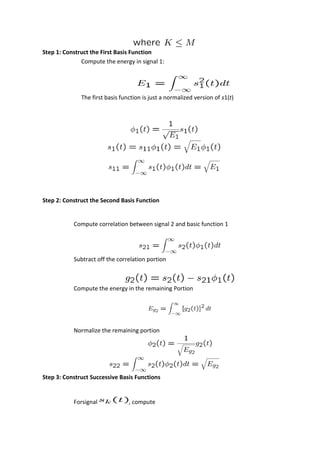
Step 1: Construct the First Basis Function
Compute the energy in signal 1:
The first basis function is just a normalized version of s1(t)
Step 2: Construct the Second Basis Function
Compute correlation between signal 2 and basic function 1
Subtract off the correlation portion
Compute the energy in the remaining Portion
Normalize the remaining portion
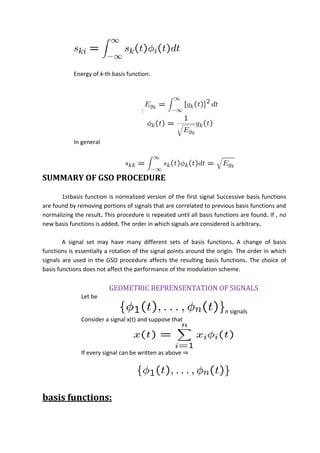
Step 3: Construct Successive Basis Functions
Forsignal , compute
Energy of k-th basis function:
:
In general
SUMMARY OF GSO PROCEDURE
1stbasis function is normalized version of the first signal Successive basis functions
are found by removing portions of signals that are correlated to previous basis functions and
normalizing the result. This procedure is repeated until all basis functions are found. If , no
new basis functions is added. The order in which signals are considered is arbitrary.
A signal set may have many different sets of basis functions. A change of basis
functions is essentially a rotation of the signal points around the origin. The order in which
signals are used in the GSO procedure affects the resulting basis functions. The choice of
basis functions does not affect the performance of the modulation scheme.
GEOMETRIC REPRENSENTATION OF SIGNALS
Let be
n signals
Consider a signal x(t) and suppose that
If every signal can be written as above ⇒
basis functions:
where N ≤ M is thedimensionof the signal space and are called the orthonormal basis
functions
CONVERSION OF CONTINUOUS AWGN CHANNEL INTO VECTOR CHANNEL
Perhaps the most important, and certainly the most analyzed, digital communication
channel is the AWGN channel shown in Figure.This channel passes the sum of the modulated
signal x(t) and an uncorrelated Gaussian noise n(t) to the output. The Gaussian noise is
assumed to be uncorrelated with itself (or “white”) for any non-zero time offset τ , that is
and zero mean, E[n(t)] = 0. With these definitions, the Gaussian noise is also strict sense
stationary). The analysis of the AWGN channel is a foundation for the analysis of more
complicated channel models in later chapters.
The assumption of white Gaussian noise is valid in the very common situation where the
noise is predominantly determined by front-end analog receiver thermal noise.
In the absence of additive noise in Figure y(t) = x(t), and the demodulation process would
exactly recover the transmitted signal. This section shows that for the AWGN channel, this
demodulation process provides sufficient information to determine optimally the transmit-
ted signal. The resulting components i, l = 1, ..., N comprise a vector channel
output, y = [y1 , ..., yN ]0
that is equivalent for detection purposes to y(t). The analysis can
thus convert the continuous channel y(t) = x(t) + n(t) to a discrete vector channel model,
y = x + n ,
where n = [n1 n2 ... nN ] and nl = hn(t), ϕl(t)i. The vector channel output is the sum of the
vector equivalent of the modulated signal and the vector equivalent of the demodulated
noise. Nevertheless, the exact noise sample function may not be reconstructed from n,
There may exist a component of n(t) that is orthogonal to the space spanned by the basis
functions {ϕ1(t) ... ϕN (t)}. This unrepresented noise component is
n˜(t) = n(t) − nˆ(t) = y(t) − yˆ(t) .
The development of the MAP detector could have replaced y by y(t) everywhere and the
development would have proceeded identically with the tacit inclusion of the time variable t
in the probability densities (and also assuming stationarity of y(t) as a random process). The
Theorem of Irrelevance would hold with [y1 y2] replaced by [ˆy(t) ˜n(s)], as long as the
relation holds for any pair of time instants t and s. In a non-mathematical sense, the
unrepresented noise is useless to the receiver, so there is nothing of value lost in the vector
demodulator, even though some of the channel output noise is not represented.
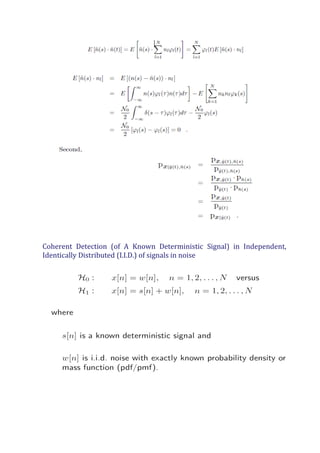
The following algebra demonstrates that ˜n(s) is irrelevant:
First,
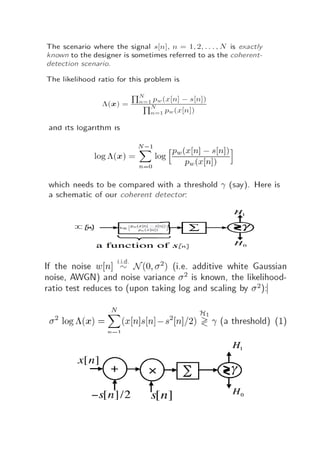
Coherent Detection (of A Known Deterministic Signal) in Independent,
Identically Distributed (I.I.D.) of signals in noise
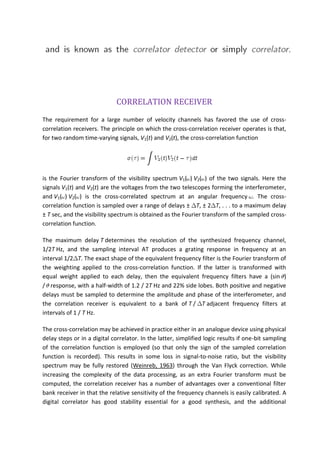
CORRELATION RECEIVER
The requirement for a large number of velocity channels has favored the use of cross-
correlation receivers. The principle on which the cross-correlation receiver operates is that,
for two random time-varying signals, V1(t) and V2(t), the cross-correlation function
is the Fourier transform of the visibility spectrum V1( ) V2( ) of the two signals. Here the
signals V1(t) and V2(t) are the voltages from the two telescopes forming the interferometer,
and V1( ) V2( ) is the cross-correlated spectrum at an angular frequency . The cross-
correlation function is sampled over a range of delays ± T, ± 2 T, . . . to a maximum delay
± T sec, and the visibility spectrum is obtained as the Fourier transform of the sampled cross-
correlation function.
The maximum delay T determines the resolution of the synthesized frequency channel,
1/2T Hz, and the sampling interval AT produces a grating response in frequency at an
interval 1/2 T. The exact shape of the equivalent frequency filter is the Fourier transform of
the weighting applied to the cross-correlation function. If the latter is transformed with
equal weight applied to each delay, then the equivalent frequency filters have a (sin )
/ response, with a half-width of 1.2 / 2T Hz and 22% side lobes. Both positive and negative
delays must be sampled to determine the amplitude and phase of the interferometer, and
the correlation receiver is equivalent to a bank of T / T adjacent frequency filters at
intervals of 1 / T Hz.
The cross-correlation may be achieved in practice either in an analogue device using physical
delay steps or in a digital correlator. In the latter, simplified logic results if one-bit sampling
of the correlation function is employed (so that only the sign of the sampled correlation
function is recorded). This results in some loss in signal-to-noise ratio, but the visibility
spectrum may be fully restored (Weinreb, 1963) through the Van Flyck correction. While
increasing the complexity of the data processing, as an extra Fourier transform must be
computed, the correlation receiver has a number of advantages over a conventional filter
bank receiver in that the relative sensitivity of the frequency channels is easily calibrated. A
digital correlator has good stability essential for a good synthesis, and the additional
advantage that the bandwidth can be changed by simply changing the clock rate which
determines the sampling interval.
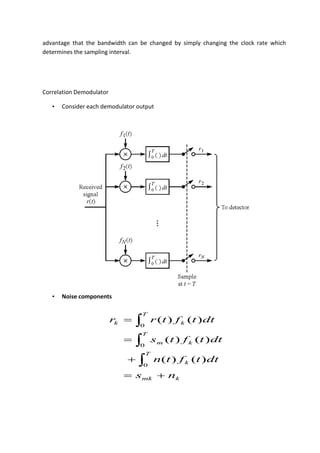
Correlation Demodulator
• Consider each demodulator output
• Noise components
kmk
T
k
T
km
T
kk
ns
dttftn
dttfts
dttftrr







0
0
0
)()(
)()(
)()(
Correlator outputs
km
kmN
dtftfN
ddtftfntnEnnE
T
mk
T T
mkmk










 
0
2
1
)()(
2
1
)()()]()([)(
0
0
0
0 0


EQIVALANCE OF CORRELATION N MATCHED FILTER RECEIVER
• Use filters whose impulse response is the orthonormal basis of signal
• Can show this is exactly equivalent to the
correlation demodulator
• We find that this Demodulator Maximizes the SNR
• Essentially show that any other function than f1() decreases SNR as is not as well
correlated to components of r(t)
PROBABILITY OF ERROR IN TRANSMISSION
In a binary PCM system, binary digits may be represented by two pulse levels. If these levels
are chosen to be 0 and A, the signal is termed an on-off binary signal. If the level switches
between A=2 and A=2 it is called a polar binary signal.
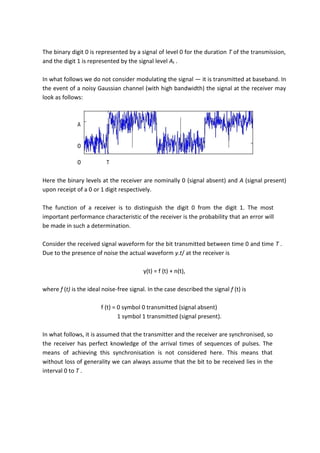
Suppose we are transmitting digital information, and decide to do this using two-level
pulses each with period T :
A
t
0
0 T
The binary digit 0 is represented by a signal of level 0 for the duration T of the transmission,
and the digit 1 is represented by the signal level At .
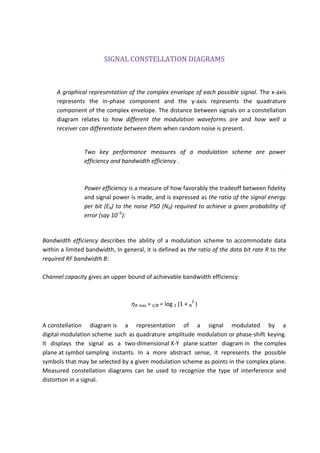
In what follows we do not consider modulating the signal — it is transmitted at baseband. In
the event of a noisy Gaussian channel (with high bandwidth) the signal at the receiver may
look as follows:
A
0
0 T
Here the binary levels at the receiver are nominally 0 (signal absent) and A (signal present)
upon receipt of a 0 or 1 digit respectively.
The function of a receiver is to distinguish the digit 0 from the digit 1. The most
important performance characteristic of the receiver is the probability that an error will
be made in such a determination.
Consider the received signal waveform for the bit transmitted between time 0 and time T .
Due to the presence of noise the actual waveform y.t/ at the receiver is
y(t) = f (t) + n(t),
where f (t) is the ideal noise-free signal. In the case described the signal f (t) is
f (t) = 0 symbol 0 transmitted (signal absent)
1 symbol 1 transmitted (signal present).
In what follows, it is assumed that the transmitter and the receiver are synchronised, so
the receiver has perfect knowledge of the arrival times of sequences of pulses. The
means of achieving this synchronisation is not considered here. This means that
without loss of generality we can always assume that the bit to be received lies in the
interval 0 to T .
SIGNAL CONSTELLATION DIAGRAMS
A graphical representation of the complex envelope of each possible signal. The x-axis
represents the in-phase component and the y-axis represents the quadrature
component of the complex envelope. The distance between signals on a constellation
diagram relates to how different the modulation waveforms are and how well a
receiver can differentiate between them when random noise is present.
Two key performance measures of a modulation scheme are power
efficiency and bandwidth efficiency .
Power efficiency is a measure of how favorably the tradeoff between fidelity
and signal power is made, and is expressed as the ratio of the signal energy
per bit (Eb) to the noise PSD (N0) required to achieve a given probability of
error (say 10−5
):
Bandwidth efficiency describes the ability of a modulation scheme to accommodate data
within a limited bandwidth, In general, it is defined as the ratio of the data bit rate R to the
required RF bandwidth B:
Channel capacity gives an upper bound of achievable bandwidth efficiency:
ηB max = C/B = log 2 (1 + N
S
)
A constellation diagram is a representation of a signal modulated by a
digital modulation scheme such as quadrature amplitude modulation or phase-shift keying.
It displays the signal as a two-dimensional X-Y plane scatter diagram in the complex
plane at symbol sampling instants. In a more abstract sense, it represents the possible
symbols that may be selected by a given modulation scheme as points in the complex plane.
Measured constellation diagrams can be used to recognize the type of interference and
distortion in a signal.
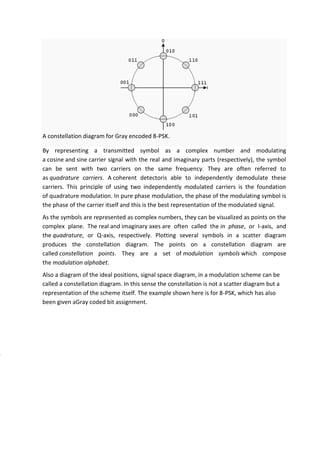
A constellation diagram for Gray encoded 8-PSK.
By representing a transmitted symbol as a complex number and modulating
a cosine and sine carrier signal with the real and imaginary parts (respectively), the symbol
can be sent with two carriers on the same frequency. They are often referred to
as quadrature carriers. A coherent detectoris able to independently demodulate these
carriers. This principle of using two independently modulated carriers is the foundation
of quadrature modulation. In pure phase modulation, the phase of the modulating symbol is
the phase of the carrier itself and this is the best representation of the modulated signal.
As the symbols are represented as complex numbers, they can be visualized as points on the
complex plane. The real and imaginary axes are often called the in phase, or I-axis, and
the quadrature, or Q-axis, respectively. Plotting several symbols in a scatter diagram
produces the constellation diagram. The points on a constellation diagram are
called constellation points. They are a set of modulation symbols which compose
the modulation alphabet.
Also a diagram of the ideal positions, signal space diagram, in a modulation scheme can be
called a constellation diagram. In this sense the constellation is not a scatter diagram but a
representation of the scheme itself. The example shown here is for 8-PSK, which has also
been given aGray coded bit assignment.
CHAPTER 4
PASSBAND DATA TRANSMISSION
2.1 INTRODUCTION
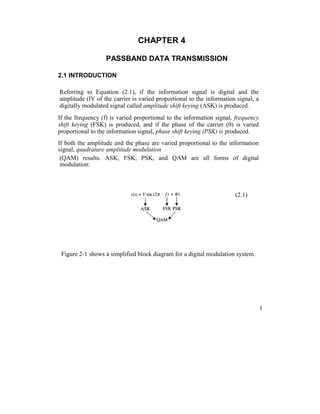
Referring to Equation (2.1), if the information signal is digital and the
amplitude (lV of the carrier is varied proportional to the information signal, a
digitally modulated signal called amplitude shift keying (ASK) is produced.
If the frequency (f) is varied proportional to the information signal, frequency
shift keying (FSK) is produced, and if the phase of the carrier (0) is varied
proportional to the information signal, phase shift keying (PSK) is produced.
If both the amplitude and the phase are varied proportional to the information
signal, quadrature amplitude modulation
(QAM) results. ASK, FSK, PSK, and QAM are all forms of digital
modulation:
(2.1)
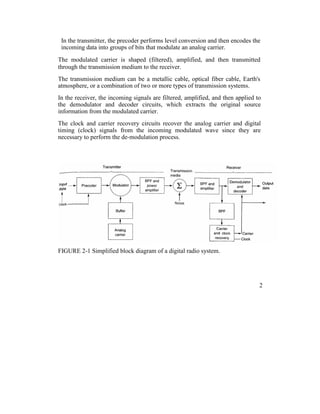
Figure 2-1 shows a simplified block diagram for a digital modulation system.
1
In the transmitter, the precoder performs level conversion and then encodes the
incoming data into groups of bits that modulate an analog carrier.
The modulated carrier is shaped (filtered), amplified, and then transmitted
through the transmission medium to the receiver.
The transmission medium can be a metallic cable, optical fiber cable, Earth's
atmosphere, or a combination of two or more types of transmission systems.
In the receiver, the incoming signals are filtered, amplified, and then applied to
the demodulator and decoder circuits, which extracts the original source
information from the modulated carrier.
The clock and carrier recovery circuits recover the analog carrier and digital
timing (clock) signals from the incoming modulated wave since they are
necessary to perform the de-modulation process.
FIGURE 2-1 Simplified block diagram of a digital radio system.
2
2-2 INFORMATION CAPACITY, BITS, BIT RATE,
BAUD, AND MARY ENCODING
2-2-1 Information Capacity, Bits, and Bit Rate
I α B x t (2.2)
where I= information capacity (bits per second) B =
bandwidth (hertz)
t = transmission time (seconds)
From Equation 2-2, it can be seen that information capacity is a linear function
of bandwidth and transmission time and is directly proportional to both.
If either the bandwidth or the transmission time changes, a directly proportional
change occurs in the information capacity.
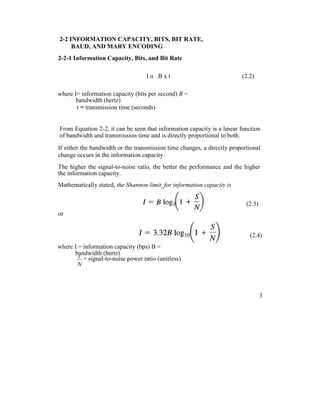
The higher the signal-to-noise ratio, the better the performance and the higher
the information capacity.
Mathematically stated, the Shannon limit_for information capacity is
(2.3)
or
(2.4)
where I = information capacity (bps) B =
bandwidth (hertz)
S
= signal-to-noise power ratio (unitless)
N
3
For a standard telephone circuit with a signal-to-noise power ratio of 1000 (30
dB) and a bandwidth of 2.7 kHz, the Shannon limit for information capacity is
I = (3.32)(2700) log10 (1 + 1000) = 26.9 kbps
Shannon's formula is often misunderstood. The results of the preceding
example indicate that 26.9 kbps can be propagated through a 2.7-kHz
communications channel. This may be true, but it cannot be done with a binary
system. To achieve an information transmission rate of 26.9 kbps through a 2.7-
kHz channel, each symbol transmitted must contain more than one bit.
2-2-2 M-ary Encoding
M-ary is a term derived from the word binary.
M simply represents a digit that corresponds to the number of conditions,
levels, or combinations possible for a given number of binary variables.
For example, a digital signal with four possible conditions (voltage levels,
frequencies, phases, and so on) is an M-ary system where M = 4. If there are
eight possible conditions, M = 8 and so forth.
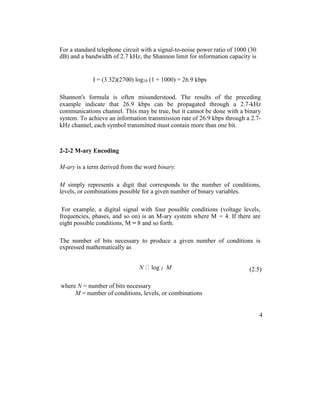
The number of bits necessary to produce a given number of conditions is
expressed mathematically as
N log 2 M (2.5)
where N = number of bits necessary
M = number of conditions, levels, or combinations
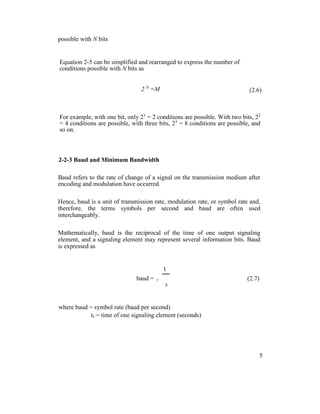
4
possible with N bits
Equation 2-5 can be simplified and rearranged to express the number of
conditions possible with N bits as
2 N
=M (2.6)
For example, with one bit, only 21
= 2 conditions are possible. With two bits, 22
= 4 conditions are possible, with three bits, 23
= 8 conditions are possible, and
so on.
2-2-3 Baud and Minimum Bandwidth
Baud refers to the rate of change of a signal on the transmission medium after
encoding and modulation have occurred.
Hence, baud is a unit of transmission rate, modulation rate, or symbol rate and,
therefore, the terms symbols per second and baud are often used
interchangeably.
Mathematically, baud is the reciprocal of the time of one output signaling
element, and a signaling element may represent several information bits. Baud
is expressed as
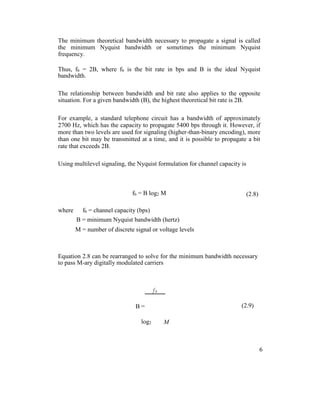
1
baud = t (2.7)
s
where baud = symbol rate (baud per second)
ts = time of one signaling element (seconds)
5
The minimum theoretical bandwidth necessary to propagate a signal is called
the minimum Nyquist bandwidth or sometimes the minimum Nyquist
frequency.
Thus, fb = 2B, where fb is the bit rate in bps and B is the ideal Nyquist
bandwidth.
The relationship between bandwidth and bit rate also applies to the opposite
situation. For a given bandwidth (B), the highest theoretical bit rate is 2B.
For example, a standard telephone circuit has a bandwidth of approximately
2700 Hz, which has the capacity to propagate 5400 bps through it. However, if
more than two levels are used for signaling (higher-than-binary encoding), more
than one bit may be transmitted at a time, and it is possible to propagate a bit
rate that exceeds 2B.
Using multilevel signaling, the Nyquist formulation for channel capacity is
fb = B log2 M (2.8)
where fb = channel capacity (bps)
B = minimum Nyquist bandwidth (hertz)
M = number of discrete signal or voltage levels
Equation 2.8 can be rearranged to solve for the minimum bandwidth necessary
to pass M-ary digitally modulated carriers
f b
(2.9)B =
log2 M
6
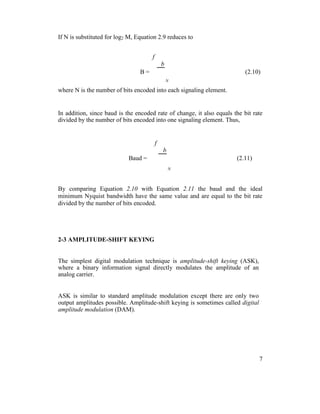
If N is substituted for log2 M, Equation 2.9 reduces to
f
b
B = (2.10)
N
where N is the number of bits encoded into each signaling element.
In addition, since baud is the encoded rate of change, it also equals the bit rate
divided by the number of bits encoded into one signaling element. Thus,
f
b
Baud = (2.11)
N
By comparing Equation 2.10 with Equation 2.11 the baud and the ideal
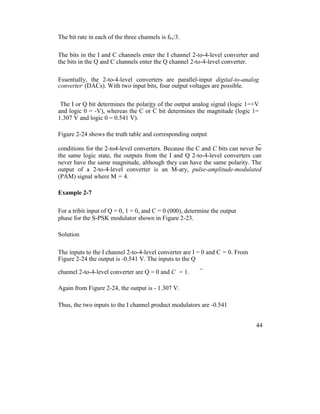
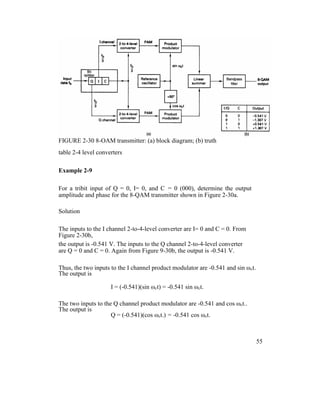
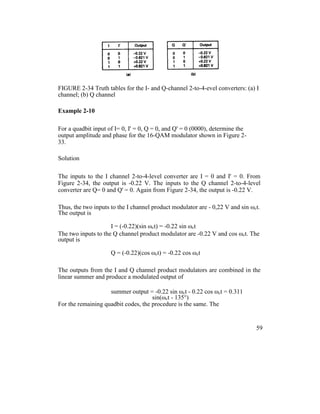
minimum Nyquist bandwidth have the same value and are equal to the bit rate
divided by the number of bits encoded.
2-3 AMPLITUDE-SHIFT KEYING
The simplest digital modulation technique is amplitude-shift keying (ASK),
where a binary information signal directly modulates the amplitude of an
analog carrier.
ASK is similar to standard amplitude modulation except there are only two
output amplitudes possible. Amplitude-shift keying is sometimes called digital
amplitude modulation (DAM).
7
Mathematically, amplitude-shift keying is
(2.12)
where
vask(t) = amplitude-shift keying wave
vm(t) = digital information (modulating) signal (volts) A/2 =
unmodulated carrier amplitude (volts)
ωc = analog carrier radian frequency (radians per second, 2πfct)
In Equation 2.12, the modulating signal [vm(t)] is a normalized binary
waveform, where + 1 V = logic 1 and -1 V = logic 0. Therefore, for a logic 1
input, vm(t) = + 1 V, Equation 2.12 reduces to
and for a logic 0 input, vm(t) = -1 V, Equation 2.12 reduces to
Thus, the modulated wave vask(t), is either A cos(ωc t) or 0. Hence, the carrier is
either "on"or "off," which is why amplitude-shift keying is sometimes referred to
as on-off keying(OOK).
8
Figure 2-2 shows the input and output waveforms from an ASK modulator.
From the figure, it can be seen that for every change in the input binary data
stream, there is one change in the ASK waveform, and the time of one bit (tb)
equals the time of one analog signaling element (t,).
B = fb /1 = fb baud = fb /1 = fb
FIGURE 2-2 Digital amplitude modulation: (a) input binary;
(b) output DAM waveform
The entire time the binary input is high, the output is a constant-amplitude,
constant-frequency signal, and for the entire time the binary input is low, the
carrier is off.
The rate of change of the ASK waveform (baud) is the same as the rate of
change of the binary input (bps).
Example 2-1
Determine the baud and minimum bandwidth necessary to pass a 10 kbps
binary signal using amplitude shift keying.
9
Solution
For ASK, N = 1, and the baud and minimum bandwidth are determined from
Equations 2.11 and 2.10, respectively:
B = 10,000 / 1 = 10,000
baud = 10, 000 /1 = 10,000
The use of amplitude-modulated analog carriers to transport digital information
is a relatively low-quality, low-cost type of digital modulation and, therefore, is
seldom used except for very low-speed telemetry circuits.
2-4 FREQUENCY-SHIFT KEYING
FSK is a form of constant-amplitude angle modulation similar to standard
frequency modulation (FM) except the modulating signal is a binary signal that
varies between two discrete voltage levels rather than a continuously changing
analog waveform.
Consequently, FSK is sometimes called binary FSK (BFSK). The general
expression for FSK is
(2.13)
where
vfsk(t) = binary FSK waveform
Vc = peak analog carrier amplitude (volts) fc = analog
carrier center frequency (hertz)
f = peak change (shift) in the analog carrier frequency
10
(hertz)
vm(t) = binary input (modulating) signal (volts)
From Equation 2.13, it can be seen that the peak shift in the carrier frequency ( f)
is proportional to the amplitude of the binary input signal (vm[t]), and the
direction of the shift is determined by the polarity.
The modulating signal is a normalized binary waveform where a logic 1 = + 1 V
and a logic 0 = -1 V. Thus, for a logic l input, vm(t) = + 1, Equation 2.13 can be
rewritten as
For a logic 0 input, vm(t) = -1, Equation 2.13 becomes
With binary FSK, the carrier center frequency (fc) is shifted (deviated) up and
down in the frequency domain by the binary input signal as shown in Figure 2-
3.
FIGURE 2-3 FSK in the frequency domain
11
As the binary input signal changes from a logic 0 to a logic 1 and vice versa,
the output frequency shifts between two frequencies: a mark, or logic 1
frequency (fm), and a space, or logic 0 frequency (fs). The mark and space
frequencies are separated from the carrier frequency by the peak frequency
deviation ( f) and from each other by 2 f.
Frequency deviation is illustrated in Figure 2-3 and expressed mathematically
as
f = |fm – fs| / 2 (2.14)
where f = frequency deviation (hertz)
|fm – fs| = absolute difference between the mark and space
frequencies (hertz)
Figure 2-4a shows in the time domain the binary input to an FSK modulator
and the corresponding FSK output.
When the binary input (fb) changes from a logic 1 to a logic 0 and vice versa,
the FSK output frequency shifts from a mark ( fm) to a space (fs) frequency and
vice versa.
In Figure 2-4a, the mark frequency is the higher frequency (fc + f) and the
space frequency is the lower frequency (fc - f), although this relationship could
be just the opposite.
Figure 2-4b shows the truth table for a binary FSK modulator. The truth table
shows the input and output possibilities for a given digital modulation scheme.
12
FIGURE 2-4 FSK in the time domain: (a) waveform: (b) truth table
2-4-1 FSK Bit Rate, Baud, and Bandwidth
In Figure 2-4a, it can be seen that the time of one bit (tb) is the same as the time
the FSK output is a mark of space frequency (ts). Thus, the bit time equals the
time of an FSK signaling element, and the bit rate equals the baud.
The baud for binary FSK can also be determined by substituting N = 1 in
Equation 2.11:
baud = fb / 1 = fb
The minimum bandwidth for FSK is given as
B = |(fs – fb) – (fm – fb)|
= |(fs– fm)| + 2fb
and since |(fs– fm)| equals 2 f, the minimum bandwidth can be
approximated as
B = 2( f + fb) (2.15)
13
where
B= minimum Nyquist bandwidth (hertz) f=
frequency deviation |(fm– fs)| (hertz)
fb = input bit rate (bps)
Example 2-2
Determine (a) the peak frequency deviation, (b) minimum bandwidth, and (c)
baud for a binary FSK signal with a mark frequency of 49 kHz, a space
frequency of 51 kHz, and an input bit rate of 2 kbps.
Solution
a. The peak frequency deviation is determined from Equation 2.14:
f = |149kHz - 51 kHz| / 2 =1 kHz
b. The minimum bandwidth is determined from Equation 2.15:
B = 2(1000 + 2000)
= 6 kHz
c. For FSK, N = 1, and the baud is determined from Equation 2.11
as
baud = 2000 / 1 = 2000
Bessel functions can also be used to determine the approximate bandwidth for an
FSK wave. As shown in Figure 2-5, the fastest rate of change (highest
fundamental fre-quency) in a non-return-to-zero (NRZ) binary signal occurs
when alternating 1s and 0s are occurring (i.e., a square wave).
14
FIGURE 9-5 FSK modulator, tb, time of one bit = 1/fb; f m mark frequency; f s,
space frequency; T1, period of shortest cycle; 1/T1, fundamental frequency of
binary square wave; f b, input bit rate (bps)
Since it takes a high and a low to produce a cycle, the highest fundamental
frequency present in a square wave equals the repetition rate of the square wave,
which with a binary signal is equal to half the bit rate. Therefore,
fa = fb / 2 (2.16)
where
fa = highest fundamental frequency of the binary input signal (hertz)
fb = input bit rate (bps)
The formula used for modulation index in FM is also valid for
FSK; thus,
h = f / fa (unitless) (2.17)
where
h = FM modulation index called the h-factor in FSK
fo = fundamental frequency of the binary modulating signal (hertz)
15
f = peak frequency deviation (hertz)
The peak frequency deviation in FSK is constant and always at its maximum
value, and the highest fundamental frequency is equal to half the incoming bit
rate. Thus,
| fm − fs |
h =
2
f
b
2
or
h =
| fm − f s |
(2.18)
fb
where
h = h-factor (unitless)
fm = mark frequency (hertz) fs =
space frequency (hertz) fb = bit rate
(bits per second)
Example 2-3
Using a Bessel table, determine the minimum bandwidth for the same FSK
signal described in Example 2-1 with a mark frequency of 49 kHz, a space
frequency of 51 kHz, and an input bit rate of 2 kbps.
Solution The modulation index is found by substituting into Equation
2.17:
h= |49 kHz - 51 kHz| / 2 kbps = 1 = 2
kHz / 2 kbps
From a Bessel table, three sets of significant sidebands are produced for a
modulation index of one. Therefore, the bandwidth can be determined as
follows:
B = 2(3 x 1000)
16
= 6000 Hz
The bandwidth determined in Example 2-3 using the Bessel table is identical
to the bandwidth determined in Example 2-2.
2-4-2 FSK Transmitter
Figure 2-6 shows a simplified binary FSK modulator, which is very similar to
a conventional FM modulator and is very often a voltage-controlled oscillator
(VCO).
The center frequency (fc) is chosen such that it falls halfway between the
mark and space frequencies.
FIGURE 2-6 FSK modulator
17
A logic 1 input shifts the VCO output to the mark frequency, and a logic 0
input shifts the VCO output to the space frequency.
Consequently, as the binary input signal changes back and forth between logic
1 and logic 0 conditions, the VCO output shifts or deviates back and forth
between the mark and space frequencies.
FIGURE 2-6 FSK modulator
A VCO-FSK modulator can be operated in the sweep mode where the peak
frequency deviation is simply the product of the binary input voltage and the
deviation sensitivity of the VCO.
With the sweep mode of modulation, the frequency deviation is expressed
mathematically as
f = vm(t)kl (2-19)
vm(t) = peak binary modulating-signal voltage (volts) kl = deviation
sensitivity (hertz per volt).
18
2-4-3 FSK Receiver
FSK demodulation is quite simple with a circuit such as the one shown in Figure
2-7.
FIGURE 2-7 Noncoherent FSK demodulator
The FSK input signal is simultaneously applied to the inputs of both bandpass
filters (BPFs) through a power splitter.
The respective filter passes only the mark or only the space frequency on to its
respective envelope detector.
The envelope detectors, in turn, indicate the total power in each passband, and
the comparator responds to the largest of the two powers.
This type of FSK detection is referred to as noncoherent detection.
19
Figure 2-8 shows the block diagram for a coherent FSK receiver.
The incoming FSK signal is multiplied by a recovered carrier signal that has the
exact same frequency and phase as the transmitter reference.
However, the two transmitted frequencies (the mark and space frequencies) are
not generally continuous; it is not practical to reproduce a local reference that is
coherent with both of them. Consequently, coherent FSK detection is seldom
used.
FIGURE 2-8 Coherent FSK demodulator
The most common circuit used for demodulating binary FSK signals is the
phaselocked loop (PLL), which is shown in block diagram form in Figure 2-9.
FIGURE 2-9 PLL-FSK demodulator
As the input to the PLL shifts between the mark and space frequencies, the dc
error voltage at the output of the phase
20
comparator follows the frequency shift.
Because there are only two input frequencies (mark and space), there are also
only two output error voltages. One represents a logic 1 and the other a logic 0.
Binary FSK has a poorer error performance than PSK or QAM and,
consequently, is seldom used for high-performance digital radio systems.
Its use is restricted to low-performance, low-cost, asynchronous data modems
that are used for data communications over analog, voice-band telephone lines.
2-4-4 Continuous-Phase Frequency-Shift Keying
Continuous-phase frequency-shift keying (CP-FSK) is binary FSK except the
mark and space frequencies are synchronized with the input binary bit rate.
With CP-FSK, the mark and space frequencies are selected such that they are
separated from the center frequency by an exact multiple of one-half the bit rate
(fm and fs = n[fb / 2]), where n = any integer).
This ensures a smooth phase transition in the analog output signal when it
changes from a mark to a space frequency or vice versa.
Figure 2-10 shows a noncontinuous FSK waveform. It can be seen that when the
input changes from a logic 1 to a logic 0 and vice versa, there is an abrupt phase
discontinuity in the analog signal. When this occurs, the demodulator has trouble
following the frequency shift; consequently, an error may occur.
21
FIGURE 2-10 Noncontinuous FSK waveform
Figure 2-11 shows a continuous phase FSK waveform.
FIGURE 2-11 Continuous-phase MSK waveform
Notice that when the output frequency changes, it is a smooth, continuous
transition. Consequently, there are no phase discontinuities.
CP-FSK has a better bit-error performance than conventional binary FSK for a
given signal-to-noise ratio.
The disadvantage of CP-FSK is that it requires synchro-nization circuits and is,
therefore, more expensive to implement.
22
2-5 PHASE-SHIFT KEYING
Phase-shift keying (PSK) is another form of angle-modulated, constant-
amplitude digital modulation.
2-5-1 Binary Phase-Shift Keying
The simplest form of PSK is binary phase-shift keying
(BPSK), where N = 1 and M = 2.
Therefore, with BPSK, two phases (21
= 2) are possible for the carrier.
One phase represents a logic 1, and the other phase represents a logic 0. As the
input digital signal changes state (i.e., from a 1 to a 0 or from a 0 to a 1), the
phase of the output carrier shifts between two angles that are separated by 180°.
Hence, other names for BPSK are phase reversal keying (PRK) and biphase
modulation. BPSK is a form of square-wave modulation of a continuous wave
(CW) signal.
FIGURE 2-12 BPSK transmitter
23
2-5-1-1 BPSK transmitter.
Figure 2-12 shows a simplified block diagram of a BPSK transmitter.
The balanced modulator acts as a phase reversing switch. Depending on the
logic condition of the digital input, the carrier is transferred to the output either
in phase or 180° out of phase with the reference carrier oscillator.
Figure 2-13 shows the schematic diagram of a balanced ring modulator.
The balanced modulator has two inputs: a carrier that is in phase with the
reference oscillator and the binary digital data.
For the balanced modulator to operate properly, the digital input voltage must be
much greater than the peak carrier voltage.
This ensures that the digital input controls the on/off state of diodes D1 to D4. If
the binary input is a logic 1(positive voltage), diodes D 1 and D2 are forward
biased and on, while diodes D3 and D4 are reverse biased and off (Figure 2-
13b). With the polarities shown, the carrier voltage is developed across
transformer T2 in phase with the carrier voltage across T 1. Consequently, the
output signal is in phase with the reference oscillator.
If the binary input is a logic 0 (negative voltage), diodes Dl and D2 are reverse
biased and off, while diodes D3 and D4 are forward biased and on (Figure 9-
13c). As a result, the carrier voltage is developed across transformer T2 180° out
of phase with the carrier voltage across T 1.
24
FIGURE 9-13 (a) Balanced ring modulator; (b) logic 1 input;
(c) logic 0 input
25
FIGURE 2-14 BPSK modulator: (a) truth table; (b) phasor diagram; (c)
constellation diagram
2-5-1-2 Bandwidth considerations of BPSK.
In a BPSK modulator. the carrier input signal is multiplied by the binary data.
If + 1 V is assigned to a logic 1 and -1 V is assigned to a logic 0, the input
carrier (sin ωct) is multiplied by either a + or - 1 .
The output signal is either + 1 sin ωct or -1 sin ωct the first represents a signal
that is in phase with the reference oscillator, the latter a signal that is 180° out of
phase with the reference oscillator.
26
Each time the input logic condition changes, the output phase changes.
Mathematically, the output of a BPSK modulator is proportional to
BPSK output = [sin (2πfat)] x [sin (2πfct)] (2.20)
where
fa = maximum fundamental frequency of binary input (hertz)
fc = reference carrier frequency (hertz)
Solving for the trig identity for the product of two sine functions,
0.5cos[2π(fc – fa)t] – 0.5cos[2π(fc + fa)t]
Thus, the minimum double-sided Nyquist bandwidth (B) is
fc + fa fc + fa
-(fc + fa) or -fc
+ f
a
2fa
and because fa = fb / 2, where fb = input bit rate,
where B is the minimum double-sided Nyquist bandwidth.
Figure 2-15 shows the output phase-versus-time relationship for a BPSK
waveform.
Logic 1 input produces an analog output signal with a 0° phase angle, and a
logic 0 input produces an analog output signal with a 180° phase angle.
27
As the binary input shifts between a logic 1 and a logic 0 condition and vice
versa, the phase of the BPSK waveform shifts between 0° and 180°,
respectively.
BPSK signaling element (ts) is equal to the time of one information bit (tb),
which indicates that the bit rate equals the baud.
FIGURE 2-15 Output phase-versus-time relationship for a BPSK modulator
Example 2-4
For a BPSK modulator with a carrier frequency of 70 MHz and an input bit rate
of 10 Mbps, determine the maximum and minimum upper and lower side
frequencies, draw the output spectrum, de-termine the minimum Nyquist
bandwidth, and calculate the baud..
28
Solution
Substituting into Equation 2-20 yields
output = [sin (2πfat)] x [sin (2πfct)] ; fa = fb / 2 = 5 MHz
= [sin 2π(5MHz)t)] x [sin 2π(70MHz)t)]
= 0.5cos[2π(70MHz – 5MHz)t] – 0.5cos[2π(70MHz + 5MHz)t]
lower side frequency upper side frequency
Minimum lower side frequency (LSF):
LSF=70MHz - 5MHz = 65MHz
Maximum upper side frequency (USF):
USF = 70 MHz + 5 MHz = 75 MHz
Therefore, the output spectrum for the worst-case binary input conditions is
as follows: The minimum Nyquist bandwidth (B) is
B = 75 MHz - 65 MHz = 10 MHz
and the baud = fb or 10 megabaud.
29
2-5-1-3 BPSK receiver.
Figure 2-16 shows the block diagram of a BPSK receiver.
The input signal maybe + sin ωct or - sin ωct .
The coherent carrier recovery circuit detects and regenerates a carrier signal that
is both frequency and phase coherent with the original transmit carrier.
The balanced modulator is a product detector; the output is the product d the two
inputs (the BPSK signal and the recovered carrier).
The low-pass filter (LPF) operates the recovered binary data from the complex
demodulated signal.
FIGURE 2-16 Block diagram of a BPSK receiver
30
Mathematically, the demodulation process is as follows.
For a BPSK input signal of + sin ωct (logic 1), the output of the balanced
modulator is
output = (sin ωct )(sin ωct) = sin2
ωct (2.21)
or
sin2
ωct = 0.5(1 – cos 2ωct) = 0.5 - 0.5cos 2ωct
filtered out
leaving
output = + 0.5 V = logic 1
It can be seen that the output of the balanced modulator contains a positive
voltage (+[1/2]V) and a cosine wave at twice the carrier frequency (2 ωct ).
The LPF has a cutoff frequency much lower than 2 ωct, and, thus, blocks the
second harmonic of the carrier and passes only the positive constant component.
A positive voltage represents a demodulated logic 1.
For a BPSK input signal of -sin ωct (logic 0), the output of the balanced
modulator is
output = (-sin ωct )(sin ωct) = sin2
ωct
or
sin2
ωct = -0.5(1 – cos 2ωct) = 0.5 + 0.5cos 2ωct
filtered out
31
leaving
output = - 0.5 V = logic 0
The output of the balanced modulator contains a negative voltage (-[l/2]V) and a
cosine wave at twice the carrier frequency (2ωct).
Again, the LPF blocks the second harmonic of the carrier and passes only the
negative constant component. A negative voltage represents a demodulated logic
0.
2-5-2 Quaternary Phase-Shift Keying
QPSK is an M-ary encoding scheme where N = 2 and M= 4 (hence, the name
"quaternary" meaning "4"). A QPSK modulator is a binary (base 2) signal, to
produce four different input combinations,: 00, 01, 10, and 11.
Therefore, with QPSK, the binary input data are combined into groups of two
bits, called dibits. In the modulator, each dibit code generates one of the four
possible output phases (+45°, +135°, -45°, and -135°).
2-5-2-1 QPSK transmitter.
A block diagram of a QPSK modulator is shown in Figure 2-17. Two bits (a
dibit) are clocked into the bit splitter. After both bits have been serially inputted,
they are simultaneously parallel outputted.
The I bit modulates a carrier that is in phase with the reference oscillator (hence
the name "I" for "in phase" channel), and the
32
Q bit modulate, a carrier that is 90° out of phase.
For a logic 1 = + 1 V and a logic 0= - 1 V, two phases are possible at the output
of the I balanced modulator (+sin ωct and - sin ωct), and two phases are possible
at the output of the Q balanced modulator (+cos ωct), and (-cos ωct).
When the linear summer combines the two quadrature (90° out of phase)
signals, there are four possible resultant phasors given by these expressions: +
sin ωct + cos ωct, + sin ωct - cos ωct, -sin ωct + cos ωct, and -sin ωct - cos ωct.
FIGURE 2-17 QPSK modulator
33
Example 2-5
For the QPSK modulator shown in Figure 2-17, construct the truth
table, phasor diagram, and constellation diagram.
Solution
For a binary data input of Q = O and I= 0, the two inputs to the I
balanced modulator are -1 and sin ωct, and the two inputs to the Q
balanced modulator are -1 and cos ωct.
Consequently, the outputs are
I balanced modulator =(-1)(sin ωct) = -1 sin ωct
Q balanced modulator =(-1)(cos ωct) = -1 cos ωct and the output of the linear
summer is
-1 cos ωct - 1 sin ωct = 1.414 sin(ωct - 135°)
For the remaining dibit codes (01, 10, and 11), the procedure is the same. The
results are shown in Figure 2-18a.
34
FIGURE 2-18 QPSK modulator: (a) truth table; (b) phasor diagram; (c)
constellation diagram
In Figures 2-18b and c, it can be seen that with QPSK each of the four possible
output phasors has exactly the same amplitude. Therefore, the binary
information must be encoded entirely in the phase of the output signal.
Figure 2-18b, it can be seen that the angular separation between any two
adjacent phasors in QPSK is 90°.
Therefore, a QPSK signal can undergo almost a+45° or -45° shift in phase
during transmission and still retain the correct encoded information when
demodulated at the receiver.
Figure 2-19 shows the output phase-versus-time relationship for a QPSK
modulator.
35
FIGURE 2-19 Output phase-versus-time relationship for a PSK modulator.
2-5-2-2 Bandwidth considerations of QPSK
With QPSK, because the input data are divided into two channels, the bit rate in
either the I or the Q channel is equal to one-half of the input data rate (fb/2) (one-
half of fb/2 = fb/4).
This relationship is shown in Figure 2-20.
FIGURE 2-20 Bandwidth considerations of a QPSK modulator
In Figure 2-20, it can be seen that the worse-case input condition to the I or Q
balanced modulator is an alternative 1/0 pattern, which occurs when the binary
input data have a 1100 repetitive pattern. One cycle of the fastest binary
transition (a 1/0 sequence in the I or Q channel takes the same time as four input
data bits.
36
Consequently, the highest fundamental frequency at the input and fastest rate of
change at the output of the balance.: modulators is equal to one-fourth of the
binary input bit rate.
The output of the balanced modulators can be expressed mathematically
as
(2.22)
where
The output frequency spectrum extends from f'c + fb / 4 to f'c - fb / 4 and the
minimum bandwidth (fN) is
Example 2-6
For a QPSK modulator with an input data rate (fb) equal to 10 Mbps and a carrier
frequency 70 MHz, determine the minimum double-sided Nyquist bandwidth
(fN) and the baud. Also, compare the results with those achieved with the BPSK
modulator in
37
Example 2-4. Use the QPSK block diagram shown in Figure 2-17 as the
modulator model.
Solution
The bit rate in both the I and Q channels is equal to one-half of the
transmission bit rate, or
fbQ = fb1 = fb / 2 = 10 Mbps / 2 = 5 Mbps
The highest fundamental frequency presented to either balanced modulator
is
fa= fbQ / 2 = 5 Mbps / 2 = 2.5 MHz
The output wave from each balanced modulator is (sin
2πfat)(sin 2πfct)
0.5 cos 2π(fc – fa)t – 0.5 cos 2π(fc + fa)t
0.5 cos 2π[(70 – 2.5)MHz]t – 0.5 cos 2π[(70 –
2.5)MHz]t
0.5 cos 2π(67.5MHz)t - 0.5 cos 2π(72.5MHz)t
The minimum Nyquist bandwidth is
B=(72.5-67.5)MHz = 5MHz
The symbol rate equals the bandwidth: thus,
symbol rate = 5 megabaud
38
The output spectrum is as follows:
It can be seen that for the same input bit rate the minimum bandwidth required to
pass the output of the QPSK modulator is equal to one-half of that required for
the BPSK modulator in Example 2-4. Also, the baud rate for the QPSK
modulator is one-half that of the BPSK modulator.
The minimum bandwidth for the QPSK system described in Example 2-6
can also be determined by simply substituting into Equation 2-10:
B = 10 Mbps / 2 = 5 MHz
2-5-2-3 (QPSK receiver).
The block diagram of a QPSK receiver is shown in Figure 2-21. The power
splitter directs the input QPSK signal to the I and Q product detectors and the
carrier recovery circuit. The carrier recovery circuit reproduces the original
transmit carrier oscillator signal. The recovered carrier must be frequency and
phase coherent with the transmit reference carrier. The QPSK signal is
demodulated in the I and Q product detectors, which generate the original I and
Q data bits. The outputs of the product detectors are fed to the bit combining
circuit, where they are converted from parallel I and Q data channels to a single
binary output data stream.
39
The incoming QPSK signal may be any one of the four possible output phases
shown in Figure 2-18. To illustrate the demodulation process, let the incoming
QPSK signal be -sin ωct + cos ωct. Mathematically, the demodulation process is
as follows.
FIGURE 2-21 QPSK receiver
The receive QPSK signal (-sin ωct + cos ωct) is one of the inputs to the I
product detector. The other input is the recovered carrier (sin ωct). The output
of the I product detector is
(2.23
)
40
Again, the receive QPSK signal (-sin ωct + cos ωct) is one of the inputs to the Q
product detector. The other input is the recovered carrier shifted 90° in phase
(cos ωct). The output of the Q product detector is
(2.24)
The demodulated I and Q bits (0 and 1, respectively) correspond to the
constellation diagram and truth table for the QPSK modulator shown in
Figure 2-18.
2-5-2-4 Offset QPSK.
Offset QPSK (OQPSK) is a modified form of QPSK where the bit waveforms
on the I and Q channels are offset or shifted in phase from each other by one-
half of a bit time.
41
FIGURE 2-22 Offset keyed (OQPSK): (a) block diagram;
(b) bit alignment; (c) constellation diagram
Because changes in the I channel occur at the midpoints of the Q channel bits
and vice versa, there is never more than a single bit change in the dibit code
and, therefore, there is never more than a 90° shift in the output phase. In
conventional QPSK, a change in the input dibit from 00 to 11 or 01 to 10
causes a corresponding 180° shift in the output phase.
Therefore, an advantage of OQPSK is the limited phase shift that must be
imparted during modulation.
A disadvantage of OQPSK is that changes in the output phase occur at twice
the data rate in either the I or Q channel".
Consequently, with OQPSK the baud and minimum bandwidth are twice that of
conventional QPSK for a given transmission bit rate. OQPSK is sometimes
called OKQPSK (offset-keyed QPSK).
42
2-5-3 8-PSK
With 8-PSK, three bits are encoded, forming tribits and producing eight different
output phases. To encode eight different phases, the incoming bits are encoded in
groups of three, called tribits (23
= 8).
2-5-3-1 8-PSK transmitter.
A block diagram of an 8-PSK modulator is shown in Figure 2-23.
FIGURE 2.23 8-PSK modulator
FIGURE 2-24 I- and Q-channel 2-to-4-level converters: (a) 1-channel truth
table; (b) D-channel truth table; (c) PAM levels
43
The bit rate in each of the three channels is fb,/3.
The bits in the I and C channels enter the I channel 2-to-4-level converter and
the bits in the Q and C channels enter the Q channel 2-to-4-level converter.
Essentially, the 2-to-4-level converters are parallel-input digital-to-analog
converter,
(DACs). With two input bits, four output voltages are possible.
The I or Q bit determines the polarity of the output analog signal (logic 1=+V
and logic 0 = -V), whereas the C or C bit determines the magnitude (logic 1=
1.307 V and logic 0 = 0.541 V).
Figure 2-24 shows the truth table and corresponding output
_
conditions for the 2-to4-level converters. Because the C and C bits can never be
the same logic state, the outputs from the I and Q 2-to-4-level converters can
never have the same magnitude, although they can have the same polarity. The
output of a 2-to-4-level converter is an M-ary, pulse-amplitude-modulated
(PAM) signal where M = 4.
Example 2-7
For a tribit input of Q = 0, 1 = 0, and C = 0 (000), determine the output
phase for the S-PSK modulator shown in Figure 2-23.
Solution
The inputs to the I channel 2-to-4-level converter are I = 0 and C = 0. From
Figure 2-24 the output is -0.541 V. The inputs to the Q
_
channel 2-to-4-level converter are Q = 0 and C = 1.
Again from Figure 2-24, the output is - 1.307 V.
Thus, the two inputs to the I channel product modulators are -0.541
44
and sin ωct. The output is
I = (-0.541)(sin ωct) = -0.541 sin ωct
The two inputs to the Q channel product modulator are - 1.307 V and cos ωct.
The output is
Q = (-1.307)(cos ωct) = - 1.307 cos ωct
The outputs of the I and Q channel product modulators are combined in the
linear summer and produce a modulated output of
summer output = -0.541 sin ωct - 1.307 cos ωct
= 1.41 sin(ωct - 112.5°)
For the remaining tribit codes (001, 010, 011, 100, 101, 110, and 111), the
procedure is the same. The results are shown in Figure 2-25.
45
FIGURE 2-25 8-PSK modulator: (a) truth table; (b) phasor diagram; (c)
constellation diagram.
46
From Figure 2-25, it can be seen that the angular separation between any two
adjacent phasors is 45°, half what it is with QPSK.
Therefore, an 8-PSK signal can undergo almost a ± 22.5° phase shift during
transmission and still retain its integrity. Also, each phasor is of equal
magnitude; the tribit condition (actual information) is again contained only in
the phase of the signal.
The PAM levels of 1.307 and 0.541 are relative values. Any levels may be used
as long as their ratio is 0.541/1.307 and their arc tangent is equal to 22.5°. For
example, if their values were doubled to 2.614 and 1.082, the resulting phase
angles would not change, although the magnitude of the phasor would increase
proportionally.
Figure 2-26 shows the output phase-versus-time relationship of an 8-PSK
modulator.
FIGURE 2-26 Output phase-versus-time relationship for an 8-
PSK modulator
2-5-3-2 Bandwidth considerations of 8-PSK.
With 8-PSK, because the data are divided into three channels, the bit rate in
the I, Q, or C channel is equal to one-third of the binary input data rate (fb /3).
47
(2.25)
where
And X = ± 1.307 or ± 0.541
Thus
48
FIGURE 2-27 Bandwidth considerations of an 8-PSK
modulator
Figure 2-27 shows that the highest fundamental frequency in the I, Q, or C
channel is equal to one-sixth the bit rate of the binary input (one cycle in the I,
Q, or C channel takes the same amount of time as six input bits).
With an 8-PSK modulator, there is one change in phase at the output for every
three data input bits. Consequently, the baud for 8 PSK equals fb / 3, the same
as the minimum bandwidth. Again, the balanced modulators are product
modulators; their outputs are the product of the carrier and the PAM signal.
49
Mathematically, the output of the balanced modulators is
The output frequency spectrum extends from fc + fb / 6 to fc - fb / 6, and the
minimum bandwidth (fN) is
Example 2-8
For an 8-PSK modulator with an input data rate (fb) equal to 10 Mbps and a
carrier frequency of 70 MHz, determine the minimum double-sided Nyquist
bandwidth (fN) and the baud. Also, compare the results with those achieved with
the BPSK and QPSK modulators in Examples 2-4 and 2-6. If the 8-PSK block
diagram shown in Figure 2-23 as the modulator model.
Solution
The bit rate in the I, Q, and C channels is equal to one-third of the input bit rate,
or 10 Mbps
fbc = fbQ = fb1 = 10 Mbps / 3 = 3.33 Mbps
Therefore, the fastest rate of change and highest fundamental frequency
presented to either balanced modulator is
fa = fbc / 2 = 3.33 Mbps / 2 = 1.667 Mbps
The output wave from the balance modulators is (sin
2πfat)(sin 2πfct)
0.5 cos 2π(fc – fa)t – 0.5 cos 2π(fc + fa)t
0.5 cos 2π[(70 – 1.667)MHz]t – 0.5 cos 2π[(70
50
+ 1.667)MHz]t
0.5 cos 2π(68.333MHz)t - 0.5 cos
2π(71.667MHz)t
The minimum Nyquist bandwidth is
B= (71.667 - 68.333) MHz = 3.333 MHz
The minimum bandwidth for the 8-PSK can also be determined by simply
substituting into Equation 2-10:
B = 10 Mbps / 3 = 3.33 MHz
Again, the baud equals the bandwidth; thus, baud =
3.333 megabaud
The output spectrum is as follows:
B = 3.333 MHz
It can be seen that for the same input bit rate the minimum bandwidth required to
pass the output of an 8-PSK modulator is equal to one-third that of the BPSK
modulator in Example 2-4 and 50% less than that required for the QPSK
modulator in Example 2-6. Also, in each case the baud has been reduced by the
same proportions.
51
2-5-3-3 8-PSK receiver.
Figure 2-28 shows a block diagram of an 8-PSK receiver. The power splitter
directs the input 8-PSK signal to the I and Q product detectors and the carrier
recovery circuit.
The carrier recovery circuit reproduces the original reference oscillator signal.
The incoming 8-PSK signal is mixed with the recovered carrier in the I product
detector and with a quadrature carrier in the Q product detector.
The outputs of the product detectors are 4-level PAM signals that are fed to the
4-to-2-level analog-to-digital converters (ADCs). The outputs from the I
channel 4-to-2-level converter are the I and C_bits, whereas the outputs from the
_
Q channel 4-to-2-level converter are the Q and C bits. The
_
parallel-to-serial logic circuit converts the I/C and Q/ C bit pairs to serial I, Q,
and C output data streams.
FIGURE 2-28 8-PSK receiver.
52
2-5-4 16-PSK
16-PSK is an M-ary encoding technique where M = 16; there are 16 different
output phases possible. With 16-PSK, four bits (called quadbits) are combined,
producing 16 different output phases. With 16-PSK, n = 4 and M = 16;
therefore, the minimum bandwidth and baud equal one-fourth the bit rate ( fb/4).
FIGURE 2-29 16-PSK: (a) truth table; (b) constellation
diagram
Figure 2-29 shows the truth table and constellation diagram for 16-PSK,
respectively. Comparing Figures 2-18, 2-25, and 2-29 shows that as the level of
encoding increases (i.e., the values of n and M increase), more output phases
are possible and the closer each point on the constellation diagram is to an
adjacent point. With 16-PSK, the angular separation between adjacent output
phases is only 22.5° (1800
/ 8 ). Therefore, 16-PSK can undergo only a 11.25°
(1800
/ 16) phase shift during transmission and still retain its integrity.
For an M-ary PSK system with 64 output phases (n = 6), the angular separation
between adjacent phases is only 5.6° (180 / 32). This is an obvious limitation in
the level of encoding (and
53
bit rates) possible with PSK, as a point is eventually reached where receivers
cannot discern the phase of the received signaling element. In addition, phase
impairments inherent on communications lines have a tendency to shift the
phase of the PSK signal, destroying its integrity and producing errors.
2.6 QUADRATURE – AMPLITUDE MODULATION
2 - 6 - 1 8-QAM
8-QAM is an M-ary encoding technique where M = 8. Unlike 8-PSK, the output
signal from an 8-QAM modulator is not a constant-amplitude signal.
2-6-1-1 8-QAM transmitter.
Figure 2-30a shows the block diagram of an 8-QAM transmitter. As you can see,
the only difference between the 8-QAM transmitter and the 8PSK transmitter
shown in Figure 2-23 is the omission of the inverter between the C channel and
the Q product modulator. As with 8-PSK, the incoming data are divided into
groups of three bits (tribits): the I, Q, and C bit streams, each with a bit rate
equal to one-third of the incoming data rate. Again, the I and Q bits determine
the polarity of the PAM signal at the output of the 2-to-4-level converters, and
the C channel determines the magnitude. Because the C bit is fed uninverted to
both the I and the Q channel 2-to-4-level converters. the magnitudes of the I and
Q PAM signals are always equal. Their polarities depend on the logic condition
of the I and Q bits and, therefore, may be different. Figure 2-30b shows the truth
table for the I and Q channel 2-to-4-level converters; they are identical.
54
FIGURE 2-30 8-OAM transmitter: (a) block diagram; (b) truth
table 2-4 level converters
Example 2-9
For a tribit input of Q = 0, I= 0, and C = 0 (000), determine the output
amplitude and phase for the 8-QAM transmitter shown in Figure 2-30a.
Solution
The inputs to the I channel 2-to-4-level converter are I= 0 and C = 0. From
Figure 2-30b,
the output is -0.541 V. The inputs to the Q channel 2-to-4-level converter
are Q = 0 and C = 0. Again from Figure 9-30b, the output is -0.541 V.
Thus, the two inputs to the I channel product modulator are -0.541 and sin ωct.
The output is
I = (-0.541)(sin ωct) = -0.541 sin ωct.
The two inputs to the Q channel product modulator are -0.541 and cos ωct..
The output is
Q = (-0.541)(cos ωct.) = -0.541 cos ωct.
55
The outputs from the I and Q channel product modulators are combined in the
linear summer and produce a modulated output of
summer output =-0.541 sin ωct. -0.541 cos
ωct.
= 0.765 sin(cos - 135°)
For the remaining tribit codes (001, 010, 0ll, 100, 101, 110, and 111), the
procedure is the same. The results are shown in Figure 2-31.
Figure 2-32 shows the output phase-versus-time relationship for an 8-QAM
modulator. Note that there are two output amplitudes, and only four phases are
possible.
FIGURE 2-31 8-QAM modulator: (a) truth table; (b) phasor diagram; (c)
constellation diagram
56
FIGURE 2-32 Output phase and amplitude-versus-time relationship
for 8-QAM
2-6-1-2 Bandwidth considerations of 8-QAM.
The minimum bandwidth required for 8-QAM is fb / 3, the same as in 8-PSK.
2-6-1-3 8-QAM receiver.
An 8-QAM receiver is almost identical to the 8-PSK receiver shown in Figure
2-28.
2-6-2 16-QAM
As with the 16-PSK, 16-QAM is an M-ary system where M = 16. The input data
are acted on in groups of four (24
= 16). As with 8-QAM, both the phase and the
amplitude of the transmit carrier are varied.
2-6-2-1 QAM transmitter.
The block diagram for a 16-QAM transmitter is shown in Figure 2-33.
57
FIGURE 2-33 16-QAM transmitter block diagram
The input binary data are divided into four channels: I, I', Q, and Q'. The bit rate
in each channel is equal to one-fourth of the input bit rate (fb/4).
The I and Q bits determine the polarity at the output of the 2-to-4-level
converters (a logic 1 = positive and a logic 0 = negative).
The I' and Q' buy determine the magnitude (a logic 1 = 0.821 V and a logic 0 =
0.22 V).
For the I product modulator they are +0.821 sin ωct, -0.821 sin ωct, +0.22 sin
ωct, and -0.22 sin ωct.
For the Q product modulator, they are +0.821 cos ωct, +0.22 cos ωct, -0.821 cos
ωct, and -0.22 cos ωct.
The linear summer combines the outputs from the I and Q channel product
modulators and produces the 16 output conditions necessary for 16-QAM.
Figure 2-34 shows the truth table for the I and Q channel 2-to-4-level
converters.
58
FIGURE 2-34 Truth tables for the I- and Q-channel 2-to-4-evel converters: (a) I
channel; (b) Q channel
Example 2-10
For a quadbit input of I= 0, I' = 0, Q = 0, and Q' = 0 (0000), determine the
output amplitude and phase for the 16-QAM modulator shown in Figure 2-
33.
Solution
The inputs to the I channel 2-to-4-level converter are I = 0 and I' = 0. From
Figure 2-34, the output is -0.22 V. The inputs to the Q channel 2-to-4-level
converter are Q= 0 and Q' = 0. Again from Figure 2-34, the output is -0.22 V.
Thus, the two inputs to the I channel product modulator are - 0,22 V and sin ωct.
The output is
I = (-0.22)(sin ωct) = -0.22 sin ωct
The two inputs to the Q channel product modulator are -0.22 V and cos ωct. The
output is
Q = (-0.22)(cos ωct) = -0.22 cos ωct
The outputs from the I and Q channel product modulators are combined in the
linear summer and produce a modulated output of
summer output = -0.22 sin ωct - 0.22 cos ωct = 0.311
sin(ωct - 135°)
For the remaining quadbit codes, the procedure is the same. The
59
results are shown in Figure 2-35.
FIGURE 2-35 16-QAM modulator: (a) truth table; (b) phasor diagram; (c)
constellation diagram.
60
FIGURE 2-36 Bandwidth considerations of a 16-QAM modulator
2-6-2-2 Bandwidth considerations of 16-QAM.
With a 16-QAM, the bit rate in the I, I', Q, or Q' channel is equal to one-fourth of
the binary input data rate (fb/4).
Figure 2-36 shows the bit timing relationship between the binary input data; the
I, I'. Q, and Q' channel data; and the I PAM signal. It can be seen that the highest
fundamental frequency in the I, I', Q, or Q' channel is equal to one-eighth of the
bit rate of the binary input data (one cycle in the I, I', Q, or
61
Q' channel takes the same amount of time as eight input bits). Also, the highest
fundamental frequency of either PAM signal is equal to one-eighth of the binary
input bit rate. With a 16-QAM modulator, there is one change in the output
signal (either its phase, amplitude, or both) for every four input data bits.
Consequently, the baud equals fb/4, the same as the minimum bandwidth.
Again, the balanced modulators are product modulators and their outputs
can be represented mathematically as
(2.26)
where
and
Thus,
The output frequency spectrum extends from fc + fb / 8 and fc - fb / 8 the
minimum bandwidth (fN) is
62
Example 2 -11
For a 16-QAM modulator with an input data rate (fb) equal to 10 Mbps and a
carrier frequency of 70 MHz, determine the minimum double-sided Nyquist
frequency (fN) and the baud. Also, compare the results with those achieved with
the BPSK, QPSK, and 8-PSK modulators in Examples 2-4, 2-6, and 2-8. Use the
16-QAM block diagram shown in Figure 2-33 as the modulator model.
Solution
The bit rate in the I, I’, Q, and Q’ channels is equal to one-fourth of the input bit
rate,
fbI = fbI’ = fbQ = fbQ’ = fb / 4 = 10 Mbps / 4 = 2.5
Mbps
Therefore, the fastest rate of change and highest fundamental frequency
presented to either balanced modulator is
fa = fbI / 2 = 2.5 Mbps / 2 = 1.25 MHz The
output wave from the balanced modulator is
(sin 2πfat)(sin 2πfct)
0.5 cos 2π(fc – fa)t – 0.5 cos 2π(fc + fa)t
0.5 cos 2π[(70 – 1.25)MHz]t – 0.5 cos 2π[(70 +
1.25)MHz]t
0.5 cos 2π(68.75MHz)t - 0.5 cos
2π(71.25MHz)t
The minimum Nyquist bandwidth is
63
B=(71.25 - 68.75) MHz = 2.5 MHz
The minimum bandwidth for the 16-QAM can also be determined
by simply substituting into Equation 2-10:
B = 10 Mbps / 4 = 2.5 MHz.
The symbol rate equals the bandwidth; thus,
symbol rate = 2.5 megabaud
The output spectrum is as follows:
For the same input bit rate, the minimum bandwidth required to pass the output
of a 16-QAM modulator is equal to one-fourth that of the BPSK modulator, one-
half that of QPSK, and 25% less than with 8-PSK. For each modulation
technique, the baud is also reduced by the same proportions.
Example 2-12
For the following modulation schemes, construct a table showing the number of
bits encoded, number of output conditions, minimum bandwidth, and baud for an
information data rate of 12 kbps: QPSK, 8-PSK, 8-QAM, 16-PSK, and 16-QAM.
64
From Example 2-12, it can be seen that a 12-kbps data stream can be propagated
through a narrower bandwidth using either 16-PSK or 16-QAM than with the
lower levels of encoding.
Table 2-1 summarizes the relationship between the number of bits encoded, the
number of output conditions possible, the minimum bandwidth, and the baud for
ASK, FSK. PSK, and QAM.
When data compression is performed, higher data transmission rates are possible
for a given bandwidth.
Table 2-1 ASK, FSK, PSK AND QAM summary.
65
2-7 BANDWIDTH EFFICIENCY
Bandwidth efficiency (sometimes called information density or spectral
efficiency, often used to compare the performance of one digital modulation
technique to another.
Mathematical bandwidth efficiency is
Bη
transmission bit rate (bps) bits / s
(2.27)
min imum bandwidth (Hz) Hertz
Where Bη = bandwidth efficiency
Example 2-13
For an 8-PSK system, operating with an information bit rate of 24 kbps,
determine (a) baud, (b) minimum bandwidth, and (c) bandwidth efficiency.
Solution
a. Baud is determined by substituting into Equation 2-10,
baud = 24 kbps / 3 = 8000
b. Bandwidth is determined by substituting into Equation 2-11:
B = 24 kbps / 3 = 8000
c. Bandwidth efficiency is calculated from Equation 2-27:
Bη = 24, 000 / 8000
= 3 bits per second per cycle of bandwidth
Example 2-14
For 16-PSK and a transmission system with a 10 kHz bandwidth, determine
the maximum bit rate.
66
Solution
The bandwidth efficiency for 16-PSK is 4, which means that four bits can be
propagated through the system for each hertz of bandwidth. Therefore, the
maximum bit rate is simply the product of the bandwidth and the bandwidth
efficiency, or
bit rate = 4 x 10,000 = 40,000 bps
Table 2-2 ASK, FSK, PSK and QAM summary
2-8 DIFFERENTIAL PHASE-SHIFT KEYING
Differential phase-shift keying (DPSK) is an alternative form of digital
modulation where the binary input information is contained in the difference
between two successive signaling elements rather than the absolute phase.
2-8-1 Differential BPSK
2-8-1-I DBPSK transmitter.
Figure 2-37a shows a simplified block diagram of a
67
differential binary phase-shift keying (DBPSK) transmitter. An incoming
information bit is XNORed with the preceding bit prior to entering the BPSK
modulator (balanced modulator).
For the first data bit, there is no preceding bit with which to compare it.
Therefore, an initial reference bit is assumed. Figure 2-37b shows the
relationship between the input data, the XNOR output data, and the phase at the
output of the balanced modulator. If the initial reference bit is assumed a logic 1,
the output from the XNOR circuit is simply the complement of that shown.
In Figure 2-37b, the first data bit is XNORed with the reference bit. If they are
the same, the XNOR output is a logic 1; if they are different, the XNOR output
is a logic 0. The balanced modulator operates the same as a conventional BPSK
modulator; a logic I produces +sin ωct at the output, and a logic 0 produces -sin
ωct at the output.
68
FIGURE 2-37 DBPSK modulator (a) block diagram (b) timing diagram
2-8-1-2 DBPSK receiver.
Figure 9-38 shows the block diagram and timing sequence for a DBPSK
receiver. The received signal is delayed by one bit time, then compared with the
next signaling element in the balanced modulator. If they are the same. J logic
1(+ voltage) is generated. If they are different, a logic 0 (- voltage) is generated.
[f the reference phase is incorrectly assumed, only the first demodulated bit is in
error. Differential encoding can
69
be implemented with higher-than-binary digital modulation schemes, although
the differential algorithms are much more complicated than for DBPS K.
The primary advantage of DBPSK is the simplicity with which it can be
implemented. With DBPSK, no carrier recovery circuit is needed. A
disadvantage of DBPSK is, that it requires between 1 dB and 3 dB more signal-
to-noise ratio to achieve the same bit error rate as that of absolute PSK.
FIGURE 2-38 DBPSK demodulator: (a) block diagram; (b) timing sequence
2-9 PROBABILITY OF ERROR AND BIT ERROR RATE
Probability of error P(e) and bit error rate (BER) are often used
interchangeably
BER is an empirical (historical) record of a system's actual bit error
performance.
For example, if a system has a BER of 10-5
, this means that in past performance
there was one bit error for every
70
100,000 bits transmitted.
Probability of error is a function of the carrier-to-noise power ratio (or, more
specifically, the average energy per bit-to-noise power density ratio) and the
number of possible encoding conditions used (M-ary).
Carrier-to-noise power ratio is the ratio of the average carrier power (the
combined power of the carrier and its associated sidebands) to the thermal noise
power Carrier power can be stated in watts or dBm. where
C(dBm) = 10 log [C(watts) / 0.001] (2.28)
Thermal noise power is expressed mathematically as
N = KTB (watts) (2.29)
where
N = thermal noise power (watts)
K = Boltzmann's proportionality constant (1.38 X 10⁻²³
joules per kelvin)
T= temperature (kelvin: 0 K=-273° C, room temperature = 290 K)
B = bandwidth (hertz)
Stated in dBm, N(dBm) = 10 log [KTB / 0.001] (2.30)
Mathematically, the carrier-to-noise power ratio is
C / N = C / KTB (unitless ratio) (2.31)
where
C = carrier power (watts)
N = noise power (watts)
71
Stated in dB, C / N (dB) = 10 log [C / N]
= C
(dBm) – N
(dBm) (2.32)
Energy per bit is simply the energy of a single bit of information.
Mathematically, energy per bit is
Eb = CTb (J/bit) (2.33)
where
Eb = energy of a single bit (joules per bit)
Tb = time of a single bit (seconds) C =
carrier power (watts)
Stated in dBJ, Eb(dBJ) = 10 log Eb (2.34)
and because Tb = 1/fb, where fb is the bit rate in bits per second, Eb can be
rewritten as
Eb = C / fb (J/bit) (2.35)
Stated in dBJ, Eb(dBJ) = 10 log C / fb (2.36)
= 10 log C – 10 log fb (2.37)
Noise power density is the thermal noise power normalized to a 1-Hz bandwidth
(i.e., the noise power present in a 1-Hz bandwidth). Mathematically, noise power
density is
No = N / B (W/Hz) (2.38)
where
72
No = noise power density (watts per hertz)
N = thermal noise power (watts)
B = bandwidth (hertz)
Stated in dBm, No(dBm) = 10 log (N/0.001) – 10 log B
(2.39)
Combining Equations 2.29 and 2.38 yields
No = KTB / B = KT ( W/ Hz ) (2.41)
Stated in dBm, No(dBm) = 10 log (K/0.001) + 10 log T (2.42)
Energy per bit-to-noise power density ratio is used to compare two or more
digital modulation systems that use different transmission rates (bit rates),
modulation schemes (FSK, PSK, QAM), or encoding techniques (M-ary).
Mathematically, Eb/No is
Eb/No = (C/fb) / (N/B) (2.43)
where Eb/No is the energy per bit-to-noise power density ratio. Rearranging
Equation 2.43 yields the following expression:
Eb/No = (C/N) x (B/fb) (2.44)
where
Eb/No = energy per bit-to-noise power density ratio C/N = carrier-
to-noise power ratio
B/fb = noise bandwidth-to-bit rate ratio
Stated in dB, Eb/No (dB) = 10 log (C/N) + 10 log (B/fb)
(2.45)
73
= 10 log Eb - 10 log No (2.46)
Example 2-15
For a QPSK system and the given parameters, determine
a. Carrier power in dBm.
b. Noise power in dBm.
c. Noise power density in dBm.
d. Energy per bit in dBJ.
e. Carrier-to-noise power ratio in dB.
f.. EblNo ratio.
C = 10-12
W
Fb = 60 kbps
N = 1.2 x 10 -14
W
B = 120 kHz
Solution
a. The carrier power in dBm is determined by substituting into Equation 2.28:
C = 10 log (10 -12
/ 0.001) = - 90 dBm
b. The noise power in dBm is determined by substituting into Equation 2-30:
N = 10 log [(1.2x10⁻¹⁴
) / 0.001] = -109.2 dBm
c. The noise power density is determined by substituting into Equation 2-40:
No = -109.2 dBm – 10 log 120 kHz = -160 dBm
d. The energy per bit is determined by substituting into equation
74
2.36:
Eb = 10 log (10-12
/ 60 kbps) = -167.8 dBJ
e. The carrier-to-noise power ratio is determined by substituting into Equation 2
.34:
C / N = 10 log ( 10- 1 2
/ 1 .2 x 10 - 1 4
) = 19 .2 dB
f. The energy per bit-to-noise density ratio is determined by substituting into
Equation 2.45:
Eb / No = 19.2 + 10 log 120 kHz / 60 kbps = 22.2 dB
2-10 ERROR PERFORMANCE
2-10-1 PSK Error Performance
The bit error performance is related to the distance between points on a signal
state-space diagram.
For example, on the signal state-space diagram for BPSK shown in Figure
2.39a, it can be seen that the two signal points (logic 1 and logic 0) have
maximum separation (d) for a given power level (D).
The figure shows, a noise vector (VN), when combined with the signal vector
(Vs), effectively shifts the phase of the signaling element (VSE) alpha degrees.
If the phase shift exceeds +90°, the signal element is shifted beyond the
threshold points into the error region.
For BPSK, it would require a noise vector of sufficient amplitude and phase to
produce more than a ±90° phase shift in the signaling element to produce an
error.
75
For PSK systems, the general formula for the threshold points is
TP = ± π / M (2.47)
where M is the number of signal states.
FIGURE 2-39 PSK error region: (a) BPSK; (b) QPSK
The phase relationship between signaling elements for BPSK (i.e., 1800
out of
phase) is the optimum signaling format, referred to as antipodal signaling, and
occurs only when two binary signal levels are allowed and when one signal is
the exact negative of the other. Because no other bit-by-bit signaling scheme is
any better, antipodal performance is often used as a reference for comparison.
76
The error performance of the other multiphase PSK systems can be compared
with that of BPSK simply by determining the relative decrease in error distance
between points on a signal state-space diagram.
For PSK, the general formula for the maximum distance between signaling
points is given by
Sin θ = sin 3600
/ 2M = (d/2) /D (2.48)
d = error distance
M = number of phases
D = peak signal amplitude
Rearranging equation 2.48 and solving for d yields
180
0
2
sin (2.49)d =
M
xD
Figure 2-39b shows the signal state-space diagram for QPSK. From Figure 2-
39 and Equation 2.48, it can be seen that QPSK can tolerate only a ± 45°
phase shift.
From Equation 2.47 the maximum phase shift for 8-PSK and 16-PSK is ±22.5°
and ±11.25°, respectively.
The higher the level of modulation, the smaller the angular separation between
signal points and the smaller the error distance.
The general expression for the bit error probability of an M-phase PSK
system is
P(e) = (1 / log2M ) erf (z) (2.50)
where erf = error function
77
z = sin(π/M) ( log 2 M )( Eb / N 0 )
By substituting into Equation 2.50, it can be shown that QPSK provides the
same error performance as BPSK. This is because the 3-dB reduction in error
distance for QPSK is offset by the 3-dB decrease in its bandwidth (in addition to
the error distance, the relative widths of the noise bandwidths must also be
considered).
Thus, both systems provide optimum performance. Figure 2-40shows the error
performance for 2-4-, 8-, 16-, and 32-PS K systems as a function of Eb / No.
FIGURE 2-40 Error rates of PSK modulation systems
78
Example 2-16
Determine the minimum bandwidth required to achieve a P(e) of 10-7
for an
8-PSK system operating at 10 Mbps with a carrier-to-noise power ratio of
11.7 dB.
Solution
From Figure 2-40, the minimum Eb / No ratio to achieve a P(e) of 10-7
for an 8-
PSK system is 14.7 dB. The minimum bandwidth is found by rearranging
Equation 2.44:
B / fb = Eb / No = C / N
= 14.7 dB – 11.7 dB = 3 dB
B / fb = antilog 3 = 2 ; B = 2 x 10 Mbps = 20 MHz
2-10-2 QAM Error Performance
For a large number of signal points (i.e., M-ary systems greater than 4), QAM
outperforms PSK. This is because the distance between signaling points in a
PSK system is smaller than the distance between points in a comparable QAM
system. The general expression for the distance between adjacent signaling
points for a QAM system with L levels on each axis is
d = 2
D
L − 1
(2.51)
where d = error distance
L = number of levels on each
axis
D = peak signal amplitude
79
In comparing Equation 2-49 to Equation 2-5 1, it can be seen that QAM
systems have an advantage over PSK systems with the same peak signal
power level. The general expression for the bit error probability of an L-level
QAM system is
1 L − 1
P(e) = erfc(z)
log 2
L L
(2.52)
Where erfc(z) is the complementary error function
Figure 2-41 shows the error performance for 4-, 16-, 32-, and 64-QAM
systems as a function of Eb/No.
Table 2-4 lists the minimum carrier-to-noise power ratios and energy per bit-to-
noise power density ratios required for a probability of error 10-6
for several
PSK and QAM modulation schemes.
Example 2-17
Which system requires the highest Eb/No ratio for a probability of error of 10-6
,
a four-level QAM system or an 8-PSK system?
Solution
From Figure 2-41, the minimum Eb/NO ratio required for a four-level QAM
system is, 10.6 dB. From Figure 2-40, the minimum Eb/No ratio required for an
8-PSK system is 14 dB Therefore, to achieve a P(e) of 10-6
, a four-level QAM
system would require 3.4 dB less Eb/NO ratio.
80
FIGURE 2-41 Error rates of QAM modulation systems.
Table 2-4 Performance Comparison of various digital modulation schemes (BER
= 10-6
)
2-10-3 FSK Error Performance
With noncoherent FSK, the transmitter and receiver are not frequency or phase
synchronized. With coherent FSK, local
81
receiver reference signals are in frequency and phase lock with the transmitted
signals. The probability of error for noncoherent FSK is
FIGURE 2-42 Error rates for FSK modulation systems
− Eb
(2.53)P(e) = 1/ 2exp
2 N
o
The probability of error for coherent FSK is
P(e) = erfc
Eb
(2.54)
N 0
Figure 2-42 shows probability of error curves for both coherent and noncoherent
FSK for several values of Eb/No. From Equations 2-53 and 2-54, it can be
determined that the prob-ability of error for noncoherent FSK is greater than that
of coherent FSK for equal energy per bit-to-noise power density ratios.
82
CHAPTER-V
Error Detection and
Correction
Special Instructional Objectives:
On completion of this lesson, the student will be able to:
• Explain the need for error detection and correction
• State how simple parity check can be used to detect error
• Explain how two-dimensional parity check extends error detection capability
• State how checksum is used to detect error
• Explain how cyclic redundancy check works
• Explain how Hamming code is used to correct error
3.2.1 Introduction
Environmental interference and physical defects in the communication medium can cause
random bit errors during data transmission. Error coding is a method of detecting and
correcting these errors to ensure information is transferred intact from its source to its
destination. Error coding is used for fault tolerant computing in computer memory,
magnetic and optical data storage media, satellite and deep space communications,
network communications, cellular telephone networks, and almost any other form of
digital data communication. Error coding uses mathematical formulas to encode data bits
at the source into longer bit words for transmission. The "code word" can then be
decoded at the destination to retrieve the information. The extra bits in the code word
provide redundancy that, according to the coding scheme used, will allow the destination
to use the decoding process to determine if the communication medium introduced errors
and in some cases correct them so that the data need not be retransmitted. Different error
coding schemes are chosen depending on the types of errors expected, the
communication medium's expected error rate, and whether or not data retransmission is
possible. Faster processors and better communications technology make more complex
coding schemes, with better error detecting and correcting capabilities, possible for
smaller embedded systems, allowing for more robust communications. However,
tradeoffs between bandwidth and coding overhead, coding complexity and allowable
coding delay between transmissions, must be considered for each application.
Even if we know what type of errors can occur, we can’t simple recognize them. We can
do this simply by comparing this copy received with another copy of intended
transmission. In this mechanism the source data block is send twice. The receiver
compares them with the help of a comparator and if those two blocks differ, a request for
re-transmission is made. To achieve forward error correction, three sets of the same data
block are sent and majority decision selects the correct block. These methods are very
inefficient and increase the traffic two or three times. Fortunately there are more efficient
error detection and correction codes. There are two basic strategies for dealing with
errors. One way is to include enough redundant information (extra bits are introduced
into the data stream at the transmitter on a regular and logical basis) along with each
block of data sent to enable the receiver to deduce what the transmitted character must
have been. The other way is to include only enough redundancy to allow the receiver to
deduce that error has occurred, but not which error has occurred and the receiver asks for
a retransmission. The former strategy uses Error-Correcting Codes and latter uses
Error-detecting Codes.
To understand how errors can be handled, it is necessary to look closely at what error
really is. Normally, a frame consists of m-data bits (i.e., message bits) and r-redundant
bits (or check bits). Let the total number of bits be n (m + r). An n-bit unit containing data
and check-bits is often referred to as an n-bit codeword.
Given any two code- words, say 10010101 and 11010100, it is possible to determine how
many corresponding bits differ, just EXCLUSIVE OR the two code-words, and count the
number of 1’s in the result. The number of bits position in which code words differ is
called the Hamming distance. If two code words are a Hamming distance d-apart, it will
require d single-bit errors to convert one code word to other. The error detecting and
correcting properties depends on its Hamming distance.
• To detect d errors, you need a distance (d+1) code because with such a code there is
no way that d-single bit errors can change a valid code word into another valid code
word. Whenever receiver sees an invalid code word, it can tell that a transmission
error has occurred.
• Similarly, to correct d errors, you need a distance 2d+1 code because that way the
legal code words are so far apart that even with d changes, the original codeword is
still closer than any other code-word, so it can be uniquely determined.
First, various types of errors have been introduced in Sec. 3.2.2 followed by different
error detecting codes in Sec. 3.2.3. Finally, error correcting codes have been
introduced in Sec. 3.2.4.
3.2.2 Types of errors
These interferences can change the timing and shape of the signal. If the signal is
carrying binary encoded data, such changes can alter the meaning of the data. These
errors can be divided into two types: Single-bit error and Burst error.
Single-bit Error
The term single- bit error means that only one bit of given data unit (such as a byte,
character, or data unit) is changed from 1 to 0 or from 0 to 1 as shown in Fig. 3.2.1.
Sent0 1 0 1 1 1 0 0 1 0 1 0 1 1 1 0
Single bit change (1 is changed to 0)
Received0 1 0 1 0 1 0 0 1 0 1 0 1 1 1 0
Figure 3.2.1 Single bit error
Single bit errors are least likely type of errors in serial data transmission. To see why,
imagine a sender sends data at 10 Mbps. This means that each bit lasts only for 0.1 μs
(micro-second). For a single bit error to occur noise must have duration of only 0.1 μs
(micro-second), which is very rare. However, a single-bit error can happen if we are
having a parallel data transmission. For example, if 16 wires are used to send all 16 bits
of a word at the same time and one of the wires is noisy, one bit is corrupted in each
word.
Burst Error
The term burst error means that two or more bits in the data unit have changed from 0 to
1 or vice-versa. Note that burst error doesn’t necessary means that error occurs in
consecutive bits. The length of the burst error is measured from the first corrupted bit to
the last corrupted bit. Some bits in between may not be corrupted.
0 1 0 1 1 1 0 0 1 0 1 0 1 1 1 0 Sent
Bits in error
0 1 0 1 0 0 0 0 0 1 1 0 1 1 1 0 Received
Length of burst (6 bits)
Figure 3.2.2 Burst Error
Burst errors are mostly likely to happen in serial transmission. The duration of the noise
is normally longer than the duration of a single bit, which means that the noise affects
data; it affects a set of bits as shown in Fig. 3.2.2. The number of bits affected depends on
the data rate and duration of noise.
3.2.3 Error Detecting Codes
Basic approach used for error detection is the use of redundancy, where additional
bits are added to facilitate detection and correction of errors. Popular techniques are:
• Simple Parity check
• Two-dimensional Parity check
• Checksum
• Cyclic redundancy check
3.2.3.1 Simple Parity Checking or One-dimension Parity Check
The most common and least expensive mechanism for error- detection is the simple
parity check. In this technique, a redundant bit called parity bit, is appended to every
data unit so that the number of 1s in the unit (including the parity becomes even).
Blocks of data from the source are subjected to a check bit or Parity bit generator form,
where a parity of 1 is added to the block if it contains an odd number of 1’s (ON bits) and
0 is added if it contains an even number of 1’s. At the receiving end the parity bit is
computed from the received data bits and compared with the received parity bit, as shown
in Fig. 3.2.3. This scheme makes the total number of 1’s even, that is why it is called
even parity checking. Considering a 4-bit word, different combinations of the data words
and the corresponding code words are given in Table 3.2.1.
Figure 3.2.3 Even-parity checking scheme
Table 3.2.1 Possible 4-bit data words and corresponding code words
Decimal value Data Block Parity bit Code word
0 0000 0 00000
1 0001 1 00011
2 0010 1 00101
3 0011 0 00110
4 0100 1 01001
5 0101 0 01010
6 0110 0 01100
7 0111 1 01111
8 1000 1 10001
9 1001 0 10010
10 1010 0 10100
11 1011 1 10111
12 1100 0 11000
13 1101 1 11011
14 1110 1 11101
15 1111 0 11110
Note that for the sake of simplicity, we are discussing here the even-parity checking,
where the number of 1’s should be an even number. It is also possible to use odd-parity
checking, where the number of 1’s should be odd.
Performance
An observation of the table reveals that to move from one code word to another, at least
two data bits should be changed. Hence these set of code words are said to have a
minimum distance (hamming distance) of 2, which means that a receiver that has
knowledge of the code word set can detect all single bit errors in each code word.
However, if two errors occur in the code word, it becomes another valid member of the
set and the decoder will see only another valid code word and know nothing of the error.
Thus errors in more than one bit cannot be detected. In fact it can be shown that a single
parity check code can detect only odd number of errors in a code word.
3.2.3.2 Two-dimension Parity Check
Performance can be improved by using two-dimensional parity check, which organizes
the block of bits in the form of a table. Parity check bits are calculated for each row,
which is equivalent to a simple parity check bit. Parity check bits are also calculated for
all columns then both are sent along with the data. At the receiving end these are
compared with the parity bits calculated on the received data. This is illustrated in Fig.
3.2.4.
Figure 3.2.4 Two-dimension Parity Checking
Performance
Two- Dimension Parity Checking increases the likelihood of detecting burst errors. As
we have shown in Fig. 3.2.4 that a 2-D Parity check of n bits can detect a burst error of n
bits. A burst error of more than n bits is also detected by 2-D Parity check with a high-
probability. There is, however, one pattern of error that remains elusive. If two bits in one
data unit are damaged and two bits in exactly same position in another data unit are also
damaged, the 2-D Parity check checker will not detect an error. For example, if two data
units: 11001100 and 10101100. If first and second from last bits in each of them is
changed, making the data units as 01001110 and 00101110, the error cannot be detected
by 2-D Parity check.
3.2.3.3 Checksum
In checksum error detection scheme, the data is divided into k segments each of m bits. In
the sender’s end the segments are added using 1’s complement arithmetic to get the sum.
The sum is complemented to get the checksum. The checksum segment is sent along with
the data segments as shown in Fig. 3.2.5 (a). At the receiver’s end, all received segments
are added using 1’s complement arithmetic to get the sum. The sum is complemented. If
the result is zero, the received data is accepted; otherwise discarded, as shown in Fig.
3.2.5 (b).
Performance
The checksum detects all errors involving an odd number of bits. It also detects most
errors involving even number of bits.
(a) (b)
Figure 3.2.5 (a) Sender’s end for the calculation of the checksum, (b) Receiving end
for checking the checksum
3.2.3.4 Cyclic Redundancy Checks (CRC)
This Cyclic Redundancy Check is the most powerful and easy to implement technique.
Unlike checksum scheme, which is based on addition, CRC is based on binary division.
In CRC, a sequence of redundant bits, called cyclic redundancy check bits, are
appended to the end of data unit so that the resulting data unit becomes exactly divisible
by a second, predetermined binary number. At the destination, the incoming data unit is
divided by the same number. If at this step there is no remainder, the data unit is assumed
to be correct and is therefore accepted. A remainder indicates that the data unit has been
damaged in transit and therefore must be rejected. The generalized technique can be
explained as follows.
If a k bit message is to be transmitted, the transmitter generates an r-bit sequence,
known as Frame Check Sequence (FCS) so that the (k+r) bits are actually being
transmitted. Now this r-bit FCS is generated by dividing the original number, appended
by r zeros, by a predetermined number. This number, which is (r+1) bit in length, can
also be considered as the coefficients of a polynomial, called Generator Polynomial. The
remainder of this division process generates the r-bit FCS. On receiving the packet, the
receiver divides the (k+r) bit frame by the same predetermined number and if it produces
no remainder, it can be assumed that no error has occurred during the transmission.
Operations at both the sender and receiver end are shown in Fig. 3.2.6.
Figure 3.2.6 Basic scheme for Cyclic Redundancy Checking
This mathematical operation performed is illustrated in Fig. 3.2.7 by dividing a sample 4-
bit number by the coefficient of the generator polynomial x3
+x+1, which is 1011, using
the modulo -2 arithmetic. Modulo-2 arithmetic is a binary addition process without any
carry over, which is just the Exclusive -OR operation. Consider the case where k=1101.
Hence we have to divide 1101000 (i.e. k appended by 3 zeros) by 1011, which produces
the remainder r=001, so that the bit frame (k+r) =1101001 is actually being transmitted
through the communication channel. At the receiving end, if the received number, i.e.,
1101001 is divided by the same generator polynomial 1011 to get the remainder as 000, it
can be assumed that the data is free of errors.
1 1 1 1 k
1 0 1 1 1 1 0 1 0 0 0
1 0 1 1
1 1 0 0
1 0 1 1
1 1 1 0
1 0 1 1
1 0 1 0
1 0 1 1
0 0 1 r
Figure 3.2.7 Cyclic Redundancy Checks (CRC)
The transmitter can generate the CRC by using a feedback shift register circuit. The same
circuit can also be used at the receiving end to check whether any error has occurred. All
the values can be expressed as polynomials of a dummy variable X. For example, for P =
11001 the corresponding polynomial is X4
+X3
+1. A polynomial is selected to have at
least the following properties:
o It should not be divisible by X.
o It should not be divisible by (X+1).
The first condition guarantees that all burst errors of a length equal to the degree of
polynomial are detected. The second condition guarantees that all burst errors affecting
an odd number of bits are detected.
CRC process can be expressed as Xn
M(X)/P(X) = Q(X) + R(X) / P(X)
Commonly used divisor polynomials are:
• CRC-16 = X16
+ X15
+ X2
+ 1
• CRC-CCITT = X16
+ X12
+ X5
+ 1
• CRC-32 = X32
+ X26
+ X23
+ X22
+ X16
+ X12
+ X11
+ X10
+ X8
+ X7
+ X5
+ X4
+
X2
+ 1
Performance
CRC is a very effective error detection technique. If the divisor is chosen according to
the previously mentioned rules, its performance can be summarized as follows:
• CRC can detect all single-bit errors
• CRC can detect all double-bit errors (three 1’s)
• CRC can detect any odd number of errors (X+1)
• CRC can detect all burst errors of less than the degree of the polynomial.
• CRC detects most of the larger burst errors with a high probability.
• For example CRC-12 detects 99.97% of errors with a length 12 or more.
3.2.4 Error Correcting Codes
The techniques that we have discussed so far can detect errors, but do not correct them.
Error Correction can be handled in two ways.
o One is when an error is discovered; the receiver can have the sender retransmit the
entire data unit. This is known as backward error correction.
o In the other, receiver can use an error-correcting code, which automatically
corrects certain errors. This is known as forward error correction.
In theory it is possible to correct any number of errors atomically. Error-correcting
codes are more sophisticated than error detecting codes and require more redundant bits.
The number of bits required to correct multiple-bit or burst error is so high that in most
of the
cases it is inefficient to do so. For this reason, most error correction is limited to one, two
or at the most three-bit errors.
3.2.4.1 Single-bit error correction
Concept of error-correction can be easily understood by examining the simplest case of
single-bit errors. As we have already seen that a single-bit error can be detected by
addition of a parity bit (VRC) with the data, which needed to be send. A single additional
bit can detect error, but it’s not sufficient enough to correct that error too. For correcting
an error one has to know the exact position of error, i.e. exactly which bit is in error (to
locate the invalid bits). For example, to correct a single-bit error in an ASCII character,
the error correction must determine which one of the seven bits is in error. To this, we
have to add some additional redundant bits.
To calculate the numbers of redundant bits (r) required to correct d data bits, let us find
out the relationship between the two. So we have (d+r) as the total number of bits, which
are to be transmitted; then r must be able to indicate at least d+r+1 different values. Of
these, one value means no error, and remaining d+r values indicate error location of error
in each of d+r locations. So, d+r+1 states must be distinguishable by r bits, and r bits can
indicates 2r
states. Hence, 2r
must be greater than d+r+1.
2r
>= d+r+1
The value of r must be determined by putting in the value of d in the relation. For
example, if d is 7, then the smallest value of r that satisfies the above relation is 4. So the
total bits, which are to be transmitted is 11 bits (d+r = 7+4 =11).
Now let us examine how we can manipulate these bits to discover which bit is in error. A
technique developed by R.W.Hamming provides a practical solution. The solution or
coding scheme he developed is commonly known as Hamming Code. Hamming code can
be applied to data units of any length and uses the relationship between the data bits and
redundant bits as discussed.
11 10 9 8 7 6 5 4 3 2 1
d d d r d d d r d r r
Redundant bits
Figure 3.2.8 Positions of redundancy bits in hamming code
Basic approach for error detection by using Hamming code is as follows:
• To each group of m information bits k parity bits are added to form (m+k) bit
code as shown in Fig. 3.2.8.
• Location of each of the (m+k) digits is assigned a decimal value.
• The k parity bits are placed in positions 1, 2, …, 2k-1
positions.–K parity checks
are performed on selected digits of each codeword.
• At the receiving end the parity bits are recalculated. The decimal value of the k
parity bits provides the bit-position in error, if any.
Figure 3.2.9 Use of Hamming code for error correction for a 4-bit data
Figure 3.2.9 shows how hamming code is used for correction for 4-bit numbers (d4d3d2d1)
with the help of three redundant bits (r3r2r1). For the example data 1010, first r1 (0) is
calculated considering the parity of the bit positions, 1, 3, 5 and 7. Then the parity bits r2
is calculated considering bit positions 2, 3, 6 and 7. Finally, the parity bits r 4 is calculated
considering bit positions 4, 5, 6 and 7 as shown. If any corruption occurs in any of the
transmitted code 1010010, the bit position in error can be found out by calculating r3r2r1
at the receiving end. For example, if the received code word is 1110010, the recalculated
value of r3r2r1 is 110, which indicates that bit position in error is 6, the decimal value of
110.
Example:
Let us consider an example for 5-bit data. Here 4 parity bits are required. Assume that
during transmission bit 5 has been changed from 1 to 0 as shown in Fig. 3.2.11. The
receiver receives the code word and recalculates the four new parity bits using the same
set of bits used by the sender plus the relevant parity (r) bit for each set (as shown in Fig.
3.2.11). Then it assembles the new parity values into a binary number in order of r
positions (r8, r4, r2, r1).
1 1 0 0 1 0 1 0 1 0 01 1 0 1 0 1 1
Data to be send Data to be send along with redundant bits
1 1 0 0 1 0 0 0 1 0 0 1 1 0 1 0 0 1
Data Received Data Received Minus Parity Bits
0 1 0 1
Parity bits recalculated
Calculations:
Parity recalculated (r8, r4, r2, r1) = 01012 = 510.
Hence, bit 5th
is in error i.e. d5 is in error.
So, correct code-word which was transmitted is:
1 1 0 1 0 1 1
Figure 3.2.11 Use of Hamming code for error correction for a 5-bit data
LINEAR BLOCK CODES:
We assume that the output of an information source is a sequence of binary digits "0" or "1." In
block coding, this binary information sequence is segmented into message blocks of fixed length;
each message block, denoted by u, consists of k information digits.
There are a total of 2k
distinct messages. The encoder, according to certain rules, transforms
each input message u into a binary n-tuple v with n > k. This binary n-tuple v is referred to as the
code word (or code vector) of the message u , as shown in Figure 1.
Fig. 1
Therefore, corresponding to the 2k
possible messages, there are 2k
code words. This set of 2k
code words is called a block code. For a block code to be useful, the 2k
code words must be
distinct. Therefore, there should be a one-to-one correspondence between a message u and its
code word v.
Definition : A block code of length n and 2k
code words is called a linear (n, k) code if and only
if its 2k
code words form a k-dimensional subspace of the vector space of all the n-tuples over the
field GF(2).
In fact, a binary block code is linear if and only if the modulo-2 sum of two code words is also a
code word. The block code given in Table 1 is a (7, 4) linear code. One can easily check that the
sum of any two code words in this code is also a code word.
Since an (n, k) linear code C is a k-dimensional subspace of the vector space Vn of
all the binary n-tuples, it is possible to find k linearly independent code words, go,
g1, • • gk-1 in C such that every code word v in C is a linear combination of these k code
words, that is,
…….(1)
Where ui = 0 or 1 for 0 ≤ i ≤ k. Let us arrange these k linearly independent code words as
the rows of a k X n matrix as follows:
…..(2)
……(3)
Clearly, the rows of G generate (or span) the (n, k) linear code C. For this reason, the matrix G is
called a generator matrix for C.It follows from (3) that an (n, k) linear code is completely
specified by the k rows of a generator matrix G. Therefore, the encoder has only to store the k
rows of G and to form a linear combination of these k rows based on the input message.
Example 1 The (7, 4) linear code given in Table 1 has the following matrix as a
generator matrix.
If u = (1 1 0 1) is the message to be encoded, its corresponding code word, according to (3),
would be
A desirable property for a linear block code to possess is the systematic structure of the code
words as shown in Figure 2, where a code word is divided into two parts, the message part and
the redundant checking part. The message part consists of k unaltered information (or message)
digits and the redundant checking part consists of n — k parity-check digits, which are linear
sums of the information digits. A linear block code with this structure is referred to as a linear
systematic block code. The (7, 4) code given in Table 1 is a linear systematic block code; the
rightmost four digits of each code word are identical to the corresponding information digits.
2
A linear systematic (n, k) code is completely specified by a k x n matrix G of the following form:
……..(4)
EXAMPLE 2: The matrix G given in Example 1 is in systematic form. Let u = (u 0, u1 ,u 2 ,u 3)
be the message to be encoded and let v = (vQ , v1 ,v 2 ,v 4 , v 3 , w5, v6 ) be the corresponding code
word. Then
There is another useful matrix associated with every linear block code. For any k X n matrix G
with k linearly independent rows, there exists an (n — k) X n matrix H with n — k linearly
independent rows such that any vector in the row space of G is orthogonal to the rows of H and
any vector that is orthogonal to the rows of H is in the row space of G. Hence, we can describe
the (n, k) linear code generated by G in an alternate way as follows: An n-tuple v is a code word
in the code generated by G if and only if v • HT
= 0. This matrix H is called a parity-check
matrix of the code.
If the generator matrix of an (n, k) linear code is in the systematic form of (4), the parity-check
matrix may take the following form:
….(6)
Example 2: Consider the generator matrix of a (7, 4) linear code given in Example 1. The
corresponding parity-check matrix is
SYNDROME AND ERROR DETECTION:
Consider an (n, k) linear code with generator matrix G and parity-check matrix H. Let v = (v 0,v1
, ….vn-1 ) be a code word that was transmitted over a noisy channel. Let r = (r0,r1,….., rn -1) be the
received vector at the output of the channel. Because of the channel noise, r may be different
from v. The vector sum
…(7)
Is an n-tuple where ei = 1 for ri≠ vi and e i = 0 for ri = vi. This n-tuple is called the error vector
(or error pattern). The 1's in
e are the transmission errors caused by the channel noise. It follows from (7) that the received
vector r is the vector sum of the transmitted code word and the error vector, that is,
……………(8)
Of course, the receiver does not know either v or e. Upon receiving r, the decoder must first
determine whether r contains transmission errors. If the presence of errors is detected, the
decoder will either take actions to locate the errors and correct them (FEC) or request for a
retransmission of (ARQ).
When r is received, the decoder computes the following (n-k)-tuple:
…..(9)
Which is called the syndrome of r. Then s = 0 if and only if r is a code word, and s ≠ 0 if and
only if r is not a code word. Therefore, when s ≠ 0, we know that r is not a code word and the
presence of errors has been detected.
When s = 0, r is a code word and the receiver accepts r as the transmitted code word. It is
possible that the errors in certain error vectors are not detectable (i.e., r contains errors but s = r
• HT
= 0). This happens when the error pattern e is identical to a nonzero code word. In this
event, r is the sum of two code words which is a code word, and consequently r • HT
= 0.
Error patterns of this kind are called undetectable error patterns. Since there are 2k
— 1 nonzero
code words, there are 2k
— 1 undetectable error patterns. When an undetectable error pattern occurs, the decoder makes a
decoding error.
Based on (6) and (9), the syndrome digits are as follows:
…..(10)
Example 4: Consider the (7, 4) linear code whose parity-check matrix is given in Example 3. Let
r = (ro,r1,r2, r3, r4, r5, r6) be the received vector. Then the syndrome is given by
The syndrome digits are
The syndrome s computed from the received vector r actually depends only on the error pattern
e, and not on the transmitted code word v. Since r is the vector sum of v and e, it follows from
(9) that
However, v • HT
= 0. Consequently, we obtain the following relation between the syndrome and
the error pattern:
…….(11)
If the parity-check matrix H is expressed in the systematic form as given by (6), multiplying out
e • HT
yields the following linear relationship between the syndrome digits and the error digits:
…….(12)
EXAMPLE 5 : Again, we consider the (7, 4) code whose parity-check matrix is given in
Example 3. Let v = (1 0 0 1 0 1 1) be the transmitted code word and r = (1 0 0 1 0 0 1) be the
received vector. Upon receiving r, the receiver computes the syndrome:
Next, the receiver attempts to determine the true error vector e = (e0, e1 , e2, e3, e4, e5 ,e 6), which
yields the syndrome above. It follows from (11) or (12) that the error digits are related to the
syndrome digits by the following linear equations:
The error vector e = (0 0 0 0 0 1 0) has the smallest number of nonzero components. If the
channel is a BSC, e = (0 0 0 0 0 1 0) is the most probable error vector that satisfies the equations
above. Taking e = (0 0 0 0 0 1 0) as the true error vector, the receiver decodes the received vector
r = (1 0 0 1 0 0 1) into the following code word:
We see that v* is the actual transmitted code word. Hence, the receiver has made a correct
decoding. Later we show that the (7, 4) linear code considered in this example is capable of
correcting
any single error over a span of seven digits; that is, if a code word is transmitted and if only one
digit is changed by the channel noise, the receiver will be able to determine the true error vector
and to perform a correct decoding.
THE MINIMUM DISTANCE OF A BLOCK CODE:
In this section an important parameter of a block code called the minimum distance is introduced.
This parameter determines the random-error-detecting and random-error-correcting capabilities
of a code. Let v = (v1, v2 ,. . , v n - 1 ) be a binary n-tuple. The Hamming weight (or simply weight)
of v, denoted by w(v), is defined as the number of nonzero components of v.
For example, the Hamming weight of v = (1 0 0 1 0 1 1) is 4. Let v and w be two n-tuples. The
Hamming distance (or simply distance) between v and w, denoted d(v, w), is defined as the
number of places where they differ.
For example, the Hamming distance between v = ( 1 0 0 1 0 1 1) and w = (0 1 0 0 0 1 1) is 3;
they differ in the zeroth, first, and third places.
It follows from the definition of Hamming distance and the definition of modulo-2 addition that
the Hamming distance between two n-tuples, v and w, is equal to the Hamming weight of the
sum of v and w, that is,
…..(13)
For example, the Hamming distance between v = ( 1 0 0 1 0 1 1) and w = (1 1 1 0 0 1 0) is 4 and
the weight of v + w = (0 1 1 1 0 0 1) is also 4.
Given a block code C, one can compute the Hamming distance between any two distinct code
words. The minimum distance of C, denoted dmin, is defined as
…..(14) If
C is a linear block code, the sum of two vectors is also a code vector. It follows from (13) that
the Hamming distance between two code vectors in C is equal to the Hamming weight of a third
code vector in C. Then it follows from (14) that
….(15)
The parameter wmin {w(x): x ∈ C, x ≠ 0} is called the minimum weight of the linear code C.
Summarizing the result above, we have the following:
“The minimum distance of a linear block code is equal to the minimum weight of its nonzero
code words”.
Therefore, for a linear block code, to determine the minimum distance of the code is equivalent
to determining its minimum weight. The (7, 4) code given in Table 1 has minimum weight 3;
thus, its minimum distance is 3.
Convolutional Coding
This lecture introduces a powerful and widely used class of codes, called convolutional
codes, which are used in a variety of systems including today’s popular wireless stan-
dards (such as 802.11) and in satellite communications. Convolutional codes are beautiful
because they are intuitive, one can understand them in many different ways, and there is a
way to decode them so as to recover the mathematically most likely message from among
the set of all possible transmitted messages. This lecture discusses the encoding; the next
one discusses how to decode convolutional codes efficiently.
5.1 Overview
Convolutional codes are a bit like the block codes discussed in the previous lecture in that
they involve the transmission of parity bits that are computed from message bits. Unlike
block codes in systematic form, however, the sender does not send the message bits
followed by (or interspersed with) the parity bits; in a convolutional code, the sender
sends only the parity bits.
The encoder uses a sliding window to calculate r > 1 parity bits by combining various
subsets of bits in the window. The combining is a simple addition in F2, as in the previous
lectures (i.e., modulo 2 addition, or equivalently, an exclusive-or operation). Unlike a
block code, the windows overlap and slide by 1, as shown in Figure 8-1. The size of the
window, in bits, is called the code’s constraint length. The longer the constraint length,
the larger the number of parity bits that are influenced by any given message bit. Because
the parity bits are the only bits sent over the channel, a larger constraint length generally
implies a greater resilience to bit errors. The trade-off, though, is that it will take
considerably longer to decode codes of long constraint length, so one can’t increase the
constraint length arbitrarily and expect fast decoding.
If a convolutional code that produces r parity bits per window and slides the window
forward by one bit at a time, its rate (when calculated over long messages) is 1/r. The
greater the value of r, the higher the resilience of bit errors, but the trade-off is that a pro-
portionally higher amount of communication bandwidth is devoted to coding overhead.
In practice, we would like to pick r and the constraint length to be as small as possible
Figure : An example of a convolutional code with two parity bits per message bit (r
= 2) and constraint length (shown in the rectangular window) K = 3.
while providing a low enough resulting probability of a bit error.
In 6.02, we will use K (upper case) to refer to the constraint length, a somewhat un-
fortunate choice because we have used k (lower case) in previous lectures to refer to the
number of message bits that get encoded to produce coded bits. Although “L” might be a
better way to refer to the constraint length, we’ll use K because many papers and docu-
ments in the field use K (in fact, most use k in lower case, which is especially confusing).
Because we will rarely refer to a “block” of size k while talking about convolutional
codes, we hope that this notation won’t cause confusion.
Armed with this notation, we can describe the encoding process succinctly. The
encoder looks at K bits at a time and produces r parity bits according to carefully chosen
functions that operate over various subsets of the K bits.1
One example is shown in
Figure 8-1, which shows a scheme with K = 3 and r = 2 (the rate of this code, 1/r = 1/2).
The encoder spits out r bits, which are sent sequentially, slides the window by 1 to the
right, and then repeats the process. That’s essentially it.
At the transmitter, the only remaining details that we have to worry about now are:
• What are good parity functions and how can we represent them conveniently?
• How can we implement the encoder efficiently?
The rest of this lecture will discuss these issues, and also explain why these codes are
called “convolutional”.
Parity Equations
The example in Figure 8-1 shows one example of a set of parity equations, which govern
the way in which parity bits are produced from the sequence of message bits, X. In this
example, the equations are as follows (all additions are in F2)):
p0[n] = x[n] + x[n − 1] + x[n − 2]
(8.1)p1[n] = x[n] + x[n − 1]
By convention, we will assume that each message has K − 1 “0” bits padded in front,
so that the initial conditions work out properly.
An example of parity equations for a rate 1/3 code is
p0[n] = x[n] + x[n − 1] + x[n − 2]
p1[n] = x[n] + x[n − 1]
(8.2)p2[n] = x[n] + x[n − 2]
In general, one can view each parity equation as being produced by composing the
mes-sage bits, X, and a generator polynomial, g. In the first example above, the
generator poly-nomial coefficients are (1, 1, 1) and (1, 1, 0), while in the second, they are
(1, 1, 1), (1, 1, 0), and (1, 0, 1).
We denote by gi the K-element generator polynomial for parity bit pi. We can then
write pi as follows:
k−1
j
pi[n] = ( gi[j]x[n − j]) mod 2. (8.3)
=0
The form of the above equation is a convolution of g and x—hence the term “convolu-
tional code”. The number of generator polynomials is equal to the number of generated
parity bits, r, in each sliding window.
8.2.1 An Example
Let’s consider the two generator polynomials of Equations 8.1 (Figure 8-1). Here, the
gen-erator polynomials are
g0 = 1, 1, 1
g1 = 1, 1, 0
(8.4)
If the message sequence, X = [1, 0, 1, 1, . . .] (as usual, x[n] = 0 ∀n < 0), then the
parity bits from Equations 8.1 work out to be
p0[0] = (1 + 0 + 0) = 1
p1[0] = (1 + 0)= 1
p0[1] = (0 + 1 + 0) = 1
p1[1] = (0 + 1)= 1
p0[2] = (1 + 0 + 1) = 0
p1[2] = (1 + 0)= 1
p0[3] = (1 + 1 + 0) = 0
p1[3] = (1 + 1)= 0. (8.5)
Therefore, the parity bits sent over the channel are [1, 1, 1, 1, 0, 0, 0, 0, . . .].
There are several generator polynomials, but understanding how to construct good
ones is outside the scope of 6.02. Some examples (found by J. Busgang) are shown in
Table 8-1.
Constraint length G1 G2
3 110 111
4 1101 1110
5 11010 11101
6 110101 111011
7 110101 110101
8 110111 1110011
9 110111 111001101
10 110111001 1110011001
Table : Examples of generator polynomials for rate 1/2 convolutional codes with
different constraint lengths.
Figure 8-2: Block diagram view of convolutional coding with shift
registers.
8.3 Two Views of the Convolutional Encoder
We now describe two views of the convolutional encoder, which we will find useful in
better understanding convolutional codes and in implementing the encoding and decod-
ing procedures. The first view is in terms of a block diagram, where one can construct
the mechanism using shift registers that are connected together. The second is in terms of
a state machine, which corresponds to a view of the encoder as a set of states with well-
defined transitions between them. The state machine view will turn out to be extremely
useful in figuring out how to decode a set of parity bits to reconstruct the original
message bits.
Block Diagram View
Figure 8-2 shows the same encoder as Figure 8-1 and Equations (8.1) in the form of a
block diagram. The x[n − i] values (here there are two) are referred to as the state of the
encoder. The way to think of this block diagram is as a “black box” that takes message
bits in and spits out parity bits.
Input message bits, x[n], arrive on the wire from the left. The box calculates the parity
bits using the incoming bits and the state of the encoder (the k − 1 previous bits; 2 in this
example). After the r parity bits are produced, the state of the encoder shifts by 1, with
x[n]
Figure 8-3: State machine view of convolutional coding.
taking the place of x[n − 1], x[n − 1] taking the place of x[n − 2], and so on, with x[n − K
+ 1] being discarded. This block diagram is directly amenable to a hardware
implementation using shift registers.
State Machine View
Another useful view of convolutional codes is as a state machine, which is shown in Fig-
ure 8-3 for the same example that we have used throughout this lecture (Figure 8-1).
The state machine for a convolutional code is identical for all codes with a given con-
straint length, K, and the number of states is always 2K−1
. Only the pi labels change de-
pending on the number of generator polynomials and the values of their coefficients.
Each
state is labeled with x[n − 1]x[n − 2] . . . x[n − K + 1]. Each arc is labeled with x[n]/p0p1 .
. ..
In this example, if the message is 101100, the transmitted bits are 11 11 01 00 01 10.
This state machine view is an elegant way to explain what the transmitter does, and
also what the receiver ought to do to decode the message, as we now explain. The
transmitter begins in the initial state (labeled “STARTING STATE” in Figure 8-3) and
processes the message one bit at a time. For each message bit, it makes the state transition
from the current state to the new one depending on the value of the input bit, and sends
the parity bits that are on the corresponding arc.
The receiver, of course, does not have direct knowledge of the transmitter’s state
transi-tions. It only sees the received sequence of parity bits, with possible corruptions.
Its task is to determine the best possible sequence of transmitter states that could have
produced the parity bit sequence. This task is called decoding, which we will introduce
next, and then study in more detail in the next lecture.
8.4 The Decoding Problem
As mentioned above, the receiver should determine the “best possible” sequence of trans-
mitter states. There are many ways of defining “best”, but one that is especially appealing
is the most likely sequence of states (i.e., message bits) that must have been traversed
(sent) by the transmitter. A decoder that is able to infer the most likely sequence is also
called a maximum likelihood decoder.
Consider the binary symmetric channel, where bits are received erroneously with
prob-ability p < 1/2. What should a maximum likelihood decoder do when it receives r?
We show now that if it decodes r as c, the nearest valid codeword with smallest
Hamming distance from r, then the decoding is a maximum likelihood one.
A maximum likelihood decoder maximizes the quantity P (r|c); i.e., it finds c so that
the probability that r was received given that c was sent is maximized. Consider any
codeword c˜. If r and c˜ differ in d bits (i.e., their Hamming distance is d), then P (r|c) =
pd
(1 − p)N−d
, where N is the length of the received word (and also the length of each valid
codeword). It’s more convenient to take the logarithm of this conditional probaility, also
termed the log-likelihood:2
log P (r|c˜) = d log p + (N − d) log(1 − p) = d
log
p
+ N log(1 − p). (8.6)1 − p
If p < 1/2, which is the practical realm of operation, then 1−
p
p < 1 and the log term is
negative (otherwise, it’s non-negative). As a result, minimizing the log likelihood boils
down to minimizing d, because the second term on the RHS of Eq. (8.6) is a constant.
A simple numerical example may be useful. Suppose that bit errors are independent
and identically distribute with a BER of 0.001, and that the receiver digitizes a sequence
of analog samples into the bits 1101001. Is the sender more likely to have sent 1100111
or 1100001? The first has a Hamming distance of 3, and the probability of receiving that
sequence is (0.999)4
(0.001)3
= 9.9 × 10⁻¹⁰
. The second choice has a Hamming distance of
1 and a probability of (0.999)6
(0.001)1
= 9.9 × 10⁻⁴
, which is six orders of magnitude
higher and is overwhelmingly more likely.
Thus, the most likely sequence of parity bits that was transmitted must be the one with
the smallest Hamming distance from the sequence of parity bits received. Given a choice
of possible transmitted messages, the decoder should pick the one with the smallest such
Hamming distance.
Determining the nearest valid codeword to a received word is easier said than done for
convolutional codes. For example, see Figure 8-4, which shows a convolutional code
with k = 3 and rate 1/2. If the receiver gets 111011000110, then some errors have
occurred, because no valid transmitted sequence matches the received one. The last
column in the example shows d, the Hamming distance to all the possible transmitted
sequences, with the smallest one circled. To determine the most-likely 4-bit message that
led to the parity sequence received, the receiver could look for the message whose
transmitted parity bits have smallest Hamming distance from the received bits. (If there
are ties for the smallest, we can break them arbitrarily, because all these possibilities have
the same resulting post-
The base of the logarithm doesn’t matter to us at this stage, but traditionally the log
likelihood is defined as the natural logarithm (base e).
Msg Xmit* Rcvd d
0000 000000000000 7
0001 000000111110 8
0010 000011111000 8
0011 000011010110 4
0100 001111100000 6
0101 001111011110 5
0110 001101001000 7
0111 001100100110
111011000110
6
1000 111110000000 4
1001 111110111110 5
1010 111101111000 7
1011 111101000110 2 Most likely: 1011
1100 110001100000 5
1101 110001011110 4
1110 110010011000 6
1111 110010100110 3
Figure 8-4: When the probability of bit error is less than 1/2, maximum likelihood
decoding boils down to finding the message whose parity bit sequence, when
transmitted, has the smallest Hamming distance to the received sequence. Ties may
be broken arbitrarily. Unfortunately, for an N-bit transmit sequence, there are 2N
possibilities, which makes it hugely intractable to simply go through in sequence
because of the sheer number. For instance, when N = 256 bits (a really small
packet), the number of possibilities rivals the number of atoms in the universe!
coded BER.)
The straightforward approach of simply going through the list of possible transmit se-
quences and comparing Hamming distances is horribly intractable. The reason is that a
transmit sequence of N bits has 2N
possible strings, a number that is simply too large for
even small values of N, like 256 bits. We need a better plan for the receiver to navigate
this unbelievable large space of possibilities and quickly determine the valid message
with smallest Hamming distance. We will study a powerful and widely applicable
method for solving this problem, called Viterbi decoding, in the next lecture. This
decoding method uses a special structure called the trellis, which we describe next.
8.5 The Trellis and Decoding the Message
The trellis is a structure derived from the state machine that will allow us to develop an
efficient way to decode convolutional codes. The state machine view shows what
happens
Figure 8-5: The trellis is a convenient way of viewing the decoding task and
understanding the time evo-lution of the state machine.
at each instant when the sender has a message bit to process, but doesn’t show how the
system evolves in time. The trellis is a structure that makes the time evolution explicit.
An example is shown in Figure 8-5. Each column of the trellis has the set of states; each
state in a column is connected to two states in the next column—the same two states in
the state diagram. The top link from each state in a column of the trellis shows what gets
transmitted on a “0”, while the bottom shows what gets transmitted on a “1”. The picture
shows the links between states that are traversed in the trellis given the message 101100.
We can now think about what the decoder needs to do in terms of this trellis. It gets a
sequence of parity bits, and needs to determine the best path through the trellis—that is,
the sequence of states in the trellis that can explain the observed, and possibly corrupted,
sequence of received parity bits.
The Viterbi decoder finds a maximum likelihood path through the Trellis. We will
study it in the next lecture.
Ilovepdf merged

Ilovepdf merged

  • 1.
  • 2.
    INTRODUCTION The purpose ofa Communication System is to transport an information bearing signal from a source to a user destination via a communication channel. MODEL OF A COMMUNICATION SYSTEM (ANALOG) Information I/P Signal TRANSMITTERSource and Input CHANNEL O/P Signal Destination RECEIVERand Output Transducer Fig. Block diagram of Communication System. The three basic elements of every communication systems are Transmitter, Receiver and Channel. The Overall purpose of this system is to transfer information from one point (called Source) to another point, the user destination. The message produced by a source, normally, is not electrical. Hence an input transducer is used for converting the message to a time – varying electrical quantity called message signal. Similarly, at the destination point, another transducer converts the electrical waveform to the appropriate message. The transmitter is located at one point in space, the receiver is located at some other point separate from the transmitter, and the channel is the medium that provides the electrical connection between them. The purpose of the transmitter is to transform the message signal produced by the source of information into a form suitable for transmission over the channel. The received signal is normally corrupted version of the transmitted signal, which is due to channel imperfections, noise and interference from other sources. The
  • 3.
    receiver has thetask of operating on the received signal so as to reconstruct a recognizable form of the original message signal and to deliver it to the user destination. Communication Systems are divided into 3 categories: 1. Analog Communication Systems are designed to transmit analog information using analog modulation methods. 2. Digital Communication Systems are designed for transmitting digital information using digital modulation schemes, and 3. Hybrid Systems that use digital modulation schemes for transmitting sampled and quantized values of an analog message signal. ELEMENTS OF DIGITAL COMMUNICATION SYSTEMS: The figure below shows the functional elements of a digital communication system. Source of Information: 1. Analog Information Sources. 2. Digital Information Sources. Analog Information Sources → Microphone actuated by a speech, TV Camera scanning a scene, continuous amplitude signals. Digital Information Sources → These are teletype or the numerical output of computer which consists of a sequence of discrete symbols or letters. An Analog information is transformed into a discrete information through the process of sampling and quantizing.
  • 4.
    DIGITAL COMMUNICATION SYSTEM Sourceof Source Channel Information Encoder Encoder Modulator channel Received Signal User of Source Channel Demodulator Information Decoder Decoder Fig : Block Diagram of a Digital Communication System SOURCE ENCODER / DECODER: The Source encoder ( or Source coder) converts the input i.e. symbol sequence into a binary sequence of 0‟s and 1‟s by assigning code words to the symbols in the input sequence. For eg. :-If a source set is having hundred symbols, then the number of bits used to represent each symbol will be 7 because 27 =128 unique combinations are available. The important parameters of a source encoder are block size, code word lengths, average data rate and the efficiency of the coder (i.e. actual output data rate compared to the minimum achievable rate) At the receiver, the source decoder converts the binary output of the channel decoder into a symbol sequence. The decoder for a system using fixed – length code words is quite simple, but the decoder for a system using variable – length code words will be very complex. Aim of the source coding is to remove the redundancy in the transmitting information, so that bandwidth required for transmission is minimized. Based on the probability of the symbol code word is assigned. Higher the probability, shorter is the codeword. Ex: Huffman coding. CHANNEL ENCODER / DECODER: Error control is accomplished by the channel coding operation that consists of systematically adding extra bits to the output of the source coder. these extra bits do not
  • 5.
    convey any informationbut helps the receiver to detect and / or correct some of the errors in the information bearing bits. There are two methods of channel coding: 1. Block Coding: The encoder takes a block of „k‟ information bits from the source encoder and adds „r‟ error control bits, where „r‟ is dependent on „k‟ and error control capabilities desired. 2. Convolution Coding: The information bearing message stream is encoded in a continuous fashion by continuously interleaving information bits and error control bits. The Channel decoder recovers the information bearing bits from the coded binary stream. Error detection and possible correction is also performed by the channel decoder. The important parameters of coder / decoder are: Method of coding, efficiency, error control capabilities and complexity of the circuit. MODULATOR: The Modulator converts the input bit stream into an electrical waveform suitable for transmission over the communication channel. Modulator can be effectively used to minimize the effects of channel noise, to match the frequency spectrum of transmitted signal with channel characteristics, to provide the capability to multiplex many signals. DEMODULATOR: The extraction of the message from the information bearing waveform produced by the modulation is accomplished by the demodulator. The output of the demodulator is bit stream. The important parameter is the method of demodulation. CHANNEL: The Channel provides the electrical connection between the source and destination. The different channels are: Pair of wires, Coaxial cable, Optical fibre, Radio channel, Satellite channel or combination of any of these. The communication channels have only finite Bandwidth, non-ideal frequency response, the signal often suffers amplitude and phase distortion as it travels over the channel. Also, the signal power decreases due to the attenuation of the channel. The signal is corrupted by unwanted, unpredictable electrical signals referred to as noise.
  • 6.
    The important parametersof the channel are Signal to Noise power Ratio (SNR), usable bandwidth, amplitude and phase response and the statistical properties of noise. SAMPLING PROCESS: A message signal may originate from a digital or analog source. If the message signal is analog in nature, then it has to be converted into digital form before it can transmitted by digital means. The process by which the continuous-time signal is converted into a discrete–time signal is called Sampling. Sampling operation is performed in accordance with the sampling theorem. SAMPLING THEOREM FOR LOW-PASS SIGNALS:- Statement:- “If a band –limited signal g(t) contains no frequency components for ‫׀‬f‫׀‬ > W, then it is completely described by instantaneous values g(kTs) uniformly spaced in time with period Ts ≤ 1/2W. If the sampling rate, fs is equal to the Nyquist rate or greater (fs ≥ 2W), the signal g(t) can be exactly reconstructed. g(t) sδ (t) -2Ts -Ts 0 1Ts 2Ts 3Ts 4Ts gδ(t) -2Ts -Ts 0 Ts 2Ts 3Ts 4Ts Fig : Sampling process
  • 7.
    QUANTIZATION The process oftransforming Sampled amplitude values of a message signal into a discrete amplitude value is referred to as Quantization. The quantization Process has a two-fold effect: 1. the peak-to-peak range of the input sample values is subdivided into a finite set of decision levels or decision thresholds that are aligned with the risers of the staircase, and 2. the output is assigned a discrete value selected from a finite set of representation levels that are aligned with the treads of the staircase.. A quantizer is memory less in that the quantizer output is determined only by the value of a corresponding input sample, independently of earlier analog samples applied to the input. Analog Signal Discrete Samples ( Quantized ) 0 Ts 2Ts 3Ts Tim Fig: Typical Quantization process. Types of Quantizers: 1. Uniform Quantizer 2. Non- Uniform Quantizer
  • 8.
    UNIFORM QUANTIZER: In Uniformtype, the quantization levels are uniformly spaced, whereas in non- uniform type the spacing between the levels will be unequal and mostly the relation is logarithmic. Types of Uniform Quantizers: ( based on I/P - O/P Characteristics) 1. Mid-Rise type Quantizer 2. Mid-Tread type Quantizer In the stair case like graph, the origin lies the middle of the tread portion in Mid –Tread type where as the origin lies in the middle of the rise portion in the Mid-Rise type. Mid – tread type: Quantization levels – odd number. Mid – Rise type: Quantization levels – even Fig: Input-Output Characteristics of a Mid-Rise type Quantizer Output 7Δ/2 5Δ/2 3Δ/2 Δ/2 2Δ 3Δ 4Δ Input
  • 9.
    Fig: Input-Output Characteristicsof a Mid-tread type Quantizer Output 2Δ Δ/2 3Δ/2 Input
  • 10.
    QUANTIZATION NOISE ANDSIGNAL-TO-NOISE: “The Quantization process introduces an error defined as the difference between the input signal, x(t) and the output signal, yt). This error is called the Quantization Noise.” q(t) = x(t) – y(t) Quantization noise is produced in the transmitter end of a PCM system by rounding off sample values of an analog base-band signal to the nearest permissible representation levels of the quantizer. As such quantization noise differs from channel noise in that it is signal dependent. Let „Δ‟ be the step size of a quantizer and L be the total number of quantization levels. Quantization levels are 0, ± ., ± 2 ., ±3 . . . . . . . The Quantization error, Q is a random variable and will have its sample values bounded by [-(Δ/2) < q < (Δ/2)]. If is small, the quantization error can be assumed to a uniformly distributed random variable. Consider a memory less quantizer that is both uniform and symmetric. L = Number of quantization levels X = Quantizer input Y = Quantizer output The output y is given by Y=Q(x) which is a staircase function that befits the type of mid tread or mid riser quantizer of interest. Non – Uniform Quantizer: In Non – Uniform Quantizer the step size varies. The use of a non – uniform quantizer is equivalent to passing the baseband signal through a compressor and then applying the compressed signal to a uniform quantizer. The resultant signal is then transmitted. UNIFORM COMPRESSOR QUANTIZER EXPANDER Fig: 2.14 MODEL OF NON UNIFORM QUANTIZER
  • 11.
    At the receiver,a device with a characteristic complementary to the compressor called Expander is used to restore the signal samples to their correct relative level. The Compressor and expander take together constitute a Compander. Compander = Compressor + Expander Advantages of Non – Uniform Quantization : 1. Higher average signal to quantization noise power ratio than the uniform quantizer when the signal pdf is non uniform which is the case in many practical situation. 2. RMS value of the quantizer noise power of a non – uniform quantizer is substantially proportional to the sampled value and hence the effect of the quantizer noise is reduced. COMPANDING: In a uniform or linear PCM system the size of every quantization interval is determined by the SQR requirement of the lowest signal to be encoded. This interval is also for the largest signal - which therefore has a much better SQR. Example:A 26 dB SQR for small signals and a 30 dB dynamic range produces a 56 dB SQR for the maximum amplitude signal. In this way a uniform PCM system provides unneeded quality for large signals. In speech the max amplitude signals are the least likely to occur. The code space in a uniform PCM system is very inefficiently utilised. A more efficient coding is achieved if the quantization intervals increase with the sample value. When the quantization interval is directly proportional to the sample value ( assign small quantization intervals to small signals and large intervals to large signals) the SQR is constant for all signal levels. With this technique fewer bits per sample are required to provide a specified SQR for small signals and an adequate dynamic range for large signals (but still with the SQR as for the small signals). The quantization intervals are not constant and there will be a non linear relationship between the code words and the values they represent.
  • 12.
    Originally to producethe non linear quantization the baseband signal was passed through a non-linear amplifier with input/output characteristics as shown before the samples were taken. Low level signals were amplified and high level signals were attenuated. The larger the sample value the more it is compressed before encoding. The PCM decoder expands the compressed value using an inverse compression characteristic to recover the original sample value. The two processes are called companding. There are 2 companding schemes to describe the curve above: 1. -Law Companding (also called log-PCM) This is used in North America and Japan. It uses a logarithmic compression curve which is ideal in the sense that quantization intervals and hence quantization noise is directly proportional to signal level (and so a constant SQR). 2. A- Law Companding This is the ITU-T standard. It is used in Europe and most of the rest of the world. It is very similar to the -Law coding. It is represented by straight line segments to facilitate digital companding. Originally the non linear function was obtained using non linear devices such as special diodes. These days in a PCM system the A to D and D to A converters (ADC and DAC) include a companding function. ENCODING Encoding is the final step in what we call analog-to-digital (A/D) conversion.Sometimes, encoding is considered as a separate stage that follows the A/D stage. The encoding stage takes a bit stream of 1‟s and 0‟s and converts it into voltages appropriate for transmission on a physical channel. Encoding schemes are usually divided into: Source encoding, Channel encoding and Line encoding . input signal level compressedsignallevel
  • 13.
    PULSE CODE MODULATION(PCM) Pulse Code Modulation (PCM) is an extension of PAM wherein each analogue sample value is quantized into a discrete value for representation as a digital code word. Thus, as shown below, a PAM system can be converted into a PCM system by adding a suitable analogue-to-digital (A/D) converter at the source and a digital-to-analogue (D/A) converter at the destination. PCM is a true digital process as compared to PAM. In PCM the speech signal is converted from analogue to digital form. PCM is standardised for telephony by the ITU-T (International Telecommunications Union - Telecoms, a branch of the UN), in a series of recommendations called the G series. For example the ITU-T recommendations for out-of-band signal rejection in PCM voice coders require that 14 dB of attenuation is provided at 4 kHz. Also, the ITU-T transmission quality specification for telephony terminals require that the frequency response of the handset microphone has a sharp roll-off from 3.4 kHz. In quantization the levels are assigned a binary codeword. All sample values falling between two quantization levels are considered to be located at the centre of the quantization interval. In this manner the quantization process introduces a certain amount of error or distortion into the signal samples. This error known as quantization noise, is minimised by establishing a large number of small quantization intervals. Of course, as the number of quantization intervals increase, so must the number or bits increase to uniquely identify the quantization intervals. For example, if an analogue voltage level is to be converted to a digital system with 8 discrete levels or quantization steps three bits are required. In the ITU-T version there are 256 quantization steps, 128 positive and 128 negative, requiring 8 bits. A positive level is represented by having bit 8 (MSB) at 0, and for a negative level the MSB is 1. A to D Converter Binary Coder Parallel to Serial Converter Digital Pulse Generator Serial to Parallel Converter D to A Converter LPF Sampler Analogue Input PCM Output Modulator PCM Input Analogue Output Demodulator
  • 14.
    LINE CODES Line codingrefers to the process of representing the bit stream (1‟s and 0‟s) in the form of voltage or current variations optimally tuned for the specific properties of the physical channel being used. The selection of a proper line code can help in so many ways: One possibility is to aid in clock recovery at the receiver. A clock signal is recovered by observing transitions in the received bit sequence, and if enough transitions exist, a good recovery of the clock is guaranteed, and the signal is said to be self-clocking. Another advantage is to get rid of DC shifts. The DC component in a line code is called the bias or the DC coefficient. Unfortunately, most long-distance communication channels cannot transport a DC component. This is why most line codes try to eliminate the DC component before being transmitted on the channel.Such codes are called DC balanced, zero-DC, zero-bias, or DC equalized.Some common types of line encoding in common-use nowadays are unipolar, polar, bipolar, Manchester, MLT-3 and Duobinary encoding. These codes are explained here: 1. Unipolar (Unipolar NRZ and Unipolar RZ): Unipolar is the simplest line coding scheme possible. It has the advantage of being compatible with TTL logic. Unipolar coding uses a positive rectangular pulse p(t) to represent binary 1, and the absence of a pulse (i.e., zero voltage) to represent a binary 0. Two possibilities for the pulse p(t) exist3: Non-Return-to-Zero (NRZ) rectangular pulse and Return-to-Zero (RZ) rectangular pulse. The difference between Unipolar NRZ and Unipolar RZ codes is that the rectangular pulse in NRZ stays at a positive value (e.g., +5V) for the full duration of the logic 1 bit, while the pule in RZ drops from +5V to 0V in the middle of the bit time. A drawback of unipolar (RZ and NRZ) is that its average value is not zero, which means it creates a significant DC-component at the receiver (see the impulse at zero frequency in the corresponding power spectral density (PSD) of this line code
  • 15.
    The disadvantage ofunipolar RZ compared to unipolar NRZ is that each rectangular pulse in RZ is only half the length of NRZ pulse. This means that unipolar RZ requires twice the bandwidth of the NRZ code. Polar (Polar NRZ and Polar RZ): In Polar NRZ line coding binary 1‟s are represented by a pulse p(t) and binary 0‟s are represented by the negative of this pulse -p(t) (e.g., -5V). Polar (NRZ and RZ) signals .Using the assumption that in a regular bit stream a logic 0 is just as likely as a logic 1,polar signals (whether RZ or NRZ) have the advantage that the resulting Dccomponent is very close to zero The rms value of polar signals is bigger than unipolar signals, which means that polar signals have more power than unipolar signals, and hence have better SNR at the receiver. Actually, polar NRZ signals have more power compared to polar RZ signals. The drawback of polar NRZ, however, is that it lacks clock information especially when a long sequence of 0‟s or 1‟s is transmitted. The receiver consists of a decoder to reconstruct the quantized error signal. Non-Return-to-Zero, Inverted (NRZI): NRZI is a variant of Polar NRZ. In NRZI there are two possible pulses, p(t) and –p(t). A transition from one pulse to the other happens if the bit being transmitted is a logic 1, and no transition happens if the bit being transmitted is a logic 0.
  • 16.
    DIFFRENTIAL ENCODING As weknow synchronization is very essential in digital communication system. This is needed in the receiver to detect the transmitted data from the received corrupt input signal waveform. Three types of synchronization need to be performed in the receiver viz. bit synchronization, frame synchronization and carrier synchronization. Bit synchronization help distinguish bit intervals. Fig. System block diagram Differential encoder is used for this. It removes unintentional inversion of the binary input waveform. Polarity of the differentially encoded signal cab be inverted without having any effect on the decoded signal waveform.
  • 17.
    DifferentialEncoder In the differentialencoder, input data bits are modulo 2 SUM with the previous output bits. Modulo 2 SUM is same as EX-OR. The differential encoder equation is mentioned below. en = dn ⊕ en-1
  • 18.
    DifferentialDecoder In the differentialdecoder, current input and delayed version of the same is fed to the module 2 sum. This produces the output bits. The differential decoder equation is mentioned below. d'n = e'n ⊕ e'n-1 This combination of encoder and decoder help in clock recovery and hence data bit streams can be easily derived even after corruption and phase inversion. DELTA MODULATION Delta modulation converts an analogue signal, normally voice, into a digital signal. The analogue signal is sampled as in the PCM process. Then the sample is compared with the previous sample. The result of the comparison is quantified using a one bit coder. If the sample is greater than the previous sample a 1 is generated. Otherwise a 0 is generated. The advantage of delta modulation over PCM is its simplicity and lower cost. But the noise performance is not as good as PCM. 0 1 0 0 0 0 1 0 0 0 1 1 1 1 1 0 1 granular noise
  • 19.
    To reconstruct theoriginal from the quantization, if a 1 is received the signal is increased by a step of size q, if a 0 is received the output is reduced by the same size step. Slope overload occurs when the encoded waveform is more than a step size away from the input signal. This condition happens when the rate of change of the input exceeds the maximum change that can be generated by the output. Overload will occur if: dx(t)/dt  q /T = q * fs where: x(t) = input signal, q = step size, T = period between samples, fs = sampling frequency Assume that the input signal has maximum amplitude Granular noise occurs if the slope changes more slowly than the step size. The reconstructed signal oscillates by 1 step size in every sample. It can be reduced by decreasing the step size. This requires that the sample rate be increased. Delta Modulation requires a sampling rate much higher than twice the bandwidth. It requires oversampling in order to obtain an accurate prediction of the next input, since each encoded sample contains a relatively small amount of information. Delta Modulation requires higher sampling rates than PCM. Delta Modulation is a special case of DPCM. In DPCM scheme if the base band signal is sampled at a rate much higher than the Nyquist rate purposely to increase the correlation between adjacent samples of the signal, so as to permit the use of a simple quantizing strategy for constructing the encoded signal, Delta modulation (DM) is precisely such as scheme. Delta Modulation is the one-bit (or two-level) versions of DPCM. DM provides a staircase approximation to the over sampled version of an input base band signal. The difference between the input and the approximation is quantized into only two levels, namely, ±δ corresponding to positive and negative differences, respectively, Thus, if the approximation falls below the signal at any sampling epoch, it is increased by δ. Provided that the signal does not change too rapidly from sample to sample, we find that the stair case approximation remains within ±δ of the input signal. The symbol δ
  • 20.
    denotes the absolutevalue of the two representation levels of the one-bit quantizer used in the DM. Output +δ 0 Input -δ Input-Output characteristics of the delta modulator. Let the input signal be x(t) and the staircase approximation to it is u(t). Sampled Input e(nTs) x(nTs) b(nTs) Output One - BitΣ + Quantizer ^ x(nTs) Σ Delay Ts u(nTs) Block diagram for Transmitter of a DM system In the receiver the stair case approximation u(t) is reconstructed by passing the incoming sequence of positive and negative pulses through an accumulator in a manner similar to that used in the transmitter. The out-of –band quantization noise in the high
  • 21.
    frequency staircase waveformu(t) is rejected by passing it through a low-pass filter with a band-width equal to the original signal bandwidth. Delta modulation offers two unique features: 1. No need for Word Framing because of one-bit code word. 2. Simple design for both Transmitter and Receiver u(nTs) Low pass Input Σ Filter b(nTs) Delay Ts u(nTs-Ts) Block diagram for Receiver of a DM system Disadvantage of DM: Delta modulation systems are subject to two types of quantization error: (1) slope –overload distortion, and (2) granular noise. Applications 1. Hierarchy of Digital Multiplexers 2. Light wave Transmission Link DIFFERENTIAL PCM (DPCM) AND ADPCM
  • 22.
    DPCM is alsodesigned to take advantage of the redundancies in a typical speech waveform. In DPCM the differences between samples are quantized with fewer bits that would be used for quantizing an individual amplitude sample. The sampling rate is often the same as for a comparable PCM system, unlike Delta Modulation. For the signals which does not change rapidly from one sample to next sample, the PCM scheme is not preferred. When such highly correlated samples are encoded the resulting encoded signal contains redundant information. By removing this redundancy before encoding an efficient coded signal can be obtained. One of such scheme is the DPCM technique. By knowing the past behavior of a signal up to a certain point in time, it is possible to make some inference about the future values. Transmitter: Let x(t) be the signal to be sampled and x(nTs) be it‟s samples. In this scheme the input to the quantizer is a signal e(nTs) = x(nTs) - x^(nTs) where x^(nTs) is the prediction for unquantized sample x(nTs). This predicted value is produced by using a predictor whose input, consists of a quantized versions of the input signal x(nTs). The signal e(nTs) is called the prediction error. By encoding the quantizer output, in this method, we obtain a modified version of the PCM called differential pulse code modulation (DPCM). Quantizer output, v(nTs) = Q[e(nTs)] = e(nTs) + q(nTs) where q(nTs) is the quantization error. Predictor input is the sum of quantizer output and predictor output, u(nTs) = x^(nTs) + e(nTs) + q(nTs) u(nTs) = x(nTs) + q(nTs) Accumulator DAC Quantiser Enoder ADC Band Limiting Filter + - Differentiator Analogue Input Encoded Difference Samples
  • 23.
    ADAPTIVE DIFFERENTIAL PULSECODE MODULATION ADPCM is standardised by ITU-T recommendations G.721 and G.726. The method uses 32,000 bits/s per voice channel, as compared to standard PCM’s 64,000 bits/s. Four bits are used to describe each sample, which represents the difference between two adjacent samples. Sampling is 8,000 times a second. It makes it possible to reduce the bit flow by half while maintaining an acceptable quality. While the use of ADPCM (rather than PCM) is imperceptible to humans, it can significantly reduce the throughput of high speed modems and fax transmissions. The principle of ADPCM is to use our knowledge of the signal in the past time to predict the signal one sample period later, in the future. The predicted signal is then compared with the actual signal. The difference between these is the signal which is sent to line - it is the error in the prediction. However this is not done by making comparisons on the incoming audio signal - the comparisons are done after PCM coding. To implement ADPCM the original (audio) signal is sampled as for PCM to produce a code word. This code word is manipulated to produce the predicted code word for the next sample. The new predicted code word is compared with the code word of the second sample. The result of this comparison is sent to line. Therefore we need to perform PCM before ADPCM. The ADPCM word represents the prediction error of the signal, and has no significance itself. Instead the decoder must be able to predict the voltage of the recovered signal from the previous samples received, and then determine the actual value of the recovered signal from this prediction and the error signal, and then to reconstruct the original waveform. ADPCM is sometimes used by telecom operators to fit two speech channels onto a single 64 kbit/s link. This was very common for transatlantic phone calls via satellite up until a few years ago. Now, nearly all calls use fibre optic channels at 64 kbit/s.
  • 24.
  • 25.
    INTRODUCTION In signal processing,a matched filter is obtained by correlating a known signal, or template, with an unknown signal to detect the presence of the template in the unknown signal.[1][2] This is equivalent to convolving the unknown signal with a conjugated time-reversed version of the template. The matched filter is the optimal linear filter for maximizing the signal to noise ratio (SNR) in the presence of additive stochastic noise. Matched filters are commonly used in radar, in which a known signal is sent out, and the reflected signal is examined for common elements of the out-going signal. Pulse compression is an example of matched filtering. It is so called because impulse response is matched to input pulse signals. Two-dimensional matched filters are commonly used in image processing, e.g., to improve SNR for X-ray. Matched filtering is a demodulation technique with LTI (linear time invariant) filters to maximize SNR.[3] It was originally also known as a North filter. MATCHED FILTER Science each of t he orthonormal basic functions are Φ1(t) ,Φ2(t) …….ΦM(t) is assumed to be zero outside the interval 0<t<T. we can design a linear filter with impulse response hj(t), with the received signal x(t) the fitter output is given by the convolution integral where xj is the j th correlator output produced by the received signal x(t). A filter whose impulse response is time-reversed and delayed version of the input signal is said to be matched. Correspondingly , the optimum receiver based on this is referred as the matched filter receiver. For a matched filter operating in real time to be physically realizable, it must be causal. For causal system
  • 26.
    Φ(t) = inputsignal h(t) = impulse response W(t) =white noise The impulse response of the matched filter is time-reversed and delayed version of the input signal. MATCHED FILTER PROPERTIES PROPERTY 1 The spectrum of the output signal of a matched filter with the matched signal as input is, except for a time delay factor, proportional to the energy spectral density of the input signal. PROPERTY 2 The output signal of a Matched Filter is proportional to a shifted version of the autocorrelation function of the input signal to which the filter is matched. PROPERTY 3
  • 27.
    The output Signalto Noise Ratio of a Matched filter depends only on the ratio of the signal energy to the power spectral density of the white noise at the filter input. PROPERTY 4 The Matched Filtering operation may be separated into two matching conditions; namely spectral phase matching that produces the desired output peak at time T, and the spectral amplitude matching that gives this peak value its optimum signal to noise density ratio MATCHED FILTER FOR RECTANGULAR PULSE • Matched filter for causal rectangular pulse shape Impulse response is causal rectangular pulse of same duration • Convolve input with rectangular pulse of duration T sec and sample result at T sec is same as First, integrate for T sec Second, sample at symbol period T sec Third, reset integration for next time period • Integrate and dump circuit It is well-known that for a radar waveform x(t) in additive white noise of power , the optimum receiver frequency response, in the sense of maximizing the signal-to- noise ratio (SNR) in the receiver output signal y(t) at a particular instant T, is the matched filter impulse response . The corresponding frequency response is . The constant α is arbitrary; it affects only the overall gain, but has no impact on the SNR achieved or the shape of the receiver frequency response. Henceforth we will assume α has been chosen to make the peak gain of equal to 1. The definition of SNR is the square of the peak signal voltage at t = T, divided by the output noise power obtained by integrating the filtered noise power spectral density over all frequency:
  • 28.
    When the matchedfilter is used, the peak SNR achieved can be shown to be , where E is the signal energy If x(t) is a simple rectangular pulse of unit amplitude and duration τ, E = τ . The problem of interest here is what happens when the signal is a rectangular pulse, but the receiver filter is, as may be more likely, a bandpass filter (BPF) with cutoff frequency ±B Hz. As the BPF cutoff B increases from zero, noise is added linearly to the output. However, signal energy is not added linearly. As B increases, the energy in the mainlobe of the pulse’s sinc- shaped spectrum increases signal output energy fairly rapidly, but after a point, only the sinc sidelobes are passed to the output, and the rate of signal energy growth will slow. Consequently, there is some choice of B that produces the maximum SNR at the output. A narrower cutoff filters out too much signal energy; a wider cutoff allows too much noise energy to pass. The goal of this memo is to determine this optimum BPF cutoff Bopt analytically, and to confirm the results via simulation. ERROR RATE DUE TO NOISE • To proceed with the analysis, consider a binary PCM system based on polar nonreturn-to-zero (NRZ) signaling. • symbols 1 and 0 are represented by positive and negative rectangular pulses of equal amplitude and equal duration. • The channel noise is modeled as additive white Gaussian noise w(t) of zero mean and power spectral density NO/2; the Gaussian assumption is needed for later calculations. In the signaling interval O < t < Tb the received signal written as: where Tb is the bit duration, and A is the transmitted pulse amplitude. • The receiver has acquired knowledge of the starting and ending times of each transmitted pulse; • Given the noisy signal x(t), the receiver is required to make a decision in each signaling interval as to whether the transmitted symbol is a 1 or a 0.
  • 29.
    The structure ofthe receiver used to perform this decision-making process is shown in Figure. It consists of a matched filter followed by a sampler, and then finally a decision device. FIGURE 3.3 Receiver for baseband transmission of binary-encoded PCM wave using polar NRZ signaling. The filter is matched to a rectangular pulse of amplitude A and duration Tb, exploiting the bit-timing information available to the receiver. The resulting matched filter output is sampled at the end of each signaling interval. The presence of channel noise w(t) adds randomness to the matched filter output. The sample value y is compared to a preset threshold A in the decision device. If the threshold is exceeded, the receiver makes a decision in favor of symbol 1; if not, a decision is made in favor of symbol 0. There are two possible kinds of error to be considered: 1. Symbol 1 is chosen when a 0 was actually transmitted; we refer to this error as an error of the first kind. 2. Symbol 0 is chosen when a 1 was actually transmitted; we refer to this error as an error of the second kind. INTER SYMBOL INTERFERENCE Generally, digital data is represented by electrical pulse, communication channel is always band limited. Such a channel disperses or spreads a pulse carrying digitized samples passing through it. When the channel bandwidth is greater than bandwidth of pulse, spreading of pulse is very less. But when channel bandwidth is close to signal bandwidth, i.e. if we transmit digital data which demands more bandwidth which exceeds channel bandwidth, spreading will occur and
  • 30.
    cause signal pulsesto overlap. This overlapping is called Inter Symbol Interference. In short it is called ISI. Similar to interference caused by other sources, ISI causes degradations of signal if left uncontrolled. This problem of ISI exists strongly in Telephone channels like coaxial cables and optical fibers. In this chapter main objective is to study the effect of ISI, when digital data is transmitted through band limited channel and solution to overcome the degradation of waveform by properly shaping pulse. 1 0 1 1 Tb Transmitted Waveform Pulse Dispersion The effect of sequence of pulses transmitted through channel is shown in fig. The Spreading of pulse is greater than symbol duration, as a result adjacent pulses interfere. i.e. pulses get completely smeared, tail of smeared pulse enter into adjacent symbol intervals making it difficult to decide actual transmitted pulse. First let us have look at different formats of transmitting digital data.In base band transmission best way is to map digits or symbols into pulse waveform. This waveform is generally termed as Line codes. NYQUIST ISI CRITERION Raised cosine response meets the Nyquist ISI criterion. Consecutive raised-cosine impulses demonstrate the zero ISI property between transmitted symbols at the sampling instants. At t=0 the middle pulse is at its maximum and the sum of other impulses is zero. In communications, the Nyquist ISI criterion describes the conditions which, when satisfied by a communication channel (including responses of transmit and receive filters), result in no intersymbol interference or ISI. It provides a method for constructing band-limited functions to overcome the effects of intersymbol interference. When consecutive symbols are transmitted over a channel by a linear modulation (such as ASK, QAM, etc.), the impulse response (or equivalently the frequency response) of the channel causes a transmitted symbol to be spread in the time domain. This causes intersymbol interference because the previously transmitted symbols affect the currently received symbol,
  • 31.
    thus reducing tolerancefor noise. The Nyquist theorem relates this time-domain condition to an equivalent frequency-domain condition. The Nyquist criterion is closely related to the Nyquist-Shannon sampling theorem, with only a differing point of view. This criterion can be intuitively understood in the following way: frequency-shifted replicas of H(f) must add up to a constant value. In practice this criterion is applied to baseband filtering by regarding the symbol sequence as weighted impulses (Dirac delta function). When the baseband filters in the communication system satisfy the Nyquist criterion, symbols can be transmitted over a channel with flat response within a limited frequency band, without ISI. Examples of such baseband filters are the raised-cosine filter, or the sinc filter as the ideal case. Derivation To derive the criterion, we first express the received signal in terms of the transmitted symbol and the channel response. Let the function h(t) be the channel impulse response, x[n] the symbols to be sent, with a symbol period of Ts; the received signal y(t) will be in the form (where noise has been ignored for simplicity): only one transmitted symbol has an effect on the received y[k] at sampling instants, thus removing any ISI. This is the time-domain condition for an ISI-free channel. Now we find a frequency-domain equivalent for it. We start by expressing this condition in continuous time: This is the Nyquist ISI criterion and, if a channel response satisfies it, then there is no ISI between the different samples. RAISED COSINE SPECTRUM We may overcome the practical difficulties encounted with the ideal Nyquist channel by extending the bandwidth from the minimum value W = R_b/2 to an adjustable value between W and 2 W. We now specify the frequency function P(f) to satisfy a condition more elaborate than that for the ideal Nyquist channel; specifically, we retain three terms and restrict the frequency band of interest to [-W, W], as shown by
  • 32.
    We may deviseseveral band-limited functions to satisfy (1). A particular form of P(f) that embodies many desirable features is provided by a raised cosine spectrum. This frequency characteristic consists of a flat portion and a rolloff portion that has a sinusoidal form, as follows: The frequency parameter f_1 and bandwidth W are related by The parameter alpha is called the rolloff factor; it indicates the excess bandwidth over the ideal solution, W. Specifically, the transmission bandwidth B_T is defined by 2W - f_1 = W(1 + alpha). The frequency response P(f), normalized by multiplying it by 2 W, is shown plotted in Fig. 1 for three values of alpha, namely, 0, 0.5, and 1. We see that for alpha = 0.5 or 1, the function P(f) cuts off gradually as compared with the ideal Nyquist channel (i.e., alpha = 0) and is therefore easier to implement in practice. Also the function P(f) exhibits odd symmetry with respect to the Nyquist bandwidth W, making it possible to satisfy the condition of (1). The time response p(t) is the inverse Fourier transform of the function P(f). Hence, using the P(f) defined in (2), we obtain the result
  • 33.
    which is shownplotted in Fig. 2 for alpha = 0, 0.5, and 1. The function p(t) consists of the product of two factors: the factor {rm sinc}(2 W t) characterizing the ideal Nyquist channel and a second factor that decreases as 1/vert tvert^2 for large vert tvert. The first factor ensures zero crossings of p(t) at the desired sampling instants of time t = iT with i an integer (positive and negative). The second factor reduces the tails of the pulse considerably below that obtained from the ideal Nyquist channel, so that the transmission of binary waves using such pulses is relatively insensitive to sampling time errors. In fact, for alpha = 1, we have the most gradual rolloff in that the amplitudes of the oscillatory tails of p(t) are smallest. Thus, the amount of intersymbol interference resulting from timing error decreases as the rolloff factor alpha is increased from zero to unity. The special case with alpha = 1 (i.e., f_1 = 0) is known as the full-cosine rolloff characteristic, for which the frequency response of (2) simplifies to Correspondingly, the time response p(t) simplifies to
  • 34.
    The time responseexhibits two interesting properties: These two properties are extremely useful in extracting a timing signal from the received signal for the purpose of synchronization. However, the price paid for this desirable property is the use of a channel bandwidth double that required for the ideal Nyquist channel corresponding to alpha = 0. CORRELATIVE CODING – DUOBINARY SIGNALING The condition for zero ISI (Inter Symbol Interference) is
  • 35.
    p(nT)={1,n=0 {0,n≠0 which states thatwhen sampling a particular symbol (at time instant nT=0), the effect of all other symbols on the current sampled symbol is zero. As discussed in the previous article, one of the practical ways to mitigate ISI is to use partial response signaling technique ( otherwise called as “correlative coding”). In partial response signaling, the requirement of zero ISI condition is relaxed as a controlled amount of ISI is introduced in the transmitted signal and is counteracted in the receiver side. By relaxing the zero ISI condition, the above equation can be modified as, p(nT)={1, n=0,1 0, otherwise which states that the ISI is limited to two adjacent samples. Here we introduce a controlled or “deterministic” amount of ISI and hence its effect can be removed upon signal detection at the receiver. Duobinary Signaling: The following figure shows the duobinary signaling scheme (click to enlarge).
  • 36.
    Encoding Process: 1) an= binary input bit; an ∈ {0,1}. 2) bn = NRZ polar output of Level converter in the precoder and is given by, bn={−d, if an=0 +d, if an=1 3) yn can be represented as yn=bn+bn−1={2d, ifan=an−1 =1 0, ifan≠an−1 −2d, ifan=an−1 =0 Note that the samples bn are uncorrelated ( i.e either +d for “1” or -d for “0” input). On the other-hand,the samples yn are correlated ( i.e. there are three possible values +2d,0,-2d depending on an and an-1). Meaning that the duobinary encoding correlates present sample an and the previous input sample an-1. 4) From the diagram,impulse response of the duobinary encoder is computed as h(t)=sinc(t/T)+sinc(t−T/T)
  • 37.
    Decoding Process: 5) Thereceiver consists of a duobinary decoder and a postcoder (inverse of precoder).The duobinary decoder implements the following equation (which can be deduced from the equation given under step 3 (see above)) b^n=yn−b^n−1 This equation indicates that the decoding process is prone to error propagation as the estimate of present sample relies on the estimate of previous sample. This error propagation is avoided by using a precoder before duobinary encoder at the transmitter and a postcoder after the duobinary decoder. The precoder ties the present sample and previous sample ( correlates these two samples) and the postcoder does the reverse process. 6) The entire process of duobinary decoding and the postcoding can be combined together as one algorithm. The following decision rule is used for detecting the original duobinary signal samples {an} from {yn} If yn<d, then a^n=1 If yn>d, then a^n=0 If yn=0,randomlyguess a^n CORRELATIVE CODING – MODIFIED DUOBINARY SIGNALING Modified Duobinary Signaling is an extension of duobinary signaling. Modified Duobinary signaling has the advantage of zero PSD at low frequencies (especially at DC ) which is suitable for channels with poor DC response. It correlates two symbols that are 2T time instants apart, whereas in duobinary signaling, symbols that are 1T apart are correlated.
  • 38.
    The general conditionto achieve zero ISI is given by p(nT)={1, n=0 0, n≠0 As discussed in a previous article, in correlative coding , the requirement of zero ISI condition is relaxed as a controlled amount of ISI is introduced in the transmitted signal and is counteracted in the receiver side In the case of modified duobinary signaling, the above equation is modified as p(nT)={1, n=0,2 0, otherwise which states that the ISI is limited to two alternate samples. Here a controlled or “deterministic” amount of ISI is introduced and hence its effect can be removed upon signal detection at the receiver. Modified Duobinary Signaling: The following figure shows the modified duobinary signaling scheme (click to enlarge). Modified DuoBinary Signaling Encoding Process: 1)an =binary input bit; an ∈ {0,1}. 2) bn = NRZ polar output of Level converter in the precoder and is given by,
  • 39.
    bn={−d, if ak=0 +d,if ak=1 where ak is the precoded output (before level converter). 3) yn can be represented as yn=bn+bn−2={2d, ifak=ak−2=1 0, ifak≠ak−2 −2d, ifak=ak−2=0 Note that the samples bn are uncorrelated ( i.e either +d for “1” or -d for “0” input). On the other-hand,the samples yn are correlated ( i.e. there are three possible values +2d,0,-2d depending on ak and ak-2). Meaning that the modified duobinary encoding correlates present sample ak and the previous input sample ak-2. 4) From the diagram,impulse response of the modified duobinary encoder is computed as h(t)=sinc(𝑡/𝑇)−sinc(𝑡 − 2𝑇/𝑇) Decoding Process: The receiver consists of a modified duobinary decoder and a postcoder (inverse of precoder).The modified duobinary decoder implements the following equation (which can be deduced from the equation given under step 3 (see above)) b^n=yn−b^n−2 This equation indicates that the decoding process is prone to error propagation as the estimate of present sample relies on the estimate of previous sample. This error propagation is avoided by using a precoder before modified-duobinary encoder at the transmitter and a postcoder after the modified-duobinary decoder. The precoder ties the present sample and the sample
  • 40.
    that precedes theprevious sample ( correlates these two samples) and the postcoder does the reverse process. The entire process of modified-duobinary decoding and the postcoding can be combined together as one algorithm. The following decision rule is used for detecting the original modified-duobinary signal samples {an} from {yn} If yn<d, then a^n=0 If yn>d, then a^n=1 If yn=0, randomlyguess a^n PARTIAL RESPONSE SIGNALLING Partial response signalling (PRS), also known as correlative coding, was introduced for the first time in 1960s for high data rate communication [lender, 1960]. From a practical point of view, the background of this technique is related to the Nyquist criterion. Assume a Pulse Amplitude Modulation (PAM), according to the Nyquist criterion, the highest possible transmission rate without Inter-symbol-interference (ISI) at the receiver over a channel with a bandwidth of W (Hz) is 2W symbols/sec. BASEBAND M-ARY PAM TRANSMISSION Up to now for binary systems the pulses have two possible amplitude levels. In a baseband M- ary PAM system, the pulse amplitude modulator produces M possible amplitude levels with M>2. In an M-ary system, the information source emits a sequence of symbols from an alphabet that consists of M symbols. Each amplitude level at the PAM modulator output corresponds to a distinct symbol. The symbol duration T is also called as the signaling rate of the system, which is expressed as symbols per second or bauds.
  • 41.
    Let’s consider thefollowing quaternary (M=4) system. The symbol rate is 1/(2Tb), since each symbol consists of two bits. The symbol duration T of the M-ary system is related to the bit duration Tb of the equivalent binary PAM system as For a given channel bandwidth, using M-ary PAM system, log2M times more information is transmitted than binary PAM system. T = Tb log2 M transmitted than binary PAM system. The price we paid is the increased bit error rate compared binary PAM system. To achieve the same probability of error as the binary PAM system, the transmit power in <-ary PAM system must be increased. For M much larger than 2 and an average probability of symbol error small compared to 1, the transmitted power must be increased by a factor of M2/log2M compared to binary PAM system. The M-ary PAM transmitter and receiver is similar to the binary PAM transmitter and receiver. In transmitter, the M-ary pulse train is shaped by a transmit filter and transmitted through a channel which corrupts the signal with noise and ISI. The received signal is passed through a receive filter and sampled at an appropriate rate in synchronism with the transmitter. Each sample is compared with preset threshold values and a decision is made as to which symbol was transmitted. Obviously, in M-ary system there are M-1 threshold levels which makes the system complicated. EYE DAIGRAMS The quality of digital transmission systems are evaluated using the bit error rate. Degradation of quality occurs in each process modulation, transmission, and detection. The eye pattern is experimental method that contains all the information concerning the degradation of quality. Therefore, careful analysis of the eye pattern is important in analyzing the degradation mechanism. Eye patterns can be observed using an oscilloscope. The received wave is applied to the vertical deflection plates of an oscilloscope and the saw tooth wave at a rate equal to transmitted symbol rate is applied to the horizontal deflection plates, resulting display is eye pattern as it
  • 42.
    resembleshumaneye. • The interiorregion of eye pattern is called eye opening  The width of the eye opening defines the time interval over which the received wave can be sampled without error from ISI.  optimum sampling time corresponds to the maximum eye opening  The height of the eye opening at a specified sampling time is a measure of the margin over channel noise. The sensitivity of the system to timing error is determined by the rate of closure of the eye as the sampling time is varied. Any non linear transmission distortion would reveal itself in an asymmetric or squinted eye.  When the effected of ISI is excessive, traces from the upper portion of the eyen pattern cross traces from lower portion with the result that the eye is completely closed.
  • 43.
    Example of eyepattern: Binary-PAM Perfect channel (no noise and no ISI) Example of eye pattern: Binary-PAM with noise no ISI
  • 45.
  • 46.
    INTRODUCTION space analysis providesa mathematically elegant and highly insightful tool for the study of digital signal transmission. Signal space analysis permits a general geometric framework for the interpretation of digital signaling that includes both baseband and bandpass signaling schemes. Furthermore, it provides an intuitive insight into the error performance and spectral efficiency characteristics of the various digital signaling schemes. Before introducing the Signal Space analysis technique, a brief review of digital transmission is necessary. The transmitter takes the message source output mi and codes it into a distinct signal si(t) suitable for transmission over the communications channel. The transmission channel is perturbed by zero-mean additive white Gaussian noise (AWGN). The AWGN channel is one of the simplest mathematical models for various physical communications channels. The received signal r(t) is given by r(t) = si(t) + n(t) for 0< t < T The receiver has the task of observing the received signal r(t) for a duration of T seconds and making the best estimate of the transmitted signal si(t). However, owing to the presence of channel noise, the decision making process is statistical in nature with the result that the receiver will make occasional errors. The key to analyzing and understanding the performance of digital transmission is the realization that signals used in communications can be expressed and visualized graphically. Thus, we need to understand signal space concepts as applied to digital communications. Two entirely different signal sets can have the same geometric representation.The underlying geometry will determine the performance and the receiver structure. GRAM SCHMITT ORTHOGONALIZATION (GSO) PROCEDURE Suppose we are given a signal set Find the orthogonal basis functions for this signal set
  • 47.
    Step 1: Constructthe First Basis Function Compute the energy in signal 1: The first basis function is just a normalized version of s1(t) Step 2: Construct the Second Basis Function Compute correlation between signal 2 and basic function 1 Subtract off the correlation portion Compute the energy in the remaining Portion Normalize the remaining portion Step 3: Construct Successive Basis Functions Forsignal , compute
  • 48.
    Energy of k-thbasis function: : In general SUMMARY OF GSO PROCEDURE 1stbasis function is normalized version of the first signal Successive basis functions are found by removing portions of signals that are correlated to previous basis functions and normalizing the result. This procedure is repeated until all basis functions are found. If , no new basis functions is added. The order in which signals are considered is arbitrary. A signal set may have many different sets of basis functions. A change of basis functions is essentially a rotation of the signal points around the origin. The order in which signals are used in the GSO procedure affects the resulting basis functions. The choice of basis functions does not affect the performance of the modulation scheme. GEOMETRIC REPRENSENTATION OF SIGNALS Let be n signals Consider a signal x(t) and suppose that If every signal can be written as above ⇒ basis functions:
  • 50.
    where N ≤M is thedimensionof the signal space and are called the orthonormal basis functions
  • 52.
    CONVERSION OF CONTINUOUSAWGN CHANNEL INTO VECTOR CHANNEL Perhaps the most important, and certainly the most analyzed, digital communication channel is the AWGN channel shown in Figure.This channel passes the sum of the modulated signal x(t) and an uncorrelated Gaussian noise n(t) to the output. The Gaussian noise is assumed to be uncorrelated with itself (or “white”) for any non-zero time offset τ , that is and zero mean, E[n(t)] = 0. With these definitions, the Gaussian noise is also strict sense stationary). The analysis of the AWGN channel is a foundation for the analysis of more complicated channel models in later chapters. The assumption of white Gaussian noise is valid in the very common situation where the noise is predominantly determined by front-end analog receiver thermal noise.
  • 53.
    In the absenceof additive noise in Figure y(t) = x(t), and the demodulation process would exactly recover the transmitted signal. This section shows that for the AWGN channel, this demodulation process provides sufficient information to determine optimally the transmit- ted signal. The resulting components i, l = 1, ..., N comprise a vector channel output, y = [y1 , ..., yN ]0 that is equivalent for detection purposes to y(t). The analysis can thus convert the continuous channel y(t) = x(t) + n(t) to a discrete vector channel model, y = x + n , where n = [n1 n2 ... nN ] and nl = hn(t), ϕl(t)i. The vector channel output is the sum of the vector equivalent of the modulated signal and the vector equivalent of the demodulated noise. Nevertheless, the exact noise sample function may not be reconstructed from n, There may exist a component of n(t) that is orthogonal to the space spanned by the basis functions {ϕ1(t) ... ϕN (t)}. This unrepresented noise component is n˜(t) = n(t) − nˆ(t) = y(t) − yˆ(t) . The development of the MAP detector could have replaced y by y(t) everywhere and the development would have proceeded identically with the tacit inclusion of the time variable t in the probability densities (and also assuming stationarity of y(t) as a random process). The Theorem of Irrelevance would hold with [y1 y2] replaced by [ˆy(t) ˜n(s)], as long as the relation holds for any pair of time instants t and s. In a non-mathematical sense, the unrepresented noise is useless to the receiver, so there is nothing of value lost in the vector demodulator, even though some of the channel output noise is not represented. The following algebra demonstrates that ˜n(s) is irrelevant: First,
  • 54.
    Coherent Detection (ofA Known Deterministic Signal) in Independent, Identically Distributed (I.I.D.) of signals in noise
  • 56.
    CORRELATION RECEIVER The requirementfor a large number of velocity channels has favored the use of cross- correlation receivers. The principle on which the cross-correlation receiver operates is that, for two random time-varying signals, V1(t) and V2(t), the cross-correlation function is the Fourier transform of the visibility spectrum V1( ) V2( ) of the two signals. Here the signals V1(t) and V2(t) are the voltages from the two telescopes forming the interferometer, and V1( ) V2( ) is the cross-correlated spectrum at an angular frequency . The cross- correlation function is sampled over a range of delays ± T, ± 2 T, . . . to a maximum delay ± T sec, and the visibility spectrum is obtained as the Fourier transform of the sampled cross- correlation function. The maximum delay T determines the resolution of the synthesized frequency channel, 1/2T Hz, and the sampling interval AT produces a grating response in frequency at an interval 1/2 T. The exact shape of the equivalent frequency filter is the Fourier transform of the weighting applied to the cross-correlation function. If the latter is transformed with equal weight applied to each delay, then the equivalent frequency filters have a (sin ) / response, with a half-width of 1.2 / 2T Hz and 22% side lobes. Both positive and negative delays must be sampled to determine the amplitude and phase of the interferometer, and the correlation receiver is equivalent to a bank of T / T adjacent frequency filters at intervals of 1 / T Hz. The cross-correlation may be achieved in practice either in an analogue device using physical delay steps or in a digital correlator. In the latter, simplified logic results if one-bit sampling of the correlation function is employed (so that only the sign of the sampled correlation function is recorded). This results in some loss in signal-to-noise ratio, but the visibility spectrum may be fully restored (Weinreb, 1963) through the Van Flyck correction. While increasing the complexity of the data processing, as an extra Fourier transform must be computed, the correlation receiver has a number of advantages over a conventional filter bank receiver in that the relative sensitivity of the frequency channels is easily calibrated. A digital correlator has good stability essential for a good synthesis, and the additional
  • 57.
    advantage that thebandwidth can be changed by simply changing the clock rate which determines the sampling interval. Correlation Demodulator • Consider each demodulator output • Noise components kmk T k T km T kk ns dttftn dttfts dttftrr        0 0 0 )()( )()( )()(
  • 58.
    Correlator outputs km kmN dtftfN ddtftfntnEnnE T mk T T mkmk            0 2 1 )()( 2 1 )()()]()([)( 0 0 0 0 0   EQIVALANCE OF CORRELATION N MATCHED FILTER RECEIVER • Use filters whose impulse response is the orthonormal basis of signal • Can show this is exactly equivalent to the correlation demodulator • We find that this Demodulator Maximizes the SNR • Essentially show that any other function than f1() decreases SNR as is not as well correlated to components of r(t)
  • 59.
    PROBABILITY OF ERRORIN TRANSMISSION In a binary PCM system, binary digits may be represented by two pulse levels. If these levels are chosen to be 0 and A, the signal is termed an on-off binary signal. If the level switches between A=2 and A=2 it is called a polar binary signal. Suppose we are transmitting digital information, and decide to do this using two-level pulses each with period T : A t 0 0 T
  • 60.
    The binary digit0 is represented by a signal of level 0 for the duration T of the transmission, and the digit 1 is represented by the signal level At . In what follows we do not consider modulating the signal — it is transmitted at baseband. In the event of a noisy Gaussian channel (with high bandwidth) the signal at the receiver may look as follows: A 0 0 T Here the binary levels at the receiver are nominally 0 (signal absent) and A (signal present) upon receipt of a 0 or 1 digit respectively. The function of a receiver is to distinguish the digit 0 from the digit 1. The most important performance characteristic of the receiver is the probability that an error will be made in such a determination. Consider the received signal waveform for the bit transmitted between time 0 and time T . Due to the presence of noise the actual waveform y.t/ at the receiver is y(t) = f (t) + n(t), where f (t) is the ideal noise-free signal. In the case described the signal f (t) is f (t) = 0 symbol 0 transmitted (signal absent) 1 symbol 1 transmitted (signal present). In what follows, it is assumed that the transmitter and the receiver are synchronised, so the receiver has perfect knowledge of the arrival times of sequences of pulses. The means of achieving this synchronisation is not considered here. This means that without loss of generality we can always assume that the bit to be received lies in the interval 0 to T .
  • 61.
    SIGNAL CONSTELLATION DIAGRAMS Agraphical representation of the complex envelope of each possible signal. The x-axis represents the in-phase component and the y-axis represents the quadrature component of the complex envelope. The distance between signals on a constellation diagram relates to how different the modulation waveforms are and how well a receiver can differentiate between them when random noise is present. Two key performance measures of a modulation scheme are power efficiency and bandwidth efficiency . Power efficiency is a measure of how favorably the tradeoff between fidelity and signal power is made, and is expressed as the ratio of the signal energy per bit (Eb) to the noise PSD (N0) required to achieve a given probability of error (say 10−5 ): Bandwidth efficiency describes the ability of a modulation scheme to accommodate data within a limited bandwidth, In general, it is defined as the ratio of the data bit rate R to the required RF bandwidth B: Channel capacity gives an upper bound of achievable bandwidth efficiency: ηB max = C/B = log 2 (1 + N S ) A constellation diagram is a representation of a signal modulated by a digital modulation scheme such as quadrature amplitude modulation or phase-shift keying. It displays the signal as a two-dimensional X-Y plane scatter diagram in the complex plane at symbol sampling instants. In a more abstract sense, it represents the possible symbols that may be selected by a given modulation scheme as points in the complex plane. Measured constellation diagrams can be used to recognize the type of interference and distortion in a signal.
  • 62.
    A constellation diagramfor Gray encoded 8-PSK. By representing a transmitted symbol as a complex number and modulating a cosine and sine carrier signal with the real and imaginary parts (respectively), the symbol can be sent with two carriers on the same frequency. They are often referred to as quadrature carriers. A coherent detectoris able to independently demodulate these carriers. This principle of using two independently modulated carriers is the foundation of quadrature modulation. In pure phase modulation, the phase of the modulating symbol is the phase of the carrier itself and this is the best representation of the modulated signal. As the symbols are represented as complex numbers, they can be visualized as points on the complex plane. The real and imaginary axes are often called the in phase, or I-axis, and the quadrature, or Q-axis, respectively. Plotting several symbols in a scatter diagram produces the constellation diagram. The points on a constellation diagram are called constellation points. They are a set of modulation symbols which compose the modulation alphabet. Also a diagram of the ideal positions, signal space diagram, in a modulation scheme can be called a constellation diagram. In this sense the constellation is not a scatter diagram but a representation of the scheme itself. The example shown here is for 8-PSK, which has also been given aGray coded bit assignment.
  • 64.
    CHAPTER 4 PASSBAND DATATRANSMISSION 2.1 INTRODUCTION Referring to Equation (2.1), if the information signal is digital and the amplitude (lV of the carrier is varied proportional to the information signal, a digitally modulated signal called amplitude shift keying (ASK) is produced. If the frequency (f) is varied proportional to the information signal, frequency shift keying (FSK) is produced, and if the phase of the carrier (0) is varied proportional to the information signal, phase shift keying (PSK) is produced. If both the amplitude and the phase are varied proportional to the information signal, quadrature amplitude modulation (QAM) results. ASK, FSK, PSK, and QAM are all forms of digital modulation: (2.1) Figure 2-1 shows a simplified block diagram for a digital modulation system. 1
  • 65.
    In the transmitter,the precoder performs level conversion and then encodes the incoming data into groups of bits that modulate an analog carrier. The modulated carrier is shaped (filtered), amplified, and then transmitted through the transmission medium to the receiver. The transmission medium can be a metallic cable, optical fiber cable, Earth's atmosphere, or a combination of two or more types of transmission systems. In the receiver, the incoming signals are filtered, amplified, and then applied to the demodulator and decoder circuits, which extracts the original source information from the modulated carrier. The clock and carrier recovery circuits recover the analog carrier and digital timing (clock) signals from the incoming modulated wave since they are necessary to perform the de-modulation process. FIGURE 2-1 Simplified block diagram of a digital radio system. 2
  • 66.
    2-2 INFORMATION CAPACITY,BITS, BIT RATE, BAUD, AND MARY ENCODING 2-2-1 Information Capacity, Bits, and Bit Rate I α B x t (2.2) where I= information capacity (bits per second) B = bandwidth (hertz) t = transmission time (seconds) From Equation 2-2, it can be seen that information capacity is a linear function of bandwidth and transmission time and is directly proportional to both. If either the bandwidth or the transmission time changes, a directly proportional change occurs in the information capacity. The higher the signal-to-noise ratio, the better the performance and the higher the information capacity. Mathematically stated, the Shannon limit_for information capacity is (2.3) or (2.4) where I = information capacity (bps) B = bandwidth (hertz) S = signal-to-noise power ratio (unitless) N 3
  • 67.
    For a standardtelephone circuit with a signal-to-noise power ratio of 1000 (30 dB) and a bandwidth of 2.7 kHz, the Shannon limit for information capacity is I = (3.32)(2700) log10 (1 + 1000) = 26.9 kbps Shannon's formula is often misunderstood. The results of the preceding example indicate that 26.9 kbps can be propagated through a 2.7-kHz communications channel. This may be true, but it cannot be done with a binary system. To achieve an information transmission rate of 26.9 kbps through a 2.7- kHz channel, each symbol transmitted must contain more than one bit. 2-2-2 M-ary Encoding M-ary is a term derived from the word binary. M simply represents a digit that corresponds to the number of conditions, levels, or combinations possible for a given number of binary variables. For example, a digital signal with four possible conditions (voltage levels, frequencies, phases, and so on) is an M-ary system where M = 4. If there are eight possible conditions, M = 8 and so forth. The number of bits necessary to produce a given number of conditions is expressed mathematically as N log 2 M (2.5) where N = number of bits necessary M = number of conditions, levels, or combinations 4
  • 68.
    possible with Nbits Equation 2-5 can be simplified and rearranged to express the number of conditions possible with N bits as 2 N =M (2.6) For example, with one bit, only 21 = 2 conditions are possible. With two bits, 22 = 4 conditions are possible, with three bits, 23 = 8 conditions are possible, and so on. 2-2-3 Baud and Minimum Bandwidth Baud refers to the rate of change of a signal on the transmission medium after encoding and modulation have occurred. Hence, baud is a unit of transmission rate, modulation rate, or symbol rate and, therefore, the terms symbols per second and baud are often used interchangeably. Mathematically, baud is the reciprocal of the time of one output signaling element, and a signaling element may represent several information bits. Baud is expressed as 1 baud = t (2.7) s where baud = symbol rate (baud per second) ts = time of one signaling element (seconds) 5
  • 69.
    The minimum theoreticalbandwidth necessary to propagate a signal is called the minimum Nyquist bandwidth or sometimes the minimum Nyquist frequency. Thus, fb = 2B, where fb is the bit rate in bps and B is the ideal Nyquist bandwidth. The relationship between bandwidth and bit rate also applies to the opposite situation. For a given bandwidth (B), the highest theoretical bit rate is 2B. For example, a standard telephone circuit has a bandwidth of approximately 2700 Hz, which has the capacity to propagate 5400 bps through it. However, if more than two levels are used for signaling (higher-than-binary encoding), more than one bit may be transmitted at a time, and it is possible to propagate a bit rate that exceeds 2B. Using multilevel signaling, the Nyquist formulation for channel capacity is fb = B log2 M (2.8) where fb = channel capacity (bps) B = minimum Nyquist bandwidth (hertz) M = number of discrete signal or voltage levels Equation 2.8 can be rearranged to solve for the minimum bandwidth necessary to pass M-ary digitally modulated carriers f b (2.9)B = log2 M 6
  • 70.
    If N issubstituted for log2 M, Equation 2.9 reduces to f b B = (2.10) N where N is the number of bits encoded into each signaling element. In addition, since baud is the encoded rate of change, it also equals the bit rate divided by the number of bits encoded into one signaling element. Thus, f b Baud = (2.11) N By comparing Equation 2.10 with Equation 2.11 the baud and the ideal minimum Nyquist bandwidth have the same value and are equal to the bit rate divided by the number of bits encoded. 2-3 AMPLITUDE-SHIFT KEYING The simplest digital modulation technique is amplitude-shift keying (ASK), where a binary information signal directly modulates the amplitude of an analog carrier. ASK is similar to standard amplitude modulation except there are only two output amplitudes possible. Amplitude-shift keying is sometimes called digital amplitude modulation (DAM). 7
  • 71.
    Mathematically, amplitude-shift keyingis (2.12) where vask(t) = amplitude-shift keying wave vm(t) = digital information (modulating) signal (volts) A/2 = unmodulated carrier amplitude (volts) ωc = analog carrier radian frequency (radians per second, 2πfct) In Equation 2.12, the modulating signal [vm(t)] is a normalized binary waveform, where + 1 V = logic 1 and -1 V = logic 0. Therefore, for a logic 1 input, vm(t) = + 1 V, Equation 2.12 reduces to and for a logic 0 input, vm(t) = -1 V, Equation 2.12 reduces to Thus, the modulated wave vask(t), is either A cos(ωc t) or 0. Hence, the carrier is either "on"or "off," which is why amplitude-shift keying is sometimes referred to as on-off keying(OOK). 8
  • 72.
    Figure 2-2 showsthe input and output waveforms from an ASK modulator. From the figure, it can be seen that for every change in the input binary data stream, there is one change in the ASK waveform, and the time of one bit (tb) equals the time of one analog signaling element (t,). B = fb /1 = fb baud = fb /1 = fb FIGURE 2-2 Digital amplitude modulation: (a) input binary; (b) output DAM waveform The entire time the binary input is high, the output is a constant-amplitude, constant-frequency signal, and for the entire time the binary input is low, the carrier is off. The rate of change of the ASK waveform (baud) is the same as the rate of change of the binary input (bps). Example 2-1 Determine the baud and minimum bandwidth necessary to pass a 10 kbps binary signal using amplitude shift keying. 9
  • 73.
    Solution For ASK, N= 1, and the baud and minimum bandwidth are determined from Equations 2.11 and 2.10, respectively: B = 10,000 / 1 = 10,000 baud = 10, 000 /1 = 10,000 The use of amplitude-modulated analog carriers to transport digital information is a relatively low-quality, low-cost type of digital modulation and, therefore, is seldom used except for very low-speed telemetry circuits. 2-4 FREQUENCY-SHIFT KEYING FSK is a form of constant-amplitude angle modulation similar to standard frequency modulation (FM) except the modulating signal is a binary signal that varies between two discrete voltage levels rather than a continuously changing analog waveform. Consequently, FSK is sometimes called binary FSK (BFSK). The general expression for FSK is (2.13) where vfsk(t) = binary FSK waveform Vc = peak analog carrier amplitude (volts) fc = analog carrier center frequency (hertz) f = peak change (shift) in the analog carrier frequency 10
  • 74.
    (hertz) vm(t) = binaryinput (modulating) signal (volts) From Equation 2.13, it can be seen that the peak shift in the carrier frequency ( f) is proportional to the amplitude of the binary input signal (vm[t]), and the direction of the shift is determined by the polarity. The modulating signal is a normalized binary waveform where a logic 1 = + 1 V and a logic 0 = -1 V. Thus, for a logic l input, vm(t) = + 1, Equation 2.13 can be rewritten as For a logic 0 input, vm(t) = -1, Equation 2.13 becomes With binary FSK, the carrier center frequency (fc) is shifted (deviated) up and down in the frequency domain by the binary input signal as shown in Figure 2- 3. FIGURE 2-3 FSK in the frequency domain 11
  • 75.
    As the binaryinput signal changes from a logic 0 to a logic 1 and vice versa, the output frequency shifts between two frequencies: a mark, or logic 1 frequency (fm), and a space, or logic 0 frequency (fs). The mark and space frequencies are separated from the carrier frequency by the peak frequency deviation ( f) and from each other by 2 f. Frequency deviation is illustrated in Figure 2-3 and expressed mathematically as f = |fm – fs| / 2 (2.14) where f = frequency deviation (hertz) |fm – fs| = absolute difference between the mark and space frequencies (hertz) Figure 2-4a shows in the time domain the binary input to an FSK modulator and the corresponding FSK output. When the binary input (fb) changes from a logic 1 to a logic 0 and vice versa, the FSK output frequency shifts from a mark ( fm) to a space (fs) frequency and vice versa. In Figure 2-4a, the mark frequency is the higher frequency (fc + f) and the space frequency is the lower frequency (fc - f), although this relationship could be just the opposite. Figure 2-4b shows the truth table for a binary FSK modulator. The truth table shows the input and output possibilities for a given digital modulation scheme. 12
  • 76.
    FIGURE 2-4 FSKin the time domain: (a) waveform: (b) truth table 2-4-1 FSK Bit Rate, Baud, and Bandwidth In Figure 2-4a, it can be seen that the time of one bit (tb) is the same as the time the FSK output is a mark of space frequency (ts). Thus, the bit time equals the time of an FSK signaling element, and the bit rate equals the baud. The baud for binary FSK can also be determined by substituting N = 1 in Equation 2.11: baud = fb / 1 = fb The minimum bandwidth for FSK is given as B = |(fs – fb) – (fm – fb)| = |(fs– fm)| + 2fb and since |(fs– fm)| equals 2 f, the minimum bandwidth can be approximated as B = 2( f + fb) (2.15) 13
  • 77.
    where B= minimum Nyquistbandwidth (hertz) f= frequency deviation |(fm– fs)| (hertz) fb = input bit rate (bps) Example 2-2 Determine (a) the peak frequency deviation, (b) minimum bandwidth, and (c) baud for a binary FSK signal with a mark frequency of 49 kHz, a space frequency of 51 kHz, and an input bit rate of 2 kbps. Solution a. The peak frequency deviation is determined from Equation 2.14: f = |149kHz - 51 kHz| / 2 =1 kHz b. The minimum bandwidth is determined from Equation 2.15: B = 2(1000 + 2000) = 6 kHz c. For FSK, N = 1, and the baud is determined from Equation 2.11 as baud = 2000 / 1 = 2000 Bessel functions can also be used to determine the approximate bandwidth for an FSK wave. As shown in Figure 2-5, the fastest rate of change (highest fundamental fre-quency) in a non-return-to-zero (NRZ) binary signal occurs when alternating 1s and 0s are occurring (i.e., a square wave). 14
  • 78.
    FIGURE 9-5 FSKmodulator, tb, time of one bit = 1/fb; f m mark frequency; f s, space frequency; T1, period of shortest cycle; 1/T1, fundamental frequency of binary square wave; f b, input bit rate (bps) Since it takes a high and a low to produce a cycle, the highest fundamental frequency present in a square wave equals the repetition rate of the square wave, which with a binary signal is equal to half the bit rate. Therefore, fa = fb / 2 (2.16) where fa = highest fundamental frequency of the binary input signal (hertz) fb = input bit rate (bps) The formula used for modulation index in FM is also valid for FSK; thus, h = f / fa (unitless) (2.17) where h = FM modulation index called the h-factor in FSK fo = fundamental frequency of the binary modulating signal (hertz) 15
  • 79.
    f = peakfrequency deviation (hertz) The peak frequency deviation in FSK is constant and always at its maximum value, and the highest fundamental frequency is equal to half the incoming bit rate. Thus, | fm − fs | h = 2 f b 2 or h = | fm − f s | (2.18) fb where h = h-factor (unitless) fm = mark frequency (hertz) fs = space frequency (hertz) fb = bit rate (bits per second) Example 2-3 Using a Bessel table, determine the minimum bandwidth for the same FSK signal described in Example 2-1 with a mark frequency of 49 kHz, a space frequency of 51 kHz, and an input bit rate of 2 kbps. Solution The modulation index is found by substituting into Equation 2.17: h= |49 kHz - 51 kHz| / 2 kbps = 1 = 2 kHz / 2 kbps From a Bessel table, three sets of significant sidebands are produced for a modulation index of one. Therefore, the bandwidth can be determined as follows: B = 2(3 x 1000) 16
  • 80.
    = 6000 Hz Thebandwidth determined in Example 2-3 using the Bessel table is identical to the bandwidth determined in Example 2-2. 2-4-2 FSK Transmitter Figure 2-6 shows a simplified binary FSK modulator, which is very similar to a conventional FM modulator and is very often a voltage-controlled oscillator (VCO). The center frequency (fc) is chosen such that it falls halfway between the mark and space frequencies. FIGURE 2-6 FSK modulator 17
  • 81.
    A logic 1input shifts the VCO output to the mark frequency, and a logic 0 input shifts the VCO output to the space frequency. Consequently, as the binary input signal changes back and forth between logic 1 and logic 0 conditions, the VCO output shifts or deviates back and forth between the mark and space frequencies. FIGURE 2-6 FSK modulator A VCO-FSK modulator can be operated in the sweep mode where the peak frequency deviation is simply the product of the binary input voltage and the deviation sensitivity of the VCO. With the sweep mode of modulation, the frequency deviation is expressed mathematically as f = vm(t)kl (2-19) vm(t) = peak binary modulating-signal voltage (volts) kl = deviation sensitivity (hertz per volt). 18
  • 82.
    2-4-3 FSK Receiver FSKdemodulation is quite simple with a circuit such as the one shown in Figure 2-7. FIGURE 2-7 Noncoherent FSK demodulator The FSK input signal is simultaneously applied to the inputs of both bandpass filters (BPFs) through a power splitter. The respective filter passes only the mark or only the space frequency on to its respective envelope detector. The envelope detectors, in turn, indicate the total power in each passband, and the comparator responds to the largest of the two powers. This type of FSK detection is referred to as noncoherent detection. 19
  • 83.
    Figure 2-8 showsthe block diagram for a coherent FSK receiver. The incoming FSK signal is multiplied by a recovered carrier signal that has the exact same frequency and phase as the transmitter reference. However, the two transmitted frequencies (the mark and space frequencies) are not generally continuous; it is not practical to reproduce a local reference that is coherent with both of them. Consequently, coherent FSK detection is seldom used. FIGURE 2-8 Coherent FSK demodulator The most common circuit used for demodulating binary FSK signals is the phaselocked loop (PLL), which is shown in block diagram form in Figure 2-9. FIGURE 2-9 PLL-FSK demodulator As the input to the PLL shifts between the mark and space frequencies, the dc error voltage at the output of the phase 20
  • 84.
    comparator follows thefrequency shift. Because there are only two input frequencies (mark and space), there are also only two output error voltages. One represents a logic 1 and the other a logic 0. Binary FSK has a poorer error performance than PSK or QAM and, consequently, is seldom used for high-performance digital radio systems. Its use is restricted to low-performance, low-cost, asynchronous data modems that are used for data communications over analog, voice-band telephone lines. 2-4-4 Continuous-Phase Frequency-Shift Keying Continuous-phase frequency-shift keying (CP-FSK) is binary FSK except the mark and space frequencies are synchronized with the input binary bit rate. With CP-FSK, the mark and space frequencies are selected such that they are separated from the center frequency by an exact multiple of one-half the bit rate (fm and fs = n[fb / 2]), where n = any integer). This ensures a smooth phase transition in the analog output signal when it changes from a mark to a space frequency or vice versa. Figure 2-10 shows a noncontinuous FSK waveform. It can be seen that when the input changes from a logic 1 to a logic 0 and vice versa, there is an abrupt phase discontinuity in the analog signal. When this occurs, the demodulator has trouble following the frequency shift; consequently, an error may occur. 21
  • 85.
    FIGURE 2-10 NoncontinuousFSK waveform Figure 2-11 shows a continuous phase FSK waveform. FIGURE 2-11 Continuous-phase MSK waveform Notice that when the output frequency changes, it is a smooth, continuous transition. Consequently, there are no phase discontinuities. CP-FSK has a better bit-error performance than conventional binary FSK for a given signal-to-noise ratio. The disadvantage of CP-FSK is that it requires synchro-nization circuits and is, therefore, more expensive to implement. 22
  • 86.
    2-5 PHASE-SHIFT KEYING Phase-shiftkeying (PSK) is another form of angle-modulated, constant- amplitude digital modulation. 2-5-1 Binary Phase-Shift Keying The simplest form of PSK is binary phase-shift keying (BPSK), where N = 1 and M = 2. Therefore, with BPSK, two phases (21 = 2) are possible for the carrier. One phase represents a logic 1, and the other phase represents a logic 0. As the input digital signal changes state (i.e., from a 1 to a 0 or from a 0 to a 1), the phase of the output carrier shifts between two angles that are separated by 180°. Hence, other names for BPSK are phase reversal keying (PRK) and biphase modulation. BPSK is a form of square-wave modulation of a continuous wave (CW) signal. FIGURE 2-12 BPSK transmitter 23
  • 87.
    2-5-1-1 BPSK transmitter. Figure2-12 shows a simplified block diagram of a BPSK transmitter. The balanced modulator acts as a phase reversing switch. Depending on the logic condition of the digital input, the carrier is transferred to the output either in phase or 180° out of phase with the reference carrier oscillator. Figure 2-13 shows the schematic diagram of a balanced ring modulator. The balanced modulator has two inputs: a carrier that is in phase with the reference oscillator and the binary digital data. For the balanced modulator to operate properly, the digital input voltage must be much greater than the peak carrier voltage. This ensures that the digital input controls the on/off state of diodes D1 to D4. If the binary input is a logic 1(positive voltage), diodes D 1 and D2 are forward biased and on, while diodes D3 and D4 are reverse biased and off (Figure 2- 13b). With the polarities shown, the carrier voltage is developed across transformer T2 in phase with the carrier voltage across T 1. Consequently, the output signal is in phase with the reference oscillator. If the binary input is a logic 0 (negative voltage), diodes Dl and D2 are reverse biased and off, while diodes D3 and D4 are forward biased and on (Figure 9- 13c). As a result, the carrier voltage is developed across transformer T2 180° out of phase with the carrier voltage across T 1. 24
  • 88.
    FIGURE 9-13 (a)Balanced ring modulator; (b) logic 1 input; (c) logic 0 input 25
  • 89.
    FIGURE 2-14 BPSKmodulator: (a) truth table; (b) phasor diagram; (c) constellation diagram 2-5-1-2 Bandwidth considerations of BPSK. In a BPSK modulator. the carrier input signal is multiplied by the binary data. If + 1 V is assigned to a logic 1 and -1 V is assigned to a logic 0, the input carrier (sin ωct) is multiplied by either a + or - 1 . The output signal is either + 1 sin ωct or -1 sin ωct the first represents a signal that is in phase with the reference oscillator, the latter a signal that is 180° out of phase with the reference oscillator. 26
  • 90.
    Each time theinput logic condition changes, the output phase changes. Mathematically, the output of a BPSK modulator is proportional to BPSK output = [sin (2πfat)] x [sin (2πfct)] (2.20) where fa = maximum fundamental frequency of binary input (hertz) fc = reference carrier frequency (hertz) Solving for the trig identity for the product of two sine functions, 0.5cos[2π(fc – fa)t] – 0.5cos[2π(fc + fa)t] Thus, the minimum double-sided Nyquist bandwidth (B) is fc + fa fc + fa -(fc + fa) or -fc + f a 2fa and because fa = fb / 2, where fb = input bit rate, where B is the minimum double-sided Nyquist bandwidth. Figure 2-15 shows the output phase-versus-time relationship for a BPSK waveform. Logic 1 input produces an analog output signal with a 0° phase angle, and a logic 0 input produces an analog output signal with a 180° phase angle. 27
  • 91.
    As the binaryinput shifts between a logic 1 and a logic 0 condition and vice versa, the phase of the BPSK waveform shifts between 0° and 180°, respectively. BPSK signaling element (ts) is equal to the time of one information bit (tb), which indicates that the bit rate equals the baud. FIGURE 2-15 Output phase-versus-time relationship for a BPSK modulator Example 2-4 For a BPSK modulator with a carrier frequency of 70 MHz and an input bit rate of 10 Mbps, determine the maximum and minimum upper and lower side frequencies, draw the output spectrum, de-termine the minimum Nyquist bandwidth, and calculate the baud.. 28
  • 92.
    Solution Substituting into Equation2-20 yields output = [sin (2πfat)] x [sin (2πfct)] ; fa = fb / 2 = 5 MHz = [sin 2π(5MHz)t)] x [sin 2π(70MHz)t)] = 0.5cos[2π(70MHz – 5MHz)t] – 0.5cos[2π(70MHz + 5MHz)t] lower side frequency upper side frequency Minimum lower side frequency (LSF): LSF=70MHz - 5MHz = 65MHz Maximum upper side frequency (USF): USF = 70 MHz + 5 MHz = 75 MHz Therefore, the output spectrum for the worst-case binary input conditions is as follows: The minimum Nyquist bandwidth (B) is B = 75 MHz - 65 MHz = 10 MHz and the baud = fb or 10 megabaud. 29
  • 93.
    2-5-1-3 BPSK receiver. Figure2-16 shows the block diagram of a BPSK receiver. The input signal maybe + sin ωct or - sin ωct . The coherent carrier recovery circuit detects and regenerates a carrier signal that is both frequency and phase coherent with the original transmit carrier. The balanced modulator is a product detector; the output is the product d the two inputs (the BPSK signal and the recovered carrier). The low-pass filter (LPF) operates the recovered binary data from the complex demodulated signal. FIGURE 2-16 Block diagram of a BPSK receiver 30
  • 94.
    Mathematically, the demodulationprocess is as follows. For a BPSK input signal of + sin ωct (logic 1), the output of the balanced modulator is output = (sin ωct )(sin ωct) = sin2 ωct (2.21) or sin2 ωct = 0.5(1 – cos 2ωct) = 0.5 - 0.5cos 2ωct filtered out leaving output = + 0.5 V = logic 1 It can be seen that the output of the balanced modulator contains a positive voltage (+[1/2]V) and a cosine wave at twice the carrier frequency (2 ωct ). The LPF has a cutoff frequency much lower than 2 ωct, and, thus, blocks the second harmonic of the carrier and passes only the positive constant component. A positive voltage represents a demodulated logic 1. For a BPSK input signal of -sin ωct (logic 0), the output of the balanced modulator is output = (-sin ωct )(sin ωct) = sin2 ωct or sin2 ωct = -0.5(1 – cos 2ωct) = 0.5 + 0.5cos 2ωct filtered out 31
  • 95.
    leaving output = -0.5 V = logic 0 The output of the balanced modulator contains a negative voltage (-[l/2]V) and a cosine wave at twice the carrier frequency (2ωct). Again, the LPF blocks the second harmonic of the carrier and passes only the negative constant component. A negative voltage represents a demodulated logic 0. 2-5-2 Quaternary Phase-Shift Keying QPSK is an M-ary encoding scheme where N = 2 and M= 4 (hence, the name "quaternary" meaning "4"). A QPSK modulator is a binary (base 2) signal, to produce four different input combinations,: 00, 01, 10, and 11. Therefore, with QPSK, the binary input data are combined into groups of two bits, called dibits. In the modulator, each dibit code generates one of the four possible output phases (+45°, +135°, -45°, and -135°). 2-5-2-1 QPSK transmitter. A block diagram of a QPSK modulator is shown in Figure 2-17. Two bits (a dibit) are clocked into the bit splitter. After both bits have been serially inputted, they are simultaneously parallel outputted. The I bit modulates a carrier that is in phase with the reference oscillator (hence the name "I" for "in phase" channel), and the 32
  • 96.
    Q bit modulate,a carrier that is 90° out of phase. For a logic 1 = + 1 V and a logic 0= - 1 V, two phases are possible at the output of the I balanced modulator (+sin ωct and - sin ωct), and two phases are possible at the output of the Q balanced modulator (+cos ωct), and (-cos ωct). When the linear summer combines the two quadrature (90° out of phase) signals, there are four possible resultant phasors given by these expressions: + sin ωct + cos ωct, + sin ωct - cos ωct, -sin ωct + cos ωct, and -sin ωct - cos ωct. FIGURE 2-17 QPSK modulator 33
  • 97.
    Example 2-5 For theQPSK modulator shown in Figure 2-17, construct the truth table, phasor diagram, and constellation diagram. Solution For a binary data input of Q = O and I= 0, the two inputs to the I balanced modulator are -1 and sin ωct, and the two inputs to the Q balanced modulator are -1 and cos ωct. Consequently, the outputs are I balanced modulator =(-1)(sin ωct) = -1 sin ωct Q balanced modulator =(-1)(cos ωct) = -1 cos ωct and the output of the linear summer is -1 cos ωct - 1 sin ωct = 1.414 sin(ωct - 135°) For the remaining dibit codes (01, 10, and 11), the procedure is the same. The results are shown in Figure 2-18a. 34
  • 98.
    FIGURE 2-18 QPSKmodulator: (a) truth table; (b) phasor diagram; (c) constellation diagram In Figures 2-18b and c, it can be seen that with QPSK each of the four possible output phasors has exactly the same amplitude. Therefore, the binary information must be encoded entirely in the phase of the output signal. Figure 2-18b, it can be seen that the angular separation between any two adjacent phasors in QPSK is 90°. Therefore, a QPSK signal can undergo almost a+45° or -45° shift in phase during transmission and still retain the correct encoded information when demodulated at the receiver. Figure 2-19 shows the output phase-versus-time relationship for a QPSK modulator. 35
  • 99.
    FIGURE 2-19 Outputphase-versus-time relationship for a PSK modulator. 2-5-2-2 Bandwidth considerations of QPSK With QPSK, because the input data are divided into two channels, the bit rate in either the I or the Q channel is equal to one-half of the input data rate (fb/2) (one- half of fb/2 = fb/4). This relationship is shown in Figure 2-20. FIGURE 2-20 Bandwidth considerations of a QPSK modulator In Figure 2-20, it can be seen that the worse-case input condition to the I or Q balanced modulator is an alternative 1/0 pattern, which occurs when the binary input data have a 1100 repetitive pattern. One cycle of the fastest binary transition (a 1/0 sequence in the I or Q channel takes the same time as four input data bits. 36
  • 100.
    Consequently, the highestfundamental frequency at the input and fastest rate of change at the output of the balance.: modulators is equal to one-fourth of the binary input bit rate. The output of the balanced modulators can be expressed mathematically as (2.22) where The output frequency spectrum extends from f'c + fb / 4 to f'c - fb / 4 and the minimum bandwidth (fN) is Example 2-6 For a QPSK modulator with an input data rate (fb) equal to 10 Mbps and a carrier frequency 70 MHz, determine the minimum double-sided Nyquist bandwidth (fN) and the baud. Also, compare the results with those achieved with the BPSK modulator in 37
  • 101.
    Example 2-4. Usethe QPSK block diagram shown in Figure 2-17 as the modulator model. Solution The bit rate in both the I and Q channels is equal to one-half of the transmission bit rate, or fbQ = fb1 = fb / 2 = 10 Mbps / 2 = 5 Mbps The highest fundamental frequency presented to either balanced modulator is fa= fbQ / 2 = 5 Mbps / 2 = 2.5 MHz The output wave from each balanced modulator is (sin 2πfat)(sin 2πfct) 0.5 cos 2π(fc – fa)t – 0.5 cos 2π(fc + fa)t 0.5 cos 2π[(70 – 2.5)MHz]t – 0.5 cos 2π[(70 – 2.5)MHz]t 0.5 cos 2π(67.5MHz)t - 0.5 cos 2π(72.5MHz)t The minimum Nyquist bandwidth is B=(72.5-67.5)MHz = 5MHz The symbol rate equals the bandwidth: thus, symbol rate = 5 megabaud 38
  • 102.
    The output spectrumis as follows: It can be seen that for the same input bit rate the minimum bandwidth required to pass the output of the QPSK modulator is equal to one-half of that required for the BPSK modulator in Example 2-4. Also, the baud rate for the QPSK modulator is one-half that of the BPSK modulator. The minimum bandwidth for the QPSK system described in Example 2-6 can also be determined by simply substituting into Equation 2-10: B = 10 Mbps / 2 = 5 MHz 2-5-2-3 (QPSK receiver). The block diagram of a QPSK receiver is shown in Figure 2-21. The power splitter directs the input QPSK signal to the I and Q product detectors and the carrier recovery circuit. The carrier recovery circuit reproduces the original transmit carrier oscillator signal. The recovered carrier must be frequency and phase coherent with the transmit reference carrier. The QPSK signal is demodulated in the I and Q product detectors, which generate the original I and Q data bits. The outputs of the product detectors are fed to the bit combining circuit, where they are converted from parallel I and Q data channels to a single binary output data stream. 39
  • 103.
    The incoming QPSKsignal may be any one of the four possible output phases shown in Figure 2-18. To illustrate the demodulation process, let the incoming QPSK signal be -sin ωct + cos ωct. Mathematically, the demodulation process is as follows. FIGURE 2-21 QPSK receiver The receive QPSK signal (-sin ωct + cos ωct) is one of the inputs to the I product detector. The other input is the recovered carrier (sin ωct). The output of the I product detector is (2.23 ) 40
  • 104.
    Again, the receiveQPSK signal (-sin ωct + cos ωct) is one of the inputs to the Q product detector. The other input is the recovered carrier shifted 90° in phase (cos ωct). The output of the Q product detector is (2.24) The demodulated I and Q bits (0 and 1, respectively) correspond to the constellation diagram and truth table for the QPSK modulator shown in Figure 2-18. 2-5-2-4 Offset QPSK. Offset QPSK (OQPSK) is a modified form of QPSK where the bit waveforms on the I and Q channels are offset or shifted in phase from each other by one- half of a bit time. 41
  • 105.
    FIGURE 2-22 Offsetkeyed (OQPSK): (a) block diagram; (b) bit alignment; (c) constellation diagram Because changes in the I channel occur at the midpoints of the Q channel bits and vice versa, there is never more than a single bit change in the dibit code and, therefore, there is never more than a 90° shift in the output phase. In conventional QPSK, a change in the input dibit from 00 to 11 or 01 to 10 causes a corresponding 180° shift in the output phase. Therefore, an advantage of OQPSK is the limited phase shift that must be imparted during modulation. A disadvantage of OQPSK is that changes in the output phase occur at twice the data rate in either the I or Q channel". Consequently, with OQPSK the baud and minimum bandwidth are twice that of conventional QPSK for a given transmission bit rate. OQPSK is sometimes called OKQPSK (offset-keyed QPSK). 42
  • 106.
    2-5-3 8-PSK With 8-PSK,three bits are encoded, forming tribits and producing eight different output phases. To encode eight different phases, the incoming bits are encoded in groups of three, called tribits (23 = 8). 2-5-3-1 8-PSK transmitter. A block diagram of an 8-PSK modulator is shown in Figure 2-23. FIGURE 2.23 8-PSK modulator FIGURE 2-24 I- and Q-channel 2-to-4-level converters: (a) 1-channel truth table; (b) D-channel truth table; (c) PAM levels 43
  • 107.
    The bit ratein each of the three channels is fb,/3. The bits in the I and C channels enter the I channel 2-to-4-level converter and the bits in the Q and C channels enter the Q channel 2-to-4-level converter. Essentially, the 2-to-4-level converters are parallel-input digital-to-analog converter, (DACs). With two input bits, four output voltages are possible. The I or Q bit determines the polarity of the output analog signal (logic 1=+V and logic 0 = -V), whereas the C or C bit determines the magnitude (logic 1= 1.307 V and logic 0 = 0.541 V). Figure 2-24 shows the truth table and corresponding output _ conditions for the 2-to4-level converters. Because the C and C bits can never be the same logic state, the outputs from the I and Q 2-to-4-level converters can never have the same magnitude, although they can have the same polarity. The output of a 2-to-4-level converter is an M-ary, pulse-amplitude-modulated (PAM) signal where M = 4. Example 2-7 For a tribit input of Q = 0, 1 = 0, and C = 0 (000), determine the output phase for the S-PSK modulator shown in Figure 2-23. Solution The inputs to the I channel 2-to-4-level converter are I = 0 and C = 0. From Figure 2-24 the output is -0.541 V. The inputs to the Q _ channel 2-to-4-level converter are Q = 0 and C = 1. Again from Figure 2-24, the output is - 1.307 V. Thus, the two inputs to the I channel product modulators are -0.541 44
  • 108.
    and sin ωct.The output is I = (-0.541)(sin ωct) = -0.541 sin ωct The two inputs to the Q channel product modulator are - 1.307 V and cos ωct. The output is Q = (-1.307)(cos ωct) = - 1.307 cos ωct The outputs of the I and Q channel product modulators are combined in the linear summer and produce a modulated output of summer output = -0.541 sin ωct - 1.307 cos ωct = 1.41 sin(ωct - 112.5°) For the remaining tribit codes (001, 010, 011, 100, 101, 110, and 111), the procedure is the same. The results are shown in Figure 2-25. 45
  • 109.
    FIGURE 2-25 8-PSKmodulator: (a) truth table; (b) phasor diagram; (c) constellation diagram. 46
  • 110.
    From Figure 2-25,it can be seen that the angular separation between any two adjacent phasors is 45°, half what it is with QPSK. Therefore, an 8-PSK signal can undergo almost a ± 22.5° phase shift during transmission and still retain its integrity. Also, each phasor is of equal magnitude; the tribit condition (actual information) is again contained only in the phase of the signal. The PAM levels of 1.307 and 0.541 are relative values. Any levels may be used as long as their ratio is 0.541/1.307 and their arc tangent is equal to 22.5°. For example, if their values were doubled to 2.614 and 1.082, the resulting phase angles would not change, although the magnitude of the phasor would increase proportionally. Figure 2-26 shows the output phase-versus-time relationship of an 8-PSK modulator. FIGURE 2-26 Output phase-versus-time relationship for an 8- PSK modulator 2-5-3-2 Bandwidth considerations of 8-PSK. With 8-PSK, because the data are divided into three channels, the bit rate in the I, Q, or C channel is equal to one-third of the binary input data rate (fb /3). 47
  • 111.
    (2.25) where And X =± 1.307 or ± 0.541 Thus 48
  • 112.
    FIGURE 2-27 Bandwidthconsiderations of an 8-PSK modulator Figure 2-27 shows that the highest fundamental frequency in the I, Q, or C channel is equal to one-sixth the bit rate of the binary input (one cycle in the I, Q, or C channel takes the same amount of time as six input bits). With an 8-PSK modulator, there is one change in phase at the output for every three data input bits. Consequently, the baud for 8 PSK equals fb / 3, the same as the minimum bandwidth. Again, the balanced modulators are product modulators; their outputs are the product of the carrier and the PAM signal. 49
  • 113.
    Mathematically, the outputof the balanced modulators is The output frequency spectrum extends from fc + fb / 6 to fc - fb / 6, and the minimum bandwidth (fN) is Example 2-8 For an 8-PSK modulator with an input data rate (fb) equal to 10 Mbps and a carrier frequency of 70 MHz, determine the minimum double-sided Nyquist bandwidth (fN) and the baud. Also, compare the results with those achieved with the BPSK and QPSK modulators in Examples 2-4 and 2-6. If the 8-PSK block diagram shown in Figure 2-23 as the modulator model. Solution The bit rate in the I, Q, and C channels is equal to one-third of the input bit rate, or 10 Mbps fbc = fbQ = fb1 = 10 Mbps / 3 = 3.33 Mbps Therefore, the fastest rate of change and highest fundamental frequency presented to either balanced modulator is fa = fbc / 2 = 3.33 Mbps / 2 = 1.667 Mbps The output wave from the balance modulators is (sin 2πfat)(sin 2πfct) 0.5 cos 2π(fc – fa)t – 0.5 cos 2π(fc + fa)t 0.5 cos 2π[(70 – 1.667)MHz]t – 0.5 cos 2π[(70 50
  • 114.
    + 1.667)MHz]t 0.5 cos2π(68.333MHz)t - 0.5 cos 2π(71.667MHz)t The minimum Nyquist bandwidth is B= (71.667 - 68.333) MHz = 3.333 MHz The minimum bandwidth for the 8-PSK can also be determined by simply substituting into Equation 2-10: B = 10 Mbps / 3 = 3.33 MHz Again, the baud equals the bandwidth; thus, baud = 3.333 megabaud The output spectrum is as follows: B = 3.333 MHz It can be seen that for the same input bit rate the minimum bandwidth required to pass the output of an 8-PSK modulator is equal to one-third that of the BPSK modulator in Example 2-4 and 50% less than that required for the QPSK modulator in Example 2-6. Also, in each case the baud has been reduced by the same proportions. 51
  • 115.
    2-5-3-3 8-PSK receiver. Figure2-28 shows a block diagram of an 8-PSK receiver. The power splitter directs the input 8-PSK signal to the I and Q product detectors and the carrier recovery circuit. The carrier recovery circuit reproduces the original reference oscillator signal. The incoming 8-PSK signal is mixed with the recovered carrier in the I product detector and with a quadrature carrier in the Q product detector. The outputs of the product detectors are 4-level PAM signals that are fed to the 4-to-2-level analog-to-digital converters (ADCs). The outputs from the I channel 4-to-2-level converter are the I and C_bits, whereas the outputs from the _ Q channel 4-to-2-level converter are the Q and C bits. The _ parallel-to-serial logic circuit converts the I/C and Q/ C bit pairs to serial I, Q, and C output data streams. FIGURE 2-28 8-PSK receiver. 52
  • 116.
    2-5-4 16-PSK 16-PSK isan M-ary encoding technique where M = 16; there are 16 different output phases possible. With 16-PSK, four bits (called quadbits) are combined, producing 16 different output phases. With 16-PSK, n = 4 and M = 16; therefore, the minimum bandwidth and baud equal one-fourth the bit rate ( fb/4). FIGURE 2-29 16-PSK: (a) truth table; (b) constellation diagram Figure 2-29 shows the truth table and constellation diagram for 16-PSK, respectively. Comparing Figures 2-18, 2-25, and 2-29 shows that as the level of encoding increases (i.e., the values of n and M increase), more output phases are possible and the closer each point on the constellation diagram is to an adjacent point. With 16-PSK, the angular separation between adjacent output phases is only 22.5° (1800 / 8 ). Therefore, 16-PSK can undergo only a 11.25° (1800 / 16) phase shift during transmission and still retain its integrity. For an M-ary PSK system with 64 output phases (n = 6), the angular separation between adjacent phases is only 5.6° (180 / 32). This is an obvious limitation in the level of encoding (and 53
  • 117.
    bit rates) possiblewith PSK, as a point is eventually reached where receivers cannot discern the phase of the received signaling element. In addition, phase impairments inherent on communications lines have a tendency to shift the phase of the PSK signal, destroying its integrity and producing errors. 2.6 QUADRATURE – AMPLITUDE MODULATION 2 - 6 - 1 8-QAM 8-QAM is an M-ary encoding technique where M = 8. Unlike 8-PSK, the output signal from an 8-QAM modulator is not a constant-amplitude signal. 2-6-1-1 8-QAM transmitter. Figure 2-30a shows the block diagram of an 8-QAM transmitter. As you can see, the only difference between the 8-QAM transmitter and the 8PSK transmitter shown in Figure 2-23 is the omission of the inverter between the C channel and the Q product modulator. As with 8-PSK, the incoming data are divided into groups of three bits (tribits): the I, Q, and C bit streams, each with a bit rate equal to one-third of the incoming data rate. Again, the I and Q bits determine the polarity of the PAM signal at the output of the 2-to-4-level converters, and the C channel determines the magnitude. Because the C bit is fed uninverted to both the I and the Q channel 2-to-4-level converters. the magnitudes of the I and Q PAM signals are always equal. Their polarities depend on the logic condition of the I and Q bits and, therefore, may be different. Figure 2-30b shows the truth table for the I and Q channel 2-to-4-level converters; they are identical. 54
  • 118.
    FIGURE 2-30 8-OAMtransmitter: (a) block diagram; (b) truth table 2-4 level converters Example 2-9 For a tribit input of Q = 0, I= 0, and C = 0 (000), determine the output amplitude and phase for the 8-QAM transmitter shown in Figure 2-30a. Solution The inputs to the I channel 2-to-4-level converter are I= 0 and C = 0. From Figure 2-30b, the output is -0.541 V. The inputs to the Q channel 2-to-4-level converter are Q = 0 and C = 0. Again from Figure 9-30b, the output is -0.541 V. Thus, the two inputs to the I channel product modulator are -0.541 and sin ωct. The output is I = (-0.541)(sin ωct) = -0.541 sin ωct. The two inputs to the Q channel product modulator are -0.541 and cos ωct.. The output is Q = (-0.541)(cos ωct.) = -0.541 cos ωct. 55
  • 119.
    The outputs fromthe I and Q channel product modulators are combined in the linear summer and produce a modulated output of summer output =-0.541 sin ωct. -0.541 cos ωct. = 0.765 sin(cos - 135°) For the remaining tribit codes (001, 010, 0ll, 100, 101, 110, and 111), the procedure is the same. The results are shown in Figure 2-31. Figure 2-32 shows the output phase-versus-time relationship for an 8-QAM modulator. Note that there are two output amplitudes, and only four phases are possible. FIGURE 2-31 8-QAM modulator: (a) truth table; (b) phasor diagram; (c) constellation diagram 56
  • 120.
    FIGURE 2-32 Outputphase and amplitude-versus-time relationship for 8-QAM 2-6-1-2 Bandwidth considerations of 8-QAM. The minimum bandwidth required for 8-QAM is fb / 3, the same as in 8-PSK. 2-6-1-3 8-QAM receiver. An 8-QAM receiver is almost identical to the 8-PSK receiver shown in Figure 2-28. 2-6-2 16-QAM As with the 16-PSK, 16-QAM is an M-ary system where M = 16. The input data are acted on in groups of four (24 = 16). As with 8-QAM, both the phase and the amplitude of the transmit carrier are varied. 2-6-2-1 QAM transmitter. The block diagram for a 16-QAM transmitter is shown in Figure 2-33. 57
  • 121.
    FIGURE 2-33 16-QAMtransmitter block diagram The input binary data are divided into four channels: I, I', Q, and Q'. The bit rate in each channel is equal to one-fourth of the input bit rate (fb/4). The I and Q bits determine the polarity at the output of the 2-to-4-level converters (a logic 1 = positive and a logic 0 = negative). The I' and Q' buy determine the magnitude (a logic 1 = 0.821 V and a logic 0 = 0.22 V). For the I product modulator they are +0.821 sin ωct, -0.821 sin ωct, +0.22 sin ωct, and -0.22 sin ωct. For the Q product modulator, they are +0.821 cos ωct, +0.22 cos ωct, -0.821 cos ωct, and -0.22 cos ωct. The linear summer combines the outputs from the I and Q channel product modulators and produces the 16 output conditions necessary for 16-QAM. Figure 2-34 shows the truth table for the I and Q channel 2-to-4-level converters. 58
  • 122.
    FIGURE 2-34 Truthtables for the I- and Q-channel 2-to-4-evel converters: (a) I channel; (b) Q channel Example 2-10 For a quadbit input of I= 0, I' = 0, Q = 0, and Q' = 0 (0000), determine the output amplitude and phase for the 16-QAM modulator shown in Figure 2- 33. Solution The inputs to the I channel 2-to-4-level converter are I = 0 and I' = 0. From Figure 2-34, the output is -0.22 V. The inputs to the Q channel 2-to-4-level converter are Q= 0 and Q' = 0. Again from Figure 2-34, the output is -0.22 V. Thus, the two inputs to the I channel product modulator are - 0,22 V and sin ωct. The output is I = (-0.22)(sin ωct) = -0.22 sin ωct The two inputs to the Q channel product modulator are -0.22 V and cos ωct. The output is Q = (-0.22)(cos ωct) = -0.22 cos ωct The outputs from the I and Q channel product modulators are combined in the linear summer and produce a modulated output of summer output = -0.22 sin ωct - 0.22 cos ωct = 0.311 sin(ωct - 135°) For the remaining quadbit codes, the procedure is the same. The 59
  • 123.
    results are shownin Figure 2-35. FIGURE 2-35 16-QAM modulator: (a) truth table; (b) phasor diagram; (c) constellation diagram. 60
  • 124.
    FIGURE 2-36 Bandwidthconsiderations of a 16-QAM modulator 2-6-2-2 Bandwidth considerations of 16-QAM. With a 16-QAM, the bit rate in the I, I', Q, or Q' channel is equal to one-fourth of the binary input data rate (fb/4). Figure 2-36 shows the bit timing relationship between the binary input data; the I, I'. Q, and Q' channel data; and the I PAM signal. It can be seen that the highest fundamental frequency in the I, I', Q, or Q' channel is equal to one-eighth of the bit rate of the binary input data (one cycle in the I, I', Q, or 61
  • 125.
    Q' channel takesthe same amount of time as eight input bits). Also, the highest fundamental frequency of either PAM signal is equal to one-eighth of the binary input bit rate. With a 16-QAM modulator, there is one change in the output signal (either its phase, amplitude, or both) for every four input data bits. Consequently, the baud equals fb/4, the same as the minimum bandwidth. Again, the balanced modulators are product modulators and their outputs can be represented mathematically as (2.26) where and Thus, The output frequency spectrum extends from fc + fb / 8 and fc - fb / 8 the minimum bandwidth (fN) is 62
  • 126.
    Example 2 -11 Fora 16-QAM modulator with an input data rate (fb) equal to 10 Mbps and a carrier frequency of 70 MHz, determine the minimum double-sided Nyquist frequency (fN) and the baud. Also, compare the results with those achieved with the BPSK, QPSK, and 8-PSK modulators in Examples 2-4, 2-6, and 2-8. Use the 16-QAM block diagram shown in Figure 2-33 as the modulator model. Solution The bit rate in the I, I’, Q, and Q’ channels is equal to one-fourth of the input bit rate, fbI = fbI’ = fbQ = fbQ’ = fb / 4 = 10 Mbps / 4 = 2.5 Mbps Therefore, the fastest rate of change and highest fundamental frequency presented to either balanced modulator is fa = fbI / 2 = 2.5 Mbps / 2 = 1.25 MHz The output wave from the balanced modulator is (sin 2πfat)(sin 2πfct) 0.5 cos 2π(fc – fa)t – 0.5 cos 2π(fc + fa)t 0.5 cos 2π[(70 – 1.25)MHz]t – 0.5 cos 2π[(70 + 1.25)MHz]t 0.5 cos 2π(68.75MHz)t - 0.5 cos 2π(71.25MHz)t The minimum Nyquist bandwidth is 63
  • 127.
    B=(71.25 - 68.75)MHz = 2.5 MHz The minimum bandwidth for the 16-QAM can also be determined by simply substituting into Equation 2-10: B = 10 Mbps / 4 = 2.5 MHz. The symbol rate equals the bandwidth; thus, symbol rate = 2.5 megabaud The output spectrum is as follows: For the same input bit rate, the minimum bandwidth required to pass the output of a 16-QAM modulator is equal to one-fourth that of the BPSK modulator, one- half that of QPSK, and 25% less than with 8-PSK. For each modulation technique, the baud is also reduced by the same proportions. Example 2-12 For the following modulation schemes, construct a table showing the number of bits encoded, number of output conditions, minimum bandwidth, and baud for an information data rate of 12 kbps: QPSK, 8-PSK, 8-QAM, 16-PSK, and 16-QAM. 64
  • 128.
    From Example 2-12,it can be seen that a 12-kbps data stream can be propagated through a narrower bandwidth using either 16-PSK or 16-QAM than with the lower levels of encoding. Table 2-1 summarizes the relationship between the number of bits encoded, the number of output conditions possible, the minimum bandwidth, and the baud for ASK, FSK. PSK, and QAM. When data compression is performed, higher data transmission rates are possible for a given bandwidth. Table 2-1 ASK, FSK, PSK AND QAM summary. 65
  • 129.
    2-7 BANDWIDTH EFFICIENCY Bandwidthefficiency (sometimes called information density or spectral efficiency, often used to compare the performance of one digital modulation technique to another. Mathematical bandwidth efficiency is Bη transmission bit rate (bps) bits / s (2.27) min imum bandwidth (Hz) Hertz Where Bη = bandwidth efficiency Example 2-13 For an 8-PSK system, operating with an information bit rate of 24 kbps, determine (a) baud, (b) minimum bandwidth, and (c) bandwidth efficiency. Solution a. Baud is determined by substituting into Equation 2-10, baud = 24 kbps / 3 = 8000 b. Bandwidth is determined by substituting into Equation 2-11: B = 24 kbps / 3 = 8000 c. Bandwidth efficiency is calculated from Equation 2-27: Bη = 24, 000 / 8000 = 3 bits per second per cycle of bandwidth Example 2-14 For 16-PSK and a transmission system with a 10 kHz bandwidth, determine the maximum bit rate. 66
  • 130.
    Solution The bandwidth efficiencyfor 16-PSK is 4, which means that four bits can be propagated through the system for each hertz of bandwidth. Therefore, the maximum bit rate is simply the product of the bandwidth and the bandwidth efficiency, or bit rate = 4 x 10,000 = 40,000 bps Table 2-2 ASK, FSK, PSK and QAM summary 2-8 DIFFERENTIAL PHASE-SHIFT KEYING Differential phase-shift keying (DPSK) is an alternative form of digital modulation where the binary input information is contained in the difference between two successive signaling elements rather than the absolute phase. 2-8-1 Differential BPSK 2-8-1-I DBPSK transmitter. Figure 2-37a shows a simplified block diagram of a 67
  • 131.
    differential binary phase-shiftkeying (DBPSK) transmitter. An incoming information bit is XNORed with the preceding bit prior to entering the BPSK modulator (balanced modulator). For the first data bit, there is no preceding bit with which to compare it. Therefore, an initial reference bit is assumed. Figure 2-37b shows the relationship between the input data, the XNOR output data, and the phase at the output of the balanced modulator. If the initial reference bit is assumed a logic 1, the output from the XNOR circuit is simply the complement of that shown. In Figure 2-37b, the first data bit is XNORed with the reference bit. If they are the same, the XNOR output is a logic 1; if they are different, the XNOR output is a logic 0. The balanced modulator operates the same as a conventional BPSK modulator; a logic I produces +sin ωct at the output, and a logic 0 produces -sin ωct at the output. 68
  • 132.
    FIGURE 2-37 DBPSKmodulator (a) block diagram (b) timing diagram 2-8-1-2 DBPSK receiver. Figure 9-38 shows the block diagram and timing sequence for a DBPSK receiver. The received signal is delayed by one bit time, then compared with the next signaling element in the balanced modulator. If they are the same. J logic 1(+ voltage) is generated. If they are different, a logic 0 (- voltage) is generated. [f the reference phase is incorrectly assumed, only the first demodulated bit is in error. Differential encoding can 69
  • 133.
    be implemented withhigher-than-binary digital modulation schemes, although the differential algorithms are much more complicated than for DBPS K. The primary advantage of DBPSK is the simplicity with which it can be implemented. With DBPSK, no carrier recovery circuit is needed. A disadvantage of DBPSK is, that it requires between 1 dB and 3 dB more signal- to-noise ratio to achieve the same bit error rate as that of absolute PSK. FIGURE 2-38 DBPSK demodulator: (a) block diagram; (b) timing sequence 2-9 PROBABILITY OF ERROR AND BIT ERROR RATE Probability of error P(e) and bit error rate (BER) are often used interchangeably BER is an empirical (historical) record of a system's actual bit error performance. For example, if a system has a BER of 10-5 , this means that in past performance there was one bit error for every 70
  • 134.
    100,000 bits transmitted. Probabilityof error is a function of the carrier-to-noise power ratio (or, more specifically, the average energy per bit-to-noise power density ratio) and the number of possible encoding conditions used (M-ary). Carrier-to-noise power ratio is the ratio of the average carrier power (the combined power of the carrier and its associated sidebands) to the thermal noise power Carrier power can be stated in watts or dBm. where C(dBm) = 10 log [C(watts) / 0.001] (2.28) Thermal noise power is expressed mathematically as N = KTB (watts) (2.29) where N = thermal noise power (watts) K = Boltzmann's proportionality constant (1.38 X 10⁻²³ joules per kelvin) T= temperature (kelvin: 0 K=-273° C, room temperature = 290 K) B = bandwidth (hertz) Stated in dBm, N(dBm) = 10 log [KTB / 0.001] (2.30) Mathematically, the carrier-to-noise power ratio is C / N = C / KTB (unitless ratio) (2.31) where C = carrier power (watts) N = noise power (watts) 71
  • 135.
    Stated in dB,C / N (dB) = 10 log [C / N] = C (dBm) – N (dBm) (2.32) Energy per bit is simply the energy of a single bit of information. Mathematically, energy per bit is Eb = CTb (J/bit) (2.33) where Eb = energy of a single bit (joules per bit) Tb = time of a single bit (seconds) C = carrier power (watts) Stated in dBJ, Eb(dBJ) = 10 log Eb (2.34) and because Tb = 1/fb, where fb is the bit rate in bits per second, Eb can be rewritten as Eb = C / fb (J/bit) (2.35) Stated in dBJ, Eb(dBJ) = 10 log C / fb (2.36) = 10 log C – 10 log fb (2.37) Noise power density is the thermal noise power normalized to a 1-Hz bandwidth (i.e., the noise power present in a 1-Hz bandwidth). Mathematically, noise power density is No = N / B (W/Hz) (2.38) where 72
  • 136.
    No = noisepower density (watts per hertz) N = thermal noise power (watts) B = bandwidth (hertz) Stated in dBm, No(dBm) = 10 log (N/0.001) – 10 log B (2.39) Combining Equations 2.29 and 2.38 yields No = KTB / B = KT ( W/ Hz ) (2.41) Stated in dBm, No(dBm) = 10 log (K/0.001) + 10 log T (2.42) Energy per bit-to-noise power density ratio is used to compare two or more digital modulation systems that use different transmission rates (bit rates), modulation schemes (FSK, PSK, QAM), or encoding techniques (M-ary). Mathematically, Eb/No is Eb/No = (C/fb) / (N/B) (2.43) where Eb/No is the energy per bit-to-noise power density ratio. Rearranging Equation 2.43 yields the following expression: Eb/No = (C/N) x (B/fb) (2.44) where Eb/No = energy per bit-to-noise power density ratio C/N = carrier- to-noise power ratio B/fb = noise bandwidth-to-bit rate ratio Stated in dB, Eb/No (dB) = 10 log (C/N) + 10 log (B/fb) (2.45) 73
  • 137.
    = 10 logEb - 10 log No (2.46) Example 2-15 For a QPSK system and the given parameters, determine a. Carrier power in dBm. b. Noise power in dBm. c. Noise power density in dBm. d. Energy per bit in dBJ. e. Carrier-to-noise power ratio in dB. f.. EblNo ratio. C = 10-12 W Fb = 60 kbps N = 1.2 x 10 -14 W B = 120 kHz Solution a. The carrier power in dBm is determined by substituting into Equation 2.28: C = 10 log (10 -12 / 0.001) = - 90 dBm b. The noise power in dBm is determined by substituting into Equation 2-30: N = 10 log [(1.2x10⁻¹⁴ ) / 0.001] = -109.2 dBm c. The noise power density is determined by substituting into Equation 2-40: No = -109.2 dBm – 10 log 120 kHz = -160 dBm d. The energy per bit is determined by substituting into equation 74
  • 138.
    2.36: Eb = 10log (10-12 / 60 kbps) = -167.8 dBJ e. The carrier-to-noise power ratio is determined by substituting into Equation 2 .34: C / N = 10 log ( 10- 1 2 / 1 .2 x 10 - 1 4 ) = 19 .2 dB f. The energy per bit-to-noise density ratio is determined by substituting into Equation 2.45: Eb / No = 19.2 + 10 log 120 kHz / 60 kbps = 22.2 dB 2-10 ERROR PERFORMANCE 2-10-1 PSK Error Performance The bit error performance is related to the distance between points on a signal state-space diagram. For example, on the signal state-space diagram for BPSK shown in Figure 2.39a, it can be seen that the two signal points (logic 1 and logic 0) have maximum separation (d) for a given power level (D). The figure shows, a noise vector (VN), when combined with the signal vector (Vs), effectively shifts the phase of the signaling element (VSE) alpha degrees. If the phase shift exceeds +90°, the signal element is shifted beyond the threshold points into the error region. For BPSK, it would require a noise vector of sufficient amplitude and phase to produce more than a ±90° phase shift in the signaling element to produce an error. 75
  • 139.
    For PSK systems,the general formula for the threshold points is TP = ± π / M (2.47) where M is the number of signal states. FIGURE 2-39 PSK error region: (a) BPSK; (b) QPSK The phase relationship between signaling elements for BPSK (i.e., 1800 out of phase) is the optimum signaling format, referred to as antipodal signaling, and occurs only when two binary signal levels are allowed and when one signal is the exact negative of the other. Because no other bit-by-bit signaling scheme is any better, antipodal performance is often used as a reference for comparison. 76
  • 140.
    The error performanceof the other multiphase PSK systems can be compared with that of BPSK simply by determining the relative decrease in error distance between points on a signal state-space diagram. For PSK, the general formula for the maximum distance between signaling points is given by Sin θ = sin 3600 / 2M = (d/2) /D (2.48) d = error distance M = number of phases D = peak signal amplitude Rearranging equation 2.48 and solving for d yields 180 0 2 sin (2.49)d = M xD Figure 2-39b shows the signal state-space diagram for QPSK. From Figure 2- 39 and Equation 2.48, it can be seen that QPSK can tolerate only a ± 45° phase shift. From Equation 2.47 the maximum phase shift for 8-PSK and 16-PSK is ±22.5° and ±11.25°, respectively. The higher the level of modulation, the smaller the angular separation between signal points and the smaller the error distance. The general expression for the bit error probability of an M-phase PSK system is P(e) = (1 / log2M ) erf (z) (2.50) where erf = error function 77
  • 141.
    z = sin(π/M)( log 2 M )( Eb / N 0 ) By substituting into Equation 2.50, it can be shown that QPSK provides the same error performance as BPSK. This is because the 3-dB reduction in error distance for QPSK is offset by the 3-dB decrease in its bandwidth (in addition to the error distance, the relative widths of the noise bandwidths must also be considered). Thus, both systems provide optimum performance. Figure 2-40shows the error performance for 2-4-, 8-, 16-, and 32-PS K systems as a function of Eb / No. FIGURE 2-40 Error rates of PSK modulation systems 78
  • 142.
    Example 2-16 Determine theminimum bandwidth required to achieve a P(e) of 10-7 for an 8-PSK system operating at 10 Mbps with a carrier-to-noise power ratio of 11.7 dB. Solution From Figure 2-40, the minimum Eb / No ratio to achieve a P(e) of 10-7 for an 8- PSK system is 14.7 dB. The minimum bandwidth is found by rearranging Equation 2.44: B / fb = Eb / No = C / N = 14.7 dB – 11.7 dB = 3 dB B / fb = antilog 3 = 2 ; B = 2 x 10 Mbps = 20 MHz 2-10-2 QAM Error Performance For a large number of signal points (i.e., M-ary systems greater than 4), QAM outperforms PSK. This is because the distance between signaling points in a PSK system is smaller than the distance between points in a comparable QAM system. The general expression for the distance between adjacent signaling points for a QAM system with L levels on each axis is d = 2 D L − 1 (2.51) where d = error distance L = number of levels on each axis D = peak signal amplitude 79
  • 143.
    In comparing Equation2-49 to Equation 2-5 1, it can be seen that QAM systems have an advantage over PSK systems with the same peak signal power level. The general expression for the bit error probability of an L-level QAM system is 1 L − 1 P(e) = erfc(z) log 2 L L (2.52) Where erfc(z) is the complementary error function Figure 2-41 shows the error performance for 4-, 16-, 32-, and 64-QAM systems as a function of Eb/No. Table 2-4 lists the minimum carrier-to-noise power ratios and energy per bit-to- noise power density ratios required for a probability of error 10-6 for several PSK and QAM modulation schemes. Example 2-17 Which system requires the highest Eb/No ratio for a probability of error of 10-6 , a four-level QAM system or an 8-PSK system? Solution From Figure 2-41, the minimum Eb/NO ratio required for a four-level QAM system is, 10.6 dB. From Figure 2-40, the minimum Eb/No ratio required for an 8-PSK system is 14 dB Therefore, to achieve a P(e) of 10-6 , a four-level QAM system would require 3.4 dB less Eb/NO ratio. 80
  • 144.
    FIGURE 2-41 Errorrates of QAM modulation systems. Table 2-4 Performance Comparison of various digital modulation schemes (BER = 10-6 ) 2-10-3 FSK Error Performance With noncoherent FSK, the transmitter and receiver are not frequency or phase synchronized. With coherent FSK, local 81
  • 145.
    receiver reference signalsare in frequency and phase lock with the transmitted signals. The probability of error for noncoherent FSK is FIGURE 2-42 Error rates for FSK modulation systems − Eb (2.53)P(e) = 1/ 2exp 2 N o The probability of error for coherent FSK is P(e) = erfc Eb (2.54) N 0 Figure 2-42 shows probability of error curves for both coherent and noncoherent FSK for several values of Eb/No. From Equations 2-53 and 2-54, it can be determined that the prob-ability of error for noncoherent FSK is greater than that of coherent FSK for equal energy per bit-to-noise power density ratios. 82
  • 146.
  • 147.
    Special Instructional Objectives: Oncompletion of this lesson, the student will be able to: • Explain the need for error detection and correction • State how simple parity check can be used to detect error • Explain how two-dimensional parity check extends error detection capability • State how checksum is used to detect error • Explain how cyclic redundancy check works • Explain how Hamming code is used to correct error 3.2.1 Introduction Environmental interference and physical defects in the communication medium can cause random bit errors during data transmission. Error coding is a method of detecting and correcting these errors to ensure information is transferred intact from its source to its destination. Error coding is used for fault tolerant computing in computer memory, magnetic and optical data storage media, satellite and deep space communications, network communications, cellular telephone networks, and almost any other form of digital data communication. Error coding uses mathematical formulas to encode data bits at the source into longer bit words for transmission. The "code word" can then be decoded at the destination to retrieve the information. The extra bits in the code word provide redundancy that, according to the coding scheme used, will allow the destination to use the decoding process to determine if the communication medium introduced errors and in some cases correct them so that the data need not be retransmitted. Different error coding schemes are chosen depending on the types of errors expected, the communication medium's expected error rate, and whether or not data retransmission is possible. Faster processors and better communications technology make more complex coding schemes, with better error detecting and correcting capabilities, possible for smaller embedded systems, allowing for more robust communications. However, tradeoffs between bandwidth and coding overhead, coding complexity and allowable coding delay between transmissions, must be considered for each application. Even if we know what type of errors can occur, we can’t simple recognize them. We can do this simply by comparing this copy received with another copy of intended transmission. In this mechanism the source data block is send twice. The receiver compares them with the help of a comparator and if those two blocks differ, a request for re-transmission is made. To achieve forward error correction, three sets of the same data block are sent and majority decision selects the correct block. These methods are very inefficient and increase the traffic two or three times. Fortunately there are more efficient error detection and correction codes. There are two basic strategies for dealing with errors. One way is to include enough redundant information (extra bits are introduced into the data stream at the transmitter on a regular and logical basis) along with each block of data sent to enable the receiver to deduce what the transmitted character must have been. The other way is to include only enough redundancy to allow the receiver to deduce that error has occurred, but not which error has occurred and the receiver asks for
  • 148.
    a retransmission. Theformer strategy uses Error-Correcting Codes and latter uses Error-detecting Codes. To understand how errors can be handled, it is necessary to look closely at what error really is. Normally, a frame consists of m-data bits (i.e., message bits) and r-redundant bits (or check bits). Let the total number of bits be n (m + r). An n-bit unit containing data and check-bits is often referred to as an n-bit codeword. Given any two code- words, say 10010101 and 11010100, it is possible to determine how many corresponding bits differ, just EXCLUSIVE OR the two code-words, and count the number of 1’s in the result. The number of bits position in which code words differ is called the Hamming distance. If two code words are a Hamming distance d-apart, it will require d single-bit errors to convert one code word to other. The error detecting and correcting properties depends on its Hamming distance. • To detect d errors, you need a distance (d+1) code because with such a code there is no way that d-single bit errors can change a valid code word into another valid code word. Whenever receiver sees an invalid code word, it can tell that a transmission error has occurred. • Similarly, to correct d errors, you need a distance 2d+1 code because that way the legal code words are so far apart that even with d changes, the original codeword is still closer than any other code-word, so it can be uniquely determined. First, various types of errors have been introduced in Sec. 3.2.2 followed by different error detecting codes in Sec. 3.2.3. Finally, error correcting codes have been introduced in Sec. 3.2.4. 3.2.2 Types of errors These interferences can change the timing and shape of the signal. If the signal is carrying binary encoded data, such changes can alter the meaning of the data. These errors can be divided into two types: Single-bit error and Burst error. Single-bit Error The term single- bit error means that only one bit of given data unit (such as a byte, character, or data unit) is changed from 1 to 0 or from 0 to 1 as shown in Fig. 3.2.1. Sent0 1 0 1 1 1 0 0 1 0 1 0 1 1 1 0 Single bit change (1 is changed to 0) Received0 1 0 1 0 1 0 0 1 0 1 0 1 1 1 0 Figure 3.2.1 Single bit error
  • 149.
    Single bit errorsare least likely type of errors in serial data transmission. To see why, imagine a sender sends data at 10 Mbps. This means that each bit lasts only for 0.1 μs (micro-second). For a single bit error to occur noise must have duration of only 0.1 μs (micro-second), which is very rare. However, a single-bit error can happen if we are having a parallel data transmission. For example, if 16 wires are used to send all 16 bits of a word at the same time and one of the wires is noisy, one bit is corrupted in each word. Burst Error The term burst error means that two or more bits in the data unit have changed from 0 to 1 or vice-versa. Note that burst error doesn’t necessary means that error occurs in consecutive bits. The length of the burst error is measured from the first corrupted bit to the last corrupted bit. Some bits in between may not be corrupted. 0 1 0 1 1 1 0 0 1 0 1 0 1 1 1 0 Sent Bits in error 0 1 0 1 0 0 0 0 0 1 1 0 1 1 1 0 Received Length of burst (6 bits) Figure 3.2.2 Burst Error Burst errors are mostly likely to happen in serial transmission. The duration of the noise is normally longer than the duration of a single bit, which means that the noise affects data; it affects a set of bits as shown in Fig. 3.2.2. The number of bits affected depends on the data rate and duration of noise. 3.2.3 Error Detecting Codes Basic approach used for error detection is the use of redundancy, where additional bits are added to facilitate detection and correction of errors. Popular techniques are: • Simple Parity check • Two-dimensional Parity check • Checksum • Cyclic redundancy check
  • 150.
    3.2.3.1 Simple ParityChecking or One-dimension Parity Check The most common and least expensive mechanism for error- detection is the simple parity check. In this technique, a redundant bit called parity bit, is appended to every data unit so that the number of 1s in the unit (including the parity becomes even). Blocks of data from the source are subjected to a check bit or Parity bit generator form, where a parity of 1 is added to the block if it contains an odd number of 1’s (ON bits) and 0 is added if it contains an even number of 1’s. At the receiving end the parity bit is computed from the received data bits and compared with the received parity bit, as shown in Fig. 3.2.3. This scheme makes the total number of 1’s even, that is why it is called even parity checking. Considering a 4-bit word, different combinations of the data words and the corresponding code words are given in Table 3.2.1. Figure 3.2.3 Even-parity checking scheme
  • 151.
    Table 3.2.1 Possible4-bit data words and corresponding code words Decimal value Data Block Parity bit Code word 0 0000 0 00000 1 0001 1 00011 2 0010 1 00101 3 0011 0 00110 4 0100 1 01001 5 0101 0 01010 6 0110 0 01100 7 0111 1 01111 8 1000 1 10001 9 1001 0 10010 10 1010 0 10100 11 1011 1 10111 12 1100 0 11000 13 1101 1 11011 14 1110 1 11101 15 1111 0 11110 Note that for the sake of simplicity, we are discussing here the even-parity checking, where the number of 1’s should be an even number. It is also possible to use odd-parity checking, where the number of 1’s should be odd. Performance An observation of the table reveals that to move from one code word to another, at least two data bits should be changed. Hence these set of code words are said to have a minimum distance (hamming distance) of 2, which means that a receiver that has knowledge of the code word set can detect all single bit errors in each code word. However, if two errors occur in the code word, it becomes another valid member of the set and the decoder will see only another valid code word and know nothing of the error. Thus errors in more than one bit cannot be detected. In fact it can be shown that a single parity check code can detect only odd number of errors in a code word. 3.2.3.2 Two-dimension Parity Check Performance can be improved by using two-dimensional parity check, which organizes the block of bits in the form of a table. Parity check bits are calculated for each row, which is equivalent to a simple parity check bit. Parity check bits are also calculated for all columns then both are sent along with the data. At the receiving end these are compared with the parity bits calculated on the received data. This is illustrated in Fig. 3.2.4.
  • 152.
    Figure 3.2.4 Two-dimensionParity Checking Performance Two- Dimension Parity Checking increases the likelihood of detecting burst errors. As we have shown in Fig. 3.2.4 that a 2-D Parity check of n bits can detect a burst error of n bits. A burst error of more than n bits is also detected by 2-D Parity check with a high- probability. There is, however, one pattern of error that remains elusive. If two bits in one data unit are damaged and two bits in exactly same position in another data unit are also damaged, the 2-D Parity check checker will not detect an error. For example, if two data units: 11001100 and 10101100. If first and second from last bits in each of them is changed, making the data units as 01001110 and 00101110, the error cannot be detected by 2-D Parity check. 3.2.3.3 Checksum In checksum error detection scheme, the data is divided into k segments each of m bits. In the sender’s end the segments are added using 1’s complement arithmetic to get the sum. The sum is complemented to get the checksum. The checksum segment is sent along with the data segments as shown in Fig. 3.2.5 (a). At the receiver’s end, all received segments are added using 1’s complement arithmetic to get the sum. The sum is complemented. If the result is zero, the received data is accepted; otherwise discarded, as shown in Fig. 3.2.5 (b). Performance The checksum detects all errors involving an odd number of bits. It also detects most errors involving even number of bits.
  • 153.
    (a) (b) Figure 3.2.5(a) Sender’s end for the calculation of the checksum, (b) Receiving end for checking the checksum 3.2.3.4 Cyclic Redundancy Checks (CRC) This Cyclic Redundancy Check is the most powerful and easy to implement technique. Unlike checksum scheme, which is based on addition, CRC is based on binary division. In CRC, a sequence of redundant bits, called cyclic redundancy check bits, are appended to the end of data unit so that the resulting data unit becomes exactly divisible by a second, predetermined binary number. At the destination, the incoming data unit is divided by the same number. If at this step there is no remainder, the data unit is assumed to be correct and is therefore accepted. A remainder indicates that the data unit has been damaged in transit and therefore must be rejected. The generalized technique can be explained as follows. If a k bit message is to be transmitted, the transmitter generates an r-bit sequence, known as Frame Check Sequence (FCS) so that the (k+r) bits are actually being transmitted. Now this r-bit FCS is generated by dividing the original number, appended by r zeros, by a predetermined number. This number, which is (r+1) bit in length, can also be considered as the coefficients of a polynomial, called Generator Polynomial. The remainder of this division process generates the r-bit FCS. On receiving the packet, the receiver divides the (k+r) bit frame by the same predetermined number and if it produces no remainder, it can be assumed that no error has occurred during the transmission. Operations at both the sender and receiver end are shown in Fig. 3.2.6.
  • 154.
    Figure 3.2.6 Basicscheme for Cyclic Redundancy Checking This mathematical operation performed is illustrated in Fig. 3.2.7 by dividing a sample 4- bit number by the coefficient of the generator polynomial x3 +x+1, which is 1011, using the modulo -2 arithmetic. Modulo-2 arithmetic is a binary addition process without any carry over, which is just the Exclusive -OR operation. Consider the case where k=1101. Hence we have to divide 1101000 (i.e. k appended by 3 zeros) by 1011, which produces the remainder r=001, so that the bit frame (k+r) =1101001 is actually being transmitted through the communication channel. At the receiving end, if the received number, i.e., 1101001 is divided by the same generator polynomial 1011 to get the remainder as 000, it can be assumed that the data is free of errors. 1 1 1 1 k 1 0 1 1 1 1 0 1 0 0 0 1 0 1 1 1 1 0 0 1 0 1 1 1 1 1 0 1 0 1 1 1 0 1 0 1 0 1 1 0 0 1 r Figure 3.2.7 Cyclic Redundancy Checks (CRC)
  • 155.
    The transmitter cangenerate the CRC by using a feedback shift register circuit. The same circuit can also be used at the receiving end to check whether any error has occurred. All the values can be expressed as polynomials of a dummy variable X. For example, for P = 11001 the corresponding polynomial is X4 +X3 +1. A polynomial is selected to have at least the following properties: o It should not be divisible by X. o It should not be divisible by (X+1). The first condition guarantees that all burst errors of a length equal to the degree of polynomial are detected. The second condition guarantees that all burst errors affecting an odd number of bits are detected. CRC process can be expressed as Xn M(X)/P(X) = Q(X) + R(X) / P(X) Commonly used divisor polynomials are: • CRC-16 = X16 + X15 + X2 + 1 • CRC-CCITT = X16 + X12 + X5 + 1 • CRC-32 = X32 + X26 + X23 + X22 + X16 + X12 + X11 + X10 + X8 + X7 + X5 + X4 + X2 + 1 Performance CRC is a very effective error detection technique. If the divisor is chosen according to the previously mentioned rules, its performance can be summarized as follows: • CRC can detect all single-bit errors • CRC can detect all double-bit errors (three 1’s) • CRC can detect any odd number of errors (X+1) • CRC can detect all burst errors of less than the degree of the polynomial. • CRC detects most of the larger burst errors with a high probability. • For example CRC-12 detects 99.97% of errors with a length 12 or more. 3.2.4 Error Correcting Codes The techniques that we have discussed so far can detect errors, but do not correct them. Error Correction can be handled in two ways. o One is when an error is discovered; the receiver can have the sender retransmit the entire data unit. This is known as backward error correction. o In the other, receiver can use an error-correcting code, which automatically corrects certain errors. This is known as forward error correction. In theory it is possible to correct any number of errors atomically. Error-correcting codes are more sophisticated than error detecting codes and require more redundant bits. The number of bits required to correct multiple-bit or burst error is so high that in most of the
  • 156.
    cases it isinefficient to do so. For this reason, most error correction is limited to one, two or at the most three-bit errors. 3.2.4.1 Single-bit error correction Concept of error-correction can be easily understood by examining the simplest case of single-bit errors. As we have already seen that a single-bit error can be detected by addition of a parity bit (VRC) with the data, which needed to be send. A single additional bit can detect error, but it’s not sufficient enough to correct that error too. For correcting an error one has to know the exact position of error, i.e. exactly which bit is in error (to locate the invalid bits). For example, to correct a single-bit error in an ASCII character, the error correction must determine which one of the seven bits is in error. To this, we have to add some additional redundant bits. To calculate the numbers of redundant bits (r) required to correct d data bits, let us find out the relationship between the two. So we have (d+r) as the total number of bits, which are to be transmitted; then r must be able to indicate at least d+r+1 different values. Of these, one value means no error, and remaining d+r values indicate error location of error in each of d+r locations. So, d+r+1 states must be distinguishable by r bits, and r bits can indicates 2r states. Hence, 2r must be greater than d+r+1. 2r >= d+r+1 The value of r must be determined by putting in the value of d in the relation. For example, if d is 7, then the smallest value of r that satisfies the above relation is 4. So the total bits, which are to be transmitted is 11 bits (d+r = 7+4 =11). Now let us examine how we can manipulate these bits to discover which bit is in error. A technique developed by R.W.Hamming provides a practical solution. The solution or coding scheme he developed is commonly known as Hamming Code. Hamming code can be applied to data units of any length and uses the relationship between the data bits and redundant bits as discussed. 11 10 9 8 7 6 5 4 3 2 1 d d d r d d d r d r r Redundant bits Figure 3.2.8 Positions of redundancy bits in hamming code
  • 157.
    Basic approach forerror detection by using Hamming code is as follows: • To each group of m information bits k parity bits are added to form (m+k) bit code as shown in Fig. 3.2.8. • Location of each of the (m+k) digits is assigned a decimal value. • The k parity bits are placed in positions 1, 2, …, 2k-1 positions.–K parity checks are performed on selected digits of each codeword. • At the receiving end the parity bits are recalculated. The decimal value of the k parity bits provides the bit-position in error, if any. Figure 3.2.9 Use of Hamming code for error correction for a 4-bit data Figure 3.2.9 shows how hamming code is used for correction for 4-bit numbers (d4d3d2d1) with the help of three redundant bits (r3r2r1). For the example data 1010, first r1 (0) is calculated considering the parity of the bit positions, 1, 3, 5 and 7. Then the parity bits r2 is calculated considering bit positions 2, 3, 6 and 7. Finally, the parity bits r 4 is calculated considering bit positions 4, 5, 6 and 7 as shown. If any corruption occurs in any of the transmitted code 1010010, the bit position in error can be found out by calculating r3r2r1 at the receiving end. For example, if the received code word is 1110010, the recalculated value of r3r2r1 is 110, which indicates that bit position in error is 6, the decimal value of 110.
  • 158.
    Example: Let us consideran example for 5-bit data. Here 4 parity bits are required. Assume that during transmission bit 5 has been changed from 1 to 0 as shown in Fig. 3.2.11. The receiver receives the code word and recalculates the four new parity bits using the same set of bits used by the sender plus the relevant parity (r) bit for each set (as shown in Fig. 3.2.11). Then it assembles the new parity values into a binary number in order of r positions (r8, r4, r2, r1). 1 1 0 0 1 0 1 0 1 0 01 1 0 1 0 1 1 Data to be send Data to be send along with redundant bits 1 1 0 0 1 0 0 0 1 0 0 1 1 0 1 0 0 1 Data Received Data Received Minus Parity Bits 0 1 0 1 Parity bits recalculated Calculations: Parity recalculated (r8, r4, r2, r1) = 01012 = 510. Hence, bit 5th is in error i.e. d5 is in error. So, correct code-word which was transmitted is: 1 1 0 1 0 1 1 Figure 3.2.11 Use of Hamming code for error correction for a 5-bit data
  • 159.
    LINEAR BLOCK CODES: Weassume that the output of an information source is a sequence of binary digits "0" or "1." In block coding, this binary information sequence is segmented into message blocks of fixed length; each message block, denoted by u, consists of k information digits. There are a total of 2k distinct messages. The encoder, according to certain rules, transforms each input message u into a binary n-tuple v with n > k. This binary n-tuple v is referred to as the code word (or code vector) of the message u , as shown in Figure 1. Fig. 1 Therefore, corresponding to the 2k possible messages, there are 2k code words. This set of 2k code words is called a block code. For a block code to be useful, the 2k code words must be distinct. Therefore, there should be a one-to-one correspondence between a message u and its code word v.
  • 160.
    Definition : Ablock code of length n and 2k code words is called a linear (n, k) code if and only if its 2k code words form a k-dimensional subspace of the vector space of all the n-tuples over the field GF(2). In fact, a binary block code is linear if and only if the modulo-2 sum of two code words is also a code word. The block code given in Table 1 is a (7, 4) linear code. One can easily check that the sum of any two code words in this code is also a code word. Since an (n, k) linear code C is a k-dimensional subspace of the vector space Vn of all the binary n-tuples, it is possible to find k linearly independent code words, go,
  • 161.
    g1, • •gk-1 in C such that every code word v in C is a linear combination of these k code words, that is, …….(1) Where ui = 0 or 1 for 0 ≤ i ≤ k. Let us arrange these k linearly independent code words as the rows of a k X n matrix as follows: …..(2)
  • 162.
    ……(3) Clearly, the rowsof G generate (or span) the (n, k) linear code C. For this reason, the matrix G is called a generator matrix for C.It follows from (3) that an (n, k) linear code is completely specified by the k rows of a generator matrix G. Therefore, the encoder has only to store the k rows of G and to form a linear combination of these k rows based on the input message. Example 1 The (7, 4) linear code given in Table 1 has the following matrix as a generator matrix. If u = (1 1 0 1) is the message to be encoded, its corresponding code word, according to (3), would be
  • 163.
    A desirable propertyfor a linear block code to possess is the systematic structure of the code words as shown in Figure 2, where a code word is divided into two parts, the message part and the redundant checking part. The message part consists of k unaltered information (or message) digits and the redundant checking part consists of n — k parity-check digits, which are linear sums of the information digits. A linear block code with this structure is referred to as a linear systematic block code. The (7, 4) code given in Table 1 is a linear systematic block code; the rightmost four digits of each code word are identical to the corresponding information digits. 2 A linear systematic (n, k) code is completely specified by a k x n matrix G of the following form:
  • 164.
    ……..(4) EXAMPLE 2: Thematrix G given in Example 1 is in systematic form. Let u = (u 0, u1 ,u 2 ,u 3) be the message to be encoded and let v = (vQ , v1 ,v 2 ,v 4 , v 3 , w5, v6 ) be the corresponding code word. Then
  • 165.
    There is anotheruseful matrix associated with every linear block code. For any k X n matrix G with k linearly independent rows, there exists an (n — k) X n matrix H with n — k linearly independent rows such that any vector in the row space of G is orthogonal to the rows of H and any vector that is orthogonal to the rows of H is in the row space of G. Hence, we can describe the (n, k) linear code generated by G in an alternate way as follows: An n-tuple v is a code word in the code generated by G if and only if v • HT = 0. This matrix H is called a parity-check matrix of the code.
  • 166.
    If the generatormatrix of an (n, k) linear code is in the systematic form of (4), the parity-check matrix may take the following form: ….(6) Example 2: Consider the generator matrix of a (7, 4) linear code given in Example 1. The corresponding parity-check matrix is
  • 167.
    SYNDROME AND ERRORDETECTION: Consider an (n, k) linear code with generator matrix G and parity-check matrix H. Let v = (v 0,v1 , ….vn-1 ) be a code word that was transmitted over a noisy channel. Let r = (r0,r1,….., rn -1) be the received vector at the output of the channel. Because of the channel noise, r may be different from v. The vector sum …(7) Is an n-tuple where ei = 1 for ri≠ vi and e i = 0 for ri = vi. This n-tuple is called the error vector (or error pattern). The 1's in e are the transmission errors caused by the channel noise. It follows from (7) that the received vector r is the vector sum of the transmitted code word and the error vector, that is, ……………(8) Of course, the receiver does not know either v or e. Upon receiving r, the decoder must first determine whether r contains transmission errors. If the presence of errors is detected, the decoder will either take actions to locate the errors and correct them (FEC) or request for a retransmission of (ARQ). When r is received, the decoder computes the following (n-k)-tuple:
  • 168.
    …..(9) Which is calledthe syndrome of r. Then s = 0 if and only if r is a code word, and s ≠ 0 if and only if r is not a code word. Therefore, when s ≠ 0, we know that r is not a code word and the presence of errors has been detected. When s = 0, r is a code word and the receiver accepts r as the transmitted code word. It is possible that the errors in certain error vectors are not detectable (i.e., r contains errors but s = r • HT = 0). This happens when the error pattern e is identical to a nonzero code word. In this event, r is the sum of two code words which is a code word, and consequently r • HT = 0. Error patterns of this kind are called undetectable error patterns. Since there are 2k — 1 nonzero code words, there are 2k — 1 undetectable error patterns. When an undetectable error pattern occurs, the decoder makes a decoding error. Based on (6) and (9), the syndrome digits are as follows:
  • 169.
    …..(10) Example 4: Considerthe (7, 4) linear code whose parity-check matrix is given in Example 3. Let r = (ro,r1,r2, r3, r4, r5, r6) be the received vector. Then the syndrome is given by
  • 170.
    The syndrome digitsare The syndrome s computed from the received vector r actually depends only on the error pattern e, and not on the transmitted code word v. Since r is the vector sum of v and e, it follows from (9) that However, v • HT = 0. Consequently, we obtain the following relation between the syndrome and the error pattern: …….(11) If the parity-check matrix H is expressed in the systematic form as given by (6), multiplying out e • HT yields the following linear relationship between the syndrome digits and the error digits:
  • 171.
    …….(12) EXAMPLE 5 :Again, we consider the (7, 4) code whose parity-check matrix is given in Example 3. Let v = (1 0 0 1 0 1 1) be the transmitted code word and r = (1 0 0 1 0 0 1) be the received vector. Upon receiving r, the receiver computes the syndrome: Next, the receiver attempts to determine the true error vector e = (e0, e1 , e2, e3, e4, e5 ,e 6), which yields the syndrome above. It follows from (11) or (12) that the error digits are related to the syndrome digits by the following linear equations:
  • 172.
    The error vectore = (0 0 0 0 0 1 0) has the smallest number of nonzero components. If the channel is a BSC, e = (0 0 0 0 0 1 0) is the most probable error vector that satisfies the equations above. Taking e = (0 0 0 0 0 1 0) as the true error vector, the receiver decodes the received vector r = (1 0 0 1 0 0 1) into the following code word: We see that v* is the actual transmitted code word. Hence, the receiver has made a correct decoding. Later we show that the (7, 4) linear code considered in this example is capable of correcting
  • 173.
    any single errorover a span of seven digits; that is, if a code word is transmitted and if only one digit is changed by the channel noise, the receiver will be able to determine the true error vector and to perform a correct decoding. THE MINIMUM DISTANCE OF A BLOCK CODE: In this section an important parameter of a block code called the minimum distance is introduced. This parameter determines the random-error-detecting and random-error-correcting capabilities of a code. Let v = (v1, v2 ,. . , v n - 1 ) be a binary n-tuple. The Hamming weight (or simply weight) of v, denoted by w(v), is defined as the number of nonzero components of v. For example, the Hamming weight of v = (1 0 0 1 0 1 1) is 4. Let v and w be two n-tuples. The Hamming distance (or simply distance) between v and w, denoted d(v, w), is defined as the number of places where they differ. For example, the Hamming distance between v = ( 1 0 0 1 0 1 1) and w = (0 1 0 0 0 1 1) is 3; they differ in the zeroth, first, and third places. It follows from the definition of Hamming distance and the definition of modulo-2 addition that the Hamming distance between two n-tuples, v and w, is equal to the Hamming weight of the sum of v and w, that is, …..(13) For example, the Hamming distance between v = ( 1 0 0 1 0 1 1) and w = (1 1 1 0 0 1 0) is 4 and the weight of v + w = (0 1 1 1 0 0 1) is also 4.
  • 174.
    Given a blockcode C, one can compute the Hamming distance between any two distinct code words. The minimum distance of C, denoted dmin, is defined as …..(14) If C is a linear block code, the sum of two vectors is also a code vector. It follows from (13) that the Hamming distance between two code vectors in C is equal to the Hamming weight of a third code vector in C. Then it follows from (14) that ….(15) The parameter wmin {w(x): x ∈ C, x ≠ 0} is called the minimum weight of the linear code C. Summarizing the result above, we have the following: “The minimum distance of a linear block code is equal to the minimum weight of its nonzero code words”. Therefore, for a linear block code, to determine the minimum distance of the code is equivalent to determining its minimum weight. The (7, 4) code given in Table 1 has minimum weight 3; thus, its minimum distance is 3.
  • 175.
    Convolutional Coding This lectureintroduces a powerful and widely used class of codes, called convolutional codes, which are used in a variety of systems including today’s popular wireless stan- dards (such as 802.11) and in satellite communications. Convolutional codes are beautiful because they are intuitive, one can understand them in many different ways, and there is a way to decode them so as to recover the mathematically most likely message from among the set of all possible transmitted messages. This lecture discusses the encoding; the next one discusses how to decode convolutional codes efficiently. 5.1 Overview Convolutional codes are a bit like the block codes discussed in the previous lecture in that they involve the transmission of parity bits that are computed from message bits. Unlike block codes in systematic form, however, the sender does not send the message bits followed by (or interspersed with) the parity bits; in a convolutional code, the sender sends only the parity bits. The encoder uses a sliding window to calculate r > 1 parity bits by combining various subsets of bits in the window. The combining is a simple addition in F2, as in the previous lectures (i.e., modulo 2 addition, or equivalently, an exclusive-or operation). Unlike a block code, the windows overlap and slide by 1, as shown in Figure 8-1. The size of the window, in bits, is called the code’s constraint length. The longer the constraint length, the larger the number of parity bits that are influenced by any given message bit. Because the parity bits are the only bits sent over the channel, a larger constraint length generally implies a greater resilience to bit errors. The trade-off, though, is that it will take considerably longer to decode codes of long constraint length, so one can’t increase the constraint length arbitrarily and expect fast decoding. If a convolutional code that produces r parity bits per window and slides the window forward by one bit at a time, its rate (when calculated over long messages) is 1/r. The greater the value of r, the higher the resilience of bit errors, but the trade-off is that a pro- portionally higher amount of communication bandwidth is devoted to coding overhead. In practice, we would like to pick r and the constraint length to be as small as possible
  • 176.
    Figure : Anexample of a convolutional code with two parity bits per message bit (r = 2) and constraint length (shown in the rectangular window) K = 3. while providing a low enough resulting probability of a bit error. In 6.02, we will use K (upper case) to refer to the constraint length, a somewhat un- fortunate choice because we have used k (lower case) in previous lectures to refer to the number of message bits that get encoded to produce coded bits. Although “L” might be a better way to refer to the constraint length, we’ll use K because many papers and docu- ments in the field use K (in fact, most use k in lower case, which is especially confusing). Because we will rarely refer to a “block” of size k while talking about convolutional codes, we hope that this notation won’t cause confusion. Armed with this notation, we can describe the encoding process succinctly. The encoder looks at K bits at a time and produces r parity bits according to carefully chosen functions that operate over various subsets of the K bits.1 One example is shown in Figure 8-1, which shows a scheme with K = 3 and r = 2 (the rate of this code, 1/r = 1/2). The encoder spits out r bits, which are sent sequentially, slides the window by 1 to the right, and then repeats the process. That’s essentially it. At the transmitter, the only remaining details that we have to worry about now are: • What are good parity functions and how can we represent them conveniently? • How can we implement the encoder efficiently? The rest of this lecture will discuss these issues, and also explain why these codes are called “convolutional”. Parity Equations The example in Figure 8-1 shows one example of a set of parity equations, which govern the way in which parity bits are produced from the sequence of message bits, X. In this example, the equations are as follows (all additions are in F2)): p0[n] = x[n] + x[n − 1] + x[n − 2] (8.1)p1[n] = x[n] + x[n − 1]
  • 177.
    By convention, wewill assume that each message has K − 1 “0” bits padded in front, so that the initial conditions work out properly. An example of parity equations for a rate 1/3 code is p0[n] = x[n] + x[n − 1] + x[n − 2] p1[n] = x[n] + x[n − 1] (8.2)p2[n] = x[n] + x[n − 2] In general, one can view each parity equation as being produced by composing the mes-sage bits, X, and a generator polynomial, g. In the first example above, the generator poly-nomial coefficients are (1, 1, 1) and (1, 1, 0), while in the second, they are (1, 1, 1), (1, 1, 0), and (1, 0, 1). We denote by gi the K-element generator polynomial for parity bit pi. We can then write pi as follows: k−1 j pi[n] = ( gi[j]x[n − j]) mod 2. (8.3) =0 The form of the above equation is a convolution of g and x—hence the term “convolu- tional code”. The number of generator polynomials is equal to the number of generated parity bits, r, in each sliding window. 8.2.1 An Example Let’s consider the two generator polynomials of Equations 8.1 (Figure 8-1). Here, the gen-erator polynomials are g0 = 1, 1, 1 g1 = 1, 1, 0 (8.4) If the message sequence, X = [1, 0, 1, 1, . . .] (as usual, x[n] = 0 ∀n < 0), then the parity bits from Equations 8.1 work out to be p0[0] = (1 + 0 + 0) = 1 p1[0] = (1 + 0)= 1 p0[1] = (0 + 1 + 0) = 1 p1[1] = (0 + 1)= 1 p0[2] = (1 + 0 + 1) = 0 p1[2] = (1 + 0)= 1 p0[3] = (1 + 1 + 0) = 0
  • 178.
    p1[3] = (1+ 1)= 0. (8.5) Therefore, the parity bits sent over the channel are [1, 1, 1, 1, 0, 0, 0, 0, . . .]. There are several generator polynomials, but understanding how to construct good ones is outside the scope of 6.02. Some examples (found by J. Busgang) are shown in Table 8-1. Constraint length G1 G2 3 110 111 4 1101 1110 5 11010 11101 6 110101 111011 7 110101 110101 8 110111 1110011 9 110111 111001101 10 110111001 1110011001 Table : Examples of generator polynomials for rate 1/2 convolutional codes with different constraint lengths. Figure 8-2: Block diagram view of convolutional coding with shift registers. 8.3 Two Views of the Convolutional Encoder We now describe two views of the convolutional encoder, which we will find useful in better understanding convolutional codes and in implementing the encoding and decod- ing procedures. The first view is in terms of a block diagram, where one can construct the mechanism using shift registers that are connected together. The second is in terms of a state machine, which corresponds to a view of the encoder as a set of states with well- defined transitions between them. The state machine view will turn out to be extremely useful in figuring out how to decode a set of parity bits to reconstruct the original message bits.
  • 179.
    Block Diagram View Figure8-2 shows the same encoder as Figure 8-1 and Equations (8.1) in the form of a block diagram. The x[n − i] values (here there are two) are referred to as the state of the encoder. The way to think of this block diagram is as a “black box” that takes message bits in and spits out parity bits. Input message bits, x[n], arrive on the wire from the left. The box calculates the parity bits using the incoming bits and the state of the encoder (the k − 1 previous bits; 2 in this example). After the r parity bits are produced, the state of the encoder shifts by 1, with x[n] Figure 8-3: State machine view of convolutional coding. taking the place of x[n − 1], x[n − 1] taking the place of x[n − 2], and so on, with x[n − K + 1] being discarded. This block diagram is directly amenable to a hardware implementation using shift registers. State Machine View Another useful view of convolutional codes is as a state machine, which is shown in Fig- ure 8-3 for the same example that we have used throughout this lecture (Figure 8-1). The state machine for a convolutional code is identical for all codes with a given con- straint length, K, and the number of states is always 2K−1 . Only the pi labels change de- pending on the number of generator polynomials and the values of their coefficients. Each
  • 180.
    state is labeledwith x[n − 1]x[n − 2] . . . x[n − K + 1]. Each arc is labeled with x[n]/p0p1 . . .. In this example, if the message is 101100, the transmitted bits are 11 11 01 00 01 10. This state machine view is an elegant way to explain what the transmitter does, and also what the receiver ought to do to decode the message, as we now explain. The transmitter begins in the initial state (labeled “STARTING STATE” in Figure 8-3) and processes the message one bit at a time. For each message bit, it makes the state transition from the current state to the new one depending on the value of the input bit, and sends the parity bits that are on the corresponding arc. The receiver, of course, does not have direct knowledge of the transmitter’s state transi-tions. It only sees the received sequence of parity bits, with possible corruptions. Its task is to determine the best possible sequence of transmitter states that could have produced the parity bit sequence. This task is called decoding, which we will introduce next, and then study in more detail in the next lecture. 8.4 The Decoding Problem As mentioned above, the receiver should determine the “best possible” sequence of trans- mitter states. There are many ways of defining “best”, but one that is especially appealing is the most likely sequence of states (i.e., message bits) that must have been traversed (sent) by the transmitter. A decoder that is able to infer the most likely sequence is also called a maximum likelihood decoder. Consider the binary symmetric channel, where bits are received erroneously with prob-ability p < 1/2. What should a maximum likelihood decoder do when it receives r? We show now that if it decodes r as c, the nearest valid codeword with smallest Hamming distance from r, then the decoding is a maximum likelihood one. A maximum likelihood decoder maximizes the quantity P (r|c); i.e., it finds c so that the probability that r was received given that c was sent is maximized. Consider any codeword c˜. If r and c˜ differ in d bits (i.e., their Hamming distance is d), then P (r|c) = pd (1 − p)N−d , where N is the length of the received word (and also the length of each valid codeword). It’s more convenient to take the logarithm of this conditional probaility, also termed the log-likelihood:2 log P (r|c˜) = d log p + (N − d) log(1 − p) = d log p + N log(1 − p). (8.6)1 − p If p < 1/2, which is the practical realm of operation, then 1− p p < 1 and the log term is negative (otherwise, it’s non-negative). As a result, minimizing the log likelihood boils down to minimizing d, because the second term on the RHS of Eq. (8.6) is a constant. A simple numerical example may be useful. Suppose that bit errors are independent and identically distribute with a BER of 0.001, and that the receiver digitizes a sequence of analog samples into the bits 1101001. Is the sender more likely to have sent 1100111 or 1100001? The first has a Hamming distance of 3, and the probability of receiving that sequence is (0.999)4 (0.001)3 = 9.9 × 10⁻¹⁰ . The second choice has a Hamming distance of 1 and a probability of (0.999)6 (0.001)1 = 9.9 × 10⁻⁴ , which is six orders of magnitude higher and is overwhelmingly more likely. Thus, the most likely sequence of parity bits that was transmitted must be the one with the smallest Hamming distance from the sequence of parity bits received. Given a choice
  • 181.
    of possible transmittedmessages, the decoder should pick the one with the smallest such Hamming distance. Determining the nearest valid codeword to a received word is easier said than done for convolutional codes. For example, see Figure 8-4, which shows a convolutional code with k = 3 and rate 1/2. If the receiver gets 111011000110, then some errors have occurred, because no valid transmitted sequence matches the received one. The last column in the example shows d, the Hamming distance to all the possible transmitted sequences, with the smallest one circled. To determine the most-likely 4-bit message that led to the parity sequence received, the receiver could look for the message whose transmitted parity bits have smallest Hamming distance from the received bits. (If there are ties for the smallest, we can break them arbitrarily, because all these possibilities have the same resulting post- The base of the logarithm doesn’t matter to us at this stage, but traditionally the log likelihood is defined as the natural logarithm (base e). Msg Xmit* Rcvd d 0000 000000000000 7 0001 000000111110 8 0010 000011111000 8 0011 000011010110 4 0100 001111100000 6 0101 001111011110 5 0110 001101001000 7 0111 001100100110 111011000110 6 1000 111110000000 4 1001 111110111110 5 1010 111101111000 7 1011 111101000110 2 Most likely: 1011 1100 110001100000 5 1101 110001011110 4 1110 110010011000 6 1111 110010100110 3 Figure 8-4: When the probability of bit error is less than 1/2, maximum likelihood decoding boils down to finding the message whose parity bit sequence, when transmitted, has the smallest Hamming distance to the received sequence. Ties may
  • 182.
    be broken arbitrarily.Unfortunately, for an N-bit transmit sequence, there are 2N possibilities, which makes it hugely intractable to simply go through in sequence because of the sheer number. For instance, when N = 256 bits (a really small packet), the number of possibilities rivals the number of atoms in the universe! coded BER.) The straightforward approach of simply going through the list of possible transmit se- quences and comparing Hamming distances is horribly intractable. The reason is that a transmit sequence of N bits has 2N possible strings, a number that is simply too large for even small values of N, like 256 bits. We need a better plan for the receiver to navigate this unbelievable large space of possibilities and quickly determine the valid message with smallest Hamming distance. We will study a powerful and widely applicable method for solving this problem, called Viterbi decoding, in the next lecture. This decoding method uses a special structure called the trellis, which we describe next. 8.5 The Trellis and Decoding the Message The trellis is a structure derived from the state machine that will allow us to develop an efficient way to decode convolutional codes. The state machine view shows what happens Figure 8-5: The trellis is a convenient way of viewing the decoding task and understanding the time evo-lution of the state machine. at each instant when the sender has a message bit to process, but doesn’t show how the system evolves in time. The trellis is a structure that makes the time evolution explicit. An example is shown in Figure 8-5. Each column of the trellis has the set of states; each state in a column is connected to two states in the next column—the same two states in the state diagram. The top link from each state in a column of the trellis shows what gets
  • 183.
    transmitted on a“0”, while the bottom shows what gets transmitted on a “1”. The picture shows the links between states that are traversed in the trellis given the message 101100. We can now think about what the decoder needs to do in terms of this trellis. It gets a sequence of parity bits, and needs to determine the best path through the trellis—that is, the sequence of states in the trellis that can explain the observed, and possibly corrupted, sequence of received parity bits. The Viterbi decoder finds a maximum likelihood path through the Trellis. We will study it in the next lecture.