
Language, spirituality and the body in
Senior Executive Development

Paul Gibbons: Chairman, Future Considerations

phone +44 207498 3459

page 1
Agenda

• Intro
• Principles and Practice
• Body
• Spirituality
• Language
• Case Studies
• KPMG
• HSBC
page 2
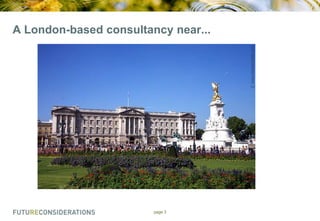
A London-based consultancy near...

page 3
No, actually near...

page 4
But we work for…

page 5
Our starting place on leadership
•

View of the person
• Emotions, cognition, spirituality, body – „individualistic‟ view
• Systemic, cultural, anthropological – „collectivist‟ view
• Dynamic – neuroscience has established much greater neuroplasticity
• But, how can plasticity be directed?
• Our view – the self is generated through language and bodily practices

• View on learning
• Leadership development and personal development are inseparable
• Choice follows awareness
• Habituation and de-habituation requires repetition
• Practice making better choices
• Takes a long time – „longitudinal‟ programs
• Context is everything – personal, organisational, and team
• View on development
• Link it to strategy through program goal setting and project-based learning
page 6
The body and leadership
• Dimensions
• Sensitivity to the bodily sensations... The root of emotional awareness and
intelligence
• Ability, through attention and direction, to „centre‟
• Attention to deportment... Posture, alignment, movement
• NOT „body language‟, but rather fundamental shifts (e.g. yoga, weights,
Alexander)
• Moving with others, blending, „striking‟, facing, extending
• Attention to „vitality‟ – a self with sufficient energy to live on purpose

• www.paulgibbons.net/publications/businessleadership

page 7
The body and leadership – an exploration

page 8
Spirituality and business
Pluralistic interpretation of spirituality
Constitutive of human beings
- search for meaning, purpose and connectedness
- rituals focus attention on the sacred and bind the community (religion = religere „re-tie‟)
- associated with some „universal‟ values: compassion, kindness, benevolence
- Greek philosophy: Stoicism, Scepticism, Virtue ethics
- Humanism: the divine and sacred is possible right here and now
- World religions: parables, stories, myths (carefully chosen) that illustrate useful moral
precepts
- Reflective and contemplative practices
- Views on personal development (eight-fold path, spiritual exercises)

www.paulgibbons.net/publications/spiritualityandbusiness

page 9
Applying spirituality in business
Research findings (Gibbons, 2000)
- Religious beliefs not related to important outcomes – well-being and morality – in any significant
way
- Certain spiritual orientations – gratitude, acceptance, mindfulness, forgiveness – we‟d intuit are
related to well-being, but then... What does well-being have to do with leadership?
- Some spiritual practices (meditation) have demonstrable empirical benefit (task achievement,
physiological benefits, greater well-being) – which seems to make no difference at all to
uptake!!!
- Spiritual worldviews are there all the time – ignoring them misses a dimension relevant for human
collaboration and flourishing
In European organisations
- Using the s-word with business people provides an unnecessary distraction: sceptics will bristle,
and believers may object to specifics or a pluralist/ secular stance
- Most senior executives (in our programs) find engaging with questions of meaning and purpose
refreshing – providing them with a new context for their work
- A much smaller percentage accept our encouragement to develop a spiritual practice: meditation
or journaling

page 10
Spirituality and leadership
•
•

•
•
•
•

•
•

Group 1
Imagine yourself looking back in time at your own ancestors. You can easily see your parents,
and most likely your grandparents. If you don't know your parents or grandparents, use your
imagination. Use this moment to feel your connection to your own history. Look back farther
than that and imagine that you can look back through the generations. Think of the sacrifices
each generation made that enabled the next one to step up and take its place. Think of the
stands your ancestors were for the future that live in this moment as you. What do you see that
they stood for that you have inherited?
If they could speak to you, what would they say to you about the way you have lived your life?
Would they be proud of what you have made of your opportunity?
Group 2
Imagine you are attending your own funeral. Picture the scene in your mind. One by one,
people who care about you mention your virtues and contributions. What are they saying?
What would you like them to say that they might not?
Group 3
What people, events, and historical trends have been instrumental in shaping who you are? Be
specific here and articulate names and occurrences as well as how and why they have shaped
you.

page 11
The language of leadership
•

The sources
• Kant – Truly free when we act not from contingency (circumstance), but in
accordance with our word
• Searle/ Austin – „Speech Acts‟, “How to do things with words”
• We are either describing, declaring, requesting, promising, offering
• Speech acts create reality – e.g. „will you marry me‟...
• Sartre – Selves as „storytellers‟... There is no meaning apart from that which we
generate...
• Generative power of language:
• “we don‟t see with our eyes, we see with our distinctions”
• “we don‟t see things as they are, we see them as we are”
Most of our thinking is done through the vehicle of language. Shifting language
is an extremely powerful tool for shifting thinking.
page 12
Implications and applications of linguistic ontology
•

Organisations are ‘networks of conversations’
•

•

The limits in the conversation space limit what is possible in the empirical space

Changing the conversation...
•
•

•

Distinguishing stories as stories and re-telling them
Makes available new ways of being, new possibilities, new leadership moves

New distinctions: (‘Trust’, ‘mood’, ‘breakdown’)
•

You can only shift what you can observe
• A car engine – „pipes‟, „tubes‟, „metal‟
• Cf. carburettor, fuel pump, ignition system
• Or, balance sheet, net current assets, gross margin
• Or, „trust‟, „vision‟, „strategy‟

• Certain ‘acts of speech missing’: decline, promise, request, offer
•

Structure of language that leads to powerful co-ordination of action

• Certain ‘acts of speech’ performed incongruously with Self (body)
•

Promise – made in a body that does not produce trust...

page 13
Case Studies: KPMG and HSBC
KPMG
•
•
•
•

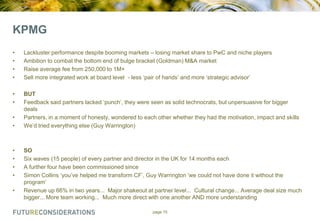
Lackluster performance despite booming markets – losing market share to PwC and niche players
Ambition to combat the bottom end of bulge bracket (Goldman) M&A market
Raise average fee from 250,000 to 1M+
Sell more integrated work at board level - less „pair of hands‟ and more „strategic advisor‟

•
•

BUT
Feedback said partners lacked „punch‟, they were seen as solid technocrats, but unpersuasive for bigger
deals
Partners, in a moment of honesty, wondered to each other whether they had the motivation, impact and skills
We‟d tried everything else (Guy Warrington)

•
•

•
•
•
•

•

SO
Six waves (15 people) of every partner and director in the UK for 14 months each
A further four have been commissioned since
Simon Collins „you‟ve helped me transform CF‟, Guy Warrington „we could not have done it without the
program‟
Revenue up 66% in two years... Major shakeout at partner level... Cultural change... Average deal size much
bigger... More team working... Much more direct with one another AND more understanding
page 15
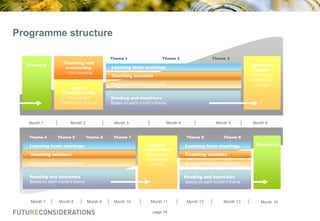
Programme structure
Pre-work

Coaching and
contracting
1-hour meeting
Impact
Fundamentals
Pitching and
relationships (3 days)

Month 1
Theme 4

Month 2
Theme 5

Theme 1

Mastering
Impact
Pitching and
relationships
(2 days)

Coaching sessions
Optional Coaching sessions
Reading and exercises
Based on each month‟s theme

Month 4

Theme 7

Coaching sessions
Optional Coaching sessions
Reading and exercises
Based on each month‟s theme

Month 8

Month 5
Theme 8

Impact
Excellence
Pitching and
relationships
(2 days)

Learning team meetings

Month 7

Theme 3

Learning team meetings

Month 3
Theme 6

Theme 2

Month 6

Theme 9

Learning team meetings

Post-work

Coaching sessions
Optional Coaching sessions
Reading and exercises
Based on each month‟s theme

Month 9

Month 10

Month 11
page 16

Month 12

Month 13

Month 14
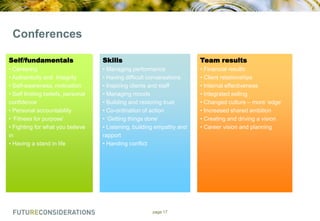
Conferences
Self/fundamentals

Skills

Team results

• Centering
• Authenticity and Integrity
• Self-awareness, motivation
• Self limiting beliefs, personal
confidence
• Personal accountability
• „Fitness for purpose‟
• Fighting for what you believe
in
• Having a stand in life

• Managing performance
• Having difficult conversations
• Inspiring clients and staff
• Managing moods
• Building and restoring trust
• Co-ordination of action
• „Getting things done‟
• Listening, building empathy and
rapport
• Handing conflict

• Financial results
• Client relationships
• Internal effectiveness
• Integrated selling
• Changed culture – more „edge‟
• Increased shared ambition
• Creating and driving a vision
• Career vision and planning

page 17
What participants have said:
“In many ways, we achieved more strategic alignment in three days than we have in three years”
(Guy Warrington)
“We made the best decision in 40 minutes; in the past these meetings have often taken 3 hours”
(Stephen Barrett)
“I can tell looking around the corridors who has been on Impact to Win and who hasn‟t – they look
more purposeful and powerful.” (CF business head)
“You‟ve helped me transform my business” (Simon Collins)
“We wouldn‟t have gone for this or won it if not for Impact to Win” (10m win, KPMG Tokyo)
“I wouldn‟t have made it through the partner process if it hadn‟t been for the programme” (New
partner)
“We won the £1M pitch by a wafer thin margin – and the Impact coaching was decisive.” (KPMG CF
Financing Team)

page 18
HSBC - Next Generation
• Marries leadership, corporate sustainability and cultural
diversity
• Structure:
• 6 months / 3 phases/ field challenge and business project
• 80 participants, 6 business sponsors,
• 6 teams of 12 people each

• The essential conditions for deep learning:
•
•
•
•
•
•
•

Out of comfort zone learning environment (off the grid in India and Brazil)
Experience of a new country/culture
Working in multicultural teams
Solving real problems
Tight time frames
Working at the interface of public/private sector
Leading edge technology and practical business skills
• U-process, assessments, milestone planning, stakeholder analysis and
engagement
page 19
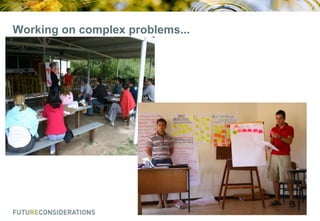
Working on complex problems...

page 20
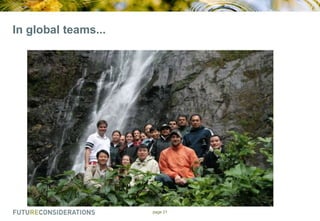
In global teams...

page 21
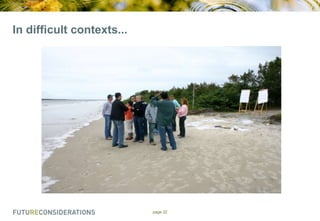
In difficult contexts...

page 22
Our company
• Three products:
• Carbon Considerations – creating cultures and behaviours in
businesses that reduce emissions and save energy
• Leadership Development
• Strategic Alignment
• „Changing the world through changing business‟
• „Making the best better still‟
• HSBC, Coke, IBM, Tesco, Barclays, KPMG, PwC, Shell
• Offices in London and Madison (2008)
• Netherlands and South Africa?
• www.futureconsiderations.com (company)
• www.paulgibbons.net (writing and rants)

page 23

Language, Spirituality, the Body and Leadership

  • 1.
    Language, spirituality andthe body in Senior Executive Development Paul Gibbons: Chairman, Future Considerations phone +44 207498 3459 page 1
  • 2.
    Agenda • Intro • Principlesand Practice • Body • Spirituality • Language • Case Studies • KPMG • HSBC page 2
  • 3.
  • 4.
  • 5.
    But we workfor… page 5
  • 6.
    Our starting placeon leadership • View of the person • Emotions, cognition, spirituality, body – „individualistic‟ view • Systemic, cultural, anthropological – „collectivist‟ view • Dynamic – neuroscience has established much greater neuroplasticity • But, how can plasticity be directed? • Our view – the self is generated through language and bodily practices • View on learning • Leadership development and personal development are inseparable • Choice follows awareness • Habituation and de-habituation requires repetition • Practice making better choices • Takes a long time – „longitudinal‟ programs • Context is everything – personal, organisational, and team • View on development • Link it to strategy through program goal setting and project-based learning page 6
  • 7.
    The body andleadership • Dimensions • Sensitivity to the bodily sensations... The root of emotional awareness and intelligence • Ability, through attention and direction, to „centre‟ • Attention to deportment... Posture, alignment, movement • NOT „body language‟, but rather fundamental shifts (e.g. yoga, weights, Alexander) • Moving with others, blending, „striking‟, facing, extending • Attention to „vitality‟ – a self with sufficient energy to live on purpose • www.paulgibbons.net/publications/businessleadership page 7
  • 8.
    The body andleadership – an exploration page 8
  • 9.
    Spirituality and business Pluralisticinterpretation of spirituality Constitutive of human beings - search for meaning, purpose and connectedness - rituals focus attention on the sacred and bind the community (religion = religere „re-tie‟) - associated with some „universal‟ values: compassion, kindness, benevolence - Greek philosophy: Stoicism, Scepticism, Virtue ethics - Humanism: the divine and sacred is possible right here and now - World religions: parables, stories, myths (carefully chosen) that illustrate useful moral precepts - Reflective and contemplative practices - Views on personal development (eight-fold path, spiritual exercises) www.paulgibbons.net/publications/spiritualityandbusiness page 9
  • 10.
    Applying spirituality inbusiness Research findings (Gibbons, 2000) - Religious beliefs not related to important outcomes – well-being and morality – in any significant way - Certain spiritual orientations – gratitude, acceptance, mindfulness, forgiveness – we‟d intuit are related to well-being, but then... What does well-being have to do with leadership? - Some spiritual practices (meditation) have demonstrable empirical benefit (task achievement, physiological benefits, greater well-being) – which seems to make no difference at all to uptake!!! - Spiritual worldviews are there all the time – ignoring them misses a dimension relevant for human collaboration and flourishing In European organisations - Using the s-word with business people provides an unnecessary distraction: sceptics will bristle, and believers may object to specifics or a pluralist/ secular stance - Most senior executives (in our programs) find engaging with questions of meaning and purpose refreshing – providing them with a new context for their work - A much smaller percentage accept our encouragement to develop a spiritual practice: meditation or journaling page 10
  • 11.
    Spirituality and leadership • • • • • • • • Group1 Imagine yourself looking back in time at your own ancestors. You can easily see your parents, and most likely your grandparents. If you don't know your parents or grandparents, use your imagination. Use this moment to feel your connection to your own history. Look back farther than that and imagine that you can look back through the generations. Think of the sacrifices each generation made that enabled the next one to step up and take its place. Think of the stands your ancestors were for the future that live in this moment as you. What do you see that they stood for that you have inherited? If they could speak to you, what would they say to you about the way you have lived your life? Would they be proud of what you have made of your opportunity? Group 2 Imagine you are attending your own funeral. Picture the scene in your mind. One by one, people who care about you mention your virtues and contributions. What are they saying? What would you like them to say that they might not? Group 3 What people, events, and historical trends have been instrumental in shaping who you are? Be specific here and articulate names and occurrences as well as how and why they have shaped you. page 11
  • 12.
    The language ofleadership • The sources • Kant – Truly free when we act not from contingency (circumstance), but in accordance with our word • Searle/ Austin – „Speech Acts‟, “How to do things with words” • We are either describing, declaring, requesting, promising, offering • Speech acts create reality – e.g. „will you marry me‟... • Sartre – Selves as „storytellers‟... There is no meaning apart from that which we generate... • Generative power of language: • “we don‟t see with our eyes, we see with our distinctions” • “we don‟t see things as they are, we see them as we are” Most of our thinking is done through the vehicle of language. Shifting language is an extremely powerful tool for shifting thinking. page 12
  • 13.
    Implications and applicationsof linguistic ontology • Organisations are ‘networks of conversations’ • • The limits in the conversation space limit what is possible in the empirical space Changing the conversation... • • • Distinguishing stories as stories and re-telling them Makes available new ways of being, new possibilities, new leadership moves New distinctions: (‘Trust’, ‘mood’, ‘breakdown’) • You can only shift what you can observe • A car engine – „pipes‟, „tubes‟, „metal‟ • Cf. carburettor, fuel pump, ignition system • Or, balance sheet, net current assets, gross margin • Or, „trust‟, „vision‟, „strategy‟ • Certain ‘acts of speech missing’: decline, promise, request, offer • Structure of language that leads to powerful co-ordination of action • Certain ‘acts of speech’ performed incongruously with Self (body) • Promise – made in a body that does not produce trust... page 13
  • 14.
  • 15.
    KPMG • • • • Lackluster performance despitebooming markets – losing market share to PwC and niche players Ambition to combat the bottom end of bulge bracket (Goldman) M&A market Raise average fee from 250,000 to 1M+ Sell more integrated work at board level - less „pair of hands‟ and more „strategic advisor‟ • • BUT Feedback said partners lacked „punch‟, they were seen as solid technocrats, but unpersuasive for bigger deals Partners, in a moment of honesty, wondered to each other whether they had the motivation, impact and skills We‟d tried everything else (Guy Warrington) • • • • • • • SO Six waves (15 people) of every partner and director in the UK for 14 months each A further four have been commissioned since Simon Collins „you‟ve helped me transform CF‟, Guy Warrington „we could not have done it without the program‟ Revenue up 66% in two years... Major shakeout at partner level... Cultural change... Average deal size much bigger... More team working... Much more direct with one another AND more understanding page 15
  • 16.
    Programme structure Pre-work Coaching and contracting 1-hourmeeting Impact Fundamentals Pitching and relationships (3 days) Month 1 Theme 4 Month 2 Theme 5 Theme 1 Mastering Impact Pitching and relationships (2 days) Coaching sessions Optional Coaching sessions Reading and exercises Based on each month‟s theme Month 4 Theme 7 Coaching sessions Optional Coaching sessions Reading and exercises Based on each month‟s theme Month 8 Month 5 Theme 8 Impact Excellence Pitching and relationships (2 days) Learning team meetings Month 7 Theme 3 Learning team meetings Month 3 Theme 6 Theme 2 Month 6 Theme 9 Learning team meetings Post-work Coaching sessions Optional Coaching sessions Reading and exercises Based on each month‟s theme Month 9 Month 10 Month 11 page 16 Month 12 Month 13 Month 14
  • 17.
    Conferences Self/fundamentals Skills Team results • Centering •Authenticity and Integrity • Self-awareness, motivation • Self limiting beliefs, personal confidence • Personal accountability • „Fitness for purpose‟ • Fighting for what you believe in • Having a stand in life • Managing performance • Having difficult conversations • Inspiring clients and staff • Managing moods • Building and restoring trust • Co-ordination of action • „Getting things done‟ • Listening, building empathy and rapport • Handing conflict • Financial results • Client relationships • Internal effectiveness • Integrated selling • Changed culture – more „edge‟ • Increased shared ambition • Creating and driving a vision • Career vision and planning page 17
  • 18.
    What participants havesaid: “In many ways, we achieved more strategic alignment in three days than we have in three years” (Guy Warrington) “We made the best decision in 40 minutes; in the past these meetings have often taken 3 hours” (Stephen Barrett) “I can tell looking around the corridors who has been on Impact to Win and who hasn‟t – they look more purposeful and powerful.” (CF business head) “You‟ve helped me transform my business” (Simon Collins) “We wouldn‟t have gone for this or won it if not for Impact to Win” (10m win, KPMG Tokyo) “I wouldn‟t have made it through the partner process if it hadn‟t been for the programme” (New partner) “We won the £1M pitch by a wafer thin margin – and the Impact coaching was decisive.” (KPMG CF Financing Team) page 18
  • 19.
    HSBC - NextGeneration • Marries leadership, corporate sustainability and cultural diversity • Structure: • 6 months / 3 phases/ field challenge and business project • 80 participants, 6 business sponsors, • 6 teams of 12 people each • The essential conditions for deep learning: • • • • • • • Out of comfort zone learning environment (off the grid in India and Brazil) Experience of a new country/culture Working in multicultural teams Solving real problems Tight time frames Working at the interface of public/private sector Leading edge technology and practical business skills • U-process, assessments, milestone planning, stakeholder analysis and engagement page 19
  • 20.
    Working on complexproblems... page 20
  • 21.
  • 22.
  • 23.
    Our company • Threeproducts: • Carbon Considerations – creating cultures and behaviours in businesses that reduce emissions and save energy • Leadership Development • Strategic Alignment • „Changing the world through changing business‟ • „Making the best better still‟ • HSBC, Coke, IBM, Tesco, Barclays, KPMG, PwC, Shell • Offices in London and Madison (2008) • Netherlands and South Africa? • www.futureconsiderations.com (company) • www.paulgibbons.net (writing and rants) page 23