“I love you, I hate you”: Transference and
Counter-transference Issues in Supervision

              Presented by
Alexandra Katehakis, MFT, CSAT-S, CST-S
           February 17, 2011

              www.thecenterforhealthysex.com
What is supervision?

              “Clinical supervision is a
                  disciplined, tutorial
              process wherein principles
                 are transformed into
               practical skills, with four
                    overlapping foci:
              administrative, evaluative,
               clinical and supportive.”

                        David J. Powell, 2004


      www.thecenterforhealthysex.com
Know your Candidate(s)

   “A productive Supervisor/Candidate
working relationship is grounded in a clear
understanding of the goals of supervision
 and clearly worked out supervision plan.
  Such a plan presupposes an accurate
assessment of the Candidate’s knowledge
   and skills – the level of professional
development the Candidate has attained.”

“Clinical Supervision in Alcohol & Drug Abuse Counseling,”
                       David J. Powell

                 www.thecenterforhealthysex.com
Know your Candidate(s)

Know your ethics & get consultation!

Make sure you are clear about the law
and ethics binding you and that the
candidate is adhering to the law and
ethics of the board that governs their
license in the state they are in.

Seek your own consultation!


             www.thecenterforhealthysex.com
Supervision involves…


• Four realms of inquiry:

•   Affective/Emotional/bodily
•   Cognitive/Behavioral
•   Insight
•   Systemic


                   www.TheCenterForHealthySex.com
Supervision involves…


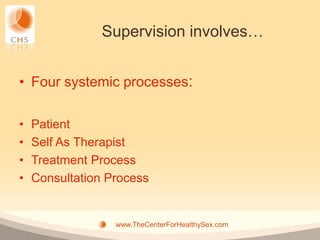
• Four systemic processes:

•   Patient
•   Self As Therapist
•   Treatment Process
•   Consultation Process


                  www.TheCenterForHealthySex.com
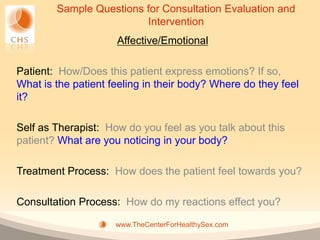
Sample Questions for Consultation Evaluation and
                         Intervention
                     Affective/Emotional

Patient: How/Does this patient express emotions? If so,
What is the patient feeling in their body? Where do they feel
it?

Self as Therapist: How do you feel as you talk about this
patient? What are you noticing in your body?

Treatment Process: How does the patient feel towards you?

Consultation Process: How do my reactions effect you?

                     www.TheCenterForHealthySex.com
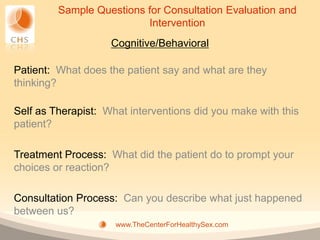
Sample Questions for Consultation Evaluation and
                          Intervention
                    Cognitive/Behavioral

Patient: What does the patient say and what are they
thinking?

Self as Therapist: What interventions did you make with this
patient?

Treatment Process: What did the patient do to prompt your
choices or reaction?

Consultation Process: Can you describe what just happened
between us?
                     www.TheCenterForHealthySex.com
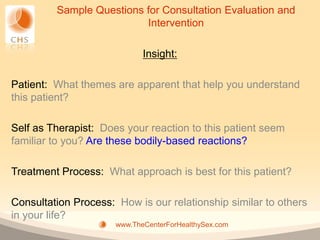
Sample Questions for Consultation Evaluation and
                          Intervention

                             Insight:

Patient: What themes are apparent that help you understand
this patient?

Self as Therapist: Does your reaction to this patient seem
familiar to you? Are these bodily-based reactions?

Treatment Process: What approach is best for this patient?

Consultation Process: How is our relationship similar to others
in your life?
                      www.TheCenterForHealthySex.com
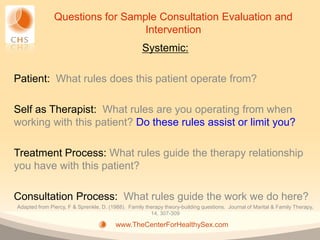
Questions for Sample Consultation Evaluation and
                                 Intervention
                                                    Systemic:

Patient: What rules does this patient operate from?

Self as Therapist: What rules are you operating from when
working with this patient? Do these rules assist or limit you?

Treatment Process: What rules guide the therapy relationship
you have with this patient?

Consultation Process: What rules guide the work we do here?
Adapted from Piercy, F & Sprenkle, D. (1988). Family therapy theory-building questions. Journal of Marital & Family Therapy,
                                                       14, 307-309

                                         www.TheCenterForHealthySex.com
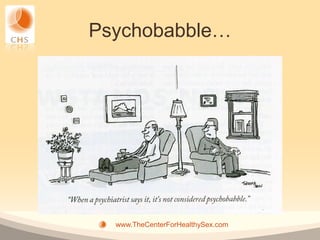
Psychobabble…


  www.TheCenterForHealthySex.com
Counter-transference
          • Freud 1910 – perceived
            it as emanating from
            therapist’s unresolved
            unconscious issues and
            conflicts deeming it
            potentially harmful to
            the therapeutic process.
            (Vulcan, 2009)


       www.thecenterforhealthysex.com
Counter-transference
• Complex and mostly unconscious, making
  it difficult to measure and
  operationalize(Fauth, 2006)

• CT is often thought of as thoughts,
  feelings, images, fantasies, and dreams.
  (Stone 2006)


               www.TheCenterForHealthySex.com
The Moderate Approach to CT
• Five domains can offer a framework for to
  review work with clients to “looking for
  evidence of counter-
  transference…supervisors and counselor
  educators may find the model similarly
  helpful in teaching trainees how to identify
  counter-transference and use the self as a
  therapeutic instrument. Hayes, et al (1998)

               www.TheCenterForHealthySex.com
Moderate Approach for Managing CT
           Hayes, et al., 1998
• Origins: areas of unsolved conflict within
  the therapist
• Triggers: are the tangible counseling
  experiences that touch upon or elicit
  therapists’ unresolved issues.
• Manifestations: When CT origins are
  triggered, therapists experience cognitive,
  affective, and behavioral reactions.

               www.TheCenterForHealthySex.com
The Moderate Approach for Managing CT

• CT effects are the subsequent results of
  CT manifestations on the therapy process
  and outcome.
• CT Management refers to therapists’
  strategies for coping with their CT

• Rosenberger & Hayes, 2002


              www.TheCenterForHealthySex.com
Counter-transference Issues in Sex Addiction
                     Consultation

                          Minimization:

 Upon initial assessment, sex addicts often minimize their thoughts
and behaviors.

 Watch for supervisees believing and/or siding with the minimization
and challenge this as you would the patient. This can have the
supervisee missing crucial acting out behaviors leaving them with a
weak treatment plan.

 It can also have them doubting whether the patient is really a sex
addict.


                        www.TheCenterForHealthySex.com
Counter-transference Issues in Sex Addiction
                           Consultation

                                      Disgust:

 Disgust can arise when assessing pedophiles or any other paraphelia that is
disturbing or uncomfortable for the therapist to talk about.

 Supervisees can report feeling “creeped out,” uncomfortable or judgmental. It is
recommended that these feelings be processed in detail so that an assessment can be
made as to whether the therapist should continue to treat the patient.

 If the therapist cannot work through their upset, they should be advised to take their
deeper issues to their own personal therapy.

 A sex addiction therapist should be ABLE to work with paraphelias, but has the right
to CHOOSE not to.


                               www.TheCenterForHealthySex.com
Counter-transference Issues in Sex Addiction
                         Consultation


  Anger: “I don’t like him” and/or “I want to kill him!”

 Passive/aggressive and narcissistic personalities are often difficult to like.

 The supervisee has to be vigilant about their counter-transference.

 Unchecked anger can lead to punitive interventions which can have the
effect of shaming the patient. The therapist needs to talk openly about the
triggers that block them from being empathic.

 Supervisees should have a good understanding of narcissistic defenses and
examine why they are recoiling or judging in the face of these defenses.

                             www.TheCenterForHealthySex.com
Counter-transference Issues in Sex Addiction
                           Consultation


                   Argumentative/power struggle:

 This is a no win situation. Trying to convince, cajole, demand, etc. recovery
leads to power struggles. If a patient is terribly resistant, doesn’t comply with
treatment recommendations, or is a “general pain,” the therapist should step
back and reevaluate why the patient is in recovery.

 The therapist also needs to look at whether their treatment agenda is ahead of
the patient’s or if they have fallen out of therapeutic alliance with the patient.

If the situation becomes intractable, both parties should seriously consider if
treatment is right at this time. Should the therapist decide to end treatment, they
should review their thoughts and reflections on the case with the supervisor first.


                              www.TheCenterForHealthySex.com
Counter-transference Issues in Sex Addiction
                                 Consultation


            Patient admits to sexualizing the therapist:

 It is not uncommon for sex addicts to sexualize their therapist. It usually comes out
at some point in treatment either directly or indirectly. If it is not stated directly, but
the supervisee has an inkling that it is occurring, they should talk about it with their
consultant.

 If it happens in early recovery, it is usually coming from an addictive/manipulative
place in the addict. When the addict makes this known early on in treatment, it can
be an inappropriate way to try and connect or a way to devalue the therapist due to
discomfort or anxiety.

 Therapists should be advised to “file” the information for processing when they feel
the patient has made significant progress in their recovery.

                               www.TheCenterForHealthySex.com
Counter-transference Issues in Sex Addiction
                             Consultation


                Therapist is seduced by patient:

 The patient can have the therapist feeling he is “such a nice guy,” “my
favorite patient” or “really trying hard.” If this happens early on the
treatment, it is imperative to remember that our patients have “dark sides.”
They are expert at looking good, rationalizing, minimizing, and justifying their
behaviors.

If that same supervisee reports task work isn’t being completed, denial
hasn’t been broken through (I.e. patient hasn’t owned up to the damage he
has wrought), or the patient seems to be going through the motions, then
they have to be confronted. This type of confrontation can bring up many
issues for the therapist which may be why the seduction was happening to
begin with.


                          www.TheCenterForHealthySex.com
Counter-transference Issues in Sex Addiction
                             Consultation

                          Idealization as seduction:

 If the therapist starts feeling or believing that “they’re the best therapist ever” they
should be aware of idealization by the patient and talk about it.

 This is especially true if the patient has had many therapists or has been through a
lot of treatment centers.

 If the supervisee feels special or like they are the only therapist who will be able to
help this patient, they’re in a trap. Believing this will have the therapist losing traction
in the treatment process and give the addict ground for running treatment.

 When this happens, the patient starts to decide whether and how many meetings to
attend, what homework they will and won’t do, etc.


                                www.TheCenterForHealthySex.com
Counter-transference Issues in Sex Addiction
                            Consultation

              Therapist is sexually attracted to patient:

 If the therapist finds their patient attractive they can find themselves struggling to
stay on task, and/or it can have them engaging in covert seduction with the patient.

The therapist finds themselves feeling sleepy during sessions

 If they are not aware that they find the patient attractive, but find themselves doing
things they wouldn’t normally do, then this too has to be examined.

 Being attracted to the patient can have the therapist not holding boundaries with
homework assignments or having blind spots in their recovery.

 Either of these are ultimately harmful to the therapy and both parties. It is essential
to talk about these attractions and if necessary, should be taken to personal therapy.
                               www.TheCenterForHealthySex.com
Sexualization by Therapist
• Sexualization may defend against feelings
  of love which may be more difficult for
  therapists to acknowledge. (Gabbard,
  1994)
• Oedipal desire is romantic and idealised,
  whereas post-Oedipal desire tolerates
  imperfections, and can experiece
  disappointment without the death of desire.
  (Gerrad, 2004)
               www.TheCenterForHealthySex.com
Deepening intimacy…
• Is crucial for successful work and occurs
  as a result of the interpersonal space
  between therapist and patient
• Termination requires a letting go of the
  patient and a kind of mourning so that the
  patient can go have his own healthy, adult
  sexual life. (Searles, 1959)


               www.TheCenterForHealthySex.com
Erotic Counter-transference most likely to
              occur with patients who:
• Have passive-obsessional and narcissistic
  character disorders
• Suffer from borderline and chronically psychotic
  conditions
• Those whose general character defenses and
  areas of specific conflict are similar to the
  therapist. The entangled transference-
  countertransference relationsip leads to the
  therapist withdrawing into sleepiness (Stone,
  2006)            www.TheCenterForHealthySex.com
www.TheCenterForHealthySex.com
Counter-transference Issues in Sex Addiction
                           Consultation


                          Intellectual seduction:

 Since many of the addicts we see are extremely intelligent, accomplished
professionals, therapists can be seduced into thinking that the person has really
“gotten it” and that they are on track quickly. CEO’s, doctors, lawyers, and so forth
are excellent at going to the top of the class.

 Intellect is no measure of sexual sobriety. The supervisee should be reminded to
look closely at the behavior and thinking of the patient first and foremost.
Supervisees can be triggered into their own issues of feeling less than when in the
presence of highly successful and/or powerful people.

The supervisee should know their triggers around intelligence, success and
money.
                               www.TheCenterForHealthySex.com
Counter-transference Issues in Sex Addiction
                    Consultation


                       Humor as seduction:

 We all know humor can be a defense against deeper, more painful
feelings.

 If a supervisee reports having a jolly good time with their patient and talks
about what a “funny guy” he is, pay attention to how the humor is being
used to keep the treatment off track.

This kind of humor can be a relief to the therapist if they are feeling
anxiety about the work.


                        www.TheCenterForHealthySex.com
Flirting…
• Flirting need not be seen as a purely
  seductive act.
• If it occurs in the symbolic, meaning
  change has actually occurred, it can be a
  type of play and an acknowledgement of
  attraction under safe conditions. (Davies
  1998, Gerrard, 2004)


               www.TheCenterForHealthySex.com
Counter-transference Issues in Sex Addiction
                             Consultation

                   Rescuing or caretaking to the patient:

 Therapists by nature are care-givers, but if they are inclined to care-take and have these issues
in their backgrounds, they can easily fall prey to this dynamic.

 Rescuing/caretaking can occur when someone is mandated to treatment and the therapist
wants to advocate for the patient, or while the patient is preparing for disclosure.

 Although it is, in part, the therapist’s job to advocate, be on the lookout for personal
involvement in the outcome like wanting to “soften the blow” for the patient.

 If the supervisee seems heavily invested in rescuing the addict from his consequences, and
doesn’t see the consequences as a part of the addict’s unmanageability, this can be problematic.

 Facing consequences are an essential part of the recovery process and it is not the therapist’s
job to thwart those, but to assist the recovering person in their grieving process.

                                   www.TheCenterForHealthySex.com
Counter-transference Issues in Sex Addiction
                            Consultation


                                 Siding with the patient:

 This is similar to the above but is more blatant and often occurs in relation to the patient’s
spouse.

 Addict’s can villanize their partners and play the victim. If the supervisor hears the
supervisee siding with the addict by validating all the hard work he is doing in recovery and
agreeing that his spouse must be “crazy,” “not working a program,” and “unfair,” then this is
a red flag.

 It is crucial that the therapist be aware of partner issues and the natural evolution of
recovery for a couple.

 Rather then taking sides with the addict, the therapist should confront the addict about his
unmanageability and what his part has been in his partner’s upset.


                                  www.TheCenterForHealthySex.com
Counter-transference Issues in Sex Addiction
                          Consultation


                                Impatience:

 Therapists can get frustrated when their patient’s don’t move as quickly in
their recovery as they would like them to.

 Remembering to slow down and pace appropriately is a clinical skill. Each
person has different cognitive and emotional skills and many sex addicts have a
low emotional IQ.

 Knowing when to put pressure on the patient to take responsibility for task
work and feel their feelings, while at the same time having empathy for them is
required to effectively execute treatment.


                            www.TheCenterForHealthySex.com
Counter-transference Issues in Sex Addiction
                           Consultation


                             Flight into health:

 Be wary of the “model prisoner.” This is a more advanced version of looking
good. This is what they call a “Big Book Thumper” in AA. If the patient has
become religious about 12-step and their recovery, it becomes more challenging to
confront their denial and point out how they are using the program to hide out.

 Conversely, the patient can be very compliant leaving the therapist feeling like
their patient is a “piece of cake” and that the treatment is “smooth sailing.”

 Challenge the supervisee to see the fear and seduction in this and how it does
not serve the patient to collude with how well they’re doing. Look for the
inconsistencies and holes in the person’s recovery. Challenge the flight into
health.

                             www.TheCenterForHealthySex.com
Somatic Counter-transference
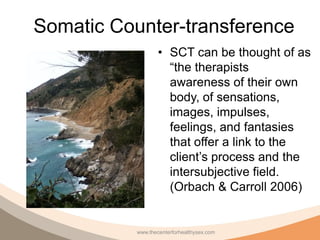
                   • SCT can be thought of as
                     “the therapists
                     awareness of their own
                     body, of sensations,
                     images, impulses,
                     feelings, and fantasies
                     that offer a link to the
                     client’s process and the
                     intersubjective field.
                     (Orbach & Carroll 2006)


           www.thecenterforhealthysex.com
Somatic Counter-transference
• “the non-verbal behavior of both patient
  and analyst is an aspect of the analytic
  situation that receives comparatively little
  attention either in supervision or in the
  teachings of technique…it is uncommon
  for supervisors to regularly inquire about,
  or for students to regularly report on, the
  nonverbal behavior of their patients.”
  (Jacobs, 1994)
                www.TheCenterForHealthySex.com
Somatic Counter-transference
• Bodily-based, embodied knowing,
  embodied cognition
• SCT commonly includes sleepiness, erotic
  and sexual arousal, trembling (Field, 1998)
  as well as aches, pains, rumblings,
  coughing, nausea, and suffocation (Stone,
  2006), tension, emptiness, and numbness.
• Non-verbal, primary process

               www.TheCenterForHealthySex.com
Somatic Counter-transference
• The therapist has to be aware of their own
  bodily-based reactions or be “rooted in a
  continuous awareness of their own
  somatic reality in the first place.” (Soth,
  2002)
• The “therapist body experience [may
  provide] invaluable information relating to
  the intersubjective space between
  therapist and client.” (Shaw, 2004)
               www.TheCenterForHealthySex.com
Therapeutic Enactment
• Sometimes the therapists past gets recreated in
  symmetry with the patient
• It can also happen as a result of counter-
  transference dominance, disrupting the
  treatment, and potentially traumatizing the
  patient
• Enactment is an “inevitable mutual event”
• Mutual unplanned behavior, a sense of
  puzzlement, and a sense of being emotionally
  out of control by both parties.
                                    Maroda, 1998
                 www.TheCenterForHealthySex.com
Therapeutic Enactment
               • Most definitions
                 agree that there are
                 two essential
                 elements: the
                 stimulation of strong,
                 unconscious affect
                 and some resulting
                 behaviors. Maroda
                   1998

        www.thecenterforhealthysex.com
Therapeutic Enactment…
• …differs from strong transference,
  counter-transference because it is
  “unconsciously motivated by the mutual
  stimulation of strong affect, with both
  persons usually stating that they felt out of
  control, or at least felt something come
  over them that was mysterious and
  powerful.” Maroda 1998

                www.TheCenterForHealthySex.com
Neuropsychoanalytic model of patient-therapist
                  enactments

• “Heightened affective moments in which
  overwhelming and thereby dissociated
  trauma is experienced by both members of
  the therapeutic dyad.
• This highlights not only the resistances
  and defenses of the patient, but how these
  align with the resistances and defenses of
  the therapist.” Schore, 2011

                www.TheCenterForHealthySex.com
Therapeutic Enactment…
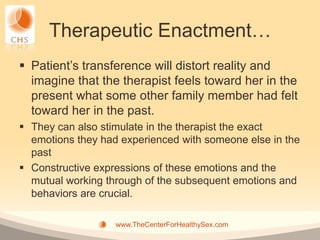
 Patient’s transference will distort reality and
  imagine that the therapist feels toward her in the
  present what some other family member had felt
  toward her in the past.
 They can also stimulate in the therapist the exact
  emotions they had experienced with someone else in the
  past
 Constructive expressions of these emotions and the
  mutual working through of the subsequent emotions and
  behaviors are crucial.

                   www.TheCenterForHealthySex.com
Feelings not within our control…
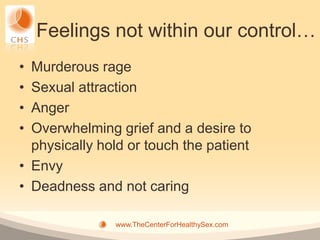
• Murderous rage
• Sexual attraction
• Anger
• Overwhelming grief and a desire to
  physically hold or touch the patient
• Envy
• Deadness and not caring

               www.TheCenterForHealthySex.com
Therapeutic Enactment
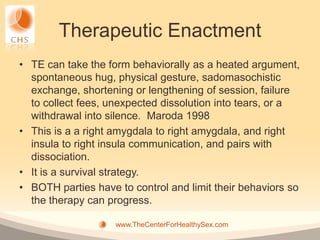
• TE can take the form behaviorally as a heated argument,
  spontaneous hug, physical gesture, sadomasochistic
  exchange, shortening or lengthening of session, failure
  to collect fees, unexpected dissolution into tears, or a
  withdrawal into silence. Maroda 1998
• This is a a right amygdala to right amygdala, and right
  insula to right insula communication, and pairs with
  dissociation.
• It is a survival strategy.
• BOTH parties have to control and limit their behaviors so
  the therapy can progress.

                    www.TheCenterForHealthySex.com
Therapeutic Enactment
• The drama of the enactment ultimately belongs to the
  patient. It is his/her chance to relive the past from an
  affective standpoint, with a new opportunity for
  awareness and integration.
• When the patient stimulates something real and primitive
  in the therapist that is split off, then they can relieve the
  drama in a real way together.

• Maroda, 1998


                     www.TheCenterForHealthySex.com
Transparency
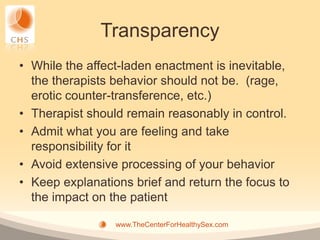
• While the affect-laden enactment is inevitable,
  the therapists behavior should not be. (rage,
  erotic counter-transference, etc.)
• Therapist should remain reasonably in control.
• Admit what you are feeling and take
  responsibility for it
• Avoid extensive processing of your behavior
• Keep explanations brief and return the focus to
  the impact on the patient

                 www.TheCenterForHealthySex.com
Transparency in action
• Don’t blame the patient, accept what you
  feel which will give your greater control
  over your behavior.
• Feelings should be related at the patient’s
  direction and behest so they are in control
  of the emotional action between them.
• The interpersonal has to be addressed
• Maroda, 1998
               www.TheCenterForHealthySex.com
Therapeutic Enactment

                • T.E. is a dynamic,
                  naturally occurring
                  manifestation of the
                  transference and
                  counter-transference
                  merging into a living
                  entity, making the
                  past alive in the
                  present.” Maroda,
                  1998
       www.thecenterforhealthysex.com
Therapeutic Enactment
• The goal should be that more of the
  patient’s past is re-created than the
  therapists, and that the patient have every
  opportunity to safely work through the
  events within the boundary of the
  therapeutic relationship.
• Therapists should expect enactments and
  be reasonably in control of how they
  behaves.      Maroda, 1998
               www.TheCenterForHealthySex.com
Coming 2010! HCI Publications


                   • Igniting Hot, Healthy,
                     Sex After Recovery
                     From Sex Addiction


    www.TheCenterForHealthySex.com
Center for Healthy Sex
    Los Angeles


      www.TheCenterForHealthySex.com

Alex Katehakis - Center for Healthy Sex - IITAP Supervision 2011

  • 1.
    “I love you,I hate you”: Transference and Counter-transference Issues in Supervision Presented by Alexandra Katehakis, MFT, CSAT-S, CST-S February 17, 2011 www.thecenterforhealthysex.com
  • 2.
    What is supervision? “Clinical supervision is a disciplined, tutorial process wherein principles are transformed into practical skills, with four overlapping foci: administrative, evaluative, clinical and supportive.” David J. Powell, 2004 www.thecenterforhealthysex.com
  • 3.
    Know your Candidate(s) “A productive Supervisor/Candidate working relationship is grounded in a clear understanding of the goals of supervision and clearly worked out supervision plan. Such a plan presupposes an accurate assessment of the Candidate’s knowledge and skills – the level of professional development the Candidate has attained.” “Clinical Supervision in Alcohol & Drug Abuse Counseling,” David J. Powell www.thecenterforhealthysex.com
  • 4.
    Know your Candidate(s) Knowyour ethics & get consultation! Make sure you are clear about the law and ethics binding you and that the candidate is adhering to the law and ethics of the board that governs their license in the state they are in. Seek your own consultation! www.thecenterforhealthysex.com
  • 5.
    Supervision involves… • Fourrealms of inquiry: • Affective/Emotional/bodily • Cognitive/Behavioral • Insight • Systemic www.TheCenterForHealthySex.com
  • 6.
    Supervision involves… • Foursystemic processes: • Patient • Self As Therapist • Treatment Process • Consultation Process www.TheCenterForHealthySex.com
  • 7.
    Sample Questions forConsultation Evaluation and Intervention Affective/Emotional Patient: How/Does this patient express emotions? If so, What is the patient feeling in their body? Where do they feel it? Self as Therapist: How do you feel as you talk about this patient? What are you noticing in your body? Treatment Process: How does the patient feel towards you? Consultation Process: How do my reactions effect you? www.TheCenterForHealthySex.com
  • 8.
    Sample Questions forConsultation Evaluation and Intervention Cognitive/Behavioral Patient: What does the patient say and what are they thinking? Self as Therapist: What interventions did you make with this patient? Treatment Process: What did the patient do to prompt your choices or reaction? Consultation Process: Can you describe what just happened between us? www.TheCenterForHealthySex.com
  • 9.
    Sample Questions forConsultation Evaluation and Intervention Insight: Patient: What themes are apparent that help you understand this patient? Self as Therapist: Does your reaction to this patient seem familiar to you? Are these bodily-based reactions? Treatment Process: What approach is best for this patient? Consultation Process: How is our relationship similar to others in your life? www.TheCenterForHealthySex.com
  • 10.
    Questions for SampleConsultation Evaluation and Intervention Systemic: Patient: What rules does this patient operate from? Self as Therapist: What rules are you operating from when working with this patient? Do these rules assist or limit you? Treatment Process: What rules guide the therapy relationship you have with this patient? Consultation Process: What rules guide the work we do here? Adapted from Piercy, F & Sprenkle, D. (1988). Family therapy theory-building questions. Journal of Marital & Family Therapy, 14, 307-309 www.TheCenterForHealthySex.com
  • 11.
  • 12.
    Counter-transference • Freud 1910 – perceived it as emanating from therapist’s unresolved unconscious issues and conflicts deeming it potentially harmful to the therapeutic process. (Vulcan, 2009) www.thecenterforhealthysex.com
  • 13.
    Counter-transference • Complex andmostly unconscious, making it difficult to measure and operationalize(Fauth, 2006) • CT is often thought of as thoughts, feelings, images, fantasies, and dreams. (Stone 2006) www.TheCenterForHealthySex.com
  • 14.
    The Moderate Approachto CT • Five domains can offer a framework for to review work with clients to “looking for evidence of counter- transference…supervisors and counselor educators may find the model similarly helpful in teaching trainees how to identify counter-transference and use the self as a therapeutic instrument. Hayes, et al (1998) www.TheCenterForHealthySex.com
  • 15.
    Moderate Approach forManaging CT Hayes, et al., 1998 • Origins: areas of unsolved conflict within the therapist • Triggers: are the tangible counseling experiences that touch upon or elicit therapists’ unresolved issues. • Manifestations: When CT origins are triggered, therapists experience cognitive, affective, and behavioral reactions. www.TheCenterForHealthySex.com
  • 16.
    The Moderate Approachfor Managing CT • CT effects are the subsequent results of CT manifestations on the therapy process and outcome. • CT Management refers to therapists’ strategies for coping with their CT • Rosenberger & Hayes, 2002 www.TheCenterForHealthySex.com
  • 17.
    Counter-transference Issues inSex Addiction Consultation Minimization:  Upon initial assessment, sex addicts often minimize their thoughts and behaviors.  Watch for supervisees believing and/or siding with the minimization and challenge this as you would the patient. This can have the supervisee missing crucial acting out behaviors leaving them with a weak treatment plan.  It can also have them doubting whether the patient is really a sex addict. www.TheCenterForHealthySex.com
  • 18.
    Counter-transference Issues inSex Addiction Consultation Disgust:  Disgust can arise when assessing pedophiles or any other paraphelia that is disturbing or uncomfortable for the therapist to talk about.  Supervisees can report feeling “creeped out,” uncomfortable or judgmental. It is recommended that these feelings be processed in detail so that an assessment can be made as to whether the therapist should continue to treat the patient.  If the therapist cannot work through their upset, they should be advised to take their deeper issues to their own personal therapy.  A sex addiction therapist should be ABLE to work with paraphelias, but has the right to CHOOSE not to. www.TheCenterForHealthySex.com
  • 19.
    Counter-transference Issues inSex Addiction Consultation Anger: “I don’t like him” and/or “I want to kill him!”  Passive/aggressive and narcissistic personalities are often difficult to like.  The supervisee has to be vigilant about their counter-transference.  Unchecked anger can lead to punitive interventions which can have the effect of shaming the patient. The therapist needs to talk openly about the triggers that block them from being empathic.  Supervisees should have a good understanding of narcissistic defenses and examine why they are recoiling or judging in the face of these defenses. www.TheCenterForHealthySex.com
  • 20.
    Counter-transference Issues inSex Addiction Consultation Argumentative/power struggle:  This is a no win situation. Trying to convince, cajole, demand, etc. recovery leads to power struggles. If a patient is terribly resistant, doesn’t comply with treatment recommendations, or is a “general pain,” the therapist should step back and reevaluate why the patient is in recovery.  The therapist also needs to look at whether their treatment agenda is ahead of the patient’s or if they have fallen out of therapeutic alliance with the patient. If the situation becomes intractable, both parties should seriously consider if treatment is right at this time. Should the therapist decide to end treatment, they should review their thoughts and reflections on the case with the supervisor first. www.TheCenterForHealthySex.com
  • 21.
    Counter-transference Issues inSex Addiction Consultation Patient admits to sexualizing the therapist:  It is not uncommon for sex addicts to sexualize their therapist. It usually comes out at some point in treatment either directly or indirectly. If it is not stated directly, but the supervisee has an inkling that it is occurring, they should talk about it with their consultant.  If it happens in early recovery, it is usually coming from an addictive/manipulative place in the addict. When the addict makes this known early on in treatment, it can be an inappropriate way to try and connect or a way to devalue the therapist due to discomfort or anxiety.  Therapists should be advised to “file” the information for processing when they feel the patient has made significant progress in their recovery. www.TheCenterForHealthySex.com
  • 22.
    Counter-transference Issues inSex Addiction Consultation Therapist is seduced by patient:  The patient can have the therapist feeling he is “such a nice guy,” “my favorite patient” or “really trying hard.” If this happens early on the treatment, it is imperative to remember that our patients have “dark sides.” They are expert at looking good, rationalizing, minimizing, and justifying their behaviors. If that same supervisee reports task work isn’t being completed, denial hasn’t been broken through (I.e. patient hasn’t owned up to the damage he has wrought), or the patient seems to be going through the motions, then they have to be confronted. This type of confrontation can bring up many issues for the therapist which may be why the seduction was happening to begin with. www.TheCenterForHealthySex.com
  • 23.
    Counter-transference Issues inSex Addiction Consultation Idealization as seduction:  If the therapist starts feeling or believing that “they’re the best therapist ever” they should be aware of idealization by the patient and talk about it.  This is especially true if the patient has had many therapists or has been through a lot of treatment centers.  If the supervisee feels special or like they are the only therapist who will be able to help this patient, they’re in a trap. Believing this will have the therapist losing traction in the treatment process and give the addict ground for running treatment.  When this happens, the patient starts to decide whether and how many meetings to attend, what homework they will and won’t do, etc. www.TheCenterForHealthySex.com
  • 24.
    Counter-transference Issues inSex Addiction Consultation Therapist is sexually attracted to patient:  If the therapist finds their patient attractive they can find themselves struggling to stay on task, and/or it can have them engaging in covert seduction with the patient. The therapist finds themselves feeling sleepy during sessions  If they are not aware that they find the patient attractive, but find themselves doing things they wouldn’t normally do, then this too has to be examined.  Being attracted to the patient can have the therapist not holding boundaries with homework assignments or having blind spots in their recovery.  Either of these are ultimately harmful to the therapy and both parties. It is essential to talk about these attractions and if necessary, should be taken to personal therapy. www.TheCenterForHealthySex.com
  • 25.
    Sexualization by Therapist •Sexualization may defend against feelings of love which may be more difficult for therapists to acknowledge. (Gabbard, 1994) • Oedipal desire is romantic and idealised, whereas post-Oedipal desire tolerates imperfections, and can experiece disappointment without the death of desire. (Gerrad, 2004) www.TheCenterForHealthySex.com
  • 26.
    Deepening intimacy… • Iscrucial for successful work and occurs as a result of the interpersonal space between therapist and patient • Termination requires a letting go of the patient and a kind of mourning so that the patient can go have his own healthy, adult sexual life. (Searles, 1959) www.TheCenterForHealthySex.com
  • 27.
    Erotic Counter-transference mostlikely to occur with patients who: • Have passive-obsessional and narcissistic character disorders • Suffer from borderline and chronically psychotic conditions • Those whose general character defenses and areas of specific conflict are similar to the therapist. The entangled transference- countertransference relationsip leads to the therapist withdrawing into sleepiness (Stone, 2006) www.TheCenterForHealthySex.com
  • 28.
  • 29.
    Counter-transference Issues inSex Addiction Consultation Intellectual seduction:  Since many of the addicts we see are extremely intelligent, accomplished professionals, therapists can be seduced into thinking that the person has really “gotten it” and that they are on track quickly. CEO’s, doctors, lawyers, and so forth are excellent at going to the top of the class.  Intellect is no measure of sexual sobriety. The supervisee should be reminded to look closely at the behavior and thinking of the patient first and foremost. Supervisees can be triggered into their own issues of feeling less than when in the presence of highly successful and/or powerful people. The supervisee should know their triggers around intelligence, success and money. www.TheCenterForHealthySex.com
  • 30.
    Counter-transference Issues inSex Addiction Consultation Humor as seduction:  We all know humor can be a defense against deeper, more painful feelings.  If a supervisee reports having a jolly good time with their patient and talks about what a “funny guy” he is, pay attention to how the humor is being used to keep the treatment off track. This kind of humor can be a relief to the therapist if they are feeling anxiety about the work. www.TheCenterForHealthySex.com
  • 31.
    Flirting… • Flirting neednot be seen as a purely seductive act. • If it occurs in the symbolic, meaning change has actually occurred, it can be a type of play and an acknowledgement of attraction under safe conditions. (Davies 1998, Gerrard, 2004) www.TheCenterForHealthySex.com
  • 32.
    Counter-transference Issues inSex Addiction Consultation Rescuing or caretaking to the patient:  Therapists by nature are care-givers, but if they are inclined to care-take and have these issues in their backgrounds, they can easily fall prey to this dynamic.  Rescuing/caretaking can occur when someone is mandated to treatment and the therapist wants to advocate for the patient, or while the patient is preparing for disclosure.  Although it is, in part, the therapist’s job to advocate, be on the lookout for personal involvement in the outcome like wanting to “soften the blow” for the patient.  If the supervisee seems heavily invested in rescuing the addict from his consequences, and doesn’t see the consequences as a part of the addict’s unmanageability, this can be problematic.  Facing consequences are an essential part of the recovery process and it is not the therapist’s job to thwart those, but to assist the recovering person in their grieving process. www.TheCenterForHealthySex.com
  • 33.
    Counter-transference Issues inSex Addiction Consultation Siding with the patient:  This is similar to the above but is more blatant and often occurs in relation to the patient’s spouse.  Addict’s can villanize their partners and play the victim. If the supervisor hears the supervisee siding with the addict by validating all the hard work he is doing in recovery and agreeing that his spouse must be “crazy,” “not working a program,” and “unfair,” then this is a red flag.  It is crucial that the therapist be aware of partner issues and the natural evolution of recovery for a couple.  Rather then taking sides with the addict, the therapist should confront the addict about his unmanageability and what his part has been in his partner’s upset. www.TheCenterForHealthySex.com
  • 34.
    Counter-transference Issues inSex Addiction Consultation Impatience:  Therapists can get frustrated when their patient’s don’t move as quickly in their recovery as they would like them to.  Remembering to slow down and pace appropriately is a clinical skill. Each person has different cognitive and emotional skills and many sex addicts have a low emotional IQ.  Knowing when to put pressure on the patient to take responsibility for task work and feel their feelings, while at the same time having empathy for them is required to effectively execute treatment. www.TheCenterForHealthySex.com
  • 35.
    Counter-transference Issues inSex Addiction Consultation Flight into health:  Be wary of the “model prisoner.” This is a more advanced version of looking good. This is what they call a “Big Book Thumper” in AA. If the patient has become religious about 12-step and their recovery, it becomes more challenging to confront their denial and point out how they are using the program to hide out.  Conversely, the patient can be very compliant leaving the therapist feeling like their patient is a “piece of cake” and that the treatment is “smooth sailing.”  Challenge the supervisee to see the fear and seduction in this and how it does not serve the patient to collude with how well they’re doing. Look for the inconsistencies and holes in the person’s recovery. Challenge the flight into health. www.TheCenterForHealthySex.com
  • 36.
    Somatic Counter-transference • SCT can be thought of as “the therapists awareness of their own body, of sensations, images, impulses, feelings, and fantasies that offer a link to the client’s process and the intersubjective field. (Orbach & Carroll 2006) www.thecenterforhealthysex.com
  • 37.
    Somatic Counter-transference • “thenon-verbal behavior of both patient and analyst is an aspect of the analytic situation that receives comparatively little attention either in supervision or in the teachings of technique…it is uncommon for supervisors to regularly inquire about, or for students to regularly report on, the nonverbal behavior of their patients.” (Jacobs, 1994) www.TheCenterForHealthySex.com
  • 38.
    Somatic Counter-transference • Bodily-based,embodied knowing, embodied cognition • SCT commonly includes sleepiness, erotic and sexual arousal, trembling (Field, 1998) as well as aches, pains, rumblings, coughing, nausea, and suffocation (Stone, 2006), tension, emptiness, and numbness. • Non-verbal, primary process www.TheCenterForHealthySex.com
  • 39.
    Somatic Counter-transference • Thetherapist has to be aware of their own bodily-based reactions or be “rooted in a continuous awareness of their own somatic reality in the first place.” (Soth, 2002) • The “therapist body experience [may provide] invaluable information relating to the intersubjective space between therapist and client.” (Shaw, 2004) www.TheCenterForHealthySex.com
  • 40.
    Therapeutic Enactment • Sometimesthe therapists past gets recreated in symmetry with the patient • It can also happen as a result of counter- transference dominance, disrupting the treatment, and potentially traumatizing the patient • Enactment is an “inevitable mutual event” • Mutual unplanned behavior, a sense of puzzlement, and a sense of being emotionally out of control by both parties. Maroda, 1998 www.TheCenterForHealthySex.com
  • 41.
    Therapeutic Enactment • Most definitions agree that there are two essential elements: the stimulation of strong, unconscious affect and some resulting behaviors. Maroda 1998 www.thecenterforhealthysex.com
  • 42.
    Therapeutic Enactment… • …differsfrom strong transference, counter-transference because it is “unconsciously motivated by the mutual stimulation of strong affect, with both persons usually stating that they felt out of control, or at least felt something come over them that was mysterious and powerful.” Maroda 1998 www.TheCenterForHealthySex.com
  • 43.
    Neuropsychoanalytic model ofpatient-therapist enactments • “Heightened affective moments in which overwhelming and thereby dissociated trauma is experienced by both members of the therapeutic dyad. • This highlights not only the resistances and defenses of the patient, but how these align with the resistances and defenses of the therapist.” Schore, 2011 www.TheCenterForHealthySex.com
  • 44.
    Therapeutic Enactment…  Patient’stransference will distort reality and imagine that the therapist feels toward her in the present what some other family member had felt toward her in the past.  They can also stimulate in the therapist the exact emotions they had experienced with someone else in the past  Constructive expressions of these emotions and the mutual working through of the subsequent emotions and behaviors are crucial. www.TheCenterForHealthySex.com
  • 45.
    Feelings not withinour control… • Murderous rage • Sexual attraction • Anger • Overwhelming grief and a desire to physically hold or touch the patient • Envy • Deadness and not caring www.TheCenterForHealthySex.com
  • 46.
    Therapeutic Enactment • TEcan take the form behaviorally as a heated argument, spontaneous hug, physical gesture, sadomasochistic exchange, shortening or lengthening of session, failure to collect fees, unexpected dissolution into tears, or a withdrawal into silence. Maroda 1998 • This is a a right amygdala to right amygdala, and right insula to right insula communication, and pairs with dissociation. • It is a survival strategy. • BOTH parties have to control and limit their behaviors so the therapy can progress. www.TheCenterForHealthySex.com
  • 47.
    Therapeutic Enactment • Thedrama of the enactment ultimately belongs to the patient. It is his/her chance to relive the past from an affective standpoint, with a new opportunity for awareness and integration. • When the patient stimulates something real and primitive in the therapist that is split off, then they can relieve the drama in a real way together. • Maroda, 1998 www.TheCenterForHealthySex.com
  • 48.
    Transparency • While theaffect-laden enactment is inevitable, the therapists behavior should not be. (rage, erotic counter-transference, etc.) • Therapist should remain reasonably in control. • Admit what you are feeling and take responsibility for it • Avoid extensive processing of your behavior • Keep explanations brief and return the focus to the impact on the patient www.TheCenterForHealthySex.com
  • 49.
    Transparency in action •Don’t blame the patient, accept what you feel which will give your greater control over your behavior. • Feelings should be related at the patient’s direction and behest so they are in control of the emotional action between them. • The interpersonal has to be addressed • Maroda, 1998 www.TheCenterForHealthySex.com
  • 50.
    Therapeutic Enactment • T.E. is a dynamic, naturally occurring manifestation of the transference and counter-transference merging into a living entity, making the past alive in the present.” Maroda, 1998 www.thecenterforhealthysex.com
  • 51.
    Therapeutic Enactment • Thegoal should be that more of the patient’s past is re-created than the therapists, and that the patient have every opportunity to safely work through the events within the boundary of the therapeutic relationship. • Therapists should expect enactments and be reasonably in control of how they behaves. Maroda, 1998 www.TheCenterForHealthySex.com
  • 52.
    Coming 2010! HCIPublications • Igniting Hot, Healthy, Sex After Recovery From Sex Addiction www.TheCenterForHealthySex.com
  • 53.
    Center for HealthySex Los Angeles www.TheCenterForHealthySex.com