Transference and
Countertransference
Say what??
A Bonjo Presentation
Origin & Example of the term
*TRANSFERENCE*
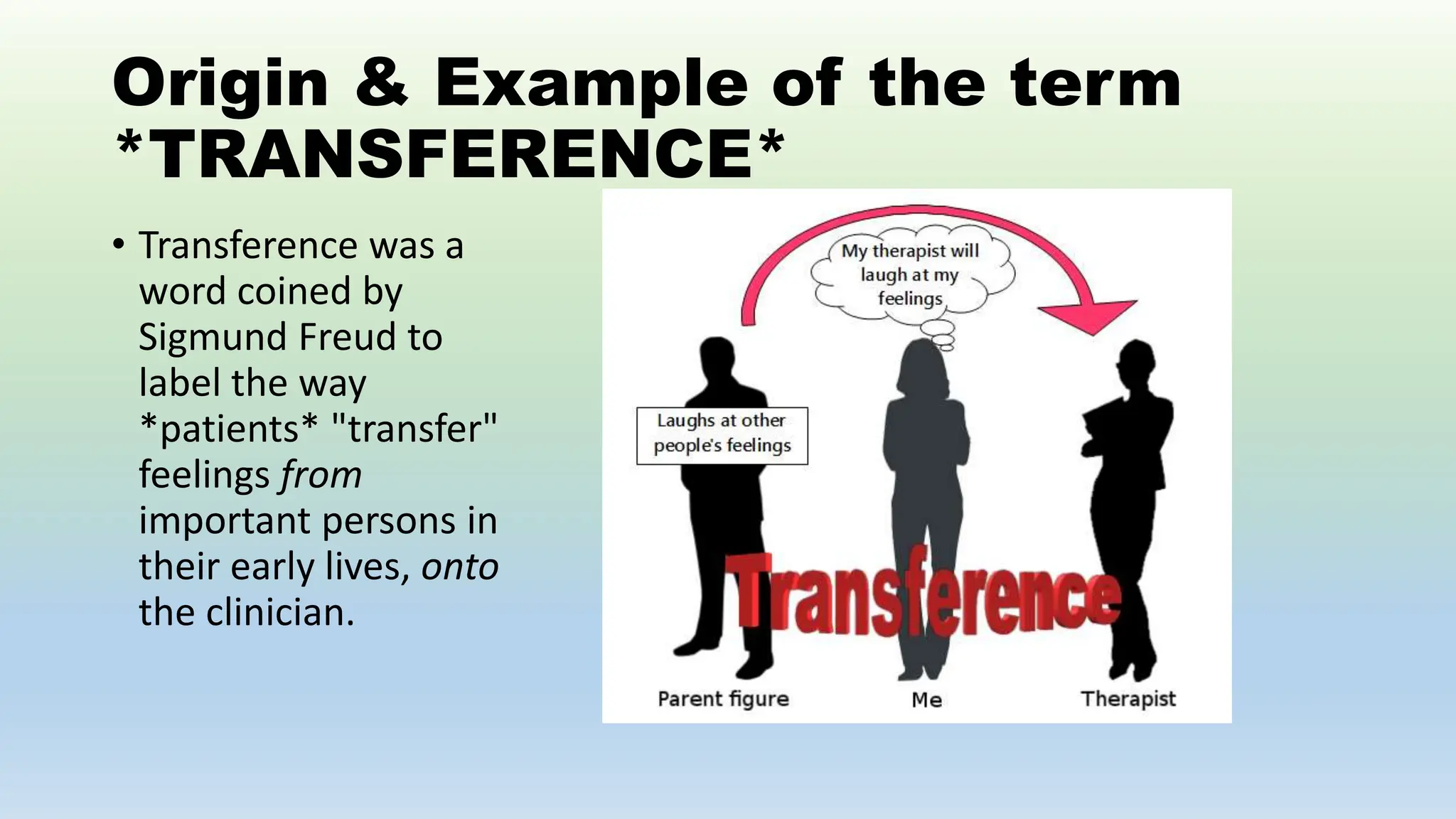
• Transference was a
word coined by
Sigmund Freud to
label the way
*patients* "transfer"
feelings from
important persons in
their early lives, onto
the clinician.
Transference examples:
• The client places unrealistic demands on
you.
• You must be available to me whenever I
want/need you!
• A client admires you and tells you how
much you remind them of their best
friend.
• I feel more comfortable when I talk to you
because you remind me of someone who
also made me feel comfortable.
• A client displaces anger onto you during
a session when talking about his abusive
parent.
• I feel like I keep telling you how things were
and you’re just not getting it! You think
everything is so easy for me! It’s not!
But What About………..
COUNTERTRANSFERENCE????
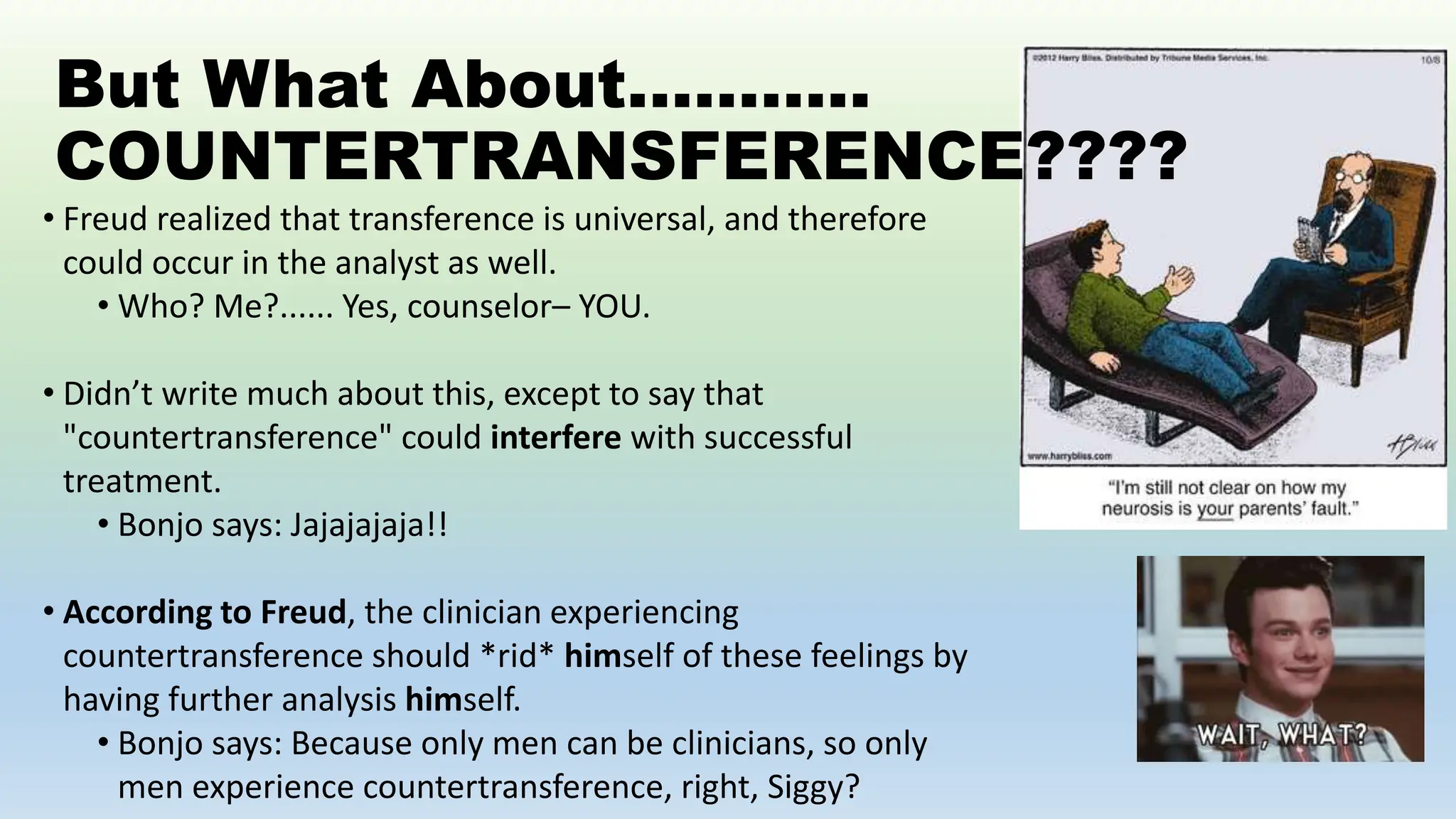
• Freud realized that transference is universal, and therefore
could occur in the analyst as well.
• Who? Me?...... Yes, counselor– YOU.
• Didn’t write much about this, except to say that
"countertransference" could interfere with successful
treatment.
• Bonjo says: Jajajajaja!!
• According to Freud, the clinician experiencing
countertransference should *rid* himself of these feelings by
having further analysis himself.
• Bonjo says: Because only men can be clinicians, so only
men experience countertransference, right, Siggy?
It’s a New Day
• Countertransference = a sensitive interpersonal
barometer, a finely tuned instrument in the field of
social interaction.
• Classic example: Clr feels irritated by Cx for what appears to be
no clear reason may eventually uncover subtle provocations by
Cx that also irritate and repel others, and thereby keep Cx
unwittingly lonely and isolated.
• Clr must consider multiple sources of his or her feelings.
• Some feelings, positive or negative, may be evoked by the Cx.
• Often, however….feelings may be stirred up by irrelevant
characteristics in Cx (e.g., the Cx physically resembles Clr’s
sibling or spouse), by the prior Cx, or by factors unrelated to
therapy (e.g., bad traffic getting to the office, a quarrel at home,
an upcoming vacation).
• Story about Bonjo’s little sister bringing home “a friend” = not
helpful countertransference
So countertransference isn’t
(!!!!!) inherently bad; we do
need to be aware of it so that
we don’t allow it to control the
session but instead use it as a
tool to inform the session.
Mental Checklist for When You Suspect
Countertransference is Operating
• Is this feeling characteristic, i.e., does the Clr have it much of
the time?
• If so, it may say a lot about the Clr, but probably less about Cx.
• Is the feeling triggered by something unrelated to the Cx?
• Feelings caused by hunger, one's personal life, bureaucracy at
the agency/school where you work, and so forth are not useful
data for helping the Cx.
• Is the feeling related to the Cx in an obvious way?
• Feeling put off by a Cx who is screaming obscenities and viciously
destroying the office is countertransference of a sort, but not
very illuminating.
• Is the feeling uncharacteristic of the Clr, a reaction specific
to this one particular Cx, and yet the exact trigger is not
immediately obvious?
• These are the most helpful times to notice countertransference,
as they often shed light on subtle yet important dynamics in the
Cx.
Countertransference is not always
helpful. But what do you mean, Bonjo?
• When it is unexamined — or, worse,
unrecognized — it can interfere with effective
treatment.
• Even happens with positive countertransference
• Example: when Clr is so entertained by a Cx's jokes that
the underlying bitterness is ignored, or when an
attractive Cx is never challenged because Clr desperately
yearns to be liked.
• More often, though, countertransference is
problematic when it is negative.
• Clr over-identifies with Cx’s issues/situation and wants
to implement the solutions that fit for Clr without truly
investigating what will work best for Cx.
Leading with
Countertransference examples:
• A clinician offers advice versus listening to the
client’s experience.
• A clinician inappropriately discloses personal
experiences during the session.
• A clinician doesn’t have boundaries with a client.
• In these cases, Bonjo (or another supervisor) will
invite you to consider whether you may be leading
with countertransference in the session
• This will be an opportunity for you to reflect
• IT IS NOT THE END OF THE WORLD
• We will not follow you around and wait until you die
so that we can carve on your gravestone “So-and-so
led with countertransference in a session on
November 11, 2022– there were witnesses to the
event!”
• Countertransference IS an opportunity for you to truly
connect with the Cx and their worldview
• Countertransference is not inherently etic

Transference and Countertransference.pptx

  • 1.
  • 2.
    Origin & Exampleof the term *TRANSFERENCE* • Transference was a word coined by Sigmund Freud to label the way *patients* "transfer" feelings from important persons in their early lives, onto the clinician.
  • 3.
    Transference examples: • Theclient places unrealistic demands on you. • You must be available to me whenever I want/need you! • A client admires you and tells you how much you remind them of their best friend. • I feel more comfortable when I talk to you because you remind me of someone who also made me feel comfortable. • A client displaces anger onto you during a session when talking about his abusive parent. • I feel like I keep telling you how things were and you’re just not getting it! You think everything is so easy for me! It’s not!
  • 4.
    But What About……….. COUNTERTRANSFERENCE???? •Freud realized that transference is universal, and therefore could occur in the analyst as well. • Who? Me?...... Yes, counselor– YOU. • Didn’t write much about this, except to say that "countertransference" could interfere with successful treatment. • Bonjo says: Jajajajaja!! • According to Freud, the clinician experiencing countertransference should *rid* himself of these feelings by having further analysis himself. • Bonjo says: Because only men can be clinicians, so only men experience countertransference, right, Siggy?
  • 5.
    It’s a NewDay • Countertransference = a sensitive interpersonal barometer, a finely tuned instrument in the field of social interaction. • Classic example: Clr feels irritated by Cx for what appears to be no clear reason may eventually uncover subtle provocations by Cx that also irritate and repel others, and thereby keep Cx unwittingly lonely and isolated. • Clr must consider multiple sources of his or her feelings. • Some feelings, positive or negative, may be evoked by the Cx. • Often, however….feelings may be stirred up by irrelevant characteristics in Cx (e.g., the Cx physically resembles Clr’s sibling or spouse), by the prior Cx, or by factors unrelated to therapy (e.g., bad traffic getting to the office, a quarrel at home, an upcoming vacation). • Story about Bonjo’s little sister bringing home “a friend” = not helpful countertransference So countertransference isn’t (!!!!!) inherently bad; we do need to be aware of it so that we don’t allow it to control the session but instead use it as a tool to inform the session.
  • 6.
    Mental Checklist forWhen You Suspect Countertransference is Operating • Is this feeling characteristic, i.e., does the Clr have it much of the time? • If so, it may say a lot about the Clr, but probably less about Cx. • Is the feeling triggered by something unrelated to the Cx? • Feelings caused by hunger, one's personal life, bureaucracy at the agency/school where you work, and so forth are not useful data for helping the Cx. • Is the feeling related to the Cx in an obvious way? • Feeling put off by a Cx who is screaming obscenities and viciously destroying the office is countertransference of a sort, but not very illuminating. • Is the feeling uncharacteristic of the Clr, a reaction specific to this one particular Cx, and yet the exact trigger is not immediately obvious? • These are the most helpful times to notice countertransference, as they often shed light on subtle yet important dynamics in the Cx.
  • 7.
    Countertransference is notalways helpful. But what do you mean, Bonjo? • When it is unexamined — or, worse, unrecognized — it can interfere with effective treatment. • Even happens with positive countertransference • Example: when Clr is so entertained by a Cx's jokes that the underlying bitterness is ignored, or when an attractive Cx is never challenged because Clr desperately yearns to be liked. • More often, though, countertransference is problematic when it is negative. • Clr over-identifies with Cx’s issues/situation and wants to implement the solutions that fit for Clr without truly investigating what will work best for Cx.
  • 8.
    Leading with Countertransference examples: •A clinician offers advice versus listening to the client’s experience. • A clinician inappropriately discloses personal experiences during the session. • A clinician doesn’t have boundaries with a client. • In these cases, Bonjo (or another supervisor) will invite you to consider whether you may be leading with countertransference in the session • This will be an opportunity for you to reflect • IT IS NOT THE END OF THE WORLD • We will not follow you around and wait until you die so that we can carve on your gravestone “So-and-so led with countertransference in a session on November 11, 2022– there were witnesses to the event!” • Countertransference IS an opportunity for you to truly connect with the Cx and their worldview • Countertransference is not inherently etic