Ser vs. Estar
Ser y Estar
Ser and Estar both mean “to be”
Uses of ser:
1. To express an inherent characteristic, a
description, or an identification:
◦ El café es bueno.- Coffee is good.
◦ María es reponsable.- Maria is responsible.
◦ La mujer es Elisa.- The woman is Elisa.
2. To express occupation or nationality
◦ Silvia es dentista.- Silvia is a dentist.
◦ Pedro es peruano.- Pedro is Peruvian.
 **Notice there are no articles after verb “ser” with
professions and nationalities.
 (unless adding a description)
 Silvia es dentista.
 Silvia es una dentista excelente.
Uses of ser:
3. To express times, dates, and
where/when an event takes place.
◦ ¿Qué hora es?- What time is it?
◦ Son las seis.- It’s 6:00.
◦ Hoy es jueves el ocho de agosto.- Today is
Thursday, 08 August.
◦ La fiesta es en casa de Miguel.- The party is at
Miguel’s house.
◦ El examen es el lunes.- The test is on Monday.
Uses of ser:
4. With de to express origin, possession or
material / what something is made of.
◦ Este café es de Colombia.- This coffee is from
Colombia.
◦ Es la mochila de Nick.- It’s Nick’s backpack.
◦ Esa corbata es de seda.- That tie is made of
silk.
Uses of ser:
5. With impersonal expressions:
◦ Es necesario comer bien.- It is necessary to
eat well.
◦ Es importante estudiar.- It’s important to
study.
Uses of ser:
1. To express location or position:
◦ Bogotá está en Colombia.- Bogota is in
Colombia.
◦ Luisa está cerca de la puerta.- Luisa is near
the door.
Uses of estar:
2. To indicate a state, condition, emotions,
feelings, or civil status (married,
divorced, alive, dead):
◦ Las ventantas están cerradas.- The windows
are closed.
◦ La bicicleta está rota.- The bike is broken.
◦ Estamos enamorados.- We’re in love.
◦ Yo estoy cansado.- I’m tired.
◦ Mis abuelos están muertos.- My
grandparents are dead.
Uses of estar:
3. To form the progressive tenses:
◦ Están hablando.- They are talking.
◦ Yo estaba comiendo.- I was eating.
Uses of estar:
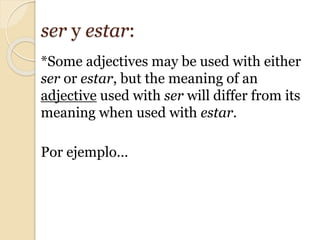
*Some adjectives may be used with either
ser or estar, but the meaning of an
adjective used with ser will differ from its
meaning when used with estar.
Por ejemplo…
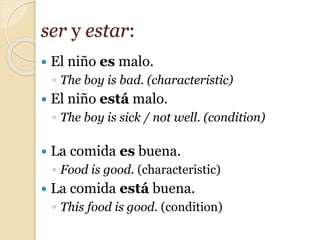
ser y estar:
 El niño es malo.
◦ The boy is bad. (characteristic)
 El niño está malo.
◦ The boy is sick / not well. (condition)
 La comida es buena.
◦ Food is good. (characteristic)
 La comida está buena.
◦ This food is good. (condition)
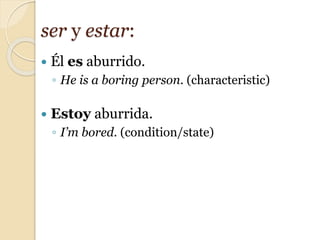
ser y estar:
 Él es aburrido.
◦ He is a boring person. (characteristic)
 Estoy aburrida.
◦ I’m bored. (condition/state)
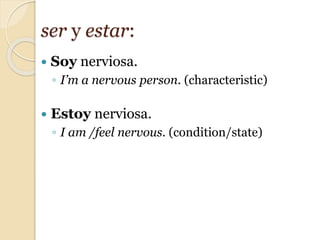
ser y estar:
 Soy nerviosa.
◦ I’m a nervous person. (characteristic)
 Estoy nerviosa.
◦ I am /feel nervous. (condition/state)
ser y estar:
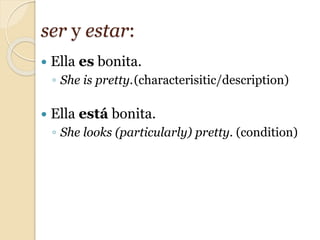
 Ella es bonita.
◦ She is pretty.(characterisitic/description)
 Ella está bonita.
◦ She looks (particularly) pretty. (condition)
ser y estar:

III- Repaso- Ser y estar- Apuntes

  • 1.
  • 2.
    Ser y Estar Serand Estar both mean “to be”
  • 3.
    Uses of ser: 1.To express an inherent characteristic, a description, or an identification: ◦ El café es bueno.- Coffee is good. ◦ María es reponsable.- Maria is responsible. ◦ La mujer es Elisa.- The woman is Elisa.
  • 4.
    2. To expressoccupation or nationality ◦ Silvia es dentista.- Silvia is a dentist. ◦ Pedro es peruano.- Pedro is Peruvian.  **Notice there are no articles after verb “ser” with professions and nationalities.  (unless adding a description)  Silvia es dentista.  Silvia es una dentista excelente. Uses of ser:
  • 5.
    3. To expresstimes, dates, and where/when an event takes place. ◦ ¿Qué hora es?- What time is it? ◦ Son las seis.- It’s 6:00. ◦ Hoy es jueves el ocho de agosto.- Today is Thursday, 08 August. ◦ La fiesta es en casa de Miguel.- The party is at Miguel’s house. ◦ El examen es el lunes.- The test is on Monday. Uses of ser:
  • 6.
    4. With deto express origin, possession or material / what something is made of. ◦ Este café es de Colombia.- This coffee is from Colombia. ◦ Es la mochila de Nick.- It’s Nick’s backpack. ◦ Esa corbata es de seda.- That tie is made of silk. Uses of ser:
  • 7.
    5. With impersonalexpressions: ◦ Es necesario comer bien.- It is necessary to eat well. ◦ Es importante estudiar.- It’s important to study. Uses of ser:
  • 8.
    1. To expresslocation or position: ◦ Bogotá está en Colombia.- Bogota is in Colombia. ◦ Luisa está cerca de la puerta.- Luisa is near the door. Uses of estar:
  • 9.
    2. To indicatea state, condition, emotions, feelings, or civil status (married, divorced, alive, dead): ◦ Las ventantas están cerradas.- The windows are closed. ◦ La bicicleta está rota.- The bike is broken. ◦ Estamos enamorados.- We’re in love. ◦ Yo estoy cansado.- I’m tired. ◦ Mis abuelos están muertos.- My grandparents are dead. Uses of estar:
  • 10.
    3. To formthe progressive tenses: ◦ Están hablando.- They are talking. ◦ Yo estaba comiendo.- I was eating. Uses of estar:
  • 11.
    *Some adjectives maybe used with either ser or estar, but the meaning of an adjective used with ser will differ from its meaning when used with estar. Por ejemplo… ser y estar:
  • 12.
     El niñoes malo. ◦ The boy is bad. (characteristic)  El niño está malo. ◦ The boy is sick / not well. (condition)  La comida es buena. ◦ Food is good. (characteristic)  La comida está buena. ◦ This food is good. (condition) ser y estar:
  • 13.
     Él esaburrido. ◦ He is a boring person. (characteristic)  Estoy aburrida. ◦ I’m bored. (condition/state) ser y estar:
  • 14.
     Soy nerviosa. ◦I’m a nervous person. (characteristic)  Estoy nerviosa. ◦ I am /feel nervous. (condition/state) ser y estar:
  • 15.
     Ella esbonita. ◦ She is pretty.(characterisitic/description)  Ella está bonita. ◦ She looks (particularly) pretty. (condition) ser y estar: